EAST RUTHERFORD, N.J. — The list of men who have won a World Cup final is less than 500 names long, making it among the most exclusive in sports.
Jurgen Klinsmann’s name is on that list. And if he had known what a special club he would join when he stepped on the pitch for the 1990 final, he might have taken more time to enjoy it.
“How big that actually was, you only realize when when you start traveling the world and you get basically approached everywhere in the world about those moments,” Klinsmann said Friday. “It’s pretty crazy.”
Several new names will be added to that list Sunday, when Spain and Argentina meet at MetLife Stadium to decide the winner of the largest, most complex World Cup in history. A record 48 teams started the tournament 39 days and 103 games ago. Now just two remain: Spain, the reigning European champion, a team that hasn’t lost in 37 games and 27 months, and top-ranked Argentina, the reigning World Cup champion seeking to become the first team to repeat in 64 years.
Argentina leads the tournament in goals with 19, 12 of them coming in the 75th minute or later. In all four of Argentina’s wins in the knockout stages, the go-ahead goal came in stoppage time or extra time. Its captain, Lionel Messi, finished the semifinals leading the tournament with contributions on 12 goals — eight goals and four assists. He‘s also the all-time World Cup leader in goals, assists and games played and seems a shoo-in for a third Golden Ball, which goes to the tournament’s best player. No one else has won that award more than once.
But if Argentina is the unstoppable force, Spain is the immovable object. It has given up just one goal in the tournament with its goalie, Unai Simón, pitching shutouts in seven of his last eight World Cup games, dating to 2022. Slowing Messi won’t be up to Simón alone, however. Midfielder Rodri, Spain’s captain and the 2024 Ballon d’Or winner as the best player in the world, is the team’s defensive anchor. He said the best way to try to control Messi is to keep him out of the box — although Messi’s two decisive assists in Argentina’s semifinal comeback against England came from outside the penalty area.
And while Klinsmann’s one-and-done experience in a World Cup final is typical of most players, Messi, 39, is the exception: When the whistle blows Sunday, he’ll become just the second player, after Brazil’s Cafu, to play in three World Cup finals. When he made his World Cup debut in 2006, two starters on Spain’s team — center back Pau Cubarsí and winger Lamine Yamal — had yet to be born.
East Rutherford was hit with heavy thunderstorms Saturday, which helped knock down the hazardous smoke from Canadian wildfires that had blanketed the tri-state area for days. The poor air quality, which is dangerous for both players and fans, led FIFA and the White House to hold informal discussions over moving the World Cup final.
So while the air won’t be clear Sunday, the greatest risk appears to have passed and the threat of rain or lightning interrupting the game has also decreased, with the forecast calling for temperatures in the mid- 80s and 55% humidity at kickoff.
President Trump is expected to attend the game, after which he will present the World Cup trophy to the victor. And Klinsmann’s advice to the players who will walk across that stage to get their winners’ medals is to savor every moment because they might not come again.

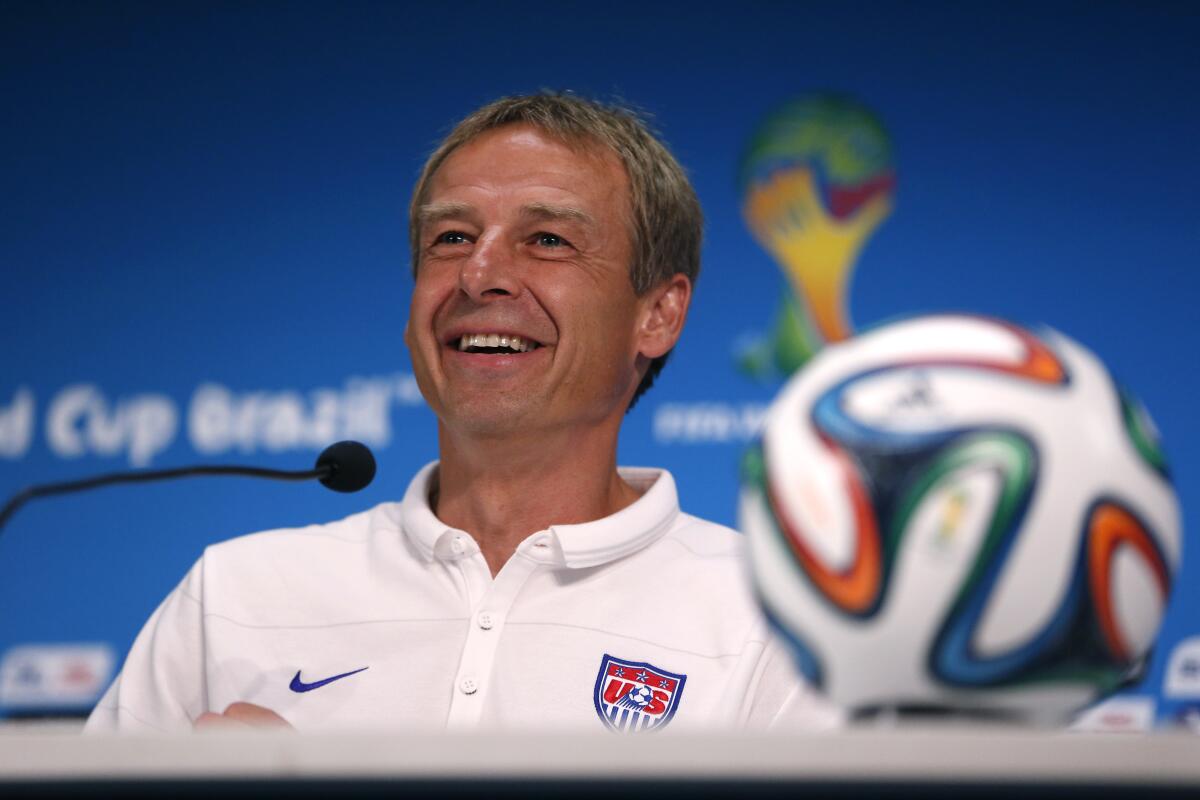
Jurgen Klinsmann, a World Cup champion with West Germany and the former U.S. men’s national team coach, understands players often forget to savor the moment of playing in soccer’s biggest game.
(Julio Cortez / Associated Press)
“Take it all in to and really enjoy every second of it,” he said. “Make it special. Don’t miss out on anything.”
Klinsmann was 25 and less than three years into his international career when he helped West Germany win the World Cup in 1990. So naturally he figured there would be more to come.
“I said, ‘Well, if this is so cool to win a title, then I want to win more titles,” he said. “The magnitude of it, I did not understand.”
In two more tournaments as a player, he never got past the quarterfinals and in two World Cups as a manager he made the semifinals once. Never again would he hold the most cherished trophy in sports, though his 11 World Cup goals are tied for ninth all-time, tied with Cristiano Ronaldo and one behind Pelé.
Mario Gotze scored only two goals in his World Cup career but the last one will never be forgotten. In the 88th minute of the 2014 final against Argentina, just before sending Gotze on as a sub, German manager Joachim Löw called Gotze over and said, “Show the world you are better than Messi and can decide the World Cup.”
With seven minutes left in extra time he did just that, chesting down a cross, then lobbing a volley into the net for the game’s only score, giving Germany its first title since Klinsmann’s team in 1990. It was a moment Gotze, then 22, had long dreamed of and one he had rehearsed as a kid.

Spain goalkeeper Unai Simon, shaking hands with France’s Kylian Mbappe after the World Cup semifinal, has given up only one goal in the tournament.
(Julio Cortez / Associated Press)
Yet it was also one he was not prepared for.
“That was a dream come true. But you can’t prepare for these kind of moments,” he said. “I get reminded about that goal and even speaking nowadays with people in Germany, and they say, ‘I still remember where I [was] in that moment.’ That’s very special. You have that connection to a lot of different people. I’m very happy about that.
“When I look back now, OK, I was there. I played 30 minutes of football in a World Cup final and I scored one goal. That impact is huge and to even be in that moment is rare.”
So rare Gotze never held the World Cup trophy again either. As a result he, like Klinsmann, would urge the players in Sunday’s game to drink in the memories, because win or lose, if your name isn’t Messi the odds are great you’ll never be back.
“You can’t describe the feelings because everything happens so fast,” he said. “You’re in the zone, you do a lot of things out of instinct, especially on the pitch. And then, at least with me, I had that relief after the final whistle.
“You get to understand over the years how special that moment was. Because in the end you only can play every four years. And then to be in the final and score a goal? That, of course, was very special.”