MONTEVIDEO, Uruguay — Jorge Messi, the father of soccer star and Argentina captain Lionel Messi, died Saturday at a hospital in the central Argentina city of Rosario. He was 68.
The Rosario-based Club Atlético Newell’s Old Boys announced his death in a social media post that said he had undergone treatment in recent months for an unspecified illness. The post described him as “the pillar and the person who, with vision, rigor and affection, supported the career of the best player of all time, alongside his wife, Celia Cuccittini.”
The South American Football Confederation, CONMEBOL, in a statement also offered its condolences “with respect and affection for Lionel.”
Lionel Messi led Argentina to a runner-up finish in this year’s World Cup. In the team’s first match, against Algeria, he was visibly emotional after scoring the first of his three goals. He said later that he wept for “a reason unrelated to sports.”
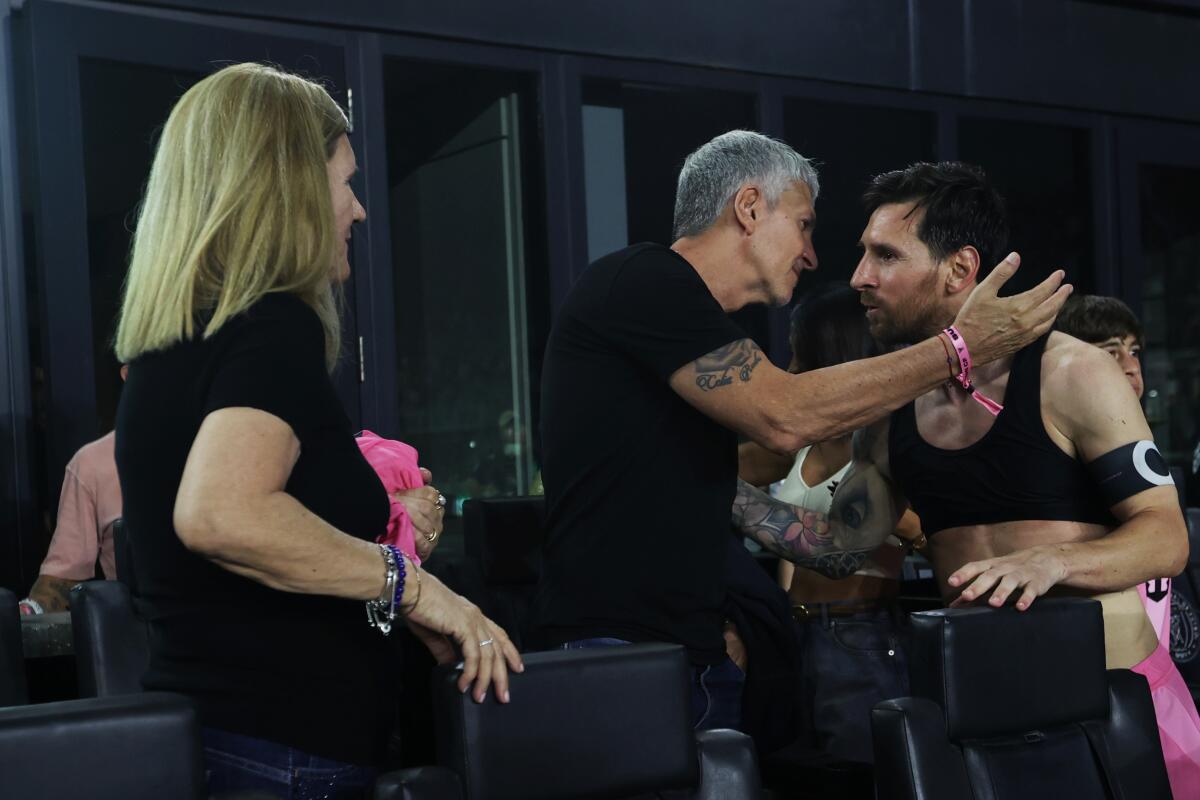
Inter Miami star Lionel Messi hugs his father, Jorge Messi, while his mother, Celia Cuccittini, looks on after a playoff match against Nashville SC in November 2025.
(Leonardo Fernandez / Getty Images)
“I went through some difficult, complicated days,” he said. “I am grateful to the delegation, to all my teammates, because they were always by my side wishing me strength so that I would be OK.”
Media reports at the time outraged the Messi family, which days later released a statement confirming that “Jorge is experiencing a health issue,” without specifying the nature of his condition.
“A person’s health and the peace of mind of their loved ones should not be the subject of speculation or irresponsible media interest,” according to the statement, which also expressed “discomfort at the lack of sensitivity, respect and scruples with which some people have treated a strictly private and family matter.”
Jorge Messi was a chemical technician and worked as a steelworker. He played soccer as a midfielder and reached the youth ranks of Newell’s Old Boys but had to abandon the sport to complete his mandatory military service in Argentina.
Argentina’s Lionel Messi sits on the pitch after losing to Spain in the World Cup final in East Rutherford, N.J., on July 19.
(Ashley Landis / Associated Press)
He played a fundamental role in his third son’s career, serving as his agent and managing his business affairs. He was the one who traveled with a young Messi to Barcelona in the early 2000s for the trial that would open the doors to La Masia, the Catalan club’s youth academy. Lionel Messi made his professional debut in 2005 and went on to win eight Ballon d’Or awards. He led Argentina to the 2022 World Cup title.
“My dad was always by my side,” Lionel Messi said in a 2007 interview with Radio del Plata. “Sometimes I would lock myself in my room to cry when we arrived in Barcelona, or my dad would do the same without me seeing him, or thinking I didn’t see him. We pretended we were both OK, but we weren’t. My dad even asked me what I wanted to do when we were feeling down, if I wanted to stay or go back, and I wanted to stay, and he stayed with me.”
His father negotiated the contracts with Barça and later his transfers to Paris Saint-Germain and Inter Miami, while also managing the use of his famous son’s image rights and his numerous investments in real estate, hotels, and restaurants.
In 2016, father and son were convicted in the Spanish courts on tax evasion charges, but avoided prison because the sentence was less than two years.
EAST RUTHERFORD, N.J. — The list of men who have won a World Cup final is less than 500 names long, making it among the most exclusive in sports.
Jurgen Klinsmann’s name is on that list. And if he had known what a special club he would join when he stepped on the pitch for the 1990 final, he might have taken more time to enjoy it.
“How big that actually was, you only realize when when you start traveling the world and you get basically approached everywhere in the world about those moments,” Klinsmann said Friday. “It’s pretty crazy.”
Several new names will be added to that list Sunday, when Spain and Argentina meet at MetLife Stadium to decide the winner of the largest, most complex World Cup in history. A record 48 teams started the tournament 39 days and 103 games ago. Now just two remain: Spain, the reigning European champion, a team that hasn’t lost in 37 games and 27 months, and top-ranked Argentina, the reigning World Cup champion seeking to become the first team to repeat in 64 years.
Argentina leads the tournament in goals with 19, 12 of them coming in the 75th minute or later. In all four of Argentina’s wins in the knockout stages, the go-ahead goal came in stoppage time or extra time. Its captain, Lionel Messi, finished the semifinals leading the tournament with contributions on 12 goals — eight goals and four assists. He‘s also the all-time World Cup leader in goals, assists and games played and seems a shoo-in for a third Golden Ball, which goes to the tournament’s best player. No one else has won that award more than once.
But if Argentina is the unstoppable force, Spain is the immovable object. It has given up just one goal in the tournament with its goalie, Unai Simón, pitching shutouts in seven of his last eight World Cup games, dating to 2022. Slowing Messi won’t be up to Simón alone, however. Midfielder Rodri, Spain’s captain and the 2024 Ballon d’Or winner as the best player in the world, is the team’s defensive anchor. He said the best way to try to control Messi is to keep him out of the box — although Messi’s two decisive assists in Argentina’s semifinal comeback against England came from outside the penalty area.
And while Klinsmann’s one-and-done experience in a World Cup final is typical of most players, Messi, 39, is the exception: When the whistle blows Sunday, he’ll become just the second player, after Brazil’s Cafu, to play in three World Cup finals. When he made his World Cup debut in 2006, two starters on Spain’s team — center back Pau Cubarsí and winger Lamine Yamal — had yet to be born.
East Rutherford was hit with heavy thunderstorms Saturday, which helped knock down the hazardous smoke from Canadian wildfires that had blanketed the tri-state area for days. The poor air quality, which is dangerous for both players and fans, led FIFA and the White House to hold informal discussions over moving the World Cup final.
So while the air won’t be clear Sunday, the greatest risk appears to have passed and the threat of rain or lightning interrupting the game has also decreased, with the forecast calling for temperatures in the mid- 80s and 55% humidity at kickoff.
President Trump is expected to attend the game, after which he will present the World Cup trophy to the victor. And Klinsmann’s advice to the players who will walk across that stage to get their winners’ medals is to savor every moment because they might not come again.
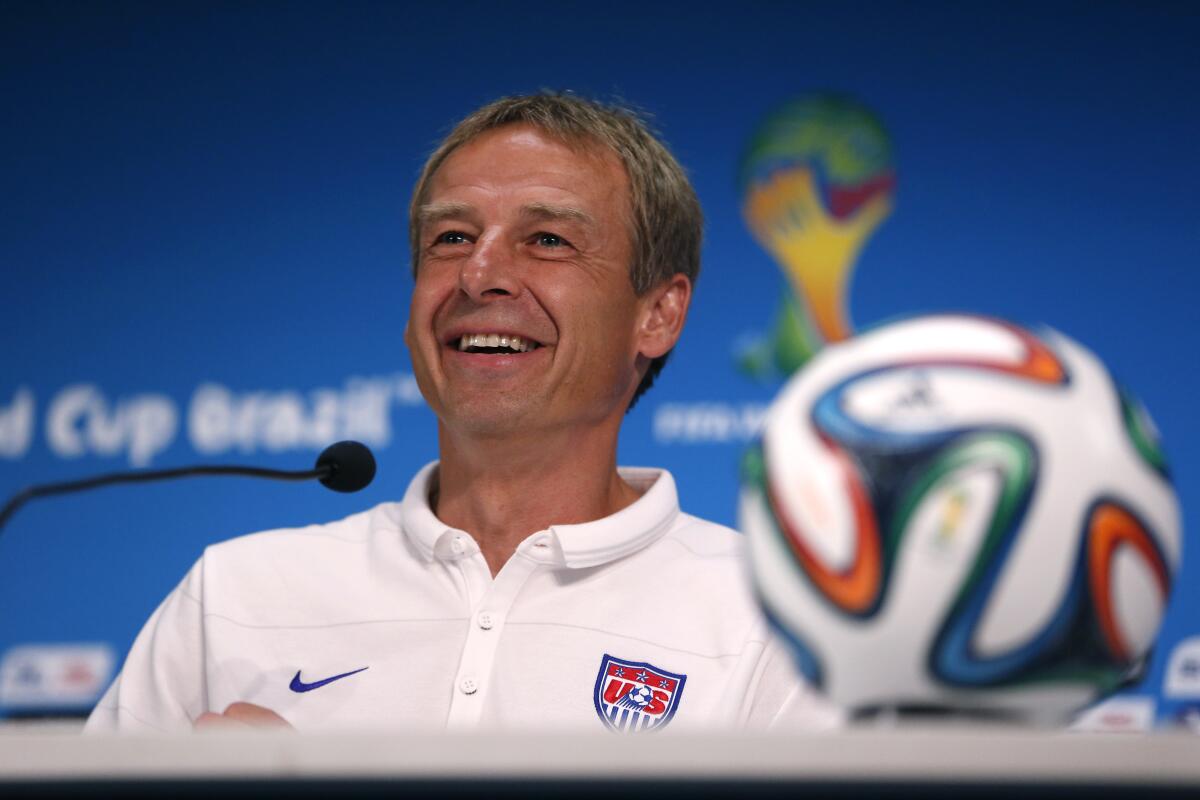
Jurgen Klinsmann, a World Cup champion with West Germany and the former U.S. men’s national team coach, understands players often forget to savor the moment of playing in soccer’s biggest game.
(Julio Cortez / Associated Press)
“Take it all in to and really enjoy every second of it,” he said. “Make it special. Don’t miss out on anything.”
Klinsmann was 25 and less than three years into his international career when he helped West Germany win the World Cup in 1990. So naturally he figured there would be more to come.
“I said, ‘Well, if this is so cool to win a title, then I want to win more titles,” he said. “The magnitude of it, I did not understand.”
In two more tournaments as a player, he never got past the quarterfinals and in two World Cups as a manager he made the semifinals once. Never again would he hold the most cherished trophy in sports, though his 11 World Cup goals are tied for ninth all-time, tied with Cristiano Ronaldo and one behind Pelé.
Mario Gotze scored only two goals in his World Cup career but the last one will never be forgotten. In the 88th minute of the 2014 final against Argentina, just before sending Gotze on as a sub, German manager Joachim Löw called Gotze over and said, “Show the world you are better than Messi and can decide the World Cup.”
With seven minutes left in extra time he did just that, chesting down a cross, then lobbing a volley into the net for the game’s only score, giving Germany its first title since Klinsmann’s team in 1990. It was a moment Gotze, then 22, had long dreamed of and one he had rehearsed as a kid.
Spain goalkeeper Unai Simon, shaking hands with France’s Kylian Mbappe after the World Cup semifinal, has given up only one goal in the tournament.
(Julio Cortez / Associated Press)
Yet it was also one he was not prepared for.
“That was a dream come true. But you can’t prepare for these kind of moments,” he said. “I get reminded about that goal and even speaking nowadays with people in Germany, and they say, ‘I still remember where I [was] in that moment.’ That’s very special. You have that connection to a lot of different people. I’m very happy about that.
“When I look back now, OK, I was there. I played 30 minutes of football in a World Cup final and I scored one goal. That impact is huge and to even be in that moment is rare.”
So rare Gotze never held the World Cup trophy again either. As a result he, like Klinsmann, would urge the players in Sunday’s game to drink in the memories, because win or lose, if your name isn’t Messi the odds are great you’ll never be back.
“You can’t describe the feelings because everything happens so fast,” he said. “You’re in the zone, you do a lot of things out of instinct, especially on the pitch. And then, at least with me, I had that relief after the final whistle.
“You get to understand over the years how special that moment was. Because in the end you only can play every four years. And then to be in the final and score a goal? That, of course, was very special.”
EAST RUTHERFORD, N.J. — The spotlight on Sunday’s World Cup final will shine brightest on two men, one playing the last game of his sixth tournament and the other the final game of his first.
Argentina’s Lionel Messi, 39, is arguably the greatest player in World Cup history, having played more games, scored more goals and collected more assists than anyone who has gone before him. If Argentina wins Sunday, he’ll match another record as captain of the first team to win back-to-back titles in 64 years.
Spain’s Lamine Yamal, who turned 19 on Monday, may be the heir to all that. He’s already scored 56 goals and won seven major trophies for club and country; Messi had 11 goals and four trophies at the same age.
But these are more than just two ships passing in the night. If fact, this isn’t even their first meeting, although neither remembers the day they were introduced in 2007.
Messi was a shaggy-haired 20-year-old, just beginning his unparalleled career with Barcelona while Yamal was a cherubic 3-month-old, just beginning his life. They came together after Yamal’s mother, Sheila, won a raffle run by a local newspaper and Barcelona’s shirt sponsor, the children’s charity UNICEF. She was told the child would pose with an unnamed first-team player for a photo that would appear in a fundraising calendar.
When she carried her son into the dressing room at Barcelona’s stadium for the photo shoot, Messi appeared, having been chosen by chance. The pictures of a clearly uncomfortable Messi helping Sheila bathe her son in a blue plastic tub were published, then forgotten, until Yamal helped Spain win the 2024 European Championship. After the tournament Yamal’s father, Mounir Nasraoui, posted the picture online with the caption “The beginning of two legends.”
Lionel Messi, then 20, helps bathe Lamine Yamal, who was 3 months old, with help from Yamal’s mother, Sheila Ebana, during a photo shoot in September 2007 in Barcelona.
(Joan Monfort/Associated Press)
“It’s unbelievable,” Yamal’s teammate Mikel Merino said Friday. “The first time I saw it, I thought it was AI. It’s funny how life works sometimes. You have these situations you think is scripted by someone. But it’s just how life works, the coincidences of life.”
That they’ll meet again Sunday afternoon at MetLife Stadium seems more like destiny than coincidence, but who wins the reunion may be decided, in part, by factors other than the play on the field. Smoke from nearly 900 wildfires burning in Canada have blanketed a large swath of the U.S., from Chicago to New York, resulting in poor air quality that forced the postponement of one MLS game Thursday.
The sky above the open-air stadium in East Rutherford, N.J., was noticeably clearer Friday and could improve even more with the heavy rains forecast for Saturday. If those rains linger, however, that could also affect what is shaping up to be a battle of the ages.
Messi has carried Argentina into its third World Cup final since 2014, matching France’s Kylian Mbappé with a tournament-best eight goals and leading all players with 12 goal contributions. Four of his scores either tied the game or put Argentina in front and in Wednesday’s frantic comeback win over England, Messi assisted on the tying and winning goals seven minutes apart.
He seems guaranteed to win his third Golden Ball, which goes to the tournament’s outstanding player. He’s already the only player to win the award twice.
Yamal now plays at Barcelona, Messi’s home for 17 years, and he’s proven to be the same kind of game-changing left-footed playmaker, leading the team in goals (24) and assists (17) in all competition and winning La Liga’s player of the year award this season. Last year, at 18, he finished second in the voting for the Ballon d’Or, an award Messi won eight times.
He’s been quieter in the World Cup, with just a goal in seven games, but Spain has never lost a match he’s played in, going 21-0-6.
Yamal’s father was born in Morocco and his mother in Equatorial Guinea before moving to Catalonia with their families as children. Yamal grew up in a working-class, largely immigrant neighborhood the Spanish newspaper El País described as “forgotten, isolated and stigmatized.” His parents separated when he was 3 and while both remained present in his life, it was his paternal grandmother, Fatima, who sacrificed to support the boy, managing his daily routine to make sure he attended training sessions.
That devotion paid off when Yamal, then just 7, was invited to live and train at Barcelona’s famed La Masia academy, the same academy the Argentina-born Messi had entered at 13. When Yamal signed his first long-term contract with the team 14 months ago — a contract that could pay him more than $45 million a year in wages, bonuses and sponsorships, making him the team’s best-paid player, as Messi once was — he was given the No. 10 shirt Messi wore.
“In every match he shows that he is the best player in history,” Yamal told a Spanish newspaper. “If someone has doubts, it is because they are looking for them. There is nothing more to say there. For me, he is the best.”
Spain forward Lamine Yamal controls the ball during a World Cup quarterfinal against Belgium at SoFi Stadium on July 10.
(Ronaldo Bolanos/Los Angeles Times)
The comparisons and the praise flatter him, said Messi, who then used the same words to describe Yamal as the best.
“There is a new generation of footballers who are very good and who have many years ahead of them. But if I have to choose one because of age, for what he has done so far and for the future he may have, it is Lamine,” he told the Spanish sports journal Diario Sport in May.”There’s no doubt, for me, he’s the best.”
For all the similarities, there are differences. Yamal plays with much more speed and street-football flair and is far more prolific than Messi was at the same age. And while a young Messi focused almost entirely on soccer, Yamal has learned to speak three languages fluently and, unlike Messi, hasn’t kept his politics hidden, waving a Palestinian flag during the club’s parade through Barcelona celebrating its La Liga title last May.
And remember that charity calendar photo with Messi? The one that raised money for UNICEF? Last month Yamal became a goodwill ambassador for the group, focusing on the right to play and supporting children living through humanitarian emergencies.
Turns out some pictures are worth more than a thousand words.
The final weekend of the 2026 FIFA World Cup is here, with France and England playing for third place on Saturday before defending champion Argentina takes on 2010 winner Spain for the title on Sunday.
Here’s everything you need to know about the last two matches of the 39-day, 48-team tournament in North America (all times Pacific).
Saturday’s third-place game
France vs. England
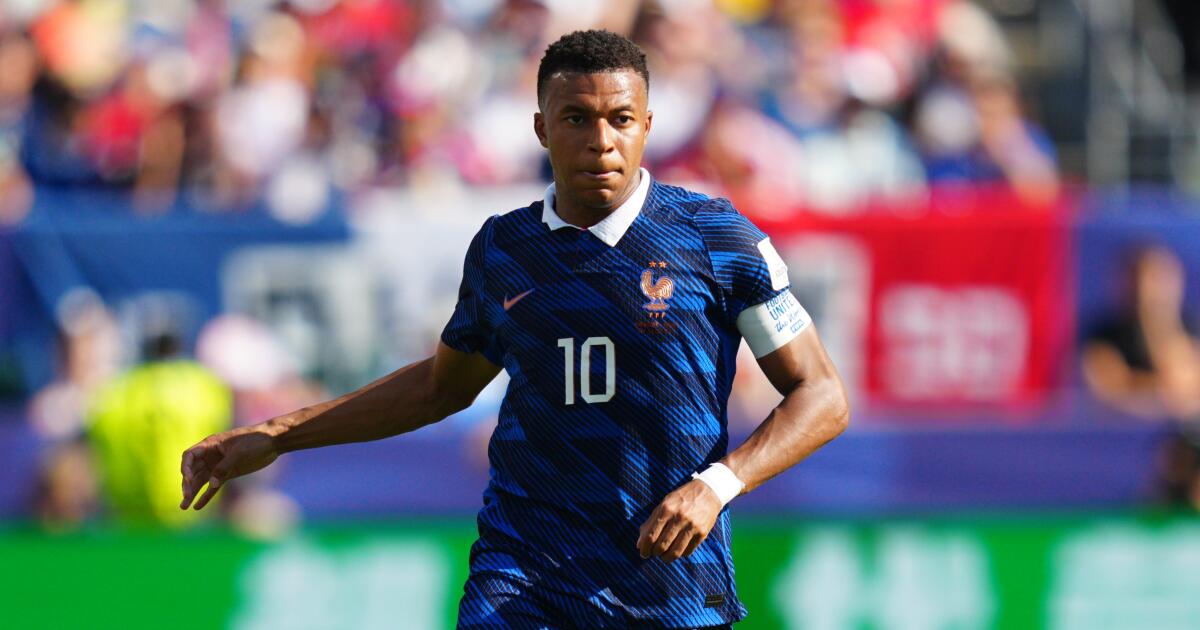
France star Kylian Mbappé smiles during a World Cup semifinal match against Spain on Tuesday.
(David Ramos / Getty Images)
Where: Hard Rock Stadium, Miami Gardens, Fla. Time: 2 p.m. TV: Fox, Telemundo | Streaming:Fox One, Peacock
The buzz: This is a game neither team really wants to play. The disappointment of missing the final is fresh and the weather report calls for temperatures in the high 80s with 68% humidity and a chance of thundershowers — a brutal South Florida summer day. The $2-million difference in prize money between third and fourth place isn’t likely to make any of that more palatable. Still, the game will have meaning for France since it will be the final match for coach Didier Deschamps, the winningest World Cup manager in history. And captain Kylian Mbappé, tied with Argentina’s Lionel Messi for most goals in the tournament (8), has a chance to become the first player to win consecutive Golden Boots. England is playing in the consolation final for the second time in three World Cups; it lost to Belgium 2-1 in 2018. But this one will probably sting even more since the Three Lions were five minutes away from their first final in six decades before collapsing against Argentina. This could be the last World Cup game for England’s Golden Generation of Harry Kane, Jordan Pickford, John Stones and Jordan Henderson.
Sunday’s championship game
Spain vs. Argentina
Argentina star Lionel Messi celebrates after a win over England in the World Cup semifinals on Wednesday.
The buzz: Argentina has a chance to become the first repeat World Cup champion since Brazil in 1962, which would give Messi another grand achievement in his sixth and likely final World Cup. Messi enters the weekend as the all-time leader in goals, assists and games played in tournament history. But unbeaten Argentina hasn’t made things easy, with its winning goals in the four knockout-round games coming in the 92nd minute or later. Spain, the reigning European champion, will be playing to put a second star on its jersey to match the one it won in 2010. La Roja, with the sixth-youngest roster in the World Cup, got to the final on the strength of spectacular defense led by Unai Simón, who has six clean sheets in seven games. Mikel Oyarzabal is the team’s leading scorer with five World Cup goals. The teams had one common opponent in this tournament, tiny Cape Verde, a World Cup debutante. It played Spain to a scoreless draw in its opener, then held Argentina to a 1-1 standoff into extra time before falling.
ATLANTA — The jury is still out on whether Lionel Messi is the greatest soccer player ever. But there should be no doubt he’s the greatest to ever play in a World Cup.
And you don’t need the records, the wins or the goals to prove that — although he certainly has enough of those. You just need to see Messi at his most magical, as he was Wednesday, setting up a pair of game-changing goals in a seven-minute span to lift Argentina to a 2-1 win over England and into Sunday’s World Cup final with Spain.
“It’s really hard to speak right now, but I’m going to try not to cry,” Lautaro Martínez, who scored the winning goal two minutes into stoppage time, said in Spanish. “I’m already overwhelmed inside. It’s incredible. Everything we’ve achieved is just incredible.”
Like their 13-game World Cup unbeaten streak, dating to the opening game of the 2022 tournament in Qatar. Or back-to-back trips to the final, which gives them a chance to become the first repeat champion in the men’s tournament since Brazil in 1962.
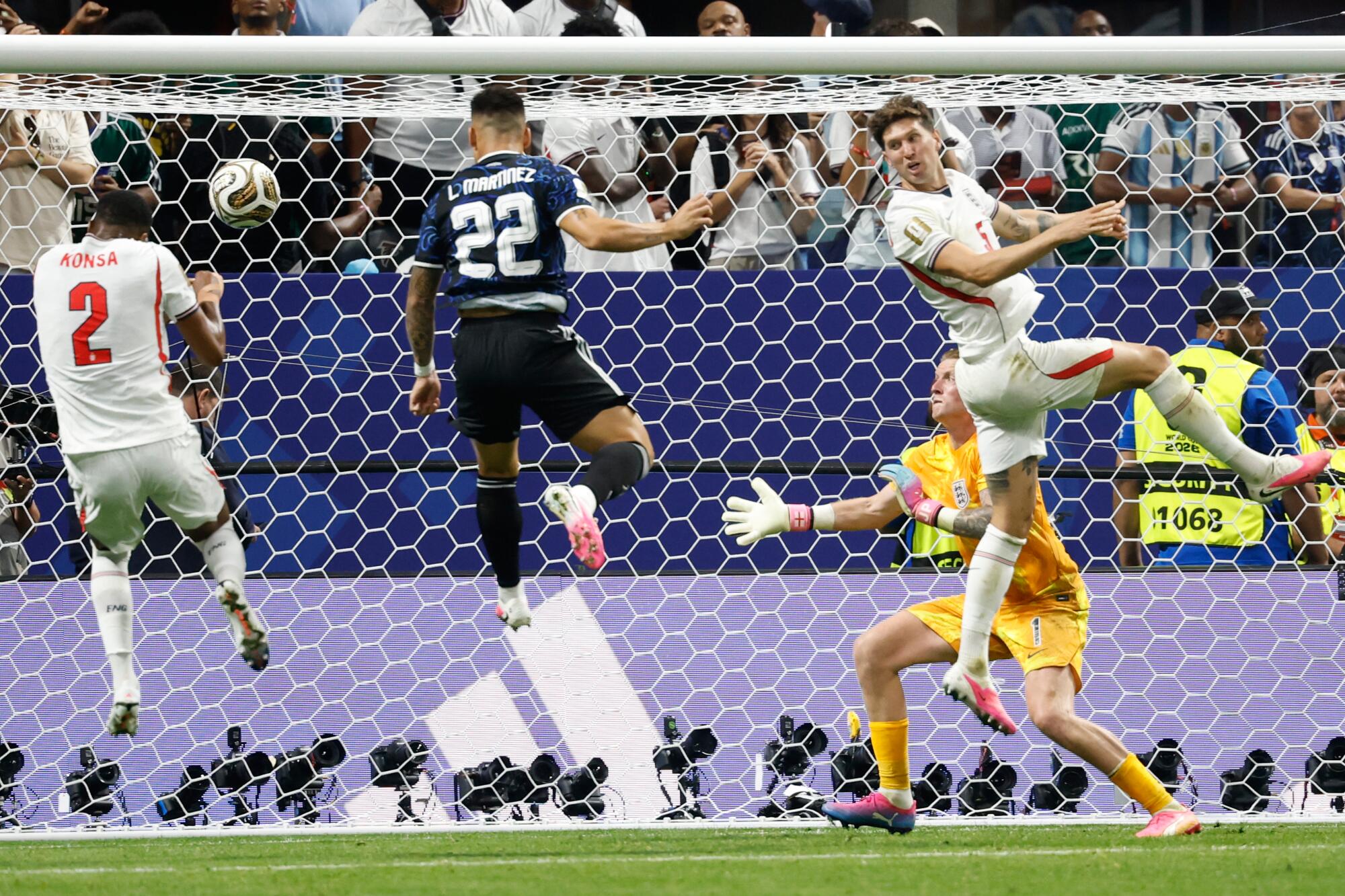
Argentina’s Lautaro Martinez scores his team’s second goal in front of England goalkeeper Jordan Pickford (1) and fellow England players Ezri Konsa (2) and John Stones (5) during a World Cup semifinal in Atlanta on Wednesday.
(Erik S. Lesser / Associated Press)
But it hasn’t been easy. Eleven of Argentina’s 19 goals — including both scores in Wednesday’s semifinal — have come after the 75th minute. They trailed in the 80th minute or later in two of their last three knockout games, only to rally both times.
And Messi has either scored or assisted on three of the four goals that rescued Argentina.
“This group, in the face of adversity, keeps going, keeps going, and never gets tired,” Martínez said. “And we have the best in the world as our example.”
On Wednesday that meant heartache for England, which was as close to a World Cup final as it has been in six decades, leading 1-0 on Anthony Gordon’s second-half goal with just five minutes left in normal time.
But after taking the lead, England turned strangely conservative, dropping all 11 players behind the ball at times, daring Argentina to score. Eventually it did, with Enzo Fernández curling a right-footed shot from about 20 yards past England keeper Jordan Pickford and in at the left post to tie the game.
It was a pass from Messi that found Fernández in space at the top of the box, earning the Argentine captain his record 11th World Cup assist.
“The opponent doubted themselves,” Argentine coach Lionel Scaloni said. “We smelt blood and went for it. We all felt it. “
The tie didn’t last for long though, with Messi threading a perfect cross from the right wing to Martínez, who found space between English defenders John Stones and Ezri Konsa at the far post. Messi’s pass just cleared the leaping Stones, then dipped to Martínez, who nodded it home.
England’s Harry Kane and England’s Jude Bellingham are dejected after losing to Argentina during a World Cup semifinal on Wednesday in Atlanta.
(Jeff Roberson / Associated Press)
When the ball hit the net, the sellout crowd at Atlanta’s massive Mercedes-Benz Stadium erupted.
“Once again, despite falling behind, we managed to turn the game around in stoppage time. That speaks volumes about this group, about this team that never settles, always wants more, always strives for more,” Martínez said.
It also gives Messi a chance to strive for more in Sunday’s final. He has already played in more World Cup games, scored more World Cup goals and had more World Cup assists than any man in history. With a win over Spain, he can join another elite group of men: those who have won back-to-back World Cup titles.
History will eventually decide if it was Messi’s brillance or the tactical surrender of England coach Thomas Tuchel that truly turned the game around. Tuchel, however, said he had no regrets.
“We played the matches how they were,” he said. “We overcame every obstacle. We were very, very close today. It’s not a moment now to analyze the full tournament because we lost a crucial match.”
His captain, Harry Kane, who lost in the semifinal of a World Cup for the second time in three tournament, was also not interested in second-guessing.
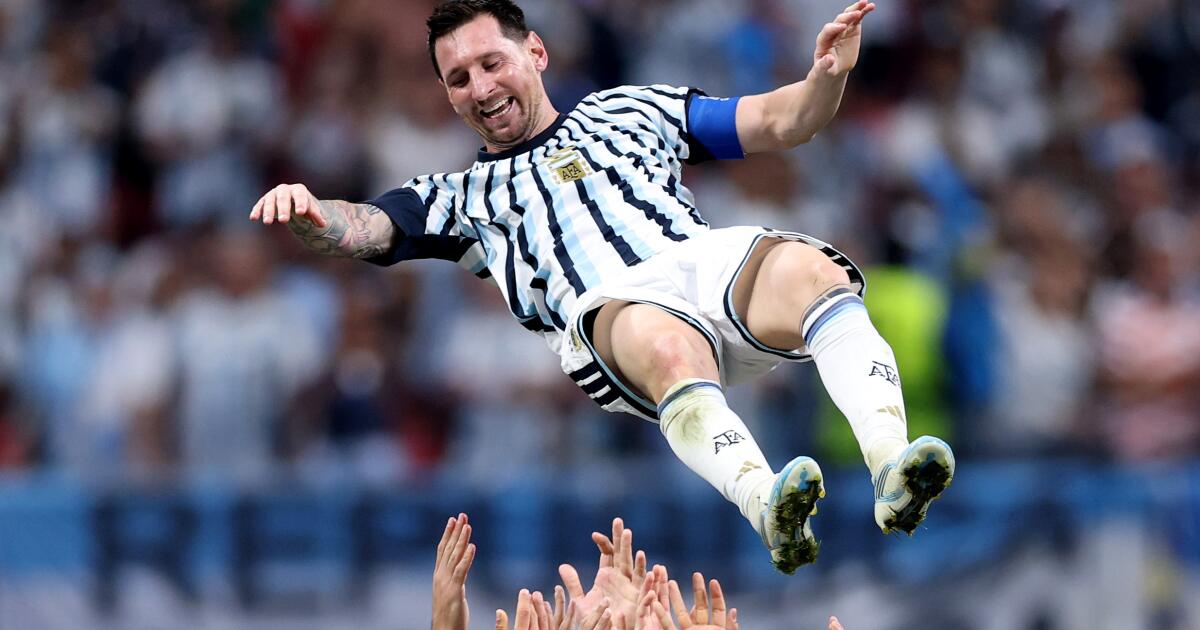
Argentina’s Lionel Messi sits on the shoulders of a teammate and celebrates after beating England in a World Cup semifinal on Wednesday in Atlanta.
(Rebecca Blackwell / Associated Press)
“We had a lot of good moments in this tournament, a lot of good games,” he said. “We talked about knocking on the door. We’re close, we just have to find that missing piece in the final stage of the tournament.”
They may be closer than they think: England is the only team this century to score the first goal in a World Cup semifinal but not reach the final, according to the OptaJoe statistical service.
Argentina’s team, meanwhile, is missing nothing — except maybe a second title,
“The people of Argentina should celebrate being in a final,” Scaloni said. “This group of players is difficult to describe in words. They are so special. I’m getting emotional. They fight for everything.
“We’re going to try to win the final. But what else does this team need to do? There isn’t much else to say. I’m eternally grateful to this group of players.”
Sports editor Iliana Limón Romero contributed to this report.
While every World Cup introduces viewers to new young stars, this tournament featured eight players who were older than 40 — one more than the number of over-40 players in the previous 22 World Cups combined.
Among them were Portugal’s Cristiano Ronaldo, 41, and Mexico’s Memo Ochoa, 40, who were playing in their sixth World Cups alongside Argentina’s Lionel Messi, a relative youngster at 39. No one has played in more men’s World Cups.
But while Ronaldo and Ochoa have gone home, Messi will be playing in his third semifinal in four tournaments Wednesday when Argentina, the reigning champion, faces England at Mercedes-Benz Stadium in Atlanta.
The newfound longevity of elite soccer players has been made possible by advances in sports medicine, diet and analytics that measure everything from biomechanics and heart rate to muscular output and sleep cycles, all in real time. And injuries that once ended careers can now be repaired through outpatient procedures.
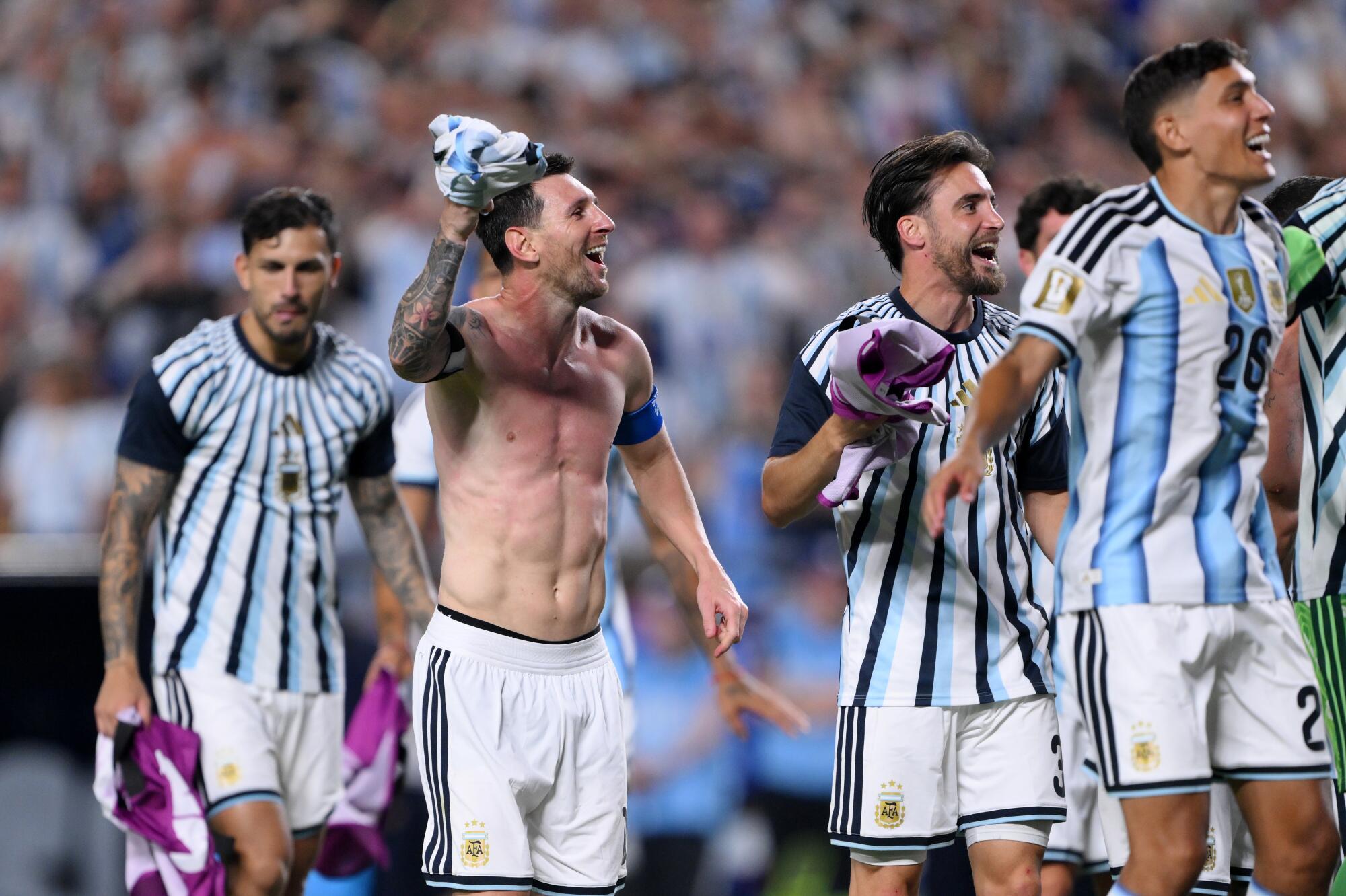
Argentina star Lionel Messi holds his jersey up and celebrates with teammates after a World Cup quarterfinal win over Switzerland on Saturday in Kansas City, Mo.
(David Ramos / Getty Images)
“Over the past 10, 20 years, the sports science within the game has changed a lot,” said Liam Anderson, an exercise physiologist at the University of Birmingham in England, who has worked as an applied practitioner in top-flight professional soccer for more than a decade.
“Players are now definitely more aware of their bodies and I think the professionalism has changed quite a lot as well. But they’re also in tune with the things which are helping them recover, manage their training load and ultimately stay fitter and healthier for longer.”
Gone are the days when chain-smoking Dutch legend Johan Cruyff would light up a cigarette on the bench, French world champion Zinedine Zidane would smoke in the locker room and George Best would party and drink so hard he would disappear for days at a time.
“There’s a couple of reasons,” Dr. Michael Joyner, a specialist in the physiology of elite athletes at the Mayo Clinic, said of the growing lifespan of soccer players. “The first is that people just make a lot more money and as a result, there’s tremendous incentive to keep playing. The second is people are taking much better care of themselves.”
“You just don’t hear about people like George Best anymore,” said Joyner, speaking for himself and not the clinic where he works.
“Diet is huge,” Anderson added. “High-protein diets and fueling with carbohydrates for matches. Nutritional strategies have changed considerably in the last 10-15 years.”
And those diets are tailored by position since a midfielder, who may run more than seven miles in a match, burns more calories than a goalkeeper.
As the eldest player in Major League Soccer, Diego Chara has had to make some concessions to age.
“It’s a little detailed,” said Chara, a midfielder with the Portland Timbers. “Talking about recovery time, it maybe takes a little bit longer than before. Nutrition. Working in the gym, it’ll be longer than other players.”
But if Chara, 40, is an old man in a league where the average age is younger than 26, he would have been something of whippersnapper in this summer’s World Cup.
The Portland Timbers’ Diego Chará passes the ball under pressure from the Columbus Crew’s Wessam Abou Ali on Feb. 21in Portland, Ore.
(Amanda Loman / Associated Press)
Soccer isn’t the only sport in which 40 is the new 30.
Serena Williams returned to Wimbledon this summer at age 44 and at least half a dozen athletes 40 and older showed up at the Milan-Cortina Olympics last February hoping to medal. Four of them succeeded, including American Elana Meyers Taylor, 41, who became the oldest athlete to win an individual gold in Winter Olympics history in the women’s monobob.
It isn’t unheard of for athletes to be golden in their golden years. Ted Williams hit .316 at 41 and Gordie Howe played 80 games and had 41 points in his final NHL season at 52. Nolan Ryan threw a no-hitter and pitched 173 innings at 44 while Tom Brady quarterbacked the Tampa Bay Bucs to a Super Bowl title at 43.
But if those age-defying performances were outliers, playing into your mid-40s and even early 50s may soon become, if not common, at least less unusual.
“People are just staying in better shape, taking care of themselves,” Joyner said. “Career-changing or career-ending injuries are no longer career-ending injuries. It just goes on and on, all of this stuff combined.”
American Serena Williams, 44, serves against Australian Maya Joint during a match at Wimbledon on June 30.
(Cameron Spencer / Getty Images)
State-of-the-art training centers and access to top-line sports medicine have also become more accessible, even in poor countries.
“The elite level has spread and really become global, as opposed to where there used to be pockets,” Joyner said. “The opportunities to compete are so great.”
Few team sports are as physically demanding as soccer, though, which makes both the growing number of seasoned citizens and their performances noteworthy. Messi has averaged nearly a game a week for club and country during the past 23 years, yet he entered the semifinals of this tournament tied for the scoring lead with France’s Kylian Mbappé, who is 12 years younger.
Ronaldo has played even more games yet he became the oldest player to score in a World Cup knockout game when his penalty kick helped eliminate Croatia and midfielder Luka Modric, who will be 41 in less than two months.
“They’ve probably lost a little bit off the top, but their experience and their mind make up for that,” said Scott Trappe, a professor of human bioenergetics at Ball State. “So the overall package of them as a sports person is really they’re contributing at a high level. I think we’re going to continue to see this movement.
Portugal’s Cristiano Ronaldo celebrates scoring a World Cup group stage goal against Uzbekistan on June 23 in Houston.
(Charlotte Wilson / Getty Images)
“They like playing the sport and as long as they can and contribute and they make these teams, they’re going to do it. I don’t see the trend going away.”
And that will not only change the way we think of sports and athletes, it will completely rewrite the record book. Messi, for instance, entered the semifinals of this World Cup as the tournament’s all-time leading scorer with 21 goals. But that was just one ahead of Mbappé, who could appear in another three or four World Cups.
“No question,” Trappe said. “You look what’s going on in pro cycling. We’ve got some guys in their upper 30s competing in the Tour de France, but we also have a teenager competing. So this lifespan, what used to be a five- to eight-year period for cycling at the at the highest levels is turning out to be, you know, double or triple that.”
Both Messi and Ronaldo have benefited from how they play as well, walking rather running for long stretches of the game to conserve energy for the burst they need to lose a defender. It’s a strategy Mbappé, Norway’s Erling Haaland and other young players have adopted and if they do that over enough games, the wear and tear it saves could add years to the end of their careers.
“We are expanding. The age will start moving up a little bit further up and players’ careers will definitely be longer,” Anderson said. “The sort of normal distribution of playing age will begin to move forward and that experience within the squad will be key.’
Argentina’s Lionel Messi dribbles the ball during the World Cup quarterfinal match against Switzerland on Saturday in Kansas City, Mo.
(Charlie Riedel / Ap Photo/charlie Riedel)
Consider Wednesday’s semifinalists. In its quarterfinal win, Argentina used six players older than 32 and two — Messi and defender Nicolas Otamendi — who are over 38. The spine of England’s team runs from goalkeeper Jordan Pickford through defender John Stones to striker Harry Kane, who are all 32.
“We’re coming up with new ways on how to improve and maximizing potential,” Anderson said. “God gave us what we are and it’s maximizing that, not necessarily changing that.”
That knowledge won’t stay in the stadiums and locker rooms for long, expanding to others who choose to adopt the same wellness discipline as professional athletes.
“It cycles down,” Trappe said. “We’re studying that in the lab at a pretty high level. This sort of healthy lifestyle in terms of functionality and extending into our later years and having a higher quality life, there’s data starting to emerge there.
“These types of things are going to trickle into that for sure.”
The buzz: This game would be far better suited as a final than a semifinal. Both are unbeaten — in fact, Spain is unbeaten in its last 36 games, one shy of the all-time record. For France, a win would put it in the final for a third straight World Cup while Spain is hoping to get back for the first time since 2010, when it won its only title. The teams got here in different ways. Spain has walked a razor’s edge, giving up just a single goal in the tournament and winning its last two games on late goals from substitute Mikel Merino. France has bludgeoned the opposition, scoring 16 goals while conceding just two. Kylian Mbappé has scored eight times and has 20 goals in 20 World Cup games, leaving him one back of Lionel Messi’s all-time record. It seems unjust that one of these teams will finish its World Cup in the third-place game.
Wednesday’s semifinal
England vs. Argentina
England’s (from left to right) Harry Kane, Jude Bellingham, and Morgan Rogers celebrate after defeating Norway in the World Cup quarterfinals on Saturday.
The buzz: Both teams are unbeaten and each survived scares in the quarterfinals, with England outlasting Norway in extra time in brutal weather in Miami and Argentina beating Switzerland in extra time in Kansas City. Jude Bellingham had a brace in each of England’s last two games to match teammate Harry Kane’s six goals in the tournament. Bellingham is the first player to score at least two goals in consecutive World Cup knockout matches since Diego Maradona in 1986. Argentina, the reigning champion, is unbeaten in its last 12 World Cup games, but four of its last six knockout-stage games have gone to extra time or penalties. Argentina has gotten eight goals and two assists from Messi in this World Cup.
Everyone knew going in that Lionel Messi would be the narrative centerpiece of the 2026 World Cup. Easily the most recognized name in the competition, Messi is considered by many to be the greatest soccer player of all time and, as the captain of 2022 winner Argentina, he is the reigning World Cup champ. At 18, he scored his first World Cup goal in 2006 and has competed in every World Cup since. He celebrated his 39th birthday before this year’s knockout rounds began, so it’s not unreasonable to assume that this will be his last.
No matter what Messi did, or failed to do, it would be News. Everyone with even a passing interest in the event knew this. Including me.
But I didn’t expect to completely fall for the guy. He’s a professional male athlete, for heaven’s sake, and I don’t emotionally invest in professional male athletes. Admire some of them, sure; watch with bated breath and then scream in astonishment when they pull off some amazing feat or another, absolutely. But the only athletes that have ever touched my heart have been women — Nadia Comăneci; Billie Jean King and the Title IX-sparking stars of women’s tennis; Dorothy Hamill; Brandi Chastain and 1999 Women’s World Cup winners; Venus and Serena Williams; Simone Biles; Caitlin Clark.
But here I am, at age 62, truly, madly, deeply in love with Lionel Messi.
I know, I know, me and half the world. Which normally would serve as an effective prophylactic. I am habitually wary of super-intense fandoms and the men who inspire them; stadiums filled with people chanting a single name inevitably set off internal alarm bells. As I have asked several times in columns throughout the years, how many “heroes” must we watch falter under pressure or be exposed for decidedly unheroic acts before we wise up and get out of the pedestal-placement business?
Yet here I am, stalking him on Instagram, up all hours flicking through interviews and career highlight clips. (I even watched the Apple TV docuseries “Messi Meets America”!) Here I am, literally praying to God, who clearly has more important things to do, for Argentina to advance and screaming Messi’s name every time he scores, assists or pretty much does anything at all.
In a matter of weeks, I have become addicted not just to watching the man play but seeing how he reacts when a shot is made or a game won.
Every World Cup player is happy when they or their team scores, but Messi is delighted. Like a kid seeing a puppy under the tree on Christmas morning. Like he cannot believe this wonderful thing that has just happened even if he was the one who sweat and ran and defied physics to make it happen.
His smile is infectious and even when he is running toward the stands, arms spread wide, after making some impossible shot or other, it never seems self-congratulatory. He is simply filled with joy and wants to spread it around. The field, the stadium, the world.
And his hugs. Long, deep, radiating emotion, utterly unself-conscious. Everyone needs to find someone who hugs them like Messi hugs people — teammates, coaches, opposing players, young fans. I could watch videos of him hugging his mentor and former teammate Ronaldinho or Argentina coach Lionel Scaloni all day long. (I’m not saying I have, nor am I saying I haven’t.)
Sometimes the hype gets a bit nauseating — former teammates who claim he never makes a mistake, commentators who refer to him as superhuman (despite the fact that he has missed as many penalty kicks as he has made in this World Cup). Whether Messi himself agrees that he is the GOAT is none of my business, but he doesn’t act like many sports stars who have received similar adulation. He doesn’t peacock, he doesn’t preen; he is visibly angry with himself when he doesn’t produce. He isn’t perfect — in various past games, he has gotten into heated disputes and shoving matches and famously (and many believe deservedly) taunted Netherlands coach Louis van Gaal during World Cup 2022. But for a man who has been such a star for so long, he presents himself as simply a player among players. The captain, certainly, but not the most important person on the field.
That is the most lovable, and superhuman, thing about him.
It feels pretty basic, not to mention embarrassing, to have a sudden summer crush on Messi, but I don’t care. He’s married to his childhood sweetheart, has three adorable sons and a picture of his mother tattooed on his back. He lets his teammates hoist him in the air and allows sports commentators to regularly (and lovingly) refer to him as “Little Messi.” He gets angry sometimes, but in this tournament he has yet to noticeably hector the refs or rumble with his opponents. He wants to win, obviously, but his joy comes from playing the game well rather than defeating another team.
That’s why, despite my newfound addiction to Messi delight, the moment I loved him best was when he didn’t celebrate at all. In the round of 32, Argentina (No. 2 in FIFA rankings) seemed guaranteed a win over Cape Verde (67). But even with Messi’s early goal, the game was a nail-biter, with Cape Verde scoring two brilliant goals while their goalie Vozinha made eight saves, including four shots (one of them a free kick) from Messi. After Argentina won in additional playing time, there was none of the usual jubilation. Instead, a subdued Messi walked to the midfield to shake hands with his opponents, a sign of exhaustion, no doubt, but also of respect. He hugged Vozinha and told him that his country should be proud of him.
The exuberance was back Tuesday, however, when, after trailing Egypt for most of the round of 16 game, Argentina managed to pull off the comeback of the tournament, going from a 0-2 deficit to a 3-2 win after the 79th minute, with Messi scoring the tying goal.
This time, the smiles, the hugs, the radiant joy filling Atlanta Stadium could have powered the entire state of Georgia. This time, Messi was so happy, he wept.
So did I. The World Cup is over in less than two weeks, and France and Spain are currently the 1-2 favorites to win the thing. My love for Messi is, after all, just a summer romance.
And as with any summer romance, I want it to last forever.
French soccer superstar Kylian Mbappé took to social media Monday to respond to racist remarks a Paraguayan senator made following her country’s 1-0 loss to France in a World Cup knockout round game over the weekend.
Mbappé called Celeste Amarilla, a 61-year-old senator from Paraguay’s Liberal Radical Party, “a despicable woman and unworthy” of her position.
And he was just getting started.
“You do not represent Paraguay, that country which has sweated passion and honor throughout the competition,” Mbappé wrote on X. “Through your recklessness and your brazen racism, the entire world has already forgotten the journey and the historic effort that your players accomplished during this World Cup, making way for an incompetent woman who gives the worst possible image of her country.
“I will never allow people like her the freedom to spread their hatred and racism across the world.”
The 27-year-old French captain scored the only goal of Saturday’s round of 16 game on a penalty kick in the 70th minute. Mbappé is tied with Argentina’s Lionel Messi and Norway’s Erling Haaland with a tournament-high seven goals. He also has 19 overall World Cup goals, one behind Messi for the all-time record.
Amarilla apparently wasn’t impressed, taking to both Instagram and X to make comments about Mbappé ‘s cultural background, appearance, education and more. She did not immediately respond to a request for comment from The Times.
The Paraguayan government said in a statement Monday that it “deplores and rejects” the senator’s remarks.
“These statements are contrary to the values and principles that inspire peaceful coexistence and respect for human dignity, which our country promotes,” it said, adding that Amarilla’s words “in no way represent the position of the Government of the Republic of Paraguay or of the Paraguayan people.”
The French Football Federation said in a statement that Amarilla’s comments were racist, as well as “utterly despicable and unacceptable” and “criminal and reprehensible.”
“These remarks are abhorrent, unworthy, and all the more unacceptable given that they come from a political figure. In the face of racism, we will not remain silent,” France’s sports minister Marina Ferrari wrote on X. “By targeting Kylian Mbappé, the senator is attacking everything our captain embodies and everything our country stands for: liberty, equality, and fraternity.”
France plays Morocco in the World Cup quarterfinals Thursday in Foxborough, Mass.
“The World Cup is ruining my life,” a neighbor recently said with a laugh. “I’m supposed to be working; instead I’m watching World Cup. I’m supposed to be doing chores; instead I am watching World Cup.”
I laughed in guilty recognition. We had met on the street by chance while I was walking the dog. Having just spent the last two hours watching, then celebrating Lionel Messi’s hat trick during Argentina’s first-game victory over Algeria, I had less than an hour to get back in time to watch Austria play Jordan.
That was on Day 6, and it’s only gotten worse. If I had to calculate my own ratio of work done to soccer watched … well, as I am not a sports reporter, I don’t think my editor would be thrilled. (Though I’m sure she appreciated the England/Congo updates I provided as I finished this piece.)
Like millions worldwide, my family and I have been deeply, and in our case, weirdly, engrossed in this year’s games. “Weirdly” because we do not follow men’s soccer. The World Cup is different, of course — going in, I figured I would check out the U.S., keep an eye on Messi, then tune into the final few games. Perhaps my husband would join (but only if he at least pretended to understand the offside rule), but with our two oldest children out of the house, it is, with the exception of the Super Bowl, unheard of for our family to concurrently view any sporting event in real time.
Until this World Cup. I’m not quite sure how it happened, but suddenly we’ve got game times written onto our calendar. Entire days have been spent in front of the TV with at least one child and the others watching from their homes, our family texts studded with “are you watching…?,” “did you just see that?” and, of course, “OMG MESSI!”
(I would attempt to calculate my recent ratio of chores done to Messi videos watched if I weren’t legitimately concerned that my family would have me committed.)
The fact that my son and his girlfriend live in Kansas City certainly helped spark our newfound fascination. Yes, Los Angeles is also a host city, but L.A. hosts so many things; inevitably we were mostly concerned about what it would do to the traffic. KC, on the other hand, is the smallest and most unlikely of the host cities, and over the last few years we have seen — on visits and through my son’s accounts — all the construction, effort and can-do spirit that has gone into preparing for the event.
We were thrilled when it was announced that Argentina, England, the Netherlands and Algeria would be based in or near KC. We wanted the city to shine, and it has — from nearby Lawrence’s enthusiastic adoption of Algeria to Messi’s historic hat trick at Kansas City Stadium.
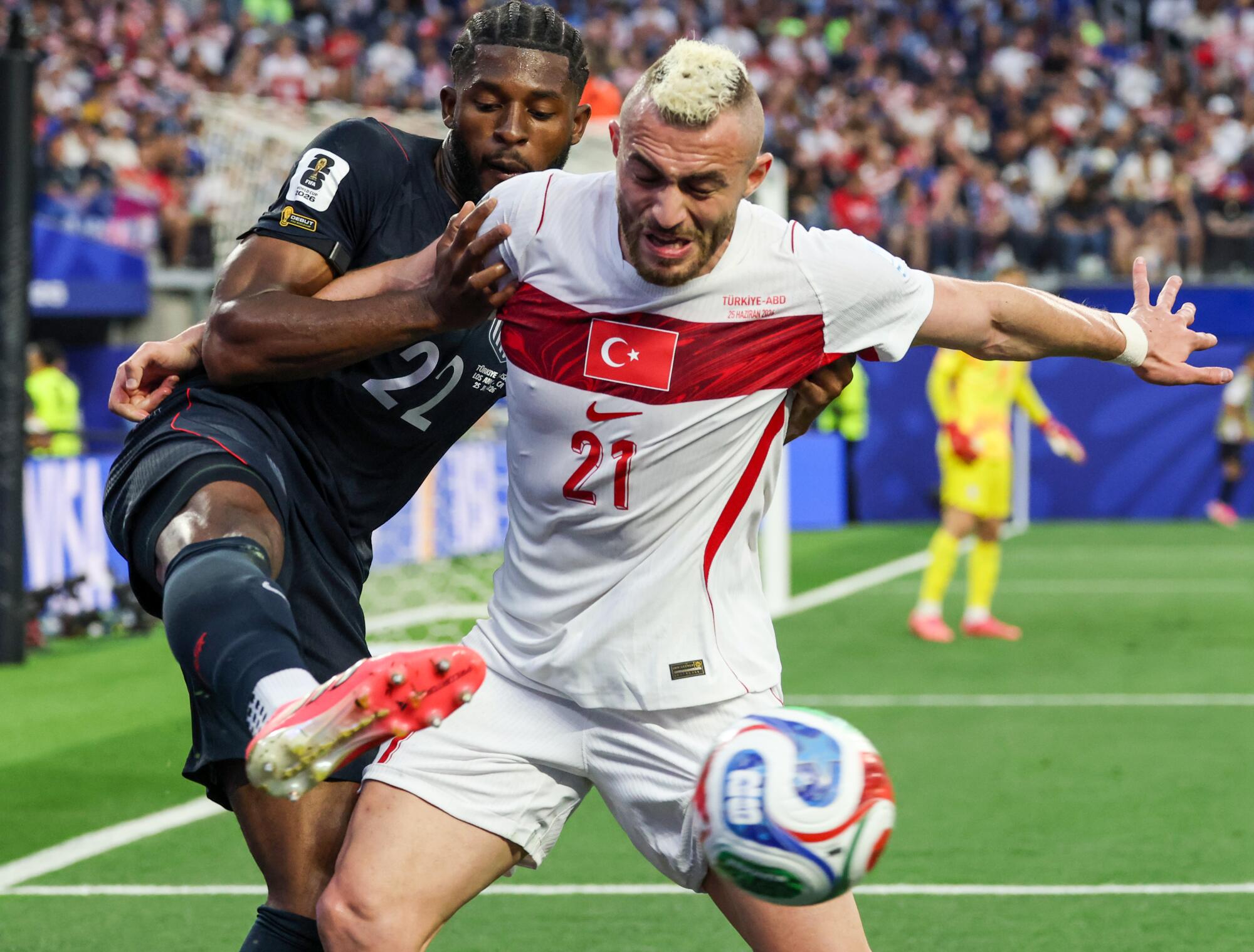
Team USA defender Mark McKenzie, left, and Turkey midfielder Baris Alper Yilmaz in the World Cup match at Los Angeles Stadium on June 25.
(Robert Gauthier / Los Angeles Times)
But it’s more than vicarious Midwestern pride. When our older daughter began texting out missives from the earliest games and our son sent pictures of fans streaming into Kansas City Stadium, we started watching as a way to stay connected.
First, as a family, and then to our country and the rest of world.
The games have been inevitably exciting, especially as now that they’re in the knockout round, but the overall sensation was unexpected relief, a soul-soothing balm.
At a time when the news cycle seems to serve up nothing but conflict, crisis and woe, the World Cup offers shelter, a truly international event in which conflict is defined by long-term sports rivalries and questionable referee decisions.
We want our national or preferred teams to win, of course, but no matter the outcome, it’s impossible not to be thrilled by the sight of phenomenal play, underdog tenacity and so many adoring and enthusiastic fans.
Soccer is called the beautiful game for many reasons, and hours/days/weeks of sustained beauty is impossible to resist. Even social media has surrendered to spectacular highlights along with tales of Japan supporters cleaning up stadiums, fans of the victorious consoling fans of the defeated and Europeans discovering the glories of free refills and ranch dressing.
None of this changes the realities we face in America and the rest of the world. Grocery and gas prices remain catastrophically high; Iran continues to contradict U.S. claims of diplomatic resolution to an unpopular war. The unnecessarily revamped reflecting pool in Washington remains a swamp of algae and tourist arrests, as the semiquincentennial struggles under the weight of our president’s self-centered hubris.
But for a few blessed weeks, the World Cup offers inspiration, escape and cultural healing.
It has also, thus far, escaped President Trump’s so often internationally insulting social-media notice and more importantly, his presence. Historically, the leaders of host countries attend the opening match; Trump has, apparently, been too busy (including planning and attending the UFC Freedom 250 cage match recently held on the South Lawn.)
Given his tendency to suck the oxygen out of any room (like his recent reception at Game 3 of the NBA Finals in New York), it’s definitely for the best. If nothing else, the World Cup has given us a chance to take a break from politics and talk instead about Messi, France’s Kylian Mbappé, England’s Harry Kane and all the amazing goalkeepers, including Cape Verde’s now-iconic Vozinha.
Never before have I so understood the therapeutic power of sport.
Who wouldn’t want to at least take a break from rising measles cases, the latest federal or Supreme Court decisions and primary tea-leaf readings to lose themselves in a game where exquisitely patient passing suddenly bursts into spectacular feats of speed and footwork? Where a well-defended ball can suddenly become a goal with a nearly undetectable flick of a foot, or a perfectly placed shot blocked by a goalie’s incredible ability to launch into space? Where an outcome that seems assured can be overturned in the final minutes to the collective roar of an international cast of thousands?
Vozinha of Cape Verde makes a save during the World Cup match between Spain and Cape Verde at Atlanta Stadium on June 15.
(Justin Setterfield / Getty Images)
Like many Americans, I have been occasionally embarrassed by the World Cup’s exposure of my world-geography ignorance — I know where Bosnia and Herzegovina lies on a map, but until recently, I couldn’t place Cape Verde, Curacao or, if I’m being completely honest, Cote d’Ivoire.
Isn’t it wonderful, though, to have a reason to reacquaint yourself with a world map that isn’t related to war, natural or man-made disaster or economic and political tension? The current U.S. administration may seem to be at odds with just about everyone, but visiting World Cup fans are here to remind us of all we share, beneath our crazy wigs and face paint, our cheers, groans and chants.
And we, as hosts, have shown them that America is so much more than the sum of our current government’s policies and posturing.
Watching all this happen, in real time, has been magical, miraculous and magnetic.
Not every moment, of course. Various visa issues created unnecessary and embarrassing drama; high ticket prices and transportation issues were blamed for empty seats at some of the early games. Members of the Iranian team and its coaching staff criticized the way they were treated (though the team left a handwritten note in the dressing room of Los Angeles Stadium, thanking L.A. for its hospitality). The controversial hydration breaks, and the extra commercials they accommodate, can be irritating (though when it’s close to 100 degrees in many stadiums, quite necessary). And though it didn’t matter in terms of standing, watching the U.S. lose to Turkey wasn’t much fun for American fans (though the Turkish exuberance was pretty infectious).
Overall, the 2026 World Cup has done exactly what it was supposed to do: create, in this country, a stage for the finest teams and players in the world’s most popular sport and, more important, carve out five weeks in which we can all spend a few hours removed from the political and cultural divisiveness that threatens to define us.
It’s space in which we can cheer, gasp and leap out of seats along with our families, friends and all the millions we will never meet but to whom we are connected all the same.
Now if you’ll excuse me, the next game is about to start.