President Trump and his allies are questioning ballot security. Democrats are warning of unconstitutional federal intervention. Experts and others are raising concerns about partisan redistricting and federal immigration agents intimidating people at the polls.
Voter trust in the upcoming midterm elections, meanwhile, has dropped off sharply, and across party lines, according to new research by the UC San Diego Center for Transparent and Trusted Elections.
Out of 11,406 eligible voters surveyed between mid-December and mid-January, just 60% said they were confident that midterm votes will be counted fairly — down from 77% who held such confidence in vote counting shortly after the 2024 presidential election.
Shifts in voter confidence are common after elections, with voters in winning parties generally expressing more confidence and voters in losing parties expressing less, said Thad Kousser, one of the center’s co-directors. However, the new survey found double-digit, across-the-board declines in confidence in the last year, he said.
According to voting experts, such drops in confidence and fears about voter intimidation are alarming — and raise serious questions about voter turnout in a pivotal midterm election that could radically reshape American politics.
While 82% of Republicans expressed at least some confidence in vote counting after Trump’s 2024 win, just 65% said they felt that way in the latest survey. Among Democrats, confidence dropped from 77% to 64%, and among independents from 73% to 57%, the survey found.
“Everyone — Democrats, Republicans, independents alike — have become less trusting of elections over the last year,” Kousser said, calling it a “parallel movement in this polarized era.”
Of course, what is causing those declines differs greatly by party, said Kousser’s co-director Lauren Prather, with distrust of mail ballots and noncitizens voting cited by half of Republicans, and concerns about eligible voters being unable to cast ballots because of fear or intimidation cited by nearly a quarter of Democrats.
Trump and other Republicans have repeatedly alleged that mail ballots contribute to widespread fraud and that noncitizen voting is a major problem in U.S. elections, despite neither claim being supported by evidence.

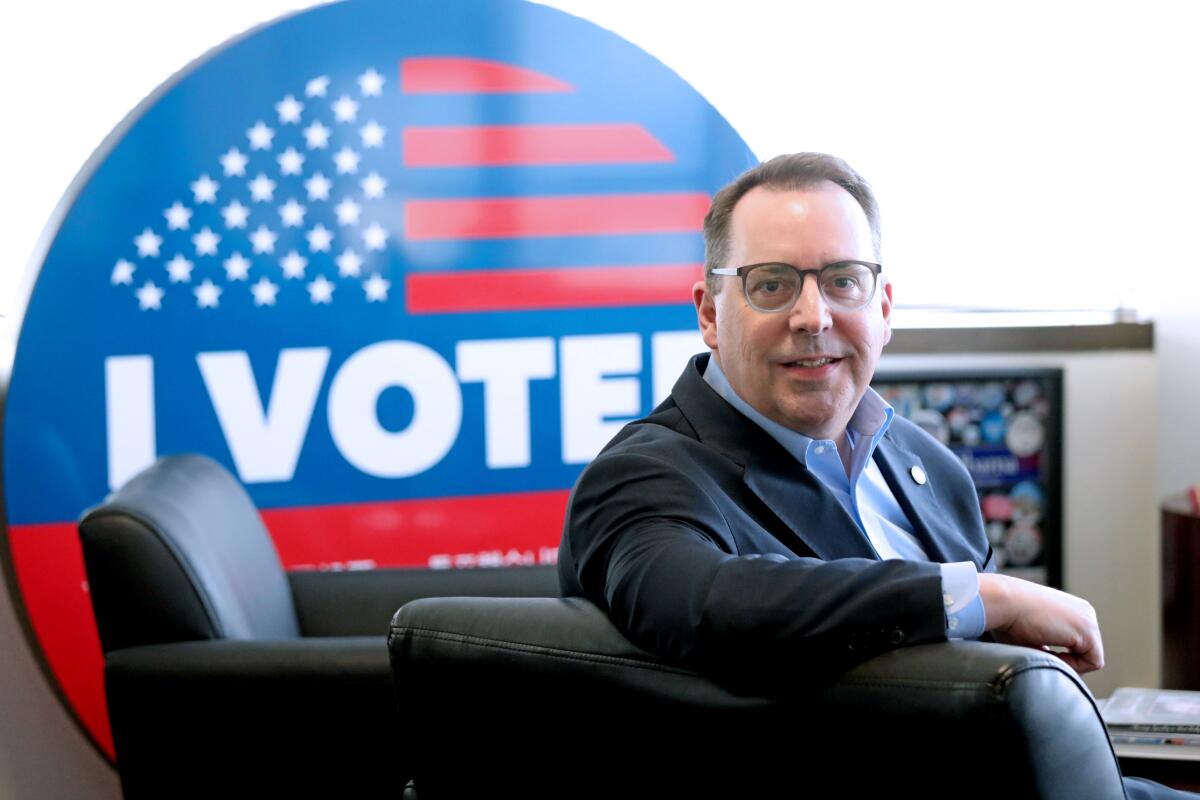
Dean C. Logan, Registrar-Recorder/County Clerk, oversees the registering of voters, maintaining voter files, administering federal, state, local and special elections and verifying initiatives, referenda and recall petitions.
(Gary Coronado / For The Times)
Many Democratic leaders and voting experts have raised concerns about disenfranchisement and intimidation of eligible voters, in part based on Republican efforts to enforce stricter voter ID and proof of citizenship requirements, and Trump suggesting his party should “take over” elections nationwide.
Others in Trump’s orbit have suggested Immigration and Customs Enforcement agents will be deployed to polling stations, and the FBI recently raided and seized ballots from Fulton County, Ga., long a target of Trump’s baseless claims of 2020 election fraud.
Prather said that research has long showed that “elite cues” — or messaging from political leaders — matter in shaping public perception of election security and integrity, so it is no surprise that the concerns being raised by Trump and other party elites are being echoed by voters.
But the survey also identified more bipartisan concerns, she said.
Voters of all backgrounds — including 51% of Democrats, 48% of independents and 34% of Republicans — said they do not trust that congressional districts are drawn to fairly reflect what voters want. They primarily blamed the opposing party for the problem, but nearly a quarter of both Democrats and Republicans also expressed dissatisfaction with their own party leaders, the survey found.
Various states have engaged in unprecedented mid-decade redistricting to win more congressional seats for their party, with Republicans seizing advantage in states such as Texas and Democrats seizing it in states such as California.
Voters of all backgrounds — including 44% of Democrats, 34% of independents and 30% of Republicans — also said they believe it is likely that ICE agents will be present at voting locations in their area, though they did not all agree on the implications.
Half of Democrats said such a presence would make them feel less confident that votes in their area would be counted accurately, compared with fewer than 14% who said it would make them more confident. Among Republicans, 48% said it would make them more confident, and about 8% less confident. Among independents, 19% said more confident, 32% less confident.
Perceptions of ICE at polling locations also varied by race, with 42% of Asian American voters, 38% of Hispanic voters, 29% of white voters and 28% of Black voters saying it would make them feel less confident, while 18% of Asian American voters, 24% of Hispanic voters, 27% of white voters and 21% of Black voters said it would make them feel more confident.
Among both Black and Hispanic voters, 46% said they expect to face intimidation while voting, compared with 35% of Asian American voters and just 10% of white voters. Meanwhile, 31% of Hispanic and Asian American voters, 21% of Black voters and 8% of white voters said they are specifically worried about being questioned by ICE agents at the polls.

A man waits in line to vote at Compton College in November.
(Michael Blackshire / Los Angeles Times)
Kousser said voters’ lack of confidence this cycle reflects a remarkable moment in American politics, when political rhetoric has caused widespread distrust not just in the outcome of elections, but in the basic structure and fairness of how votes are collected and counted — despite those structures being tested and proven.
“We’re at this moment now where there are people on both sides who are questioning what the objective conditions will be of the election — whether people will be able to freely make it to the polls, what the vote counting mechanisms will be — and that’s true sort of left, right, and center in American politics today,” he said.
Prather said research in other countries has shown that distrust in elections over time can cause voters to stop voting, particularly if they think their vote won’t be fairly counted. She does not think the U.S. has reached that point, as high turnout in recent elections has shown, but it is a longer-term risk.
What could have a more immediate effect are ICE deployments, “especially among groups that have worries about what turning out could mean for them if they expect ICE or federal agents to be there,” Prather said.
Election experts said voters with concerns should take steps to ensure their vote counts, including by double-checking they are registered and making a plan to vote early, by mail or with family and friends if they are worried about intimidation.
What voters should not do if they are worried about election integrity is decide to not vote, they said.
“The No. 1 thing on my list is and always will be: Vote,” said Sean Morales-Doyle, director of the Voting Rights and Elections Program at the Brennan Center for Justice at New York University Law. “That sounds maybe trite or simple, but the only way we hold on to our democracy is if people continue to participate and continue to trust it and put their faith in it.”

Registrar voter staff members process ballots at the Orange County Registrar of Voters in Santa Ana in November.
(Christina House / Los Angeles Times)
“Now is the time to buckle down and figure out how to fortify our protections for fair elections, and not to give into the chaos and believe it’s somehow overwhelming,” said Rick Hasen, an election law expert and director of the Safeguarding Democracy Project at UCLA Law.
“I don’t want people to feel like nothing is working, it’s all overwhelming and they are just being paralyzed by all the news of these attacks, these threats,” said Sophia Lin Lakin, director of the Voting Rights Project at the ACLU. “There are a huge range of folks who are working to ensure that these elections go as smoothly as possible, and that if anything comes up, we are ready to respond.”
Mike Madrid, a Republican political consultant in California, said the erosion of confidence in U.S. elections was “a deliberate strategy” pushed by Trump for years to explain away legitimate election losses that embarrassed him, and facilitated by Republicans in Congress unwilling to check Trump’s lies to defend U.S. election integrity.
However, Democrats have added to the problem and become “the monster they are fighting” by gerrymandering blue states through redistricting measures such as California’s Proposition 50, which have further eroded American trust in elections, Madrid said.
Madrid said that he nonetheless expects high turnout in the midterms, because many voters have “the sense that the crisis is existential for the future, that literally everything is on the line,” but that the loss of trust is a serious issue.
“Without that trust, a form of government like democracy — at least the American form of democracy — doesn’t work,” he said.
Trump — who in a post Friday called Democrats “horrible, disingenuous CHEATERS” for opposing voter ID laws that most Americans support — has long called on his supporters to turn out and vote in massive numbers to give him the largest possible margin of victory, as a buffer against any election cheating against him. One of his 2024 campaign slogans was “Too Big to Rig.”
In recent days, some of Trump’s fiercest critics — including Sen. Adam Schiff (D-Calif.) — have made a similar pitch to Democrats.
In an interview with The Times, Schiff said that he is “deeply concerned” about the midterms given all of Trump’s threats, but that voters should understand that “the remedy here is to become more involved, not less.”
“The very best protection we’ll have is the most massive voter turnout we’ve ever had,” he said. “It’s going to be those with the most important title in our system — the voters — who end up saving this country.”