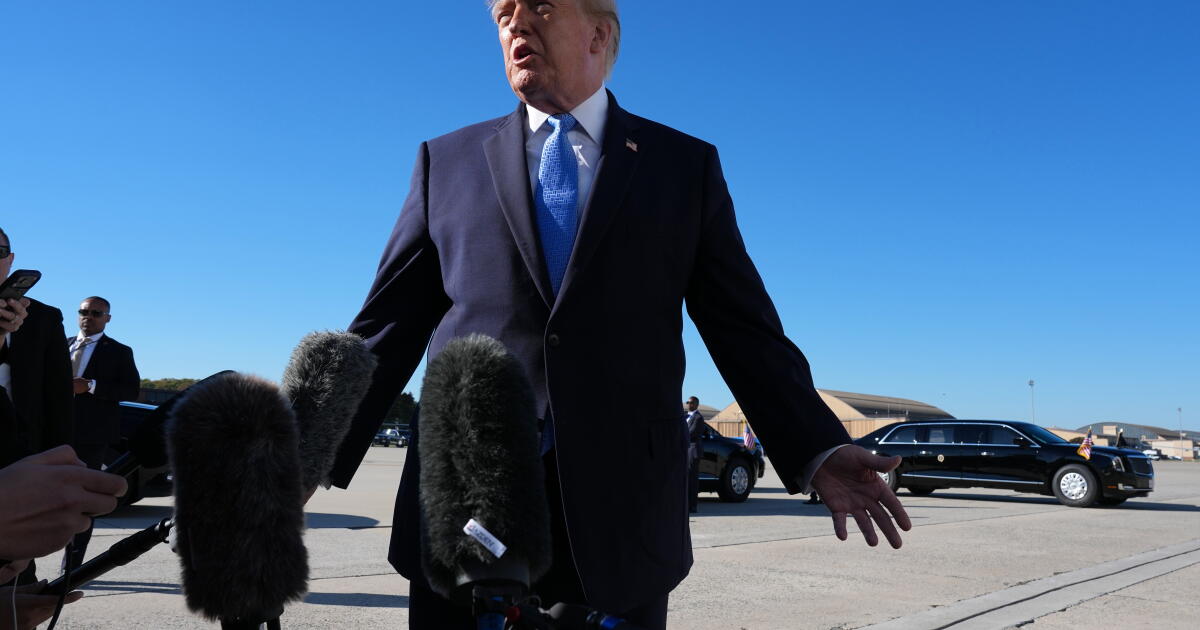
WASHINGTON — President Trump offered $1 million Monday to anyone who reports voter fraud that leads to an arrest and conviction, escalating his efforts to cast doubt on the midterms as Republicans risk losing control of Congress.
“Anybody reporting Voter Fraud in the past Elections, or the upcoming 2026 Midterm Election, will be paid $1,000,000 upon the arrest and conviction of those that created the Fraud!” Trump posted on Truth Social.
Trump did not say how the tips should be submitted to the federal government or who would decide whether a claim qualifies for a reward. The White House declined to comment beyond Trump’s social media post.
Last week, the administration launched a separate program that is meant to pay people for providing information to the administration to combat fraud. When announcing it, Trump said he would personally decide who gets paid.
“I will be the arbitrator of all of these decisions,” Trump told reporters in the Oval Office. “In other words, I’ll determine whether or not the person is deserving, and I’ll determine, and I will be very generous.”
It is unclear whether Trump, who has spread false claims about the nation’s voting systems and routinely questions the integrity of the elections, intends to play a similar role over the voter fraud tipping system.
In the lead up to the midterms, Trump has tried to assert more control over the elections, calling on Republicans to “nationalize” voting and pushing for restrictions on mail-in ballots. Trump has also cast doubt over the integrity of California’s primary election, claiming without evidence that Democrat cheated — an allegation that was investigated by the U.S. attorney’s office in Los Angeles, which is run by a Trump loyalist.
Even as Trump says he wants “honesty in our elections,” the president told supporters at the Republican Party convention in Dallas in September to “cheat like hell, like they do.”
Trump’s efforts to cast doubt over voting come as polls show Republicans facing headwinds heading into the Nov. 3 election as Trump’s popularity sags amid voter concerns over the economy.
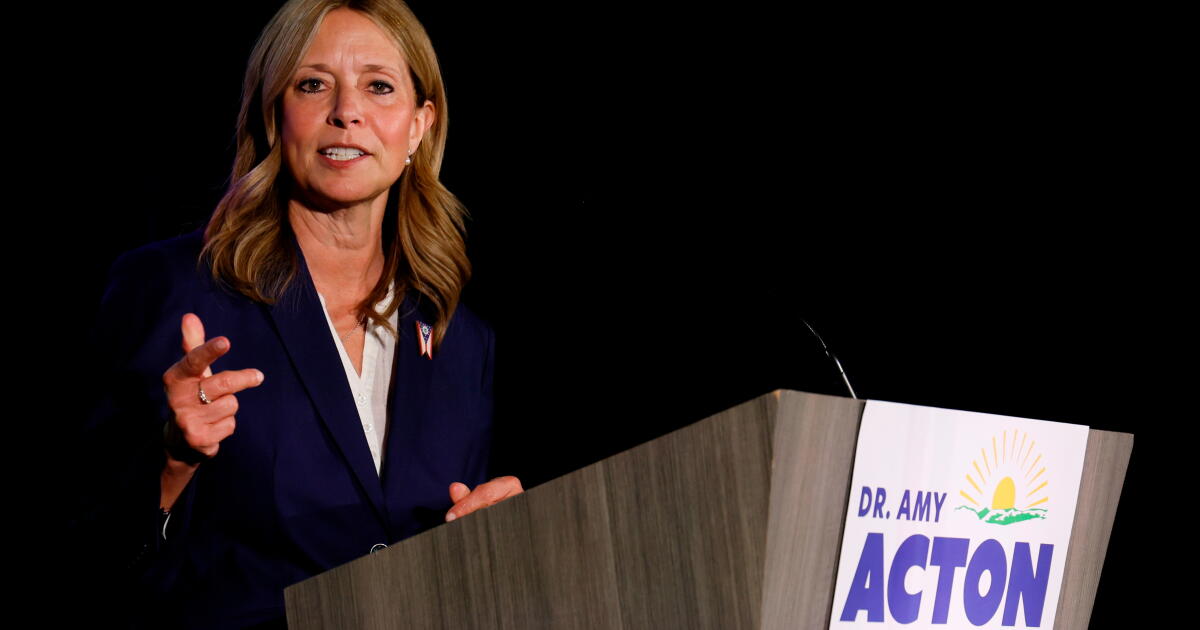
You know the one I’m talking about — Ohio gubernatorial candidate Vivek Ramaswamy’s attack on opponent Amy Acton using her clearly troubled mother, who failed to protect Acton as a child from her rapist stepfather and instead abandoned her kids to stay with the now-deceased pedophile.
Wow. Even in 2026, that’s a lot.
The ad, released last week on the internet and set for a television blitz through the election, has sparked condemnation even from Republicans. Some anyway. President Trump and Vice President JD Vance (a close friend of Ramaswamy’s) have defended it, much to the chagrin of decent people everywhere who have labeled this a make-it-or-break-it moment for the Grand Old Party.
Trump called getting Acton’s mom on camera “hitting pay dirt.”
“Why shouldn’t somebody use that?” Trump said Friday. “To me, that’s something that’s very much fair game.”
Trump’s right, in his world anyway. His faithful may not like the ad, but it’s not a deal-breaker.
The appalled, left and right, are wrong on this one — this is not a turning point for the Republican Party or the moment it realized its soul was in the frying pan.
When Ramaswamy loses — and he’s likely going to lose, if polls are right — it won’t be because Republican voters finally believe the party has sunk too low, lost its way or lacks morals. And when the postmortem happens on the right, it won’t examine whether exploiting victims of sex abuse is a smart move. (Full disclosure: One of my relatives is an advisor of Ramaswamy.)
Instead, the ad will eventually be seen as a great gift to Donald Trump for two reasons.
First, it allows Ramaswamy — his endorsed candidate — to lose without it being the president’s fault for starting a war, tanking the economy and generally being entirely unpopular with average Americans. Get ready, because if Ramaswamy goes down, Trump will spin it that Democrats and the corrupt media misrepresented the ad and lied about Ramaswamy. Not Trump’s fault, just further proof of why his battle is righteous.
Second, it allows him to test the loyalty of his MAGA acolytes ahead of 2028, and folks, I’m sorry to say it’s a test they are likely to pass with flying colors. Vance laid this out clearly in his defense, reserving his scorn for Republicans who dared to be anything but steadfast.
“Stop whining about an advertisement and go win the race in 13 days,” Vance said in response to a question about the ad. He added he was “disgusted” that his fellow Republicans were seemingly more upset about the ad “than they are about what the congressional Democrats and other Democrats want to do to the United States of America.”
For all the angst about sexual abuse, even of minors, the forever Trumpers honestly don’t care as long as their candidates win and maintain power. Just ask Jeffrey Epstein’s victims. Ask E. Jean Kelly. Ask Victim A in the Matt Gaetz allegations, or Christine Blasey Ford if you can remember that far back. The list goes on.
MAGA diehards may holler and stomp about how much they hate pedophiles, but they hate Democrats more. Trump has told these voters to ignore the ad and vote Ramaswamy. I predict more of them do it than decency permits — because we’ve seen this MAGA mental split before, where they somehow set aside all of their so-called outrage when Trump tells them to do something.
These voters are clear that the Trump regime presents a real opportunity to remake the country into a conservative bastion in ways that will be hard to undo, and they will overlook even the indecency of exploiting childhood rape.
“I love how Vivek does not hesitate to call out wrongdoings,” wrote another.
Others tried to turn the topic to their conspiracies about Rep. Ilhan Omar and Michigan senate candidate Abdul El-Sayed, two bogeyman of the right for their race and religion. The responses of Trumpers to his post were exactly on brand — deflecting or blaming media and disinformation for skewing the issue. (Trump and Ramaswamy are claiming that the ad isn’t about sexual abuse, but only about whether Acton is truthful.)
With that veneer of justification, it’s likely his most devout base in Ohio, led by the 20% of voters who consider themselves white evangelicals, will stick with their guy. Nearly 8 in 10 white evangelical Protestants support Trump, and they are motivated voters who have disconnected the Trump reality from the Trump promise for years.
Despite all the outrage across the country about the ad, it’s likely the final tally in Ohio will remain largely as it would have been before the kerfuffle. Ramaswamy was down in the polls before he dove into the muck of the past few days. A reliable Cook’s poll put Acton ahead 49% to 44% — one of the reasons Ramaswamy was desperate enough to try this last-ditch smear.
I’ll bet an Ohio buckeye the final count isn’t far outside that margin, with no sign of a massive drop in Republican support of Ramaswamy, despite all the posturing and hand-wringing. If he loses, it is likely more about the surging racism against Indian Americans, especially with young conservatives, than one ugly ad.
But those Republicans who denounced the ad will face the president’s punishment. The ad is not a mistake. It is an inadvertent test. By embracing the ad even as it’s disparaged nationally, the president is discovering exactly who he can, and can’t, trust as he heads into the two most difficult years of his decadelong rule — the part where he stops pretending to be anything but what he is, a corrupt and greedy man intent on maximizing power and wealth. The part where he challenges elections.
We are watching the last of the old-guard Republicans being purged thanks to the ad. Republicans who have gathered up the tattered shreds of their integrity and courage over this ad are shredding them to nothing on this moment, giving Trump insight into who might stand up to him when the protection of our democracy is on the line.
Trump has started lashing out already, making sure those potential last-round conscientious objectors are damaged.
After current Ohio Republican Gov. Mike DeWine called for Ramaswamy to stop airing the spot, labeling it “deeply troubling,” Trump attacked him — even though DeWine said he continued to support Ramaswamy as his replacement. (DeWine is facing term limits.)
“Mike DeWine, who I unfortunately helped get elected years ago, when he was losing by 16 points prior to my doing a Rally for him was, as usual, disloyal to the Republican Party,” Trump wrote on social media.
DeWine was far from alone.
Trump’s days of conning himself into a coalition are behind him — well into his second term, is now consolidating power behind his core, public opinion be damned.
The independent voters that may indeed not vote or change votes because of the ad were just as likely to switch over gas prices or wars.
The ad was never for them, but rather just for this outrage, this push to motivate the base with just the sort of grimy bullying Trump does best — I believe him when he says he wishes he could make an ad like this. Trump will rally in Ohio this week with Ramaswamy, and it’s likely most Republicans will somehow have transmuted their outrage into support by the time he appears in person.
His base understands his support of the ad is an expression of power. His base understands the trade they are making. His base doesn’t care what happened to Acton, because she will never give them the America they want.
His base likes the ad, even if they won’t admit it.
BAKERSFIELD — Top Democratic and Republican leaders are sweeping through California as the Nov. 3 election approaches, evidence of the state’s pivotal role in deciding which party will control the U.S. House of Representatives and the fate of President Trump’s final two years in office.
Seizing on their party’s momentum nationwide, Democrats rallied crowds from Orange County to the Bay Area this past week. They blamed Trump and the Republican-led Congress for rising gas and food prices, massive cuts to healthcare funding, deceitful attacks on the elections process and the vilification of immigrants.
In the Central Valley, New York Rep. Alexandria Ocasio-Cortez on Friday evening appeared alongside Randy Villegas, a Democrat challenging Republican incumbent David Valadao of Hanford in a Latino voter-heavy district in the state’s agricultural heartland. The population of the district is one of the youngest in the country, Ocasio-Cortez told the crowd, and Gen Z and millennial voters are expected to play a pivotal role.
“We have the opportunity to take the reins,” said Ocasio-Cortez, one of the nation’s most well-known progressive leaders. “And to give direction to where our future will be headed. And I got to tell you, folks, the future is not with David Valadao.”
Roughly two dozen House races across the country are expected to decide the House majority, including three competitive races in California: Those of Republican Valadao, Democratic Rep. Adam Gray in the Central Valley and the open seat of retiring Republican Rep. Darrell Issa in the San Diego area.
Democrats are hoping that the new congressional maps approved by California voters in 2025 will give them an edge. The reconfigured congressional districts approved by Proposition 50 were a response by California’s Democratic leadership to Trump urging Republicans, notably in Texas, to shift their boundaries to help the GOP hold onto control of Congress during his final two years in office.
The San Joaquin Valley district represented by Valadao, which already had a Democratic majority, added about 100,000 Fresno residents, turning it even bluer. Valadao has been a perpetual target of Democrats given their longtime voter registration edge in this area.
Aside from briefly losing the seat for one term nearly a decade ago, Valadao has hung onto the seat. He comes from a dairy farming family and is well-known in the area, winning by nearly seven percentage points in 2024, outperforming Trump.
This cycle, Democrats are hammering him for supporting Trump’s budget cuts that impacted healthcare programs, a critical issue since roughly two-thirds of the population in his district is covered by Medi-Cal, as Medicaid is known in the state, the most of any district in California, according to the UC Berkeley Labor Center.
Valadao is among a handful of GOP members in California’s 52-member congressional delegation, the largest of any state in the nation, and among the Republicans targeted by Democrats in response to Trump’s efforts to keep his party in control of Congress.
“Donald Trump’s gerrymandering scheme is going to fail,” said House Minority Leader Hakeem Jeffries in Buena Park on Thursday. “It’s going to fail in Texas. It’s failing in Florida, and it’s failing in North Carolina. But I’m grateful to the people of California who decided to decisively respond and create the situation where we’ll have a fair national map.”
The party in control of the White House typically loses seats in the midterm election, and Trump and the GOP face additional headwinds because of the affordability crisis that the president promised to address when he ran for reelection in 2024. Californians face some of the highest gas and electricity prices in the country.
“The MAGA extremists are on the run because they have failed. They’ve broken every promise that they’ve made to the American people,” Jeffries said, after stumping for Rep. Derek Tran (D-Orange) at a carpenters’ union hall. “Life has not gotten more affordable. Life is far too expensive. Trump policies … have increased costs on everyday Americans by thousands of dollars per year.”
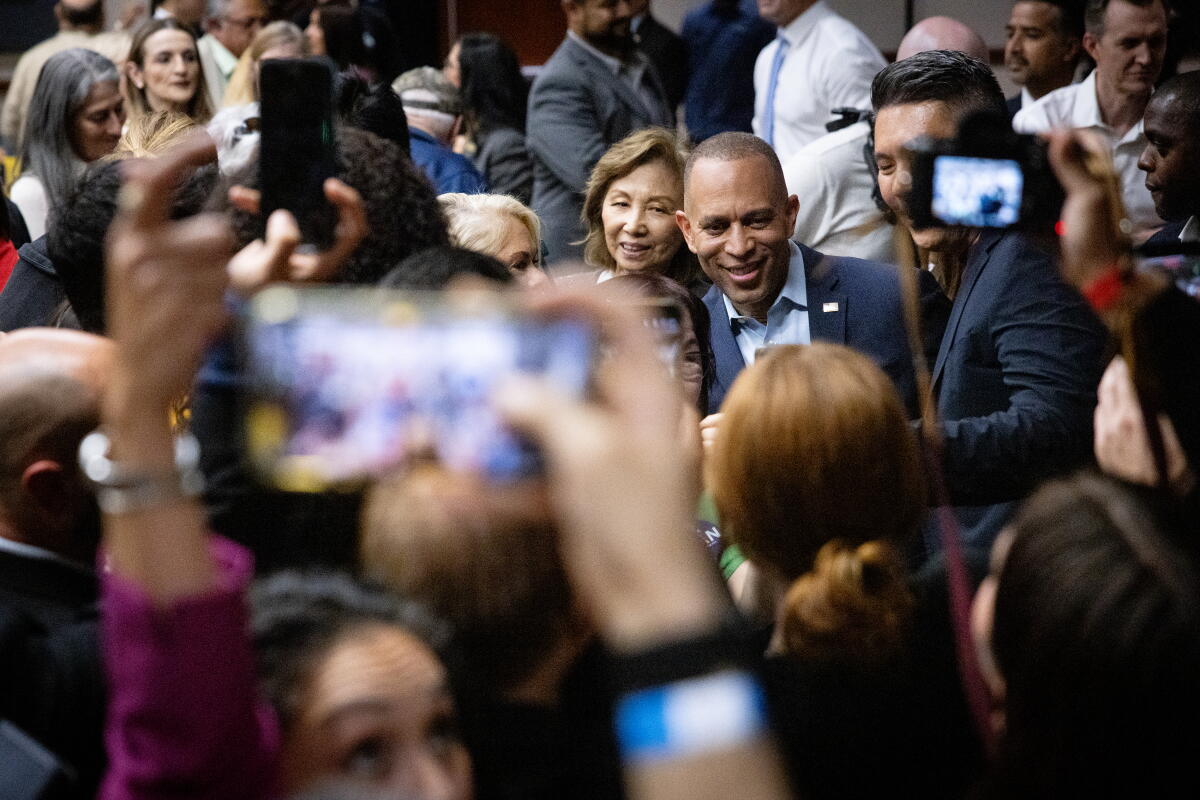
House Democratic Leader Hakeem Jeffries interacts with members of the audience after he delivered a speech during representative Derek Tran’s “Take Back the House” rally for his reelection campaign in California’s 45th Congressional District, at Carpenters Local Union 714 in Buena Park on Thursday.
(Etienne Laurent/For The Times)
Tran narrowly unseated Republican Rep. Michelle Steel in 2024, winning by just 653 votes. The recently redrawn district, which is located primarily in Orange County, could give him an edge this election.
“Prop. 50 did help me out of the battleground districts in California,” Tran said. “I got the least amount of help, but better, still better.”
On Wednesday, the Republican House speaker acknowledged his party’s hurdles while stumping for congressional candidate Kevin Lincoln in Stockton in the Central Valley.
“We’re gonna be very sober-minded about the challenge, and I want you all to know the odds that we are facing,” Johnson said.
Campaigning for Lincoln, a former Stockton mayor and an underdog in a congressional race against Democratic Rep. Gray of Merced, Johnson acknowledged that the congressional midterm will be a “very close election.” But he argued that public polling is flawed and fought back against the notion that GOP voters are dejected.
Speaker of the House Mike Johnson (R-La.), center left, and Rep. David Valadao (R-Hanford) talk to reporters after a campaign event in Bakersfield on Sept. 30.
(Jae C. Hong / AP)
“Republicans are not staying home. They are not depressed,” said Johnson, who also traveled to Bakersfield to campaign for Valadao just a few weeks ago. “They’re coming out in huge numbers, and we’re going to win because of that. You know why? Because everybody knows what’s at stake.”
Lincoln, the grandson of an immigrant and the son of a teenage mother, talked up his experiences in the military and as a pastor. He aligned himself with the “hardworking” people in the Valley, suggesting that D.C. leaders were failing the district.
“When you have a job to do, you show up, you roll up your sleeves and you get that job done, and that same standard should apply to the people that we choose to send to Washington, D.C.,” he said.
Two of California’s most powerful Democrats, Speaker Emerita Nancy Pelosi of San Francisco and Gov. Gavin Newsom, on Friday appeared at a San Francisco union hall to rally support for Democratic congressional candidates and warn that basic rights will be at risk if Republicans stay in power in Washington. They urged voters to reject Proposition 39, the Republican-led voter identification measure that comes amid Trump’s baseless claims of widespread, illegal voting by undocumented immigrants.
Pelosi, who will retire early next year after a historic 40-year run in Congress and two stints as House speaker, criticized Trump’s “vicious, malicious” attempts to undermine elections through gerrymandering, fraud claims and attempts to mandate voter ID.
“They are putting up obstacles to participation to vote. As women, if you have your husband’s name in marriage, you’re going to have to go find your birth certificate in order to vote,” Pelosi warned of voter ID requirements. After “63 years in marriage, you think I could find my birth certificate?” Newsom, a potential 2028 presidential candidate, warned that Republicans “are ruthless” in their attempts to roll back civil rights. The outgoing governor said the 2026 midterm fight began when he and state lawmakers put Proposition 50 on last year’s November ballot.
California Gov. Gavin Newsom speaks during a rally, accompanied by former Speaker of the House Nancy Pelosi, right, members of the state’s Democratic Party, organized labor and other advocates in San Francisco on Friday.
(Heather Diehl / AP)
“Everything we have done to get us to this point is unbelievable,” he told union members in the Mission District. “You’re unbelievable, but it won’t mean anything unless we run through the tape.”
The Democrats were supporting state Sen. Mike McGuire, who is trying to flip one of Northern California’s redrawn congressional districts. He faces Rep. James Gallagher (R-Yuba City), who won a June special election to finish the term of the late Rep. Doug LaMalfa. “Prop. 50’s final chapter is almost here,” said McGuire, who has represented the rural North Coast in the Senate since 2014. “It is time to close the book on Donald Trump. It’s time to take America back.”
Seema Mehta reported from Buena Park, Nicole Nixon from San Francisco and Dakota Smith from Bakersfield.
MISSION VIEJO — Twenty years after the GOP last won a state-level election in California, few Republican voters believe this will be the year.
But they can hope.
“I’m praying, praying, praying that people will come out of the woodwork and show up and just vote for Steve,” said Annette Owens, a 65-year-old Orange County resident and longtime special education teacher.
Steve Hilton, a former Fox News host originally from the United Kingdom, faces Xavier Becerra, a longtime Democratic politician who is heavily favored to win the Nov. 3 election to replace term-limited Gov. Gavin Newsom.
The 2026 elections are looking particularly grim for California Republicans, whose statewide influence over the past two decades has atrophied to super-minority levels. Redistricting from Proposition 50 removed some key GOP seats in Congress. And nationally, the party is struggling with high prices, fallout from the war in Iran and polls showing President Trump’s popularity at all-time lows.
While she is “doubtful” Hilton or any other Republicans running statewide will beat their Democratic opponents, Owens says “if anyone’s going to do it,” it’s Hilton.
The candidate had just spent nearly 40 minutes addressing several dozen Orange County moms in Mission Viejo, a hilly and affluent enclave speckled with golf courses and Spanish colonial architecture.
Republican gubernatorial candidate Steve Hilton visits patrons at Victorio’s Ristorante in North Hollywood, which hosted a watch party for the CNN debate between him and Xavier Becerra.
(Jason Armond / Los Angeles Times)
Sipping mimosas in a glass-walled event space overlooking the city’s verdant public course, women — and a couple of tagalong husbands — listened as Hilton and local Republicans argued for a change after 16 years of Democrats controlling California government.
“We can make this a place where people follow their dreams and build their lives, and that’s the ultimate test: That people are moving back to California after my first four years in government,” Hilton said.
Rachel Darvish drove from her home in Pacific Palisades to support the gubernatorial candidate. In the aftermath of the January 2025 fires, Darvish was captured on viral video angrily confronting Newsom as he toured the wreckage. She joined the Republican Party after the fires.
“I considered myself an independent up until the day I realized we had no choice,” Darvish, wearing a Hilton campaign T-shirt, said. “I think this is really the first election that the R or the D really does matter, and there is an obvious difference.”
Hilton and other Republicans acknowledge the math. Democrats outnumber GOP voters nearly 2-to-1 in California, and no-party-preference voters largely side with Democrats in statewide contests.
Hilton, who is endorsed by Trump, often declares to supporters that the race against Becerra, a President Biden-era U.S. Health and Human Services secretary and former state attorney general, “is going to be really difficult to win, but not impossible.”
As he calculates his chances of victory, the former Fox News host considers three sets of facts. The “establishment polls,” as he calls them, conducted by widely trusted pollsters, including the Berkeley Institute of Governmental Studies and the Public Policy Institute of California, have shown him more than 20 percentage points behind. His internal polls also have him losing, albeit by smaller margins.
Then there are the people who come to his events.
California Democratic gubernatorial candidate Xavier Becerra speaks at a rally Thursday in Bakersfield.
(Jae C. Hong / Associated Press)
“Every single day I get all these people saying, ‘I’m a lifelong Democrat, but I’m voting for you because we got to have some balance, we got to have a change,’” he said in an interview on the golf course patio following his event. “A lot of them say, ‘But I’m not telling anyone.’”
Midterm elections are historically more difficult for the incumbent president’s party. While never popular in California, Trump’s approval rating recently fell to a record low of 27% in a Berkeley IGS poll.
Fierce headwinds for GOP in California
Political operatives expect anti-Trump sentiment to intensify the headwinds Republicans face in California. More than half of likely Democratic voters, and 37% overall, said a top motivator in this election is pushing back against the administration‘s policies.
“I’m not really anticipating Republicans winning for anything statewide,” said Jon Fleischman, a conservative writer and former executive director of the California GOP. “If somebody’s anticipating that, then they don’t know how to do math.”
He doesn’t expect Republican turnout to drop, but “Democrat turnout could be enhanced over what it normally is. Maybe it’s a distinction without a difference.”
Some Republicans are frustrated by the Democratic-only choices in the high-profile race for Los Angeles mayor, as well as the down-ballot contest for state insurance commissioner.
Darvish, who supported conservative Spencer Pratt for L.A. mayor in the primary, described the runoff between incumbent Karen Bass and City Councilmember Nithya Raman as a choice between “Satan and Lucifer.”
“I’m going to have to vote for Karen Bass,” she said. “It’s really hard for me to say that,” but she does not want Raman or any candidates backed by the Democratic Socialists of America to win.
Some Republicans say they won’t vote for insurance commissioner, the only statewide race between two Democrats: Jane Kim, a former San Francisco supervisor, and state Sen. Ben Allen.
Fleischman described the DSA-endorsed Kim as “nuts” and Allen, who represents Manhattan Beach, El Segundo, Beverly Hills and other cities, as “an extreme liberal” who “has enthusiastically supported virtually every Gavin Newsom policy I dislike.”
While Trump and Republicans will likely suffer midterm losses, many Democrats are “massively unpopular as well,” said Republican strategist Rob Stutzman. “All politicians are underwater right now. Voters are in a pretty bad mood.”
Hilton concedes it would be easier to run a midterm race with a sitting Democratic president, but believes the Trump endorsement is not as toxic to his campaign as it might seem.
Republican gubernatorial candidate Steve Hilton enjoys a light moment with a woman who was happy to get gas for $3 a gallon at a gas station in Los Angeles on Oct. 8.
(Genaro Molina / Los Angeles Times)
“It doesn’t come up in really any of the meetings,” he said. “People really are asking about gas prices.”
Republican candidates and party officials are making the case that California’s longstanding homelessness and cost-of-living woes have little to do with the president.
“I can’t think of anything less relevant” than Trump, said Roxanne Hoge, chair of the Los Angeles Republican Party. “We are drowning in high taxes and high costs. Anyone trying to make this election about who the president is — and who will only be president for two more years — has a screw loose and also doesn’t have much of anything to offer.”
Hilton doesn’t engage in voter fraud allegations
Federal authorities this week charged 28 people in California with illegally registering and casting ballots as part of a broader fight to exert more control over elections, which are run by states.
Having just won an election primary in June, Hilton walks a line when discussing claims of electoral fraud. He takes issue with rules like ballot harvesting and a seven-day, post-election deadline for mail ballots to arrive, but he does not believe there is systemic fraud or cheating.
“We mustn’t let ourselves believe that every time we lose an election, it’s because they cheated,” he said when a supporter made the accusation during a Modesto town hall in August. “We lose the elections [because] we don’t win enough votes, right?”
Viewers attend a watch party at Victorio’s Ristorante in North Hollywood during the debate between gubernatorial candidates Democrat Xavier Becerra, left, and Republican Steve Hilton earlier this month.
(Jason Armond / Los Angeles Times)
That’s why he is trying to reach independent voters and Democrats who “can’t stand President Trump” but “are desperate for something to change in California,” he explained as applause rippled through the heavily Republican crowd.
Hilton is counting on voters like Summer Behan, a former Democrat, to not only vote for him but persuade other disenchanted voters.
“My car got broken into 14 times in a year and a half,” Behan told Hilton during the Modesto event. “Our homeowners insurance went from $180 to $860, so we had to sell our house.”
She drives more than two hours to her nonprofit job in San Francisco.
“It’s sort of an exhausting way to live,” Behan said after the town hall. Families from her children’s schools have moved to other states, but she wants to stay. “California is beautiful, and it’s just got so much to offer people, so I want to try and stick it out and see what it looks like with different leadership.”
EDINBURG, Texas — Clad in pressed jeans and cowboy hats, dozens of riders on horseback and drivers in pickups kicked up dust along a dirt road in Edinburg, near the southern tip of Texas. They were there for a cabalgata, a traditional horse procession, with a political message: Send Tejano singer Bobby Pulido to Congress.
Some were lifelong Democrats. Others had voted for President Trump two years ago. But on this Saturday, they all rode for Pulido, a Democrat trying to flip a House seat Trump carried by 18 percentage points in 2024.
Among them was David Lopez, 54, astride his brown horse, Black Jack. He voted for Trump because he saw him as a good businessman. But now, Lopez says the president’s tariffs have hurt his truck and trailer repair shop in nearby McAllen, and business is down about 20% from last year.
“I am voting Democrats all the way. Trump is no longer doing a good job,” Lopez said. “We need to find a way to make it out of this together.”
Lopez is part of a shift rippling through Latino communities across the country. Two years after helping return Trump to the White House with a Republican-controlled Congress, Latino voters are souring on the party in power, fueled by frustration over rising costs and the administration’s aggressive approach to immigration enforcement.
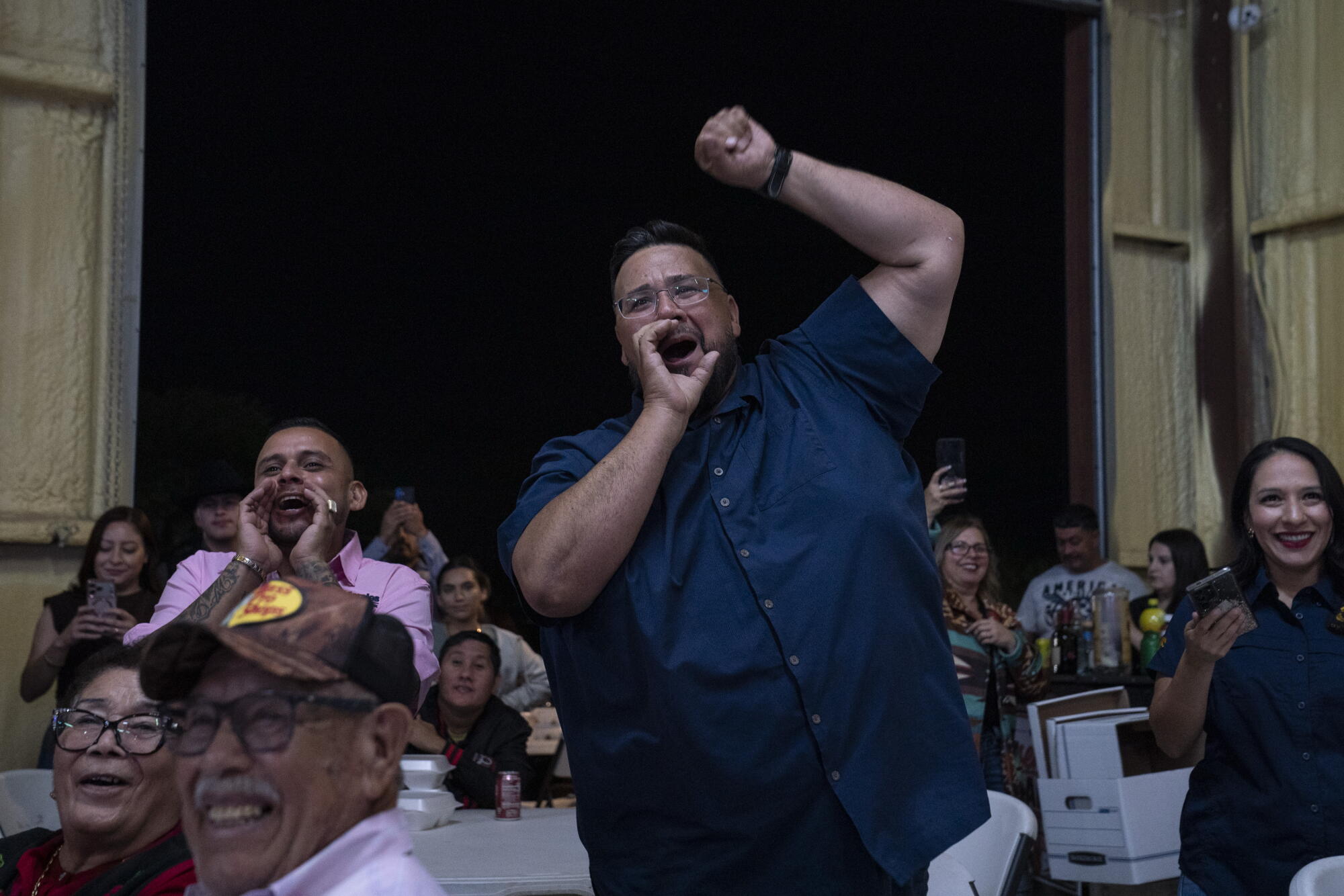
People cheer while listening to congressional candidate Bobby Pulido at an Oct. 16, 2026, rally in Mercedes, Texas.
In 2024, Trump won the support of 48% of Latino voters, expanding Republican gains with a group that has long leaned Democratic. Now, that support is cratering. The president’s approval rating among Latino registered voters has fallen to 24% from 38% at the start of his second term, polls show.
Among Latinos who voted for Trump, 65% say they plan to back Republicans on Nov. 3, while more than a third said they were ready to vote for a Democrat or were undecided, according to a Pew Research Center poll released this month.
More broadly, Latino voters favor Democrats in House races 51% to 24%, and those who sat out the 2024 election are leaning toward Democrats. Those shifts could help decide control of the House, in part because Republicans in Texas and Florida redrew their congressional maps betting that their 2024 gains among Latino voters would last through the midterms.
Bobby Pulido, a Latin Grammy winner and Democrat running for Texas’ 15th Congressional District, sings at the Bert Ogden Arena on Oct. 17, 2026, in Edinburg, Texas.
Nowhere is that test sharper than in the borderlands of the Rio Grande Valley, where voters say that Trump has failed to deliver on his economic promises and that his administration has gone too far on immigration enforcement, an issue they wanted addressed, but humanely.
In more than two dozen interviews in the Latino-majority region, voters say they are driven less by party loyalty and more by frustrations that they have been taken for granted, and want to elect politicians who take their votes seriously.
They say it has become harder to keep up with rising costs, including for the diesel that fuels their trucks and their weekly grocery runs. Builders say construction projects have ground to a halt as workers are detained or deported. And small-business owners say sales have dropped, either because customers are afraid to leave their homes or because tariffs have driven up their costs.
1
2
1.Sebastian Guevara, 65, poses for a photo at a political rally on Oct. 16, 2026, in Mercedes, Texas. “Trump forgot about Latinos as soon as he won,” he said.2.Luis Sustaita, 49, a mariachi musician who had voted Republican in previous years, says he will be voting for Bobby Pulido.
Nidia Olivarez, 48, and her husband, Arnulfo, 55, voted for Trump in 2024 but have grown frustrated with how he has handled the economy and immigration raids in their community. This year, they’re backing Pulido over GOP Rep. Monica De La Cruz in Texas’ 15th Congressional District. But not because they’ve had a change of heart about the Democratic Party.
“We are only voting for Pulido, not other Democrats,” Olivarez said. The couple are still unsure whether they’ll support any Republicans.
For them, the vote is personal. They’ve long loved Pulido’s Tejano music and like that he’s a familiar figure in their community. They trust him, she said. They’re less sure about the Republicans at the top of the ticket: Ken Paxton, the Senate nominee running against Democrat James Talarico, and Gov. Greg Abbott, who is seeking reelection.
“We want to see who continues to show up in the area,” Olivarez said. “That matters to us.”
People cheer during Tejano singer Bobby Pulido’s last song “Desvelado” during a concert in October in Edinburg, Texas.
Latino voters in Texas are increasingly willing to consider candidate over party, said Brandon Rottinghaus, a professor of political science at the University of Houston.
“They are not just looking for what party to align with. They want to know that they can trust the person they’re voting for,” Rottinghaus said.
That dynamic will play a role in the competitive races for Texas’ 15th, 28th and 34th congressional districts and in the Senate seat, which has proved to be one of the most expensive and high-profile contests this year. In a sign of GOP concerns, Trump and Vice President JD Vance have repeatedly traveled to Texas this month to rally voters.
In recent weeks, Trump has brushed off polls that show him losing ground with Latino voters.
“I think we are doing great, I won Hispanics,” Trump told reporters on Monday. “I’ve done more than any other Republican in history, I got tremendous Hispanics.”
In early October, Trump was asked about Latino voters who say they feel betrayed by his administration’s immigration and economic policies. His message to them was that “we have to do what we have to do,” in reference to his immigration crackdown.
1
2
3
1.People dance during Bobby Pulido’s concert. 2.A man rides his horse before a parade in support of Bobby Pulido on Oct. 17, 2026, in Edinburg, Texas.3.Bobby Pulido, in brown vest and white cowboy hat, upper left, takes a photo with rallygoers after speaking on Oct. 16, 2026, in Mercedes, Texas.
Gloria Rodriguez, a social worker in Edinburg, has seen the impact the immigration raids have had on children. Since Trump returned to the White House, she has helped coordinate services for hundreds of kids whose parents or caregivers have been detained or deported. She worries many of them will develop post-traumatic stress disorders.
“Everything they are doing with immigration is too much,” said Rodriguez, 50, who is voting for Democrats down the ballot. Her 15-year-old daughter, Angelina, says she told her mother to vote for Democrats, in part because she is scared her friends will be deported.
Luis Sustaita, 49, a mariachi who owns a music store that sells instruments to school districts, is voting Democrat this year because he says he is disheartened by the values of the modern-day Republican Party.
“There are no old-school Republicans anymore. It is all MAGA,” said Sustaita, who lives in Weslaco. “They used to be about the people. Trump is all about himself and making himself rich.”
In South Texas, Republicans and Democrats alike are trying to court voters on a more personal level. It is about identity more than political affiliation in many ways.
In the majority-Latino 15th Congressional District, Pulido’s campaign slogan is “Not team red, not team blue — South Texas I am team you.” In an interview, Pulido added that his message to Latino voters is: “I hear you loud and clear, and I believe I share values with you.”
Rodrigo Pulido, 6, with his mother, Mariana Morales, cheers as his father, Bobby Pulido, sings the last song, “Desvelado,” during his concert at the Bert Ogden Arena on Oct. 17, 2026, in Edinburg, Texas.
De La Cruz, a former insurance agent and a staunch Trump ally, said Latinos are “tired of being taken for granted” and said Pulido “has some nice records, but he’s a product of the same corrupt system that got rich and made us poorer.”
“I grew up in South Texas watching the compadre system steal from us while our families struggled to get by,” De La Cruz said in a statement. “You work hard and want a little more for your family and safe communities. I cut your taxes, protected Social Security and Medicare, stood with Border Patrol agents, and I’m fighting every day to bring down gas and grocery prices.”
Whether that message will resonate with voters will be seen on Nov. 3.
Tina Treviño, 61, said she hopes “la raza” — a term used in the Mexican American community that is widely understood as “the people” — will deliver political change to Texas. She says the system is not working for Latinos, and believes Democrats will be able to bring that change.
“It’s about Chicano power,” Treviño said. “We need that more than ever.”
LONG BEACH, Wash. — Tourist dollars are drying up in this small town at the edge of the Pacific Ocean. Foot traffic is down. Visitors have less to spend on souvenirs.
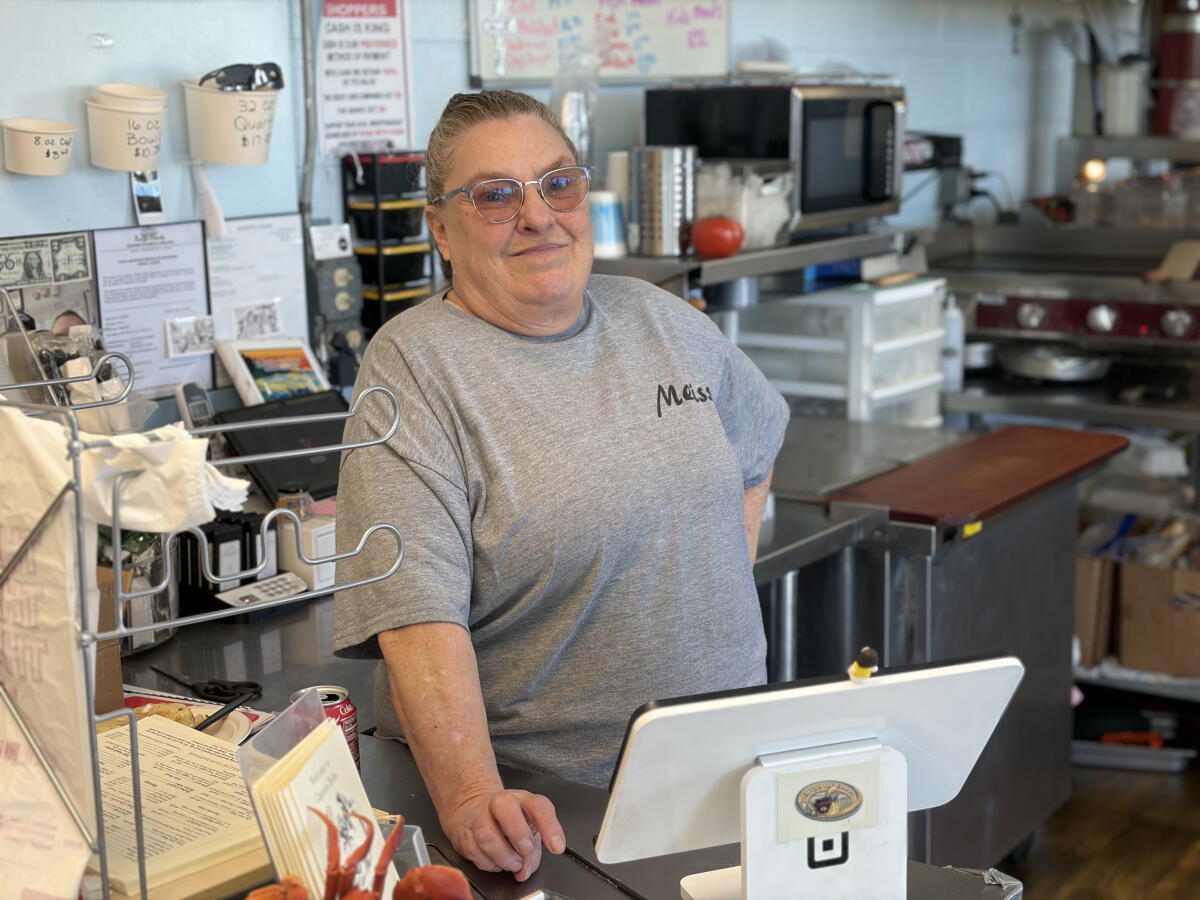
And beachgoers now bring packed lunches instead of stopping at Captain Bob’s Chowder Sisters, said Melissa Huddleston, waiting for customers at her sister-in-law’s shop on Sunday.
Huddleston, 60, is depressed about the state of the country, and while she’s planning to vote in the Nov. 3 midterms, she hasn’t decided who she’ll vote for. This swing district, Washington’s 3rd, is home to a tight congressional race that will help determine the balance of power in the U.S. House.
Huddleston doesn’t think anyone in Congress can really do what she wants: Bring decorum back to the national discourse and bring the economy back to life. She isn’t a particular fan of Rep. Marie Gluesenkamp Perez, the independent-leaning Democratic incumbent, nor is she persuaded by state Sen. John Braun, the Trump-endorsed Republican challenger.
“I don’t know which one is better,” Huddleston said, shaking her head. “I really don’t.”
Melissa Huddleston waits for customers at Captain Bob’s Chowder Sisters in Long Beach, Wash.
(Justine McDaniel/Los Angeles Times)
As the battle to persuade midterm voters intensifies in the election’s final stretch, its fever pitch is evident in places like this largely rural stretch of southwest Washington — a rare three-time Trump-voting district with a Democratic incumbent.
Republican-aligned groups are pouring money into flipping the district red, considering it one of the GOP’s best chances to gain a House seat in an increasingly unfavorable environment, while Democrats see retaining the district as urgent to their effort to secure control of the chamber.
The contest offers a glimpse into a purple region a time when both parties are testing strategies for winning voter loyalty — not just in the midterms but looking ahead to 2028. And the dynamic in the candidates’ race to capture swing voters reflects the national debate gripping both parties about how moderate to be.
As Democrats debate whether progressives or centrists should chart the party’s path, Gluesenkamp Perez has modeled an independent streak that has helped her win two elections but disappointed some in her own party. And as Republicans grapple with low public support for Trump, Braun has packaged his conservatism as balanced while assuring supporters that he’s rowing in the same direction as the president and party leaders.
Interviews with more than 30 voters across the district revealed a mix of support for the two candidates, largely based on partisan politics, views about Trump and concern with which party controls the House.
“This is a very pivotal time, and this area has a history of being more of a swing [district],” said Mark Maxwell, 46, of Vancouver, Washington, who planned to vote blue. “It’s a chance for our voice to be heard.”
A sign for Washington State Sen. John Braun, R-Centralia, is displayed among other campaign signs near I-5, Saturday, Oct. 10, 2026, in Ridgefield, Wash.
(Lindsey Wasson/Associated Press)
The number of congressional battlegrounds nationwide has shrunk with gerrymandering and political polarization, making the district one of about two dozen races that will decide the House majority. The West’s other highly competitive contests include three in California — those of Republican Rep. David Valadao and Democratic Rep. Adam Gray in the Central Valley and the open seat of retiring Republican Rep. Darrell Issa in the San Diego area.
In southwest Washington, polling has indicated the congressional race may be essentially tied. A late September poll commissioned by Oregon Public Broadcasting had Braun up by one point. A July Emerson College poll showed the same. Earlier this month, election forecaster Cook Political Report moved the race from a toss-up rating to lean-Democrat.
‘Stubborn loyalty’
Across the district last week, left-leaning voters said they were backing Gluesenkamp Perez — some precisely because of her maverick streak.
“She’s voted against the Democrats and I know she’s voted against the Republicans, which is what one would hope,” said Helios Ovando, 69, of Battle Ground, Wash., who decided this year to volunteer for Gluesenkamp Perez’s campaign for the first time. “She’s more about the local scene.”
Ovando has been turned off by what he sees as Republicans’ adherence to the party line; Gluesenkamp Perez’s willingness to “buck the system” gives him more confidence in her integrity, he said.
July 2026 photo of Rep. Marie Gluesenkamp Perez (D-WA)at a House Appropriations Committee hearing on Capitol Hill.
(Anna Moneymaker/Getty Images)
Gluesenkamp Perez, 38, who ran an auto shop with her husband before being elected to Congress, frames her mission as one built around the practical needs of her district. She argues that Democrats should break the Republican hold on rural districts and talks about reestablishing voters’ confidence that the Democratic Party is “listening to and reflective of working people.”
“When you have people come to Congress with a very stubborn loyalty to their communities, you get better federal policy,” Gluesenkamp Perez said in an interview.
“That’s the value of breaking up the monopolization of politics in rural America,” she added. “It gets you to a better place from a policy lens.”
She points to funding wins and work to mitigate pressures on public schools and housing costs in Congress. On Saturday evening, she talked to a crowd at a brewery about restoring shop class to junior high schools and creating measures that facilitate repairing rather than replacing electronics and appliances.
Gluesenkamp Perez’s independence has also earned her critics. She twice helped House Republicans advance their legislative agenda in September, angering Democratic leaders, and voted to fund the Department of Homeland Security in January. In each case, she said the packages contained secondary measures that aligned with her constituents’ values.
At a “No Kings” protest last weekend in Vancouver, the district’s urban center, several Democratic voters said they weren’t happy with Gluesenkamp Perez but still planned to back her.
Rep. Marie Gluesenkamp Perez, D-Wash., speaks during an interview at a canvass launch at Recreation Park Penny Playground, Saturday, Oct. 10, 2026, in Chehalis, Wash.
(Lindsey Wasson/Associated Press)
“I will vote for her even though I don’t like her policies,” said Carol Rochat, 71, of Vancouver. “We need all the Democrats we can get, at least to get the majority, and then we’ll still work on her to try to be a little bit more progressive.”
‘Win their trust’
Gluesenkamp Perez ran against a hard-right candidate in her first two races, but this time she’s facing a less-polarizing and better-funded opponent in Braun, 59, a business owner and former Navy captain who has represented a slice of the district in the state Legislature for 13 years.
He made his pitch to a group of supporters at Long Beach’s historic train depot, framing his mission as balancing out the state’s Democratic voices in Congress and helping government “get out of the way” of its citizens.
“That’s sort of the American dream,” he said. “Government doesn’t create success for each of us, but we can set the framework for each of us to go out and find whatever success means for us.”
Braun talks about reforming tax and energy policy, funding infrastructure improvements and backing the military. He argues for balancing the federal budget, envisioning doing detailed, line-level work to find cuts that will reduce the national debt.
“He’s in line with my thinking,” said Liz Glenn, 63, of Raymond, Wash., listing Christian values, support for law enforcement and “protecting children” as some of her top concerns. A retired bookkeeper who is concerned about immigration and wants to see the House seat turn red, Glenn said she viewed maintaining a Republican majority as critical.
“It’s the only way to protect our country’s growth,” she said, adding, “Without the Republicans fighting against the perversions of the world, there’s so much non-American value being brought in.”
May 2023 photo of Washington state Sen. John Braun speaking in Olympia, Wash.
(Karen Ducey/Associated Press)
Braun told supporters that Trump’s endorsement had helped bring in financial support for his campaign. But, like other Republicans across the country, he has tried to appear independent on issues such as the war in Iran, which Braun has said the United States needs a plan to end.
“This district is a very independent district. I think it gives an opportunity to go make your case directly with the voters and win their trust … regardless of what the national picture is,” Braun said in an interview.
Pattie Gray, 66, who chairs the county Republican Party and watched Braun stump at the train depot, said Braun’s legislative and military experience made her view him as a “natural fit” for the seat.
“We need somebody who’s representing us the way we want to be represented,” Gray said. “He sees what this state needs.”
Gray, who is running for a Pacific County commissioner seat, has been door-knocking for Braun and other local Republican candidates. She’s optimistic about the chances to flip the seat, though it’s not “a shoo-in,” she said.
“We have to work really hard,” Gray said of turning out voters. “We’ve only got a couple more weeks.”
Huddleston, at the chowder shop, didn’t cast a ballot in 2024, unable to stomach supporting either party. She is motivated to vote this time because she wants to back a local Republican sheriff, whose campaign sign hung on the shop door.
But she’s upset with Trump’s brand of political divisiveness and where it has taken the country. She would prefer a Democratic majority in Congress, she said, to see if they can help fix the economy.
That might, Huddleston mused, lead her to support Gluesenkamp Perez when she fills out her ballot. But if so, it won’t be with gusto.
“Our country is horrible now,” Huddleston said. “How can you be enthusiastic about an election?”
United States President Donald Trump has long touted himself as a political outsider, someone who would expose the elites’ abuse of power and shift government focus from far-off conflicts to problems at home. Phrases like “drain the swamp” and “America first” have proved to be powerful rallying cries, sparking a whole cadre of “Make America Great Again” (MAGA) Republicans.
Halfway through his final term as president, though, Trump has backpedalled on many of those ideas, cosying up to the ultra-wealthy, sidelining investigations into convicted sex trafficker Jeffrey Epstein, and launching an ongoing war with Iran.
Recommended Stories
list of 3 itemsend of list
That about-face appears to be having a real impact on Republicans running in the US midterm elections in November, said Rina Shah, a geopolitical adviser and strategist and a former senior GOP congressional aide.
“In competitive races, some are quietly distancing,” Shah said, adding that they are “talking about gas prices, local issues, or [saying] ‘I’m focused on my district’ – because the Iran war and the Epstein drip are already showing up in attack ads and soft polling.”
Here’s what you need to know about whether the Republican Party has softened its stance on these issues.
Which Republicans have broken with Trump over the Epstein files?
During his 2024 presidential campaign, Trump said he would declassify troves of files kept by the Federal Bureau of Investigation (FBI) about Epstein and his global network of contacts. Trump’s future cabinet members, too, were enthusiastic about this, with Kash Patel, now head of the FBI, saying it was time to “put on your big boy pants and let us know who the pedophiles are”.
Yet a few months after taking office, Trump began dragging his feet, sparking a backlash from influential MAGA figures. Trump began calling the entire issue a “hoax” and saying Republicans were being duped by Democrats into calling for an investigation into Epstein’s network.
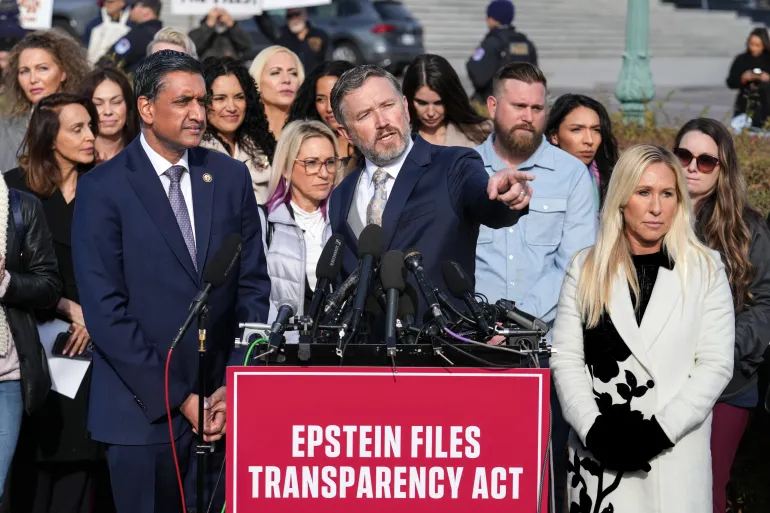
US Congressional Representatives Ro Khanna, Thomas Massie, and Marjorie Taylor Greene speak during a news conference as the US House of Representatives prepares to vote on the Epstein Files Transparency Act, at the US Capitol in Washington, DC, the United States on November 18, 2025 [File: J Scott Applewhite/AP]
Congress did eventually force the release of the files, with help from a handful of Republicans who broke with Trump. The Trump administration has released batches of the heavily redacted files, but has continued to withhold some. Meanwhile, all the Republican lawmakers who voted to mandate releases have paid a price for their insubordination, with three even losing their offices.
US Representative Marjorie Taylor Greene left her Georgia seat in January 2026, after publicly clashing with Trump over Epstein. Nancy Mace, a Republican from South Carolina, lost her bid to become the party’s candidate in her home state after Trump refused to endorse her. Colorado’s Lauren Boebert barely won the primary in her own contest after angering Trump by supporting calls for transparency from Thomas Massie, another Republican bent on exposing what the files held. Massie, of Kentucky, also drew Trump’s ire, which likely cost him the primary.
Republican presidential nominee Donald Trump participates in a fireside chat with media host Tucker Carlson at the Desert Diamond Arena, in Glendale, Arizona, the US, October 31, 2024 [File: Brendan McDermid/Reuters]
No more foreign wars?
Trump had long said he would be reducing foreign military involvement, breaking with the interventionist tendencies of other recent Republican presidents. Now he and his party face tough questions about the US-Israel war on Iran, which influential figures in the MAGA movement like political commentator Tucker Carlson have called a mistake, saying, “This is Israel’s war. This is not the United States’ war.”
Amongst disgruntled MAGA supporters, a narrative has emerged of Trump using the war to also distract from the Epstein issue. Massie, the former congressman, summed up the sentiment by saying, “Bombing a country on the other side of the globe won’t make the Epstein files go away.”
Trump has tried to downplay the war’s impact, but voters, even in the Republican Party, think he broke his own promise, driving the overall approval rating for the ratings-obsessed president down to record lows. “Seven months into an open-ended campaign with shifting goals,” said Shah, “that promise looks different to a lot of his voters.”
Few Republicans, however, have responded to that public sentiment with their votes in Congress, where Democrats have tried repeatedly to curtail Trump’s war on Iran by passing resolutions pointing out he failed to get the body’s approval.
In September, just seven Republican House members joined Democrats to pass an anti-war bill. In the Senate, similar efforts have been supported by just a handful of Republicans. Trump called the Republican lawmakers supporting the anti-war bills “unpatriotic,” and said, “They should be ashamed of themselves.”
As with the Epstein files, Trump took action against rebellious Republicans over the Iran war, for instance backing a rival of Senator Bill Cassidy, who voted in favour of the anti-war bill, in a primary in Louisiana that the Republican senator ended up losing.
What happened to Trump’s promise to “drain the swamp”?
One of Trump’s most appealing promises had been to purge the government of a “deep state” establishment he says is running the country without being accountable to the public on social issues, and fiscal and foreign policy.
Priscilla Chan, Meta founder Mark Zuckerberg, Lauren Sanchez, Amazon founder Jeff Bezos, Google CEO Sundar Pichai and Tesla CEO Elon Musk attend Donald Trump’s inauguration ceremony on January 20, 2025 [Chip Somodevilla/POOL/AFP]
In a way, Trump did keep that promise. An entire federal government division – the Department of Government Efficiency (DOGE) – forced tens of thousands of federal workers out of their jobs and dismantled institutions like the US Agency for International Development (USAID). The military threw out notions of racial, gender, and economic diversity. Everything from universities to the Smithsonian Institution was subjected to a campaign against an unqualified, diversity-obsessed elitist class.
But lobbying groups, including some supporting foreign governments, have been given a free hand, and ethics rules and watchdogs who would tackle political corruption have been weakened, said Shah, the Republican strategist.
At his presidential inauguration, Trump literally surrounded himself with the wealthiest people in the world, some of whom have gone on to play some part in his administration.
TOPEKA, Kan. — At 94 years, the Kansas GOP’s streak of one-party dominance in Senate races is the nation’s longest because even in the toughest years, disaffected Republican-leaning voters have reliably drifted back to the party’s fold before Election Day.
But Republicans fear this year could be different, setting the race between Republican Sen. Roger Marshall and Democrat Adam Hamilton on track to be the most expensive in state history.
Hamilton, founder and senior pastor of the nation’s largest United Methodist church, has raised significantly more money than Marshall, who is seeking his second term. Hamilton’s candidacy — and voters’ disapproval of President Trump’s handling of the economy — have upended GOP hopes of seeing Marshall coast to victory as the GOP tries to hold its Senate majority.
Kansas, which Trump carried in three presidential races, is an unlikely Senate battleground. Republicans redirected money from the North Carolina Senate race to help Marshall, and Trump flew to Kansas this week to hold a rally for him, calling Marshall “one of the greatest senators in our country”.
Stalwart GOP voters sensed a serious threat even before Trump announced his rally.
In Topeka, 81-year-old Julie Adamson has been praying about the election, but she’s also knocked on doors for Marshall, about 200 by her count. She said if Hamilton wins and Democrats control the Senate, “We’ll see, ‘impeach, impeach Trump.’”
“And nothing will get done for our country,” she added.
A formidable candidate emerged in a tough year for the GOP
Before entering the race, Hamilton already had a public profile in vote-rich suburbs through building his Kansas City-area Church of the Resurrection into a 25,000 member congregation. Churchgoing Protestants also knew him as the author of several dozen books, and he’s honed his speaking skills through weekly sermons.
Hamilton has positioned himself as a moderate and made rising prices, particularly for fuel, a key issue. During a debate Wednesday, both he and Marshall endorsed barring transgender girls and women from female sports teams. Hamilton called for local officials to make such decisions but suggested Marshall and other Republicans have been bullying transgender people by making the issue prominent in campaigns.
Marshall, a mostly retired doctor, portrays Hamilton as too liberal — radical, even — for a state where less than 26% of the 2 million registered voters are Democrats, while more than 44% are Republicans.
During Wednesday’s debate, Marshall repeatedly said a Hamilton victory would put Democrats in charge of the Senate and that Hamilton would vote with liberal Democrats.
“We need to remind everybody that control the Senate goes through Kansas,” he said.
There are signs that voter enthusiasm is with the Democrats as advance voting has surged across the U.S. compared to the last midterm. In Kansas, it has more than doubled for the same period.
Amanda Chavez Thomson, who is part owner of a small home-restoration business, said she believes change has been needed “for quite some time.”
“I think we finally have a candidate that can give us that energy and that surge that we need from people who may be on the fence or may not have voted in the past,” she said.
Fundraising emerges as a key concern for Republicans
Since the state’s August primary, Republican groups have committed to spending more than $26 million on television and digital advertising to boost Marshall, more than what they spent in his first race in 2020, according to the ad-tracking firm AdImpact. Including Marshall’s campaign, total GOP ad spending would exceed $32 million.
But Hamilton and Democratic groups together have committed to spending more than $38 million, according to AdImpact. Total ad spending — involving more than 40 groups outside the campaigns — would be about $71 million, a record for Kansas.
One of the reasons the GOP is pushing money towards Marshall may be that the incumbent has proven a lackluster fundraiser. Between the state’s August primary and Thursday, Hamilton has collected more than 10,000 contributions from Kansas residents, while raising $8 million from across the U.S., online campaign finance reports show. Marshall has about 200 contributions from Kansans while raising $905,000 total.
“People are crying out, saying, ‘Come on, Roger Marshall, speak up for us,’” Hamilton said during Wednesday night’s debate.
Marshall talking about liberal Democrats and ‘wokeness’
Marshall’s campaign and GOP groups have tried to knock any shine off Hamilton’s public image by attacking how he’s led his church and using snippets of his own sermons to portray him as too “woke.” During Trump’s rally, Marshall called Hamilton “the most radical liberal Democrat to ever get through a Senate primary in the history of Kansas.”
But such attacks aren’t resonating with at least a few disaffected Republicans. Don Hineman, a western Kansas rancher and former GOP state House majority leader, said he’s tired of “woke” being as an insult.
Hineman, who has signed on to the Republicans for Hamilton group, added that no one “was more ‘woke’ than Jesus Christ.”
Democrats have countered with television ads over Marshall’s pursuit of unpaid patient bills from the practice as an obstetrician that he gave up a decade ago. State court records online show that from 1996 through 2016, Marshall or his practice filed at least 700 debt-collection lawsuits, occasionally 10 or more a day.
The New York Times first reported the extent of the litigation. It said that in 81 cases, patients were arrested for missing court dates and quoted two experts who called Marshall’s tactics extreme. During Wednesday’s debate, Marshall said he’s faced a “gross mischaracterization” of his actions.
History and loyalty have been key assets for the Kansas GOP
Democrats can hold out hope for a Hamilton victory because the state has sizable blocs of moderate Republican and independent voters who’ve regularly swung elections to their candidates for governor and who protected abortion rights in a statewide vote in 2022.
Yet Republicans still have two key assets: Kansas’ political history and the loyalty that even unhappy Republican-leaning voters show to the party.
Not only have Democrats lost every Senate race in Kansas since 1932, no Democrat has come within 10 points of winning since 1974. In both 2014 and 2020, races considered tossups in mid-October fizzled, and Marshall’s predecessor, Republican Sen. Pat Roberts, won.
Leroy Towns, a former Roberts chief of staff, said many Republicans in 2014 who considered voting against Roberts “just couldn’t do it.” Towns — who switched parties because of Trump — is backing Hamilton.
Towns believes Hamilton will win, but added, “That Republican pull at the end of an election is really, really strong in this state.”
Hanna and Cappelletti write for the Associated Press. Cappelletti reported from Washington. AP writer Nicholas Ingram in Topeka, Kan., contributed to this report.
What role will the Latino vote have in the upcoming midterm elections?
In the latest episode of “The De Los Podcast,” hosts and Times editors Fidel Martinez and Suzy Exposito welcome Times columnist Gustavo Arellano to dissect the increasingly important electorate, one that will help decide races locally and at the national level.
Long considered a reliable vote for the Democratic Party, Latinos shifted rightward in 2024.
“The Republican Party has always known — going back to the days of [President Dwight D.] Eisenhower — that there is something there in this demographic as it starts getting bigger,” Arellano said.
Arellano documented the history of Democratic support among California Latinos, highlighting the passage of 1994’s California Proposition 187 — which prohibited undocumented immigrants from using the state’s public services including non-emergency healthcare and education resources — as a turning point.
“It turned a whole generation of Latinos into voting Democrat, but it also showed the Republican Party that anti-immigrant politics work,” he said. “The problem with the Democratic Party in California for basically the next 30 years is all they would do is say, ‘You as a Latino should never vote Republican because they did 187.’”
A Pew Research Center study showed that in the 2024 presidential election, a slight majority of Latinos voted for former Vice President Kamala Harris — but they also voted for President Trump at a much higher rate than they did in 2020.
Trump garnered 48% of the Latino vote compared with Harris’ 51% share and significantly jumped past the 36% clip he received in the 2020 presidential election. The study’s results reveal that the initial 2024 exit polls actually underestimated Latinos’ Trump support, with the Republican candidate tracking at 46% of the Latino vote on election day.
Arellano contributed this shift in voting pattern to a lack of effective messaging from Democrats and widespread material hardships among Latinos.
“[You now have] an entire generation who have grown up and life has been harder for them because they are working-class folks,” he said. “And they’re saying, ‘The Republicans are racist? Well, life hasn’t improved for me as a Democrat, let me just take my chance with the racist.’”
But recent polling shows Latinos might have buyers’ remorse. The community cited increased cost of living, immigration tactics, involvement in wars across the world and a struggling economy as reasons for retreating from Republican leadership. Trump’s approval rating among Latinos dipped to 27% in an early October NBC News study. That same poll found that Democrats have a 24-point lead on whom Latino voters want to see in control of Congress.
“The Republican Party was given this extraordinary gift of the Latino vote, and what did they do? They blew it,” Arellano said.
He spotlighted Texas as a prime of example of how Republicans squandered their grip on Latino voters. The demographic voted heavily in favor of Trump in 2024, even in the long-Democratic borderland region of the state.
“Texas [Republicans] gerrymandered their state because they thought, “We have now this permanent Latino shift to our party, so let’s make these districts even more Latino because they’re going to vote Republican,’” Arellano said. “And now Latinos are running away [from the Republican Party] hard.”
Across the country, Latinos have also soured on the Republican Party due to the public display that Immigration and Customs Enforcement officers have put on in recent years, Arellano noted.
“To see people dragged and beaten … that weighs on you,” he said. “On top of that, the economy sucks, we’re in a stupid war, this president is increasingly saying crazy things … and now this immigration stuff. So [people are wondering] what good is it to be with [Trump] now.”
Vice President JD Vance declined Monday to endorse Israeli Prime Minister Benjamin Netanyahu for reelection a day after President Trump endorsed the embattled Israeli leader.
“The president has the most influential endorsement in American or international political history,” Vance said during an interview with journalist Mark Halperin.
“I endorse American candidates, and that’s where I’m focused on the midterms,” Vance said, while traveling Monday to campaign for Republican Senate nominee Michael Whatley of North Carolina. “So, I’m not getting involved in Israeli elections.”
Vance has campaigned for a foreign leader — then-Hungarian Prime Minister Viktor Orban, last spring before the right-wing leader’s party lost that country’s parliamentary election.
Vance’s deference to Trump on Netanyahu comes at an extraordinarily sensitive time for Jewish Americans and the U.S. alliance with Israel. Concerns about antisemitism have surged across the political spectrum ahead of the midterm elections.
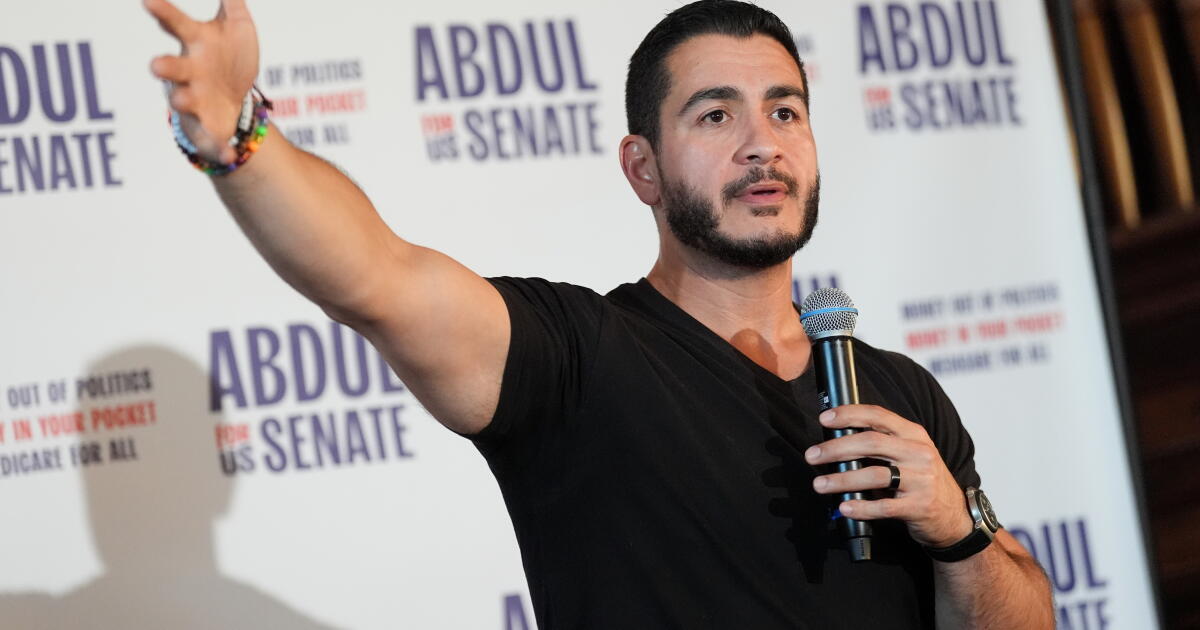
Republicans have been eager to portray Democrats, notably Michigan Democratic Senate nominee Abdul El-Sayed, as hostile toward Jews and Israel, while they deal with their own internal schisms.
Vance has faced skepticism from Jewish Republicans about his commitment to Jewish Americans and the U.S. alliance with Israel.
Last month, Vance spoke privately in Las Vegas to the Republican Jewish Coalition, a leading GOP group committed to advocating for a strong U.S. relationship with Israel and against antisemitism.
Vance left a positive impression on his RJC audience while stopping short of disavowing influential conservative podcast host Tucker Carlson.
Vance has faced general questions about his association with Carlson, a former Fox News host who faced backlash last year for interviewing antisemite Nick Fuentes on his podcast.
In June, Vance sharply criticized members of Israel’s government for opposing Trump’s efforts to resolve the war with Iran.
In July, Vance said elements of the Israeli government had tried to influence American sentiment to derail negotiations.
“There are some people within their system that we know beyond a shadow of a doubt are manipulating and trying to change American public opinion to keep the war going on indefinitely,” Vance said during an appearance on Joe Rogan’s podcast.
WASHINGTON — President Trump is hoping that $5,000 checks can juice Republican turnout in November’s midterm elections — but even some of his devoted fans are doubting that government payouts would arrive.
“I mean, I guess it’s good for some people. I really don’t care,” said Jamie Alvarez, who attended Trump’s recent Alaska rally in a red, white and blue outfit. “I don’t feel like your vote should be bought. I feel like you should vote for who you feel is going to do the best job.”
Joseph Eatherton was attending that same rally and said he was “not sure if it’s necessary.” When asked whether Trump could deliver on the promised money, he said, “I don’t know, and I hate being an armchair quarterback.”
The offering of government checks has become a go-to tactic for Trump when he faces a political jam. He’s previously endorsed $2,000 in dividends from tariff revenues and large refunds from spending cuts achieved by the Department of Government Efficiency, neither of which materialized. The latest example could reveal how much voters still trust Trump as they decide control of Congress in the midterm elections on Nov. 3.
Staunch supporters such as Lucy Martinez, the president of a Republican women’s club who attended a recent Trump rally in Texas, said there’s no doubt in their minds.
“I think that I will get the $5,000,” she said. Out of all the presidents, Trump is someone “who kept his promises to his people and all the United States.”
Trump has dished out payments as elections approach
However, many voters are already embittered by his economic leadership. His critics see a president who failed to tame inflation and keep America out of overseas conflicts, and whose agenda has fueled higher prices as the war with Iran appears to be at a stalemate.
“The trust on this is already gone for most people,” said Amy Frederiksen, a former Republican Minnesota Senate majority leader who now runs a public affairs firm.
“I just don’t see the energy around that line,” she added. “Most people know that’s a blatant over-the-top promise like several he’s made in the last couple of years, and they’re not buying it.”
As the midterms approach, Trump has also pledged a $90 payment to 20 million Medicare enrollees and $500 “rebates” for people the administration says were overcharged for their Obamacare plans. He has automatically enrolled every U.S. child in “Trump accounts” to invest in stocks.
The $5,000 payouts would only occur, Trump says, if Republicans keep their majorities in the House and Senate. Trump acknowledges that the cost would exceed $1 trillion, but it’s not clear that the White House is seriously engaging with the proposal’s ramifications, from the increased deficit to the likely boost to inflation.
The White House said the payments are possible because of Trump’s trade deals, investment commitments by foreign countries, government stakes in private companies and deals for oil and minerals.
The administration’s position is that the payments will help people recover from the inflation that began in 2021 under then-President Joe Biden, though Republicans, at the time, attributed that inflation to excessive government checks tied to pandemic relief.
When The Associated Press asked several weeks ago if the administration was modeling the economic impact from the checks, Christopher Phelan, chairman of the White House Council of Economic Advisers, said he would “refrain” from answering.
Roughly half of registered voters say Donald Trump does not keep his promises to Americans, according to an AP-NORC poll from September. About 3 in 10 say Trump tries to keep his promises but is unable to, while only about 2 in 10 say he keeps his promises.
Republican voters are more accommodating. About half say Trump tries to keep his promises but is unable to, and about 4 in 10 say he keeps his promises.
Trump is talking about the payments as a sure thing.
“If the Republicans win, you’ll each have $5,000 in your pocket and economic success for our country like we have never seen before,” he said at a Saturday rally in Kentucky. “And remember, ’cause they like to say, ‘Oh, well, maybe he won’t do that.’ Uh, I always do it.”
Campaign spending tracked by AdImpact suggests that Republicans are not running advertisements either on television or online about the promise. The few advertisements that do exist are from pro-Democratic groups such as Rolling Sea Action Fund that conclude with the voiceover, “Come on, do you really think he’s sending you a check? Yeah, right, we won’t get fooled again.”
At a Friday rally in Georgia, Trump noted that he had previously delivered a $1,776 “Trump dividend” to troops in the military. But those payments came from a congressionally approved housing supplement.
Trump claims the nation could not afford the payments if Democrats hold a chamber in Congress because the nation would be “flat broke.” But he said that one caveat is that the money could only be spent in the U.S., rather than in China, Japan or France. He joked that people should spend the check at his luxury club in Palm Beach, Florida.
“Let’s have lunch at Mar-a-Lago, where for $5,000, you’ll get one hamburger and a small dessert,” he told the crowd in Georgia.
Some in the crowd took Trump at his word that he would fight to get them the money. But they added the caveat that if he didn’t come through, it would not be his fault.
“I could use $5,000,” said Mike Boatman, a 58-year-old from Evansville, Indiana, who travels the country attending the president’s rallies. “I mean, he’s done everything he’s said he’s going to do.”
Boak, Bohrer and Barrow write for the Associated Press. Bohrer reported from Wasilla, Alaska, and Barrow reported from Dalton, Georgia. AP reporters Aaron Kessler and Linley Sanders in Washington and Lekan Oyekanmi in San Antonio, Texas, contributed to this report.
WASHINGTON — Asian Americans, Native Hawaiians and Pacific Islander adults have become more disillusioned with President Trump and Republicans as the Nov. 3 midterm elections approach, according to a new AP-NORC/AAPI Data poll, giving Democrats a substantial edge on major issues like the economy and health care.
About one-quarter of AAPI adults approve of the way Trump is handling his job as president overall. Only about 2 in 10 approve of his performance on the economy, which the vast majority of AAPI adults see as one of the most important issues for the upcoming election.
But although AAPI adults trust Democrats more than Republicans on a wide range of issues, views of the Democratic Party itself are still split.
Rebecca Larocco, a 45-year-old Korean American in Corning, Iowa, voted for Trump in 2016 and is leaning Republican in the midterm elections. She approves of his immigration policies but is unsure about Trump’s handling of the economy as the Iran war continues to compound gas prices.
“Where I’m at, it’s went up almost $1.50 (a gallon),” she said. “I didn’t expect to go into war at all, that has been definitely unexpected and I’m not sure… I’m just hoping they’ll do what they’re saying and get our economy back on track, get immigration and crime lowered.”
The economy is a top issue for AAPI adults
The economy remains top of mind for an overwhelming majority of the AAPI adult population when they consider the midterms. With the ongoing Iran war affecting gas prices and other costs staying elevated, Americans overall are deeply pessimistic about the state of the economy and see it as a high priority for the midterms. That includes AAPI adults — according to the poll, about 9 in 10 rank the economy as one of the most important issues for the upcoming election, and about 8 in 10 say this about the cost of living.
The economy, the cost of living and healthcare dwarf other issues for AAPI adults. About 7 in 10 AAPI adults say healthcare is one of the most important issues for the election, while only about half say this about foreign policy, crime, immigration, election fairness or climate change.
At the same time, Trump’s economic approval among AAPI adults has dropped about 10 percentage points over the course of the year, and there are other signs his popularity has waned with this group. In late 2024, just after the election, about 4 in 10 AAPI adults had a “somewhat” or “very” favorable view of Trump. That’s fallen to about 3 in 10 now.
“What the data show is that any gains that he made not only during the 2024 election — there was a bit of a honeymoon period that Trump enjoyed after the election before Inauguration Day — that has now largely disappeared,” said Karthick Ramakrishnan, founder and executive director of AAPI Data.
Len Takahashi, 57, of Universal City, Texas, describes himself as conservative but voted for Democrats in the last three presidential elections and for Republicans in midterm elections. For this midterm election, he is simply open to candidates who prioritize the economy.
“I would like policies that look in the best interest of the American public,” said Takahashi, who is Japanese American. “That could be bringing down spending, a balanced budget of U.S. spending, bringing down inflation, working towards a more stable economy and, lastly, just a better atmosphere between the far left and far right.”
AAPIs trust Democrats more on most issues but are not entirely sold on the party
Democrats have gained at Republicans’ expense since Trump returned to the White House when it comes to AAPI adults’ trust in handling many key issues.
In a March 2025 poll, AAPI adults were evenly divided over which political party would better handle the economy and immigration. Now, Democrats have a roughly 20-percentage-point advantage on both issues.
Meanwhile, around two-thirds of AAPI adults have a “somewhat” or “very” unfavorable view of the GOP. Only about one-quarter have a “somewhat” or “very” favorable view.
But while trust in the Democrats on specific issues has increased, AAPI adults are ambivalent about the party as a whole. About half, 48%, of AAPI adults have a “somewhat” or “very” unfavorable impression of the Democratic Party, while 44% have a “somewhat” or “very” favorable impression.
A separate AP-NORC survey of registered voters in September found, similarly, that while voters in general are deeply dissatisfied with Trump and the GOP, few think either party is capable of solving important problems.
Louise Rider, 40, is a Democrat living in Chicago. She believes Democrats are better than Republicans across all issues but says she’s unhappy with how the party has governed.
“I don’t think the Democrats are doing great, I think they need a lot of change as a party,” she said. “It’s kind of a helpless feeling, that nothing will get done with both parties unless there’s major changes.”
Some Republicans still stand behind Trump. James Finley, 74, of Lenox, Massachusetts, said Trump deserves some understanding because he cannot bring down high prices overnight. When it comes to Republicans in general, Finley is a little more critical.
“They’ve had the majority for a couple of years,” said Finley, whose ancestry includes Japanese heritage. “I think they could have done a little bit more or maybe a lot more in terms of passing certain things that I wanted to pass.”
Still, he sticks to the party line and because “all I ever hear from Democrats is to get Trump,” Finley said.
AAPIs concerned about fair midterm elections
As the election approaches, many AAPI adults are worried about problems with misinformation, legal challenges to the results, and voter suppression. About half of AAPI adults say it’s a “major problem” in U.S. elections that people who are eligible are not allowed to vote, while about two-thirds see foreign government attempts to influence results as a “major” problem.
Looking ahead to the November election, about half of AAPI adults are “extremely” or “very” concerned about fake or false information about the candidates, and about half also feel this way about legal challenges to the election results.
Finley is unsure if the voting process can be tightly monitored to prevent undocumented or unregistered people from attempting to vote.
But Takahashi, the conservative from Texas, is worried that Trump will try to manipulate the election.
He’s concerned, he said, that Trump would amplify claims of “fraud in the election system” should the midterms not go in his favor. “(He’ll) make that a point to distract the American public,” he said.
Tang, Jiang and Sanders write for the Associated Press. Tang reported from Phoenix and Jiang from New York. The poll of 1,023 U.S. adults who are Asian American, Native Hawaiian and Pacific Islander was conducted Sept. 8-15, using a sample drawn from NORC’s probability-based Amplify AAPI Panel, designed to be representative of the Asian American, Native Hawaiian and Pacific Islander population. The margin of sampling error for all respondents is ±4.7 percentage points. This poll is part of an ongoing project exploring the views of Asian Americans, Native Hawaiians and Pacific Islanders, which are usually not highlighted in other surveys because of small sample sizes and lack of linguistic representation.
BANGOR, Maine — Ever the optimist, Speaker Mike Johnson said he believes Republicans will hold on to their U.S. House majority, defying a surge of Democratic momentum in the final stretch of the midterm elections that will determine control of Congress.
It’s the crowds he says he’s seeing as he crosses the country campaigning for GOP candidates. The caliber of recruits and incumbents he calls workhorses, not show horses. And the nearly half a billion he has raised for House Republicans.
He also has faith.
“We run to win, and that’s biblical: You run to win,” he told the Associated Press during a campaign stop in Maine.
“And I believe that we will.”
House Speaker Mike Johnson, right, applauds along with President JD Vance as President Trump delivers his State of the Union address during a joint session of Congress in February in Washington.
(Andrew Harnik / Getty Images)
The speaker of the House is one of the most consequential elected officials in the United States, second in line of succession to the president. While Johnson quipped to Fox News recently that he may return to his hometown of Shreveport, La., to start a lawn care business if Republicans lose power on Nov. 3, he fully expects to buck an American midterm tradition that often sees the president’s party dumped in Congress.
It can be said that Johnson, who has drawn so close to President Trump that he routinely fields 1 a.m. calls — they spoke the night before as Trump rallied in Alaska — walks on the sunny side of the street. That’s despite voter frustration over high prices and the Iran war, and his own challenge of leading one of narrowest House majorities in modern times.
In his three years as speaker, Johnson has pushed past the doubters and naysayers, holding his thread-thin GOP majority together to deliver Trump’s agenda. He notably led passage of the big tax breaks and social service cuts bill. Most days he does not have a single vote to spare.
“So many times everybody had written off, there was no way he was going to be able to pull off a particular vote,” said Republican Rep. Mark Harris of North Carolina, who joined the speaker on the campaign swing. “Yet he always seems to pull out the win in the end.”
In the interview, Johnson did not speak brashly about expanding the House majority on election day, as he has in the past. But on track to visit more than 20 states and 40 congressional districts though November, he said the political mood reminds him of the 2024 election that swept Republicans to control of Congress and the White House.
“It’s not going to be a giant majority,” he said. “But I genuinely believe that we will have a working majority.”
Emboldened by Trump
Johnson first fell into the speaker’s job almost by accident, a desperate choice by his GOP colleagues after a contingent of renegade Republicans ousted his predecessor, then-Rep. Kevin McCarthy of California in 2023.
Johnson had been a lower-level member of House leadership, but distinguished himself before the Jan. 6, 2021, attack on the Capitol by organizing support for Trump’s false claims of widespread fraud in the election that he lost to Democrat Joe Biden.
In the time since, Johnson has secured proximity to Trump’s power. He joined Trump at a UFC fight in New York and once gifted the president a speaker’s gavel as Trump signed the “One Big Beautiful Bill” into law. It was a symbolic act, but one that critics saw as giving away the authority of a coequal branch of government.
More recently, Johnson abruptly sent lawmakers home early rather than face a vote forced by Republican Rep. Thomas Massie of Kentucky to impeach Defense Secretary Pete Hegseth as lawmakers tried to halt the Iran war, which has not been authorized by Congress.
Over coffee in Bangor, after rallying for House candidate Paul LePage, a former governor, Johnson brushed back criticism that Congress has eroded under his watch as Trump works to amass executive power.
“Absolute nonsense,” Johnson said.
“We did not yield Article 1 authority to the president,” he said, referring to the powers spelled out in the Constitution. “We used our own,” he said, to muscle GOP priorities past Democratic opposition.
Trump agenda at risk
Johnson has focused the election on Democrats he portrays as “communists.” A handful of far-left liberals, backed by the Democratic Socialists of America, are on the ballot.
Rep. Hakeem Jeffries of New York, the House Democratic leader who is in line for the speaker’s gavel if his party sweeps to power, is preparing a first-100 days agenda for when the new Congress convenes in January, if there is a change in control.
What the Republicans will do if they retain power is less defined.
“Lots of plans,” Johnson said, “along the same course of what we’ve been doing — less taxes, less regulation.”
Trump “wants to go big for his legacy,” he said. “We have big things on the horizon that we can do.”
The president has essentially purged the House GOP ranks of those perceived to be disloyal. Among them are Massie, who lost his primary, and Marjorie Taylor Greene of Georgia, who retired early after breaking with Trump over release of the Jeffrey Epstein files.
Pressed how he would keep Republicans in line, Johnson said he is preparing to change the House rules if he returns as speaker.
“There’s going to be some changes that are going to make the machinery work smoother,” he said.
Praying for the speaker, and the country
Faith has often been strong among House leaders. Two former speakers, Nancy Pelosi and Newt Gingrich are Catholics, as is John Boehner, who invited Pope Francis to address Congress.
Johnson, a former constitutional lawyer who was first elected alongside Trump in 2016, is expected to win his own reelection next month.
“My faith is a huge component of how I think and how I act and what I do,” said Johnson, who led a public prayer on the National Mall as part of the nation’s 250th anniversary.
He is drinking lots of coffee these days, he said, cutting back on the Celsius, and still has 1,413 unread text messages, a slight dip from the frightful number reported a few months ago by the Wall Street Journal.
One text is from someone praying for him.
Johnson said he is grateful for the outpouring of prayers he receives, for him and the country.
“I pray for God’s will. And I believe God’s will is for us — and not the communists — to be in charge of America,” Johnson said.
“And it does say in the New Testament, you run the race to win,” he said, citing 1 Corinthians 9:24. “This is a biblical admonition. So we will.”
McALLEN, Texas — On a quiet corner of downtown McAllen, past shops selling quinceañera gowns and perfumes, about 30 people trickled into a small brewery on Wednesday evening to watch James Talarico, the Democratic Senate nominee in Texas, take questions from voters in a CNN town hall.
With beers and tacos, they gathered in front of a large projector screen. Karyme Segura, 18, sat at the front, listening closely as Talarico said federal immigration agents should be going after violent criminals, not “terrorizing our communities” and breaking up families.
Segura clapped. The message was personal to her. A day earlier, her stepfather had been deported to Mexico. Since his detention, her mother has been afraid to leave the house, she said. Now Segura has turned to politics, hoping to change the conditions that have left her family fractured and rattled.
“I just have to do something,” Segura said. “I am hoping that after the election my mom will feel more secure. That if Texas turns blue, Trump will feel threatened.”
Segura is the kind of voter Democrats are counting on as Talarico, a state representative from Austin, tries to defeat Ken Paxton, the state’s Republican attorney general, to become the first Democrat to win a statewide race in Texas since 1994. The race could decide control of the Senate, and has become one of the most high-profile and bitterly fought contests this year.
Talarico, a former teacher and Presbyterian seminarian, has courted voters with a populist economic pitch blended with an overlay of Christian messaging to “love thy neighbor.” Paxton, an ally of President Trump, has focused on rallying his party’s base by portraying Talarico as too progressive for Texas, including his past opposition to transgender sports restrictions.
Since late June, Talarico has led narrowly in most polls, alarming Republicans who have poured hundreds of millions of dollars into ads meant to boost Paxton. Elon Musk, the world’s richest person with significant operations in Texas, has helped buoy that GOP political rescue mission by dropping nearly $190 million into the race, according to federal campaign finance records filed Thursday.
Alyssa Cantu and Antonio Reyna, owners of the Gremlin Bar at their club Thursday in McAllen, Texas.
(Delcia Lopez / For The Times)
Democrats have spent heavily, too. In total, ad spending in the race has surpassed $500 million, according AdImpact, an ad-tracking firm, making it one of the most expensive non-presidential contests in U.S. history.
The Wednesday town hall amounted to free national airtime for Talarico too, who showed up on stage alone despite Paxton —who had so far refused to commit to any debate — being invited. In McAllen, the owners of the brewery, Tony Reyna and Alyssa Cantu, said they bought a projector screen just for the event.
“Any information we can bring out to the community, we try to make it happen,” Reyna said. “And if there is not going to be a debate, we are showing the town hall.”
In recent weeks, conspiracy theories, leaks and attacks have been constant in the lead-up to the election.
Both campaigns are courting independents and right-leaning voters, including Latinos who swung sharply toward Trump in 2024. But Trump’s unpopularity has complicated Paxton’s task. The latest polls show Trump’s approval rating at 32%, the lowest of his political career, as voters struggle with rising prices tied to tariffs and the war in Iran.
In Texas, about half of likely voters in a recent Fox News poll said they worried Paxton was too close to the president; nearly as many were concerned Talarico was too liberal.
Mario Guerrero, a 33-year-old home builder and executive director of the South Texas Builders Assn.
(Delcia Lopez / For The Times)
Along the border in the Rio Grande Valley, an overwhelmingly Latino region, there are signs that voters who backed Trump two years ago are now open to voting for Talarico — and Democrats as a whole. In interviews with more than a dozen voters across the region, many described the Trump administration’s approach to immigration enforcement as inhumane and morally wrong, as well as detrimental to the local economy.
“I didn’t think he was going to do what he is doing now. I don’t think anybody thought it would be like this,” said Mario Guerrero, chief executive of the South Texas Builders Assn. “I think they have gone too far.”
Guerrero voted for Trump all three times. Now he is voting for Democrats, he said.
Residents talked about how in July, a local nun from Nigeria was detained by federal immigration agents after walking from her home on her way to Mass. They talk about their small businesses hurting because people are afraid to be out in public shopping. Others say it is impossible to find workers in the region.
A candidate’s campaign sign marked with graffiti in McAllen, Texas.
(Delcia Lopez / For The Times)
Ariel Salinas, 50, a longtime builder in McAllen, said he has voted for Trump all three times he has been on the ballot. Now, he is voting for Democrats because he is furious at this administration’s approach to immigration, which he says has hurt the entire region’s economy.
“Everyone is hurting right now. Builders, the subcontractors, their families and their friends,” he said. “It’s a trickle effect down. If there are no homes being built, nobody gets paid and in turn no one goes to spend money at local groceries, at mom-and-pop shops, and so forth.”
On Thursday morning, at a housing development on the north edge of McAllen, about 10 homes stood unfinished, and there were no workers in sight. A house that once took four and a half months to build now takes a year, Salinas said. Laborers, whether undocumented or with work permits, have stopped showing up, afraid of being questioned by immigration agents.
“This shouldn’t be reality,” Salinas said. “It is a nightmare.”
Salinas still does not consider himself a Democrat, but said he plans to cast his ballot for them this year because he is so angered by how Republicans and Trump have handled immigration and mistreated hard-working people, many of whom are his neighbors.
“That doesn’t mean that in two years, we are going to vote Democrat again,” he noted. “We are going to vote for them and watch if they keep their promises to us.”
President Trump listens as Texas Atty. Gen. Ken Paxton, the Republican candidate for Senate, speaks at a campaign rally in San Antonio this month.
(Eric Gay / Associated Press)
Opinions on the race are “pretty baked in” by now, so the heavy spending in the final stretch may be hitting diminishing returns, said Brendan Steinhauser, a longtime Texas GOP strategist who previously worked for Sen. John Cornyn, whom Paxton defeated in the GOP primary.
“There are a few undecideds, but not many,” Steinhauser said. “And if they are undecided, the longer they go, I am guessing they are going to break away from the GOP.”
Most Texans appear to have made up their minds.
A University of Texas/Texas Politics Project poll released Wednesday showed 83% of Talarico’s supporters and 69% of Paxton’s said they were unlikely to change their minds. The poll also showed 72% of Democrats were extremely or very enthusiastic about voting, 10 points more than Republicans. In that poll, Talarico led among Latinos, women, suburban and urban voters, while Paxton had the edge with men and rural voters.
Fernando Salinas, 54, the owner of eight dress shops in McAllen, has always voted for Democrats, and after seeing how immigration raids have affected the local community, he believes this year will bring what many in the Valley call a “voto de castigo,” a punishment vote for the party in power.
“I think Texas is going to turn blue,” he said. “People are that upset.”
Republicans are already bracing for a possible loss. In a social media post Thursday, Trump blamed fellow Republicans for the struggles Paxton is facing in the race. He said Cornyn and GOP strategist Karl Rove were doing “everything possible to make it hard” for Paxton to win.
“They are hurting Texas and, more importantly, hurting the United States of America!” Trump wrote. “If Ken Paxton loses, it will be because of WEAK and INEFFECTIVE Political Hacks like John Cornyn and Karl Rove, who have ineffectively opposed me for my entire political career.”
In a September discussion during the Texas Tribune Festival, Rove said the contest “would be over” if Cornyn had defeated Paxton in the primary. Trump, who endorsed Paxton, has campaigned in Texas in recent weeks to rally the Republican base and urge them to vote. Vice President JD Vance has also stumped in the red state.
Texas state Rep. James Talarico, the Democratic candidate for U.S. Senate, speaks Thursday at a campaign event in San Marcos.
(Eric Gay / Associated Press)
In those campaign rallies, Trump has attacked Talarico — whom he calls “Talafreako” — for being a vegan, which Talarico say he is not. Vance has also jokingly questioned Talarico’s sexuality, a comment the campaign has dismissed as irrelevant to the issues that matter to Texans.
But in the Rio Grande Valley, some voters say they feel forgotten by Republicans.
Aaron Garza, 56, a business associate of Salinas, has watched immigration raids hurt business and the community. He has voted for Trump every time he has been on the ballot. But with early voting set to begin Monday, he has not decided whom to support yet.
Garza said he feels no loyalty to either party and wishes there were a third party that showed it actually cared about Latinos and their interests. Still, one thing has him leaning toward Democrats this year: They have shown up.
“The Republicans haven’t been here,” Garza said. “How come you are not here talking to us?”
NEW YORK — President Trump says he wants voters to pretend that he’s on the ballot in this year’s midterm elections.
His rivals are doing their best to help his case.
Democratic candidates and their allies have spent more than $163 million since Sept. 1 on television advertising that mentions the Republican president, according to an Associated Press analysis of data from AdImpact, which charts media spending.
That includes airing ads that reference Trump on broadcast, cable and streaming nearly 180,000 times, the data shows. Republicans, meanwhile, have run ads that talk about the president just 16,000 times, at an estimated cost of $11 million, over the same period.
It’s a noticeable silence about the party’s dominant yet unpopular leader.
Many of the Democrats’ ads accuse Republican opponents of siding with the president over voters, particularly on issues like tariffs and the Iran war, which they blame for jacking up costs.
The ads include one from the campaign of Georgia Sen. Jon Ossoff, who is running for reelection and has spent nearly $3 million on a Trump-focused ad attacking his rival, Rep. Mike Collins, for his close relationship with the president.
“Mike Collins voted for Trump’s war in Iran, sending gas prices through the roof. He voted for Trump’s tariffs, sending grocery prices soaring. And Mike Collins voted with Trump to double health insurance premiums for more than a million Georgians,” it says. “Mike Collins sides with Donald Trump and makes you pay more.”
Republican National Committee spokesperson Natalie Baldassarre said Democratic messaging reflected the party’s hollowness instead of its strength.
“Democrats are lighting money on fire talking about President Trump because they have no agenda other than investigation, obstruction and impeachment,” she said. “Trump Derangement Syndrome isn’t a policy platform, it’s a $160 million way of saying you have nothing to offer to the American people.”
Democrats link Trump and his allies to economic woes
Another ad from the House Majority PAC, a super PAC dedicated to electing Democrats to the House, opens with a middle-aged woman standing over her kitchen stove and talking about how her family is “barely getting by” before she expresses her disappointment in Pennsylvania Rep. Brian Fitzpatrick, who is one of Republicans’ vulnerable incumbents.
“He used to be independent. But now it seems like he’s in lockstep with Donald Trump. It really bothers me,” she says, adding, “Congressman Fitzpatrick is not for us anymore.”
Indeed, all the Democratic ads that have aired in Pennsylvania’s tightly contested 1st Congressional District since Sept. 1 have mentioned Trump, even though Fitzpatrick voted against Trump’s tariffs and his power to wage war against Iran without congressional approval.
All four of the ads talking about Trump have aired a combined 2,000 times in that period, the AdImpact data shows. Fitzpatrick is being challenged by Democrat Bob Harvie, a county commissioner who is a former social studies teacher.
Democratic strategists say the messaging reflects the sentiment of voters.
“Every single poll and every single focus group shows affordability to be voters’ number one issue, and they specifically point to corrupt politicians as being responsible for driving up prices,” said House Majority PAC spokesperson Katarina Flicker.
Republican ads back away from the president
Out of dozens of issue categories tracked by AdImpact, the analysis found that Trump was the fourth most common issue mentioned by Democrats in House and Senate races’ final stretch. It was topped only by healthcare, taxes and accusations about opponents being beholden to special interests.
For Republicans in the same races, Trump-themed ads clocked in at number 33, by comparison. The top issues in their ads were taxes and crime.
Idaho Republican Senator Jim Risch tells viewers he “fought alongside President Trump to pass the biggest tax cuts for working families in American history.”
Overall in the race’s final stretch since Sept. 1, Democrats have spent or plan to spend $1.8 billion in ads across all federal, state and local elections. Republicans have spent or reserved $2.2 billion nationwide.
Republican strategist Alex Conant said Democrats are banking on Trump motivating their base to vote, an approach they’ve routinely used over the last decade.
“Democrats want this election to be a referendum on Trump. They want to equate a vote for a Republican candidate to a vote for Trump,” he said.
For Conant’s party, it’s a different calculus.
“We have a ton of money and we’re throwing every kind of message on the wall to see what sticks,” he said. “There’s not a cookie-cutter Republican ad this year. Whereas the Democratic ads are pretty obvious.”
Colvin and Kessler write for the Associated Press.
There are just weeks to go until the US midterm elections that will decide control of Congress, with campaigning in full swing around the country and voters weighing who to back at the ballot box.
The elections will have a potentially major impact on the remainder of President Donald Trump’s time in office. He is facing challenging political headwinds with concerns over rising costs and the war in Iran high on the minds of voters.
Ahead of the elections, the BBC’s Sarah Smith travelled across Iowa to speak to voters in the predominately Republican state.
Produced by Cai Pigliucci, filmed by John Landy and edited by Blanca Estrada
WASHINGTON — The Supreme Court sided with Republicans Wednesday and gave political parties and their fundraising committees lower rates for broadcast campaign ads.
Over two dissents, the justices granted a fast-track appeal from the Trump administration and the National Republican Congressional Committee and upheld the use of the GOP-friendly rule in the midterm election.
In a brief order, the court said the issue should be left to the Federal Communications Commission.
The outcome has given Republican candidates an advertising edge in the final weeks of the campaign.
Federal law says a “legally qualified candidate” running for election is entitled to a “lower unit charge” for campaign ads in the 60 days prior to an election.
However, on March 30, the FCC, under Republican control, announced that broadcasters must extend the lower rates to political parties and their joint fundraising committees.
The FCC notice did not explain the basis for this change, and it refused to hold a commission hearing to debate the issue.
But the change was seen as benefiting Republicans.
Democratic candidates have raised more money from direct but limited contributions from individuals, while Republicans have raised far more through party committees that are funded by wealthy donors.
The non-partisan Campaign Legal Center said the FCC’s rule change was “contrary to the text and purpose of the federal statute and would effectively grant super PACs an advertising discount.”
Anna Gomez, the lone Democrat on the FCC, issued a statement objecting to the change.
“The American public should not have sweeping election-year rule changes forced on them in the dark, on the eve of the election, without a single opportunity for public input,” she said.
Democratic Senate candidates Sherrod Brown of Ohio, Jon Ossoff of Georgia and Roy Cooper from North Carolina objected to the FCC rule change in April and and asked for a review.
When no action was taken, they filed suit in federal court. They argued the FCC had no authority to change the law that gave only candidates, not fundraising committees, the benefit of the lower ad rates.
Since then, the two sides have gone back and forth in the courts, with both accusing the other of seeking a late change in the rules.
The U.S. 4th Circuit Court of Appeals in Virginia ruled for the Democrats in a pair of 2-1 decisions.
“Suffice to say that any ‘chaos’ is the FCC’s fault, not ours,” Judge Robert B. King, a Clinton appointee, said on Oct. 7. It “has endeavored to create from whole cloth a new rule entirely outside the purview of judicial review.”
But the Supreme Court stepped in twice to overturn the 4th Circuit and rule for the Republicans.
In a Sept. 4 order, the court said in an unsigned order the 4th Circuit intervened too soon. The law “makes clear that an aggrieved party must wait for the Commission to resolve its application for review by order before filing a petition for judicial review.”
Only Justice Ketanji Brown Jackson dissented.
In September, the FCC did nothing other than to ask for public comments on its March rule change.
Frustrated with the delay, the 4th Circuit issued a second order requiring the FCC to act by Oct. 9.
Last week, in response to an appeal from Solicitor Gen. D. John Sauer, Chief Justice John G. Roberts put the 4th Circuit order on hold.
On Wednesday, the full court said the 4th Circuit Court should have left the issue to the FCC.
“Our system of separation of powers does not allow the judiciary to meddle in the workings of a coordinate branch of the government in this manner,” the court said an unsigned opinion.
In dissent, Jackson and Justice Sonia Sotomayor voted to deny the administration’s appeal.
ANCHORAGE, Alaska — It’s a long way from Washington, has a small population and hasn’t backed a Democrat for Senate in nearly 20 years.
Yet President Trump on Tuesday will devote a big chunk of his dwindling time ahead of crucial midterm elections to head all the way to Alaska — attempting to bolster a Republican incumbent senator in another sign of GOP fears about retaining control of Congress after Election Day on Nov. 3.
Trump is headlining a rally for Sen. Dan Sullivan in Wasilla, about 45 miles north of Anchorage — famous for being the hometown of former Republican vice presidential nominee Sarah Palin and the headquarters of the Iditarod sled dog race across the state.
Trump’s stop is part of a western swing also taking him to rallies in Arizona and Montana on Wednesday.
“I’m right now going to Alaska to try and help Dan Sullivan. That’s a long way away,” Trump told reporters as he left the White House for the trip on Tuesday. “I would only do it if I thought he was good. And he’s very good. And so, I’m going to Alaska to help Dan Sullivan, and then I’m stopping in numerous places.”
Democrats last won a Senate seat in Alaska in 2008, and the state hasn’t elected a governor from that party since 1998. The only time Alaska didn’t vote Republican for president was during Lyndon B. Johnson’s landslide 1964 reelection.
Yet high gasoline prices from the Iran war and persistently elevated inflation have damaged Trump’s approval ratings enough to leave Democrats dreaming of Alaska upsets.
Trump and Vance have been trying to boost Sullivan repeatedly
Seeking his third Senate term, Sullivan faces Democrat Mary Peltola, a former congresswoman running to put “Alaska First,” emphasizing cost-of-living issues.
Alaska pollster Ivan Moore said he’s seen a decline in Trump’s support statewide that mirrors the president’s falling approval ratings nationally — meaning the Senate race may be decided by Trump 2024 voters who are now unsure they still back him.
“The visit is certainly appropriate. Whether the visit will be effective or not is another matter,” said Moore, who said when he first heard that Trump would visit Alaska, he didn’t believe it would actually happen.
The Trump administration has prioritized the opening of more of Alaska to oil and gas drilling. Vice President JD Vance already campaigned in Fairbanks for Sullivan.
The senator also recently joined Trump in the Oval Office where the president announced a $54 billion investment by South Korea’s government into an Alaska natural gas project. That’s despite South Korea saying the deal, and its total value, haven’t been finalized.
Still, Trump trekking four time zones west to get to Sullivan’s home turf — an unusually long trip so close to the midterms — is his strongest show of support.
Trump last campaigned in Alaska to try to defeat a fellow Republican
Alaska is home to around 740,000 people, making it slightly less populous than Denver. It ranks 48th out of 50 states in population, smaller than all but Vermont and Wyoming.
Trump nonetheless headlined a 2022 rally in Anchorage opposing Republican Alaska Sen. Lisa Murkowski after she voted to convict him on a charge of incitement of insurrection during his second impeachment trial, following the attack on the U.S. Capitol by a mob of his supporters on Jan. 6, 2021.
Trump endorsed Kelly Tshibaka, who challenged Murkowski that year, but that didn’t stop incumbent Murkowski from winning reelection.
This year, there are two Dan Sullivans on the ballot
Trump has complained about Alaska’s unique elections system. The state has open primaries, in which the four top vote-getters — regardless of party affiliation — advance to the general election, which uses ranked choice voting.
That’s led to a scenario where there also will be another Dan Sullivan on the ballot on Nov. 3: retired teacher Dan J. Sullivan, whom Trump and other allies of Sen. Sullivan have called a sham candidate. Dan J. Sullivan has denied this.
At his rally, Trump also plans to stump for Republican Rep. Nick Begich. Begich is facing a competitive challenge from Bill Hill, an independent.
Alaska has a history of rewarding candidates with an independent streak — something Vance acknowledged during his trip to Fairbanks last week. “In very deep red years, Alaska is competitive. In very deep blue years, Alaska is still competitive,” Vance said. “I think it’s just a reality of the politics of the state.”
Independence has been hard to find in the Republican Party where Trump for years had total control. Some Republicans facing tough elections have begun tiptoeing away from Trump on key issues like Iran and tariffs, but not Sullivan, who has been vocal in supporting both.
In a post last week, Trump questioned why three Republicans were running against a Democrat for governor. “How stupid are we to do this?” he said on social media. This comes at the same time state Republican party leaders are urging voters to rank Republicans on the ballot and leave the Democrats blank.
“We want to be clear: we do not support ranked choice voting. It is a confusing, burdensome and costly voting scheme,” party leaders, including GOP chair Carmela Warfield, said in a statement Saturday. “That said, ranked choice voting is the system Alaska will use for the 2026 General Election, and we must work within it for this election to keep Alaska’s recent momentum going strong.”
Trump’s trade war with Canada may also be a factor
Trump has also triggered a trade war with Canada, which shares a 1,500-plus-mile border with Alaska and is among the state’s most important trading partners.
The U.S. banned nearly $1 billion worth of imports from its neighbor to the north — including alcoholic beverages, dairy products and motorcycles — after previously imposing 50% tariffs on about $20 billion in Canadian products. Canada has responded with reciprocal bans and its own import levies, and the back-and-forth could raise prices for Alaska consumers.
Making Canada an enemy of sorts is “discomforting” for many Alaskans, said pollster Moore.
“We associate, I think, probably more closely with the Canadians — more than a lot of the Lower 48,” he said.
Weissert and Bohrer write for the Associated Press. Weissert reported from Washington. AP reporter Michelle L. Price contributed to this report.
NEW YORK — Elon Musk, the world’s only trillionaire, has quietly become the biggest known donor in this year’s midterm elections, doling out more than $276 million since July to try to save Republican majorities in Congress.
The numbers, first reported by the New York Times ahead of this week’s federal filing deadline, were confirmed by Andrew Romeo, a spokesperson for Musk’s super PAC.
The money includes $158 million given to the Senate Leadership Fund, the main super PAC supporting Republican Senate candidates, one of the largest known political donations in American history, according to the Times.
Another $76 million went to America PAC, a Musk super PAC, which has once again built out a major turnout operation like the one it used to help elect President Trump by knocking on doors in 2024.
Musk also provided $10 million to Lone Star Liberty PAC, a group that supports the Republican nominee for Senate in Texas, Ken Paxton. The race has been a major focus of Musk’s efforts.
It’s a dramatic turnaround since last May, when Musk said he intended to cut back on future political spending. “I think I’ve done enough,” he said at the time.
Despite the cash infusion, Musk has generally kept a lower profile than in 2024, when he appeared on stage next to Trump at rallies, and in the early days of the president’s second term, when he led the Department of Government Efficiency.
He had a falling out with Trump while leaving his government post, but the two have since reconciled. Trump presented Musk with the National Medal of Science last week.
Musk’s net worth has fluctuated around the trillion-dollar line this year based on changes in stock prices, but he topped $1 trillion again last week according to Forbes magazine.
Republican have a gaping financial advantage over their Democratic counterparts — a disparity that has been a rare bright spot for a party that is bracing for major potential losses amid deep voter frustration over the president’s performance, stubbornly high prices and the unpopular war with Iran.
They have been using the money to blanket the airwaves in the race’s final stretch.
“These robust investments have allowed the G.O.P. apparatus to get its message out so Republicans can have a fighting chance to defy history,” Romeo told the Times.
Democrats responded to the news by accusing Republicans of using vast amounts of cash to mask their shortcomings.
“Republicans are hoping to buy these elections, injecting tens of millions into races to try and outrun their unpopular candidates, unpopular president, and unpopular economy,” said Lauren French, a spokesperson for Democrats’ Senate Majority PAC.
JUNEAU, Alaska — In the thick of Alaska’s primary election season this summer, independent Bill Hill took a break from his U.S. House campaign to return home to Bristol Bay.
The world’s biggest sockeye salmon run was beginning, and that meant he needed to get back to work.
“I told my team that I have got to fish,” he said, adding: “Commercial fishing is the way that we pay the bills.”
Hill, 57, grew up in a tiny southwest Alaska village where he said his family had no phone and had to haul water from a nearby lake for cooking and bathing. Today, while he no longer has to fetch water, his lifestyle is not much different. He lives in a remote fishing community of about 430 people that he has called home for nearly half his life.
A retired teacher and school administrator, Hill has positioned himself as a working-class candidate who can relate to Alaskans’ frustrations with high fuel and other costs. He has made affordability and pushing back against billionaires a central theme in his campaign against Republican Nick Begich, who’s seeking a second term in Congress.
“We are pedal to the metal, making sure that every Alaskan knows about this campaign, every Alaskan knows what we stand for and every Alaskan knows that it’s really one of them going to Congress,” Hill told people at a campaign event this week in Juneau, wearing his standard campaign uniform of jeans, a zip-up vest and cap with a fishing company logo. “I need your help getting there.”
The race has become a concern for Republicans as they are trying to hold onto their majority in the U.S. House. Vice President JD Vance held a rally this week for Begich and Dan Sullivan, the U.S. senator who also is in a tight reelection race. President Trump is scheduled to do another in the coming week.
Begich and Republican political action committees have ratcheted up ad spending in the House race since the primary.
Planes, ferries and four-wheelers on the campaign trail
Hill, a first-time candidate who is Alaska Native, faces an incumbent from a prominent family long associated with the state’s politics. Begich’s late grandfather once held the state’s only U.S. House seat. Begich’s uncle Mark was a U.S. senator. Both were Democrats. Nick Begich is a lifelong Republican and has aligned himself with Trump, who has carried Alaska in his White House runs.
Hill’s campaign said he has traveled more than 20,000 miles in the state, including by plane, ferry and all-terrain vehicle, to introduce himself to voters and promote his message.
Begich’s name recognition presents a hurdle for Hill’s campaign, but some Democrats tried to clear a better path for Hill. One suspended his campaign before the August open primary and endorsed Hill. Two other Democrats with virtually no name recognition withdrew after the primary despite being in line to advance.
One candidate registered as a Democrat remains in the top four, Eric Hafner. He has no apparent ties to the state and is incarcerated in New York.
Hafner received 3.8% of the vote, enough to qualify for the ranked vote general election on Nov. 3. His submitted candidate biography appearing in state election materials makes no reference to his stint in federal prison, where he is serving time for making threats against police officers, judges and others.
Hill’s campaign has shared stickers showing Hafner in an orange jumpsuit and calling him a “fake ‘Democrat.’”
“We want to make sure that the Alaskan people are well-informed,” Hill said.
Begich gets support from Trump and the U.S. House speaker
The contest has received national attention, with spending by groups that include the National Republican Congressional Committee and House Majority PAC, which seeks to flip the U.S. House to Democrats.
In early August, U.S. House Speaker Mike Johnson, R-La., held a rally for Begich that was closed to reporters. Vance called Begich a “machine” and effective legislator during his rally in Fairbanks, where Vance also gave support to Sullivan, who faces a challenge from Democrat Mary Peltola, a former congresswoman.
Trump has cited Begich’s support of his signature package of tax breaks, social service cuts and immigration enforcement that was passed last year. The president plans to headline a rally Tuesday in Wasilla, hometown of Sarah Palin, the party’s 2008 vice presidential nominee.
Hill said the visits show Republicans are nervous.
“I was not going to get into this race to waste people’s time, to waste people’s money,” he said. “I did my due diligence before jumping in to ensure that there was a path to victory.”
Begich’s campaign did not respond to messages from the Associated Press. On social media, the campaign has highlighted events such as Begich’s visit to the Alaska State Fair and recently has taken swipes at Hill.
Zach Bannon, an NRCC spokesperson, said Begich has delivered “commonsense wins for Alaska,” including support of expanded oil and gas development. He called Hill a “far-left Democrat.”
Hill was endorsed by Democrats but asserts his independence
Hill, who was endorsed by the Alaska Democratic Party, said he is a lifelong independent. He said he will not be beholden to a “party boss” or party line, and he rankled some voters earlier in the campaign by not explicitly saying which party he would caucus with in the House if he were elected.
He has said he is willing to work with anyone on what is best for Alaska. He also has called for bans on congressional stock trading and for limiting the influence of money in elections.
Hill said he wants to help build coalitions, saying he “can be a big part of a small group that makes big changes.”
Democrat Bill Brown came to the Juneau event planning to vote for Hill but wanting to talk with him directly. He said they aligned on numerous issues, including support for the environment, schools and ending “forever” wars.
The retired economics professor said policy is important, but in this political moment he finds himself “most interested in the integrity of the candidate. Bill Hill convinced me on that issue.”
Hill, who is Dena’ina Athabascan, said the top concerns he hears about from Alaskans are the price of fuel and overall cost of living. He said he had to fly home earlier this year and pump fuel oil from the textile manufacturing business he runs with his wife and bring it back to his house in a barrel because the community had run out.
He said fuel prices jumped from about $6.70 per gallon to about $9 per gallon after a barge shipment to his town earlier this year. Prices also have been higher elsewhere, particularly in communities accessible only by air or water. On social media, Hill’s campaign calls out Begich for his support of the Iran war as it posts photos of fuel prices around the state.
Steve Davis, a voter at Hill’s Juneau event this week, called him authentic and a “really good dude.” He said he was drawn to Hill in part because he wants to see Congress reclaim its oversight role. Hill drew applause during the gathering when he said Congress must reassert itself as a separate but equal branch of government.
“We don’t need a unified executive, we don’t need kings,” Davis said. “We need a Congress that actually functions.”
PORT HURON, Mich. — Abdul El-Sayed, holding a microphone and wearing his signature V-neck black T-shirt, slowly shook his head as a woman at his town hall described how she burned through her savings after undergoing emergency brain surgery.
“I’m really sorry for your experience, and I hope that you’re on the mend,” said El-Sayed, the Democratic nominee for U.S. Senate in Michigan, after outlining proposals for guaranteed healthcare and paid leave.
Later that night, while talking to reporters in the basement below the theater, his tone was far different. El-Sayed called his Republican opponent, Mike Rogers, a “coward” and said President Trump was “afraid” to visit the state, and he dismissed as “dumb” a question about whether Iran or Israel posed a greater threat to the United States.
The exchanges captured two sides of a candidate who is the central figure in one of the nation’s most consequential Senate races. El-Sayed would be the country’s first Muslim senator, and he’s crisscrossing the state to counter a Republican effort, fueled by tens of millions of dollars, to portray him as a dangerous radical. But he has also embraced his confrontational side by mocking and taunting Trump and Rogers.
“If they want to make me the main character in the midterms, I’m not shying away from it,” El-Sayed said in an interview. “Run against me. See how well that works out for you.”
El-Sayed’s resolute confidence rubbed some Democrats the wrong way during a divisive primary against Rep. Haley Stevens. The former public health official has shown little interest in toning it down, defending his progressive agenda and adversarial approach toward Republicans, emboldening supporters who believe he’s the right candidate for an angry electorate that has lost faith in the political establishment.
But his doubters fear he’ll cost Democrats control of the Senate by failing to unite his party’s disparate factions ahead of November.
“If you want their votes, you have to make nice with those people, and he’s not really doing that,” said Michigan political strategist Adrian Hemond, who supported Stevens. “Maybe he doesn’t have to. The entire theory of this candidacy has been he can remake what the electorate looks like.”
A Republican target
Even though Michigan backed Trump twice in his three presidential campaigns, no Republican has won a Senate race in the state since 1994.
The political landscape is no friendlier this year. Trump started an unpopular war with Iran, leading to higher gas prices and related inflation. Rogers has opted for a low-key campaign with fewer public events than El-Sayed as he tries to make the race all about his Democratic opponent.
As of Saturday, Republicans had outspent Democrats by $78 million to $63 million in the Michigan Senate race, according to AdImpact, which tracks political advertising. Around $40 million in Republican spending has gone toward negative advertisements, compared with around $20 million from Democrats.
The ads portray El-Sayed as “dangerously radical” and “too extreme,” highlighting his past calls to defund the police and relax immigration enforcement. Others tie him to Hasan Piker, a popular online streamer with whom El-Sayed has appeared and who has drawn criticism for past comments, including saying that “America deserved 9/11.”
On Friday, Rogers appeared alongside Louisiana Sen. John Kennedy, who told reporters that El-Sayed “sleeps in a Bin Laden jersey.” Rogers laughed.
Vice President JD Vance has called El-Sayed “evil.” In one social media post, Trump shared a photo of himself with First Lady Melania Trump alongside a photo of El-Sayed and his wife, who wears a hijab, with the caption: “Two VERY DIFFERENT America’s.”
Late Wednesday, Trump referred to El-Sayed as “Mohammed” and said he “goes back to the days of the Jihad.”
El-Sayed has hardly backed down. At the campaign stop in Port Huron, he taunted Trump and invited him to visit Michigan, suggesting Rogers and other Republicans were afraid the president would hurt their chances.
“Donald, if you’re watching, don’t wuss out, man,” El-Sayed said.
And he responded to Kennedy’s attack by suggesting the Republican is in the Ku Klux Klan.
“That’s rich coming from someone who wears his bed sheets out at night,” El-Sayed posted on social media.
A personal touch with voters
Before the Port Huron town hall, El-Sayed worked his way down a line of people who couldn’t fit inside the theater, shaking hands, taking photos and stopping for conversations.
Jeff Petrucella and his wife, Alice, traveled from Macomb County to see El-Sayed. They described themselves as politically “middle of the road” and said they had voted Republican in the past.
“I’m pretty done with the Republicans right now,” Jeff said.
Alice said she was “looking for a change that is better for my granddaughters,” pointing to El-Sayed’s support for Medicare for All. Nor was she put off by his more confrontational appearances on Fox News.
“I think he expresses himself well. You can tell he’s a well-spoken, educated man,” she said.
Pat Kreiner was among those who waited nearly an hour to see El-Sayed. Her children had persuaded her to support him in the Democratic primary.
“My son said to me, ‘I have been living with this trickle-down economy since the day I was born,’” Kreiner said. “‘It doesn’t work for me.’”
Kreiner also expressed anger about Trump’s trade war with Canada, just across the river from Port Huron.
“We are heartsick about our neighbors,” she said. “They used to come over a lot. We don’t see them now.”
Visiting smaller towns such as Port Huron has become central to El-Sayed’s campaign, with his team recently saying he’s held more than 500 events in over 100 cities across the state.
“Go everywhere. Talk to everyone. That’s what we do,” El-Sayed said in an interview.
The personal approach has not erased all the skepticism surrounding El-Sayed, including within his party.
His criticism of Israel and association with Piker have raised concerns among some Jewish Democrats. El-Sayed has held a series of private gatherings with undecided Jewish voters as he works to win their support.
He has also sought to strengthen his standing with Black voters. In the Democratic primary, Stevens drew more support in Wayne County, home to Detroit and its large Black population.
Ahead of Thursday’s debate, El-Sayed attended two events with Black leaders before stopping at a Black barbershop, where he moved from chair to chair talking with customers. He stopped at one point to speak with a pregnant woman, congratulating her and asking when her baby was due.
“November 8th? Make sure you vote early, huh?” the candidate joked.
A race about more than just Michigan
While El-Sayed has spent much of his campaign trying to win over Michigan voters, his candidacy has taken on significance far beyond the state. Republicans have made him a symbol of what they say is an increasingly radical Democratic Party, while progressives see his campaign as a chance to prove their politics can win in a closely divided state.
At a New York City fundraiser on Oct. 5, Rep. Alexandria Ocasio-Cortez cast his campaign as a test for progressives nationwide.
“If Abdul can win in Michigan, anybody can win anywhere,” said the New York Democrat, a potential presidential candidate.
Ocasio-Cortez plans to campaign with El-Sayed in Michigan this week, followed by former President Obama on Oct. 24.
The national stakes have also drawn renewed opposition. United Democracy Project, a super PAC affiliated with the pro-Israel group AIPAC, disclosed an initial $94,000 expenditure against El-Sayed on Friday, after spending nearly $30 million to oppose him in the Democratic primary.
And El-Sayed, while maintaining that the election should focus on Michigan voters and their economic struggles, has also embraced the larger implications of his candidacy.
“I am grateful for your support,” he told the audience at the New York fundraiser, according to remarks obtained by the Associated Press. He said he had two goals: “pick up a U.S. Senate seat” and “change the nature of our politics for the better.”
At the Republican Party’s midterm convention, President Trump said he would make his crusade against transgender rights a major campaign issue ahead of the Nov. 3 election — calling the message that “men should not be playing in women’s sports” one of his party’s “great sound bites of all time.”
During a recent campaign trip, Gov. Gavin Newsom, a longtime LGBTQ+ advocate and likely Democratic contender for president in 2028, stood by his remark last year that allowing transgender athletes to compete in girls’ sports is “deeply unfair,” saying, “I haven’t been able to figure out how to make it fair from my perspective.”
For the second election cycle in a row, the rights of transgender people have taken center stage politically, despite their accounting for only about 1% of the U.S. population and many voters identifying other issues as far more important — splitting Republicans and Democrats, but also Democrats among themselves and putting the party on the defensive.
Transgender athlete AB Hernandez, third from right, sits with other athletes at the CIF State Track Championship finals in Clovis on May 30, 2026.
(Tomas Ovalle / For The Times)
The politics are part of a much broader, international battle playing out in education, sports and the law, from local California classrooms and high school sports to the Olympic stage and the U.S. Supreme Court. Polling for years has shown most Americans oppose discrimination against transgender people, but also that a majority — including a substantial portion of Democrats — oppose transgender athletes participating in girls’ sports and children receiving gender-affirming care such as surgery or puberty blockers.
Republicans are pushing a well-funded message that transgender rights should be dismantled across the board, in healthcare, education, sports, the military and public spaces such as restrooms. Conservative mega-donors such as Elon Musk have spent millions amplifying that message in competitive races from Alaska to Ohio to Texas.
And to some degree, those tactics have worked. While many Democrats have ardently defended transgender rights, particularly in California, others in the party have sided with Republicans or softened their support.
Democratic Senate candidate James Talarico appears with Jeffrey Epstein abuse survivors in Dallas on Sept. 10.
(Anja Schlein / Dallas Morning News )
James Talarico, the Democratic U.S. Senate candidate in Texas, backpedaled from past votes by saying young transgender athletes shouldn’t be allowed to play “if it risks safety or fairness,” while others including Rob Sand, a candidate for Iowa governor, and Rep. Marcy Kaptur (D-Ohio) have said they shouldn’t play.
Such messaging has dismayed transgender people and their families, as well as LGBTQ+ rights groups who have been trying to refine Democratic messaging on trans issues since Vice President Kamala Harris — another longtime LGBTQ+ advocate from California — responded to Trump’s anti-trans attacks in 2024 with a message some considered muddled.
Imara Jones, a transgender journalist and founder of TransLash Media, a platform built to spotlight trans people’s own experiences, said the party’s conflicting messaging “underscores the degree to which the Republicans have actually successfully weaponized trans issues.”
“You’re seeing a really sharp political calculus among Democrats,” Jones said, with those “in tight races, where they need to have Republican votes,” bending one way, and others who “want to make a statement about principle” and defending LGBTQ+ rights moving in the other.
Many Democrats in California say they believe the issue is a moral one and that Democrats only hurt themselves by ceding ground on human rights.
A volunteer for Toni Atkins, the former president pro tempore of the California State Senate, is silhouetted holding a Pride flag at the Harvey Milk Coachella Valley Diversity Breakfast, at the Palm Springs Convention Center in Palm Springs Thursday, May 8, 2025.
(Allen J. Schaben / Los Angeles Times)
“The solution is not to be ambiguous, but to be firm that we support basic human rights and the basic humanity of trans people,” said state Sen. Scott Wiener (D-San Francisco), a leader on pro-LGBTQ+ legislation running to replace retiring Rep. Nancy Pelosi (D-San Francisco). “Then go on to talk about the big issues facing our country, like this illegal war, like the fact that Congress has done nothing to regulate AI, like the explosive cost of energy and child care and housing.”
A national conversation
Trump has signed executive orders to bar transgender athletes from competing in girls’ sports, prohibit federal funding for gender-affirming care for youth, oust transgender service members from the military and deny recognition of transgender and nonbinary identities on critical documents such as passports.
The Justice Department has sued California and other states over their trans-inclusive sports policies, and successfully threatened large hospitals into ending gender-affirming care programs. The Centers for Medicare and Medicaid Services barred federal Medicaid spending on gender-affirming medication or surgeries for minors.
Martin Makary, commissioner of the Food and Drug Administration, speaks at Health and Human Services headquarters in Washington on Dec. 18, 2025.
(Stefani Reynolds / Bloomberg)
Trump campaigned on such policies, and he and other Republicans clearly see them as helpful in the midterms. In his convention speech, Trump said he’s been surprised more Democrats haven’t abandoned transgender rights given polling showing a majority of Americans oppose transgender athletes in girls’ sports.
“They say it’s an 80/20 issue,” Trump said, in an apparent reference to a January 2025 New York Times/Ipsos poll that found 79% of respondents believed transgender athletes should not be allowed to compete in women’s sports. More recent polls have shown a smaller majority opposed.
Demonstrators at a Rainbow Families Action march in Emeryville, Calif., on Dec. 8, 2025.
(Jessica Christian / San Francisco Chronicle )
Arne Johnson, a Bay Area father of a transgender child who helps run the advocacy group Rainbow Families Action, said being targeted by Republicans is scary, but watching Democrats “find ways to be more flexible about the rights of human beings” has been profoundly disappointing.
But he said he’s also been encouraged by some more recent polling showing Americans moving back toward the middle on transgender rights, which he believes is in part due to people being deluged with anti-trans ads getting frustrated that the political conversation isn’t focused on issues they care more about, like affordability and healthcare.
Ramiro Sarmiento, a spokesperson for the Human Rights Campaign, which has tracked at least $50 million in anti-trans political ads this cycle, agreed, saying, “MAGA wants to talk about trans kids because they’re losing the conversation voters actually care about.”
Conservative groups reject that framing. Many deny tht transgender people exist, while others say they are working to protect cisgender children or defend religious beliefs. They have also scoffed at Democrats who have changed their positions in the lead-up to the election, with the conservative American Principles Project accusing Talarico of only pretending to shift away from his “gender radicalism” on sports in order to win votes.
Allison Schuster, a White House spokesperson, said the Biden administration “spent four years pushing a radical agenda” of gender-affirming care for children, while Trump “pledged to restore common sense” and has since “delivered by consistently taking strong action to protect children from these dangerous, life-altering medical practices.”
The fight in California
In California, transgender athletes competing in youth sports has been raised as an issue in the governor’s race, where Republican hopeful Steve Hilton has rallied against their inclusion, and featured prominently in the races for the next state attorney general and the next state superintendent of public schools.
Transgender athlete AB Hernandez competes for Jurupa Valley High School at the 2025 CIF state track and field championships.
(Tomas Ovalle / For The Times)
Several Democrats running for Congress in the state have been criticized for their records on transgender rights, including San Diego City Councilmember Marni von Wilpert, who is seeking the redistricted congressional seat of departing Rep. Darrell Issa (R-Bonsall), as well as Reps. Adam Gray (D-Merced) and Derek Tran (D-Orange).
Christian Martinez, a National Republican Congressional Committee spokesperson, has accused Von Wilpert of having a “perverted agenda [that] pushes hormone treatments on kids,” and Gray of being “for they/them, not for Californians.”
Marni von Wilpert, a Democratic candidate for California’s 48th Congressional District, canvasses in a neighborhood Friday, May 29, 2026, in San Marcos, Calif.
(Gregory Bull / Associated Press)
California Atty. Gen. Rob Bonta’s office is fighting on multiple fronts to protect gender-affirming care and successfully rebuffed a Justice Department lawsuit over the state’s transgender sports policies. But pressure is coming not only from the Trump administration.
The California Interscholastic Federation, which oversees high school athletics, also revised its rules to ensure that transgender athletes in individual sports do not displace cisgender ones from rankings or medal podiums. And after local California teachers sued, the U.S. Supreme Court in March ruled against a controversial California student privacy law that precluded teachers from revealing a child’s interest in presenting in gender nonconforming ways in school to their parents if the child requested confidentiality, finding that the policy infringed on parents’ rights and the free exercise of religion.
Meanwhile, state lawmakers just passed at least a dozen measures aimed at bolstering LGBTQ+ rights, including by restoring an LGBTQ+ youth suicide and crisis hotline; helping discharged LGBTQ+ service members find housing and jobs; requiring California gender-affirming healthcare providers who are subpoenaed to inform Bonta’s office if they intend to respond; improving access to HIV prevention care and enhancing LGBTQ+ data privacy.
Newsom signed all those measures into law — his office said California “will not stand” for Trump’s “all-out assault on the LGBTQ community” — but vetoed a bill that would have barred future governors from allowing the extradition of abortion or gender-affirming care providers in California to states where such care is illegal, citing concerns about reduced executive discretion.
The 2026-27 state budget appropriated $66 million for gender-affirming care, including up to $30 million for underinsured patients in the Uncompensated Care Program, $26 million to assist organizations that provide such care and $10 million to cover care for poor children who lost it under the new Medicaid rules. Wiener called the latter a “short-term solution” that will protect kids while the state figures out a more permanent billing pathway under Medi-Cal.
A.W., a Bay Area mother of a transgender teenager who requested anonymity because she fears being targeted by the Trump administration, said her child’s gender-affirming care — a lifeline for him in recent years — was disrupted by the Medicaid rule change, and the state’s temporary fix was too little, too late.
A.W. said families like hers “shouldn’t have to make medical decisions based on politicians in Washington,” particularly for care so critical to her son and other kids. “If he had not had access to gender-affirming care, I don’t know where we would be,” she said. “It scares me to think about it.”
Times staff writer Dakota Smith contributed to this report.