SACRAMENTO — Gov. Gavin Newsom has threatened to tax 100% of the money Californians receive from President Trump’s “anti-weaponization” fund for his political allies.
Trump’s Justice Department had announced last week that it would establish a $1.776-billion fund to compensate allies of the president who claim they have “suffered weaponization and lawfare” under the Biden administration’s Justice Department.
“Anyone from California that receives any of those funds, we want to tax 100% of those proceeds,” the governor told reporters Thursday.
“That’s an action the state of California can take …[and] it’s an action we look forward to taking.”
Just how Newsom would do so remains unclear. He indicated that he would need action from the Democratic-led California Legislature to impose the new tax. If adopted, the measure would likely face legal challenge.
The fund has prompted outrage from Democrats and some Republicans — including Sen. Mitch McConnell (R-Ky.), who said in a statement that the “slush fund,” which would “pay people who assault cops,” was “utterly stupid.”
Newsom’s remarks about Trump’s settlement fund came on Thursday as he signed a bill designed to prevent election interference ahead of Tuesday’s primary.
The bill, Senate Bill 73, restricts law enforcement agencies and officers — including those from federal agencies — from interfering with state and local election officials, such as confiscating ballots, voter rolls or voting machines without a warrant.
The governor said the bill is meant to address “legitimate anxiety” over threats to election integrity after Riverside County Sheriff Chad Bianco’s decision to seize ballots from the county’s voter registrar as part of a fraud probe. Bianco, a long-time Trump supporter, is one of the top Republicans running to succeed Newsom after the end of his second and final term as governor.
Newsom also pointed to ICE and Border Patrol’s decision last November to stage an event near Dodger Stadium, calling it a “show of force designed to intimidate free expression and free speech.”
“That’s why we have to step up and we have to draw the line,” Newsom said. “We have to clarify the rules of engagement… there are fines associated with this, criminal fines and jail time of three years, so that’s a warning [to] the folks out there that think they can do the bidding of the Trump administration.”
Newsom said he expects Trump to interfere with the upcoming election — noting that the president has falsely claimed that he “won” California in the last election.
“Every single thing that Donald Trump is saying only suggests that he will do more, not less, to intimidate and to impact the outcome of this election,” Newsom said. “I absolutely expect the worst again, because we’ve been on the receiving end of it.”
WASHINGTON — Alabama on Wednesday asked the Supreme Court to allow it to use a congressional map favoring Republicans in this year’s elections, despite a lower court’s ruling that the redistricting plan intentionally discriminates against Black people.
The state’s Republican leadership filed an emergency appeal with the justices a day after a three-judge court refused to let the state use a map it adopted three years ago that has a majority Black population in just one of its seven congressional districts.
The judges instead required Alabama to continue using a court-ordered map that was put in place for the 2024 elections that includes two districts where Black residents comprise a majority or close to it.
Atty. Gen. Steve Marshall told the court that the state did not intentionally discriminate against Black residents and should be allowed to hold elections this year under a map chosen by lawmakers, not judges.
The appeal is the latest development in the fallout from last month’s Supreme Court ruling that struck down a Black-majority district in Louisiana and weakened the federal Voting Rights Act. That ruling has led Republicans in several Southern states, including Alabama, to take steps to reshape voting districts with large minority populations that have elected Democrats.
The redistricting frenzy is part of a broader push by President Trump to try to hold on to Republicans’ slim House majority in the November elections.
The Alabama cases stretches back several years. The three-judge panel in 2023 ruled that a map drawn by Republican state lawmakers intentionally diluted the voting power of Black citizens. The court said the state, which is about 27% Black, should have two districts where Black voters are the majority or close to it. The court-selected map was used in 2024.
After the Supreme Court’s recent ruling in the Louisiana case, Alabama officials moved to implement the 2023 state-drawn map. The Supreme Court’s conservative majority agreed to lift the injunction that had blocked the map’s use and sent the case back to the three-judge panel for reconsideration in light of the Louisiana ruling.
In the meantime, voters cast ballots in Alabama’s May 19 primaries, and Republican Gov. Kay Ivey set new special primaries for Aug. 11 in four congressional districts affected by the map switch.
Upon further review, the judicial panel said it was standing behind its initial finding that there was “undisputed evidence” of intentional racial discrimination, a holding that was independent of and unaffected by the Supreme Court ruling on the Voting Rights Act.
It said the special congressional primaries should instead proceed under the previous court-approved districts.
The use of the court-ordered map led to the 2024 election of U.S. Rep. Shomari Figures, a Black Democrat. State Republicans are seeking to use a map that would give the GOP an opportunity to reclaim the south Alabama seat.
The state is asking for Supreme Court action by Monday as it makes preparations for the special vote in August.
It’s been half a century since the party carried Texas in a presidential election. The last time Democrats won a statewide office, back in 1994, “The Lion King” was smashing box office records, Boyz II Men ruled the radio and the World Wide Web was about to change everything.
As Texas grew increasingly Republican, and politically beyond reach, Democrats insisted every election year was the one when they’d end their futility and take back power in either Washington or Austin, the state capital.
It never happened.
But is this, finally, the year?
With Ken Paxton stomping incumbent John Cornyn on Tuesday in a fierce and astronomically expensive U.S. Senate primary, many Democrats believe so — and even neutral observers agree they’ve been handed their best shot at resurrection in a good while.
“Paxton is going to be a much tougher guy [for Republicans] to haul over the finish line five months from now as opposed to Cornyn, who never lost an election until this one,” said Richard Murray, an emeritus political science professor at the University of Houston, who spent decades surveying Texas voters. “We’re looking at a very expensive, hard-fought race.”
Paxton, Texas’ three-term attorney general, is a singularly flawed candidate. Indicted,impeached, accused by his ex-wife of adultery, the GOP nominee is, to put it mildly, “an ethically challenged individual,” as the famously understated (and concerned) Republican Maine Sen. Susan Collins put it.
Trump described Cornyn, a four-term senator and former justice of the Texas Supreme Court, as a “good man” but insufficiently supportive when “times were tough.” Among those occasions of abandonment, Cornyn voted to certify the incontrovertible result of the 2020 presidential election, thwarting Trump’s bid to illegally stay in office.
The Democratic nominee for U.S. Senate is James Talarico, 37, a state representative from Austin and a Presbyterian seminarian and former public schoolteacher who’s built a nationwide following with his articulate and scriptural takedown of Republican foes. Imagine Beto O’Rourke with a clerical collar and capacity to mint money.
The key difference this time, with all due credit to Talarico and his prodigious fundraising, is his damaged-goods opponent. Normally, all it takes to win in Texas is a Republican ‘R’ beside a candidate’s name. But polling suggests a not-insignificant number of GOP voters could have a hard time supporting Paxton, which doesn’t necessarily mean they’ll back Talarico. They may simply not vote in the Senate race, which could be nearly as costly.
(The counterargument is that Paxton, a martyred hero to the MAGA movement, could boost turnout among the party base at a time Trump is leaking support within the establishment GOP.)
Either way, the president’s me-first political self-indulgence is not making things any easier for his fellow Republicans as they fight to hang on to control of the House and Senate in November.
In the 2022 midterm election, Trump boosted a batch of unappealing misfits — their sole attribute being their fealty to him — with poor results. Republicans lost eminently winnable Senate contests in Arizona, Georgia, New Hampshire and Pennsylvania and, with it, their chance at control of the chamber.
Even if Paxton prevails in November, Trump’s endorsement could prove quite costly to the GOP, and not just in the figurative sense.
Democrats need a gain of four seats to flip the Senate. To do so, they must successfully defend seats in Georgia, Michigan, Minnesota and New Hampshire and then pick up at least four others from a menu that includes Alaska, Iowa, Maine, Montana, Nebraska, North Carolina, Ohio and, now, Texas.
Holding on to Cornyn’s seat will end up costing Republicans a kingly sum — money that “can’t be spent in two places at the same time,” as Matt Mackowiak, a longtime Texas GOP strategist and advisor to Cornyn’s campaign, noted. “It can go either to Michigan, New Hampshire, Georgia, Iowa, Alaska. Or it can go here to Texas, which is extremely expensive.”
Odds are against Talarico and Democrats winning the Senate race in November, because Texas remains, fundamentally, a Republican and conservative-leaning state. Paxton may win for that reason and that reason alone.
“This is as good an environment as Democrats are going to get realistically,” said Jim Henson, head of the Texas Politics Project at the University of Texas in Austin, who’s witnessed many highly touted Democrats fail in a blaze of unwarranted hype. “But when you start doing the math, it’s a little bit hard to see it all adding up.”
Which is not to say it can’t happen.
Truth, as the saying goes, can be stranger than “Moby Dick” or any other fiction.
Federal judges on Tuesday blocked Alabama’s plan to use a congressional map that could give Republicans an advantage in a key U.S. House race in the midterm elections.
A three-judge panel in the state’s long-running redistricting case issued a preliminary injunction that prevents the state from switching maps, ruling that the Republican-backed plan “intentionally discriminated based on race” by including only one Black-majority district. The judges instead required Alabama to continue using a court-ordered map in place for the 2024 elections that includes two districts where Black residents comprise a majority or close to it.
“Ultimately, we cannot see our way clear to requiring Alabamians to cast their votes in the 2026 elections under a districting plan tainted by intentional race-based discrimination,” the judges wrote.
The ruling is a setback for Republicans, who want to use a map for the November midterms that would give the GOP a chance to reclaim the seat now held by Democratic U.S. Rep. Shomari Figures. However, the state could appeal the ruling to the U.S. Supreme Court.
Figures said he is pleased with the ruling but expects an appeal. “This is a significant step in the right direction, but there is still a long way to go before this fight is settled,” Figures said.
The court order is the latest development in the twisting legal and political saga following a U.S. Supreme Court ruling that struck down a Black-majority district in Louisiana and weakened the federal Voting Rights Act. That ruling has led Republicans in several Southern states, including Alabama, to take steps to reshape voting districts with large minority populations that have elected Democrats.
The redistricting frenzy is part of a broader push by President Trump to try to hold on to Republicans’ slim House majority in the November elections.
Alabama court fight stretches back several years
The three-judge panel in 2023 ruled that a map drawn by Republican state lawmakers intentionally diluted the voting power of Black citizens. The court said the state, which is about 27% Black, should have two districts where Black voters are the majority or close to it. The court-selected map was used in 2024.
After the Supreme Court’s recent ruling in the Louisiana case, Alabama officials moved to implement the 2023 state-drawn map. The Supreme Court’s conservative majority agreed to lift the injunction that had blocked the map’s use and sent the case back to the three-judge panel for reconsideration in light of the Louisiana ruling.
In the meantime, Alabama Gov. Kay Ivey set Aug. 11 special primaries using the new map.
Upon further review, the panel said there was “undisputed evidence” of intentional racial discrimination. It said the special congressional primaries should instead proceed under the previous court-approved districts.
The decision to temporarily block the map switch came after a seven-hour court hearing Friday in which judges sharply questioned state lawyers about the timeline and the impact of the Louisiana ruling.
Using the same districts that had been in place for the previous election would prevent “an expensive, aggressive, and perhaps logistically impossible voter reassignment effort,” the judges wrote.
“Candidate and voter confusion is troublesome and warrants significant consideration, but we do not see that a preliminary injunction will worsen it. To the contrary, we expect a preliminary injunction to lessen it,” the judges said.
Deuel Ross, director of litigation for the NAACP Legal Defense Fund, said the court ruling “again vindicated the constitutional rights of voters in the Black Belt, and our clients look forward to voting under a fair map this fall.”
Redistricting changes affect primaries in several states
Other states also have considered adjustments to their primary elections to allow time for congressional redistricting after the U.S. Supreme Court’s decision affecting the Voting Rights Act. Louisiana’s congressional primaries, scheduled for May 16, were postponed until later this summer by Republican Gov. Jeff Landry so that state lawmakers could consider a new U.S. House map that would eliminate a majority-Black district.
In South Carolina, the Republican-led legislature is considering a plan that could throw out the votes from its June 9 congressional primary and instead hold a new primary in August under revised districts that could improve Republicans’ chances of winning an additional seat.
Tennessee also moved quickly to enact new U.S. House districts after the Supreme Court’s ruling, carving up a Black-majority district based in Memphis that had elected the state’s only Democratic representative. The new map gives Republicans a chance to sweep all nine of the state’s seats. As part of the plan, Tennessee temporarily reopened the candidate qualifying period for its August congressional primaries, allowing new candidates to enter the race and existing ones to either switch districts or drop out.
Since Trump first urged Texas to redraw its U.S. House districts last summer, about a half-dozen Republican-led states have enacted new voting districts, though some still face legal challenges. Democrats countered with new districts in California and also expect to gain a seat from new court-imposed districts in Utah.
With little more than a week left until primary voters winnow the candidates for Los Angeles mayor, California governor and Congress, there remains a palpable sense of political uncertainty among the electorate — attributable to a lack of clear front-runners, redrawn political maps, messy party infighting and competing voter frustration with both President Trump and the state’s Democratic establishment.
In a state where Democrats hold a substantial advantage among registered voters and Trump lost in 2024 by more than 20 percentage points, MAGA-aligned Republicans are nonetheless competing on a message of ineptitude from longtime liberal leaders to address the state’s most intractable problems. Even some Democrats have railed against the status quo.
With Trump’s grip on the Republican base intact despite abysmal overall approval ratings, many Republican candidates have courted his approval — and been hammered for it by their Democratic opponents.
But those same Democrats have found it harder to explain why their own party should continue to lead the state despite allowing its affordability, housing and homelessness crises to take root and persist — taking little responsibility while swiping at each other for having failed to find solutions sooner.
All that party infighting — present before every primary, but at a fever pitch now — comes against a backdrop of broader voter unease about the war in Iran, volatile oil and gas prices, and the burgeoning threat of AI to the American workforce.
Republican voters are being warned of a blue wave in November giving Democrats control of Congress and grinding Trump’s agenda to a halt. Democratic voters are being warned of Trump administration efforts to undermine local and state elections, and of control of Congress unfairly slipping from reach thanks to further Republican redistricting following a U.S. Supreme Court decision undermining the Voting Rights Act and its protections for majority-Black districts across the South.
Many California voters — some already shaken or burned by former Rep. Eric Swalwell dropping from the gubernatorial race amid sexual assault and rape allegations last month — appear hesitant to cast ballots early, despite warnings that the Trump administration may try to discount those mailed at the last minute.
“Voters don’t want to make a mistake. They’re not absolutely certain,” said Rob Stutzman, a Republican consultant in California. “It’s just not real clear where to land.”
James Adams, a political science professor at UC Davis who studies elections and public opinion, said California Democrats this cycle “have a candidate problem and they have a message problem,” in that they are trying to convince voters to back them “not because they offer exciting ideas or inspiring leadership, but because their Republican opponents are even worse.”
And that message — offered as they gerrymander California in a race to the bottom with Republicans nationally — isn’t cutting it, Adams said.
“People are alienated from our current politics not because Americans are cynical, but because people recognize that they deserve better.”
Outsider shakes up L.A. mayor’s race
Amid entrenched homelessness, affordability concerns and lingering anger over the bungled response to last year’s wildfires, the L.A. mayor’s race was “supposed to be a referendum” on embattled Mayor Karen Bass, Stutzman said.
And yet, Bass remains in the lead, and many voters remain confused about which way to turn away from her — if at all.
Bass has won the endorsement of three council members who are members of the Democratic Socialists of America, despite City Councilmember Nithya Raman, an ally who’d previously endorsed Bass and is a member of the DSA herself, entering the race to her left.
Unable to consolidate support from the city’s progressive flank, Raman is now running neck and neck for a second-place finish and a chance to face Bass in the November runoff with former reality TV personality Spencer Pratt, who has remained in contention in ultra-liberal L.A. despite pushing a MAGA-aligned message to Bass’ right.
Pratt, who did not respond to a request for comment, lost his Pacific Palisades home in the fires and has won over many frustrated city residents with his anti-establishment message and cheeky AI videos — including one casting him as Batman, taking on a corrupt Democratic bourgeoisie.
Pratt, a registered Republican, has tried to dance around politics in the race, calling his campaign a “nonpartisan” one and comparing himself to President Obama politically. But he is backed by many Republicans, has echoed Trump’s rhetoric around restoring “common sense” and a “Golden Age” to L.A., and recently responded to Trump saying that he’d heard Pratt “is a big MAGA person” — and Raman posting the quote to X — with a meme of himself shrugging.
Fernando Guerra, founding director of the Center for the Study of Los Angeles at Loyola Marymount University, said he’s glad city voters have choices this race, because they clearly aren’t happy. He said Angelenos are less optimistic today than ever before and are deeply frustrated with “this same liberal Democratic regime from Bradley to Bass over 50 years” — a reference to former Mayor Tom Bradley, who first took office in 1973.
Voters are clearly tired of that regime, which has succumbed to “policy paralysis” in the name of “inclusion” and trying to please everyone, Guerra said — but not so much that they will consider going MAGA for Pratt.
“People say, ‘Yeah, Democrats have really f—d it up, but there’s no way we’re going to [back] Republicans. Look what they’ve done to the nation.’”
Others aren’t so sure. In its voter guide, the progressive group LA Forward wrote that the “most important thing” in the June 2 primary is to block Pratt — whom it called a “right-wing reality TV buffoon” — from advancing, and the best way to do so is to vote for Raman.
“We would much rather see a Bass/Raman runoff, with no chance of Pratt becoming mayor, than a Pratt/Bass runoff where a Pratt win would be a real possibility — plunging LA into a Trumpian mayoral nightmare,” the group wrote.
An unsettled gubernatorial contest
In the gubernatorial race, none of the many Democratic candidates has been able to consolidate a sizable lead, creating a lingering apprehension that Republicans could somehow eke out a stunning upset in the biggest of blue states.
That’s in part thanks to leading Democratic candidate Xavier Becerra, the former California attorney general and U.S. Health secretary under President Biden, being dogged by insinuations, including from fellow Democrats, that he was somehow complicit in a scheme by underlings to steal from his campaign coffers, despite prosecutors in the case — which resulted in his former chief of staff pleading guilty — never alleging wrongdoing on his part.
It’s also thanks in part to the fact that the leading progressive, Tom Steyer, is a billionaire who has bought his way into contention with nearly $200 million of his own money — in an election cycle in which progressive voters nationwide are decrying billionaires as the clearest symbol of all that is wrong with the nation’s lopsided economy.
“This kind of weird self-loathing rationale of why he’s the right guy to take on billionaires because he is one? You can’t build a Mamdani movement around that,” said Stutzman, referring to New York City Mayor Zohran Mamdani, who shot to power on a democratic socialist platform last year.
The Democrats have also struggled to combat the criticism — leveraged time and again by their Republican competitors — that their party has failed for years to solve California’s most substantial problems, and deserves to be ousted from power.
Republican Steve Hilton and Democrat Xavier Becerra speak during a break in the April 28 gubernatorial debate.
(Eric Thayer / Los Angeles Times)
Former Fox News commentator Steve Hilton has hammered that message in ads and on the debate stage, lambasting the Democratic establishment for pushing so much unnecessary regulation that it has chased out business and investment and made everything from gas to housing to groceries more expensive for average residents.
He has blamed Democrats for California’s high rates of poverty and unemployment, its high cost of living and high taxes, its record homelessness and its poor public school results.
In an interview, Hilton said he understands that California voters may not like Trump — who endorsed him — and may have conflicting beliefs about federal and international policy, but that California’s biggest problems have “nothing to do with President Trump.”
“Voters need to decide on what direction they want to take in terms of the policies that affect their daily lives in California,” he said, and those are “devised and enacted within California by our politicians here in Sacramento.”
He also said it’s no surprise that some of his Democratic rivals have also acknowledged that the Democratic establishment has been a failure, because “if you pretend otherwise, you show that you’re just completely out of touch with public opinion.”
Rusty Hicks, chair of the California Democratic Party, said “every campaign is entitled to run the race that they believe matches their story,” even if that means questioning the party’s past performance. But he also said polling hasn’t shown that message to be an effective one, and he’s confident that voters will show their ongoing trust in the party at the polls.
Redistricting, sniping and name-calling
The decision by California voters last November to pass Proposition 50 and allow the state’s Democratic leaders to redraw the state’s congressional maps to favor Democratic candidates in a handful of additional districts — part of a wider redistricting war sparked by Trump — has intensified the primary races in those areas.
As an example, longtime incumbent Reps. Ken Calvert (R-Corona) and Young Kim (R-Anaheim Hills) are now competing to represent the same redrawn swath of Orange, Riverside and San Bernardino counties, and have bitterly attacked one another. Kim has called Calvert a “swampy,” “sleazy” and “corrupt” politician guilty of “sabotaging President Trump’s agenda.” Calvert has called Kim a “RINO,” or Republican In Name Only, and a “Trump-hating liberal.”
Democrats have also sniped at each other, including in the race to replace retiring Rep. Darrell Issa (R-Bonsall) in his redrawn district in San Diego and Riverside counties — where Trump also holds an outsize presence.
Rep. Young Kim and Rep. Ken Calvert are opponents in a heated race in a newly redrawn congressional district.
(Associated Press)
Stutzman said it will be interesting to see how those primaries play out, but also how Democrats there and in other races perform in November — when Democrats are expected to perform well nationally given Trump’s lousy ratings, but Democrats in California could underperform thanks to statewide frustration with affordability, housing and homelessness here.
“People are like, ‘Eh, you know, yeah, Trump — but there’s some problems here,’” Stutzman said.
Hicks said he expects California voters to not only elect another Democratic governor, but to “push back on a Trump administration and congressional Republicans and Republicans around the country that have sought to rig the game in their favor,” including by “ensuring that we fulfill the promise of Proposition 50 by winning congressional seats and retaking the House of Representatives.”
He said the current political moment “can feel like a pressure cooker,” but Californians will “continue to adapt and overcome and be resilient, just as they always have been.”
CLOVIS, Calif. — In the waning days before California’s primary election, the two top Republicans running for California governor delivered closing arguments in front of a friendly Central Valley audience Friday evening.
Hilton criticized Newsom’s new $20-million program to provide free diapers for families of newborn babies, referring to the outgoing governor as “the great loaded diaper of California himself.”
Earlier this year, Hilton and Bianco topped the governor’s race polls as a packed field of Democrats split many of the state’s liberal voters. Under California’s “jungle primary” system, where the top two candidates advance from the primary to the general election regardless of political affiliation, that led to fleeting hope among Republicans that the two candidates could shut Democratic candidates out of the November election.
“That idea was always a fantasy,” Hilton wrote in an op-ed published in the New York Post earlier this week in which he urged Bianco to drop out of the race “for the sake of the state we both love.”
“Steve, it is time for you to drop out,” Bianco retorted in a video posted to social media soon after. “In no world, no world does Steve Hilton beat a Democrat in November.”
After winning an endorsement from President Trump in early April, Hilton has steadily outpaced Bianco in polls. A poll commissioned by the California Democratic Party released last week showed Hilton leading the field with support from 22% of likely voters, followed by Democrat and former Biden Cabinet member Xavier Becerra with 21%. Bianco was at 10%, down from 15% in a previous poll conducted two weeks prior.
Still, Bianco, the two-term sheriff of California’s fourth most populous county, is a favorite of many Republicans in the state and won more support from delegates during the party’s recent endorsing convention than Hilton, though neither reached the necessary 60% to win the party backing.
While the two candidates have needled each other with personal digs and insults throughout much of the campaign, they appeared to set that energy aside during the Clovis forum and even traded some compliments. Hilton praised “sheriffs like Chad who actually understand what public safety looks like” while Bianco acknowledged that his opponent “should be very proud” to have Trump’s endorsement.
State Sen. Shannon Grove (R-Bakersfield), who moderated the more than 90-minute event, praised their “extraordinary civility” before she pressured each to commit to backing whichever Republican makes it through the June 2 primary — or if they both advance, continue to focus on policy debates over attacks.
The forum was hosted by the Fresno County & City Republican Women Federated as part of a fundraiser and dinner honoring the upcoming 250th anniversary of the nation’s founding. About 450 attendees were served dishes inspired by presidential favorites including sirloin steak for Theodore Roosevelt, a chopped salad from Chasen’s, a favorite Los Angeles eatery for Ronald Reagan, and a chocolate pie with cherry vanilla ice cream for Trump.
The Central Valley stretches from Bakersfield to Redding and is home to some of the nation’s most lucrative farmland. It also includes the heart of California oil country in Kern County. Yet residents feel largely neglected by statewide politicians who are more drawn to the ample votes and wealthy donors in Southern California and the Bay Area.
“We are the breadbasket of the world but we’ve been overlooked for too long,” said Andrea Shabaglian, a vice president of the Fresno Republican women’s group. “When gubernatorial candidates come here to sit down and listen to our communities, they realize that a stronger Valley means a stronger California.”
Though he lost California handily to former Vice President Kamala Harris in the 2024 election, Trump dominated in the state’s midsection. Even in Fresno County, where the Republican forum was held, Trump beat Harris by a four percentage point margin despite Democratic voters slightly outnumbering Republicans.
“We need a Republican in office because California is a mess. I mean, anybody with common sense can see that,” said LuAnne Pinedo-Madden, a retiree living in the Sierra foothill community of Coarsegold who listed transgender girls being allowed to compete in girls’ sports and government corruption as her top concerns.
Pinedo-Madden said she was “pretty sure” she had decided which of the Republican candidates to vote for but declined to say whom. “I feel that if we don’t get a Republican in office, we’re looking at moving” to Utah, Idaho or Nevada, she said. “We can’t take this anymore.”
Bianco and Hilton spoke about their plans to improve public safety, small businesses, homeowner’s insurance and water management, a crucial issue for the conservative-leaning owners of vast swaths of California’s agricultural heartland.
Signs along the major highways that straddle California’s Central Valley proclaim that “Food grows where water flows” and criticize Newsom for allowing water to flow into the ocean instead of capturing and storing more of it for farming.
Both of the GOP candidates described their visions for the state, which include building new dams and raising existing ones to store more water.
“We don’t have the water problem. We have a water management problem,” Bianco said before falsely arguing that “we get more water every single year than any other state in the country” and that California has “never, ever, ever been in a drought.”
“The water will be flowing to our farmers, the oil will be flowing to our refineries, the forests will be managed, the timber will be harvested” and used to build new single-family homes, Hilton said. “We’ve got the best weather, we’ve got the best people, we’ve got the best farmers, we’ve got everything we need to make this place amazing, except a good governor. Very soon we’ll have that as well.”
Though a Republican governor would likely face a hostile Legislature intent on blocking many priorities, Bianco and Hilton both promised sweeping cuts and cutbacks of state agencies. Both pledged on Friday to replace every member of the state’s parole review board, which drew criticism in February when it granted elderly parole to a man convicted of 16 counts of kidnapping and child molestation in 1999.
“California criminal justice is absolutely broken and it was forced upon us in the name of reform. What I’m going to do is make it a crime to hear the word reform again, because we lost track of what that word even means,” Bianco said.
He also pledged to eliminate laws and environmental regulators often blamed for slowing housing development: the California Environmental Quality Act, the California Coastal Commission and the state Air Resources Board.
Though his opponent has the coveted Trump endorsement, Bianco argued that it will hurt Hilton’s chances of winning the general election. The Republican president has never been popular in deep-blue California; just 25% of adults in the state approved of Trump’s performance according to a February survey by the Public Policy Institute of California.
“Steve should rightfully be proud of being endorsed by President Trump [but] we have to actually realize, is that a good thing in California? It’s a good thing in this room,” Bianco said as the crowd cheered at the mention of the president’s name. “We have to realize strategically that President Trump ran three elections in this state, and he lost 60-40 in all three of them.”
The Riverside sheriff argued he is “the only person that can actually sway Democrats to vote for a Republican across party lines on a public safety platform.”
WASHINGTON — For much of President Trump’s second term, Republican senators have largely stayed in line, wary of the consequences of defying a president with a history of targeting those who cross him. This week, that dynamic noticeably shifted.
Senate Republicans blocked two of Trump’s legislative priorities, angered by the push to create a $1.8-billion federal fund to compensate people who claim to have been politically persecuted, including rioters who assaulted the Capitol on Jan. 6, 2021. The revolt forced Republican leaders to pull a planned vote on legislation to fund the president’s immigration crackdown and security features for the president’s White House ballroom project.
In response, the president defended the fund and lashed out at its critics.
“I gave up a lot of money in allowing the just announced Anti-Weaponization Fund to go forward,” Trump wrote in a post on Truth Social. “Instead, I am helping others, who were so badly abused by an evil, corrupt and weaponized Biden Administration, receive, at long last, JUSTICE”!
The president also called Republican senators who broke with him quitters who are “screwing the Republican Party.”
The friction, which has been building for weeks, is being watched as potential test to the limits of Trump’s grip on his party amid an already tense political environment heading into the midterm elections.
“This is kind of a perfect storm,” former Sen. Jeff Flake (R-Ariz.) said on NBC’s “Meet the Press.” “It may be that this time you can point to it and say this is when the great migration begins, away from some of the president’s policies and away from the fear that the president can target you.”
Whether this week marks the beginning of that moment — or simply another episode of political turbulence that fades — is the central question now handing over Trump’s second term.
Not the first break — but an escalation
This is not the first time Republicans have broken with the president. In November, Congress overwhelmingly voted to force the Justice Department to release of the Jeffrey Epstein files, an effort that Trump unsuccessfully tried to thwart for months.
The Epstein vote showed that on the right issue, under the right circumstances, Republicans could be moved to defy Trump. This week, the creation of the fund changed the circumstances again, and the number of Republican senators willing to act quickly grew.
This moment comes after months of rising costs during the war in Iran, efforts by the president to oust members of his own party and now a set of proposals that are proving hard to defend in an election year.
“What you have is basically a bunch of people who feel a bit under siege,” said Bob Olinksy, the senior vice president of Structural Reform and Governance at the Center for American Progress. “At the same time, they know that most of what the president is doing is unpopular, and they’re the ones who are going to be standing for reelection in November.”
Republicans push back
Senate Republicans leaders are now asking the Department of Justice to reconsider the terms of the fund, underscoring just how politically toxic the idea has become within the president’s own party.
Sen. Kevin Cramer (R-N.D.) told reporters that the politically speaking, the fund is “unexplainable.” Sen. Susan Collins (R-Maine) told the New York Times the fund should be in real trouble. Sen. Mitch McConnell (R-Ky) called the fund “utterly stupid” and “morally wrong.”
Sen. Thom Tillis, a North Carolina Republican whom Trump has singled out for going against him, was equally unsparing, saying he opposed “using billions of taxpayer dollars to compensate convicted felons and thugs who attacked police.” He also criticized the administration for pushing domestic and foreign policy issues that he says are bad for housing and the military.
“If opposing these things makes me a RINO [Republican In Name Only], then I gladly accept that nickname,” Tillis wrote on X. “We need Republicans to do well in November, but the stupid stuff is killing our chances!”
The Republican push back comes as the concern about self-dealing runs deep across the electorate.
A recent poll Economist/YouGov poll found that 59% of Americans believe Trump is using his office for personal gain, though that belief is sharply divided among partisan lines. A CNN poll found that 37% of Americans say Trump puts the good of the country above his personal gain, while 32% say he is in touch with the problems of ordinary Americans.
Asked if the political environment influenced the actions this week, Senate Majority Leader John Thune (R-S.D.) told reporters that there is a “political component to everything we do around here.”
Funds and tax immunity clauses
Senate Democrats are wondering if the fund will mark a watershed moment for Republicans.
“Have Republicans finally found a bridge too far?” Sen. Richard Durbin (D-Ill.) told reporters after Republicans left Washington without funding Trump’s priorities.
Democrats have called the fund an illegal abuse of power designed to line the pockets of Trump’s allies with taxpayer dollars. Sen. Chris Van Hollen (D-Md.) called it a “pure theft of public funds.”
The fund was created as part of a settlement resolving a $10-billion lawsuit Trump personally brought against the Internal Revenue Service over the leak of his tax returns. Alongside it, the deal says the IRS is “forever barred and precluded” from pursuing any tax claims against Trump and his businesses.
The fund, however, has been the target of most of the bipartisan ire. Mostly because Trump and administration officials have not ruled out that it could stand to benefit people who carried out violence during the Jan. 6 riot.
The public funds, if disbursed, would come from the federal judgment fund, which is a Congress-approved ongoing appropriation that allows the Justice Department to settle cases and make payouts. In the past, Republicans have taken issue with the fund. The GOP-controlled House Judiciary Committee characterized it an abuse in 2017.
Several of the president’s allies have already talked about tapping into the fund.
Former Proud Boys leader Enrique Tarrio, who was convicted of seditious conspiracy and later pardoned by Trump, told CBS News he would seek a payout from the fund.
“I was targeted,” Tarrio said. “And I do believe that this fund does apply to me.”
Americans always say they want politicians with backbone — men and women of principle who will stand up for what they believe in, even when it’s unpopular.
And every so often, the American people prove their commitment to this noble aspiration by firing anybody who actually tries it.
Take Republican Rep. Thomas Massie, who just lost a reelection bid by double digits after President Trump’s affiliated committees dumped enough money into Kentucky to purchase, well, Kentucky.
Massie committed the cardinal sin of modern Republican politics: He behaved as though Congress were a coequal branch of government instead of the warm-up act before a Trump rally.
He bucked Trump on spending, Iran and — in what apparently qualified as political suicide — whether or not to release the Epstein files. For this display of independent thought, Massie was summarily retired by what can only be described as the Trump cult (formerly known as the Republican primary electorate).
At a town hall in Burlington, Ky., one voter explained to Massie that Trump is basically omniscient.
“As I see it,” the voter said, “the one person in the whole United States, maybe the world, that understands everything and has input to everything is Donald Trump.”
Not content with mere earthly wisdom, Trump also possesses universal awareness, superior intelligence and perhaps even low-level clairvoyance. The voter continued that Trump “gets more information, more meetings, more everything” than anybody else in government.
When Massie noted that Trump opposed releasing the Epstein files, the man calmly explained that if Trump changed positions, “there was a reason” — one too profound for ordinary mortals to comprehend.
Massie’s reply deserves to be bronzed and mounted over the entrance to the U.S. Capitol: “I don’t give anybody but God that kind of trust.”
Unfortunately, for a large portion of the Republican electorate (about 55%, based on the Kentucky primary results), those words constitute sacrilege against their earthly savior.
The one ironic twist in all of this is that Americans finally managed to punish somebody over the Epstein files — only it turned out to be the guy who wanted them released.
There’s American justice for you.
Massie isn’t the only Republican currently being fitted for concrete shoes. Trump also helped finish off Louisiana Sen. Bill Cassidy, whose unforgivable crime was voting to convict Trump during the impeachment trial following Jan. 6. And Trump has endorsed controversial Texas Atty. Gen. Ken Paxton over incumbent Sen. John Cornyn, which in today’s GOP primary environment is roughly the equivalent of finding a horse head in your bed.
Now, to be fair, Cassidy and Cornyn are no Massie, who openly opposed Trump and paid the price standing upright. Cassidy and Cornyn demonstrated brief moments of independence, only to spend years vainly performing political interpretive dance routines in hopes of regaining Trump’s favor.
Still, there may be a silver lining here for students of political irony.
Trump’s endorsement of Paxton will force Republicans to spend enormous sums defending a deep red state that would ordinarily require little more than a campaign sign and a pickup truck.
Meanwhile, Trump is creating resentful lame-duck Republicans in Congress who now possess the most dangerous attribute in politics: nothing left to lose.
But the broader message is unmistakable. Trump wants Republicans to understand that disagreement will not be tolerated. No criticism. No distancing. No independent branding.
The party line is whatever Trump said five minutes ago, amended by whatever he says five minutes from now. By now, everyone knows this to be true.
Which would be excellent news for Trump, if not for one small complication: The rest of the country appears to be tiring of his act. Recent polling shows Trump’s approval slipping to 37%, while Democrats gain major ground, surging to a +11 on the generic congressional ballot.
Trump, it seems, has created a situation in which Republicans can either oppose him and be destroyed in a primary, or they can embrace him and risk losing the House and the Senate in November’s general election. It’s the old “damned if you do, damned if you don’t” conundrum.
The point is this: With the midterms approaching, Trump is making sure Republicans are ensnared in the gravitational pull of his unpopularity.
That may satisfy the president’s desire for complete loyalty. It may also hand Democrats control of both chambers of Congress.
Trump is settling all family business this week, by purging those pesky disloyal Republicans. Only time will tell whether he’s also purging America’s non-Republican “swing” voters, as well.
May 21 (UPI) — House Republicans abruptly pulled legislation to curb President Donald Trump‘s ability to continue the war with Iran on Thursday amid Democratic accusations that GOP leaders shelved the measure over fears it would pass.
House Concurrent Resolution 86 was listed on House Majority Leader Steve Scalise‘s schedule for possible consideration on Thursday but no vote was held before the House left Washington.
The resolution was delayed until after the lower chamber returns from recess on June 2, leaving Democrats fuming.
“Are we not voting on it because the American people are sick and tired of this illegal war that is costing tens of billions of dollars, gas prices are through the roof, people can’t afford their groceries? Is that why you’re pulling it?” Rep. Jim McGovern, D-Mass., asked on the House floor as cheers and boos erupted behind him.
“You guys don’t have the guts … to vote on this.”
NEWS: Republicans just pulled a vote on the Iran War Powers Resolution because they knew they were going to lose. They rigged the rules to protect the president’s historically unpopular war from a fair up or down vote. pic.twitter.com/v2JzwD7UKJ— Rep. Jim McGovern (@RepMcGovern) May 21, 2026
The resolution, sponsored by Rep. Gregory Meeks, D-N.Y., directs Trump to remove U.S. forces from hostilities with Iran unless authorized by Congress.
Democrats put the measure forward amid a larger congressional push aimed at reining in Trump’s ability to go to war in the Middle East. Democrats in the Senate on Tuesday advanced similar legislation in the eighth vote they have forced on the matter since the war began Feb. 28.
While Democrats have said the war is illegal without congressional authorization, Trump and his Republican Party argue the effort is moot, claiming the war ended with a fragile cease-fire announced last month.
The Senate measure advanced with support from a handful of Republicans who have split from their party on the issue as the war has continued. In the House, where the GOP also holds a narrow majority, defections were anticipated. Republican Rep. Thomas Massie of Kentucky has supported previous similar measures.
“Let’s be clear: Republicans pulled this vote because they knew they were going to lose it,” Meeks, ranking member of the House Foreign Affairs Committee, said in a statement after the House recessed.
“They know this war is a political and strategic disaster. They know that as Americans head into Memorial Day weekend paying over [$]4.50 a gallon at the pump, they cannot go home and explain they voted to keep this war going. So, instead of casting that vote, they ran from it.”
Rep. Richard Neal, D-Mass., accused House Speaker Mike Johnson, R-La., and House Republicans of abdicating their responsibility by postponing the vote.
“This is a disservice to the American people and the troops being put in harm’s way.”
House Minority Leader Hakeem Jeffries, D-N.Y., lambasted Trump for starting the war without articulating its objectives and exit strategy and without garnering public support or congressional approval for it.
“Even as we prepare to recognize our nation’s fallen heroes on Memorial Day, House Republicans refuse to show up and be accountable to the brave service members that have been recklessly put in harm’s way,” he said in a statement.
“The American people will remember in November.”
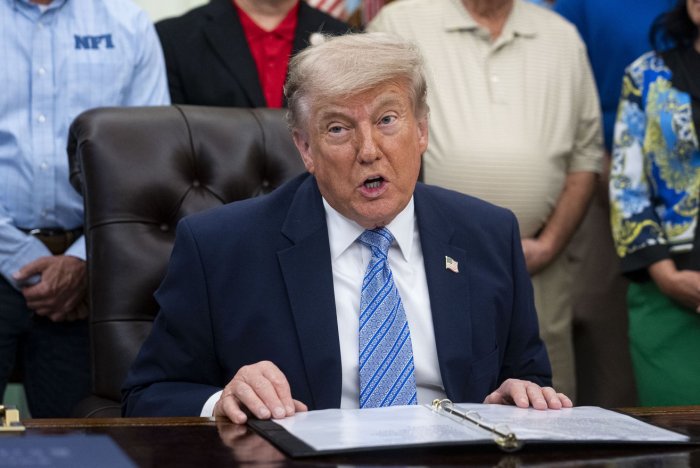
President Donald Trump speaks at an event with Environmental Protection Agency (EPA) Administrator Lee Zeldin in the Oval Office at the White House on Thursday. Photo by Al Drago/UPI | License Photo
In a Republican-led Congress defined by deference to President Trump, there’s a small but steadily growing cohort who have found themselves more willing to break with the White House. Although the president maintains a firm grip on Republican voters, the expanding club could hinder his agenda on everything from the Iran war to immigration funding at a moment when his party holds a tenuous majority on Capitol Hill.
Sen. Bill Cassidy of Louisiana is the newest member of the club. Just days after losing his primary to a Trump-backed challenger, Cassidy on Tuesday reversed himself on legislation involving the war in Iran and voted with Democrats to rein in U.S. military action.
“The way our Constitution is set up, Congress should hold the executive branch accountable,” he told reporters the day before.
Sen. John Cornyn of Texas could be next after Trump endorsed Ken Paxton, Cornyn’s rival for the Republican nomination in next week’s runoff.
Rep. Thomas Massie of Kentucky is perhaps a founding member of the YOLO caucus — slang for “you only live once,” used to punctuate unbothered or even foolhardy behavior. He frustrated Trump since the president’s first term, and his status was solidified after losing his primary on Tuesday to a Trump-backed challenger. Massie has enraged Trump by voting against his signature tax and spending bill and by pushing for the release of the Jeffrey Epstein files.
He hinted there’s more to come before he leaves office.
“I got seven months left in Congress,” Massie said with a grin during his concession speech as the crowd erupted.
More Republicans feel free to shrug off Trump
Other similarly situated Republicans include Sen. Thom Tillis, who was a fierce critic of former Homeland Security Secretary Kristi Noem and has more recently turned his attention to Defense Secretary Pete Hegseth. There’s also Sen. Lisa Murkowski of Alaska, who joined Democrats last week in a bid to curb Trump’s war powers in Iran. Sens. Susan Collins of Maine and Mitch McConnell of Kentucky have voted against some of Trump’s Cabinet picks. And in the House, Rep. Don Bacon of Nebraska has pushed to reclaim congressional power over tariffs.
“If the legislative branch always votes with the president, we do have a king,” Massie said in his concession speech Tuesday.
This hardly amounts to a revival of the Never Trump movement that some Republicans unsuccessfully hoped would curb the president’s excesses during his first term or block him from returning to office. Many in the party, including Trump’s occasional detractors, have either stood by or been unable to block the president as he launched the war in Iran and presided over an aggressive immigration enforcement operation and the dismantling of the federal workforce.
Today’s unencumbered Republicans don’t fit into an ideological box. But they are united by a sense of emboldening that can only be attained in a few ways in Trump’s Washington.
Many, like Tillis, McConnell and Bacon, have decided to retire and can cast votes knowing they’ll never again have to face Republican primary voters. Others like Collins and Murkowski have more leeway because they represent states that tend to reward political independence. And some like Massie banked on the idea that voters could support both Trump and someone who occasionally crossed him.
It’s a paradox for Trump. As he demands total loyalty and pushes out Republican dissenters, he’s left with a growing cohort who, for one reason or another, owe Trump nothing.
Democrats look to capitalize
That could be a problem for Senate Majority Leader John Thune and House Speaker Mike Johnson, who are already governing with threadbare majorities. Shifting loyalties of even a few Republican lawmakers could dramatically complicate the ability for either chamber to pass substantial legislation ahead of the November midterm elections.
Thune called Cornyn a “principled conservative” and “very effective senator” on Tuesday.
“None of us control what the president does,” he said.
The next tests could come later this week as Thune pushes a funding package for Immigration and Customs Enforcement and Customs and Border Protection designed to pass on a party line basis.
Democrats are eager to pounce.
Speaking at an event in Washington on Tuesday sponsored by the Center for American Progress, House Democratic leader Hakeem Jeffries said he would aim to drive a wedge between Republicans by using a so-called discharge petition to bring issues directly to the floor for a vote.
That tactic has been successful in securing House passage on issues including the Epstein files and temporary protection of Haitian immigrants.
“When we’re disciplined and when we’re focused and when we put pressure in particular on the so-called swing seat Republicans, they have been breaking with us,” Jeffries said.
California Gov. Gavin Newsom told reporters on Tuesday that Trump’s endorsement of Cornyn’s rival was a sign that his political power lies within the Republican base — not the American public at large.
“He’s showed the only influence he has, and that’s an outsize influence within the base of the party,” the potential 2028 Democratic presidential contender said. “Otherwise he’s shown little to no influence with the American people.”
Counting the votes
That leaves Republicans gaming out how they might cobble together the votes needed to pass legislation.
Sen. John Hoeven of North Dakota called Cassidy a “good friend” and said the loss was “tough for him.” He said Cassidy “will always vote in line with what he thinks is best” but doubted he will become a less reliable Republican vote.
His fellow Louisianan, Sen. John Kennedy, said Cassidy deploys power “rationally and maturely” and “will continue to do the same thing.”
Cassidy repeatedly rejected the notion that he will spend his final months in Washington as a troublemaker for Trump, saying he’s going to do “what’s good for my country and my state.”
Yet the independent streak that ended his political career quickly resurfaced. A week after Trump visited China, Cassidy spoke of a Western alliance that’s “totally falling apart” and will be unable to “push back on the threat China represents.” He seemed stunned that the administration would create a nearly $1.8-billion fund to compensate Trump allies who they believe have been unjustly investigated and prosecuted.
“I just came off the campaign trail,” he said. “People are concerned about making their own ends meet, not about putting a slush fund together without a legal precedent.”
Sloan and Cappelletti write for the Associated Press. AP writer Stephen Groves in Washington contributed to this report.
WASHINGTON — Republican senators are considering dropping a proposal for $1 billion in security money for the White House complex and President Trump’s ballroom after it has failed to win enough party support on Capitol Hill.
Pressured by the White House, Republicans have tried to add the money to a roughly $70-billion bill to restore funding to U.S. Immigration and Customs Enforcement and the Border Patrol. But the security proposal has met with backlash from some GOP lawmakers who are questioning the cost and the lack of detail from the White House and U.S. Secret Service about how the taxpayer dollars would be used.
Sen. John Kennedy (R-La.) said Wednesday that the bill was “back to square one” without the security money because “the votes are not there.”
Sen. Thom Tillis (R-N.C.) said the effort to add the security package to the bill was a “bad idea” and he does not think there is enough backing to pass it, even if it were reduced.
The text of the bill has not yet been released. But Senate Majority Leader John Thune (R-S.D.) acknowledged “ongoing vote issues” as leaders try to measure Republican support, as well as “ongoing parliamentarian issues” as they try to figure out what will be allowed in the bill under the chamber’s rules.
The wrangling comes as Democrats have criticized Republicans for trying to fund Trump’s ballroom when voters are concerned about basic affordability issues — and as some GOP lawmakers have grown increasingly frustrated with Trump. Several have spoken out against the administration’s $1.8-billion settlement fund designed to compensate Trump’s allies, and many were upset by the president’s endorsement Tuesday of Texas Atty. Gen. Ken Paxton in the party primary runoff next week against Sen. John Cornyn.
“There’s always a consequence with taking on United States senators,” Thune said. Trump “obviously has his favorites and people he wants to endorse and that’s his prerogative. But what we have to deal with up here is moving the agenda, and obviously that can become slightly more complicated.”
Republican opposition blocks Secret Service request
Under the Secret Service request, about $220 million would pay for security improvements related to the ballroom. The rest would go for a new screening center for visitors, training and other security measures.
Tillis said the bill should not have included the other security improvements “because it’s just giving everybody the ‘billion-dollar ballroom.’”
“They need to explain to me why we need this,” Tillis said, noting that Trump had originally said private money would cover the project.
Several other Republicans in the House and Senate have questioned the request, and senators left a briefing with the director of the Secret Service last week saying they needed a lot more information.
People “can’t afford groceries and gasoline and healthcare, and we’re going to do a billion dollars for a ballroom?” asked Louisiana Sen. Bill Cassidy (R-La.), who lost reelection in the GOP primary on Saturday after Trump endorsed one of his opponents.
Sen. Jim Justice (R-W.Va.) said he is supportive of the security money and thinks it is necessary to protect the president. But he acknowledged that the optics are not very good for Republicans, and that they have not communicated about it well.
“We’ve got people out there who are worried about how in the world they’re going to have enough gas to get home,” Justice said.
Tensions rise between Senate and White House
As Republicans challenged parts of his agenda, Trump unloaded on the Senate in a social media post.
He urged Republicans to fire the Senate parliamentarian, Elizabeth MacDonough, who said over the weekend that parts of the $1-billion security proposal cannot remain in the ICE and Border Patrol bill. Trump renewed his long-standing calls for the Senate to pass the SAVE Act, a Republican bill that would require all voters to prove U.S. citizenship, and to end the Senate filibuster.
“Republicans play a very soft game compared to the Dumocrats,” he wrote. “It is their single biggest disadvantage in politics.”
Trump said Democrats would eliminate the filibuster “on the First Day” if they ever get full power in Washington again and that Republicans need to “get smart and tough” or “you’ll all be looking for a job much sooner than you thought possible!”
Republicans have been loyal to Trump on most issues, but they have resisted his repeated calls — even in his first term — to kill the filibuster, which triggers a 60-vote threshold in the Senate.
Hanging over the growing GOP rift is Trump’s surprise endorsement of Paxton. That intervention has Republican senators privately fuming that it could cost them their majority in November as they view the incumbent, Cornyn, as the better candidate in the November general election.
Democrats test Republicans on settlement fund
As Republicans move forward on the immigration enforcement legislation, Senate Democratic leader Chuck Schumer of New York said Democrats plan to force a vote on Trump’s proposed settlement fund.
Democrats have an opening because Republicans are trying to pass the immigration enforcement bill through a complicated budget process that requires a long series of amendment votes. Democrats are considering multiple amendments potentially to block that new fund outright or to ban any payments to Trump supporters who harmed law enforcement officers in the Jan. 6, 2021, attack on the Capitol.
Those amendments, along with others, could pass as a growing number of Republicans speak out against the fund and other parts of Trump’s agenda.
Thune said he was “not a big fan” of the new fund, which the administration announced as a part of a settlement that resolves the president’s lawsuit against the IRS over the leak of his tax returns. Cassidy called it a “slush fund” and said “you can’t just make up things.”
Tillis said he thinks it is a “real risk” that some of the rioters charged — and later pardoned by Trump — in the Jan. 6 attack could get compensation through the fund. He said that would be “absurd.”
On Wednesday, two police officers who helped defend the Capitol in the 2021 assault sued to block the payouts. Acting Atty. Gen. Todd Blanche, a personal attorney for Trump before joining the Department of Justice in Trump’s second term, would not rule out the possibility that rioters who assaulted police on Jan. 6 would be eligible for compensation when he testified in a Senate hearing this week.
Jalonick, Freking and Cappelletti write for the Associated Press.
WASHINGTON — Republicans are unhappier with President Trump’s handling of the economy than they were a few months ago, but they’re largely continuing to stand behind him as the war with Iran continues, a new AP-NORC poll finds.
The poll comes as the Mideast war fuels higher gasoline prices, while the U.S. and Iran struggle to move toward a permanent ceasefire. Trump’s hold on the GOP remains strong, as he demonstrated Tuesday when his handpicked candidate defeated Rep. Thomas Massie, a critic of the president, in a primary election challenge. The findings highlight Trump’s continued strength within the Republican Party, even as economic frustration grows.
Ariel Gutierrez, a 55-year-old Republican in Wisconsin, usually requires his teenage children to pay for their own gas. But with spiking gas costs, he’s helping out his 15-year-old, who’s just learning to drive.
“The whole Iran issue has just exacerbated it,” he said. “Maybe we were seeing it in groceries before, but now — with this push on gas and travel and all that — that is how people want to live the leisure part of their lives … and it is directly impacting us there now. And yes, that is, I believe from Trump’s policies, not from his predecessors.”
Trump remains unpopular outside his base. Most Americans continue to disapprove of Trump’s approach to both Iran and foreign policy. His overall approval rating in the new poll stands at 37%, up slightly from 33% in April. Nearly all Democrats disapprove of his performance as president, as do about 7 in 10 independents.
The economy remains a struggle
About one-third of U.S. adults approve of how Trump is handling the economy. That’s in line with an AP-NORC poll conducted in late April, but down slightly from the start of his second term, when 40% of U.S. adults approved.
The economy was a strength for Trump in his first term, but he’s struggled with skepticism about his handling of the issue since his return to the White House last year, after repeatedly promising to bring prices down. His second-term economic approval has fallen among Republicans, in particular. While a majority, 63%, still approve, that’s down from 79% in February, a few weeks before the war with Iran began.
Richard Baumgartner, a 77-year-old Republican from Las Vegas, believes higher costs are a necessary side effect of the war, which he supports.
“Unfortunately, because of the war, the economy is a little bit off-kilter,” Baumgartner said. “I think it’ll fall back into place after things resolve over there. Temporary price increases — it’s unfortunate, but it’s something that has to be confronted in a situation like this where you have a very serious problem.”
Trump regains some strength on immigration
Although economic promises were pivotal to Trump’s reelection, so were his goals of stricter immigration enforcement — and this issue may be reemerging as an asset.
Immigration emerged as one of Trump’s strengths early in his second term, with about half of U.S. adults saying they liked his approach, but approval of his handling of the issue dipped to 38% in January and February, after months of aggressive immigration enforcement that led to the shooting deaths of two U.S. citizens in Minneapolis.
Now, just under half of U.S. adults, 45%, approve of how he is handling that issue.
Brenda Theiss, an independent from Cullman, Ala., doesn’t like everything Trump is doing. But she gives him credit for being willing to disrupt the status quo to reduce the flow of immigrants who are in the country illegally, compared with Democratic Presidents Obama and Biden.
“I liked Obama; I voted for Obama — but Trump was the only one that did something. All of the other presidents sat back and went, ‘Well, there’s nothing we can do,’” the 73-year-old said. “He’s closing the border. He did it. Biden didn’t do it. For that, I give him one hundred.”
Over the last few months, the Trump administration has appeared to recalibrate its approach on immigration, moving away from aggressive, public-facing tactics toward a quieter approach to enforcement.
Immigration remains one of Trump’s stronger issues among Republicans. About 8 in 10 approve of his handling of the issue, which is roughly 10 points higher than the share who say he’s doing a good job as president.
Few approve of Trump on Iran or issues abroad
Trump’s handling of the war with Iran remains unpopular.
Only about one-third of U.S. adults approve of how he is handling Iran. Roughly two-thirds of Republicans approve, though an AP-NORC poll conducted last month found that younger Republicans are more likely to disapprove of Trump’s performance on the issue than older ones.
Similarly, about one-third of Americans approve of Trump’s approach to foreign policy. Though Trump has zeroed in on a more aggressive international approach this year — including capturing the leader of Venezuela and threatening Cuba — Americans’ views of his overall handling of foreign policy have not shifted significantly in recent months.
Amanda Wylie, a 22-year-old who lives in Athens, Ga., says Iran is one of the few issues where Trump doesn’t have her support.
“I feel like we’re wasting resources over there at this point and not for the benefit of the American people,” said Wylie, who identifies as a Republican-leaning independent. “Especially if everyone is worried about gas prices and the ultimate goal of this is to prevent Iran from having a nuclear weapon. Yes, that’s important, but at what cost?”
Sanders and Thomson-Deveaux write for the Associated Press. The AP-NORC poll of 1,117 adults was conducted May 14-18 using a sample drawn from NORC’s probability-based AmeriSpeak Panel, which is designed to be representative of the U.S. population. The margin of sampling error for adults overall is plus or minus 3.8 percentage points.
WASHINGTON — The Senate advanced legislation Tuesday that seeks to force President Donald Trump to withdraw from the Iran war, as a growing number of Republicans defied the president’s wishes.
Since Trump ordered the attack on Iran at the end of February, Democrats have forced repeated votes on war powers resolutions that would require him to either gain congressional approval for the war or withdraw troops. Republicans had been able to muster the votes to reject those proposals, but Louisiana Sen. Bill Cassidy — fresh off a primary election loss in which Trump endorsed his opponent — switched sides to deliver a crucial vote to pass the legislation.
The 50-47 vote tally demonstrated the small but crucial number of Republicans voting to halt the war with Iran. The legislation will get a vote on final passage, but the timing was not immediately clear.
Republican Sens. Rand Paul of Kentucky, Susan Collins of Maine and Lisa Murkowski of Alaska had all previously voted for similar war powers resolutions and did so again Tuesday. Cassidy voted for the legislation for the first time.
After his primary election loss last week, Cassidy returned to Washington saying that he was proud of his work to uphold the Constitution and would carefully consider how he would vote on several priorities of the Trump administration.
WASHINGTON — A proposal to fund $1 billion in security additions for the White House campus and President Trump’s new ballroom fails to meet procedural rules, according to the Senate parliamentarian, dealing a blow to Republican plans to include it as part of a bill to fund immigration enforcement agencies for the next three years.
The parliamentarian’s ruling, described late Saturday by Senate Democrats, said that funding for a project as large and complex as Trump’s massive East Wing renovation is too broad to be included in the narrow GOP budget bill, which cannot be filibustered and needs only a simple majority to pass.
It’s unclear whether Republicans will be able to immediately salvage any part of the billion-dollar Secret Service proposal, which would fund security for Trump’s ballroom along with other parts of the White House, including a new visitor screening center, additional training for agents and extra reinforcements for large events. Republicans said Saturday night that they are revising the legislation based on the parliamentarian’s advice.
Ryan Wrasse, a spokesman for Senate Majority Leader John Thune (R-S.D.), wrote in a post on X that “none of this is abnormal” during the complicated budget process that Republicans are using to try to pass the immigration enforcement and White House security money on a partisan basis.
“Redraft. Refine. Resubmit,” Wrasse said in the post.
Democrats say they’re ‘ready to stop them again’
Democrats have seized on the security request, accusing Republicans of dedicating federal resources to the ballroom project instead of focusing on helping Americans with rising costs. Republicans have insisted that private donations will be used to build the ballroom and that the federal dollars are focused just on much-needed security enhancements.
Senate Minority Leader Chuck Schumer (D-N.Y.) took credit for the ruling after Democrats argued to the parliamentarian that the security money doesn’t belong in the bill.
“Republicans tried to make taxpayers foot the bill for Trump’s billion-dollar ballroom,” Schumer said Saturday evening. “Senate Democrats fought back — and blew up their first attempt.”
Schumer added that Democrats “will be ready to stop them again” as Republicans say they will revise the bill.
The ruling from the Senate parliamentarian is advisory, but such rulings are rarely if ever ignored when lawmakers put together legislation that can pass with a simple majority. Most bills are subject to a filibuster and thus need 60 votes for passage — meaning Republicans must find some Democratic support in the 53-47 Senate.
Part of immigration bill
Republicans are looking to approve a roughly $72-billion package to fund Immigration and Customs Enforcement and Customs and Border Protection until the end of Trump’s term after Democrats have blocked the money for months.
As part of that package, Republicans included $1 billion for White House security enhancements, part of it connected to Trump’s ballroom. The Secret Service had requested the money after a man was charged with trying to assassinate Trump at the White House Correspondents’ Assn. dinner last month.
The overall budget package is providing another boost of funding for Trump’s immigration and deportation agenda, fueling operations through September 2029. It comes on top of Immigration and Customs Enforcement and Border Patrol funds Congress provided last year in the One Big Beautiful Bill Act that Trump signed into law.
The parliamentarian kept most of the immigration portion of the legislation intact, though some minor provisions were blocked, including Customs and Border Patrol funds to hire, train and pay Border Patrol agents. Republicans said those were only technical fixes.
Oregon Sen. Jeff Merkley, the top Democrat on the Senate Budget Committee, said Saturday evening that “Democrats are prepared to challenge any change to this bill.”
Americans shouldn’t spend “a single dime” on Trump’s “Louis XIV-style ballroom and throw tens of billions more at two lawless agencies,” Merkley said.
Jalonick and Freking write for the Associated Press. AP writer Lisa Mascaro contributed to this report.
COVINGTON, Ky. — Rep. Thomas Massie was stuck in Washington for a vote on Capitol Hill, so one of his supporters made the pitch for his campaign in a banquet hall packed with Republicans in northern Kentucky.
The audience had just heard Ed Gallrein, who was drafted by President Trump to run against Massie in next Tuesday’s primary, describe the congressman as suffering from “a severe case of Trump derangement syndrome.”
Then Gex Williams, a state senator backing Massie, told the audience at the Lincoln Day Dinner not to worry about all that.
“If you are thinking that you can’t be for President Trump and for Thomas Massie, you certainly can be,” Williams said.
Whether voters agree will determine whether Massie’s political career survives Trump’s most aggressive attempt to purge the Republican Party of dissenters. The president already succeeded last week in dislodging several Indiana state senators who opposed his redistricting plan, and he’s supporting a primary challenge against U.S. Sen. Bill Cassidy in Louisiana on Saturday.
But nothing compares to the vitriol against Massie, whom Trump has called a “moron” and a “nut job” who “will go down as the WORST Republican Congressman.” Trump made an unusual trip to Kentucky to campaign against Massie, and some of the president’s top advisors are working to help Gallrein, a former Navy SEAL.
Massie angered Trump by voting against his signature tax legislation over concerns of adding to the national debt, pushing for the release of the Jeffrey Epstein files and opposing his decision to go to war with Iran. His positions, Massie insists, reflect the America First promises Trump initially made on the campaign trail.
In a Kentucky district where the president won by 35 points two years ago, Massie told the Associated Press that the upcoming primary is “by far the most challenging reelection I’ve ever faced.”
Party loyalty or ideological purity?
The race is playing out across Kentucky’s 4th Congressional District, which sweeps northeast from the outskirts of Louisville along the Ohio River, through the suburbs south of Cincinnati and over to the lush foothills and old coal towns of Appalachia.
Voters here have sent Massie back to Congress ever since his first election in 2012, embracing his stalwart independence and jaunty personality. Back in 2020, they brushed off Trump’s social media demand to “throw Massie out of Republican Party” because he was a “third rate Grandstander.”
Now, Republican voters are debating whether they will do the same thing again.
“If all we’re doing is pulling in yes men, then how do you grow from that? How do you have the best end product if everyone just says, ‘Oh yeah, that’s a great idea,’” said Tonya Young, an attendee of the Lincoln Day Dinner who is leaning toward Massie but still undecided.
“However, I do feel like it’s important to stay loyal. That’s where, I’m like, I’m a hot mess,” said the 57-year-old special education teacher. “Sometimes you have to just bite the bullet and compromise on things.”
Young said she will plumb through the Republican-backed bills that Massie voted against before she makes up her mind. What isn’t a major part of her calculation is Trump’s endorsement of Gallrein or his epithets against Massie.
Young still supports Trump, rating his second term at a “B to a C+” relative to his campaign promises. During Trump’s first term, Young said, she’d “probably put more stock in” his endorsement.
‘I’m going to vote for Massie even though he makes me mad’
At the Lincoln Day Dinner in Covington, well-dressed Republicans sat at circular tables, ate dinner and listened attentively as candidates gave speeches.
Steve Jarvis, a 77-year-old retired law enforcement officer, who stood near the late night coffee station, has decided to vote against Massie for the very first time.
“Made me sad, truly it does,” said Jarvis, wearing a bespoke American flag bow tie made of feathers, “I like Massie.”
When Massie first ran for Congress, Jarvis bought a Massie campaign sign, sized for a freeway overpass, and planted it outside his home, a few doors down from which lived Massie’s opponent.
But some of Massie’s departures from the party, he said, “made me nuts. I can’t do it anymore.”
One was Trump’s flagship Big Beautiful Bill, which Massie voted against citing the consequent budget deficit and increased inflation.
“I understand voting your principle once or twice,” said Jarvis, “but at some point in time when it becomes crucial, I think they have to get in line.”
Gallrein, he said, would get in line.
Jana Kathman came to a different conclusion.
“I’m going to vote for Massie even though he makes me mad,” she said while shopping for bagels at a local farmers market outside Covington.
The 56-year-old registered nurse said, “I just like him as a person, I like how he lives his life, and I know he stands very strong with his convictions.”
Though she still likes Trump, his endorsement and attacks don’t impress her.
“I don’t like when Trump plays the little games as soon as someone opposes him, but we know that’s how Trump lashes out,” Kathman said.
‘Antibodies’ to Trump’s electoral broadside
Gallrein mounted the stage at the Lincoln Day Dinner with a prepared speech. He grew up on a family farm, was inspired by President Reagan to join the Navy SEALs and was recently asked by Trump to serve his country again in Congress.
He hyped up Trump — “Do you know he doesn’t take a salary?” — and launched into a list of Trump-backed policies Massie had voted against, lumping him in with the “radical Democrats.”
Gallrein declined an interview request, and he’s declined to attend candidate forums and debates with Massie.
Several voters said they were grateful for Gallrein’s service, but still don’t have a grasp of his platform, aside from his fidelity to Trump.
Massie argues that’s why Kentucky should stick with him, using what has become a go-to refrain.
“Politicians promise during the campaign, and then they go to D.C. to go along to get along,” he said. “My opponent is promising to go along to get along.”
Massie is hopeful that Trump’s anger will blow over once he wins the primary.
“Once this race is over, I don’t think there’s any benefit to him attacking me, I’ll have the antibodies from a natural infection,” Massie said chuckling.
After years of being considered a conservative gadfly in Congress, he said, maybe he has some of those antibodies already.
WASHINGTON — House Democratic leader Hakeem Jeffries had warned Republicans they would come to regret the congressional redistricting fight, and when Democrats counterpunched last month with a redrawn Virginia map, he had made his point.
The net tally of seats gained and lost was essentially a wash.
“F— around and find out,” said Jeffries after the election victory.
But in a matter of days, the race for control of the House — and the speaker’s gavel — was dramatically reset by back-to-back court rulings that wiped out the Democratic gains in Virginia and now threaten to erode Black representation by Democrats in the Deep South.
The shifting political prospects have been a wake-up call for Democrats, who have been favored to win back the House this November, riding the wave of President Trump’s dipping approval ratings, and a test for Jeffries as the party faces an enlarging map of Republican-friendly seats.
The leader’s aligned outside group has spent some $60 million, much of it on Virginia alone, a hit to the Democrats’ resources as they confront Trump’s Republicans.
“It sort of crystallizes the election is now a contest between one side that has the money and the maps, and the other that has the voters and the candidates,” said Jesse Ferguson, a Democratic strategist and former deputy director of the House Democrats’ campaign arm.
Jeffries would make history as the first Black speaker of the House
Jeffries, who is in line to make history as America’s first Black speaker of the House, acknowledged the Democrats may need to flip twice as many Republican seats — a total gain of six rather than just three — to win the majority in the aftermath of the redistricting fights.
But he insisted that Democrats were on track to pick up seats, as they did in 2018 during Trump’s first term, because Republicans are relying on redistricting — rather than policy solutions — to win elections.
Trump Republicans “don’t give a damn” about Americans’ financial struggles, Jeffries said, paraphrasing the president’s own remarks.
During a closed-door meeting on Wednesday with House Democrats, Jeffries described the work ahead in almost existential terms for the country.
He said the court rulings against the Voting Rights Act and the Virginia measure were “disgusting.” And he warned his colleagues that Republicans would proceed with “diabolical intensity” in their campaigns to regain control of the House, which Democrats will not only have to match but “we have to exceed it with righteous intensity at all times.”
“Failure is not an option,” he told the Democrats, according to a person in the room granted anonymity to disclose the private remarks. “We have to win, and we are going to win.”
Path to power depends on a handful of House seats
Never easy, the race to the House majority was also not expected to be this complicated. Republicans hold a slim majority, among the most narrow in modern House history, and midterm elections tend to favor the party out of power, as a check on the White House.
But when Trump said last summer that Republicans were “entitled” to five more GOP seats from Texas, it sparked a redistricting crusade that led Jeffries to respond in kind.
Rather than take what they call the high road, Democrats said they decided to fight back, believing they could not fully count on the nation’s institutions — in this case, the courts — to provide a check on the GOP power play.
Jeffries flew to Austin to join the Texas Democrats fighting the redistricting plan in their state and stood with those same lawmakers in Chicago where they fled to deny statehouse Republicans a quorum. He joined the private meetings of California Democrats as they launched their counter attack, a voter initiative that put five more seats in the Democratic column. The Democrats picked up a seat in Utah.
And on it went.
“We had to very quickly make a decision, set a course and take a risk,” said Rep. Jared Huffman, D-Calif., recalling the closed-door talks last summer. “There was no guarantee this was going to work out.”
The Virginia measure became a turning point, Jeffries’ biggest swing yet, putting Democrats essentially at parity, if not a potential upper hand in the number of seats gained, and shifting Old Dominion more securely into the party’s column.
He rallied some 1,000 churchgoers in Richmond ahead of Election Day as voters headed to the polls.
House Speaker Mike Johnson on Wednesday called the Democratic play for Virginia a “crazy overreach” that was rightly rejected by the state’s high court.
“Fortunately, the plan failed spectacularly,” Johnson said.
Redistricting battles push into 2028
While Democrats said they expected the Supreme Court to gut the Voting Rights Act, the Virginia Supreme Court’s decision to toss last month’s election results blindsided many of them.
Jeffries joined a call with furious Virginia Democrats over the weekend who said they were more determined than ever to win the Republican seats outright, regardless of their loss over the map changes.
The overall tally after nearly a year of redistricting battles is still shifting as Republican legislatures in the South rush to redraw their maps in the aftermath of the ruling in the Voting Rights Act case, many of them preparing to eliminate districts held by some of the most senior Black lawmakers in Congress.
Rep. James Clyburn, the veteran Democratic legislator from South Carolina whose own seat is at risk, blamed the justices, not Jeffries, for the outcome in Virginia and elsewhere.
“What the hell, he can’t control the courts,” Clyburn said, vowing to run for reelection regardless of where his district is drawn. “Don’t put that on Jeffries. We won the vote.”
Jeffries acknowledged that this year’s maps are almost set, and pivoted to 2028 when he said Democrats will redouble their efforts to confront the GOP redistricting battle ahead of the next election.
“We know this unprecedented assault on Black political representation, the likes of which we have not seen since the Jim Crow era, the ghost of the Confederacy” will continue, he said. “The challenge that is in front of us is ensuring that there is a decisive and overwhelming response in advance of 2028.”
BATON ROUGE, La. — Republican senators in Louisiana advanced a plan Wednesday to eliminate one of two majority-Black, Democratic-held congressional seats following a U.S. Supreme Court ruling that struck down the state’s U.S. House map as an illegal racial gerrymander.
The early morning Senate committee vote came after hours of impassioned testimony from Black residents and Democrats opposed to the move. Republicans opted not to pursue a more aggressive approach, which could have targeted both Democratic seats for elimination.
The Supreme Court’s recent ruling weakening federal Voting Rights Act protections for minorities has prompted Republicans in several Southern states to try to eliminate House districts with large minority populations that have elected Democrats. Tennessee and Alabama already have acted to implement different House maps that could help Republicans win an additional seat. But a similar effort fizzled Tuesday in the South Carolina Senate.
The redistricting efforts to undo minority districts are the latest variation in a 10-month-long national redistricting battle that already has involved about one-third of the states. It gained steam when President Trump urged Texas Republicans last year to redraw House districts in an attempt to win more seats in the midterm elections. Democrats in California responded with their own new districts. Numerous Republican states have redistricted since then.
Republicans think they could gain as many as 15 seats so far from new House maps in Texas, Missouri, North Carolina, Ohio, Florida, Tennessee and Alabama. Democrats, meanwhile, think they could gain six seats from new maps in California and Utah. The Virginia Supreme Court last week struck down a redistricting effort that could have yielded four more winnable seats for Democrats.
Brook and Lieb write for the Associated Press. Lieb reported from Jefferson City, Mo.
President Trump’s push to redraw the nation’s U.S. House districts received mixed results Tuesday as South Carolina senators defied his desires, but Missouri’s top court upheld a new map that could help Republicans win an additional seat in the November midterm elections.
Rather than waning, a national redistricting battle that began 10 months ago has intensified — inflamed by a recent U.S. Supreme Court ruling that weakened the federal Voting Rights Act and provided grounds for states to try to eliminate voting districts with large minority populations.
Republican lawmakers in Louisiana are wrestling with how politically aggressive to be when redrawing House districts after the U.S. Supreme Court invalidated a majority-Black district as an illegal racial gerrymander.
The ripples of the Louisiana ruling already have led to new U.S. House districts in Tennessee and have extended to Alabama, where Republican Gov. Kay Ivey announced an Aug. 11 special primary for four of the state’s seven congressional districts. That came after the U.S. Supreme Court on Monday overturned an order mandating use of a map with two largely Black districts. The state plans to switch to a map passed in 2023 that has only one majority-Black district.
Republicans think they could gain as many as 14 seats from new House maps enacted so far in Texas, Missouri, North Carolina, Ohio, Florida and Tennessee. Democrats, meanwhile, think they could gain six seats from new maps in California and Utah. The Virginia Supreme Court last week struck down a redistricting effort that could have yielded four more winnable seats for Democrats.
Missouri map splits Kansas City district
Missouri was the second Republican state, after Texas, to redraw its congressional districts at Trump’s urging last year. Since then, numerous other states have joined the redistricting battle.
During arguments earlier Tuesday, attorneys for voters challenging Missouri’s new map focused on changes to a Kansas City-based district long represented by Democratic U.S. Rep. Emanuel Cleaver, who previously was the city’s mayor, the first Black person to hold the post.
The new map takes a compact urban district that covered 20 miles and two counties and stretches it 200 miles over 15 counties, distorting it “into a sprawling behemoth that cuts clear across the state to unite territories that share nothing in common,” said Abha Khanna, an attorney who has represented Democrats in voting and redistricting cases across the country.
A lower court ruled in March that the map as a whole satisfied the compactness requirement, even though the Kansas City district is less compact. No Missouri court has ever struck down a congressional map for not being compact, said attorney John Gore, who defended the districts on behalf of the Republican Party.
A second case heard by the high court centered on whether the new map took effect in December, as asserted by Republican Atty. Gen. Catherine Hanaway and Republican Secretary of State Denny Hoskins, or whether it should have been suspended when referendum signatures were submitted.
To suspend the map before validating the signatures would let activists temporarily undercut laws by submitting boxes of fraudulent signatures, Missouri Solicitor Gen. Lou Capozzi argued.
But to not immediately suspend the map “would dilute the referendum right, if not destroy it altogether,” said attorney Jonathan Hawley, arguing for voters who sued.
Republican officials contend the new districts can be suspended only after Hoskins determines the petition meets constitutional requirements and has enough valid signatures. Hoskins has until Aug. 4, the day of Missouri’s primary elections, to make that determination. The Supreme Court upheld the decision of a state judge in March who agreed with Republicans’ position.
Louisiana hearing leads to death threats
Louisiana state Sen. Jay Morris, a Republican who drafted redistricting bills that would eliminate one or both of the state’s majority-Black districts, told lawmakers Monday that he received death threats after Friday’s contentious hearing in which he told members of the public to “shut up.”
Morris acknowledged the outburst but denied the Louisiana Democratic Party’s assertion — blasted across social media and in a news release — that he also used the derogatory term “boy” toward its executive director, Dadrius Lanus, who is Black.
State Sen. Gary Carter, one of three Black Democrats serving alongside six white Republicans on the Senate committee overseeing redistricting, told the Associated Press on Tuesday that he had withdrawn from the committee “to help restore the decorum and focus that this moment demands” after shouting at Republicans during Friday’s hearing. Carter publicly apologized Monday to Morris and his Senate colleagues for having “lost my temper” and for any remarks that were taken as “personal attacks.”
Carter is the nephew of U.S. Rep. Troy Carter, a Democrat who represents New Orleans and is at risk of losing his seat in the redistricting process. Gary Carter is being replaced on the committee with state Sen. Royce Duplessis, a Democrat representing New Orleans.
South Carolina weighs political risks of redistricting
The Republican push for South Carolina to join the national redistricting battle by redrawing its U.S. House map fizzled Tuesday as an initial vote in the state Senate fell short.
Trump had urged South Carolina to redraw its congressional districts ahead of the November elections in an attempt to help Republicans win another seat in the closely divided chamber. The state House had voted in favor of letting lawmakers return after the regular session ends this week to consider redistricting, and had proposed a new map that could eliminate the state’s only Democratic-held seat.
But the Senate had to give permission to take up redistricting, too.
The 29-17 vote failed, with just two votes short of the two-thirds needed. Five Republicans joined all the Democrats in the chamber to reject the proposal.
Trump said Monday on social media that he was closely watching the redistricting vote, urging South Carolina senators to “be bold and courageous” and to delay the House primaries so new districts can be drawn.
Although Republicans have a supermajority in the chamber, some GOP senators weren’t sure the proposed map would guarantee the party could unseat longtime Democratic U.S. Rep. James E. Clyburn. They also said it could push enough Democrats into other districts to backfire, resulting in a 5-2 or even a 4-3 Republican split.
Republican Senate Majority Leader Shane Massey acknowledged the pressure from Trump, but said he doesn’t like being asked to bend to someone’s will instead of doing what’s best for his state.
“I got too much Southern in my blood,” Massey said. “I’ve got too much resistance in my heritage.”
Lieb, Collins, Brook and Chandler write for the Associated Press. Brook reported from Baton Rouge, La.; Chandler from Montgomery, Ala.; Collins from Columbia; and Lieb from Jefferson City, Mo.
WASHINGTON — Defense Secretary Pete Hegseth faced tough questions Tuesday from Republican and Democratic lawmakers about the Trump administration’s end game for the Iran war, the cost of the conflict and its impact on diminishing U.S. weapons stockpiles.
For his part, the Pentagon chief softened his tone from hearings before Congress nearly two weeks ago, notably avoiding the same pointed criticism of lawmakers in his opening remarks as he outlined the Trump administration’s efforts to ramp up production of weapons and other military capabilities.
Even so, Hegseth insisted that the military has plenty of missile defense systems and other munitions for the Iran war or future conflicts as both Republicans and Democrats hammered him with those concerns.
“I take issue with the characterization that munitions are depleted in a public forum,” Hegseth said. “That’s not true.”
The cost of the Iran war has risen to about $29 billion, the vast bulk of which — $24 billion — is related to replacing and repairing munitions but also includes operational costs to keep forces deployed, Pentagon comptroller Jay Hurst said. That’s up from $25 billion that he told lawmakers nearly two weeks ago.
The powerful House and Senate Appropriations subcommittees that oversee defense spending are holding back-to-back hearings to review the Trump administration’s 2027 military budget proposal, which calls for a historic allocation of $1.5 trillion. The discussions in the House quickly veered into the handling of a war that appears locked in a stalemate as higher fuel prices pose political problems for Republicans in the midterm congressional elections.
Hegseth and Caine face bipartisan pushback on munitions stockpiles
Rep. Rosa DeLauro, the ranking Democrat on the House Appropriations Committee, told Hegseth that the “question must be answered at the end of this crisis: What have we accomplished and at what cost?”
“This administration has not presented Congress with any kind of clear or coherent strategy week to week, day to day, hour to hour,” DeLauro said. “The rationale shifts, the objectives change. The end game is ill-defined when it is defined at all.”
California Republican Rep. Ken Calvert, the House subcommittee’s chair, also asked about the impact of the Iran war on military funding as well as the U.S. military’s weapons stockpiles.
“Questions persist about whether we are building the depth and reliance required for a high-end conflict,” Calvert said.
Minnesota Rep. Betty McCollum, the defense subcommittee’s ranking Democrat, pressed Hegseth on whether the military has a plan to draw down troops in the Middle East if Congress passes so-far-unsuccessful efforts to end the Iran war.
“We have a plan to escalate if necessary,” Hegseth said. “We have a plan to retrograde if necessary. We have a plan to shift assets.”
He said he would not reveal any next steps publicly. Noting repeated questions from lawmakers over the military’s weapons stockpiles, drawn down from the Iran war, Hegseth said the concerns have been “unhelpfully overstated” and that “we have plenty of what we need.”
He said the defense industry has been told to “build more and build faster,” blaming the military industrial base’s inadequate capacity on previous administrations and U.S. aid to Ukraine in its war with Russia.
Trump administration faces pressure from impact of the Iran war
President Trump is facing increasing pressure from the economic shocks of Iran effectively closing the Strait of Hormuz, a vital shipping corridor where 20% of the world’s oil normally flows. The U.S. military in turn has blockaded Iranian ports and the two sides have traded fire, with American forces thwarting attacks on their warships and disabling Tehran-linked oil tankers.
Trump said Monday that the ceasefire is on “massive life support” and criticized Iran for its latest proposal, pointing to his demands that Iran significantly limit its nuclear program.
“I would call it the weakest right now after reading that piece of garbage they sent us,” Trump said.
The Republican president also said he wanted to suspend the federal gas tax to help Americans shoulder surging fuel prices. He has previously said higher costs are worth it to prevent Iran from getting a nuclear weapon.
Tuesday’s hearings are giving a mostly new group of lawmakers the chance to grill or applaud Hegseth and Gen. Dan Caine, chair of the Joint Chiefs of Staff, on the planning and execution of the war.
The Senate hearing later Tuesday will include Sen. Susan Collins of Maine, a Republican whose reelection this year is far from guaranteed. She voted with Democrats on an effort to halt the conflict late last month, saying she wants to see a defined strategy for bringing the war to a close.
Alaska Sen. Lisa Murkowski, another Republican on the Senate Appropriations defense subcommittee, has voted against the string of unsuccessful war powers resolutions but spoken of the need for congressional authorization so Americans will know the war’s limits and objectives.
He also will face plenty of friendly Republicans, including the Senate subcommittee’s chair, Sen. Mitch McConnell of Kentucky, and perhaps the Iran war’s biggest booster in Congress, Sen. Lindsey Graham of South Carolina.
Finley, Toropin and Barrow write for the Associated Press. Barrow reported from Atlanta.
BATON ROUGE, La. — Thousands of Louisiana voters have already cast early ballots for congressional candidates in what soon could be the wrong districts. Alabama’s primaries are a week away, but the state could force a do-over for voting on U.S. House races. A new congressional map in Tennessee upended races that had been underway for months.
Republicans’ rush to gerrymander congressional districts across several Southern states after a U.S. Supreme Court ruling hollowed out the Voting Rights Act is confusing voters and creating logistical headaches for local election officials. The changes are hitting while primary season is in progress.
The chaotic upheaval to an election season that could determine which party controls the U.S. House is the latest fallout from an intensely partisan gerrymandering battle initiated by President Trump last year to protect Republicans’ slim majority.
The Supreme Court’s decision last month severely weakening the Voting Rights Act required Louisiana to reconsider a map drawn in 2024 with two majority minority congressional districts that elected Black representatives. The GOP-controlled Legislature could eliminate one or both in a state where roughly 30% of the population is Black.
The ruling also encouraged Republicans in Alabama, Mississippi, South Carolina and Tennessee to consider eliminating four Democratic districts among them, three represented by Black lawmakers. Florida has a new map meant to cost Democrats four of their eight seats, out of 28.
In Louisiana, 66-year-old New Orleans resident Sallie Davis voted early last week. Her ballot allowed her to vote for Democratic U.S. Rep. Troy Carter, but a sign at her polling booth showed his race crossed off with a ballpoint pen. She was confused and frustrated — especially when a poll worker told her to go with what the sign seemed to convey. She’s now worried that her entire ballot will not be counted.
“I was supposed to believe a piece of paper with an X on it marking out the person I wanted to vote for,” she said, her voice breaking as she recounted her experience later. “I think I have been disenfranchised. I think my vote, that I just voted on, it’s not going to count or something. I think it’s illegal.”
Primaries postponed, deadlines compressed
Louisiana’s primary is on Saturday, and a week of early voting there began May 2, two days after the Republican governor declared an emergency and suspended congressional primaries to give lawmakers a chance to draw a new map.
Republican Secretary of State Nancy Landry’s office said nearly 179,000 primary ballots had been cast as of Friday, including about 53,000 absentee ballots returned by mail. She said the ballots included U.S. House races, but votes in those contests won’t be counted.
In Alabama, South Carolina and Tennessee, Republicans justified pursuing new maps by saying that electing more Republicans would better reflect their states’ conservative values. Alabama lawmakers passed legislation Friday allowing a do-over of congressional primaries.
Alabama’s primary is May 19, and voting in congressional races will occur then as planned, but with the old districts. Those votes would end up not counting if a court allows the switch to different districts.
Mississippi held its primaries in March, but a federal court has ordered it to redraw its state Supreme Court districts, and Trump is pushing Republicans to redraw the state’s four congressional districts.
A special session of its Legislature is set for May 20. Renovations of the House chamber will force members to meet at the Old State Capitol, where, decades ago, Mississippi lawmakers passed Jim Crow laws suppressing Black voting.
“Modern-day voter suppression relies on election administration errors and chaos, and that’s what we’re going to see play out in all of these states,” said Amir Badat, a Jackson, Mississippi, voting rights attorney and activist.
Tennessee continues yearlong fight
Tennessee was the first state to enact a new map since the U.S. Supreme Court decision, but Trump’s push for redistricting started in Texas last year. Democrats countered in California and tried but ran afoul of the courts in Virginia.
Before Tennessee’s GOP-controlled Legislature passed a new map last week, the state’s elections coordinator told county officials in a memo what that would mean: reprogramming election systems, retraining poll workers and possibly adjusting precinct boundaries, meaning some voters’ polling places could change.
Tennessee’s congressional primaries still will be held Aug. 6 as planned, and candidates have until Friday to qualify for the ballot. Those who qualified previously will get a pass if they can run in a new district with the same number.
In South Carolina, lawmakers could move all the state’s June 9 primaries to August, or just the congressional races. While mail balloting is limited because the state requires an excuse to do it, more than 6,800 mail ballots already had been sent to voters — with 260 returned — as of Friday, according to the state Elections Commission.
Holding a separate election for congressional primaries would cost $3 million and the time for preparations would be compressed, Conway Belangia, the commission’s executive director, told lawmakers Friday.
“It will be difficult, but it will be possible,” he said.
Activists see problems ahead for voters
Michael McClanahan, president of the NAACP’s Louisiana State Conference, is hearing “total confusion” as voters call him and ask, “Is there an election?”
“People say, ’I ain’t going to vote because the governor’s suspended the election,’” he said. “But he didn’t, he only suspended one aspect of it.”
In Alabama, Senate Democratic leader Bobby Singleton said he has been fielding calls from public officials who also are confused.
“These are the people who are the head of elections,” he said. “They don’t know what to do.“
Voting rights activists see problems that arose in Nashville, Tennessee, in 2022, when Republican legislators divided the state’s capital city into three congressional districts to take a seat from Democrats, as a harbinger of what Memphis voters could face this year. A state report said more than 3,000 Nashville-area voters were assigned to incorrect districts and more than 430 cast ballots in the wrong races in the November 2022 election.
“It’s going to be really hard for the election commissions to be able to keep up with this short timeline,” Matia Powell, executive director of the voting rights nonprofit Civic TN, said during a conference call Friday with other voting rights activists in the South.
Some fear confusion will lead to distrust and apathy
Anneshia Hardy, executive director of Alabama Values, which provides support to voting and civil rights groups, said people will lose trust in elections if they believe the rules can change every two years.
“Once people stop believing that the process is stable and fair, disengagement is going to increase, and that’s one of the biggest dangers here,” she said. “Democracy doesn’t just depend on voting systems existing but really on people believing that their participation matters.”
At least a few Democratic voters who went to the Louisiana Capitol on Friday to protest the gerrymandering expressed doubt about whether they still have a political voice.
Davis came to the State Capitol in Baton Rouge and had a bullhorn with her for a protest in which she yelled, “Whose vote? Our vote!”
David Victorian, a 79-year-old Vietnam veteran from Baton Rouge, said: “I’m concerned for the survival of the democracy that we’re supposed to be living in.”
Hanna and Brook write for the Associated Press. Hanna reported from Topeka, Kan. AP writers Jeffrey Collins in Columbia, S.C., and Kim Chandler, in Montgomery, Ala., contributed to this report.
It’s a showdown that — regardless of the outcome in the June 2 primary election — probably won’t have Republicans in a celebratory mood.
The battle for the 40th Congressional District representing a swath of inland Orange County and portions of San Bernardino and Riverside counties is happening in one of Southern California’s only remaining solidly red districts. But that doesn’t provide much solace, experts say.
The shuffling of districts following the passage of Proposition 50, which gave Democrats in Sacramento the authority to redraw the state’s congressional districts in favor of Democratic candidates, is pitting two current members of Congress — Young Kim (R-Anaheim Hills) and Ken Calvert (R-Corona) — against each other in a bid to keep their seat.
The two are also fending off challenges from a host of Democrats and an independent candidate who says she hopes to win votes from those disenchanted by deeply partisan politics felt across the country.
But even if a Republican keeps the seat, California’s Republican congressional delegation is still down by another member.
“It was all part of the Prop. 50 effort,” said Jon Fleischman, a conservative strategist. “Not only did they reduce the number of seats that Republicans have, they got to shove a couple of incumbents into one seat and eat popcorn and watch the food fight.”
And the gloves are already off.
Kim launched a $3.7-million ad blitz last month with a video boasting her support of President Trump, saying that she’s a “trusted Trump conservative.”
Calvert’s campaign responded in an attack ad that referred to Kim as a RINO, or Republican in name only, a pejorative term frequently used by Trump and others in the GOP to describe conservatives perceived as being disloyal to the party and a “Trump traitor.”
The television advertisement, which began airing last month, called attention to Kim co-sponsoring legislation with other Republicans to censure Trump in 2022 after the Jan. 6, 2021, attack on the U.S. Capitol. Democrats widely criticized the move as a slap on the wrist.
“I believe censuring the president after his actions helps hold him accountable and could garner wide bipartisan support, allowing the House to remain united during some of our nation’s darkest days,” Kim said at the time.
The nonpartisan Cook Political Report lists the 40th District, which extends from Villa Park south to Mission Viejo in Orange County and into Corona, Murrieta and Menifee in the Inland Empire, as being solidly Republican.
It’s the only House seat that was competitive under the old congressional district map that is now fairly safe for the GOP. Trump would have won the district by 12 points in 2024.
As the two incumbents trade jabs, Democrats Esther Kim Varet, an art gallery owner; Lisa Ramirez, an immigration attorney; Joe Kerr, a retired fire captain; and Claude Keissieh, an electrical engineer; are hoping to garner enough support among the progressives in the district to advance to the November election.
Nina Linh, who entered the race early on as a Democrat but has since identified as an independent, is hoping to make inroads with voters disenchanted by both parties.
“When I look at our political climate, I have never in my adult life witnessed or experienced anything so polarized,” she said in a recent interview. “And people, including myself, are just exhausted from this back-and-forth rhetoric for over a decade that has gotten us into a culture of just hyper-divisiveness and extreme partisanship that is prioritized over what everyday people are concerned about.”
Dan Schnur, who teaches political communications at USC, UC Berkeley and Pepperdine, called the race in the 40th District a “classic matchup between the two Republican parties — the pro-Trump party and the pre-Trump party.”
Kim, who in 2020 was one of the first Korean American women elected to Congress, does vote to advance Trump policies, but her biography is more consistent with an earlier era of conservatism. Calvert, the longest-serving Republican in California’s congressional delegation, has much more aggressively positioned himself in line with Trump, Schnur said.
The district is representative in a lot of ways of the two types of Republicans that make up much of the party’s base — MAGA supporters and traditional Republicans who have either come to accept Trump or quietly resent him.
“Not only is this district reflective of the challenge that the party is facing around the country this year, it could be an early precursor of what Republicans will face in the 2028 presidential primary,” Schnur said.