Birmingham and West Midlands Wightwick Manor Gardens Clent Hills Coventry Charterhouse
Cambridgeshire Peckover House and Garden – closed on Sunday 25th, reopens Monday 26th
Cornwall Lanhyrdrock Trelissick – also closed on Saturday 24th Cotehele Godolphin – also closed on Saturday 24th Trerice – also closed on Saturday 24th Trengwainton – also closed on Saturday 24th, Sunday 25th and Monday 26th Glendurgan Garden – closed until Saturday 24th Pentire – cafe and toilets are closed today
Devon Killerton – The Parkland, Garden, Chapel and Chapel Grounds are closed today. The house, cafés and shop are open. Arlington Court and the National Trust Carriage Museum – also closed on Saturday 24th Castle Drogo Knightshayes Coleton Fishacre Saltram Buckland Abbey – also closed on Saturday 24th Greenway Lydford Gorge A la Ronde Finch Foundry
Dorset Kingston Lacy – The Woodland Walk is closed but the house, garden, shop and cafe are open. The Pikachu Art Adventure Trail will be affected by the woodland closure. Corfe Castle Brownsea Island – also closed on Saturday 24th
Essex, Bedfordshire and Hertfordshire Hatfield Forest Paycocke’s House and Garden – also closed on Sunday 25th
Gloucestershire and the Cotswalds Hidcote Woodchester Park – the Trust10 is also cancelled on Sunday 25th Snowshill Manor and Garden
Hampshire Mottisfont The Vyne Hinton Ampner Sandham Memorial Chapel
Lake District Hill Top and Hawkshead – closed on Sunday 25th Aira Force and Gowbarrow Park – closed on Sunday 25th Historic Steam Yacht Gondola- Sailing is cancelled on Saturday 24th
Leicestershire and Northamptonshire Lyveden
Liverpool and Lancashire Speke Hall – also closed on Saturday 24th and Sunday 25th
London Ham House and Garden Osterley Park and House Morden Hall Park – also closed on Saturday 24th, Sunday 25th and Monday 26th Runnymede and Ankerwycke
North East Wallington – closed until 11am on Monday 26th
Oxfordshire Stowe Gardens – the gardens are closed but New Inn, including the café and shop, are open. Hughenden Basildon Park Cliveden
The Peak District and Derbyshire Kedleston Hall – closed from 3pm today. The hall is open 11am to 4pm daily with last entry at 3.15pm
Shropshire and Staffordshire – Attingham Park – The Mile Walk, Walled Garden, Field of Play and Deer Park are closed but the Mansion and Stables (cafe, shop, bookshop) are open Ironbridge Gorge – The Miners walk, Canal Side and the Adventure Playground are closed and will reopen on Monday 26th. All other areas remain open as normal Shugborough Estate Wightwick Manor and Gardens Dudmaston Estate Comer Woods – The Cafe In Comer and visitor facilities are closed
Somerset Montacute House Dunster Castle and Watermill Barrington Court Lytes Cary Manor Fyne Court – also closed on Saturday 24th Prior Park Landscape Garden Brean Down
Suffolk Sutton Hoo – closing at 4pm on Friday 23, Saturday 24 and Sunday 25 October. Tales by Torchlight is cancelled on 23 and 24. Ticket holders have been contacted via email and will be automatically refunded. Flatford
Surrey Polesden Lacey Hatchlands Park Winkworth Arboretum Box Hill Claremont Landscape Garden Runnymede and Ankerwycke
Sussex Nymans Sheffield Park and Garden Petworth Bodiam Castle Standen House and Garden Bateman’s Birling Gap and the Seven Sisters – Café, Shop & toilets will be closed on Friday 23rd October Alfriston Clergy House – closed from 3.30pm today Monk’s House
Warwickshire Charlecote Park – some areas closed but The House, Wood Yard Cafe and Service Courtyard all remain open Packwood House – The Mystical and Magical Woodland Trail is closed and other partial closures are in place across the site Baddesley Clinton – some areas of the site are partially closed Upton House and Gardens Coventry Charterhouse – The garden is closed all day but the house and café remain open
Wiltshire Stourhead Mompesson House The Courts Garden
Worcestshire and Herefordshire
Berrington Hall Brockhampton Croft Castle and Parkland The Weir Garden Croome Hanbury Hall Tyntesfield
Yorkshrie Fountains Abbey and Studley Royal Water Garden – Fountains by Floodlight is cancelled on Saturday evening and the whole estate will be closed on Sunday 25th Goddards – closed on Saturday 24th and Sunday 25th Treasurer’s House, York – the gardens at Treasurer’s House will be closed on Saturday 24th and Sunday 25th. The house will remain open as usual, by guided tour only
Disney actor Erik von Detten is being sued for allegedly scamming an elderly couple in a bizarre precious-metals scheme.
The “Brink!” and “Princess Diaries” star — alongside Rosland Capital, a Los Angeles-based precious-metals asset management and sales firm where Detten worked as an account representative — is accused of scamming Sheila Greenberg, 85, and her husband, Norman Greenberg, 97. According to the lawsuit, filed in May, Rosland Capital and Von Detten persuaded the couple to invest more than $2 million of their retirement savings in gold coins worth only $1.3 million.
Representatives for Von Detten could not immediately be reached.
According to the court documents, obtained by The Times, the Greenbergs called the firm after seeing several Rosland Capital commercials on TV, which they claim were “designed in large part to appeal to senior citizens.”
“The advertisements warn of dire consequences facing retirees in the United States, coupled with concerns like runaway debt, inflation, political turmoil and the ever-devaluing dollar,” reads the suit. “The commercials tout the security of gold, silver and other precious metals against imminent financial chaos and tell of the benefits of ‘investing’ through Rosland Capital. Viewers are told that ‘investing’ through Rosland Capital is a way to protect hard-earned wealth.”
When the Greenbergs asked the firm for their “top advisor,” they claim they were connected with Von Detten. “They were very clear with Von Detten that they had never invested in gold or other precious metals and really knew very little about these things,” reads the suit. “They told Von Detten they were of advanced age as they thought it important to someone who was going to help them invest in gold bullion as part of their IRA. They told Von Detten that they wanted a trusted and knowledgeable advisor. And after speaking with him they were so sufficiently impressed that they disclosed that their combined Traditional IRA account balances were in excess of $2,000,000.”
According to the filing, the former teen heartthrob earned the couple’s trust, told the couple to leave the decision-making up to him, and that he was “very knowledgeable in precious metals and precious metal IRA accounts and would make very specific recommendations that meet the Greenberg’s needs.”
The Greenbergs allege that they rolled over the entirety of their traditional IRA accounts into the gold IRA, per Von Detten’s insistence. They said they paid $2,146,958.22 for gold coins worth roughly $1,360,925.00, “without any notion that in a matter of just two weeks” their retirement accounts had been sapped of more than $780,000.
After the couple’s retirement accounts were drained, they say Von Detten convinced them to invest another $114,000 through a family trust.
Rosland Capital filed for bankruptcy in July.
The actor, who also starred in the TV series “So Weird” and the 1997 film “Leave It to Beaver,” was a star on the rise through the ’90s and early aughts. His career in Hollywood fizzled out over the last two decades. According to IMDb, he acted in the 2024 thriller “My Acting Coach Nightmare” and in 2010, he voiced Sid in “Toy Story 3,” a role he also played in the 1995 original. In 2018, he joined Rosland Capital.
Accidents on roller coasters are rare. But that is precisely why when they happen, they are so disarming and affecting. Places such as theme and amusement parks are where we go to momentarily escape the stressors of daily life, often with friends or loved ones.
Last week, Hassan Jihad Ibn Kariem, 42, of Atlanta, was ejected from a roller coaster at Six Flags Over Georgia and struck other riders as he fell, the Cobb County Police Department said in a statement. It’s tragic and heartbreaking, and the type of event that can make all fans of these spaces begin to question their safety, and whether theme parks can be a third space where we can go for a respite.
You’re reading Mr. Todd’s Wild Ride newsletter
Todd Martens’ newsletter delivers news and commentary on the past, present and future of theme parks, right from the theme park capital of the world — Southern California.
By continuing, you agree to our Terms of Service, which include arbitration and a class action waiver. You agree that we and our third-party vendors may collect and use your information, including through cookies, pixels and similar technologies, for the purposes set forth in our Privacy Policy such as personalizing your experience and ads.
It’s been a particularly rough year for Six Flags, a company still in transition after merging with Cedar Fair just a couple of years ago. Last month, Six Flags Magic Mountain closed its X2 coaster permanently after a history of injuries. While it’s important to note that there is no connection or similarities between the two incidents, their combination creates an overall public perception that the brand is compromised. The industry will be closely watching how Six Flags responds in the weeks and months that it may take to complete an investigation.
In the days since the Georgia accident, I have been asked repeatedly, by friends and even members of the media, if I have been scared on a roller coaster or would hesitate to get on one.
They’re not easy questions to answer. For one, roller coasters are safe, and yes, I have been scared on them, but they are designed to frighten, to thrill and provide airtime in our seats that makes us wonder just how secure they are. To be sure, this is not a flaw. This is their intent.
I was also reminded of a 2003 accident at the Disneyland Resort, when a guest died after a derailment on Big Thunder Mountain. The ride was shuttered for about six months before it was reopened, and when it did so it was immediately met with long lines and cheers. Such is the pull and trust of Disneyland, but the company at the time was relatively transparent about the cause of the accident — two bolts on the locomotive’s left guide wheel assembly fell off — and measures taken to retrain workers.
It took officials from the state of California three months to investigate the incident, and Disney detailed to the media the changes it made to park maintenance procedures. Big Thunder has operated without any headline-generating incidents since.
We don’t yet know what happened in Georgia, and it may be some time before we do, but I only hope Six Flags is similarly direct, especially if this accident was the result of mechanical or human error. There’s too often little reporting on roller-coaster incidents, in part because rules and regulations can vary by state, and also because most infractions are deemed relatively minor and quickly handled in-house by the various parks. Journalists, including myself, should do better when it comes to requesting public records and educating ourselves on coaster engineering.
And when the unthinkable happens, such as what occurred last week, the public should be made aware of exactly what caused it. We’re owed that. To be sure, this is less about assigning blame for an accident, and more about ensuring measures are taken to guarantee it doesn’t happen again. Park operators would be wise to realize the issue just won’t be forgotten or disappear.
Of course, nothing is 100% fail-proof. Daily life is full of risk-taking endeavors such as getting behind the wheel of a car, and riding a roller coaster is strictly optional. But theme and amusement parks — despite the warnings that accompany most any attraction — enter an unspoken contract with their guests. And that is that here, you are safe. I don’t know when or if Six Flags will regain the trust of those who may be rightfully coaster-timid at the moment. But I know that the way they respond can determine whether they’ll lose it for good.
This week in SoCal theme parks
The dinosaurs on the Disneyland Railroad.
(Todd Martens / Los Angeles Times)
A dinosaur spotlight. The other week, I noted a recent ride around the park on the Disneyland Railroad was looking particularly spiffy, thanks to a refurbishment of the Grand Canyon diorama and dinosaur-heavy Primeval World section of the attraction. No changes to the dinos, but the lighting overall felt more lively and theatrical. Later Walt Disney Imagineering posted a behind-the-scenes look at the updates on Instagram, noting there had been a full lighting overhaul. A switch to an LED-based system gave the team greater control and flexibility in the tone of the lighting.
A Magic Mountain coaster reopens. Six Flags closed a number of rides around the country, including Goliath at its Valencia park, after a man fell to his death from a roller coaster at one of its parks in Georgia. After a two-day shutdown and review last week, Goliath reopened by the end of the week.
A can’t–miss Disneyland double feature. We’ve highlighted the current Walt Disney Studies film program at Santa Ana’s Frida Cinema before, but this Sunday will have a showing that’s particularly notable to park fans. The movie theater will be screening “Disneyland Handcrafted” and “Disney Worldbuilders,” two films that I’ve praised. The screening, hosted by author/historian Jeff Kurtti, will feature a discussion with former Imagineer-turned-historian Tom Morris as well as Roland Betancourt, who wrote the fascinating “Disneyland and the Rise of Automation: How Technology Created the Happiest Place on Earth.” Tickets are $16 for the 5:30 p.m. event on Sunday.
Get ready for candy cane season. Disneyland has unveiled the dates in which guests can attempt to snag one if its handmade, oversize 18-inch candy canes. They are available select dates at Candy Palace in Disneyland and Trolley Treats in Disney California Adventure beginning Nov. 27. Prepare to rope drop the park if you want one, as guests will need to head straight to the candy shop to score a wristband to purchase one. I bought one back in 2018 or so, and used it primarily as a holiday decoration. Since then, they’ve become a coveted item thanks to social media hype, and I’ve struck out in attempts to snag another one. @FoodatDisneyland has all the dates.
Attention, Haunted Mansion fans. Disneyland Magic Key holders can starting this week pick up one of four lenticular cards celebrating 25 years of Haunted Mansion holiday. They’re free, and released on Mondays at Disneyana in Disneyland, Kingswell Shop in Disney California Adventure and WonderGround Gallery in Downtown Disney. Limit one per guest, and the cards come with a display frame. More information is available on the Disneyland Magic Key site.
Meow Wolf noodles! The opening of Meow Wolf’s L.A. locale is now just a couple months away, and the Santa Fe, N.M.-based art collective is in the midst of a promotion with Tsujita Artisan Noodles. The latter, with local locations in the downtown Arts District as well as in Sawtelle, is currently serving up what it’s calling the Meow Wolf Anti-Gravity Noodles. The noodles on the latter appear in a frozen, midair state, and Meow Wolf fans may also want to go for the branded chopsticks.
Tell us your stories. Ask us your questions.
Have a theme park tale to share? Whether it was a good day or less-than-perfect day, I would love to hear about it. Have a question? A tip? A fun photo from the parks to share? Email me at todd.martens@latimes.com. I may feature your note in an upcoming newsletter.
Ride on,
Todd Martens
P.S.
The Ghost of Halloween Future (Samantha Aotaki) in “A Halloween Carol.”
(Lawrence Meyers)
On a lighter note, it’s spooky season, and that means the L.A. immersive scene is at its best. I’ve long maintained that there is a big overlap between the the theme park community and those who appreciate interactive, immersive entertainment, and that is why I would heartily recommend “A Halloween Carol,” which has a few more dates open before its run concludes next week.
The show, as the name implies, is a twist on the Charles Dickens classic, only here we are visited by the ghosts of Halloween past, present and future. It’s an insightful look at how, from a young age, we are asked to don metaphorical masks of sorts. The show asks us to grapple with what aspects of our personality we are hiding, or putting forth, and does so via intimate, one-on-one conversations, many of which take on a philosophical bent.
If you come ready to play, you may find yourself being disarmed to the point of vulnerability. I wouldn’t call it scary — some may even find some moments near the end a bit sexy — but it does ask us to thoughtfully confront how honest and performative we are being to get through the day.
WASHINGTON — Asian Americans, Native Hawaiians and Pacific Islander adults have become more disillusioned with President Trump and Republicans as the Nov. 3 midterm elections approach, according to a new AP-NORC/AAPI Data poll, giving Democrats a substantial edge on major issues like the economy and health care.
About one-quarter of AAPI adults approve of the way Trump is handling his job as president overall. Only about 2 in 10 approve of his performance on the economy, which the vast majority of AAPI adults see as one of the most important issues for the upcoming election.
But although AAPI adults trust Democrats more than Republicans on a wide range of issues, views of the Democratic Party itself are still split.
Rebecca Larocco, a 45-year-old Korean American in Corning, Iowa, voted for Trump in 2016 and is leaning Republican in the midterm elections. She approves of his immigration policies but is unsure about Trump’s handling of the economy as the Iran war continues to compound gas prices.
“Where I’m at, it’s went up almost $1.50 (a gallon),” she said. “I didn’t expect to go into war at all, that has been definitely unexpected and I’m not sure… I’m just hoping they’ll do what they’re saying and get our economy back on track, get immigration and crime lowered.”
The economy is a top issue for AAPI adults
The economy remains top of mind for an overwhelming majority of the AAPI adult population when they consider the midterms. With the ongoing Iran war affecting gas prices and other costs staying elevated, Americans overall are deeply pessimistic about the state of the economy and see it as a high priority for the midterms. That includes AAPI adults — according to the poll, about 9 in 10 rank the economy as one of the most important issues for the upcoming election, and about 8 in 10 say this about the cost of living.
The economy, the cost of living and healthcare dwarf other issues for AAPI adults. About 7 in 10 AAPI adults say healthcare is one of the most important issues for the election, while only about half say this about foreign policy, crime, immigration, election fairness or climate change.
At the same time, Trump’s economic approval among AAPI adults has dropped about 10 percentage points over the course of the year, and there are other signs his popularity has waned with this group. In late 2024, just after the election, about 4 in 10 AAPI adults had a “somewhat” or “very” favorable view of Trump. That’s fallen to about 3 in 10 now.
“What the data show is that any gains that he made not only during the 2024 election — there was a bit of a honeymoon period that Trump enjoyed after the election before Inauguration Day — that has now largely disappeared,” said Karthick Ramakrishnan, founder and executive director of AAPI Data.
Len Takahashi, 57, of Universal City, Texas, describes himself as conservative but voted for Democrats in the last three presidential elections and for Republicans in midterm elections. For this midterm election, he is simply open to candidates who prioritize the economy.
“I would like policies that look in the best interest of the American public,” said Takahashi, who is Japanese American. “That could be bringing down spending, a balanced budget of U.S. spending, bringing down inflation, working towards a more stable economy and, lastly, just a better atmosphere between the far left and far right.”
AAPIs trust Democrats more on most issues but are not entirely sold on the party
Democrats have gained at Republicans’ expense since Trump returned to the White House when it comes to AAPI adults’ trust in handling many key issues.
In a March 2025 poll, AAPI adults were evenly divided over which political party would better handle the economy and immigration. Now, Democrats have a roughly 20-percentage-point advantage on both issues.
Meanwhile, around two-thirds of AAPI adults have a “somewhat” or “very” unfavorable view of the GOP. Only about one-quarter have a “somewhat” or “very” favorable view.
But while trust in the Democrats on specific issues has increased, AAPI adults are ambivalent about the party as a whole. About half, 48%, of AAPI adults have a “somewhat” or “very” unfavorable impression of the Democratic Party, while 44% have a “somewhat” or “very” favorable impression.
A separate AP-NORC survey of registered voters in September found, similarly, that while voters in general are deeply dissatisfied with Trump and the GOP, few think either party is capable of solving important problems.
Louise Rider, 40, is a Democrat living in Chicago. She believes Democrats are better than Republicans across all issues but says she’s unhappy with how the party has governed.
“I don’t think the Democrats are doing great, I think they need a lot of change as a party,” she said. “It’s kind of a helpless feeling, that nothing will get done with both parties unless there’s major changes.”
Some Republicans still stand behind Trump. James Finley, 74, of Lenox, Massachusetts, said Trump deserves some understanding because he cannot bring down high prices overnight. When it comes to Republicans in general, Finley is a little more critical.
“They’ve had the majority for a couple of years,” said Finley, whose ancestry includes Japanese heritage. “I think they could have done a little bit more or maybe a lot more in terms of passing certain things that I wanted to pass.”
Still, he sticks to the party line and because “all I ever hear from Democrats is to get Trump,” Finley said.
AAPIs concerned about fair midterm elections
As the election approaches, many AAPI adults are worried about problems with misinformation, legal challenges to the results, and voter suppression. About half of AAPI adults say it’s a “major problem” in U.S. elections that people who are eligible are not allowed to vote, while about two-thirds see foreign government attempts to influence results as a “major” problem.
Looking ahead to the November election, about half of AAPI adults are “extremely” or “very” concerned about fake or false information about the candidates, and about half also feel this way about legal challenges to the election results.
Finley is unsure if the voting process can be tightly monitored to prevent undocumented or unregistered people from attempting to vote.
But Takahashi, the conservative from Texas, is worried that Trump will try to manipulate the election.
He’s concerned, he said, that Trump would amplify claims of “fraud in the election system” should the midterms not go in his favor. “(He’ll) make that a point to distract the American public,” he said.
Tang, Jiang and Sanders write for the Associated Press. Tang reported from Phoenix and Jiang from New York. The poll of 1,023 U.S. adults who are Asian American, Native Hawaiian and Pacific Islander was conducted Sept. 8-15, using a sample drawn from NORC’s probability-based Amplify AAPI Panel, designed to be representative of the Asian American, Native Hawaiian and Pacific Islander population. The margin of sampling error for all respondents is ±4.7 percentage points. This poll is part of an ongoing project exploring the views of Asian Americans, Native Hawaiians and Pacific Islanders, which are usually not highlighted in other surveys because of small sample sizes and lack of linguistic representation.
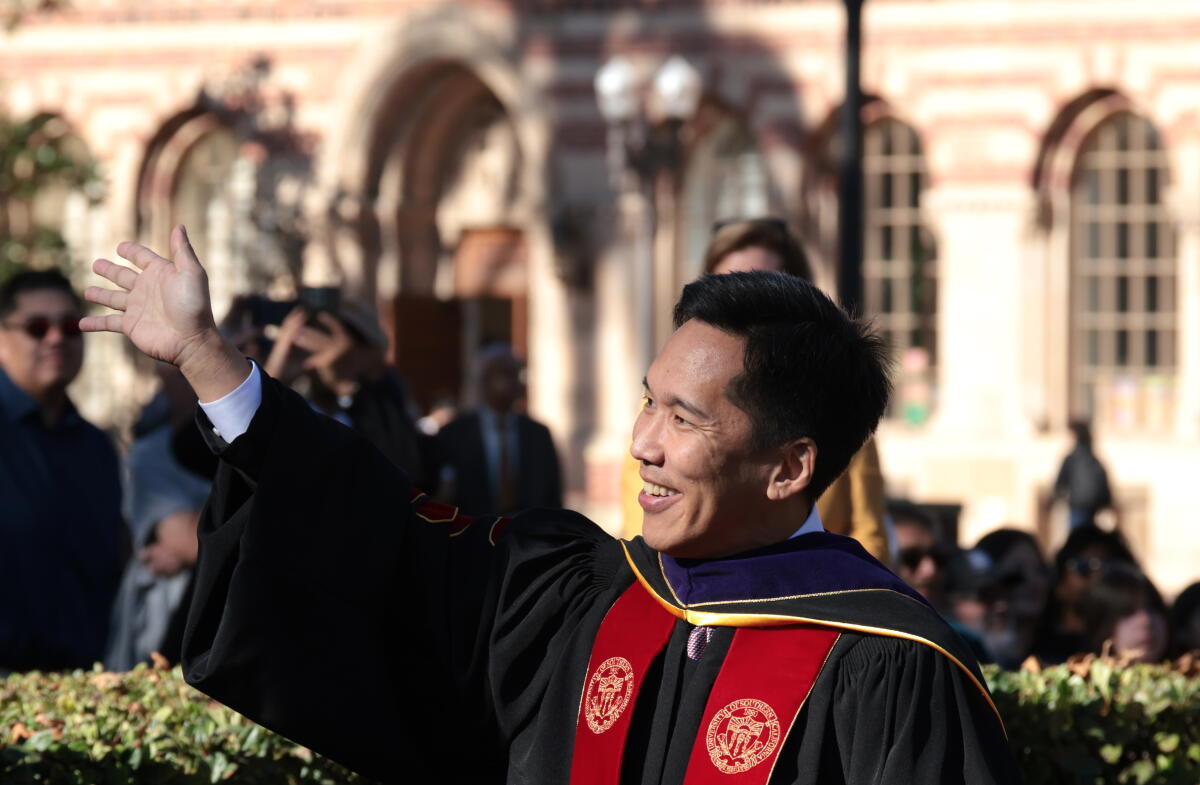
Eyo-Dae Kim and Susan Kim attended the University of Southern California decades ago, two international students with little money and no family in the U.S. On Friday, their son, Beong-Soo Kim, stood before an Alumni Park crowd and was formally installed as the 13th president of their alma mater.
“It is wonderful to have you here, Dad, facing the same library where you and Mom studied together at USC,” Kim, 53, said to his father, who took doctoral courses in economics. Kim’s late mother fled during the Korean War and earned a USC master’s degree.
“They certainly would never have imagined, as international students, that this day could possibly come,” Kim had said earlier.
In a wide-ranging interview before the event, Kim — who was appointed in February after holding an interim presidential role — said he leads USC at a time of promise and deep challenges:
The Los Angeles Memorial Coliseum, leased and operated by USC, will be a showcase site for the 2028 Olympics. A recent $200-million gift is fueling a university-wide push into artificial intelligence. USC admitted 12.6% of first-year applicants this fall for sought-after slots.
Beong-Soo Kim was formally installed as USC’s 13th president during an investiture ceremony Friday.
(Myung J. Chun / Los Angeles Times)
Yet he faces steep hurdles. The former federal prosecutor who spent five years as USC’s general counsel inherited a deficit of more than $200 million. Among his first actions, Kim approved the layoffs of more than 900 workers and ordered deep cost-saving measures. USC is still recovering from years of scandal and controversy that scarred its national reputation, including a $1.1-billion payout to settle sexual abuse allegations against a campus gynecologist, its involvement in the “Varsity Blues” admissions bribery scheme and its handling of pro-Palestinian protests.
Then there is Trojan football.
Fans chanted this month for the firing of football coach Lincoln Riley — after years of underachieving — though the Trojans have defeated Washington and Penn State after an Oregon loss.
Although fans and analysts have soured at times on Riley — whose pay exceeds $11 million and whose reported buyout is about $70 million — Kim declined to say whether USC could afford a coaching change, saying, “We’re not thinking about that.”
Share via
Amid fan chants to fire Trojan football coach Lincoln Riley, USC President Beong-Soo Kim declined to say whether USC could afford a coaching change, saying “we are laser-focused on the next game.”
“We are laser-focused on the next game, and then the game after that, and really having the best possible season that we can have in football,” he said.
After the stinging rounds of layoffs, Kim said, the university expects to “significantly exceed” the roughly $30-million surplus he forecast for USC earlier this year during his state-of-the-university speech, though final numbers are pending.
In his speech, Kim said that public trust in universities has declined and “we must regain trust by earning it.” USC is among the elite universities targeted last year by the Trump administration over alleged campus antisemitism, though it has not faced major federal funding freezes or lawsuits as the UC system has.
On Friday, deans and faculty in academic regalia processed into Alumni Park, where the Trojan Marching Band accompanied the national anthem as temperatures climbed toward the 90s during the nearly two-hour ceremony.
USC religious life dean Varun Soni opened an invocation by describing the cello’s sound post — a small wooden piece called its “soul” in Italian and French — and comparing it to the soul of a university. Kim, a cellist, later joined USC Thornton School of Music students to play “Prelude,” the first movement of Grieg’s “Holberg Suite,” Op. 40, as Kaufman School of Dance students performed.
Morton Schapiro, Northwestern’s president emeritus and a former USC dean, represented visiting academic delegates and praised Kim’s “creativity, character and commitment to community” before Suzanne Nora Johnson, chair of the Board of Trustees, formally installed Kim. Jewish, Christian, Muslim, Hindu, Buddhist and humanist blessings closed the ceremony. In the afternoon, a “Trojan Family celebration” in McCarthy Quad was scheduled to feature food stalls and performances by singer-songwriters Aloe Blacc, a USC alumnus, and Allen Stone.
Money, medicine and priorities
When he took over as interim president in 2025, upon the departure of Carol Folt, Kim immediately confronted the university’s financial crisis. The campus had long spent more than it brought in, an imbalance driven by rising athletics costs, pandemic expenses and major legal settlements. A weak year for USC’s health system deepened the shortfall. Kim maintained a hiring pause, stopped merit raises and took “a hard look at a lot of our administrative expenses and our operations,” he told The Times.
Keck Medicine of USC took a significant hit in the layoffs after running a deficit in the tens of millions in recent years. Last month, dozens of layoffs took place at the Viterbi School of Engineering.
Kim said Keck’s performance “has been good, but it can get better.” The health system is “making very positive progress” to cut expenses while focusing on “patient care, patient quality.”
Across campus, he credited staff and faculty with “stepping up, asking how can we do more with less.”
USC is also challenging a faculty union before the National Labor Relations Board. Non-tenure-track faculty voted in June to join United Faculty-UAW, with about 70% in favor. USC has asked the labor board to review the decision that allowed the vote, arguing the union is too broad. Faculty leafleted Friday during Kim’s event.
Kim said he wants USC to build strong partnerships with Los Angeles industries, including entertainment, biotechnology, sports and “the new space economy.”
He cautioned in his speech that “great universities do not become greater by trying to do everything.”
During the interview, he did not say which university programs need to shrink but said such decisions will come through a strategic plan that will “engage the whole community.”
“One of the things that I frankly pride myself on as a university president is that I readily admit that I don’t have all the answers, and certainly not the best answers,” he said.
Beong-Soo Kim speaks at USC’s commencement in May.
(Jason Armond / Los Angeles Times)
Admissions
A pressing debate — particularly within the University of California system — is whether standardized tests should be required for admissions. Many of the nation’s most elite institutions have recently turned away from test-blind or test-optional admission policies. UC, which does not consider SAT scores in admissions, is reviewing whether to resume SAT and ACT requirements.
Kim said USC, which is test-optional, is studying the issue too. USC considers SAT and ACT scores if applicants submit them but does not require them.
Share via
As the University of California evaluates whether to reintroduce SAT and standardized testing requirements for admission, USC President Beong-Soo Kim said USC is also looking at the question. He said USC, which is test-optional, has not made a final decision.
“It’s absolutely something that has been under discussion, particularly with respect to STEM students,” he said, referring to science, technology, engineering and math majors. He cautioned that no final decision has been made and that the new provost, David Madigan, will be looking at the issue.
Kim said UC’s test-blind policy is “one of the contextual factors that we have to consider.” Many California students who plan to apply to UC skip the tests, and many of them also apply to USC, he said.
USC said last year it would keep weighing applicants’ family ties to the university despite a state ban on legacy and donor preferences. In 2024, while the ban was pending, USC said it would “comply with state law” if it were signed. Schools that keep the preferences are listed publicly as out of compliance and must report more admissions data to the state.
Kim said USC chose to keep “considering whether someone is a member of the Trojan family” as one of many factors. He said he is “actually quite proud” that USC maintained its “holistic admissions practices” in a way that “provides more transparency about our admissions.”
Image and trust
Legacy preferences have fed a stereotype of USC as a college for the wealthy and well connected. Kim disputed that image.
He pointed to USC’s transfer students, Pell Grant recipients and first-generation students. USC opens its doors to “so many people in California, throughout the country, and throughout the world,” he said.
Still, Kim acknowledged that trust in education has fallen, though he said that trust in American institutions “across the board has been declining.”
Share via
USC violates state law by considering legacy and donor ties in admissions, a practice President Beong-Soo Kim defended as part of a holistic review while touting the university’s transparency in reporting admissions data to the state.
“Some might have to do with events from several years ago,” he said.
He did not say which events, though USC has had its share. As general counsel, Kim helped steer it through the aftermath of the national Varsity Blues admissions bribery scandal and the sex abuse payout to former patients of campus gynecologist George Tyndall, the largest in higher education history.
His answer to falling trust has been the Open Dialogue Project, which he launched in October 2025 to bring clashing views to campus. Guests have included National Institutes of Health Director Jay Bhattacharya, former ACLU President Nadine Strossen and legal scholar Jonathan Turley.
In September, the Foundation for Individual Rights and Expression gave USC its top “green light” rating for several speech policies. After the group recalculated its college free speech rankings, USC rose from 198th to 37th out of 261 schools.
White House pressure
Last fall, the Trump administration invited USC and eight other universities to sign a higher education compact offering favorable access to federal research grants. Signers would cap international undergraduates at 15%, require the SAT or ACT and freeze tuition for five years.
USC rejected the compact last October — about two weeks after the administration offered it.
Some faculty viewed USC’s initial reluctance to reject the overture as a sign it was unwilling to openly challenge Trump’s education demands. They also point to USC’s closure of its university-wide Office of Inclusion and Diversity last year amid a federal anti-DEI push and its removal of pages for cultural heritage months from its “Culture Journey” website earlier this year.
Kim disagreed that USC bends quickly to the White House.
“It would have been highly presumptuous for me just to make a rash decision about what we were going to do without listening,” he said of the compact.
International students have also faced pressures, as the government restricts some visa programs and significantly increases costs for others.
About 26% of USC students are international, with 15% of the undergraduate population coming from other nations. Kim said international students “have been part of USC for decades” and called their presence “a win-win.”
AI risks
USC is also leaning into artificial intelligence, with a $200-million gift from Nvidia board member Mark Stevens and his wife, Mary Stevens, meant to infuse AI across the campus and recruit AI researchers.
But leaders of OpenAI and Anthropic have warned that the technology’s fast development poses serious risks to jobs and human existence.
“We have to take those warnings very seriously,” Kim said. Universities, he said, can help clarify what it means for AI to be “aligned” and “safe.”
Kim said USC wants to make sure its students “are leading in terms of how to use it ethically, how to use it morally.”
The future
On July 14, 2028, the Coliseum — USC’s campus-adjacent home stadium — will share the Olympics’ opening ceremony with SoFi Stadium in Inglewood.
Kim said he hopes Olympic visitors will see “a university that has an incredible Olympic tradition,” but also one whose reach goes well beyond sports.
The Games will also bring alumni and students “from across the globe,” he said. “I think that’s going to make for a very magical moment.”
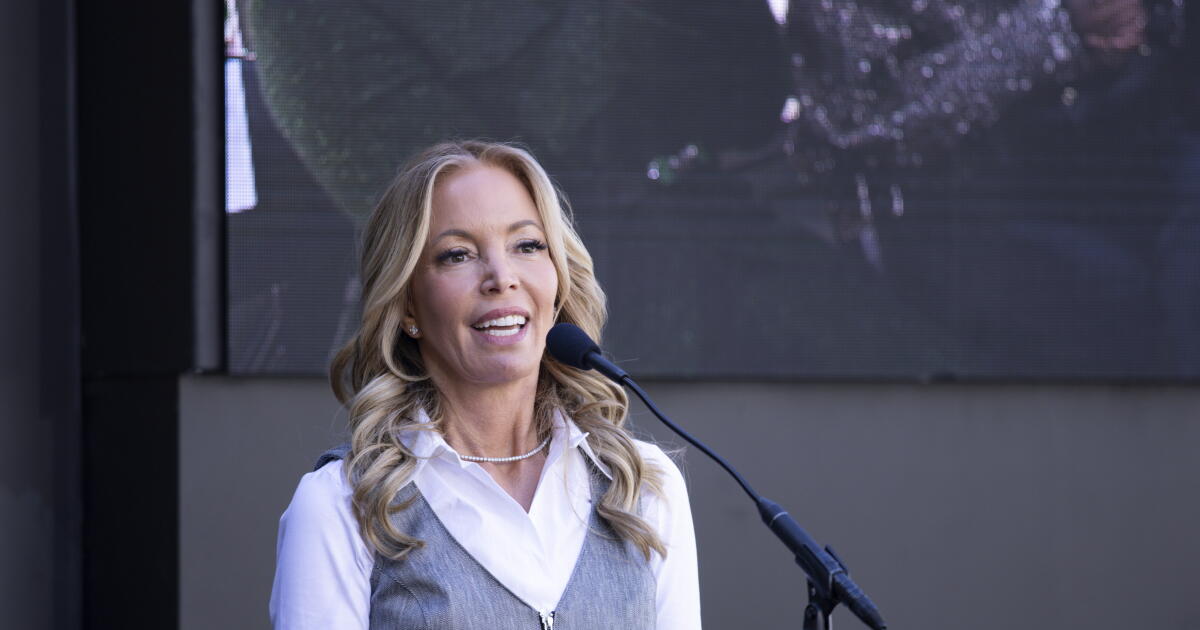
Lawyers for Janie and Joey Buss, two of the co-trustees of the Buss Family Trust that owns part of the Lakers, filed a response to Jeanie Buss’ petition Friday with intention to move forward with the proposed sale of the family’s remaining shares of the team.
While Jeanie is trying to block her five siblings from selling the team, the new response filed in L.A. Superior Court states that Janie and Joey, the two other co-trustees of the family trust, were authorized and required to implement the vote after a majority of the living siblings opted to terminate the trust in August. The vote of five siblings to sell the shares triggered the termination clause in the trust, and the filing argues that the trust doesn’t grant trustees discretion to disregard a valid vote to terminate.
Jeanie argued that her siblings could not terminate the family trust and sell the remaining 17.82% of the team without her approval, citing a 2017 court order that instructed trustees to “take reasonably available steps” to support Jeanie’s annual election as Lakers controlling governor. The court order, obtained after Jeanie’s older brothers Jimmy and Johnny Buss tried to oust her from the organization, installed Janie and Joey as co-trustees.
But the court order did not prohibit a sale or termination of the trust, lawyers for Janie and Joey argue. While the order named “voting the trust’s shares” as a reasonable action, it did not require the trust to hold a 15% stake in the team to reach the NBA’s eligibility threshold for minority owners to serve on the league’s board of governors, the filing states.
Jeanie was selected by her father Jerry Buss to serve as the team’s controlling governor after his death in 2013.
Using a tag-along provision secured during the sale to Walter, the five Buss siblings hope to maximize value for all six beneficiaries, including Jeanie, the new filing reports. Selling the 17.82% stake in the team would be worth about $2.2 billion.
A hearing is scheduled for Dec. 8. The Lakers open the regular season on Oct. 21 against the Golden State Warriors at Crypto.com Arena. Jeanie was seen at the Lakers’ home preseason opener on Oct. 8, sitting courtside on the baseline.
A Gallup survey highlights a deep – and historic – partisan divide over confidence in the country’s elections.
Published On 7 Oct 20267 Oct 2026
With less than a month to go before the United States’ pivotal midterms, a new survey found that most independent voters and supporters of President Donald Trump’s Republican Party do not believe the elections will be honest.
Polling from Gallup, released on Wednesday, found 37 percent of Republicans and 35 percent of independents have confidence in the country’s electoral system, significantly lower than US Democrats (63 percent).
Recommended Stories
list of 3 itemsend of list
Overall, 49 percent of Americans said they were confident in the honesty of elections, while 51 percent said they were not. Those figures are unchanged from the country’s last midterm election in 2022.
This “marks a change from 2025, the first year of Trump’s second term, when confidence was nominally higher among approvers (51 percent) than disapprovers (45 percent)”, Gallup wrote in a statement highlighting the results of the survey.
The numbers highlight a deep, historic partisan divide over confidence in US elections.
“Since 2025 and Trump’s return to the White House, the relationship between leadership approval and confidence in elections has disappeared,” Gallup wrote.
Gallup said that the US is the only country out of more than 100 polled annually over the past 15 years to show this pattern – trust in US election integrity is markedly higher among those who disapprove of the country’s leadership under Trump (52 percent) than those who approve (41 percent).
In more than 100 countries where the polling organisation tracks views of national leadership and confidence in elections, people who approve of their governments have generally been more likely to trust their country’s elections.
In 2025, 70 percent of people globally who approved of their national leadership expressed confidence in the honesty of their elections, compared with 30 percent among those who disapproved.
“The current US pattern is highly unusual compared with the rest of the world,” Gallup wrote.
Under former US President Joe Biden, 81 percent of Americans who approved of the government expressed confidence in elections, compared with just 30 percent of those who disapproved, according to Gallup.
Gallup said the unusual divide could have implications for the November elections, raising questions about whether some voters will view the results as legitimate.
The White House did not respond to a request for comment.
Cristiano Ronaldo says he is not retiring from international football but deserves to be punished for walking out on Portugal for a “breach of the coach’s trust”.
The 41-year-old captain left his country’s Nations League camp after being an unused substitute against Norway and then finding out he would not start against Denmark.
Al-Nassr forward Ronaldo has scored 146 goals in 234 Portugal appearances – both world records – helping them win Euro 2016 and the Nations League twice.
In a lengthy statement, the former Real Madrid and Manchester United player said he should be held accountable for his actions.
“The Portuguese Football Federation must assess the consequences of my actions and punish me for them. I believe the punishment should not be reduced,” Ronaldo said.
“I have already apologised, but I know that actions have consequences.”
Portugal manager Jorge Jesus said on Sunday that the door was still open for Ronaldo to play for the country’s national team.
Ronaldo said that, provided he was “physically fit, playing with my team, and hopefully scoring goals”, he would like to continue to play international football.
“After my suspension period ends, I will be available, as I always have been, to compete and win with our national team,” he added.
ATLANTA — When Edwin Díaz envisioned his first season with the Dodgers, it looked nothing like this. He was going to stay healthy all year, pitch like an All-Star. He certainly was going to throw in more than 21 regular-season appearances.
A slew of injuries, with mechanical issues layered on top, had other plans. But everything resets in the postseason. And against the odds, the right-hander is back in the closer conversation.
“It means a lot,” Díaz said in a conversation with the Times Monday. “Because I was nowhere, basically this season. They gave me the last week and a half of the season to come and pitch. And I was ready every day.”
If he can keep pitching the way he has since returning from the IL in September, it’ll strengthen the Dodgers’ chances at a three-peat. They went into the postseason with a closer-by-committee approach. But manager Dave Roberts said before the Dodgers’ workout at Truist Park on Monday that they could get to a consistent closer by the end of the postseason.
“Certainly that last outing was as good as we’ve seen him throw, and it’s hard to imagine throwing any better,” Roberts said of Díaz’s perfect inning against the Atlanta Braves Sunday, which included three fastballs over 100 mph. “We built him up, regained the confidence in himself. So, I think that it’s certainly a viable option for [Tuesday] night. I feel very confident [with] him finishing a game.”
Though his first postseason outing for the Dodgers was in the sixth inning of Game 2 of the National League Division Series, Díaz has been mainly in high leverage in his playoff career — he owns a 2.19 ERA in nine postseason appearances. The former Mets closer even recorded a four-out save at Dodger Stadium in Game 2 of the 2024 National League Championship Series.
“I don’t try to think, ‘Oh, there’s many thousands of fans here,” he said. “Just me against the hitter, and I trust myself. And like I always tell myself, ‘You are a warrior, you are you are the best, and go and compete.’”
The Dodgers’ closer situation has been in flux all year. They had signed Díaz to a three-year, $69 million contract with that role in mind. And even when he missed three months for arthroscopic surgery to remove loose bodies from his elbow, and lefty Tanner Scott took over in the ninth inning, the spot was open for Díaz when he returned.
That was not the case after his second IL stint. And it was during that month-long road back that he finally re-found himself on the mound.
“I was like this maybe in the [World Baseball Classic] and first couple games early in the year before I got hurt,” Diaz said. “But now I feel way better than everything. So I think this is the best I ever felt this year.”
The process started with treating his neck. Díaz was feeling tightness around the front side of his right trapezius muscle, which could have contributed to Díaz dropping his arm angle. He received medication and needling therapy to address the issue, he said.
Trainers used manual manipulation to find Diaz’ ideal arm slot and build muscle memory, and he was quickly cleared to resume throwing.
“I’ve been doing that for so long, I just lost it for a little,” Díaz said of his arm angle. “And we’ve got a really good group of coaches right here, and they found it right away.”
Díaz began a rehab assignment with Triple-A Oklahoma City in early September. But it wasn’t smooth sailing. In his fourth outing, Díaz issued three walks and surrendered five runs in just two-thirds of an inning.
“I got mad at myself because I knew I was better than that,” Díaz said. “I wasn’t able to control my fastball. So after that game, I talked to the pitching coaches in Triple-A to say, ‘We need to find something because I want to be back in the big-leagues, I want to help this team to win.’”
They dug into Díaz’ biomechanics and found that his hip position was different from last year. When he’s right, Díaz explained, his leg lift starts with his hip. But he’d begun to rush the move, which caused his arm to lag behind.
He threw a bullpen with the adjustment and then took it into one final rehab appearance, a one-hit outing.
“I told the team, ‘I’m ready to go,’” Díaz said.
He sure was. Díaz posted a spotless ERA in six games down the stretch, limiting opponents to one hit combined. And that success carried into his Dodgers postseason debut.
“He’s put himself in a position to be the closer,” Roberts said. “And in October, I don’t pay too much attention to the long sample of a season in a lot of cases because in October things happen quickly, and you’ve got to be willing to read and react.”
For Díaz, the season may not have gone as planned, but his vision of the next few weeks is as clear as ever. He wants to record the final out of the World Series.
“I know how to control my emotions,” he said. “I learned that during my career, and I’m pretty good at that. I just can’t wait to be in that position, and if I’m in there, I will give my 100%.”
Gordon, the grateful beneficiary of Alexander-Arnold’s class, said: “I make that run time and time again and only a certain number of players have that ability, technique and bravery to be willing to make the mistake trying that pass. That’s why he’s so good and I’ve been dying to play with him for that reason.
“He’s had his own journey with England. He would’ve liked to have played more than he has but he’s been a great character during this camp. I’ve really enjoyed being around him.”
Alexander-Arnold is a risk taker, both in the defensive and attacking context, but only Elliot Anderson (41) made more passes in the final third than he did (32), while only Anthony Gordon, with four, created more chances than the defender’s three.
Tuchel, it should be stated, is not alone in having doubts about Alexander-Arnold.
Who can forget – although many would love to – Sir Gareth Southgate’s ill-fated attempt to utilise Alexander-Arnold as a midfielder at Euro 2024? It was ditched after 54 minutes of England’s second game against Denmark never to be seen again.
More will be revealed if Tuchel persists with Alexander-Arnold against Croatia behind closed doors in Rijeka on Saturday – but this must be close to make or break time for this lavishly-talented player who is 28 on 7 October.
If he cannot convince Tuchel in this camp, and surely that one moment of game-changing skill must be fixed in the head coach’s mind, then you wonder if he ever will.
Alexander-Arnold said: “It was amazing. It’s always an honour to represent my country. It’s been a long time, but I’ve always believed I can play for England. That belief has always been there and it was about proving it at club level. The manager gave me a chance, now hopefully he is happy with how I played.”
How happy? Time, and Tuchel, will tell.
Alexander-Arnold, however, could not have done any more as England, who sealed the three points with captain Harry Kane’s 87th goal in 123 international appearances, got their Nations League campaign going in Prague.
Most UK holidaymakers still consult and trust their family and friends’ recommendations over AI for travel advice
08:00, 29 Sep 2026Updated 13:37, 29 Sep 2026
Three-quarters of Brits said having a holiday booked gives them a ‘sense of purpose’(Image: Hilton)
A landmark study of 14,000 travellers from countries including the UK and Australia found that in the UK, family (84%) and friends (81%) trumped AI (45%) for travel tips and holiday hotspots.
Just one in 10 rely on influencers for travel advice – highlighting ‘The Travel Trust Equation’ will be a strong theme emerging for 2027. Artificial intelligence is seen to be transforming the way we travel, but it hasn’t quite replaced the human touch. It also revealed they are set to prioritise things like balance, flexibility and trips that leave a lasting impact.
Of the 1,000 Brits surveyed as part of the Hilton 2027 Trends Report, The Great Rebalance, three-quarters said having a holiday booked gives them a ‘sense of purpose’.
This reflects ‘The Beforeglow’, with booking a trip giving people a much-needed psychological boost and offering them a sense of excitement, motivation and escape weeks, or even months, ahead of departure. More than a quarter (27%) also seek a new perspective through travel, which changes how they view everyday life when they get back home.
Simon Vincent CBE, executive vice president and president, EMEA, Hilton, said: “Travellers are increasingly focused on making their time away count. Rather than chasing a one-size-fits-all idea of the perfect trip, they’re looking for experiences that reflect their own interests and priorities.
“Our job is to help guests make the most of every trip; whether they’re exploring a new destination, reconnecting with loved ones, taking time to switch off – or even a little bit of everything.”
The study also found 60% of all Brits claimed having a holiday booked helps them stick to personal goals, while 53% use them to mark important life moments, meaning travellers are well into their ‘Optimisation Era’.
But 28% of Gen Z travellers see holidays as a chance to kick-start a healthier lifestyle, whereas 63% are more likely to make a significant life change after returning home from their travels.
Nearly three quarters of this generation (74%) also feel motivated to stick to personal goals knowing a holiday is on the cards, and 32% regarded maintaining their fitness routine while away as ‘non-negotiable’.
But the Morning Consult research found 29% of younger travellers feel pressure to plan the ‘right’ kind of trip – compared with just 6% of 62-80-year-olds, showing a rise in ‘Boomer Goals’.
Only 18% of this older generation stick to a strict itinerary, compared with 41% of Gen Z, with 53% of Boomers favoured a spontaneous approach instead. And 72% never feel pressure when making travel decisions, compared with only 27% of Gen Z.
Travel loyalty is emerging as another status symbol among younger holidaymakers, with 27% of Gen Z belonging to a points or miles programme.
The rise of ‘Status Seekers’ suggests travel loyalty programmes have entered a new era, where status matters as much as savings.
With 37% even admitting to feeling jealous of friends with a higher travel status, as 41% see that status as a sign of personal success.
A further 58% of 18-to-29-year-olds believed people with elite travel status have greater influence over group travel decisions.
Where travellers stay is changing too, as gardens were named as an accommodation ‘must-have’ by 40% of Brits, placing them ahead of hotel pools at 33%.
Fresh air and time outdoors were key to holiday relaxation (76%), while 47% will use travel to spend more time immersed in settings such as forests, mountains and coastlines.
UK adults are also reconsidering the traditional big annual getaway in favour of shorter, more flexible breaks, with 65% planning to take more short trips over the next year.
Among these “micro-travellers”, 35% want to tick more destinations off their travel lists, and 26% value the spontaneity offered by shorter breaks.
A further 56% will plan a micro-trip around one standout experience, rising to 74% of Gen Z travellers.
Simon Vincent added: “With a portfolio spanning everything from luxury retreats and city-centre collection hotels to family-friendly resorts and extended-stay brands, we offer travellers the choice and flexibility to find the experiences that are right for them.”
Seven travel trends for 2027
The Travel Trust Equation – AI may be transforming travel, but it hasn’t replaced the human touch.
Status Seekers – Travel loyalty programmes have entered a new era: where status matters as much as savings.
Boomer goals – In contrast to the younger generation’s optimisation obsession, Boomers are making a compelling case for doing less.
The Beforeglow – Booking a trip is giving people a much-needed psychological lift, offering a sense of excitement, motivation and escape weeks, or even months, ahead of departure.
Optimisation Era – Self-optimisation culture continues as travellers will see time away as an opportunity to return home levelled-up.
Wellness Rewired – Nature is the new must-have, with outdoor spaces now valued more than hotel pools.
The Micro-Travel Mindset – More Brits are swapping one big annual holiday for a series of shorter, experience-led escapes throughout the year
It’s never good when NFL coaches on struggling teams have to publicly reaffirm their faith in members of their staff before the calendar turns to October — and that’s what Chargers coach Jim Harbaugh did on Monday.
Speaking to reporters in the wake of a 24-16 loss to the Buffalo Bills, Harbaugh was asked if he would consider taking some control away from offensive coordinator Mike McDaniel if the offense doesn’t improve.
“No, we trust Mike. We believe in Mike,” Harbaugh said.
It would be odd for Harbaugh to publicly admit to anything else at this point, especially because he’s not in a good position to do much else to salvage the season. Harbaugh has never called plays at the NFL level and must hope McDaniel and Justin Herbert can fix the NFL’s No. 21-ranked offense (309 yards per game) if the Chargers have any chance of becoming the eighth team in NFL history to reach the postseason after an 0-3 start.
“We’re searching for every possible way to give ourselves an advantage,” Harbaugh said. “Every possible way to not beat ourselves.”
Although Harbaugh doesn’t see himself intervening on McDaniel’s turf, he does want to see improvement from Herbert. The quarterback struggled against the Bills, failing to capitalize on five takeaways from the Chargers’ defense. He passed for 226 yards with a touchdown and an interception, but four trips to the red zone — two of which were assisted by favorable field position off takeaways — resulted in only three field goals and a touchdown.
“To be better,” said Harbaugh, regarding Herbert’s decision-making. “That drives Justin, that drives me, that drives his position coach, that drives Mike [McDaniel]. … I mean, drives us all.”
Herbert isn’t the only underperformer. Dropped passes from wide receiver Quentin Johnston and tight end Oronde Gadsden II were factors in the Bills becoming the first team since the Jacksonville Jaguars in the 2022 season wild-card playoffs to win despite five turnovers and a minus-four turnover differential.
The team the Jaguars beat that January? The Chargers.