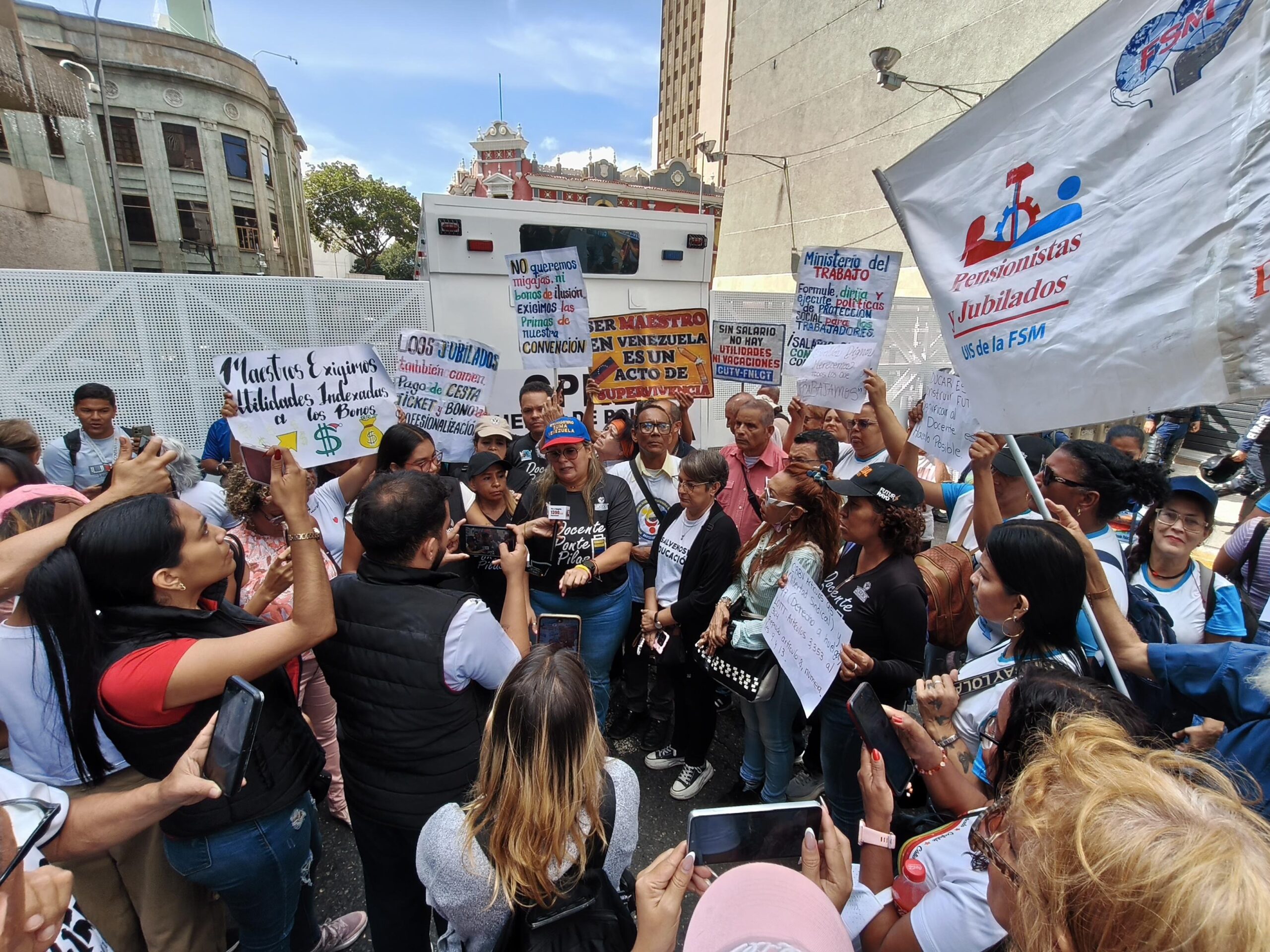
Education and healthcare workers held demonstrations and blocked highways. (Fevemaestros)
Caracas, November 16, 2026 (venezuelanalysis.com) – Venezuelan education and healthcare workers staged a 12-hour work stoppage and blocked highways across the country on Monday to demand better pay and labor conditions.
The initiative was backed by multiple trade unions and federations in several Venezuelan states.
“The Venezuelan working class is taking to the streets to fight for its rights and this stoppage has been a resounding success,” Eduardo Sánchez, president of the SINATRA university workers union, told Venezuelanalysis. “The latest trigger was the government’s decision to award US $150 in end-of-year bonuses,” which he called “a joke and a slap in the face”
Sánchez stated that unions are demanding $960, corresponding to four months of the present minimum income.
Since 2022, Venezuelan authorities have declined to raise the monthly minimum wage, leading it to devalue to $0.15. Instead, they have replaced it with non-wage bonuses that do not factor into the calculation of labor benefits such as vacation or Christmas bonuses, and severance pay. The current monthly income floor for public sector workers is $240.
Long-time union leader Sánchez stated that activities at the Central University of Venezuela (UCV), the country’s largest, were “completely paralyzed” on Monday. Local reports and social media content also showed adherence to the work stoppage in universities in Barinas, Zulia, Anzoátegui, Aragua, and other states.
“There has been great participation from the healthcare, education, and higher education sectors all over Venezuela,” he said. He vowed that “the struggle is just beginning,” announcing upcoming protests and workers’ assemblies. A group of protesters temporarily blocked the Gran Cacique Guaicaipuro highway which crosses Caracas from east to west.
“[Acting President] Delcy Rodríguez will have to take our demands into account and clarify before the country where the oil revenues have gone, because the Venezuelan working class has not seen any improvements,” Sánchez concluded.
Mauricio Zambrano, trade union leader from the healthcare sector, congratulated workers for “paralyzing” Caracas and other parts of the country by blocking major roads and highways.
“This was a successful mobilization on a national scale,” he affirmed. “And we are going to stay on the streets until our demands are addressed.”
There were reported stoppages and demonstrations in several of Caracas’ main hospitals. Spokespeople told local media that doctors, nurses, and other personnel from multiple areas were protesting but that the hospitals’ emergency and other critical services would continue uninterrupted.
End-of-year bonuses have been at the heart of labor mobilizations across the country. Earlier this month, workers from the Corporación Venezolana de Guayana (CVG), a state-owned heavy industry conglomerate, secured a $1,100 payment, to be split up in four installments.
The Venezuelan government gave in to the workers’ demands after weeks of protests and repeated efforts to block a major bridge in Bolívar State.
In late October, Venezuelan authorities likewise agreed to pay a $2,000 bonus, divided into three instalments, to workers from state mining company MINERVEN after a short-lived work stoppage.
Multiple spokespeople during Monday’s demonstrations referred to the CVG and MINERVEN precedents, warning authorities that there cannot be “first-class and second-class workers” in the public sector.
Since the start of the year, Venezuelan trade unions and worker federations have staged recurring protests, demanding dignified pay, including the conversion of bonuses to wages, and the reinstatement of collective bargaining agreements.
Representatives have denounced plans by the executive and business lobbies such as FEDECÁMARAS to implement regressive labor reforms. FEDECÁMARAS spokespeople have expressed optimism that a “Law of Labor Consensus” will soon be approved to reduce labor costs for employers as well as eliminate the retroactive nature of benefits such as social security and severance, considered a red flag for unions.
Former President Hugo Chávez approved a historic Labor Law in 2012 that banned unfair dismissal and outsourcing, enshrined the world’s third-longest maternity leave, guaranteed the right to work for both women and people with disabilities, and extended retirement pensions to all workers, including full-time mothers and the self-employed.
Apart from the labor reforms, the Venezuelan government is likewise preparing to privatize state-owned assets it deems “non-strategic.” Acting President Rodríguez vowed to return companies nationalized during the Chávez government to their former owners.
Edited by Lucas Koerner in Philadelphia, USA.