Wages

Adelmo Becerra: ‘It Is Essential to Defend Labor Rights Against Regressive Reform’

Becerra argues that there are economic conditions for a gradual restoration of the minimum wage. (Venezuelanalysis)

Adelmo Becerra is a Venezuelan trade union representative from the National Institute for Training and Socialist Education (INCES) and also a member of David Hernández Oduber Revolutionary Current (CREDAHO). In the past, he worked as an instructor at INCES and as a worker in the steel industry in Ciudad Guayana. In this interview, Becerra discusses the Venezuelan government’s recent labor policies under US sanctions, the growing labor reform prospects, and the present struggles and challenges facing the working class.

On May 1, the Venezuelan government raised non-wage bonuses while maintaining the minimum wage frozen. What was your reaction to these announcements? How do you place them in the context of recent labor policies in Venezuela?

The announcements represent a continuity of the labor policies of recent years. There had been expectations for restoration of the minimum wage in the short term. According to Article 91 of the Constitution, it must be adjusted once a year. Naturally, it would be a partial and limited restoration. But it is important to place the announcements in the context of various processes currently unfolding in the labor sphere.

In Venezuela, the Social Dialogue Forum, a body coordinated by the International Labour Organization (ILO), has been in place since 2021. Several trade union federations participate in this forum, including the Independent Trade Union Alliance of Venezuela (ASI), to which the INCES union belongs, the Venezuelan Workers’ Confederation (CTV), the Bolivarian Socialist Workers’ Federation (CBST), as well as government representatives. The Social Dialogue Forum is not binding, but Venezuela has ratified conventions, including Convention 26, which establishes consultations with trade union organizations for setting the minimum wage. However, a mechanism for establishing it has not yet been agreed upon.

At the same time, the government led by Acting President Delcy Rodríguez has established the National Dialogue for Labor Consensus, which includes the CTV, ASI, and CBST labor federations, along with representatives from business associations FEDECÁMARAS and FEDEINDUSTRIA, and government officials.

Then there is the struggle on the streets that has unfolded in the country in recent years. I would single out the August 2018 Program for Growth, Recovery, and Economic Prosperity as a starting point. This program produced two instruments that have denied wage and labor rights established in collective bargaining agreements, even disregarding the Constitution and labor legislation. I am referring to Memorandum 2792, from October 2018, which sets out the broad guidelines regarding the suspension of collective bargaining rights. And then there is the 2021 ONAPRE Directive, which addresses its specific application. Both instruments remain in force, and their repeal has been a constant demand in the workers’ struggles.

So, back to May 1, there was no restoration of the minimum wage. However, the announcements stem from agreements reached at the National Dialogue for Labor Consensus. And the signed minutes refer to a “wage consultation process” that will begin in May. This indicates that the issue of the minimum wage is far from settled. Similarly, the agreements “urge” the private sector to establish this same US $240 income floor, specifying that it may be through “non-wage bonuses,” although in reality there are no mechanisms to enforce it.

But the minimum wage is not an isolated issue. We have heard spokespersons from both the government and the private sector speak of labor reform. Just in recent days, in a meeting of the Social Dialogue Forum, one of the agreements was to “coordinate consultations of labor-related laws with the National Assembly.”

Adelmo Becerra during a rally in 2023. (Frenpodes)

Let us take a closer look at the issue of bonuses versus wages. What are the consequences of this “bonus-ization” policy?

The main impact is on workers’ entitlements, specifically in the form of social benefits. These benefits accumulate over the course of the employment relationship, and their primary function is to recognize seniority so that it can be taken into account when paying out benefits.

But there is also another concept: retroactivity. This means that benefits are paid based on the final salary. Thus, when an employment relationship ends at a private company, the benefits paid as compensation are calculated based on the final wage and the duration of the employment. The same applies to those retiring from the public sector, or from a private company that offers a retirement plan –which is very rare in Venezuela.

This issue is very important because it has been at the center of the historical Venezuelan working-class struggles following the oil-led industrialization and the 1936 Labor Law. Social benefits allowed Venezuelan families to have assets, purchase homes or other property, and also served as a safety net in contexts of unemployment or economic crisis. This safety net no longer exists today because the minimum wage has been effectively eliminated.

Then there are other important factors, such as social security contributions, which fund the Venezuelan Social Security Institute (IVSS). This is a universal solidarity-based system in which both employers and employees contribute, and it serves as the economic foundation for old-age pensions and other IVSS social support initiatives, such as in healthcare. So, this system is also in crisis because contributions are computed based on wages.

The result is that for the private sector, both social security contributions and severance pay are practically free right now, and that in turn affects job stability.

Speaking specifically about INCES, which is a state-run training institute, what is the current employment situation like? Do the staff work full-time?

According to data recently provided to us by the authorities, there are approximately 11,500 people on the payroll, 6,800 of them active workers, and the rest are retirees. The vast majority receive only the “economic war” and bonuses, now set at $200 and $40 a month, respectively. Through our collective bargaining agreement, retirees also receive the food bonus, which is not the case in general in the public sector.

In recent years, as a union, we have held discussions with INCES authorities and the Ministry of Labor –which oversees the institute –to ease the requirement that people come to work every day while we try to secure better conditions. Simply put, if their income isn’t enough, they should have the option of trying to find a second or third job. With the recent increases in bonuses, the authorities are putting more pressure on workers to return to full-time work, but it’s complicated.

We are still in that struggle to improve conditions, even though we have not even been able to make progress on a memorandum of understanding to improve the socioeconomic clauses of the current collective bargaining agreement. But that’s the priority.

Turning now to the private sector, you have participated in the Observatory for Labor Dignity, which has investigated current working conditions in Venezuela. In general terms, why the focus on the private sector? And what is the reality of that world?

The first reason is that unionization rates in the private sector have historically always been very low in our country. At its peak, in the 1970s, it reached 30%, and today it is likely below 15% –and that is being optimistic. We must take into account the massive migration of recent years. It is a very low unionization rate, and in sectors such as retail or services, there are practically no unions.

Consequently, the level of job insecurity and vulnerability is much higher, especially given the government’s policy of restraining official workplace inspections based on tacit agreements with the private sector under the pretext of “promoting employment.”

One issue that came up repeatedly was the lack of maternity protection which was one of the advances of the 2012 Labor Law. Right now, in the companies we investigated, such as [department store chain] Traki or [textile distributor] El Castillo, no woman wants to get pregnant because that would mean immediately losing their job. Not only that, but it would also make it impossible to get a reference letter or a recommendation for another job.

It is important to stress that the approach to undermine or marginalize collective bargaining agreements was not limited to the public sector. The private sector also adopted it. Under the guise of “protecting jobs”–claiming that companies would go bankrupt otherwise –many employers sent workers home on minimum wage, with some being called back to work at the employer’s discretion.

Given the context of crisis and precariousness, under US economic sanctions, that has persisted for several years now, is the impact on workers’ awareness noticeable?

Indeed, there is a very acute lack of awareness regarding labor rights. The new generation of workers is entering the workforce with virtually no knowledge of the rights they hold by law, in part because they have never had access to them.

So, issues like employment contracts, pay stubs, or even working hours themselves are a problem. It is very common to have 10, 12, or even 14-hour workdays, or for the two days off per week not to be upheld. At Traki, this is usually respected, although the two days are not necessarily consecutive. In El Castillo, the average is one and a half days. In El Castillo, there is also a practice of having workers sign their contract and a resignation letter at the same time, which is obviously illegal.

Another characteristic is high turnover. Fixed-term contracts have become the norm. Although after several contracts the law grants the right to continued employment, this is practically nonexistent. The vast majority of people move around a great deal between jobs. This is, of course, made possible by the fact that benefits are nearly non-existent and it is extremely cheap to dismiss a worker, which in turn keeps people in a much more precarious situation.

But there is an important factor to consider: the shift in subjectivity –and this, of course, is not a phenomenon unique to Venezuela. A few days ago, I watched an interview with a North American researcher who found that for young people in the US a job at Starbucks seems like a good opportunity –better than average. Here, in some of the testimonies we collected, young people expressed satisfaction with working at the Traki department stores. They earn some $250 a month, work 9- or 10-hour shifts –while conditions elsewhere are worse –have two days off a week, and would like to stay there. Therefore, the notion of work with rights has also eroded. Issues like overtime pay, not to mention social security, become irrelevant due to the precariousness of the present. The employment relationship, which includes rights and mechanisms to protect them, is beginning to be viewed simply as a commercial transaction.

Former President Hugo Chávez wrote “social justice” as he enacted the 2012 Labor Law. (Archive)

Labor reform talks are underway. Government spokespeople talk about “updating” the law following the impact of US sanctions, while private sector spokespeople are also voicing their demands. What is currently at stake?

I think there are several aspects to consider. We are clearly witnessing an aggressive campaign being waged by the media, along with well-known economists and influencers, to impose a narrative that any wage increase will cause inflation. As such, the only way to raise wages is to reduce employers’ responsibilities and eliminate the retroactive nature of labor benefits.

The 2012 Labor Law reinstated the calculation of benefits based on the last salary. This had been modified, amid much controversy, during the Caldera administration in the 1990s. Still, unlike proposals we see now, retroactivity was not completely eliminated. There is a proposal to let workers choose between receiving benefits immediately or accumulating them, which completely distorts the concept and takes advantage of current economic difficulties. If wages are insufficient, workers obviously prefer to collect as much as they can right away. Even if the current $240 minimum income was turned into salaries, this would represent less than 50% of the food basket for a family, according to different estimates.

I believe it is essential to reject the narrative promoted by groups like Fedecámaras, to reject the premise that we must give up our rights and historic achievements because there are no conditions to sustain them. For starters, there is a lack of transparency and information. We do not even have reliable information on the size of the economically active population. The last census was in 2011, and following the massive migration over the past decade, we do not know what the current picture looks like.

According to 2021 data from the National Institute of Statistics (INE), there were roughly 4 million workers in the formal private sector, just over 3 million in the public sector, and around 5 million pensioners. Therefore, with that precise data, and with transparent information on revenues, it would be possible to quantify whether or not there are resources. Because GDP was heavily hit by the US blockade but has been growing—according to the Central Bank, for 20 consecutive quarters –but the last adjustment to the minimum wage, to $30 per month, was in March 2022.

Another piece of data we lack is the distribution of surpluses among the workforce, private capital, and the state. According to research by former Minister Víctor Álvarez, the labor share reached 40% by 2010. Currently, according to estimates by researcher Carlos Dürich, that figure may be around 20%, which is what is typically observed in African countries with high levels of poverty and inequality.

We need all that data if we want to discuss what is possible or not, and how the wealth that is generated will be distributed. This is especially true in this context, where, outrageously, the US controls Venezuela’s oil sales. Now the Central Bank will be subject to external auditing, but the public still lacks information. So there is a second layer of opacity there.

In summary, under the present conditions, with an unfavorable correlation of forces and foreign control over the Venezuelan economy, it is not possible to restore the minimum wage and have it cover living costs, as established in Article 91 of the Constitution. Nevertheless, economists and trade union federations have argued that there are conditions for a partial restoration.

In this complex context, both domestically and internationally, what is the path forward for the workers’ struggle in the country?

For me, there is one fundamental factor –one that has been evident in recent years –and that is social pressure. Workers are the only force that has exerted pressure on the government, and to some extent on the private sector as well, particularly since 2022. In 2023, the government placated the protests by introducing the “economic war” bonus. The minimum wage had been devalued to $5 at the beginning of the year, and 15 days later the government set the bonus at $25, and then in May at $70. Even if it happens through non-wage bonuses, it is a struggle with the bourgeoisie over the country’s income.

The May 1 increase, again via bonuses, is also a response to pressure from the streets. We will now see what happens with the wage consultations and labor reform plans. The challenge is to sustain the actions and protests over time. But that sustainability depends on unity.

venezuela trade unions minimum wagevenezuela trade unions minimum wage
Labor organizations have demanded an increase of the minimum wage. (Archive)

And what are the challenges to building unity around the labor agenda? A few weeks ago, we witnessed an absurd demonstration by certain union factions asking for support at the US Embassy.

Precisely. On May 1, there was a unified demonstration that likely drew 3,000 to 4,000 people in Caracas, along with smaller marches in other parts of the country. Various labor federations were present, ranging from the more left-wing ones like the CUTV to those social-democratic or Christian-democratic like the CTV or ASI.

On March 12, we also had a united mobilization, but since then the forces have split. And that weakens us because it reduces our impact; the business leaders rub their hands together.

This division has partly to do with issues of leadership and protagonism, and with the fact that not all federations understand that we must play on two chessboards at this moment: on one hand, the negotiating tables, and on the other, applying pressure in the streets.

But the division is also due to a particular factor: a group called the Coalición Sindical, whose main focus is not so much labor or wages, but politics. It serves as the vehicle within the labor movement for María Corina Machado’s political faction, which is obviously trying to capitalize on labor issues for its own agenda. This group has no interest in joint actions to secure better conditions –even if only partial –for the working class; rather, its priority is to stoke conflict.

That is why we see actions such as demonstrations in front of the US Embassy, calling on Trump to intervene. But right now, the priority for the US is stability, so it can advance its energy and mining interests. It views social pressure as something the Venezuelan government must handle on its own.

In short, it is essential at this moment to have a united force with a specific agenda: to fight for the restoration of wages, for the reopening of collective bargaining negotiations, for the release of unjustly imprisoned workers and trade unionists, and to defend labor rights against regressive reform efforts.


Source link

Venezuelan Gov’t Maintains Frozen Minimum Wage, Hikes Bonuses on May Day

With the economy under wide-reaching sanctions, the Venezuelan government has favored non-wage bonuses in recent years despite criticism from trade unions. (AFP)

Caracas, May 1, 2026 (venezuelanalysis.com) – Venezuelan Acting President Delcy Rodríguez announced on Thursday an increase in the so-called “integral minimum income” to the equivalent of US $240 per month for public sector workers.

At a public rally in Caracas, Rodríguez stated that the private sector was also urged to establish employees’ incomes at $240 per month or more. The amounts are set in US dollars but paid in bolívares at the day’s official exchange rate set by the Central Bank.

The latest adjustment involved an increase of the “economic war bonus” from $150 to $200 a month, alongside a $40 monthly food bonus. Venezuela’s monthly minimum wage has remained frozen at 130 bolívares, roughly $0.27 at the present exchange rate, since the last increase in March 2022.

The economic war bonus for pensioners was raised from $58 to $70 a month, and for public sector retirees from $130 to $168. The acting president further introduced a new, one-time “professional and academic recognition” bonus, ranging between $60 and $120, aimed at strategic sectors such as security, education, and healthcare. She also urged labor inspectorates to address workers’ demands regarding employment conditions.

The acting president described the latest income hike as “the most significant increase in recent years,” while acknowledging that it remains insufficient in the face of rising living costs. The announcement also included a commitment to develop a special plan to improve conditions for elders in the medium term.

“When I see workers protesting, I tell them ‘you are right!’” Rodríguez stated. “We want to recover wages, and this is a first step to protect the workers’ purchasing power.” In the lead-up to May 1, the Venezuelan leader had argued that salary adjustments must be “responsible” in order not to trigger inflation.

Rodríguez emphasized that the latest bonus adjustments, while maintaining the minimum wage freeze, were agreed upon in discussions between government representatives, trade unions, and business sector associations.

The tripartite negotiations are also advancing in a proposal to reform Venezuela’s Labor Law. On Thursday night, Labor Minister Carlos Castillo confirmed that a labor reform is being evaluated.

“We are discussing it,” he said in an interview with state broadcaster VTV. “It has to come out of the negotiating table and generate consensus.” 

The labor reform plans, as well as the continued bonus-over-wage policies, have drawn fierce criticism from trade unions. Center-right, right-wing, and left-wing labor organizations staged a number of rallies in multiple states on May 1st.

Organizations such as the Central University of Venezuela Professors Association (APUCV) rejected the bonus increase, arguing that it deepens the “de-waging” of salaries and undermines labor rights.

“Continuing the policy of replacing wages with income is another severe blow against the university. It disregards merit, experience, and hierarchy. It also destroys collective bargaining agreements and the institutions responsible for social security,” the group said in a statement.

In recent months, labor protests have intensified in sectors such as education, healthcare, and public services. Workers have demanded that any wage increase be fully incorporated into base salaries rather than delivered through discretionary bonuses, noting that Venezuela’s Constitution mandates at least one annual adjustment to the legal minimum wage. Unions have likewise demanded the repeal of statutes such as the 2792 Memorandum that suspended several collective bargaining rights.

These sectors have also voiced opposition to business-backed proposals to reform the Organic Labor Law (LOTTT) in ways that could reduce benefits and social security contributions. Fedecámaras and other private sector associations have demanded reforms that cheapen labor costs for employers and increase flexibility for dismissals.

Venezuela’s landmark 2012 Labor Law, one of the last major legislative projects of former President Hugo Chávez, prohibits unjustified dismissal and outsourcing, establishes one of the longest maternity leaves globally, guarantees the right to work for women and people with disabilities, and extends pension rights to all workers, including full-time homemakers and the self-employed.

The latest bonus adjustment was announced during the closing rally of the “Great Pilgrimage for a Free and Peaceful Venezuela,” a series of mobilizations across the country calling for an end to wide-reaching US sanctions imposed on the country.

The measures followed a string of recent oil agreements with transnational corporations and optimistic forecasts regarding the Venezuelan economy. However, since January, the Trump administration has imposed control over the Caribbean nation’s oil export revenues, with the disbursement amounts and timings left at US officials’ discretion.

Edited by Ricardo Vaz in Caracas.

Source link

Chávez the Radical XXXII: ‘The Bonus-over-Wage Policy Pulverized Incomes’

Once he got into power, Hugo Chávez spared no effort to reverse the neoliberal policies implemented in the 80s and 90s. This meant impressive advances for the Venezuelan working class.

In this 2006 speech, Chávez paid special attention to the Fourth Republic’s policies to increase the precariousness of the workers and favor business interests, particularly by replacing wages with bonuses.

With the economy under merciless US attacks in recent years, the Venezuelan government has favored non-wage bonuses, sparking widespread debate within Chavismo and criticism from trade unions.

Source: Tatuy Tv


Source link

Riot police push back protesters demanding higher wages in Venezuela | US-Venezuela Tensions

NewsFeed

Police pushed back protesters in Venezuela’s capital as they demanded an increase to the minimum wage of 130 bolivars ($0.27) per month. Earlier this week, Venezuela’s interim president, Delcy Rodriguez, promised ‘a responsible increase’ in salaries by May 1, but didn’t disclose the amount.

Source link

Venezuela: Rodríguez Announces Labor, Pension, Tax Reforms

Caracas, April 9, 2026 (venezuelanalysis.com) – Venezuelan Acting President Delcy Rodríguez announced a series of upcoming reforms concerning Venezuela’s labor, tax, and pension frameworks during a press conference on Wednesday, April 8. 

Addressing her cabinet at Miraflores Presidential Palace, Rodríguez unveiled the creation of a commission made up of representatives from the state, business sector, active workers, and pensioners to “review labor conditions, address precariousness, and strengthen the social security system.”

Rodríguez acknowledged deficiencies in areas such as working hours, vacation benefits, and pensions, arguing that the present social security system is not sustainable due to insufficient contributions from active workers and the private sector.

The acting president disclosed an upcoming increase to workers’ incomes on May 1, but did not specify if it would come in the form of an adjusted minimum wage or non-wage bonuses. Rodríguez warned that salary adjustments must be “responsible” so that they do not trigger inflation.

Venezuelan authorities have discussed the prospect of reforming the 2012 Labor Law for several months, installing several dialogue commissions and public debates.

The existing labor law, approved by former President Hugo Chávez, prohibits unfair dismissal and outsourcing, enshrines the world’s third-longest maternity leave, guarantees the right to work for both women and people with disabilities, and extends retirement pensions to all workers, including full-time mothers and the self-employed. However, trade unions have pointed out that state institutions and the Labor Ministry have reduced their enforcement of the law in recent years.

Rodríguez’s public broadcast came hours before workers and unions staged a mobilization in Caracas demanding higher wages, improved working conditions, and the repeal of statutes that suspended several collective bargaining rights. In recent protests, workers have called for an end to the government’s bonus-based wage policy and the restoration of collective bargaining agreements.

Venezuela’s minimum wage has remained unchanged since March 2022 at 130 bolívares per month—equivalent at the time to around US $30 but presently worth approximately $0.27 at the official exchange rate.

With the economy heavily constrained by US sanctions, the Venezuelan government relied on non-wage bonuses—paid in bolívares but pegged at a fixed US dollar amount. A recent increase took the so-called Economic War Bonus, paid to public sector employees, to $150 a month. Coupled to a $40 food bonus, it brought the floor income to $190.

Public sector retirees and pensioners receive $130 and $60 Economic War bonuses, and do not access the food bonus.

For their part, business sector representatives have demanded changes to the labor law that reduce costs for employers before any adjustment to the minimum wage. Amid ongoing discussions with the International Labour Organization (ILO), private sector organizations proposed modifying Article 122 of the Labor Law, which establishes that severance payments are calculated based on the last salary earned by the worker.

Tax reform and state asset review

Rodríguez also announced the immediate convening of a National Economic Council tasked with designing a more “efficient” tax model aimed at making Venezuela “more competitive.”

“I hope that this council can produce a new tax model that can generate consensus among the different economic sectors in the country,” the Venezuelan leader stressed. 

She further enacted the Law on Streamlining and Optimization of Administrative Procedures, previously approved by the National Assembly, which seeks to modernize public administration by reducing bureaucracy and incorporating digital tools. According to Rodríguez, the law grants the executive authority to eliminate procedures, shorten timelines, and improve coordination between institutions.

In addition, she ordered the creation of a mixed commission to evaluate which state-owned assets have “strategic” importance, potentially opening some to private investment. However, she clarified that the hydrocarbons sector will remain under state control. The Cisneros group, one of Venezuela’s largest conglomerates, recently announced plans to raise funds ahead of an “expected wave of privatizations.”

The Venezuelan acting administration’s wholesale reform plans follow a recent pro-business overhaul of the Hydrocarbon Law in late January. The South American country’s National Assembly is likewise close to approving a new Mining Law with the goal of attracting foreign investment for extractive activities.

On Wednesday, Rodríguez additionally called for reforms to the country’s housing laws, claiming that there are half a million “frozen” properties presently that could be incorporated into the real estate market.

The acting president’s final announcement was a nationwide “pilgrimage” scheduled from April 19, Venezuela’s Independence Day, to May 1 to demand the lifting of US unilateral coercive measures against the Caribbean nation. While the Trump administration has issued selective and restrictive licenses to favor the participation of Western companies in the Venezuelan oil and mining sectors, wide-reaching sanctions remain in place.

Edited by Ricardo Vaz in Caracas.

Source link

Hegseth asks the Army’s top uniformed officer to step down while U.S. wages war against Iran

Defense Secretary Pete Hegseth has asked the Army’s top uniformed officer, Gen. Randy George, to step down, the Pentagon said Thursday, as the United States wages a war against Iran.

A Pentagon official, who spoke on condition of anonymity to discuss the sensitive matter, confirmed that George has been asked to take early retirement from the post of Army chief of staff, which he has held since August 2023.

The ouster of George is just the latest of more than a dozen firings of top generals and admirals by Hegseth since he first took office last year.

CBS News was first to report the ouster.

George is a graduate of West Point Military Academy and an infantry officer who served in the first Gulf War as well as Iraq and Afghanistan. He also served as Defense Secretary Lloyd Austin’s top military aide from 2021 to 2022, during the Biden administration, before taking on top leadership roles in the Army.

George survived the initial round of firings last February, which saw the removal of top military leaders, including Adm. Lisa Franchetti, the Navy’s top uniformed officer, and Gen. Jim Silfe, the No. 2 leader at the Air Force, by Hegseth. President Donald Trump also fired Gen. Charles “C.Q.” Brown, then the Chairman of the Joint Chiefs of Staff, at the same time.

Since then, more than a dozen other top military generals and admirals have either retired early or been removed from their posts.

Among these departures was George’s deputy, the Vice Chief of Staff of the Army, Gen. James Mingus, who was in the post for less than two years when Trump suddenly nominated Lt. Gen. Christopher LaNeve for the position. LaNeve was then serving as Hegseth’s top military aide, having been plucked for that post from commanding the Eighth Army in South Korea after less than a year in the job.

Toropin writes for the Associated Press.

Source link

Venezuelan Trade Unions Stage Protests, Spark Renewed Minimum Wage Debate

Thursday’s protest ended at the National Assembly in Caracas. (Archive)

Caracas, March 14, 2026 (venezuelanalysis.com) – Venezuelan workers, activists, and trade union organizers held marches in several cities on Thursday to demand wage increases and respect for labor rights.

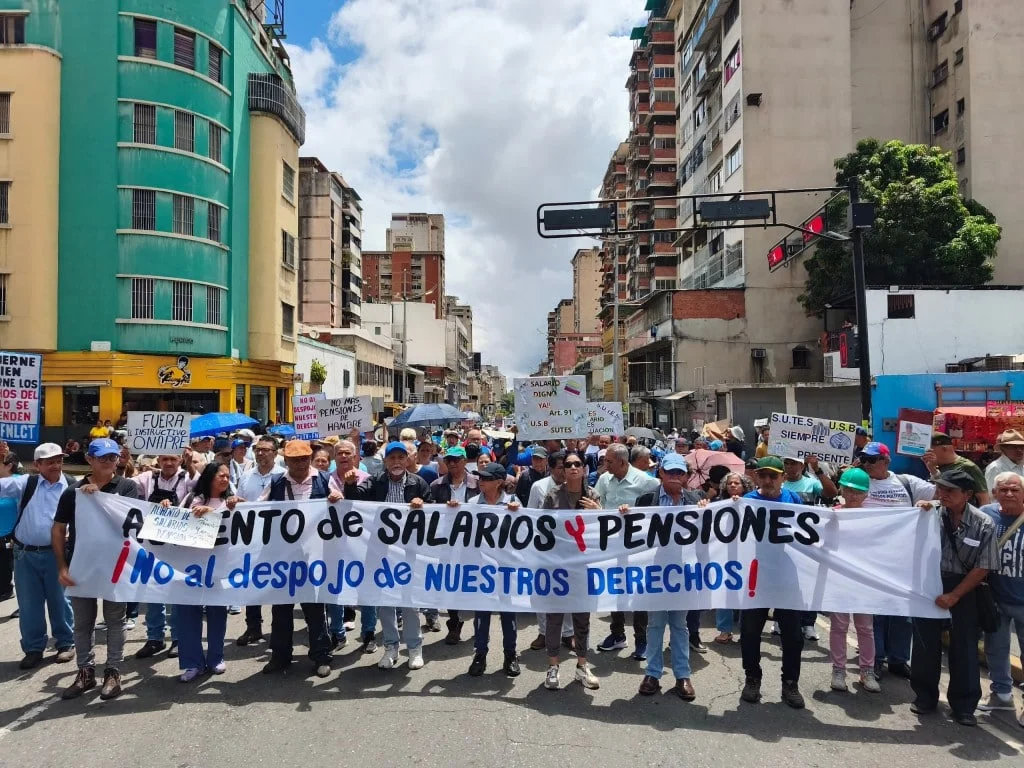
A coalition of labor organizations staged protests in Caracas and over 25 other cities across the country. In the Venezuelan capital, around 1,000 demonstrators marched from Plaza Morelos and broke through a police cordon to reach the National Assembly in the city center.

“Mobilizations like the one we had today will continue and grow until the government changes its salary policies,” José Gregorio Afonso, president of the Central University of Venezuela (UCV) professors’ association, stated. “We believe the economic conditions allow for the establishment of a minimum wage as determined by the Constitution and the Labor Law.”

Afonso added that the Constitution mandates the government adjust the minimum wage at least once a year to keep up with inflation, but the last increase was in 2022. He likewise pointed to recent official figures of economic growth and prospects of increased oil revenues.

Thursday’s rally consisted largely of education sector trade unions, as well as public sector retirees. A commission met with a group of legislators at the end of the march to deliver a list of 17 demands signed by over 200 trade unions. 

A similar document was delivered to the Labor Ministry following prior nationwide rallies on February 26. The labor organizations’ demands include raising the minimum wage in accordance with the Constitution and labor legislation, the release of workers and trade unionists allegedly arrested for defending labor rights, and the repeal of statutes such as the 2792 Memorandum that suspended several collective bargaining rights.

Activists have also voiced opposition to plans to implement a pro-business reform of the country’s Organic Law of Labor and Workers (LOTTT) that would cut benefits, social security contributions, and other employer responsibilities. 

The historic 2012 law, approved by former President Hugo Chávez, prohibits unfair dismissal and outsourcing, enshrines the world’s third-longest maternity leave, guarantees the right to work for both women and people with disabilities, and extends retirement pensions to all workers, including full-time mothers and the self-employed.

Later on Thursday, the ruling Socialist Party (PSUV) held its own march in Caracas along the same route, with spokespeople urging the defense of the country’s peace and sovereignty, as well as calling for the release of kidnapped President Nicolás Maduro and First Lady Cilia Flores.

Labor Minister Eduardo Piñate told reporters that the rally was in “firm backing” of the Maduro and Rodríguez government’s labor policies.

Gov’t increases bonus amid salary debates

On Friday, unofficial channels reported that the acting Rodríguez administration had raised the monthly “economic war bonus” by 25 percent, from US $120 to $150. Coupled with a $40 food bonus, the move brings the monthly income floor for public sector workers to $190. The amount is paid in bolívars at the official exchange rate.

Venezuelan government officials have not commented on the increase. It is not presently known whether public sector retirees and pensioners, who receive $70 and $50 economic war bonuses, respectively, will benefit from similar hikes.

Venezuela’s monthly minimum wage was set at 130 bolívars (BsD) in March 2022 and has not been adjusted since. At the time, 130 BsD amounted to around US $30, but with the Venezuelan currency’s devaluation, it is now equivalent to $0.29. With the Venezuelan economy heavily battered by US sanctions, the Nicolás Maduro government prioritized non-wage bonuses as the main income source for workers and pensioners.

Trade unions and leftist organizations have criticized the policy for violating the country’s labor laws and favoring business sector interests by reducing labor costs and making dismissals more flexible.

In recent weeks, trade union coalitions have put forward proposals for a minimum wage adjustment. Center-right and right-wing alliances such as the Independent Union Alliance (ASI) and the Confederation of Venezuelan Workers (CTV) have urged authorities to set the monthly minimum salary at $200 before pegging it to a cost-of-living index.

For its part, the government-aligned Bolivarian Socialist Union of Workers (CBST) proposed that the minimum wage be raised by $50 each quarter, though it did not specify a time frame. The CBST added that, should the government deem the salary increase unfeasible, it should implement a similar increase in non-wage bonuses.

Liberal economists, including Asdrúbal Oliveros and José Guerra, have argued that minimum wage increases beyond $100 and $150 a month, respectively, might place too high a burden on the state’s budget. At the same time, business sector representatives have called for a flexibilization of labor protections and benefits.

Leftist economists, including former PSUV congressman Tony Boza, Pasqualina Curcio, and Juan Carlos Valdez, have proposed raising wages and pegging them to inflation as is currently done by private banks with interest rates.

Edited by Lucas Koerner in Fusagasugá, Colombia.


Source link