Venezuelan Workers Protest for Fair Wages, End-of-Year Bonuses
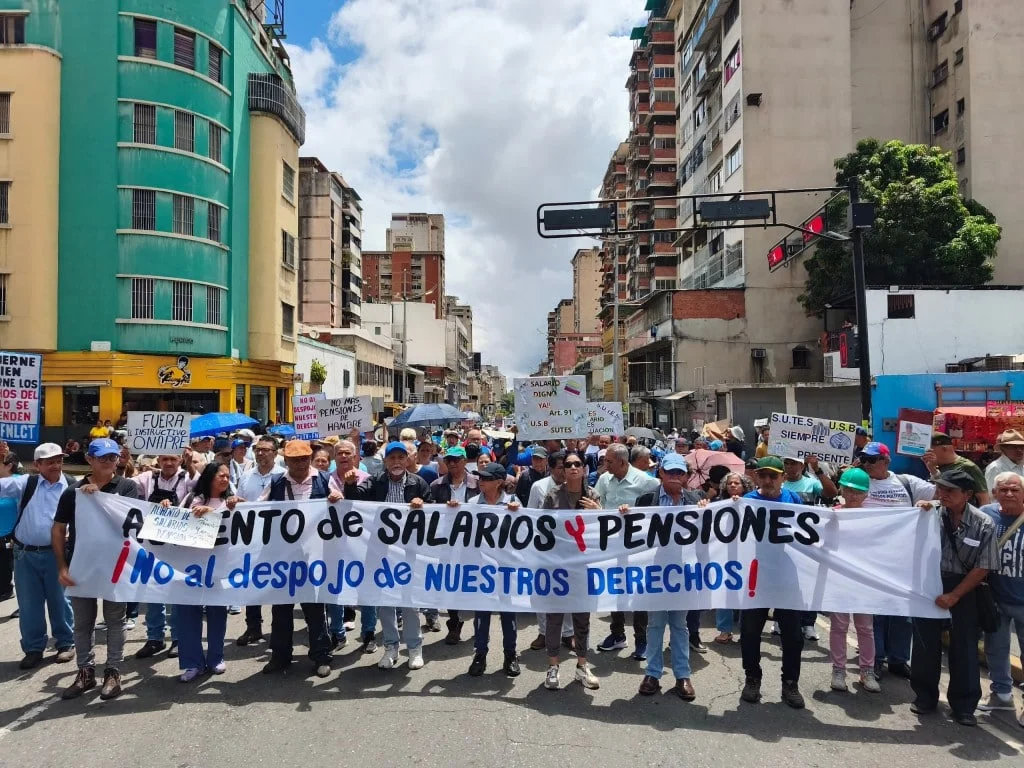
“Salaries and pensions increase,” reads a banner held by healthcare workers during Tuesday’s demonstration. (Archive)
Caracas, October 13, 2026 (venezuelanalysis.com) – Hundreds of Venezuelan workers took to the streets on Tuesday to demand that the acting Delcy Rodríguez government address a series of labor grievances.
The mobilization in Caracas was called by healthcare trade unions to deliver a petition at Miraflores Palace. Education and higher education unions likewise endorsed the rally, which had a turnout estimated at 2,000 people.
Venezuelan police shepherded the march through the center of the Venezuelan capital but protesters were ultimately stopped a few blocks from the presidential palace. A commission of union representatives delivered the document, which reportedly collected over 45,000 signatures from healthcare professionals, to Venezuelan government representatives.
“It looks like the plan is to invite foreign capital by offering cheap labor,” FETRASALUD union leader Pablo Zambrano told press. “The Venezuelan workers must struggle to be fairly compensated for their work.”
Protesters echoed a longstanding demand that existing bonuses be converted into wages. The monthly minimum wage was last increased by the Venezuelan government in March 2022 and currently stands at 130 bolívars, around US $0.15. Instead, the Nicolás Maduro and Rodríguez administrations have relied on non-wage bonuses which have no impact on vacation pay, social security contributions, or severance. The income floor for public sector workers was raised to $240/month in May.
The petitions delivered on Tuesday included a demand that holiday bonuses be computed based on workers’ present incomes as opposed to the actual salary. It likewise called for the “professional responsibility bonus,” which ranges from $40 to $170 per month and is discretionally assigned to certain sectors, to be extended to retired workers, and for unions to participate in the drafting of new wage scales.
“Holiday bonuses are fundamental labor rights, and we need to have them based on the real incomes,” said Yilbert Giménez, director of the SINTRACUPEM healthcare workers’ union in Miranda state. “We are also opposed to any regressive reforms on labor matters.”
Pedro Eusse, from the CUTV labor confederation, called on workers’ organizations to unite to “defeat the plan to dismantle labor rights.”
“The government is allied with business elites whose goal is to destroy the working class’ existing social benefits and social security rights,” he told reporters. “We need a broad unity to defeat this plan.”
Labor Minister Carlos Castillo has drawn criticism in recent days over comments that he “relates to business owners” on labor costs.
“Nowadays, as I run a ministry with a significant labor weight on its shoulders and have to calculate payroll every month, I have truly started to relate to business owners,” he said during his keynote address at business association FEDECÁMARAS annual summit on Friday.
Castillo went on to say that he “understood that business owners are not an evil abstraction from ideological manuals” but rather “makers of reality who risk their capital, their mental health, and their daily effort.”
FEDECÁMARAS, the Caribbean nation’s most influential private sector lobby, has actively campaigned for labor reform reducing responsibilities for employers and eliminating the retroactive nature of social benefits and severance pay, which trade unions consider a red line.
Former FEDECÁMARAS President Jorge Roig, who currently serves as a business sector representative in a “labor dialogue” initiative mediated by the International Labor Organization (ILO), recently expressed “optimism” about securing consensus with the Venezuelan government and worker organizations.
Roig argued that the current labor conditions “are not working” and proposed the creation of a Law of Labor and Social Consensus to introduce temporary solutions adjusted to different economic sectors.
Venezuela’s historic Labor Law, approved in 2012 by former President Hugo Chávez, prohibits unfair dismissal and outsourcing, enshrines the world’s third-longest maternity leave, guarantees the right to work for both women and people with disabilities, and extends retirement pensions to all workers, including full-time mothers and the self-employed.
The ruling United Socialist Party (PSUV) also staged a march in Caracas on Tuesday afternoon. Interior Minister Diosdado Cabello claimed that Venezuelan workers are “the bulwark of peace” in the South American country.
“We have delivered a document supporting all the actions by Acting President Delcy Rodríguez and the ongoing dialogue process while also demanding the lifting of sanctions against Venezuela,” Cabello told those present.
Edited by Lucas Koerner in Philadelphia, USA.