Thirty years ago a teenage boy, traveling abroad and without parents for the first time, came upon a scene of staggering destruction.
At Pompeii, when Tom Hiddleston saw the casts of the bodies killed by the explosion of Mt. Vesuvius in AD 79, he wasn’t just horrified, he was mesmerized, even excited; amid all that death it felt like the past was alive.
“Until that point, it had existed in books in the classroom, but I felt like was going back in time, walking into the past,” he said in a recent video interview about “Pompeii: Out of Time With Tom Hiddleston,” his new series that’s a hybrid of travelogue, documentary and extensive dramatic reenactments (with a meta touch).
“I was knocked sideways by the quality of the preservation,” he recalled of that teenage visit. “You can hear that these buildings carry the echoes of the lives they contained because of the frescoes, the mosaics, the furniture. You feel 2,000 years compress and collapse. It’s like magic.”
Hiddleston knows something about magic and time travel. After studying classics at Cambridge, his acting career led to the Marvel Cinematic Universe and the role of Loki, the god of mischief and “the boundary crosser.” Loki’s movie misdeeds get him “removed from the timeline of history,” and in the “Loki” spinoff TV show, he faces his past while bouncing through time.
One place Loki lands is Pompeii. Hiddleston was actually on a set in Atlanta, but there he was speaking Latin and revisiting his own past. “I felt this extraordinary confluence of my passions.”

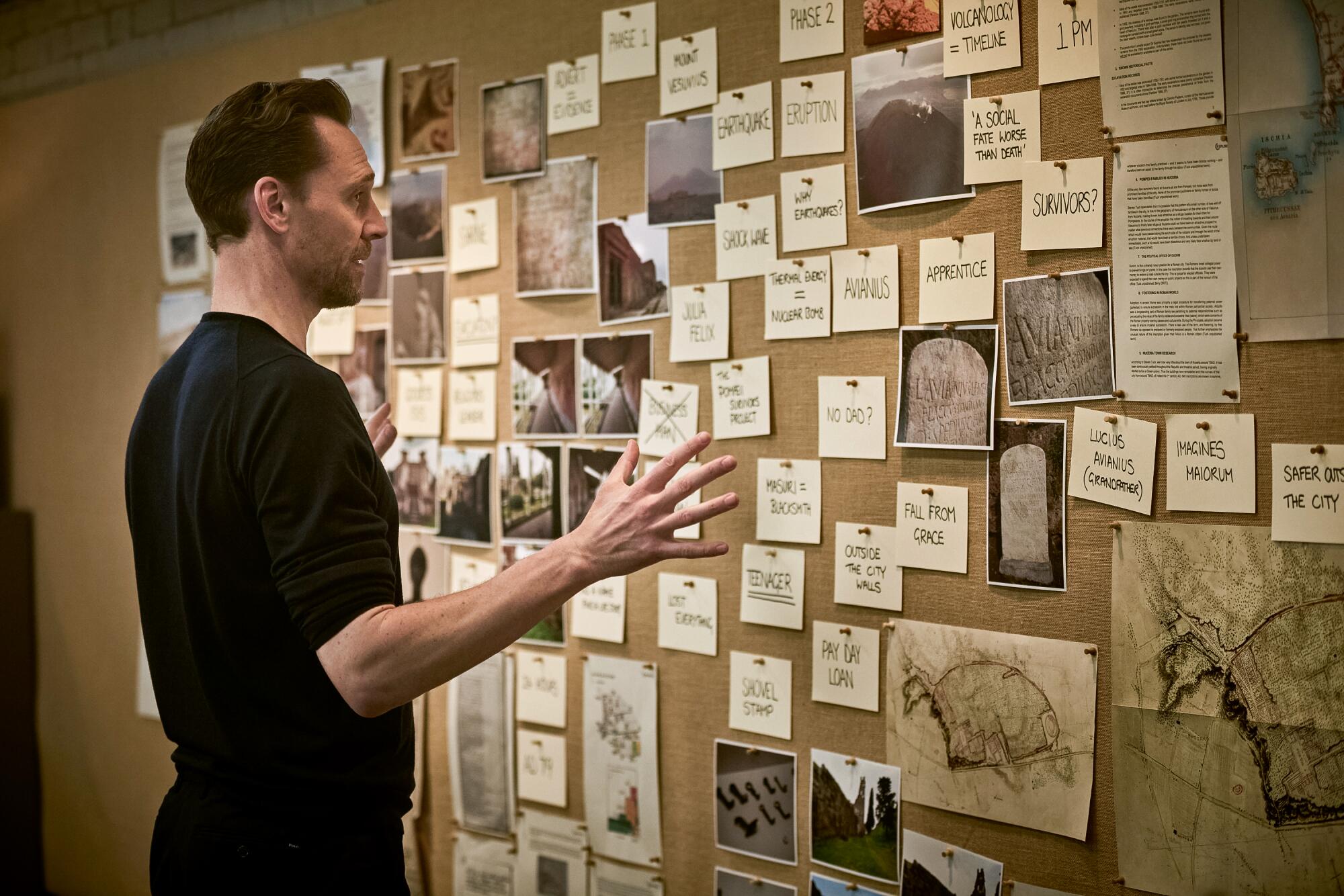
Tom Hiddleston in a scene from the series, where he speaks to experts about Pompeii and how the eruption of Mt. Vesuvius unfolded.
(Christian Black / National Geographic)
Hiddleston had been talking with producer Kevin R. Wright about his fascination with the ancient world, and after seeing Hiddleston in fictional Pompeii, Wright got the ball rolling on “Out of Time,” co-writing and helping to produce the series, which debuts Wednesday on NatGeo and Thursday on Hulu and Disney+.
On the show, Hiddleston travels back to Pompeii and the lip of the volcano, speaking to experts of Pompeii’s history and volcanoes but also one in surviving disasters to help him understand people’s behavior as the sky was falling on them. “It’s about trying to gather as much evidence from different disciplines,” he explained.
Hiddleston’s enthusiasm for the project is evident throughout our interview: Each question earned a five-minute response, all delivered with passion (and incredibly articulate with no verbal fillers or talking in circles) and fascinating digressions — he broke down the Greek and Latin roots of the words “democrat” and “republican,” mentioned the classical references in the architecture of the New York Stock Exchange and British Museum, and tied in the relevance of Christopher Nolan’s “The Odyssey.”
Here, for instance, is a portion of his answer to my first question about whether the driving force of the series was the importance of facts in understanding history, using storytelling and imagination to create empathy for the people of Pompeii, or to show the way our past still has lessons to offer today:
“I wanted a series with an original dynamism, which could be immersive and propulsive and emotional, and bring the story of Pompeii and its people back to life in a way that could be different and innovative. I wanted to evoke for the audience the feeling that I had when I first went to Pompeii.
“At university, I had teachers who taught me to live in the question and that our relationship with the past is a two-way street. One cannot examine the past without acknowledging that we look back from the perspective of where we stand. We tell stories to understand something about ourselves — we need to know who we were to think about who we are now.

Darius Arya, an archeologist and historian, with Hiddleston in the ancient city of Herculaneum. (Paolo Verzone/National Geographic)

Human remains inside of boat sheds, where people took shelter from the eruption of Mt. Vesuvius. (Paolo Verzone/National Geographic)
“The engine of my commitment was centered on empathy, trying to honor the lives of the people of Pompeii. If we could gather enough evidence, enough fragments of truth, they might add up to a picture of history, which would generate great reserves of feeling and compassion so we could see ourselves in their predicament, their instincts, their choices, their capacity to help each other. And that experience of empathy and compassion would connect us to a thread across time to people experiencing a terrifying and traumatic event, and to see that in our world now.
“But we were very careful about the idea that the truth matters. In writing history, there must be intense rigor — evidence is important and if you have evidence that should counteract any bias or hypothesis.
“But the evidence here is incomplete so at some point, you have to take an educated guess, a leap of imagination. The past is a two-way street with the present, but it’s also an eternal mystery and all of our questions will never be answered so there’s that joy of living in the question.”
When the publicist said our time was up, Hiddleston stepped out of time and took one more question. And then another and another, nearly doubling the time allotted, thrilled to be exploring the connections between past and present.
While many people think that the city’s population was wiped out, the vast majority actually escaped and modern research has found the names and details of hundreds of survivors. Hiddleston notes that “one great gift of Pompeii is that the Romans didn’t have paper, so the walls, the columns, the houses, the public buildings are covered in writing: deeds, business contracts, advertisements, gossip, doodles.”

In this behind the scene photo, director of photography Jim Jolliffe runs with a camera, following Frankie Treadaway playing Avianius, a teenage boy whose story is reenacted in the series.
(Darrin Zammit Lupi / National Geographic)
The three episodes track the stories of a teenage boy, a successful businesswoman and a soldier in the nearby town of Herculaneum, with a sprawling cast and special effects bringing those scenes to life. “We thought that in the words of Pliny the Younger, ‘their lives were worthy of our memory.’ ”
While there have been other more traditional Pompeii documentaries, Hiddleston felt he had something distinctive to offer, thanks to his “day job.”
“I take a piece of writing and a character, real or imagined, and research as much as I can, and then imagine it and try and breathe life into a person,” he says. “Even when I’ve played real people, I’ve run out of evidence. That’s when you just have to extend your empathy and compassion, your knowledge of human beings and the breadth and range of human experience, the things we all share and can connect with to find an internal world of variety and depth.”
Hiddleston wanted to extend that to the people of Pompeii. “They were three dimensional people with rich lives,” he says. “We follow the trail of breadcrumbs as far as we can, and then try to bring them to life with empathy and compassion.”