‘Fatherland’ review: Sandra Hüller triumphs in terseness
A bittersweet homecoming — emphasis on the bitter — propels Polish filmmaker Paweł Pawlikowski’s spare, precise drama “Fatherland,” which takes an episode from the life of Nobel Prize-winning German author Thomas Mann and, with the help of some poetic license, creates a story full of simmering anger and sorrow. Only rarely do the dignified characters allow their emotions to come storming out. When they do, though, the sound seems to reverberate, the tumult of the past ringing in our ears.
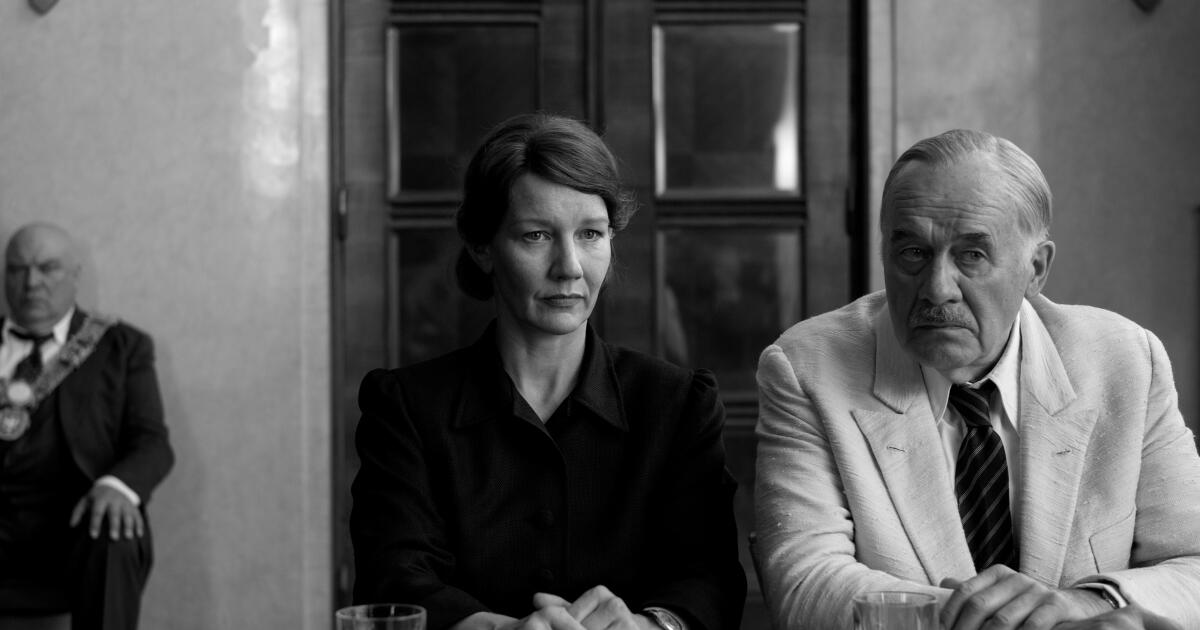
Like Pawlikowski’s previous two features, “Ida” and “Cold War,” “Fatherland” is a period piece shot in black and white in a boxy 4:3 aspect ratio so that the frame resembles an old photograph, although his images contain no hint of nostalgia. It’s 1949, and the 70-something Mann (Hanns Zischler) has returned to Germany for the first time since fleeing to America 16 years prior. Accompanying him is Erika (Sandra Hüller), his daughter and fellow writer, who begrudgingly serves as interpreter, personal assistant and driver. In addition, she’ll offer her brutally honest thoughts on the flowery speeches he will deliver while being honored for his artistry.
Quickly, they discover that while the war may be over, the bombed-out buildings remain, as do the lingering resentments within Germany, which is controlled by the United States in the west and the Soviets in the east. Thomas, an outspoken critic of Nazism, leading to his exile, believes that his public appearances can unite the country he loves. The cynical Erika knows better, convinced he’s a PR tool for a nation hoping to refurbish its tarnished reputation.
Drawing inspiration from “The Magician,” Colm Tóibín’s fictionalized 2021 Mann biography, Pawlikowski uses this trip as a jumping-off point, introducing real-life individuals who were not present and inventing a new central dynamic. (In truth, Thomas traveled with his wife, not his daughter.) But those creative liberties merely accentuate Pawlikowski’s narrative and thematic aims, which, as in “Ida” and “Cold War” include pairing an intimate story with the larger rumblings of postwar Europe. Thomas and Erika arrive in a Germany torn apart and the ruptures within their family are nearly as tumultuous.
The film is haunted by the specter of Klaus (August Diehl), Erika’s brother, who is actually the first person we see onscreen. In a masterful unbroken shot, Klaus is on the phone from France with his sister, expressing his bottomless anguish. “I don’t believe in anything anymore,” Klaus, who is also a writer, declares. “I can’t remember the last time I felt something.” He’s talking about the fractured Germany, but his depression speaks to something closer to home too. Concerned, Erika encourages Klaus to join them. He declines, but his absence — and a shocking later revelation — informs so much of their journey, personalizing the sense of disrepair Thomas and Erika experience.
Working with his usual cinematographer Łukasz Żal, Pawlikowski prefers a static camera, leaving plenty of headroom above the characters so that they feel entombed by their surroundings. The effect is especially disconcerting as this father and daughter navigate glad-handers and former Nazi collaborators in West Germany who are anxious to bury the past. But Thomas and Erika are no fools, coolly telling off smiling Hitler sympathizers during a tony reception. There has been no more satisfying slap in cinema this year than the one Erika lands on a smug German actor, leading to a wicked punchline that shouldn’t be spoiled.
Such moments of barbed humor are infrequent in “Fatherland,” but Pawlikowski wields them like grenades, shattering the stifling niceties enveloping Thomas and Erika. The Germany of “Fatherland” is one of contradictions, with Erika uncovering letters sent to Thomas’ hotel that savagely accuse him of betraying his country, despite state officials eager to embrace him as a symbol of the nation’s creative and cultural excellence. In contrast to the gorgeous monochrome visuals, this is a land that stinks of complicity and delusion — of opportunists desperate to scramble onto the right side of history. Pawlikowski has said that he keeps returning to the past in his films because addressing our modern ills directly would be too daunting. But whether in Frankfurt or, later, Weimar — where Soviet officials are as keen to canonize Thomas — this father and daughter aren’t simply driving through Germany but taking a tour across fascism’s long shadow, which still darkens the world.
Both leads are exceptional, with Zischler articulating the great writer’s arrogance and willful denial of the inconvenient truths he wants to ignore. As for Hüller, this is another superb performance in a series of them in recent years. Where Thomas is aloof and proud, Erika is prickly and sardonic, excellent tools for protecting a surprisingly fragile heart. Their journey to Germany will heal neither the nation nor the divisions within this family. You can’t go home again and in the case of the characters in “Fatherland,” maybe you shouldn’t try.
‘Fatherland’
In German, French, Russian and English, with subtitles
Not rated
Running time: 1 hour, 22 minutes
Playing: Opens Friday, Oct. 22 in limited release