passion

Tom Hiddleston’s ‘Pompeii: Out of Time’ is a confluence of his passions

Thirty years ago a teenage boy, traveling abroad and without parents for the first time, came upon a scene of staggering destruction.

At Pompeii, when Tom Hiddleston saw the casts of the bodies killed by the explosion of Mt. Vesuvius in AD 79, he wasn’t just horrified, he was mesmerized, even excited; amid all that death it felt like the past was alive.

“Until that point, it had existed in books in the classroom, but I felt like was going back in time, walking into the past,” he said in a recent video interview about “Pompeii: Out of Time With Tom Hiddleston,” his new series that’s a hybrid of travelogue, documentary and extensive dramatic reenactments (with a meta touch).

“I was knocked sideways by the quality of the preservation,” he recalled of that teenage visit. “You can hear that these buildings carry the echoes of the lives they contained because of the frescoes, the mosaics, the furniture. You feel 2,000 years compress and collapse. It’s like magic.”

Hiddleston knows something about magic and time travel. After studying classics at Cambridge, his acting career led to the Marvel Cinematic Universe and the role of Loki, the god of mischief and “the boundary crosser.” Loki’s movie misdeeds get him “removed from the timeline of history,” and in the “Loki” spinoff TV show, he faces his past while bouncing through time.

One place Loki lands is Pompeii. Hiddleston was actually on a set in Atlanta, but there he was speaking Latin and revisiting his own past. “I felt this extraordinary confluence of my passions.”

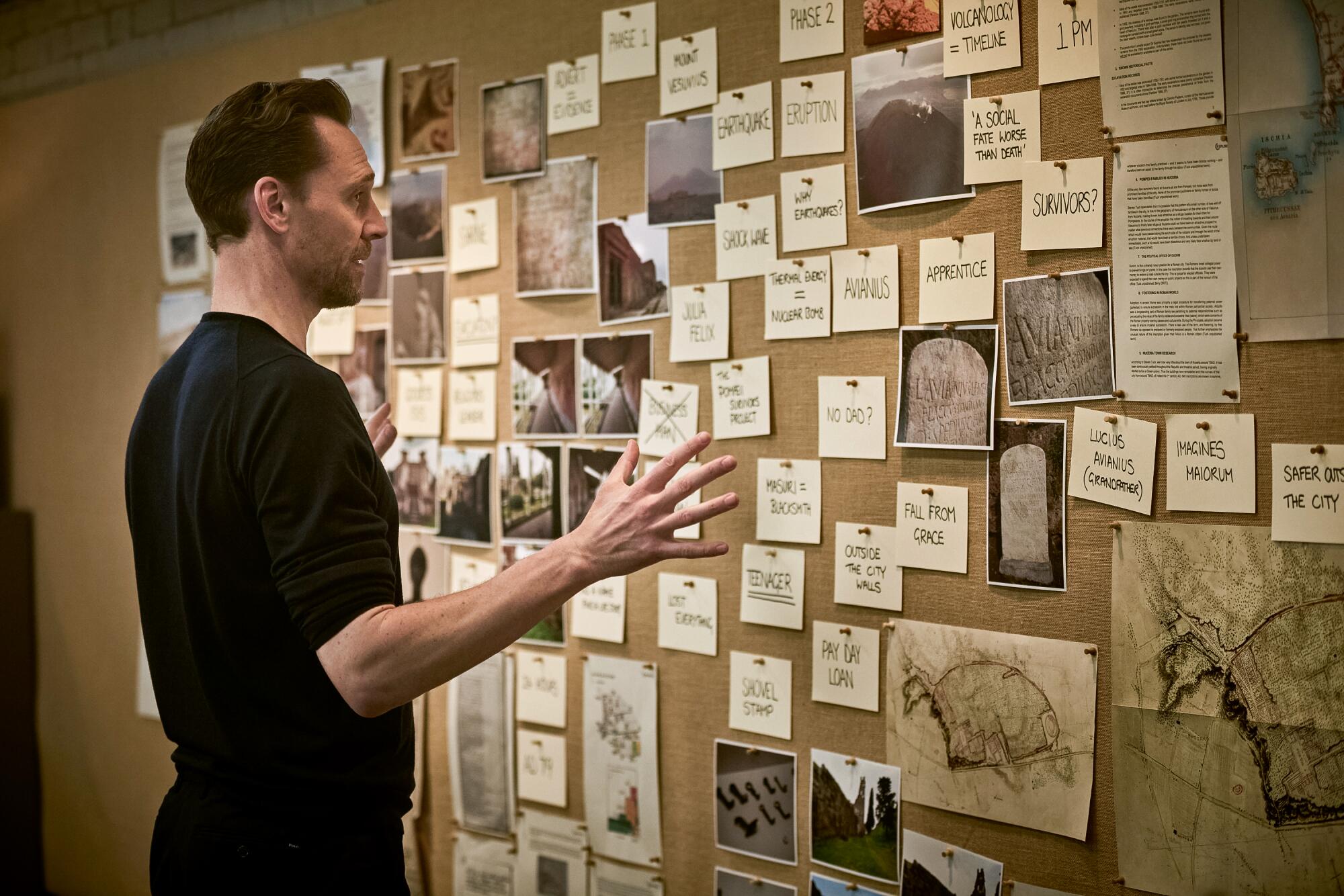
A man in a black T-shirt gestures in front of a corkboard covered in notecards, photographs and maps.

Tom Hiddleston in a scene from the series, where he speaks to experts about Pompeii and how the eruption of Mt. Vesuvius unfolded.

(Christian Black / National Geographic)

Hiddleston had been talking with producer Kevin R. Wright about his fascination with the ancient world, and after seeing Hiddleston in fictional Pompeii, Wright got the ball rolling on “Out of Time,” co-writing and helping to produce the series, which debuts Wednesday on NatGeo and Thursday on Hulu and Disney+.

On the show, Hiddleston travels back to Pompeii and the lip of the volcano, speaking to experts of Pompeii’s history and volcanoes but also one in surviving disasters to help him understand people’s behavior as the sky was falling on them. “It’s about trying to gather as much evidence from different disciplines,” he explained.

Hiddleston’s enthusiasm for the project is evident throughout our interview: Each question earned a five-minute response, all delivered with passion (and incredibly articulate with no verbal fillers or talking in circles) and fascinating digressions — he broke down the Greek and Latin roots of the words “democrat” and “republican,” mentioned the classical references in the architecture of the New York Stock Exchange and British Museum, and tied in the relevance of Christopher Nolan’s “The Odyssey.”

Here, for instance, is a portion of his answer to my first question about whether the driving force of the series was the importance of facts in understanding history, using storytelling and imagination to create empathy for the people of Pompeii, or to show the way our past still has lessons to offer today:

“I wanted a series with an original dynamism, which could be immersive and propulsive and emotional, and bring the story of Pompeii and its people back to life in a way that could be different and innovative. I wanted to evoke for the audience the feeling that I had when I first went to Pompeii.

“At university, I had teachers who taught me to live in the question and that our relationship with the past is a two-way street. One cannot examine the past without acknowledging that we look back from the perspective of where we stand. We tell stories to understand something about ourselves — we need to know who we were to think about who we are now.

Two men stand side by side outdoors near a gated entrance.

Darius Arya, an archeologist and historian, with Hiddleston in the ancient city of Herculaneum. (Paolo Verzone/National Geographic)

Several human skeletons inside of a stone boat shed.

Human remains inside of boat sheds, where people took shelter from the eruption of Mt. Vesuvius. (Paolo Verzone/National Geographic)

“The engine of my commitment was centered on empathy, trying to honor the lives of the people of Pompeii. If we could gather enough evidence, enough fragments of truth, they might add up to a picture of history, which would generate great reserves of feeling and compassion so we could see ourselves in their predicament, their instincts, their choices, their capacity to help each other. And that experience of empathy and compassion would connect us to a thread across time to people experiencing a terrifying and traumatic event, and to see that in our world now.

“But we were very careful about the idea that the truth matters. In writing history, there must be intense rigor — evidence is important and if you have evidence that should counteract any bias or hypothesis.

“But the evidence here is incomplete so at some point, you have to take an educated guess, a leap of imagination. The past is a two-way street with the present, but it’s also an eternal mystery and all of our questions will never be answered so there’s that joy of living in the question.”

When the publicist said our time was up, Hiddleston stepped out of time and took one more question. And then another and another, nearly doubling the time allotted, thrilled to be exploring the connections between past and present.

While many people think that the city’s population was wiped out, the vast majority actually escaped and modern research has found the names and details of hundreds of survivors. Hiddleston notes that “one great gift of Pompeii is that the Romans didn’t have paper, so the walls, the columns, the houses, the public buildings are covered in writing: deeds, business contracts, advertisements, gossip, doodles.”

A teenage boy runs through a set as he's being splattered with recreated ash as men with cameras follow his movement.

In this behind the scene photo, director of photography Jim Jolliffe runs with a camera, following Frankie Treadaway playing Avianius, a teenage boy whose story is reenacted in the series.

(Darrin Zammit Lupi / National Geographic)

The three episodes track the stories of a teenage boy, a successful businesswoman and a soldier in the nearby town of Herculaneum, with a sprawling cast and special effects bringing those scenes to life. “We thought that in the words of Pliny the Younger, ‘their lives were worthy of our memory.’ ”

While there have been other more traditional Pompeii documentaries, Hiddleston felt he had something distinctive to offer, thanks to his “day job.”

“I take a piece of writing and a character, real or imagined, and research as much as I can, and then imagine it and try and breathe life into a person,” he says. “Even when I’ve played real people, I’ve run out of evidence. That’s when you just have to extend your empathy and compassion, your knowledge of human beings and the breadth and range of human experience, the things we all share and can connect with to find an internal world of variety and depth.”

Hiddleston wanted to extend that to the people of Pompeii. “They were three dimensional people with rich lives,” he says. “We follow the trail of breadcrumbs as far as we can, and then try to bring them to life with empathy and compassion.”

Source link

Best restaurants to try in Mexico City, according to an expert

Yes, you should visit Mexico City. Don’t overthink it and don’t delay. Despite excessive tourism and rising gentrification fears, the seething capital of Mexico — 25 million souls strong — remains a top-tier international destination for any committed food lover. And the intensity of its dining scene seems to be only growing.

Sure, a wave of privileged remote workers oozing dollars and euros may have dampened the vibe for Mexico City natives, leading to protests. The post-pandemic issues of housing displacement and rising costs for locals are serious challenges that political leaders must address. Yet time and again, on every visit, the resiliency and passion that original defeños have for their gastronomical paradise proves to be boundless.

Use these handy dining guides for all of your summer travel, near and far.

I have traveled to Mexico City regularly since 2002 and lived there for nearly a decade. I won’t feel slighted if you prefer the dining advice of current residents, or from any of the numerous local dining guides online. But one thing about me, I have an aversion to hype, and tend to avoid the city’s contemporaneous food magnets where the ratio of foreigners to locals is too out of whack. (No, the Michelin-starred taqueria was never extraordinarily better than any others in its bracket.) Where my native friends go, I go.

Here are highlights of my top, top, top recommendations from my L.A. Times restaurant guides on Mexico City, plus a few more favorites. My goal here is to distill down your options for a concentrated, food-centric visit, from nostalgic jewels beloved by hardscrabble chilangos to the celebrated shrines of high-end chefs reaping the bounties of the Valley of Mexico.

Source link

William Hasley dead: Hollywood writer, friend of Caitlyn Jenner died hiking

Authorities have identified the hiker who suffered a fatal medical emergency in Runyon Canyon as 78-year-old screenwriter William Hasley.

Hasley was a veteran TV writer who taught screenwriting classes at UCLA Extension. He was also a friend of Caitlyn Jenner and helped write the former athlete’s motivational book “Finding the Champion Within,” according to his biography.

The L.A. County medical examiner released Hasley’s identity Tuesday but had yet to rule on his cause of death.

More than two dozen personnel with the Los Angeles Fire Department responded to a report of a hiker in grave medical condition off Nichols Canyon Road near Hollywood Boulevard shortly before 7 p.m. Saturday.

A helicopter was used to reach the patient and allow paramedics to provide urgent medical care. They were unable to save him, and he was declared dead shortly after, according to the LAFD.

Hasley hailed from Pittsburgh and played university football before venturing to Hollywood to pursue his dreams as a writer. He wrote on 37 episodes of “The Smurfs” in the late 1980s and early ’90s as well as several episodes of “Fat Albert and the Cosby Kids,” according to IMDB. His TV writing credits also included “Swift Justice,” “Ghost Stories,” “Murder, She Wrote,” “Young Riders” and “Highway to Heaven.”

He was able to channel his love of sports while working with NBC on the network’s project “Star Salute to the U.S. Olympic Team,” where he met Olympic gold medalist Caitlyn Jenner, according to his professional biography.

The pair became friends, and Hasley went on to help write a book about Jenner’s philosophy on overcoming adversity in sports and life. He was commissioned to ghostwrite several other motivational books including “Passion, Profit, & Power” for hypnotist Marshall Sylver and “The Slight Edge” for self-help expert Jeff Olson.

Hasley loved sharing his passion for writing with students at UCLA and described the process of writing as akin to assembling a puzzle, where one tries many different combinations of pieces before finding the perfect fit, according to his teaching biography.

“I personally believe that when you know your characters well enough they will start dictating their actions,” he wrote. “When that happens writing becomes a euphoric experience.”

In addition to teaching and writing, he enjoyed golfing, horseback riding, fighting City Hall over an environmental issue, volunteering in soup kitchens and speaking to youth organizations, according to his bio.

Hasley was formerly married to actor Robin Riker, best known for her roles on “Brothers” and “The Bold and the Beautiful.”

He lived in the Hollywood Hills not far from where he suffered the medical emergency. A neighbor told the New York Post they had seen him earlier Saturday carrying groceries home. “It’s very sad he had to die all alone like that,” the neighbor said.

Times staff writer Sonja Sharp contributed to this report.

Source link

Kyle Loftis death: Street racing media pioneer dies at 43

Kyle Loftis, who started filming street racing with a point-and-shoot camera and went on to become a pioneer in car culture media, has died, his company confirmed Wednesday. He was 43.

“We are extremely saddened to share that Kyle Loftis, the founder of 1320video, passed away last night,” the company wrote in a statement posted on social media. “We are in a state of shock.”

No cause of death has been disclosed.

The Sarpy County Sheriff’s Office and Gretna Fire Department in Nebraska responded to Loftis’ home Tuesday night, a spokesperson for the sheriff’s office said in a statement emailed to The Times.

“Loftis was declared deceased; his death is not suspicious,” the spokesperson wrote. “Out of respect for privacy, we will not be releasing further details.”

According to his LinkedIn page, Loftis attended the University of Nebraska at Omaha from 2000-2005 and earned a bachelor’s degree in management of information systems.

It was there, Loftis said in a 2023 video on his company’s YouTube channel, that his interests in car stereos and photography evolved into a passion for street racing — in particular, capturing races in still photos and on video and making that media available to fans.

“I’m a hardcore ‘car nut’ that’s taken his love for cars and turned it into the most amazing ‘job’ of my life,” Loftis wrote on LinkedIn. “Through my business, 1320Video, I’m able to experience the craziest & best automotive events (fitting my tastes) and share them with millions of people around the world!”

Back in the early days, Loftis posted his work on message boards and sold it on DVDs. For nearly 10 years after college, he worked for PayPal while building his motorsports media business on his own time. He dedicated himself to 1320Video full time starting in January 2015.

Currently, 1320Video has nearly 4 million subscribers on YouTube, more than 6 million followers on Facebook and nearly 3 million followers on Instagram.

“Kyle’s passion for motorsports inspired millions of people around the world and we will never forget what he has done to grow our beloved sport,” 1320Video wrote. “Kyle was a beam of light at every gathering… his enthusiasm, kindness, and creativeness was contagious.

“Let us pray that Kyle is in a better place.”

Garrett Mitchell — the YouTuber and stock car racer known as Cleetus McFarland — posted a tribute to his longtime friend on Facebook.

“Completely shocked about the loss of Kyle,” Mitchell wrote. “The most influential person on my life. We’re crushed. Please pray for his Mother and close friends, they need it most.”


Source link

Powell Won’t Run in 1996; He Cites Lack of ‘a Calling’ : Presidency: General tells of worries about privacy and lack of passion for political wars. He says for first time he’s a Republican and rejects accepting No. 2 spot on the ticket.

Retired Gen. Colin L. Powell, citing concerns about his privacy and a lack of passion for political combat, on Wednesday proclaimed that he would not run for President in 1996.

For the first time, Powell declared that he was a Republican. And he seemed clearly to leave open the possibility of seeking political office in the future. But he categorically ruled out accepting the vice presidential nomination next year.

In a dramatic afternoon press conference in suburban Washington, Powell, 58, said that entering the political arena “requires a calling that I do not yet hear. And for me to pretend otherwise would not be honest to myself, it would not be honest to the American people.”

“And therefore I cannot go forward,” he said. “I will not be a candidate for President or for any other elective office in 1996.”

Powell’s wife, Alma, stood at his side as he ended months of suspense about his political intentions and disappointed millions of potential supporters. His adult children, Michael, Linda and Annemarie, looked on in the packed hotel ballroom where Powell delivered his fateful verdict.

“I have spent long hours talking with my wife and children, the most important people in my life, about the impact an entry into political life would have on us,” Powell said. “It would require sacrifices and changes in our lives that would be difficult for us to make at this time.”

With the September publication of his best-selling memoirs, “My American Journey,” Powell had become a four-star American icon, the repository of the hopes of millions who dreamed that he could bind up the nation’s racial and political wounds.

But in the end, that task proved too great even for the charismatic general, who braved unfriendly fire in Vietnam and survived the ordeals of bureaucratic combat in four presidential administrations.

Powell said Wednesday he hoped he could help restore civility to American political dialogue and a “sense of shame in our society.” He also said he hoped to bring blacks back into the party by broadening the GOP’s appeal and humanizing its attempts to reform social welfare programs.

“While we’re sending out block grants, while we’re dismantling programs that have not completely satisfied everything we hoped of them, we have to concern ourselves about those who may be cut loose, and we have to be prepared to help them,” Powell said. Over the past months, “I didn’t sense there was enough consideration of that.”

“I will continue to speak out forcefully in the future on the issues of the day, as I have been doing in recent weeks,” Powell said. “I believe I can help the party of Lincoln move once again close to the spirit of Lincoln.”

But–for now–he said he would do so from outside the realm of electoral politics.

Powell largely came to his decision over the weekend and formalized it in a meeting Monday night with two of his closest friends, former Pentagon official Richard L. Armitage and former White House Chief of Staff Kenneth M. Duberstein. With a third aide, retired Col. Bill Smullen, joining in by phone, the three men sat in Powell’s formal office on the ground floor of his McLean, Va., mansion, a room dominated by his Medal of Freedom and three framed photographs of the presidents he has served–Ronald Reagan, George Bush and Bill Clinton.

Alma Powell joined the group about halfway through the 2 1/2-hour meeting, Armitage said in an interview Wednesday.

“By then, the decision was primarily made,” Armitage said. “Over these past weeks, he was up and down, he agonized. He’d go out and meet with crowds and they’d fire him up. Then he’d get back home and wonder, ‘Do I have the necessary fire in the stomach to be worthy of support of these people?’ And he found he did not,” Armitage said.

As it became clear that Powell would not run, the meeting moved quickly to a discussion of the logistics of the announcement. The four discussed various drafts of a statement, then decided that Powell should speak solely in his own words. On Wednesday afternoon, he did just that, speaking largely without reference to the note cards he had carried with him.

He had looked “deep into my own soul” before deciding not to run, Powell said, and had found that he could not summon up the “commitment and passion” he felt every day in his 35 years as a soldier.

Powell also pointedly refused to endorse any of the Republican candidates, or even the party’s eventual nominee. He answered a curt “yes” to the question of whether there were candidates in the current crop of GOP hopefuls who were unacceptable to him.

A close friend said later that Powell was referring specifically to Patrick J. Buchanan, who has harshly criticized Powell’s stands on social issues.

Powell’s decision reopens a presidential contest that had been largely frozen for the last two months as he flirted with running.

Within an hour of Powell’s announcement, House Speaker Newt Gingrich (R-Ga.) said that the former general’s withdrawal made it more likely that he would enter the race. Gingrich said he would think about it over the next several weeks and make a decision after the current federal budget deliberations are finished but before the Dec. 15 deadline for entering New Hampshire’s primary.

Powell’s withdrawal was particularly welcome news at the White House and at the headquarters of GOP presidential front-runner Sen. Bob Dole. In a statement, Dole praised Powell’s “outstanding character and leadership” and expressed pleasure that he had joined the Republican Party.

At the White House, aides showed unusual discipline in not admitting that they felt a huge sense of relief at not having to face Clinton’s worst nightmare–a black, centrist, Republican military hero–in the general election next year.

“Everyone wants some hook to say there was a sigh of relief at the White House–but you’ll have to do it on your own,” said White House Press Secretary Mike McCurry.

He added that Clinton “understands the decision to run for President of the United States is one of the most difficult decisions any human can make. He respects the general and respects the general’s right to make that decision.”

Powell met with the press for 40 minutes at the Ramada Plaza hotel in Alexandria, Va., a few miles down the George Washington Parkway from the Pentagon, where Powell made history by becoming the first African American and youngest chairman of the Joint Chiefs of Staff.

His appearance was marked by the good humor, military carriage and unshakable poise he displayed in private meetings with presidents, kings and prime ministers and in public briefings on the American military operations he directed.

He expressed gratitude to the thousands of citizens who urged him to run. “It says more about America than it says about me. In one generation, we have moved from denying a black man service at a lunch counter to elevating one to the highest military office in the nation and to being a serious contender for the presidency,” he said.

Powell drew laughs when asked whether his wife shared his enthusiasm for the Republican Party. “Next!” he boomed. He also fended off a question about whether he had been bothered by published reports that his wife was under treatment for depression.

“It is not a family secret,” he said. “It is very easily controlled with proper medication, just as my blood pressure is sometimes under control with proper medication.”

For her part, Alma Powell made clear her concerns about her husband’s safety should he become a candidate. She and the general denied that fears of assassination were a factor in his decision not to run, but the final call was not made until Monday night, the day slain Israeli Prime Minister Yitzhak Rabin was buried in Jerusalem.

Had he been elected, Powell said, his priorities in office would have been: “Show leadership. Be a conciliator. Move the government forward toward less government. . . . Try to inspire people. And try to restore a sense of family, restore a sense of shame in our society, help bring more civility into our society.”

Powell said he regretted the disappointment he caused those who enthusiastically promoted his candidacy.

“I am deeply, deeply appreciative of that support, I’m deeply appreciative of the time and talent and energy you put into it. I’m sorry I disappointed you, but I hope you will see that in the next phase of my life I will continue to serve the country in a way that will justify the kind of inspiration and enthusiasm and support you sent my way this time around,” Powell said, addressing the several dozen supporters who attended the press conference and millions more watching on television.

He said he understood the “down and dirty” of American politics and said they were a proper test of a potential leader. He said he was not afraid of that “test of fire,” but that he was not yet ready to face it.

Among those watching on television were about half a dozen disheartened volunteers at the draft-Powell headquarters in the Crenshaw district in Los Angeles. The group, which had just opened the office last week, vowed to launch an effort to change Powell’s mind. Through letters, phone calls and other means, they hope to persuade the retired general “to report for duty as a candidate for the presidency,” said Powell backer Ron Weekly.

Times staff writers Sam Fulwood III in Washington and Erin Texeira in Los Angeles contributed to this story.

* LOCAL REACTION: General’s Orange County kin pleased with his decision. A17

Source link