Tom Hiddleston

Tom Hiddleston’s ‘Pompeii: Out of Time’ is a confluence of his passions

Thirty years ago a teenage boy, traveling abroad and without parents for the first time, came upon a scene of staggering destruction.

At Pompeii, when Tom Hiddleston saw the casts of the bodies killed by the explosion of Mt. Vesuvius in AD 79, he wasn’t just horrified, he was mesmerized, even excited; amid all that death it felt like the past was alive.

“Until that point, it had existed in books in the classroom, but I felt like was going back in time, walking into the past,” he said in a recent video interview about “Pompeii: Out of Time With Tom Hiddleston,” his new series that’s a hybrid of travelogue, documentary and extensive dramatic reenactments (with a meta touch).

“I was knocked sideways by the quality of the preservation,” he recalled of that teenage visit. “You can hear that these buildings carry the echoes of the lives they contained because of the frescoes, the mosaics, the furniture. You feel 2,000 years compress and collapse. It’s like magic.”

Hiddleston knows something about magic and time travel. After studying classics at Cambridge, his acting career led to the Marvel Cinematic Universe and the role of Loki, the god of mischief and “the boundary crosser.” Loki’s movie misdeeds get him “removed from the timeline of history,” and in the “Loki” spinoff TV show, he faces his past while bouncing through time.

One place Loki lands is Pompeii. Hiddleston was actually on a set in Atlanta, but there he was speaking Latin and revisiting his own past. “I felt this extraordinary confluence of my passions.”

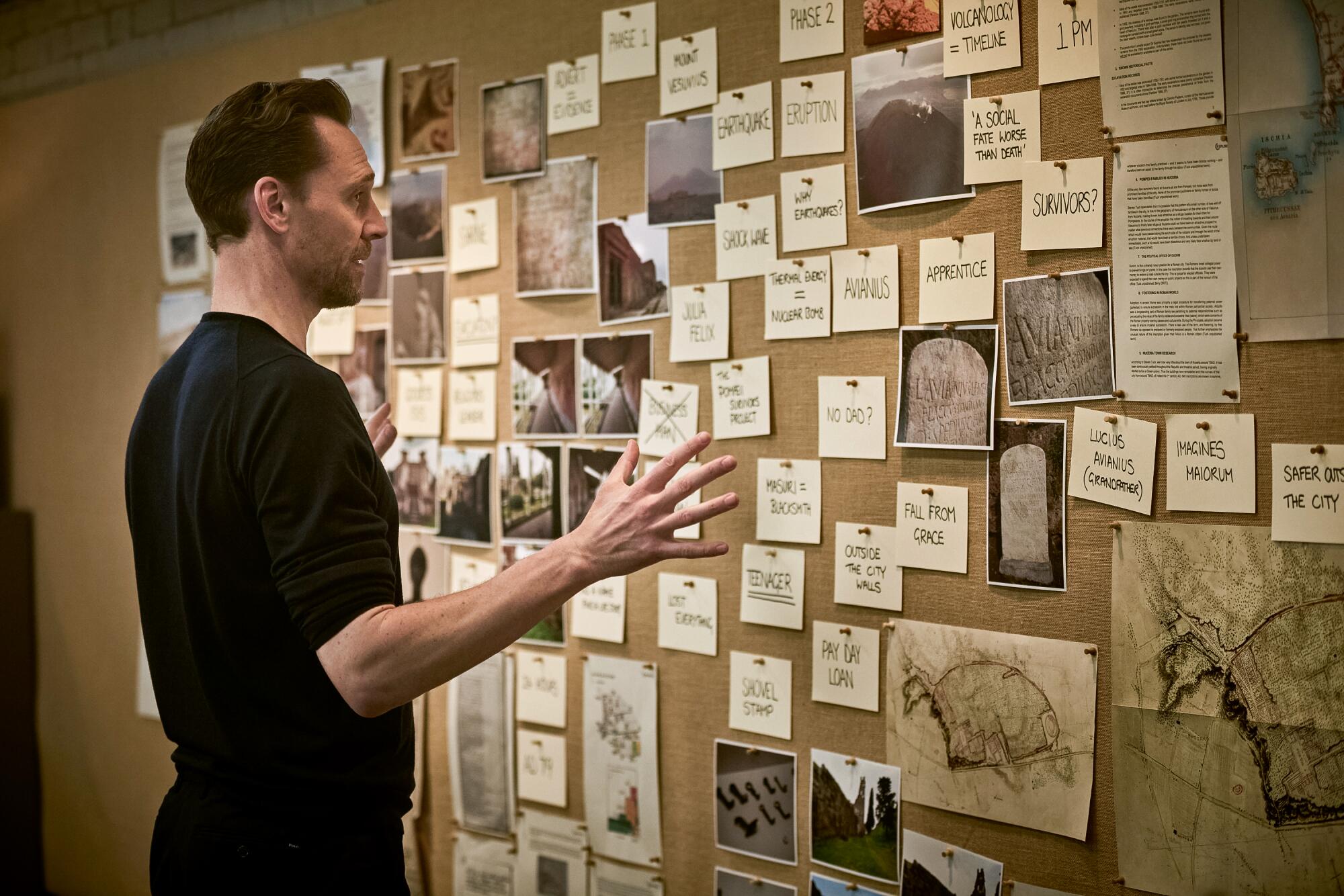
A man in a black T-shirt gestures in front of a corkboard covered in notecards, photographs and maps.

Tom Hiddleston in a scene from the series, where he speaks to experts about Pompeii and how the eruption of Mt. Vesuvius unfolded.

(Christian Black / National Geographic)

Hiddleston had been talking with producer Kevin R. Wright about his fascination with the ancient world, and after seeing Hiddleston in fictional Pompeii, Wright got the ball rolling on “Out of Time,” co-writing and helping to produce the series, which debuts Wednesday on NatGeo and Thursday on Hulu and Disney+.

On the show, Hiddleston travels back to Pompeii and the lip of the volcano, speaking to experts of Pompeii’s history and volcanoes but also one in surviving disasters to help him understand people’s behavior as the sky was falling on them. “It’s about trying to gather as much evidence from different disciplines,” he explained.

Hiddleston’s enthusiasm for the project is evident throughout our interview: Each question earned a five-minute response, all delivered with passion (and incredibly articulate with no verbal fillers or talking in circles) and fascinating digressions — he broke down the Greek and Latin roots of the words “democrat” and “republican,” mentioned the classical references in the architecture of the New York Stock Exchange and British Museum, and tied in the relevance of Christopher Nolan’s “The Odyssey.”

Here, for instance, is a portion of his answer to my first question about whether the driving force of the series was the importance of facts in understanding history, using storytelling and imagination to create empathy for the people of Pompeii, or to show the way our past still has lessons to offer today:

“I wanted a series with an original dynamism, which could be immersive and propulsive and emotional, and bring the story of Pompeii and its people back to life in a way that could be different and innovative. I wanted to evoke for the audience the feeling that I had when I first went to Pompeii.

“At university, I had teachers who taught me to live in the question and that our relationship with the past is a two-way street. One cannot examine the past without acknowledging that we look back from the perspective of where we stand. We tell stories to understand something about ourselves — we need to know who we were to think about who we are now.

Two men stand side by side outdoors near a gated entrance.

Darius Arya, an archeologist and historian, with Hiddleston in the ancient city of Herculaneum. (Paolo Verzone/National Geographic)

Several human skeletons inside of a stone boat shed.

Human remains inside of boat sheds, where people took shelter from the eruption of Mt. Vesuvius. (Paolo Verzone/National Geographic)

“The engine of my commitment was centered on empathy, trying to honor the lives of the people of Pompeii. If we could gather enough evidence, enough fragments of truth, they might add up to a picture of history, which would generate great reserves of feeling and compassion so we could see ourselves in their predicament, their instincts, their choices, their capacity to help each other. And that experience of empathy and compassion would connect us to a thread across time to people experiencing a terrifying and traumatic event, and to see that in our world now.

“But we were very careful about the idea that the truth matters. In writing history, there must be intense rigor — evidence is important and if you have evidence that should counteract any bias or hypothesis.

“But the evidence here is incomplete so at some point, you have to take an educated guess, a leap of imagination. The past is a two-way street with the present, but it’s also an eternal mystery and all of our questions will never be answered so there’s that joy of living in the question.”

When the publicist said our time was up, Hiddleston stepped out of time and took one more question. And then another and another, nearly doubling the time allotted, thrilled to be exploring the connections between past and present.

While many people think that the city’s population was wiped out, the vast majority actually escaped and modern research has found the names and details of hundreds of survivors. Hiddleston notes that “one great gift of Pompeii is that the Romans didn’t have paper, so the walls, the columns, the houses, the public buildings are covered in writing: deeds, business contracts, advertisements, gossip, doodles.”

A teenage boy runs through a set as he's being splattered with recreated ash as men with cameras follow his movement.

In this behind the scene photo, director of photography Jim Jolliffe runs with a camera, following Frankie Treadaway playing Avianius, a teenage boy whose story is reenacted in the series.

(Darrin Zammit Lupi / National Geographic)

The three episodes track the stories of a teenage boy, a successful businesswoman and a soldier in the nearby town of Herculaneum, with a sprawling cast and special effects bringing those scenes to life. “We thought that in the words of Pliny the Younger, ‘their lives were worthy of our memory.’ ”

While there have been other more traditional Pompeii documentaries, Hiddleston felt he had something distinctive to offer, thanks to his “day job.”

“I take a piece of writing and a character, real or imagined, and research as much as I can, and then imagine it and try and breathe life into a person,” he says. “Even when I’ve played real people, I’ve run out of evidence. That’s when you just have to extend your empathy and compassion, your knowledge of human beings and the breadth and range of human experience, the things we all share and can connect with to find an internal world of variety and depth.”

Hiddleston wanted to extend that to the people of Pompeii. “They were three dimensional people with rich lives,” he says. “We follow the trail of breadcrumbs as far as we can, and then try to bring them to life with empathy and compassion.”

Source link

BBC The Night Manager star bags role in ‘gripping’ period drama based on real events

One of the most devastating moments in world history will be brought to life on Disney+ by a beloved star of The Night Manager and Marvel blockbusters

It’s shaping up to be one of the year’s most gripping docudramas.

BBC The Night Manager star Tom Hiddleston will be playing time detective in an immersive new historical series coming to National Geographic and Disney+ later this year.

Pompeii: Out of Time will reunite the iconic Marvel star with Loki executive producer Kevin R Wright for the three-part series that promises to lift the lid on the explosive historical moment.

The first-look trailer has given fans a glimpse of Hiddleston stepping into his new role as he makes the case that the eruption of Vesuvius wasn’t just a catastrophic day of death and destruction.

His latest series will feature an eye-opening investigation into those who may have survived the blast, brought to life with immersive and thrilling dramatisations.

Along for the journey is a team of ancient Rome experts, from archaeologists and historians to geologists and disaster experts, who will uncover remarkable real-life stories that challenge assumptions people have about the fateful day in 79 AD.

A teenage apprentice, a powerful businesswoman and a mysterious Praetorian Guard are all vital pieces of the puzzle as Hiddleston steps back in time to explore the hours before and during Vesuvius’ eruption in what is shaping up to be an essential watch for any history buff. A synopsis from Disney+ teases: “As the volcano awakens and the countdown to catastrophe begins, the evidence converges in a gripping race against time to uncover who survived, who perished, and what determined their fate.”

Hiddleston says in a statement: “The ancient world has compelled my imagination and curiosity for as long as I can remember: I’ve been fascinated by it all my life.

“Classical Antiquity is the foundation and cornerstone of Western and European culture. To visit Pompeii is to feel the distance of the 2,000 years between now and then compress. The past becomes the present; the past feels so close. Tangible, honest and real.

Content cannot be displayed without consent

“Our relationship with the past is alive — studying who we were in order to understand who we are. Pompeii is a gateway for that conversation. It’s a privilege to host this visually immersive and dynamic series.”

He added: “Pompeii is often remembered for how its story ended. But by looking closer, we can uncover the details of people’s lives, the choices they made, and the moments that came before the city was buried.

“To revisit the final hours of those ordinary people, caught in an extraordinary moment, and to help bring these remarkable human stories back into the light, is a genuine honour.”

The upcoming series is already generating excitement amongst fans, with one user commenting below the trailer on YouTube: “Omg this seems so interesting.”

“This is absolutely fascinating — Pompeii is an incredible place, and this approach brings its story to life in a very powerful way,” someone else replied, adding they’re “really looking forward” to tuning in.

Get Disney+ for £3.99 for three months

This article contains affiliate links, we will receive a commission on any sales we generate from it. Learn more
Content Image

£5.99

£3.99

Disney+

Get Disney+ here

Disney+ is offering a discounted subscription at £3.99 per month for three months when signing up by May 6. This provides cheaper access to hit series like Rivals, Only Murders in the Building and The Bear, plus countless titles from Marvel, Star Wars, Pixar and more.

“I want to see it NOW!” another fan exclaimed, and a final fan wrote: “For someone who’s survived Ragnarok, Tom Hiddleston couldn’t be better suited for this doc. Looking forward – or back – to it.”

Mark your calendars, as all three episodes will be available to stream in just over a month’s time.

Pompeii: Out of Time with Tom Hiddleston premieres Thursday, 23rd July on National Geographic and Disney+.
Source link

Britain’s Prince George to attend Eton College

From left, William, the prince of Wales; Kate Middleton, the princess of Wales; Princess Charlotte; Prince Loui; and Prince George look upward Saturday while on the balcony of Buckingham Palace after the annual Trooping the Colour in recognition of the king’s birthday. Officials have announced that Prince George, second in line for the throne, will attend Eton College starting in September. Photo by Hugo Philpott/UPI | License Photo

June 16 (UPI) — Britain’s Prince George will attend Eton College, the same school as his father, starting in September, Kensington Palace announced Tuesday.

Eton is an elite private school in Berkshire with students from ages 13 to 18. In Britain, “college” refers to pre-university education. George, the oldest child of the prince and princess of Wales, will turn 13 in July. William, prince of Wales and heir to the British throne after his father, King Charles III, also attended Eton.

Prince George attended Lambrook School in Berkshire with his siblings, Princess Charlotte, 11, and Prince Louis, 8, BBC News reported. That school accepts students up to age 13.

Prince Harry, Prince William‘s brother, also attended Eton, as did many other prominent politicians, including 20 of the country’s 58 prime ministers, CNN reported. Celebrities including Tom Hiddleston and Eddie Redmayne are also alumni.

The school, founded in 1440 by King Henry VI, is considered prestigious — and expensive, with yearly fees nearly $85,000 in U.S. dollars. It’s a full boarding school, meaning Prince George will live and study there.

Melanie Sanderson, managing editor of “The Good Schools Guide,” said Eton has “spectacular facilities and spacious grounds” and that “despite its ancient buildings, it is a modern school with a progressive outlook,” BBC News reported.

“Most 13-year-old boys arriving there in September cannot possibly know what adult life holds for them,” she said. “Prince George, however, faces a very particular future and his parents, with an unrivaled choice of schools available to them, have decided that an Eton education represents the best preparation for life as a modern working royal.”

King Charles III toasts with President Donald Trump during a state dinner at the White House in Washington on April 28, 2026. Photo by Craig Hudson/UPI | License Photo

Source link