Hello! I’m Mark Olsen. Welcome to another edition of your regular field guide to a world of Only Good Movies.
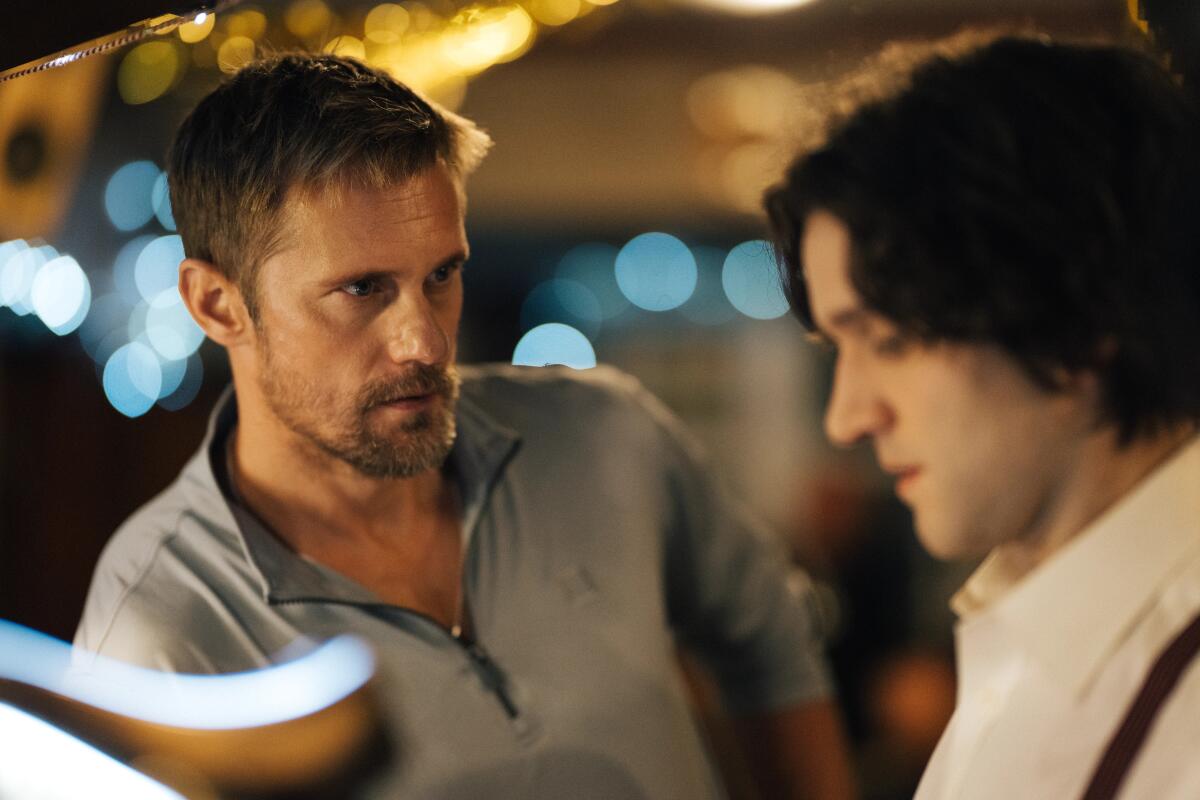
Movies that had limited awards releases last year are seeing their full-fledged openings this week. Top among them is “Pillion,” the debut from British writer-director Harry Lighton, starring Alexander Skarsgård and Harry Melling as two men who become engaged in a dominant-submissive relationship.

Alexander Skarsgård, left, and Harry Melling in the movie “Pillion.”
(A24)
In her review, Amy Nicholson writes of the film, “This fetishy adventure is a minimalist romantic comedy in which submissive meets dominant, and submissive explores his physical and emotional vulnerabilities. Marriage and a baby carriage are off the table; the journey matters, not the destination. … Lighton’s biker BDSM rom-com might sound niche, but free yourself to see it and you’ll discover it’s a universal romance.”
Emily Zemler asked Skarsgård about what has been guiding his decisions lately when choosing roles. As he said, “People think there’s this invisible ladder and you have to get to the next rung of the ladder. It’s easy to forget to check in with yourself and ask, ‘Well, what do I want to do?’ You can get swept away. I’m trying to get down the ladder to the ground.”
Some other notable openings this week are “Dracula,” “Scarlet,” “The President’s Cake,” “Natchez” and “The Love That Remains.”
Points of interest
‘Porn Chic’ revival at the New Beverly

Sylvia Kristel in the movie “Emmanuelle.”
(Severin Films)
For most of the month of February, the New Beverly will refashion itself into the Eros, the adult movie theater it was called throughout much of the 1970s. (There’s even a commemorative T-shirt.) Married film dudes throughout the city are presumably coming up with inventive rationales and/or excuses as to why they simply must attend some of these screenings.
The programming leans into what was referred to in The Times as “porn chic” — movies that were meant to work as cinema, even appealing to couples, while also fulfilling the needs of the raincoat crowd. This Friday and Saturday will be a double bill of Just Jaeckin’s 1974 “Emmanuelle,” starring Sylvia Kristel, and Bitto Albertini’s 1975 “Black Emmanuelle,” starring Laura Gemser.
When The Times’ Charles Champlin reviewed “Emmanuelle” after it opened in 1975 at the Fine Arts in Beverly Hills, he noted, “It may be the first porno film designed for people who don’t really want to see one.”
Other notable titles during the New Bev’s Eros month include “The Opening of Misty Beethoven,” directed by Radley Metzger under the pseudonym Henry Paris, Russ Meyer’s “Vixen” (with star Erica Gavin in-person), Ingmar Bergman’s “Summer With Monica,” Roger Vadim’s “Pretty Maids All in a Row,” “The Fireworks Woman,” directed by Wes Craven (credited as Abe Snake), Nagisa Oshima’s “In the Realm of the Senses” and Gerard Damiano’s “Deep Throat.”
Quentin Tarantino’s “Once Upon a Time … in Hollywood” will be playing on Fridays at midnight, which includes a knowing line about the Eros when Margot Robbie asks, “What’s happening at the dirty movie place?”
A 1976 article in The Times by Barry Siegel states that there were then 47 adult theaters operating within the city limits of Los Angeles, even while charting the rapid rise and quick decline of porn-chic movies in the wake of the success of “Deep Throat” in 1972.
‘sex, lies and videotape’ with star Laura San Giacomo

Laura San Giacomo in the movie “sex, lies and videotape.”
(Criterion Collection)
The Los Angeles Film Critics Assn. continues its 50th anniversary series at the Egyptian Theatre on Tuesday with a screening of Steven Soderbergh’s 1989 debut feature “sex, lies and videotape,” a key title in kicking off the independent filmmaking scene of the 1990s. Actor Laura San Giacomo, who won LAFCA’s New Generation Award for her performance, will be there for a Q&A moderated by Lael Loewenstein.
Soderbergh was all of 26 years old when the film premiered at what was then called the U.S. Film Festival (the precursor to Sundance), where it won the audience award before heading to Cannes, where it won the Palme d’Or. (James Spader picked up an acting prize there too.) Among the film’s many other accolades, Soderbergh would also be nominated for an Academy Award for original screenplay.
Spader plays Graham, an enigmatic wanderer who inserts himself into the lives of his old friend John (Peter Gallagher), his wife Ann (Andie MacDowell) and her sister Cynthia (San Giacomo), drawing out all manner of confessions and revelations.
In her original review of the film, Sheila Benson called the film an “electrifying psycho-sexual comedy … the funniest and saddest American movie since Jim Jarmusch landed straight in the middle of our consciousness, and it’s possibly the most compelling.”
Benson added, “What is not apparent from a thumbnail description is the film’s lacerating wit, its beautiful look and sound, and the bravura quality to each performance. Or the terrible vein of melancholy that Soderbergh touches.”
‘In the Soup’ in 35mm

Steve Buscemi and Seymour Cassel in the movie “In the Soup.”
(Factory 25)
Winner of the Grand Jury prize at 1992’s Sundance — the same year “Reservoir Dogs” premiered there — is “In the Soup.” Directed and co-written by Alexandre Rockwell, the film follows an aspiring filmmaker (Steve Buscemi) who falls in with an irresistibly charming gangster (Seymour Cassel, who won Sundance’s first acting award) as his erstwhile producer. A recently restored 35mm print of the film will be playing in L.A. for the first time Sunday at Brain Dead Studios.
The cast of the film also features Carol Kane, Jim Jarmusch and Jennifer Beals, the last married to director Rockwell at the time. Reviewing the film in November 1992, Kenneth Turan called it “a charming pipsqueak of a movie, a playful film of ragged and shaggy appeal.”
Director Michael Almereyda on the ’90s vampires of ‘Nadja’

Elina Löwensohn in the movie “Nadja.”
(Arbelos Films)
As much a survey of late-night diners, bars and 3 a.m. conversations, Michael Almereyda’s “Nadja” is very much a vampire film. It is also a wonderful example of the creative freedom of the ’90s indie boom — everything from its cast to its look to its deadpan humor.
Executive produced by David Lynch (who paid for the film out of his own pocket and appears in a small role), “Nadja” combines the 1936 horror film “Dracula‘s Daughter” with Andre Breton’s 1928 surrealist novel “Nadja.” In the movie, a New York City vampire (Elina Löwensohn) looks to avenge the death of her father at the hands of Dr. Van Helsing (Peter Fonda) while also dealing with a complicated swirl of relationships involving her brother (Jared Harris), his nurse (Suzy Amis), Van Helsing’s nephew (Martin Donovan) and his wife (Galaxy Craze).
Re-released by Grasshopper Film and Arbelos Films with a streaming and home video release to follow, the new 4K restoration of the film’s original version that premiered at the 1994 Toronto International Film Festival is a few minutes longer than what played at Sundance just a few months later. (It was there that Almereyda also made the documentary “At Sundance,” interviewing filmmakers for their thoughts on the future of movies.) This new “Nadja” is playing on Feb. 6 and 8 at the Philosophical Research Society, then at Vidiots on Feb. 21 and 22 and Frida Cinema on Feb. 25 and 26.
On the phone from Sao Paulo, Brazil, where he is prepping an adaptation of Don DeLillo’s 2016 novel “Zero K,” the thoughtful and reflective Almereyda shared some of his memories of making the film.

Peter Fonda, left, Jared Harris, Martin Donovan and Galaxy Craze in the movie “Nadja.”
(Arbelos Films)
How did you get the idea of combining “Dracula’s Dracula” with Breton’s “Nadja”?
Michael Almereyda: It was fairly spontaneous. David Lynch had offered to help me make a movie if I could come up with something that was definably genre. And I went to [NYC movie theater] Film Forum at a time when — do you remember [film historian] William K. Everson? He would show up at Film Forum unannounced to start talking before the movie. This was one time when I showed up late and he was talking and they read a raffle ticket and there was silence. And I reached in my pocket: I had won the raffle. And that was to get a book of William K. Everson’s about horror movies. And so it was kind of a gift that I read about “Dracula’s Daughter.” I’d never seen it and I liked the outline of the plot and I chased it down and it felt like I could retrofit a number of ideas I had about New York with that story. It felt like the two things talked to each other.
One thing about vampire movies is that the best ones are always about something else. For you with “Nadja,” what’s the something else?
Almereyda: It’s not really a scary movie and it wasn’t really designed to be. It’s certainly atmospheric but the emotion of it, when I saw it again recently, had to do with both the comic aspects of being in love and the miserable aspects. It’s kind of a side-winding answer, but that’s partly what it’s about. It’s about family ties, obviously. I think I made or wrote enough scripts about tangled families that I began to sort of get over it. But we all come from these families.

David Lynch in the movie “Nadja.”
(Arbelos Films)
Did David Lynch‘s presence impact the tone at all? Do you feel the movie became in any way Lynchian?
Almereyda: Well, David’s impact on me and my whole generation of filmmaking and the generation behind us is vast. And I wouldn’t want to pretend it’s not, but direct influence is kind of minimal. It might be more fair to say that David’s art school background rhymes with mine. And that we had similar influences. People don’t really talk about how much David did or didn’t know about Maya Deren and Cocteau, but it’s kind of hard to miss. And there was just a certain sensibility and attitude. I felt close to David’s Midwestern-ness, and you combine that with some fondness for and knowledge of French culture, including surrealism, and you’re halfway to David Lynch without specifically thinking about it.
I really haven’t addressed this question much, but when he died, I ended up writing a fair bit of my memories and it’s moving to me how much impact he had when he died. There was such a wave of mourning and celebration, too, that it felt more phenomenal than he could have anticipated. It was clear how famous he was — how recognizable he was — within the time I knew him. But the love of David Lynch is really moving to me and it’s still something we’re swimming in, I hope, in a dark time.
For all the difficulties of being an independent filmmaker, what keeps you doing it?
Almereyda: I’m stumped. I was just going through my head and I know you just interviewed Ethan Hawke and he’s a true comrade that I’ve been lucky to work with a few times. And he was in the interview with Rick Linklater when we did our “At Sundance” movie. They had “Before Sunrise” at the festival and Rick started by quoting Truffaut, talking about the future of film is the personal film.
Even if it’s a fantasy, even if it’s a vampire movie, you’re still relating to your experience and your sense of an emotional reality. So that feels like a candle that doesn’t go out for me. And despite all the derailments and dead ends, I don’t question continuing. It just feels like a natural path, even if it’s winding and difficult.
In other news
Timothée Chalamet, tributee

Timothee Chalamet in the movie “Marty Supreme.”
(A24)
I will leave the ins and outs of this year’s awards campaigns to my trusted colleague Glenn Whipp at The Envelope, but one event jumped out as worth noting: Announced this week and immediately selling out is an eight-film American Cinematheque retrospective of Timothée Chalamet‘s movies, with the actor in person for all screenings.
Chalamet is currently an Oscar nominee as both actor and producer for “Marty Supreme.” And he has an impressive roster of collaborators who will be appearing with him to show their support, including Edward Norton with “A Complete Unknown,” Denis Villenueve with “Dune” and “Dune: Part Two,” Christopher Nolan with “Interstellar” and Elle Fanning with “Beautiful Boy.”
If there were some murmurs last year that Chalamet didn’t do enough conventional campaigning to win for his turn as Bob Dylan in “A Complete Unknown,” this year he seems to be pulling out all the stops.