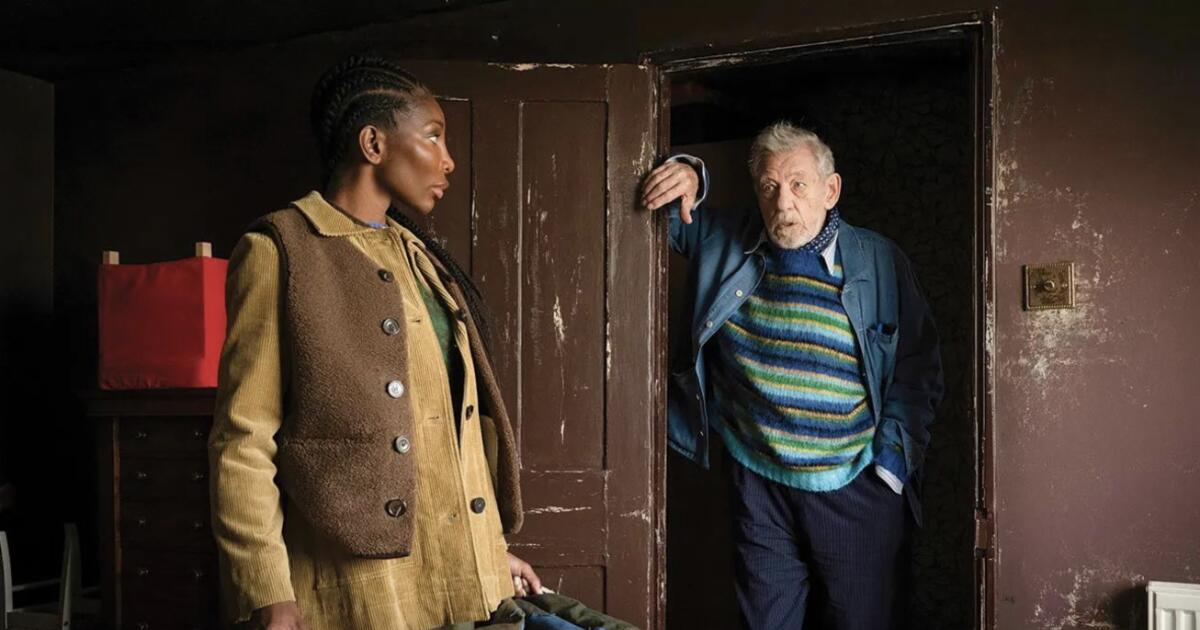
No actor in a movie this month is enjoying themselves more than Ian McKellen as an egomaniac painter in Steven Soderbergh’s slender pleasure “The Christophers.” Once, his Julian Sklar was the bisexual provocateur of the London art scene commanding millions for a single piece. Now he’s better known as the villain of “Art Fight,” a reality competition show where he took cruel pleasure destroying amateurs’ hopes.
Equally dismissive of his own output, Julian hasn’t wielded a paintbrush in decades. And so his adult children Barnaby and Sallie (James Corden and Jessica Gunning of “Baby Reindeer”) — two money-grubbing, untalented brats — hire a broke art restorer, Lori (Michaela Coel), to finish a stack of half-sketched portraits Julian made of his male ex-lover that were left abandoned in the attic. Don’t think of it as forgery, Barnaby assures Lori, “more like forging through them until they are completed.”
That’s a great line, and “The Christophers” has a dozen more almost as good. Nearly all get delivered by McKellen’s Julian, waving a champagne coupe while monologuing about humidifiers, cancel culture and a doctor who smells like radishes. He seems to imagine acolytes — or at least, television audiences — eagerly soaking up his bon mots. Meanwhile, Lori, a young Black woman hired under false pretenses as an assistant, stares mutely. If their first meeting as boss and employee were freeze-framed into a painting, it would be called “A Study in Contrasts.”
The script is by Ed Solomon, who also collaborated with Soderbergh on the more action-packed 2021 gangster movie “No Sudden Move.” This plot doodles along, rarely going where we expect. Mostly, Julian and Lori take turns thwarting his obnoxious kids and threatening to quit. I chuckled every time Corden and Gunning showed up for more abuse, including from Soderbergh, who shoots them like a wall of stupidity, blocking doorways as they stand side-by-side like Tweedledee and Tweedledum.
The inequalities of the art world are gestured to as fact. Lori, who might be every bit as technically gifted as Julian, ekes out a living serving egg rolls in a food truck while sharing a walk-up loft with three other struggling painters. Julian lords over not one but two swanky adjoining townhouses stuffed with antiques. Once, to flip off the establishment, he sold a work worth 2 million British pounds for the price of a used car. His version of disdain is her idea of a fortune.
One stick figure by Julian would be worth more than anything Lori’s ever done, which makes it extra maddening that he chooses instead to earn a little extra pocket money recording video messages for fans who only care about him as that mean guy on TV. In the glow of a ring light, he tosses off glib advice that might itself be worthless. Quit art school, he tells one, and “happy birthday, blah, blah, blah.” (Even imagining a popular TV show about art is, in itself, culturally aspirational for those of us who enjoy reruns of Bob Ross.)
Why is there such disparity between the value of Julian and Lori’s work? The reasons are so obvious that, to the film, they’re barely worth mentioning: age, gender, era, fame and skill. Julian would dismiss the first two, claiming that wokeness gives an old, white male like him the handicap. But it’s frustrating that the film doesn’t dig very deep into the rest, either. I especially wanted a scene where Julian must reckon with a no-name interloper’s ability to copy his genius, but comparing whether Lori is Julian’s equal would call the film’s bluff and force it to actually show us their art. The handheld camera prefers to lurk on the wooden side of the easel.
Really, I’m not sure Soderbergh even has an opinion on their clash. He just wants to be an eavesdropper in the room, standing back against the dusty brick-a-brack. Of course, if you squint, you can see what interests Soderbergh in this set-up. Like Julian, he’s been threatening to retire for years. He knows how irritated people are when an artist claims they don’t want to bother anymore. And like the neglected paintings in the attic — the Christophers of the title — every filmmaker has their own unfinished projects taking up mental space overhead, treasured ideas that will never emerge to their satisfaction.
Still, I suspect that even if Soderbergh personally identifies with the premise (even though he continues to release more movies in one year than his peers do in five), he still finds Julian’s paralysis a bit pathetic. Julian just needs paint, a brush and the will to create. Filmmakers, now those poor bastards need rich patrons.
Even so, Soderbergh likes to make movies as resourcefully as he can, doing his own editing and cinematography and, above all, prioritizing the act of invention. He can’t be copied because his own work is so eclectic. Have you ever heard of any director being called the next Soderbergh? You sense that, to him, forgery is as creatively dull as a factory-issued franchise sequel. (Except, of course, his “Magic Mike” and “Ocean’s” series, which are, at their best, closer to wacky Warhols.)
Tasked to play the foil to McKellen’s clown, Coel comes off stiff. She has the spine to hold her own against him, but it’s hard to play withholding, particularly when the film needs her character to be both the voice of reason and a politically correct scold. Only her carved cheekbones give off an impression of Lori’s hungry ambition. Still, when she does deign to speak, there’s a dynamite scene where she dresses down Julian critically and psychologically. Whether or not she’s the second coming of him as an artist, she’s more insightful than he ever was insulting watercolors of kittens on TV.
Really, we’re just watching McKellen give a bravura, scene-gobbling performance that doesn’t hold back one iota. My favorite detail he pulls off comes when he greets Lori at the front door undressed and, when she insists he wear clothes, ties on a trench coat that somehow makes him look even more pervy and naked in how McKellen wears it, leaving one bare shoulder roguishly exposed.
The film has plenty of funny little asides like that which make it worth your while. Angelenos will chuckle at a scene in which two characters verbally commit to a meet-up both know won’t happen — or, as we say here, let’s do lunch. Out of magnanimity, I’ll liken this trifle to a Rothko. The more I think about “The Christophers,” the more I imagine it has interesting layers. But I won’t fault anyone who just sees a simple square.
‘The Christophers’
Rated: R, for language
Running time: 1 hour, 40 minutes
Playing: Opening Friday, April 10 in limited release