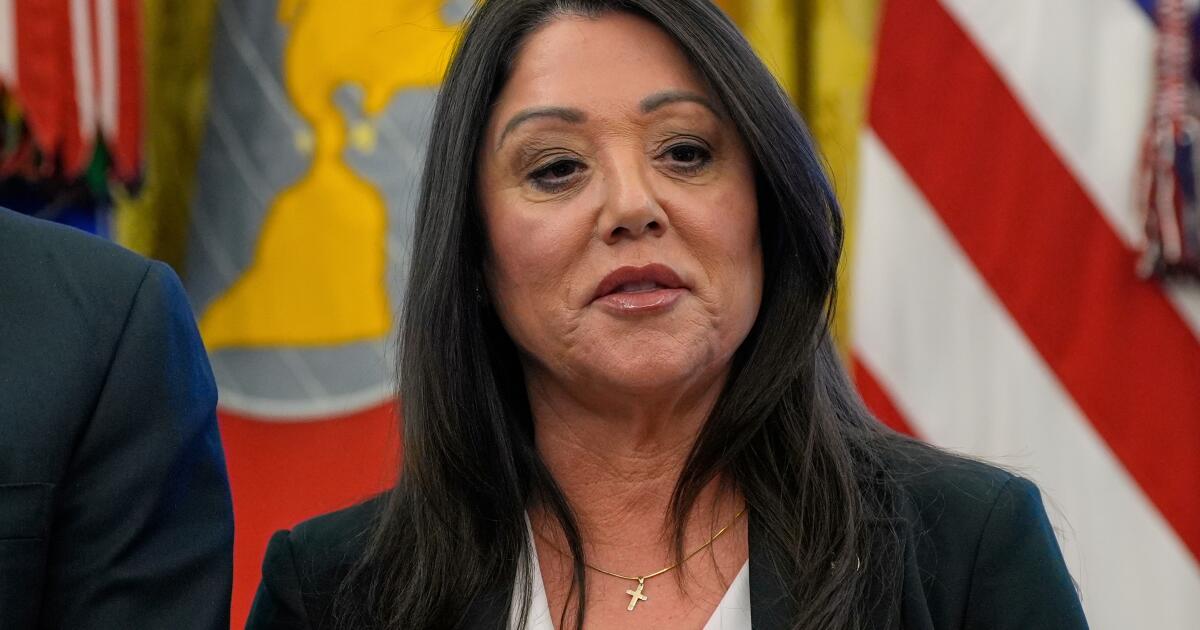
lori

Hiltzik: A not-so-fond farewell to Lori Chavez-DeRemer

Lori Chavez-DeRemer seemed at first to be a good Trump hire as Labor secretary. Wow, were we wrong

It has long become clear that those of us who saw a glimmer of hope in President Trump’s appointment of Lori Chavez-DeRemer as secretary of Labor got snowed.

It wasn’t just, or even chiefly, the miasma of sleaze and corruption that seemed to surround her wherever she went. Or her slavish sucking up to Trump in public, notably at a Cabinet meeting in which she pleaded with Trump to send his immigration goons into Portland, Ore., to “crack down.” (“Thank you for what you’re doing with your agents on ICE,” she said at the August 2025 session.) Fun fact: She had represented a Portland suburb as a Republican for a single House term.

No. It was the gulf between the expectations, even among Democrats, that she might be a decent pick for the job, and the reality.

We fought against sweatshopsWe took on big co. rporations that were cheating their employees. We kept workers safe.

— Former Labor Secretary Robert Reich, recalling his departments accomplishments under Bill Clinton

After all, she had been one of only three Republicans in the House to vote in favor of the so-called PRO Act, which would significantly strengthen collective bargaining rights. (The measure passed the House in 2019 and 2021 but hasn’t gotten out of committee in the current Congress.)

As I reported after her nomination, labor activists and pro-labor politicians made encouraging noises about her. Among them was Sen. Elizabeth Warren (D-Mass.): “It’s a big deal that one of the few Republican lawmakers who have endorsed the PRO Act could lead the Department of Labor,” Warren said. “If Chavez-DeRemer commits as Labor secretary to strengthen labor unions and promote worker power, she’s a strong candidate for the job.”

Get the latest from Michael Hiltzik

Commentary on economics and more from a Pulitzer Prize winner.

She received an explicit endorsement from Randi Weingarten, president of the American Federation of Teachers. “Her record suggests real support of workers & their right to unionize,” Weingarten tweeted. “I hope it means the Trump admin will actually respect collective bargaining and workers’ voices from Teamsters to teachers.”

The betting was that Chavez-DeRemer would be, at the very least, an upgrade from Trump’s previous appointee as Labor secretary during his first term. That was Eugene Scalia, son of the late Supreme Court justice, who had been a lawyer for big corporations fighting unions and resisting workplace regulations.

The most commonly expressed doubt about Chavez-DeRemer was whether she would have the fortitude to maintain a pro-labor stance in the face of the open hostility to workers displayed by Trump and the rest of his administration.

Within months, the answer was clear, and it was no. In May, she ceased enforcing a Biden administration rule that had discouraged businesses from designating their workers as independent contractors, depriving those workers of the legal protections and wage and hour benefits they would have received as employees.

The budget she submitted to Congress last year would slash her agency’s discretionary funding by more than 35%, to $8.6 billion from $13.2 billion, and cut its workforce by nearly 4,000 full-time workers, or more than 26%. In July she announced a plan to rescind 63 regulations that had been designed to help workers.

With language that sounded cribbed from the MAGA playbook, she said her goal is to “eliminate unnecessary regulations that stifle growth and limit opportunity.” Most of the regulations facing the guillotine related to worker health and safety protections.

Brief as it was, Chavez-DeRemer’s tenure wasn’t the first time that the Department of Labor was ill-served by its management. Republican presidents have displayed a decades-long tendency to fill the top spot with political cronies or pro-business activists masquerading as worker advocates, or worse.

Frances Perkins, Franklin Roosevelt’s Labor secretary, recalled having to clean up the agency — not just morally and ethically, but with broom and bucket, when she took over from William Nuckles Doak, Herbert Hoover’s appointee.

The Labor Department was located in a converted apartment building, its interior dark and foreboding, its shadowy corners occupied by silent, hulking men whom Perkins mentally labeled “cigar in the corner of the mouth types. Stale ashtrays and spittoons were everywhere, along with wastebaskets surrounded by mounds of misaimed and crumpled papers. (Its current Washington quarters are in the Frances Perkins Building.)

Doak didn’t seem inclined to leave the premises. Perkins got rid of him by sending him to lunch and packing up his personal effects while he was out.

Perkins’ first step as secretary was to disband an anti-immigrant squad that shook down foreign-born laborers for cash and helped employers harass labor organizers. She set a high standard for the agency, pushing forward legislation establishing the 40-hour workweek and the National Labor Relations Board — and also creating Social Security.

Many of Perkins’ Democratic successors have watched sadly as their efforts have been undone with a change in administrations. Robert Reich, who served under Bill Clinton (and is now an emeritus professor of public policy at UC Berkeley and an assiduous blogger), wrote Tuesday of having loved the agency’s mission: “to protect and raise the standard of living of working Americans.”

With Reich at Labor, the Clinton administration raised the federal minimum wage in 1997 from $3.35 an hour, where it had been stuck since 1980, to $5.15 (albeit still a cheeseparing $10.69 in today’s buying power). “We fought against sweatshops,” Reich recalled. “We took on big corporations that were cheating their employees. We kept workers safe.”

That the agency has been “treated like crap is an insult to generations of hardworking DOL employees, to American workers, to America,” Reich wrote.

Under Trump, the Department of Labor has become just another pro-business front pretending to advocate for workers. Genuine labor advocates are infuriated by its decline, which has proceeded under Republican and Democratic administrations alike.

The budget for its all-important wage and hour division, which enforces laws governing the minimum wage, overtime and prohibitions on child labor, has shrunk by 26% over a decade, according to David Weil, who headed the division under Obama and whose appointment by Biden to head the division was derailed by opposition from Big Business.

“There were 1,050 investigators working for the agency when I had the honor to lead it in the Obama administration,” Weil, who is a professor of social policy and management at Brandeis University, wrote last year. “It has barely over one-half that number now. The agency had 63 times more investigators per workplace in 1939 than in 2024.”

Trump poses as a pro-worker force, but his policies are atrocious for the laboring class. His Labor Department “walked away from a rule that expanded overtime protections to millions of workers,” Weil observed.

“While Congress’s ‘big beautiful bill’ boasts its worker-friendly removal of taxes on overtime, that provision benefits only a small slice of workers and revoking the overtime regulation further reduces the number of workers eligible for overtime protections when working long hours,” he wrote. “Or take the administration’s attack on low-paid workers whose employers hold federal contracts, by rescinding a $15 minimum wage for contractors covered by a Biden-era executive order, which benefited construction workers, purportedly a key Trump constituency.”

The Labor Department plays a role not only in regulating current workplace conditions but looking ahead at the “long-term prospects of our labor markets,” Weil told me Tuesday. “For example, the discussion of ‘affordability’ is rooted not only in rapidly rising price levels but also the low level of long-term earnings growth. Equally, our beliefs about the future prospects of employment and opportunity for college-educated workers are being upended by the potential impacts of AI.”

He added, “Questions like these require that the Labor Department be led by serious and knowledgeable individuals who place the interests of workers as their focus. So far, this administration has shown contempt for this mission,” as is shown by the decline and fall of Chavez-DeRemer.

Sometimes, the departure of an underperforming executive or official presages improvements ahead. That hasn’t been the pattern under Trump, and sadly, it’s not likely to happen at Labor.

Source link

Trump’s Labor Secretary Lori Chavez-DeRemer latest to leave administration | Donald Trump News

Chavez-DeRemer is the third high-profile female official to leave the Trump administration after recent departures of Kristi Noem and Pam Bondi.

US Secretary of Labour Lori Chavez-DeRemer will be leaving her post in the administration of President Donald Trump, the White House has said.

Chavez-DeRemer is the third woman to leave the Trump administration since March, when the president fired Homeland Security Secretary Kristi Noem in the wake of federal immigration raids in Minnesota that led to the deaths of two protesters. Trump also ousted Attorney General Pam Bondi earlier this month.

Recommended Stories

list of 4 itemsend of list

Chavez-DeRemer has done a “phenomenal job” protecting American workers and is set to “take a position in the private sector”, White House Director of Communications Steven Cheung said in a post on X late on Monday, announcing the labour secretary’s departure.

“Keith Sonderling will take on the role of Acting Secretary of Labor,” Cheung added, referring to the current deputy labour secretary.

While Cheung did not give a reason for Chavez-DeRemer’s departure, the New York Post reported in January that she was under investigation for “pursuing an ‘inappropriate’ relationship with a subordinate” and drinking in her office during the work day.

Al Jazeera was unable to independently verify the allegations.

From the beginning of her tenure, Chavez-DeRemer had some notable differences with other members of Trump’s inner circle.

She had voiced support for the pro-union Protecting the Right to Organize Act (PRO Act), earning support for her nomination from some Democrats.

Her appointment was also seen as favoured by Sean O’Brien, the president of the International Brotherhood of Teamsters, who notably spoke in support of Trump’s re-election campaign at the Republican National Convention in July 2024.

However, as the labour secretary, Chavez-DeRemer’s positions have more closely aligned with the Trump administration’s overall anti-regulatory policies, according to US media outlets. During her tenure as secretary, the Labor Department stalled on responding to calls for limits on silica exposure from Appalachian coal miners suffering from the occupational black lung disease.

Chavez-DeRemer is not the first top official to leave the Labor Department during Trump’s second term.

In August 2025, Trump fired the director of the Bureau of Labor Statistics (BLS), Erika McEntarfer, who was appointed by previous President Joe Biden, after a report showed that hiring had slowed in July and was worse in May and June than had previously been reported.

Chavez-DeRemer had supported the president’s move at the time.

“I support the President’s decision to replace Biden’s Commissioner and ensure the American People can trust the important and influential data coming from BLS,” Chavez-DeRemer said in a post on X following McEntarfer’s removal.

Source link

Labor Secretary Lori Chavez-DeRemer is leaving Trump’s Cabinet after abuse of power allegations

Labor Secretary Lori Chavez-DeRemer is out of President Trump’s Cabinet, the White House said Monday, after multiple allegations of abusing her position’s power, including having an affair with a subordinate and drinking alcohol on the job.

Chavez-DeRemer is the third Trump Cabinet member to leave her post after Trump fired his embattled Homeland Security Secretary Kristi Noem in March and ousted Atty. Gen. Pam Bondi earlier this month.

Unlike other recent Cabinet departures, Chavez-DeRemer’s exit was announced by a White House aide, not by the president on his social media account.

“Labor Secretary Lori Chavez-DeRemer will be leaving the Administration to take a position in the private sector,” White House communications director Steven Cheung said on the social media site X. “She has done a phenomenal job in her role by protecting American workers, enacting fair labor practices, and helping Americans gain additional skills to improve their lives.”

He said Keith Sonderling, the current deputy labor secretary, would become acting labor secretary in her place. The news outlet NOTUS was the first to report Chavez-DeRemer’s resignation.

Labor chief, family members faced multiple allegations

Chavez-DeRamer’s departure follows reports that began surfacing in January that she was under a series of investigations.

A New York Times report last Wednesday revealed that the Labor Department’s inspector general was reviewing material showing Chavez-DeRemer and her top aides and family members routinely sent personal messages and requests to young staff members.

Chavez-DeRemer’s husband and father exchanged text messages with young female staff members, according to the newspaper. Some of the staffers were instructed by the secretary and her former deputy chief of staff to “pay attention” to her family, people familiar with the investigation told the Times.

Those messages were uncovered as part of a broader investigation of Chavez-DeRamer’s leadership that began after the New York Post reported in January that a complaint filed with the Labor Department’s inspector general accused Chavez-DeRemer of a relationship with the subordinate.

She also faced allegations that she drank alcohol on the job, and that she tasked aides to plan official trips for primarily personal reasons.

Both the White House and the Labor Department initially said the reports of wrongdoing were baseless. But the official denials became less full-throated as more allegations emerged — and when Chavez-DeRemer might be out of a job became something of an open question in Washington.

At least four Labor Department officials have already been forced from their jobs as the investigation progressed, including Chavez-DeRemer’s former chief of staff and deputy chief of staff, as well as a member of her security detail, with whom she was accused of having the affair, the New York Times reported.

She enjoyed union support — rare for a Republican

Confirmed to Trump’s Cabinet in a 67-32 vote in March 2025, Chavez-DeRemer is a former House GOP lawmaker who had represented a swing district in Oregon. She enjoyed unusual support from unions as a Republican but lost reelection in November 2024.

In her single term in Congress, Chavez-DeRemer backed legislation that would make it easier to unionize on a federal level, as well as a separate bill aimed at protecting Social Security benefits for public-sector employees.

Some prominent labor unions, including the International Brotherhood of Teamsters, backed Chavez-DeRemer, who is a daughter of a Teamster, for Labor secretary. Trump’s decision to pick her was viewed by some political observers as a way to appeal to voters who are members of or affiliated with labor organizations.

But other powerful labor leaders were skeptical when she was tapped for the job, unconvinced that Chavez-DeRemer would pursue a union-friendly agenda as a part of the incoming GOP administration. In her Senate confirmation hearing, some senators questioned whether she would be able to uphold that reputation in an administration that fired thousands of federal employees.

She was a key figure in Trump’s deregulatory push

Aside from reports of wrongdoing in recent months, Chavez-DeRemer had been one of Trump’s more lower-profile Cabinet picks but took key steps to advance the administration’s deregulatory agenda during her tenure.

For instance, the Labor Department last year moved to rewrite or repeal more than 60 workplace regulations it saw as obsolete. The rollbacks included minimum wage requirements for home healthcare workers and people with disabilities, and rules governing exposure to harmful substances and safety procedures at mines. The effort drew condemnation from union leaders and workplace safety experts.

The proposed changes also included eliminating a requirement that employers provide adequate lighting for construction sites and seat belts for agriculture workers in most employer-provided transportation.

During Chavez-DeRemer’s tenure, the Trump administration canceled millions of dollars in international grants that a Labor Department division administered to combat child labor and slave labor around the world, ending their work that had helped reduce the number of child laborers worldwide by 78 million over the last two decades.

The Labor Department has a broad mandate as it relates to the U.S. workforce, including reporting the U.S. unemployment rate, regulating workplace health and safety standards, investigating minimum wage, child labor and overtime pay disputes, and applying laws on union organizing and unlawful terminations.

Kim writes for the Associated Press. AP writers Cathy Bussewitz in New York and Will Weissert in Washington contributed to this report.

Source link

‘The Christophers’ review: Ian McKellen as a reclusive art star is the draw

No actor in a movie this month is enjoying themselves more than Ian McKellen as an egomaniac painter in Steven Soderbergh’s slender pleasure “The Christophers.” Once, his Julian Sklar was the bisexual provocateur of the London art scene commanding millions for a single piece. Now he’s better known as the villain of “Art Fight,” a reality competition show where he took cruel pleasure destroying amateurs’ hopes.

Equally dismissive of his own output, Julian hasn’t wielded a paintbrush in decades. And so his adult children Barnaby and Sallie (James Corden and Jessica Gunning of “Baby Reindeer”) — two money-grubbing, untalented brats — hire a broke art restorer, Lori (Michaela Coel), to finish a stack of half-sketched portraits Julian made of his male ex-lover that were left abandoned in the attic. Don’t think of it as forgery, Barnaby assures Lori, “more like forging through them until they are completed.”

That’s a great line, and “The Christophers” has a dozen more almost as good. Nearly all get delivered by McKellen’s Julian, waving a champagne coupe while monologuing about humidifiers, cancel culture and a doctor who smells like radishes. He seems to imagine acolytes — or at least, television audiences — eagerly soaking up his bon mots. Meanwhile, Lori, a young Black woman hired under false pretenses as an assistant, stares mutely. If their first meeting as boss and employee were freeze-framed into a painting, it would be called “A Study in Contrasts.”

The script is by Ed Solomon, who also collaborated with Soderbergh on the more action-packed 2021 gangster movie “No Sudden Move.” This plot doodles along, rarely going where we expect. Mostly, Julian and Lori take turns thwarting his obnoxious kids and threatening to quit. I chuckled every time Corden and Gunning showed up for more abuse, including from Soderbergh, who shoots them like a wall of stupidity, blocking doorways as they stand side-by-side like Tweedledee and Tweedledum.

The inequalities of the art world are gestured to as fact. Lori, who might be every bit as technically gifted as Julian, ekes out a living serving egg rolls in a food truck while sharing a walk-up loft with three other struggling painters. Julian lords over not one but two swanky adjoining townhouses stuffed with antiques. Once, to flip off the establishment, he sold a work worth 2 million British pounds for the price of a used car. His version of disdain is her idea of a fortune.

One stick figure by Julian would be worth more than anything Lori’s ever done, which makes it extra maddening that he chooses instead to earn a little extra pocket money recording video messages for fans who only care about him as that mean guy on TV. In the glow of a ring light, he tosses off glib advice that might itself be worthless. Quit art school, he tells one, and “happy birthday, blah, blah, blah.” (Even imagining a popular TV show about art is, in itself, culturally aspirational for those of us who enjoy reruns of Bob Ross.)

Why is there such disparity between the value of Julian and Lori’s work? The reasons are so obvious that, to the film, they’re barely worth mentioning: age, gender, era, fame and skill. Julian would dismiss the first two, claiming that wokeness gives an old, white male like him the handicap. But it’s frustrating that the film doesn’t dig very deep into the rest, either. I especially wanted a scene where Julian must reckon with a no-name interloper’s ability to copy his genius, but comparing whether Lori is Julian’s equal would call the film’s bluff and force it to actually show us their art. The handheld camera prefers to lurk on the wooden side of the easel.

Really, I’m not sure Soderbergh even has an opinion on their clash. He just wants to be an eavesdropper in the room, standing back against the dusty brick-a-brack. Of course, if you squint, you can see what interests Soderbergh in this set-up. Like Julian, he’s been threatening to retire for years. He knows how irritated people are when an artist claims they don’t want to bother anymore. And like the neglected paintings in the attic — the Christophers of the title — every filmmaker has their own unfinished projects taking up mental space overhead, treasured ideas that will never emerge to their satisfaction.

Still, I suspect that even if Soderbergh personally identifies with the premise (even though he continues to release more movies in one year than his peers do in five), he still finds Julian’s paralysis a bit pathetic. Julian just needs paint, a brush and the will to create. Filmmakers, now those poor bastards need rich patrons.

Even so, Soderbergh likes to make movies as resourcefully as he can, doing his own editing and cinematography and, above all, prioritizing the act of invention. He can’t be copied because his own work is so eclectic. Have you ever heard of any director being called the next Soderbergh? You sense that, to him, forgery is as creatively dull as a factory-issued franchise sequel. (Except, of course, his “Magic Mike” and “Ocean’s” series, which are, at their best, closer to wacky Warhols.)

Tasked to play the foil to McKellen’s clown, Coel comes off stiff. She has the spine to hold her own against him, but it’s hard to play withholding, particularly when the film needs her character to be both the voice of reason and a politically correct scold. Only her carved cheekbones give off an impression of Lori’s hungry ambition. Still, when she does deign to speak, there’s a dynamite scene where she dresses down Julian critically and psychologically. Whether or not she’s the second coming of him as an artist, she’s more insightful than he ever was insulting watercolors of kittens on TV.

Really, we’re just watching McKellen give a bravura, scene-gobbling performance that doesn’t hold back one iota. My favorite detail he pulls off comes when he greets Lori at the front door undressed and, when she insists he wear clothes, ties on a trench coat that somehow makes him look even more pervy and naked in how McKellen wears it, leaving one bare shoulder roguishly exposed.

The film has plenty of funny little asides like that which make it worth your while. Angelenos will chuckle at a scene in which two characters verbally commit to a meet-up both know won’t happen — or, as we say here, let’s do lunch. Out of magnanimity, I’ll liken this trifle to a Rothko. The more I think about “The Christophers,” the more I imagine it has interesting layers. But I won’t fault anyone who just sees a simple square.

‘The Christophers’

Rated: R, for language

Running time: 1 hour, 40 minutes

Playing: Opening Friday, April 10 in limited release

Source link