WASHINGTON — The Supreme Court ruled Wednesday that California this fall may use its new election map, which is expected to send five more Democrats to Congress.
With no dissents, the justices rejected emergency appeals from California Republicans and President Trump’s lawyers, who claimed the map was a racial gerrymander to benefit Latinos, not a partisan effort to bolster Democrats.
Trump’s lawyers supported the California Republicans and filed a Supreme Court brief asserting that “California’s recent redistricting is tainted by an unconstitutional racial gerrymander.”
They pointed to statements from Paul Mitchell, who led the effort to redraw the districts, that he hoped to “bolster” Latino representatives in the Central Valley.
In response, the state’s attorneys told the court the GOP claims defied the public’s understanding of the mid-decade redistricting and contradicted the facts regarding the racial and ethnic makeup of the districts.
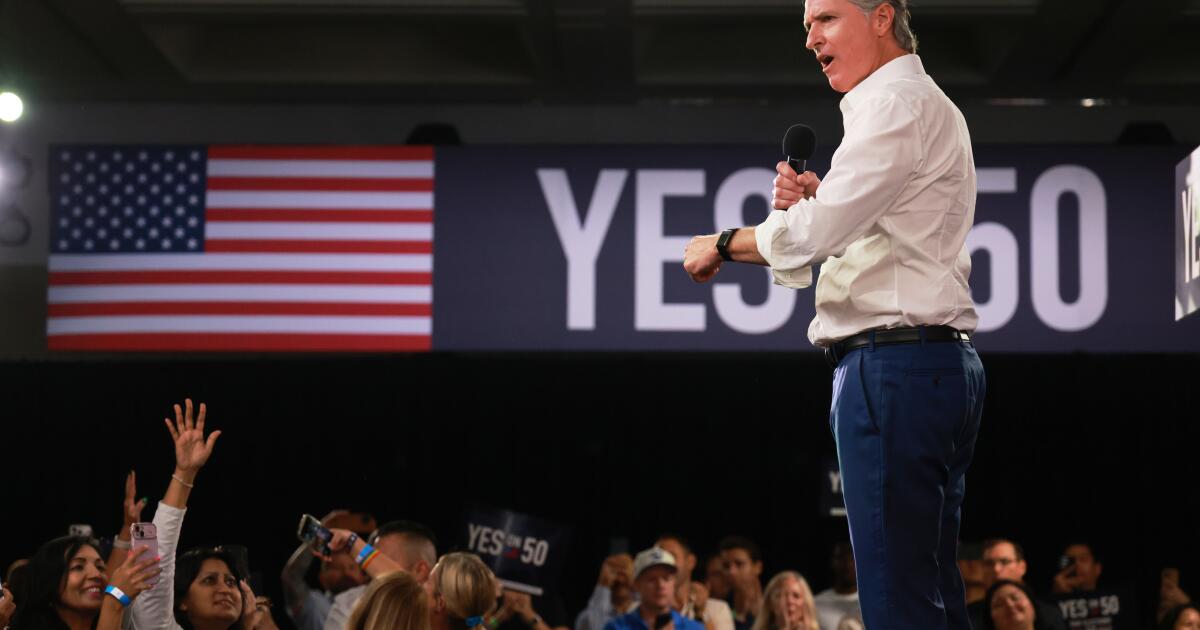
Gov. Gavin Newsom proposed re-drawing the state’s 52 congressional districts to “fight back against Trump’s power grab in Texas.”
He said that if Texas was going to redraw its districts to benefit Republicans so as to keep control of the House of Representatives, California should do the same to benefit Democrats.
The voters approved the change in November.
While the new map has five more Democratic-leaning districts, the state’s attorneys said it did not increase the number with a Latino majority.
“Before Proposition 50, there were 16 Latino-majority districts. After Proposition 50, there is the same number. The average Latino share of the voting-age population also declined in those 16 districts,” they wrote.
It would be “strange for California to undertake a mid-decade restricting effort with the predominant purpose of benefiting Latino voters and then enact a new map that contains an identical number of Latino-majority districts,” they said.
Trump’s lawyers pointed to the 13th Congressional District in Merced County and said its lines were drawn to benefit Latinos.
The state’s attorneys said that too was incorrect. “The Latino voting-age population [in District 13] decreased after Proposition 50’s enactment,” they said.
Three judges in Los Angeles heard evidence from both sides and upheld the new map in a 2-1 decision.
“We find that the evidence of any racial motivation driving redistricting is exceptionally weak, while the evidence of partisan motivations is overwhelming,” said U.S. District Judges Josephine Staton and Wesley Hsu.
In the past, the Supreme Court has said the Constitution does not bar state lawmakers from drawing election districts for political or partisan reasons, but it does forbid doing so based on the race of the voters.
In December, the court ruled for Texas Republicans and overturned a 2-1 decision that had blocked the use of its new election map.
The court’s conservatives agreed with Texas lawmakers who said they acted out of partisan motives, not with the aim of denying representation to Latino and Black voters.
“The impetus for the adoption of the Texas map (like the map subsequently adopted in California) was partisan advantage pure and simple,” Justice Samuel A. Alito Jr. wrote in a concurring opinion.
California’s lawyers quoted Alito in supporting their map.