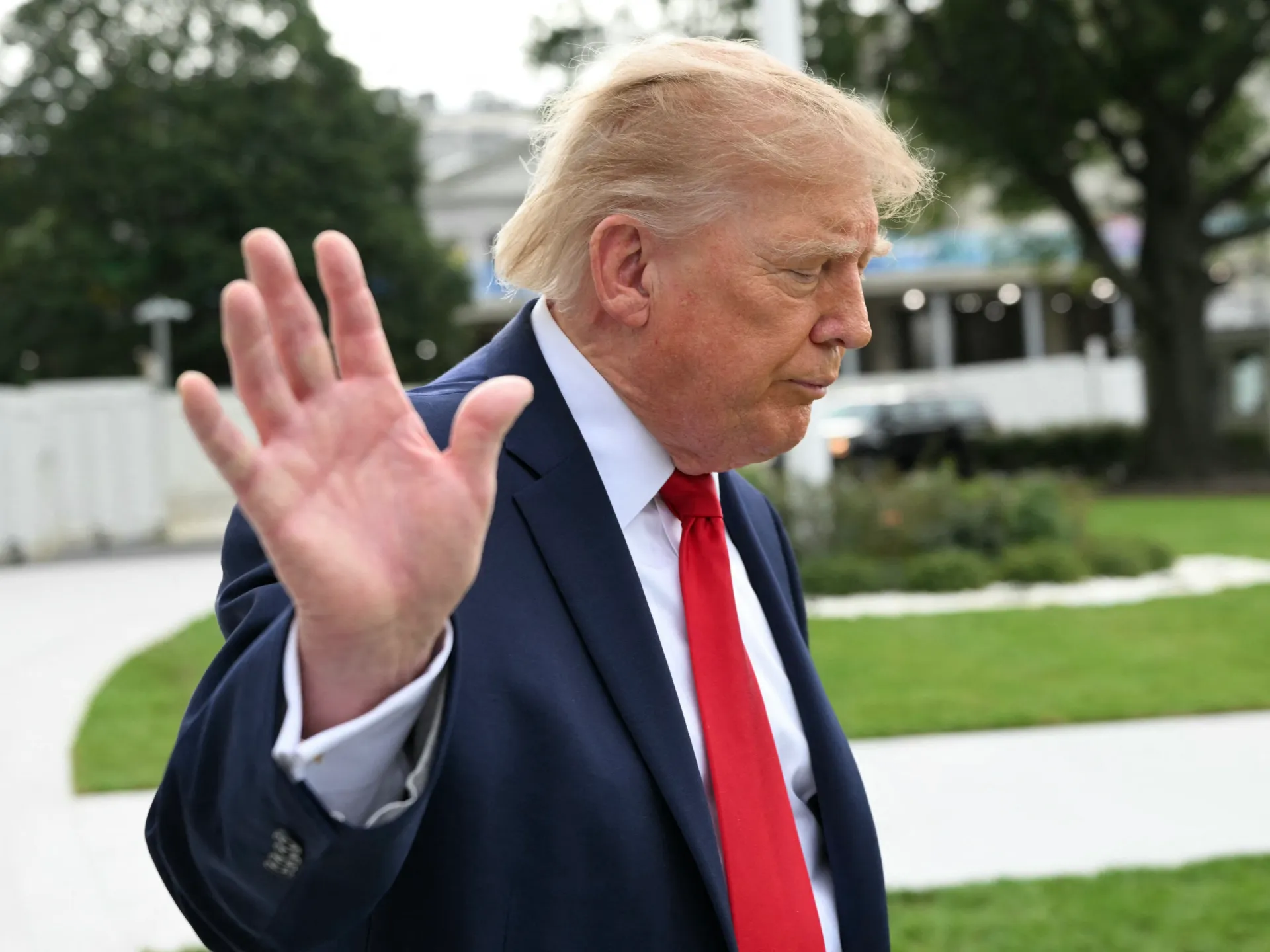
Trump says Tehran did not make satisfactory offer after Iranian foreign minister travelled to Pakistan to present a framework to mediators to end the war.
Judges say Trump’s order for swift removal at the border ‘cast aside federal laws affording’ right to seek asylum.
Published On 24 Apr 202624 Apr 2026
An appeals court has ruled that President Donald Trump’s ban on asylum applications in the United States is unlawful, dealing a setback to the administration’s immigration crackdown.
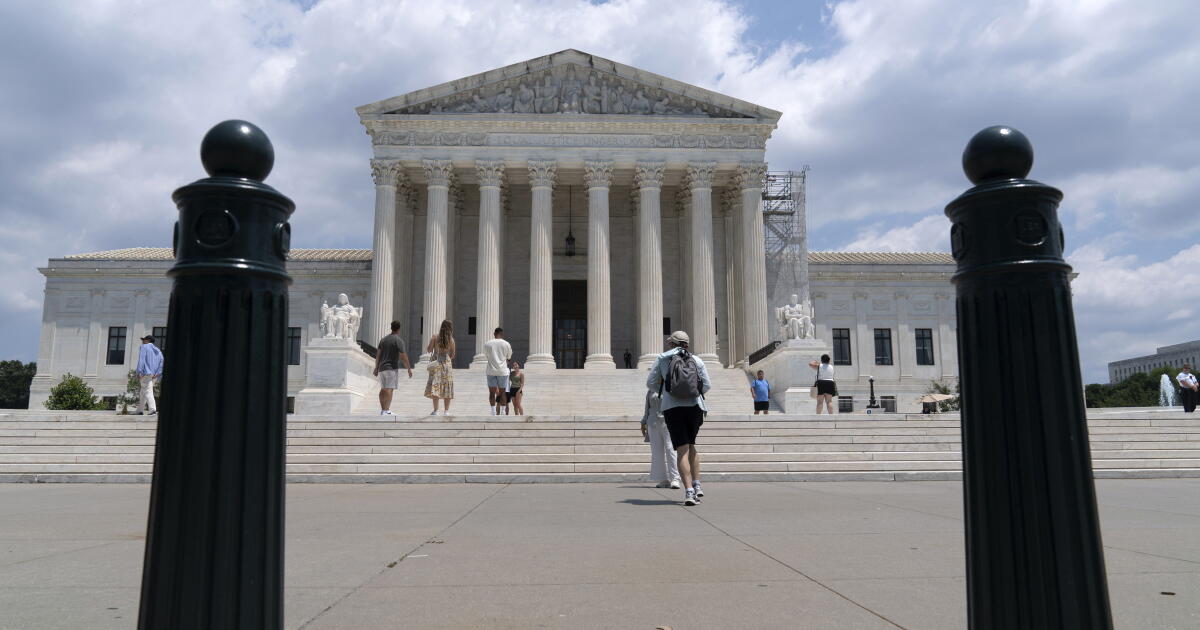
In a decision released on Friday, a three-judge panel from the US Court of Appeals in Washington, DC, found that existing laws — namely the Immigration and Nationality Act (INA) — give people the right to apply for asylum at the border.
Recommended Stories
list of 3 itemsend of list
Trump had issued the asylum ban in a proclamation on January 20, 2025, on the first day of his second term.
But the appeals court questioned whether suspending asylum unilaterally was within the president’s power.
“Congress did not intend to grant the Executive the expansive removal authority it asserts,” the ruling said.
“The Proclamation and Guidance are thus unlawful to the extent that they circumvent the INA’s removal procedures and cast aside federal laws affording individuals the right to apply and be considered for asylum or withholding of removal protections.”
The decision validated a ruling by a lower court. While the judges blocked Trump’s order, it is unclear what its immediate impact will be. Already, the White House has signalled it plans to appeal.
Trump made immigration a major pillar of his 2024 re-election campaign, pledging to repel what he describes as an “invasion” of migrants by shutting down the southern border of the US.
Asylum in the US can be granted to people facing “persecution based on race, religion, nationality, political opinion, or membership in a particular social group”. Such protections have been recognised as a fundamental human right under international law.
But unauthorised border crossings reached record levels during the administration of President Joe Biden, which had itself imposed asylum restrictions.
Millions of migrants — many suffering from gang violence and political persecution in Central and South America — have claimed asylum upon reaching the US.
Nearly 945,000 filed for asylum in 2023, according to the Department of Homeland Security.
In his January 2025 decree, Trump suspended “the physical entry of aliens involved in an invasion into the United States across the southern border”.
The proclamation was quickly challenged in court, as other measures in Trump’s immigration crackdown have been.
But the appeals court panel concluded that the INA does not authorise the president to remove the plaintiffs under “procedures of his own making”.
Nor does it allow him to suspend the plaintiffs’ right to apply for asylum or curtail procedures for adjudicating claims of torture and persecution.
“The power by proclamation to temporarily suspend the entry of specified foreign individuals into the United States does not contain implicit authority to override the INA’s mandatory process to summarily remove foreign individuals,” wrote Judge J Michelle Childs, a Biden appointee.
The Trump administration will likely appeal the ruling to the full appellate court and subsequently to the Supreme Court.
The White House stressed after the court’s decision that banning asylum is part of Trump’s constitutional powers as commander-in-chief.
“We have liberal judges across the country who are acting against this president for political purposes. They are not acting as true litigators of the law. They are looking at these cases from a political lens,” White House spokesperson Karoline Leavitt told reporters.
Hybe Chairman Bang Si-hyuk speaks to reporters as he arrives at the Seoul Metropolitan Police Agency on Sept. 15, 2025, for questioning over unfair stock trading allegations. File Photo by Yonhap
Prosecutors said Friday they have rejected a police request for an arrest warrant for Bang Si-hyuk, chairman and founder of K-pop powerhouse Hybe, who is accused of unfair stock trading, citing insufficient evidence.
The Seoul Southern District Prosecutors’ Office sent back to the police the arrest warrant request filed against Bang earlier this week on charges of fraudulent unfair trading under the Capital Markets Act.
The chief was suspected of deceiving investors in 2019 into selling their shares in Hybe before the company held an initial public offering (IPO), through which he allegedly pocketed about 260 billion won (US$175.28 million) in illegal profits.
“At this stage, there is insufficient evidence to justify the necessity of detention, and we have therefore requested a supplementary investigation,” the prosecution said.
The act prohibits obtaining financial gains through false statements or by using deceptive schemes in connection with financial investment products, such as unlisted shares. Violations involving profits exceeding 5 billion won are punishable by life imprisonment or a minimum of five years behind bars.
Bang has denied the allegation, saying the IPO had followed the law and regulations.
Police first received a tip-off on the allegations in late 2024 and raided the Korea Exchange and Hybe’s headquarters the following year as part of the probe. Bang was banned in August from leaving the country, leading to various restrictions on his activities.
The U.S. Embassy in Seoul recently sent a letter to the police agency asking that it allow him to travel to the United States to take part in K-pop supergroup BTS‘ world tour.
Copyright (c) Yonhap News Agency prohibits its content from being redistributed or reprinted without consent, and forbids the content from being learned and used by artificial intelligence systems.
Kevin Warsh, the man nominated to lead the Federal Reserve, the world’s most important financial institution, told the US Senate Banking Committee on Tuesday that he had made no secret agreements with the White House over interest rate policy, defending his professional integrity.
ADVERTISEMENT
ADVERTISEMENT
He said he would act independently if confirmed to succeed Jerome Powell, despite continued public pressure from US President Donald Trump for lower borrowing costs.
The question of that independence was put sharply to him during the hearing, when Republican Senator John Kennedy asked whether he would be Trump’s “human sock puppet”. Warsh replied: “Absolutely not.”
His comments came amid broader concerns on Capitol Hill about the future direction of the central bank, with lawmakers divided over his past record and approach to monetary policy.
Warsh insisted that the President had never asked him to commit to any specific interest rate path and said he would not have agreed to such a request.
The hearing highlighted the significant pressure facing the Federal Reserve as it maintains its independence while addressing inflation, which remains at 3.3%.
Just hours before the session began, US President Donald Trump stated in a CNBC interview that he would be disappointed if Warsh did not immediately implement rate cuts.
This current friction suggests that the White House may struggle to secure the necessary votes to confirm Warsh before Powell’s term as Fed Chair expires on 15 May.
Democratic opposition and Republican dissent
Democratic senators were particularly vocal in their scepticism, accusing Warsh of shifting his economic stance to suit the political climate.
US Senator Elizabeth Warren labelled the nominee a “sock puppet”, suggesting his installation would facilitate an “illegal takeover” of the institution.
Critics also pointed to his historical record, alleging that he favoured higher rates during Democratic administrations but has become more dovish under Republican leadership.
US Senator Ruben Gallego cited reporting from the Wall Street Journal (WSJ), which claimed the President had previously urged Warsh to reduce borrowing costs. Warsh responded by stating that such reports were based on inaccurate sources and reiterated that the independence of the Fed is “essential” for economic stability.
Despite Trump’s backing, the nomination also faces a critical roadblock within the Republican Party.
US Senator Thom Tillis, a Republican from North Carolina, reiterated his refusal to support Warsh as long as a Department of Justice investigation into Jerome Powell continues.
The probe, led by Assistant US Attorney Jeannine Pirro, is examining whether Powell committed perjury during testimony last year regarding the budget of a Federal Reserve building renovation project.
Tillis and other Republican colleagues have expressed their support for Powell, arguing that the investigation is meritless. According to Tillis, he will not vote for a successor until the “investigation is dropped,” a stance that effectively freezes the nomination in a closely divided committee.
Federal prosecutors have reportedly continued their efforts to access Fed records as recently as last week, even after a judge previously found no evidence to support the charges.
Legal and ethical hurdles
The proceedings also delved into Warsh’s personal financial interests and the logistical challenges of a potential leadership transition.
US Senator Elizabeth Warren raised questions about the nominee’s investments in private entities, including SpaceX and Polymarket, noting that the specific size of these holdings had not been fully disclosed to the public.
Warsh defended his position by stating that the Office of Government Ethics has already approved his plan to divest all assets within 90 days of his confirmation.
Compounding the uncertainty is the unique situation involving Jerome Powell.
Unlike most departing Chairs, Powell has indicated he intends to remain on the Federal Reserve’s governing board until his separate term ends in 2028, or until the perjury investigation is concluded.
This could create an awkward power dynamic where the former Chair sits alongside his successor, a scenario not seen in Washington since the late 1940s.
While US President Donald Trump has threatened to remove Powell from the board entirely, legal experts suggest such a move would be difficult, particularly given recent US Supreme Court precedents relating to the protection of Fed governors from political dismissal.
Additionally, it said the applications, “through a wholly-owned and financed government club”, were part of an “aim of facilitating transfers of allegiance and enabling those athletes to represent Turkey at future international competitions, including the Los Angeles 2028 Olympic Games”.
It added: “Given the common features across the applications, the panel assessed them together and determined that such an approach is inconsistent with the core principles of the regulations.
“As a result of the decisions, the athletes are not eligible to represent Turkey in national representative competitions or other relevant international events.”
The other athletes were Catherine Relin Amanang’ole, Brian Kibor, Ronald Kwemoi and Nelvin Jepkemboi from Kenya, Jamaica’s Rajindra Campbell, Jaydon Hibbert and Wayne Pinnock plus Nigeria’s Favour Ofili and Russian Sophia Yakushina.
A dispute has emerged between Kenya and the United Nations over allegations of sexual exploitation and abuse linked to a UN backed security mission in Haiti. The force, largely composed of Kenyan police officers, was deployed in June 2024 to stabilise a country where armed gangs control much of the capital.
A UN report, based on findings from its Human Rights Office, concluded that four allegations of abuse were substantiated. Kenya has formally rejected these findings, asserting that its own internal investigation found no evidence to support the claims. This divergence has opened a deeper debate over credibility, jurisdiction, and the persistent problem of accountability in international interventions.
Conflicting Investigative Authority
At the core of the dispute lies a fundamental question: who has the authority to determine truth and accountability in multinational missions. The United Nations, through its human rights mechanisms, operates as an external oversight body, positioning itself as impartial and norm driven. Kenya, by contrast, asserts sovereign control over its personnel, emphasising that its internal inquiry was independent and shared with relevant stakeholders.
This clash reflects a structural ambiguity built into international peace operations. While missions are authorised or supported by the UN, enforcement power over individual personnel remains with contributing states. As a result, accountability mechanisms are fragmented, allowing for conflicting conclusions such as those seen in this case.
Historical Context and Institutional Credibility
The controversy is intensified by Haiti’s history with international peacekeeping missions, particularly the MINUSTAH deployment between 2004 and 2017. That mission was marred by widespread allegations of sexual exploitation and abuse, many involving vulnerable populations, including children. Despite the scale of accusations, prosecutions were rare, largely dependent on the willingness of troop contributing countries to act.
This legacy casts a long shadow over current operations. Allegations, whether proven or disputed, are not assessed in isolation but through a lens of accumulated mistrust. The UN therefore faces pressure to demonstrate that oversight mechanisms have improved, while Kenya is equally motivated to avoid reputational damage associated with past failures of the peacekeeping system.
Power, Reputation, and Strategic Stakes
Kenya’s firm rejection of the UN findings is not only a legal position but also a political one. As the primary contributor to the mission, Nairobi has invested significant diplomatic capital in presenting itself as a stabilising force in Haiti. Accepting the UN’s conclusions would risk undermining both domestic legitimacy and international standing.
For the United Nations, the stakes are similarly high. Its credibility as a guarantor of human rights depends on its willingness to investigate and publicly report abuses, even when doing so creates friction with member states. Backing down or appearing inconsistent would weaken its already challenged authority in overseeing multinational operations.
Victims and the Accountability Gap
Amid institutional disagreement, the position of alleged victims becomes increasingly precarious. When investigative bodies reach opposing conclusions, the likelihood of justice diminishes. The reliance on troop contributing countries to prosecute their own personnel has historically resulted in limited accountability, reinforcing perceptions of impunity.
This gap is not merely procedural but systemic. Without a unified mechanism for enforcement, findings risk becoming symbolic rather than consequential. The repetition of such disputes suggests that structural reforms within the peacekeeping system remain incomplete.
Implications
The dispute signals potential strain in cooperation between Kenya and the United Nations at a critical moment for the Haiti mission. Operational effectiveness may be affected if trust between the UN and its primary personnel contributor erodes. At the same time, the controversy could deter other countries from participating in similar missions, given the reputational risks involved.
More broadly, the case highlights enduring contradictions in international peace operations. The system depends on state contributions but lacks full authority over them, creating a persistent tension between sovereignty and accountability.
Analysis
This episode underscores a recurring paradox in global governance. The United Nations is tasked with upholding universal norms, yet it relies on sovereign states that retain ultimate control over their agents. When allegations of abuse arise, this division of authority becomes a fault line.
Kenya’s rejection of the UN findings is therefore not an anomaly but an expression of this structural tension. Both sides are operating within their respective logics: the UN prioritising normative legitimacy, and Kenya defending sovereign jurisdiction and institutional credibility.
The result is not simply disagreement over facts but a deeper contest over who defines accountability in international interventions. Until this question is resolved, similar disputes are likely to recur, particularly in high risk environments where oversight is most needed and most difficult to enforce.
Weekly insights and analysis on the latest developments in military technology, strategy, and foreign policy.
Iran has rejected a ceasefire proposal from the United States, but says it sees a need for a permanent end to the war, its official news agency has reported. As of Monday, the United States and Iran were considering a framework aimed at ending their five-week conflict, as Tehran stressed its desire for a durable resolution and resisted pressure to quickly reopen the Strait of Hormuz under a temporary ceasefire.
According to the official IRNA news agency, Iran delivered its response to the U.S. proposal via Pakistan, rejecting the idea of a ceasefire and underscoring the need for a permanent conclusion to the war.
The response outlined 10 provisions, including ending regional hostilities, lifting sanctions, and supporting reconstruction efforts, IRNA reported.
According to a report from Axios that cites “four U.S., Israeli, and regional sources with knowledge of the talks,” the two-tier plan was to start with a 45-day ceasefire, planned to lead into a longer-term peace deal.
A senior Iranian official confirmed to the Reuters news agency that Tehran had received the ceasefire plan from Pakistan.
April 6 (Reuters) – Iran and the U.S. have received a plan to end hostilities that could come into effect on Monday and reopen the Strait of Hormuz, a source aware of the proposals said on Monday.
A framework to end hostilities has been put together by Pakistan and exchanged…
Pakistan has been playing a leading role in negotiations, with its Army chief, Field Marshal Asim Munir, reportedly in contact throughout the night with U.S. Vice President JD Vance, special envoy Steve Witkoff, and Iranian Foreign Minister Abbas Araqchi.
Pakistan’s army chief, Field Marshal Asim Munir, was in contact “all night long” with U.S. Vice President JD Vance, special envoy Steve Witkoff and Iranian Foreign Minister Abbas Araqchi, a source told Reuters.
One major sticking point appears to be Iran’s refusal to reopen the Strait of Hormuz in exchange for a “temporary ceasefire.” Around a fifth of the world’s oil supply usually passes through the strait, which Iran has effectively blocked.
The same Iranian official told Reuters that the United States is not ready for a permanent ceasefire. Tehran will not be pressured into accepting deadlines and making a decision, the official added.
Iran and the United States have received a plan to end hostilities that could come into effect on April 6 and reopen the Strait of Hormuz, a source aware of the proposals said https://t.co/i98nhEFDcr
Over the weekend, U.S. President Donald Trump threatened to obliterate Iranian power plants and bridges if it doesn’t agree to fully reopen the Strait of Hormuz by 8:00 p.m. Tuesday (U.S. Eastern Time). “If they don’t come through, if they want to keep it closed, they’re going to lose every power plant and every other plant they have in the whole country,” Trump said in an eight-minute interview with The Wall Street Journal on Sunday.
Today, Trump reiterated that the Tuesday deadline is final.
(Reuters) – U.S. President Donald Trump said on Monday the Tuesday deadline he has set for Iran to make a deal is final, adding that Iran’s proposal was significant but not good enough.
Trump also issued an expletive-laden warning on his Truth Social website: “Tuesday will be Power Plant Day, and Bridge Day, all wrapped up in one, in Iran. There will be nothing like it!!! Open the Fuckin’ Strait, you crazy bastards, or you’ll be living in Hell – JUST WATCH! Praise be to Allah. President DONALD J. TRUMP.”
Trump reiterates his demands to Iran: “Open the Fuckin’ Strait, you crazy bastards, or you’ll be living in Hell” pic.twitter.com/aZb8sSjGBU
Iran’s parliament speaker responded with a warning that the US president’s “reckless moves” would mean “our whole region is going to burn”.
Iran’s deputy foreign minister said that those threats could amount to war crimes. “The American president, as the highest official of his country, has publicly threatened to commit war crimes,” Kazem Gharibabadi said on X, citing provisions of international law.
“The threat to attack power plants and bridges (civilian infrastructure) is a war crime under Article 8(2)(b) of the Rome Statute of the International Criminal Court,” he said, cited by AFP. Gharibabadi also warned that Iran would “deliver a decisive, immediate and regret-inducing response to any aggression or imminent threat.”
Iran has itself attacked civilian infrastructure on the Arabian Peninsula, including desalination plants critical to providing water to people living there.
Iran’s parliamentary speaker, Mohammad Baqer Qalibaf, condemned Trump’s threats and argued that he was being misled by Israel’s Prime Minister Benjamin Netanyahu. “Your reckless moves are dragging the United States into a living HELL for every single family, and our whole region is going to burn because you insist on following Netanyahu’s commands,” Qalibaf posted on X.
Iran’s central military command also responded to the latest threats, promising “much more devastating” retaliation if the U.S. military starts to hit civilian targets.
According to Barak Ravid, global affairs correspondent for Axios, the 45-day ceasefire is “one of many more ideas” being discussed.
🚨🇺🇸🇮🇷A White House official told me the plan for a 45-day ceasefire between the U.S. and Iran is “one of many ideas” being discussed at the moment. “The President has not signed off on it. Operation Epic Fury continues. President Trump will speak more at 1pm”, the White House… https://t.co/gKzZ30ZMaL
Author’s note: We will be updating our readers on what we know about the F-15E WSO recovery in a separate piece.
UPDATE: 4:15 PM EDT –
A recent post on X by the U.S. Central Command shows U.S. Marines preparing an example of the M142 High Mobility Artillery Rocket System (HIMARS) during Operation Epic Fury.
UPDATE: 4:10 PM EDT –
Reutersreports that four Iranian army ground force officers were killed on Sunday during an operation to counter U.S. aircraft in Isfahan, citing the semi-official Fars news agency. It is unclear if this is connected to the F-15E WSO recovery operation, which was taking place in the same region at that time.
Four officers of the Iranian army’s ground forces were killed during clashes with US aircraft in the central Isfahan province on Sunday, the state-affiliated Fars news agency reports, saying they died while engaging attacking warplanes, helicopters and drones. pic.twitter.com/l46hpCwyKr
Temporary markings in the form of Easter eggs appeared on the nose of this U.S. Air Force U-2S spy plane, seen departing RAF Fairford, in England, for a mission this morning.
U.S. Secretary of War Pete Hegseth says the United States will step up its strikes on Iran under Trump’s orders.
“Per the president’s direction, today will be the largest volume of strikes since day one of this operation. Tomorrow, even more than today. And then Iran has a choice.”
UPDATE: 3:40 PM EDT –
Trump today repeated his familiar assertions about the success of the war and the performance of the U.S. military (it has performed “unbelievably well,” he said), while also praising the “very historic” rescue of the second crew member from the Air Force F-15E shot down over Iran last week.
Shifting to his latest deadline for Tehran to reopen the Strait of Hormuz (8:00 p.m. ET on Tuesday), he added:
“The entire country can be taken out in one night, and that night might be tomorrow night.”
Trump warned that if Iran failed to meet his deadline, it would be left with “no bridges” and “no power plants,” saying the country would be reduced to “the Stone Ages,” reiterating his previous threat to send Iran “back to the Stone Ages.”
He later reinforced that warning, saying strikes on Iran’s bridges and power plants could begin from 8:00 p.m. ET tomorrow and suggesting the operation could be completed in as little as four hours.
“Every power plant in Iran will be out of business, burning, exploding, and never to be used again … I mean complete demolition by 12 o’clock. And it will happen over a period of four hours if we wanted to. We don’t want that to happen.”
.@POTUS: “We have a plan, because of the power of our military, where every bridge in Iran will be decimated by 12 o’clock tomorrow night, where every power plant in Iran will be out of business…it’ll happen over a period of 4hrs if we want it to. We don’t want that to happen.” pic.twitter.com/965HCIV9HB
— Rapid Response 47 (@RapidResponse47) April 6, 2026
UPDATE: 3:45 PM EDT –
In a surprising disclosure, Trump today suggested that Washington armed (Kurdish) Iranian opposition groups during the January demonstrations.
Trump:
We sent some guns; they were supposed to go to the people of Iran. You know what happened? The people we sent them through kept them.
I am very upset with a certain group of people, and they will pay a big price for that. pic.twitter.com/dACg5aZyMS
“President Trump told me the United States sent guns to the Iranian protesters,” Trump told Trey Yingst on the Fox News channel.
“He told me, ‘We sent them a lot of guns. We sent them to the Kurds.’ And the president says he thinks the Kurds kept them. He went on to say. ‘We sent guns to the protesters, a lot of them.’”
As well as lending credence to Iran’s claims that the protests were foreign-inspired, the disclosure would appear to put Kurds in an even more dangerous position. For their part, Kurdish groups have denied the claims.
This puts Kurds in such a dangerous position, particularly with the threat at the end. (Kurdish groups have denied Trump’s claims.) Yesterday, a lot of people blamed the journalist who reported Trump’s comments, hard to do that in this case. https://t.co/Wz6ogQbnCf
Trump today implied that the widening rift between the United States and NATO began when he floated the idea of taking over Greenland.
“It all began with, if you want to know the truth, Greenland. We want Greenland. They don’t want to give it to us. And I said, ‘bye, bye.’”
He made the comments ahead of a scheduled visit to the White House later this week by NATO Secretary-General Mark Rutte — whom Trump, for what it’s worth, describes as a “wonderful guy” and a “great person.”
“NATO is a paper tiger. We didn’t need them, obviously, because they haven’t helped at all.”
Trump on NATO:
It all began with Greenland. We want Greenland, and they don’t want to give it to us, and I said, “Bye-bye!” pic.twitter.com/Jhp0izwfht
Earlier today, U.S.-Israeli strikes killed the intelligence chief of Iran’s Revolutionary Guards, according to Iran’s Islamic Revolutionary Guard Corps (IRGC).
“Major General Majid Khademi, the powerful and educated head of the Intelligence Organisation of the Islamic Revolutionary Guard Corps, was martyred in the criminal terrorist attack by the American-Zionist enemy… at dawn today,” said the Guards in a post on their Telegram channel.
BREAKING: Majid Khademi, the head of the Iranian Revolutionary Guards’ Intelligence Organisation, has been killed, according to state media. pic.twitter.com/NaMHbNx6Hm
The IDF has continued airstrikes against Iranian targets, including further attacks on Mehrabad International Airport in Tehran, a major hub for commercial flights, which is also used by the government of Iran, and is one of the bases of the Islamic Republic of Iran Air Force (IRIAF). A video released by the IDF shows multiple Mi-8/17 Hip-series helicopters being targeted on the ground at Mehrabad. The IDF claims that “dozens” of aircraft were hit.
The IDF says it destroyed dozens of Iranian aircraft during strikes on three airports in the Tehran area overnight.
According to the military, the strikes were aimed at causing a blow to the Iranian air force and IRGC air force.
— Emanuel (Mannie) Fabian (@manniefabian) April 6, 2026
U.S. forces located on Bubiyan Island, Kuwait, were targeted by Iran, Ebrahim Zolfaghari, the spokesperson of Iran’s Khatam al-Anbiya Central Headquarters, said in a video statement shared by state media on Monday. Bubiyan is the largest of Kuwait’s coastal island chain, located in the northwest of the Gulf. Zolfaghari said that Iran targeted satellite equipment and munitions on the island with drones, adding that U.S. forces had relocated there from Arifjan camp in Kuwait after that base was repeatedly struck by Iran.
BREAKING: Iran targeted US forces relocated on Kuwait’s Bubiyan island, the spokesperson for Iran’s Khatam al-Anbiya Central Headquarters Ebrahim Zolfaghari said in a video statement shared by state media. pic.twitter.com/GLwEkjLJFX
Israeli rescue teams were searching through debris on Monday for two people still missing after a missile strike in the northern city of Haifa, authorities said. The projectile, reportedly launched from Iran, hit a residential building, killing two people.
Officials said the direct impact on the seven-storey structure caused severe damage, leaving parts of it partially collapsed. Videos showed rescuers combing through the rubble with flashlights, navigating broken concrete and debris as the search continued.
“We have a major destruction site,” said Elad Edri, chief of staff of Israel’s home front command. Israel’s fire and rescue services said later that two of four people trapped under the rubble had been found dead.
A senior Home Front Command search and rescue officer describes the 18-hour effort to recover the four bodies at the site of an Iranian ballistic missile impact in Haifa as one of the “most complex” rescue operations of the war.
— Emanuel (Mannie) Fabian (@manniefabian) April 6, 2026
The International Atomic Energy Agency (IAEA) has warned that strikes near Iran’s Bushehr nuclear power plant pose a serious risk to nuclear safety and must cease.
Located in the country’s south, the facility, which is home to a 1,000-megawatt reactor, has reportedly been targeted four times since the start of the latest conflict.
Rafael Grossi, director of the IAEA, said that any strikes around the area “could cause a severe radiological accident with harmful consequences for people and the environment in Iran and beyond.” He added that one strike hit just 250 feet from the plant perimeter. “A nuclear facility and surrounding areas should never be struck,” he said.
The International Atomic Energy Agency said it can confirm recent impacts of military strikes close to Iran’s Bushehr nuclear power plant, but said that the plant itself was not damaged https://t.co/REx5AQ76kr
Israel has struck a major petrochemical facility at Iran’s massive South Pars natural gas field, according to multiple news agencies.
Israel’s defence minister, Israel Katz, confirmed what he described as “a powerful strike on the largest petrochemical facility in Iran,” which accounts for roughly half of the country’s petrochemical output. Meanwhile, Israeli military spokesperson Lt. Col. Nadav Shoshani said there would be “no immunity” for Iran as negotiations continue.
Israeli Defense Minister Israel Katz:
The IDF forcefully struck Iran’s largest petrochemical plant. This key facility accounts for about 50% of Iran’s petrochemical output. This follows an attack on Iran’s second-largest facility last week.
Katz’s remarks followed an earlier report from the FarsNews Agencystating that “several explosions” were heard at the South Pars petrochemical complex in Asaluyeh.
The development raises doubts about ongoing efforts to secure a ceasefire between the United States and Iran. The field, which Iran shares with Qatar, is the largest natural gas reserve in the world and lies beneath the Persian Gulf. The latest strikes come just weeks after widespread international criticism of Israel’s March 18 attack on the same South Pars gas field.
Airstrikes hit petrochemical facilities at Iran’s South Pars gas field a short while ago, Iranian state media reports.
The Fars news agency says there was an “enemy attack” on “South Pars Petrochemical in Asaluyeh.”
Israel bombed gas infrastructure in the area last month.
— Emanuel (Mannie) Fabian (@manniefabian) April 6, 2026
Iran widened its attacks on Gulf energy infrastructure over the weekend, carrying out drone and missile strikes on petrochemical sites in Kuwait, Bahrain, and the United Arab Emirates. The Revolutionary Guards also said they had targeted an Israeli-linked vessel at Dubai’s Jebel Ali port.
BREAKING: Iran’s IRGC has claimed it fired a missile at an Israel-linked ship in a channel leading to Dubai’s Port of Jebel Ali, causing it to catch fire.
There was no immediate confirmation from Emirati authorities.
Authorities in the emirate of Sharjah said on Sunday that they were responding to an incident involving Khor Fakkan Port, one of the United Arab Emirates’ largest container hubs. No injuries were reported, and officials provided no additional details in a statement released by the Sharjah media office.
Earlier, the United Kingdom Maritime Trade Operations (UKMTO) reported that the captain of a container ship at the port had observed several splashes from unidentified projectiles landing close to the vessel.
A container ship at the UAE’s Khor Fakkan Port reported several projectiles were fell in the water near the ship while conducting loading operations, UKMTO reports. pic.twitter.com/HvvWGUCA7Q
— Ariel Oseran أريئل أوسيران (@ariel_oseran) April 5, 2026
An Indian-flagged, Japan-owned tanker has crossed the Strait of Hormuz. A spokeswoman for Mitsui O.S.K. Lines told AFP that the Green Asha, owned by its subsidiary, had passed through the strait and was en route to India. The vessel, a liquefied petroleum gas tanker, is the third Japan-linked ship to transit the strait. “Both the crew and the cargo are safe,” the spokeswoman said.
Two more Indian-flagged liquefied petroleum gas tankers, Green Asha and Green Sanvi, have exited the Gulf carrying the fuel for the South Asian nation, according to ship tracking data on LSEG and Kpler.https://t.co/DDCq4ZWgwh
North Korea appears to be stepping back from its longstanding ties with Iran and is carefully shaping its public messaging to keep open the possibility of improved relations with the United States after the Iran conflict, South Korean lawmakers told Reuters on Monday, citing intelligence officials.
North Korea appears to be distancing itself from longtime partner Iran and carefully managing its public messaging to preserve the possibility of a new relationship with the US after the Iran war, South Korean lawmakers said, citing the spy agency https://t.co/0Ju5su12yR
There are unconfirmed reports, based on publicly available flight-tracking data, that a U.S. Air Force F-35 fighter flying in an area in southern Iraq, close to the Kuwaiti border, has squawked 7700. This is the universal, international transponder code used by aircraft to immediately alert Air Traffic Control (ATC) of a general emergency.
A U.S. Air Force F-35A Lightning II declared an emergency while flying over Iraq about two hours ago, squawking 7700.
That code is the universal signal for a general in-flight emergency, indicating the crew is dealing with a serious situation. pic.twitter.com/qa4Dh54JTo
While we had previously seen Iranian satellite imagery that purported to show the extent of the Iranian attack on Prince Sultan Air Base in Saudi Arabia that occurred on March 27, the destruction of an aircraft maintenance shelter now appears to have been verified by commercially available Sentinel-2L imagery. The attack also destroyed a prized E-3 Sentry Airborne Warning and Control System (AWACS) as well as damaging other aircraft and injuring several American service members, as you can read more about here.
Iranian satellite imagery has once again been confirmed as authentic.
Sentinel-2L imagery confirms the destruction of the Large Area Maintenance Shelter (LAMS) used by U.S. forces at Prince Sultan Air Base in Saudi Arabia, likely as a result of an Iranian attack that occurred… https://t.co/VFQXcho2UNpic.twitter.com/B1RLeyvZom
An IDF spokesperson disclosed recently that an Iranian underground complex used for storing ballistic missiles had been targeted.
Based on open-source intelligence, this appears to have been a relatively new and sizable missile base, constructed within the past two years along the Tehran–Qazvin road. It features at least five large access points designed for missile transporters and launch systems.
It also seems that the site was put into operation before construction was fully completed.
לפני מספר ימים, דובר צה”ל חושף כי הותקף מתחם אחסון תת-קרקעי לטילים בליסטיים.
מדובר בבסיס טילים חדש וגדול שנבנה ממש בשנתיים האחרונות על כביש טהראן-קזוין. המתחם כולל לא פחות מחמישה פתחים רחבים עבור מובילי טילים ומשגרים. אין הרבה תשתיות עיליות בשטח, מה שאומר שהאיראנים פעלו בשנים… pic.twitter.com/rzZtWj6fFF
— Ben Tzion Macales (@BenTzionMacales) April 6, 2026
In recent days, imagery has emerged showing the reported aftermath of an Iranian drone strike on Camp Buehring in Kuwait, which appears to have destroyed at least one U.S. Army CH-47F Chinook helicopter.
Further signs of an attack on Camp Buehring are provided by infrared imagery from the NASA FIRMS portal.
More evidence has emerged of the use of cluster bombs in U.S. airstrikes on Iran. Last week, photos appeared showing Israeli Air Force F-16I Sufa fighters apparently carrying cluster munitions. Now, U.S. Air Force F-16s have also been photographed with cluster bomb units underwing. The kinds of submunitions that might be inside remain unknown. However, Iranian officials previously accused the United States of employing air-dropped BLU-91/B anti-tank mines, which are delivered via cluster bomb. This seems most likely to be part of a limited-use area denial strategy to contain long-range missile launches, as you can read about in our previous reporting here.
Armed with cluster bombs, a U.S. Air Force F-16 flies over the U.S. Central Command area of responsibility, April 2, 2026. U.S. Air Force photo U.S. Central Command Public Affa
Russia’s intelligence agency accuses the second secretary at the British Embassy in Moscow of espionage.
Published On 30 Mar 202630 Mar 2026
Russia’s Federal Security Service (FSB) has ordered a British diplomat to leave the country within two weeks over allegations of economic espionage, which the United Kingdom rejected as “unacceptable” amid tensions over Russia’s war on Ukraine.
The FSB, the main successor to the Soviet-era KGB, on Monday said its counterintelligence officers had expelled Albertus Gerhardus Janse van Rensburg, the second secretary at the British Embassy in Moscow.
Recommended Stories
list of 3 itemsend of list
“The FSB uncovered signs that the diplomat was carrying out intelligence and subversive activities that threaten the security of the Russian Federation,” the agency said.
It added that the diplomat had attempted to “obtain sensitive information during informal meetings with Russian experts in the field of economics”.
“In order to avoid negative consequences, including criminal liability, the FSB of Russia recommends that compatriots refrain from holding meetings with British diplomats,” it said.
The Russian Ministry of Foreign Affairs said it had delivered a protest to Britain’s charge d’affaires over the alleged spy.
The British Foreign Office responded by saying that Russia’s accusations against its diplomats were “completely unacceptable” and that it would not tolerate “intimidation” of its embassy staff or their families.
Russia-UK discord
Russia has claimed British intelligence launched espionage activities at a level unseen since the depths of the Cold War to sow discord within the country, and it has long complained that its own diplomats are routinely harassed in key Western capitals.
The UK, which supports Ukraine with money and weapons, sees Russia as its biggest immediate threat and accuses its intelligence of mounting cyberattacks, killings and sabotage campaigns across the Western world.
Since Russia launched its full-scale military invasion of Ukraine on February 24, 2022, Russian authorities have sought to suppress opposition to the war while aiming to rally support for the war among Russian citizens.
Last week, Russia declared the teacher and main protagonist of the Oscar-winning documentary Mr Nobody Against Putin a “foreign agent“. Pavel Talankin spent two years documenting pro-war propaganda at a school in the Chelyabinsk region in west-central Russia while working as the school’s videographer.
“No negotiations have taken place.” Iran’s foreign minister, Abbas Araghchi says his country is not and will not negotiate with the US while it is under attack. A day earlier, President Trump said the US was already in talks with Iranian officials, which Tehran denied.
The proposals request that Iran must “commit never to pursue nuclear weapons“, pledge to dismantle nuclear facilities and to hand over the enriched amounts of uranium it possesses to the International Atomic Energy Agency (IAEA), the UN nuclear watchdog, which is to monitor the issue going forward.
The 2026 World Cup matches will be played as per schedule announced last year, the football organisation says.
Published On 17 Mar 202617 Mar 2026
The world’s top football organisation, FIFA, has said the 2026 World Cup matches will take place per the schedule announced last year, shutting down Iran’s hopes of having its matches moved from the United States to Mexico due to the ongoing US-Israeli war on Iran.
“FIFA is in regular contact with all participating member associations, including Iran, to discuss planning for the FIFA World Cup 2026,” the organisation’s statement said. “FIFA is looking forward to all participating teams competing as per the match schedule announced on 6 December 2025.”
Recommended Stories
list of 3 itemsend of list
Following the outbreak of the war on February 28, Iran’s participation in the games has been cast in doubt.
Last week, US President Donald Trump said Iran was welcome to come to his country for its matches, but added: “I really don’t believe it is appropriate that they be there, for their own life and safety.”
In response to Trump’s comments, Iran’s football team said in a post on social media that “no one can exclude Iran’s national team from the World Cup”.
More recently, on Monday, Iranian football chief Mehdi Taj said on social media that “when Trump has explicitly stated that he cannot ensure the security of the Iranian national team, we will certainly not travel to America”.
“We are currently negotiating with FIFA to hold Iran’s matches in the World Cup in Mexico,” Taj said.
Iran’s Ambassador to Mexico Abolfazl Pasandideh also condemned on Monday Washington’s “lack of cooperation regarding visa issuance and the provisions of logistical support” for the Iranian delegation.
The 2026 World Cup is set to be played in three countries for the first time ever: the US, Mexico and Canada.
The first game is scheduled for June 11, and will be played between South Africa and Mexico.
But when asked if Mexico could host Iran’s games, Mexican President Claudia Sheinbaum said on Tuesday that the country was prepared to host its first-round matches.
“Mexico maintains diplomatic relations with every country in the world, therefore, we will wait to see what FIFA decides,” Sheinbaum said.
Iran was the second Asian team, after Japan, to qualify for the World Cup, securing its place almost a year ago after topping its qualifying group.
They are currently scheduled to play New Zealand and Belgium in Los Angeles, and Egypt in Seattle.
Irish rapper Liam O’Hanna welcomes ruling in case he says was ‘never about any threat to the public, never about terrorism’.
Published On 11 Mar 202611 Mar 2026
Share
British prosecutors have lost an appeal seeking to reinstate a “terrorism” charge against a member of Irish rap group Kneecap accused of waving a Hezbollah flag during a gig in London.
London’s High Court on Wednesday rejected prosecutors’ attempts to challenge a lower court’s decision to throw out the case against Liam O’Hanna in September due to a technical error.
Recommended Stories
list of 3 itemsend of list
The decision means the case will not proceed. In a statement, the Crown Prosecution Service said the High Court had “clarified how the law applies” to such cases and that it accepted “the judgement and will update our processes accordingly”.
O’Hanna – also known as Liam Og O hAnnaid (his name in Gaeilge, the Irish language) and by the stage name Mo Chara (“My Friend”) – was charged in May of last year with displaying a Hezbollah flag during a November 2024 concert in London, in violation of the United Kingdom’s 2000 Terrorism Act.
Kneecap’s members – who rap in Gaeilge and English and have been outspoken in their condemnation of Israel’s genocide against Palestinians in the Gaza Strip – have called the attempted prosecution a “British state witch-hunt”.
Liam O’Hanna (Liam Og O hAnnaid) welcomed the ruling during a news conference in Belfast, Northern Ireland [Charles McQuillan/Getty Images]
O’Hanna welcomed the ruling on Wednesday, saying during a news conference in Belfast that the case was “never about me, never about any threat to the public and never about terrorism”.
“It was always about Palestine, about what happens if you dare to speak up, about what happens if you can reach large groups of people and expose their hypocrisy, about the lengths Britain will go to cover up Israeli and US war crimes,” he said.
Cheered by supporters at the event, O’Hanna was joined by Kneecap bandmates JJ O Dochartaigh and Naoise O Caireallain – better known by their respective stage names, DJ Provai and Moglai Bap.
“Your own High Court ruled against you,” O’Hanna added, addressing the UK government.
“The pathetic thing about this whole process is that you falsely tried to label me a terrorist when it is the British government ministers that are arming and assisting a genocide in Gaza, the destruction of Lebanon, and the senseless slaughter of schoolkids in Iran.”
Frustrated players say they were left in the dark for days over their travel while England flew out within two days.
Published On 11 Mar 202611 Mar 2026
Share
Cricket’s governing body has rejected suggestions of unequal treatment after the West Indies and South Africa squads were stranded in India for more than a week following their exit from the T20 World Cup, while England flew out in less than two days.
The International Cricket Council (ICC) has been accused of giving preferential treatment to one team over the other two amid the travel chaos resulting from airspace closures and rerouted flights because of the war in the Middle East.
Recommended Stories
list of 3 itemsend of list
However, the ICC said on Wednesday it “rejects any suggestion that these decisions have been driven by anything other than safety, feasibility and welfare”.
“We understand that players, coaches, support staff and their families who have completed their ICC Men’s T20 World Cup 2026 campaigns are anxious to return home,” it said in a statement.
Cricket West Indies said on Tuesday its squad had waited nine days for a charter flight that was “repeatedly delayed”, calling the uncertainty “increasingly distressing”.
West Indies players were leaving India on commercial flights in batches 10 days after their scheduled departure, which led to frustrated players airing their thoughts in social media posts.
The ICC said nine West Indies players and staff members were already travelling to the Caribbean, with the remaining 16 booked on flights departing India within 24 hours.
Indian media reported that a charter flight for the West Indies and South Africa Twenty20 World Cup teams scheduled to fly to Johannesburg before continuing on to Antigua was cancelled earlier on Tuesday.
Meanwhile, South Africa, who have been stranded in India since March 4, will begin to fly home on Wednesday, with the entire contingent departing in the next 36 hours, the ICC said.
England flew home less than two days after being beaten in the semifinals, prompting criticism of the ICC from the South African and West Indian camps.
Darren Sammy, head coach of West Indies, began venting his frustration on social media on the fifth day since his team’s exit from the T20 World Cup.
“I just wanna go home,” he wrote on X, followed by another tweet requesting an update after being left in the dark for five days.
Three days after South Africa were knocked out, in the first semifinal, their players Quinton De Kock and David Miller said the team had heard nothing from the ICC regarding their departure while England, who were eliminated a day later in the second semifinal had already left.
“England are leaving before us somehow?! Strange how different teams have more pull than others,” De Kock wrote in an Instagram story.
Miller, commenting on a post announcing England’s departure, said: “It doesn’t take the ICC long to organise England charter. WI have been waiting for 7 days for a charter and SA coming on 4 days now. And yet we still wait.”
The ICC said the criticism was “incorrect” and that there was no comparison between arrangements for South Africa and the West Indies and those made for England, “which arose from separate circumstances, routing options and different travel conditions”.
“Throughout this period, the ICC’s overriding priority has been the safety and welfare of everyone affected,” the sport’s global governing body said.
“We will not move people until we are satisfied that the travel solution in place is safe, and that commitment will not change.”