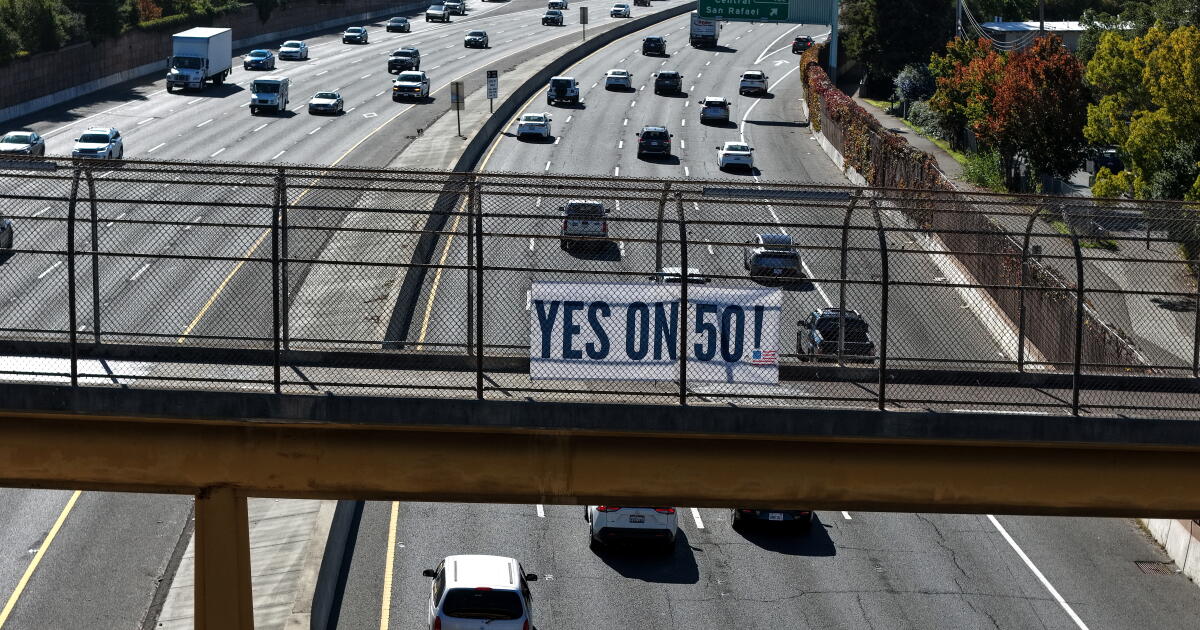
GOP

Louisiana congressional primaries are suspended as a result of Supreme Court ruling

Louisiana’s congressional primaries won’t be going forward as scheduled in May, as a result of a U.S. Supreme Court ruling that struck down a majority-Black congressional district, the state’s top elected officials said Thursday.

Gov. Jeff Landry and Atty. Gen. Liz Murrill, both Republicans, said in a joint statement that Wednesday’s high court ruling effectively prohibits the state from carrying out the primaries under the current districts. Early voting had been scheduled to begin Saturday in advance of the May 16 primary.

“The State is currently enjoined from carrying out congressional elections under the current map,” Landry and Murrill said in the statement posted to social media. “We are working together with the Legislature and the Secretary of State’s office to develop a path forward.”

That path is likely to lead to a new U.S. House map benefiting Republican candidates in Louisiana.

President Trump, in a series of social media posts Thursday, praised Landry for moving quickly to revise the state’s congressional districts and urged Republican Tennessee Gov. Bill Lee to do likewise in light of the Supreme Court’s decision.

While civil rights activists denounced the potential for diminished minority representation in Congress, top Republicans cited the Supreme Court’s decision as justification to spur an already intense national redistricting battle among states before the November elections.

“I think all states who have unconstitutional maps should look at that very carefully, and I think they should do it before the midterm,” House Speaker Mike Johnson told reporters in Washington.

Questions persist about election postponement

Louisiana’s election suspension was denounced by some Democrats and questioned by some legal experts.

“This is going to cause mass confusion among voters — Democrats, Republicans, white, Black, everybody,” said Louisiana state Sen. Royce Duplessis, a Democrat who represents the New Orleans area. “What they’re effectively doing is changing the rules of the game in the middle of the game. It’s rigging the system.”

Although Louisiana officials may legally be able to move the primary, it’s not accurate to assert that it was blocked by the Supreme Court’s decision, said Ruth Greenwood, director of the Election Law Clinic at Harvard Law School.

State Rep. Kyle Green, a former assistant state attorney general who is chair of the House Democratic caucus, also cast doubt on the legal justification for postponing the congressional primary.

“The Court’s decision does not halt the election process on its own,” Green said. “And any attempt to suspend or disrupt an ongoing election at this stage would raise serious constitutional concerns.”

Delaying an election is unusual but not unprecedented.

During the onset of the COVID-19 pandemic in 2020, several states pushed back elections because of health concerns. Democratic Gov. John Bel Edwards, who led Louisiana at the time, postponed Louisiana’s April 4 presidential primary three weeks before it was supposed to occur — then delayed it again until July 11.

Louisiana could join a national redistricting wave

Louisiana currently is represented in the U.S. House by four Republicans and two Democrats. A revised map could give Republicans a chance to pick up at least one more seat in the November midterms — adding to Republican gains elsewhere from redistricting.

Voting districts typically are redrawn once a decade, after each census. But Trump last year urged Texas Republicans to redraw House districts to give the GOP an edge in the midterms. California Democrats reciprocated, and redistricting efforts soon cascaded across states.

On Wednesday, Florida became the latest state to redraw its U.S. House districts, adopting a new map backed by Republican Gov. Ron DeSantis that could give the GOP a chance at winning several additional seats.

The Florida vote occurred just hours after the U.S. Supreme Court’s conservative majority issued a ruling that significantly weakened minority protections under the federal Voting Rights Act. The court said Louisiana officials had relied too heavily on race when drawing a congressional district that is represented by Democrat Cleo Fields.

Trump wants Tennessee to also take up redistricting in response to the court’s ruling. The president posted on social media that he had spoken with Lee, who he said would work hard for a new map that could help Republicans gain an additional seat. Democrats currently hold only one of the state’s nine House seats — a district centered in Memphis, which is majority-Black.

Tennessee House Speaker Cameron Sexton, a Republican, said he is in conversations with the White House and others while reviewing the court’s decision.

Louisiana has a history of redistricting challenges

After the 2020 census, Louisiana officials had drawn House voting district boundaries that maintained one Black-majority district and five mostly white districts, in a state with a population that is about one-third Black.

A federal judge later struck down the map for violating the Voting Rights Act. And the following year the Supreme Court found that Alabama had to create its own second majority-Black congressional district.

In response, Louisiana’s Legislature and governor adopted a new House map in 2024 that created a second Black-majority district. But that map also was subsequently challenged in court, leading to the most recent Supreme Court ruling.

After the ruling, Landry called U.S. House candidates on Wednesday and told them that primaries would probably be stalled, according to Misti Cordell, a Republican running in a crowded race to fill U.S. Rep. Julia Letlow’s vacated seat.

“It’s an inconvenience for a candidate for sure, but you know they want to do it right versus having to go through all this again,” Cordell said. She added that she appreciated the heads-up before she and other candidates began “spending their war chest” during the final weeks leading up to election day.

Republican state lawmakers are reviewing which pending bills could be used to alter primaries and reconfigure congressional maps, said Louisiana state Rep. Beau Beaullieu, chair of the House committee overseeing redistricting efforts.

Cline, Brook and Lieb write for the Associated Press. Brook reported from New Orleans and Lieb reported from Jefferson City, Mo. AP reporter Travis Loller contributed to this report from Nashville.

Source link

‘Earthquake’: Supreme Court limits Voting Rights Act in setback for Black Democrats, boost for GOP

The Supreme Court’s conservative majority on Wednesday sharply limited a part of the Voting Rights Act that has forced states to draw voting districts to help elect Black or Latino representatives to Congress as well as state and local boards.

In a 6-3 decision in Louisiana vs. Callais, the court ruled that creating these majority-minority districts may amount to racial discrimination that violates the 14th Amendment.

When weighing what the Voting Rights Act requires, “we start with the general rule that the Constitution almost never permits the federal government or a state to discriminate on the basis of race,” Justice Samuel A. Alito Jr. wrote for the court.

Alito said states may draw election districts for partisan advantage but may not use race as a basis for redistricting.

The ruling in a Louisiana case appears to clear the way for Republican-led states across the South to redraw their election maps and eliminate voting districts that favor Black or Latino candidates for Congress, state legislatures and county boards.

UCLA law professor Rick Hasen said, “It is hard to overstate what an earthquake this will be for American politics,” adding that the decision makes the Voting Rights Act a “much weaker, and potentially toothless law.”

Hasen said it’s unclear how the decision will affect the November election because in many states early voting has already started and primaries have already taken place.

But the ruling’s long-term consequences for minority representation in Congress, state legislatures and local government are almost “certainly” going to be felt in 2028, Hasen said.

Republican leaders in states across the South have already signaled they intend to move quickly to redraw congressional maps in the wake of the ruling.

Alabama Atty. Gen. Steve Marshall said the state will “act as quickly as possible” to ensure its congressional maps “reflect the will of the people, not a racial quota system the Constitution forbids.” Marshall called the decision a recognition of how much the South has changed since the civil rights era.

“The court rightly acknowledged that the South has made extraordinary progress, and that laws designed for a different era do not reflect the present reality,” he said in a statement.

Florida was already in motion before the ruling came down. But Gov. Ron DeSantis celebrated the decision and said it was all the more reason for state lawmakers to redraw its congressional maps, in a manner that could give Republicans up to four more seats in Congress.

The proposed congressional maps, drawn by DeSantis’ office, were first unveiled to Fox News on Monday. On Wednesday, both chambers approved the maps, and readied them for DeSantis’ final approval.

In Mississippi, Gov. Tate Reeves had already called lawmakers into a special session at the end of May in anticipation of a court ruling on the Voting Rights Act. In a post on X, Reeves underscored the ideological underpinnings to the ruling’s potential implications.

“First Dobbs. Now Callais. Just Mississippi and Louisiana down here saving our country!” Reeves wrote.

Sen. Raphael Warnock of Georgia speaks outside the Capitol.

Sen. Raphael Warnock (D-Ga.) speaks at a news conference outside the U.S. Capitol after the Supreme Court ruling.

(Tom Williams / CQ-Roll Call / Getty Images)

At issue was how to ensure equal representation for Black and Latino citizens.

About one-third of Louisiana’s voters are Black, but the state seeks an election map that will elect white Republicans to five of its six seats in the House of Representatives.

Lower courts said that map violated the Voting Rights Act because it denied fair representation to Black residents.

The state had one Black-majority district, in New Orleans.

Two years ago, judges upheld the creation of a second Black-majority district that stretched from Shreveport to Baton Rouge on the grounds that it was required under the law.

The state’s Republican leaders appealed and argued that race was the motivating factor in drawing the second district.

Alito and the conservatives agreed and called that district an “unconstitutional racial gerrymander.”

The three liberals dissented. The consequences of the ruling “are likely to be far-reaching and grave,” said Justice Elena Kagan, adding that it will allow “racial vote dilution in its most classic form.”

She said the decision means “a state can, without legal consequence, systematically dilute minority citizens’ voting power. Of course, the majority does not announce today’s holding that way. Its opinion is understated, even antiseptic.”

But she said states across the South may draw electoral districts that deprive Black voters of equal representation. Justices Sonia Sotomayor and Ketanji Brown Jackson agreed.

The decision was the latest example of a partisan political dispute in which the court’s six Republican appointees vote in favor of the Republican state plan, while the three Democratic appointees dissent.

The ruling is likely to have its greatest impact in the Southern states, where white Republicans are in control and Black Democrats are in the minority.

The court’s divide over redistricting is similar to the long dispute over affirmative action.

For decades, university officials said they needed to consider the race of applicants to achieve diversity and equal representation.

But in 2023, the court by a 6-3 vote struck down college affirmative action policies at Harvard and the University of North Carolina and ruled race may not be used to judge applicants.

The historic Voting Rights Act of 1965 succeeded in clearing the way for Black citizens to register and vote across the South, but it took longer for Black candidates to win elections.

The dispute was highlighted in a 1980 case from Mobile, Ala. Its three commissioners were elected to six-year terms, and each of them ran countywide.

Even though one-third of the county’s voters were Black, white candidates always won.

The Supreme Court upheld this arrangement as legal and constitutional. In dissent, Justice Thurgood Marshall said Black residents were left with the right to cast meaningless ballots.

In response, Congress amended the Voting Rights Act in 1982 to say states must give minorities an opportunity to elect representatives of their choice.

Four years later, the Supreme Court interpreted that to mean that states had a duty to draw voting districts that would elect a Black or Latino candidate if these minorities had a sufficiently large number of voters in a particular area.

In recent years, the court’s conservatives, led by Justice Clarence Thomas, have chafed at the rule on the grounds it sometimes required states to use race as a factor for drawing election districts.

Alito’s opinion adopted that view and said states are not required or permitted to use race as a basis for drawing districts.

Hours after the ruling came out, President Trump met with reporters in the Oval Office and said he had not yet seen the decision. He was visibly excited, however, when a reporter explained the decision favored Republicans.

“I love it!” he said. “This is very good.”

Former President Obama said in a statement that the court’s decision “effectively guts a key pillar of the Voting Rights Act, freeing state legislatures to gerrymander legislative districts to systematically dilute and weaken the voting power of racial minorities — so long as they do it under the guise of ‘partisanship’ rather than explicit racial bias.”

The Mexican American Legal Defense and Educational Fund, in Los Angeles, also denounced the decision.

“The Supreme Court’s decision blesses racially discriminatory gerrymandering, and dismantles the legal protections for minority voters,” said Nina Perales, the group’s vice president for litigation. It “openly invites states to dilute minority voting strength, and undermines our democracy.”

Source link

Analysis: Trump loomed over midterms and GOP suffered for it

The protracted uncertainty over control of Congress reverberated through both major political parties on Wednesday, as Democrats basked in the relief of the red wave that wasn’t and Republicans became increasingly clear-eyed that the lingering influence of former President Trump had hamstrung their party.

President Biden’s emphasis during the campaign season on the extremism of “MAGA Republicans” had been greeted skeptically by many. In the Democratic Party’s better-than-expected showing, though, he saw vindication of his appeals for civility and normalcy.

“This election season, American people made it clear: They don’t want every day going forward to be a constant political battle,” Biden said at a White House news conference. “The future of America is too promising to be trapped in endless political warfare.”

Amid high inflation and Biden’s lackluster approval numbers, Democrats’ hopes had hinged on voters being more put off by Trump’s imprint on the Republican Party — be it the divisive candidates he endorsed, the political violence that festered from his lies about election fraud, or the reversal of federal abortion protections made possible by justices he appointed to the Supreme Court.

“We knew going into the cycle that there was going to be an opportunity to rally a moral majority that is an anti-MAGA coalition,” said Tory Gavito, president of Way to Win, a progressive donor network. “When I say that, I include everyone from [GOP Rep.] Liz Cheney to [democratic socialist Sen.] Bernie Sanders. Think about that spectrum of the middle to the left coming together to say Republicans are just too damn extreme.”

If recent history is any guide, Trump’s not going anywhere. The once and likely future presidential candidate is unpopular, but he continues to exercise outsized sway over the Republican base, and could hobble the party for the next two years and beyond.

“While in certain ways yesterday’s election was somewhat disappointing, from my personal standpoint it was a very big victory,” Trump said on his conservative social media network, Truth Social, pointing to the record of candidates he endorsed. “219 WINS and 16 Losses in the General – Who has ever done better than that?”

The specter of the former president hampered the GOP’s ability to frame the midterm as a referendum on Biden, said Ken Spain, a GOP strategist and former spokesman for the party’s House campaign arm.

“Trump was always a looming shadow over this election, more than Republicans probably wanted to admit,” he said. “This essentially became a choice election between an unpopular president and an even more unpopular Trump.”

There were signs that patience was running thin among Republican power brokers. Notably, Trump’s much-beloved New York Post, the tabloid owned by conservative media magnate Rupert Murdoch, featured Florida Gov. Ron DeSantis on its cover Wednesday with the headline “DeFuture.” DeSantis is widely considered Trump’s biggest threat for the 2024 GOP presidential nomination.

Republicans still had a chance of winning both chambers of Congress as vote-counting continued Wednesday. House Minority Leader Kevin McCarthy (R-Bakersfield) projected confidence that his party would win the five additional seats necessary to take the majority there, and announced his intention to run for speaker of the House.

Whether he secures a majority may come down to his home state. California’s 11 competitive races remained unsettled as of Wednesday evening, with results trickling in slowly, as is common with the state’s methodical ballot-counting procedures.

Republicans had targeted incumbent Democratic Reps. Katie Porter and Mike Levin in Orange County, as well as an open seat in the Central Valley, as possible pick-ups. But Democrats were also watching the returns for the potential to oust vulnerable GOP Reps. David Valadao of Hanford and Ken Calvert of Corona.

Republican Sen. Ron Johnson of Wisconsin notched a close win over Democratic challenger Mandela Barnes, giving Republicans a 49-48 advantage in the Senate, with races in Georgia, Arizona and Nevada yet to be decided.

With neither candidate in Georgia winning more than 50% of the vote, the race will go to a Dec. 6 runoff, like the one that decided Senate control in 2020. A 50-50 split in the Senate would let Democrats maintain control with Vice President Kamala Harris’ tiebreaking vote.

Republicans made some successful pushes into blue territory; in New York, for example, they appeared likely to win four Democratic-held House seats. Rep. Sean Patrick Maloney, a New York Democrat who led his party’s efforts to keep the House, conceded his own race Wednesday morning to Mike Lawler, a Republican state assemblyman.

Still, the night was distinctly underwhelming for a party that contemplated a blowout win in the House and an assured majority in the Senate.

“Definitely not a Republican wave, that’s for darn sure,” Sen. Lindsey Graham (R-S.C.) said Tuesday night on NBC as he predicted a narrow win for Republicans in the Senate.

Paradoxically, a small Republican majority in the House would likely give Trump more leverage there, as McCarthy would have to depend on continued support from acolytes of the former president, such as Rep. Marjorie Taylor Greene, to exercise the GOP’s majority power.

Biden, speaking at the White House on Wednesday, said he had not had much occasion to interact with McCarthy but planned to talk with him later in the day. The president promised to work with Republicans in Congress, but noted pointedly that the American people had also sent the message that they wanted the GOP to show similar cooperation.

The president was happy to point out that his party had defied expectations, noting that “while the press and the pundits [were] predicting a giant red wave, it didn’t happen.”

National exit polls gave a glimpse into why Republicans fizzled. The surveys showed inflation was a top concern among voters. But abortion ranked second. That, and the relative weakness of Trump-backed candidates, helped Democrats stay in the fight.

Many voters appeared willing to swallow their disappointment with Biden. An NBC exit poll showed Democrats narrowly winning — 49% to 45% — among voters who “somewhat disapprove” of Biden’s performance.

Results in Michigan underscored the extent of the Republican Party’s disappointments. Democratic Gov. Gretchen Whitmer, whom Trump had attacked relentlessly, defeated his endorsed candidate, Tudor Dixon, and Democratic incumbents held on to the state’s attorney general and secretary of state posts and gained control of the Legislature as well.

The GOP failed to oust Rep. Elissa Slotkin, a vulnerable Democrat in a Michigan swing district that barely backed Biden two years ago. Elsewhere in the state, a Trump-backed candidate — who in the primary beat Rep. Peter Meijer, a Republican who had voted to impeach the former president — lost in the general election, costing Republicans a seat in the surprisingly tight battle for control of the House.

Michigan voters also approved a ballot measure striking down a 1931 ban on abortion, and voters in Kentucky rejected an initiative that would have amended the state constitution to make clear it did not protect abortion rights.

The Republicans’ loss of a Senate seat in Pennsylvania could prove the most consequential if Democrats keep the chamber. Lt. Gov. John Fetterman defeated Mehmet Oz, a television doctor and first-time candidate backed by Trump. Fetterman, still recovering from a stroke, painted the untested Oz as an elite carpetbagger.

Many of the gubernatorial candidates Trump backed also lost or were in danger of losing as of Wednesday afternoon. DeSantis’ double-digit win in Florida, as well as his strong coattails for Republicans in the House, served as a stark contrast. But Trump has said he will run again even if party leaders prefer DeSantis. Opinion polls, at least for now, show the former president as the prohibitive favorite to capture the party’s nomination.

Jason Miller, an advisor to Trump, told the BBC on Wednesday morning that he was urging Trump to postpone an announcement that he will run again from next week — as he has been teasing — to December, to avoid distracting from a potential Senate runoff in Georgia. But Miller said he remained 100% certain that Trump would run.

“Many of the people who are championing Ron DeSantis for president are the same people who were skeptical of President Trump ever since he came down the escalator in 2015,” Miller said, recalling Trump’s improbable announcement for the 2016 race.

Miller predicted that Trump would “have his hands full” but would ultimately win the nomination again.

Mason reported from Los Angeles and Bierman from Washington. Times staff writer Erin B. Logan contributed to this report from Washington.


Source link

Here’s how the GOP could scheme to keep control of the House

For Democrats or, for that matter, anyone who believes in checks and balances, things are starting to look up.

President Trump’s days of untrammeled war-making, law-breaking and generally doing whatever he damn well pleases may finally be drawing to a close. Public opinion, history and, especially, the surging price of gasoline and groceries, all point to a Democratic takeover of the House in November’s midterm election.

There’s a direct correlation between a president’s approval rating and the way his party performs at the midpoint of his term. Anything below 50% favorability portends political trouble; right now Trump’s positive standing in polls hovers around a dismal 40%.

Then there’s the history part. Since World War II, the party out of the White House has gained an average of more than two dozen House seats in midterm elections. Democrats need to pick up just three to take control beginning in January.

(While the Republican grip on the Senate seems weaker than just a few months ago, the GOP is still favored to hang onto the chamber in November.)

There is, however, a looming threat causing nervousness among Democrats and their allies as they contemplate a celebratory fall, a landmine of sorts buried deep in the congressional election process.

Let’s acquaint ourselves with Article 1, Section 5 of the Constitution.

The pertinent language written by the Framers states, “Each House shall be the Judge of the Elections, Returns and Qualifications of its own Members.” In other words, it’s up to the House and Senate to acknowledge and abide by the will of voters as expressed in the election returns.

What could possibly go wrong?

Well, if you let your paranoia run wild, quite a lot. If the election outcome is close — and probably it would have to be very close — Republican lawmakers could theoretically seize on phony claims of fraud and effectively nullify the results of enough contests to deny Democrats control of the House.

There’s plenty of skepticism that would or could ever take place. But if it were to happen, hello, national crisis!

Normally, we could count on the occupant of the White House to humbly submit to the election returns, even if it’s a “shellacking” as President Obama called his walloping in the 2010 midterm election, or a “thumpin’ ” as President George W. Bush described his electoral spanking in 2006.

Not Trump.

This president has amply demonstrated the lengths to which he’ll go to overturn an honest election, siccing a violent mob on lawmakers certifying his 2020 defeat, telling endless lies and using the Justice Department to confiscate ballots and intimidate innocent election officials and others Trump deems his enemies.

He strong-armed Texas into a highly unusual, highly partisan redrawing of its congressional boundaries, an effort to net five seats and lengthen the odds against a Democratic takeover.

The move appears to have backfired, spurring voters in California and, last week, Virginia to redraw their state’s political maps to more than offset Texas and boost Democrats in November. (The Virginia results are being contested in court.)

A gathering of Virginia voters in front of television screens

Voters attend an Arlington Democrats redistricting vote watch party during a special election Tuesday in Virginia. A measure to redraw the state’s congressional map was narrowly approved.

(Valerie Plesch/Bloomberg via Getty Images)

That failure doesn’t take away Trump’s malign intent. And in the supine Speaker Mike Johnson, he has the perfect handmaiden to undermine the midterm vote.

In 2020, Johnson was the lead author of a Supreme Court brief seeking to overturn the results in four states that Joe Biden had indisputably won. That speaks to Johnson’s probity and integrity.

How would subversion of November’s election take place?

One theory goes like this: When the balloting is over, Johnson could appoint a House committee packed with Trump’s acolytes to investigate alleged voting irregularities. (And if you think Trump won’t be bellowing the words “rigged” and “fraud” in the face of defeat, you’ve either been in a coma or living on another planet for the last decade.)

Those hearings and the “evidence” they turn up could then be cited by election officials in key states — collaborators, if you will — as a reason to delay the certification of election results and block the seating of majority-making Democrats in the next Congress. In their place, the theory goes, Republicans could vote to fill those seats with GOP candidates who lost at the polls, keeping themselves in control.

Derek Muller, an election law expert, suggests that scenario is little more than a fever dream of doomsday devotees and overly nervous Nellies.

He said he’d be very surprised if all the election results weren’t certified by Jan. 3, when the new Congress convenes, given the legal remedies available to prevent stalling and undue delay. And, Muller said, there is no assurance Republicans would march in lockstep behind a plan to prevent the seating of Democrats.

Thwarting a duly elected Democratic majority “involves extraordinary coordination and precedents that have never occurred, with a unique convergence of factors,” said Muller, who teaches law at Notre Dame — though, he added, if control of the House came down to, say, a single seat “all bets are off.”

Far-fetched? Perhaps. Some of the spun-up theories surrounding November’s election do sound a bit like a product of political science fiction.

But what kind of president picks a fight with the pope? Plunges the world into crisis by unilaterally going to war with Iran with no exit plan? Demolishes the East Wing of the White House on an egotistical whim?

If Trump, an inveterate norm-buster, sees a way to keep his grip on unchecked power, don’t put anything past him.

Source link

GOP Renews Drive to Drill in Arctic Wildlife Refuge

As President Bush was out promoting his stalled plan to allow drilling in an Alaskan wildlife refuge, the leader of a Senate committee said Wednesday that he would try a new strategy to navigate the proposal through Congress.

Senate Budget Committee Chairman Judd Gregg (R-N.H.) said he would add into a budget bill a measure to allow companies to drill for oil and gas in Alaska’s Arctic National Wildlife Refuge.

Because Senate rules treat the budget measure differently from other legislation, successfully attaching the drilling provision to it means it could pass with support from 51 senators. That would end opponents’ chances to block the drilling measure with a filibuster. A filibuster would force supporters to find 60 votes.

In 2003, Senate Democrats and several Republicans blocked a proposal for drilling in the refuge by a vote of 52 to 48. The GOP has gained four seats in the Senate since then, giving them 55.

Traveling to Ohio, Bush toured a technology development institute and made his first major speech on energy in his second term, calling on Congress to adopt his energy policy.

“We have had four years of debate about a national energy bill,” Bush said. “Now is the time to get the job done.”

The president called for greater reliance on coal and nuclear power, as well as for greater efforts at conservation and the modernization of the energy infrastructure. He said the U.S. could achieve all of that while remaining a good steward of the environment.

The energy bill before Congress includes a number of politically popular features, such as requiring greater use of ethanol, an alternative fuel made from corn. It also has measures that supporters say would strengthen the nation’s electric grids and prevent fuel shortages and price spikes, such as those that occurred during California’s electricity crisis in 2000 and 2001.

Bush’s speech comes at a time when gas prices have been rising — to an average of nearly $2 per gallon nationwide as of Monday, according to Energy Department figures. Retail prices on average are 26 cents higher than at this time last year. Prices in California are nearly $2.23 on average.

The president said that “higher prices at the gas pump and rising home heating bills and the possibility of blackout are legitimate concerns for all Americans. And all these uncertainties about energy supply are a drag on our economy…. To meet America’s energy needs in the 21st century, we need a comprehensive national energy policy.”

White House Press Secretary Scott McClellan told reporters that Bush remained opposed to tapping the Strategic Petroleum Reserve as a way to increase supply and cut prices. Some Democrats have called for releasing oil from the reserve, which they say could be replaced after prices decline.

Speaking about plans to drill in the Arctic refuge, Bush said the Department of Energy believed the effort would yield 10 billion barrels from “a small corner” of the reserve — “just 2,000 acres,” or roughly the size of the airport here in Ohio’s capital. By using innovative techniques, he said, such development would have “almost no impact” on the land or local wildlife.

He noted that no nuclear power plant had been ordered since the 1970s, and declared: “It’s time to start building again,” adding that decades of experience and advances had proven the reliability and security of nuclear power.

Bush, whose environmental policies have been condemned by groups such as the Sierra Club, renewed his push for energy legislation just as Congress was preparing to take up one of his most controversial initiatives: opening a portion of the Arctic National Wildlife Refuge to oil and gas exploration.

“The votes are extremely close,” Senate Minority Leader Harry Reid (D-Nev.) said. He called Gregg’s maneuver to attach the drilling approval to the budget bill an aberration of the budget process.

By contrast, Sen. Pete V. Domenici (R-N.M.), chairman of the Senate Energy and Natural Resources Committee, welcomed Gregg’s approach. He told the Budget Committee, of which he is also a member, that “the cleanest energy development in the world” was proceeding in the North Slope, near the Arctic reserve.

Energy legislation has been one of Bush’s priorities virtually from the day he took office, during the California energy crisis. An energy bill that included measures to promote conservation and production passed the House in 2003, but fell two votes short of overcoming a filibuster in the Senate.

A significant hurdle to passage of an energy bill is a dispute over whether it should limit manufacturers’ liability in lawsuits over the controversial fuel additive MTBE, or methyl tertiary butyl ether.

Senators from states contaminated by the fuel additive — including California’s Democratic senators and New Hampshire’s Republican senators — have objected to the provision, complaining it could force their taxpayers to pick up the tab for cleaning up the contamination.

But House Majority Leader Tom DeLay, whose home state of Texas has been a big producer of the fuel additive, has insisted on the liability shield.

*

Chen reported from Columbus and Simon from Washington. Times staff writer Joel Havemann in Washington contributed to this report.
Source link

Black Clergy Courted by GOP

Seldom have black ministers been more popular. Historically wooed by liberal politicians as conduits to African American communities, they are now the darlings of conservatives as well.

In the last year, conservative groups have flown a delegation of ministers, including a dozen from Los Angeles, to Washington to chat about racial profiling with Atty. Gen. John Ashcroft and hobnob with conservative scholars at the Heritage Foundation.

California Republican lawmakers have flown ministers of primarily black mega-churches and community chapels, storefronts and sanctuaries to Sacramento for “Pastors Days” and hosted hundreds of them at conservative community-renewal conferences.

A handful of Republican legislators trawl the length of the state, stopping in Berkeley, Los Angeles and San Diego, where they preach conservative remedies to poverty, unemployment and the spread of AIDS. African American pastors turn out by the hundreds to hear them.

“Not bad, when white Republicans can come to Los Angeles, host a meeting for 400 black pastors, and some Latinos too, without anyone really knowing about it,” boasts state Sen. Tim Leslie (R-Tahoe City). “In fact, just weeks ago I spent the night there–in the ‘hood” as the guest of one minister’s family.

Many African American ministers, whose congregants voted overwhelmingly Democratic in the 2000 presidential election, say they are not yet converted–but make it clear they are listening.

“Of course I know the Republican Party has an objective and an agenda–it’s trying to win favor with the black community through the pastors,” said Bishop Frank Stewart of Zoe Christian Center in Los Angeles. “But I don’t think that’s negative…. They’re saying some things that are interesting to me.”

There is deep desperation on both sides of this would-be relationship.

Stark demographic changes make it clear that if the state Republican Party does not diversify, it will go the way of the dinosaur. Latinos in California supported Democrat Al Gore in 2000 by a 2-to-1 margin. Nationally, 90% of blacks and a majority of Latinos and Asians voted for Gore, while white men voted 62% in favor of Bush and white women were split almost evenly.

Courting minorities “is our No. 1 priority,” said Pamela Mantis, deputy director of outreach for the Republican National Committee.

So the GOP goes on the road. Last year, the RNC held African American outreaches in Memphis, Philadelphia, Atlanta and Arkansas, and earlier this month hosted blacks and Latinos in Mississippi. In mid-April, the party will hold an event targeting Haitian Americans in Miami.

“The African American community has felt abandoned by our party for the last 40 or 50 years,” Mantis said, “and the other side, the Democrats, took advantage of that.”

The desperation on the black ministers’ side is the belief by some that they are taken for granted by the Democrats, and that liberal solutions to urban problems have done little to improve their communities.

Some are drawn to conservative notions like the privatization of Social Security, President Bush’s initiative to give faith-based organizations greater access to federal funding, school vouchers and opposition to abortion.

“My vote is now definitely up for grabs,” said the Rev. James Price of Long Beach Christian Center. Republicans “have definitely said things that make me listen.”

He said he decided he favored privatizing part of Social Security, which would allow individuals to make their own investment choices, during the pastors’ trip to the Heritage Foundation.

“My desire is to bring biblical truths to my congregation and we’re supposed to be good stewards of things that we have,” he said. “Timothy says, in Chapter 5.8, that he who does not provide for his own and those of his household is worse than an infidel and has denied the faith.”

Last month, African American pastors from around the country gathered at a hotel near Los Angeles International Airport for the conservative Coalition on Urban Renewal and Education’s annual convention.

The coalition is a nonprofit organization founded by black welfare mother-turned-conservative author Star Parker, best known for her book “Pimps, Whores and Welfare Brats.” It paints liberal Democrats as pimps who buy off black leaders in exchange for their support of a welfare culture. Published in 1997 with a forward by Rush Limbaugh, the book rocketed her to national prominence in conservative circles.

Parker, who now lives in San Clemente, says she enjoys the Republican Party’s praise but questions its support. “Republicans, as a party, are unwilling to acknowledge social problems regarding race,” Parker said. “When I do [conservative] radio shows, racial profiling will come up, they’ll ask me: ‘Well, racial profiling isn’t a big problem, is it?’ And when I say ‘Well, actually it is … ‘ there’s silence.”

Parker organized the black ministers’ visit to Washington last year. Using donations to her nonprofit, she paid for 47 ministers from Los Angeles, Houston, Philadelphia and Chicago to visit Capitol Hill. She also has organized conferences for pastors featuring conservative stars such as Jack Kemp, Dick Armey, Newt Gingrich and Alan Keyes.

“I start with pastors because they’re socially conservative,” Parker said. “I really don’t care about the politics of it all. I’m interested in seeing my community healed.”

The Rev. Eugene P. Pack, assistant pastor at the Praise and Worship Center in Houston, attended the coalition’s conference to learn more about Bush’s faith-based initiative, which the president hopes will allow churches with social service agencies to gain a greater share of federal dollars.

Pack, who with his wife runs a family assistance and crisis pregnancy center in Houston’s struggling 3rd ward, said he had long ago embraced a conservative message and the Republican Party.

“I tell folks, if you read the platform you’ll find out the majority of you are already Republicans,” Pack said. “You just don’t know it.”

Not the Rev. Johnny Hunter of North Carolina, another conference guest. Hunter, the national director of the Life Education and Resource Center, left the Democratic Party several years ago over its pro-choice stand but said he simply could not become a Republican.

“I just can’t do it,” he said. “There are some issues of social justice that really need to be addressed.”

Historically, the last time the Republican Party actively identified with African Americans was during Abraham Lincoln’s presidency. And winning over a pastor does not necessarily mean the flock will follow.

Most black people–63%–say pastors are the most important leaders in the African American community, according to the Barna Research Group Ltd., a Ventura company that tracks cultural trends and Christianity. Yet the African American vote is the only one in the nation that has no correlation between high church attendance and acceptance of the Republican Party, the research firm says.

Among California Republican legislators, the most enthusiastic envoys to black churches have been Leslie and Sen. Ray Haynes (R-Riverside).

Their efforts began about two years ago. Senate Republican Leader Jim Brulte (R-Rancho Cucamonga) hired consultant Tony Lowden, who had worked on recruiting ministers for the Democratic Party, to launch a similar fact-finding mission for Republicans. When Lowden returned, he told Brulte, Haynes and Leslie the time was ripe for them to step in.

Haynes and Leslie say they keep their black pastor events in Sacramento low-profile to avoid any hint of insincerity. Haynes goes so far as to say he is not recruiting blacks for the party, merely building relationships in minority communities and staying true to conservative problem-solving methods.

Haynes said he was surprised by the black churches’ industriousness. “Those pastors are doing more with the hundreds of dollars that they get than we’re doing with millions we dump into bureaucracies.”

Now, after their immersion in black neighborhoods, Haynes and Leslie are conversant in a litany of services of interest to many African Americans, from convict employment programs to mortgage lending opportunities.

None of this is enough to win the many ministers who continue to view the GOP as racially hostile.

“They’re the same people who didn’t want us to come to their schools and now they want to pray with us? I think for myself and I’m just not hearing that,” said the Rev. M. Andrew Robinson-Gaither of Faith United Methodist Church in South-Central.

Gaither went on pastors’ trips to Washington and Sacramento and says he is open to a conservative solutions. But, “I would not want Social Security privatized. I don’t think we should legislate abortion, and then their whole approach to the economy is that business can do no wrong. But business abuses us as much as the government does. As for welfare reform, what about the welfare we give to corporations?”

David Bositis of the Joint Center for Political and Economics, an organization that researches public policy issues of concern to African Americans, said the GOP’s dilemma is how to woo black conservatives without alienating white ones .

Even where black conservatives agree with mainstream conservatives, they do so for different reasons, Bositis said.

Take school vouchers. Bositis’ research shows that the majority of African Americans want school vouchers, but do so out of “desperation,” he said. “Their children are going to schools that are broken.”

White conservatives, as often as not, would use vouchers to move their children away from other kinds of children–such as black ones, Bositis said. “And those are two entirely different things.”

Party officials recognize that an accommodation has to be reached, if only for practical reasons. In 2000, Gore won 71% of the big-city vote. An example was Michigan, where he narrowly won the state’s electoral votes even though Bush won most counties. The reason: Gore took heavily black Detroit, winning 94% of the African American vote.

The GOP does not need the majority of blacks to vote Republican, Bositis said, just a few more. Doubling its national share to 20% would dramatically change its fortunes.

Bositis recently sat down with party leaders, who sought his advice about winning greater black support.

“I believe they really want to do it, but I told them it was going to be a long process, hard to accomplish,” he said. “It’s not necessarily impossible, just extremely difficult.”

Source link

A Civil Rights Ruling Dear to South’s GOP

There is no little irony in the U.S. Supreme Court’s recent holding that racial redistricting is permissible as long as race is not the sole or dominant factor. With the Senate equally divided and Republicans holding a razor-thin advantage in the House of Representatives, the court’s ostensibly liberal ruling, one backed by civil rights organizations and opposed by the court’s four conservatives, could not be more dear to the hearts of Southern Republicans. The 5-4 decision will buttress GOP efforts to retain control of Congress by making the election and reelection of Republicans in the South easier after congressional districts are redrawn to reflect the 2000 census.

The strategy of racial redistricting, or creating “minority majority” congressional districts, was put into full play after the 1990 census. Racial gerrymandering isolates blacks, who vote overwhelmingly for liberal Democrats, in awkwardly shaped districts that often cut across the entire width of some states, particularly in the South. In turn, white conservative voters are placed in surrounding districts, which virtually guarantees the election of Republicans in those districts. As a result, although more minorities may be elected to Congress, fewer Democrats and more Republicans end up in the House of Representatives.

During the first Bush administration, the Department of Justice hit upon racial redistricting as a way to both increase minorities’ representation in Congress and elect more Republicans at the expense of the Democrats. The 1965 Voting Rights Act requires that all redistricting in Old South states not dilute black votes. Somewhat perversely, the department parlayed this standard into an affirmative action policy to benefit Republicans. By forcing Southern state legislatures to redistrict along racial lines, it slightly increased the number of minority-majority districts while greatly boosting the number of those disposed to vote Republican.

The Congressional Black Caucus welcomed the Bush administration’s innovative compliance with the Voting Rights Act, but white Democratic politicians in states like Virginia, North Carolina and Georgia were left in a no-win situation. On the one hand, they could not argue, at least vehemently in public, against the creation of such minority-majority districts without inviting charges of racism. On the other, they faced losing seats in districts that lacked their most reliable supporters.

Make no mistake, this affirmative action strategy worked for Republicans. Following the 1990 census, 26 new minority-majority districts were created. More blacks and Latinos were elected to Congress. But so were Republicans like Newt Gingrich; in 1994, the Grand Old Party won control of the House in large part because of their wins in the South.

Ever since, the Republican National Committee has pushed its self-serving version of affirmative action to maintain party hegemony in the South. Although not widely known, the committee has even developed computer programs and models–so-called “Max Black” plans–to help Southern legislatures draw racially gerrymandered districts for distribution to black politicians.

Ironically, during the last decade, the Supreme Court’s five most conservative justices voted to strike down such districts. The lead case, Shaw v. Reno (1993), involved a challenge to North Carolina’s 12th Congressional District. As redrawn in 1992, it was overwhelmingly black and slithered, snake-like, about 160 miles along Interstate 85, from Charlotte to Winston-Salem and to Durham. Writing for the court in that case, Justice Sandra Day O’Connor was joined by Chief Justice William H. Rehnquist and Justices Antonin Scalia, Anthony M. Kennedy and Clarence Thomas. She held that “bizarre,” ’tortured” and “irregular” minority-majority districts run afoul of the 14th Amendment’s equal protection clause.

O’Connor’s bare majority hung together in rejecting other racial gerrymandered districts in the 1990s. But she never completely ruled out race as a factor in redistricting. By contrast, Scalia and Thomas, the court’s most conservative justices, have held that race-based redistricting is never permissible.

The more liberal members of the court–Justices John Paul Stevens, David H. Souter, Ruth Bader Ginsburg and Stephen G. Breyer–steadfastly dissented. They argued for judicial self-restraint and deference to politics in determining the shape and composition of congressional districts.

The court’s latest ruling on North Carolina’s 12th Congressional District is its fourth. Redrawn three times since the 1993 case, the district is currently about 40% black and more compact, stretching across only one-third of the state, from Charlotte to Winston-Salem.

But this time, O’Connor abandoned her more conservative colleagues and joined with the more liberal dissenters. Race may be considered in redistricting, according to the court’s new majority, but only as long as it’s not the “predominate factor.” In other words, race may be a factor in redistricting but not the sole factor, and blacks apparently may not constitute a majority in the district.

With congressional redistricting underway, the decision in Hunt v. Cromartie could not be more timely. But it is certain to be a hollow victory for liberal Democrats, because, as O’Connor knows, it signals Republicans to press ahead with their brand of affirmative action in racial redistricting to hold onto their control of the House.

It’s noteworthy that the ruling turned on the vote of the justice with the most political experience and, arguably, the vote of the most political justice on the court. Before her appointment in 1981 by former President Ronald Reagan, O’Connor served on state courts and in Arizona’s state legislature, where she must have learned something about the politics of redistricting.

Moreover, she is at the court’s center stage, casting the pivotal vote on such hotly contested political issues as abortion and affirmative action. Recall, too, that on election night in November at a cocktail party, O’Connor reportedly became upset when news organizations initially announced that Vice President Al Gore had won the presidency. Her husband explained that she had planned to retire if Bush was victorious. Time will tell whether O’Connor will give President George W. Bush his first opportunity to make his mark on the Supreme Court.

Source link

NEWS ANALYSIS : Clinton Sees Chance to Win the Budget Battle : Politics: President hopes GOP proposals will cause a public backlash. That would pave way for a compromise.

Amid the din of battle over the federal budget, President Clinton summoned Democratic congressional leaders to the White House last week and gave them an unexpectedly upbeat message: With a little discipline and a little luck, they might win this fight yet.

“The Republicans are very disciplined and very good,” Clinton warned his war council around the Cabinet Room’s long mahogany table, according to people who were present. “But we’re making headway.”

Congress’ drive to cut the budget this spring was launched by triumphant GOP leaders, confident that they had a mandate from voters to slash government programs and shrink the federal budget deficit to zero.

But after three months of rhetorical battle, Clinton believes that he has begun to turn the Republicans’ issue around–into a major political opportunity for himself.

The budget battle is “the centerpiece” of Clinton’s work this year, said White House Chief of Staff Leon E. Panetta. “It will determine a lot about the priorities of the country; it will determine a lot about our economy in the future; it will determine a lot about the role of government.”

It will also determine a lot about how voters view Clinton as the election year of 1996 approaches. “It . . . will better define who the President of the United States is, and I think that’s helpful,” Panetta said in an interview.

Transforming budget-cutting from a liability into an asset would be a startling turnaround for a President whom Republicans succeeded in painting as a “tax-and-spend Democrat” only last year. But public opinion polls read raptly by White House aides suggest that the voters are moving Clinton’s way: An ABC News-Washington Post poll last week found that while respondents by a wide margin once trusted Congress over Clinton to deal with the deficit, the President has nearly closed the gap.

Clinton’s biting attacks on GOP plans to shrink Medicare, education and veterans programs have helped lift his approval rating in the poll to 51%, its highest level in a year.

White House strategists said they were not worried that the House Republicans passed their GOP budget plan last week, as was long expected. More important, they said, was that Clinton apparently succeeded with his threat to veto a GOP spending-cut bill, since the GOP leadership acknowledged that they probably wouldn’t have the votes to override a veto. It showed that the President can still make himself relevant.

Clinton is betting that House Speaker Newt Gingrich (R-Ga.) and other GOP leaders overestimated the public’s desire for cutting government–especially once the public realizes that the savings would come not only from unpopular programs, such as welfare and foreign aid, but also from middle-class benefits.

Political strategists note that Clinton’s argument may attract some swing voters–especially white women older than 35, one of the President’s critical demographic targets. Making up more than one-fourth of the electorate, they largely voted for Clinton in 1992, abandoned the Democrats in 1994–and could be key to his prospects in 1996.

At the same time, Clinton and his aides believe that they must eventually seek a budget compromise with the Republicans–if only to avoid the charge that the President has become irrelevant to the process of shrinking the government, a goal most voters still want.

“Preserver of the Big Government status quo is not a place you can end up in a fight this big,” one presidential adviser said.

So Clinton, Panetta and other aides have devised a two-part strategy to try to stop the GOP juggernaut and turn the budget battle to their advantage.

The first phase has been to shift the topic away from the deficit, force the public to confront the kind of cuts the Republicans want and paint the GOP as heartless vandals who would loot Medicare and student loans to give tax cuts to the wealthy.

“Less government? That’s not the issue. The issue is: Do you want your kids to go to college?” Labor Secretary Robert B. Reich said.

If that tactic works, and Republicans retreat from their proposed spending and tax cuts, then the Administration wants to sit down and try to negotiate a compromise, a budget “that might be nobody’s first choice but that is really quite a good budget,” said Alice Rivlin, director of the Office of Management and Budget.

But Clinton doesn’t want to begin those negotiations until “his leverage is at a peak,” Panetta said, meaning the President wants to continue whipping up public opposition to GOP budget cuts and threatening to veto a budget he doesn’t like, at least for a while.

“The Republicans are beginning the budget triage, amputations and decapitations, and for the moment the Democrats are happy to sit in the surgical theater and watch the blood flow,” said Ross K. Baker, an expert on Congress at Rutgers University.

Already, however, Panetta and other Administration officials have begun sending signals to Capitol Hill about the kind of deal Clinton might eventually want to make.

“Yes, we want additional deficit reduction,” Panetta said. “But in order to engage, the Republicans have to back off these huge tax cuts, they have to recognize that any Medicare or Medicaid savings have to be done in the context of [health care] reform, and they have to be willing to protect education as a key investment.” Almost everything else is “on the table,” he said.

One key concession the White House has quietly offered: Clinton is willing to drop most or all of his proposed $500-per-child tax credit–the core of his long-promised “middle-class tax cut”–if Congress agrees to make college tuition tax-deductible.

Those early signals suggest to some members of Congress, including some worried liberal Democrats, that Clinton may be willing to give up quite a lot–except for his major concerns on Medicare, Medicaid and education–for the chance to claim a victory.

When bargaining can begin in earnest depends mostly on the GOP’s tolerance for pain. Aides say Clinton will stay on the attack for at least three weeks as Republicans pass their budget resolutions and begin making decisions on the discretionary portion of the budget.

But White House officials hope that the solid Republican line will begin to fracture as members of Congress read the mood of their constituents. Some in Congress predict a turning point could come as early as the Memorial Day recess, which begins Saturday, but others warn that it might be September before negotiations start.

The White House strategy is not assured of success, of course. At least three problems loom:

First, Clinton has succeeded only partially in changing the focus of the debate from deficits to middle-class benefits. By a wide margin, the public still says it wants a balanced federal budget, with no deficit. The President’s dirty little secret is that he doesn’t think a balanced budget can be achieved in the foreseeable future at reasonable cost.

In fact, the public is inconsistent on these issues. Large majorities say they want to balance the budget, but equally large majorities say they are opposed to significant cuts in Medicare, Medicaid, student loans and other education programs.

Second, Democrats aren’t entirely unified behind Clinton’s strategy, which is why the President spent much of his meeting in the Cabinet Room last week appealing for more discipline.

Some strains were already evident in the closed-door session, participants said. House Minority Leader Richard A. Gephardt (D-Mo.) urged Clinton to give the Republicans no quarter, but Sen. John Kerry (D-Mass.) said: “It’s not enough to complain; we need to say where we go from here.”

Third, and most important, the Republicans may not cooperate. “Democrats have no standing to say anything about what we are doing in the House and the Senate,” House Budget Committee Chairman John R. Kasich (R-Ohio) said last week. Gingrich and Senate Majority Leader Bob Dole (R-Kan.) often disagree with each other, but they agree on one point: They don’t want Clinton to win credit for their hard work in fashioning a leaner federal budget. So they may be tempted to pass a budget bill of their own design and dare Clinton to veto it this fall.

That would lead to a messy confrontation that could require the federal government to halt routine operations until a solution is found.

“I don’t think anyone comes out a winner” in an impasse like that, Panetta said. “I don’t think the President wins; I don’t think Republicans or Democrats win.”

Source link

California Republicans rejoice over Swalwell scandal, but split on best GOP candidate for governor

While their spring convention was held beneath mostly sunny San Diego skies, delegates and leaders of the California Republican party basked in a different sort of glow over the weekend as the campaign for a leading Democratic candidate for governor imploded because of allegations of sexual assault and misconduct.

The party did not endorse a candidate for governor on Sunday because neither of the top Republicans — Riverside County Sheriff Chad Bianco and former Fox News host Steve Hilton — received the support of 60% of delegates. Bianco won 49% while Hilton had 44%; 7% of delegates voted not to endorse in the race.

“We’re very happy,” Bianco said after the vote. “We got the popular vote here, right? Ultimately, our goal is to win California, and you win California with the popular vote … Californians are looking for a leader. Californians are looking for integrity. Californians are looking for honesty. And they want someone that they know is going to be looking out for them, working for them, and that’s why I won this vote.”

Hilton also said he was pleased by his showing.

“Chad came into this convention thinking he had it in the bag,” Hilton said. “I think we made a lot of progress this week and I think the endorsement of President Trump is the one that’s gonna be decisive in the primary.”

The convention took place as a former staff member for Rep. Eric Swalwell (D-Dublin) accused him of forcing himself on her twice when she was too intoxicated to consent, according to reports published by the San Francisco Chronicle and CNN. Three other women also accused Swalwell of misconduct that included sending and soliciting explicit photos and messages.

Swalwell has not withdrawn from the race, but within hours of the allegations top supporters withdrew endorsements of the East Bay Area congressman, including Sen. Adam Schiff, campaign co-chairs Reps. Jimmy Gomez and Adam Gray, and prominent labor unions including the California Teachers Assn.

The collapse of Swalwell’s campaign brought a surge of energy to leaders and hundreds of die-hard members of a state Republican Party that holds a superminority in the state Legislature and no statewide elected offices. The news broke Friday, just as the party convention was getting underway at the bayside Sheraton San Diego Resort and hours before the Artemis II crew splashed down off the nearby coast.

Sean Spicer, a former press secretary during President Trump’s first term who is promoting a new book, joked during a Saturday brunch panel about landing in San Diego just in time to see “the fall.”

“Sorry, I was talking about Swalwell,” he said to laughter. “It was also cool to see Artemis come back down.”

Republicans have not won a statewide election since 2006 and some hoped Swalwell’s controversy would fuel voters already beleaguered by the cost of living to consider supporting GOP candidates this year.

“Quite frankly, Californians are, by and large, looking for viable alternatives. They’re looking towards the California Republican Party,” Chairwoman Corrin Rankin told reporters.

Republicans running to succeed Democratic Gov. Gavin Newsom shared similar visions during five-minute speeches at a Saturday afternoon candidate forum.

“We meet here today, full of energy and hope and optimism, with a spring in our step on this beautiful spring day. Why? Because every party has its season, and for the California Democrats, the leaves are cascading from the trees,” Hilton told delegates.

Hilton, who served as a top political advisor to U.K. Prime Minister David Cameron, argued that 16 years of Democratic rule has led to dysfunction, chaos and scandal that alarmed voters in the overwhelmingly blue state even before the Swalwell scandal.

“And now, it’s been a couple of hours, so I think we’re due for another Eric Swalwell intern eruption,” he said.

Hilton touted Trump’s endorsement, describing it as a “tremendous asset for us, the energy, the resources, the precious gift of having the boost that makes the biggest difference in a midterm year turnout.”

Bianco emphasized his decades serving in law enforcement in the state, one of his main selling points to Californians concerned about liberal criminal justice policies of past Democratic administrations.

“I have spent every day serving California residents, making our lives better and safer. I have fought for you, and I have bled for you,” Bianco said.

Bianco refuted Hilton’s allegations that he coddled undocumented immigrants, sympathized with Black Lives Matter protesters and threatened county residents with punishment if they did not abide by mask mandates during the pandemic. He said he was the first law-enforcement official in the nation to defy a lockdown order after the pandemic. Bianco said that while he prayed with protesters in the aftermath of George Floyd’s death, he also “forcefully” expelled “rioters and domestic terrorists” from his county.

Bianco also obliquely referred to attacks Hilton has lobbed against the sheriff on the campaign trail.

“This was never supposed to be about a dishonest smear campaign and bullseyes,” Bianco said, referring to a mailer Hilton’s campaign sent to voters that pictured Bianco’s head with circles around it that resemble a shooting target.

As Bianco walked through the bayfront convention hotel after the forum, he was swarmed by supporters chanting his name.

Saturday night, Bianco hosted a western-saloon themed party for delegates. Attendees wearing cowboy hats line danced, petted fluffy white calves and posed for pictures in front of an inflated cactus.

A Hilton-hosted party took on the feel of a candidate forum as he and Republican allies running for other statewide offices gave another round of speeches, often punctuated by shushing attendees who chattered in the back of the room.

Under California’s top-two primary system, the two leading candidates advance to the general election regardless of party affiliation. For weeks, Hilton and Bianco have led polls while eight prominent Democrats including Swalwell split the support of liberal voters, stoking anxiety among Democrats that the party could end up shut out of the November election.

The chances of that happening diminished with Swalwell’s fall from grace and Trump’s endorsement of Hilton, political experts said, but those in the conservative wing of California politics celebrated the apparent downfall of the once-powerful Democrat.

Swalwell is “in denial right now, but once he realizes he doesn’t have any friends left and his campaign team is leaving him, people are laughing at him in the restaurant, I think, and I hope for his sake, he has enough self-awareness that he’ll quietly drop out and go to the south coast of France and put on a wig,” said Republican National committeeman Shawn Steel.

One of the convention’s celebrated speakers, Sen. Ted Cruz (R-Texas) took shots at other California Democrats during a Saturday evening banquet, describing Los Angeles Mayor Karen Bass as “the Democrats’ national ambassador for disaster management” and Newsom as a contender for “Texas Realtor of the year, because no person in human history has sold more homes in the state of Texas.”

“Look, as a Texan, I gotta say, just isn’t fair. [You have] an economy that has been a monstrous engine driving America forward for decades, and yet you were cursed with idiot politicians,” Cruz said.

While Hilton‘s and Bianco’s campaigns have sparred about their respective records, the candidates largely avoided direct confrontation until a debate earlier this month in Rancho Mirage. The two GOP candidates tore into each other about issues such as immigration, their credentials and their honesty.

Delegates also sparred about Bianco and Hilton’s records in the halls of the convention.

Shiva Bagheri, a Bianco supporter from Beverly Hills, said that Hilton’s political positions are not constitutional.

“Steve said that anybody that makes under $100,000 shouldn’t pay [income] taxes,” said Bagheri, 52. “That’s against the 14th Amendment. I’m a constitutionalist.” She said she preferred Bianco’s plan to cut income taxes for everyone to avoid class warfare.

Celeste Greig, a Hilton supporter from Northridge, initially supported Bianco and donated to his campaign. But she grew troubled after hearing about Bianco’s comments about immigration, seeing images of the sheriff taking a knee alongside BLM protesters and learning of what she believes was an unlawful arrest of a person outside of President Trump’s 2024 rally in the Coachella Valley.

Some Republicans longed for a return to a bygone era when state lawmakers regularly worked across the aisle. State Sen. Tony Strickland (R-Huntington Beach) described teaming up with Democratic Sen. Alex Padilla when they served in the Legislature, adding that he still considers Padilla, now the state’s senior U.S. senator, a friend.

“We’re in a divided era right now,” Strickland said. “If we actually pick up a few more seats, I think it will give more comfort to some of those moderate Democrats to come over and work with us.”

Source link

Will California elect a GOP governor? Democrats are panicked

Today we discuss probability, self-destruction and political bossism.

Wow. California, which is as blue as Lake Tahoe, is about to elect a Republican governor! How crazy is that?

Whoa. Hold up, pony. Let’s not get too far ahead of ourselves.

Well, there’s certainly a lot of Democratic angst out there.

That’s for sure. It’s reminiscent of the panic that followed Joe Biden’s wretched debate performance in Atlanta, the biggest disaster to hit the city since a 2009 flood caused more than half a billion dollars in damage.

In California, the high anxiety is a result of the state’s “jungle” primary, in which all candidates appear on the same ballot, regardless of party, with the top two finishers advancing to a November runoff. With so many Democrats running, there’s the genuine prospect of them splintering partisan support, resulting in the leading GOP candidates — Chad Bianco and Steve Hilton — grabbing both slots and moving past June 2.

How likely is that to happen?

I can’t say. And Nostradamus is away on spring break.

But one of California’s leading political savants, Paul Mitchell, has developed a helpful online tool to suss out the possibilities. Visitors to his site have run tens of thousands of simulations, which right now put the odds of a Democratic freeze-out at about 17% to 20%.

Which suggests it’s unlikely. But it’s also not impossible.

Why don’t some Democrats step aside, for the good of the party?

That’s easy for you to say.

Anyone putting themselves out there by seeking public office has to have a certain amount of faith, in both their capabilities and the prospect of good fortune smiling upon them. (Luck being a greatly undervalued factor in political success.)

To be clear, no one is running away with the gubernatorial contest. For all the talk of Republicans “leading” in the polls, it’s more like a four- or five-way tie for first place, when you factor in the margin of error. And 20% support — which is roughly what the top candidate receives in surveys — is hardly a number to strike fear in the heart of rivals.

There’s also the YOLO factor.

You mean the county just outside Sacramento?

No, that’s Yolo.

I mean, YOLO — as in You Only Live Once

Several of the candidates mired near the bottom of polls — Antonio Villaraigosa, Xavier Becerra, Betty Yee — are probably looking at the end of the line if they lose this race. So you can understand, if not necessarily agree with, their reluctance to drop out and call it a day, in the hope that, just maybe, that proverbial bolt of lightning will strike.

So why doesn’t someone force some candidates to drop out?

Like who? There is no Tammany Hall. This isn’t Chicago under Boss Daley. Modern-day California has never had that kind of all-powerful political machine.

The closest approximations were in San Francisco, where brothers Phil and John Burton held great sway, and Los Angeles, where another pair of siblings, Howard and Michael Berman, exercised enormous clout with their compatriot, Henry Waxman. But their influence was mainly limited to Congress, the Legislature and local politics. They weren’t kingmakers when it came to electing California governors.

And the two major political parties, which never wielded the power they enjoy in other states, have become even less influential in this entrepreneurial age of politics, when candidates raise their money online and boost their profile by going on the political chat shows on TV.

What about Gavin Newsom?

The governor could certainly try to pare the Democratic field. But he’d risk humiliating himself and hurting his presidential prospects in the process.

How so?

It would be embarrassing if Republicans were to seize the governorship on Newsom’s watch. (At least among those political insiders who pay attention to that kind of stuff.) It would also be embarrassing if the governor tried to muscle candidates aside and failed.

It’s not at all clear Newsom would have much clout. He isn’t particularly close to any of the candidates running. No one needed his blessing to enter the race, or his backing to sustain their candidacy. And there isn’t very much the term-limited governor, playing out his final months in office, can offer as incentive to quit.

Newsom also has to consider how it would look if he tried to ease out the laggards — whose ranks happen to include all the prominent candidates of color: Becerra, Villaraigosa, Yee and state Supt. of Public Instruction Tony Thurmond.

We saw how that worked out for USC, which abruptly canceled a scheduled debate after a storm of criticism over its selection process and the exclusion of those four candidates.

Would Newsom care to veto Thurmond et al., then defend his actions in, say, South Carolina, where Black voters typically constitute more than half the Democratic primary electorate?

Sounds like Newsom doesn’t have many good options.

No.

Speaking of options, is there anything Democrats could do if they’re frozen out of the runoff?

Such as?

Waging a write-in campaign in the fall?

Nope. Under California law, write-in candidates are allowed only in the primary.

Hmm. How about a Democrat running as an independent?

Nope. Same rule applies. Only the two candidates getting the most votes in June will be on the November ballot.

So what can Democrats do?

Hope their voters consolidate around a single candidate, or either Bianco or Hilton pull far enough ahead with GOP voters that there’s room for a Democrat to make the top two.

Failing that, get ready for a Democratic-led recall campaign, beginning early in 2027.

Source link

Rubio’s and Vance’s differing postures on Iran war highlight their challenges ahead of 2028 election

As President Trump assembled his Cabinet last week, he asked Secretary of State Marco Rubio and Vice President JD Vance to give an update on the Iran war.

Rubio, known for his hawkish views, gave an impassioned defense of the war, calling it “a favor” to the United States and the world.

Vance, who has long pushed for restraint in U.S. military intervention overseas, was more sedate. He said that the U.S. now has “options” it didn’t have a year ago and that it is important Iran does not get a nuclear weapon — before redirecting his remarks toward wishing the troops a happy Easter.

The exchange was a distillation of their diverging postures toward the war that their boss has launched in Iran. And it comes as some would-be Republican presidential candidates begin quietly courting officials in key states like New Hampshire in the early stages of the GOP’s next nomination fight.

With Vance and Rubio seen as the party’s strongest potential candidates in a 2028 primary, the two have to balance their roles in the Trump administration with their future political plans.

“It’s very obvious from the way that Rubio talks about Iran and the way that Vance talks about Iran that they are of different casts of mind,” said Curt Mills, the executive director of “The American Conservative” magazine and a vocal critic of the war. The Cabinet meeting episode was telling, he said, because it seemed as though Vance, discussing Easter, was “literally trying to talk about anything else other than the war.”

The White House addressed the Rubio-Vance relationship on Wednesday in an unsolicited statement after the initial publication of this article.

“President Trump has full confidence in both Vice President Vance and Secretary Rubio, who continue to be trusted voices within the administration,” said White House spokesperson Anna Kelly. “He values both the vice president and the secretary’s opinions and wealth of expertise.”

It’s too soon to forecast how Republican voters might feel about the war next spring, when the 2028 contest is expected to begin in earnest, but the risks for both Vance and Rubio are acute. Rubio’s full-throated support for the war could come back to haunt him depending on how the conflict develops. Vance, meanwhile, would risk accusations of disloyalty if he were to stray too far from Trump, but struggles to square an appearance of support for the war with his past comments.

Vance, who served in the Marines in the Iraq war, has said that Iran cannot have a nuclear weapon, but he’s long been skeptical of foreign military interventions.

Trump seemed to allude that Vance may have held onto that position in private discussions about Iran, telling reporters that Vance was “philosophically a little bit different than me” at the outset of the conflict.

“I think he was maybe less enthusiastic about going, but he was quite enthusiastic,” Trump said.

Though Vance has been careful in how he speaks about the war, what he’s not saying has been conspicuous. On a March 13 trip to North Carolina, he was twice asked by reporters if he had concerns about the conflict. Each time, he said it was important that Trump could have conversations with advisers “without his team then running their mouths to the American media.”

A few days later at the White House, when Vance was again asked if he had concerns, he accused the reporter of “trying to drive a wedge between members of the administration, between me and the president.”

For Rubio, long before he became the country’s chief diplomat, he voiced support for muscular foreign policy and American intervention abroad.

Days into the war, he told reporters that it was “a wise decision” for Trump to launch the operation, that there “absolutely was an imminent threat” from Iran and that the operation “needed to happen.”

State Department spokesperson Tommy Pigott pointed to last week’s Cabinet meeting as evidence that “the entire administration is in lockstep behind President Trump.”

“Secretary Rubio is proud to be on the team implementing President Trump’s policies, and he has a great relationship, both professionally and personally, with the entire team,” Pigott said.

Fractures are emerging in the GOP

The apparent split between Rubio and Vance on the Iran war is emblematic of the divide starting to cleave within the Republican Party. A recent survey from The Associated Press-NORC Center for Public Affairs Research found some divisions within the GOP on Iran, with about half of Republicans saying the U.S. military action has been “about right.” Relatively few Republicans, about 2 in 10, say military action has not gone far enough, while about one-quarter say it’s gone too far.

While some conservatives have described the war as a betrayal, many other Republicans have cheered on the president’s actions.

Alice Swanson, a 62-year-old who attended Vance’s event in North Carolina, said she wants Vance and Rubio to run together in 2028 but favors the vice president.

“I think he fully believes and supports exactly what his convictions are,” Swanson said.

Swanson acknowledged, nonetheless, that Vance has been an outspoken opponent of interventionist policy but has been quieter on the subject since the war. “I can see both sides,” Swanson said after expressing full support for Trump’s decisions.

Tracy Brill, a 62-year-old from Rocky Mount, spoke highly of Rubio, but declared, “I love JD Vance.”

She made it clear she sides with the president, calling the course he’s taken “spot on.” But she defended the vice president if he seems at odds with his past statements, noting politicians do it frequently. “They’ve all changed their positions at one point or another,” she said.

However, Joe Ropar, attending the Conservative Political Action Conference last week, said Rubio’s unequivocal support for the Iran war helped crystallize his preference for the secretary of state for 2028.

“I’m not looking at JD Vance for president, and it’s for stuff like that,” said Ropar, a 72-year-old retired military contractor from McKinney, Texas. “I don’t 100% trust him.”

Benjamin Williams, of Austin, Texas, said at CPAC that both Trump and Vance are “tied to this war.” The 25-year-old marketing specialist for Young Americans for Liberty is looking elsewhere for a candidate.

The political risks might not be known until the field fills out

Whether the war becomes a political problem for Vance and Rubio depends on who ultimately enters the GOP’s next presidential primary.

While Vance and Rubio are currently considered the overwhelming front-runners, former New Hampshire Gov. Chris Sununu expects a half dozen high-profile Republicans to enter the contest.

Sununu and former RNC Committeewoman Juliana Bergeron told The Associated Press that multiple Republican presidential prospects have reached out to them in recent weeks to discuss the political landscape in the state that traditionally hosts the opening presidential primary; they declined to name them.

Republican strategist Jim Merrill, a top New Hampshire adviser for Rubio’s 2016 presidential bid, predicted that Iran would become a flashpoint in 2028 — just as the Iraq war was for Democrats in 2004 and 2008.

“If for some reason things don’t go as anticipated, there will be contrasts drawn,” he said.

Still, Sununu is doubtful that Iran would become a meaningful dividing line in a prospective Vance-Rubio matchup given their status as prominent members of the Trump administration. Both will likely take credit if the conflict ends well, and both would look bad if it does not, he predicted.

“They’re tied together with the success or failure of Iran. It doesn’t really separate one versus the other, at least I don’t think that’s how the electorate will see it,” Sununu said.

Price and Peoples write for the Associated Press. Peoples reported from New York. AP writers Matthew Lee in Washington, Bill Barrow in Rocky Mount, N.C., and Thomas Beaumont in Grapevine, Texas, contributed to this report.

Source link

Buchanan Poised at the Edge of Political Credibility Gap : Campaign: No matter what polls and receptive New Hampshire voters say, GOP pols insist he’s not electable.

The problem for Patrick J. Buchanan, the silver-tongued Republican who would be President, is people like George Anthes.

“It seems that Pat Buchanan has truly caught fire,” says Anthes, the king of talk radio at station WMVU, introducing the candidate to a listening audience of flinty New Englanders. “There seems to be a change brewing.”

And so Buchanan begins his spiel: The national polls–three of five in August–that peg him No. 2 behind Senate Majority Leader Bob Dole of Kansas in the race for the GOP nomination. His recent endorsement by the Manchester Union Leader, the paper of record for New Hampshire’s hard-core conservatives. A credible showing in the recent Iowa straw poll–in his eyes, No. 3 with a bullet.

“We have crossed the threshold,” said a confident Buchanan, “of credibility and electability.”

Not so fast. Thirty minutes later, with the microphone off and the candidate heading quickly for the door, Anthes gets a little more honest. “I’d love to see Pat as President, but I have my doubts.” A pause. “He is picking up though.”

Well, sort of. Somehow, even when they suffer setbacks or fail to make headway in the polls, Texas Sen. Phil Gramm, ex-Tennessee Gov. Lamar Alexander and California Gov. Pete Wilson get taken seriously as potential nominees. Even when Buchanan is on a roll–like the one that fuels his hopes today–he is rarely accorded the same respect.

The reasons are plentiful. Buchanan rose to prominence as a commentator and author; although he ran for President in 1992, he has never won an elected office. He is an unabashed, uncompromising conservative, and thus a polarizing figure to many. And the disdain he does not hide for some in his own party has cut into his ability to raise money.

Buchanan and his followers are “outsiders, they’re populists,” said political analyst Kevin Phillips. “In terms of the Republican power elite, they’re not Buchananites. He could never be the nominee.”

Striving for Second

Buchanan, 56, is undeterred by such naysayers. And his quest, at least for now, is not to be No. 1, but to come in second in the early primaries and caucuses of 1996–a crucial three weeks, Buchanan contends, that will decide if he can raise the money to continue campaigning.

“I’ve got the resources to go three weeks,” said the candidate, who so far has raised about $3 million and spent an estimated $2.5 million. A bad showing in those crucial contests and contributions will dry up, leaving him at great disadvantage to his cushier competitors who have the money “to sustain the kinds of defeats I can’t.”

Indeed, as of June 30, in the most recent Federal Election Commission statistics available, Dole had raised $13.5 million and had $6.5 million cash on hand; Gramm had raised $16.8 million and had $7.3 million left.

Dole’s and Gramm’s years in public office have given them extensive lists of big-money campaign donors. Buchanan, on the other hand, appeals to ideologically inspired small donors and reports an average contribution of less than $40. “We are appealing to the grass-roots,” said K. B. Forbes, Buchanan’s deputy press secretary.

Buchanan is struggling mightily to claim the crown of true conservative in a crowded field of candidates, to fuse together the disaffected, the religious, the working class, Ross Perot voters, gun owners, the Christian Coalition. He is striving to be second.

“Dole might be ahead of me,” Buchanan contended, “but then the conservatives will say: ‘It’s Buchanan or Dole.’ If they say that, then I can beat Bob Dole.”

Hanging over the upbeat campaign for the past month was the ill health of Buchanan’s mother, Catherine, 83, who was injured in a fall. She died Monday, and Buchanan headed home from a campaign swing in the West.

One recent Sunday morning, he could be found striding into Washington’s National Airport, fresh from a hand-clapping, foot-stomping success at the Christian Coalition’s annual meeting. He was armed with a newspaper and briefcase, garbed in the politician’s standard-issue blue suit. He was headed to New Hampshire for three days of campaigning. No one paid a bit of attention.

This is the conservative made famous by his 1992 declaration of a cultural war “for the soul of America,” a battle that he will likely wage as long as he can breathe–and talk.

“Have you read that U.N. report?” he asked supporters at a Republican town hall meeting in New Hampshire later the same day. “They say there aren’t two sexes, there are five genders.”

He paused for laughter, warmed to his crowd and continued: “They started with heterosexual; I followed them there. They went on to homosexual; I was slowing down. They said transsexual, that’s the third one. I don’t understand the last two. I tell you this: God created man and woman, I don’t care what Bella Abzug says.”

In the circles Buchanan travels, that one always goes over well. So do his stands on affirmative action (against), abortion (vehemently against), the death penalty (oh, yes), the Department of Education (oh, no).

He would bury the North American Free Trade Agreement and erect an ideological wall around the nation to rival the actual wall he would build along the U.S. border with Mexico. No more foreign aid, no more global free trade. In Buchanan’s brand of economic nationalism, “we must stop sacrificing American jobs on the altar of transnational corporations.”

And he would tell the nation about his economic platform, unveiled in a recent Wall Street Journal essay, if only people would tear their attention away from his stand on social issues. His program, he contends, will make America “the enterprise zone for the entire industrialized Western world.”

The highlights: A flat tax on personal income. A flat tax for big corporations. A much lower tax for small ones. No more inheritance tax on family businesses and family farms. He will pay for the plan with a 10% tariff on Japanese imports and a 20% tariff on Chinese goods.

In New Hampshire, with its recent memory of economic privation, of local industries fleeing oversees, the Buchanan plan resonates.

Norma Moreau, 38, stands in front of Martha’s Exchange restaurant and brew pub here in Nashua, waiting for a friend so they can map out the future of her small-business career. Moreau said that she is likely to cast her ballot for Buchanan, even though she disagrees with his rock-solid stand against abortion. Everything else, she says, she likes–particularly the tariffs.

“I think there should be tariffs put on anything from another country,” said the owner of Imprints Ink, a struggling silk-screening firm. “We have to protect our own jobs. All we do is help other countries. Why don’t we take the money and help the United States?”

She has too many friends who have lost their jobs, run out of unemployment assistance, lost their homes. “It’s sad,” she said.

Familiar Territory

Buchanan used this New Hampshire despair, coupled with Republican anger at the 1991 tax increase shepherded by then-President George Bush, to garner an unimaginable 37% of the vote in the 1992 GOP primary here.

He still considers the region his, with its picket fences, clapboard houses, and guys named Charlie who wear shirts and ties when they go to work pumping gas at the local Shell station.

People here still smoke in restaurants; adults are not required to wear seat belts or motorcycle helmets. The state motto is, “Live Free or Die.”

At St. Marie Parish in industrial Manchester, where Buchanan took in Sunday Mass, the homily began with a tale about how burdensome laws in New York City required Mother Teresa to install an elevator for the handicapped in her refurbished community center. The result, according to the priest: She left.

“I notice Pat Buchanan is here,” said Father Marc Montminy to great applause. “Welcome in our midst.”

Charles M. Arlinghaus, executive director of New Hampshire’s Republican State Committee, contends that the race here is still wide open and that Buchanan still has a shot. “Anyone could win New Hampshire,” he said, “with a couple of exceptions I won’t name.”

Phillips concedes that Buchanan was underestimated in New Hampshire in 1992.

But the author of the American Political Report figures that a GOP presidential nomination for the conservative commentator and author is “unlikely.” Chances are, Phillips says, Buchanan will not even win 25% of the vote in the upcoming New Hampshire primary.

“I think 25% would be doing very well,” Phillips said. “It would probably put him second place, clearly put him third. He does have a chance of going that high. On the other hand, the chance of Pat lasting with a lot of pep into March is not very good. He doesn’t have the budget.”

But the lengthy race to choose a President is still in its very early stages, as was painfully evident as Buchanan campaigned in Concord Sept. 11.

Performing the mandatory New Hampshire dance of meet and greet the voters, he introduced himself to Bea McGinnis, 76, a loyal Republican, shook her hand and went on his way. And who does McGinnis like in the Republican race? “Well, you got Bill Wilson, running, right? He’s a Republican. And I like John over there,” she said, glancing at Buchanan’s receding back. “That’s his name, right?”

La Ganga reported this story while on assignment in New Hampshire.

Source link

GOP Latinos Feel Like the Party’s Over

Stu Spencer, guru of political gurus, towed three old Latino buddies to the side at his annual holiday party. “Here, listen to these guys,” he said. “You don’t need to quote me.” Minutes later he returned with another, and then another. “They’ll tell ya. . . . Hey Manuel, don’t talk his ear off.”

Manuel Hidalgo, 67, East Los Angeles attorney. Frank Veiga, 59, East Los Angeles mortician. Albert Zapanta, 55, executive vice president of the U.S.-Mexico Chamber of Commerce. . . .

All had one thing in common besides their Mexican ancestry. They’re lifelong California Republicans who are disenchanted with their party. Not just disappointed and discouraged, but downright disgusted.

“I like the [Republican] philosophy, but they don’t like me,” Hidalgo said. “I like ‘em, but I can’t go to the party.”

Zapanta: “The party has too much of a bigot streak in it. And that’s 25 years of Republican activism talking.”

They’ve been working up to this point for years. Proposition 187 pushed them to the edge. Proposition 209 was one more boot. In their view, the policies were bad enough–taking public services from illegal immigrants and dismantling race-based affirmative action. Much worse was the politics.

“187 was racist, bigoted,” said Veiga. “Who’d you see in the ads?”

Not Russians or Asians, he and his friends noted. TV viewers saw Mexicans streaming across the border and were told, in ominous tones, that “they keep coming.” Latinos–even third-generation Americans–saw Republican fingers pointed at them. This year, again, GOP ads pointed to brown skins.

And Latino fingers pointed back–particularly at Gov. Pete Wilson, the wizard of wedge.

“We’ve lost a lot of respect for him,” Veiga said. Added Zapanta: “Pete’s a big boy. He knows what he’s doing.”

*

Playing the race card?

“Pete does not play the race card,” Spencer insisted. “He just got to the point where he believes [the policy].”

Spencer has been a Wilson loyalist for 30-plus years. He won’t criticize him personally. But he does think that the governor’s 187 ads, in the heat of a reelection campaign, “scared the hell out of” Latinos. “The fallout’s going to be around for awhile.”

In fact, Spencer said the dubious duo of 187 and immigrant bashing by conservatives nationally could drive Latinos away from the GOP en masse–just as blacks aligned solidly with Democrats during FDR’s New Deal and, later, the civil rights movement.

Rather than pushing punitive 187, asserted the guru and his Latino buddies, the GOP merely should have attacked President Clinton for neither enforcing the border nor reimbursing the state for its illegal immigrant costs.

Republicans paid the price in last month’s elections. How much of that price is directly attributable to the state ballot props and the Buchanan-style immigrant bashing is only speculative. But clearly it’s substantial.

We do know, according to The Times’ exit polling, that the Latino slice of the California vote jumped 43% between 1992 and 1996, to 10% of the total. In 1992, 51% of Latinos voted for Clinton; this year, 75% did.

Latinos apparently tipped the balance in several legislative and congressional races. A record 14 Latinos were elected to the Assembly, which then elected its first Latino speaker, Cruz Bustamante (D-Fresno).

Bustamante attended Spencer’s party Tuesday night.

*

Pundits and pols everywhere have been expounding on the growing muscle of Latinos. But Spencer has been doing it for decades, mostly to plugged ears.

Although he could steer Ronald Reagan to the governor’s office and the White House and help elect countless other candidates, Spencer has struck out trying to persuade Republicans to focus on Latinos.

“I keep losing every battle,” he lamented. “They don’t get it.”

Spencer, 69, cut his political teeth in East L.A. in the 1950s, organizing Mexican Americans for the party. In the early ‘60s, he opened a community “service center”–precursor to a would-be political machine–and “handed out goodies” like free polio shots. But the GOP shut it down when he left.

“We never have taken advantage of our patronage–judgeships, commissions. You’ve got to get people active and reward them. You’ve got to look at the figures and see that the future of this state is going to be determined by Mexicans. We don’t have to change our basic message–get government off our back, low taxation, family values. . . .

“But I’m past that point. There’s got to be a young Stu Spencer out there somewhere who understands it.”

Source link

State budget crisis boosts GOP clout

California has a huge deficit, a looming cash crisis, an angry public and pressure to raise taxes — and in this dismal state of affairs, the state’s minority Republicans see opportunity.

GOP lawmakers hope to use their leverage over the state budget, which cannot pass without some of their votes, to roll back landmark policies implemented by Democrats and the governor. Among them are curbs on greenhouse gas emissions, regulations banning the dirtiest diesel engines and rules dictating when employers must provide lunch breaks for workers.

None of those laws has any direct connection to the state budget; changing them will do nothing to close California’s $15.2-billion deficit. And the Democrats who control the Legislature already have rejected Republican proposals to delay or eliminate the laws through the regular legislative process.

But as pressure mounts on lawmakers to resolve the budget crisis, the GOP’s renewed requests could get some traction. Republican clout grows along with the state’s financial problems — at least during the summer budget season.

“We think the budget is an appropriate place to talk about these issues,” said Sen. George Runner (R-Lancaster). “We are setting them on the table for discussion.”

Runner acknowledges that the proposals won’t help balance the books in the coming fiscal year, but he argues that they would stimulate the economy and thus generate cash for the state over time.

“They are reasonable issues to bring up” now, he said.

Lawmakers are making little progress in those negotiations. Legislators did not meet their June 15 constitutional deadline for passing a budget, and they are saying publicly that a spending plan is unlikely to be in place by the July 1 start of the fiscal year.

The state will run out of cash in September, according to the state treasurer, and finance officials say that borrowing to remain solvent will be extremely tough without a budget in place by July. Securing a loan takes time, and lenders look for an enacted budget as assurance that the state will have enough cash to repay them.

Democrats, meanwhile, are calling for as much as $11.5 billion in new taxes — though they have not specified what they want to tax.

Republicans say cuts in government services and programs are the way to go — though they, too, mostly demur when it comes to specifics.

Republicans have made clear, however, that relaxing the environmental and labor laws would put them in more of a mood to compromise. That position has drawn a sharp rebuke from Democrats and activists.

“Using a fiscal crisis to delay and roll back protections for Californians is just wrong,” said Sen. Alan Lowenthal (D-Long Beach).

Sierra Club lobbyist Bill Magavern called the GOP lawmakers “a dwindling minority trying to exploit the limited leverage they have.”

Environmentalists are particularly outraged by the Republican call for a delay in the curbs on greenhouse emissions.

The global warming measure is one of Gov. Arnold Schwarzenegger’s proudest accomplishments. It has landed the governor, himself a Republican, on the covers of magazines around the world.

State officials are drafting rules for implementing the emissions caps, which are scheduled to take effect in January 2010. GOP legislators say complying with the rules will be costly for businesses at a time when they already are reeling from the poor economy and higher oil prices.

They want the governor to exercise a provision in the law that allows him to postpone implementation by declaring that it would cause the state “significant economic harm.”

“We’ve got a major downturn in the economy,” said Dave Cogdill of Modesto, leader of the state Senate’s Republicans. “We’re trying to convince the governor to give us more time on this.”

Republicans are making the same case for new rules requiring retrofitting of diesel engines on trucks, tractors and heavy construction equipment. The engines are a leading source of pollution and have been singled out by scientists as a cause of thousands of premature deaths and hospital admissions for respiratory problems in California each year.

Supporters of the laws say that the sickness they will prevent and the boost they will give to “green” technologies promise to be far more helpful to California’s economy than a delay in their implementation.

Schwarzenegger has said through aides that he does not wish to postpone environmental regulations and won’t let the budget situation sidetrack his long-term goals. But he also says nothing is off the table.

“We have open doors where everything is on the table,” Schwarzenegger said in a speech last month to the California Peace Officers Assn. “I don’t want to go and say to anything, ‘No.’ ”

Schwarzenegger spokesman Aaron McLear said the governor is interested, for example, in working with Republicans on a relaxation of workplace rules that dictate when employees must be granted lunch breaks.

The governor, an ally of the state Chamber of Commerce and other business groups, is sympathetic to complaints from business owners that some workplace rules cost them money without benefiting employees.

The example most often cited comes from restaurant owners who say they must give their workers breaks at particular times, even if it is in the middle of the busiest shift, when many would rather be working tables to collect tips.

The Legislature must sign off on changes to such laws, something Democrats say they have no intention of doing. Their labor allies say budget season is a cynical time to raise the issue.

“If these were viable policy proposals, they would pass on their own merits,” said Emily Clayton, policy coordinator with the California Labor Federation.

Republicans, she said, “are trying to hold the budget negotiations hostage.”

evan.halper@latimes.com

Source link

Joyce Anderson Valdez; Major GOP Fund-Raiser

Joyce Anderson Valdez, major fund-raiser for Republican politicians including three former presidents and two former California governors who was respected professionally and revered personally for her tenacity and charm, has died. She was 70.

Valdez, who served as state GOP finance director for many years, died Wednesday at her Arcadia home after a long illness.

Pete Wilson, who benefited from Valdez’s expertise in his campaigns for both the U.S. Senate and California governor, considered her a longtime close friend.

“With the exception of Ronald Reagan, Joyce Valdez is probably responsible for more of the successes of the Republican Party in California than anyone else in history,” Wilson said in a statement after her death. “She never had an event that wasn’t a huge success because she simply refused to accept failure.”

He ended his accolade warmly: “She lightened our hearts as she lightened our pockets. Advice to St. Peter: Don’t even try to hang onto your wallet. With Joyce’s energy and charm, you don’t have a chance!”

When major donors reversed the tables and threw a salutary black-tie dinner for Valdez at Jimmy’s in 1985, Interior Department Western representative Carol Hallett telegraphed knowingly: “When Joyce gives the last supper, you can be sure she’ll have a cash bar.”

From the early 1960s to mid-1980s, the effervescent Valdez organized dinners and other events that raised more than $100 million for Republican candidates, among them Presidents Reagan, Gerald Ford and George Bush and Govs. Wilson and George Deukmejian. Many considered her the party’s best fund-raiser not only in California but nationwide.

Not all of her candidates were successful, even with the money she funneled to their campaign coffers. Among those were GOP presidential candidate Bob Dole and Senate candidate Ed Zschau.

Occasionally, Valdez lent her talents to favored Democrats for “nonpartisan” offices such as Los Angeles City Council members John Ferraro and Joan Milke Flores. She also raised campaign money at the local level for the late Los Angeles County Sheriff Sherman Block.

Valdez told The Times in 1982 that she often relied on celebrity guests to attract paying supporters to her fund-raising dinners, cocktail parties or coffees.

“There are so many fund-raising events, and people get so tired of going out night after night,” she said. “A star will draw them out to actually attend the event.”

Frank Sinatra was a favorite, she said, and Wayne Newton, and especially her longtime friend Ronald Reagan.

“The prez looks like a Supreme Court justice all of a sudden–very distinguished,” she said proudly in late 1989 when she booked him as centerpiece for a dinner that netted Wilson $700,000.

When he was governor, Reagan appointed Valdez as a commissioner of the state’s Industrial Welfare Board. She had also helped Block set up his Sheriff’s Youth Foundation and served on its board.

Born in Supreme, Ala., Valdez lived much of her adult life in the Los Angeles area, where she became a nationally top-ranked amateur golfer.

Valdez, widowed by the death of her husband of 48 years, Frank Valdez, is survived by four children, Dennis Valdez, Valinda VanderWerff, Vicky Vangeison and Valerie Iida; a brother, Monte Anderson; three sisters, JoAnn Scott, Vivian Whitaker and Gloria Alerich, and 10 grandchildren.

Services are scheduled at 11 a.m. today at Rose Hills Memorial Park in Whittier.

Source link

More than half a million ballots seized by top GOP candidate in California governor’s race

Riverside County Sheriff Chad Bianco, who is a leading Republican candidate for governor, has seized more than 650,000 ballots from last November’s election and is investigating whether they were fraudulently counted.

“This investigation is simple: Physically count the ballots and compare that result with the total votes recorded,” Bianco said at a news conference Friday.

The unusual probe drew a sharp rebuke from California Atty. Gen. Rob Bonta, who said in a statement Friday that it is “unprecedented in both scope and scale” and appears “not to be based on facts or evidence.”

“There is no indication, anywhere in the United States, of widespread voter fraud,” Bonta said. “Counts, recounts, hand counts, audits, and court cases all support this.”

According to Bonta’s office, Bianco’s department on Feb. 26 seized about 1,000 boxes of ballot materials in Riverside County related to the November election for Proposition 50, which temporarily redrew the state’s congressional districts to favor Democrats in response to partisan redistricting in Republican states, including Texas.

The sheriff said his investigators are looking into allegations by a local citizens group that “did their own audit” and found that the county’s tally was falsely inflated by more than 45,000 votes — a claim that local election officials have rejected.

President Trump, who remains fixated on his 2020 election loss, continues to amplify election conspiracy theories and has repeatedly called for the federal government to “nationalize” state-run elections to counter what he says is widespread fraud.

Bonta and California Secretary of State Shirley Weber, both Democrats, have vowed to fight federal interference that could affect voting in California, including efforts to seize election records, as the FBI recently did in Georgia.

Bianco is an outspoken Trump supporter who said in an endorsement video in 2024 that, after 30 years of putting criminals in jail, he figured it was “time to put a felon in the White House — Trump 2024, baby” — referencing Trump’s conviction by a New York jury for falsifying business records while paying hush money to a porn actor.

Bianco’s investigation, which includes all the ballots cast in Riverside County in November, raises questions about how he would handle the election denialism movement if elected governor.

A poll released last week by UC Berkeley’s Institute of Governmental Studies and co-sponsored by The Times showed Bianco and conservative commentator Steve Hilton leading the crowded field of gubernatorial candidates by slim margins, in a left-leaning state.

Last fall, Proposition 50 passed in Riverside County with 56% of the vote — a margin of more than 82,000 ballots.

A citizens group called the Riverside Election Integrity Team has said it performed an audit finding that 45,896 more ballots were counted than were cast.

In a lengthy February presentation to the Riverside County Board of Supervisors, Registrar of Voters Art Tinoco disputed that figure, saying it was based on a misunderstanding of raw data that had not been fully processed.

The actual discrepancy, Tinoco said, was 103 votes, a variance of 0.016% that was far below what he said was the state’s preferred 2% margin of error for certifying results.

Bianco on Friday said that there “is no acceptable error, small or large, in our elections.”

The sheriff did not name the Riverside Election Integrity Team, but his description of the allegations brought to him by “a group of citizen volunteers” matched theirs.

Bianco said the investigation was “not a recount” for the Proposition 50 contest and was “just as much to prove the election is accurate as it is to show otherwise — we will not know until the count is complete.”

Bonta said his office has “attempted to work cooperatively” with the Sheriff’s Department to understand the basis for the probe. The sheriff, Bonta said, “has delayed, stonewalled, and otherwise refused to work with us in good faith” and failed to provide most of the requested documents.

“We’re concerned that there is not sufficient justification for seizing every ballot that was cast in this very largely populated county,” an official in Bonta’s office said in an interview Friday night.

In a March 4 letter to Bianco, the attorney general cited Bianco’s plan to use Sheriff’s Department staffers, “who are not trained and have no experience,” to count the ballots.

“Let me be clear: this is unacceptable,” Bonta wrote. “Your decision to seize ballots and begin counting them based on vague, unsubstantiated allegations about irregularities in the November special election results sets a dangerous precedent and will only sow distrust in our elections. You are also flagrantly violating my directives.”

At his news conference Friday, Bianco fired back by calling Bonta “an embarrassment to law enforcement.”

A Riverside County Superior Court judge, Bianco said, has ordered the appointment of a special master to oversee the ballot count.

In a statement Friday, Secretary of State Weber said “the Sheriff’s assertion that his deputies know how to count is admirable. The fact remains that he and his deputies are not elections officials and they do not have expertise in election administration.”


Source link

Anti-Muslim rhetoric rises among Republicans; GOP leaders silent

Anti-Muslim rhetoric from some Republicans in Congress intensified this week against the backdrop of the Iran war, with several lawmakers — including one who said that “Muslims don’t belong in American society” — drawing condemnation from Democrats but little response from GOP leaders.

The derogatory language has been percolating among Republican officials for months, often prominent when criticizing New York Mayor Zohran Mamdani, who is Muslim. But against the backdrop of the Iran war, a country with an overwhelmingly Muslim population, and attacks at a synagogue in Michigan and a college in Virginia, the tone sharpened this week.

“The enemy is inside our gates,” Sen. Tommy Tuberville of Alabama wrote Thursday in response to a photo of Mamdani sitting on the ground during an iftar dinner at New York City Hall. The photo was juxtaposed with a picture of the Sept. 11 attacks.

Hours later, Tuberville added: “To be clear, I didn’t ‘suggest’ Islamists are the enemy. I said it plainly.”

The rhetoric intensified Friday as GOP lawmakers responded to the attacks in Michigan and Virginia by urging a halt to all immigration into the United States. Some singled out Muslims specifically.

For many Muslims, it’s a political moment that carries echoes from the early 2000s, when the Sept. 11 attacks and the Afghanistan and Iraq wars generated hostility toward Muslim communities in the United States, often accompanied by discrimination and racist violence.

“When members of Congress speak, it’s not just words,” said Iman Awad, the national director for policy and advocacy for the Muslim American advocacy group Emgage Action. “It shapes public perception. It legitimizes prejudice.”

GOP rhetoric targeting Muslims spreads online

Rep. Andy Ogles (R-Tenn.) in his social media post stated flatly that Muslims don’t belong in the United States. He stood behind it after criticism mounted, later writing that “paperwork doesn’t magically make you American” and that “Muslims are unable to assimilate; they all have to go back.”

Asked about Ogles’ post Tuesday, House Speaker Mike Johnson (R-La.) said he had spoken to members “about our tone and our message and what we say.” He said Ogles used “different language than I would use,” but added that he believes the issue raised by the comments is “serious.”

“There’s a lot of energy in the country, and a lot of popular sentiment that the demand to impose sharia law in America is a serious problem,” Johnson said. “That’s what animates this.”

Sharia is a religious framework that guides many Muslims’ moral and spiritual conduct. References to “sharia law” have often been invoked by officials to suggest Muslims are attempting to impose religious practices on communities in the United States.

Many Republicans point to a Muslim-centered planned community near Dallas as proof of “sharia law” — though the developers have denied the allegations and said they are being targeted only because they are Muslim.

With Johnson not condemning Ogles’ remarks — or recent comments from Rep. Randy Fine (R-Fla.) that “the choice between dogs and Muslims is not a difficult one” — the anti-Muslim rhetoric grew louder. After the photo circulated of Mamdani at the iftar dinner, several Republicans responded with critical posts.

Democrats broadly condemned the Republican messages. Sen. Chuck Schumer of New York, the leader of Senate Democrats, called Tuberville’s post “mindless hate.”

“Islamophobic hate like this is fundamentally un-American and we must confront and overcome it whenever it rears its ugly head,” Schumer said.

Mamdani — in response to Tuberville’s post that “the enemy is inside our gates” — said: “Let there be as much outrage from politicians in Washington when kids go hungry as there is when I break bread with New Yorkers.”

Attacks in Michigan and Virginia spark more rhetoric

Federal officials identified a man who rammed his vehicle into a hallway at Temple Israel in West Bloomfield Township, Mich., this week as a naturalized citizen born in Lebanon. Officials have said that the man — who was killed by security guards at the temple — had lost four family members in an Israeli airstrike in Lebanon during the ongoing war in the Middle East, just after sunset as they were having their fast-breaking meal during the Muslim holy month of Ramadan.

In Virginia, Mohamed Bailor Jalloh opened fire in a classroom at Old Dominion University before ROTC students subdued and killed him. Court documents showed that he had served time for attempting to aid the militant group Islamic State and was released less than two years ago.

Some Republican lawmakers claimed vindication for their views. Others pushed for legislation. Rep. Tom Emmer of Minnesota, the House Republican whip, said that “the security of our nation hinges on our ability to denaturalize and deport terrorists.”

Rep. Riley M. Moore (R-W.Va.) said he would introduce a bill to denaturalize and deport any naturalized citizen who “commits an act of terrorism, plots to commit an act of terrorism, joins a terrorist organization or otherwise aids and abets terrorism against the American people.”

Similar rhetoric and policy efforts have surfaced before and stoked controversy. Protesters connected to demonstrations in recent years over the Israel-Hamas war were arrested and targeted by authorities, including former Columbia University graduate student Mahmoud Khalil, a Palestinian activist the government has sought to detain and deport.

Mamdani responds

Middle East conflicts bringing domestic tensions is nothing new. With the war in Gaza, both Muslim and Jewish communities have faced faith-based discrimination and attacks.

Mamdani said the posts invoking the 9/11 attacks are problematic not just because of the words, but because of “the actions that often accompany them.”

“I think too of the smaller indignities, the indignities that many New Yorkers face, but that Muslims are expected to face in silence,” the mayor said. “Of the exhaustion of having to explain yourself to those who are not interested in understanding. Of the men who introduce themselves by their given name only to be called Muhammad for years on end.”

The stark silence from Republican leaders, including President Trump, reflects a broader change in the party. After the Sept. 11 attacks in 2001, Republican President George W. Bush visited the Islamic Center of Washington to explicitly warn against Muslim discrimination.

“America counts millions of Muslims amongst our citizens, and Muslims make an incredibly valuable contribution to our country,” Bush said during the visit, adding: “They need to be treated with respect. In our anger and emotion, our fellow Americans must treat each other with respect.

“Those who feel like they can intimidate our fellow citizens to take out their anger don’t represent the best of America, they represent the worst of humankind, and they should be ashamed of that kind of behavior,” Bush said.

Cappelletti writes for the Associated Press.

Source link