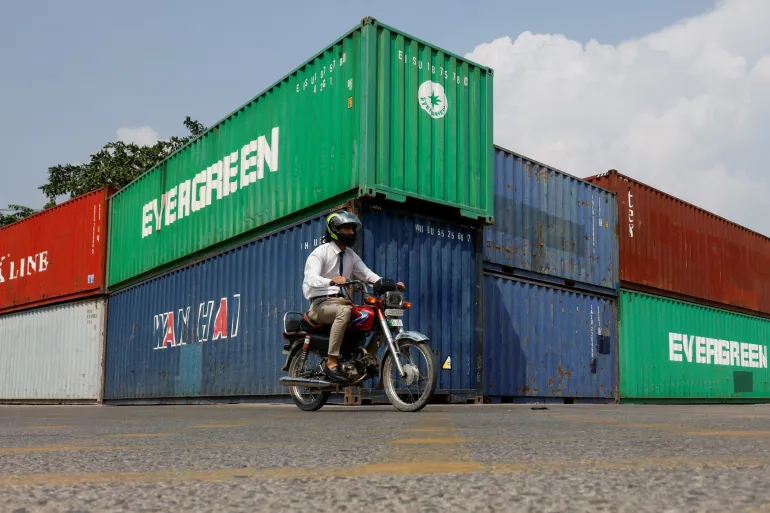
Islamabad, Pakistan — The motorway linking Pakistan’s capital with Peshawar, about 180km (110 miles) to the northwest, has been closed to all traffic until further notice, according to a police notification.
So have the highway towards Dera Ismail Khan, the Hazara motorway and the Grand Trunk Road at Attock.
Recommended Stories
list of 4 itemsend of list
Each carries traffic between Islamabad and Khyber Pakhtunkhwa, the province governed by the party of jailed former Prime Minister Imran Khan, whose supporters plan to march on the capital on Sunday, September 27, demanding his release.
The motorway from Lahore, about 375km (235 miles) to the southeast, remains open.
Inside Islamabad, workers have welded shipping containers together and filled them with gravel and sand so they cannot be pushed aside. Several schools and colleges have been told to shut so police brought in from Punjab and Sindh can be housed there.
Police expect the march to draw between 20,000 and 25,000 people, according to local media reports.
While two of the country’s main opposition parties announced marches on the capital this month, only Khan’s Pakistan Tehreek-e-Insaf (PTI) has faced measures on this scale.
Jamaat-e-Islami (JI), a religious party, also set out for Islamabad last week to protest against rising fuel prices. On Monday, Prime Minister Shehbaz Sharif telephoned its leader, Hafiz Naeemur Rehman, and by Tuesday afternoon JI had postponed its march, pending a meeting between the two men.
PTI leaders have received no such call.
Instead, Khan’s three sisters, all over the age of 65, have been detained in Lahore and at least six of the party’s legislators in Islamabad, all under a 1960 public order law that allows preventive detention without charge.
PTI says the true figure of those arrested is higher, and that one lawmaker taken from the parliament lodges has not been traced since.
Khan has been in prison since August 2023 and remains Pakistan’s most prominent opposition figure. But his party enters the final stretch before the protest weakened, with no major demonstration outside Khyber Pakhtunkhwa since November 2024, by its own account.
Yet, say analysts, the Pakistani government appears to be treating the protest march as a far bigger threat than a regular political event would warrant.
“While this is undoubtedly a difficult moment for PTI, it is equally exposing the government’s own frustration,” Habib Akram, a Lahore-based political analyst, told Al Jazeera.
“In fact, the government’s conduct suggests something more. It isn’t just afraid of this protest; it has turned this protest into a matter of its own survival.”
A capital behind containers
More than 2,000 containers have been placed across Islamabad and at Attock Bridge, the main crossing between Khyber Pakhtunkhwa and Punjab, according to media reports, with 19,000 police officers on their way from Punjab and Sindh, and thousands more deployed at Attock.

Dawn, the country’s leading English-language newspaper, said in an editorial that the government appeared to be preparing “not for a political event but an invasion”.
Talal Chaudhry, the junior interior minister, rejected the suggestion that the government was shutting down the capital itself.
“Normal life in Islamabad is continuing. Hospitals, offices and essential services are functioning. The containers and security arrangements are precautionary measures, not a shutdown,” he told Al Jazeera.
Rana Ihsaan Afzal, a coordinator to the prime minister and a government spokesperson, was more candid.
“In trying to counter the rhetoric PTI has adopted, we do have to take certain measures, and yes, those measures carry their own consequences too, but we have to look at the bigger picture,” he told Al Jazeera.
It is all being mounted during one of the deadliest weeks for Pakistan’s security forces this year.
An attack on a police compound in Kohat, in Khyber Pakhtunkhwa, killed more than 20 people on September 18, and six soldiers were killed in a gunfight in nearby Hangu two days later.
Interior Minister Mohsin Naqvi set those losses against the march in Lahore on Monday.
“The situation in KP [Khyber Pakhtunkhwa] over the past 10 days is before everyone. There was a suicide attack on a mosque, and two or three other attacks. Our captain was killed, our soldiers were killed, our policemen were killed, and these people are preparing to storm a city,” he said.
The government’s case
Government ministers have seized on a remark by Junaid Akbar, PTI’s chief in Khyber Pakhtunkhwa, who said protesters would turn Islamabad into Somnath, a Hindu temple in India sacked by Mehmood of Ghazni, an 11th-century invader, to try to paint the upcoming protest as a major law and order threat.
“Peaceful people do not leave their homes carrying nail-studded sticks,” Information Minister Attaullah Tarar said in Kohat on Monday.
But the PTI’s Sohail Afridi, the chief minister of Khyber Pakhtunkhwa, who will lead the September 27 march, answered Tarar in Peshawar on Monday.
“We will go there on nothing but two hands and two feet. There will be nothing else in our hands,” he said.
In a September 18 judgement, the Islamabad High Court ruled that no party could block roads into the capital, and barred provincial governments from using state resources for the march.
Days later came the arrests of Imran Khan’s sisters. Aleema Khan was detained in Lahore on Sunday, and her sisters, Uzma Khan and Noreen Niazi, were taken in a predawn raid on their homes the next day, according to a family statement on September 22.
The Lahore High Court has reserved its decision on whether a petition challenging Aleema’s detention is admissible, after the family’s lawyer argued that the order was issued after the arrest.
Chaudhry said the sisters faced several cases, had led confrontational protests in the past, and were being held as a preventive measure.
PTI says the arrests reach far wider, listing five members of the National Assembly, a senator, provincial legislators and more than 1,500 workers.
“We were peaceful, we are peaceful, and we will remain peaceful. We are being punished for being peaceful,” Gohar Ali Khan, the PTI chairman, said in Peshawar on Monday, noting that four women from Khan’s family, including his wife Bushra Bibi, are now in jail.

‘Long march’ vs ‘permanent plan of action’
But Interior Minister Naqvi suggested that the government is bracing for a confrontation.
“I think this time we will draw up a permanent plan of action. We will not go halfway,” Naqvi said in Lahore on Monday, adding that the matter would be settled “once and for all”.
What he ruled out was a long sit-in of the kind PTI has staged before.
“This time, it will not happen that they come, and the country is shut down for 10 or 20 days. That possibility does not exist,” he said.
Afridi has signalled that he has exactly that in mind.
“The long march is not a T20, it will be a Test match,” he said on Monday, a reference to cricket’s five-day format.
If Naqvi’s comments sound ominous, they also carry a history with them.
On May 9, 2023, after Imran Khan was briefly arrested, his supporters attacked military installations across the country, including burning down a senior commander’s official residence in Lahore. That led to a major crackdown on the PTI’s supporters and leaders, with hundreds placed under arrest for days, and party leaders pressured to leave the group.
Then, on November 26, 2024, a PTI march on Islamabad ended in an overnight crackdown by security forces, in which the party says at least 12 of its supporters were killed. The government denies that, and says four security personnel died — even though Al Jazeera met families of some of the PTI supporters killed.
A contested mandate
PTI was stripped of its electoral symbol before the February 2024 general election, forcing its candidates to run as independents.
They still won 93 seats, more than any other party, but could not form a coalition, and the Pakistan Muslim League – Nawaz took power with other major parties.
A Commonwealth observer group, in its report on the polls released a year later, found that decisions by key institutions had “consistently limited the ability of one particular party” to contest the vote, in a reference to the PTI.
While the Election Commission of Pakistan rejected allegations of rigging, two and a half years on, the popularity scale remains tilted in favour of PTI.
Bilal Gilani, executive director of the pollster Gallup Pakistan, said its unpublished Public Opinion Pulse surveys showed a landscape broadly similar to 2024.
“PTI continues to lead nationally, but faces strong competition from PML-N in Punjab and PPP in Sindh,” he told Al Jazeera, adding that Khan remained the country’s most popular leader.
For Akram, that unresolved argument — over the lack of legitimacy of the 2024 election in the eyes of Pakistanis — is what keeps the pressure on.
“You can hold as much power as you want, but that question never fully goes away. It continues to haunt you, and it continues to be a source of anxiety for the government,” Akram said.
The ‘hard state’
In March 2025, army chief Field Marshal Asim Munir, who now also serves as Pakistan’s chief of defence forces, told a parliamentary security committee that the country must stop acting as a “soft state”.
“How long will we continue to sacrifice countless lives in a manner of a soft state?” he asked, according to state broadcaster PTV.
For Ahmed Ijaz, an Islamabad-based political analyst, the response to the September 27 march is a response to that thinking, rather than the PTI’s strength.
“Behind that confidence lies the thinking of a hard state, one that has decided no one will be granted an unconditional right to protest going forward,” he said.

Akram, however, said that a different factor might also be worrying the government and the military behind it.
The war in the Middle East has pushed petrol to 393.75 rupees ($1.42) a litre ($5.37 per gallon), up about 51 rupees ($0.18) since the start of September. That is what Jamaat-e-Islami was marching against, and it has warned that it will resume its march in October if the prime minister offers no relief.
Akram said the government’s real worry is multiple issues of antigovernment anger — price rises and Imran Khan’s continued incarceration — coming together.
“That merging could then pull other groups out onto the streets too, and that is precisely what worries the government,” he said.