Bollywood actor Tiger Shroff escaped unharmed after gunmen opened fire at his vehicle in Mumbai. His driver and an autorickshaw driver were reportedly injured. A social media post linked to the Lawrence Bishnoi gang claimed responsibility, but police are investigating the incident and verifying the claim.
United States Secretary of State Marco Rubio is to visit India in the coming week, but he will not set foot in the capital, New Delhi.
Instead, on Monday, Rubio will hold talks with Indian External Affairs Minister Subrahmanyam Jaishankar in Mumbai, India’s financial hub, and then visit an oil refinery in Jamnagar in the western state of Gujarat, according to a statement from the US Department of State.
Recommended Stories
list of 4 itemsend of list
His itinerary sparked a political storm after the US ambassador to India said Washington expected Jaishankar to travel to meet Rubio, prompting opposition leaders to accuse the government of allowing India’s top diplomat to be “summoned” on home soil.
The spat comes as relations between the two countries are strained over trade, tariffs and India’s purchases of Russian oil.
So why is Rubio avoiding New Delhi, and why has it caused such upset? Here’s what you need to know:
What is Rubio doing in India?
He plans to discuss trade, energy and investment.
Rubio is arriving on Sunday from Samarkand, Uzbekistan, where he has been meeting with five Central Asian states at the C5+1 summit.
In India, he is due to meet senior officials to discuss the US-India strategic partnership and energy cooperation and hold talks with business leaders, the State Department said.
Indian Ministry of External Affairs spokesperson Randhir Jaiswal appeared to confirm the agenda, stating on Friday that the Mumbai talks would cover energy, trade and investment, defence, and critical and emerging technologies.
In Jamnagar, Rubio is to visit the world’s largest single-site refinery, operated by billionaire Mukesh Ambani’s Reliance Industries, and attend a reception hosted by the Ambani family, according to The Hindu newspaper.
Rubio and his wife, Jeanette Rubio, appear with Ambassador to India Sergio Gor, also the US special envoy for South and Central Asia, at the Taj Mahal in Agra, India, on May 25, 2026 [Julia Demaree Nikhinson/Pool via Reuters]
Why isn’t Rubio going to New Delhi?
No official reason has been given.
Rubio was in the Indian capital in May for a meeting of foreign ministers of countries in the Quad, a group consisting of the US, India, Japan and Australia.
The State Department has framed his upcoming trip around energy and investment, and the second stop on Rubio’s India visit, Jamnagar, is one of the world’s most important energy hubs.
The visit also comes as fuel prices bite in the US before next month’s midterm elections.
Business Standard, an Indian financial daily, said the Jamnagar stop was significant because Reliance is the biggest buyer of Venezuelan crude oil besides the US at a time when Washington has been urging India to buy more.
Since US forces seized Venezuelan President Nicolas Maduro in January and took essential control of the country’s oil industry, the US government has marketed Venezuelan oil to buyers abroad.
Reliance is also investing in a new refinery in Texas, the first to be built in the US in 50 years, which Trump hailed as a $300bn deal when he announced it in March, Business Standard reported.
Villagers sit outside the Jamnagar refinery, run by the Indian business conglomerate Reliance Industries, in Jamnagar, India [File: Manish Swarup/AP]
What did the US ambassador say, and why has it caused upset?
Speaking at the Bloomberg New Economy Forum in New Delhi on Thursday, US Ambassador to India Sergio Gor said Rubio would meet Indian government officials in Mumbai, and Washington “expected” Jaishankar and others from New Delhi to travel there to see him.
Earlier in the week, however, Jaiswal had not confirmed the trip or explained why Rubio was skipping New Delhi, telling reporters the Indian government would announce it “at the appropriate time”, The Hindu newspaper reported.
Jairam Ramesh, a general secretary of the opposition Indian National Congress party, wrote on X that the ambassador’s statement was “quite extraordinary”.
Rahul Gandhi, leader of the opposition in parliament’s lower house, also took to X to comment, writing on Friday that Rubio had “summoned his employee to Mumbai”.
Congress MP Pawan Khera went further.
“A foreign government summoning India’s External Affairs Minister on Indian soil is a new low, even by the Modi Government’s standards,” he wrote on X, referring to Prime Minister Narendra Modi.
Why are US-India relations strained?
Mainly because of Trump’s tariffs and Russian oil.
In August last year after a round of trade talks broke down, the US hit most Indian goods with a 50 percent tariff. Under a framework the two sides agreed in February, that rate fell to 18 percent, however.
Since then, negotiations have stalled.
This month, Indian Finance Minister Nirmala Sitharaman said the talks had “plateaued”, according to The Hindu.
On Thursday, Trade Minister Piyush Goyal said the “first tranche” of a deal was in its final stages but India would not sign until its exporters had an edge over rivals such as Bangladesh, Vietnam and Indonesia, according to the Reuters news agency.
Other points of friction have emerged.
Last week, US Labor Secretary Keith Sonderling announced that his department was suspending eight companies – including the Indian IT giants Infosys, Tata Consultancy Services, Wipro and HCL – from a labour certification scheme that is a key step for employers seeking green cards for their foreign staff.
Sameer Lalwani, a senior fellow in the South Asia Program at the Carnegie Endowment for International Peace, wrote this week that Indian public opinion of the US has hit a record low, citing US engagement with Pakistan and the US-Israel war on Iran, which he said had pushed India back towards Russian oil.
Despite that, he argued, defence and technology cooperation has quietly deepened, and bilateral trade grew by almost 12 percent in 2025 to nearly $240bn.
In his view, “perceptions of the political relationship have deteriorated faster than its strategic foundations.”
A sanctions law had threatened to make matters worse.
Last month, Trump signed the Lindsey O Graham Sanctioning Russia and Iran Act, which could impose tariffs of up to 100 percent on goods from the five largest importers of Russian oil or gas.
India, one of the world’s biggest buyers of Russian oil, had warned Washington that new tariffs could hurt bilateral ties. Trump signed an executive order seeking to waive the sanctions on Friday as he tries to ease high oil prices before the November 3 US elections.
New Delhi, India – A 19-year-old woman was detained by police during the youth-led antigovernment protests in the Indian capital over the weekend.
The young woman, who asked to remain anonymous for fear of further reprisals from the authorities, said she was detained on Sunday as thousands of people congregated in central New Delhi. They were demanding the resignation of India’s Chief Election Commissioner, Gyanesh Kumar, over alleged irregularities in electoral rolls, which saw the removal of 133 million people from the voter lists.
Recommended Stories
list of 4 itemsend of list
After the woman’s detention, she and several other demonstrators were taken on a police bus to a location about 50km from the protest site. With no cash and her phone battery drained, the woman spent nearly an hour wandering along a dark road, trying to figure out what to do next.
A car pulled up and the driver asked if she needed any help.
“I was frightened and completely lost. When those volunteers finally helped me get back safely, it felt like a miracle. I had never imagined that someone I had never met would come forward to help me like that,” she told Al Jazeera.
For a young woman in New Delhi, notoriously referred to as the “rape capital of India”, being alone in the middle of the night and getting into a car with strangers is not an easy decision. The city records an average of three rapes a day.
But the young protester said she immediately recognised one of the volunteers in the car. She had seen his videos online, in which he had asked the detained protesters whether they needed help. Recognising a familiar face reassured her that the people offering the ride could be trusted.
The woman was rescued using an AI-assisted tool developed by 25-year-old Rajiv Choudhary, who is helping protesters get home safely after being detained and dropped off by the police far away.
Called the Detainee Gharwapsi Yojana, the initiative combines a digital dashboard with a network of volunteers who track information about police buses carrying detainees and arrange transport for those left stranded.
“Gharwapsi” in Hindi means “to return home”. It is also a play on a campaign by India’s right-wing Hindu groups which want to bring the country’s Muslims and Christians back into the Hindu fold, claiming that their ancestors converted to “foreign” religions from Hinduism. “Yojana” means a plan.
Since the beginning of this month, India has seen near daily protests over alleged electoral fraud by Kumar and his commission. Led by the satirical Cockroach Janta Party (CJP), a number of left-leaning student groups as well as the main opposition Congress party, the protests have seen tens of thousands of people hitting the streets in New Delhi and other cities.
In response, authorities in the Indian capital have imposed a sweeping crackdown, blocking roads, closing metro stations and detaining thousands as Prime Minister Narendra Modi’s government faces the biggest challenge to its power after 12 years of rule.
Choudhary said his network’s primary focus was to help minors, elderly people and women, mainly first-time protesters.
The initiative operates through a private digital dashboard that uses AI-assisted data processing, live mapping and information shared by volunteers on the ground. Volunteers send details, including police bus numbers and locations, through WhatsApp, helping the team coordinate assistance and rides home.
A map showing the locations of rescue cars deployed by Rajiv Choudhary’s team in New Delhi [File; Mehran Firdous/Al Jazeera]
Choudhary said he and his associate, journalist Meghnad, who goes by a single name, initially worked with a small group of volunteers to connect detainees with transport, legal assistance and medical support. The network has since expanded to more than 130 volunteers, who have offered their time and resources to assist detained demonstrators.
“For people caught up in these demonstrations, the ordeal doesn’t end with detention. They can be taken far from the protest site and left trying to find their way home from unfamiliar locations, often struggling to contact friends or arrange transport,” he said.
The idea grew out of Choudhary’s experience during an earlier protest called by the CJP at Jantar Mantar, the designated protest site in New Delhi that has now been denotified by the authorities. Initially, he helped organise supplies and volunteers.
As demonstrations continued, he recognised that protesters needed more systemic support, particularly those who were detained by the police and left fending for themselves far from the city limits.
A young protester is detained by police during a demonstration in New Delhi, October 4, 2026 [Mehran Firdous/Al Jazeera]
As renewed protests began on October 2 , Choudhary built a digital system around the same volunteer network using AI tools. It began with a simple spreadsheet.
“The whole aim behind the application was that I had to systemise things that are not systemised,” he said. “We just wanted to become a support system that could help our people in their fight for their demands.”
Choudhary recalled receiving a distress call from a woman who had been detained in central New Delhi and released on the outskirts of the city. Stranded alone near a railway station, with metro services shut and no clear way to get home, she was frightened and unsure which way to turn.
She reached out to Choudhary’s network for help and he arranged for a nearby female driver to take her home safely. “It is heartbreaking to see people left helpless in an unfamiliar city, frightened and unsure of how they will get home,” he said.
For now, the Detainee Gharwapsi Yojana operates only in New Delhi, but Choudhary plans to expand it to other cities.
“I am overwhelmed by the response from volunteers and drivers who have come forward to help without charging anything. They are offering their services for free because they want to support the protesters,” he said.
The 19-year-old woman who was helped by Choudhary’s team described the initiative as “a lifeline for protesters”. She said the team not only arranged her return, but also offered reassurance and emotional support.
“I cannot thank them enough. As long as we have people like them in our society, no authority can stop us from demanding our rights and protesting peacefully,” she said.
A seven-year-old girl was among at least 19 people killed in a stampede during a Hindu festival in Kolkata, India. Heavy rain and a sudden crowd surge triggered the deadly crush, leaving another 25 people injured.
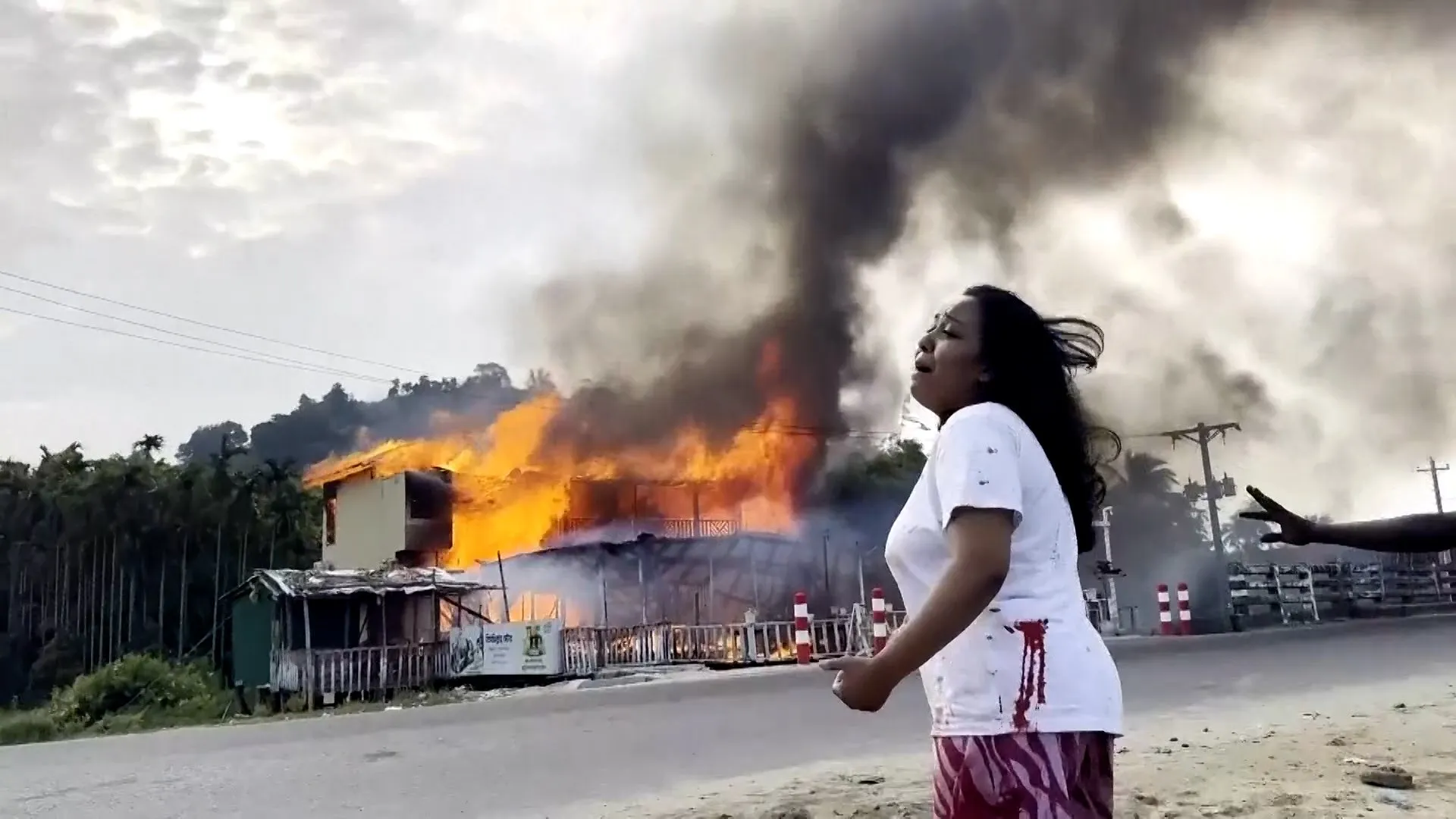
Ten people, including six members of the same family, were killed in a fire at a beach resort in Bangladesh. The resort, in Cox’s Bazar, was operating without a fire safety licence despite an official warning in June, say authorities.
Incident took place at festival in north Kolkata in India’s West Bengal state amid big crowds and rainfall, police said.
Published On 17 Oct 202617 Oct 2026
A “stampede” during a Hindu religious festival in eastern India has killed at least 17 people and injured 25, officials said.
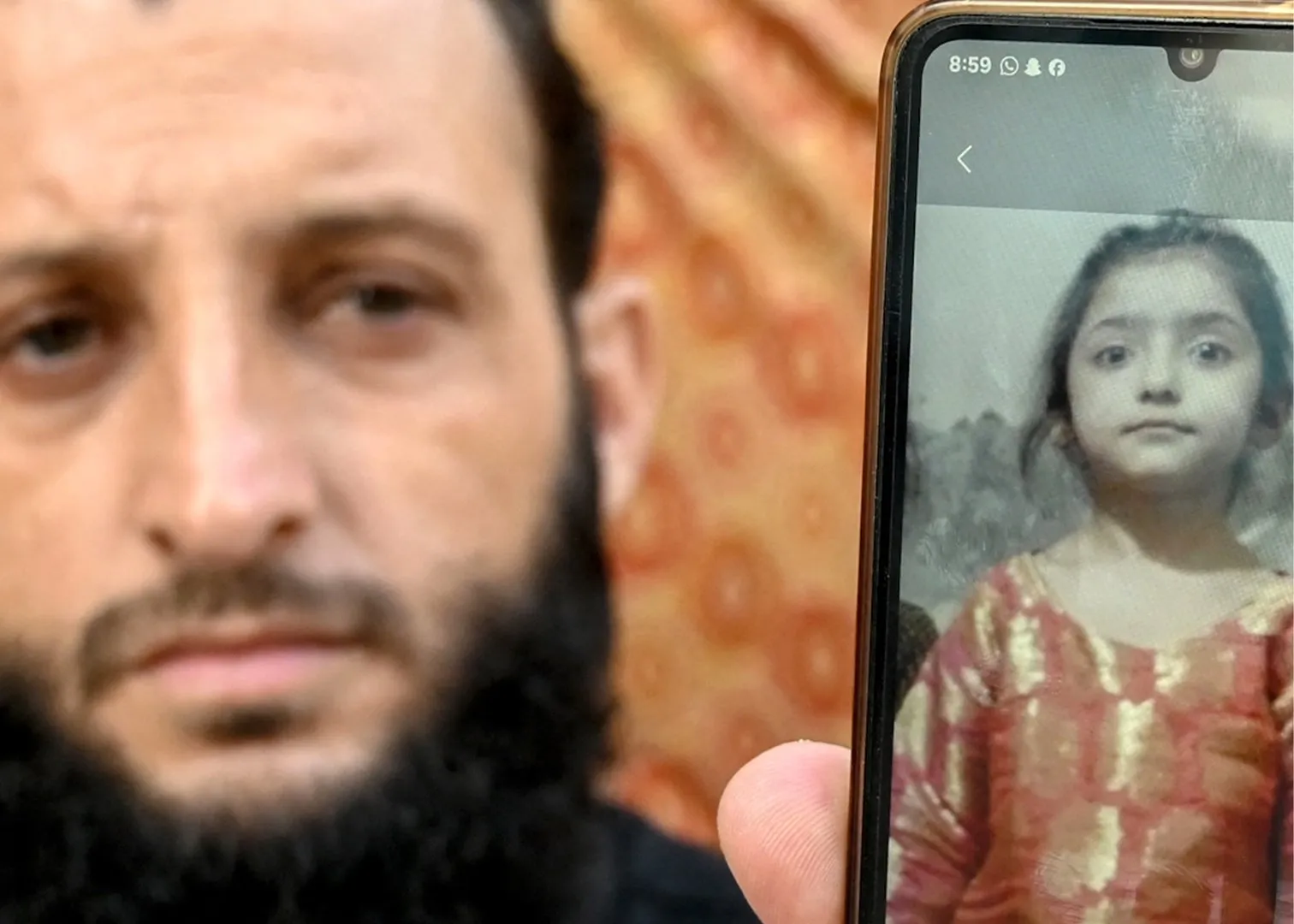
A seven-year-old girl was among the fatalities in Saturday’s disaster in north Kolkata in West Bengal, the state’s Chief Minister Suvendu Adhikari told reporters.
Recommended Stories
list of 3 itemsend of list
“Six bodies have so far been identified,” Adhikari said.
Police said the injured were taken to hospital from a Durga Puja pandal, a temporary pavilion housing idols of the goddess Durga at a festival which attracts thousands of devotees.
A police statement said the stampede happened in the evening due to “heavy crowds of pandal hoppers amid rainfall”.
A senior police official at the scene told the AFP news agency that an announcement caused “commotion” after it started raining and the “crowd waiting outside the pandal [pavilion] was pushing, pulling and rushing forward and fell on the ground, leading to the stampede.”
Prime Minister Narendra Modi described the incident as “saddening.”
“Condolences to the bereaved families. Wishing the injured a speedy recovery. The West Bengal Government is providing all possible help to the affected families,” Modi wrote on X.
Modi’s office announced a compensation payment of 200,000 rupees ($2,106) for the next of kin of those who died and 50,000 rupees ($527) each for the injured.
Interior Minister Amit Shah said the “administration is ensuring that all possible medical facilities are being provided to the injured.”
Deadly crowd incidents happen frequently at Indian mass events, such as religious festivals, often due to poor management and safety lapses.
Last year, a stampede at India’s Kumbh Mela religious fair killed 30 people and injured several others. In Bengaluru, 11 fans were crushed to death during celebrations for the local cricket team’s first Indian Premier League title.
In southern Tamil Nadu state, 36 people were killed in a stampede at a campaign rally for a popular actor-turned-politician
In 2024, 121 people were killed in northern Uttar Pradesh state during a Hindu religious gathering.
India reached 118-5 after seven overs with Naman Dhir hitting 24 off six balls before rain forced an end to the game.
Published On 17 Oct 202617 Oct 2026
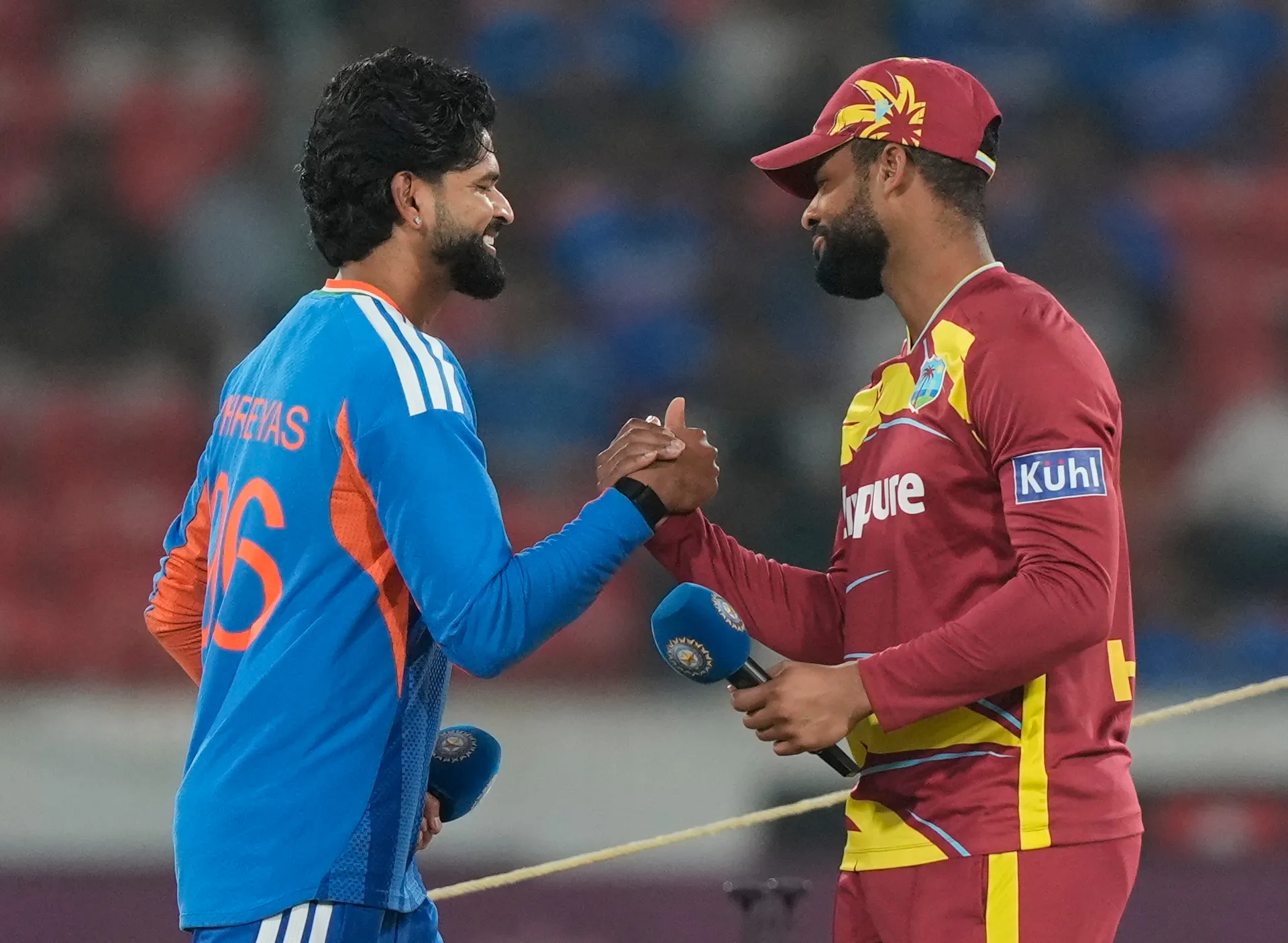
India and the West Indies were forced to settle for a 2-2 stalemate in their five-match Twenty20 International series after Saturday’s deciding match lasted just 48 minutes before it met a watery end.
At Bengaluru’s M Chinnaswamy Stadium, where play began an hour and 45 minutes behind schedule and the match was reduced to nine overs a side, India had reached 118-5 in 7.4 overs when the rain returned, forcing the umpires to call off play with not even a five-overs-a-side shootout possible.
Recommended Stories
list of 4 itemsend of list
The stadium was hosting its first international fixture since the October 2024 Test match between India and New Zealand and more than 20,000 expectant fans braved the inclement weather.
Their patience was rewarded when India’s batters went on the rampage after being put in by West Indies captain Shai Hope, with Ishan Kishan, Sanju Samson and the impressive Naman Dhir – with an unbeaten 24 off six balls – leading the way.
India lashed eight fours and seven sixes in their limited batting stint, with Kishan bringing up the 100th six of the series by swinging Romario Shepherd over long leg and out of the stadium.
But then, the skies opened up again, emphatically washing away any prospect of a decisive outcome.
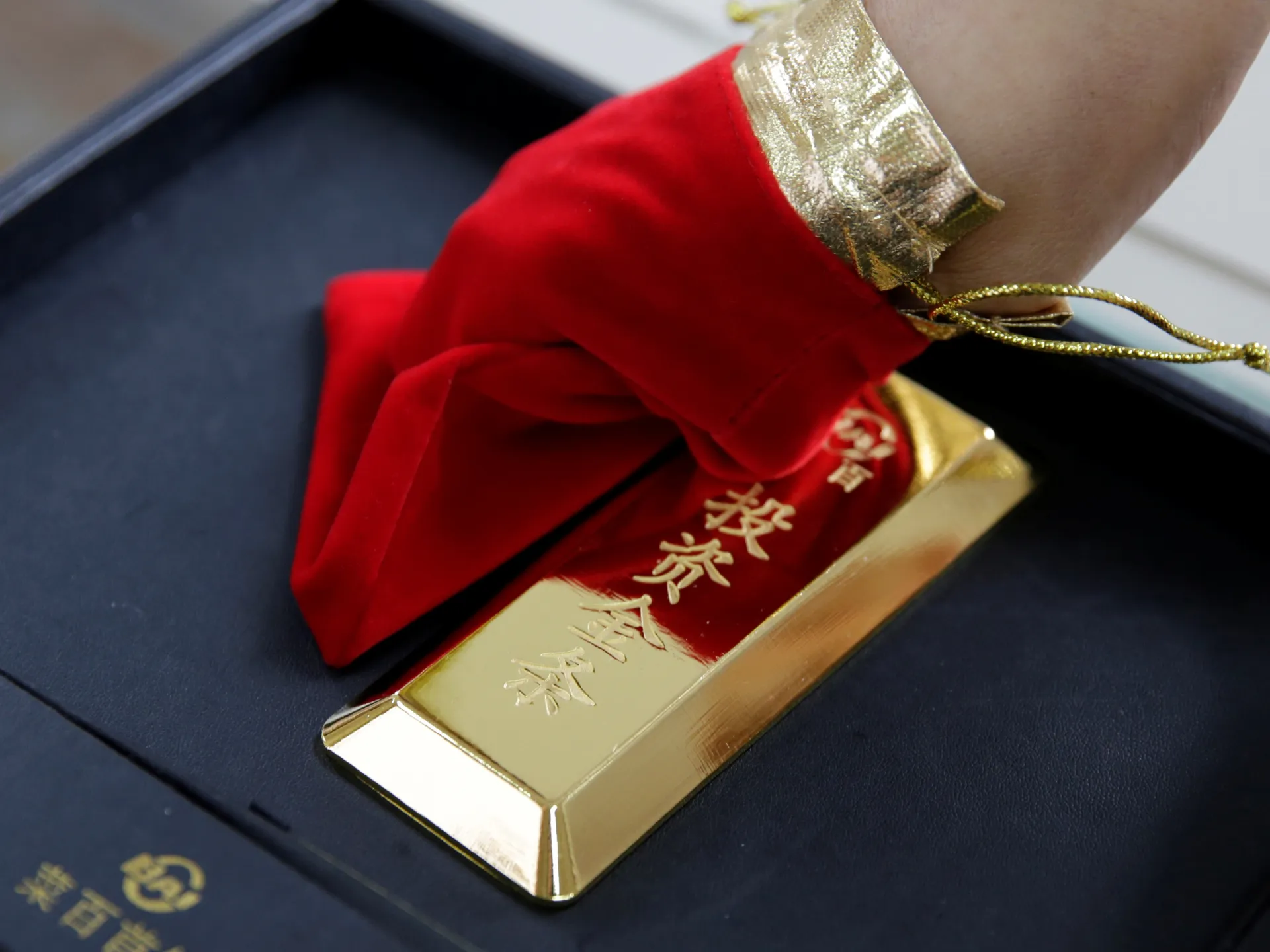
China is increasing its gold reserves in a bid to reduce its dependence on US dollar assets and protect against financial and geopolitical risks, analysts say, while households are turning to the precious metal amid uncertainty over the domestic economy.
The People’s Bank of China reported buying gold for a 23rd consecutive month in September, when the country’s central bank also made its largest monthly purchase in nearly three years. The sustained buying points to a longer-term effort to spread risk associated with its vast reserves, experts say.
Among concerns is high US debt and Western governments’ freezing of assets, which has highlighted the inherent risk in holding money overseas, particularly for emerging market and Global South economies. Gold bought and stored domestically offers protection against that risk because access does not depend on the will of another government.
But central bank buying and household demand for gold in China have different drivers. While Beijing is managing its financial exposure, private investors are seeking somewhere to preserve their savings. Here is what we know.
How much gold has China bought?
China’s central bank added approximately 23 tonnes of gold in September, bringing its reported holdings to about 2,410 tonnes, according to the World Gold Council. That was its largest monthly purchase since October 2023. Gold accounted for 8.5 percent of China’s total official reserves at the end of September, compared with 5.5 percent at the end of 2024.
Reserves are assets central banks hold to ensure they can meet international payments and respond to financial disruption. They usually include foreign currencies, foreign government debt and gold.
Private demand for gold within China has also risen, with purchases of gold bars and coins 28.4 percent higher in the first half of 2026 than during the same period last year, according to the China Gold Association. The buying of gold has continued amid falling prices, with gold down around 8.5 percent over the month.
The World Gold Council attributed the decline in gold prices partly to a stronger dollar and higher returns on US government debt. With interest rates going up in an attempt to curb inflation, these investments are attractive for buyers as they pay interest, making them more attractive to private investors than gold, which does not.
Why is China buying more gold?
A key objective is to reduce dependence on US government debt, known as Treasuries, according to Thu Lan Nguyen, head of commodity research at Commerzbank in Frankfurt.
China holds substantial reserves in dollar-based assets and, therefore, buying gold reduces its exposure to decisions taken in Washington. “China’s gold purchases are part of a broader effort to make its reserves more resilient,” Nguyen told Al Jazeera.
The freezing by Western countries of roughly $300bn in Russian Central Bank overseas assets following Moscow’s invasion of Ukraine in 2022 demonstrated how reserves held abroad can quickly become inaccessible.
The concern for China may be that a future confrontation with Washington could expose some of its overseas assets to similar restrictions. “Gold held domestically has a crucial advantage in this respect: it does not represent a claim on another country and is therefore much less exposed to sanctions or asset freezes,” Nguyen said.
“I would interpret it primarily as risk management,” she added, pointing to increased geopolitical tensions and economic and fiscal risks.
America’s rising debt, which hit $40 trillion for the first time in history earlier this year, adds another source of uncertainty. In February, the US Congressional Budget Office projected that federal debt held by the public would rise from 101 percent of the size of the US economy in 2026 to 120 percent in 2036. That provides context for concerns about Washington’s ability to repay that debt going forward should an economic crash occur. Much of this debt is held by China. Gold, therefore, offers a less volatile and risky asset to hold.
Chinese households have different motivations for buying gold. When confidence in other investments weakens, gold can become more attractive as a way to hold savings. “Strong demand for gold can partly reflect a search for alternative stores of value,” Nguyen said.
The World Gold Council has identified weak Chinese share markets as one factor supporting domestic demand for gold, while its property market is burdened by heavy borrowing and overbuilding, contributing to a fall in housing prices, making it a poorer investment.
What this means for the US dollar
Analysts warned that China’s increased buying of gold does not signal an imminent end to the dollar’s global dominance. “I would be cautious about describing this as a major shift away from the dollar,” Nguyen said. “The dollar remains by far the dominant global reserve currency.”
But a gradual shift could still matter if China and other central banks put more of their new reserves into gold, buying fewer US assets than they normally would. That could weaken one source of demand for US government debt. But the effect would depend on how widely and quickly the shift developed.
“The key point is, therefore, that this is likely to be a slow diversification process rather than a sudden abandonment of the dollar,” Nguyen said. She added that the consequences for the US economy would remain limited unless the trend broadened and accelerated substantially.
Central banks also need readily available foreign currency to support international payments and the dollar remains central to those transactions. So gold can provide financial protection, but it cannot directly replace all the functions of dollar reserves.
Who else is buying gold?
China is part of a wider trend, particularly among central banks in emerging economies, Nguyen said.
“The trend is particularly visible among emerging market central banks,” Nguyen said. “But sanctions are only part of the story.”
Poland has also become a more prominent buyer. Its central bank purchased 31 tonnes in the first quarter of 2026 and another eight tonnes in July, according to the World Gold Council.
Large holdings do not necessarily indicate recent purchases. India, for example, confirmed in June that its physical gold stock remained unchanged at about 880.5 tonnes. India’s gold reserves have changed little since mid-2025, according to the World Gold Council. It bought about four tonnes in 2025, down from 73 tonnes in 2024.
Despite China’s sustained buying, its reserves remain far smaller than those of the United States. Its holdings of about 2,300 tonnes at the end of 2025 amounted to less than one-third of the US stockpile of approximately 8,133 tonnes.
India host West Indies in the final match of the tour on Saturday with an all-time classic T20 series level at 2-2.
Who: India vs West Indies What: Twenty20 International cricket series Where: M Chinnaswamy Stadium, Bengaluru, India When: Saturday, October 17, at 7pm (13:30 GMT) How to follow: Al Jazeera Sport will have all the build-up from 11:30 GMT before our live text commentary stream
India host West Indies in the decisive T20 International series finale on Saturday after one of the most compelling white-ball tours in recent memory.
Recommended Stories
list of 4 itemsend of list
The five-game series is level at 2-2 before the match in Bengaluru after record-breaking feats by the tourists that have pushed the T20 World Cup holders to the limit.
Al Jazeera Sport takes a look at what has become a must-not-miss showdown.
How did West Indies tour of India begin?
The teams played a three-match One-Day International to begin the white-ball tour, which saw India take an unassailable lead after opening eight-wicket wins in Thiruvananthapuram and Guwahati.
After posting a mammoth 351-7 off their 50 overs – thanks largely to KL Rahul’s 129 off 87 balls – in New Chandigarh, India would have felt they had enough on the board to claim the third match, too.
Enter West Indies captain Shai Hope. The opener hit 162 off 143 balls in an unbeaten knock that led his side to a five-wicket win.
It was the West Indies highest ODI run chase.
How did the India-West Indies T20 series begin?
India put the disappointment of the closing defeat in the ODI series behind them by claiming an eight-win win, with 5.2 overs to spare, in the first T20 of the series.
Despite fifties from Hope and Sherfane Rutherford, West Indies were bowled out for 171, with Naman Dhir taking three wickets for the hosts.
Hope hit nine sixes and six boundaries as the West Indies finished with 252-4 in reply to India’s 249-5.
India restored their series lead in the third match, but only via a narrow 14-run victory.
After being bowled out off the last ball of their innings, India posted 223 – led by Abhishek Sharma’s 69 off 30 balls.
Arshdeep Singh claimed three wickets as West Indies were restricted to 209-7.
What happened in the last India-West Indies T20?
It was time for the Hope show again in the fourth game of the T20 tour, as the wicketkeeper-batter hit his second century of the series.
The tourists struck 247-3, having been put in, with Hope hitting an unbeaten 102.
His nine sixes and four fours were a record tally for a West Indies batter in a T20 International.
The total was the second-highest first innings score in T20s against India, trailing England’s 257-3 in Southampton this year.
Opener Sanju Samson’s 56 off 23 balls set India off to a good start, but Keemo Paul’s five-wicket haul led West Indies to a 24-run series levelling win.
What did Shai Hope joke about his Player of the Match awards?
Hope joked after the fourth T20 that he was worried he may have to fork out excess baggage fees after picking up his third Player of the Match award on their tour of India.
“To be honest, they are a bit heavy, and we have got to look at the luggage weight,” he quipped after the win.
“I think we are going to have some problems going back home.”
For every five plates of food served around the world, roughly one ends up in the bin. That adds up to more than a billion tonnes of food a year.
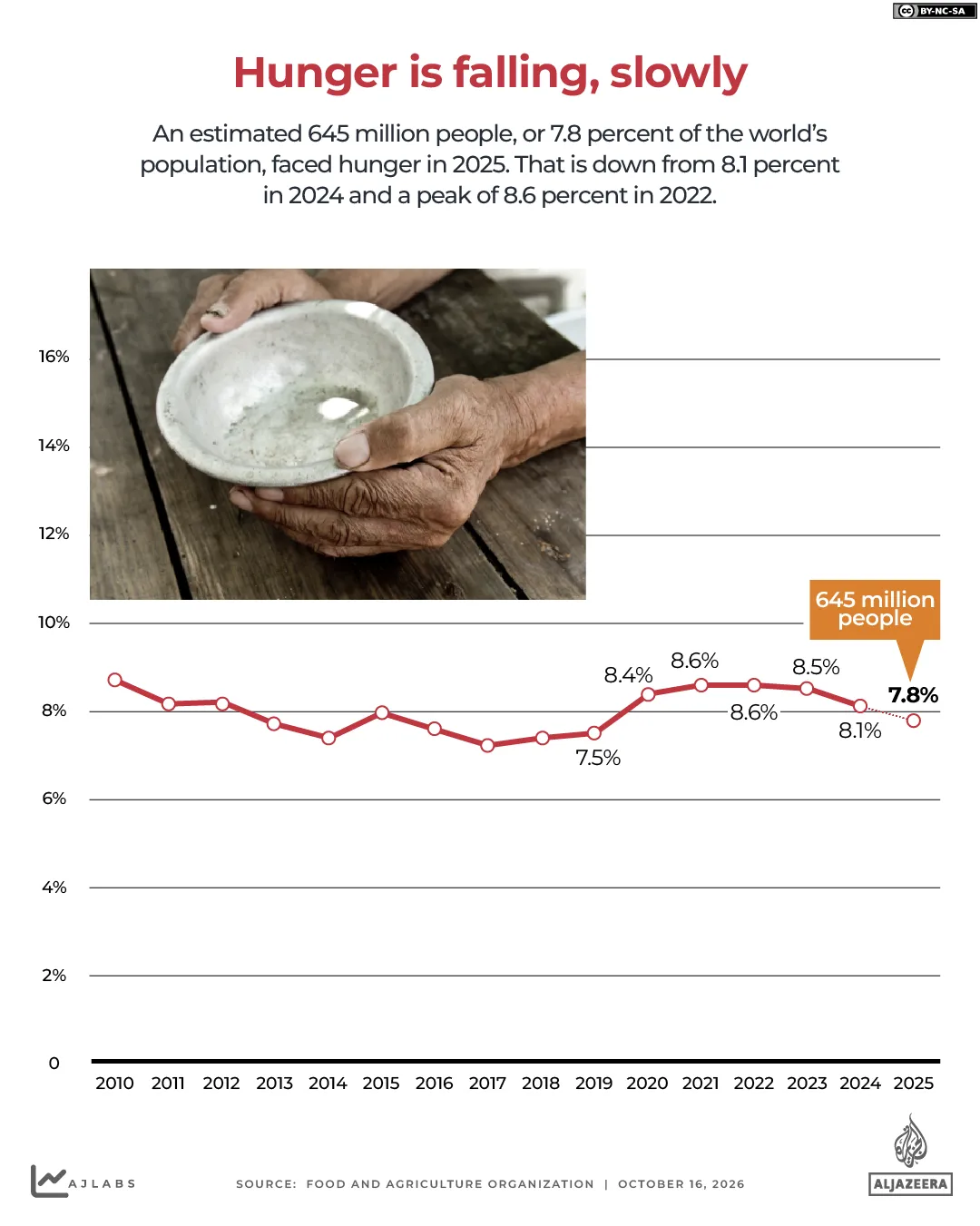
Meanwhile, 645 million people, about one in 13 of the world’s population, went hungry in 2025, according to the UN.
That gap is the focus of World Food Day on October 16, the annual UN observance marking the founding of the Food and Agriculture Organization (FAO) in 1945. This year’s theme, “Innovate today, nourish tomorrow”, calls for food systems that feed more people and waste less.
In this visual explainer, Al Jazeera looks at global hunger, which countries waste the most food and simple ways to waste less at home.
Hunger is falling, slowly
Global hunger has fallen for a third year in a row, but it remains above levels seen before the COVID-19 pandemic.
According to the UN’s annual State of Food Security and Nutrition in the World report, an estimated 645 million people, or 7.8 percent of the world’s population, faced hunger in 2025. That is down from 8.1 percent in 2024 and a peak of 8.6 percent in 2022, but still about 61 million more people than in 2019.
[Al Jazeera]
Where are people the most hungry?
Africa has more hungry people than any other region.
In 2025, an estimated 309 million people in Africa were undernourished. That is one in five people on the continent and almost half of the world’s hungry people.
By comparison, 292 million people in Asia (6 percent of the population) and 32 million in Latin America and the Caribbean (4.8 percent) were undernourished.
The 2026 Global Hunger Index shows a similar pattern at the country level. The index scores countries out of 100, combining undernourishment with child stunting, child wasting and child mortality. Scores of 35 or more are considered “alarming”.
Hunger is classed as alarming in eight countries, seven of them in Africa. Somalia has the worst score of the 122 countries ranked, followed by the Democratic Republic of the Congo, Chad and Madagascar.
Sudan, South Sudan, Burundi and Yemen were also classed as alarming, but conflict and data gaps meant the index could not calculate their scores.
At the same time, a large share of the food the world grows never reaches a plate.
How much food is wasted every year?
Food is lost and wasted at every stage of its journey from farm to table.
According to the FAO, about 13 percent of the food produced globally is lost after harvest and before it reaches shops, spoiling in storage, during transport or in processing. Fruits and vegetables suffer the highest losses.
Food lost before it reaches shops is worth more than $400bn a year, according to the FAO.
Shops, restaurants and households then throw away almost a fifth of the food available to consumers, about 1.05 billion tonnes in 2022, according to the UN Environment Programme (UNEP). That is equivalent to 52.5 million trucks, each carrying 20 tonnes.
Households account for the most, 60 percent, followed by restaurants and other food services at 28 percent and shops at 12 percent.
How to reduce food waste at home
Most food waste happens at home, which means households can make a real difference. Here are some simple steps recommended by food waste campaigners and UN agencies:
Plan before you shop: Check what you already have, plan meals for the week and shop with a list to avoid buying more than you need.
Understand date labels: “Use by” dates are about safety, but “best before” dates are about quality. Food is often still safe to eat after its “best before” date.
Store food properly: Keep your fridge at 5C (41F) or below, and store fruit and vegetables where they last longest. Bananas, for example, speed up the ripening of other fruit nearby.
Use the freezer: Bread, cooked meals, meat and many fruits and vegetables can be frozen before they go off.
Cook the right amount: Measuring portions, especially for rice and pasta, cuts down on leftovers that get thrown away.
Eat the oldest food first: Move older items to the front of the fridge and cupboard so they get used before newer ones.
Use leftovers and scraps: Turn leftovers into new meals, and use vegetable peels and stalks in soups and stocks.
Compost what you can’t eat: Composting inedible parts such as peels and eggshells keeps them out of landfills, where rotting food releases methane.
A ‘best before’ label on Heinz baby food tells shoppers when the product is at its best quality, not when it stops being safe to eat [Anthony Devlin/Getty Images]
Which country wastes the most?
On average, every person in the world wastes about 132kg (291 pounds) of food a year, roughly the weight of two adults. Of that, 79kg (174 pounds) was thrown away at home.
But the amount varies widely. Hotter countries tend to waste more at home, UNEP says, possibly because of more fresh produce and less refrigeration.
The Maldives wastes the most food, with each person throwing away about 260kg (573 pounds) a year, about twice the global average. Syria, the Dominican Republic, Seychelles, Mexico and Tunisia follow, each wasting more than 210kg (463 pounds) per person, according to UN estimates.
Spain recorded some of the lowest levels, at around 39kg (86 pounds) or less per person.
What does food waste cost?
Food loss and waste costs the global economy more than $1 trillion a year, according to the UN.
To put that in perspective, what else could $1 trillion buy?
Use the + buttons to add items to your cart and see how the money would be spent across 35 categories.
Throwing food away also wastes the money, land and energy used to produce it.
About 1.4 billion hectares (3.5 billion acres) of land, or 28 percent of the world’s agricultural land, is used to grow food that is never eaten. That is an area larger than Canada.
Food loss and waste also generate an estimated 8 to 10 percent of global greenhouse gas emissions, including methane released as food rots in landfills.
Thousands gather for funeral prayers in Pakistan’s Peshawar after a school rooftop collapse killed at least 34 children and a teacher and injured more than 50 people. Police have attributed the collapse to weak infrastructure.
“The Palestinian question is the greatest historical injustice of this century,” China’s foreign minister said.
Published On 16 Oct 202616 Oct 2026
China’s Foreign Minister Wang Yi has told Israeli President Isaac Herzog during a meeting in Azerbaijan that Israel should stop and reverse its “forced establishment” of West Bank settlements, China’s foreign ministry said in a statement.
Wang told Herzog that China has consistently viewed the Palestinian question as the greatest historical injustice of this century, the ministry said in the statement on Friday.
Recommended Stories
list of 3 itemsend of list
Wang emphasised that the “two-state solution” is the right path to a resolution and said the immediate priority is to fully open access to the Gaza Strip so a humanitarian “catastrophe” is not allowed to spread.
Wang added that China is willing to work with the international community to push all parties to return to dialogue as soon as possible and seek a political settlement.
Wang is attending the Seventh Summit of the Conference on Interaction and Confidence-Building Measures in Asia, held in Baku, Azerbaijan, as the special representative of President Xi Jinping, China’s state news agency Xinhua reported.
China urges new Middle East framework
In September, Chinese President Xi Jinping visited Cairo for the first time in a decade and called on Middle East countries to oppose external influence and consider reshaping the region’s security order.
Xi’s rare visit arrived as Beijing seeks to expand its influence in the region amid the US-Israel war on Iran.
The talks covered the US-Israel war on Iran, with both presidents urging “diplomatic solutions” to reach a “comprehensive agreement to end the war”, according to a statement from Egyptian President Abdel Fattah el-Sisi’s spokesperson.
In March, China criticised the US and Israeli attacks on Iran, with Beijing demanding an immediate halt to the joint attacks. Wang told his Israeli counterpart, Gideon Saar, that the attack on Iran came as negotiations between Washington and Tehran had “made significant progress, including addressing Israel’s security concerns”, China’s foreign ministry said in a statement following the start of the war.
China was Iran’s largest trading partner, buying up to 90 percent of its oil, according to the US-China Economic and Security Review Commission. In 2021, Beijing signed a 25-year “comprehensive strategic partnership agreement” with Tehran.
At the same time, Beijing has spent the past decade cultivating closer ties with Gulf countries, including Saudi Arabia, Qatar and the United Arab Emirates, and remains a top trade partner of both the US and Israel.
Coworker alerted police after receiving disturbing messages from 19-year-old suspect.
Published On 15 Oct 202615 Oct 2026
A teenager arrested in a Chicago suburb had shared a document expressing white supremacist views and outlined an alleged plan to carry out a mass shooting, potentially targeting a Hindu place of worship, police in the US state of Illinois have said.
Alexandros Paporakis, 19, of Palatine, was arrested on Sunday after an individual reported receiving concerning electronic communications from him, Palatine police said on Wednesday. It was not immediately clear whether he had legal representation.
Recommended Stories
list of 3 itemsend of list
Detectives searched Paporakis’s home and recovered a rifle, multiple loaded rifle magazines and hundreds of additional rounds of rifle ammunition.
“Among the recovered items was a tactical vest containing body armor and a patch displaying imagery associated with white supremacist extremism,” a police statement said.
Paporakis’s coworker reportedly told police that he openly identified himself as a white supremacist at work and said he “couldn’t wait” to kill Indian people, according to prosecutors from the Cook County State’s Attorney’s office.
Detectives recovered a document called “Why I fought: A.K.A.: (Aurora Shooter’s Manifesto)” which had sentiments expressing white supremacist and extremist ideologies, referencing violence towards South Asians, specifically Indians.
Authorities believed Paporakis was planning to carry out his attack on Sunday, possibly targeting a Hindu temple in Aurora, 40 miles (65km) southwest of Palatine.
“However, the specific intended location has not been confirmed and remains under investigation,” the police said, adding the FBI was assisting in the probe.
Police said Paporakis is facing felony charges of “making a terrorist threat” and possessing an unlawful weapon.
The suspect appeared for a detention hearing on Wednesday and his next court appearance is scheduled for the end of October.
Human rights advocates said hate against South Asians has surged in the United States in recent years due to rising anti-immigration policies and a rise in white supremacist ideology.
Without a quick deal to move fertiliser through the strait, agricultural productivity would ‘significantly drop’.
Published On 14 Oct 202614 Oct 2026
A senior United Nations official has warned that parts of Asia and Africa could face a food security crisis unless Iran and the United States quickly agree on a UN-backed plan to move fertiliser through the embattled Strait of Hormuz.
UN Under-Secretary-General Jorge Moreira da Silva said on Wednesday that it was “absolutely critical” that the two countries agree to the proposal within weeks as planting season approaches. It calls for a UN-staffed coordination centre in Oman to help register vessels and oversee their safe passage in the waterway, through which a large portion of key global fertiliser inputs traditionally flow.
Recommended Stories
list of 3 itemsend of list
“If we miss that planting season, the productivity of agriculture would significantly drop and the impact on prices will significantly increase,” Moreira da Silva told Reuters on the sidelines of International Monetary Fund and World Bank meetings in Bangkok, Thailand.
Farmers operate strict crop calendars, and even slight delays could severely affect yield.
‘Negligible’ fertiliser shipments
Traffic in the Strait of Hormuz has been severely disrupted since the start of the US-Israel war on Iran, with Iran targeting vessels in the strait and the US and Iran exchanging fire in and around the waterway.
The disruption has hit global supplies of urea, the world’s most widely used nitrogen fertiliser, as well as seaborne sulphur, a key input. Before the war, roughly a third of global urea shipments and nearly half of seaborne sulphur passed through the strait.
Although some ships have been able to sail through amid the crisis, fertiliser products have made up a “very negligible” share of moving cargo, according to the Washington-based International Food Policy Research Institute.
Moreira da Silva said the UN-backed fertiliser mechanism, drawn up in March, could be activated within seven to 10 days if both Iran and the US agree.
Under the plan, UN monitors would work alongside local authorities at Gulf ports to verify cargo loading. Ships would be tracked during transit, and additional inspections could be carried out if countries raised concerns about a vessel or its cargo, said Moreira da Silva. He did not say why the US and Iran have not yet agreed.
The passage of only five vessels per day through the Strait of Hormuz could keep fertiliser supplies flowing to countries in critical need, he added.
‘Let us do our job’
The UN mechanism could work alongside negotiations for a “comprehensive deal” to restore freedom of navigation in the strait, Moreira da Silva said.
Iran and the US have exchanged proposals through intermediaries since a June interim ceasefire collapsed. Efforts to reopen the Strait of Hormuz have stalled over Tehran’s conditions and Washington’s insistence on addressing Iran’s nuclear programme from the outset.
“What we are telling them is, while you continue your discussions towards a comprehensive deal, let us work, let us do our job,” said Moreira da Silva.
His plea comes amid growing concern that fertiliser shortages could hit global food supplies.
In May, the UN’s Food and Agriculture Organization warned that fertiliser scarcity could tighten food supplies from late 2026 into 2027, and would likely hit countries facing climate or other crises much harder.
In South Asia, where most rely on imported fertiliser, farmers are already struggling because of soaring costs and fertiliser scarcity. On Wednesday, farmers in Spain took to the streets to protest rising production costs amid high oil and fertiliser prices.
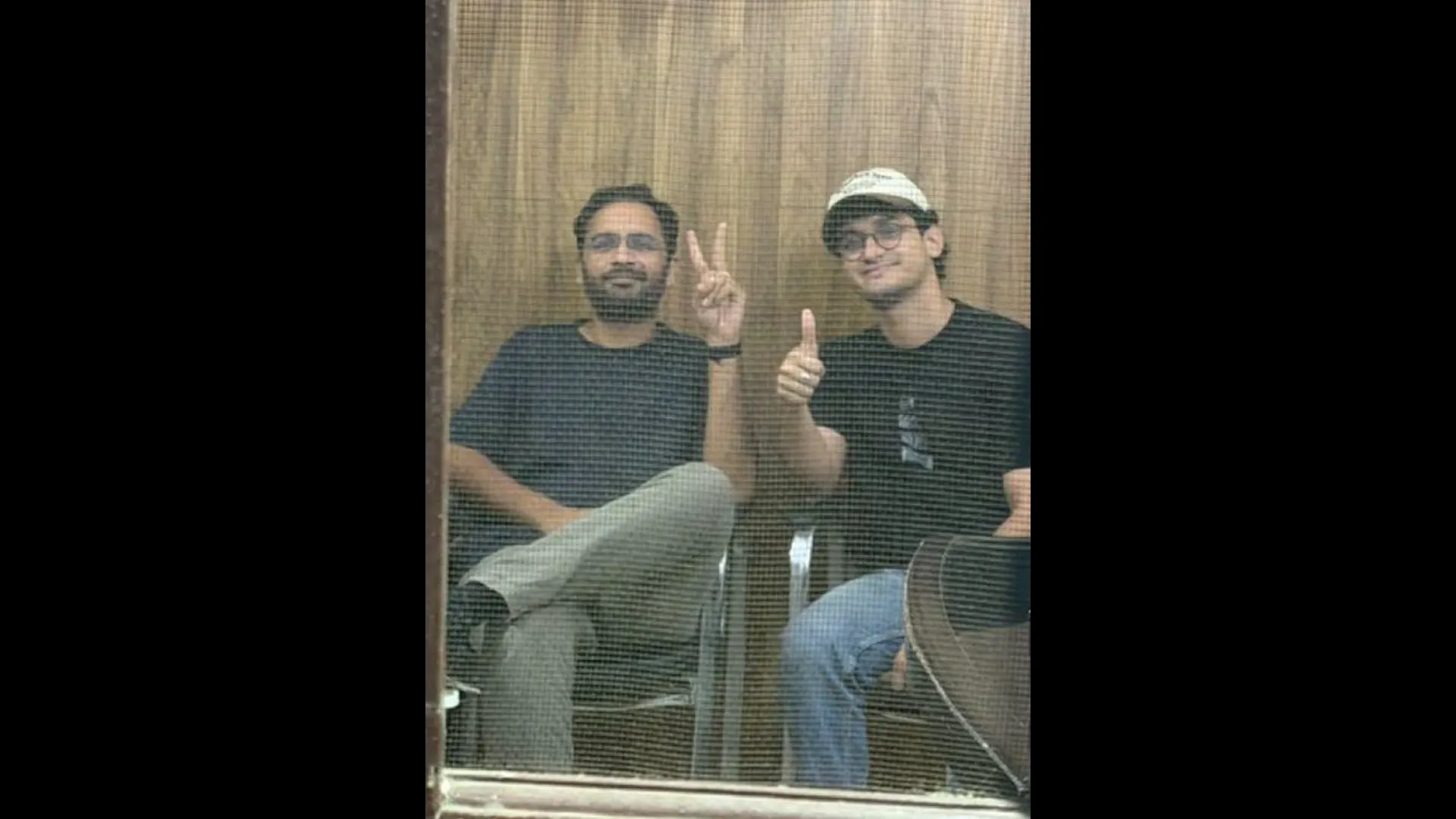
Two leaders of India’s Cockroach Janta Party have been jailed for five days after entering Delhi’s ‘Jantar Mantar’ protest site to demand the election chief’s resignation. The previously designated protest area recently lost its status as an authorised protest venue.
The long-delayed bridge will formally open on Thursday, according to China’s state-run Xinhua news agency.
Published On 14 Oct 202614 Oct 2026
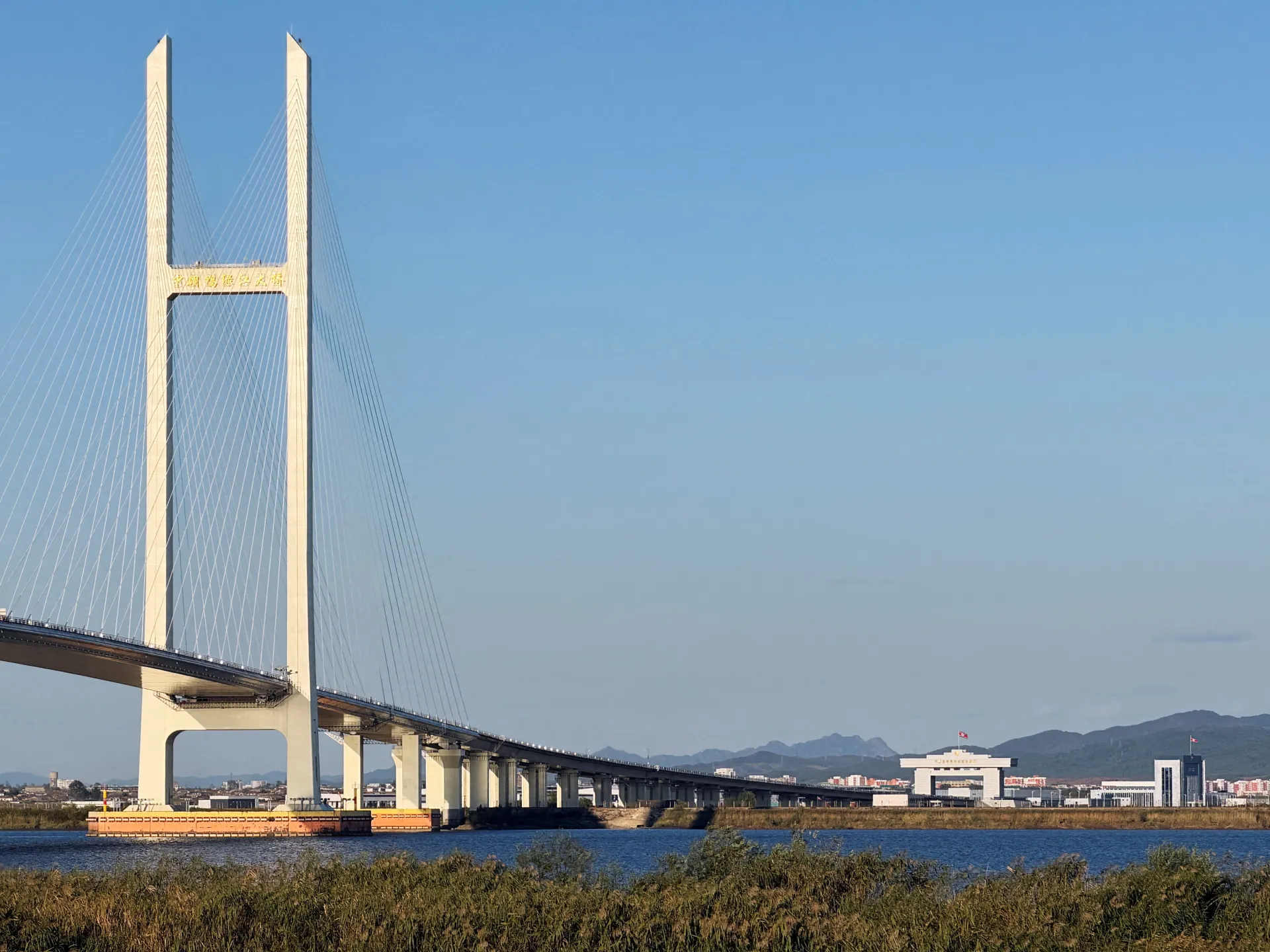
China and North Korea will officially open the New Yalu River Bridge to traffic on Thursday, China’s state-run Xinhua news agency reports.
China completed its side of the bridge in 2014, hoping to boost trade ties. However, North Korea left its side unfinished for years as relations soured after Beijing supported United Nations sanctions over Pyongyang’s nuclear tests.
Recommended Stories
list of 4 itemsend of list
The first bridge connecting Russia and North Korea also opened earlier this month.
China-North Korea Relations
China’s exports to North Korea rose to a six-year high of $2.3bn last year, a 25 percent increase from the previous year. Chinese President Xi Jinping was welcomed in Pyongyang in June for the first time since 2019.
Since 2018, Beijing has tried to repair ties with Pyongyang, which also briefly began improving relations with Washington around the same time.
The China-North Korea relationship was forged during the Korean War. In 1961, the two countries signed the Treaty of Friendship, Cooperation and Mutual Assistance, which remains China’s only formal military alliance.
The treaty contains a mutual defence clause committing either side to assist the other if one comes under armed attack.
Although China was North Korea’s main diplomatic partner and protector for decades, relations strained after Beijing in 2017 supported tightening sanctions on Pyongyang for its nuclear weapons programme.
Analysts say North Korea’s recent growing relationship with Russia may have changed the balance of Pyongyang’s diplomatic dependence, reducing its reliance on Beijing.
North Korea and Russia signed a comprehensive strategic partnership treaty in 2024, including a mutual defence provision. Military and political ties between the two countries have grown considerably stronger, with North Korea deploying thousands of troops to fight in Russia’s war on Ukraine.
United States President Donald Trump also signalled an interest in repairing relations with Pyongyang last month, after his talks with North Korean leader Kim Jong Un abruptly ended in 2019. In his second term, Trump has floated meeting Kim again, though no official meeting has been set.
North Korea has not yet resumed issuing tourism visas to Chinese citizens, who once made up the bulk of its overseas visitors.
While North Korea’s trade with Russia largely involves military supplies, exchanges with China could arguably involve goods North Korea needs to develop its civilian economy, analysts have said.
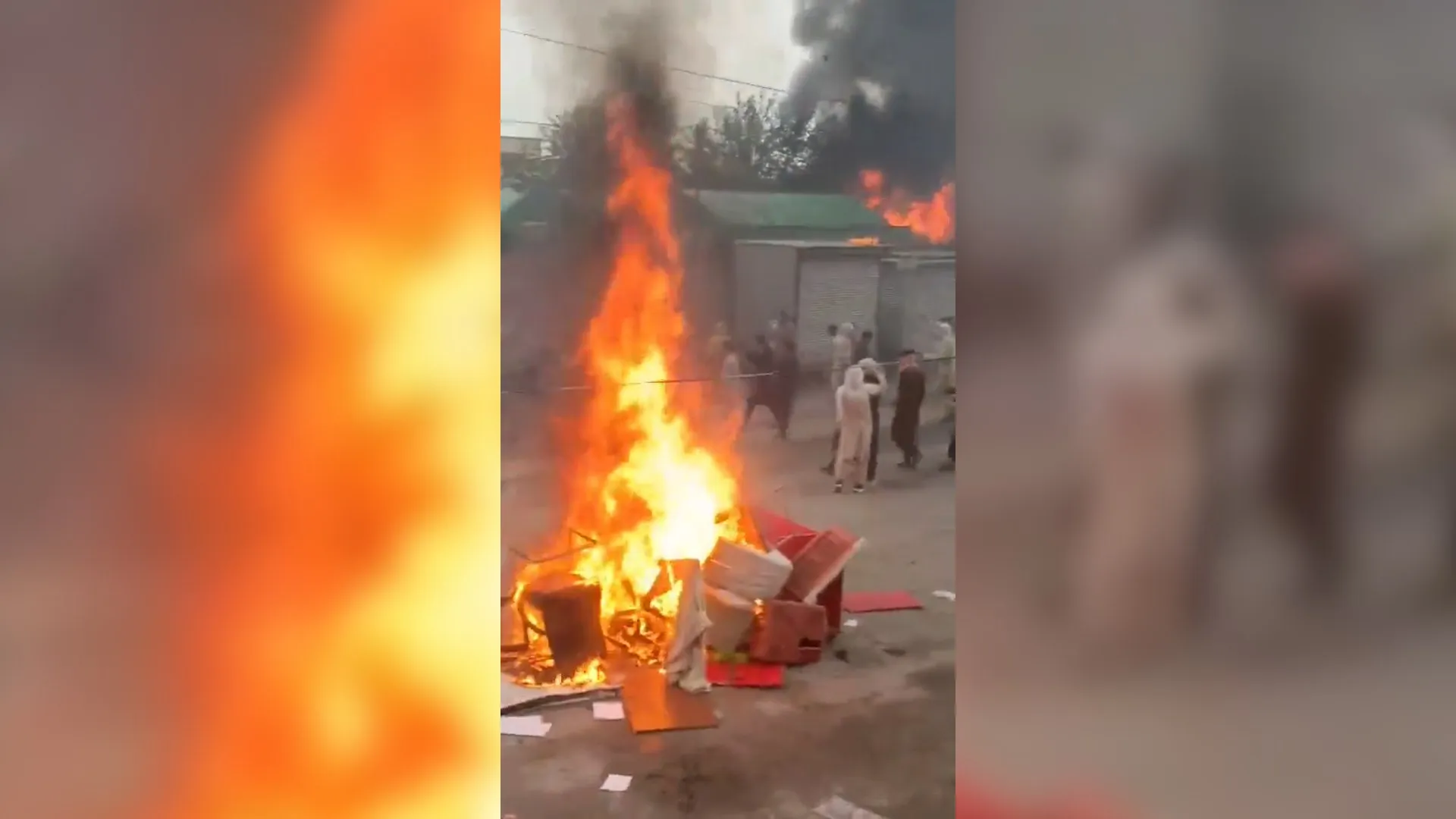
Protesters in Pakistan’s Khyber Pakhtunkhwa province clashed with police over emergency and governor’s rule put in place over the local government’s alleged failure to crackdown on Tehrik-e-Taliban Pakistan fighters. Police fired on protesters, injuring at least five people.
Suspect was arrested on Russia’s far-eastern Sakhalin Island before being transferred to Moscow, says Russia’s FSB.
Published On 13 Oct 202613 Oct 2026
Russian authorities say they have arrested a Japanese journalist on the far eastern Sakhalin Island, accusing him of espionage.
The Federal Security Service (FSB) announced the arrest on Tuesday, saying the man was believed to have gathered information on Russia’s defence capabilities for Japanese intelligence. The charges carry up to 20 years in prison.
Recommended Stories
list of 3 itemsend of list
Russia’s Ministry of Foreign Affairs named the journalist as Imai Yuki, who it said worked for Japan’s Hokkaido Shimbun newspaper.
The Japanese government was trying to verify reports of the journalist’s detention, according to an official at Tokyo’s embassy in Moscow cited by Japan’s Kyodo news agency.
The journalist was arrested on Yuzhno-Sakhalinsk, the main city on Sakhalin Island, as he was preparing to leave Russia, said the FSB. He was then flown to Moscow, where a court ordered him to be held behind bars pending the probe, the agency added.
A video shared by Russia’s TASS news agency, attributed to the FSB, shows masked officers appearing to handcuff the suspect in a hotel room, before transporting him to an interrogation room.
The suspect was then shown boarding a plane accompanied by two FSB servicemen, before appearing in a cage on trial in a Moscow court, which authorised his custody for nearly two months.
The Japanese man’s arrest comes amid a spike in tensions between Russia and Japan following Russian President Vladimir Putin’s trip in August to the Kuril Islands, the Moscow-controlled Pacific archipelago that is claimed by both countries.
The Sakhalin region includes Sakhalin Island and the four southernmost islands of the Kuril chain, which Japan calls the Northern Territories.
Russia and Japan never signed a formal World War II peace treaty, with the main obstacle being the unresolved territorial dispute over the Kuril Islands.
Authorities in Russia have arrested numerous foreigners for alleged espionage since it invaded neighbouring Ukraine in 2022.
One of the most prominent cases was the detention of Wall Street Journal reporter Evan Gershkovich in 2023. He was found guilty of espionage by a Russian court, sentenced to 16 years and then freed in a major prisoner swap involving Russia and Western countries in August 2024.
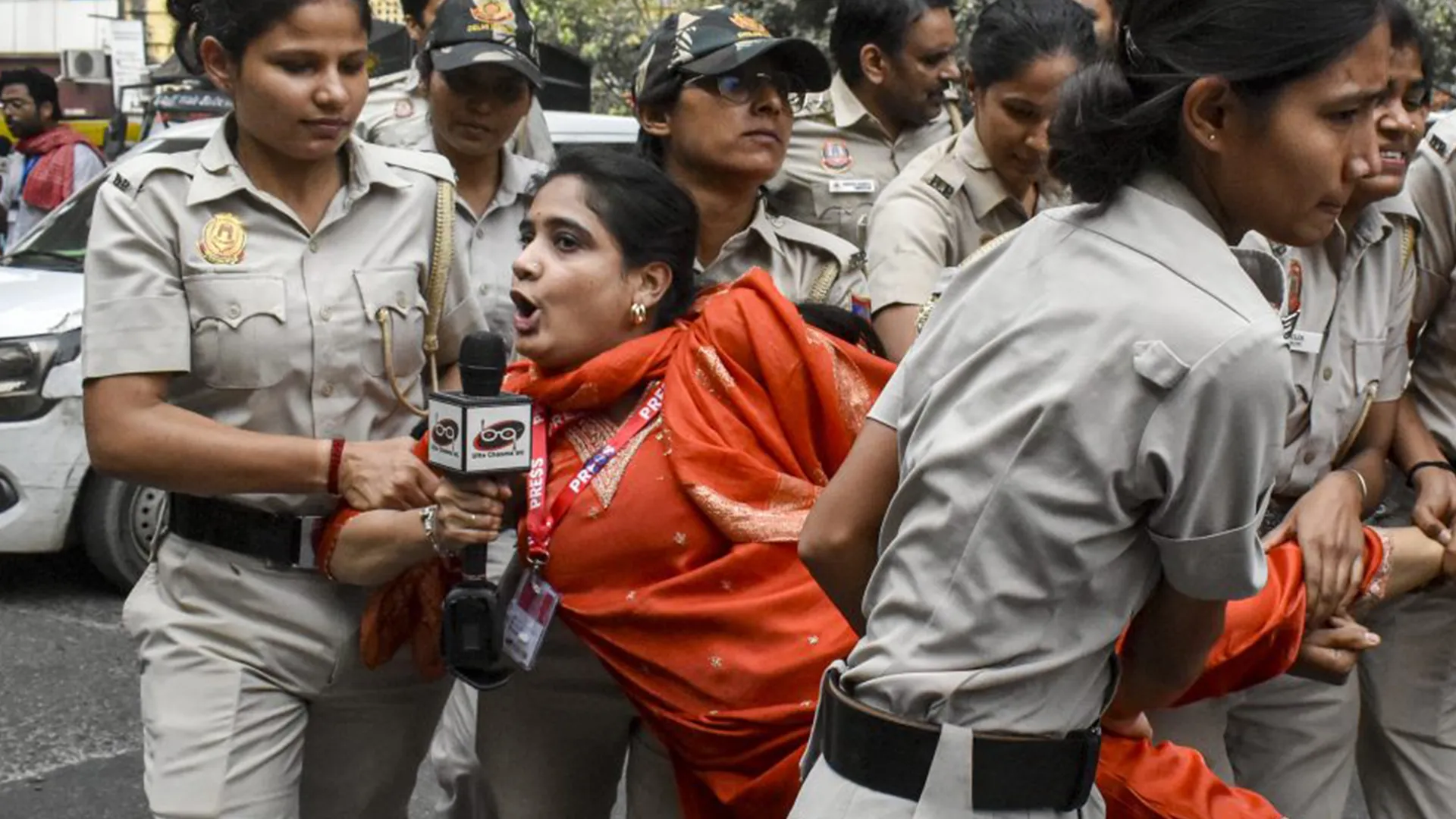
Police in India detained at least 35 media workers covering protests in New Delhi over a 48-hour period, according to the US-based Committee to Protect Journalists. Authorities allege they were obstructing police duties.