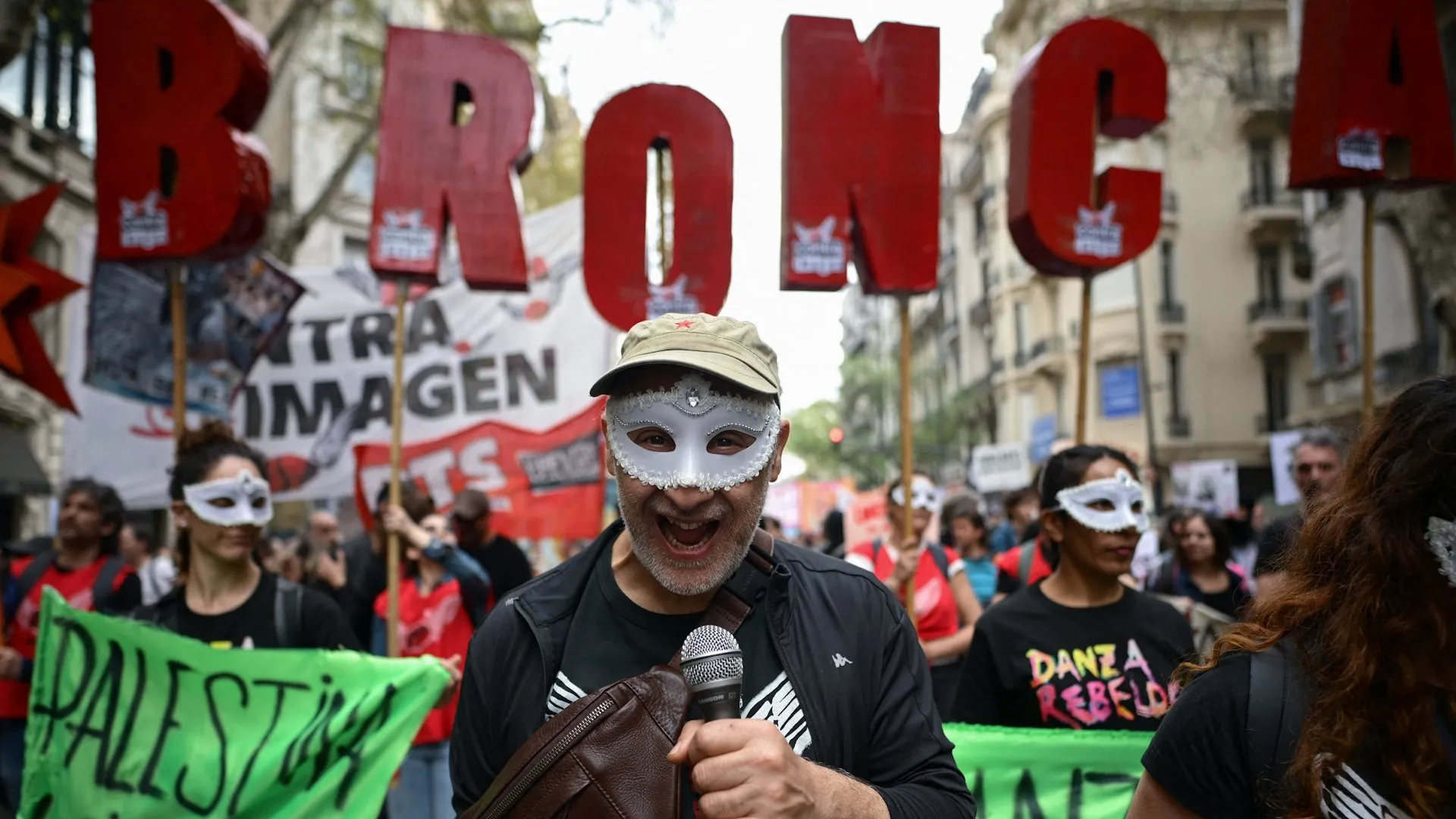
Thousands of people have taken to the streets of Rio de Janeiro in a student-led protest against presidential candidate Flavio Bolsonaro and the growing influence of Brazil’s far right.
The march happened on Wednesday, just days after far-right Senator Flavio Bolsonaro, the son of former President Jair Bolsonaro, earned the most votes in the first round of the country’s presidential race.
Bolsonaro won 47 percent, ahead of his closest rival, incumbent left-wing President Luiz Inacio Lula da Silva, who gained 45 percent support.
Since neither candidate surpassed the 50 percent threshold, they will face each other in a run-off on October 25.
The results have triggered fears that Brazil could become the latest Latin American country to see its presidency switch from left to right.
Protesters marched through downtown Rio carrying signs reading “Never again Bolsonaro” and “No to the father, no to the son”. Others held banners reading “Dictatorship never again” and “Get out Bolsonaro”.
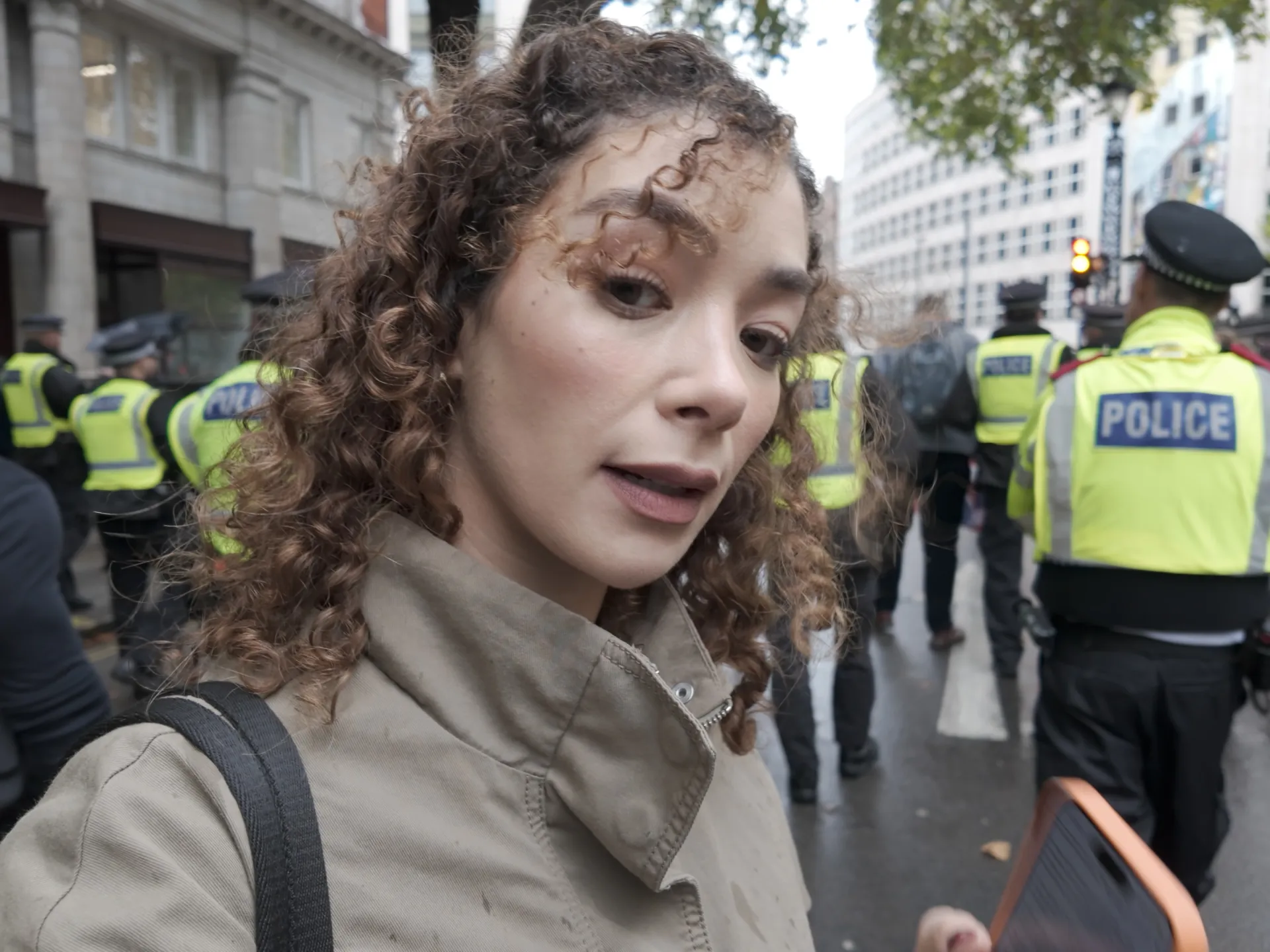
“I’m here because I believe in democracy. Because I’m scared,” said Alice Carneiro, 25, an administrator in maritime shipping who participated in the protests. She explained that, under a far-right government, she feared a backlash against her wife, who is transgender.
Jair Bolsonaro, the former president, led the country from 2019 to 2023. But his single-term tenure was marked by a series of controversies related to his far-right policies.
He voiced support for Brazil’s past military dictatorship, which was responsible for the disappearance and murder of hundreds of perceived dissidents. He also spread unfounded claims about the accuracy of Brazil’s election system, leading to a court ruling that barred him from holding office for eight years.
Currently, the former president is serving a 27-year sentence after being convicted of plotting to overturn his 2022 election defeat. After Lula’s inauguration in 2023, Bolsonaro’s supporters stormed government buildings in the capital, reportedly hoping to trigger a military uprising.
Critics have framed Jair Bolsonaro’s actions as a threat to Brazil’s democracy.
But Senator Flavio Bolsonaro has received his father’s endorsement, and he has backed amnesty for his father, a prospect that has raised concerns among protesters.
“I find this rise of the far right and the rise of Bolsonarism in Brazil very, very sad,” said Emmanuel Araujo, 19, who is preparing for university entrance exams.
“Lula might not be my preferred candidate,” Araujo added, “but amid this barbarism, we have to choose between someone we can keep criticising and someone who might take away our right to speak.”
Horror star Mia Goth is ending her marriage to Shia LaBeouf just days short of their 10th wedding anniversary.
Goth, star of Ti West’s “X” trilogy, on Tuesday filed her petition to divorce “Peanut Butter Falcon” and “Honey Boy” actor LaBeouf in Los Angeles Superior Court. According to the petition, the estranged spouses married Oct. 10, 2016 but separated in July 2025. The petition confirms reports from earlier this year that the actors were on the outs.
Goth, 32, and LaBeouf, 40, share a 4-year-old daughter born March 2022, according to the petition. Neither representatives for the actors immediately responded on Wednesday to a request for comment.
The “Odyssey” actor filed her petition a day after LaBeouf’s ex-girlfriend FKA twigs brought her latest lawsuit against the former Disney Channel star to a close.
LaBeouf, who had an off-and-on relationship with Goth since their marriage, began dating FKA twigs, legal name Tahliah Barnett, in 2018. Barnett first sued LaBeouf in 2020, claiming she was subjected to frequent episodes of verbal and emotional abuse that escalated into physical assaults by the “Transformers” actor. She also accused LaBeouf of “knowingly infect[ing]” her with a sexually transmitted disease. The exes settled that case with prejudice last year but it returned to a legal spotlight in March.
The Grammy-winning “Eusexua” musician sued LaBeouf, alleging he “sought to silence her” from speaking out about his alleged abuse via an NDA which she claimed violated California law. Barnett on Monday notified the court that she and LaBeouf settled their case, noting that her ex “has agreed that the non-disclosure provisions (NDAs) contained” in the 2025 settlement “are terminated and void.”
LaBeouf faced additional legal turmoil for his arrests in February after his involvement in a Mardi Gras brawl. He pleaded guilty to three counts of simple battery in June.
Goth also faces legal issues. The British star was sued for battery in a 2024 lawsuit that accused her of “intentionally and willfully” assaulting and kicking an actor in the head while filming “Maxxxine” in 2023. Goth was sued alongside director West and movie studio A24. That case is ongoing and a jury trial is scheduled to begin April 17, 2028, according to a court order filed Monday.
California voters will decide whether to establish a $7.5-billion state scientific research arm — similar to the National Institutes of Health — after Gov. Gavin Newsom signed a bill that will put the proposal on the March 2028 ballot.
The new state fund would aim to blunt federal research cuts by the Trump administration and ensure state and private institutions — including the University of California and California State University — can continue to produce scientific breakthroughs.
If voters approve the measure, $7.5 billion in bonds would fund California scientific and medical research into diseases such as cancer, Parkinson’s and ALS. Other research areas include reducing wildfire risk and fighting pandemics and climate change.
“This is a research and science bond that does the opposite of what Donald Trump is doing that will allow us to double down on what makes this state great — what makes America great,” Newsom said Wednesday during a bill signing atop the Golden Gate Bridge. “We are the tentpole of the U.S. economy because we invest in the future so that we can all do well there.”
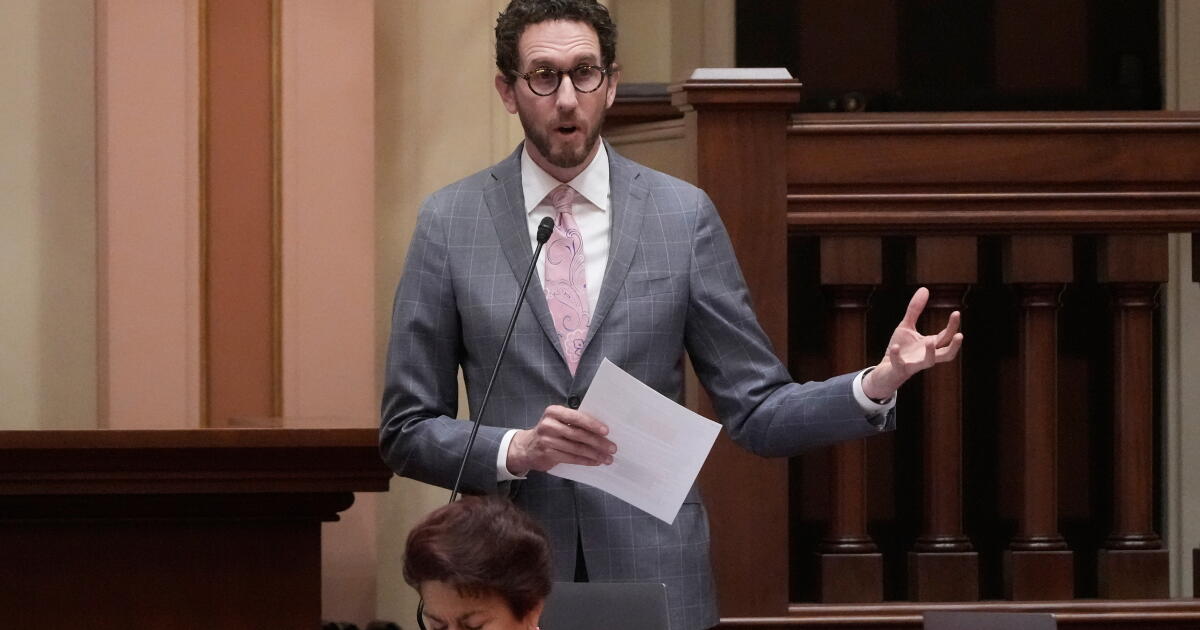
The legislation to establish the bond measure, state Senate Bill 895, was authored by Sen. Scott Wiener (D-San Francisco), who in a statement called it a “bold step to protect science, improve lives, and continue California’s global leadership on innovation for many years to come.”
The bill was sponsored by the Union of American Physicians and the University of California, as well as the United Auto Workers Local 4811, which represents some 60,000 UC academic workers.
The bond measure represents a pullback from what Wiener and supporters first proposed.
Originally conceived as a $23-billion bond measure that the Legislature would approve to go before voters in November, it was whittled down to $12 billion. But lawmakers then did not approve it in time for the November ballot.
Wiener said legislative leaders and the governor’s office then worked out a compromise, deciding on a $7.5-billion bond measure for 2028.
The measure also calls for the new state fund to establish regulations that would allow it to recoup part of its investments while not damaging innovation.
“This is a major achievement, made possible by an extraordinary coalition of people who understand the importance of investing in scientific research,” UC President James B. Milliken said in a statement.
Crowd gathers on Garvaghy Road early on Sunday morning to protest against the ruling allowing the march.
Published On 27 Sep 202627 Sep 2026
Northern Ireland’s High Court has permitted the Orange Order, a Protestant organisation, to march through a mainly Catholic area in the town of Portadown for the first time in 28 years, reviving one of the region’s most contentious marching disputes.
The court rejected a final attempt by residents to stop the parade passing through the Garvaghy Road early on Sunday, after Northern Ireland’s Court of Appeal overturned a temporary injunction granted on Saturday.
Recommended Stories
list of 2 itemsend of list
Large crowds gathered on the road before the procession, with the Belfast Telegraph reporting that protesters planned to block the route peacefully by linking arms.
First Minister Michelle O’Neill, vice president of Sinn Fein, an Irish nationalist party that supports a united Ireland, joined residents opposing the march.
In a statement posted on X on Sunday, she backed their right to protest and urged restraint, saying, “I am calling for calm on all sides.”
Sinn Fein leader Mary Lou McDonald also condemned the court decision in a post on X early on Sunday, calling it “disgraceful” and saying her party stood with the Garvaghy Road community.
Deputy First Minister Emma Little-Pengelly, from the Democratic Unionist Party (DUP), which supports Northern Ireland remaining part of the United Kingdom, urged people to stay away from the area.
She said on Sunday that threats of violence were unacceptable and added: “No one in Northern Ireland wants violence or disorder.”
The Orange Order is a Protestant organisation closely associated with unionism, the political tradition that favours Northern Ireland remaining in the UK.
The Parades Commission, the independent body that rules on disputed marches in Northern Ireland, approved Sunday’s procession with a 35-person limit, barred bands and accompanying supporters, and required the march to finish by 9:30am (08:30 GMT).
The dispute over the Drumcree parade and Garvaghy Road became one of the most bitter marching confrontations of the “Troubles”, the decades-long conflict over Northern Ireland’s political status that largely ended with the 1998 Good Friday Agreement.
Repeated attempts by the Orange Order to return from Drumcree church along Garvaghy Road triggered protests, violence and major security operations during the 1990s.
Pro-Palestine protesters have marched on Labour’s annual conference in Liverpool, calling for an end to UK arms sales to Israel and the imposition of sanctions. The protest follows Labour’s sanctions on Israeli settlements, but demonstrators say the measures do not go far enough.
Islamabad, Pakistan — The motorway linking Pakistan’s capital with Peshawar, about 180km (110 miles) to the northwest, has been closed to all traffic until further notice, according to a police notification.
So have the highway towards Dera Ismail Khan, the Hazara motorway and the Grand Trunk Road at Attock.
Recommended Stories
list of 4 itemsend of list
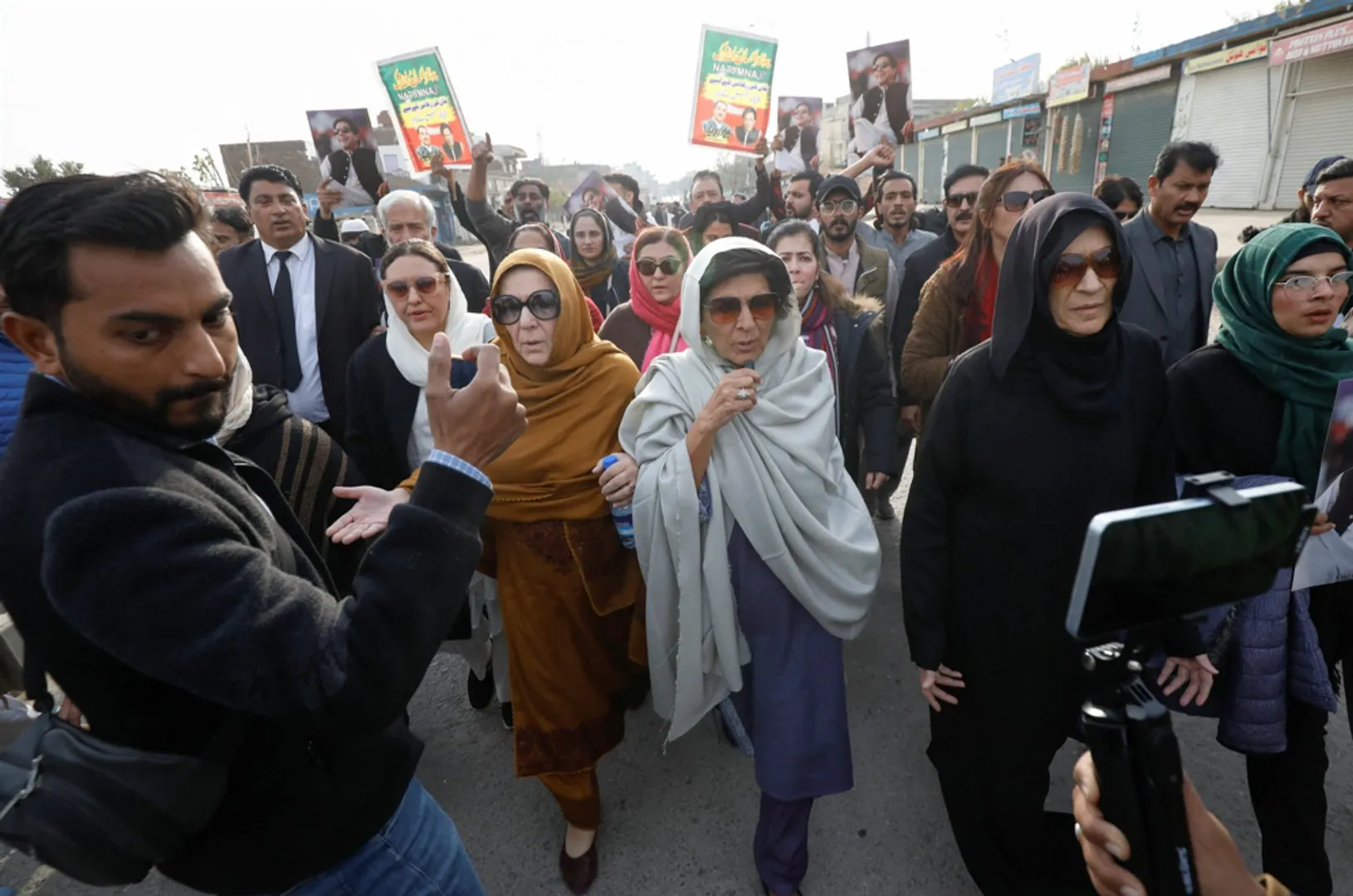
Each carries traffic between Islamabad and Khyber Pakhtunkhwa, the province governed by the party of jailed former Prime Minister Imran Khan, whose supporters plan to march on the capital on Sunday, September 27, demanding his release.
The motorway from Lahore, about 375km (235 miles) to the southeast, remains open.
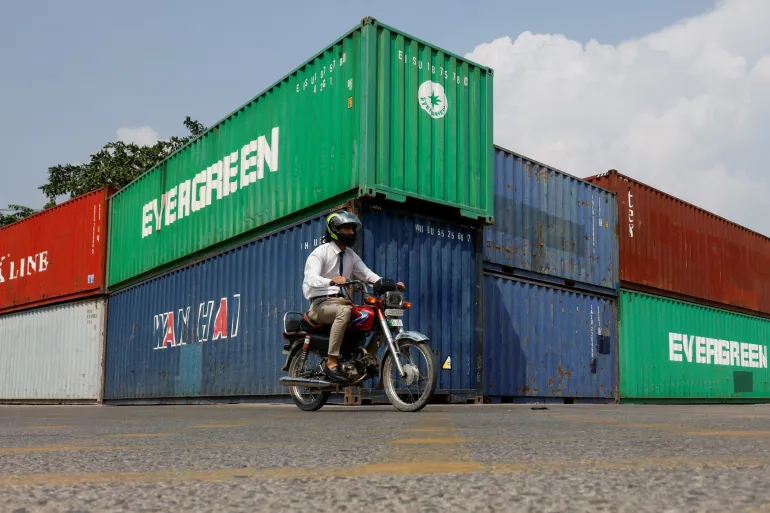
Inside Islamabad, workers have welded shipping containers together and filled them with gravel and sand so they cannot be pushed aside. Several schools and colleges have been told to shut so police brought in from Punjab and Sindh can be housed there.
Police expect the march to draw between 20,000 and 25,000 people, according to local media reports.
While two of the country’s main opposition parties announced marches on the capital this month, only Khan’s Pakistan Tehreek-e-Insaf (PTI) has faced measures on this scale.
Jamaat-e-Islami (JI), a religious party, also set out for Islamabad last week to protest against rising fuel prices. On Monday, Prime Minister Shehbaz Sharif telephoned its leader, Hafiz Naeemur Rehman, and by Tuesday afternoon JI had postponed its march, pending a meeting between the two men.
PTI leaders have received no such call.
Instead, Khan’s three sisters, all over the age of 65, have been detained in Lahore and at least six of the party’s legislators in Islamabad, all under a 1960 public order law that allows preventive detention without charge.
PTI says the true figure of those arrested is higher, and that one lawmaker taken from the parliament lodges has not been traced since.
Khan has been in prison since August 2023 and remains Pakistan’s most prominent opposition figure. But his party enters the final stretch before the protest weakened, with no major demonstration outside Khyber Pakhtunkhwa since November 2024, by its own account.
Yet, say analysts, the Pakistani government appears to be treating the protest march as a far bigger threat than a regular political event would warrant.
“While this is undoubtedly a difficult moment for PTI, it is equally exposing the government’s own frustration,” Habib Akram, a Lahore-based political analyst, told Al Jazeera.
“In fact, the government’s conduct suggests something more. It isn’t just afraid of this protest; it has turned this protest into a matter of its own survival.”
A capital behind containers
More than 2,000 containers have been placed across Islamabad and at Attock Bridge, the main crossing between Khyber Pakhtunkhwa and Punjab, according to media reports, with 19,000 police officers on their way from Punjab and Sindh, and thousands more deployed at Attock.
A man rides a motorcycle past shipping containers used to block the road in Islamabad before a planned march by former Pakistani Prime Minister Imran Khan’s party, demanding his release, on September 23, 2026. [Akhtar Soomro/Reuters]
Dawn, the country’s leading English-language newspaper, said in an editorial that the government appeared to be preparing “not for a political event but an invasion”.
Talal Chaudhry, the junior interior minister, rejected the suggestion that the government was shutting down the capital itself.
“Normal life in Islamabad is continuing. Hospitals, offices and essential services are functioning. The containers and security arrangements are precautionary measures, not a shutdown,” he told Al Jazeera.
Rana Ihsaan Afzal, a coordinator to the prime minister and a government spokesperson, was more candid.
“In trying to counter the rhetoric PTI has adopted, we do have to take certain measures, and yes, those measures carry their own consequences too, but we have to look at the bigger picture,” he told Al Jazeera.
It is all being mounted during one of the deadliest weeks for Pakistan’s security forces this year.
An attack on a police compound in Kohat, in Khyber Pakhtunkhwa, killed more than 20 people on September 18, and six soldiers were killed in a gunfight in nearby Hangu two days later.
Interior Minister Mohsin Naqvi set those losses against the march in Lahore on Monday.
“The situation in KP [Khyber Pakhtunkhwa] over the past 10 days is before everyone. There was a suicide attack on a mosque, and two or three other attacks. Our captain was killed, our soldiers were killed, our policemen were killed, and these people are preparing to storm a city,” he said.
The government’s case
Government ministers have seized on a remark by Junaid Akbar, PTI’s chief in Khyber Pakhtunkhwa, who said protesters would turn Islamabad into Somnath, a Hindu temple in India sacked by Mehmood of Ghazni, an 11th-century invader, to try to paint the upcoming protest as a major law and order threat.
“Peaceful people do not leave their homes carrying nail-studded sticks,” Information Minister Attaullah Tarar said in Kohat on Monday.
But the PTI’s Sohail Afridi, the chief minister of Khyber Pakhtunkhwa, who will lead the September 27 march, answered Tarar in Peshawar on Monday.
“We will go there on nothing but two hands and two feet. There will be nothing else in our hands,” he said.
In a September 18 judgement, the Islamabad High Court ruled that no party could block roads into the capital, and barred provincial governments from using state resources for the march.
Days later came the arrests of Imran Khan’s sisters. Aleema Khan was detained in Lahore on Sunday, and her sisters, Uzma Khan and Noreen Niazi, were taken in a predawn raid on their homes the next day, according to a family statement on September 22.
The Lahore High Court has reserved its decision on whether a petition challenging Aleema’s detention is admissible, after the family’s lawyer argued that the order was issued after the arrest.
Chaudhry said the sisters faced several cases, had led confrontational protests in the past, and were being held as a preventive measure.
PTI says the arrests reach far wider, listing five members of the National Assembly, a senator, provincial legislators and more than 1,500 workers.
“We were peaceful, we are peaceful, and we will remain peaceful. We are being punished for being peaceful,” Gohar Ali Khan, the PTI chairman, said in Peshawar on Monday, noting that four women from Khan’s family, including his wife Bushra Bibi, are now in jail.
Supporters welcome Khyber Pakhtunkhwa Chief Minister Sohail Afridi (centre) in Hyderabad, Pakistan on September 6, 2026, during a rally. [Nadeem Khawar/EPA]
‘Long march’ vs ‘permanent plan of action’
But Interior Minister Naqvi suggested that the government is bracing for a confrontation.
“I think this time we will draw up a permanent plan of action. We will not go halfway,” Naqvi said in Lahore on Monday, adding that the matter would be settled “once and for all”.
What he ruled out was a long sit-in of the kind PTI has staged before.
“This time, it will not happen that they come, and the country is shut down for 10 or 20 days. That possibility does not exist,” he said.
Afridi has signalled that he has exactly that in mind.
“The long march is not a T20, it will be a Test match,” he said on Monday, a reference to cricket’s five-day format.
If Naqvi’s comments sound ominous, they also carry a history with them.
On May 9, 2023, after Imran Khan was briefly arrested, his supporters attacked military installations across the country, including burning down a senior commander’s official residence in Lahore. That led to a major crackdown on the PTI’s supporters and leaders, with hundreds placed under arrest for days, and party leaders pressured to leave the group.
Then, on November 26, 2024, a PTI march on Islamabad ended in an overnight crackdown by security forces, in which the party says at least 12 of its supporters were killed. The government denies that, and says four security personnel died — even though Al Jazeera met families of some of the PTI supporters killed.
A contested mandate
PTI was stripped of its electoral symbol before the February 2024 general election, forcing its candidates to run as independents.
They still won 93 seats, more than any other party, but could not form a coalition, and the Pakistan Muslim League – Nawaz took power with other major parties.
A Commonwealth observer group, in its report on the polls released a year later, found that decisions by key institutions had “consistently limited the ability of one particular party” to contest the vote, in a reference to the PTI.
While the Election Commission of Pakistan rejected allegations of rigging, two and a half years on, the popularity scale remains tilted in favour of PTI.
Bilal Gilani, executive director of the pollster Gallup Pakistan, said its unpublished Public Opinion Pulse surveys showed a landscape broadly similar to 2024.
“PTI continues to lead nationally, but faces strong competition from PML-N in Punjab and PPP in Sindh,” he told Al Jazeera, adding that Khan remained the country’s most popular leader.
For Akram, that unresolved argument — over the lack of legitimacy of the 2024 election in the eyes of Pakistanis — is what keeps the pressure on.
“You can hold as much power as you want, but that question never fully goes away. It continues to haunt you, and it continues to be a source of anxiety for the government,” Akram said.
The ‘hard state’
In March 2025, army chief Field Marshal Asim Munir, who now also serves as Pakistan’s chief of defence forces, told a parliamentary security committee that the country must stop acting as a “soft state”.
“How long will we continue to sacrifice countless lives in a manner of a soft state?” he asked, according to state broadcaster PTV.
For Ahmed Ijaz, an Islamabad-based political analyst, the response to the September 27 march is a response to that thinking, rather than the PTI’s strength.
“Behind that confidence lies the thinking of a hard state, one that has decided no one will be granted an unconditional right to protest going forward,” he said.
Supporters of the Islamic political party Jamaat-e-Islami (JI) hold placards and party flags during a protest in Karachi, Pakistan, September 20, 2026 [Shahzaib Akber/EPA]
Akram, however, said that a different factor might also be worrying the government and the military behind it.
The war in the Middle East has pushed petrol to 393.75 rupees ($1.42) a litre ($5.37 per gallon), up about 51 rupees ($0.18) since the start of September. That is what Jamaat-e-Islami was marching against, and it has warned that it will resume its march in October if the prime minister offers no relief.
Akram said the government’s real worry is multiple issues of antigovernment anger — price rises and Imran Khan’s continued incarceration — coming together.
“That merging could then pull other groups out onto the streets too, and that is precisely what worries the government,” he said.
Imran Khan’s family and PTI officials say three of the jailed former PM’s sisters have been detained in Lahore ahead of a September 27 march on Islamabad demanding his release. Authorities have confirmed Aleema Khan was ordered to be held for 30 days.
Thousands of protesters took to the streets of Buenos Aires for the ‘March of Anger’, organised largely by left-wing groups opposing the Milei government’s austerity policies. Protesters say the cuts are hurting working families.
The former couple, who tied the knot in March 2017, told People that they had been separated for some time.
“We have been separated for a while, and it’s proven to be the right move for us and our family unit. We’ve got each other forever — and it’s GOOD,” Seyfried and Sadoski told the outlet.
On Tuesday, Seyfried shared a piece of prose by poet and author Bianca Sparacino on her Instagram stories that read:
“Maybe in another lifetime.”
“No.
“This is all you get. So please, just fight for the things that crack light into your life, fight for the things that soften you. Protect the people you love, leave them better than you found them. Defend your heart, do whatever it takes to keep it open despite what it has been through. Forgive, not just others, but yourself, as well. Slow down. Taste, and touch, and feel and care. Create the things you want to see in this world, stay as curious as possible. Honour your joy, do not shy away from the good that is trying to reach you, do not convince yourself that you are unworthy of it. Be strong enough to be gentle. Be brave enough to break. Be all that you are. Be all that you are.”
The pair met back in 2015 while starring in “The Way We Get By,” a two-person off-Broadway play that explores love and lust and takes place the morning after a drunken hookup. It was Seyfried’s stage debut. “I feel like the luckiest guy in New York right now, to be honest with you,” Sadoski told Backstage on Broadway at the time. “I mean, I get one of the great American playwrights, one of the great American directors, and a perfect scene partner, I’m a pretty happy guy.”
The two teamed up again the same year to play love interests once more in “The Last Word.”
After spending a good portion of the year pretending to be in love with Seyfried on stage and screen, in October 2015, Sadoski split from his wife of eight years, studio casting executive Kimberly “Becky” Hope. By March 2016, the “Newsroom” actor was romantically linked to the “Mamma Mia!” star.
Seyfried, 40, and Sadoski, 50, tied the knot in a private countryside ceremony in 2017. There were no family or friends on the guest list, just their officiant and Seyfried’s dog, Finn. Shortly after the nuptials, the pair welcomed a baby girl, Nina. In 2020, they had a son, Thomas Jr.
The couple have raised their family on a farm in the Catskill Mountains of upstate New York, a property the “Mean Girls” star bought in 2013, while also maintaining properties in Los Angeles and Manhattan. But last month, Seyfried listed her 2,700-square-foot Los Angeles residence for about $3.2 million.
Protesters in about 20 cities, including Berlin, Hamburg and Munich, demand the banning of the Alternative for Germany.
Published On 12 Sep 202612 Sep 2026
Tens of thousands of people took to the streets across Germany to protest against the Alternative for Germany (AfD) after the far-right party won a state election by a landslide.
About 150,000 demonstrators turned out in roughly 20 cities on Saturday, including Berlin, Hamburg and Munich, in rallies organised by Pruef, a campaign group pushing for a ban on the AfD.
Recommended Stories
list of 3 itemsend of list
Protesters carried signs reading “Ban the AfD now” and “Democracy needs no alternatives.”
“A broad cross-section of civil society is taking to the streets to prevent the enemies of the constitution … from gaining government power,” said Christoph Bautz, head of Campact, another campaign group involved in the protests, which put turnouts at about 25,000 in Hamburg and 12,000 in Munich.
According to police, several thousand more joined separate demonstrations in Berlin.
The AfD held its own counter-rally in the German capital, attended by Kristin Brinker, the party’s lead candidate for Berlin’s upcoming regional election.
The protests follow a stunning result for the AfD in Saxony-Anhalt, a state in eastern Germany, where the party took nearly 44 percent of the vote on September 6 — far ahead of the roughly 17 percent won by Chancellor Friedrich Merz’s Christian Democratic Union (CDU), which has long dominated German politics.
The AfD, known for its anti-immigration stance and friendly posture towards Russia, fell just short of an outright majority and is now in talks with other parties to try to form a government, which would make it the first far-right party to lead a German state since the Nazi era ended in 1945.
AfD state leader Ulrich Siegmund called the result historic, telling supporters: “The people have made it absolutely clear that they finally want political change and, above all, they have shown that they want it with us.” He has since signalled openness to working with other parties, after previously saying he wanted to govern alone.
The AfD’s growing strength has deeply unsettled many Germans, given the country’s history and its commitment to never repeating it.
The party is projected to win 39 of 83 seats in the state parliament, three short of a majority. It now needs a coalition partner, though all mainstream parties have so far refused to govern with the AfD under a longstanding policy known as the “firewall.” The far-right party has never joined a governing coalition anywhere in Germany, at either state or national level.
The unease has fuelled growing calls to ban the AfD altogether, though that would be legally difficult in Germany, and Chancellor Merz has been reluctant to pursue it.