



Wimbledon boss jokes Royal Marines would ‘love to sort out’ disruptive influencers
Royal Marine commandos providing security at Wimbledon would like “nothing more than to sort out” disruptive social media influencers at the prestigious tournament, its chief executive has joked.
US Open organisers accredited 100 influencers and content creators for this year’s tournament.
But when a match involving two-time champion Naomi Osaka was disrupted by a group of influencers conducting a photo shoot, it prompted a debate about tennis etiquette.
Richard Atkinson, interim chief executive at the All England Lawn Tennis Club, said Wimbledon did not offer accreditation to influencers and sources have indicated to BBC Sport that is unlikely to change in the near future.
While Atkinson acknowledged that influencers were a “crucial part of the marketing mix” and to ban them from attending the tournament entirely would be “nonsense”, he said any that were brought in by brands would be “tightly chaperoned”.
He also backed the traditional “self-policing” ethos at SW19, whereby fans respect the action.
After the disruption at the US Open, world number four Coco Gauff said it was important to welcome a “new demographic” to the sport, but said: “I think it’s just, follow the etiquette of the sport. That’s all.”
And Wimbledon’s boss made it clear he does not expect to see a repeat at the All England Club.
“We don’t have a category of accredited people called influencers,” Atkinson told a panel at Leaders Week London.
“That said, clearly influencers are a crucial part of building your brand around the world in the third decade of the 21st century.
“What you have to do is keep them under control. One of our big partners, Polo Ralph Lauren, will have their influencer, but they are all tightly chaperoned.”
He said the atmosphere at the US Open is “very New York City”, adding: “It’s dead easy for someone who has just bought a ticket to show up there with their ring lights and literally start broadcasting in the middle of a match.
“If you tried to do that at Wimbledon, I think you’d probably have some Royal Marine Commando…”
He then joked: “We do have military. And they would like nothing more, I suspect, than to sort out some influencer.”
Fans will also not be allowed to bring portable ring lights – a piece of equipment used by content creators – to SW19.
Atkinson did, however, point out that the media landscape has changed, and suggested there is a place for embracing influencers and content creators to ensure Wimbledon remains relevant.
“It’s just a crucial bit of the marketing mix, of course it is,” he said.
“We’re not in the world of newspapers and television anymore, right? The world has changed. But it’s just really important, it’s a bit of a cliched expression, you’ve got to sort it out in a Wimbledon way. But to say “we’re not going to have any influencers at Wimbledon”, it’s obviously nonsense.”
“Our marketing team work meticulously to make sure they are working in a way that is consistent with our Wimbledon brand and keeps that magic that I was referring to earlier.”

Katherine Ryan takes cheeky swipe at David Beckham
KATHERINE Ryan couldn’t resist taking a cheeky pop at David Beckham as she joked about being “cancelled” by the BBC after her rude slur about his wife Victoria.
Last month it was revealed that the broadcaster had upheld complaints after she made the offensive joke about Posh Spice while hosting an episode of Have I Got News For You last year.
Two weeks ago, Katherine issued an online apology to Victoria, 52, after the ruling by the BBC‘s Executive Complaints Unit (ECU).
Raising the controversy during a stand-up gig in Chelsea, London, last night, the 43-year-old declared her love for Victoria Beckham while making a sly joke about her famous footballer hubby.
“I have been cancelled by the BBC for allegedly calling Victoria Beckham the C word,” she said.
“Or as David Beckham knows it – the K word, because bless him the alphabet is hard,” prompting laughter from the audience.


“But I actually did not do that, I actually love Victoria Beckham.”
Speaking in an episode that aired on November 7 in 2025, Katherine made reference to a 2013 private email sent by David Beckham, where he allegedly used the word ‘c***’.
She said on the show: “I don’t know that we are allowed to broadcast the C-word, but you did reference Victoria Beckham earlier and we’ll allow that.”
The BBC’s Executive Complaints Unit said “there was no such justification” for the comment which two viewers had complained was “gratuitously offensive”.
They added that the word was justified in relation to David’s alleged use of it, but not in reference to his wife.
Now an edited version of the episode has replaced the original on the BBC’s streaming service.
Katherine Ryan publicly apologised to Victoria in an Instagram reel where she shared a screenshot of her message to the fashion designer.
“Hi I’m comedian Katherine Ryan and today the BBC announced their decision to uphold a complaint made by two very influential viewers about a joke that I tried to make on an episode of Have I Got News For You eleven months ago,” she began.
“At that time, though there is no defence, I was suffering from a condition called matrescence.
“I was in that building with a 10-day old baby. Should I have left the house?
“This is gonna be a tough one for the feminists because I was a woman going to work but I did call another woman a c***.
“Sometimes I forget that celebrities are not my friends. If I had called Jimmy Carr a c***, he wouldn’t have minded.
“Joanne McNally, c***, she wouldn’t have minded but this was described by the BBC as a slur.
“As though c**** are part of a protected group,” Katherine said in her trademark sarcastic way.
“The trouble is now that section’s been taken off iPlayer so the incident only exists in printed media, online media and then you lost the context because on the day, if you watched it, it was clearly a joke and the whole audience went ‘huhhhh’ and I said ‘whoaaaa’.”
She then plugged her new book before adding: “I love Victoria Beckham so much that I actually included her in one of my celebrity firstborn daughter chapters.
“I’d like to read you that now whilst remaining very sorry.”
In her apologise message to Victoria shown on screen, Katherine told her it was a “throwaway” comment and that she immediately expressed her love for her after, making it clear it was a “stupid joke”.
Police lawsuits have cost L.A. $480 million since 2019, new data show
The LAPD’s legal bills keep piling up.
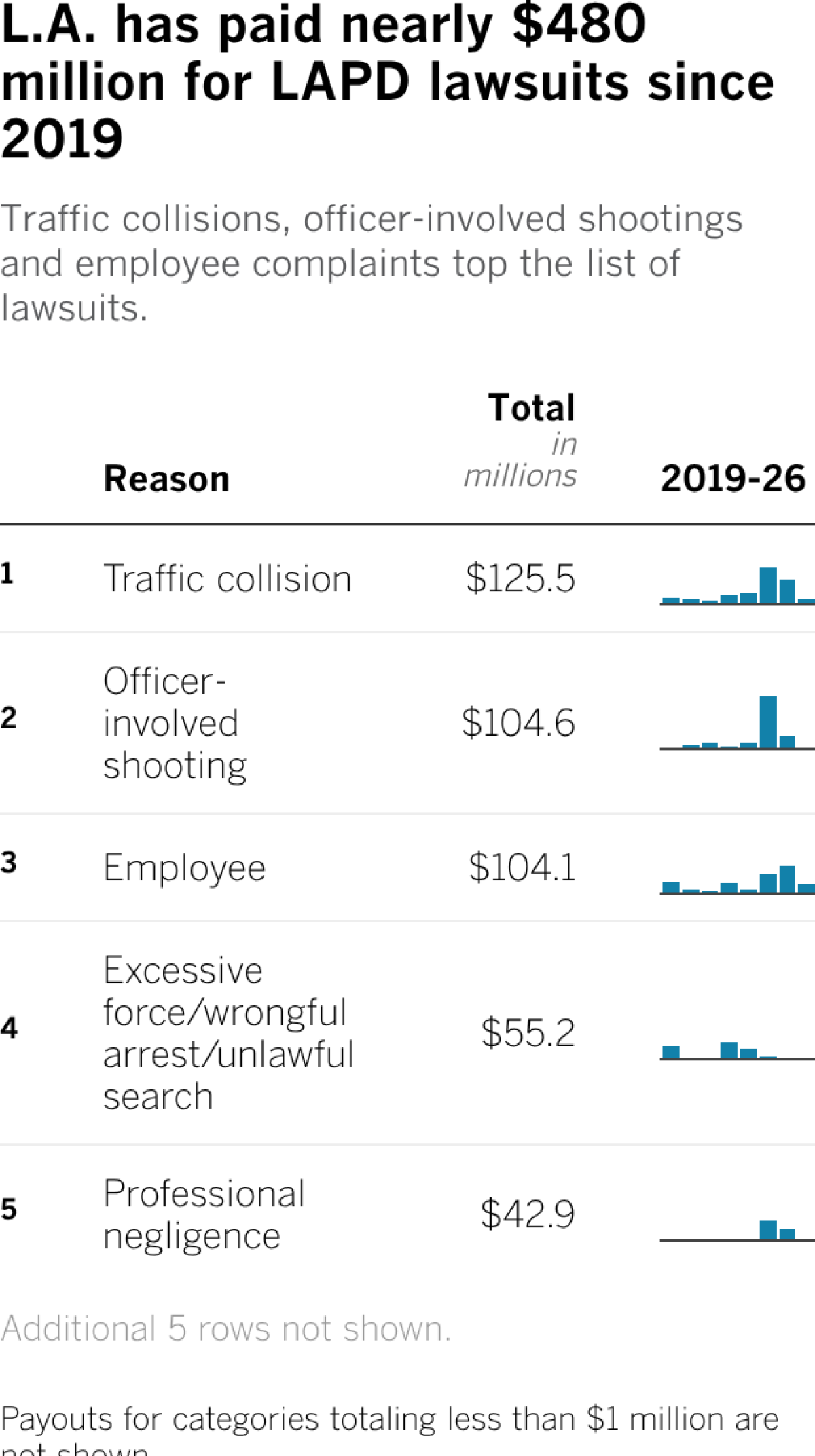
The city of Los Angeles has shelled out nearly $480 million over the last five and a half years to end legal disputes involving the Police Department, including claims of excessive force, litigation over traffic accidents and cases filed by employees who allegedly faced retaliation after reporting misconduct.
The soaring legal costs have come under greater scrutiny in recent years as Los Angeles’ financial problems have gotten worse. The city faced a $1-billion budget shortfall in 2025 but, after various cost-cutting measures, managed to set aside funding for the LAPD to hire more than 500 new officers in the coming year.
The LAPD’s annual lawsuit costs more than doubled from 2019 to 2025. The payouts peaked in 2024, when the city spent $178.6 million to resolve more than 300 police-related lawsuits and civil claims, before dropping to just over $100 million in 2025, according to a Times analysis of city attorney’s data.
The Times reviewed hundreds of pages of court documents and analyzed data from the city attorney’s office released through a public records request showing nearly 2,000 payouts dating to January 2019.
Through the first six months of this year, the city has paid out $20.3 million in legal settlements and court judgments involving LAPD officers. Several recent big-dollar verdicts aren’t included in that tally because they hadn’t yet been approved by the City Council.
The surging cost of LAPD payouts depriving the cash-strapped city of money for pressing needs such as fixing roads and sidewalks, according to City Controller Kenneth Mejia.
“There’s a reason why your streetlights are out and they’re not fixed for a year, there’s a reason why your sidewalk won’t get fixed or your animal shelters are understaffed or underfunded,” said Mejia, whose office is conducting an audit of the city’s risk management strategies, the results of which will be released this year.

Experts are still untangling the reasons for the explosion of legal payouts involving police — which stretches far beyond L.A.
This year, a legal defense organization found that New York City has paid more than $796 million since 2019 to settle lawsuits involving accusations of police misconduct — including $117 million in 2025. In Chicago, the city is on track to blow past the $252 million spent last year to resolve police lawsuits, mostly involving plaintiffs who went to prison based on faulty evidence, according to local news reports.
In Los Angeles, the surge has come under the watch of City Atty. Hydee Feldstein Soto, who has blamed the rising costs on the way the office handled litigation of all kinds before her administration — as well as a national legal trend of so-called nuclear verdicts.
“The system is getting inflated in a way that is unhealthy and it creates, I think, incentives to sue and to do pie-in-the-sky settlements,” Feldstein Soto said in interview with The Times earlier this year. She said her office evaluates each claim case by case, deciding when it makes more sense to settle rather than go to trial, at which juries can issue decisions based on emotion or differing perceptions of what occurred. Feldstein Soto has lobbied for years to change state law to limit “non-economic” damages.
Feldstein Soto’s critics contend that she has pursued a hard-line approach in recent years, refusing to settle except in cases where it is clear the city is likely to lose in court.
That tough stance has led to mixed results. The city has lost some jury verdicts that could have been avoided if it had been willing to settle. It has also prevailed in several high-profile cases, including this year when a jury ruled that an officer was not liable for the 2021 death of a 14-year-old girl killed by a wayward bullet fired during a hasty confrontation with a suspect at a North Hollywood department store.
The city attorney’s office said in a statement to The Times that while it is proactively working to curb rising litigation costs “by every means possible,” it could not “control the number, timing or claimed damages of lawsuits filed against the City.”
“Nor does the Office have control over the alleged root causes of these liabilities: the City Attorney’s Office is not responsible for LAPD policies or personnel,” said the statement, adding that the number of lawsuits filed against the city has risen by roughly 20% in each of the last four budget years, straining the office’s resources.
Zachary Powell, an associate professor of criminal justice at Cal State San Bernardino, said that although data suggest that use of force by police has decreased since 2020, the public has become “much more aware of police abuses and conduct than they ever were before.”
“I think people also ask a lot more questions in a jury setting,” he said.
Other explanations, he says, are the passage of statewide police accountability measures and the fact that a backlog of cases from the pandemic years are finally coming due.
The Times’ analysis found that hundreds of legal battles involving officer-involved traffic incidents make up nearly a quarter of all payouts. Since 2019, the city has paid $125 million for the thousands of accident claims, just under a third of which stemmed from cases in which officers were found to have failed to stop or yield at crossings before crashing into another vehicle or a pedestrian. Pursuit-related claims and suits stemming from cases in which officers made improper left turns have also cost the city millions.
Other legal costs date back years — and in some cases decades.
The city is still paying $7,410 a month to Clarence Chance, who in the early 1990s was awarded a large payment over a wrongful arrest that led him to spend 17 years in prison for a murder he didn’t commit. Nearly $40 million has gone to people whose homes were damaged after the LAPD bomb squad botched the detonation of seized fireworks and leveled part of a city block in 2021.
One of the biggest payout categories was $104.6 million spent since 2019 on claims related to police shootings — more than three-fourths of which involved people who were reported to be under the influence of a substance or in the midst of a mental health crisis, according to The Times’ analysis. Roughly $38.4 million was paid out after police shot someone wielding an edged weapon, such as a knife, the analysis found. Shootings involving gang officers cost the city nearly $4 million in that span.

Dozens of lawsuits remain pending, including claims related to the handling of mass pro-immigration protests since last year, likely putting taxpayers on the hook for more large payouts in the future. Police use of hard foam projectiles, house-mounted officers and other tactics against crowds have already cost the city at least $22 million in the last seven and a half years — just over half of which stemmed from the department’s response to the 2020 mass protests over the murder of George Floyd.
Such totals may not always include lawyer fees that are negotiated after a settlement is reached — or if a case is appealed.
Jonathan Evans, a civil rights attorney who has sued the department, thinks the big payouts show that greater public awareness of mental health issues is a factor. Recognizing this, he said, municipalities are agreeing to higher settlements than in years past.
“The decision to use lethal force is being more heavily scrutinized,” he said.
Tens of millions of city dollars have in recent years gone to disgruntled police officers who sued over workplace injustices such as sexual harassment, racial discrimination and retaliation. Since 2019, at least 27 LAPD employees have won million-dollar-plus jury verdicts or settlements from the city; many more have seen five- or six-figure paydays.
To clamp down on future legal costs, the department last year brought back a former senior official, Arif Alikhan — at a monthly salary of $20,000, paid for by a private donation — to study how to reduce the number of costly lawsuits. Alikhan did not respond to a call requesting comment.
The department maintains an early intervention system that flags officers based on risk factors, such as a relatively high volume of civilian complaints, frequent use force, and involvement in preventable traffic collisions or pursuits. The system is used to determine whether they need additional training or should be reassigned or placed on a performance improvement plan.
Within the LAPD, some officers and the Los Angeles Police Protective League, the rank-and-file union, argue that the city should fight back harder against claims with no credibility, instead of settling. They say officers who are most often sued tend to come from specialized units that do the type of proactive policing that the department and most of of the public wants: targeting gangs, drugs and guns.
Attorneys who represent officers that have sued the department over whistleblower retaliation dismiss the claim by Chief Jim McDonnell and others that some cops are exaggerating their claims in pursuit of a big payday. If anything, they contend, the continued large payouts are a product of entrenched racial and gender bias and inconsistent discipline — and the LAPD’s unwillingness to learn its lessons from past lawsuits.
Greg Yacoubian, a labor attorney, said there is little incentive for the current system to change because the costs of lawsuits are passed on to taxpayers — not the officers involved in misconduct and their bosses.
“The person responsible for the error never feels the pinch,” Yacoubian said.
Times staff writer James Queally contributed to this report.

Don’t expect Dodgers to sweep Milwaukee Brewers again in NLCS
A growing scrum of reporters around Andrew Friedman, the Dodgers’ president of baseball operations, in the locker room Wednesday night after the Dodgers defeated the Atlanta Braves to advance to the National League Championship Series, didn’t put a damper on the celebration.
Tanner Scott stuck upside-down beers in Friedman’s shirt. Alex Freeland dumped beer into his mouth and all over his face. Eric Lauer coordinated a sneak attack, announcing that he was heading to the showers before reappearing from a side entrance.
Friedman never stopped grinning. But it almost looked like he had an extra glint in his eye when asked whether he’d rather take on the Milwaukee Brewers or San Diego Padres in the NLCS.
“I just want chaos,” Friedman said.
Later that night, the Brewers advanced, locking in an NLCS rematch that could certainly deliver chaos.
The Dodgers and Brewers are meeting in the playoffs for the fourth time in nine years. Last season, the Dodgers swept Milwaukee in the NLCS.
Usually before playing a big-market team like the Dodgers, Brewers manager Pat Murphy leans into the underdog narrative by saying he suspects the opponent can’t name many of the Brewers players. But by becoming perennial playoff contenders, and posting the best record in the majors over the past two seasons, the Brewers have given up whatever anonymity they may have had when they promoted Murphy a few years ago.
The cast of characters on both sides has remained relatively consistent since last October. But even after trading away top pitcher Freddy Peralta, Milwaukee is a more complete team than last season.
But losing talented players hasn’t stopped the Brewers from winning the last four NL Central titles. They keep saying goodbye to top players — including Cy Young winner Corbin Burnes, closer Devin Williams and shortstop Willy Adames — then raise their win total.
Many of the players remain the same, although the Brewers added former Dodgers starting pitcher Dustin May and reliever JoJo Romero in a trade with the St. Louis Cardinals at the deadline, after losing in the Tarik Skubal sweepstakes. Several players also took important steps forward.
The biggest difference-maker has been Jacob Misiorowski, who had the lowest ERA (1.80) in the majors this season and is the NL Cy Young favorite. As a rookie last year, the flame-thrower was relegated to the postseason bullpen until the NLCS. This year, he was the Brewers’ Game 1 starter in the NLDS against the Padres.
The Brewers have long hung their hat on playing sound baseball, from pitching and defense to baserunning. But the knock on them has been the lack of thump in their lineup.
First baseman Jake Bauers had a career season, leading the team in home runs (26), on-base percentage (.389) and on-base-plus-slugging percentage (.873). Jackson Chourio, who was hobbled by a hamstring injury in the last NLCS, hit a career-high 25 home runs and led the team in slugging percentage (.487). And though the Brewers likely won’t out-slug the Dodgers — they hit 50 fewer home runs during the season — they have a pesky roster that stole 90 more bases.
The Brewers also had a better regular-season record (103-59) than the Dodgers (100-62), so the series will begin in Milwaukee on Sunday.
Signs point to a more competitive series than last year. The Brewers even entered the postseason with the better World Series odds (18.5%) than the Dodgers (16.7%), according to Baseball Prospectus’ PECOTA standings.
The Dodgers certainly won’t take the matchup lightly. They made sure not to underestimate the No. 3 seed Braves.
“The mistake that the outside perspective kind of gets sometimes is to underestimate certain teams,” said Kiké Hernández as the Dodgers celebrated their NLDS victory. “And we knew we had a tough task ahead of us. [The Braves are] a team that was playing really good baseball, had a lot of momentum, and they were throwing the ball really well. They had a really good bullpen, a lot of different kinds of arms, and, fortunately for us, they were a little bit short on starting pitching, so they had to tax their bullpen to a point where it paid off for us.”
The Dodgers ended the series before it returned to Los Angeles for an if-necessary Game 5. So they got to turn their attention to the Brewers a couple days early.
“I think the strength of our team is our rotation,” Friedman said. “And so even if we weren’t able to reset it, we still feel like it would be a strength of ours. But to be able to line it up the way we want to, certainly advantageous. To be able to have a few days off our feet and rest up for Sunday, also really helpful.”
Then the chaos begins.

Is Trump signalling a return to war with Iran after the midterms? | US-Israel war on Iran News
United States President Donald Trump has said that he does not intend to bomb Iran again until the November midterm elections, even though several US media outlets have reported that the Pentagon has drawn up plans to relaunch attacks before that vote.
Trump has been accused of misdirection on the issue in the past. The US launched its initial attacks on Iran on February 28, as talks with Iran were ongoing and despite Trump saying just the day before that he had not made any decision. One year previously, the US struck Iran towards the end of Israel’s June 2025 12-day war, despite Trump saying he would announce a decision about attacks “in two weeks”.
Recommended Stories
list of 4 itemsend of list
Still, striking Iran ahead of the midterm elections would be risky for the administration as the war remains deeply unpopular with Americans.
Resuming the war afterwards may have less of a negative impact on Trump, who is not eligible to run for another term as US president anyway.
Here’s what we know about Trump’s plans.
In the past two days, The New York Times, The Wall Street Journal and other publications have reported claims by unnamed officials that the Pentagon has drawn up plans to attack Iran before the midterms, if authorised to do so.
On Wednesday, US publication Axios cited US and Israeli officials saying the Pentagon has instructed US Central Command (CENTCOM) to prepare for imminent major combat operations. The Atlantic also reported along similar lines.
What has Trump said?
On Thursday, Trump posted on his Truth Social media platform that he will not order a resumption of strikes on Iran before November 3, when the US midterm elections will be held.
“I want to make it clear to everybody that, while Iran is in very bad condition…we will not be attacking Iran at any time prior to the Midterm Elections to be held in the United States on November 3rd,” he said.
The president added that the US is presently “having productive discussions” with the Iranian side. However, that was also the case on February 28, the day the US and Israel first struck Iran, triggering the war.
Trump did not make any reference to preparing for potential military operations, nor did he provide more details on the state of talks.
Why might Trump be hesitant about resuming bombing before the midterms?
Trump and Republicans are worried about a voter backlash against the war at the polls. The US war on Iran is intensely unpopular domestically as Americans have had to grapple with surging prices of gas, food and other basic commodities because of the crisis in the Middle East.
Since the start of the war, surveys have shown that large numbers of Americans did not approve of striking Iran.
Now, about 65 percent of Americans say they “disapprove” of the way in which Trump has handled the Iran war overall, according to a Pew Research Center poll released on Thursday. Trump stated at the start of the war that it would go on for just a few weeks, however, it is now into its eighth month.
According to Pew, most Americans now believe the war will continue for at least another year. Even Republican or more conservative-leaning voters are growing more negative about the war, its poll found.
The conflict has also severely affected Trump’s personal ratings and eroded support for Republicans. A Reuters/Ipsos poll on Thursday found that only 30 percent of his supporters were enthusiastic about voting in the midterms, compared with 48 percent of Democratic voters.
About 13 percent of those who voted for Trump in 2024 say they are not sure who to vote for in the congressional elections.
Delaying attacks until after the elections could potentially shield Republican candidates from voter backlash, analysts say.
While analysts say Trump will see a good performance at the polls as approval for renewed strikes, a Republican defeat at the polls could equally further incentivise him to hit Iran again as he will calculate that he has little to lose at that point.
While that could further affect Trump’s ratings, the president is not eligible to run in the next presidential election in any case.
Will the US restart the war after the midterms?
In recent weeks, the US president has threatened to “end” the war with force after the elections as talks with Iran have dragged on.
At a Republican convention in September, he accused Iran of trying to affect the outcome of the midterms and said that conflict “is going to end immediately after the elections”.
In an interview with Time magazine two weeks ago, he also said it would be “possible” to ramp up bombing in Iran after the elections, but declined to elaborate. Analysts say his comments were designed to calm voters, while at the same time warning Iran of potential aggression after the vote.
Last week, the US military dispatched about 7,000 sailors and 2,000 Marines aboard several ships now sailing to the Middle East amid threats of new attacks from Trump. The vessel formation included the USS Theodore Roosevelt carrier strike group.
The deployment increases the number of US troops in the region to 20,000, alongside hundreds of aircraft and at least three carrier strike groups.
In the past, US troop build-up in the Middle East and the Caribbean has subsequently resulted in military action.
In June, Washington and Iran signed a ceasefire agreement that quickly broke down over control of the Strait of Hormuz.
Trump has repeatedly said that the US has the upper hand in the strait, citing more oil exports and Iran’s weakened economy. He has also voiced aversion to a deal with Tehran over management of Hormuz, but said he might consider it because “they’re willing to offer us anything to stop”.
Washington rejected a recent proposal from Iran to reopen the strait based on certain conditions it wants the US to meet, including the lifting of sanctions, unfreezing Iranian assets and guaranteeing an end to attacks. Last week, Foreign Minister Abbas Araghchi said Iran was considering a counterproposal from the US.
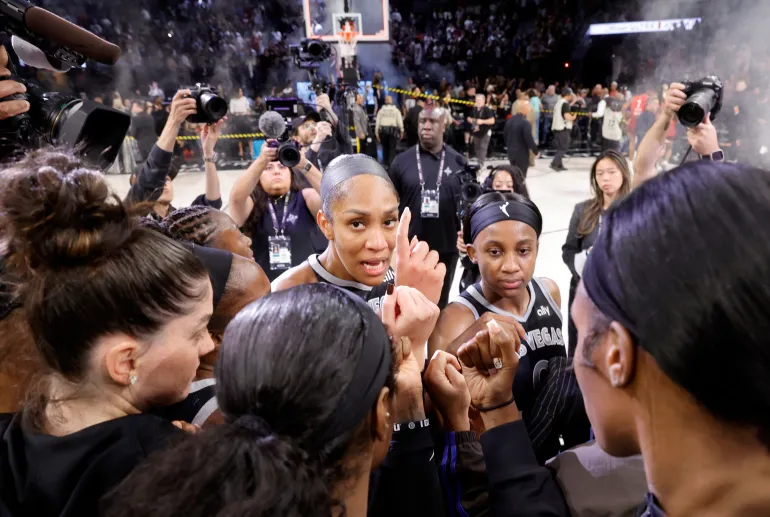
A’ja Wilson wins her third straight WNBA MVP and record fifth overall | Basketball
Former US Vice President Kamala Harris among those to hail Wilson as Las Vegas Aces centre continues record run.
Published On 9 Oct 2026
A’ja Wilson fine-tunes her shooting touch after every practice. That extra work has defined her greatness since being drafted first overall in 2018.
On Thursday, she received a voice message from former Vice President Kamala Harris congratulating her on redefining greatness leaguewide after she was named the WNBA’s MVP for a third straight year and for the fifth time overall.
Recommended Stories
list of 4 itemsend of list
“Obviously, that is an honour,” Wilson said. “A woman of our history, and I’m so appreciative to be able to share that moment with her through the phone call and the message of her delivering that I won my fifth MVP.”
In addition to becoming the first player to three-peat, Wilson won the award in 2020 and 2022.
Commissioner Cathy Engelbert, Aces owner Mark Davis and team President Nikki Fargas accompanied Wilson’s mother, Eva, who presented her daughter with the trophy.
“Each one of these has not been taken lightly,” Wilson said while flanked by all five of her MVP trophies. “In my heart, they’ve always been so special. But this one here, I cried a little bit harder. This one here is just a little bit different. … When you dream as a young girl, you dream so big and you write your goals out, and you just never imagine that you were able to just check them off.
“And when you’re able to check them off – small wins, big wins – it truly means a lot. And so I think that’s why I cried a little bit harder on this one, because 15-year-old A’ja wasn’t sitting up here dreaming about being a five-time MVP. She wasn’t dreaming about being a three-time champion. She was dreaming about surviving this world.”
The 30-year-old Wilson once again led the league in scoring with an average of 26.2 points per game while shooting nearly 53 percent from the field. She averaged 9.4 rebounds per game, a career-best 3.2 assists and 1.9 blocks.

Wilson has the defending champion Aces back in the WNBA semifinals for the eighth consecutive season although Las Vegas is down 2-0 in the best-of-five series against Golden State. Game 3 is on Friday.
“This is great. I love it, not going to take for granted, shine her up, let’s do it,” Wilson said on Thursday. “But tomorrow, when it comes to hoisting it in front of the fans, I love the fans, … but I doubt I will be doing that. I’ll be warming up with my team. … Everyone in this room knows the competitor that I am. Everyone knows what my main focus is, and that is to get a game.”
Wilson received 65 first-place votes and nine second-place votes for a total of 713 points from a national panel of sportswriters and broadcasters. Minnesota’s Olivia Miles received six first-place votes and 40 second-place votes (442 points) while Indiana guards Kelsey Mitchell and Caitlin Clark followed with 287 and 212 points, respectively.
No WNBA player besides Wilson has more than three MVPs. Sheryl Swoopes, Lisa Leslie and Lauren Jackson each have a trio. On the NBA side, Kareem Abdul-Jabbar has six, and Michael Jordan and Bill Russell each have five.
“A’ja Wilson is one of one,” Fargas said. “She’s now standing in a category that no other WNBA player in the history of the league has accomplished. She’s in the conversations with the Michael Jordans and the Wayne Gretzkys of the world – where she belongs.”

Jessica Chastain looks incredible on red carpet for ‘scariest of the year’ horror movie that gave fans ‘panic attacks’
AMERICAN actress Jessica Chastain looked sensational on the red carpet for “the scariest of the year” horror movie that gave fans “panic attacks in the cinema.”
The 49-year-old posed for the cameras at the Los Angeles premiere of Other Mommy yesterday.
Jessica looked incredible as she flashed her long legs in a green silk mini dress.
She exuded effortless Hollywood glamour; looking world’s away from her terrifying character.
The film star had her blonde locks styled in a curly bob and accessorised her dress with a pair of strappy silver Louboutin heels.
Jessica was snapped beaming as she waved at her fans.
Read more on Jessica Chastain


In Other Mommy, Jessica stars in a dual role as normal mother Ursula and the sinister supernatural force using her appearance as a disguise.
The villainous entity is targeting Bela, played by Arabella Olivia Clark, Ursula’s young daughter.
Fans were left traumatised by the trailer of the film and took to social media to discuss their reactions.
One fan remarked: “Whoever decided to air this trailer right before The Odyssey started is a f*****g d******d.
“Thought it was an ice cream commercial. Next thing you know I’m having a panic attack in my seat.”
“That scene when she’s under table made my entire theater jump,” wrote another fan.
A third commented: “The theater played a trailer for this movie Other Mommy before the odyssey and there’s a jump scare it in that I’m still thinking about and it should be illegal.”
Other Mommy comes out in cinemas across the UK today.

Train strike to spark chaos for thousands in UK tomorrow as workers walk out in row over DOORS
A TRAIN strike is set to spark chaos for passengers tomorrow as railway workers walk out in a row over doors.
A number of service cancellations or changes will be in place from October 10.

Members of the Rail, Maritime and Transport union (RMT) at Chiltern Railways are participating in strike action this weekend.
Workers are set to walk out on October 10 for 24 hours, with further strike action planned for October 17.
Passengers have been advised to check their journey details ahead of travelling tomorrow.
The decision comes over plans to introduce driver-only operation (DOO) on East West Rail services.


This means the driver alone oversees both the train’s movement and door operations, rather than having a second conductor on board.
The dispute centres on the first stage of the new railway, serving six stations between Oxford and Milton Keynes.
Trains on this route will stop at Oxford, Oxford Parkway, Bicester Village, Winslow, Bletchley and Milton Keynes Central.
According to RMT general secretary Eddie Dempsey, the proposals would be a “significant risk” to safety and existing train manager roles.
He added: “RMT will not accept the watering down of safety on the rail network.”
However, Chiltern Railways has rejected the claim that the new services would compromise passenger safety.
Interim managing director Tony Baxter said: “We have run most of our trains with the driver in control of the doors for decades, safely and as approved by the independent rail regulator.
“It also means over 100 new permanent jobs at Chiltern, and no changes to the roles of existing colleagues.”
The operator also stressed that every East West Rail train will have two staff members on board – a driver, and a colleague to look after and assist passengers and check tickets.
The company has said it remains committed to working with RMT to solve the dispute.
What changes will be in place over the weekend?
According to Chiltern Railways’ website, the majority of passengers will “experience a near normal train service”.
There will be no services for Stratford-upon-Avon or Leamington Spa for the entire day.
Passengers will instead need to travel via Dorridge, taking a West Midlands Railway service between Stratford-upon-Avon and Dorridge.
Customers have been assured that tickets will be valid via Dorridge at no additional cost.
A further four long distance services will only operate part of their journeys:
- 0644 Stourbridge Junction to London Marylebone – will start at Banbury
- 0819 Stourbridge Junction to London Marylebone – will start at Birmingham Moor Street
- 1802 London Marylebone to Stourbridge Junction will terminate at Birmingham Moor Street
- 1932 London Marylebone to Stourbridge Junction will terminate at Banbury
Certain trains in and out of London Marylebone will have additional stops at Wembley Arena for passengers heading to the Girlguiding Big Gig pop concert.
We live in a world the L.A. City Hall audio leak scandal wrought. Thank God
If I ever need to humble myself — if my head inflates with grand visions of becoming the next Steve Lopez or Bill Plaschke — I pull up the transcript of the secret recording that upended Los Angeles politics after The Times broke the story exactly four years ago.
It’s like a modern-day version of “Ozymandias,” except far more vulgar, nowhere near as poetic and a better warning against hubris than anything Shelley could have penned.
“The thing for us is to exercise our power,” said then-City Councilmember Gil Cedillo, about halfway through an hourlong conversation he was having with three of the city’s most powerful political figures.
Oh, did they ever — and nowhere near the way they intended.
Nury Martinez and Ron Herrera, the president of the City Council and head of the Los Angeles County Federation of Labor, respectively, quickly resigned for their roles in the racist, homophobic drivel on the recording. Cedillo — who was finishing out his term — and Councilmember Kevin de León refused to step down, besmirching their well-earned reputations as progressive lions.
The L.A. they sought to create — where Latinos ascend at the expense of the Black community, and anyone who gets in the way is crushed — never came to be. And the recording that exposed their machinations ultimately destroyed the type of ethnic politicking that made the careers of too many self-serving power grabbers, including this quartet.
The transcript of their back-and-forth now reads as prophecy — and we’re far better for it.
Much of the discussion, which happened in October 2021 at the headquarters of the L.A. County Federation of Labor, was devoted to whining that L.A.’s Latino-majority council districts, and some cities elsewhere in the county, were represented by Black leaders instead of Latinos, even as Latino residents far outnumbered Black ones.
“F—, the way I see it, all of the seats are Latino,” said Herrera, who hailed the rise of a “little Latino caucus of our … own” that he felt should reign permanently.
He and the others predicted a future in which vengeful Black politicians would try to sabotage future Latino leaders on their way out of office, creating “poor Latino districts with nothing,” as Martinez put it.
She was referring to redistricting proposals that would chop off assets like the Coliseum and Exposition Park from South L.A.’s District 9 — the most Latino district in the city, represented by a Black council member, Curren Price.
“So they f— a future Latino for CD 9,” De León whined. “That’s how arrogant, just how arrogant it is.”
That’s not what ended up happening.

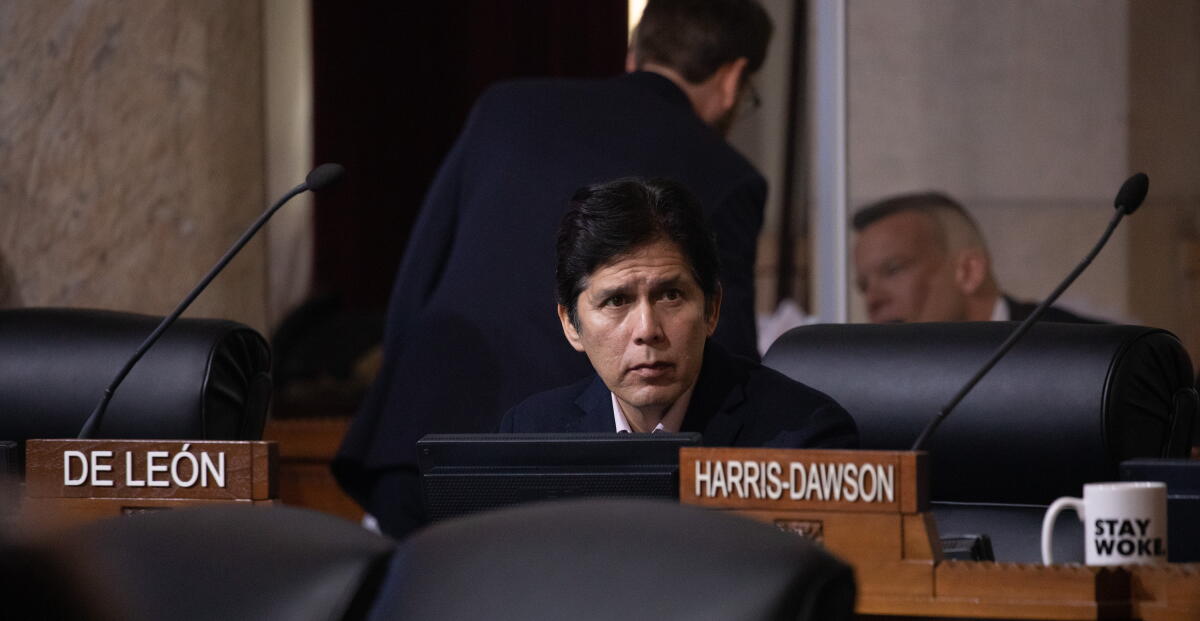
Los Angeles City Councilmember Kevin de León at a council meeting in December 2022 after a two-month absence following his role in that year’s audio leak scandal.
(Myung J. Chun / Los Angeles Times)
District 9 didn’t lose any assets. Black leaders saw the writing on the wall and didn’t run a serious Black candidate to replace the termed-out Price this year. That created space for two Latinos — Estuardo Mazariegos and Jose Ugarte — to make it to the general election. No matter which candidate wins in November, the City Council will have fewer than three Black members for the first time in 63 years.
Both Mazariegos and Ugarte say that the anti-Black scheming of the audio leak villains inspired them to run campaigns focusing on Black and Latino residents as one constituency, reflecting how life is actually lived in South L.A., not how Latinos from elsewhere in the city imagine it to be.
Mazariegos attended the first City Council meeting after The Times dropped the audio leak bombshell in October 2022. He remembers Cedillo peeking at the angry audience and temporarily returning to the council’s back room.
“No community should have to lose power for another to gain it,” said Mazariegos, who would become the first Central American immigrant to serve on the council if he were to win. “Our power grows when we build it together.”
Ugarte, formerly one of Price’s top aides, agreed. He argued that the best way to lead in South L.A. as a Latino council member is “with respect for those who came before us, the humility to listen to those doing the work today, and the understanding that District 9 is strongest when [Black and Latino residents] move forward together.”
Born in Oaxaca, Ugarte would become L.A.’s first Indigenous council member if he wins. That would be a rich coda to the audio leak, considering that Oaxacans received some of the nastiest insults. Martinez described them as “ little short dark people” who were feos — ugly. Cedillo joked that they were “little ones,” while Herrera cracked that they were “indios.”
Who’s laughing now?
The Feos Four also spent time kvetching about Nithya Raman, who was finishing her first year on the council. In 2020, she had upset an incumbent to become the first democratic socialist council member.
At the time of the recording, rivals were trying to diminish Raman’s power by drawing boundaries that would put her district “in the blender and chop [it] up, left and right,” as De León described it.
“She’s not our ally,” Cedillo said. “She’s not going to help us. Her district is not a district we can count on.”
Give credit to Cedillo and his pendejo pals: They were already seeing Raman and other democratic socialists as an emerging force, even while downplaying the DSA’s chances. De León said that Raman’s politics were “about just her as an individual.” Herrera dismissed Hugo Soto-Martínez, then a no-name union organizer aiming to unseat Councilmember Mitch O’Farrell, as a “kid.” Nury Martinez blithely mispronounced Eunisses Hernandez’s name while cackling about the first-time candidate’s challenge to Cedillo.
If Cedillo and De León weren’t so convinced of their own political immortality, they could have helped check the DSA’s rise that has so vexed L.A.’s liberal leaders. Instead, Hernandez beat Cedillo in a shocking upset in 2022, while Soto-Martínez won in the fall. And fellow democratic socialist Ysabel Jurado took out De León in 2024. Those triumphs paved the path for DSA-LA-backed candidate Marissa Roy to make a strong run for city attorney this year. Mazariegos is also endorsed by DSA-LA, which is backing Raman for mayor against incumbent Karen Bass.

Then-Councilmember Gil Cedillo at the Los Angeles City Council meeting on Oct. 11, 2022, two days after the release of explosive audio involving him led to protesters demanding his resignation.
(Gary Coronado / Los Angeles Times)
The group should send Cedillo and De León bouquets of red roses as gracias for assisting their ascendancy. All of us owe the foursome a thanks for hastening the demise of the old Latino political machines that birthed them and kept the city stuck in tribalism for too long.
Now, Latino politicians must run on their bona fides for all Angelenos, instead of just their latinidad. Soto-Martínez and Hernandez won reelection outright in the June primary because their constituents appreciated their sewer socialism approach, focusing on quality of life issues instead of ideological revolution. Meanwhile, Chicanosauruses are wheezing with diminished power as they urge Latinos to back Bass. The message doesn’t seem to be landing: A recent Berkeley IGS/Times poll found that 45% of Latino voters favored Raman to Bass’ 21%, with 34% undecided.
Gone are the days when Latino voters blindly believed Latino leaders. Why bother, after Martinez and her crew proved the folly of ethnic politics?
Near the start of the recording, Martinez complained that voters and the media always seemed to forgive Black politicians caught up in scandal, while Latinos didn’t get the same treatment.
“They’re never done,” she complained. “They never close a chapter on us.”
L.A. did close the chapter. Now, the Feos Four’s only legacy is “that colossal wreck” of their conversation, to quote the finale of “Ozymandias,” left to rot forever.
USC, UCLA push to extend dominance of Big Ten women’s basketball
ROSEMONT, Ill. — With UCLA coming off a national title and USC going for one of its own with star JuJu Watkins returning from injury, there may never have been more attention on women’s basketball in Los Angeles.
“If you intend to come,” USC coach Lindsay Gottlieb said Wednesday at Big Ten media days, “you should probably get your tickets early.”
The success of the two West Coast schools has been a bigger problem for the rest of the Big Ten than Los Angeles basketball fans. In the two years since USC and UCLA left the Pac-12 for the Big Ten, each school has topped the standings once and the Bruins have won the conference tournament twice, going on to the Final Four two years ago and winning the championship last April.
UCLA has some holes to fill this season but is still expected to be top-25 caliber. Watkins returns after missing last season with a torn ACL and will join the country’s top recruiting class to try to help USC return to the nation’s elite and extend the rivals’ dominance over their new league.
“Honestly, for me, I’m just excited to be back and whatever comes with that will come,” Watkins said. “I know the team is excited. We’re preparing for a great season ahead. I’m ecstatic.”
The question that poses for the rest of the conference is whether any of the legacy Big Ten teams can mount a challenge to this newfound tilt from Midwest to West. Iowa and Michigan look like the strongest contenders to break the California grip on the league, but there could be as many as eight other Big Ten teams in the preseason Top 25 poll.
“Our league is stronger and tougher than it has ever been,” Michigan coach Kim Barnes Arico said. “Every night, you’re going to face a top-25 opponent in our league. It’s incredibly, incredibly challenging.”
The Big Ten has been through this before. When Maryland jumped from the ACC in the fall of 2014, the Terrapins claimed at least a share of first place in six of the next seven seasons. Either Ohio State or Indiana topped the standings in the three years prior to the latest expansion, but since then it’s been all UCLA and USC at the top.

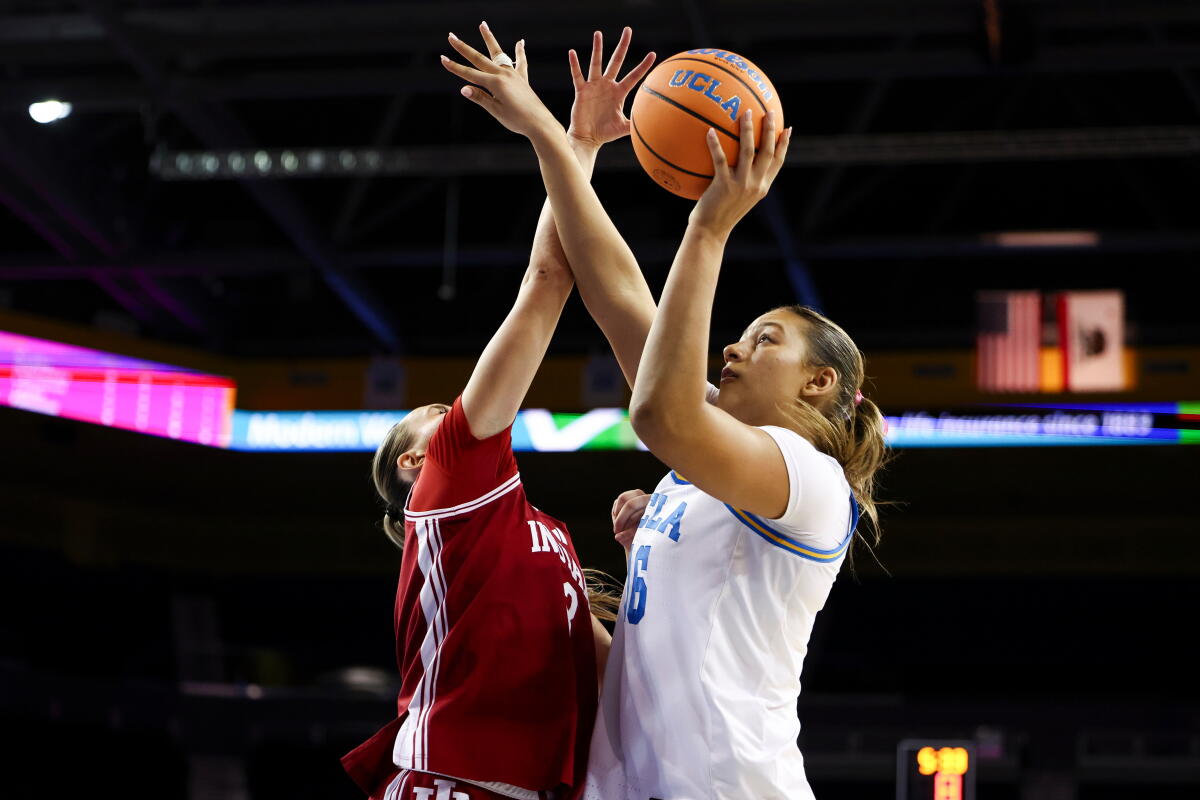
UCLA forward Sienna Betts, right, drives to the basket under pressure from Indiana forward Maya Makalusky on Feb. 15 at Pauley Pavilion.
(Jessie Alcheh / Associated Press)
The Bruins have work to do after accounting for six of the first 18 picks in the WNBA draft, but have five returnees assuming larger roles, including sophomore Sienna Betts and junior Timea Gardiner.
“I think we’re not trying to repeat an outcome, we’re really just trying to repeat a process,” Gardiner said. “Really just giving everything we can to each and every day. We have such an amazing group that is committed to doing that, so we will let the cards fall where they may.”
USC, meanwhile, added the No. 1 and No. 5 recruits in the country and a pair of impact transfers to a Watkins-Jazzy Davidson backcourt after going 18-14 without the preseason Big Ten player of the year. The Trojans have loaded up the roster to make a run at the their first Final Four in 40 years. Gottlieb resisted when asked if she had built a super team, but didn’t exactly deflect the notion, either.
“I’ve never called it that,” Gottlieb said. “We’ve just tried to assemble a team that we think can have championship aspirations. We’ve got a lot of excellent players that are all going to play whatever role they’re asked to the best of their ability. If you do that at the highest level, it becomes a super team.”
Super team or not, the challenge the rest of the Big Ten continues to face has not changed.
“It’s great for our league,” Purdue coach Katie Gearlds said. “Obviously, UCLA winning the championship last year, USC as good as they’re going to be this year having Juju back healthy and the star power that they have, it just elevates and lifts our games and gets more eyeballs on us. I think if you talk to anybody that’s here, we all want to find a way to beat them, but it’s cool that we have them in our league and they are as good as they are.”
DeCock writes for the Associated Press.

Navi Pillay wins Nobel Peace Prize | Newsfeed
International Court of Justice judge Navi Pillay has been awarded this year’s Nobel Peace Prize. A former head of the UN’s inquiry into the occupied Palestinian territories, the Nobel committee called her ‘one of the great defenders of international legal principles’.
Published On 9 Oct 2026

The ridiculously cheap holiday deals you can book right now with £16 hotels, £21 flights & ENTIRE package hols for £92pp
IF you’re after an insanely affordable holiday, then there is a fantastic travel website you need to know about.
Opodo offers flights, hotels, car hire and package holiday deals for prices that will make you do a double take.
We’ve found hotels in Marrakech from £16, return flights to Barcelona from £21 and even entire Tenerife holidays from £147pp, to name but a few.
So whether you’re looking to book a family holiday, a couples getaway or even a solo travel retreat, here’s our round-up of the best Opodo deals right now.
Browse affordable deals on Opodo – package hols from £92pp
Alicante – £117pp
Hop on a two-and-a-half-hour flight over to Alicante to soak up some rays on a stunning stretch of Spanish coast, with sizzling highs of 25°C in October.
Postiguet is the main beach here, sitting at the foot of Mount Benacantil and watched over by Santa Barbara Castle.
Read more on cheap holidays


Once you’re done topping up your tan, you can hike up to the spectacular castle to soak up panoramic views of the Mediterranean coastline for free.
With package deals from £117pp, a quick sunny Spanish getaway might be closer than you’d think.
Browse Alicante package holidays from £117pp
Rome – £119pp
You do not need to spend a fortune to visit Rome, with Opodo’s package holiday deals starting from £119pp.
Rome is a giant, open-air museum where simply wandering the cobbled streets to toss a coin in the Trevi Fountain or marvel at the Pantheon costs absolutely nothing.
Plus if you time your trip to include the first Sunday of the month, visits to state museums, attractions and even the Colosseum offer free entry.
Head across the river to the buzzing Trastevere neighbourhood for authentic €3 pizza by the slice and €5 Aperol Spritzes.
Browse Rome package holidays from £119pp
Cheap flights
Here’s our selection of bargain flights we found with Opodo Prime
If you’re signed up to Opodo Prime, you can bag super cheap flights like the ones we’ve found below.
Opodo Prime plans start from £8.99 a month and can save you hundreds per year on flights, hotels and more.
Faro – from £22 return
Milan – from £31 return
Barcelona – from £21 return
Paris – from £46 return
Madrid – from £39 return
Amsterdam – from £89 return
Ibiza – from £37 return
Geneva – from £55 return
Tenerife – £147pp
Tenerife is a classic, affordable winter sun destination, with highs of 26°C in October and still sitting at toasty highs of 24°C in November.
The flight is only four hours from the UK for these sunny temperatures, and once you’re there, there are loads of ways to enjoy all that sunshine.
Stroll the sweeping volcanic beaches of Costa Adeje, enjoy €3 tapas in traditional tavernas or go whale watching on an unforgettable boat tour.
Make sure to check out Siam Park, a paradise for waterpark fans which has been crowned the world’s No.1 waterpark for 10 consecutive years by Tripadvisor.
Browse Tenerife package holidays from £147pp
Athens – £162pp
Ancient historical sites, snazzy rooftop bars, amazing Greek food – Athens is an underrated choice when it comes to city breaks.
The famous Acropolis of Athens is a must-visit. To stretch your cash, buy a €30 combo ticket which gets you into seven major archaeological sites.
When it comes to cheap eats, you can grab some delicious pork or chicken gyros stuffed with chips and tzatziki for around €3, before hitting the bars for a €2 Mythos beer.
This deal includes a stay at the Sparta Team Hotel, which is only a 12-minute taxi ride or 20-minute walk away from the Acropolis.
Browse Athens package holidays from £162pp
Cheap hotels
Here’s our selection of bargain hotels we found on Opodo (prices per night)
Paris – £92pp
Enjoy a chic getaway to the French Capital with friends or your partner for under £100 each.
Take in the city with strolls along the Seine, or venture to the cobbled hills of Montmartre to take in sweeping views of the city from the Sacre-Coeur basilica.
For a budget-friendly feast, skip the expensive restaurants and hit up a local boulangerie. Grab a fresh baguette, a wedge of creamy brie, and a cheap bottle of supermarket wine for a delicious Parisian picnic.
Book yourself a £92 package getaway or a £46 return flight with Opodo, and you can say Bonjour to your next bargain escape.
Browse Paris package holidays from £92pp
Prices correct at the time of publication.

How to have the best Sunday in L.A., according to Charles Phoenix

Midcentury pop culture expert Charles Phoenix thinks Long Beach gets a bad rap.
“It is very underrated in the grand scheme of all of Southern California, but there is a lot to see and do there,” says the Ontario native, who uses the word “time-honored” repeatedly when describing his favorite attractions in the seaside community. “I often refer to it — under my breath — as the New Jersey of Los Angeles. It doesn’t get much respect, yet it’s loaded with attractions.”

In Sunday Funday, L.A. people give us a play-by-play of their ideal Sunday around town. Find ideas and inspiration on where to go, what to eat and how to enjoy life on the weekends.
When he isn’t gushing over Long Beach, the humorist and author hosts nostalgic slideshows and double-decker open-air bus tours of Midcentury architecture during Modernism Week in Palm Springs. His next event, “LosAngelesland,” is a lively retro slideshow featuring vintage Kodachrome slides taken by Los Angeles locals and tourists in the 1950s and ’60s. The show is scheduled for Oct. 17 during Modernism Week’s October festival in Palm Springs and a Halloween-themed version on Oct. 24 at the Anaheim Fall Festival. Phoenix will also present “Disneyland: Live Retro Slide Show Celebrating the Original Magic Kingdom in the 1950s & ’60s!” at the Hilbert Museum in Orange on Oct. 18.
Phoenix lives in a Midcentury Modern home in Claremont, but he’s always happy to spend a day in Long Beach. His ideal Sunday includes eating clam chowder-topped biscuits at a floating restaurant, shopping for vintage treasures along 4th Street Retro Row, cruising around Naples in an electric Duffy boat and ending the day at a classic diner from 1939.
“There’s more to do in Long Beach,” he says. “I could keep going, but there’s only so much space in this column.”
This interview has been lightly edited and condensed for length and clarity.

8 a.m.: Wake up early and say thanks
When I wake up, I usually have nonfat yogurt, chopped walnuts and one or two types of fresh fruit. Then I walk through my house, and whatever room I walk in first — either the living room or the den and say, “I love you, house.” Those are the first words I speak out loud.

10 a.m.: Drive to the coast for lunch on a floating restaurant
We’re going to start at the only floating restaurant I know of in the Western United States, the Chowder Barge. It stands out on its own, although it’s a bit tricky to find, so it’s a good thing we have GPS or we might never get there. It’s a little bit tiki, a little bit pirate and a little bit seafarer. There’s always an old wizard-like man sitting in the corner with a long beard that reaches the floor. When you’re on the barge and a boat passes by, you can feel it. The best thing there is their fried clams and clam chowder, which you can eat in a bowl or use the chowder as gravy. For breakfast, you could have biscuits topped with clam chowder instead of gravy. It’s the best clam chowder ever. If you want fried clams on top of the biscuits, that’s incredibly delicious. They also have an open-faced hamburger covered with clam chowder and fried clams or just clam chowder.
The place has a deep soul, and everything there is unique and time-honored.

1 p.m.: Go vintage shopping on Retro Row
Next I would go shopping on 4th Street, a.k.a. Retro Row, which is absolutely, in no uncertain terms, the best vintage shopping street in the Western United States — probably the Eastern and Midwestern as well. There are three stores there that I concentrate heavily on. The first is Sneaky Tiki Boutique, which is the destination of all destinations for what I wear all spring and summer and fall — vintage Hawaiian shirts from the ’50s and ’60s. They’re not Hawaiian shirts unless they’re made in Hawaii. Nobody has a better supply than Sneaky Tiki. I mean nobody.
A couple of doors down is another world-class vintage store, Meow. Meow is an institution in the world of vintage clothing, shoes and accessories. And it’s absolutely a spectacular themed environmental extravaganza, as is Sneaky Tiki. There are all kinds of vintage in there. So it is a feast for the senses and your wardrobe and accessory needs.
And then for your Midcentury home decor needs, there’s Xcape Modern. They’ve been there for probably 30 years, and it’s a little mumbo jumbo as far as the way it’s all laid out. It’s a little messy, but they have incredible Midcentury furniture and home decor, including patio items. It’s a spectacular, well-curated collection.
3 p.m.: Explore Rancho Los Alamitos
After that, I’d take a quick late-afternoon scamper around Rancho Los Alamitos. It’s really special, and it’s free, F-R-E-E, free. It’s this gorgeous, time-honored place; basically, you’re walking back into time. The family started building it in 1790 and finished in 1834. I love to look around and walk through the layers of time. The house is beautiful. The barn is beautiful. There are animals there too. It reminds me a little bit of old-timey Knott’s Berry Berry Farm. Chickens walk around, and it just has, again, this deep soul, layers of time, mature garden. And it’s impeccably kept, impeccably groomed. You can spend 20 minutes walking around there or you could spend four hours. And of course, the garden is absolutely out of this world.
It’s its own little world. It doesn’t know the rest of the world exists, which is the kind of place that I really, really love — a place that’s true to itself, time-honored and lost in its own wonderland. You know, it’s just so special to be able to escape to such a rarefied environment.

5 p.m.: Go for a ride on a Duffy Boat in Naples
From there, get ready for my favorite thing to do in Southern California: taking a Duffy Boat ride around Naples. I always rent from Anchors Away. The boats remind me of the Jungle Cruise at Disneyland. Most are white and blue, but a couple of years ago, around the time of the Barbie movie, they added some bright pink ones. You can pay a little extra for the pink boats, but the blue and white ones are just as fun. The boats seat about eight to 10 people, and you rent them for two hours and just cruise around. The canals are much bigger than those in Venice. They give you a map and two hours to enjoy the water. I usually drive the boat while my friends bring drinks, cookies, snacks and whatever they want to drink. I had no experience before my first time, but it’s easy and relaxing. It’s never crowded, the homes are beautiful, and of course, I always wear a captain’s hat.

8 p.m.: Late–night snack at a 1939 diner
After that, even if we’ve already had plenty to eat and drink, we usually end up at one of my favorite diners, Harbor House Cafe, on Pacific Coast Highway in Sunset Beach. It’s been open since 1939. So we drive a couple of miles down PCH, pile into the Harbor House and finish the day with whatever we want — dessert, more dessert, onion rings or a milkshake. It’s our spot to unwind. The onion rings are especially good. It’s an easy, time-honored place, just like everywhere I love to go. I like to soak in the history. After we leave, everyone heads home, and I drive back up the 605 Freeway to Claremont.

Wednesday 9 September Independence Day in Tajikistan
This article outlines the historical journey of Tajikistan toward its official Independence Day on September 9th. It details how the nation transitioned from centuries of foreign rule and Russian conquest to its status as a Soviet republic. Despite decades of USSR administration, the Tajik people maintained a strong national identity, eventually declaring sovereignty in 1991 following a period of political unrest. Additionally, the text provides cultural context regarding the capital city, Dushanbe, while offering a broader snapshot of global news, travel tips, and economic datafrom the same period. This summary serves as both a historical record and a contemporary news digest for the Central Asian region.

1million easyJet passengers warned to check key date on their booking
EasyJet chief executive Kenton Jarvis announced that the airline is removing a further 600,000 to 700,000 seats from its winter schedule, on top of 700,000 that have already been cancelled

The airline has cut over a million seats(Image: Reinhard Krull/Getty Images)
EasyJet is cutting thousands of flights this winter, with customers urged to check one date before their flight is due to depart.
EasyJet chief executive Kenton Jarvis told reporters in Brussels on 8 October that the airline is removing a further 600,000 to 700,000 seats from its winter schedule because of elevated fuel costs. This comes after it announced around 700,000 seats would be removed earlier this year, bringing the total reduction to between 1.3 million and 1.4 million seats.
EasyJet CEO Kenton Jarvis told the FT: “People are taking capacity out, we see that across all competitors,” adding that was “no surprise” given fuel costs. However, he admitted that the high cost of fuel had not been expected. “I honestly think it’s been quite a surprise for the industry that fuel has stayed as high as it is,” he said.
Do you have a travel story to share? Email webtravel@reachplc.com
Jet fuel costs have doubled following the start of the Iran conflict, which led to the closure of the Strait of Hormuz. Although prices have started to fall, they remain far higher than airlines expected when the war began.
EasyJet passengers have been urged to check their tickets for one date. If your booking is cancelled, you may not get paid compensation. Whether you do or not depends on your flight date, when you were notified of the cancellation, the reason recorded for that particular cancellation and the timings of the replacement journey.
Under the law UK261, passengers notified between seven and 14 days before departure are entitled to compensation unless the replacement leaves no more than two hours earlier and arrives less than four hours later . Passengers notified fewer than seven days before departure are entitled to compensation, unless the replacement leaves no more than one hour earlier and arrives less than two hours later.
Compensation ranges from £220 to £520 depending on the distance, unless easyJet proves that extraordinary circumstances caused the cancellation. It is unlikely that they will be able to in this instance. Passengers notified at least 14 days before departure are not entitled to fixed compensation, although their refund or rerouting rights remain fully intact.
Refund and rerouting rights apply separately. Passengers who still need to travel should therefore compare the proposed replacement before accepting a refund. If another airline can reach the destination significantly sooner, the CAA says the passenger may have the right to be rerouted on that alternative service.
An easyJet spokesperson said: “Like all airlines, we review our schedule on an ongoing basis and sometimes make some changes. The changes to our winter flying represent a tiny proportion of our flying programme. We make any changes in advance and typically choose multi-daily frequency flights so customers can easily move to an alternative flight.”
The airline originally released more than 25 million seats across almost 138,000 flights between 19 October and 31 January, giving an average of approximately 181 seats per flight. On that basis, the latest reduction is equivalent to roughly 3,300 to 3,900 one-way flights, with the total winter cuts equivalent to approximately 7,200 to 7,700 one-way flights.
These are capacity estimates, not confirmed cancellation numbers. EasyJet has not published the affected routes, the proportion involving UK services or how many removed seats had already been sold. The airline has said it makes changes in advance and typically targets routes with several daily services so passengers can be transferred to another flight.
Anton Radchenko, aviation expert and CEO of AirAdvisor , said: “Airlines commonly describe these decisions as capacity management, but passenger-rights law examines the individual booking. If a flight was sold and subsequently withdrawn, the airline should be able to show when the passenger was informed, the specific reason that service was removed and what comparable rerouting was offered; a general reference to higher fuel costs would not, by itself, establish extraordinary circumstances.
“The most revealing cases will be passengers transferred between services on a route that operates several times a day. Moving someone from a morning flight to an evening departure may appear to be a straightforward consolidation. Still, the resulting arrival time can change the compensation position, and the existence of a substantially earlier flight with another carrier may determine whether the rerouting offered genuinely met the earliest-opportunity requirement.”
“Passengers affected by a schedule change should retain the original itinerary, the timestamped cancellation email and every replacement option offered. Those three records will be considerably more important to an individual claim than the airline’s overall capacity figure.”
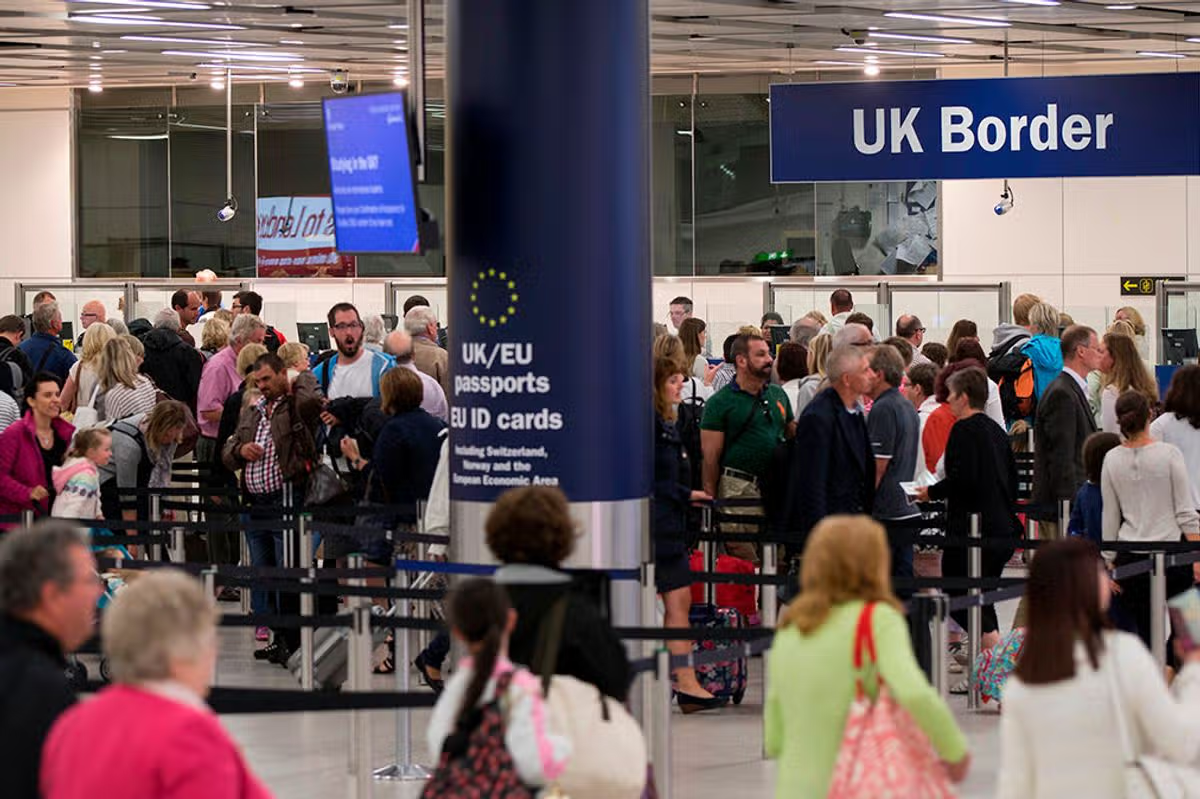
Full list of 13 UK airports where new passport rules are coming into force
A new passport rule will be introduced across 13 airports from this month, and it’s good news for holidaymakers as it could allow for a smoother travel experience

Going through border control after landing back in the UK is about to get easier for British passport holders (Image: Getty Images)
Airports across the UK are rolling out new contactless technology that will allow Brits to pass through the e-gates without presenting their passports. This is due to an enhanced facial recognition system that will capture the returning passenger’s face at the e-gates and cross-reference it with their passport photograph already stored on file.
The upgraded technology, being introduced at the e-gates of 13 UK airports, will help to speed up security checks and is said to dramatically cut queues by up to 25 per cent, according to the Home Office. It will also provide British passport holders with a smoother journey home, as they no longer need to rummage around for their document or face lengthy border control queues.
Phil Douglas, director general of Border Force, said: “This is a win for travellers coming to our brilliant country. By using state-of-the-art technology, we are making journeys smoother and faster, all while fully maintaining the UK’s robust border security. Our digital transformation also builds on our work this summer to extend eGates to children aged eight and above, making life a little easier for families.”
To make the process more efficient, it’s been reported that airlines would forward passport photos of their British passengers to border control at each airport on the day of arrival, which would then be uploaded onto the e-gates system. Douglas added: “Because we know who’s coming and can load up that gallery of who is arriving, it’s not a one in 60 million check, it’s a one in tens of thousands check [because the system only needs to check against the passports of passengers travelling on that particular day].”
The phased introduction of the revamped system began on Tuesday, 6 October, and will initially launch at Birmingham and East Midlands airports over the coming weeks. By early next year, the new ‘contactless borders’ will be rolled out across other UK airports already equipped with e-gates.
Steve Griffiths, managing director of East Midlands Airport, said: “We’re delighted to be the first UK airport to have contactless eGates introduced by Border Force. As an airport committed to providing an effortless travel experience, we welcome any technological innovation that can help to safely make our customers’ journeys smoother, swifter and simpler. This complements changes that we carried out to our immigration hall recently to help improve the flow of arriving passengers through the area.”
Full list of 13 UK airports impacted
- Birmingham Airport
- Bristol Airport
- Cardiff Airport
- East Midlands Airport
- Edinburgh Airport
- Glasgow Airport
- London City Airport
- London Gatwick Airport
- London Heathrow Airport
- London Luton Airport
- London Stansted Airport
- Manchester Airport
- Newcastle International Airport
While the system will initially be introduced for British passport holders using e-gates at UK airports, there are proposals to extend it to other nationalities holding biometric passports, including those from Europe, Australia, Canada, Japan, New Zealand, Singapore, South Korea, and the US. Officials hope it will streamline re-entry into the UK and prevent disruptions at border controls.
Passengers who cannot be identified at the e-gate under the new system would need to revert to the existing method and scan their passports instead. Should this also prove unsuccessful, they will be directed to a staffed border control desk where their passport will be manually verified.
Do you have a travel story to share? Email webtravel@reachplc.com

Spain travel warning as huge strike could ‘bring country to standstill’
A NATIONWIDE strike in Spain is expected to ‘bring the country to a complete standstill’ next month.
The industrial action will affect flights, public transport, shops, restaurants and museums.
The shutdown is due to take place on November 11 when major trade unions in Spain will stage a 24-hour walkout.
The strike is protesting the escalating housing crisis – and it will be the country’s first joint general strike in almost 15 years.
While it hasn’t been confirmed, flights across Spain are expected to face cancellations or delays.
Previous general strikes have heavily involved airport ground staff, air traffic controllers, and airline cabin crews causing lots of disruption.


It’s not just flights either – on the ground, public transport will be affected.
The strike is expected to impact trains including high-speed lines, the city metro, and buses which could face severe disruption.
Roads could be closed as well in cities like Madrid and Barcelona which are likely to see large protest marches.
For anyone already on holiday there at the time, the walkout could see some restaurants, museum and shops close too.
If they’re not shut, the opening hours could be reduced to holiday hours.
Advice for those due to travel on November 11 is to keep an eye on any updates from your airline.

Many airlines operate flights from the UK to Spain like BA, EasyJet Ryanair, Iberia, TUI, Jet2, Wizz Air and Vueling.
Disruption to flights on this day would be deemed as being an “extraordinary circumstance” which means airlines aren’t required to pay extra compensation.
However, airlines are legally required to rebook you or offer a refund.
The strike is being held ahead of the November 29 snap election.
Flight compensation rules

A look at your rights if a flight is delayed or cancelled, when your entitled to compensation and if your travel insurance can cover the costs.
What are my rights if my flight is cancelled or delayed?
Under UK law, airlines have to provide compensation if your flight arrives at its destination more than three hours late.
If you’re flying to or from the UK, your airline must let you choose a refund or an alternative flight.
You will be able to get your money back for the part of your ticket that you haven’t used yet.
So if you booked a return flight and the outbound leg is cancelled, you can get the full cost of the return ticket refunded.
But if travelling is essential, then your airline has to find you an alternative flight. This could even be with another airline.
When am I not entitled to compensation?
The airline doesn’t have to give you a refund if the flight was cancelled due to reasons beyond their control, such as extreme weather.
Disruptions caused by things like extreme weather, airport or air traffic control employee strikes or other ‘extraordinary circumstances’ are not eligible for compensation.
Some airlines may stretch the definition of “extraordinary circumstances” but you can challenge them through the aviation regulator the Civil Aviation Authority (CAA).
Will my insurance cover me if my flight is cancelled?
If you can’t claim compensation directly through the airline, your travel insurance may refund you.
Policies vary so you should check the small print, but a delay of eight to 12 hours will normally mean you qualify for some money from your insurer.
Remember to get written confirmation of your delay from the airport as your insurer will need proof.
If your flight is cancelled entirely, you’re unlikely to be covered by your insurance.

NBA star Wembanyama to French students: ‘I hear you’ | Basketball
San Antonio Spurs player Victor Wembanyama offers solidarity to students protesting conditions at schools in France.
Published On 9 Oct 2026
France’s basketball star Victor Wembanyama voiced his support on Thursday for French teenagers protesting conditions in the country’s schools.
The Ministry of the Interior said 71,500 people took part in Thursday’s demonstrations, including 24,500 in the main Paris march centred on Place de la Bastille.
Recommended Stories
list of 4 itemsend of list
“These are systemic inequalities – problems so deep-rooted that, in fact, I’m glad that high-school students and young people in general are speaking up,” Wembanyama told a news conference on Thursday night.
“I hear them, and I support them, and I hope the people all over there will do the same.”
The San Antonio Spurs player had previously replied “I would love to” when a fan asked him in an Instagram post to join the protest with the French teenagers.
“I have a lot of interest. I meant it,” Wembanyama added at the news conference. “I was in that position not so long ago.
“I’ve had the chance to escape this system, to escape these problems. But it’s chance, it’s luck. So I want to show my support.
“It’s not something that’s completely unfamiliar to me. I went to high school in Nanterre, which was already a stronghold of ‘blocages’ back then,” he said, referring to student-led school blockades.
Concerns about state schools have helped prompt a number of France’s most significant protests in decades.
They began last month at high schools in the poor northern suburbs of Paris, where anger over teacher absences and shabby facilities quickly evolved into a nationwide movement against inequality, weak public spending and falling standards.

80s rock legends rush drummer offstage mid-set after he suffers medical emergency during gig
80s rock legends rushed Deen Castronovo offstage mid-set after he suffered a medical emergency during gig on Thursday night.
The 62-year-old, who is the drummer for rock band Journey, had performed just two songs before he was rushed off stage at the BOK Center in Tulsa, Oklahoma.
According to Tulsa World, keyboardist Jonathan Cain made the crowd aware of the situation after performing their tunes Be Good To Yourself and Stone in Love.
He said to fans: “We’re going to see what happens as this progresses.
“It’s an unfortunate situation. We’re very sorry. We’re hoping it’s only a delay, but please — I’m sorry. Don’t worry.
“Have your prayers ready. Have your prayers ready for Deen Castronovo, everybody. Thank you.”


Guitarist Neal Schon later returned and told the crowd that their band mate had been taken to hospital.
And according to Rolling Stone, when the group got back to performing, he told fans: “This concert is for Deen.
“I think he’s going to be fine.”
Journey has not addressed what has happened on social media.
The Sun has contacted the band’s representative for comment.
The band were performing as part of their Final Frontier Tour across North America when it happened.
Journey are set to return to the stage in San Antonio tomorrow night for one of their remaining shows.
Their tour is set to wrap up at the beginning of November.
The group currently consists of Neal Schon, Jonathan Cain, Deen Castronovo, Arnel Pineda, Jason Derlatka and Todd Jensen.
Journey was formed back in 1973 until 1987.
They reunited in 1995 and have been together ever since.
Some of the their best songs include Don’t Stop Believin’, Separate Ways, Faithfully and Open Arms.

Luka Doncic, Austin Reaves click in Lakers’ preseason win vs. Kings
The bond between Luka Doncic and Austin Reaves is as real as it gets.
And though it was just a preseason game Thursday night, Doncic and Reaves showed why they form one of the most dynamic offensive backcourts in the NBA.
The Lakers duo linked up on the very first play against the Sacramento Kings, with Reaves passing to Doncic as he cut to the basket before scoring while being fouled.
Both played 25 minutes, with Doncic finishing with 23 points on six-for-16 shooting during the Lakers’ 114-110 win over the Kings at Crypto.com Arena. Reaves had eight points on two-for-seven shooting, eight assists and five rebounds.
Doncic, who picked up a technical foul with six minutes and 48 seconds left in the third quarter, and Reaves, who played in his first exhibition game after missing the first two, gave the fans something to be excited about.
Doncic’s moment came in the second quarter when he drilled a 31-foot, one-legged three-pointer off a pass from Sandro Mamukelashvili (19 points).
Reaves’ moment came late in the second quarter when he had a nice hesitation move that froze Emanuel Sharp, allowing him to waltz along the baseline for a layup.
Lakers coach JJ Redick explained why Doncic and Reaves have been so close in their time playing together.
“I think there’s good chemistry with each other,” Redick said. “I think it’s just the natural way they like each other. They like playing together. I think having them together means there’s automatically two ballhandlers on the court. I think that’s like an underrated part of the NBA now … having two-to-three ballhandlers on the floor at all times.”

Injury update
Walker Kessler and Collin Sexton both missed their third straight preseason game and Ziaire Williams missed his second straight game. Cameron Carr, Dalton Knecht and Arthur Kaluma also didn’t play.
Kessler, the Lakers’ big acquisition at center from the Utah Jazz, has been nursing a finger injury he sustained after hitting the backboard during practice.
“We’ve got to check in tomorrow. … It’s not concerning. He’ll play in the preseason,” Redick said.
Redick said Williams had “some soreness, but it’s not anything that we’re concerned about.”
LeBron James stars in NBA preseason debut but Nets defeat 76ers | Basketball
All-time leading scorer LeBron James makes 76ers debut following LA Lakers switch in NBA preseason, but Nets claim win.
Published On 9 Oct 2026
NBA superstar LeBron James delivered a solid first half in his first preseason game for Philadelphia, but the new-look 76ers fell 114-108 to the Nets in Brooklyn.
James, the NBA’s all-time leading scorer, announced in July that he had signed a two-year, $8m deal with the 76ers, ending weeks of speculation over where the four-time NBA champion would land as a free agent after eight seasons and one title with the Los Angeles Lakers.
Recommended Stories
list of 4 itemsend of list
The 41-year-old superstar, entering a record-extending 24th NBA season, won two titles with Miami, another with Cleveland and a fourth with the Lakers, and is aiming to help the Sixers win their first title since Julius Erving led the club to the crown 43 years ago.
Thursday’s game marked his first chance to line up alongside new teammates Joel Embiid, VJ Edgecombe, Tyrese Maxey and Jaylen Brown – a new arrival from the Boston Celtics.
“It felt a little different,” James said. “Obviously, just wearing a new uniform, but the game is the game.
“We’re still trying to put each other in a position to be successful and complement each other the best way we can out on the floor,” he added. “But it’s going to take some time. Tonight was a good sample size for us to build on.”
James scored 10 points, connecting on his lone shot from the floor and making all eight of his free-throw attempts. He added four rebounds, five assists and a steal in 18:04 minutes in the first half.
Brown led all scorers with 18 points. Julius Randle had 14 for the Nets, who outscored the Sixers 37-23 in the third quarter to take control.
LeBron James captures NBA spotlight again
But all eyes were on James, starting with his first signature pre-game chalk-toss in a 76ers uniform.
James smoothly directed the Sixers’ offence in his time on the floor, making all five of his assists in the first quarter and combining effectively with Maxey.
“I think there was some really good things happening, you know, right off the bat,” 76ers coach Nick Nurse said after seeing his starters together for the first time.
“A bunch of back cuts and good passing, etc, there were segments where obviously we turned the ball over a lot … just the little clunky segments, too. But, again, it’s preseason, first time they’re together.
“I think you look at it as what’s good and what are the learning experiences, things that we can improve.”
The 76ers have two more preseason games, both against Boston, before opening the NBA regular season against the defending champion New York Knicks at Madison Square Garden on October 20.
James’s arrival has already found the 76ers battling outside “noise”.
James took to Instagram to refute a report from a play-by-play announcer during the team’s first preseason game on Monday that James had admonished Embiid for being late to a practice.
“He ain’t been late, so stop the lie,” James posted.
James had acknowledged at the team’s media day last month that such outside hubbub around the 76ers would be “doubled, tripled and quadrupled now that I’m here”.
European airport axes 140 flights as strike hits major airlines TODAY
A MAJOR airport has been hit by strike action with thousands of passengers facing cancelled strikes.
Ground handling group, Alyzia, are taking part in a national strike which affects airlines like Brussels Airlines, ITA Airways, Air Arabia and United Airlines.

The airport expects only half of the flights handled by Alyzia to operate as planned.
Brussels Airport said that airlines working with Alyzia have contacted passengers directly to inform them about the status of their flight and their options.
It added: “We regret the inconvenience caused by this union action.”
The strike action comes as workers protest against governmental policies.


According to FlightRadar which monitors movements of planes, Brussels Airport has had 103 cancellations today and 34 flights have been delayed.
As this strike is outside the control of individual airlines, it will be deemed an ‘extraordinary circumstance’, which means if your flight is cancelled you will not be entitled to compensation.
Public transport is also expected to be disrupted in Brussels today too.
The good news for Brits is that flights handled by Aviapartner will not be affected.
This includes major airlines serving UK destinations such as British Airways, easyJet, Ryanair, Tui, and Wizz Air.
The airport told The Independent that around 400 flights will still operate as usual today.


Flight compensation rules

A look at your rights if a flight is delayed or cancelled, when your entitled to compensation and if your travel insurance can cover the costs.
What are my rights if my flight is cancelled or delayed?
Under UK law, airlines have to provide compensation if your flight arrives at its destination more than three hours late.
If you’re flying to or from the UK, your airline must let you choose a refund or an alternative flight.
You will be able to get your money back for the part of your ticket that you haven’t used yet.
So if you booked a return flight and the outbound leg is cancelled, you can get the full cost of the return ticket refunded.
But if travelling is essential, then your airline has to find you an alternative flight. This could even be with another airline.
When am I not entitled to compensation?
The airline doesn’t have to give you a refund if the flight was cancelled due to reasons beyond their control, such as extreme weather.
Disruptions caused by things like extreme weather, airport or air traffic control employee strikes or other ‘extraordinary circumstances’ are not eligible for compensation.
Some airlines may stretch the definition of “extraordinary circumstances” but you can challenge them through the aviation regulator the Civil Aviation Authority (CAA).
Will my insurance cover me if my flight is cancelled?
If you can’t claim compensation directly through the airline, your travel insurance may refund you.
Policies vary so you should check the small print, but a delay of eight to 12 hours will normally mean you qualify for some money from your insurer.
Remember to get written confirmation of your delay from the airport as your insurer will need proof.
If your flight is cancelled entirely, you’re unlikely to be covered by your insurance.