



Clinton Takes a Different Road to Reach Black Voters
WASHINGTON — Before a Mt. Rushmore-like painting of seven revered and deceased black heroes, a tuxedoed Bill Clinton stood in a darkened hall recently to describe himself to an audience of black Americans.
The 10-minute speech by the Democratic presidential nominee to the Congressional Black Caucus Foundation Dinner in Washington expressed a simple, direct and unspoken–though clearly understood–contrast to the last 12 years. Clinton did not have to spell out a course of action to win their support.
Rather, he swore to the 4,000 black diners that if they helped him fulfill his quest to win the presidency, he would provide “full participation, full partnership” in a Clinton White House.
“If I change my address, I will only be a tenant there,” he said. “You still own the place, and I want you to act like it.”
For Clinton, the moment was special only because it occurred in the harsh glare of a spotlighted public gathering. More typical of his efforts to court black support was the private, closed-door fundraiser held hours earlier and a few blocks away at a downtown Washington art museum. That reception, hosted by some 60 affluent black American business owners, produced $600,000 for the Arkansas governor.
“This was a historic event,” Rodney Slater, one of Clinton’s top black aides, said immediately after the fund-raiser. “This represents the fact that African-Americans want to be key players in the Clinton Administration. When they can raise that kind of money–that’s more than African-Americans have ever raised for anybody–you can bet the candidate will pay attention to them.”
Like all contemporary Democratic presidential candidates, Clinton is counting on overwhelming support from the nation’s black voters to propel him to victory. But to achieve that, he has taken a significantly different approach than the party’s previous nominees.
Clinton has avoided offering himself as a benefactor of black Americans through dramatic, highly publicized appeals to them or by proposing a host of social programs. Rather, the Arkansas governor has conducted an almost stealth-like campaign within black communities, quietly collecting chits from influential leaders and middle-class blacks while limiting efforts directed at poor, ghetto-dwelling African-Americans. And in targeting middle-class blacks, he has tried to blend their political and economic concerns into the same mix of issues aimed at attracting the highly coveted white suburban voting bloc.
He has done this in order to claim a larger share of the white vote–especially suburban white males, who polls have suggested viewed previous Democratic presidential candidates as too eager to genuflect to black demands. No Democrat since Lyndon B. Johnson in 1964 has won a majority of the white vote, a major reason the party has lost all but one presidential election since then.
With this strategy, Clinton sought to give his campaign an inclusive middle-class cast, effectively defusing race as an issue and avoiding the need to reassure white voters that he would not unduly bend toward poor and needy blacks.
Surprisingly, as Clinton has pursued this strategy, polls have shown he has garnered increasingly enthusiastic support from black voters. A recent survey of 850 blacks by the Washington-based Joint Center for Political and Economic Studies showed more than 80% giving Clinton highly favorable marks on questions of knowledge, fairness and leadership.
In fact, if there has been any genius–or luck–to Clinton’s handling of black voters, it has stemmed from amplifying the hard-edged pragmatism with which many black political leaders and their constituents approached the 1992 campaign. Minimizing conflict within their ranks, they have kept their eyes fixed on the prize: returning a Democrat to the White House. And Clinton appears to have been the beneficiary of this growing political maturity among black voters.
“We’re smart,” Rep. Maxine Waters (D-Los Angeles), one of Clinton’s earliest and most important black backers, said recently. “We know where our best interest lies. Even if it means that we campaign a little bit differently and not in the ways that we have before, we are out to win, and we can win with Bill Clinton.”
Overall, blacks make up about 1-in-6 of Clinton’s voters, according to recent polls. In the final Times national pre-election poll, released last week, he was favored by 78% of black voters, with President Bush and independent candidate Ross Perot each backed by 9%.
Many of these voters are the legacy of the Rev. Jesse Jackson’s unsuccessful 1984 and 1988 campaigns for the Democratic presidential nomination, which excited political passions among blacks and swelled voter registration rolls within their communities.
Democratic nominees Walter F. Mondale in 1984 and Michael S. Dukakis in 1988 each publicly enlisted Jackson to their cause in hopes of gaining the allegiance of his followers. But while both Mondale and Dukakis harvested the vast majority of black votes cast in their respective races, neither was able to generate a huge turnout by African-Americans. That was especially apparent four years ago, when the failure of blacks to turn out in large numbers was seen as a major reason Dukakis lost close races to then-Vice President Bush in several states, including Illinois, Pennsylvania, Maryland and Missouri.
Clinton, during most of his campaign, took the alternative approach of keeping Jackson at arm’s length while beckoning an aspiring breed of black leaders to supplant him as a link to black voters.
Among the first black officials to join the Clinton cause early in the primary season–at a time when Jackson’s disdain for the Arkansas governor was undistinguished–were Reps. John Lewis of Georgia, Mike Espy of Mississippi and William J. Jefferson of Louisiana.
These three, like others, are not especially well-known nationally. But for the Clinton camp, what counts is that each commands strong and favorable name identification among blacks in their home states. And while in large measure these politicians offered their early support based on their association with Clinton as a fellow Southerner, it also reflected the new pragmatism among them.
Waters, a national co-chairwoman of the Clinton campaign, most vividly illustrates this phenomenon, given her past close ties to Jackson. Echoing countless other black elected officials, she makes clear that winning the White House is what matters to her this year, not the strategy the candidate employs to get there.
“I don’t question it at this point,” she said. “I want George Bush out of the White House so bad, I’ll buy (Clinton’s) strategy.”
Like Waters, Rep. Craig Washington (D-Texas) is unconcerned about Clinton’s primary focus on white, middle-class, suburban voters.
“He needs to go where he can get votes that I can’t get for him,” Washington said. “The fact that he doesn’t come into black churches every Sunday and that he doesn’t campaign in black communities (to avoid) turning off Joe Willie Six-Pack doesn’t bother me. He doesn’t want to send them back to help the Republicans.”
Linda Faye Williams, associate professor of government and politics at the University of Maryland, said statements like those from black elected leaders–most of whom were faithful Jackson supporters in the past–reveals the “12 years of pent-up leadership hopes” among black leaders.
She also said that “many black elected officials chafed during the last two (presidential) elections over their own roles as leaders because Jesse was always the one out front. Clinton has answered their prayers by giving them room to maneuver.”
Ironically, in the campaign’s final hours, Clinton finds himself more dependent on black votes in some key states than many of his advisers anticipated. As many polls have shown the race tightening, the Arkansas governor’s fate appears increasingly tied to a heavy turnout among traditional Democratic constituencies, including blacks.
That’s especially true in two key regions. It appears Clinton needs a high black turnout in the Midwestern battleground states of Michigan and Ohio–where blacks cast 8% and 12%, respectively, of the votes four years ago–and in such hotly contested Southern states as Georgia and Louisiana, where blacks constituted about a fifth of the vote in 1988.
These political realities have helped lead to a rapprochement between Clinton’s campaign and Jackson. The campaign is hoping Jackson can help spur a big turnout among blacks for the Democratic ticket. And the civil rights leader, for his part, is quietly cooperating in hopes of gaining clout.
Meanwhile, some blacks have remained lukewarm toward Clinton, worrying that his campaign strategy will serve only to get him elected without demonstrating a real commitment to helping poor blacks. These leaders were distressed that the well-publicized bus tours that helped define the Clinton campaign immediately after the summer’s Democratic National Convention focused on small towns and rural America, where the crowds were made up mostly of white faces.
“We’re going to have to put a lot of pressure on Brother Clinton once he gets in the White House,” said Cornell West, director of Afro-American studies at Princeton University. “I hope he wins, but I recognize he’s not a true warrior for our cause.”
After a flurry of complaints that the campaign was avoiding black voters and ignoring their issues, Clinton’s staff squeezed in time for him to campaign a few weeks ago with a delegation of black congressional leaders as they barnstormed several Southern states in a get-out-the-vote effort sponsored by the Democratic National Committee.
Still, the bus trip failed to quell all of the concerns. Even some of those who joined in the journey dubbed it “The Back of the Bus Tour.”
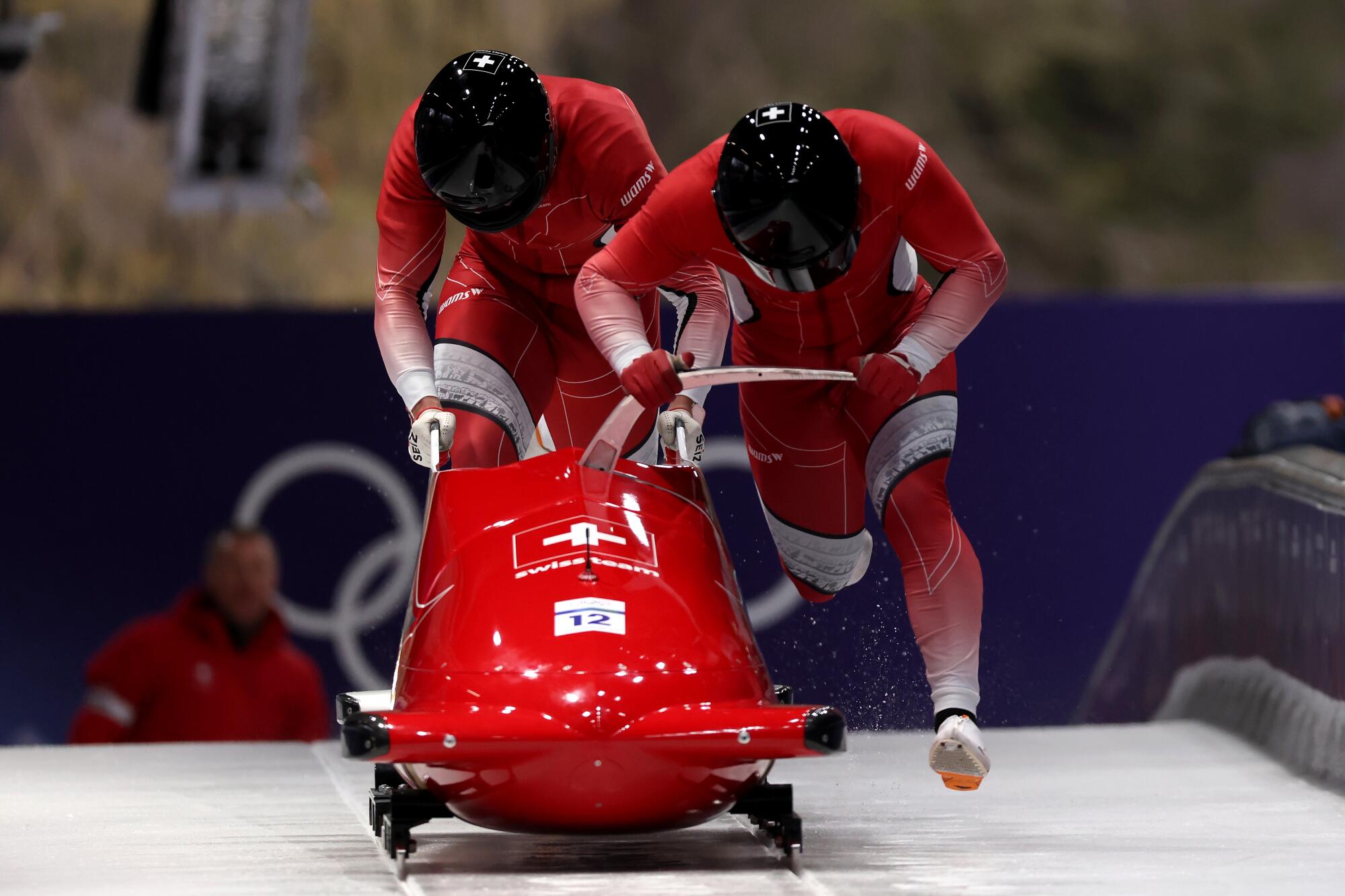
Olympic dreams on hold: Swiss bobsledder opens up about cancer fight
CORTINA D’AMPEZZO, Italy — World-class athletes, thrilling events, stirring medal ceremonies, I will remember all of those from the Winter Olympics. But what I experienced Sunday on my 45-minute bus ride from my hotel to Cortina will stay with me longer.
There was a young woman sitting across the aisle. She looked to be in her mid-20s, about the age of my daughter, and was wearing a knit cap with a Switzerland logo. Her dark hair was in long, thin braids and framed her friendly face.
“How’s it going?” I asked, setting down my backpack.
“Nervous,” she said with a faint smile.
That started the conversation, one that would have me repeatedly wiping my eyes with my sleeve.
Her name was Michelle Gloor. She’s 25 and from a small town outside of Zurich. Her boyfriend, Cedric Follador, is pilot of the Swiss bobsled team and has races throughout the week. She was heading to watch him practice.
Michelle knows all about the sport. In fact, she had been the brake woman on the Swiss national team and had hoped to be competing in these Olympics herself. She grew up as a track-and-field athlete, a sprinter, and only took up bobsled in 2022.
Women’s bobsled — or bobsleigh, as Europeans call it — is a two-person operation with a pilot in front and brake woman in back.
“The first responsibility is pushing the sled as fast as I can, together with my pilot,” she said in a German accent and near-flawless English. “I have to sit still and count the curves until we reach the finish line, when I have to pull the brakes. I’m responsible that the sled won’t crash into something.”
Her best friend had made the transition from track to bobsled, was looking for a brake woman, and convinced Michelle to give it a try.
“My first bobsleigh ride was in St. Moritz and I was so nervous,” said Gloor, a third-year law student at the University of Zurich. “I think I was crying in the back of the sled because I’d never felt anything like that, all the G-forces and you don’t have any cushion in the sled. It all hurts.
“But after the second run, I felt the adrenaline and it was great. It caught me from then. It took me two runs.”
She was 22 and the future was bright. They entered the Swiss championships and won. Michelle got serious about her new sport, training every day, eating right, building muscle.
Immersed in that world, she met Cedric but for the first 1½ years they were just casual friends. Their conversations were all bobsled-related.
“Then in spring 2024 he texted me and asked, ‘How are you?’” she said. “More personal stuff.”
They had been dating for about six months when a discovery would dramatically change their lives.
In November 2024, during a routine check-up, a gynecologist found evidence of cancer in Michelle’s ovaries. If there were signs she was ill, Michelle hadn’t noticed them. She had been tired the prior summer, yes, but she attributed that to her training.
“It was pretty advanced,” she said of the cancer. “I went to the women’s doctor every year and they couldn’t explain why they couldn’t see it earlier. I don’t know. I’m not questioning that anymore. It’s just … yeah.”
There was no time to wait. By December, she was in surgery. Doctors opened her abdomen from her breast bone down, looking for more growths. They deemed the operation a success, and six months of chemotherapy began in February.
“I lost my hair,” she said. “I had long, black hair. Losing that wasn’t bad. But I lost the hair on my face — my eyebrows, my eyelashes — that was hard. But I always knew it just had to be.”
Her doctor told her her cancer was Stage 3.
“That means it’s on the other organs too,” she said. “But the difference between Stage 3 and Stage 4 is it’s not in my lungs. It’s in my tummy area but not more upwards.”
“Women or even men my age, you live in your world, you are following your dreams. And you don’t think about something happening in your life.”
— Michelle Gloor, on being diagnosed with cancer at a young age
Cedric was by her side.
“I asked him after the diagnosis if he wants to join me in this journey or not,” she said. “I can understand if he won’t because we were together not even half a year, and I can understand if he said, ‘Hey, it’s too much for me. I can’t do that.’
“Then he took time for himself, and he came back and said he wants to stay with me. He wants to support me in every imaginable way.
“He drove me to therapy when he was in town because he had a bobsleigh season going on from November until March, in my toughest time. Every time he was home, he was there for me. When he wasn’t there, we were phoning every day. He was there all the time, even when he wasn’t there physically.”
Her parents and younger brother were there for her too, of course, but she wanted to give them some time to themselves. Cedric was her rock.
There are elements in his job as a driver that both help him in his sport, and her in her disease.
“As a driver, you really need to focus on what’s going on straight ahead of you,” she explained. “You can’t really switch away your thoughts. You have one minute of full concentration. I think you can compare it to Formula One because you only see the next curve in front of you.
“He’s very calm and I think that helps him in a sporting way to not overreact emotionally and stuff like that. But also for me as a partner, I’m very emotional. When I’m too excited or too sad or too angry, he can calm me down to a normal level. On a stress-less level, and to be stress-free is very important for someone who has cancer.”

Switzerland’s Cedric Follador, right, and Luca Rolli compete in two-man bobsled at the Milan-Cortina Olympics on Monday.
(Richard Heathcote / Getty Images)
Michelle, petite and pale, has lost about 40 pounds over the past year. Mostly muscle.
“I was avoiding sugar in the beginning of the illness,” she said. “You read so much stuff. But after losing so much weight, doctors told me just eat what you want to eat. Because having energy is more important than eating too much sugar.”
In August, doctors discovered more cancer in her. Another surgery to open her abdomen.
“They said it’s still there,” she said. “Those microcells which they couldn’t remove because they couldn’t see them, they grew. But once all those microcells have grown up and been removed, or have been killed by therapy and medication, there won’t be any new cells because the ovaries have been removed, so they don’t produce any more.”
She tries not to Google her illness anymore. It doesn’t help her frame of mind. She’s changed in other ways, too.
“I was a very direct person before my illness,” she said. “Now I’m even more direct and straight-forward. I say no, and I don’t explain myself. If I don’t want to do something, I don’t have to. I just say no.
“Before that, I had a bad feeling about myself and explained myself just because I say no. I don’t do that anymore.”
In December, she began radiation. She has another scan after the Olympics.
There are times she just can’t believe this is happening.
“Women or even men my age, you live in your world, you are following your dreams,” she said. “And you don’t think about something happening in your life. I only know young people in Switzerland, so I can only speak for them. But they don’t talk about that.
“They are not sensible about what can happen, and that’s why it’s important for me to speak out about it. For example, with a women’s doctor, you have to go. It can happen to anyone.
“I’m a young woman. I do sports since I’m 10 years old. I don’t drink alcohol. I don’t smoke. But it still can happen.”
Her illness has shined a spotlight on her friendships. Lots of her old friends showed concern at first, then went on with their lives. A handful checked in on her frequently. Some are new.
“I got in touch with a woman during chemotherapy, she was there too,” Michelle said. “She has breast cancer. She saw my cross necklace, and we were talking about faith and how it helped in those hard times.
“We are still in contact now. We are writing letters to each other. We’re not texting or phoning, just writing letters and sending postcards. She’s as old as my mom, but it’s very cool to have someone with almost the same story.”
How will that story end? Michelle has her hopes, this fearless young woman who took to bobsledding on her second time down the track.
“My goal is to be in the Olympics in four years,” she said. “I’ll be 29 by then. The age is still good — even better than now for a bobsleigh athlete. And I have a great team. My bobsleigh pilot is very supportive and she said she always has a place for me in the sled.”
This week, Michelle is supporting Cedric — just a sliver, she said, of the way he has supported her. They got engaged in December. It happened at sunset in his little hometown in the Swiss Alps.
“He was talking about himself and us, and then he proposed to me,” she said. “I said yes. Of course.”
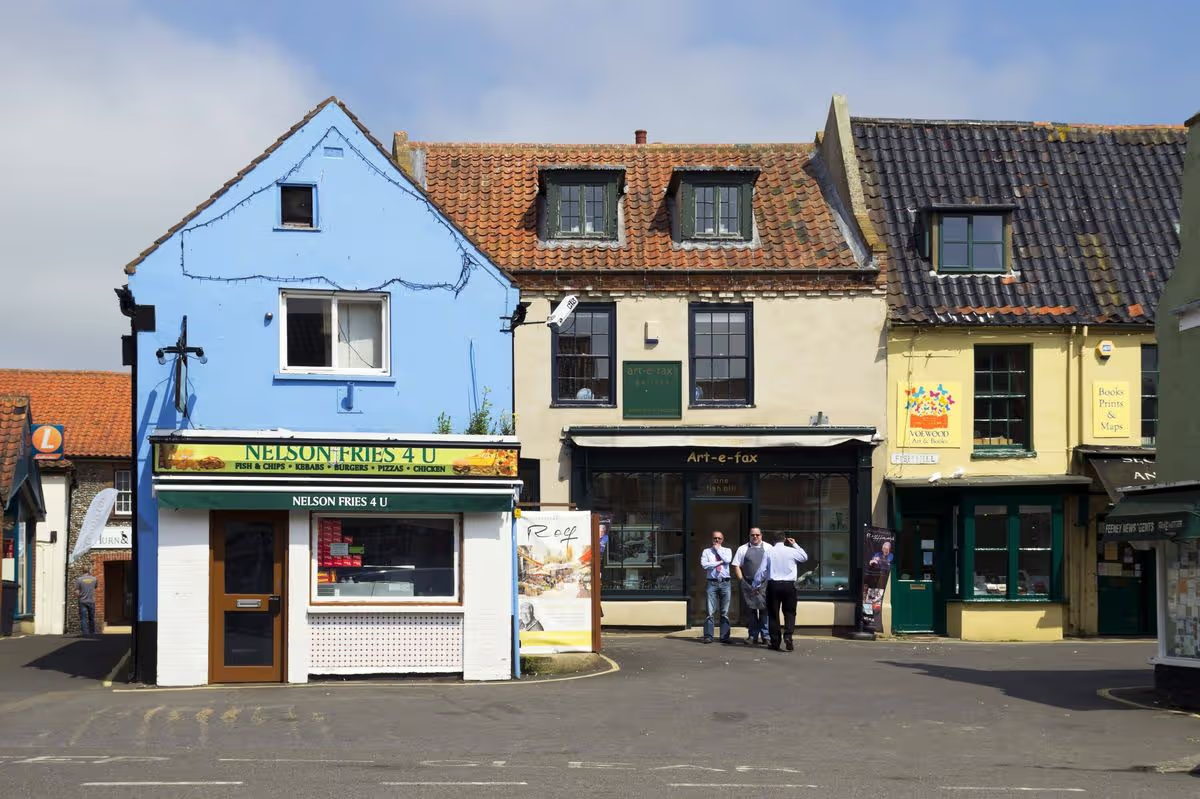
UK’s ‘quintessential market town’ that burned down now full of cafés and shops
The charming Georgian market town is packed with independent shops, cafés and a rich history dating back to the 1708 Great Fire – and it’s one to have on your staycation wishlist

Holt is full of independent shops(Image: Getty)
Strolling through the delightful market town of Holt, situated near the north Norfolk coastline, you’ll undoubtedly be captivated by its wealth of exquisitely maintained Georgian architecture.
Yet without a devastating blaze, the town’s appearance might have been entirely different, and its heritage extends much further back than the Georgian period. Holt featured in the 1086 Domesday Book, where it was recorded as a market town boasting five watermills and twelve plough teams, establishing it as a thriving and affluent community by medieval measures.
Its fortunes shifted dramatically on 1st May 1708 when The Great Fire of Holt swept through the town, its timber-framed medieval structures proving powerless against the inferno. In just three hours, a substantial portion of the town’s heritage vanished forever, with damage exceeding £11,000 reported – equivalent to more than £2.1 million today.
Contributions flooded in from throughout the nation and reconstruction commenced, though this time with a striking Georgian character that persists to the present day. Among the handful of structures surviving in an earlier architectural style is the Norman church of St Andrews.
Whilst its thatched roof was consumed by flames, the majority withstood the fire and it remains amongst the town’s most ancient buildings. Many of the watermills were decimated and never restored, but Letheringsett Watermill emerged in their stead in 1802, reports the Express.
It now holds the distinction of being Norfolk’s oldest operational watermill, producing flour to this day. Visitors can delve into the mill’s rich history or indulge in a homemade cake at the tearoom, made with locally sourced ingredients.
The town boasts a delightful high street dotted with Georgian buildings that have been transformed into quaint independent boutiques. Meander through the streets and you’ll stumble upon cosy cafés, historic pubs, and traditional tearooms.
From April to December, on the first Sunday of each month, Holt Sunday Market commandeers the town centre, featuring a plethora of traders peddling crafts, artisanal local food and drink, and global street food.
Holt also serves as a gateway to some of north Norfolk’s top attractions. Baconsthorpe Castle is merely a 10-minute drive away, offering free entry to explore the remnants of this once magnificent 15th-century castle.
Once the pride of a wealthy family, the castle was gradually sold off piece by piece as their fortunes dwindled, though parts of the edifice still stand.
A short journey will also take you to the Muckleburgh Military Collection. This family-run museum, located in a former Royal Artillery Anti-Aircraft training camp, is a treasure trove for military enthusiasts, housing an extensive collection of tanks, weaponry, and uniforms.
It’s a must-visit for any history aficionado. For those seeking somewhere distinctive to rest their heads, Byfords in the town centre is worth considering. Housed within a grade II listed building that ranks among Holt’s most historic, it offers 16 well-appointed bedrooms alongside a favoured restaurant downstairs dishing up seasonal fare.
Alternatively, secure accommodation at The Feathers, a Georgian coaching inn boasting 24 rooms – including dog-friendly options – and a welcoming pub below complete with an open fireplace.

Iran launches naval drills ahead of US nuclear talks | Military
Iran launched naval drills in the Strait of Hormuz, Persian Gulf and Oman Sea, state TV reports, ahead of US-Iran nuclear talks in Geneva on Tuesday. Video shows Gen. Mohammad Pakpour, the head of Iran’s Islamic Revolutionary Guard Corps, overseeing the drills.
Published On 16 Feb 2026
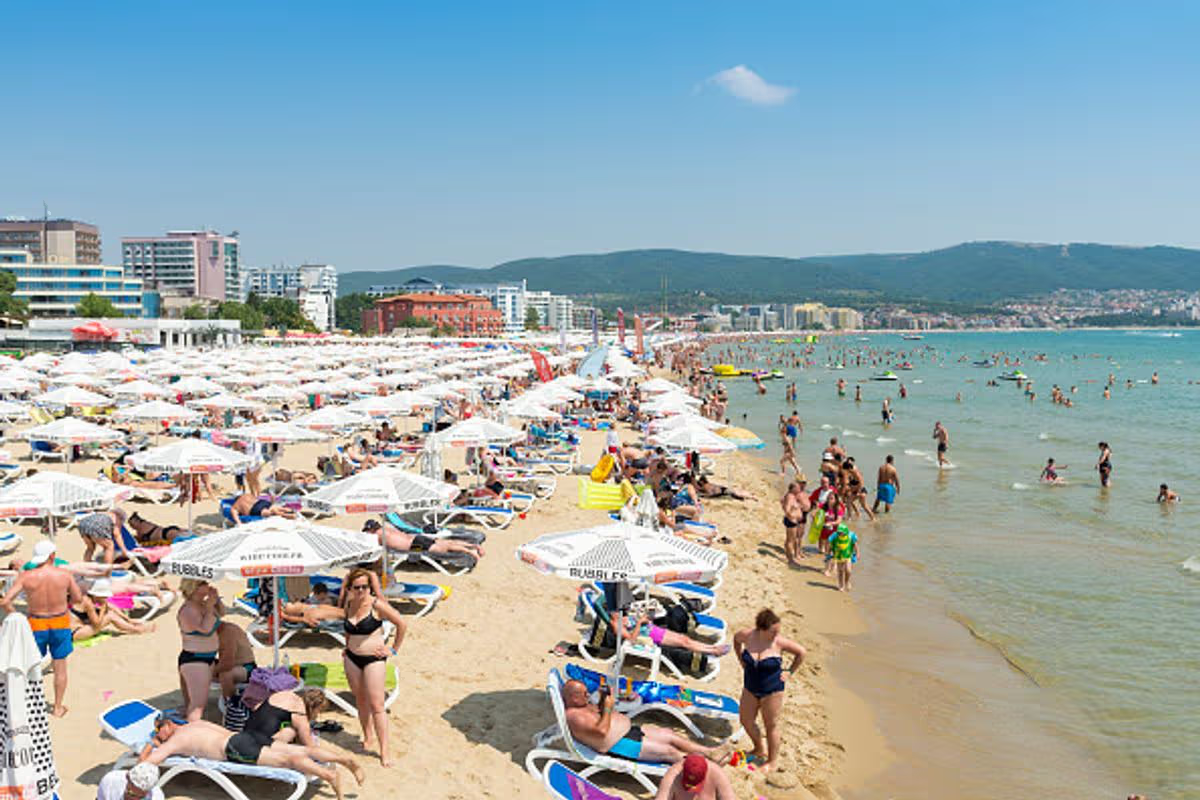
Sunny town hailed as ‘new Benidorm’ with £1.50 pints and 24-hour clubs
If you’re looking for alternatives to Benidorm, there’s a destination that’s becoming increasingly popular with Brits who are seeking sunshine, inexpensive pints, and lively nightlife

The resort is often compared to Benidorm(Image: Alex Segre/UCG/Universal Images Group via Getty Images)
Benidorm is the perfect choice of destination if you like a lively atmosphere, plenty of beach space, and clubs within walking distance of your hotel. However, in recent years, many tourists have been looking for alternatives to the Spanish town, and if you’re bored of Beni, there’s another fun destination about 3.5 hours from the UK.
Sunny Beach in Bulgaria has many similarities to Benidorm. Both resorts were developed in the 1960s with the package holiday boom, and Sunny Beach’s promenade with its high rise hotels could easily be mistaken for Benidorm’s Levante Beach area.
However, with some tourists complaining about Benidorm prices in recent years, Sunny Beach offers a cheaper alternative. YouTuber Travel with Col made a video of some of Sunny Beach’s prices in June of last year and showed deals such as two cocktails for £4.60, and beers for £1.50.
As the name implies, Sunny Beach sits on a long stretch of sandy coast. The Blue Flag beach is about six miles long, and there are quieter spots to be found for those who want to relax or enjoy more of a family-friendly atmosphere. The sand gently slopes into the Black Sea, and waters are shallow, clear, and calm, ideal for swimming or snorkelling.
Central Beach is at the heart of the action, and along the coast is a huge number of beach bars, nightclubs, and large hotels. By day, you’ll see people lounging on sunbeds with cocktails and enjoying DJ sets, while at night, the clubs are packed with people dancing until dawn. Many clubs open until five or six am, just as the sun comes up, but some spots such as Cacao Beach open 24-hours a day, so the party never stops.
Inland, the town is a tourist haven, full of shops selling beachwear, a market with lots of colourful stalls, and inexpensive fast food joints. You’ll find restaurants serving cuisine from around the world, as well as a few Bulgarian places where you can try Balkan dishes. Sunny Beach Amusement Park is popular with families, offering fairground rides and rollercoasters, while the Action Aquapark has pools, slides, and a lazy river.
Most Brits arrive via Burgas Airport, which has seasonal connections with airlines including easyJet, Jet2, Ryanair, TUI, and Wizz Air. It’s about half an hour from Sunny Beach, and has good public transport connections.
READ MORE: Ibiza and Majorca could end up restricting tourist numbers under radical plansREAD MORE: Tourists flock to UK’s ‘lost city’ to see hidden gem – only to find it’s a toilet
It’s worth taking a day trip to Burgas to explore this historic Bulgarian city. Attractions include The Sea Garden, famous for its pier which looks a lot like something you’d see at the British seaside. Dino Park is an amusement park with animatronic dinosaurs, allowing you to feel like you’ve stepped back in time, and there’s the vast Mall Galleria where you’ll find lots of popular European chains.
Finish your day with a boat trip to St. Anastasia Island. Dating back to medieval times, this tiny 2.5 acre island has a monastery, museum, and historic lighthouse to explore.
Have a story you want to share? Email us at webtravel@reachplc.com
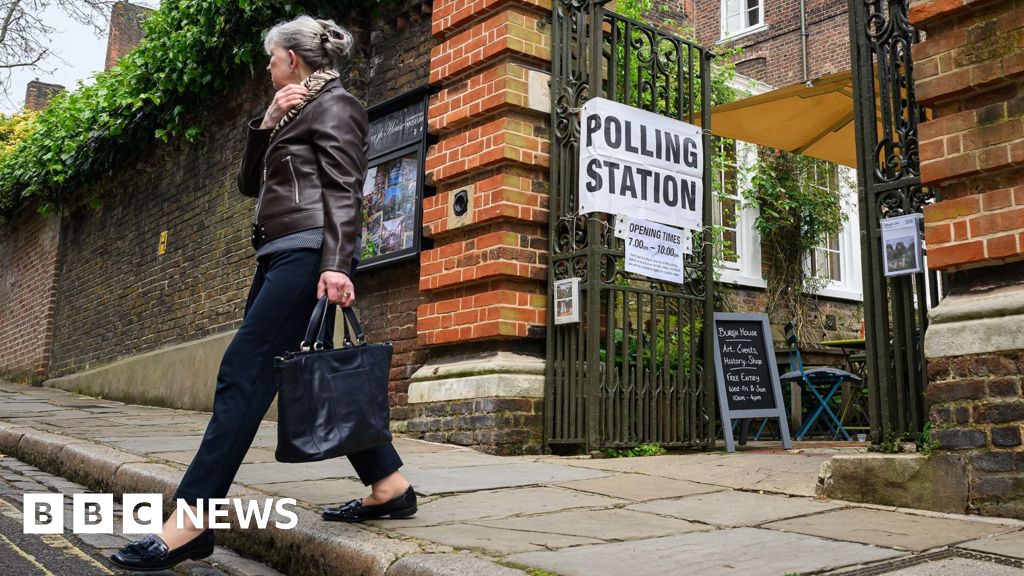
Government abandons plans to delay 30 council elections
All English elections will now go ahead as originally planned after Reform UK brought a legal challenge over the decision to delay some polls.
Source link

Huge Brit band cancel string of gigs after ‘medical emergency’ saying ‘we are so sorry’
ROCK band The Enemy have been forced to cancel a string of gigs after a “medical emergency” as they issue an apology to their fans.
The group have revealed that their Glasgow and Edinburgh shows for tonight and Tuesday have been cancelled.
Taking to Instagram to share the news, their management posted a statement on their behalf.
It read: “Due to a family medical emergency within the band, they have had to rush back home and both tonight’s show at King Tut’s Glasgow and tomorrow night at The Caves Edinburgh have been cancelled.
“Refunds will be issued within the next 24 hours.
“We are so sorry for the disappointment caused, your support means the world to the band, thank you on their behalf for being so understanding of the circumstances. Many thanks, Management,” they signed off.


The group are still currently scheduled to perform at Brudenell in Leeds on Friday 27 and 100 Club in London on March 4.
Their beloved fans rushed to the comments section to send them their well-wishes as they navigate the emergency.
One concerned fan penned: “Hope all is well. Family should always come first. The shows can wait.”
Another understanding social media user commented: “Sending loads of love, hope everything is ok. Family is always first priority.”
Somebody else said: “Gutted. Hope everything is ok though,” while a fourth added: “Sorry to hear this, family first.”
The English indie rock band was formed in Coventry back in 2006 and consists of members, Tom Clarke, Andy Hopkins and Liam Watts.
The Enemy’s debut album, We’ll Live and Die in These Towns was released in 2007 and went straight to number one in the UK Albums Chart.
They followed this up with a further three albums and are gearing up for their fifth studio album, Social Disguises, which releases this week.
After disbanding in 2016, the trio reunited in 2022 for two reunion shows in their hometown of Coventry as well as embarking on a UK tour.
While Tom is on lead vocals as well as guitar, piano and strings, Andy is on bass guitar and vocals and Liam is in charge of drums.
The group revealed earlier this month they’re releasing their newest album, Social Disguises.
Taking to Instagram, they penned: “We can officially say that there is a brand new album by The Enemy being released THIS MONTH.
“It’s been a while since last time we said that!
“Massive love to everyone who’s listened to singles and pre-ordered the record! Go get yours from our website.”
This Summer is also set to be a good one for the band’s fans as they’ve been lined up to play Tramlines in Sheffield, Y Not? Festival in Derbyshire and Victorious Festival in Portsmouth.

Political Road Map: California has long depended on an illegal-immigration program that Trump wants to kill
Reporting from Sacramento — For all of the unprecedented elements of President Trump’s federal budget plans, there’s an item buried in the list of detailed spending cuts that has a familiar, contentious political legacy in California.
Trump has proposed canceling federal government subsidies to states that house prisoners and inmates who are in the U.S. illegally. He’s not the first president to try it, and undoubtedly will get an earful from states like California.
For sheer bravado, the award for defending that subsidy probably goes to former Gov. Pete Wilson. In a letter sent to federal officials in 1995, two days after Christmas, Wilson threatened to drop off one of the state’s undocumented prisoners — in shackles, no less — on the doorstep of a federal jail. (He never actually did it.)
“The intent of federal law is unequivocal,” Wilson wrote about the subsidy program. “The federal government must either reimburse the state at a fair rate for the incarceration of any undocumented inmate which it identifies or… take the burden of incarceration off the state’s hands.”
Wilson had won a second term the year before, with a blistering campaign attacking illegal immigration. His time in office was also marked by persistent state budget problems, and the money mattered. The state never got as much as it wanted, though, and years of squabbles followed over the fate of the State Criminal Alien Assistance Program, established as part of the sweeping immigration reforms of 1986.
Former Gov. Arnold Schwarzenegger did his fair share of complaining about skimpy SCAAP funding. In 2005, he and a bipartisan group of western U.S. governors demanded a boost in the program to a total of $850 million. That didn’t happen.
The past two presidents, George W. Bush and Barack Obama, offered their own proposals to cancel the program. Trump’s budget scores the possible savings at $210 million. His budget blueprint lampoons SCAAP as “poorly targeted,” and describes it as a program “in which two-thirds of the funding primarily reimburses four states” for housing felons who lack legal immigration status.
Want to take a guess which state gets the most? OK, that’s an easy one.
California’s state government received $44.1 million in the 2015 federal budget year, according to Justice Department data. Add to that another $12.8 million that was paid directly to California counties, with the largest local subsidy being the $3 million paid to the Los Angeles County Sheriff’s Department.
More than one-third of the entire program went to California. No other state’s share was even close. A win on this issue for the president would be particularly bitter for the state, where political animosity toward Trump is widespread.
Political Road Map: There’s a $368 billion reason that California depends on Washington »
In Gov. Jerry Brown’s budget unveiled last month, he assumed $50.6 million in federal help for prison costs related to felons in the U.S. illegally. A budget spokesman for Brown said the governor will ask for help from the state’s congressional delegation in saving the program. Still, it’s safe to say the estimate is now in doubt.
Roll back the clock, though, and take a look at how this political debate has changed. Wilson’s legacy on illegal immigration cast a long shadow as candidate Trump promised to go after “bad hombres” who are illegally in the country. The president’s official plan, by most estimates, would go even further.
When President Obama tried to nix the subsidy, conservatives warned it would endanger public safety. So far, few are making the same case now that it’s coming from Trump — a curious development, given California’s most famous illegal immigration critic once insisted the program was essential.
Follow @johnmyers on Twitter, sign up for our daily Essential Politics newsletter and listen to the weekly California Politics Podcast
ALSO:
Los Angeles County sheriff opposes legislation to create a ‘sanctuary state’ in California
Gov. Jerry Brown projects a $1.6 billion deficit by the summer of 2018

Winter Olympics 2026: GB curlers semi-final hopes on line after shock defeat
The Winter Olympics medal hopes of Team GB’s men’s curlers have been cast into doubt after a shock 8-6 defeat by Norway left them scrambling to make the semi-finals in Cortina.
Bruce Mouat’s world champions had lost two of their opening six matches, and were expected to beat the Norwegians for their fifth victory of the competition.
Leading 4-2 after six ends, they appeared to be in good shape. But a few untimely errors, combined with a disciplined display by their unheralded opponents, left them 6-4 down with two ends left.
Mouat’s attempted triple takeout in the penultimate end was a fraction out, but still yielded two to level the scores going into the last. However, Norway held their nerve with the hammer to close out an unexpected victory.
Given results elsewhere,, external five wins might still prove to be enough to reach Thursday’s semis.
But the British rink will need to beat both Canada on Tuesday and the United States the following day (both 18:05 GMT).
“We need to win our next two to make sure we’re definitely in the semis,” lead Hammy McMillan told BBC Sport. “We’re doing a lot of the right things, we just need to find that extra inch.”
The women’s rink are not well-placed, either, but they did deliver their best in the biggest moment to beat Denmark 7-2 and keep their hopes alive.
Having lost three of their opening four, Rebecca Morrison’s rink need victories in at least four of their final five matches to have any chance of salvaging a place in Friday’s last four – and they began that quest well.
An aggressive start was rewarded with an early 2-0 advantage and the British rink led 3-2 at the break.
Another fine two-point haul in the sixth, followed by a steal in the seventh, opened up a four-point gap with three ends to play and the Scottish quartet closed out the win.
They are back on the ice against Switzerland at 18:05 GMT in another must-win contest, live on the BBC.

UK holiday park with its own shopping village, theatre and golf course plunges into administration
A POPULAR UK holiday park has gone into administration after nearly 20 years.
The future of the resort, which features a retail village, golf course, and theatres, currently remains uncertain.
Stonham Barns Park, based in the Suffolk countryside, filed the notice on Monday, February 16.
David Hudson and David Hinrichsen of FRP Advisory have been appointed as joint administrators following a period of financial pressure on the business”.
The administrators confirmed they are focused on continuing to trade the site while seeking a buyer, with the aim of securing the park’s future as a going concern.
All existing holiday bookings will be honoured, and the site will continue to take new bookings, with all facilitiesoperating as normal throughout the administration process.
Read More On Holiday Parks


David Hudson, joint administrator and partner at FRP, told The Sun: “We are very much focussed on business as usual and want to reassure guests with existing bookings that these are unaffected.
“Anyone considering booking a visit can make one with confidence too.
“We are actively marketing the site for sale and would welcome bidders who see the opportunity here with a well-established and popular caravan park.”
Located conveniently on the A1120 tourist route, Stonham Barns Park was first opened in 1987, with the current management taking over in 2001.
Stonham Barns eventually evolved into a multi-facility destination, offering fun for all the family for 362 days of the year.
The park is famous for hosting niche enthusiast shows, including historic re-enactments of the Viking era, as well as classic car shows and darts tournaments.
Visitors can also enjoy countless onsite attractions, including an indoor soft play area, a pirate-themed adventure golf, a vibrant shopping village, an owl sanctuary and Meerkat castle, fair rides, and fishing lakes.
The park is also popular with golf enthusiasts, offering a nine hole golf course, simulator bays, a street golf driving range, a chip n putt course, golf darts, and foot golf.
Stonham Barns Showground is also located within the park, hosting numerous events throughout the year, including an annual dog show and a Christmas spectacular.
Visitors can also rent or buy holiday homes on-site, including luxury lodges situated around the scenic lake.
In December, the HMRC issued the park with a Winding Up Petition, a last‑resort enforcement tool when other collection options have been exhausted.
A deadline was reported for the end of January, with no official amount disclosed.
At the time of issue, company directors publicly stated that the park was fully in funds to meet the obligation and that there was no risk to the ongoing operation of the resort and its on‑site businesses.
The Sun has reached out to Stonham Barns for comment.

Warner Bros. Discovery may reopen talks with Paramount Skydance
Feb. 16 (UPI) — Warner Bros. Discovery is considering reopening talks with Paramount Skydance after Paramount sweetened its offer to buy the company last week, sources say.
Bloomberg News first reported Sunday that WBD was considering the offer.
In October, Warner Bros. said it was open to offers, and on Dec. 5, after a bidding war between Netflix and Paramount, WBD agreed to Netflix’s offer. Then Paramount launched a hostile bid to buy WBD, but the board wasn’t budging. Then Paramount announced that Oracle creator Larry Ellison was backing the deal with $40 billion in equity. On Jan. 20, Netflix changed its offer to all cash, then on Feb. 10, Paramount did the same and added some sweeteners.
The sweetened deal included paying the $2.8 billion termination fee that WBD would owe Netflix and an agreement to back WBD’s debt costs. It also agreed to pay a ticking fee of 25 cents per share for each quarter the deal is delayed, starting in 2027, totalling about $650 million in cash per quarter.
Paramount and Netflix have both said they would be willing to raise their bids, Bloomberg reported. This is the first time, though, that WBD has given serious consideration to Paramount’s offer. It has until Feb. 25 to respond to Paramount’s offer.
Some WBD shareholders, including the investment firm Ancora, have expressed concerns with Netflix’s deal. One main issue is whether it would pass federal scrutiny. Paramount’s connection with Larry Ellison is a bonus because he’s friendly with President Donald Trump, who has said he would get involved with the process.
Last week, Paramount appointed Rene Augustine as its senior vice president of global public policy. Augustine is a former lawyer in the Trump administration, further bolstering Paramount’s regulatory clout.
Netflix has said it’s confident it can pass regulatory scrutiny. Its co-CEO Ted Sarandos faced a Senate hearing on Feb. 4 about the deal. Paramount didn’t participate.
Warner Bros. is waiting for the Security and Exchange Commission to approve its filings, which would allow it to schedule a shareholder vote on the Netflix offer.

President Donald Trump speaks alongside Administrator of the Environmental Protection Agency Lee Zeldin in the Roosevelt Room of the White House on Thursday. The Trump administration has announced the finalization of rules that revoke the EPA’s ability to regulate climate pollution by ending the endangerment finding that determined six greenhouse gases could be categorized as dangerous to human health. Photo by Will Oliver/UPI | License Photo

Europe’s Israel policy faces a democratic test | Israel-Palestine conflict
More than 457,000 European citizens have signed a petition calling for the full suspension of the European Union’s partnership agreement with Israel within the initiative’s first month.
Launched on January 13 as a formally registered European citizens’ initiative, the petition must reach 1 million signatures from at least seven EU member states by January 13 next year to trigger formal consideration by the European Commission. It is not a symbolic appeal. It is a mechanism embedded within the EU’s democratic framework, designed to translate public will into institutional review.
The speed and geographic spread of this mobilisation matter. The demand to suspend the EU-Israel Association Agreement is no longer confined to street demonstrations or activist circles. It has entered the EU’s formal democratic architecture.
The petition calls for suspension on the grounds that Israel is in breach of Article 2 of the association agreement, which conditions the partnership on respect for human rights and international law. As the initiative states, “EU citizens cannot tolerate that the EU maintains an agreement that contributes to legitimize and finance a State that commits crimes against humanity and war crimes.” The text further cites large-scale civilian killings, displacement, destruction of hospitals and medical infrastructure in Gaza, the blockade of humanitarian aid and the failure to comply with orders of the International Court of Justice.
As of Monday, the initiative had gathered 457,950 signatures, more than 45 percent of the required total in just one month. Signatories come from all 27 EU member states without exception. This is not a regional surge. It is continental.
The distribution of signatures reveals more than raw numbers. France alone accounts for 203,182 signatories, nearly 45 percent of the total. That figure reflects the country’s longstanding tradition of solidarity mobilisation, sustained mass demonstrations throughout the genocidal war on Gaza and the clear positioning of major political actors, such as La France Insoumise. France has emerged as the principal engine of this institutional push.
Spain follows with 60,087 signatures while Italy stands at 54,821, a particularly striking figure given the presence of a right-wing government that openly supports Israel. Belgium has registered 20,330 signatures from a population of roughly 12 million, reflecting high relative engagement. In the Nordic region, Finland with 12,649 signatures, Sweden with 15,267 and Denmark with 8,295 show sustained participation. Ireland has reached 11,281 signatures from a population of just over five million.
Several of these countries have already exceeded their required national thresholds under EU rules. France, Spain, Belgium, Finland, Ireland, Italy and Sweden have all surpassed the minimum number needed for their signatures to count towards the seven-member-state requirement. This is a critical development. It means the initiative is not merely accumulating volume but is also already satisfying the geographic legitimacy criteria built into the European citizens’ initiative mechanism.
The Netherlands, with 20,304 signatures, is approaching its national threshold. Poland, at 22,308 signatures, reflects engagement that extends beyond Western Europe. Even in smaller states such as Slovenia with 1,703 signatures, Luxembourg with 900 and Portugal with 4,945, participation is visible and measurable.
Germany presents a revealing contrast. Despite being the EU’s most populous member state and the site of some of the largest demonstrations against Israel’s genocidal campaign in Gaza, the petition has gathered 11,461 German signatures, only 17 percent of Germany’s national threshold of 69,120. This gap between visible street mobilisation and formal institutional participation highlights the particular political and legal environment in Germany, where pro-Palestinian expression has faced restrictions and where successive governments have maintained near-unconditional support for Israel as a matter of state policy. The relatively low percentage does not signal absence of dissent. Rather, it illustrates the structural constraints within which dissent operates. That more than 11,000 citizens have nevertheless formally registered their support indicates that institutional engagement is occurring even under conditions of political pressure.
Taken together, these patterns reveal something deeper than a petition’s momentum. Over more than two years of genocidal war, ethnic cleansing and the systematic destruction of civilian life in Gaza, solidarity across Europe has not dissipated. It has moved from protest slogans and street mobilisation into a formal democratic instrument that demands institutional response.
Petitions do not automatically change policy. The European Commission is not legally bound to suspend the association agreement even if the initiative ultimately reaches 1 million signatures. But the political implications are significant. A successful initiative would formally compel the commission to respond to a demand grounded in the EU’s own human rights clause. It would demonstrate that the call for suspension is rooted in broad and measurable public support across multiple member states.
The European Union has long presented itself as a normative power committed to international law and human rights. Article 2 of its partnership agreements is foundational. If hundreds of thousands, and potentially more than a million, European citizens insist that this principle be applied consistently, EU institutions will face a credibility test.
This petition is not merely a count of signatures. It is an index of political will. It shows that across France, Spain, Belgium, Italy, Ireland, the Nordic states and beyond, citizens are invoking the EU’s own democratic mechanisms to demand accountability.
Whether the initiative ultimately reaches 1 million, one reality is already established. The demand to suspend the EU-Israel partnership has entered Europe’s institutional bloodstream. It can no longer be dismissed as marginal rhetoric. It is embedded within the union’s formal democratic process, and that marks a significant development in Europe’s response to the genocide in Gaza.
The views expressed in this article are the author’s own and do not necessarily reflect Al Jazeera’s editorial stance.

Chelsea footballers blasted by Sharron Davies over ‘shameful’ tunnel footage
Chelsea FC footballers have been blasted on social media after they appeared to snub young mascots before their clash with Hull City ahead of Friday night’s match

Baroness Sharron Davies blasted the Chelsea team(Image: ITV)
Chelsea FC players have been slammed for the treatment of young mascots at their FA Cup game. Ahead of match against Hull City, the stars of the Premier League side appeared to snub the mascots of their opposition.
Ahead of kick off on Friday night, the official X, formerly known as Twitter page for the Blues, shared footage of players, led by Reece James, walking out, and completely ignoring the young mascots who were eagerly waiting to see them dress in their Hull kits.
While the smiling young lads appeared ready to engage with the Chelsea players, they were relentlessly snubbed by the players who walked on by without acknowledging them. Liam Delap looked as if he was walking towards the boys, but later hugged a member of the Hull team, having previously spent time on loan with the Yorkshire club in his earlier career.
The Blues’ actions have been slammed by stars including Baroness Sharron Davies, who said on X: “Very disappointing @chelseafc could no one be bothered to even say hello to those young footballers as they passed? 5 seconds of their time!”
Former Apprentice star turned GB News presenter, Michelle Dewberry, fumed on social media: “You should be ashamed your players act like this with little boys. Instead, you’re proud and desperate to share it. Gross.”
Meanwhile, fellow anchor Bev Turner commented: “Say hello to the children you fools!! You only kick balls for a living. But you would give these kids a massive thrill. Give them high fives! Anything!!”
Fans have also criticised the move, with one saying: “Not one Chelsea player acknowledging or high-fiving the mascots. Who stole the soul?” Another added: “(It would) be nice if they looked at the mascots at all, even a smile, a glance or a wave. Would mean the world to those kids.”
A third penned: “We have a great video of our overpaid, arrogant and self-centred players walking past a bunch of kids and ignoring them. Great for social content.” However, it remains unclear if the Chelsea players interacted with the mascots after the cameras stopped rolling.
Elsewhere, Jeff Stelling said on talkSPORT earlier today: “Chelsea players are getting a bit of stick online for apparently snubbing Hull City mascots on arrival. You can see the mascots in the background there, all standing to attention, and the Chelsea players do not bat an eyelid and walk straight past.”
Meanwhile, Ally McCoist added: “It’s not a good look!” Jeff went on to add: “It’s not a good look, is it? Do they need reminding that they have some responsibilities?” Ally went on to say: “Never mind not a good look, it’s not good. One of the best I’ve seen at it is Jack Grealish, right?
“Jack Grealish to me, plays a game with a smile on his face. He looks as though he’s very thankful to the opportunity that has been given to him to play football. I just think he’s brilliant, and I don’t know, I’m not watching him all the time, but any time I see him arriving at grounds, he’s always got a word for whoever that is, the guy at the front door, the kids waiting to see them. It costs nothing.”
Ally continued: “You may be underestimating how much it means to people, those kids, for sitting there. Imagine the kid in the playground, ‘You know, so and so came up and said hello to me.’ I’m loath to use the word wee things like that because those wee things are big things in the grand scheme of things, Jeff. That is not a good look at all. What does it take to come out of your way and walk and give the kids a wee high five on the way through?”
Chelsea eventually won 4-0 following a hat-trick from Pedro Neto and a goal from Estêvão, meaning that they’re in the hat for the fifth-round draw later today.
The Mirror has approached Chelsea FC for comment.
Like this story? For more of the latest showbiz news and gossip, follow Mirror Celebs on TikTok, Snapchat, Instagram, Twitter, Facebook, YouTube and Threads.

Tourists flock to UK’s ‘lost city’ to see hidden gem – only to find it’s a toilet
At one of the most popular tourist destinations, which dates back more than 5,000 years, visitors throw coins into a toilet in what they believe is a wishing well

The stone-built Neolithic settlement is located in the Orkney archipelago of Scotland(Image: Getty Images)
The UK’s ‘lost city’ has been attracting tourists from around the world – but most of them want to toss pennies into a toilet.
Skara Brae, on the Orkney archipelago in Scotland, is a preserved Neolithic village that was inhabited by a farming community around 5,000 years ago. It stands as one of the finest-preserved farming settlements across the British Isles and is known as the “Scottish Pompeii”.
The village was inhabited between 3100 and 2500 BC, and its close proximity to the sea allowed its residents to easily hunt for fish while also growing crops and tending to their various animals. It isn’t exactly clear why Skara Brae was abandoned, but it’s thought to have become uninhabitable due to climate change and severe weather.
READ MORE: Abandoned UK village left a ‘ghost town’ with 33 unfinished new build homes boarded upREAD MORE: I booked a mystery holiday for £79 and thought things couldn’t get worse — they did
It was left largely untouched until a storm in 1850 uncovered the site, revealing its fascinating past and prehistoric dwellings. Following a dig at Skara Brae, remnants of the community were further uncovered, including stone dressers and box beds, along with artefacts such as tools, gaming dice, pots and jewellery.
Together with a substantial chambered tomb (Maes Howe) and two ceremonial stone circles (the Stones of Stenness and the Ring of Brodgar), the settlement now forms part of the “Heart of Neolithic Orkney” collection of monuments, designated a UNESCO World Heritage Site in 1999.
Dating back thousands of years, the site remains one of the island’s most popular tourist attractions, drawing crowds near and far. In a long-standing tradition, superstitious visitors have frequently thrown pennies into an ancient hole in the ground of the preserved Neolithic village, believing it to be a wishing well.
However, it’s actually a toilet – and not everyone realises. Experts have outlined that the hole in the ground is merely an “old sewer” and a network of well-constructed drains and substantial cisterns.
Local tour guide from Orkney Uncovered, Kinlay Francis, previously shared on Facebook: “For years, people have been throwing money down a subterranean hole in the Skara Brae ground, thinking they are throwing money down a well to make a wish.
“I have great delight in telling my clients and anybody who throws their money down there that they are, in fact, throwing money down a toilet.
“This is the old drain/sewer from the Skara Brae site. It is not, and I repeat, not a wishing well. So don’t go there to spend a penny.”
The post quickly amassed over 2,000 reactions and nearly 150 comments, as people couldn’t believe the hilarious mix-up. One person remarked: “Oh! So! Priceless!”, while a second said: “Really a p*****g well not a wishing well then”.
A third commented: “It’s not a wishing well…it’s a s******g well.” Yet, not everyone was prepared to ditch their beliefs, as one noted: “Still…maybe brings good luck”, and another stated: “Where there is muck, there is brass!”
The confusion hasn’t stopped visitors from marvelling at the Neolithic village, and it’s received outstanding praise on TripAdvisor. One traveller shared: “Skara Brae Prehistoric Village is a must-see if you are in the Orkney Islands. Such an interesting place. You will be blown away by how well-preserved this 5000-year-old site is.”
A second commented: “This was my second time to Skara Brae and it was just as wonderful as the first. The setting of this village is spectacular, and on this visit, the weather was outstanding. On my first visit, the rain was blowing sideways. It is fantastic to view the site and then visit the reconstructed house to see how these people lived. Not so different from us – pretty pots, stone dressers and reasonably comfortable beds with skins as duvets!”
One more noted: “A must-see bucket list experience older than the Giza pyramids. Although the museum is small, the recreated room really brings alive the site. They even had plumbing. Once you are at the site, you can tour the homes from the walkway, which shows the genius of the ancient culture. Plentiful parking with a good gift shop/cafe.”
Do you have a travel story to share? Email webtravel@reachplc.com
What binds Bush, Kerry – Los Angeles Times
In the last several months, Tim Russert of NBC’s “Meet the Press,” one of TV’s toughest interviewers, struck out with two of his biggest “gets”:
In August, he quizzed Sen. John F. Kerry, “You both were members of Skull and Bones, a secret society at Yale. What does that tell us?”
Kerry: “Not much, because it’s a secret.”
In February, he asked President Bush, “You were both in Skull and Bones, the secret society?”
Bush: “It’s so secret we can’t talk about it.”
Such coyness on the part of grown men! And yet, their recalcitrance does prove one thing: The guys can keep a secret.
But is that good? Secrecy, after all, leads to rumors. And the rumors about Skull and Bones — naked confessions of sexual conquests, grave robbing, free money and, of course, plans for world domination — don’t look good on the presidential resume. Those rumors received a boost when it became apparent that, for the first time in history, two Bonesmen will face off for the presidency in November.
“It’s certainly a coincidence that lends itself to attention,” said the historian Kevin Phillips, whose recent work, “American Dynasty,” explores how the Bushes have benefited from what he calls “crony capitalism.” “Is it nefarious? I guess it’s a little insidious.”
Journalist and author Ron Rosenbaum (Yale ‘68), who wrote the seminal article on Skull and Bones for Esquire in 1977, thinks the Bush-Kerry coincidence should be treated thoughtfully. “Obviously, it’s part of what shaped the character of the two presidential candidates, and yet there’s a lot of overblown conspiracy theory that has outweighed the seriousness.”
Indeed, a serious political discussion might examine the meaning of both presidential candidates maintaining an inherently undemocratic affiliation and refusing to address an important aspect of their university lives. Instead, discussions on the Internet, talk radio and cable TV, generally turn on suspicions that Skull and Bones has attempted to mastermind a “new world order” in which only a handful of wealthy, old-line families control the planet.
“Is this a satanic cult? No. Is this a group that operates as a shadow government? No. Is this a group that has an institutionalized superiority complex? Yes,” said Alexandra Robbins, a 27-year-old journalist and Yale alumna whose book “Secrets of the Tomb” explores the 172-year-old club based on interviews with 100 anonymous Bonesmen. Bones, she said, has “a power agenda” that “prioritizes its own elitism and its own members above other concerns.”
Rosenbaum disputes that there is a specific “power agenda” at work. “I would say the best way of describing it is by analogy to the old boys’ network in England, where graduates of Eton and Oxford and Cambridge form a network of influence and power and share a mind-set. They know each other, they trust each other and they bonded at an early age.”
If nothing else, Skull and Bones has produced some odd bedfellows. “I am a liberal Democratic criminal defense attorney who voted for George Bush, and I will vote for him again,” said Bush’s fellow Bonesman Donald Etra, an Orthodox Jew who lives in L.A. and was appointed by Bush to the U.S. Holocaust Memorial Council. Etra, who called himself “a strong Zionist,” said one of his closest Bones friends is a Jordanian-born Muslim. “Most of us,” he said, “put friendship first and politics a far, far second.”
Next month, an eclectic group of 15 juniors will be tapped for Skull and Bones by this year’s seniors. There have never been specific criteria for membership, which in generations past might have included some standard campus types: the editor of the Yale Daily, an outstanding athlete, a son of a Bonesman etc. Women were admitted in 1991, after a rancorous 20-year battle.
Bones members spend each Thursday and Sunday of their senior year in the Tomb, the group’s clubhouse on High Street in the middle of the Yale campus. It is windowless, ersatz Greco-Egyptian temple, readily identified on Yale maps.
“It’s kind of foreboding looking,” said a 48-year-old Toronto writer who sneaked into the Tomb with her boyfriend during spring break 1975. “They made it into this big mystery thing. But it wasn’t. It’s just like a big clubhouse, but it’s not in a tree.” There was a large dining room with a long table, and she recalled a room full of license plates. “They were always ripping things off with ‘322’ on them.”
The number 322 is a variation on the year (1832) that the club was founded by William H. Russell, a Yale student who modeled it after one he’d encountered in Germany. At its inception, said Dr. Alan Cross, one of Kerry’s classmates and a third-generation Bonesman, the club was “basically a debating society, where members of the senior class would get together and discuss important topics of the day.” (Bonesmen have a special regard for Demosthenes, the famed Greek orator who died in 322 BC.)
In later generations, the conversations became not just confessional but confrontational in the manner of group therapy, according to some reports. There was always security, said Cross, a professor of social medicine and pediatrics at the University of North Carolina, Chapel Hill, in the knowledge that “what goes on inside, what people reveal about themselves … would stay inside the building.”
Not surprisingly, given Yale’s lofty status in the firmament of American universities, Bonesmen often have occupied positions of power and prestige as adults. Three have become president (both Bushes and William Howard Taft). A partial roster of the famous includes diplomat Averill Harriman, poet Archibald MacLeish, financier Dean Witter Jr., Time magazine founder Henry Luce, Supreme Court Justice Potter Stewart, national security advisor McGeorge Bundy, writers William F. Buckley and Christopher Buckley, former Sen. David Boren and FedEx founder Frederick Smith.
Not every Bonesman has loved the club unconditionally. As an adult, William Sloane Coffin, the Yale chaplain known for his opposition to the Vietnam War, developed a distaste for it. “He thought it was inappropriate,” said Cross. “A snobby thing. We were discouraged from gathering in groups around campus because it would perpetuate the notion that this was an elitist group.”
But of course, it is an elite group. Members can’t apply for membership — they are secretly elected. They have lifelong access to Deer Island, a private 40-acre sanctuary in the St. Lawrence River, which is owned by Skull and Bones’ corporate parent, the Russell Trust Assn. And they are accorded other, less tangible benefits for life, not the least of which are their connections to the well-connected.
The Bush family has a long history with Skull and Bones. George W. Bush’s father tapped him in 1967, as a favor to the seniors who nominated him. The president’s grandfather, Prescott Bush, who was a U.S. senator, supposedly boasted in a journal that he stole the skull of Geronimo in 1918 for display among the many osseous relics in the Tomb, according to Robbins.
The current college generation of Bushes may represent a break in family tradition: Barbara Bush, a Yale senior, reportedly rejected an invitation to join the club.
Kerry, tapped in 1965, has no family history with Bones, although David Thorne, the twin of his first wife, Julia, is a member, as was his current wife’s first father-in-law, John Heinz.
Whether the president and his challenger are influenced by their Skull and Bones associations is, in a general sense, a matter of record. Both men have close friends and political contributors who are Bonesmen. Bush’s early forays into business were helped along by older Bonesmen. Bush has appointed several of his clubmates to government positions, including William H. Donaldson, the head of the Securities and Exchange Commission.
Tales from a ‘savage’
The general goings on in the Tomb — particularly of eras past — are not truly secret anymore. This is due, mostly, to the investigative efforts of the two Yalie journalists, Rosenbaum and Robbins.
Robbins was an editorial assistant in the Washington bureau of the New Yorker when she first wrote a story about Skull and Bones for the Atlantic in 2000, which she expanded into a book two years later. Her own membership in a Yale secret society, Scroll and Key, helped open doors. “I got a lot of hang-ups and a lot of gruff voices saying, ‘I’m not talking to you about that!’ ” But when she identified herself as a “savage” — Bones-speak for a member of another secret society — it worked as an entree. (Regular folks are “barbarians.”)
Robbins has revealed that all Bonesmen receive lifelong nicknames, some handed down. (The president’s father, she writes, was “Magog,” a name given to the most sexually experienced Bonesman. George W. never got around to choosing a nickname and was dubbed “Temporary.”)
Like Rosenbaum (who has participated in covert taping operations of Bones rituals with infrared equipment), Robbins has written about the Tomb’s initiation rites. Bonesmen dress up as a variety of characters — “right out of Harry Potter meets Dracula” — and conduct what she has described as “a cross between haunted-house antics and a human pinball game.”
“World domination aside,” she writes in “Secrets of the Tomb,” the most pervasive rumors about Bones are that initiates must masturbate in a coffin while recounting their sexual exploits and that their candor is ultimately rewarded with a no-strings gift of $15,000.”
No Bonesmen interviewed for this article would comment on the nature of the confessional conversations. But Cross and Etra laughed at the idea that there was a monetary gift. “There was no check,” said Cross. Another Bonesman who graduated from Yale in 1975 and lives in Los Angeles, agreed: “That’s ridiculous! I never got any money.”
‘Somewhat laughable’
Despite the fact that the presidential race has kindled interest in Skull and Bones, many believe the club has been in a long decline. Admitting women may have struck a blow for equality, but the Tomb just hasn’t generated much juicy buzz since then.
These days, wrote Franklin Foer in an April 2000 issue of the New Republic, Yale’s secret societies are “high temples of political correctness” where women outnumber men and “conservatives are scarce.”
While Kerry has said that he favored admitting women, the Bush position is not known. However, rumors have it that some older Bonesmen have forsaken the club now that it is coed.
“Once upon a time there was something called the Eastern Establishment, and Skull and Bones was a significant institution feeding into it,” said Jacob Weisberg, 39, editor of the online magazine Slate. “There is the residue of it, but it is not the same kind of network, not the same kind of career path.”
Weisberg should know.
In spring 1986, Weisberg, a Yale student interning at the New Republic, was invited to Kerry’s office. “I was writing about politics, so I thought maybe he was going to give me a scoop or something,” Weisberg said. But when Weisberg showed up, Kerry tapped him for Skull and Bones.
“I said, ‘Sen. Kerry, as a liberal, how do you justify supporting this club that doesn’t admit women?’ ”
Kerry was taken aback. According to Weisberg, Kerry said: “I’ve marched with battered women.”
Weisberg declined the tap and has no regrets.
“The institution is somewhat laughable at this point,” he said. “That we’re having a presidential race with two alumni of this club tells you something, but it tells you more about what’s changed, because it’s inconceivable that in 20 years we’ll have an election where two candidates are from Skull and Bones. This is the last time this could plausibly happen. I think it’s sort of the last gasp.”

A way too early look at the Dodgers’ opening day roster
Hi, and welcome to another edition of Dodgers Dugout. My name is Houston Mitchell. At last, our long, national nightmare is over. The Dodgers re-signed Kiké Hernández.
Well, the first spring training game is Saturday against the Angels. Opening day is March 26 at home against Arizona. So what better time to look at a potential opening day roster? After all, it’s not like there will be injuries and roster moves before then, right? This will definitely be the roster.
But first, a couple of notes to catch up on:
—They are splitting up the raising of the World Series flag and the ring ceremony again. The ring ceremony is March 27.
—The Dodgers re-signed Evan Phillips to a one-year, $6.5-million deal. The Dodgers originally acquired Phillips off waivers from the Tampa Bay Rays near the end of the 2021 season. Since then, he has gone 15-9 with a 2.22 ERA and 45 saves in 201 games (195 innings). His injury last season threw the bullpen into disarray. He had Tommy John surgery in June and won’t be back until the All-Star break.
—To make room for Phillips on the 40-man roster, the Dodgers designated Ben Rortvedt for assignment, probably hoping again that Rortvedt will go unclaimed and they can send him to the minors. However, the New York Mets claimed Rortvedt, and he will compete for a backup spot with, among other, former Dodger Austin Barnes, who signed a minor-league deal with the Mets on Jan. 29
—The Dodgers re-signed Kiké Hernández to a one-year, $4.5-million deal. He had elbow surgery in the offseason and won’t be able to play until probably the All-Star break, so expect him to be put on the 60-day IL soon. To make room for Hernández, the Dodgers put Phillips on the 60-day IL.
—The Dodgers traded Anthony Banda, whom they designated for assignment last week, to the Minnesota Twins for $500,000 of international bonus pool space.
—The Dodgers signed Max Muncy to a contract extension, giving him $7 million for the 2027 season with a $10-million team option for 2028. Muncy has said he wants to remain with the Dodgers the rest of his career, and he will be 38 when the 2028 season ends.
—In this era of high contracts, you have to look at Muncy and Will Smith, who has a 10-year, $140-million contract, and marvel. They both have left a lot of money on the table to remain with the Dodgers. Especially Smith, who is arguably the best catcher in baseball, and definitely in the top three.
Why are the Dodgers so good at getting players for under market value? Muncy said this last week to reporters:
“Part of me and who I am as a person and how I was raised, I like to be loyal to people. This organization took a chance on me when I was out of baseball, basically. That meant a lot to me. They stuck with me when things were going bad. They’ve never wavered on me at all. That means a lot to me in itself, and it’s just a place I’m very comfortable. My family’s comfortable here. We have a chance to win every single year. That’s why I play this game. I want to win. Obviously you make money in this game, but that’s not why I play. I play because I want to win. It’s the competitive fire that I want to go out and win as much as I can. That to me is worth more than money.
“I know I’m leaving money on the table, but I’m more than OK with that because I wouldn’t be OK with myself trying to chase money somewhere else watching this team win and I’m on the sidelines. That’s just not who I am. I would rather win. Another component to it is just the relationships I’ve built here. Like I was just saying, I like to be loyal and my relationships mean a lot. I’ve created such a relationship with the staff, the front office, the coaches, the medical and training staff, the clubhouse guys. I just don’t want to create that somewhere else. Being here for my entire career at this point would mean the world to me, and this gives me the chance to do that.”
So, with that out of the way, let’s take a look at the 40-man roster.
Pitchers
Ben Casparius
Edwin Díaz
Jack Dreyer
Paul Gervase
Tyler Glasnow
Brusdar Graterol
Edgardo Henriquez
Kyle Hurt
Will Klein
Landon Knack
Ronan Kopp
Bobby Miller
Evan Phillips-*
River Ryan
Roki Sasaki
Tanner Scott
Emmet Sheehan
Blake Snell
Brock Stewart
Gavin Stone
Blake Treinen
Alex Vesia
Justin Wrobleski
Yoshinobu Yamamoto
Two-way players
Shohei Ohtani
Catcher
Dalton Rushing
Will Smith
Infielders
Mookie Betts
Tommy Edman
Alex Freeland
Freddie Freeman
Kiké Hernández
Hyeseong Kim
Max Muncy
Miguel Rojas
Outfielders
Alex Call
Teoscar Hernández
Andy Pages
Michael Siani
Kyle Tucker
Ryan Ward
*-on 60-day IL so doesn’t count as part of the 40-man limit.
So, let’s assume the Dodgers go with 13 pitchers and 13 position players as usual. And, Dave Roberts reiterated Thursday that they will go with a six-man rotation, at least for the first part of the season. Where does that leave us?
Starting pitchers (6)
Tyler Glasnow
Shohei Ohtani
Roki Sasaki
Emmet Sheehan
*Blake Snell
Yoshinobu Yamamoto
Bullpen (8)
Edwin Díaz
*Jack Dreyer
Brusdar Graterol
Will Klein
*Tanner Scott
Blake Treinen
*Alex Vesia
*Justin Wrobleski
*-left-handed
—Henriquez also could slip in here, it just depends on how everyone looks in spring training. Plus, knowing Dodgers history, one of these guys probably will start the season on the IL.
—Stewart is expected to miss part of the season, and there are questions about Snell, who says he slowed his process of getting ready for the season, and Graterol, who didn’t pitch last season.
—Remember, Ohtani counts as a two-way player, so he is a pitcher and designated hitter but takes only one roster spot, allowing the Dodgers to carry 14 pitchers when the official roster says 13.
Two-way player (1)
Shohei Ohtani
Catchers (2)
Dalton Rushing
Will Smith
Infielders (6)
Mookie Betts
Tommy Edman
Freddie Freeman
Hyeseong Kim
Max Muncy
Miguel Rojas
Outfielders (4)
Alex Call
Teoscar Hernández
Andy Pages
Kyle Tucker
—There’s a chance Edman starts the season on the IL.
—The odds that this is the actual opening day roster are very long. Remember, this is just a guess, not a prediction, so please, no wagering.
—This is just to give you a sense of where the Dodgers stand. Dave Roberts already said it is the best team he has had. But, as I’ve said before, here is what will happen: People will say they are going to set the record for wins. Expectations will be sky high. Injuries will hit the pitching staff. Slumps will happen. Some fans will wonder what happened and say the Dodgers stink and Roberts couldn’t manage his way out of his own house. The Dodgers will end the season with around 95 wins. And then anything can happen in the postseason.
In case you missed it
Plaschke: Yoshinobu Yamamoto must remain the calm in the Dodgers’ storm
Edwin Díaz responds to Steve Cohen comments, settles into Dodgers’ ‘really good clubhouse’
Why Dave Roberts expects Shohei Ohtani to be ‘in the Cy Young conversation’
Plaschke: Alex Vesia opens up about unimaginable loss: ‘Life can change in an instant’
Plaschke: Start talking three-peat! Dave Roberts believes these Dodgers can be better than ever
Kiké Hernández is back with the Dodgers, agreeing to terms on eve of spring training
And finally
Yoshinobu Yamamoto talks about pitching and other topics with José Mota. Watch and listen here.
Until next time…
Have a comment or something you’d like to see in a future Dodgers newsletter? Email me at houston.mitchell@latimes.com. To get this newsletter in your inbox, click here.

Israel to restart land registration in West Bank. What that means | Israel-Palestine conflict News
The Israeli government has approved a plan to begin land registration in the occupied West Bank, meaning it will be able to seize land from Palestinians who cannot prove ownership.
For the first time since Israel’s occupation of the West Bank in 1967, it will register such land as property of the state – also known as settlement of land title – in Area C of the occupied West Bank.
Recommended Stories
list of 3 itemsend of list
Area C is the part of the West Bank that remains under direct Israeli control. It covers about 60 percent of the West Bank.
According to Israeli media, Israeli Minister of Finance Bezalel Smotrich, who submitted the proposal to restart land registration with Minister of Justice Yariv Levin and Minister of Defence Israel Katz, said the move was a continuation of “the settlement revolution to control all our lands”.
The Palestinian Authority presidency said the decision amounts to “de facto annexation” of the West Bank. It is the formalisation of the ongoing process of building settlements in the West Bank in violation of international law over the past several decades.
Here’s what we know about how this could be implemented:
What does the land registration process mean?
During Jordanian control of the West Bank from 1949 to 1967, the administration primarily followed the British Mandate of land ownership, under which land was registered as state or private property.
But only about one-third of the land in the West Bank was formally registered under this process. Large numbers of Palestinians living in the region had no documentation or other means of proving they owned their own land. Many of them had also lost documents or they had been destroyed during the 1967 six-day Arab-Israeli war, which resulted in the Israeli occupation of the West Bank.
When Israel took control of the West Bank, it discontinued the process of land registration.
Now, the government has decided to restart the land registration, a move that many Israeli human rights groups and political analysts have condemned.
Xavier Abu Eid, a political analyst based in the West Bank, described the Israeli government’s move as a “de facto annexation of Palestinian territory”.
“What they are doing is the implementation of annexation, packaging it as a mere bureaucratic process,” he told Al Jazeera.
He added that it reaffirms the idea that “there is a colonial power that sets two different sets of legislation depending on ethnic and religious identity, defined also as apartheid.”
Where will land registration be implemented?
In 1993 and 1995, the Oslo Accords were signed between Israel and the Palestine Liberation Organization. They laid out administrative control of the West Bank and Gaza and divided the occupied West Bank into three areas – Area A, Area B and Area C.
The new Palestinian Authority (PA) was granted full administrative control of 18 percent of the land – Area A – and joint control with Israel over 22 percent – Area B. Area C remained under complete Israeli military control. These areas were meant to be in place for five years, after which full administrative control would be handed to the PA. However, this transfer never took place.
The land registration that will now be restarted will apply to Area C, which is home to more than 300,000 Palestinian people.

According to the Israeli anti-settlement group Peace Now, in Area C, about 58 percent of the land remains unregistered. In a statement on Sunday, the group warned that the Israeli government’s land settlement process will now facilitate full Israeli control of this unregistered land.
How will land registration work?
Israeli authorities have provided few details about how the process will unfold, but essentially, it will likely involve transferring legal ownership of land to the Israeli state and issuing evictions to Palestinian communities, as has been happening in East Jerusalem in recent years, experts told Al Jazeera.
Michal Braier, an architect and the head of research at Bimkom, an Israeli human rights organisation that focuses on land and housing rights, said it is likely Israeli authorities will take the same approach in the West Bank as they have taken in East Jerusalem since 2018. In East Jerusalem, only 1 percent of settled land has been registered to Palestinians from 2018 to 2024, according to Bimkom.
Braier said Israel will begin by selecting the areas of land it wants to register. The government has set a goal of registering about 15 percent of the unregistered land within the next four years, she added.
“Now we can pretty clearly guess that this 15 percent will be lands where they assume that they can prove the state ownership easily or they can easily reject Palestinian ownership claims because a lot of these unregistered lands don’t have clear records and the records go a very, very long time back. So it will be very hard to prove Palestinian ownership,” she told Al Jazeera.
In theory, she said, Palestinians will be able to file land claims as part of the new process, but in practice, it is likely that they will be prevented from successfully doing so.
“Even if they do file claims, the legal bars they need to meet are very difficult to obtain. On top of this, there is the problem of Absentee Property Law, which moves land into the state’s hands and is yet unclear how exactly it will be practised in the occupied West Bank. So Palestinians are highly likely to lose their individual property rights,” she said.
The Absentee Property Law is an Israeli law enacted in 1950 that states that Israel has the right to seize property of “absentees” – people who were expelled, fled or who left the country after November 29, 1947, the day the United Nations General Assembly passed a resolution to end the British Mandate and recommend the creation of a Palestinian and a Jewish state. Israel was founded less than six months later.
Braier said land registration “will be used as another mechanism to grab land that they could not grab until now for different reasons and to build more settlements and push out Palestinians from Area C”.
According to a Times of Israel report, an Israeli government resolution linked to the land registration bill has allowed for an initial budget of $79m for the land registration process in Area C from 2026 to 2030. The report added that during this process, Israel, which already has civilian and military control of the area, will establish 35 ministerial positions and set up state agencies to begin the process of registering land.
What does this mean for Palestinian communities?
Peace Now described the Israeli government’s decision to restart land registration in the West Bank as “a mega land grab of Palestinian property”.
“Land registration will result in the transfer of ownership of the vast majority of Area C to the state, leaving Palestinians with no practical ability to realise their ownership rights,” the group said in a statement on Sunday.
Abu Eid said the land registration process the government intends to undertake amounts to a “full-fledged ethnic cleansing policy” and added that it is a moment that will be “remembered as a turning point in Israeli attempts at erasing the Palestinian cause”.
But he noted that the Israeli government’s decision has not arisen in a vacuum as Israel has “allowed for a wave of terror attacks by Israeli settlers and the expansion of colonial settlements all over the West Bank” for years.
“Palestinians in general are not just dispossessed of their land and natural resources but come under attacks that are dealt with utter impunity both by the Israeli regime and by the international community,” he said.
“In al-Auja, for example, near Jericho, from 100 Palestinian families that used to live in the place a few months ago, now there is not a single family left,” he added.
He said it is likely that Israel will expect thousands of displaced people from the West Bank to go to Jordan.
“You should not forget the incitement coming out from members of the Israeli government claiming that Jordan should be turned into Palestine while Palestine should be left for the Zionist project,” Abu Eid said.

How have Palestinian land rights been eroded before this?
The West Bank is home to about 3.3 million Palestinians. It is divided into 11 governorates with Hebron being the most populous at 842,000 residents. Jerusalem follows with 500,000, Nablus with 440,000, Ramallah and el-Bireh with 377,000 and Jenin with 360,000.
Since the Israeli occupation in 1967, the Palestinian people have been subject to land seizures and illegal settlement expansion.
Today, about 700,000 Israelis live in the West Bank and East Jerusalem in settlements and outposts that are Jewish-only communities built on Palestinian land. These range in size from a single dwelling to a collection of high rises. Last year, the Israeli government approved the construction of new settlements in the region, seeking to advance “de facto sovereignty” in the region.
In all, the number of settlements and outposts in the West Bank and East Jerusalem has risen by nearly 50 percent since 2022 – from 141 to 210 now.
Besides eroding Palestinian people’s land rights, Israel has also carried out frequent raids in the West Bank, where Palestinians are also subject to checkpoints, arbitrary arrests, home demolitions and settler attacks.
The Israeli human rights organisation B’Tselem estimated that settler attacks against Palestinians have forcibly displaced 44 communities across the West Bank in recent years. These attacks have also resulted in the deaths of Palestinian people. Since Israel’s genocidal war on Gaza began on October 7, 2023, settler attacks have also intensified.
At least 1,054 Palestinians were killed in the West Bank by Israeli soldiers and settlers from October 7, 2023, to February 5 of this year, according to the latest United Nations figures.
Braier said Sunday’s approval of Israel’s land registration in the West Bank will result in a rise in violence in the region.
“Area C is being cleared out by what is usually regarded as settler violence, but this violence is actually state violence, backed by state mechanisms, so this is all working together to expand Israeli control over Area C and expand settlement in Area C,” she said.

Is Israel’s land registration process legal?
In 2024, the International Court of Justice (ICJ) ruled that Israel’s “expropriation of land and properties, transfer of populations, and legislation aimed at the incorporation of the occupied section are totally invalid and cannot change that status”.
The ICJ has also ruled that Israel’s long-term occupation of Palestinian territory is illegal and must be terminated “as rapidly as possible”.
Braier said the Israeli government’s latest decision on land registration also contravenes international law.
“International law is clear: As an occupying power, Israel cannot exercise sovereign powers, including final determination of land ownership, in an occupied territory,” she told Al Jazeera.
“This position was reinforced by the International Court of Justice’s 2024 advisory opinion, which found that similar settlement of land title proceedings in East Jerusalem violate the laws of occupation,” she said.
“Furthermore, the decision to authorise Israeli civilian authorities to manage the land registration procedures likewise constitutes a clear indication of the annexation of the area,” she added.
What does this mean for Israel’s peace treaty with Jordan?
On October 26, 1994, Israel and Jordan signed the Wadi Araba Treaty, which formally ended the state of war between the two nations that had existed since the creation of Israel in 1948.
Under the agreement, Israel and Jordan established diplomatic ties, agreed to exchange territory and opened the way for cooperation in trade, tourism, transport links, water resources and environmental protection. Jordan also signed the agreement seeking to ensure a two-state solution between Israel and Palestine would be established.
But the public in Jordan, opposition groups and human rights groups have repeatedly called on the government to sever relations with Israel due to its continuing aggression in Palestine.
In 2014, many Jordanians took to the streets, calling on the government to scrap its peace treaty with Israel after clashes between Israeli police and Palestinians at Al-Aqsa Mosque in Jerusalem.
In 2024, a similar call was issued by Jordanian activists as Israel conducted its genocidal war in Gaza, which has killed more than 70,000 Palestinians.
On Sunday, Jordan, which shares a 482km (300-mile) border with Israel and the West Bank, condemned Israel’s decision to reinstate land registration in the West Bank. Jordan’s Ministry of Foreign Affairs described Israel’s move as a “flagrant violation of international law”.
While Jordan’s peace treaty with Israel still holds, Abu Eid said Sunday’s decision by the Israeli cabinet is a serious and sensitive matter for Jordan, particularly if thousands of people are forcibly displaced from the West Bank.
Furthermore, he said, Israel has been acting against the principles of the Jordan-Israel peace agreement for years.
“If peace agreements are aimed at creating the conditions to enhance cooperation and establish a two-state solution, Israel goes against all of such principles, seeking the expansionist ‘Greater Israel’ agenda,” he said.
“Jordan takes such matters seriously and will certainly seek to have collective action with other regional and international allies,” he added.

How shipping company MSC facilitates trade from Israeli settlements through | Occupied Golan Heights
The world’s largest shipping company MSC has been moving goods to and from illegal Israeli settlements in the occupied West Bank and Syria’s occupied Golan Heights, with the help of European port operators.
Published On 16 Feb 2026

Say goodbye to Spring Break? Government shutdown sparks concern of travel chaos over busy period
SPRING Break travelers are set to be hit by disruption amid the partial government shutdown.
Major airlines and travel groups have urged Congress to sort out funding for thousands of Transportation and Security Administration workers.
It comes as millions of high school and college students are preparing to travel nationwide for Spring break.
The annual one-to-two-week academic vacation period is kicking off soon.
But, holidaymakers and flyers will be hit by annoying flight delays and longer wait times at security due to the partial US homeland security shutdown, according to travel groups and airlines.
And, TSA staff are likely to suffer financially, reported Simple Flying on Saturday.
“Not again: 50,000 TSA officers face unpaid work as shutdown threatens Spring Break travel,” its headline warned.
“As yet another government shutdown looms, so does one of the busiest travel times of the Year — spring break,” said U.S. Travel, Airlines for America, and the American Hotel & Lodging Association in a joint statement last Friday.
“Travelers and the U.S. economy cannot afford to have essential TSA personnel working without pay.”
They warned that the funding delays raise “the risk of unscheduled absences and call outs, and ultimately can lead to higher wait times and missed or delayed flights.”
The partial government shutdown began on Saturday over money for the Department of Homeland Security.
Congressional Democrats and President Donald Trump’s team failed to reach a deal on legislation to fund the department through September.
And their inability to reach a compromise has sparked huge concern within the travel and hospitality industry – particularly with Spring break looming, plus the FIFA World Cup 2026.
The United States, along with Canada and Mexico, will be hosting the biennial football competition from June 11 through July 20.
Airlines for America also warned that funding uncertainty is “creating lasting damage to the entire travel ecosystem.”
The organization said the damaging interruption would hit “airlines, hotels and thousands of small businesses the travel industry supports.”
Tips on getting through TSA security faster during the 2026 partial shutdown

Funding for the DHS expired at midnight last Friday
The 95% of TSA workers deemed essential personnel will be required to keep working – but without pay.
To minimize delays at the airport:
- Arrive at the airport with ample time to pass through airport security – about 1–2 hours before your flight
- Ensuring you are dressed without excess layers or metal devices
- Slip-on shoes also make the screening at TSA much quicker
Source: Simple Flying
“With America’s 250th anniversary and the 2026 World Cup this summer, the nation should be focused on showcasing the country on the world stage and maximizing the multi-billion-dollar economic opportunity these events bring,” the statement added.
“A lapse in TSA funding will significantly undermine those efforts.
“Last year’s shutdown alone resulted in an economic impact of $6 billion —nearly $140 million per day — and disrupted travel for more than 6 million travelers.”
FATAL SHOOTINGS
It comes days after Delta Air Lines’ boss told international visitors ahead of the World Cup that the U.S. remains a welcoming destination despite the controversial crackdown on immigration.
“Hopefully, the World Cup will bring a lot of Europeans, a lot of international visitors into the US market,” said Ed Bastian last Thursday.
“Yes, the US has a focus on immigration. This is not immigration. This is tourism,” Bastian added.
“And as long as people are coming with the proper credentials, they’re not having any issues.”
Democrats are demanding changes to how immigration operations are conducted after the fatal shootings of U.S. citizens Alex Pretti and Renee Good by federal officers in Minneapolis last month.
Congress is on recess until February 23.
OFF SICK
The longer the shutdown continues, the more likely flyers will be hit with delays as they will have to queue in longer lines at airports if workers call in sick.
Ha Nguyen McNeill, the acting TSA administrator, explained last Wednesday that TSA remained “laser-focused on returning the U.S. back to being the top global travel destination.”
Spring break 2026 – in numbers

- Spring breakers are primarily high school and college students
- 2 million college students travel for the holiday nationwide
- Florida enjoys a $2.7 billion economic windfall from Spring break
- Cancun’s Spring break tourism brings in $300 million yearly
- More than 500,000 students flock to South Beach Miami
- 1.5 million visitors attend Spring break in Panama City Beach
- Only around 30% of bookings are made within 30 days of travel
- The most popular domestic beach destinations this year are: Orlando, Fort Lauderdale, Miami, Los Angeles, and San Diego
Sources: Travel Awaits and Gitnux
However, this can’t happen “in a timely manner if Congress does not fund DHS through the end of Fiscal Year 2026.”
“With the United States hosting the 2026 FIFA World Cup in June of this year, TSA does not have the luxury of time to prepare for the influx of passengers and international travelers,” McNeill warned.
“A lack of funding and predictability will pose significant challenges on our ability to deliver transportation security for the American public with the level of excellence we expect, and the American taxpayer deserves.”
It follows a record 43-day shutdown last fall.
TSA agents fall under the DHS.
ITV confirms replacement for Betrayal as series comes to an end
ITV drama Betrayal, which stars Shaun Evans, will end with its final episode tonight

ITV’s Betrayal will air its final episode
ITV has announced which programme will replace Betrayal in the TV schedule as the final episode airs tonight at 9pm.
The synopsis for the episode, which is available to watch on ITVX, reads, “With hours until the suspected attack on a university, John finds himself alone and in captivity.
“If he is to save the lives of those at risk, he must find a means of escape without alerting the men who are holding him and the allies whom he can no longer trust.”
The final instalment of the drama, which features Shaun Evans as M15 agent John Hughes and Beyond Paradise star Zahra Ahmadi, will be broadcast between 9pm and 10pm.
Set in Manchester, the show follows John as he juggles a crumbling marriage with the pressures of protecting national security, after becoming embroiled in a dangerous conspiracy involving an informant who’s murdered before sharing crucial intelligence.
The four episodes of Betrayal, which are available to watch on ITVX, have received mixed reviews from viewers.
Last week, the ITV drama sparked a backlash with fans, with many stating there were too many plot holes “too obvious to overlook”.
One wrote on X, “Most indiscreet MI5 worker ever.”
“I think an MI5 guy would know to hide a message on the lock screen,” someone else said.
A third asked: “After the two deaths at the start of #Betrayal episode 1, how come no one ran out after the first shot, and started filming with a mobile?”
“Shootout at the airport? In broad daylight? And did she crouch behind some explosive barrel?” queried another.
However, next Monday, season one, episode two of The Lady will air on ITV in its place.
The show will air between 9pm and 10pm, like Betrayal, and the synopsis teases, “Jane meets dashing businessman Luis Castillo and the two begin a relationship, but tensions soon erupt on a holiday in Greece, and she becomes increasingly unstable.
“As Jane’s carefully constructed composure starts to fracture and puts her position with the duchess at risk, a lifeline appears in the shape of the charismatic Tommy Cressman.”
Betrayal is available to watch on ITVX.
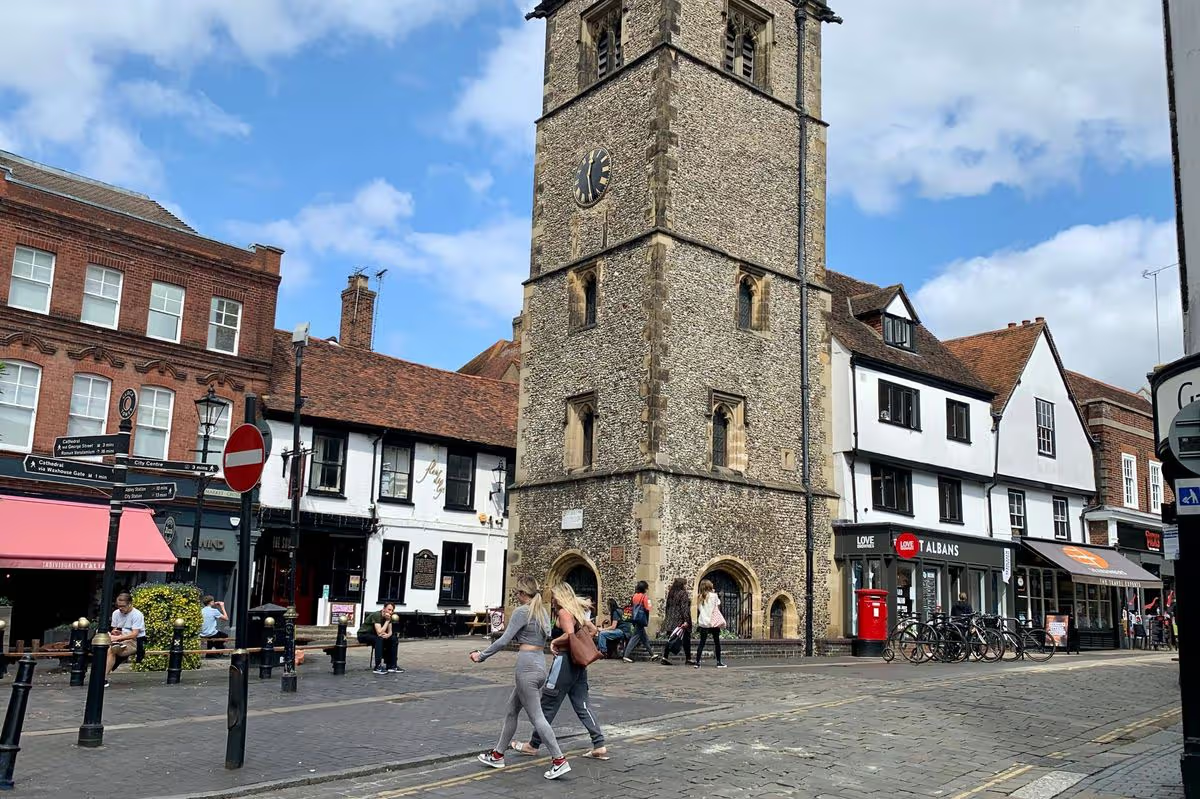
I visited UK city with 1000-year-old market but I wouldn’t rush back
Considered to be one of the UK’s best cities with Roman ruins and a historic market, I was expecting more, but after visiting at the weekend, I left feeling underwhelmed and wouldn’t rush back.

I found the city to be disappointing (Image: Alla Tsyganova via Getty Images)
I’m passionate about exploring fresh destinations across England, so when a particular city kept appearing on my social media timeline, I knew I had to make the trip. St Albans is a historic cathedral city in Hertfordshire, England, situated approximately 20 miles north of London.
Nowadays, it’s recognised as an appealing and wealthy commuter hub, yet its heritage extends back almost 2,000 years. Combining Roman archaeological remains and medieval thoroughfares with contemporary retail outlets, St Albans has evolved into one of the most historically significant cities in southeast England.
St Albans’ roots trace back to the Roman settlement of Verulamium, established in the 1st century AD and growing into one of Roman Britain’s largest urban centres.
The settlement served as a vital hub for commerce and administration, featuring temples, bathhouses and a theatre. Sections of the Roman fortifications and mosaics remain visible today, especially in and surrounding Verulamium Park.
The vestiges of this Roman community constitute a significant element of the city’s character and draw numerous tourists annually.
The city takes its name from St Alban, traditionally regarded as Britain’s first Christian martyr, who was put to death for sheltering a Christian priest.
A memorial erected in his memory eventually became St Albans Cathedral, which continues to be the city’s most renowned monument.
Currently, it’s a thriving and affluent city celebrated for its heritage, open spaces and excellent transport connections to London. I popped over to St Albans this past weekend and left feeling somewhat let down.
Given its stellar reputation, I’d anticipated something rather more refined, yet sections of the town centre appeared decidedly weary.
Certain streets looked decidedly shabby, whilst the uneven footpaths made strolling about considerably less enjoyable than I’d envisaged.
The town was absolutely heaving as well, which contributed to a feeling of disorder rather than character, and securing a parking spot proved far trickier than expected. This might have been down to it being market day.
I kicked off my morning at The Ivy for brekkie, what should have been a proper treat at a restaurant I previously adored. However, it failed to impress, with sluggish service and subpar fare.
That being said, alternative dining options were genuinely brilliant. I grabbed a bite at Japes, where the pizza was absolutely cracking, and also popped into Knoops for a decadent hot chocolate.
Regarding places to grab food, drinks and browse, the town absolutely excels, as it does with its historical offerings.
It’s also difficult to write off entirely a place boasting shops like Anthropologie, Oliver Bonas and Space NK – that trio alone typically indicates a respectable retail destination. Yet, notwithstanding that, I’m uncertain I’d be keen to return in the near future.

The billionaire who wants to be California governor
SACRAMENTO — Tom Steyer must solve this dilemma: How does he convince financially struggling Californians they can trust a billionaire to be their governor?
Because, after all, the former hedge fund titan doesn’t exactly share their daily ordeal of scraping up enough money to pay for rent, groceries and gas in the run-down car.
And he doesn’t have any record in public office to point to. He’s trying to start his elective career at the top.
So, what’s the solution? Well, you can be a global celebrity like super-rich actor Arnold Schwarzenegger when he was elected in 2003. Or a Gold Rush tycoon like Leland Stanford back in 1861. Other than those two, there’s a long list of well-heeled rookie failures.
They include Republican Meg Whitman, who blew $144 million of her fortune losing in 2010. And Al Checchi, who spent $40 million of his own money getting beaten in the 1994 Democratic primary.
“Look, they didn’t have anything to say,” Steyer told me while sipping tea at a popular hangout near the state Capitol, specifically mentioning Whitman and Checchi. “They’d never done anything. Not like I’ve done for 14 years.”
Steyer, 68, who lives in the San Francisco Bay Area, touts his record of funding and promoting progressive causes, including successful ballot campaigns that raised tobacco taxes, closed a major corporate tax loophole and beat back oil industry efforts to kill climate fighting laws.
“I could give you 10 things I’ve done about environmental sustainability and economic justice,” he said.
“Why trust me? Because I’ve gotten results. And I don’t owe anybody anything.”
The Democrat spent $12 million on TV ads last year pushing Gov. Gavin Newsom’s Proposition 50 that allowed the Legislature to gerrymander congressional districts aimed at gaining five more Democratic seats in California.
Being a billionaire allows Steyer to buy all the TV spots he wants. He already has popped for $27 million worth running for governor.
But astronomical wealth comes with a political price.
“California voters do not cotton to some rich guy who has never spent a day in office but looks in the mirror one morning and suddenly sees a governor of California,” says veteran Democratic strategist Garry South.
So, in his campaign TV commercials, Steyer wears casual backyard barbecue garb trying to look like Mr. Average, but with a populist agenda.
“I’m the billionaire who’s going to take on the billionaires,” he says.
That sounds counterintuitive, and I’m skeptical about how well it sells.
Steyer knows he sorely needs labor support to seem credible among the working class. That’s why he recently joined rallies for striking teachers in San Francisco and healthcare workers in San Diego.
He has scored endorsements from the California School Employees Assn. — a union representing school staff — and the California Nurses Assn.
Nurses are backing Steyer largely because he has embraced their No. 1 goal: a single-payer, state-run health insurance system.
They’ve attempted to push that in Sacramento for years and failed. And for good reason.
Single-payer would cost the state barrels of money it doesn’t have. Moreover, it would replace not only private insurance, but popular federal Medicare and the state’s Medi-Cal program for the poor. The federal government would need to agree. Fat chance.
I asked Steyer whether he really believes the state bureaucracy is capable of handling such an ambitious undertaking.
“We’re going to have to get back to having a government that works,” he replied, in what sounded like a knock on Newsom and his predecessors.
How could he make a single-payer system work? “God is in the details,” he answered, a phrase he frequently uses. Translation: “I don’t know.”
“We’re going to work through it. That’ll take at least three years… But we’re going to have to do it…. Healthcare costs have been escalating for a very long time. And they’re eating up the [state] budget.”
After Steyer left hedge fund investing, he became an ardent crusader for clean energy and fighting climate change. It was his core issue running for president in 2020, when he spent $340 million before giving up.
But these days, he barely mentions climate. The better politics du jour is advocating for “affordability” — especially affordable housing.
Steyer said he doesn’t have a “silver bullet” for lowering housing costs. He has “silver buckshot” — a scattergun of solutions for boosting housing supply, plus rent control.
He’d shorten the time for issuing construction permits, require rezoning to develop vacant land, tax unoccupied housing left off the market and build higher — more like in New York’s Manhattan, where he was raised.
“What we’re doing is sprawl,” he said. “And what sprawl leads to is an awful lot of commuting, a lot of driving.”
That’s been a problem for generations, I noted. Suburban ranch-style housing is the California way. “People can change,” he said. “I think people want to.”
I asked him about the slow-poke bullet train project that’s costing four times original estimates.
“Of course, I’m in favor of high speed rail,” he said. “But good grief. We’ve been working on this for an incredibly long time and spent an incredible amount of money. As far as I can tell, we haven’t built anything. If we’re going to do high-speed rail, we have to build it at a reasonable price. And we haven’t been able to do that.”
Might he abandon the project? “I want to look at it,” he said.
The odds are against him ever getting the opportunity.
But the odds aren’t exciting for any candidate in this ho-hum contest.
Steyer is running in the middle of the pack, based on polls. He has hired the strategists who managed Democratic Socialist Zohran Mamdani’s victorious campaign for New York mayor.
There’s no front-runner for governor. But Rep. Eric Swalwell (D-Dublin) has some momentum. He recently was endorsed by Sen. Adam Schiff. And he’ll also soon be endorsed by influential former House Speaker Nancy Pelosi, I’m told.
Voters will do their all-important endorsing in the June 2 primary.
What else you should be reading
The must-read: In 50-year fight to protect California’s coast, they’re the real McCoys, still at it in their 80s
CA vs. Trump: Trump, California and the multi-front war over the next election
The L.A. Times Special: Who pays for Newsom’s travel? Hint: It’s not always taxpayers
Until next week,
George Skelton
—
Was this newsletter forwarded to you? Sign up here to get it in your inbox.