



Ryan Poehling injured on winning goal as Ducks beat Flames
Ryan Poehling broke a tie with a short-handed goal at 5:35 of the third period, but was injured on the play in the Ducks’ 4-2 victory over the winless Calgary Flames on Saturday night to start a home-and-home series.
The teams will meet against Tuesday night in Anaheim.
Poehling was injured when he slid into the post and Flames goalie Dustin Wolf. Poehling, who also had an assist, didn’t return to the game.
Jackson LaCombe, Frank Vatrano and Nikita Nesterenko also scored for the Ducks (4-1-0), who won a second road game in two nights after a 5-1 win over the Winnipeg Jets. The Ducks have won their first three road games to start a season for the first time.
Ville Husso stopped 27 shots in his first start of the season.
Morgan Frost and Aydar Suniev scored for Calgary (0-5-0), which started a season with five straight losses for the first time.
Matt Coronato had two assists and Wolf stopped 24 shots.

ICE agent in New York shooting also involved in assault of pregnant woman | Donald Trump
An ICE supervisor seen brandishing a rifle after the high-profile shooting in New York on Oct 8 was also involved in a controversial arrest in Minneapolis in December in which agents knelt on and dragged a pregnant woman through the street.
Published On 11 Oct 2026

How genocidal war on Gaza is shaping Israel’s election | Israel Election 2026 News
As Israel entered the final month before its October 27 election, Prime Minister Benjamin Netanyahu had a chilling warning to share.
Israel’s enemies, he said on September 29, were plotting an attack on the country before the vote. Without providing any evidence, he then quickly referred to continuing attacks by Israeli troops in the Gaza Strip, where he said they had killed more than 100 “terrorists” in recent weeks.
That link drawn by Netanyahu – between the genocidal war on Gaza that began after the Hamas-led October 7, 2023 attacks, the upcoming elections, and Israel’s national security – was not coincidental, say analysts.
Netanyahu’s insistence that he alone can secure Israelis from a range of threats they face from across the country’s borders, they say, lies at the heart of his re-election campaign, even as his alleged failures during the attack three years ago and in securing the quick release of captives have offered his opponents ammunition.
When a Flydubai flight packed with Israeli passengers on their way from Dubai to Tel Aviv a day after his recent warning nearly crashed after a co-pilot attacked his pilot with an axe in the cockpit, Netanyahu was quick to seize on the incident to argue that he is still man for the country’s top job.
Polls suggest that he faces a stiff test in what is the first general vote since the 2023 attacks, which led to the killing of 1,139 people in Israel and triggered the genocidal war on the Gaza Strip, where Israeli have attacks have since killed more than 74,000 Palestinians.
Three years later, the war has become inseparable from the domestic debate over Israel’s direction while also accelerating a political shift to the right – with once-fringe positions on Palestinians now very much the mainstream view.
Few embody this transformation more than Israel’s far-right financial Minister Bezalel Smotrich, sanctioned by a number of Western countries and known for his incendiary and racist language and policies towards Palestinians.
In one of his characteristically inflammatory statements, Smotrich told Israeli outlet Ynet late last month that the Israeli army should “go to war” in the occupied West Bank and “do there what we did in Gaza”.
Less than two weeks later, Smotrich’s electoral ally Moshe Feiglin added fuel to the fire.
“The enemy is Gaza, not Hamas”, he told the Jerusalem Post, calling for the annexation of the besieged territory after the election. “The baby that will be born tomorrow in Gaza will do exactly the same,” he said, in reference to the 2023 attacks.
Palestinian political analyst Ahmed Najar said these are not “stray comments” from marginal figures but an electoral message from power-seeking politicians aimed at portraying Palestinians as “not a people with rights, but a demographic and security problem to be expelled, conquered or destroyed”.
He added: “The frightening reality is that the coming election risks becoming a competition not over whether Palestinian life should be protected, but over who can promise to erase it most aggressively.”
‘This is madness’
Following October 7, the younger generation in particular slid rightwards, said Ahron Bregman, an Israeli security analyst and senior teaching fellow at King’s College London.
He said the forces driving Israel to the right had been gathering for decades.
“The trend toward the right began after the Yom Kippur War in 1973, but it has intensified dramatically since October 7,” Bregman told Al Jazeera, referring to the bloody 19-day October War, or the 1973 Arab-Israeli War – a conflict between Israel and a coalition of Arab states led by Egypt and Syria.
More recently, the far right has been emboldened through electoral politics as part of Netanyahu’s government since 2022 – the most right-wing government in Israeli history.
Another outspoken cabinet member alongside Smotrich is Minister of National Security Itamar Ben-Gvir, a far-right provocateur who has previously been convicted of inciting racism and of supporting a terrorist organisation.
“Netanyahu’s greatest mistake – among many – was bringing figures like Ben-Gvir and Smotrich into his coalition,” said Bergman. “By doing so, he legitimised them as influential forces in Israeli politics.”
Ben-Gvir has been so cemented into Israel’s political system, he has hopes pinned on becoming the next Israeli defence minister, the analyst pointed out.
“This is madness. But that’s contemporary Israel,” said Bergman.

Analysts also pointed out that several parties running, including ones that are currently in power and a number that are challenging the current coalition, all advocate for the expulsion of Palestinians from Gaza, as one of the examples of the shift to the right.
Omar Baddar, director of Palthink for Strategic Studies, said the messaging from across the Israeli political and military spectrum in the lead-up to the election shows that there is “a consensus” to continue the attacks on Gaza, where nearly 1,500 have been killed since a “ceasefire” last year.
“They’re using the threats to get more votes,” he said, pointing out to what he described as the radicalisation of the society.
With the election approaching, added Baddar, Israeli leaders are seeking to undo one another: “Who[ever]’s more radical is more likely to get more votes.”
As Ehab Jabareen, a Palestinian political analyst and researcher from inside Israel, writes, “what it means to be ‘right-wing’ in Israel today is above all to take a harder line on Palestinian national claims, security and territorial control.”
He adds: “On security and the Palestinians, a large part of Jewish Israeli politics already works from assumptions that would have been treated as right-wing a generation ago: Deep suspicion of a sovereign Palestinian state, a high tolerance for prolonged military control, and a stronger insistence on Jewish sovereignty as the starting point rather than one value among others.”
Observers and rights groups say the disparity is even evident in the electoral process. A prominent politician and Palestinian citizen of Israel, Sami Abu Shehadeh, has been forced to withdraw from the election over his remarks about the Gaza war, while Israeli far-right leaders have remained untouched despite their violent rhetoric against Palestinians.
Netanyahu’s security credentials endure
Recent polling indicates that the events of October 7 are top of mind for Israelis, who also have questions about who was responsible for the security failures of that day.
Just last month, reports surfaced indicating that Netanyahu had received two separate warnings about an imminent Hamas attack in 2023, from Egypt’s intelligence chief, Abbas Kamel, and United Arab Emirates President Sheikh Mohamed bin Zayed Al Nahyan.
Netanyahu’s two main rivals in the race for prime minister have cited the alleged warnings to call the prime minister “unfit” to remain at the helm of the country.
But Netanyahu has denied suggestions that he had been forewarned about the attack, and the reports do not appear to have had a significant effect on opinion polls.
While October 7 represents a profound rupture in Israelis’ sense of security, public trust in the Netanyahu government had already been badly shaken by its controversial judicial overhaul, introduced when the prime minister’s current coalition first came to power, said Mairav Zonszein, an Israel-Palestine analyst at the International Crisis Group based in Tel Aviv.
Despite these breaches of trust, the Israeli leader retains support.
“Israelis in general still see Netanyahu as kind of the guy on security. And more to the point, they don’t really see an alternative,” Zonszein told Al Jazeera.
A June survey by Mitvim – the Israeli Institute for Regional Foreign Policies found that the Israeli public supports its government’s military and security solutions, and rejects resolving the Palestinian issue and ending the Israeli occupation of Palestinian territory. This is the case even while it has been concerned about international isolation and the decline of Israel’s international standing since the beginning of the genocidal war on Gaza, the survey reported.
Yet Israelis are also increasingly war-weary, even as they back the use of more force. Its troops – stretched between six fronts of war in the last few years – are bearing the brunt of this fatigue in Israeli society.
Israel’s Ministry of Defence said on Tuesday that nearly 30,000 soldiers and security personnel are facing psychological trauma since the war.
The ministry said its rehabilitation department’s budget has increased by 88 percent over the past three years to 10 billion shekels ($3.3m), with the majority supporting treatment for mental health conditions and post-traumatic stress disorder.
As Israel expands, the two-state solution fades
Still, Israel in recent months has been more and more vocal about its expansionist vision, with officials brazenly stating the goal of “Greater Israel”. The claim for the conquest is based on a biblical verse (Genesis 15:18-21).
For decades, Israel has ignored international law in its continuous occupation of Palestinian and Syrian land, and has shown little respect for its neighbours’ sovereignty, occupying more land in Syria, as well as in Lebanon in more recent years.
According to Najar, the political economist, the “complete dehumanisation” of Palestinians as evidenced during the campaign reveal that Gaza “is being presented to Israeli voters not as a catastrophe or a crime for which there must be accountability, but as a blueprint to be repeated elsewhere”.
In southern Lebanon, where Israel has been carrying out near daily attacks and and has occupied large swathes of land, residents have told Al Jazeera they expect little to change even if Netanyahu is defeated in the election.
Netanyahu’s main political challenger, Gadi Eisenkot – head of the Yashar party and former army chief of staff – is the father of the so-called Dahiyeh Doctrine, and is just as hawkish about expansion. That doctrine, since Israel’s war with the Lebanese group Hezbollah in 2006, calls for the use of huge force, even against civilian infrastructure, as a deterrent against enemies and was deployed in Israel’s recent wars, particularly in Beirut’s southern suburbs.
If it were up to Eisenkot, the Lebanon front of war would have never scaled down: He has accused Netanyahu of bowing to US pressure to halt operations in Beirut, and has insisted that the military should be able to attack Hezbollah anywhere in Lebanon.
For Israelis still reeling from the events of October 7, Eisenkot could fill the security void many are feeling, said Zonszein.
“They really … see the world as kind of very hostile towards them, the world not understanding what they went through on October 7, and [therefore why] the need to have these security buffer zones in Lebanon, in Syria, and Gaza,” she said.
A two-state solution to the Israel-Palestine conflict is therefore out of the question, said the analysts – and has not even made a blip of an appearance in campaigning before the election.
The idea first emerged during the Oslo Accords more than 30 years ago, which set out a negotiating process aimed at resolving the Israeli-Palestinian conflict, predicated on the belief that the creation of a Palestinian state alongside Israel was imperative to forge peace.
But since the Oslo process began in 1993, the number of Israeli settlers in the West Bank has ballooned from about 260,000 to more than 700,000, embedded deep inside West Bank areas that would be needed for a contiguous Palestinian state.
“The concept of a two-state solution is currently irrelevant and likely will remain so for another decade or two, if not longer,” said Bergman. “It is unlikely to become a reality in the foreseeable future, as no Israeli leader can propose it to the Israeli public after the events of October 7.”
The only way it could regain prominence is if there is substantial international pressure, including severe sanctions on Israel, and a non-violent intifada, or an uprising by Palestinians, he said.
The outright rejection of Palestinian statehood has simply become much more “acceptable”, said Zonszein.
“There’s several parties who advocate these views, whereas there isn’t a single Jewish Zionist Party that puts the need for a two-state solution or a Palestinian political process at the forefront,” she said.
Taken all together, Israel’s election appears less a demand for change than a further entrenchment of the jingoism that surged after October 7, 2023.
“[There’s] more and more movement towards more military force, more need for pushing the borders … out of a lot of fear that another October 7 could happen,” said Zonszein.

Cheryl Tweedy makes surprise The Voice UK coaching debut as she ‘saves Saturday night TV’
Cheryl has made a surprise early return to The Voice UK and is set to appear in Saturday night’s episode for the Battle Rounds, joining long-time friend Will.i.am as his assistant coach

Cheryl’s appointment is part of a wider shake-up for The Voice UK(Image: ITV/Rachel Joseph/Shutterstock)
Cheryl has made her debut on The Voice UK as a guest mentor. The chart-topper has given fans a first glimpse of her new role as a coach ahead of the show’s 2027 series.
The Girls Aloud star, 43, appeared in the latest episode as the ITV singing competition continues its Battle Rounds, joining her longtime friend Will.i.am to help him decide which contestants deserve a place in the semi-finals.
Cheryl was confirmed as a coach for the next series last month, replacing Sir Tom Jones on the panel. Her appearance this weekend will give viewers an early taste of what to expect when she officially takes up the role. The singer arrived alongside Black Eyed Peas star Will.i.am, 51, looking stylish in a red tasselled leather jacket and light blue flared jeans.
To see more of the stories you love from The Mirror and to find them easily in Google, make us your preferred source. Free and easy to do, just click on the link here to find more from The Mirror at the top of your feed.
The pair embraced as they reunited for filming, having worked together on music projects over the years. Will revealed that he had been trying to have Cheryl join him for the last 13 years. Cheryl knows exactly what it takes to make it in the music industry, having found fame after being selected for Girls Aloud on Popstars: The Rivals in 2002.
Speaking to Team Will, the Call My Name songstress said: “I’m so excited for you. You couldn’t be in better hands than you are with my man Will. Will and I have collaborated a lot over the years, so we know what it’s like for two very different artists to come together. I wish you all the very best for what you’ve got today, and I’m excited to see you all!”
Reflecting on her own experience, having found fame on Popstars, Cheryl said during a solo interview: “I have stood in the shoes that the contestants are standing in, and I know what it feels like to perform in this environment. You’ve just got to know that you’re good, or you wouldn’t be here.”
And fans were overjoyed to see Cheryl back on screens. One said on X, formerly known as Twitter: “Cheryl looks amazing, oh my gosh.” “CHERYL ON #TheVoice Saturday night TV is SO back,” said a second. “Ah I’m buzzing,” commented a third. A fourth exclaimed: “So excited.” “I’m excited to see Cheryl and Will back together,” commented another.
Her appearance marks a return to television after a lengthy break from the spotlight following the death of her former partner, Liam Payne, in October 2024.
The singer had largely stepped back from public life in the wake of the tragedy, making her new coaching role a significant career move. While Cheryl once dominated the music industry and became the first female artist to have five records debut at Number One, her last single, Let You, was released in 2019 and peaked at Number 57 on the Official Charts Company.
Prior to this, her last album, Only Human, which peaked at Number 7, boasted the singles Crazy Stupid Love and Only Human, and was released in November 2014.
Cheryl’s appointment is part of a wider shake-up for The Voice UK, with Stacey Solomon and Alesha Dixon confirmed as the show’s new presenters. The pair will take over from Emma Willis, who is moving on after landing a presenting role on Strictly Come Dancing.
The Voice Australia coach and current Strictly Come Dancing contestant, Delta Goodrem, is helping Kelly after spending eight seasons on the Aussie edition of the programme.
Also, Danny and Tom were joined by their McFly band members Dougie Poynter and Harry Judd as they tried to win The Voice UK two consecutive years in a row following their success with AVA in 2024.
Last Saturday (October 3), the final round of the blind auditions aired, and the coaches finalised their teams, which consist of eight acts each.
Team will.i.am is made up of Diogo Ferreira, Sonna Rele, BMG, Triple Threat, Teodora Sava, Naná Aldrin-Quaye, Ardú, and Bella Popera. Team Kelly has Monique Nicholson-Porter, Ray Gelato, Lascel Wood, Aaren James, Cris Quammie, Samantha Udeke, Turah Sadiq, and Jessica Beth.
Cate McHugh, Vadé Amãlia Estradas, Harry Linacre, Eric & Jensen, Dakari Love, Molly J, Robbie McMinn represent Team Sir Tom and Ellie Harney, Ross McGuire, Ciiara Nyx, Finlay McKillop, Jack Algar, Frank Raven, Regan Preece, Adam Tucker have joined Team Tom and Danny.
The coaches and their advisors will now work with the acts to try to help them secure their place in the competition but not every act can progress.
The Voice UK returns to ITV1 and ITVX on Saturday, October 17 at 8.35pm
Like this story? For more of the latest showbiz news and gossip, follow Mirror Celebs on TikTok , Snapchat , Instagram , Twitter , Facebook , YouTube and Threads .

Healing waters: 10 of the best spa towns in Europe for a restorative autumn break | Spa breaks
Mariánské Lázně, Czechia
In 2021, Unesco designated 11 historic spa towns across Europe as one transnational world heritage site, recognising their “exceptional testimony to the European spa phenomenon, which gained its highest expression from around 1700 until the 1930s”. This was the original wellness tourism, and these grand health resorts include Bath in England and the town of Spa in Belgium, as well as the west Bohemia spa triangle of Karlovy Vary, Františkovy Lázně and Mariánské Lázně.
Of that trio, Karlovy Vary is the most well known and within a day trip of Prague, but Mariánské Lázně is arguably the prettiest. The town offers three natural healing traditions: mineral springs, carbon dioxide springs known as Maria’s Gas, and therapeutic peloids (mud and clay). Czech nationals are still prescribed weeks-long spa stays to recover from surgery, severe illness or chronic conditions, but anyone can check into the Nové Lázně hotel (doubles from €234 B&B, including spa access), a canary yellow neo-renaissance confection built in 1896 that faces the central park.
Its spa is a trip back in time: baths surrounded by marble columns and intricately decorated treatment cabins, including one built for King Edward VII, who visited nine times. Join tourists and locals drinking the waters from special porcelain cups while walking along the colonnades, and don’t forget to pair it with a spa wafer – large, thin, crispy confections with sweet fillings such as hazelnut or chocolate. It’s not all virtuous.
Bad Kissingen, Germany
Germany is home to about 350 designated spa towns, including three of the Unesco Great Spa Towns of Europe: celebrity favourite Baden-Baden, quiet riverside Bad Ems and elegant Bad Kissingen in Bavaria. The latter’s striking architecture is arguably the most interesting of the three, much of the central spa district having been rebuilt by star German architect Max Littmann in the early 20th century. This includes the grand fountain hall, with its stained-glass roof, where Brunnenfrauen (fountain women) dispense different mineral waters from bronze pipes, and the huge basilica-style Wandelhalle, where the town’s spa philharmonic orchestra performs several times a day.
Music has always been part of the spa experience – the Staatsbad Philharmonie Kissingen holds the world record for the most concerts performed in one year (727!) – and the beautiful art nouveau-style Regentenbau houses one of the best concert halls in Europe.
The modern KissSalis Therme (from €19 for two hours) on the southern edge of town is the main public bathhouse today, with indoor and outdoor thermal pools, mud treatments and various – clothing-free – saunas.
At the more classical end of the spa spectrum, the Grand Hotel Kaiserhof Victoria (doubles from €209 B&B, including spa access) sits next door to the Wandelhalle on the town’s Kurgarten. The water used in the spa here is pumped up directly from the brine spring, while the inhalation room has a wooden graduation tower covered in knobbly salt deposits, which mimics the healing effects of mineral-rich sea air.
Bad Wildbad, Germany
Deep in the north of the Black Forest, this spa town offers ways of immersing in nature beyond soaking in waters from the thermal springs. Rising above the town, Sommerberg (meaning “summer mountain”) will get pulses racing. A funicular railway whizzes visitors to the top, the starting point for hiking and biking routes. For more heart-pumping views, the accessible Treetop Walk (€12.50) spirals above the dense pine trees to an observation tower 40 metres up, with a tunnel slide back down the middle for extra thrills, while the Wildline suspension bridge (€9.50) – with its 380-metre walkway – arches over the Enz valley for maximum views.
Back in town, there are two thermal baths to dip into: the modern Vital Therme, where those with joint and back problems are prescribed movement therapy and spa treatments (€14 for three hours); and the historic Palais Thermal, where the pools are surrounded by marble pillars, statues of Venus and Moorish tiles (€21 for three hours). Mokni’s Palais Hotel is connected to the Palais Thermal building, meaning guests can pad over in their bathrobes (doubles from €183 B&B, including access to the spa).
Bagnoles-de-l’Orne, France
Local legend has it that, after many battles, the medieval lord Seigneur Hugues de Tessé freed his faithful warhorse Rapide in Normandy’s Andaines forest to live out the rest of its days in peace. Much to the nobleman’s surprise, the horse later returned to him stronger and full of life, then led his master to the warm, sulphurous waters of Bagnoles’ spring. Centuries later, a spa resort sprang up so the Parisian bourgeoisie could also tap into this fountain of youth, with belle époque villas laid out on the shores of a lake in the middle of the forest (today, it’s also handily less than an hour and a half from the ferry at Caen for British wellness seekers).
That belle époque quartier was the vision of local politician Albert Christophle, whose former hunting lodge on the edge of the village is now the very lovely five-bedroom Château du Gué aux Biches (doubles from €195 B&B).
This summer, its Danish owners, Klaus Bentin and Soren Rasmussen, added a new restaurant in the old kitchen, serving up smørrebrød (open sandwiches).
The hotel has a partnership with the nearby spa at B’O Resort, meaning Klaus or Soren will line up your treatments, and there are bicycles to borrow so you can pedal a couple of kilometres over for that clay body wrap or hydromassage.
The surrounding forest is crisscrossed with hiking, biking and trail running routes. In autumn, take things more meditatively by going mushroom foraging among the more than 1,700 varieties sprouting from the Andaines forest floor.
Bad Gastein, Austria
This genteel town in the Hohe Tauern Alps was built on water; indeed, a roaring waterfall cascades right through the middle of it. The healing reputation of its radon-rich waters, which bubble up from the town’s thermal springs, saw grand hotels built in the 19th century to house the emperors and aristocrats, writers and thinkers (Sigmund Freud among them) who came to be cured of their ills.
The fashion for “taking the waters” trickled away, but in recent years there’s been something of a revival, with a clutch of new hotels opening. The Cōmodo (doubles from €188 B&B) is one of them, a slick spot refashioned from a 1960s sanatorium. Bedrooms look out over the valley and mountains, as does the thermal water-filled indoor pool. There are several public fountains where you can still drink water straight from the source (warm, slightly salty and metallic tasting), but perhaps more palatable is to soak at the brutalist Felsentherme public bath complex with its numerous pools (€40 for a day pass).
Just as warming – but with fewer health benefits – is a bowl of Kaspressknödelsuppe (beef broth with cheese-infused dumplings) at the cosy cabin of Schafflinger Alm (soups from €4.50, mains from €17) after a bracing hike through the forest or carving up the Schlossalm-Angertal-Stubnerkogel ski area, where the season kicks off in late November.
Piešťany’s Spa Island, Slovakia
Just before crossing the Colonnade Bridge to get to Piešťany’s Spa Island, there’s a statue of a man breaking his crutch, symbolic of the healing powers of the town’s thermal waters and sulphurous mud, harnessed on this enclave of wellness in the Váh River. The first simple wooden bathhouses were built on the island in 1778, but the opening of the Thermia Palace hotel and its Irma Balneotherapy House in 1912 turned it into a health resort.
Further hotels and spas are dotted between the trees and become increasingly concrete and functional as you get further from the bridge.
The Thermia Palace is still the fanciest option, with a raft of treatment programmes in the spa, from extensive diagnostics and lab tests to mud packs and pools (doubles from €210 half-board, including spa access). The blue-black goop is applied all over the body at a toasty 45C and left for about 10 minutes before being unceremoniously hosed off.
Outside, the spa park also feels restorative, with lily ponds, fountains and free-roaming peacocks.
In town, Elektrárňa Piešťany is a former power plant turned cultural centre that feels surprisingly vital, with film festivals and rock concerts, while the strikingly brutalist House of Arts hosts chamber orchestras and tango music trios.
Rogaška Slatina, Slovenia
This town in eastern Slovenia is famed for Donat Mg, one of the world’s most magnesium-rich mineral waters, traditionally consumed for its digestive benefits. The company now sells millions of bottles of the stuff each year, but here at the source you can sip it for free from the fountains in the Pivnica Drinking Hall – although its salty, fizzy, metallic flavour is something of an acquired taste.
Like other towns of its ilk, Rogaška attracted the great and the good of Europe in the 19th century, and its confection of architecture is testament to that. A short stroll away from the drinking hall, through immaculately clipped gardens, the butter-yellow Grand Hotel Rogaška is straight out of the town’s golden age (doubles from €198 half-board include spa access). Bedrooms are traditional, but the spa has all the bells and whistles, from carbon dioxide baths and mineral water inhalations to reflexology and magnetotherapy.
Somewhat fittingly for a town famous for its drinking water, Rogaška is also known for its glassware – and visitors can tour the Rogaška crystal factory (€12) to see the glass-blowing in action before buying glasses for their Donat Mg from the on-site shop. The surrounding wooded hills are the place for autumn walks.
Salsomaggiore Terme, Italy
In Emilia-Romagna’s so-called “food valley”, not far from Parma, this small spa town will help balance out some of that indulgence. Last year, the Italian thermal brand QC Spa of Wonders reopened the beautiful art deco-style Terme Berzieri, where the gilded interiors – all frescoes, mosaics, majolica and stucco – are as much of a draw as the salty spring waters, rich in iodine and bromide (five-hour spa sessions from €62). There’s the usual thermal attractions, as well as a sauna cinema and infinity rooftop pool, while treatments in wooden barrels nod to the area’s winemaking.
Try some of those wines at the Cantina Il Poggio vineyard in the hills outside Salsomaggiore, which produces a range of styles including the local sparkling Malvasia di Candia Aromatica (tastings from €30). Continue the tastings with a visit to a parmigiano reggiano producer, such as Caseificio Ugolotti (tour and tasting €23), before picking up some ham from Parma’s famous La Prosciutteria. Stop for a roast pork sandwich at legendary panini place Pepèn, before feasting your eyes on the Pilotta Palace complex with the Galleria Nazionale, Palatine Library and Farnese theatre, while the opulent Teatro Regio hosts the annual Verdi festival in October. The organic agriturismo Case Zucchi, about a 10-minute drive from Salsomaggiore, makes a suitably foodie base, with bedrooms named after herbs and the breakfast table piled with fresh bread, eggs, ham, cheese and fruit each morning (doubles from £104 B&B).
Caldas de Monchique, Portugal
High in the Serra de Monchique mountains, surrounded by cork oak and eucalyptus forests, the whitewashed hill town of Monchique offers a slower-paced autumn escape than the nearby Algarve coast. Its cobbled streets are lined with craft shops, ceramic workshops and simple taverns serving chouriço (smoked sausage) with a small glass of medronho (fruit brandy). In a wooded valley below town, the spa village of Caldas de Monchique is little more than a handful of 19th-century buildings around a shaded square and park, where you can drink slightly warm spring water from the public fountain.
Wallow in the alkaline waters a little longer at Caldas de Monchique Villa Termal Spa Resort (doubles from €84, thermal water circuit £17 for 90 minutes).
The spa offers hydro rituals including a Vichy shower, massage and bath, or thermal water circuits around the pools, sauna and Turkish baths, before a dip in the outdoor pool.
Afterwards, the 1692 restaurant, with its stained-glass windows, dishes up bacalhau à Monchique (salt cod stuffed with chouriço and ham). It’s not far from here to Fóia, the highest mountain in the Algarve at 902 metres. It’s worth the walk to the summit for the views, or hike on a further 2½ miles (4km) to the Barbelote waterfall, which cascades over a rocky cliff face in the wetter months.
Chaves, Portugal
There’s a little run of spa towns in the north of Portugal near the Spanish border, a curative route through Pedras Salgadas, Carvalhelhos, Vidago, Carlão and Chaves.
In Chaves, the waters are some of the hottest in Europe, coming out of the ground at a scorching 76C. The Romans built a large therapeutic bathing complex here, that was only rediscovered by accident in 2006 when work began on an underground car park. Now, the free Museu Termas Romanas de Chaves allows visitors to explore the pools and soaking baths, perfectly preserved thanks to an earthquake in the 4th century that sealed them for millennia.
To take the waters today, head to the Aquae Salutem Thermal Complex (€30 for 90 minutes), a circuit of outdoor pools, saunas, steam and showers that opened in 2025.
About half an hour down the road, the Pedras Salgadas Spa and Nature Park sits on the fringes of one of the other small spa towns. The owners have built 18 eco-houses and treehouses on stilts (doubles from £171 B&B, spa access additional £17 per room) among the pine trees at the source.
Guests can do a spot of forest bathing before dipping into the spa – redesigned by one of Portugal’s most famous architects, Álvaro Siza – for a thermal water hydro-massage, or wander between the pink spring pavilions in the park. Pedras Salgadas is also a popular, naturally sparkling mineral water brand.

From Depression to Enormous Wealth : War Turned Impoverished U.S. Into a Superpower
WASHINGTON — In September of 1939, just a week after World War II had erupted in Europe, The American Home advertised why a housewives magazine like itself mattered in a time of distant trouble. “Hitler threatens Europe,” the ad proclaimed, “but Betty Havens’ husband’s boss is coming to dinner–and that’s what really counts.”
The ad fixed an awful truth: World War II, the most fearsome and bloody cataclysm of world history, caught America napping and unawares. An enervated giant, the United States in 1939 was weak, poor, isolated and ignorant of the rest of the world. Eighteen other countries–even Turkey–had more soldiers than the United States. The American Army outnumbered the Bulgarian army, but only by 23,000.
Americans were so oblivious of events abroad that James McClure Clarke and his roommate left for a bicycle trip through Europe in the summer of 1939 just after their graduation from Princeton University.
“That was the sort of thing a lot of young men did,” Clarke, now a 72-year-old Democratic congressman from North Carolina, recalled in his Capitol Hill office recently.
Unaware that war was imminent, they cycled into Germany.
“On every train, at every station,” he said, “there were German soldiers. And if you greeted anybody, they would ‘Heil Hitler.’ And even when we climbed in the mountains, you would see young people, Boy Scout age, groups of them, and they would raise their hands, ‘Heil Hitler.’ When we were in the Black Forest, I remember seeing a big sign put up there by Hitler saying the Jew is our enemy and then talking about the Jew in North America, listing Franklin D. Roosevelt and Henry Morgenthau and so forth.”
That sign, of course, told a lie. Aside from its virulent anti-Semitism, it was wrong about Roosevelt, although correct about Secretary of the Treasury Morgenthau’s Jewishness. But for Clarke, it hit home: Morgenthau’s son was a Princeton classmate.
War was declared before Clarke and his friend could return to the United States. They boarded the British liner Antonio during the first week of the war. The Antonio’s sister ship, the Athenia, leaving only a few days earlier, had been stalked by a German U-boat and torpedoed. More than a hundred people died when the ship sank in the Atlantic.
Did these experiences make Clarke and others like him more vitally concerned about events in Europe?
“Not much, I’m afraid,” Clarke replied. “I think it took a while for America to wake up. It took Pearl Harbor.”
Yet, once America woke up, it somehow transformed itself swiftly into an enormous, engulfing and astounding dynamo that would shake and cow the world. By the end of World War II, a nation once bereft of military strength had turned itself into the most awesome military power ever seen; a nation once contemptuous of entangling alliances had turned itself, however reluctantly, into a natural leader of grand alliances, and a nation still impoverished and reeling from the Great Depression had turned itself into an Olympus of wealth.
Moreover, mobilization for war altered society in quiet but profound ways that would not make themselves obvious for two decades or more. Rural blacks migrating to the cities or fighting in American armies would never go back easily to sharecropping and oppression.
“Rosie the Riveter,” the popular song heroine working in a war factory while her boyfriend fought in the Marines, would return to the kitchen after the war, but her legacy would lead to the women’s liberation movement.
400,000 Lost Lives
Compared to the carnage suffered elsewhere, U.S. casualties in World War II were, relatively speaking, light. More than 400,000 military personnel lost their lives–about 292,000 in combat–a tragic and bitter waste, but no more than a small statistic when measured against the 50 million Europeans and Asians slaughtered. There were more American civilian deaths from pneumonia and tuberculosis during the war than deaths on the battlefield. The wartime population of the United States, in fact, increased by a healthy 6%. The enemy inflicted negligible damage on the American mainland in a handful of incidents, and the United States was the only belligerent to end the war richer than before.
Americans owed the relative comfort and low cost of their victory to geographic distance, natural resources and a good deal of luck. But many preferred to believe that God-given American pluck and ingenuity had counted far more. While many Europeans agitated for radical changes in the political systems that had driven them to Fascism and war, Americans felt more pride in their own system than ever before. An era of great self-confidence came after the war.
“American experience,” wrote Henry R. Luce in a Life magazine editorial, “is the key to the future.”
Looking back, the year 1939 now seems like a last, lost age of innocence in America, undarkened by the clouds in Europe. The Hit Parade was led by a song that asked:
Jeepers Creepers, where’d you get those peepers?
Jeepers Creepers, where’d you get those eyes?
A 23-year-old vocalist named Frank Sinatra joined the Harry James band. Only 3% of Americans earned enough money to pay income tax. Almost 50 million people glimpsed the wondrous sleek highways and blight-free cities of the future in the General Motors Futurama pavilion at the New York World’s Fair. New Pontiacs sold for $862 and Florsheim shoes for $8.75.
Shirley Temple and Clark Gable were the biggest box office stars of the year. Hoping to do something about what it called “our national shame,” Standard Plumbing Fixtures reported in its advertisements that 15 out of 100 homes in 213 American cities still had no indoor toilets. Lou Gehrig retired from the Yankees, and Ted Williams joined the Red Sox.
The New York Telephone Co. explained that it did not hire Jewish women as operators because their arms were too short to operate phone equipment. Two new products–DDT and nylon stockings–were introduced. “Gone With The Wind” premiered in a banner movie year that included “Stagecoach,” “Wuthering Heights,” “Four Feathers,” “The Wizard of Oz” and “Ninotchka.” Pepsi-Cola challenged Coca-Cola with a catchy jingle:
Pepsi – Cola hits the spot, 12 full ounces that’s a lot ;
Twice as much for a nickel too, Pepsi – Cola is the drink for you.
The war probably left the United States with no more dramatic legacy than its transformation from unabashed isolationism to eventual guardian of the Free World. The day war erupted in Europe, Washington correspondent Phelps Adams asked President Roosevelt in his crowded White House office, “Mr. President, can we stay out of it?”
The President, who had been awakened at 2:50 a.m. with the news of the war, sat silently, his eyes cast downward, for several long moments, and then replied solemnly, “I not only sincerely hope so, but I believe we can, and every effort will be made to do so.”
Later, Roosevelt, sounding more firmly convinced that America could avoid war, warned on radio, “Let no man or woman thoughtlessly or falsely talk of America sending its armies to European fields.”
As far as many Americans were concerned, Europe had botched the peace cemented for them by American intervention in World War I. They were in no mood to get involved again. Sen. Hiram Johnson of California admonished Americans against heeding the echoes of the First World War. “Beware the words ‘We cannot keep out,’ ‘Our entry into the war is inevitable,’ ‘We must fight to preserve democracy’ and all the Devil’s messages we heard 20 years ago,” he said.
Sen. Arthur Vandenburg boasted: “My passion is to keep America out of other people’s wars.”
Feted in Germany
Charles A. Lindbergh, who had touched the romantic fancy of both Europe and America with his solo flight across the Atlantic in 1927 and had been feted in Nazi Germany, told Americans at many isolationist rallies that a Nazi victory in Europe would not hurt the American way of life.
The isolationist mood was so strong that Roosevelt, accused by Republican candidate Wendell L. Wilkie of dragging America into war, pledged in a 1940 presidential election rally: “I have said this before, but I shall say it again and again and again: Your boys are not going to be sent into any foreign wars.”
Many skeptics believed that he never intended to keep that pledge. But the attack on Pearl Harbor in December, 1941, demolished the issue. With their infamous bombing of American territory and ships and citizens, the Japanese had turned World War II into an American war, not another people’s war, not a foreign war.
At the end of the war, no one could deny the United States the status of a superpower, bristling with more military and economic strength than any other country. It had led its allies to victory over Nazi Germany, Fascist Italy and militaristic Japan, and it now had the power and influence to lead much of the world in peace as well. It was reluctant to do so at first, but it finally faced the reality wrought by World War II: a world divided into two hostile camps led by superpowers, the United States and the Soviet Union, once allied against the Axis.
“In 1945,” recalled Don Cook, the 69-year-old retired foreign correspondent who wrote “Forging the Alliance,” a recent history of the founding of the North Atlantic Treaty Organization, “you could never have gotten a two-thirds majority in the Senate for entering an alliance with Europe. The rump element of isolationism in the United States was still extremely strong and still had electoral appeal.
“I knew most of the isolationist senators because I had covered the Senate in the prewar period. The extent of their conversion from isolationism was a reluctant readiness to get into the United Nations. They weren’t going to repeat the mistake after World War I of not joining the League of Nations. But the United States had no intention of using military force in its role in the world. The senators had not reached the point of committing our power.”
Yet, in five years, the United States learned to commit its power and entangle itself in Europe and elsewhere. The Truman Doctrine, the Marshall Plan, the Berlin Airlift, the NATO treaty and the Korean War followed swiftly. By 1950, isolationism was dead.
“This may have been the first real major sweeping change in foreign policy since the founding of America,” said Cook.
World War II also swept the United States into the terrors of the Nuclear Age, for much of America’s immense new power came from its monopoly of nuclear bombs, the kind that destroyed Hiroshima and Nagasaki in 1945 and brought the war to a close.
Refugee Scientists
That short-lived monopoly–the Soviet Union developed its own atomic bomb four years later–came out of the prescience of refugee scientists living in the United States in 1939. Unlike other Americans, they could not ignore the awful horror of Adolf Hitler, for they had fled from him. These scientists knew that scientific research had made an atomic weapon feasible and that, though Hitler had driven many scientists away in his obsession for ethnic purity, enough scientists remained in Germany to create a bomb that might ensure his infernal domination of this planet.
Three Hungarian refugee scientists–Leo Szilard, Eugene Wigner and Edward Teller–met with German-born Albert Einstein, probably the world’s best-known physicist, in Princeton in 1939 and urged him to write Roosevelt about the need for an American program to build an atomic bomb.
In a now famous letter, dated one month before the outbreak of the war in Europe, Einstein told Roosevelt that recent scientific research indicated “that it may become possible to set up a nuclear chain reaction in a large mass of uranium, by which vast amounts of power and large quantities of new radium-like elements would be generated.”
“This new phenomenon,” Einstein went on, “would also lead to the construction of bombs, and it is conceivable–though much less certain–that extremely powerful bombs of a new type may thus be constructed.”
It is unclear exactly what role Einstein’s letter played in the President’s decision, but Roosevelt finally ordered an all-out program known as the Manhattan Project in 1942 to develop an atomic bomb. American scientists, many of them refugees from Hitler, won the race with the German scientists but not in time to use the terrible weapon against Nazi Germany. The first and, thus far, only nuclear devastation in history, came in the American bombing of the two Japanese cities in August, 1945. The precarious reality of the Nuclear Age has governed American foreign policy ever since.
Most Americans now are too young to remember how poor their parents and grandparents were half a century ago. It was no accident that John Steinbeck’s “The Grapes of Wrath,” a long novel about impoverished Oklahoma farmers trekking to California, selling for $2.75 a copy, led the best-seller list in 1939. The Great Depression of the 1930s had weakened the United States far more than any country in Europe.
Despite all Roosevelt’s New Deal programs, 10 million people were unemployed in 1939, more than 15% of the work force. The American share of world manufacturing was lower than it had been at any time since 1910. At least one-third of Americans lived in or near poverty.
But the United States had enormous productive potential. In 1938, for example, two-thirds of its steel plants were idle. In 1939, it was spending less than 2% of its gross national product on defense. If Americans had the will to harness the potential, they could create a colossus of fearful military might and of enormous wealth. Once the Japanese attacked Pearl Harbor, Americans showed that will.
At the end of the war, the American economy overshadowed the economies of the rest of the world in a show of relative wealth never seen before. Americans had a higher standard of living than any other people in the world and produced more goods per capita than anyone else. Half of the world’s manufacturing now took place within the United States. Practically any American who wanted a job had one.
Some Americans feared that unemployment and depression would return after the demobilization of the armed forces. But, though the economy would experience ups and downs and though thick pockets of poverty would persist, especially for blacks, most Americans have lived for the last 50 years in an era of bounding prosperity.
World War II changed the United States in other, less obvious ways as well. In 1939, the Daughters of the American Revolution, citing the local customs of Washington, refused to allow the reknowned black opera singer Marian Anderson to sing in the DAR’s Constitution Hall in Washington. The blatant refusal struck many Americans as scandalous, and the federal government let Anderson sing instead, with Mrs. Eleanor Roosevelt and other prominent white Americans in attendance, on the steps of the Lincoln Memorial.
Yet the shame of the DAR refusal did not change most American attitudes toward blacks. Benny Carter, the 82-year-old black jazz saxophonist and composer, recalls what it was like taking his big band around the United States during World War II.
‘No Black Hotels’
“We weren’t interested in getting into any serious incidents, but it was the same old thing,” Carter said recently. “My bands were mostly black. There might be two out of 17 who were not minority musicians. We had problems about where to stay in the South. We stayed mainly in the homes of people–what they would consider bed and breakfast places now. There were no black hotels, and we weren’t welcome in the others.”
As industries girded for war, they tried to hire as few blacks as possible. In 1941, for example, Douglas Aircraft had only 10 blacks among its 33,000 employees. Under the threat of black demonstrations, Roosevelt created a Fair Employment Practices Committee in 1941 to ensure some kind of fairness in hiring.
The committee had little power, but its creation was looked on later as a significant first step toward civil rights. As the war progressed, blacks were drafted into the army or lured to jobs in the North. That began the enormous migration of blacks out of rural America into the cities of both the South and the North, making the problems of this repressed minority national rather than regional. Rioting soon erupted in Detroit. By 1945, the status of American blacks had not improved very much, but the war had laid the seeds for the civil rights movement that followed.
For women, the war offered, but only briefly, an immense opportunity. The Great Depression had made it even more difficult for women to work. With millions of men unemployed, a working woman was looked on by many as a usurper–snatching a job out of the hands of some family’s breadwinner. Public opinion polls showed that most Americans in 1939 would support laws to prohibit the employment of women whose husbands earned more than $1,600 a year.
The war changed all that.
Factories needed women to replace the millions of men drafted into the armed services. The number of women in the labor force increased during the war to 19 million from 14 million. Nearly half of all American women worked at some time from 1941 to 1945. Many took jobs once typed as masculine: riveting, welding and operating cranes.
There was a good deal of male anxiety about this. Columnist Max Lerner complained that the war may have created “a new Amazon” who could “outdrink, out-swear and out-swagger the men.” Social workers and journalists began to blame an increase in juvenile delinquency on absent, working mothers.
When the war ended, millions of women left or lost their jobs to make room for the returning men. In Los Angeles, for example, the proportion of women working in the aircraft industry dropped from a high of 40% during the war to 18% in 1946. The sexual division of labor reasserted itself, and many women were forced back into lower paying “women’s work.”
Yet, as Secretary of Interior Harold Ickes predicted in a magazine article in 1943, the role of women would never be the same.
“I think this is as good a time as any . . . to warn men,” he wrote, “that when the war is over, the going will be a lot tougher, because they will have to compete with women whose eyes have been opened to their greatest economic potentialities.”
After the war, the numbers of working women never dropped to the levels of the Depression and, in a decade, started to increase to levels well beyond what had been reached during the war. There is little doubt that the ground for the women’s liberation movement was set during World War II.
When the war ended, a nation that had produced 71,000 naval craft, 300,000 aircraft and 2.5 million military trucks now hungered for more ordinary goods. Radio still dominated popular culture, but television, delayed by the war, would come swiftly. New products such as dishwashers, garbage disposal units and aerosol sprays reached the market. Teen-agers, whose families could hardly afford to buy them toys five years earlier, now had loose change in their pockets and wanted records. By 1945, the sales of records had increased tenfold in a decade.
No one expected the United States to return to 1939. No one wanted to.
“For those of us like myself who came out of high school in the Depression,” said Cook, “the war offered us a sense of adventure and change. . . . I think practically anybody of my generation would say that the war was decisive in framing one’s life and one’s future. And, in varying degrees, a considerable majority would say these were the best years of our lives. They gave us momentum. . . . It was tragic for a number of people . . . but there was an exhilaration to those times.”
“One of the best things you realized (serving in the wartime military) was the great diversity of the country. Gosh, here you are thrown in with guys from Georgia Tech, Louisiana State, Iowa–it just made you realize what a big country it was and how a relatively small percentage of the world the Ivy League was. . . . And it was also good for making some of us more confident in being able to stand on your own.” North Carolinians returning from the war “realized there was a world beyond the mountains. They went all over the place. They went to the Pacific, they went to Europe, they were prisoners of war. It was an eye opener to them.”
— Rep. James McClure Clarke (D-N.C.), 72, a Princeton graduate who served as a naval officer on Guadalcanal during the war.
“Our soldiers were not fighting to make the world safe for democracy like in World War I. This was much more of a crusade of our own. . . . The war took over everyone’s life whether you were drafted or not. It had this sense of adventure. I don’t like the word ‘purity,’ but the war had an uplift about it, because we were fighting Nazis and fighting for ideals. It had an idealism about it.”
— Don Cook, 69, author and journalist, who covered World War II in Europe and spent 43 years as a foreign correspondent for the New York Herald Tribune and Los Angeles Times.
U.S. ACTIVE MILITARY PERSONNEL
Army Navy Marines Total 1939 189,839 125,202 19,432 334,473 1940 269,023 160,997 28,345 458,365 1941 1,462,315 284,427 54,359 1,801,101 1942 3,075,608 640,570 142,613 3,858,791 1943 6,994,472 1,741,750 308,523 9,044,745 1944 7,994,750 2,981,365 475,604 11,451,719 1945 8,267,958 3,380,817 474,680 12,123,455
Source: World War II Almanac

High school football: Saturday's scores
Results from CIF City and Southern Section high school football games from across the Southland on Saturday, Oct. 10.
Source link
Hurricane Isaias kills four, leaves 650,000 without power in Florida | Climate Crisis

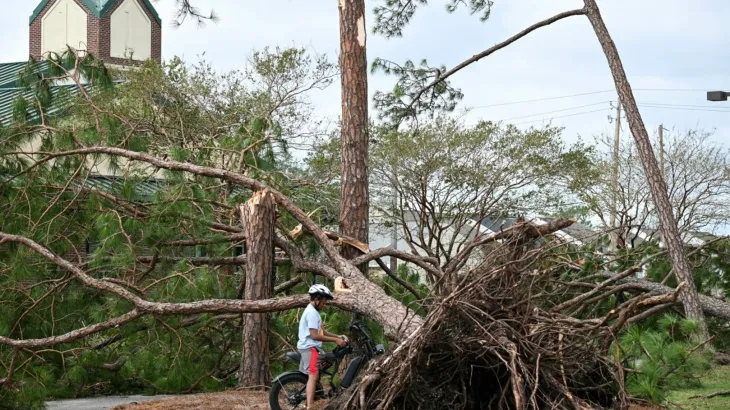
Hurricane Isaias kills four, leaves 650,000 without power in Florida
Hurricane Isaias has killed four people and left more than 650,000 people without power, with Pensacola, Florida, among the hardest-hit areas, as officials warn of further flooding from heavy rainfall.
Published On 11 Oct 2026

US opens antitrust probe into TV networks halting Trump coverage | Donald Trump News
Department of Justice says it’s investigating whether the White House press pool’s decision violated antitrust laws.
Published On 11 Oct 2026
The United States Department of Justice has opened an investigation into television networks’ decision to halt coverage of President Donald Trump last month.
A spokesperson said on Saturday that the department was investigating whether the networks violated federal antitrust laws by their boycott, which followed a White House decision to pull the credentials of reporters from three news organisations, including CNN.
Recommended Stories
list of 4 itemsend of list
The networks under investigation are ABC, CBS, CNN, NBC and Fox News, said Emily Convington, the Justice Department spokesperson.
“Group boycotts among commercial competitors can violate the Sherman Act,” she said of the antitrust legislation.
“The Antitrust Division is simply investigating to determine whether these news organizations have violated the antitrust laws.”
The investigation is the latest in a series of clashes between the Trump administration and major news organisations. Trump has repeatedly called the mainstream media “fake news” and frequently clashes with reporters during encounters with the press.
The action also puts legal and potentially financial pressure on the media to continue coverage of the president even when they disagree with how the White House handles them.
The networks did not immediately comment on the announcement.
The Justice Department’s move came after the television pool of five broadcasters last month ceased presidential coverage after the administration barred CNN, MS NOW and Politico from the White House.
The White House said on September 19 that covering the president was a “privilege – not a right”. The outlets sued the administration, alleging the exclusions violated the First Amendment and that the White House was retaliating over their coverage.
CNN is one of the five news organisations – along with ABC, CBS, Fox News and NBC – that make up the primary White House television pool.
They share the costs of covering the president, take turns organising coverage, and share the footage with outlets around the country.
All of the five television networks that cover the White House, including Fox News, suspended coverage in solidarity and refused to provide replacement coverage.
The White House reinstated the credentials on September 24 after US District Judge Timothy Kelly ruled that the ban was likely unconstitutional and ordered the administration to “immediately return, reinstate, and restore” their access.
However, disputes over access to specific presidential events and pool assignments continued.
Jose Zamora, the Committee to Protect Journalists’ Americas director, on Saturday criticised the administration’s decision to investigate.
“The government should not use antitrust investigations to intimidate news outlets defending press access,” Zamora said on X. “The public’s right to know depends on that access.”

The week’s bestselling books, October 11
The Southern California Independent Bookstore Bestsellers list for Sunday, Oct. 11, 2026, including hardcover and paperback fiction and nonfiction.
Source link

California Proposition 2 election voter guide: ‘Rainy day’ fund and taxpayer rebates
p]:text-cms-story-body-color-text”>
Under an existing state appropriations restraint, also known as the Gann Limit, lawmakers cannot spend more in the state budget than an amount determined by a formula that takes annual tax proceeds, changes to the population and cost of living into consideration.
Tax revenue above the limit must be divided between schools and refunds to taxpayers. More recent carve-outs in the law also allow leaders to direct excess funds to infrastructure and local government.
The limit applies to most other appropriations of tax revenue, including money that lawmakers tuck away into the “rainy day” fund and other reserves.
California voters also have capped the amount of money lawmakers can set aside in the rainy day fund at 10% of general fund proceeds in a given year.
The proposed changes would exempt deposits into the rainy day fund and a short-term reserve, called the Projected Surplus Temporary Holding Account, from the state appropriations limit. The cap on the rainy day fund would grow from 10% of general fund tax revenue to 20%.
In effect, the measure would allow the governor and the Legislature to put more money into budget reserves, creating another option to avoid triggering rebates.
For example, if the spending limit is $400 billion for the year, and revenue hits $410 billion, the measure would give lawmakers the option to deposit the $10 billion above the spending limit into the rainy day fund, direct the money to infrastructure or give it to local governments, instead of returning the funding to taxpayers and increasing funding for schools.

Lincoln Riley’s bold decisions help lift USC to win over Penn State
USC coach Lincoln Riley kept his offense on the field on fourth and four at the USC 13.
The decision was so confounding, Penn State coach Matt Campbell burned the Nittany Lions’ final timeout with 4:15 remaining. Riley grinned with his team protecting a 31-23 lead in front of a rowdy crowd of more than 106,000 fans decked in all white at Beaver Stadium Saturday night.
USC punted after the timeout and Riley watched his maligned defense recover Penn State receiver Brett Eskildsen’s fumble on the Nittany Lions’ first snap of the ensuing drive.
With no timeouts remaining, Penn State had no room for error while trying to stop USC. The Trojans burned as much clock as they could and were again prepared to snap the ball on fourth down when the Penn State defense jumped offside, effectively sealing the Trojans’ win.
Riley has long been scrutinized for clock management and late-game decision making, but in one of the most hostile environments in the country, he helped the No. 19 Trojans work their way to a 31-23 win.
USC (6-1, 3-1 Big Ten) had the better record and national ranking, but Penn State (3-3, 0-3) was favored to win by 1½ points in a sign of the plunging confidence in Riley and his Trojans.
“We came in here against the odds,” Riley said during his postgame on-field interview with NBC. “Everybody in the country counted us out and said we weren’t going to win a tough road game.
“Trojans came [to] play. Great environment here. Tonight the white-out game went cardinal and gold.”
Quarterback Jayden Maiava, who had struggled at times the past few weeks, completed 21 of 33 passes for 301 yards, three touchdowns and no interceptions. He was sacked once.
Trent Mosley, who returned after missing the past two games with an injury, and Tanook Hines delivered a series of highlight catches to support Maiava. Mosley hauled in nine passes for 111 yards and a touchdown, while Hines added four catches for 82 yards and another touchdown.
King Miller ran for 102 yards in 19 carries and scored off a Maiava option pitch.

USC wide receiver Kayden Dixon-Wyatt catches a touchdown pass ahead of Penn State linebacker Tony Rojas during the second half of the Trojans’ 31-23 win Saturday.
(Barry Reeger / Associated Press)
The teams traded touchdowns and field goals early, entering halftime tied 17-17.
Riley made the curious decision to open the third quarter with an onside kick, but his defense limited Penn State to a field goal.
Miller ran for a 13-yard touchdown on USC’s next drive.
Penn State mounted a long drive that the Trojans’ defense again limited to a field goal, giving USC a 24-23 lead with 14:52 left in the fourth quarter.
Maiava then led a 10-play, 71-yard scoring drive. On the final snap of the drive, Maiava had time to sit in the pocket, scan the field and connect with Kayden Dixon-Wyatt for a 10-yard touchdown. USC hit the extra point and led 31-23 with 11:11 left in the fourth quarter.

USC’s defense forced a Penn State punt and Riley worked the clock to protect the win.
Desman Stephens II returned from his one-game suspension for his hit on Oregon quarterback Dante Moore and led the Trojans with nine tackles.
Freshman Luke Wafle delivered five tackles and one massively important sack of Penn State quarterback Rocco Becht for a loss of 10 yards with six minutes left in regulation.
It was raining in State College late in the fourth quarter. The Trojans’ defense danced on the sideline as the song “Umbrella” played in the stadium and the Trojans lingered on the field to soak up a big road victory.
US forces disable ship ‘attempting to run’ Iran blockade in Gulf of Oman | US-Israel war on Iran News
US military jet strikes stern of commercial cargo ship in the Gulf of Oman ‘without harming the crew’, CENTCOM says.

Published On 11 Oct 2026
United States forces have disabled a commercial cargo vessel in the Gulf of Oman after its crew “ignored repeated warnings and attempted to run the ongoing naval blockade against Iran”, according to US Central Command (CENTCOM).
A US military fighter jet struck the stern of the Panama-flagged M/V Ocean Molica, also known as the Arika Sun, with a precision munition on Saturday, “fully disabling the ship’s propulsion without harming the crew”, CENTCOM said in a statement. The vessel was attempting to transit regional waters after “having previously departed an Iranian port”.
Recommended Stories
list of 3 itemsend of list
CENTCOM said its forces resumed their blockade against all ships “entering or departing Iranian ports on July 14”, disabling four commercial vessels and turning around 135 ships during “three months of strict enforcement”.
US forces also destroyed 10 tankers linked to the Islamic Revolutionary Guard Corps’ (IRGC’s) “multibillion-dollar shadow network” over the same period, CENTCOM said.
Meanwhile, Iran’s IRGC said it struck a vessel in the Strait of Hormuz for attempting to take an “illegal route”, as Tehran seeks to enforce its own blockade on the vital waterway.
In a statement carried by official Iranian media, the IRGC claimed Iranian forces “have taken control of the administration of the strait”.
“In carrying out this mission, a few hours ago, a giant LPG carrier named NV Sunshine, owned by NatWit, which was attempting to transit via the illegal route south of the Strait of Hormuz, was struck,” the statement said.

The United Kingdom Maritime Trade Operations (UKMTO) agency said on Sunday that an outbound tanker in the strait was struck on the port side by an unknown projectile, causing a fire on board. The UK agency said crew members were reported safe, while the damage and environmental impact remained unknown at the time of the report.
Tehran has attempted to enforce control over the Strait of Hormuz during the US-Israel war on Iran, insisting that ships obtain permission to cross via its preferred routes. However, vessels have increasingly risked taking an alternative route hugging the strait’s southern coast.
The UKMTO said on Thursday that a vessel sailing 94km (58 miles) north of Madinat ash Shamal, off the north coast of Qatar, was struck by multiple projectiles, resulting in a number of casualties.
The agency did not specify the origin of the ship or the number of people killed or injured, adding that authorities were investigating the incident amid a recent rise in attacks on vessels near the Strait of Hormuz.
Ships in the Gulf attempting to cross the strait, which is the sole maritime route in or out of the oil-rich region, have faced repeated attacks since the US and Israel began the war in late February.
The Strait of Hormuz remains vital to the global economy, with about a fifth of the world’s oil and liquefied natural gas passing through the passage before the war began.

Retired KC-10 Extender Tankers Could Get A Second Life With North African Mystery Operator
Just over two years after the U.S. Air Force retired the last of its KC-10A Extender aerial refueling tankers, four of those aircraft may be bound for a new career in North Africa for a mysterious end user.
The Air Force Life Cycle Management Center (AFLCMC) put out a contracting notice yesterday “solely for information and planning purposes” with the express intent “to identify potential industry sources that possess the capability, expertise, and facilities to execute the regeneration, one-time flight clearance, depot-level return to service, worldwide ferry delivery, in-country Contractor Logistics Support (CLS), and operational/maintenance training for up to four (4) KC-10 Extender aircraft.”
The KC-10s could be “transferred via Excess Defense Articles (EDA) to a partner nation in North Africa,” the notice adds, without naming the country in question.

The Air Force operated KC-10s between 1981 and 2024. TWZ has reached out to the U.S. Air Force, as well as the U.S. State Department, for more information. The State Department directed us to contact the Pentagon.
The EDA program allows for materiel deemed extraneous to U.S. military needs to be transferred to allies and partners either at a reduced cost or as a grant. The foreign nation in question has to pay for those assets to be delivered, as well as refurbishment, if applicable.
It is important to note here that the Extender, as designed, is capable of refueling receivers using either the boom or the probe-and-drogue method. Tankers equipped for the probe-and-drogue method are, by far, more common internationally. We will come back to this later on.


While we don’t know what the North African country might be in line now to receive the quartet of KC-10s, Egypt and Morocco would seem to be the most likely candidates based on their current and planned aircraft inventories. They are also both major U.S. allies.
The Egyptian Air Force currently does not operate any dedicated aerial refueling tankers. The country is in the process of acquiring two new C-130J-30 Hercules aircraft for use as airlifters, as well as tankers, using the probe-and-drogue method. It does already fly C-130s, but none explicitly configured for aerial refueling duties. Egypt also has a very diverse array of fighters that includes U.S.-made F-16 Vipers that can only be refueled in mid-air via boom.

Morocco’s Air Force also flies F-16s and is in the process of acquiring more. The first new-production Block 72 F-16D for the Moroccan Air Force just flew for the first time earlier this week. Morocco does have an organic aerial refueling capability now, but in the form of C-130s equipped to dispense fuel via probe-and-drogue.

As mentioned, the KC-10 was designed to connect with receivers via probe-and-drogue, as well as boom, and could be used to refuel other tactical jets in Egyptian or Moroccan service. As an aside, fighters belonging to both regularly receive foreign tanker support during exercises, as already seen earlier in this story. Just last month, Chinese YY-20 tankers (also sometimes referred to as Y-20Us) notably did just this in an exercise in Egypt.
Whichever country may be in line to receive the four KC-10s, there is a question about the current state of those aircraft. Earlier in this story, we talked about the Extender’s capabilities as designed.
McDonnell Douglas (since absorbed into Boeing) delivered a total of 60 KC-10s to the U.S. Air Force between 1979 and 1987. The Extender was derived from the three-engine DC-10 airliner, the last of which was produced in 1989. The Air Force lost one of its KC-10s in an accident in 1987.
Of the remaining 59 KC-10s, 10 were put up for auction in a non-flyable state last year. For reasons that remain unclear, a single engine had been removed from under one of the wings of each of those aircraft. These Extenders were also among the first to be retired, and their booms had been stripped to be used as spares for the examples that remained in service until 2024. Private aerial refueling contractor Omega Air looks to have subsequently won those auctions. Omega also operates two ex-Dutch KDC-10 tankers, which are broadly similar to the KC-10, as well as another DC-10 converted into a probe-and-drogue-only tanker. The company has several Boeing 707-based tankers, as well.

The condition of the remaining 49 Extenders is unclear. Congress included a provision in the annual defense policy bill, or National Defense Authorization Act (NDAA), for the 2026 Fiscal Year that required the Air Force to preserve remaining retired KC-10s, but only stipulated they be maintained “in the same storage condition” they were in as of September 30, 2025. The bill, which was signed into law in December 2025, also made clear that the Air Force could still “dispose” of the aircraft in accordance with existing property management statutes.
Regenerating military aircraft, especially larger ones, back to service can be costly, complex, and time-consuming, even when they are kept in storage in a highly maintained state. In this particular case, acquiring KC-10s via the EDA program, with a very low up-front purchase price, could still be attractive to the right buyer, especially compared to the cost of acquiring new-production tankers.

For a country like Egypt or Morocco that has never operated a boom-equipped tanker, second-hand Extenders could be a valuable entry point to future aerial refueling capabilities, as well. In general, organic aerial refueling capability is an important force multiplier for any air arm.
There is a possibility that KC-10s could be regenerated not as tankers, but as cargo aircraft, though this seems less likely to be the case. Cargo carrying was also an important duty for the Extenders while in U.S. Air Force service, and they still could operate in this role even when returned to service as tankers.
Though the aging KC-10s were getting increasingly more difficult to operate and maintain, the Air Force’s decision to retire them was still controversial. The Extender was a highly flexible tanker that could carry more fuel than the KC-46s that supplanted them. Clearly, there are others still interested in operating them.
It should be stressed that the AFLCMC contracting notice does not present the transfer of the four KC-10s as a done deal. At the same time, it has revealed that one of America’s partners in North Africa could breathe new life into four of these retired tankers.
Contact the author: joe@twz.com

Brandon Flowers on ‘Thrasher,’ the Killers and his fave L.A. breakfast
Brandon Flowers stands onstage at the Ford Theatre wearing a sharp black suit and a bejeweled bolo tie and tells the audience about his cousin Bobby’s job parking cars in the 110-degree heat of the Las Vegas Strip.
“That was gonna be me in another life, only my big plan was to work at the Bellagio,” he adds. “Nicer place, more tips.”
As the frontman of the Killers, Flowers, 45, has spent more than two decades singing about the struggles and the temptations at the heart of the American dream. But on his new solo album, “Thrasher,” he trades the Killers’ gleaming, synth-laced rock for the crackling sound of hand-played country music.
He cut the LP at Nashville’s historic RCA Studio A, where country giants like Dolly Parton and Waylon Jennings once worked; not only that, but to accompany him he recruited veteran session players including David Rawlings, Bruce Bouton and 85-year-old Charlie McCoy, who played harmonica on George Jones’ immortal “He Stopped Loving Her Today.”

Yet for all its old-school country cred, “Thrasher” also emphasizes Flowers’ roots as a Vegas showman — his tremulous croon, his go-for-broke emotion, his almost preacherly understanding of how to take a crowd up (and up) and how to take it back down. Think Glen Campbell or Donny Osmond.
“Or Wayne Newton,” says Rawlings with admiration. The guitarist, known for his long collaboration with Gillian Welch, performed with Flowers at July’s Newport Folk Festival. “It’s really thrilling to see the way he inhabits this stuff onstage,” he adds. “I have such incredible respect for anybody who knows how to entertain at that level because it’s an absolute gift — and it’s really hard work.”
Flowers, who grew up in Las Vegas and Utah and who shares three sons with his wife, spoke about the album in his dressing room last month a few hours before the Ford show. A sequel to “Thrasher,” recorded during the same sessions, is due out next year.
The Nashville OGs who played on these records — do you think they were impressed by you?
I think they were refreshed. I think they didn’t quite know what they were getting into and were pleasantly surprised.
For you, it was a different way of working, right? These players are artists. But it’s also just another day on the job.
You feel that: “Charlie’s got to leave at 4 to go to the Opry.” He still gets his licks in.
I wonder what it would’ve sounded like to cut 10 Killers classics with this band.
Probably like the Traveling Wilburys or something. The second album has some of that DNA. This one was more of a narrative album — a lot of stories. The other one, it’s more in the romantic realm. I’m excited to get it out. I have another one cooking.
A third album?
Well, because they’re so efficient. It’s opened up a door for me that I feel like I’ll always be able to explore. If I have 10 songs, I can go to Nashville for five days and cut the whole thing. We do two songs a day, no problem.
You’ve said there’s this idea in rock music that making an album needs to feel like climbing a mountain.
I blame it on U2. You don’t feel like you’re doing it right if you’re not doing that. We really went into that on “Sam’s Town” — we climbed Everest, man. When we finished “Sam’s Town,” I remember the last day — it was like 6 in the morning, the sun was up and we were finally done. What a relief it was.
Now the veil has been lifted.
It doesn’t have to be like that.
Did you get a feel for Nashville as a town while you were there?
I got a breakfast spot: Cafe Roze. I don’t want to blow it up too much because I want to be able to get in. But you know Cafe Stella in Silver Lake? They used to have my favorite breakfast in the world: sourdough, soft scramble, prosciutto and Parmesan. And they have that exact thing at Cafe Roze — it’s like I’m transported back. I could eat it every day with a side of avocado.
“Thrasher” follows a number of country excursions by rappers and pop stars. Do you have any anxiety about being seen as a carpetbagger?
No, because I’m not trying to bulldoze my way into the world and open a bar in Nashville. This is an authentic part of myself — I have an education in this music. People have a lot of preconceptions about country music, especially lately. Everyone says the same thing: cold beer, dirt road, Friday night. But there’s such an art to the tradition — it’s a soulful artistic endeavor. I’m trying to come at it from that angle.
What’s your relationship with modern country music — Morgan Wallen and Miranda Lambert and the like?
I don’t have one. It’s more people that are on the fringes, I guess — Jason Isbell or Sturgill Simpson. I got Sturgill’s guitar player because I was a fan of that stuff.
Before I heard “Thrasher,” I expected kind of a stripped-down Isbell vibe.
I could see him doing “In a Heartbeat” or “Miss America.” But once we got to Nashville and got the guys in the room, it just got a little more pep in its step.
Does being embraced by the Nashville industry feel like a reasonable goal?
That’s a whole other nut to crack. You hear stories about Dwight Yoakam having a tough time — and he brought some heat. Or John Prine just because he was from Illinois and not from further south. I’m not gonna go on a campaign to prove how worthy I am.
You’ve been dinged by people who think you’re putting on an accent on this record.
I feel like this is more how I speak than maybe they’re accustomed to. I don’t know, I might’ve leaned in a couple times. There is a Utah accent — it was something I was embarrassed by when I was younger. But now I’ve lived there 16 years of my life total, so it just starts feeding its way back in.
Is your vocal approach different for country than for rock?
There’s more quiet in these songs — more room for the story to be told. In the rock band, I’m competing — everybody wants to be heard — whereas this one, there’s this beautiful thing where the guys don’t mind being in the background. They want to frame the picture, and I’m the picture.
Did you find yourself making more of an effort to enunciate?
I’ve always been cognizant of that. Just today, there was a band — I won’t say who it was — but I was interested in hearing their new thing, and I didn’t understand a word until the chorus. I was rooting for the guy the whole time, but it’s like: How can I fall in love with this if I don’t know what’s happening?

Brandon Flowers performs last month at the Ford Theatre.
(Rob Loud)
Got some questions about specific songs. “One of Us” is about your brother-in-law, which made me realize how few people write songs about their in-laws.
He passed away unexpectedly a few years ago. You know, I’m the youngest of six, and he married my oldest sister. She’s 17 years my senior, so when they got married, I was a kid — he became my big brother and was a masculine figure in my life and all that. There’s your family and then there’s your found family, and he’s part of my found family. I wanted to honor him, and this is my way of doing it.
I assume your sister’s heard the song.
Oh yeah. A lot of those moments happen on this record where I had to play the song for the person, and you just can’t help but be brought closer together. You’re taking part in their grief but we’re also celebrating him. It was beautiful.
“Miss America” is about another one of your sisters.
The one next in line.
She’s addressing an abusive ex, and you sing it from her point of view — from a woman’s perspective.
It just started like that. I don’t remember a moment of thinking: Am I gonna do this from the outside or am I gonna step into her shoes? Maybe it’s something to do with that Tom Waits song [“Christmas Card from a Hooker in Minneapolis”] — something about that maybe gave me permission.
Did you play “Miss America” for that sister?
It felt like the gentlemanly thing to do. If she’d said no, I would’ve been heartbroken because I think “Miss America” is gorgeous — I’m really proud to be part of it. But I would’ve honored her wishes.
In “An American Dream,” the point of view seems to keep shifting. At one point I think the narrator becomes Elvis Presley?
Chorus 1, I’m singing with this man that used to give me cigars and tobacco when I was a kid — we’re singing it together. Giving a 13-year-old Red Man tobacco — there was nothing shady about it, or nothing too shady — but it was still a wild move. Then Chorus 2, Elvis and I are both singing — I see it that way.
Which era of Elvis are you envisioning?
Whenever I think of him, I think of him in ’68. Nobody’s ever looked that good — it’s not fair.
You’re known for your flights of lyrical fancy: “Burning down the highway skyline in the back of a hurricane,” for instance, from the Killers’ “When You Were Young.” Did country music allow for those flourishes?
Verse 2 of “Does It Ever Cross Your Mind?” is a great example: “I could’ve been born in Bangladesh but I wasn’t / I was born here with just enough jelly beans in my basket to ask you to go wishing on a star.” That’s fun.
In “An American Dream” you say, “We blew through starlight on bricklayers’ knees.”
We’re performers, and we’re here to entertain you. But we’re working-class men, me and Elvis.
Some of these lines get at this crucial point that I think your music makes, which is that pageantry and sincerity can coexist.
I think people get confused a lot — they might look at a line like the one you just talked about and think it’s total bulls—. It’s annoying to me to read a review and see where they just don’t get it — and they think they’re the smart one. I saw someone talking about my tropes, and they brought up the Bangladesh line. I thought: What are you talking about? That’s the most left-field line.
You’re challenging the listener to accept that over the top doesn’t necessarily mean phony.
It’s so American to be over the top and to still have substance. That’s the chorus of “An American Dream”: “Gold and silver / God and glitter.” I guess I’m trying to spoon-feed it there a little bit.
Plenty of Killers songs involve people making bad decisions. How do you think about the degenerate’s place in country music?
It’s funny how people aren’t quite familiar with how wild it was. The same person in me that was excited about old Depeche Mode stories still gets excited about old George Jones stories. And a part of me yearns for that. But I keep it under wraps.
Your oldest son is 19, which means you became a dad at a fairly young age.
It was just par for the course. I grew up in an LDS family — my sisters were having kids when they were 17 and 18. So having Ammon at 26 — that was the oldest anyone had had their first child in my family. They were like, “Brandon might be gay.”
How did you reconcile the rock star and new dad halves of your life?
It sort of gave me a direction early on because I was a little bit teetering in those days. Who’s ready to have this wild fame brought on them at such a young age? We weren’t the Beatles, but “Hot Fuss” and “Sam’s Town” were really successful records — we went straight to arenas. It was tough to navigate, and family gave me an anchor.
Do you hear before parenthood and after parenthood in your music?
There’s a song called “Be Still” on the fourth record — a song to the kids. But I don’t know if the writing changed that much. Everybody was getting older in the band, so whatever happened, you can’t place the blame just on me.

DOJ investigating TV networks’ pool coverage in antitrust case
WASHINGTON — The U.S. Department of Justice is investigating whether the decision of the White House television press pool to halt coverage of President Trump last month violated antitrust law, an agency spokesperson said Saturday.
Emily Covington, a spokesperson for the department, said group boycotts among business competitors might violate U.S. law. “The Antitrust Division is simply investigating to determine whether these news organizations have violated the antitrust laws,” she said.
The announcement came after the television pool of five broadcasters last month ceased presidential coverage after the administration barred CNN, MS NOW and Politico from the White House because of coverage Trump disliked.
Messages were sent late Saturday to the five outlets seeking comment: ABC, CBS, CNN, Fox and NBC.
The White House press pool, which is a rotating cast of news outlets that covers the president, has become a proxy for the wider fight over whether the president, or anyone, can control the content of news reports — a type of free speech, a pillar of American democracy.
Last month’s developments marked an extraordinary escalation in Trump’s efforts to restrict news reporters and outlets that he finds insufficiently supportive.
CNN, MS NOW and Politico sued over the days-long ban. It was lifted after a judge handed the three news organizations a reprieve, which is in place until Tuesday.
Television pool coverage of the White House has also resumed.
Jose Zamora, the Committee to Protect Journalists’ regional director of the Americas, on Saturday criticized the administration’s decision to investigate.
“The government should not use antitrust investigations to intimidate news outlets defending press access,” Zamora said on X. “The public’s right to know depends on that access.”
Durkin Richer and Taxin write for the Associated Press. Taxin reported from Santa Ana.

Highlights and analysis on Match of the Day
With Man Utd v Spurs, Arsenal v Leeds and Chelsea v Bournemouth as the top flight returns
Source link

Trump ‘may’ join Saudi strikes on Houthis after Riyadh airport attack | Conflict
President Donald Trump says the US ‘may’ join Saudi strikes against Yemen’s Houthis following the latest attack on Riyadh airport. Trump made the comments before Saudi authorities confirmed 12 people were killed and more than 300 were injured in that attack.
Published On 11 Oct 2026

Why are so many four-year-olds not potty-trained before school?
A third of school starters in the West Midlands last year were not toilet-trained, a survey suggests.
Source link

Nicolas Cage says he won’t work with Amazon again over AI dispute
Nicolas Cage is making it clear — he’s not an “AI-friendly actor.”
The 62-year-old actor spoke out against a tech giant during an appearance at New York Comic Con on Saturday. He alleged that he was asked to sign an artificial intelligence waiver for the television series “Spider Noir.”
“Amazon is a very AI-friendly company, to the tune of $50 billion invested in OpenAI,” Cage said on stage.
“I am not an AI-friendly actor, so it’s like, connect those dots! I’m not a member of their club. I didn’t sign the waiver to let him use AI on ‘Spider-Noir.’ I’m probably not going to be working with that studio again, but that’s OK.”
Amazon did not immediately respond to a request for comment.
The use of AI continues to be a major sticking point across Hollywood. Industry unions including SAG-AFTRA and the Writers Guild recently secured protections against technology in new contracts. But as AI evolves and AI actors like Tilly Norwood continue to make headlines, it’s still unclear exactly how the industry will be affected.
“Spider-Noir,” which premiered in May, is a “Spider-Man” project that put a 1930s crime-thriller spin on the web-slinging superhero. The show was produced by both Sony Pictures Television and Amazon MGM Studios.
Cage’s part as “The Spider” marked his first leading role in a series. The Oscar-winning actor, whose home in Malibu was recently affected by a sinkhole, is known best for his roles in movies like “National Treasure,” “Moonstruck” and “The Rock.”
Upon its release, “Spider-Noir” received much praise from fans and critics alike. In its first six weeks of streaming, the series earned 2.6 billion minutes watched, according to Nielsen. It was also Amazon’s most-nominated show at this year’s Emmys, with 11 nominations and five wins.
Last month, Amazon announced that the show was canceled after only one season, leaving much of the industry in shock.
During his Comic Con panel, Cage also said he plans to keep working in TV. He announced that he will be joining the HBO series “True Detective.”
“My agent’s out there somewhere listening,” Cage said. “That’s OK that I’m the first to announce that, right?”

Lockheed Martin raises dividend by 4.3% to $3.60
Lockheed Martin raises dividend by 4.3% to $3.60
Source link

Man Utd midfield can't control games – Murphy
Match of the Day pundit Danny Murphy looks at Manchester United’s problems in midfield in their 1-1 draw against 10-man Tottenham.
Source link