



‘Gripping’ documentary airing dark side of NHS returns tonight with harrowing episode
5 Star’s gripping documentary series A+E After Dark returns for its seventh series at a time when new figures reveal a stark and troubling reality for frontline NHS workers
A&E After Dark: Doctors tend to car crash victim at Dublin hospital
Gripping documentary series A+E After Dark returns for its seventh series on Thursday night on 5 Star.
The new season is filmed inside the A+E departments of Norfolk and Norwich University Hospital, Newham Hospital in East London, and Royal Victoria Hospital in Belfast.
The show offers unprecedented access to the night shifts where staff pressure, violent attacks and life-or-death decisions collide.
The first episode shows shocking racist abuse towards an A+E nurse in Newham, attempts to save a stabbing victim and their attacker in Norwich and two injured young men involved in a 70mph collision during wet weather in Belfast
A synopsis for episode one reads: “At Norfolk and Norwich University Hospital, doctors race to save both victim and attacker after a shocking stabbing brings two critically injured men into A+E at the same time.
“In Belfast, a high-speed crash during extreme weather leaves multiple patients at risk of spinal injuries, while an elderly woman undergoes a painful procedure for a broken femur.
“Meanwhile in Newham, security intervene when a patient refuses to stop live streaming inside the department, and in Norwich, a team fights to restart a patient’s heart during a sudden cardiac arrest.”
In a chilling first look clip at the collision in Belfast, it sees four young men rushed into the department after a high impact car crash at 70mph.
It then sees Doctor Michael examining one of the front passengers, David, who is in serious pain. Speaking in a VT, Doctor Michael explains: “Obviously, the faster the car is going, the more severe injuries you will get.”
Looking over David, Doctor Michael says the patient will be sent for X-rays on his face, neck, lower back and knees to check there are no fractures or breaks.
It comes as NHS England sadly reports a three-year high in violence against staff. Almost 1 in 7 NHS workers (14.47%) were physically attacked by patients or the public last year, with a record number of staff subjected to unwanted sexual behaviour, rising sharply to nearly 1 in 3 ambulance workers (31%), while 9% reported experiencing discrimination – the highest level ever recorded, according to new data from NHS England.
A+E After Dark captures the relentless reality of night-time emergency care across the UK. The new series follows dedicated teams in Belfast, Newham and Norwich as they battle exhaustion, overcrowding and escalating violence to save lives.
**A+E After Dark airs on 5 Star at 9pm on Thursday 2 April and is available to stream on My5. You can follow the series on **Facebook** and **Instagram** and **TikTok.
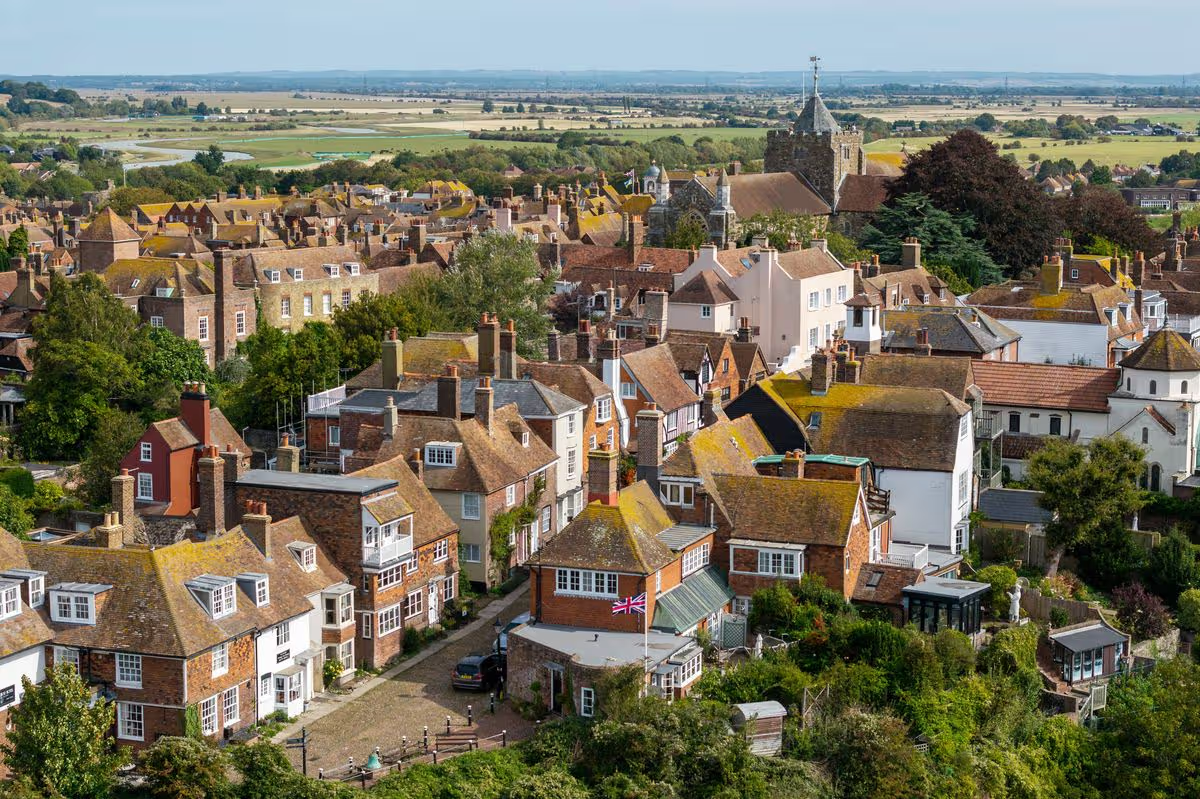
Charming UK village has cobbled streets, historic pubs and is near to beach
Tourist, Samuel Carceres confessed he was ‘unaware places in England like this exist’ after visiting a picturesque medieval town that is just two miles from the coast

Historic streets and rooftops of Rye old town, East Sussex(Image: Arthur Passant via Getty Images)
If you’re after a quintessentially British location to explore that’s perfect for a weekend away, an escape in the south of England comes highly recommended. “I can’t believe places like this in England exist,” confessed visitor, Samuel Caceres in a TikTok video.
The Spaniard shared footage of himself standing on a cobbled hillside street, taking in an array of Tudor architecture after making the journey to the Sussex town from London. “It’s famous for one of the prettiest streets in the UK – Mermaid Street,” Samuel explained as he descended the slope. “This medieval street dates back to the 12th century.”
The town he’s referring to is Rye, where Samuel kicked off his visit by tucking into a “delicious brunch” at the Whitehouse restaurant.
“I then wandered through the town’s charming little alleyways,” he added, passing independent shops including The Mint Arcade and Curious and Curiouser.
Samuel continued: “There is so much to do here – from climbing the church’s tower to take in the sweeping views – to exploring the church’s grounds and postcard-perfect streets.”
He proceeded to tell his followers they simply ‘can’t miss” the chance to enjoy a pint at the Mermaid Inn – an historic hotel and restaurant that “feels like stepping inside a Tudor castle”.
Samuel also highlighted Rye’s Watchbell Street, drawing attention to the “stunning viewpoints” it provides of the surrounding countryside overlooking the River Tillingham.
He concluded his visit at the “famous” Cobbles Tea Room, where he savoured an afternoon tea. “It was cosy, welcoming, and perfect for homemade scones and a warm cup of tea,” Samuel enthused.
He wrapped up his travel recommendation: “You need to add Rye to your bucket list – it’s the perfect daytrip.”
And he provided additional details in a caption: “Rye is a storybook town full of crooked lanes, medieval charm, and smuggler legends. Once a major port and part of the historic Cinque Ports, Rye lost its seaside access as the coastline shifted, but not its character.
“In the 18th century, it became a hotspot for smuggling, with secret tunnels said to run beneath old inns like The Mermaid Inn. Writers like Henry James found inspiration here, and festivals like Rye Bonfire Night still light up the cobbled streets.”
How to Get to Rye
Discover Sussex has the following advice for those wishing to travel to Rye:
By Car – If you are driving, there are many car parks in Rye including Rope Street car park, the Cattle Market car park (not Thursdays) and Cinque Ports Street car park, which are all within walking distance to the town centre.
By Train – Rye has a beautiful Grade II listed train station, which is located north of the town centre and is only minutes from the high street. Trains run approximately every hour from London St Pancras, which require one change at Ashford International, with the journey taking approximately 1 hour 10 minutes.

We solved the fire crisis 100 years ago, by the way
When I cracked open retired firefighter Bruce Hensler’s 15-year-old book, Crucible of Fire, I felt I had found an oracle.
Before 15 out of California’s 20 most destructive fires on record, Hensler described large chunks of cities burning to the ground, insurance companies jacking up premiums after realizing they wildly underestimated the risk and politicians failing to enforce the few fire safety rules on the books.
He even describes the fire chief of a decimated city criticizing city its politicians for failing to properly prepare for such a disaster, resulting in the city ousting the chief. (Sound familiar, Palisadians?)
Yet Hensler wasn’t trying to predict what would unfold in California’s wildland-urban interface in the 21st century. He was simply telling the story of the late 1800s and early 1900s in the Eastern U.S.’ downtowns of dense, wooden buildings.
Spoiler: Firefighters, policymakers, local advocates and, notably, insurance professionals figured out how to stop it from happening. Here’s how they did it.
The Industrial Revolution, supercharged by the Civil War, transformed Northeastern cities into denser and denser wooden tinderboxes filled with tons of humans more than capable of accidentally generating sparks.
Fire departments, inspired by the war, were already reorganizing under a new paramilitary structure to more quickly and aggressively respond to blazes although most were still primarily volunteer-based. And beyond a few ad hoc fire safety laws that were scarcely enforced, cities’ building codes and water infrastructure naively lagged far behind the threat cities were creating.
So, cities started burning.
In 1866, a Fourth of July firecracker burned down much of Portland, Maine.
The destruction — more than $240 million in damage in today’s dollars — seriously spooked insurance companies focused on downtown industrial properties. Within days, they joined together to form the National Board of Fire Underwriters to try to stabilize their industry and promote fire-safety measures.
It wasn’t enough. A barn fire burned down Chicago in 1871 — more than $4 billion in damage in today’s dollars. A warehouse fire burned down Boston the next year — causing more than $1 billion in damage.
After the Boston fire, the board raised rates by 50% in large cities and began hurling ham-fisted threats to pull coverage altogether if cities didn’t get their act together and address their tinderbox problems quickly.
Over the next few decades, the board slowly got its own act together: It began collecting data on what caused cities to burn and funded a lab to run experiments. After Baltimore burned in 1904, the board released its own national fire-safety building codes based on that knowledge and created a grading scale to identify the risk of different cities based on their fire departments and water utilities as well as how closely their building practices aligned with the board’s building and electrical codes.
For politicians who dragged their feet because bolstering a water system or fire department is costly and designing a fire-safe building is, quite frankly, more cumbersome, the grading system made maintaining the status quo no longer viable — try explaining to your constituents that insurance rates in town are through the roof simply because the city won’t adopt the board’s new codes.
At some point, cities no longer burned down, only blocks or buildings did. As fire departments and cities continued to adopt new tech (with some pushing from the insurance industry) — motorized fire engines to replace horse-drawn ones, and later, smoke detectors and indoor sprinklers, then air tanks that allowed firefighters to enter buildings — fires didn’t often spread past a single floor or room.
These reforms, targeted mainly at commercial and industrial buildings in dense downtowns, largely missed the looming crisis in suburban residential areas that were slowly building themselves into a different kind of tinderbox that burned from the outside in.
In those areas, we’ve already seen many of the same dynamics play out: first the insurance rate hikes, then the cancellations. Now, some conversations and many heated debates — often driven by the insurance industry — are taking place around what we ought to do to protect our urban-wildland interface areas and how we can make them insurable again.
Organizations such as the Institute for Business & Home Safety play the role of the National Board of Fire Underwriters. Insurance wildfire models are starting to play the role of the grading scale, and policies such as Zone Zero, the national building codes.
As Hensler wrote in 2011, we now “accept building fires as commonplace but no longer expect them to consume adjacent buildings or blocks.”
It reminds me of a text Keegan Gibbs, who leads the Community Brigade program with the Los Angeles County Fire Department, sent me when I asked what he hopes to see in 10 years’ time: “neighborhoods where wildfire can move through the landscape without becoming a community-level disaster.”
More recent wildfire news
State Farm reached a deal with California last month to keep a 17% rate hike that took effect after the 2025 L.A. County fires, my colleague Paige St. John reports. The state initially rejected State Farm’s 22% rate hike request but eventually offered a temporary approval of the 17% hike last year. State Farm — which said it paid $6.2 billion in claims last year, largely from the L.A. County fires — said the increase enables the company to continue serving Californians.
A monthlong heat dome over the American West, fueled by climate change, has melted mountain snowpacks significantly this year, writes fellow Boiling Point host Ian James. With more time for vegetation to dry out, the early melting brings an increased risk of wildfire across the region this year.
In fact, acreage burned this year is nearly triple the 10-year average, reports Tim Casperson of newsletter the Hotshot Wake Up. The uptick has been fueled by a series of fires in Nebraska that has stunned many of the state’s ranchers as it decimated the hay that cattle rely on and stressed pregnant cows, reports Anila Yoganathan at the Flatwater Free Press.
A few last things in climate news
The U.S. Forest Service announced a major reorganization effort Tuesday that will move its headquarters from Washington to Salt Lake City, close research and development facilities in more than 30 states and shift management from broader regional offices to more localized state offices, reports Christine Peterson for High Country News. Former Forest Service employees and tribal leaders expressed concern that the move would uproot thousands of employees, scattering specialized regional knowledge. The chief of the Forest Service said the plan is intended to make the agency more “nimble, efficient, effective and closer to the forests and communities it serves.”
Gas prices in Los Angeles surged to $6 per gallon this week after the U.S. and Israel’s and the U.S.’s attack on Iran prompted the nation to close the Strait of Hormuz. However, California’s petroleum market watchdog is warning that some of the inflated price may be due to price gouging, my colleague Blanca Begert reports. In January, refineries were making 49 cents on the gallon, the watchdog group said; now, it’s closer to $1.25.
Honda is scrapping plans to build and sell three new electric-vehicle models in the U.S. after the Trump administration abandoned Biden-era policy goals to increase EV manufacturing and adoption, Dan Gearino reports for Inside Climate News. It comes after similar moves by Ford and Ram.
Finally, Heatmap News, in collaboration with MIT, has launched a new tool tracking electricity prices across the country on a month-to-month basis all the way down to the Zip Code level. You can check it out here.
This is the latest edition of Boiling Point, a newsletter about climate change and the environment in the American West. Sign up here to get it in your inbox. And listen to our Boiling Point podcast here.
For more wildfire news, follow @nohaggerty on X and @nohaggerty.bsky.social on Bluesky.

Sam Kerr’s uncertain future: Should Chelsea keep hold of her?
Kerr’s status at Chelsea was unquestionable before she suffered an anterior cruciate ligament (ACL) injury while at her peak in January 2024.
It took her more than 18 months to recover and she is still returning to full fitness as Chelsea struggle to meet expectations this season.
Off the pitch, Kerr has endured difficulties too. She was found not guilty of causing racially aggravated harassment against a Metropolitan Police officer in 2025 – the result of a court case which played out in the public eye and caused controversy.
That led to calls in her home country to strip her of the Australia captaincy, while she stepped out of the limelight in England.
It has also been a period of change for Kerr as she got married to former West Ham midfielder Kristie Mewis and they have a son, who was born in May.
In her absence, Chelsea went unbeaten domestically and won the treble in manager Sonia Bompastor’s debut campaign, but it has not gone to plan this year.
Injuries – particularly in attacking positions – players departing the club and performances not being up to scratch mean Chelsea are set to miss out on the Women’s Super League title and are out of the Women’s Champions League.
Kerr has struggled to regain her place in the starting XI despite this, playing just 444 minutes in the WSL this season.
She has made 15 appearances in the league, but only started two games, while she netted three goals in three starts in Europe.
Bompastor has fewer options up front, with USA striker Catarina Macario joining San Diego Wave, and Aggie Beever-Jones and Mayra Ramirez out injured.
So has Kerr been overlooked?
“She’s featured in almost every league game this season but it’s only two that she has started. The number nine position has been difficult for Chelsea,” said former Scotland captain Rachel Corsie on BBC Radio 5 Live.
“Lauren James has played there to allow them to get Alyssa Thompson and Johanna Rytting Kaneryd in the team, who have been in good form. There’s lots of different factors.
“But they haven’t got an out-and-out number nine. Chelsea need a number nine. To let go of Sam Kerr, without having a replacement there, would be a big step.”

Pakistan to continue with Iran-US mediation despite ‘obstacles’ | US-Israel war on Iran News
Islamabad, Pakistan – Pakistan intends to continue to nudge the United States and Iran towards negotiations aimed at ending their war, but the Ministry of Foreign Affairs acknowledges “obstacles” in its efforts.
Foreign Office spokesperson Tahir Andrabi did not specify the roadblocks on the path to peace that he was referring to. But his comments, made during a weekly media briefing in Islamabad, came hours after US President Donald Trump threatened to bomb Iran “back to the Stone Ages” if it did not accept Washington’s terms for a peace deal.
Recommended Stories
list of 4 itemsend of list
Pakistan has been leading a multination effort to facilitate negotiations between the US and Iran.
“Despite challenges and obstacles, Pakistan will continue its efforts to promote facilitation and dialogue,” Andrabi said. He added that Islamabad was working to create conditions for “meaningful negotiations among relevant stakeholders”.
He said the US and Iran had confidence in Pakistan’s role as a neutral intermediary.
In a sign of that confidence, Iran has allowed 20 Pakistani-flagged vessels to transit the Strait of Hormuz. Andrabi called it “a harbinger of peace” and a positive step for regional stability.
He did not confirm whether any Pakistani ship had so far sailed through the strait.
The Hormuz route has been largely blocked since Iran began restricting oil and gas shipments following the outbreak of the US-Israel-Iran conflict on February 28. The disruption has driven up energy prices and triggered widespread economic strain.
Andrabi also pointed to sustained high-level contact between Islamabad and Tehran. He cited a March 28 call in which Iranian President Masoud Pezeshkian spoke with Prime Minister Shehbaz Sharif, stressing the need to “build trust in order to facilitate talks and mediation” and praising Pakistan for its “supportive role for peace”.
Regional diplomacy
The briefing came just a day after Deputy Prime Minister and Foreign Minister Ishaq Dar returned from Beijing, where he met China’s Foreign Minister Wang Yi.

The visit produced a joint five-point initiative calling for an immediate ceasefire, urgent diplomatic engagement to prevent further escalation, and the restoration of normal maritime traffic through the Strait of Hormuz.
Andrabi said the Chinese-Pakistani plan had since been shared with Iran, the US and other stakeholders, receiving appreciation “across the region and beyond”.
He added that the proposals were consistent with the outcome of the four-nation ministerial meeting held in Islamabad the previous weekend — the foreign ministers of Saudi Arabia, Turkiye and Egypt joined Dar for those talks.
Dar travelled to Beijing despite medical advice to rest after sustaining a hairline fracture during the Islamabad talks, a move Andrabi said reflected the importance Pakistan places on its ties with China. “The Chinese side expressed deep appreciation, conveying that China and Pakistan are strategic cooperative partners,” he said.
The Islamabad meeting between Pakistan, Saudi Arabia, Turkiye and Egypt was the second such gathering in a coordinated regional push to de-escalate tensions. The first was held in Riyadh on March 19.
Following those talks, Dar said Pakistan was prepared to host direct US-Iran negotiations “in the coming days”.
“Pakistan will be honoured to host and facilitate meaningful talks between the two sides for a comprehensive and lasting settlement,” he said on March 30.
At Thursday’s briefing, Andrabi reiterated that offer, confirming Pakistan had formally “offered to host and facilitate negotiations as part of its broader diplomatic outreach”.
He said the next phase of efforts would focus on securing “meaningful negotiations among relevant stakeholders”.
He appeared to acknowledge that Iran — which has so far denied any direct negotiations with the US and has insisted that the mediation is limited to messages being passed between Tehran and Washington by Islamabad — was not fully on board with the efforts to push the warring nations towards talks.
“Iran, as a sovereign country, determines its own policies,” Andrabi said.
Afghanistan breakthrough?
Separately, the Pakistani Foreign Ministry confirmed sending a delegation of senior officials to the northwestern Chinese city of Urumqi for talks with Afghanistan. It is the first substantive contact since Islamabad launched cross-border strikes in late February.
The Urumqi meeting on Wednesday focused on exchanging views on the current escalation, Andrabi said.
“Our participation is a reiteration of our core concerns,” he said. “The burden of real process, however, lies with Afghanistan, which must demonstrate visible and verifiable actions against terrorist groups using Afghan soil against Pakistan.”
Pakistan launched Operation Ghazab lil-Haq on the night of February 26, targeting what it described as sanctuaries of “terrorists” in Afghanistan, following what it called unprovoked fire from across the border by Afghan Taliban forces.
After a five-day pause from March 18 to 23 for Eid-ul-Fitr, partly in response to de-escalation requests from Saudi Arabia, Qatar and Turkiye, Andrabi confirmed the operation was continuing.
“There has been no change in Operation Ghazab lil-Haq, and operations are continuing,” he said.
Islamabad has repeatedly accused the Taliban administration in Kabul of enabling groups such as Pakistan Taliban, known by the acronym TTP, which have repeatedly launched deadly attacks inside Pakistan, to operate from Afghan soil. Kabul denies those allegations.
Islamabad says its concerns remain unaddressed, and violence has surged since the Taliban’s return to power in August 2021.
China has also played a role in facilitating engagement between Pakistan and Afghanistan, including meetings in Beijing in May and in Kabul in August.

Violence Erodes Adamawa’s Farmer-Herder Social Tradition
The year was 1975.
On a quiet afternoon in Bare, a farming community in Numan Local Government Area of Adamawa State, northeastern Nigeria, Clement Coleman sat beneath a neem tree with an old friend. Alhaji Sadiki, a herder from the nearby village of Sabewa, had come to visit.
Clement had recently bought two calves, and he believed that Sadiki was best positioned to raise them. There were no contracts to sign, no witnesses to summon. By the end of their conversation, he handed them over to Sadiki. At the time, this was not unusual in Bare. It was the system.
Farmers routinely bought a handful of calves and entrusted them to herders they knew. In return, the herders were given access to farmland within the community, land they could not cultivate themselves because of their nomadic life and the demands of managing large herds. Farmers, in turn, worked those fields on their behalf.
It was an arrangement built on mutual dependence. At harvest, farmers handed over the yields to the herders. When they needed money or access to their cattle, they turned to the herders to whom they had entrusted their animals. Over time, the cattle multiplied. Farmers who never grazed a single animal came to own sizeable herds. Herders, meanwhile, secured steady food supplies through farms they did not till themselves. Risks were shared, and so were rewards.
That afternoon, Clement and Sadiki sealed their agreement with a handshake.
The pact that fed generations
For years, the system worked with remarkable ease.
Clement recalls how Sadiki managed the cattle as though they were his own, alerting him whenever one fell ill. “One time, the cows entered someone’s farm and destroyed their crops. Sadiki told me, and I went to the farmer and covered the loss in cash,” Clement told HumAngle.
A decade on, by 1985, his herd had grown to four cattle. By 1990, it had increased to six. The herd continue to multiply.
“They were healthy and big. I considered myself a rich man back then,” he recounted.

The cattle became a financial lifeline. One time when Clement was short of funds and needed to pay for his children’s education, he went to Sadiki and one of the big cows was sold. He paid his children’s fees and used the balance to support his household. He continued to use the system for years to support his family.
Others relied on the same system.
Buba Sarno, a lifelong herder in Mararaban Bare, never had time to farm. Yet, for four decades, each harvest season, he received about 25 bags of rice and 30 bags of maize. It was simple. All he did was seek land for free and reached an agreement with a local who tended to the farm on his behalf. If the farm required manual labour or fertiliser, Buba sorted it through the farm attendant. “With time, I also cultivated soya beans and other crops, and my family never had to buy food,” Buba told HumAngle.
Magaji Yakubu, another herder in Mararaban Bare, told HumAngle that he combined grazing with both rainy season and irrigation farming, relying on locals to manage his fields. “I cultivated rice, guineacorn and soya beans,” Magaji noted. Like Sadiki, he tended farmers’ cattle.
The same arrangement played out in Bwashi community in Adamawa’s Demsa Local Government Area, where Theophilus Tapu built his livelihood around it. The 80-year-old farmer is a father of 10 and grandfather of over 40 children. He is considered an accomplished cattle rearer in his community, but Theophilus never led a herd to graze. Instead, he bought young male calves, handed them to trusted herders, and sold them at maturity.
“I sold them to sort my needs and purchase more young ones, then hand them back to the herders,” he told HumAngle, adding that when some of the herders were migrating, they would hand over his herd to him, and he would entrust it to a new batch of herders.
The cycle sustained him for over 60 years.
By 2000, he had lost count of his herd. He explained that his relationship with the herders thrived to the extent that he didn’t have to follow them to the market; the herders sold the cattle and brought him the proceeds.

It was, in every sense, a shared economy rooted in trust.
From trust to tension
The trust began to fracture in 2017.
That year, violence broke out between farmers and herders in several communities in Adamawa State, with Numan and Demsa among the hardest hit local government areas. What had once been isolated disputes escalated into deadly clashes, displacing communities and destroying livelihoods.
Despite government intervention and multiple peacebuilding efforts, the violence has persisted for almost a decade.
At its core, the conflict is about land and water. Farmers have accused herders of encroaching on farmlands. Herders, in turn, said grazing routes had been taken over.
In Bare, the turning point came in 2017, when a confrontation between a farmer and a herder spiralled out of control. “The herder took his cattle to the farm, and when the owner of the farm confronted him, things got out of hand, and they started fighting,” Jackson Amna, the District Head of Bare, told HumAngle.
What began as a verbal confrontation that day turned into full-blown violence, leading to deaths and displacement. The clashes now follow a pattern, according to locals; they subside during the dry season and resurface when farming resumes with the rains.
HumAngle has extensively covered the conflict in Bare and Mararaban Bare.

With each recurrence, trust erodes further.
The long-standing system, in which farmers entrusted cattle to herders and herders relied on farmers for farm produce, is steadily collapsing across Numan and Demsa. Even though a few farmers still hand over farmland to herders, the District Head of Bare explained that it is rare.
“During the 2017 conflict, some herders ran with people’s cattle and have not been seen to date,” Jackson said. “My herd was also taken away by the herder I entrusted them with, so I won’t give my cattle to somebody who can run away with them.”
Strained lives
The consequences have been profound.
When clashes between farmers and herders continued in Bwashi, Theophilus’ relatives urged him to retrieve his cattle from the herder he had entrusted to them. He noted that most herders had already started leaving the area at that time.
“They [herders] were considered our enemies, and we could no longer trust them, but I knew some of them were good, but my people wanted me to do nothing with them,” he said.
Theophilus succumbed and took over his cattle from the herder.
Not long after, thieves stole the animals he had struggled to manage himself. The old farmer doesn’t have a single cow to call his own. “I lost everything,” he said. “I’m very poor now, and survival is hard.”
Theophilus had a well-planned retirement. He was to stop farming in 2024 and live off his herd, but now he says his entire life has been altered, and with many mouths to feed, he had to go back to the farm that yields little.
Things didn’t change only for the farmers. In 2019, two years after the conflict began, the man who had given the farmland to Buba Sarno in Mararaban Bare told him never to set foot on the land again, so Buba migrated with his herd and family to Lamurde, a nearby local government area. In Lamurde, he tried to rent land for farming but couldn’t get any.
“I went to a hill and established a farm there, but unfortunately, the soil is not good, and the land is not fertile, so my crops didn’t yield,” he said.
Like Buba, several other herders who once lived in Bare have been displaced to settlements such as Sabewa, Ubandoma, and Mararaban Bare. However, since they are not indigenous to those communities, they told HumAngle that farming has become restricted as locals have taken over their lands and broken the pact that existed between them for generations.
Magaji Yakubu, who lost his farmland at Mararaban Bare after locals took charge of it, has also retired all the cattle he had been tending for locals. “Feeding has become very hard for my family and me since the conflict began,” he stated. As someone who had access to large harvests in past years, Magaji said navigating a new life without owning farmland or grain is difficult.

For Clement, the loss is both economic and deeply personal. Sadiki, the man he trusted for decades, disappeared with his cattle during the 2017 crisis. Although his phone rings occasionally when he dials it, no one has ever responded. Clement says he is not sure whether the man is dead or alive.
“Some say the herders around here migrated to Cameroon for safety due to the recurring clashes. We also heard that some have moved to other states. I’ve looked for Sadiki everywhere I can in the past nine years and haven’t seen him,” he said.
He had planned to fund his children’s education by selling cattle. Without them, those plans collapsed. Even if Sadiki returns, Clement believes the relationship might not be as usual.
“Right now, I believe he intentionally ran away with my herd,” he said.
Searching for solutions
Efforts to restore peace continue, but progress remains slow.
The Justice, Development, and Peace Commission (JDPC), a faith-based organisation affiliated with the Catholic Diocese of Yola, has worked for decades to address the crisis. According to Jareth Simon, JDPC’s Project Manager in Adamawa State, land and water were the initial triggers, but new pressures have emerged.
“The one that is glaring to us now is the climate-related issues,” he said. “We’ve also seen where there is an increase in population, leading to more people wanting to cultivate more land.” Additionally, Jareth noted that displacement caused by the Boko Haram insurgency in the region has further intensified competition for resources.
While most of Adamawa’s 12 LGAs have been affected by the farmers-herders crisis, Jareth said that JDPC’s engagements have identified Demsa, Numan, and Yola South as the hardest hit areas. “This is as a result of the number of cases that have been reported,” he said.
To mitigate the crisis, JDPC’s approach focuses on community-led solutions, bringing together local government representatives, religious leaders, women, and persons with disabilities. Currently, about 415 stakeholders in conflict-prone areas are engaged in this initiative.
“These are people who cut across the local structures at the local government level. That includes the local government representative and religious leaders from the Muslim and Christian associations. We have women’s representation and persons with disabilities,” he said.
Jareth explained that people meet at least once a month to discuss issues related to peaceful coexistence, social cohesion, and community protection, and to identify local actions to mitigate them. “We don’t dictate to them. We only strengthen their capacity, and they themselves identify the leadership structure,” Jared said.

In some communities, such as Namtari in Yola South, the approach has helped reduce clashes. “We have programmes for children like Peace Clubs, and we also have the one that targets adults using informal education and informal approaches,” he added.
But challenges remain, particularly around funding and sustainability. “So we’ve seen where we’ve intervened, and then the projects have to end, but you also see that there is an increased need for you to also go out and support, and the funds are limited,” he said.
Jareth said that government authorities should set up and maintain multiple community-based interventions. “Because one of the gaps we’ve noticed is that from the community to the local government, from the local government to the state, there seems to be some gaps sometimes even in terms of information sharing,” he said.
Government interventions to resolve the farmers-herders conflict across Nigeria have struggled over the years. For instance, the Rural Grazing Area (RUGA) scheme, introduced in 2019, was derailed by mistrust and controversy and later suspended by the former President Muhammad Buhari’s administration.
Another intervention, the National Livestock Transformation Plan (NLTP), remains largely unimplemented. It was initially introduced to “create a peaceful environment for the transformation of the livestock sector that will lead to peaceful coexistence, economic development, and food security…”
The Plan, whose first phase execution was budgeted at ₦120 billion, has not been actualised.
While Jareth acknowledged the efforts of the Adamawa State government in establishing a peace commission comprising committees across the LGAs, he said there’s a need to strengthen security across the locations. “We also want to see the government come out with policies […] that help resolve some of these tensions that arise as a result of scarce resources within these communities,” Jareth stressed.
Government interventions and community-led peace initiatives continue, but the deep scars of mistrust, competition for land, and recurring violence make reconciliation slow and fragile.
What is being lost in Adamawa is not just a livelihood, but a way of life.

‘Original’ sci-fi film from writers of ‘best horror movie ever’ on TV tonight
Fans will need to tune in as it is not streaming anywhere

The film can only be caught on TV tonight(Image: Sony)
An ‘original’ sci-fi film that comes from the writers of the ‘best horror movie ever’ is on TV tonight.
The movie, 65, was originally released in 2023 and gives film fans the ideal way to begin their extended bank holiday weekend. According to its synopsis, the story follows a lone pilot named Mills, who after a catastrophic crash, lands on an unknown planet.
He quickly discovers he’s actually stranded on Earth… 65 million years ago. Now, with only one chance at rescue, Mills and the only other survivor, Koa must make their way across an unknown terrain riddled with dangerous prehistoric creatures in an epic fight to survive.
Those wanting to watch the film will be able to watch it tonight (April 2) from 9pm on Film4. Fans will need to make sure they tune in if they don’t want to miss it as at the time of writing, the title is not currently streaming anywhere. Viewers could alternatively tune in to Film4+1 where the film will begin an hour later at 10pm.
Adam Driver, known for playing Kylo Ren in the Star Wars sequel trilogy leads the cast as Mills, while he is also joined by Ariana Greenblatt as Koa. Former Disney actress Greenblatt has since appeared in Barbie, Borderlands and Now You See Me Now You Don’t.
The film was written and directed by writing partners Scott Beck and Bryan Woods. The pair are most famously known for being the ones who penned the original horror film A Quiet Place before handing off creative control of the franchise to John Krasinski. They also made Heretic together, with fans calling both of their spooky offerings as ‘one of the best horror movies ever’.
Meanwhile, 65 failed to repeat the commercial success of their previous projects. It only made $60 million against a $45 million budget at the worldwide box office. And despite its less than favourable 35% rating on Rotten Tomatoes, many fans say it is well worth checking out.
Although one critic looking back on the film did share an updated verdict for why it is worth watching years after its release.
the film delivers a tense sci-fi survival story where action drives a narrative of isolation and connection. Fans of creature features and suspense will appreciate its concise format, focused on impact and pacing, echoing the tradition of dinosaur movies that have long held a unique place in the world of blockbuster cinema.
Many fans go so far as to disagree completely with the negative critical reviews. Its brief 93 minute runtime is also hailed as a positive and preferred option than slogging through a marathon release.
One fan went so far say it is the “best dinosaur movie ever made” with many making comparisons to how it has superior action to the Jurassic World movies. Another viewer added: “This film deserves 10 STARS!!! Instant Classic!!!”
Someone else claimed: “This movie checked off all the boxes. Space travel, dinosaurs, suspense, emotional connection, and Adam Driver! It doesn’t waste any time grabbing your attention, and the compelling story line is a great ride all the way through.”
However there are some who disagree, although they largely feel disappointed in the ending. Others argue that 65 did not get a fair chance at the cinema because it ended up against some big franchise sequels like John Wick 4, Shazam 2, Scream VI and Creed III.
One fan gave the ultimate approval when they commented: “Think Jurassic Park but much better and believe me when I say a lot better. This is that rare science fiction action movie that people have tried to make but didn’t get it right. Here, they finally not only got it right but they excelled!! Plus, real life marine Adam Driver is top notch in a really exciting movie.”
65 airs tonight at 9pm on Film4.

The best UK beach for spring has been revealed
THERE are thousands of beaches in the UK but Cuckmere Haven has been named the best to visit in spring.
With beautiful views across the Seven Sisters chalk cliffs and some of the mildest temperatures in the country, it’s the perfect spot for your next trip to the seaside.
The experts at GO Outdoors analysed average spring temperatures, rainfall, sunshine hours and Google reviews to reveal the best spring beaches across England.
Cuckmere Haven in East Sussex came in top spot, scoring highly when it comes to mild temperatures as it’s an average of 9.5C during the spring months.
It averages 52mm of rainfall across the month, and 7.8 hours of sunshine each day.
The beach had a Google review score of 4.8 out of 5 and received an overall score of 9.60 out of 10 by Go Outdoors.


It beat other popular spots like Camber Sands, Southwold and Porthcurno Beach.
The shingle shoreline itself is unique as it’s the only spot in Sussex where a river flows through the beach to meet the sea.
It’s isolated too, but it’s worth the walk for the incredible views of the huge white cliffs.
One visitor said: “Absolutely stunning scenery. Long walks and perfect for the family I loved every second of walking his beautiful beautiful cliffs.”
Another added: “Wow – this iconic sight takes your breath away! The cliffs are blindingly white and the beach and surrounding countryside is so pretty. Everyone should see this once in their lifetime.”
While it has no shops or cafes around, there are four cottages up on the hilltop.
These are former homes of the coastguard and their families built in the 1820s, and are now used as residential homes.
Cuckmere Haven has also been called a ‘wild beach’ thanks to the amount of wildlife here, ranging from oystercatchers and skylarks to rabbits, seahorses and butterflies.
Daniel Start, author of Wild Guide London and South England, says: “This is a wild beach, where the river meets the sea, against a backdrop of the iconic Seven Sisters.
“You can explore the myriad caves carved within them or wander upstream to swim in the lakes made from the meanders of the ancient river.”
Here’s another of our favourite beaches in the south of England – and a hotel to stay at too…

*If you click on a link in this box, we will earn affiliate revenue.
Sidmouth, Devon
Take a trip to Sidmouth on the Jurassic Coast and wander down Jacob’s Ladder to its pretty shingle beach. Make sure to walk along the promenade and check out the independent shops and boutiques. Stay at the four-star Harbour Hotel for sea views and traditional afternoon tea from £135 per room.
Even if you haven’t been there, you might recognise the spot as Cuckmere Haven is frequently used in the backdrops of films.
Movie fans will recognise the spot at the top of Cuckmere Haven from Harry Potter and the Goblet of Fire when the characters use the Portkey to get to the Quidditch game.
The beach and surrounding area has also been used to film Robin Hood: Prince of Thieves, Atonement, Agatha Christie’s Poirot and Luther.
It was even used for Cheryl Cole’s music video, The Flood.
The closest train station to Cuckmere Haven beach is Seaford.
From there it’s a 15-minute drive, or there’s a popular walking route from the town across the coastline which takes just over an hour.
Another popular option is to head to Eastbourne and walk from there which is around a 12-mile trek.
Here are the best beaches to visit this spring…

This the full list of the best beaches to go to this spring according to Go Outdoors…
- Cuckmere Haven, East Sussex
- Southwold Beach, Suffolk
- Druridge Bay Beach, Northumberland
- Pentle Bay, Tresco
- Thornwick Bay, Flamborough Head
- Kimmeridge Bay, Dorset
- Camber Sands, East Sussex
- Porthcurno Beach, Cornwall
- West Wittering Beach, West Sussex
- Brancaster Beach, Norfolk
For more on beaches, here’s where to find the best UK beach and it gets the least amount of rain in the country.
Our 26 must-visit UK beaches for 2026 including tropical-feel spots and family-friendly finds.

Stunning city named ‘Europe’s chocolate capital’ — not Paris or Brussels
One city has been crowned Europe’s chocolate capital in a new study analysing chocolate culture across the continent

Turin has been known for its chocolate since the late 1500s(Image: Getty)
When you think of chocolate, your mind might wander to the Belgian capital of Brussels, or perhaps the Swiss Alps, yet neither has claimed the top spot on Europe’s list of “chocolate capitals”. Instead, that coveted title belongs to the Italian city of Turin.
Ahead of the bustling summer tourist season, Avis examined European cities for their chocolate culture, taking into account the number of chocolatiers and shops listed on Yelp, chocolate-related attractions such as museums and factory tours, and consumer ratings.
Their research placed Turin firmly at the top, closely followed by Perugia, also in Italy, with Austria’s Salzburg taking third place.
Two British cities also featured on the list, with one securing fourth place and London coming in eighth.
Turin boasts 233 chocolatiers and five chocolate attractions; regarded as Europe’s historic chocolate capital since 1585, the city is the birthplace of gianduja and bicerin – iconic hazelnut-chocolate specialities.
There’s also the Pfatisch Chocolate Museum and factory tours from renowned brands such as Caffarel.
The city’s annual CioccolaTò festival further solidifies its standing as a must-visit destination for immersive chocolate experiences.
Taking to TripAdvisor, one recent visitor to the Pfatisch Chocolate Museum wrote: “Beautiful audio guided tour, interactive for families. The children had a great time with the interactive games.
“Very cosy and realistic environment recreated for the tour. Exhaustive on the subject. It involved all the senses.
“Small taste of the three chocolates (dark, milk, white) and finally the king Gianduiotto.”
Meanwhile, another visitor who enjoyed a trip to the Pfatish Museum remarked: “This place looks it belongs on a movie set. Everything looks so good and so perfect. Even if you don’t buy anything here, it is well worth a visit.”
Top 10 unexpected “chocolate capitals” of Europe
- Turin, Italy
- Perugia, Italy
- Salzburg, Austria
- York, UK
- Antwerp, Belgium
- Strasbourg, France
- Krakow, Poland
- London, UK
- Amsterdam, Netherlands
- Prague, Czechia

I went to Disneyland Paris for the first time – 5 things I wish I’d known before
Most people take their first Disney trip as a child, but I visited for the first time as a middle-aged woman, and some parts of my trip were completely unexpected – here’s what first time visitors should know

My first trip to Disney was one to remember(Image: Natalie King)
Look for advice on your first trip to a Disney park and you’ll often be overwhelmed with dos and don’ts, and a lot of the advice is conflicting. Going into my first Disney trip to Disneyland Paris, I tried to do some research, but found there’s just so much information out there it can be difficult to know who to listen to.
However, there are a few simple things I wish I’d known before I went with my seven year old, and if you’re a first timer like me, you might find it useful to keep these things in mind when planning.
1. The days are long
We arrived late evening on our first day and found the park beautifully lit up and the atmosphere buzzing. As someone who is used to British theme parks that usually slam their doors shut at 6PM, I didn’t realise that everything opens so much later at Disneyland. Even after the night shows, people were wandering round the shops at nearly 11PM and seemingly not planning to go to bed anytime soon.
There are certainly upsides to this. You can squeeze lots of fun out of your day and plan to go on rides when it’s quieter. However, with younger kids you might want to plan some strategic naps otherwise they aren’t going to make it through to the night-time shows, which really are worth staying up for.
2. You find most of the fun stuff by accident
While I did have a vague plan for the things we wanted to see, some of the stuff we really loved we stumbled across completely accidentally. Wandering into the main Disneyland Park at just the right time meant we arrived just in time to see Mickey dance by on a parade float. While walking around the Studios Park, we found ourselves just in time to see Stitch Live, a super fun interactive show which my daughter is still talking about, which we hadn’t planned to see.
It’s tempting to overplan on these kinds of trips, but the park really is a magical place, and sometimes it’s best to just wander round and let the magic find you.
3. The shopping and dining are as impressive as the rides
Let’s face it, the facilities at many theme parks in the UK leave a lot of room for improvement. Food is limited to burgers and hot dogs, and the gift shops have a few overpriced toys and some branded merch.
Our hotel was close to Disney Village, which had a seriously impressive selection of shops, restaurants, bars, plus some familiar chains like Starbucks and McDonald’s. There were clothing shops with just Disney-branded items, a posh décor shop were you could get upmarket scented candles and bougie gifts, and even a giant LEGO store.
The restaurants we visited, including the new Regal View restaurant, were certainly much different to any other theme park dining I’ve ever experienced. There was not a chicken nugget or sticky table in sight as we enjoyed upmarket French cuisine. Even the kids meals were fresh, seasonal, and beautifully presented. It’s great to have these options especially if you’re visiting the park for a special occasion.
4. Premier Access is an upgrade worth paying for
If you have a short window of time to visit the parks, then Premier Access is definitely one upgrade to get. It meant we could get on most rides in under five minutes so could pack so much into a short space of time. You can also buy passes for individual rides, which would definitely be worth it if you have your heart set on one of the big attractions.
READ MORE: Major cruise line cancels all sailings in April in ‘disappointing’ blow to customersREAD MORE: Brit lad books Airbnb stay in someone’s garage – and sums it up in 2 words
5. You’ll need a day to recover
My editor, who has visited the parks many times, warned me that I’d be exhausted after my trip describing it as ‘Disney tired’. She wasn’t wrong. The combination of 25,000 steps a day, constant stimulation, and being in crowds for hours and hours at a time left me extremely fatigued.
If you’ve got an extra day of annual leave going spare, you might want to book the day off after coming home, or at least get a nap on the Eurostar, because I honestly felt jet-lagged after arriving home. But of course, it was well worth it.
Have a story you want to share? Email us at webtravel@reachplc.com

‘I visited Yorkshire beauty spot perfect for dreamy stargazers – breathtaking doesn’t cover it’
Mirror writer Julia Banim visited Robin Hood’s Bay, an atmospheric gem on the Yorkshire Coast, and soon learned that the true beauty of this picturesque seaside village is best seen by starlight

A night under the stars did wonders for my sleeplessness(Image: Julia Banim/Reach PLC)
Once upon a time, we Brits could look out of our window at night and see cluster upon cluster of sparkling stars. And in some parts of the country, you still can.
I’m lucky enough to spend a twinkling evening at Robin Hood’s Bay, one of the most striking villages of the Yorkshire Coast, with enough atmosphere to rival its more imposing literary sister, Whitby. I arrive on a bright day in early spring, the first daffodils nodding gently by the winding coastal path that leads down to the sea. I feel suddenly swept into a gothic romance novel, which feels very suitable, given this is the year of Wuthering Heights. And while Brontë fever may have drawn coachloads of would-be star-crossed lovers to Howarth, might I suggest this equally evocative Yorkshire beauty spot.
The sunlit waves crash beneath spectacular cliffs, and the sea stretches out endlessly before me. Time seems to stand still here, and it’s easy to imagine pirates of the old ballads making land here, treasure clinking in their chests. But today, all is peace as I make my way through the steep, cobbled streets, where smugglers of stories once made use of secretive, subterranean passages, and ghostly figures supposedly roam.
READ MORE: Spain hotspot ‘doubles’ charge for UK travellers from today
My nostrils fill with scents of delicious food, with each street boasting pubs and eateries that appear untouched since the days of clandestine chats over ale and candlelight. But it’s not quite time for sustenance yet, and a night of stargazing awaits. Little do I know then that Robin Hood’s Bay is a gem that glows even brighter in the dark.
I’m staying at the superb Hotel Victoria, which boasts extraordinary views over the cliffs, noted through North Yorkshire and beyond. Beloved by passing sea captains since the Victorian age, the 30-bedroom Hotel Victoria is newly refurbished, but maintains much of its historic character. The rooms in the ‘Captain’s Quarters’ are comfortable and beautifully decorated, and as I enjoy a relaxing soak in the clawfoot tub, I feel very much like an elegant 19th-century lady.
Of course, the rooms are also well appointed for a aspiring-elegant 21st century lady like myself, and I’m positively thrilled to see a Dyson hairdryer on the dressing table, as well as a little bottle of Yorkshire gin. Absolute bliss. Wrapping up warm, I head to meet Mark Dawson, chairman of the Whitby and District Astronomical Society, in the tasteful hotel bar, and his passion for all things stargazing is instantly infectious. He has a deep knowledge of the yearly patterns of the stars, best seen here in the month of August, describing them touchingly as “old friends returning”.
Mark told the Mirror: “We forget that though, literally, people’s lives were ruled by what they saw in the night sky, by where objects rose, when they rose, when they set. You only have to look at Stone Henge, these ancient monuments that were sky clocks, all related to the sky. So their lives were ruled by events that went on in the sky. In Egypt, when they had what we call the helical rise of the Siririus, which is the brightest star in the night sky, that was the first rising before the sun in the dawn sky.
“They knew then that the Nile was shortly going to flood. So their lives would be ruled by when they first saw Sirius in the morning. And we forget that now, in all the modern day, and all that detritus, we’ve lost our connection with the night sky. I think it’s only people who are in really dark areas, rural locations, that maybe still have that. Which is a shame”.
With so many of us experiencing sleep issues, investing in all sorts of modern appliances to get some rest, could it be that our body clocks are rebelling against adjusting to a world where the skies are shut out? And could embracing the dark skies and their cycles, as our ancestors did since time immemorial, be the answer? As someone who struggles to drift off, I’m willing to try.
Mark first became fascinated by all things space as a youngster, watching the moon landings, and there is perhaps no better area in England for a budding stargazer to hone their interest. In December 2020, the North York Moors National Park was designated as an International Dark Sky Reserve, making it one of just 25 locations worldwide recognised for outstanding night-sky quality. In the darkest areas, some 2,000 stars can be seen at any one time – a notion that feels positively alien to a city dweller such as myself.
There have been some steps taken to reduce light pollution in Britain in recent years, with significant improvements to street lighting, including the removal of the old sodium lights with their “terrible” orange glow. But still, those travelling over to the North York Moors from the neighbouring metropolises of Sheffield and Leeds are regularly left speechless during stargazing expeditions. Mark said, “People are quite literally stunned. Over the years, they can’t believe what they’re seeing. And we tend to forget that when you’re sort of living on the doorstep, because it’s fairly easy for us just to drive ten minutes and be able to appreciate that.”
We leave the plush surroundings of Hotel Victoria behind and head out into the darkness for a mini ‘stargazing safari’. It’s a clear night, and Mark feels hopeful we’ll enjoy some splendid views. Sadly, this is an occurrence that has become less frequent in recent times, yet another depressing blow of climate change. In winters gone by, the chance of a clear sky was around 30 per cent, but for the last few years it’s sat around the 12 per cent mark. Mark told me, “I hope it’s not a trend. It’s probably to do with global warming. It seems that because the sea temperature is warmer, which it is, it tends to generate more moisture, which then means more cloud.”
Already, as I look up from the hotel steps, I can see a good quantity of glitter in the blackness, but I am nowhere near prepared for the phenomenal sight that’s about to greet me. We walk a short way off the road, away from the streetlights and into the true darkness. Remembering my glasses in my pocket, which I so often neglect out of vanity, I pop these on and audibly gasp. Side note, please always wear your glasses when out seeking the awe-inspiring.
Without exaggeration, the sky is quite literally filled with stars, many of which give off a sparkle I didn’t think possible. An upturned jewellery box spilled into endless folds of velvet. While still very much firmly on the ground, it almost feels as though we’ve somehow lifted some way up into the spangled heavens, as if I could reach out a finger and nudge a perfectly set constellation out of place. Breathtaking doesn’t quite cover it. It was one of those moments where you’re very much glad to be alive.
Mark points out various constellations using his long torch in an accessible way, and there is not a twinkle in the sky that he doesn’t know intimately. A whole history is written here, from the older stars blazing towards death, to the younger stars with their youthful blue hue, and I never even realised. I never really saw myself as a scientifically inclined person, but here I don’t feel out of my depth. Perhaps it takes such sights to bring the universe and all its enormity home.
I talk Mark’s ear off with questions, and he very politely obliges, but soon it’s time for me to let him carry on with his evening and for me to return to the warmth of Hotel Victoria. It’s only when I step into the foyer that I remember how hungry I am. Luckily, a slap-up dinner awaits, with a hearty steak and chips, followed by an absolutely enormous Eton Mess dessert, soon hushing my stomach grumbles.
The staff couldn’t have been more attentive and friendly, making sure I had a suitably big wine ready to take out with me on the veranda for the final part of my day. And I would wholeheartedly recommend this part. Blanket around my shoulders and torch in hand – both provided by the hotel – I sit, sip and look out at the sky and sea, both so dark, beautiful and mysterious.
It’s undoubtedly a romantic spot, but also equally perfect for being alone with your thoughts and a good audiobook, like this writer. I’m not alone for long, though, with a rather grumpy-looking cat plonking itself on my lap and loafing contentedly. Whether this is part and parcel of the overall experience, I can’t really say, but I certainly enjoy his company, as cross as he looks with mine.
I sleep like a baby, and not just because of the pleasant wine or deep, comfy bed. I think over Mark’s words, how we humans were supposed to live by the stars, to abide by a shared celestial clock. The following morning, after a breakfast of fresh kippers, I head back to my city home, knowing that taking time to see the stars, and see them how they should be seen, is something I want to factor into mt own personal calendar for the rest of my life.
Do you have a story to share? Email me at julia.banim@reachplc.com
READ MORE: Amazon Music Unlimited is offering 3 months of 100 million songs for few days only

Top 10 days out and travel tips for your spring break

THE Easter holidays are finally here, and for many, it offers a welcome break for children and parents alike.
Whether you’re travelling abroad with the kids, planning a low-key escape, or squeezing in a quick day trip, it’s one of the best opportunities to reset.
The good news is that many destinations are still sitting just outside peak-season prices, so it’s possible to find great value for money if you plan smart (but you can still find some gems if you leave it to the last-minute).
In our checklist guide, we’ve outlined some of the top deals to consider for the Easter school holiday adventures.


Woofstock
Tickets on sale now
If you’re looking for a fun activity that the entire family can get involved in, Woofstock is the perfect solution.
Visit the award-winning dog and family-friendly festival set in the stunning grounds of Powderham Castle near Exeter.
Back for 2026, the much-loved event promises a bumper turnout, easy access and plenty of free parking.
Visitors can expect live music, fun dog shows open to all breeds, and impressive displays, including agility and obedience stations to keep your pooch entertained.
There’ll also be plenty of dog-friendly stalls to browse, alongside reasonably priced food and drink.
Even better, one lucky winner can bag a VIP glamping package to enjoy the festival with their four-legged best friend. Enter the competition here.
Leeds Castle
Visit the Leeds Castle website to book your Spring getaway
Make this Easter extra special with a spring escape to the stunning Leeds Castle, which is nestled in the Kent countryside.
It offers the perfect mix of history, nature and family-friendly fun.
Choose from cosy B&B rooms in the Stable Courtyard or opt for the playful Knights’ Retreat lodges, ideal for families looking to add a little adventure to their stay.
Guests also enjoy access to the castle and its beautiful grounds, where there’s plenty to explore, from colourful spring gardens to three adventure playgrounds and impressive Birds of Prey displays.
From 3–19 April, families can take part in the Enchanted Easter Trail, a magical outdoor experience filled with interactive challenges, riddles and live entertainment.
After a day of exploring, guests can unwind in comfortable accommodations and soak up the unique atmosphere.
Slap Adventures
Visit the website
For those who believe driving should be more than just getting from A to B, Slap Adventures offers a next-level experience.
Designed exclusively for sports, performance and supercar owners, these curated driving tours transform every journey into something unforgettable.
Covering some of the most thrilling routes across the UK and Europe, each trip is carefully planned to combine exhilarating roads with stunning scenery, from winding mountain passes to scenic coastal stretches.
Every detail is taken care of, from premium accommodation to well-chosen stops along the way, allowing you to relax and fully enjoy the experience.
It’s a seamless, stress-free way to explore new destinations behind the wheel.
Cofton Holiday Park
Plan your stay
Set in a scenic valley near Dawlish Warren beach, Cofton Holidays is a five-star, family-run holiday park in South Devon offering a premium staycation experience for families, couples, and dog owners alike.
With a range of accommodation, including luxury lodges with hot tubs to touring and camping pitches, it caters to every kind of getaway.
Guests can enjoy standout facilities such as indoor and outdoor pools (open May to September), a leisure complex and on-site dining, making it easy to relax and unwind without leaving the park.
Cofton has earned multiple awards, including Holiday Park of the Year at the Dog-Friendly Awards for two consecutive years.
What sets it apart is its all-in-one approach.
From woodland walks to the beach and peaceful fishing lakes to a high ropes course, it offers something for everyone.
Port Aventura World
Book your visit
Located on Spain’s Costa Daurada, just an hour from Barcelona, PortAventura World is one of Europe’s most convenient and exciting short-haul family getaways, with direct flights from major UK airports.
With over 100 million visits in its 30-year history, the resort has become a go-to destination for families seeking sunshine, thrills and all-in-one entertainment.
It offers a wide choice of accommodation, including five themed four-star hotels and a five-star option within the resort, plus four additional hotels nearby (Ponient Hotels by PortAventura World).
At its heart are three standout parks: PortAventura Park, Ferrari Land, the only Ferrari-branded theme park in Europe, and Caribe Aquatic Park, one of southern Europe’s largest water parks.
For 2026, new attractions, including Coral Bay: The Lost Legend and Makamanu Jungle, promise even more family-friendly adventures, perfect for all ages. Enter the competition here.
Lenor
Shop the range
If you have a holiday planned, there’s nothing worse than arriving at your destination and finding your neatly packed clothes creased.
While many travellers rely on quick fixes like steam from the shower or flattening clothes under a mattress, there’s a far simpler solution: Lenor Crease Releaser.
This travel-friendly spray smooths wrinkles in seconds. Simply hang your clothes, spritz lightly, and smooth by hand for a fresh, ready-to-wear finish.
Now available in a handy 100ml size alongside the standard 500ml bottle, it’s ideal for holidays and weekends away.
Plus, Lenor’s Steamer and Ironing Waters make tackling laundry easier too, helping reduce creases while adding a long-lasting fragrance and preventing limescale build-up in your iron.
Crealy Theme Park & Resort
Explore short breaks at Crealy
Crealy Theme Park & Resort is one of Devon’s top family staycation spots, combining accommodation, entertainment and theme park thrills all in one place.
Families can choose from a wide range of stays, from luxury lodges with hot tubs and themed glamping to caravans and fully serviced camping pitches.
Voted Best Theme Park for Families at the 2025 UK Theme Park Awards, Crealy is home to over 60 rides and attractions, live shows, seasonal events and even animals, making it a hit with all ages.
Guests staying on short breaks can also enjoy evening entertainment during school holidays and selected weekends, with theme park entry included or discounted.
For 2026, the park is turning up the excitement with two major new rides, one of which is Pirates’ Plummet (the South West’s tallest), plus a packed events calendar that starts from Easter.
Visit Isle of Wight
Book now
If you’re craving a getaway that feels a world away without the long journey, the Isle of Wight delivers exactly that.
Just a short crossing over the Solent, you’re greeted by golden beaches, fresh sea air and an instant sense of escape – perfect for sunnier days.
From scenic coastal walks and dramatic cliff-top views to peaceful cycling routes through rolling countryside, there’s something for everyone to enjoy.
Whether you’re after adventure or a slower pace, it’s easy to switch off and soak it all in.
Food is another huge highlight too, with fresh seafood, artisan produce and locally crafted drinks adding to the experience.
Families will find plenty to keep everyone entertained, from unique attractions to unforgettable coastal views, which can be enjoyed from cosy cottages and boutique stays to laid-back campsites by the sea. Enter the competition here.
Bluebell Railway
Find out more
Climb aboard for a magical adventure at the Bluebell Railway, where every journey feels like stepping into a storybook.
Just a short trip from London or Brighton, this isn’t your average train ride.
Guests can hop onto a real vintage steam train and chug through the beautiful Sussex countryside, with smoke puffing and whistles blowing as they go.
With an all-day ticket, little explorers can jump on and off at different stations, each one like travelling through time, from the 1880s to the 1950s.
There’s plenty to discover along the way too.
Kids can get hands-on in the SteamWorks! exhibition, explore giant locomotives, or stop off for a bite to eat before the next adventure begins.
During Easter and school holidays, the fun goes even further, with children travelling for just £1 and surprise entertainment like dinosaurs, unicorns, a mobile zoo and favourite characters popping up along the route.
It’s a day full of imagination, adventure and unforgettable moments for the whole family.
Temblant Living
Find out more
Step into a real-life winter wonderland at Mont-Tremblant.
Here, snowy rooftops, twinkling lights and a cosy village feel like something straight out of a festive storybook that the whole family will love.
Days can be spent completely how you want them, whether that’s zooming down snowy slopes, building snowmen, or warming up with hot chocolate by the fire.
With Tremblant Living, the whole trip is made easy.
Their ski-in, ski-out stays mean you can step straight onto the slopes, while everything else, from lift passes to equipment and special experiences, is taken care of.
Mont-Tremblant is packed with everything you need for a fun snowy getaway with family and friends, creating cosy moments that kids (and grown-ups) will never forget.
Follow Checklist for more tips
If you want travel inspiration follow Checklist for more tips, tricks and deals.
You can follow @ChecklistSocial on Facebook, Twitter and Instagram or sign up to the newsletter and get inspiration for everything from home and DIY to wellbeing or food and drink.
Checklist is dedicated to providing the best free online competitions too – discover amazing new services and products when you visit the website today.

Abandoned department store to be turned into huge rooftop attraction with bars, restaurants and live events
AN ABANDONED department store’s roof is being turned into a huge new attraction – after success in two other UK cities.
Freight Island will open at the abandoned Debenhams in Eldon Square Shopping Centre in Newcastle in June.
Costing £16million, the “island above the city centre” is set to become the largest food, drink, and entertainment venue in a UK city centre.
The venue itself will be on the top floor of the empty Debenhams store and span 5,574-square-metres.
Inside, the main hub called The Plant Room will boast communal areas for guests to dine under a retractable roof.
The Plant Room will feature 12 street food-style restaurants with specific brands including Meat: Stack, I Scream for Pizza, Miso, V.Goode Pies, Fab Bakery, Churros Kingdom, Fuku and Pita.
Read more on travel inspo


When it comes to grabbing a drink, there will be four bars including a specialist Aperitivo cocktail bar with cocktails on tap and Two by Two Brewing beers.
For music lovers, there will also be a 1,200 person venue called the Music Box, where touring acts, theatre shows, festivals and DJ sets will take place.
Reportedly, there will even be raves for kids, as well as multiple screens showing live sporting events.
The venue will be inspired by New York‘s Coney Island and Copenhagen’s Tivoli Gardens.
When the new destination was announced last year, Co-founder and Managing Director of Freight Island, Dan Morris, said: “This venue has been designed with scale, prominence, and long-term investment in mind.
“We hope to replicate the huge success of Freight Island in Manchester, where it has already contributed over £30million to the local economy.
“This incredible venue in the heart of a very special city offers a truly exciting opportunity to create a cultural space that could become a focal point of Newcastle for years to come.”
Freight Island is already open in Manchester and, back in January, announced that it is opening a new site in the Trinity Leeds shopping centre.
Similar to the Newcastle venue, there will be street food-style stalls, bars and live entertainment.
There will also be an outdoor terrace looking over City Square.
Construction of the Leeds site is set to start in late spring.
And next month, Freight Island will open a venue in Brixton, south west London.
The rooftop destination will be able to host around 1,000 people and officially opens on May 7.
It is expected to be the capital’s largest rooftop venue with chef residencies, cocktail bars, live music, DJ sets, food festivals and major sports screenings, amongst other events.
For the upcoming World Cup, the rooftop will even have a dedicated World Cup Fanzone with screenings of the matches.
Other upcoming events include Reggae Brunch and Maggi Brunch.
There will be family-friendly daytime sessions in the summer too.
Similar to the Newcastle venue, Freight Island Brixton will have a number of speciality bars including the Casamigos ‘House of Friends’ and Hotel Milano – themed around much-loved Italian aperitivos.
Freight Island already has a destination in Manchester, located near Piccadilly Station.
It was the brand’s first venue, opening its doors back in July 2020.
In other attraction news, one of the UK’s most popular seaside towns is getting a huge new £3million indoor attraction this summer.
Plus, there’s a new £379million attraction dedicated to chocolate opening in Europe with rides and hotels.

Democracy at risk, California needs new voting protections, poll shows
SACRAMENTO — Strong majorities of California voters believe American democracy is under attack and, in the wake of U.S. Supreme Court rulings narrowing federal protections, support enacting a new state Voting Rights Act to prohibit discrimination and efforts to suppress the ability to cast a ballot, a new poll showed.
The survey showed a sharp partisan divide over increasing voting rights protections, with Democrats and political independents overwhelmingly in favor and a majority of Republicans opposed. Fears that American democracy was either under attack, or at the very least being “tested,” were shared across political allegiances, according to a new poll released Thursday by the UC Berkeley Institute of Governmental Studies.
“I think that it suggests that the California voters, especially Democrats and independents, are very worried about some of what they’ve seen going on in Washington, both the court decisions and the Trump administration,” said Eric Schickler, the institute’s co-director. “They see it as threatening kind of core American values.”
That anxiety comes after years of baseless claims by President Trump that the 2020 election was stolen from him, as well as Republican-led efforts to restrict the use of mail-in ballots and impose new requirements for voters to show identification and proof of citizenship.
Trump earlier this week signed an executive order to place new federal controls on voting by mail in states such as California, an action that Democrats called unconstitutional and vowed to challenge in court.
Schickler said Republican concerns about the fate of American democracy may stem in large part from allegations about voter fraud hyped by Trump and his supporters, including unfounded claims that droves of undocumented immigrants are swaying elections.
The survey found that 67% of California voters believe American democracy is under attack, including 84% of Democrats, 40% of Republicans and 64% of voters registered as “no party preference” or with other political parties. An almost equal number of Republicans, 38%, believed democracy was being “tested” but not under attack, compared with 13% of Democrats and 26% of independents. The remainder of those surveyed said American democracy is in no danger.

The partisan divide was more pronounced when voters were asked if they wanted California to enact its own Voting Rights Act after decisions by the Supreme Court limited federal protections against discrimination and unequal access to ballots, the poll found.

Overall, 66% of California registered voters backed adopting new state voter protections, with 88% of Democrats supporting new laws compared with 25% of Republicans and 66% of voters who are political independents or belong to other parties. Support for new state laws was strongest among Black voters — 72% — who historically have been targeted with discriminatory voting policies, including Jim Crow-era laws such as literacy tests and poll taxes.
The federal Voting Rights Act of 1965 banned those policies, ensuring that the right to vote cannot be denied because of race. The law also ensured that Black Americans and other communities of color had the opportunity to participate in all parts of the political system and elect the leaders of their choosing, influencing how political districts are drawn. The act was reauthorized by Congress in 2006 by an overwhelming bipartisan majority.
“Now it has come to the point where the president has tried to convince people that somehow equal voting rights is bad, because, in his words, ‘The wrong people are voting right,’” said Matt Barreto, faculty director of the UCLA Voting Rights Project, referring to Trump. “You have super majorities, very large percentages of Californians, who want the state to do more to protect voting rights, I think, because of the very tenuous climate right now, with the president constantly going after states for vote by mail and trying to get their voter rolls and these other sorts of things.”
Recent rulings by the conservative-leaning Supreme Court also have rolled back federal protections under the Voting Rights Act. A pending case, Louisiana vs. Callais, which involves the drawing of congressional districts, may overturn some of the remaining protections, Barreto said.
“I think people should be extremely nervous this court has not shown a lot of support for voting rights, and that’s the reason why California has an opportunity to pass its own state laws,” he said.
Among the laws California legislators could adopt, Barreto said, would be protections for early voting, banning onerous requirements on voters to prove citizenship and provide identification, and ensuring that congressional and other political districts are created to allow minority groups to elect representatives of their choice.
The Berkeley poll also found widespread support among California voters for requiring that the top three financial backers supporting and opposing ballot measures be listed in official ballot voter guides. A majority of Californians also supported expanding access to translation and interpreter assistance for populations that make up at least 5% or 5,000 voters in a county.
The Berkeley IGS poll surveyed 5,109 California registered voters online in English and Spanish from March 9 to 15. The results are estimated to have a margin of error of 2.5 percentage points in either direction in the overall sample, and larger numbers for subgroups.
Funding for the poll was provided to IGS by the Evelyn and Walter Haas, Jr. Fund, a private foundation based in San Francisco that aims to increase civic participation and improve the state’s democratic processes.

Dodgers stay positive despite some early struggles at the plate
From Marjam Swanson: Sure, it’s very early. Maybe that’s why all Dodgers’ batters seem to be hitting is the snooze button — snoozing and, on Wednesday, losing 4-1 to the Cleveland Guardians.
Only Andy Pages has looked alert in the Dodgers’ super-imposing lineup, which would have been shut out before a crowd of 45,556 at Dodger Stadium if not for Freddie Freeman’s two-out home run in the ninth inning.
Before Freeman’s 407-foot blast, Pages had the only two hits off Guardians starter Gavin Williams. Cleveland’s 6-foot-6 right-hander had Dodgers hitters scuffling for seven innings, striking out 10 as the Guardians won for the second time in the three-game series.
Otherwise, the Dodgers only seriously threatened when reliever Shawn Armstrong was on the mound in the eighth inning and they got runners on second and third, as Pages doubled over Teoscar Hernández, who had singled.
But then Shohei Ohtani struck out on three pitches to end the inning.
A day off and a road trip are now just what Doc ordered: manager Dave Roberts suggested a day to reset and some hostile crowds in Washington and then Toronto, where the Dodgers won last season’s epic, seven-game World Series against the Blue Jays, could help get his club’s juices flowing.
Puka Nacua voluntarily enters rehab

Rams wide receiver Puka Nacua stands on the field before a playoff game against the Carolina Panthers in January.
(Eric Thayer / Los Angeles Times)
From Gary Klein: Rams star receiver Puka Nacua, who was involved in a string of off-the-field situations the last few months, including an alleged biting incident that led to a civil lawsuit, entered a rehabilitation care facility in March, his attorney confirmed Wednesday.
Last week, a woman filed a civil lawsuit against Nacua, alleging that on New Year’s Eve he made an antisemitic statement during a group dinner and later bit her shoulder. Attorney Levi McCathern told The Times before the lawsuit was filed that Nacua denied the allegations and that Nacua would “pursue all available legal remedies in response to these false and damaging statements.”
The California Post reported Wednesday that Nacua had checked into a Malibu rehab facility. A Rams official declined to comment.
In a statement to The Times on Wednesday, McCathern said Nacua “voluntarily entered a private facility to focus on his health, personal growth, and overall development — and I’m really proud of him for doing that ahead of his upcoming season.
Lakers prepare for showdown with Thunder

Lakers star LeBron James reacts during a game against the Sacramento Kings in December.
(Eric Thayer / Los Angeles Times)
From Broderick Turner: The tests kept coming in the month of March for the Lakers and they responded with the same resounding answer: We’re ready.
Yet, even though the Lakers posted a 15-2 record last month, even though they beat some of the best teams in the NBA, they still have another big test on the horizon that will further show whether they’re ready.
The Lakers will meet the defending NBA champion Thunder in Oklahoma City on Thursday night, and it will be the test of all tests because OKC is just as hot as L.A. and owns the best record in the NBA.
Angels can’t keep pace with the Cubs

Angels starter Yusei Kikuchi was tagged for five runs in the third inning and took the loss against the Chicago Cubs on Wednesday.
(Paul Beaty / Associated Press)
From the Associated Press: Matthew Boyd struck out 10 while pitching into the sixth inning, and the Chicago Cubs beat the Angels 6-2 on Wednesday.
Nico Hoerner had three hits for Chicago on a chilly and windy afternoon at Wrigley Field. Matt Shaw had two hits and two RBIs, and Alex Bregman reached three times in the rubber game of the three-game series.
Boyd (1-1) yielded two runs, one earned, and two hits over 5 2/3 innings in his second start of the season. The left-hander was tagged for six runs in 3 2/3 innings in a 10-4 loss to Washington on opening day.
Trevor Moore saves Kings in overtime

Kings forward Trevor Moore, center, celebrates with teammates after scoring in overtime of a 2-1 win over the St. Louis Blues at Crypto.com Arena on Wednesday.
(Kyusung Gong / Associated Press)
From the Associated Press: Trevor Moore scored 1:56 into overtime to lift the Kings to a 2-1 victory over the St. Louis Blues on Wednesday night.
Adrian Kempe also scored for the Kings, who moved into the second wild-card spot in the Western Conference — one point ahead of San José and Nashville. Anton Forsberg made 23 saves, including one in overtime, for the Kings, who stopped a four-game losing streak at home.
Robert Thomas scored the only goal for the Blues on a deflection with 3:53 left in the third period to send it to overtime. Jordan Binnington stopped 24 shots in the loss, including two in the extra period. St. Louis is four points behind the Kings for the second wild-card spot.
Ducks lose in heartbreaker to Sharks

Ducks forward Ryan Poehling skates toward the puck between Sharks forward Adam Gaudette, left, and defenseman Sam Dickinson during the second period of the Ducks’ 4-3 loss Wednesday.
(Jeff Chiu / Associated Press)
From the Associated Press: Macklin Celebrini tied the score with less than two minutes to play then assisted on Alexander Wennberg’s winning goal with 31 seconds left to complete a four-point game as the San José Sharks beat the Ducks 4-3 on Wednesday night.
With two goals and two assists, Celebrini has 40 goals and 105 points this season, moving him past Erik Karlsson (101 points in 2022-23) for the second highest single-season point total in franchise history behind Joe Thornton’s 114-point effort in 2006-07.
The 19-year-old Celebrini also has 17 games this season with three or more points, second among teenagers in NHL history only to Wayne Gretzky, who had 19 in 1979-80.
Former NFL official suing the league

NFL referee Robin DeLorenzo prepares for a game between the Texans and Saints on Oct. 15, 2023, in Houston.
(Eric Christian Smith / Associated Press)
From Chuck Schilken: One of the first women to officiate an NFL game is suing the league for gender discrimination, harassment and retaliation more than a year after she was fired.
Robin DeLorenzo filed a lawsuit last week in the U.S. District Court for the Southern District of New York that claims she was “subjected to gender-based scrutiny, humiliation, disparate training, unequal gear, and open hostility” while employed as an NFL official from April 2022 to February 2025.
“She was denied the support and development routinely afforded to male officials, graded through a system built and controlled by men who had fixated on her gender from day one, and punished when she reported harassment or insisted on being treated with basic respect,” the lawsuit states.
Valley Ice Center faces demolition

Rick Scott practices at the Valley Ice Center on Wednesday.
(Kayla Bartkowski / Los Angeles Times)
From Cierra Morgan: For nearly three decades, the L.A. Kings Valley Ice Center has served as a second home for hundreds of young hockey players in the San Fernando Valley. Now, that future is on shaky ice.
The Panorama City facility is set to demolish its main ice rink, leaving athletes who use the center with a smaller, non-regulation rink. Taking the place of the main rink will be a medical facility for seniors, according to the Valley Ice Center’s owner.
Some local parents say the situation has been heart-wrenching for them and their children.
This day in sports history
1939 — Ralph Guldahl beats Sam Snead by one stroke to capture the Masters golf tournament.
1969 — Toronto center Forbes Kennedy sets a Stanley Cup playoff record for most penalties in one game with 8.
1978 — Czech tennis star Martina Navratilova wins her first WTA Tour Championship.
1980 — Wayne Gretzky becomes the youngest player to reach 50 goals at 19 years and 2 months of age.
1983 — New York Islander Mike Bossy becomes the first player to score 60 or more goals in three consecutive seasons.
1984 — Georgetown, led by junior center Patrick Ewing and freshman forward Reggie Williams, beats Houston 84-75 to win the NCAA championship in Seattle. Houston becomes the second team to lose in two consecutive finals.
1985 — Edmonton C Wayne Gretzky sets an NHL record with his 34th career hat trick.
1986 — The 3-point field goal, at 19 feet, 9 inches, is adopted by the NCAA.
1989 — Eighth NCAA Women’s Basketball Championship: Tennessee beats Auburn, 76-60.
1990 — UNLV pounds Duke 103-73 to win its first NCAA championship and extend the Blue Devils’ streak to eight Final Four appearances without a title. The Runnin’ Rebels become the first team to score more than 100 points in a championship game and the 30-point margin is the largest ever.
1995 — Connecticut caps an unbeaten season by defeating Tennessee 70-64 for the NCAA women’s championship. The Huskies, 35-0, become the winningest basketball team for one season in Division I.
2000 — Connecticut wins its second women’s national championship with a 71-52 victory over Tennessee. The top-ranked Huskies beat No. 2 Tennessee for the second time in three meetings this season.
2001 — New York Yankees pitcher Roger Clemens becomes American League all-time strikeout leader.
2001 — Seattle outfielder Ichiro Suzuki has 2 hits and becomes first Japanese position player to play in a regular season MLB game.
2001 — 63rd NCAA Men’s Basketball Championship: Duke beats Arizona, 82-72.
2003 — At 27 years, 249 days Texas Rangers infielder Alex Rodriguez becomes the youngest MLB player to hit 300 home runs.
2005 — Bubba Stewart becomes first African-American to win a major motor sports event when he takes out the Monster Energy AMA Supercross C’ship event in Irving, Texas.
2007 — The Florida Gators keep their stranglehold on the college basketball world with an 84-75 victory over Ohio State for their second straight national championship. The Gators are the first team to repeat since Duke in 1991-92.
2010 — Basketball superstar Kobe Bryant signs a three-year contract extension with the NBA’s Los Angeles Lakers worth $87 million.
2011 — The Detroit Red Wings clinch their 20th straight playoff berth with a 4-3 victory over Nashville. The Red Wings extend the longest active playoff streak among North America’s four major professional sports and extend their NHL record with 11 straight seasons with 100 points.
2012 — Doron Lamb scores 22 points as Kentucky wins its eighth men’s national championship, holding off Kansas for a 67-59 victory.
2013 — Shoni Schimmel scores 24 points and giant-slaying Louisville claims another big upset, beating second-seeded Tennessee 86-78 and earning the school’s second trip to the Women’s Final Four.
2014 — The Sacramento Kings beat the Los Angeles Lakers 107-102 to give the Lakers their 50th loss of the season. The last time the Lakers had 50 or more losses was 1974-75 (30-52).
2016 — Villanova advances to the national championship game with the biggest margin of victory in Final Four history, overwhelming Oklahoma in a resounding 95-51 victory. The margin topped 34-point Final Four wins by Cincinnati over Oregon State in 1962 and Michigan State over Penn in 1979.
2017 — 36th NCAA Women’s Basketball Championship: South Carolina defeats Mississippi State, 67-55.
2018 — Pernilla Lindberg makes a 30-foot birdie putt on the eighth extra hole to win the ANA Inspiration for her first professional victory. Lindberg finishes off Inbee Park on the par-4 10th, the fourth playoff hole at Mission Hills.
2018 — Villanova wins its second men’s national championship in three years after a 79-62 victory over Michigan. Donte DiVincenzo comes off the bench to score 31 points for the Wildcats. Villanova wins all six games by double digits over this tournament run, joining Michigan State (2000), Duke (2001) and North Carolina (2009) in that company.
2019 — OKC guard Russell Westbrook becomes 2nd player in NBA history to have 20+ points, rebounds and assists in a game; records 20-20-21 in 119-103 win over LA Lakers.
2023 — Caitlin Clark scores 41 points in the Final Four for Iowa against South Carolina.
Compiled by the Associated Press
Until next time…
That concludes today’s newsletter. If you have any feedback, ideas for improvement or things you’d like to see, email me at houston.mitchell@latimes.com. To get this newsletter in your inbox, click here.

5 killed, 11 injured in large-scale Russian strikes across Ukraine
Airborne attacks across large areas of Ukraine by Russian forces with drones and artillery killed at least five people, injured 11 others over the past 24 hours, inflicting widespread damage to infrastructure and in residential areas. File photo by Sergey Kozlov/EPA
April 2 (UPI) — At least five people were killed and 11 injured in large-scale Russian strikes across Ukraine involving more than 360 drones, Ukrainian authorities said.
One person was killed and two injured, one of them a 12-year-old boy, in the southeastern city of Synelnykove, after drone and artillery strikes across Dnipropetrovsk province overnight.
In an online post, Dnipropetrovsk Military Administration head Oleksandr Hanzha said that an administrative building and a shopping complex were set ablaze in Synelnykove as well as infrastructure, a dozen apartment buildings and private houses and buses in a series of strikes also targeting Pavlohrad and communities to the south in and around Nikopol.
Four people were killed and four injured on both banks of the Dnipro River in Cherkasy province, some 80 miles downstream from Kyiv, amid mass daytime attacks on Wednesday centered on central and western Ukraine.
The fatalities occurred in a blast in the Zolotoniskyi district after local residents gathered in an open area where a drone had crashed and the warhead detonated without warning.
Cherkasy Regional Prosecutor’s Office said in a Telegram post that it had launched a pre-trial investigation into the attack as a possible war crime and reiterated warnings to people to stay well away from downed drones, drone debris and other munitions.
“Law enforcement agencies and rescue services once again emphasize: any fragments of UAVs, missiles, or other explosive objects pose a mortal threat. WHAT EVERYONE NEEDS TO KNOW: It is strictly forbidden to: approach the crash site of a UAV; touch the debris; photograph or film them up close; carry any parts of the object,” the prosecutor’s office added.
Four civilians were injured in air attacks on Cherkasy district, three of them passengers on a bus that was struck by debris from a Russian drone, said the province’s governor, Ihor Taburets.
In Poltava, 125 miles to the east, four people, including a child, were injured when a drone hit a private holding and one person was injured in attacks targeting critical infrastructure facilities in the far west of Ukraine, close to the border with Romania in Zakarpattia province.
The Ukrainian Air Force reported hundreds of drones crossing into Ukraine from the southeast, headed toward western regions, including Ivano-Frankivsk and Chernivtsi with blasts heard in Lviv and Ternopil and damage reported in the cities of Lutsk, Khmelnytskyi and Khotyn in Volyn, Khmelnytskyi and Chernivtsi provinces.
Khotyn Mayor Andrii Dranchukon took to social media Thursday morning to call on residents to limit their electricity use to essential purposes, saying damage to power infrastructure from drones would take up to two weeks to repair and pledging assistance to people whose homes had sustained damage.

Children race to push colored eggs across the grass during the annual Easter Egg Roll event on the South Lawn of the White House in Washington on April 21, 2025. Easter this year takes place on April 5. Photo by Samuel Corum/UPI | License Photo

Donald Trump claims US ‘nearing completion’ of Iran war aims within weeks
“Donald Trump’s actions in Iran will be considered one of the greatest policy blunders in the history of our country, failing to articulate objectives, alienating allies, and ignoring the kitchen table problems Americans are facing,” Schumer wrote on X. “He is completely unfit to be Commander-in-Chief and the whole world knows it.”

Huw Edwards issues bombshell statement in response to TV drama as he plots next move
Huw Edwards has said he will ‘challenge the misleading or fabricated’ claims surrounding him after he pleaded guilty to making indecent images of children

Huw is plotting his next move(Image: PA)
Huw Edwards vows to “challenge” claims about himself. The disgraced BBC News anchor will “challenge the misleading or fabricated claims” made in recent coverage, and will “produce my own account”.
Edwards was one of the BBC’s highest-paid newsreaders, known for presenting the BBC’s News At Ten for decades, before pleading guilty to making indecent images of children in July 2024.
He was handed a six-month prison sentence, suspended for two years. Edwards was placed on the sex offenders’ register for seven years after his sentence.
The disgraced broadcaster was offered “naughty” images of somebody described as “ying [sic]”, to which he replied “go on”. Edwards was also the subject of a recent Channel 5 drama about his downfall, starring Doc Martin actor Martin Clunes.
He said in a statement: “Much has been written and reported in the past week following Channel 5’s one-sided account. Other opportunities will arise later this year for me to state my case and to challenge the misleading or fabricated claims made in recent coverage.
“A number of serious questions still remain to be answered, and not just by me. It will now take some time for me to produce my own account, and until then, I do not intend to comment any further.” It is understood that Edwards intends to make his own documentary or podcast series about the events.
Edwards previously claimed the production company behind the 5 drama, Wonderhood Studios, failed to check the “truth” of the narratives shown in the series, relating to allegations made by The Sun in July 2023, which claimed that a “top BBC star” paid a teenager more than £35,000 for sexual pictures.
Days later, Edwards’ wife named him as the presenter at the centre of the scandal. He resigned from the BBC in April and was charged in June 2024 following a Metropolitan Police investigation.
In a previous statement, he said: “[They] made no attempt to check with me the truth of any aspect of their narrative before going ahead with the production. They belatedly asked for a response after the drama had been made, while reserving the right to edit any such response. They also refused to disclose whether any of those making allegations had been paid for their contributions. Channel 5’s ‘factual drama’ is hardly likely to convey the reality of what happened.
“My deep regret and remorse for the crimes I committed were expressed in court. In pleading guilty at the earliest opportunity, I took full responsibility for my reprehensible actions. I am repelled by the idea that some people enjoy viewing indecent images of children. Every image represents an innocent victim. I offer my sincere and profound apologies for what I did.
“I am making an effort to produce my own account of these terrible events. This is a slow process, given the fragile state of my health. have been open about my struggle with persistent mental illness over a period of 25 years. What is less well known is the severity of that condition, which was managed successfully until the downward spiral which led to an appalling outcome.
“Mental illness is misunderstood by many, but can never be an excuse for criminality. It can, however, at least help explain why people sometimes behave in shocking and reprehensible ways, and why things fell apart for me in the way they did.”
A previous statement from Channel 5 said: “Power: The Downfall Of Huw Edwards is based on extensive interviews with the victim, his family, the journalists who revealed his story, text exchanges between the victim and Edwards, and court reporting.
“It has been produced in accordance with Ofcom’s Broadcasting Code. All allegations made in the film were put to Huw Edwards via his solicitors six weeks before transmission.”
Like this story? For more of the latest showbiz news and gossip, follow Mirror Celebs on TikTok, Snapchat, Instagram, Twitter, Facebook, YouTube and Threads.

Easter rail chaos as UK’s busiest train line to shut in just HOURS for £400million upgrade
THE UK’s busiest train line is just hours away from being shut down as Network Rail looks to complete essential upgrades.
Commuters will not be able to use the route for six days starting tomorrow.

The West Coast Main Line (WCML) service between London Euston and Milton Keynes will be paused from April 3 to April 8.
The line closure is part of a £400million project by Network Rail to make upgrades to the line.
New tracks will be laid out in Willesden, north-west London, with Harrow and Wealdstone station getting repairs and upgrades.
A bridge in Ledburn, Buckinghamshire will also be receiving additional waterproofing to prevent further damage.


More than £7million will be spent on signal upgrades to help reduce failures and improve the reliability of journeys.
Network Rail described WCML as “Britain’s economic backbone”, connecting major cities with “thousands of trains and tonnes of goods every day”.
It said that parts of the line could not manage the service’s more recent demands and needed investment to prevent disruptions.
The network owner said it would provide replacement buses between Milton Keynes Central and Bedford or Potters Bar for passengers to get trains to reach central London.
The WCML operator, Avanti, has warned commuters that its train lines are expected to be busy and has lifted peak restrictions for today.
Normal services on WCML are expected to resume on April 9.
Iconic 145-year-old pier finally re-opens in boost for quaint UK seaside town
SEASIDE lovers are in for a treat as an iconic pier is finally re-opening today.
The historic 145-year-old pier is back in business after a grueling six-month closure that left locals and tourists high and dry.

Hythe Pier, which stretches a whopping 700 yards into Southampton Water, has undergone a massive “deep clean” and vital electrical upgrades to make it ship-shape for the public.
And the best part is it’ll cost sun-seekers just £1 to take a stroll and soak up the stunning coastal views.
Local leaders are hailing the move as a massive “first step” in bringing the Hampshire town’s “beating heart” back to life.
The pier, which first opened its doors in 1881, was forced to shut last year due to safety concerns and infrastructure wobbles.


But thanks to a band of dedicated volunteers and local businesses, the Grade II-listed structure is ready for action once again.
A spokesperson for the Hythe Pier, Train and Ferry Group previously said: “We could see how incredibly important it was that we bring our much-loved pier back to the community.
“Every £1 you spend goes back into the pier, supporting its future. Come and walk the full length, take in the views, and be part of this next chapter.”
The pier is also home to a historic ferry train which having opened in 1922 makes it the world’s oldest, a feat recognised by Guinness World Records.
While the walkway is officially open from 10am today, fans of the pier’s world-famous railway will have to wait a little longer.
Work is still ongoing to get the vintage carriages and the ferry service back on track, but bosses are “hopeful” the full service will be restored soon.
Hythe councillor Malcolm Wade said: “It’s really good news that it has been opened so residents can go up and down the pier again.”
The pier’s reopening is a major shot in the arm for the quaint town, which relies on the landmark to draw in thousands of visitors every year.


11 of the best English towns for a day trip this Easter from historic markets to trendy seasides
WITH the long weekend just around the corner, a trip to some of England’s most beautiful towns is the perfect way to spend one of the days.
So our team of experts have revealed their favourites, all the way from Yorkshire to Cornwall.
Fowey, Cornwall
Fowey is frequently overlooked for the busier and more famous Padstow, but therein lies its charm.
Crowd free, but with all the magic of a sleepy, typically Cornish town, – great cafes whipping up homebaked treats, locals sharing weekend gossip in the quirky bookstore and, most importantly, those glorious harbour views.
Pick up a coffee and freshly prepped sarnie from Olive Branch Cafe – the oozing eggo mayo and crispy onion one is a crowd pleaser – then wander to Fowey Old Grammar School Garden for a picnic-style lunch among the flowers and overlooking the bobbing sailboats.
For a sitdown meal that you’ll be dreaming of for years to come, North Street Kitchen at the opposite end of the town is where to head.


This restaurant looks a little like a battered old garage from the outside but it serves up incredible seafood from an ever changing chalkboard menu according to what the local fishermen have caught that day.
– Sophie Swietochowski, Assistant Travel Editor
Witney, Cotswolds
The Cotswolds is always a busy place during bank holidays, but my hometown of Witney is one where you can avoid the crowds but enjoy the beautiful buildings its known for.
There is the amazing Huffkins and Hunters Cake Company for a cuppa and a slice of cake, or hop in the queue at Sandwich de Witney for hugely overfilled baguettes.
Kids will love Cogges Manor Farm where they can feed some of the animals, or you can practise your mug painting at The Pottery Place in town.
Want to stay longer? I recommend the Blue Boar Inn as a cosy place to stay, or splash out on Estelle Manor just out of town – named one of the best hotels in the world.
– Kara Godfrey, Deputy Travel Editor
Chester, Cheshire
This historic Cheshire town is perfect for a Bank Holiday trip – with an intoxicating mix of beautiful architecture, history and great food and drink.
Head to The Rows for shopping that dates back 700 years with the medieval timbered, double level shopping galleries hosting a range of brands.
Shopaholics can get their beauty fixes at the new Harrods H beauty hall that opened in the town last month – the first outpost of the posh brand outside of London.
Or stroll along the two miles of city walls, the most complete Roman and medieval walls in Britain that offer a unique perspective of the town.
A new Ivy Brasserie opens its doors this April and for street food from around the globe, head to the New Chester Market.
– Lisa Minot, Head of Travel
Weston-Super-Mare, North Somerset
When you think of Weston-Super-Mare in Somerset you probably picture the Grand Pier, and that’s with good reason.
The famous attraction is a great day out and doesn’t have to cost much either. You can swap a couple of quid for pennies and get competitive with your family on the slot machines.
If you do want a bit more of an adrenaline rush though, the pier does have other attractions including a 300-metre indoor Glo Kart track, House of Horross and a freefall ride.
After a fun day on the pier, make sure to walk along the two-mile beach and grab an ice cream.
– Cyann Fielding, Travel Reporter
Our favourite seaside town deals
*If you click on a link in this box, we will earn affiliate revenue.
Sidmouth, Devon
Take a trip to Sidmouth on the Jurassic Coast and wander down Jacob’s Ladder to its pretty shingle beach. Make sure to walk along the promenade and check out the independent shops and boutiques. Stay at the four-star Harbour Hotel for sea views and traditional afternoon tea from £135 per room.
Whitby, North Yorkshire
With a history of sailors and vampires, a dramatic coastal path, and the very best in pints and scampi, it takes a lot to beat Whitby. Pop in the amusements, eat award-winning fish and chips, and board the all-singing Captain Cook boat tour on the harbour. The Royal Hotel overlooks the harbour with stays from just £68 per room.
Old Hunstanton, Norfolk
This town has some of the best beach walks beside striped limestone cliffs, a Victorian lighthouse and 13th century ruins. The beach has golden sands with rolling dunes and colourful beach huts, backed by a pretty pinewood forest. Stay at a beachfront hotel from £100 per room.
Seahouses, Northumberland
This is an authentic British seaside break, with fishing boats bobbing on its pretty harbour and fresh catches of the day to enjoy in local restaurants. There’s no flashing arcades here, but there’s a great beach with rockpools, boat trips, and you may even spot a grey seal, too. Treat yourself to a stay at the Bamburgh Castle Inn from £129 per room.
Sheringham, Norfolk
This sprawling Victorian seaside town is a hit with families visiting the North Norfolk coast, and it’s clear to see why.
Entire days can easily be spent on golden stretches of sand backed by beach huts, with bucket and spade in hand.
But it’s worth pulling yourself away from the shores for a ride on the heritage steam railway, where the pretty Poppy Line runs from Sheringham to Holt.
There’s even an Easter Eggspress egg hunt taking place onboard, costing £26 per adult and £18.20 per child with unlimited rides all day.
Plus theatre fans will love a visit to Sheringham Little Theatre, where family-friendly productions, quiz and bingo nights fill the historic theatre with a lively buzz.
Stroll along to Stevenson’s Fish and Chips to grab a takeaway tea and catch the sunset, and you’ve done a visit to this seaside town right.
– Jenna Stevens, Travel Reporter
Worthing, Sussex
For decades this seaside town on the South coast has been loved for its traditional holiday vibes, from fish and chips to buckets and spades.
But recent years have seen the creative crowd arrive. The town is now a haven for artists inspired by the sea and foodies flock here to sample the produce of local artisan producers and chefs.
The converted beach huts that make up East Beach Studios are now home to tiny, vibrant galleries and workshops for local artists and this year the
Dwell initiative will see 30 artists take over vacant or traditional shopfronts turning the high street into a rotating exhibition space.
Enjoy fine dining at the end of the pier at the Tern restaurant, breakfast on the beach at The Perch and a tipple or two from the local producers including Slake Gin, Merakai Brewing and Titch Hill.
– Lisa Minot, Head of Travel
Welwyn Garden City, Hertfordshire
Sometimes I like a lazy day in my homecounty over a Bank Holiday weekend, and being in Hertfordshire, Welwyn Garden City is a lovely spot for a daytrip.
While it might be lacking in the shop department, apart from its fab John Lewis store, it certainly is thriving when it comes to cafes and restaurants along Howardsgate like Megan’s to Welwyn Coffee Lab, Postino Lounge and the Two Willows.
One of my favourite spots is slightly out of the town. Called Tewingbury Farm, it’s primarily a hotel and wedding venue, but visitors are welcome to pop in anytime.
I particularly rate the oven-fired pizzas which you can tuck into at the Courtyard which has outdoor fires, and games like pool and table tennis.
In classic Easter fashion, it’s lovely to then take a stroll around the ground and farm where you’ll spot plenty of cows and pigs.
– Alice Penwill, Travel Reporter
Malton, Yorkshire
This North Yorkshire market town doesn’t feel as if it’s aged a day since its time as an agricultural hub in the 19th century.
Today it’s a proper foodie destination. Very friendly traders – this is Yorkshire, after all – flog their delicious goods from market stalls every Saturday. Think hot and steaming sausage rolls, blue cheese chocolate truffles (they’re delicious, I promise) and cannolis seeping sweet ricotta.
There’s live music taking place all Easter weekend at the Brass Castle Taphouse brewery as well as Easter egg hunts for the little ones at the Abbey.
Make sure to visit the glorious Castle Howard while you’re here, a gorgeous Baroque estate that’s home to one of the most spectacular arboretums.
– Sophie Swietochowski, Assistant Travel Editor
Margate, Kent
Margate remains one of the trendiest seaside towns in the UK and, having lived there for a few years, can vouch for it being the perfect day trip.
There’s nothing better than stepping out the train station and seeing the huge sandy beach, overlooked by the multicoloured bars and restaurants.
Pop into the Turner Art Museum for some culture, or the unusual Crab Museum (the only one of its kind in Europe, bizarrely), followed by some of the rides at the free-to-visit theme park Dreamland.
The pretty Old Town is full of shops, ice cream parlours and book shops for some perusing and photo taking.
For the best pizza in town, head to Palm’s Pizzeria for a slice, or go to Bottega Caruso for some fabulous Italian food that was even backed by Madonna, weirdly enough.
– Kara Godfrey, Deputy Travel Editor
Southwold, Suffolk
I’ve been going to Southwold for years, playing games at the arcades on the pier, watching those braver than I go crabbing, and trying to lay down my towel on the beach while the breeze blows against me.
One of the best ways to spend an afternoon is stocking up on food and taking it for a beach picnic.
For drinkers, I’d recommend heading into Adnams Brewery where you can buy some of its locally brewed gin or beer which is an untraditional seaside souvenir, but tasty nonetheless.
The seaside town has everything you need for a quintessentially British day out, like its line multi-coloured beach huts for pictures and plenty of fish and chip shops.
In my opinion, for the best chippie tea, head to the Sole Bay Fish Company which is out of the town towards the harbour.
– Alice Penwill, Travel Reporter
Totnes, Devon
Historically, Totnes has made the news for feeling like a ‘hippy’ town and more recently, it has been referred to as the ‘New Age capital of the UK’.
This is because the Devonshire town, situated on the River Dart is home to amazing independent shops, a strong eco-conscious spirit and a relaxed lifestyle.
The highstreet is full of cosy coffee shops, quaint bookshops and boutiques ideal for gift hunting.
Do not miss the weekly market on Fridays and Saturdays between 9am and 4pm. You can grab tasty street food and find antique gems.
On one visit I even picked up a phrenology head for a few quid…
– Cyann Fielding, Travel Reporter
Here are some other beautiful Easter breaks to go on this weekend.
Or here are some all-inclusive weekends that are cheaper than a night out with your mates.

A guide to South Pasadena: Best things to do, see and eat

If you grew up in the ‘70s or ‘80s, your vision of suburban America probably looks a lot like South Pasadena. There’s good reason. The picturesque town on the western edge of the San Gabriel Valley was often used as a backdrop in films like “Halloween,” “Pretty in Pink” and “Back to the Future” (the street where George McFly, Lorraine and Biff lived is actually Bushnell Avenue).
Today in South Pasadena, you’ll still find this idyllic Anytown USA landscape — but with a twist: Along with verdant parks, Craftsman bungalows and tree-lined streets, the city gleams with cool new developments like the recently opened Sid the Cat Auditorium, an all-ages live music venue in a converted 1930s elementary school; the always-packed Cannonball from chef Matt Molina; L.A.’s first nonalcoholic bottle shop Burden of Proof and a high-tech head spa imported from Japan. Add on a walkable downtown and a bustling Thursday night farmers market and it’s easy to see why so many Angelenos are drawn to this increasingly hip community.

Get to know Los Angeles through the places that bring it to life. From restaurants to shops to outdoor spaces, here’s what to discover now.
“So few pockets of L.A. County are actually great for families and that’s what makes South Pas so compelling,” said my friend Tom, who moved to the area after having a baby two years ago. “Plus, it has light-rail.”
Located six miles from downtown L.A., South Pasadena was marketed as a “garden community” when it was founded in the late 19th century. New residents were promised homes with flowering vines and sweet-smelling gardens, all just a short cable car ride away from a bustling metropolis.
“It was that early promise of suburbia,” said Becky Nicolaides, a historian and author of the book “The New Suburbia: How Diversity Remade Suburban Life in Los Angeles After 1945.” “When it was incorporated, there weren’t cars, so the town was built to be walkable.”
But that peaceful facade hid an ugly truth. Like many suburbs in the L.A. area, the town’s officials put race restrictive covenants into place soon after its founding, making it illegal for residents to sell property to people of color.
Those covenants became illegal in 1948, but the town continued to discourage people of color from living within its boundaries for several more decades. That began to change in the 1960s and South Pasadena has diversified, particularly over the past decade. In recent years, town leadership has taken steps to acknowledge its racist past.
Now, even as a new energy permeates, the city continues to lean into its early suburban history. The town is just 3.4 square miles, but it encompasses 100 acres of parks and playgrounds as well as 21,000 trees. There’s an old-fashioned pharmacy where parents have taken their kids for a phosphate soda (or just a regular old milkshake) for over 100 years and volunteers from the community still decorate a float for the Tournament of Roses each year, just as they have since 1911.
And though its historic Red Car trolleys have been discontinued for decades, today it’s still a comfort to take the Metro home from work at the end of a long day and enjoy the peace and quiet of this pastoral suburb, just like its founders did more than a century ago.
What’s included in this guide
Anyone who’s lived in a major metropolis can tell you that neighborhoods are a tricky thing. They’re eternally malleable and evoke sociological questions around how we place our homes, our neighbors and our communities within a wider tapestry. In the name of neighborly generosity, we may include gems that linger outside of technical parameters. Instead of leaning into stark definitions, we hope to celebrate all of the places that make us love where we live.
Our journalists independently visited every spot recommended in this guide. We do not accept free meals or experiences. What L.A. neighborhood should we check out next? Send ideas to guides@latimes.com.
