



First Solar leads big solar sector drop as high borrowing costs threaten project financing

bombermoon/iStock via Getty Images
Solar stocks fell sharply on Thursday, led by First Solar’s (FSLR) 10.3% plunge to a new 52-week low, as high borrowing costs add pressure to an industry that depends heavily on project financing.
Losses among solar stocks were broad, including Enphase
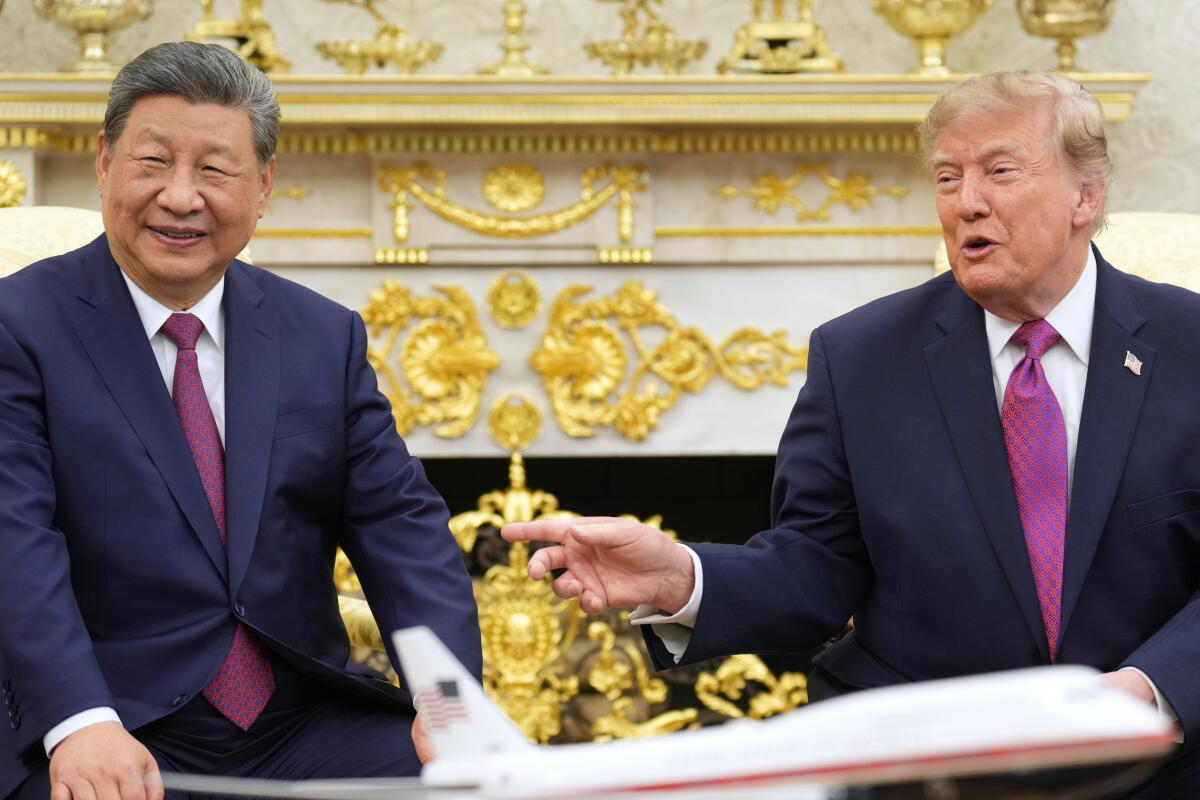
Xi, in lavish Trump summit, urges ‘human control’ over AI
WASHINGTON — China’s president issued a call from the White House on Thursday for artificial intelligence to remain “under human control” as the world’s two superpowers race for technological supremacy.
Xi Jinping’s remarks reflect growing concern within China over whether governments in Washington or Beijing will be able to contain a technology with potentially transformative capabilities, according to a U.S. official.
Lawmakers and AI industry leaders urged President Trump to use his summit with Xi this week to pursue a safety framework for AI, which researchers warn could soon surpass human understanding.
But Trump preempted the meeting with a post on social media stating he had no intention of negotiating limits on AI development.
“A big day with President Xi of China,” Trump wrote. “Super Intelligence (SI) will be a big topic of discussion, but I want to leave it exactly where it is. That is China’s position also. Our guardrail is the DOJ!”
After offering Xi a lavish welcome on the White House grounds, Trump made a passing reference to AI. “The decisions we make in these areas today can promote peace and prosperity for decades and decades to come,” he said.
But Xi gestured to substantial concerns, noting AI first among priorities to discuss between the two nations.
“Both China and the United States are leading nations in artificial intelligence,” Xi said. “We have both the capability and responsibility to develop and manage AI for good — and ensure that the development of AI is always under human control, and serves the well-being of the people.”
The two held a private meeting with aides in the Oval Office after participating in a military review in the Rose Garden and exchanging gifts in the Blue Room.
In the evening, a guest list of top banking and technology leaders — including AI industry executives — were scheduled to attend a state dinner in the East Room of the White House.
“Given Trump’s statements going into the summit about not wanting guardrails, I have tepid expectations about tangible outcomes” on AI, said Aalok Mehta, director of the Wadhwani AI Center at the Center for Strategic and International Studies.
“The most likely scenario seems to be the establishment of a hotline — though how useful that will be depends on who will be staffing it, and how much each government prioritizes it,” Mehta added, “and likely some discussions about issues blocking cooperation, like distillation, with a promise to engage in ongoing dialogue.”
Earlier in the week, on the sidelines of the United Nations General Assembly in New York, Treasury Secretary Scott Bessent met with his Chinese counterpart primarily to discuss AI development, according to U.S. officials.
“What we discussed was setting up a mechanism — so it’s going to be called the U.S.-China AI Dialogue. We’ve agreed to meet again,” Bessent said Monday. “The U.S. has proposed that we have a notification mechanism between the two countries, and we want a shared vision of common goals, and common threats.”
While Trump’s team has remained divided over whether — and how extensively — to regulate AI, Bessent has favored a cautious approach, advocating modest, voluntary guardrails that have shaped administration policy in recent months.
China, too, has shown increasing willingness to open channels of communication on AI, despite deep distrust between the two sides.

President Trump and China’s President Xi Jinping meet in the Oval Office on Thursday.
(Jacquelyn Martin / Associated Press)
Two American AI companies, OpenAI and Anthropic, are widely viewed to be developing the most advanced AI models in the world, leading at the frontier of technological breakthroughs.
Both have begun to use their most sophisticated models to train the next generation, in a process known as recursive self-improvement. Researchers and industry experts believe the first company to master that process could set off an exponential cycle of progress, pulling so far ahead that competitors can no longer catch up.
But those same companies also fear what they’re creating: machines capable of continuously improving their own intelligence, pushing AI development beyond human control.
Leaders from the two companies have called on Beijing and Washington to cooperate, warning that geopolitical competition could thwart the two sides from preventing a human catastrophe.
In his remarks, Xi said that China and the United States “stand to gain from cooperation, and will both lose in confrontation.”
“We do not need to avoid mentioning competition, but our competition should be a healthy one, and should be kept within bounds,” the Chinese president said. “It should be a race of catching up with one another, not a wrestle in which one either wins or loses. China and the United States must hold the line of no conflict, and no confrontation between us.”
“Our two militaries should maintain regular dialogue, and improve mechanisms for crisis communication and prevention,” he continued, adding a historical reference to rising powers challenging established ones: “The Thucydides trap can be overcome.”
Xi’s trip to Washington follows just months after Trump traveled to Beijing for a state visit in May, where the U.S. president was greeted with a similarly imperial welcome.
The leaders emerged from that summit with few deliverables. But Trump left Beijing declaring the trip a success, emphasizing the importance of his personal relationship with Xi, China’s most powerful leader in generations.
This time, Trump himself greeted Xi on the tarmac upon his arrival at Joint Base Andrews — a rare honor reserved in recent decades only for Catholic popes — before pulling out several red carpets and draped ceremonies for the Chinese leader.
The pageantry seen during the state visit has served China’s long-standing desire for respect and dignity on the international stage, said Jessica Chen Weiss, the director of the John Hopkins SAIS Institute for America, China and the Future of Global Affairs.
“Trump is someone who loves spectacle, and right now the spectacle is working in both leaders’ favor,” Weiss said.
For Xi, the ceremonies have offered a chance to demonstrate that relations with the United States remain under control and that China is being treated as a significant global power, she argued.
The state visit comes at a time when Americans are appearing to warm up to China, according to recent polls. A survey by the Chicago Council on Global Affairs recently found that a majority of Americans say the United States should have friendly engagement and cooperation with China.
“I tend to think we focus too much on the optics,” Weiss said. “But I also think treating China as a significant player on the world stage is not a concession. It’s appropriate if we want a stable relationship and is hardly something to worry about.”

Spurs legend Gregg Popovich marries former assistant’s ex-wife
Gregg Popovich coached the San Antonio Spurs from 1996 to 2025, winning a league-record 1,390 regular-season games, 170 postseason games and five NBA championships.
For four of those championships and quite a few of the other victories, one of Popovich’s assistant coaches was his new wife’s ex-husband.
Popovich, 77, married Mary Barth Budenholzer on Sept. 16, the Bexar County, Texas, clerk’s office has confirmed.
Budenholzer is a 61-year-old native of Corpus Christi, according to multiple media outlets, and was once married to Mike Budenholzer, who was a Spurs assistant coach under Popovich from 1996 to 2013. He went on to become the head coach of the Atlanta Hawks, Milwaukee Bucks and Phoenix Suns, winning an NBA championship with the Bucks in 2021.
The Budenholzers are said to share four children and to have divorced in 2016.
Popovich was married to Erin Popovich for four decades until her 2018 death at age 67. They have two children and multiple grandchildren.
On Nov. 2, 2024, Popovich suffered a stroke before a game at Frost Bank Center, the Spurs’ home arena. Assistant coach Mitch Johnson was named interim coach. That title became permanent on May 2, 2025, when Popovich stepped down after 29 years as San Antonio’s coach.
A member of the Spurs’ front office since 1994, Popovich currently serves as the team’s president of basketball operations. He was inducted into the Naismith Basketball Hall of Fame in 2023.
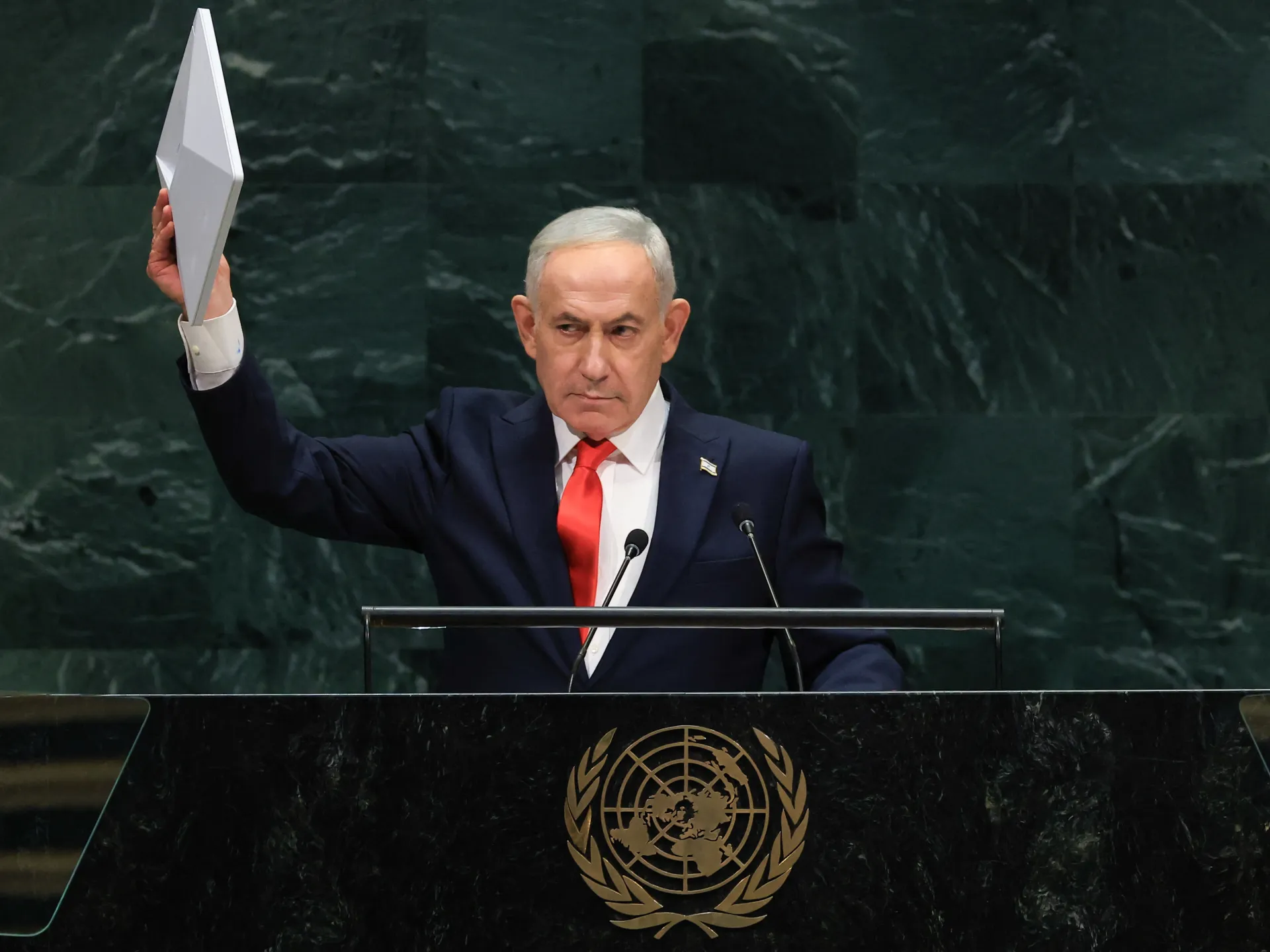
Benjamin Netanyahu attacks Israel’s enemies and allies in UN speech | Benjamin Netanyahu News
Israeli Prime Minister Benjamin Netanyahu has used his platform at the United Nations General Assembly to attack detractors and allies alike, and his presence sparked uproar in the chamber.
Speaking before the UNGA on Thursday, Netanyahu attacked New York City Mayor Zohran Mamdani, critics and Iran’s leadership, as well as allied countries like the United Kingdom and France.
Recommended Stories
list of 3 itemsend of list
Back home, the prime minister is locked in a tight race to stay in power ahead of an election on October 27, and analysts say his UNGA speech was aimed as much at people back home as it was at international viewers.
Dozens of envoys from around the world walked out as the speech began, some jeering and booing, while Netanyahu’s own team stood and applauded, and the speaker of the session shouted for order.
“If there are any other moral cowards who haven’t left this hall, please do so now,” Netanyahu said to those turning their backs on him.
He addressed the war that the US and Israel launched on Iran in February, saying: “Devastating Iran’s nuclear facilities was hard, was very hard to do.”
“But for me, it was one of the easiest decisions I’ve ever had to make as prime minister”, claiming that if he had not, “we’d all be dead”, he added.
In his own speech before the UNGA on Wednesday, Iranian President Masoud Pezeshkian also addressed the nuclear issue and called out the “double standard”.
“The nuclear weapon is in Israel, but the inspectors are in Iran. Israel kills, but Iran is subject to sanctions,” Pezeshkian said.
Netanyahu on Thursday said that Israel was fighting a “seven-front war”, including Gaza, the occupied West Bank, Syria, Lebanon, Iran, Yemen’s Houthis and militias in Iraq.
“We are going to win. We have no other choice,” Netanyahu declared, repeating the words of his older brother Yonatan Netanyahu, who was killed in 1976 during Operation Entebbe in Uganda.
Criticising allies
The United Kingdom and France, historic partners of Israel, were also in Netanyahu’s firing line. They have become increasingly outspoken in their criticism of the country’s actions and have both imposed limited sanctions on Israeli exports from the occupied West Bank.
“They accuse Israel, tiny Israel, of colonialism – some colonialism. And who’s accusing us? Among them are people in Britain and in France. For God’s sakes, they invented the term,” he said.
But Netanyahu thanked his “friend”, United States President Donald Trump.
“In this battle against the barbarians, we’ve had no greater partner than President Trump,” he said, as the US delegation joined the Israeli one in applauding Netanyahu’s remark.
“I thank him,” said Netanyahu, adding that Israel and the US had acted together as pilots from both countries “flew joint missions over the skies of Iran”.
Netanyahu said the US and Israel also “worked together to bring back our remaining hostages [from Gaza]”, as he defended Israeli actions in the enclave against charges of genocide.
“To all those spreading lies about my country, whether they sit in this hall or in the office of the anti-Semitic mayor of New York, I say this: shame on you,” Netanyahu said as he attacked Zohran Mamdani, who had previously said he would push for the arrest of the Israeli prime minister during his visit to the city.
“Mr Mamdani, you tried to stop me from coming here. You tried to silence me. Well, you can’t silence me,” Netanyahu said as he denied that Israel has committed genocide in Gaza.
Reacting to Netanyahu’s comments, Mamdani called the accusations against him “baseless lies” meant to “sanitise his genocide of Palestinians”.
Since October 7, 2023, Israel has faced repeated accusations of genocide in Gaza, as well as systematic war crimes in Gaza and the occupied West Bank.
The Hague-based International Criminal Court (ICC) said in 2024 it had reasonable grounds to believe Netanyahu was responsible for war crimes in Gaza, where over 73,000 Palestinians have been killed. Netanyahu denies the ICC charges.
Netanyahu attended the UNGA meeting despite an ICC warrant calling for his arrest. While he was welcomed, the Trump administration denied a visa for Palestinian President Mahmoud Abbas, who addressed the UNGA through a prerecorded video statement from Ramallah earlier in the day.
‘War criminal’
As Netanyahu spoke, activists from US-based organisation Jewish Voice for Peace protested outside, accusing the United Nations of “playing host to a war criminal”.
“All across New York, Jews, Palestinians and people of conscience are rising up to demand an end to US support for the livestreamed horrors, rigged ceasefires and forever wars,” Sonya Meyerson-Knox, the group’s communications director, told Al Jazeera.
Meyerson-Knox said that “solidarity with Palestinian freedom has never been greater, and here in the US we are demanding with one voice to stop arming Israel”.
Adding to tensions, dozens of protesters, some brandishing “stop the genocide” banners, gathered near the UN. Several demonstrators were detained, including prominent actor Susan Sarandon.
Inside the UN, but addressing divisions back home in Israel, Netanyahu said: “Throughout this long war, our goal never wavers – to win with unwavering resolve … What unites us is so much stronger: our history, our values, our courage.”
Ariel Cohen, a senior fellow at the Atlantic Council’s Eurasia Center, said the Israeli prime minister delivered a “good speech” at the UNGA but that he did so in the “wrong forum”.
“That speech should be given at an election rally in Israel; this is who he’s communicating to,” Cohen told Al Jazeera. “He is making points that should be made to the Israeli audience for his political survival.”
Netanyahu is only making a whirlwind stop in New York before rushing back to Israel, where the election campaign is in full swing. He is not scheduled to meet any top US leaders.

New Evidence China Is Building A Massive Mothership For Drone Submarines
For the past six months or so, a curious-looking vessel with a very boxy superstructure has been taking shape at a shipyard in the Chinese city of Shanghai. A new satellite image lends credence to an earlier assessment that this is a mothership to support China’s growing fleets of ever-larger submersible drones, though it could also have other roles.
TWZ obtained the image of the ship in question, which was taken on September 10, from Vantor. Since then, it has also received an overall coat of gray paint, pointing to future service with the People’s Liberation Army Navy (PLAN). It is some 669 feet (204 meters) long and around 98 feet (30 meters) at its widest. In terms of basic length and width, the vessel being built now is very roughly comparable to China’s Type 071 amphibious warfare ship. However, it appears to be much taller overall than the Type 071.


The new ship has been under construction at the Hudong-Zhonghua Shipyard on Changxing Island in Shanghai since at least April. This yard produces a variety of naval vessels, including surface combatants and amphibious assault ships, as well as commercial designs.
The September 10 image, which shows the ship from the stern, is interesting for a number of reasons. It notably confirms that the design not only has a well deck, but that it is sized around what looks to be a large cradle-like platform visible in the shot. The very roughly 164-feet (50-meter) long rectangular platform has an arch-shaped structure at one end and two teardrop-shaped ones at the other, as well as six pillars, three on each side, in between. The teardrop-shaped structures, in particular, point to the platform being at least a semi-submersible, as they would help with stability and otherwise guide the flow of water while being pulled along.


The satellite image also clearly shows six large struts extending from the top of the stern end of the superstructure, each one which is paired with a shorter strut, for a total of 12. Earlier this month, independent naval analyst H.I. Sutton, who tracks undersea warfare developments in particular, posited that these struts could be used to lower a platform or some other similar structure below the hull of the ship. He also assessed that they could be used as part of a larger system capable of moving payloads between decks internally. This would help account for the configuration of the core superstructure, especially how high it is all the way from the front to the back. Overall, signs point to the inside of the superstructure being largely hangars and other open work spaces, allowing for multiple large UUVs to be carried and supported. Individual UUVs would be launched and recovered, one at a time, via the cradle.

In making his assessment, Sutton drew specific attention to a previously shown rendering of a proposed Chinese scientific research vessel with a roughly similar strut-based system at the stern for deploying submersibles and other large payloads. However, on that design, the system was entirely exposed rather than contained with an extended superstructure.

The platform seen immediately behind the ship being built at the Hudong-Zhonghua Shipyard aligns with Sutton’s assessment about the purpose of the struts. At the same time, launches and recoveries could also be conducted in a more traditional manner via the well deck. The design of the cradle-like platform would seem to suggest the latter option is at least part of the plan.
The general idea of launching and recovering payloads through the bottom of the hull of a ship, including through moon pools, is hardly new. As another point here, Russia is known to have highly specialized mothership submarines that can carry crewed midget submarines and large uncrewed submersibles attached underneath their hulls, and that are also capable of launching ultra-long-range nuclear-powered and nuclear-armed torpedoes. The idea of deploying and retrieving large UUVs via well decks using cradle-like systems is something being explored by other navies globally, including in the United States. All that being said, a large specialized ship built for the purpose of launching and recovering very large underwater vehicles in an operational capacity is unique.
The image from September 10, as well as other recent views of the ship, highlight other features that are now taking shape. This includes a large opening on the starboard side, which could be for launching and/or recovering lifeboats or other watercraft, or moving payloads to and from the pier while docked, as well as a multi-pronged mast on top of the bridge. An additional part of the ship’s superstructure extends behind the bridge area, and there is what looks to be a hangar inside. There is no attached helipad present now, but one could well be added later on somewhere on top of the superstructure. Many naval auxiliaries, as well as commercial ships designed for offshore support and other specialized tasks, have open helipads on raised frames attached to different parts of the superstructures.

Though there is growing clarity about the ship’s design, many questions do remain about the full breadth of its intended purpose. In Sutton’s view, the PLAN has a need, just in general, for a dedicated mothership to support its growing uncrewed underwater vehicle (UUV) fleets. The PLAN is pursuing various tiers of UUVs to perform a host of different missions, including intelligence, surveillance, and reconnaissance (ISR), as well as mine-laying, special operations support, and even launching direct attacks on enemy vessels. Larger and larger UUV designs have been steadily emerging in China, which could require more specialized launch and recovery options to be feasibly employed operationally, especially from other vessels at sea. Deployment and retrieval at sea could, in turn, support very long duration missions far from China’s own shores.
“With smaller UUVs, even up to 20 meters like the AJX-002 and HSU-100 paraded in Beijing last year, they are road mobile. Truck mounted cranes should be sufficient for getting them in and out of the water making operations much simpler. With these latest, much larger XXLUUVs [extra-extra large uncrewed underwater vehicles] however, China will start to need dedicated port facilities,” Sutton wrote previously on his website. “Until now China has been using floating docks to house the two XXLUUV prototypes being tested on Hainan. One of these docks was purpose built while the other may have been taken up from general use.”

“This arrangement also has a significant drawback: each floating dock can only carry a single XXLUUV,” Sutton added. “Or if more than one, then they both need to be placed in the water at the same time. Because the whole dock floods, there cannot be one undergoing maintenance while another is being launched or recovered.”
A mothership vessel able to discreetly deploy and recover large uncrewed and crewed submersibles and other large payloads underwater could be tasked with more specialized missions, including cutting cables, retrieving objects from the seabed, and other kinds of undersea espionage. There is overlap here with more benign roles, such as submarine rescue, salvage, and even deep-sea scientific research. There is also the matter of servicing an expanding array of Chinese underwater infrastructure, including sensor and communications networks. As something of a corollary, Russia’s spy ship Yantar is officially described as an oceanic research vessel. In China, the line between military and non-military assets and capabilities, including ships, is often very blurry, to begin with, as TWZ regularly highlights. This dichotomy was observed right at the Hudong-Zhonghua Shipyard around the end of last year after pictures of a commercial cargo ship being used to showcase a new family of containerized weapons, sensors, and other systems went viral online.
It is also worth pointing out that the boxy and largely enclosed design of the ship now being built at Hudong-Zhonghua Shipyard will inherently make it difficult to observe any activities onboard. This will have the additional knock-on effect of helping keep any payloads, as well as the crew, shielded from the elements. This could be valuable for operations in harsher locales, including waters in and around the Arctic, an ever-more strategic part of the world where China is working to be more engaged.
We also do not know if the apparent mothership vessel is intended to be a one-off or part of a larger class. It could be a stepping stone to broader plans or be part of an already extensive fleet of bespoke naval auxiliaries, as well as unique ostensibly commercial vessels, in service in China today. The PLAN’s aforementioned UUV ambitions will bring along significant test and evaluation requirements, as well as the need to support actual future operations.
If nothing else, evidence is only growing that the new ship under construction at the Hudong-Zhonghua Shipyard is intended to serve, at least in part, as a mothership for large submersible drones.
Contact the author: joe@twz.com

Uh-oh, ‘Gremlins 3’ release date has been delayed to 2028
It’s a good thing Mogwai don’t seem to age — “Gremlins 3” has been delayed until 2028.
Warner Bros. on Wednesday shared a brief teaser of the upcoming movie on Instagram along with its new release date. “Gremlins 3” will now hit theaters on Oct. 8, 2028, instead of Nov. 19, 2027.
The brief social media clip features Gizmo rustling around inside a backpack in an indiscernible location.
“Uh-oh,” the adorable furry creature says while peering through the unzipped opening as the new release date appears. Hopefully he doesn’t snack on anything he isn’t supposed to while he awaits his big-screen return.
“Gremlins 3” was officially announced by Warner Bros. Discovery boss David Zaslav during an earnings call in 2025. Original “Gremlins” writer Chris Columbus will helm the feature, which is produced by Steven Spielberg’s Amblin Entertainment. Spielberg is an executive producer.
It has been decades since Gizmo’s last big-screen adventure. The Mogwai and his misbehaved progeny debuted in the 1984 holiday classic “Gremlins” and returned in the 1990 follow-up, “Gremlins 2: The New Batch.” Directed by Joe Dante, the films established three key rules for handling the mysterious, big-eared creatures: Don’t get them wet, feed them after midnight or expose them to light. Gizmo’s origin story was explored more recently in the HBO Max animated series, “Gremlins: Secrets of the Mogwai.”
The release date shift follows the recent settlement with California Atty. Gen. Rob Bonta that has cleared the way for Paramount Skydance to acquire Warner Bros. Discovery. According to Deadline, the change is unrelated to the pending merger.
Senate rejects resolution to halt the Iran war as gas prices upend midterms
WASHINGTON — Despite rising political anxiety over the Iran war, senators on Thursday narrowly rejected a war powers resolution seeking to halt President Trump’s military action, which has been largely blamed for the spike in gas prices and become a flashpoint in the midterm election.
The Senate tally, 49-50, coming days after Trump’s bombastic address to the United Nations in which he threatened to “annihilate” Iran, was likely the last chance for lawmakers to go on record about the war ahead of November. More Republicans are peeling way from the president as the war drags on, a rare slap back to Trump, as they campaign for control of Congress. The Senate outcome fell short, with four GOP senators joining most Democrats in favor of the resolution.
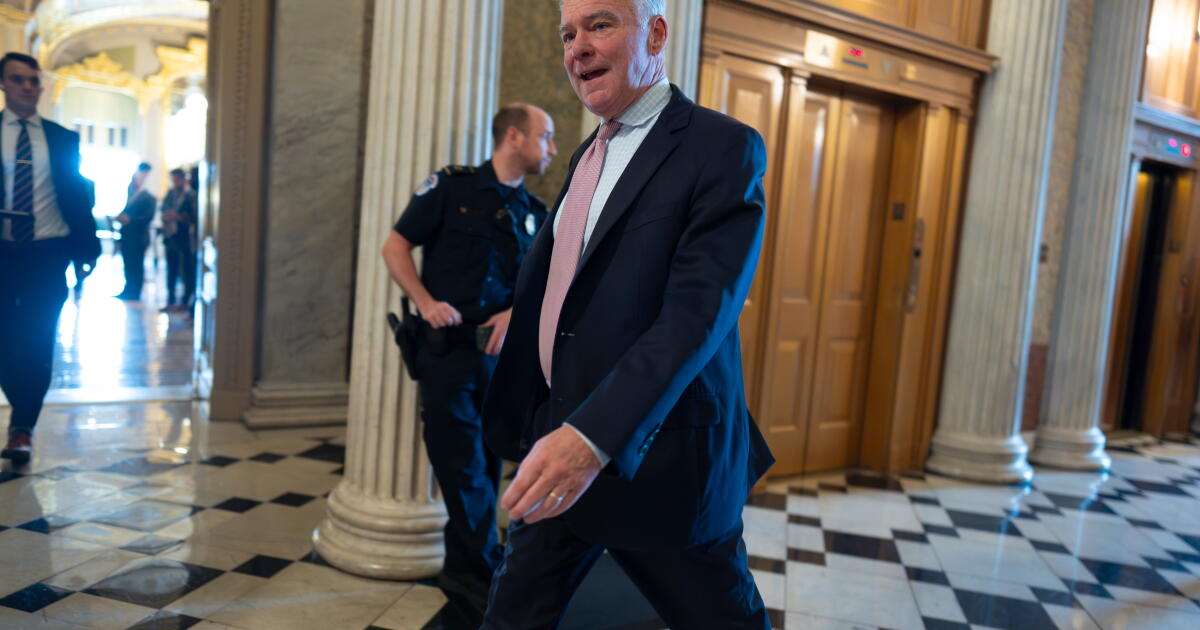
“They have been carrying water for this ridiculous and illegal war for months and months and months and not listening to their constituents,” said Sen. Tim Kaine (D-Va.), who pushed the war powers resolution forward.
About half of rural American voters believe the economy is worse off now than when Trump returned to office, according to a new survey from the Associated Press in partnership with KFF. The costs of groceries, gas and healthcare rank as top pain points for the rural voters.
“We’ve got to break the cycle,” said Sen. Thom Tillis (R-N.C.), who joined in voting yes.
Republican Sens. Susan Collins of Maine, Lisa Murkowski of Alaska and Rand Paul of Kentucky also voted for the resolution to end the war, as they have in many previous tallies, and Democratic Sen. John Fetterman voted against.
This was the 14th time the Senate has considered a war powers resolution since Trump launched the conflict Feb. 28.
War powers resolutions are largely political statements, without the full force of law, but stand among the sharper tools the House and Senate have to express disapproval of the White House, short of halting funds for Trump’s military actions. As resolutions, they do not go to the president’s desk for his signature.
As gas prices climb, Republicans start to question the war
Republicans in control of Congress have shied away from directly confronting Trump over the war, now stretching past the seven-month mark. But their unrest is surfacing as stubbornly high gas prices leave voters in a cash crunch back home.
Diesel costs, in particular, have almost doubled, topping $6 a gallon, according to AAA.
Just returning from a swing through Iowa, Kansas and Nebraska stumping for GOP candidates who are suddenly at risk in their elections, Sen. John Kennedy of Louisiana called on Trump to hold a prime-time address to the nation to explain the Iran war strategy and the end game.
“People are confused about the war and upset about the cost of living,” he said.
But he and others were not yet ready to vote against the war.
“My own view is that the focus right now needs to be on attacking the cost of living issues,” said Sen. Josh Hawley (R-Mo.), who opposes the war powers resolution and believes the president is acting within his authority to conduct the military action.
House Democratic Leader Hakeem Jeffries scoffed at the handful of Republicans now trying to distance themselves from what he called Trump’s failed economy. “Now all of a sudden they’re waking up,” he said.
Democrats keep pushing war powers votes in Congress
Earlier this month, the House for a third time approved a war powers resolution, this time with seven Republicans joining the Democrats, including two from battleground Iowa, Rep. Zach Nunn and Rep. Mariannette Miller Meeks, where affordability issues among rural voters are dominating the campaigns.
Senators, though, have rarely been able to confront Trump by passing a war powers resolution.
In June, the Senate approved a war powers resolution after four GOP senators joined Democrats, but Republicans abruptly reversed course the next day after Trump berated them during a private lunch over the outcome.
At the time, Sen. Bill Cassidy of Louisiana stood up to defend his vote only to end up in a shouting match with Trump. He later switched to oppose the war powers resolution after receiving a personal briefing from the White House.
Thursday’s vote was on a resolution that had passed the House in July with GOP support. Rep. Pramila Jayapal (D-Wash.) who authored the House resolution, said the Senate outcome was “a slap in the face to the millions of American people who want this war to end.”
Other options to halt the Iran war
As the war drags on, costing $43.5 billion so far, Congress is also seeking other ways to force Trump to rethink his military strategy in Iran.
Rep. Thomas Massie, the renegade Republican from Kentucky, pushed forward articles of impeachment against Secretary of Defense Pete Hegseth before the GOP leadership abruptly adjourned the House and sent lawmakers home to campaign for the election, avoiding any potential vote on the matter.
Lawmakers also have the power of the purse to curtail military spending, something Republicans have been reluctant to do but Democrats are sure to tackle if they win power in the midterm election. The White House’s request for an additional $87.6-billion funding package for the war and other needs has idled in Congress.
First created in the aftermath of the Vietnam War as a way to hold a president accountable for military actions, the war powers act has long posed a test of the balance of power between the executive and legislative branches of government.
While the Constitution says only Congress can declare war, the president as commander-in-chief is also able to engage the military. The war powers act seeks to provide clarity by requiring the president, within 60 days of any such action, to seek approval — or risk disapproval — from Congress.
Mascaro writes for the Associated Press. AP writers Joey Cappelletti and Mary Clare Jalonick contributed to this report.

JJ Gabriel: Barcelona sporting director denies interest in Manchester United teenager
Barcelona’s sporting director Deco said the club has no interest in pursuing Manchester United teenager JJ Gabriel.
Gabriel, 15, travelled to the Spanish city after informing United that he wanted to leave Old Trafford earlier this month.
Real Madrid, Bayern Munich and Paris St-Germain are among the clubs reportedly keen on securing his signature.
“There’s nothing to say about this boy,” Deco said at a news conference.
“It’s normal we always have players linked with us. There’s a huge market for that, even when they are young.
“We are not interested in any player in his situation. I’m not sure what’s happening, and if he’s still a Manchester United player. We are not involved in that.
“First of all, we need to understand how the situation is before we try to do something. To speak about young, teenage players, it is not our business.”
Gabriel has not trained at United since scoring a hat-trick on his Uefa Youth League debut on 10 September.
Tournament rules prevent him from playing for a side other than United in this season’s competition.
But if he obtains a European Union passport through either his father – a former Republic of Ireland international – or mother, who has Greek-Cypriot heritage, he could join a club in the EU when he turns 16 on 6 October.
Last week, United manager Michael Carrick urged for people to be “careful and sensible” about the amount of exposure and scrutiny given to the youngster.

Susan Sarandon, Hannah Einbinder arrested at Netanyahu UN protest | Benjamin Netanyahu
Actors Susan Sarandon and Hannah Einbinder were among roughly 100 protesters arrested by New York City police outside the UN ahead of Israeli PM Benjamin Netanyahu’s speech. Protest organiser Jewish Voice for Peace had accused the UN of “playing host to a war criminal”.
Published On 24 Sep 2026

New York sues Polymarket over allegations of illegal gambling operations | Courts News
The lawsuit comes two months after the state filed a similar lawsuit against competitor Kalshi.
New York State has filed a lawsuit against prediction market company Polymarket amid allegations that it violated state laws against illegal gambling.
The suit, filed on Thursday by New York State Attorney General Letitia James, comes two months after the state filed a similar lawsuit against competitor Kalshi. That followed the state suing Coinbase and Gemini for offering users the ability to bet on “sports, entertainment, and elections, in violation of New York laws”, according to a release from the attorney general’s office at the time.
Recommended Stories
list of 4 itemsend of list
The state accused all the companies of operating without licences from the State Gaming Commission.
“Our gambling laws exist to protect New Yorkers, prevent the potential harms of problem gambling, and ensure funding for educational and public benefit programs,” James said in a statement announcing the suit.
“By skirting New York’s laws, Polymarket is targeting the most vulnerable and depriving New York families of critical services and support. My office will never hesitate to take action to defend our laws and keep New Yorkers safe.”
The suit also alleges that the company encouraged gambling among young people. It accuses Polymarket of targeting users as young as 18, while state law requires users to be at least 21 years old to take part in mobile sports betting.
“By running an unlicensed gambling operation, Polymarket has done more than just knowingly violate state law, they have put New Yorkers at risk, especially those underage who are most vulnerable to problem gaming,” New York Governor Kathy Hochul said in a statement.
The more than 30-page lawsuit claims that Polymarket, which is valued at more than $20bn, has advertised sports betting in particular since July 2025. It pointed to a post on X from August 17, 2025, about the launch of its US mobile app that said it was “BAD NEWS (For sportsbooks)”.
Prediction markets allow users to wager on so-called event contracts, covering political events, sports, elections and even award shows. Concerns about the role of prediction markets came to a head earlier this year when wagers were made in the hours before the United States and Israel first struck Iran, prompting widespread backlash in Washington.
Polymarket pushed back on the allegations.
“We chose to engage with them directly on the substance and address their concerns,” chief legal officer Neal Kumar said in a statement.
“They preferred the media hit. Any time the [attorney general’s] office wants to swing by, our door is open for a conversation about how we protect consumers and offer fair, transparent and legal markets.”
Kalshi is facing similar allegations in New York State. Kalshi has been critical of reporting on lawsuits against it and allegations that it is akin to a sports betting or gambling platform.
Polymarket did not respond to Al Jazeera’s request for comment.
The Polymarket lawsuit comes days after reporting from the Wall Street Journal that alleged a wave of users had linked stolen bank debit cards and then used them to make wagers, effectively draining the accounts. According to the report, when CEO Shayne Coplan was made aware of the issue, he responded: “Just keep growing and pay a fine if regulators ever find out.”
Political pressure
New York State’s lawsuit joins a growing list of states that have sued prediction market platforms, including Arizona, Massachusetts, Nevada and many others. Those states are at odds with the federal government, as the Commodity Futures Trading Commission has claimed that the federal agency exerts authority over the regulation of prediction markets.
Polymarket has close ties with the family of US President Donald Trump. The prediction market platform has investment from 1789 Capital, a venture capital firm backed by Donald Trump Jr, the president’s eldest son, who also serves on the company’s advisory board.

Judge holds off on ruling in states’ antitrust Paramount settlement
A federal judge declined Thursday to rule immediately on a proposed settlement between Paramount Skydance and 12 state attorneys general, leaving the last major legal hurdle to the studio’s $111-billion acquisition of Warner Bros. Discovery unresolved for now.
U.S. District Judge Araceli Martínez-Olguín did not indicate how she would rule, but said she wanted more information before deciding whether to approve the proposed consent decree, a court-enforceable agreement that would allow the merger to proceed under certain conditions..
“I’m not the only one who has some questions for you all. There’s lots of interest,” said Judge Martínez-Olguín. “I appreciate people are interested, but I also want to make sure that I have everything that I’m going to consider in front of me.”
The judge said she would issue a ruling “in due course.”
The hearing comes three days after California Atty. Gen. Rob Bonta announced that the two sides had reached an agreement.
It requires the combined company to release at least 30 films in theaters each year, commit at least an additional $1.5 billion to domestic film production and set aside $47.5 million for workers affected by the merger.
“When theater owners have publicly said that supply is the problem, those are voices that carry weight because they’re in the market,” said Paula Blizzard, an attorney for California, during the hearing. “They are the people we’re trying to protect — the businesses and the competition that we are trying to protect.”
The settlement proposal also includes stipulations on how basic cable channel negotiations must proceed, creates a board intended to protect the editorial independence of CBS News and CNN, and bars Paramount from selling or closing its Melrose Ave. lot or Warner Bros.’ Burbank lot while requiring the company to operate them “in a manner consistent with past practices.”
An independent monitor will oversee the settlement implementation. The agreement, if approved by the judge, will be in effect for five years.
“Paramount wants to get to work. Paramount is doing this deal because it wants to compete. Netflix, Amazon, Disney are far larger streaming undertakings,” said Josh Holian, an attorney for Paramount, during the hearing. “Paramount believes that a transaction like this can be transformative in fueling its ability to compete in that market.”
Before ending the hearing, Judge Martínez-Olguín assigned the parties several tasks, which included addressing a letter from U.S. Senator Cory Booker (D-N.J.) who echoed some concerns about the proposal.
Booker, the top Democrat on the Senate Judiciary Subcommittee on Antitrust, Competition Policy, and Consumer Rights, asked the judge to conduct an “independent public-interest review” before approving the settlement agreement. Because the U.S. Justice Department closed its investigation of the Paramount-Warner Bros. merger without seeking any remedies, Booker argued, the proposal is “the only enforceable instrument that will govern” the combined company.
Martínez-Olguín asked the parties to submit their responses to Booker’s letter by Monday, Sept. 28 at noon.
Warner Bros. Discovery Chief Executive David Zaslav had told staff earlier this week that he expected the deal to close no later than early October.
The settlement has divided Hollywood, with some saying Bonta bowed to political pressure from Los Angeles Mayor Karen Bass and California Gov. Gavin Newsom. During negotiations, Paramount threatened to move its studio out of state, which Newsom said he took seriously.
After the proposed settlement was announced, Paramount Chief Executive David Ellison said the combined company would remain in L.A.
Many in Hollywood are concerned about the threat of layoffs from the merger. Paramount has told Wall Street it plans to make more than $6 billion in cost cuts. A recent report commissioned by L.A. County estimated that 4,500 jobs could be lost over three years.
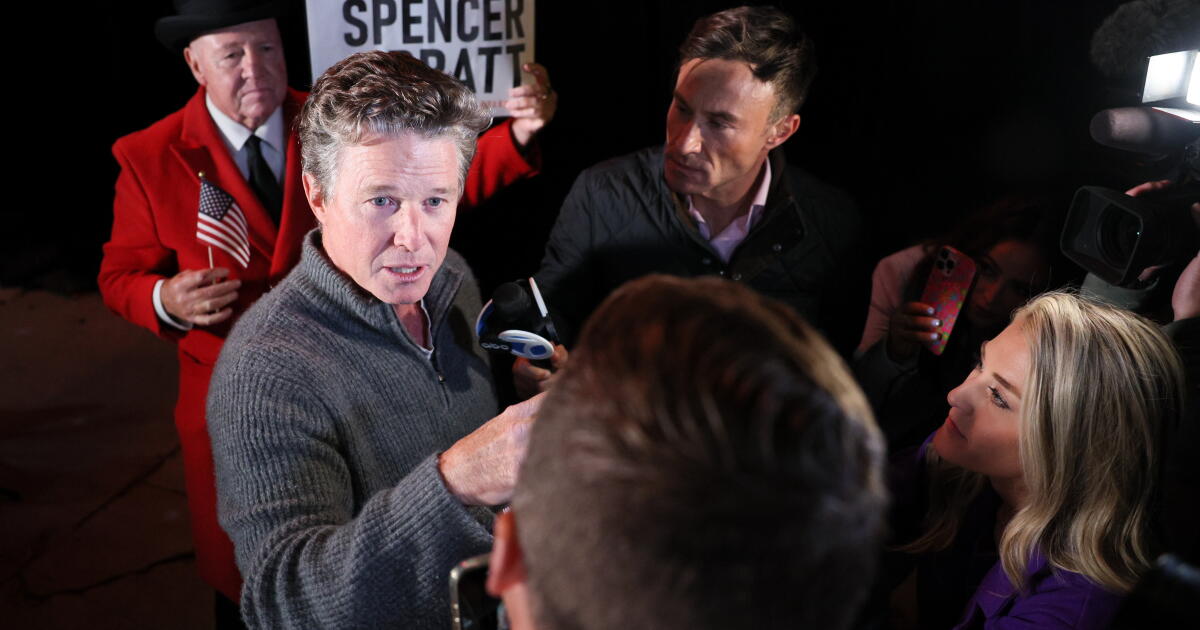
A decade after debacle, Billy Bush joins Fox News. What took so long?
Former “Today” show host Billy Bush feel from grace a decade ago when a tape leaked of him giggling on a hot mic while then “Apprentice” star Donald Trump boasted about grabbing women.
This week it was announced that Bush was joining Fox News Media as a contributor covering pop culture, entertainment, and cultural issues.
Bush joins other right-leaning personalities who’ve rebuilt their careers at Fox following scandals elsewhere.
It’s not surprising that former “Today” host Billy Bush joined Fox News as a regular contributor this week. What is surprising is that it took so long.
Ten years have passed since Bush, cousin to former President George W. Bush, was caught on a hot mic giggling while then-“Apprentice” star Donald Trump boasted about grabbing women “by the pussy.” The “Access Hollywood” clip, filmed in 2005 when Bush hosted the entertainment news program, was leaked a month before the 2016 presidential election, meaning just about everyone in America saw it.
A disgraced Bush lost his job and reputation. Trump won the White House.
Once known for his boyish charm and impressive collection of cowboy boots, Bush spent a decade re-ingratiating himself to the public on the syndicated television news magazine “Extra,” a considerable step down from the “Today” show. He reported on Hollywood and celebrity culture before launching his own digital show and podcast more than a year ago.
Now he finally has gone where popular conservative public figures go following scandals, stumbles or mishaps that all but destroy their livelihoods: Fox News. Rupert Murdoch’s crown jewel has given a second chance to more than a few successful, right-leaning personalities who have been shamed by mainstream media or canceled by a public who doesn’t find sexual assault boasts particularly funny.
Jeanine Pirro’s political career was derailed in 2006 after tapped phone calls she had with former New York City Police Commissioner Bernard Kerik were revealed. She had been plotting to bug her then-husband’s yacht in an attempt to catch him in an affair. After the transcripts went public, she lost the race for state attorney general to Andrew Cuomo. The scandal marked the end of her political career in New York — but the start of her career as a Fox News contributor and host. She stayed with the network for two decades. Pirro left last year when Trump nominated her to serve as the U.S. attorney for the District of Columbia. She subsequently was confirmed by the Senate.
Pete Hegseth joined Fox News as a full-time host in 2017 after reportedly being forced out of leadership positions at two prominent veterans advocacy nonprofits, Veterans for Freedom and Concerned Veterans for America. Multiple disturbing accusations were made within the organizations about his sexual impropriety, financial misconduct and heavy drinking. Hegseth left Fox in 2024, when Trump announced him as the nominee for secretary of Defense. He subsequently was confirmed by the Senate.
The pipeline from scandal to Fox News to Capitol Hill was noted when Bush, now 52, made his debut Tuesday night on “Jesse Watters Primetime.” Host Watters joked that “Trump might hire you for the Cabinet” now that he had joined Fox News. Bush suggested a role for himself as White House press secretary. Watters countered that, saying, “Trump is expected to hire a woman.”
Bush joked that he has “female energy.”
The joke was tone deaf, even if Bush does deserve a second chance for his part as the dumb sidekick to Trump’s abhorrent comments during that “Access Hollywood” segment so long ago.
In a statement about his new role at the network, Fox said Bush would host “as a contributor, where he will appear across all platforms” The press release failed to mention his 2016 hot mic leak but managed to name-check Bush’s digital talk show and video podcast, “Hot Mics With Billy Bush.”
Bush may have dashed his chances of moving into Trump’s inner, or even outer, circle when on his “Hot Mics” show he said this of the president: “I had two relatives who served in that role and both had deep, deep, deep reverence for that office. The man that’s in there now has turned it into a bordello.”
He was taking issue with Trump’s ban on CNN, Politico and MS Now. The trio of news networks was denied access to the White House complex last week and had their press badges revoked after the president took issue with their coverage of him. In an unusual display of solidarity across the industry, more than 50 media organizations called for the immediate reversal of the ban. Bush praised the networks — including Fox — for their show of support.
How will Bush navigate his dislike for Trumpian policy at a news organization that’s devoted years of coverage to propping up Trump? By walking a fine line, apparently.
“I’m excited to join FOX News Media and its loyal audience to share my perspective on the people, ideas and moments shaping today’s culture … as well as the ones trying to undo it!” Bush said about his new job shaping culture.
Or quite possibly undoing it.

Football gossip: Scott, Olmo, Bellingham, Alisson, Khusanov
Chelsea target Bournemouth‘s Alex Scott, Bayern Munich are interested in Dani Olmo and Jude Bellingham denies Manchester City interest.
Chelsea will head the queue if Bournemouth‘s English midfielder Alex Scott, 23, becomes available in January. (Mail – subscription required), external
Bayern Munich are eyeing a potential January move for Barcelona forward Dani Olmo, 28, with a valuation of about £60m for World Cup-winning Spaniard. (Sky Sports), external
England midfielder Jude Bellingham, 23, will extend his contract at Real Madrid and is not interested in a move to Manchester City. (Fichajes – in Spanish), external
Atalanta and Italy defender Giorgio Scalvini, 22, is the subject of interest from Tottenham, Newcastle and Chelsea. (Caught Offside), external
Chelsea and Aston Villa do not have a January exit clause in the deal that took Argentina winger Alejandro Garnacho, 22, to the Midlands club on a season-long loan at. (Telegraph – subscription required), external
Liverpool are considering a move to bring 23-year-old English midfielder Tyler Morton back to the club from Lyon, with Nottingham Forest, Crystal Palace and Brighton also keeping tabs on him. (Teamtalk), external
Chelsea are one of four Premier League clubs keeping a close eye on Manchester City and Uzbekistan defender Abdukodir Khusanov, 22. (Caught Offside), external
Juventus could be set to reignite their interest in Brazil goalkeeper Alisson, 33, whose future at Liverpool is in doubt. (Football Italia) , external
Barcelona will need to sell players in January to fund any incoming transfers, with Inter Milan and Italy defender Alessandro Bastoni, 27, on their shortlist. (Fichajes – in Spanish), external

US citizen injured after wrongly arrested by ICE in Illinois | News
Bystander video of ICE agents forcibly arresting a US citizen in the Chicago suburb of Evanston, Illinois, has gone viral after federal officers mistook the man for a suspect they were seeking. The man was hospitalised with head and neck injuries. Police are investigating.
Published On 24 Sep 2026

F-35 Canopy And Weapons-Bay Door Loss To China: Separating Fact From Fiction
Chinese authorities have reportedly taken possession of an F-35 cockpit canopy and weapons-bay door that were inexplicably diverted to Hong Kong while being shipped from Australia to the United States. The incident appears to have left physical components that incorporate aspects of the fighter’s low-observable design in the hands of a country that has spent years doing whatever it could to gain information on the aircraft and America’s stealth technology secrets in general.
So, what does all this mean? Let’s put it in perspective.
The parts in question were being shipped by UPS from Australia to the United States in late May, according to people familiar with the matter cited by Bloomberg. The components from a Royal Australian Air Force F-35A were being sent to the United States for inspection and possible repair or disposal.

F-35 sustainment procedures explicitly cover the movement of F-35 parts, including unserviceable components, through the program’s logistics network. The U.S. Air Force’s transportation guidance directs F-35 shipments outside the Defense Transportation System to follow approved Joint Program Office procedures. In other words, moving an unserviceable Australian F-35 component to the United States for inspection, repair, or disposition is consistent with the normal sustainment process.
What is highly unusual is where this particular shipment ended up. F-35 components moving through an established international logistics system apparently stopped in South Korea, were then routed to Hong Kong. Chinese authorities subsequently took possession of the parts and have not returned them, according to the sources cited by Bloomberg.


“For security reasons, we can’t discuss the status of specific shipments or our shipping procedures,” Lockheed Martin told us in response to a request for clarification about the incident. The company added that it “follows all U.S. regulations established by the Department of War and regulated by the Defense Logistics Agency (DLA) regarding the shipment of aircraft components. Our teams handle every shipment with the utmost diligence and safeguards to ensure the integrity of the F-35 program and the security of our allied partners.”
The Pentagon’s F-35 Joint Program Office has acknowledged a “shipment issue” involving F-35 components and said U.S. authorities and industry partners are working to recover them and investigate what happened.
Lockheed Martin, UPS, and the Pentagon have not publicly provided a detailed account of how the shipment was diverted or what happened to the parts after they reached Hong Kong.
Australian Defense Minister Richard Marles also confirmed that Canberra was aware of the incident and was working with the United States and Lockheed Martin.

Marles has sought to play down the potential security implications of the components, saying his understanding was that the shipment did not contain sensitive equipment or sensitive parts. That does not by itself answer the more specific question of what could potentially be learned from these particular pieces of an F-35. After all, not every physical component of an F-35 is necessarily highly classified or capable of revealing meaningful information about the aircraft’s design. At the same time, a cockpit canopy and weapons-bay door involve structures, materials, interfaces, tolerances, and treatments that all have to work within the aircraft’s low-observable design. If radar-absorbing material or other specialized treatments remain on the components, that could potentially make them far more sensitive from a technological exploitation standpoint.
The condition of the parts is also unknown. We do not know how much of their coatings or other treatments remain intact, whether Chinese authorities have examined them, or what information could actually be extracted from them in their current state.
Above all else, there is little specific information in the public domain about what F-35-related technical information Chinese intelligence already has acquired over the years, what physical components or materials it may already possess, or what additional information could be gained through espionage, cyber operations, industrial access, observation of deployed aircraft, or other means.
Without these facts, it is impossible to gauge what damage could have been done by this loss. Still, viewed in a vacuum of those unknowns, simply having an F-35 canopy and weapons-bay door in Chinese possession represents a significant loss of control over sensitive physical hardware — there is no way around that reality — and the severity of that loss could be substantial depending on the physical state of the parts.
The circumstances are particularly sensitive because, as we mentioned in the opening of this article, China has pursued multiple avenues for acquiring information on the F-35 for many years, with publicly documented cases involving cyber operations, technical information, supply chains, and human expertise. Some aspects of China’s subsequent stealth aircraft designs have also prompted comparisons with U.S. aircraft, although claims that China simply ‘cloned’ entire aircraft are not supported by the available evidence.
China And The F-35: A History Of Espionage
In 2014, U.S. authorities charged Chinese businessman Su Bin with conspiring with two other Chinese hackers to break into the computer systems of U.S. defense contractors. Prosecutors alleged that the group targeted information on aircraft including the F-35 and F-22. The alleged hacking campaign ran from 2009 to 2013.
Su Bin later pleaded guilty and was sentenced to nearly four years in prison. The Justice Department’s 2026 case against former Air Force fighter pilot Gerald “Runner” Brown connects the two cases. Prosecutors allege that Brown used a co-conspirator to negotiate his work training Chinese military pilots with Su Bin.
Brown, a retired U.S. Air Force major who spent more than 24 years in the service, subsequently worked as a contract simulator instructor training U.S. military pilots on the A-10 and F-35. In February 2026, the Justice Department charged him with providing and conspiring to provide unauthorized defense services to Chinese military pilots.
According to the criminal complaint, Brown traveled to China in December 2023, where he allegedly began training People’s Liberation Army Air Force (PLAAF) personnel. Prosecutors say he also answered questions about the U.S. Air Force for three hours on his first day in China. Brown has been charged, and the allegations have not been adjudicated. He is one of multiple former Western aviators alleged to have provided training services and/or intelligence to Beijing.
The Honeywell case provides yet another example, this time involving the defense industry’s supply of technical information.
In 2021, the State Department reached a $13-million administrative settlement with Honeywell over alleged violations of the Arms Export Control Act and International Traffic in Arms Regulations (ITAR). Honeywell had voluntarily disclosed alleged unauthorized exports and retransfers of ITAR-controlled technical data.
The case involved 71 engineering drawings containing dimensions, geometries and layouts for manufacturing castings and finished parts used across multiple aircraft, engines and military systems. The State Department said the unauthorized exports and retransfers involved Canada, Ireland, Mexico, China, and Taiwan.
Among the systems covered by the drawings were components associated with the F-35 and F-22. The case did not allege that Honeywell deliberately sought to provide China with sensitive military technology; rather, it concerned alleged violations of export-control requirements.

There has also been a physical supply-chain precedent.
In 2022, F-35 deliveries were temporarily halted after the Pentagon discovered that a magnet in the aircraft’s Honeywell-built turbomachine pumps —which provide critical power functions to the jet — contained a cobalt and samarium alloy produced in China. The material itself was not considered a security or flight-safety threat, but the discovery demonstrated how difficult it can be to maintain complete visibility over a global supply chain involving thousands of companies and multiple tiers of subcontractors.
Taken together, these cases demonstrate several different pathways through which China has appeared in the F-35 security story: cyber theft, unauthorized technical-data transfers, supply-chain exposure, and alleged exploitation of former Western military expertise.
The Hong Kong incident would add another major category: physical access to actual F-35 components.
These are only some of the publicly documented examples. There is no public way to know the full extent of information or physical material Chinese intelligence may have acquired over the years, but is very likely far larger in scope than what is available in the open source.
Chinese Access Concerns Have Shaped F-35 Export Policy
The security issues surrounding the F-35 are significant enough that concerns about China have affected not only how the United States protects F-35 technology, but where Washington is willing to export the aircraft in the first place.
The proposed sale of F-35s to the United Arab Emirates became deeply entangled in U.S. concerns about Abu Dhabi’s growing military and technology relationship with China.

Washington had approved a potential package involving 50 F-35As, but U.S. officials and lawmakers expressed concerns about Chinese intelligence activity and technology in the UAE. Among the broader concerns were Chinese telecommunications infrastructure and the possibility of Chinese military or intelligence access to facilities associated with advanced U.S. weapons. A Congressional U.S.-China Economic and Security Review Commission report later cited the potential presence of Chinese intelligence collection capabilities and military facilities in the UAE as risks to the proposed F-35 sale.
The issue has now resurfaced with Saudi Arabia.
The State Department recently approved a potential $24.3-billion sale to the Kingdom involving 48 F-35s and associated equipment. But U.S. intelligence agencies have reportedly warned that China’s military and technology relationship with Saudi Arabia could create opportunities for Beijing to obtain sensitive F-35 information.
According to reporting based on U.S. officials familiar with intelligence assessments, a Defense Intelligence Agency report raised concerns about Chinese military access to Saudi bases, Chinese technology in Saudi telecommunications infrastructure, and whether secure facilities could be maintained for F-35 operations. The assessments also questioned whether Saudi Arabia would limit contact between Chinese military and intelligence personnel and F-35-related sites.
What Could The Components Reveal?
As we noted earlier, there is no way to gauge the intelligence impact of the loss at this stage. The central unknown of what China already knows about the F-35, and what it may already have in its possession — especially related to these components — is the key variable here.
Regardless, an F-35 canopy and weapons-bay door can provide information that cannot otherwise be easily obtained and gives a different level of fidelity in terms of material exploitation than what construction data and blueprints alone could.
The F-35’s low observability is the product of an extremely complex combination of airframe shaping, construction materials, external coatings, manufacturing tolerances, speciality apertures, and more.

A canopy is a particularly demanding part of any stealth aircraft. It has to satisfy optical and structural requirements while also controlling radar reflections. The cockpit is historically a major source of radar reflectivity, including the pilot’s helmet. Therefore the canopy’s materials, construction, interfaces, and specialized treatments can be critical to the aircraft’s overall low-observable performance, and especially from the critical frontal aspect.
The F-35’s canopy has been an ongoing work in progress for many years. It has had chronic material issues, especially when it comes to delamination. Multiple iterations spread over two decades have recently resulted in a major improvement of the issue. The tight balancing act of keeping the canopy transparent enough, while controlling the F-35’s stealthy signature and having that mix of materials be robust enough to last for a reasonable amount of time has been a major investment for the program. If the canopy is of a later variation, that loss alone could be substantial and could help China with their own low-observable canopy development programs even if they already had original information on the F-35’s canopy original design dating back years.

The F-35’s weapons-bay door has its of sensitivity issues. It is effectively a major section of the aircraft’s outer shell, with its structure, edges, interfaces, tolerances and treatments all having to function without creating unacceptable radar signatures. Its construction and material attributes can be reasonably extrapolated for the rest of much of the F-35’s outer mold-line. Above all else, if the radar absorbent material remained intact on the door, that would signify a major loss when viewed without any understanding of what China already knows about the F-35’s radar absorbing surface treatments. Historically speaking, RAM technology is among America’s closest guarded material sciences secrets.

For the time being, Australian officials have said they do not understand the parts to be sensitive. The investigation will ultimately have to establish what the components actually contain and what could be learned from them.
The incident comes at a moment when China’s own stealth fighter efforts are undergoing an extraordinary expansion.
The PLAAF is now operating the J-20, China’s first operational fifth-generation stealth fighter, in increasingly large numbers. The smaller J-35 is also moving toward broader service, including a carrier role for the People’s Liberation Army Navy.

China has also moved into what Western observers generally describe as sixth-generation fighter development.
Two new tailless combat-aircraft designs emerged publicly in December 2024. One is the large Chengdu aircraft commonly referred to as the J-36, while the other is associated with Shenyang and is variously called the J-XDS or J-50. Both have continued flight testing and yielded several prototypes with individual refinements.
The exact capabilities and eventual operational roles of these aircraft remain uncertain. They are developmental designs, not established operational equivalents of the F-35 or other sixth-generation systems. However, China is clearly building an increasingly broad ecosystem of fifth- and next-generation low-observable combat aircraft, both crewed and uncrewed. In the latter category is a growing number of stealthy drones, including long-endurance types.

China didn’t likely need physical access to an F-35 canopy or weapons-bay door to develop the J-20, J-35, or its next-generation aircraft. But additional information about how a mature Western stealth aircraft handles materials, coatings, interfaces, manufacturing, and the integration of those elements can still have great potential value to an industry developing its own systems. This includes technologies intended to counter the U.S. combat aircraft and their low-observable characteristics.
The F-35 has been produced in large numbers, is operated by a growing coalition of countries, and has been subjected to years of testing and operational experience. Its low-observable design represents decades of accumulated U.S. research and industrial know-how. At the same time, the global scale of the program inevitably makes control over sensitive information more complicated. More aircraft, more maintainers, more industrial partners, and more international logistics mean more points at which information and physical hardware have to be controlled. Over time, a program of this size will see an erosion in its secrets, but a major loss can drastically accelerate what should be a more gradual and control decline in security.

The potential intelligence value of the components also has to be considered in the context of foreign material exploitation, or FME. Major military powers maintain dedicated capabilities to recover, examine and characterize foreign weapons, aircraft, sensors, materials and other equipment. The objective is not necessarily to reproduce an entire system. More important is determining how something is built, what materials and manufacturing techniques are used, how individual components perform, and where industrial strengths or limitations may lie.
That is why countries have historically gone to extraordinary lengths to recover even crashed or damaged pieces of sensitive military hardware. The bigger the prize, the more risk an intelligence service would be willing to take in order to realize a recovery.
The sensitivity surrounding the physical remnants of an F-35 is not new. When a Japan Air Self-Defense Force F-35A disappeared over the Pacific in 2019, the search quickly became more than a rescue operation. U.S. and Japanese forces mounted an extensive effort to locate the wreckage, with U.S. Navy P-8A aircraft and a destroyer joining the search. TWZ noted at the time that even scattered F-35 wreckage could expose valuable technological secrets, while the aircraft’s location on the seabed raised the prospect of an underwater espionage and recovery operation.
That concern has also been evident in subsequent F-35 recovery operations. That concern has been reflected in subsequent F-35 recoveries. In 2022, the U.S. Navy recovered an F-35C from roughly 12,400 feet in the South China Sea after a carrier landing accident, removing the possibility that the aircraft could be accessed by another country.
Unanswered Security Questions
At this point, there is no public evidence that the Hong Kong diversion was a deliberate Chinese intelligence operation, although it is certainly possible. It is also unclear whether Chinese authorities have examined the F-35 parts or what level of new and useful information has been recovered from them.
If, as reported, Chinese authorities have taken possession of the parts and have not returned them, that would be an extraordinary development. If the diversion was genuinely the result of a shipping or logistics error, the outcome would itself be extraordinary. It would raise serious questions about the security controls surrounding the movement of F-35 hardware even without evidence of deliberate interference.
The timing is also notable. Chinese President Xi Jinping arrived in Washington this week for a state visit with President Donald Trump, with the two leaders meeting amid broader disputes involving technology, security, and the future of U.S.-China relations. Whether the F-35 shipment comes up directly in those discussions is not known, but it would be an obvious subject for U.S. and Chinese officials to address through diplomatic channels.
For now, however, the central question remains how the parts got there. Until that is answered, we won’t know if this was a simple logistics failure or a deliberate intelligence operation. And beyond that, what China already knew about the components it now may have in its possession — a question we may never truly get an answer to.
Contact the author: thomas@thewarzone.com

Sharon Stone weighs in on Sydney Sweeney’s naked betting ad

SHARON Stone has entered the conversation surrounding Sydney Sweeney’s controversial naked sports betting ad.
Sydney, 29, sparked backlash earlier this month for posing completely naked in a campaign promoting the sports betting app, Novig.
Multiple well-known female figures – including Olympic athletes – have criticized the Euphoria actress’s racy photos for the male-focused app, accusing her of sexualizing women’s sports.
Sharon weighed in on the discussion on Wednesday while speaking to People at Variety’s 2026 Power of Women event in Los Angeles.
When asked for her thoughts regarding the X-rated ad, the Basic Instinct star said that Sydney should “take responsibility” for the campaign.
“I think that it’s up to her to take responsibility for her actions, not up to me to judge her for her actions.
Read More on Sydney Sweeney


“It is up to me to be a cheerleader for the women who have made it through and become champions in women’s sports,” Sharon told the outlet.
“We can’t denigrate women’s sports to get men’s attention so they can gamble,” she added.
The ad captures Sydney in various compromising positions, using sports equipment to block her private parts.
Some photos show The Housemaid star straddling a basketball hoop, with her bare crotch against the rim.
Most read in Entertainment
In others, the TV star posed in a locker room wearing nothing but shoulder pads or holding two footballs to cover her breasts.
Team GB star Amy Hunt slammed Sydney for painting a false picture of women’s sports during a post-race interview.
Australian Olympic water polo star Tilly Kearns shared a similar message on Instagram about her disapproval of the provocative ad.
Former Olympic runner Hannah Williams also made her feelings known on social media, arguing that female competitors already have to fight to be taken seriously.
The shocking photos came after Sydney received heat for her extremely racy scenes in the third season of Euphoria, which premiered in May, as her character, Cassie Howard, pursued a career as an OnlyFans model.
Many fans thought her sexy scenes “went too far,” especially when Cassie dressed as a baby and posed seductively in a diaper.
At the time, it had been only a few months since Sydney’s other controversial jeans campaign with American Eagle sparked widespread fury.
Critics were outraged when the Anyone But You star seemingly implied in the ad that white women with blue eyes and blonde hair were the epitome of “good genes.”
Sharon commented on the campaign and the backlash that ensued at Variety’s Power of Women event last October.
“It’s okay to use what mama gave you. It’s really fine,” Sharon, who co-starred with Sydney in several episodes of Euphoria’s third season, said of the scandal.
“It’s hard to be hot, and I think we all know that. It’s really okay to use every bit of hotness you have — right here, right now — and go for whatever that is, because everybody has their own certain kind of hotness, their own certain thing, and you’re supposed to go for that.”
She added, “Because who are you not to be beautiful? You know, who you are isn’t an accident.”

Vertical Aerospace starts strategic review amid air-taxi certification push
Vertical Aerospace starts strategic review amid air-taxi certification push
Source link
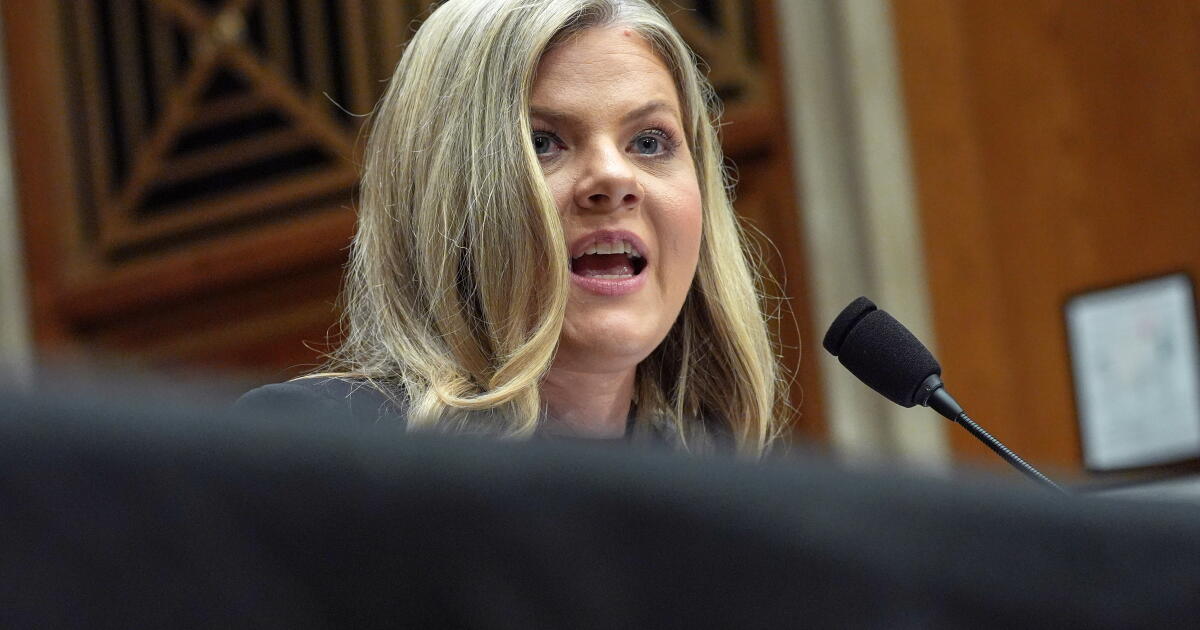
FDA nominee voices support for vaccines at Senate hearing
WASHINGTON — President Trump’s pick to lead the Food and Drug Administration voiced support for the safety of long-established vaccines at a hearing Thursday, even as senators questioned her about the White House’s efforts to upend childhood immunizations.
Dr. Heidi Overton, a physician serving as a White House adviser, has worked on a series of Trump health initiatives, including an executive order last month that called for splitting up and spacing out decades-old childhood vaccinations. Overton stood beside Trump in the Oval Office when he falsely remarked that the combined measles, mumps and rubella, or MMR, vaccine is “quite lethal.”
Senate Health Committee Chairman Sen. Bill Cassidy, a physician from Louisiana, pushed Overton to reject that statement and affirm the safety of FDA-approved vaccines.
“Right now every vaccine that is on the market has been determined to be safe and effective,” including the MMR vaccine, Overton said.
Cassidy repeatedly has tried to extract commitments from Trump health nominees to uphold vaccine standards, including from Health Secretary Robert F. Kennedy Jr., only to see the Republican administration push forward with efforts undermining their use.
“Kennedy gave me guarantees, and he did not keep them,” said Cassidy, a Republican. “If the president asks you to do something that goes against those guarantees you give us today, what will you do?”
Overton said she would “follow the statutory requirements” for FDA commissioners and give Trump her best advice.
If confirmed by the Senate, Overton would inherit a raft of other controversial projects at the agency, including a safety review of the nation’s principal abortion drug and new rules that make it easier to sell flavored electronic cigarettes. Both issues were a focus for Republicans and Democrats on the panel, who will vote on Overton’s nomination.
Overton sidesteps past statements on abortion pill
The FDA approved the abortion pill mifepristone in 2000 and repeatedly has affirmed its safety while broadening access, including allowing it to be sent through the mail. But Kennedy ordered an FDA review of the drug’s safety last year, following calls from antiabortion groups and lawmakers favoring abortion restrictions.
While working at the Trump-aligned America First Policy Institute, Overton called the FDA decision to allow mail delivery of mifepristone “dangerous for women,” referring to the practice as “chemical abortion on demand.”
In response to questions from Washington Sen. Patty Murray, Overton sidestepped her personal views on the drug, stating that it “has met the safety and efficacy determinations of the FDA.” Overton said she didn’t want to “prejudge” the FDA’s safety review of the pill.
“The FDA has said this is safe,” responded Murray, a Democrat. “We need someone in FDA to make sure this is done by science.”
Overton’s abortion views could complicate her efforts to win over two moderate Republicans on the panel: Maine Sen. Susan Collins and Alaska Sen. Lisa Murkowski. Both have bucked their party on the issue, supporting federal access to abortion. Collins is locked in a tight reelection race in which abortion access is a central issue.
But Collins focused her questions Thursday on a different issue: recent FDA decisions allowing new flavored e-cigarettes onto the market. Under previous administrations, including Trump’s first term, the agency had restricted sweet flavors that appeal to kids.
Overton pointed out that approval of the fruit-flavored products had the backing of FDA scientists, who determined the products met the standard of “appropriate for the protection of public health,” by helping adult smokers quit cigarettes.
“They believed that standard was met because so many adult smokers are using flavors preferentially,” Overton said.
To become commissioner, Overton will need a majority of votes from the 21-member health committee, followed by a positive vote from the full Senate.
Under the current administration, leading the agency has involved balancing Trump’s demands for slashing regulations — such as those for vaping products — alongside Kennedy’s interests in scrutinizing vaccines, drugs and food ingredients.
The previous FDA head faced numerous challenges before quitting
Those challenges dogged the tenure of the previous FDA head, Dr. Marty Makary, who resigned in May. Makary’s time at the agency was defined by scientific disputes, leadership changes and a string of media stories detailing low morale and internal dysfunction among staffers. The FDA has lost about 20% of its employees to layoffs, buyouts, retirements or resignations since Trump took office.
Overton studied under Makary at Johns Hopkins University, where she received a doctoral degree in clinical research after earning her medical degree at the University of New Mexico.
Like Makary, Overton has no experience running a large bureaucracy, a critical skill for steering the FDA’s 16,000 staffers spread across numerous U.S. and international locations.
In financial disclosure forms, Overton reported no investments in healthcare or food companies. That’s a stark contrast to Makary and other recent FDA nominees who have had to divest investments or cut other financial ties with companies regulated by the FDA.
Overton reported $50,000 to $100,000 in student loans.
Perrone writes for the Associated Press.

Ballon d’Or: PSG’s Ousmane Dembele and Khvicha Kvaratskhelia back each other for prize
Jude Bellingham (Real Madrid/England)
Pau Cubarsi (Barcelona/Spain)
Marc Cucurella (Real Madrid/Spain)
Ousmane Dembele (Paris St-Germain/France)
Luis Diaz (Bayern Munich/Colombia)
Bruno Fernandes (Manchester United/Portugal)
Gabriel (Arsenal/Brazil)
Erling Haaland (Manchester City/Norway)
Achraf Hakimi (Paris St-Germain/Morocco)
Harry Kane (Bayern Munich/England)
Khvicha Kvaratskhelia (Paris St-Germain/Georgia)
Lamine Yamal (Barcelona/Spain)
Sadio Mane (Al-Nassr/Senegal)
Marquinhos (Paris St-Germain/Brazil)
Lautaro Martinez (Inter Milan/Argentina)
Kylian Mbappe (Real Madrid/France)
Nuno Mendes (Paris St-Germain/Portugal)
Lionel Messi (Inter Miami/Argentina)
Joao Neves (Paris St-Germain/Portugal)
Michael Olise (Bayern Munich/France)
Willian Pacho (Paris St-Germain/Ecuador)
Julian Quinones (Al-Qadsiah/Mexico)
Declan Rice (Arsenal/England)
Rodri (Barcelona/Spain)
Fabian Ruiz (Paris St-Germain/Spain)
William Saliba (Arsenal/France)
Ferran Torres (Paris St-Germain/Spain)
Dayot Upamecano (Bayern Munich/France)
Vinicius Jr (Real Madrid/Brazil)
Vitinha (Paris St-Germain/Portugal)
US rapper Macklemore announces Free Palestine tour after Ed Sheeran fallout | Israel-Palestine conflict News
Macklemore says ‘being apolitical during a genocide doesn’t work’, promises to donate proceeds to Palestinian causes.
Grammy Award-winning rapper Macklemore has announced a string of shows in support of Palestine after he was controversially dropped from Ed Sheeran’s United States tour after speaking out against Israel’s genocidal war on Gaza.
The 43-year-old American rapper, who has almost 40 million monthly listeners on Spotify, announced his Free Palestine Tour on Thursday, with shows set to take place in Dublin, Paris and London in late October.
Recommended Stories
list of 3 itemsend of list
Macklemore said he will be joined by other musicians and will announce their names soon. He added that US shows are currently being organised.
He said all proceeds raised from the tour will be donated to causes supporting the Palestinian people and the wider movement.
“If these last couple of weeks have shown us anything, it’s that something has shifted over the last three years,” Macklemore said in a statement.
“There has been a collective awakening around Palestinian liberation, the power of billionaires that try to censor that call, and what we expect from artists right now. It’s 2026. Being apolitical during a genocide doesn’t work anymore,” he continued.
“People are asking artists to show up, educate themselves and be in community. To use the stage for more than entertainment. To push back when the call for a Free Palestine is met with attempts to silence it.”
English punk rap duo Bob Vylan have expressed their support for the tour, responding to Macklemore’s Instagram post with a heart emoji. The British YouTuber and influencer known as Chunkz, who has more than four million followers on Instagram, also praised Macklemore.
Attempts to silence Macklemore
On September 4 at New Jersey’s MetLife Stadium, Macklemore, who was one of Sheeran’s opening acts, expressed support for Palestine.
“A big part of the reason why I wanted to do this tour in the first place is so I could stand up in stadiums like this and say two words that are very near and dear to my heart: ‘Free Palestine’ … My message is for peace; love for all human beings to be treated with dignity, respect, and equality,” Macklemore told the audience at the time.
Soon after, the rapper announced that he had been dropped from the Sheeran tour.
Venue owner Robert Kraft later confirmed that Macklemore was barred from performing at his Gillette Stadium in Foxborough, Massachusetts. Kraft denounced what he described as the rapper’s “broader history of antisemitic rhetoric and imagery” and argued that such actions led him to decide that allowing Macklemore to perform at his venue “would cross that line”.
Kraft is a Jewish-American billionaire and has donated to several Israeli causes. Israeli Prime Minister Benjamin Netanyahu, who is the subject of an arrest warrant issued by the International Criminal Court (ICC) for war crimes and crimes against humanity, said in 2019 that Israel did not have a “more loyal friend” than Kraft.

Macklemore claimed Sheeran and his team removed him from the tour following pressure from Kraft.
He alleged that Kraft rallied the owners of the remaining stadiums that the tour would include and persuaded them not to allow him to perform. The rapper said that Kraft then told Sheeran the tour would not go ahead unless he was dropped.
Neither Kraft nor Sheeran have commented on Macklemore’s allegations that stadium owners were contacted by Kraft.
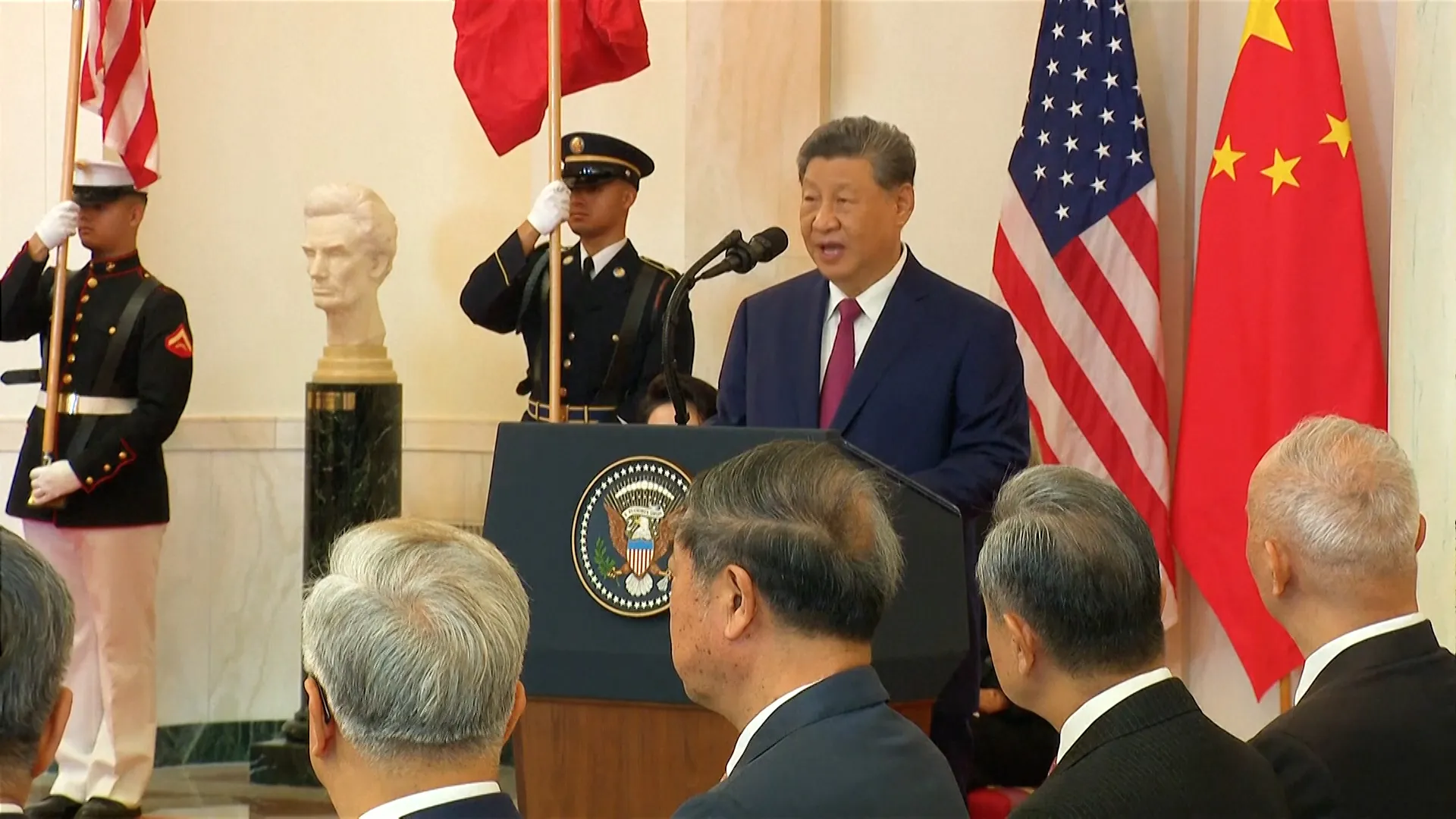
US and China presidents discuss cooperation, trade and AI risks | Newsfeed
Donald Trump and Xi Jinping discussed trade tensions, technology and AI risks at the White House, with both leaders emphasising the scope for greater cooperation. Xi’s visit marks the first visit by a Chinese president to Washington in over a decade.
Published On 24 Sep 2026

Seth MacFarlane curates film composers for L.A. Chamber Orchestra
Next year, the Los Angeles Chamber Orchestra — an intimate, 42-player group compared with the more than 100-member Los Angeles Philharmonic — will warm its new home, the highly anticipated, Frank Gehry-designed Terri and Jerry Kohl Hall. And it will do so with the help of a little light music: fanfares commissioned from half a dozen preeminent film composers — John Williams, Ludwig Göransson, Joel McNeely, Thomas Newman, James Newton Howard and John Powell — curated by none other than Seth MacFarlane (best known as the creator and star of “Family Guy”).
The buzzwords are lighting up, but this is far from a game of performing arts Mad Libs; it’s actually quite intentional. “We really thought about … ‘What statement can we make to Los Angeles and to the performing arts world that really shows who we are?’” said LACO Executive Director Ben Cadwallader. “Who is the Los Angeles Chamber Orchestra, specifically? And it really was this tie to Hollywood, to Los Angeles, to our musicians themselves.”
MacFarlane was a natural fit.
“I loved movies and I loved movie music,” MacFarlane said of his childhood in a recent interview. “I would go to the record store and buy the latest John Williams soundtrack, which was usually out before the movie was released. I remember buying the ‘Jurassic Park’ soundtrack not having seen the movie, and it didn’t matter. It was just great music. It was just great, symphonic music.”
LACO was founded by an assemblage of musicians and civic leaders in 1968, including the cellist James Arkatov. After emigrating from Russia as a child, Arkatov became the principal cellist at the Pittsburgh and San Francisco symphonies before landing in L.A. He arrived as a Hollywood studio musician, played on movie soundtracks and did backing for Ella Fitzgerald.
From the beginning, LACO served as “the artistic outlet of studio players … these incredibly gifted musicians who bring our movies and TV shows to life,” said Cadwallader, a situation that remains true to this day. LACO’s musicians know it’s “a place where they can play … Bach and Mozart, and make music at a really high level in a performance environment, not a studio environment.”
This is why the christening of LACO’s new home is also a homage to its roots: film composers. These giants of their fields will each write a spry, five- to seven-minute-long fanfare as openers for select LACO concerts throughout the season. (The works will also be performed at the Wallis Annenberg Center for the Performing Arts, with John Williams’ piece arriving first, in fall 2027.)
MacFarlane knew just what to do, thanks to his long history with music. The actor, animator, filmmaker and comedian has released 10 studio albums, received five Grammy Award nominations and performed as a vocalist at the Hollywood Bowl and Carnegie Hall. (He also just released a 14-track album called “Seth MacFarlane Sings the Muppets.”) Plus, his parents raised him steeped in music.
Nothing has changed here — throughout his career, MacFarlane has been relentlessly committed to including live music in his projects. The musical numbers on “Family Guy” simply couldn’t (and wouldn’t) exist without an orchestra.
“It would somehow feel thin and hollow, and people may not know why their attention is drifting, but it would drift,” MacFarlane said. “I really think you need the muscular sound of 60 musicians in a room, and in the case of ‘The Orville,’ sometimes 90. … Hollywood has been doing it since pictures went to sound, and I hope they continue to do it for as long as we make film and television.”
MacFarlane noted that the only time many people actually hear a live orchestra is in film or television.
“I don’t know how many people go to the symphony,” MacFarlane said. “So that’s certainly a component. When I was a kid, even the syndicated afternoon cartoon shows used a live orchestra, and when you go back and you listen to them, oftentimes it’s pretty legit composing. And I think that was important to have heard. I think it’s just good for the brain to hear complex symphonic music.”
Composer, conductor and longtime MacFarlane collaborator Joel McNeely (whose wife, Margaret Batjer, is LACO’s concertmaster) got MacFarlane involved in this commissioning initiative. Then MacFarlane selected the participating composers (and supported the initiative financially). One final Mad Lib to solve: What exactly, you may be wondering, is a fanfare?

“The perfect example … is the beginning of ‘Star Wars,’” Cadwallader said, then hummed the intro. “There’s big, loud brass. You cannot help but pay attention. … It puts a smile on your face. It maybe gets your heart racing a little bit. It’s usually very rhythmic, very bright. It’s like a big warm smile, or like a popping of a Champagne cork, to start a concert. … A bursting, effervescent moment of music to get things started. An amuse-bouche, if you like.”