AN ICONIC noughties star looked unrecognisable to many as he took to the stage during this weekend’s Estero Picnic Festival in Columbia.
Over two decades since his initial rise to fame, the now 52-year-old musician looks a far cry from the twenty-something many fans remember.
Sign up for the Showbiz newsletter
Thank you!
This iconic Indie star took to the stage at a music festival in Columbia this weekend, but do you recognise him?Credit: Shutterstock EditorialThe musician rose to fame back in the nineties and was a staple in British music throughout the noughtiesCredit: Shutterstock EditorialIt’s Fran Healy, the frontman of iconic Scottish band Travis (pictured here in 1998)Credit: Getty
Do you recognise him?
The singer in question in Travis frontman Fran Healy!
Known for hits such as Why Does It Always Rain On Me? and Sing, Travis dominated the music scene in the late nineties and early noughties.
Lead singer Fran has swapped the bright red hair he rocked a few years ago for a bleached look, donning a sky blue jumper as he joined numerous stars in fronting the Columbian festival this weekend.
Alongside his Travis bandmates, Dougie Payne, Andy Dunlop and Neil Primrose, Fran took to the festival’s Smirnoff stage to perform to the waiting crowds on Sunday.
The three-day festival also saw Sabrina Carpenter, Tyler The Creator, Swedish House Mafia and The Killers perform.
Alongside their own set on Sunday, Travis joined The Killers on stage to perform with them on Saturday.
Born in Stafford, Fran was raised in Glasgow and formed Travis back in 1991 while studying at the Glasgow School of Art.
Still going strong, the band are performing across Chile this month and next, with gigs in Viña del Mar, Frutillar and Santiago.
While the band have taken breaks throughout their lengthy career, they are famous for having never split up.
Their tenth studio album, L.A Times, was released in 2024.
Fran was in a relationship with German photographer Nora Kryst for 23 years before splitting back in 2019.
At the time, Fran took to Instagram to explain that he was wheeled out on a gurney and put into an ambulance.
Admitting that he thought he’d broken his ankle, the musician confirmed it was simply a “gnarly sprain”.
The band have been going strong for over three decades and have never officially split upCredit: GettyFran and his bandmates joined the likes of Sabrina Carpenter and The Killers this weekendCredit: Shutterstock Editorial
A crucial 50-mile airspace route through Azerbaijan has become vital for European travellers as Middle East airspace restrictions impact millions of passengers
Jetting away on holiday is getting a bit trickier (Image: Getty Images/iStockphoto)
The flight corridor that dictates whether vast numbers of passengers can reach their destination is getting narrower.
32,432. That’s the number of Middle East flights that have been scrapped since Israel and the US began bombing Iran at the end of February. The tally of affected passengers now runs well into the millions.
Whilst the daily cancellation figure has now dropped considerably to 11% per day, according to analytics firm Cirium, the knock-on effects of the disruption are still being experienced and will continue for some time.
One way the conflict has and will continue to affect travel is by constricting flight corridors. Now, many European holidaymakers are dependent on a roughly 50-mile route spanning three countries.
The flight corridor over Azerbaijan is one that numerous commercial aircraft have been using to travel from Europe to Asia since early March, when the country closed portions of its airspace following drone strikes the Azerbaijani authorities claim had been launched from Iranian territory, reports the Express.
Prior to the Iran war, the Azerbaijan path was 100 miles wide at its narrowest points, owing to the Russian invasion of Ukraine to the north. It is now 50 miles wide, with airspace to the south closed off by the Azerbaijan authorities.
Almost three weeks into the Iran war, this route through Azerbaijan, Georgia and Turkey is one of just two available for a majority of long-haul flights between Europe and Asia. The alternative route passes through Saudi Arabia and Egypt. The shortage of accessible airspace is fuelling rivalry amongst airlines competing for routes. It is also rendering air travel more costly and environmentally harmful.
Prior to 2022, flights linking much of Europe and Asia travelled over Russia, via the “Siberian Corridor.” That was regarded as one of the most direct ways to connect the two continents.
Following Russia’s invasion of Ukraine, Western airlines were denied access to the airspace. Now a flight from northern Europe, which would have passed directly over Russia, must take a lengthier route either over the North Pole or around the Black Sea. This can tack on roughly three hours to a nine-hour journey, consuming thousands of pounds more jet fuel and emitting dozens of tonnes more CO2e into the atmosphere.
The alternative route from Europe to Asia that is presently available takes passengers south, via Egypt, Saudi Arabia and the United Arab Emirates. Whilst it is returning to capacity following weeks of disruptions and cancellations, the escalating conflict in Iran means its viability in the long or medium term remains uncertain.
Dubai International Airport is typically one of the globe’s busiest travel hubs, averaging approximately 1,200 departures and landings daily. It, like numerous airports in the region, is still functioning considerably below its standard capacity. This is partly due to the aerial battles taking place overhead. On Friday, the UAE government reported that it had intercepted 338 ballistic missiles, 15 cruise missiles, and 1,740 drones since February 28, Forbes reports. Despite these efforts, at least eight people have been killed in the UAE, and over 150 have been injured.
Ian Petchenik, the communications director for the flight-tracking site FlightRadar24, fears that the narrowing of flight corridors and the uncertain status of major travel hubs is driving up the cost of plane tickets. He told the New York Times: “At some point, we get to the point where airlines have to make the decision: Is this route still economically viable? Is this a route that we can continue to operate long term within these parameters?”
Mr. Petchenik characterises the flight corridor above Azerbaijan as “a very narrow strip of land.”
To increase the number of planes that can fly on a restricted flight corridor, air traffic controllers instruct aircraft to fly at varying altitudes – effectively spreading them out.
However, according to Graham Wild, a senior lecturer of aviation science and technology at the University of New South Wales in Australia, this can trigger other problems. Planes flying at lower altitudes are more vulnerable to weather and turbulence and also consume more fuel, as the air is denser. Extended flight times and the potential for diversions also present staffing challenges for pilots and flight crews.
IMPERIAL — Whenever the weather changes suddenly, or the skyline becomes shrouded in a windy haze, Fernanda Camarillo braces herself for an asthma attack.
Her condition has become more manageable, but the 27-year-old said it’s still scary when her chest tightens and she starts to wheeze. It was one of her first thoughts when she heard about plans to develop a massive data center next to her home in Imperial County, a farming community near the border of Mexico that struggles with poor air quality.
“A lot of people in the county are asthmatic,” she said, explaining that she worries the new center would add more pollution. “I’ve been anxious — so many of us are voicing our concerns.”
Data centers have existed for decades but are rapidly changing and expanding due to the worldwide boom in artificial intelligence, or AI as it’s known. States and communities nationwide havestarted pushing back, citing concerns that the projects could strain power grids, increase utility bills and have negative health and environmental impacts.
In California, state legislators are debating how to protect residents and natural resources without creating so much red tape that developers go elsewhere, taking their jobs and taxable earnings with them.
No Data Center signs are posted in the front yard of a home that is right behind the proposed site.
“We can be supportive of innovation and a technology that is needed but also protect our communities and our health and our environment,” said state Sen. Steve Padilla (D-San Diego). “We can do both at the same time.”
The California Legislature is considering bills to prohibit the projects from being exempted from the state’s stringent environmental law and to impose new tariffs on new major energy users that strain power supplies. Lawmakers also have proposed restrictions on new data centers, requiring companies to provide verifiable estimates on expected water and energy usage before they can be granted a business permit.
Imperial resident Fernanda Camarillo, who is an asthmatic, holds some of her medications.
Members of Congress also expressed concerns. Rep. Ro Khanna, speaking at a town hall about AI last month at Stanford University, said legislators must ensure data centers serve the communities that power them.
“We live in a new gilded age,” said Khanna (D-Fremont). “What kind of future are we going to build?”
::
Eric Masanet, a professor at UC Santa Barbara specializing in sustainability science for emerging technologies, described the facilities as the “brains” of the internet. The sprawling centers are filled with banks of specialized computers that process online shopping orders, stream movies, host websites, encode Zoom and other videoconferencing apps, store data and serve as switching stations for the digital world that’s now woven into daily life.
Data centers, particularly those that power AI, use significant amounts of water and energy. The facilities accounted for about 4.4% of the nation’s total electricity consumption in 2023, up from 1.9% in 2018, according toa report provided to Congress from the Lawrence Berkeley National Laboratory. The researchers projected that figure will reach 6.7% to 12% by 2028.
Many companies, including big tech giants like Meta, Google and Amazon, are making major investments in AI.
“We are building a lot more data centers faster than we ever did — and a new AI data center is 10 to 20, maybe 30 times, the size of the largest data centers we had before,” Masanet said.
The proposed site of the 950,00-square-foot data center is on a dusty parcel that is next to the Victoria Ranch housing community and adjacent to farmland in Imperial, Calif.
It’s unclear how many data centers are in the state. A California Energy Commission spokesperson told the Los Angeles Times it does not track this information. Data Center Map, a nongovernmental website that tracks data centers across the world, lists 289 facilities in California, with more than 4,000 nationwide.
The federal government has, so far, largely left it to states or localities to regulate data centers.
The facilities can generate significant revenue for local governments due to sales and property taxes.
But some new proposals are sparking a backlash. More than 200 community and environmental organizations, including a dozen from California, sent an open letter to Congress in December calling for a national moratorium on new data centers.
Robert Gould, a pathologist with San Francisco Bay Physicians for Social Responsibility, one of the organizations that signed the letter, explained data centers are causing a shift away from renewable energy and back toward fossil fuels because the facilities need a reliable and constant stream of power.
Cornell Universityresearchers last year estimated that AI growth could add 24 to 44 million metric tons of carbon dioxide to the atmosphere annually by 2030, unless steps are taken to change course.
Gould said fossil fuel emissions are associated with various cancers, an increase in hospitalizations for older adults due to respiratory conditions, and asthma attacks or stunted lung growth in children. Particulate matter from fossil fuel emissions is also linked to cardiovascular events and negative effects on maternal fetal health.
Gould’s organization has noticed an alarming trend.
“These are generally placed in communities that are the least able to defend themselves,” he said.
Farmworkers toil in the noon heat to pick vegetables in Imperial. Agriculture is an important part of the Imperial Valley economy.
::
The debate over data centers is heating up in the Imperial Valley, a rural desert region in southeastern California where a proposed center faces fierce opposition from residents.
The county in 2025 granted the project an exemption for the California Environmental Quality Act, known as CEQA. The landmark 56-year-old state law has been credited with helping to preserve California’s natural beauty and protecting communities from hazardous impacts of construction projects — but also blamed for stymieing construction.
Imperial Valley Computer Manufacturing, a California-based limited liability company that started two years ago, plans to develop a 950,000-square-foot facility in the county that’s designed for advanced artificial intelligence and machine learning operations. The company says it will use reclaimed wastewater and EPA-certified natural gas generators, and create 2,500 to 3,500 construction jobs and 100 to 200 permanent positions.
“We are committed to Imperial County and to creating lasting economic opportunity,” the company website states. “The project will generate $28.75 million in annual property tax revenue for local schools, fire departments, libraries, and essential services.”
The Imperial County Board of Supervisors is moving toward finalizing the proposal.
Farmland spreads out in front of the Imperial Valley Fair near a proposed data center in Imperial.
Sebastian Rucci, an attorney and chief executive officer of Imperial Valley Computer Manufacturing, said he commissioned multiple studies assessing the proposed center’s potential effect on issues like traffic or the environment that found no or minimal harms. He threatened to pull his proposal if a CEQA review was required.
“CEQA leaves you in an unknown territory — some of the environmental groups have used it for extortion, they sue, they have no basis for the suit but they delay you, and then they can squeeze money out of you for settling the lawsuit,” said Rucci.
The exemption, however, has alarmed residents, who have spoken up at county board meetings and launched a community organization, Not in My Backyard Imperial, to protest the data center and demand a CEQA review.
“It feels like it’s us against the county,” said Camarillo, adding that many feel the board has dismissed their questions and concerns.
None of the Imperial County Board of Supervisors responded to requests for comment.
Resident Fernanda Camarillo’s home is right behind the proposed site of the data center in Imperial.
The center would be a neighbor to Camarillo’s house in Victoria Ranch, a family-friendly area with beige stucco homes topped with terracotta tile roofs. She worries about noise, pollution and spiking utility bills. Power companies that have to upgrade grids to meet data centers’ energy demands sometimes seek to recoup that cost by hiking up rates for all consumers.
Camarillo, a substitute teacher, is also scared for her students. The air quality in Imperial Valley is already so poor that schools use a system of color-coded flags to signal whether it’s safe for children to go outside during gym or recess, she said.
“I think they see [the valley] as easy pickings because we are a low-income community and we have such a large population of Latinos here,” Camarillo said.
A quick drive around the neighborhood shows others share her concerns. Signs protesting the data center pop up throughout the community, displayed on front lawns or nestled into rocky garden beds.
Victoria Ranch was quiet and peaceful on a sunny Sunday in late February. Francisco Leal, a resident and lead organizer for NIMBY Imperial, said that’s a major part of its appeal.
The colorful dusk sky hovers over a Little League baseball game at Freddie White Park in Imperial. The debate over data centers is heating up in the Imperial Valley, a rural desert region in southeastern California.
Leal wants answers about everything from potential health hazards and impacts on the local water supply to whether the fire department is equipped to handle a large-scale electrical blaze. But without a CEQA review, he says residents are left to trust assurances from the developer or privately hired consultants.
Leal plans to sell his property if the project goes forward, but the thought makes him emotional.
“It’s not just a house; it’s a home,” he said. “This is the only home my kids have ever known and all of our family memories are here.”
Gina Snow, another resident, isn’t necessarily against bringing a data center to the county. But she wants the proposal to undergo a CEQA review.
“Clearly we understand that there is economic development and the potential for that to be positive for the county, but at what cost?” she said.
Daniela Flores, executive director of Imperial Valley Equity and Justice, a nonprofit that works for social and environmental equality, stands on the site of the proposed data center.
::
Daniela Flores, executive director of Imperial Valley Equity and Justice, a nonprofit that works for social and environmental equality, said the community has good reason to be wary. Various industries have come into the region over the years and made grand promises that never panned out.
“We became a sacrifice zone,” she said, adding industries use the area’s resources while ultimately doing little to permanently improve the lives of most residents.
Flores said the community continues to struggle with a range of problems, including poor air quality, high poverty rates, weak worker protections and crumbling infrastructure. She believes a data center could add new and potentially dangerous challenges.
The valley has long, brutal summers with temperatures that swell to 120 degrees. If the data center strains the grid and causes a lengthy blackout, or low-income residents have their power shut off because they can’t afford the rising bills, Flores fears the situation could quickly turn deadly.
The city of Imperial also has concerns. The city hasfiled a lawsuit calling on the county to halt the project, arguing it should not have received a CEQA exemption.
The controversy has drawn attention from Padilla, whose district includes Imperial Valley. Padilla has echoed residents’ calls for more transparency from the county and introduced Senate Bill 887, which would ban data centers from receiving exemptions from CEQA.
“I am not anti-data center or anti-artificial intelligence,” Padilla said. But, he added, we need to “find a way to do this right and make sure there is adequate review and understanding.”
A dusty haze settles over the city of Imperial at dusk near the site of a proposed data center.
Another measure from Padilla, Senate Bill 886, would direct the Public Utilities Commission to create an electrical corporation tariff to cover the cost of data center-related grid upgrades.
Other related legislation this year includes Assembly Bill 2619 from Assemblymember Diane Papan (D-San Mateo) that would require data center owners to provide an estimate about expected water usage and sources before applying for a business license, and Assembly Bill 1577, by Assemblymember Rebecca Bauer-Kahan (D-Orinda), which would require data center owners to submit monthly information to a state commission about water and fuel consumption and energy efficiency.
While lawmakers weigh new policies at the statehouse, Camarillo said she hopes the priority will be protecting communities.
“Innovation is important, but innovation for the sake of innovation has never really been something that hasn’t had negative impacts,” she said. “Think about human lives.”
There’s no way of sugar coating it – losing Dan Ballard is a massive blow to Northern Ireland’s hopes of reaching a first World Cup in 40 years.
The Sunderland defender has been integral to the progress of Michael O’Neill’s young side and he has an impact in both boxes.
While he has always been a physical presence, his composure on the ball has also improved from playing Premier League football this season.
Excluding Kieran Morrison, who has only played in the cup competitions for Liverpool, losing two of his four Premier League players is awful luck for O’Neill, after Conor Bradley was sidelined with a knee injury in January.
Thankfully for NI, Ruairi McConville, who was also an injury doubt when the squad was announced, has played two sets of 90 minutes for Norwich City in the past week.
He will be an option for stepping in for Ballard and has impressed in his short international career to date, as will Oxford United’s Ciaron Brown and Bolton’s Eoin Toal.
An Air Canada plane was involved in a collision late Sunday at new York City’s LaGuardia Airport. Photo by Graham Hughes/EPA
March 23 (UPI) — An Air Canada regional jet with nearly 80 people onboard collided with a fire truck at LaGuardia Airport, prompting federal officials to halt air traffic to and from the airport.
The FAA ordered the ground stop at 12:04 a.m. EDT, according to a statement from its Air Traffic Control System Command Center. The agency later said the airport would be closed until 2 p.m.
The plane struck the Port Authority Aircraft Rescue and Firefighting vehicle on Runway 4 late Sunday as it was responding to a separate, unknown incident, the Port Authority of New York and New Jersey, which operates LaGuardia, told UPI in a statement.
The National Transportation Safety Board said in a statement the involved vehicle was a fire truck and that it had deployed a team expected to arrive at LaGuardia later Monday to begin its investigation.
The extent of the collision and whether there were any casualties was unclear early Monday.
The Port Authority said the airport was closed to facilitate the response and allow for an investigation. Emergency response protocols were activated and its police force was at the scene working with airline and federal authorities, the agency said.
The New York Fire Department confirmed to UPI that it had responded to an incident.
Air Canada confirmed to UPI that it was aware of the crash involving Air Canada Express Flight 8646 from Montreal, Canada, to New York City.
The flight was operated by Jazz Aviation, which said in a statement that the incident occurred at 11:47 p.m. EST Sunday. The plane was carrying 72 passengers and four crew, the Halifax-based airline said.
All streets and highway exits to the airport have been closed until further notice, according to the New York Police Department.
New York City’s official Emergency Notification System has issued an alert warning residents to expect “cancellations, road closures, traffic delays and emergency personnel near LaGuardia Airport.”
Flight 8646, a CRJ900 regional jet, had departed from Montreal at about 10:35 p.m. EST, according to flight-tracking website Flightradar24.
Emmerdale’s Aaron Dingle actor Danny Miller has candidly opened up about his father in an emotional update on Good Morning Britain
Joe Crutchley Screen Time Reporter
10:42, 23 Mar 2026Updated 10:43, 23 Mar 2026
Emmerdale’s Danny Miller emotional as he makes heartbreaking confession about famous dad(Image: ITV)
Emmerdale’s Danny Miller has spoken out about his father amid his dementia battle, revealing he misses him “so much”.
The Aaron Dingle actor has been incredibly open in recent months about his father Vince, who is living with dementia. Vince is a well-known star in the showbiz world as a singer, compere and comedian.
And on Monday (March 23) Danny appeared on Good Morning Britain where he spoke about Vince in an emotional update. He said: “It’s sad, and, you know, me and my dad were thick as thieves at one point, and, you know, losing him over and over again is awful.”
Admitting he misses the man his dad was, Danny added: “I live a couple of hours drive from my dad now, which breaks my heart, but I have my own family.”
He continued: “I’ve got a job up in Yorkshire, on Emmerdale, and being around in Manchester isn’t easy anymore, so I moved my family up there, and it was kind of a really tough thing to do, because I’m not there for my dad as much as I’d like to be. I miss him terribly.
“But you know, the days where I do see him again, I often get, you know, a good visit, and I usually find if I play Matt Monroe – my dad was a comedian, but he’s a singer as well – and Matt Monroe was a friend of his.”
Danny went on: “I played it one day, and he just kind of pointed at it, and he said, 10th of December, 1970, whatever, and I Googled it, and he was right. I think it was either his birthday or when the single was released, and from then on I kind of thought, I’m gonna do that, so I do it as a normal thing. Now I’ll put it on the side and just play and just talk to him normally. I tend to get a better visit.“
Danny then spoke about his Emmerdale co-star Charley Webb, whose mum Helen passed away last week following a 12-year battle with Alzheimer’s. He said: “Charley Webb is a good friend of mine. She was on here [GMB] with you guys not long ago, talking about her mum’s Alzheimer’s, and unfortunately, she passed, and it’s so sad.”
Danny continued: “Charley was a massive inspiration for me to why I spoke out about it. It made me want to talk out, it made me want to be vulnerable, and allow myself to sort of put out an unfiltered video.”
He added: “I wanted to just try and allow people to see me to be someone completely different and be vulnerable and talk about these things in hope that it will sort of resonate with somebody somewhere and they can relate to it and go, actually, I’m going to go out and get a memory test.
“That is the beginning of how to sort of get that diagnosis for dementia and it’s something that, you know, I want to fly the flag for because I don’t want dementia to destroy the families as it’s destroyed ours.”
The GMB host then pointed out how Danny’s father had a very successful career as a compere comedian and “knew lots of influential and important people”.
Danny then went on to reveal what it is like now having a conversation with his father. He shared: “There’s good days and bad days. There was a time last week where I didn’t know if I’d be sat here, because, you know, he’s up and down with his general health anyway, but dementia does always make it feel somewhat worse, and there’s all water infections that, so, your urine infections that suddenly make them more confusing. And then his health declined. He looked, he looked ill.”
When asked if his father is sometimes unaware of who Danny is, the actor replied: “No, that will break my heart. I’m not there yet. We’re not there yet, luckily, but it will break my heart.” Admitting he misses his father “so much”, Danny said: “He used to call me a lot and just ranted and then put the phone down without even saying, how are you? And I’d give anything back to have those conversations.”
Known as the ‘king of comperes’, Danny’s father Vince worked as the VIP host at Manchester United for almost 30 years. He also worked at Old Trafford for 29 years and often interviewed football legend, Sir Alex Ferguson.
No stranger to rubbing shoulders with famous faces throughout his 65-year career, Vince has also worked with Johnny Mathis and Shirley Bassey and even spoke at comedian Bernard Manning’s funeral.
When Vince was 82, he announced that he would be officially retiring from the showbiz and entertainment world. He told Manchester Evening News: “I’ve no upset about it, the time is now to get out while you’re on top, you don’t want people saying ‘not him again’!”
To celebrate his retirement, Danny put together a charity bash in which he paid tribute to his dad, dubbing him the “best in the business”. On stage, Vince said: “I’ve had a great career, I’ve done it all as a presenter, comedian, singer, I’ve been very fortunate. As Edith Piaf said, Je Ne Regrette Rien, no regrets!”
Emmerdale airs Monday to Friday at 7:30pm on ITV and ITVX
Keeping and maintaining friends as an adult is hard, especiallywith the demands of life, travel and work. In volunteering, I encounter more people like myself, which is nice, but sometimes it’s difficult to participate without a lot of commitment to the organizations. I’m wanting to explore smaller, intimate groups to build community with people who I share similar values with. I’m interested in self-growth, psychology, games, mindfulness and yoga. I loved the L.A. Times story “Awaken your inner child at this welcoming collage club for adults” and I would love to know about similar activities. Thanks! —Marlen I.
Looking for things to do in L.A.? Ask us your questions and our expert guides will share highly specific recommendations.
Here’s what we suggest:
Marlen, I couldn’t agree more. As we get older, it can feel more and more difficult to sustain friendships, especially in Los Angeles, where people live so far apart and have busy lives. This struggle is exactly why so many social clubs have been sprouting up in L.A. over the last few years. From board game clubs to junk journaling meetups, there’s so many different ways to connect and maybe try something new. I’ve compiled a list of social clubs and community spaces that I think you’ll enjoy.
Since you’re already familiar with Art+Mind Studios, you should definitely check out Junk Journal Club. Junk journaling is essentially a craft practice that combines elements of collaging, journaling and scrapbooking. With the rise of junk journaling content on social media, the once solo pastime has turned into a lively social scene. Junk Journal Club, dubbed “the original junk journal club,” hosts monthly meetups, which can be found on its Instagram page. When my colleague Malia Mendez went to an event recently, people told her that attending Junk Journal Club “has made befriending strangers easy,” and many of them stay in touch.
Another craft-centered event that’s worth exploring is the Crafters Clubhouse, which founder Victoria Ansah calls “a creative third space for adult makers.” She hosts monthly arts and crafts workshops including activities like scrapbooking, punch needle embroidery and clay art.
Given that you’re interested in yoga and mindfulness, you may like WalkGood LA, a community-centered wellness organization that hosts a variety of activities including a run club and accessible yoga classes. During the pandemic, I found solace in attending their weekly yoga classes called BreatheGood. The outdoor sessions take place every first Sunday at Kenneth Hahn State Recreation Area and feature free chiropractic adjustments and healthy food vendors. The vibe of the intergenerational event feels warm and welcoming. All you have to do is show up with your yoga mat. The organization also hosts various classes including yoga, breath work, mindful meditation, mat Pilates and step aerobics at their studio, the WalkGood Yard, in Arlington Heights.
Another social club I recommend is Love, Peace & Spades, which my friend Kevin Clark started in 2022, to create a space where people could play the card game with others. With music provided by a live DJ, the monthly game night feels like being at a family cookout. Spades can be extremely intimidating to start as a beginner playing with pros. But don’t worry. Love, Peace & Spades has instructors who can teach you how to play.
If you’re interested in chess, L.A. Chess Club is “an event with the laid-back ease of a chill game night and all the social and romantic possibility of a night out on the town,” according to Times contributor Martine Thompson, who wrote a story about the event. At the weekly gathering, which features a food vendor, cocktails, tattoo artists and DJs, you can “competitively play chess, learn the game, meet new friends or mingle as a single person,” Thompson shares. Another fun event is RummiKlub, a monthly Rummikub game night that takes place in elevated, design-forward spaces across the city.
L.A. also has several fun creative venues that regularly bring people together, such as Junior High, a nonprofit art gallery and inclusive gathering space that hosts artist showcases, comedy nights, pottery workshops and more. There’s also Nina in Atwater, which holds a variety of gatherings including a monthly series that focuses on mindfulness called “Be Here Now: Simple Tools for an Everyday Nervous System Reset.”
I hope that these suggestions are a good starting point for finding the group, or several groups, that are an ideal fit for you. Just by putting yourself out there and being open, you are bound to build and find community. Best of luck on your journey!
United Airlines is the latest to confirm that it would be cutting five per cent of flights in the second and third quarters of 2026.
With up to 5,000 flights a month – working out to around 4,000 domestic and 800 international routes – this means it affects around 250 flights a month.
And with this set to last until the end of summer, it means thousands of passengers will be affected.
While the affected flights haven’t been confirmed, it will mainly affect the “less profitable” routes so including midweek flights, as well as overnight and Saturday routes.
United Airlines has the world’s largest airline fleet with more than 1,075 aircraft.
United Airlines‘ Chief Executive Scott Kirby said the cancellations were due to fears of oil rising to as much as $175 (£131) a barrel, and remaining above $100 (£75) until the end of next year.
This would mean the airline’s fuel costs would rise to $11billion (£8.2billion) – double the profit of their best year which was $5billion (£3.7billion).
They warned: “There’s no point in burning cash in the near term on flying that just can’t absorb these fuel costs.”
It’s not just the cost of fuel but how much is being used by airlines as well.
The closure of airspaces and Middle East airports, particularly Dubai which is one of the world’s busiest, has forced airlines to fly alternative – and longer – routes, which burn more fuel.
Other airlines have already confirmed they would be cancelling flights due to expected fuel costs.
COLUMBIA, S.C. — When you look at the USC Trojans, one might think they’re setting the table for next year.
Buying time until JuJu Watkins returns. Keeping the ship afloat until the talented recruiting class that includes Saniyah Hall makes its way to campus.
But the Trojans showed Saturday that’s not the case. They’re making a plate and eating now.
The No. 9 seed Trojans gutted out a 71-67 overtime win over No. 8 seed Clemson in what USC coach Lindsay Gottlieb described as “a culture win.”
That game featured many tests for a young team in March and the Trojans responded well to the challenges. They are advancing on the back of freshman Jazzy Davidson’s 31 points and senior Kara Dunn’s 22.
Davidson, who appeared to be on the verge of tears as the referees reviewed the final play of regulation to determine whether she had committed a foul that would have set Clemson up for game-winning free throws, said on Sunday there’s a standard that this year’s Trojans feel they are responsible for meeting.
“I think our expectations, you know nobody wanted to lose JuJu, we all love her, but we have to keep going as you said and just holding that same expectation that they had last season. Just the program standard,” Davidson said. “And just resiliency and making sure that we’re doing our best every game.”
Dunn said the deck has been stacked against the Trojans all season and it’s forced them to grow stronger as a unit.
USC guard Kara Dunn drives to the basket in front of Clemson guard Taylor Johnson-Matthews during the first round of the NCAA tournament on Saturday in Columbia, S.C.
(Nell Redmond / Associated Press)
“I think this year has just been about focusing on going against all odds,” Dunn said. “A lot of people didn’t expect much from this team and they might have turned away at certain times when we had lower moments this season and I think that it built our own culture for this season specifically. I feel like we had to come together, we had to support each other when it didn’t feel like we had much support and I think that that’s been really important.”
She added that moving through the season with just the support of each other and their die-hard fans works in their favor as they prepare to take on powerhouse South Carolina on the Gamecocks’ formidable home floor.
“We have everything to gain, nothing to lose going into this game, so I feel like this has really helped us,” Dunn said.
The NCAA tournament game against the No. 1 seed on the Trojans’ side of the bracket will be a rematch of the unofficial “Battle of the Real USC” in November. The Gamecocks claimed a 69-52 win during that meeting.
USC guard Jazzy Davidson drives under pressure from Clemson guard Rachael Rose Saturday in Columbia, S.C.
(Nell Redmond / Associated Press)
Gottlieb said Sunday she scheduled that game to prepare her team for moments like Monday’s tough matchup.
“Maybe if we hadn’t played Notre Dame, UConn and South Carolina, maybe our record would be a little better coming in, but it doesn’t make you a better program,” she said. “Our goals remain the same; which is to win a national championship. So if you’re skipping those people in nonconference hoping to manipulate it, it doesn’t work that way. You have to see the best. You have to elevate your program to be the best, then ultimately, you have to beat the best to get to where you want to be.”
South Carolina is trying to avenge last season’s championship loss to UConn and secure its fourth national championship in program history and the third in five years. USC, meanwhile, is trying to match the Cheryl Miller era when she led the Trojans to back-to-back national titles in 1983 and 1984.
Trojan culture will be tested more than ever, but Dunn feels good about where the team is heading.
“Obviously that was the beginning of the season, now it’s towards the end and we’re two very different teams,” she said of the previous loss to South Carolina. “We’ve grown in a lot of ways, but we’re using that scout just to see what we did well and what we could’ve done better. We just want to make sure that we control those things first and then adjust.”
Davidson will have the chance to play in another legacy defining game during her second NCAA tournament appearance.
“I feel like I have nerves a little bit before every game, [Monday] especially because it’s a big game,” she said. “My teammates are always just making sure I’m calm and in the moment. The confidence that they instill in me every day really helps.”
March 23 (UPI) — Senate Republicans have advanced the nomination of Sen. Markwayne Mullin for secretary of the Department of Homeland Security, paving the way for his confirmation as early as Monday evening.
The Senate voted 54-37 Sunday afternoon to invoke cloture, clearing a procedural hurdle permitting a final vote on his confirmation.
The vote was mostly along party lines, with Democratic Sens. John Fetterman of Pennsylvania and Martin Heinrich of New Mexico joining their Republican colleagues in approving the motion.
Nine lawmakers, including eight Democrats, did not vote, including GOP Sen. Rand Paul of Kentucky, chair of the Homeland Security and Governmental Affairs Committee, who has been vocally opposed to Mullin’s confirmation.
Paul was the only Republican to vote against the Oklahoma senator when his committee voted last week to advance his nomination to the full Senate.
The Senate is expected to vote on his confirmation Monday night.
President Donald Trump nominated Mullin after firing Kristi Noem following months of controversy over her leadership of the department, especially after the fatal shootings of two U.S. citizens by federal immigration officers in Minneapolis and a $220 million advertising contract.
Fetterman was among those who called for Noem’s firing, and said he was supportive of Mullin to lead the DHS.
He has said he approached Mullin’s confirmation “with an open mind.”
“My AYE is rooted in a strong committed, constructive working relationship with Senator Mullin for our nation’s security,” he said.
Following Sunday’s vote, Heinrich issued a statement, similarly addressing the Oklahoma senator as “a friend” with whom he shares “a very honest and constructive working relationship.”
“We often disagree and when we do, we work to find whatever common ground we share,” he said.
“I have also seen first-hand that Markwayne is not someone who can simply be bullied into changing his views, and I look forward to having a secretary who doesn’t take their orders from Stephen Miller.”
Miller is Trump’s far-right Homeland Security adviser.
Mullin is likely to be confirmed by the GOP-controlled Senate, despite opposition from Paul, who voted against him during last week’s committee hearing and did not vote on Sunday.
Paul confronted Mullin during the committee hearing over reportedly calling him “a freaking snake.” He also accused Mullin of lying when he told a reporter he had told Paul that he “completely” understood why a man had attacked him in late 2017, breaking five of his ribs.
“You got a chance today. You can either continue to lie or you can correct the record,” Paul said in his opening statement.
“You have never had the courage to look me in the eye and tell me that the assault was justified, so today, you’ll have your chance.”
When it was Mullin’s turn to give his opening statement he began by addressing Paul’s comments, stating that he had made the remarks while Paul was in the same room and that it was due to his behavior of seemingly going against hardline Republican policies.
“As far as my terms of a snake in the grass, I worked to try to fix problems. I’ve worked with many people in this room. It seems like you fight Republicans more than you work with us.”
President Donald Trump presents the Commander in Chief’s Trophy to the Navy Midshipmen football team during a ceremony in the East Room of the White House on Friday. The award is presented annually to the winner of the football competition between the Navy, Air Force and Army. Navy has won the trophy back to back years and 13 times over the last 23 years. Photo by Bonnie Cash/UPI | License Photo
The violence comes as Israel continues its push to expand control over Palestinian territories in violation of international law.
Published On 23 Mar 202623 Mar 2026
At least nine Palestinians have been injured as Israeli settlers rampaged through towns and villages in the occupied West Bank for a second night in a row.
A 45-year-old man was shot in the foot late on Sunday during a confrontation with Israeli settlers in Deir al-Hatab, east of Nablus, the Wafa news agency reported.
Recommended Stories
list of 3 itemsend of list
The Palestinian Red Crescent reported that a 47-year-old Palestinian man was attacked by settlers in Jabal al-Arma in Beita, while others were beaten.
Earlier, Israeli settlers set fire to homes and cars in two areas south of Jenin and vandalised property across the occupied West Bank.
Simultaneous attacks took place on Saturday night in at least six communities, including the villages of Silat al Dahr and Fandaqumiya, both near Jenin; in Jalud and Salfit, both south of Nablus; and in the agricultural regions Masafer Yatta and the Jordan Valley.
The Palestinian news agency reported that homes and cars were set ablaze, Palestinians were pepper-sprayed and at least five people were wounded in the assaults, which took place during the Eid al-Fitr holiday marking the end of Ramadan.
Sunday night’s attacks came after Israeli settlers in the settlement of Elon Moreh held a funeral for 18-year-old Yehuda Sherman, who was killed in a collision with a Palestinian vehicle in an area north of the villages attacked.
Israeli police said they were investigating the settlers’ claims that the collision was deliberate.
Israel’s government is pressing ahead with new settlements in the occupied West Bank as attention shifts to the Iran war.
According to the United Nations Office for the Coordination of Humanitarian Affairs, 25 Palestinians have been killed by Israeli settlers and soldiers so far this year.
Israel’s security cabinet last month ratified a series of decisions pushed by Finance Minister Bezalel Smotrich and Defence Minister Israel Katz, enabling Israel to claim large areas of the occupied West Bank as “state property” if Palestinians cannot prove ownership.
The Palestinian presidency condemned the decision in a statement, calling it a “grave escalation and a flagrant violation of international law” that amounts to “de facto annexation”.
Amnesty International said the expansion of illegal settlements and state-backed settler violence in the occupied Palestinian territories were “a direct indictment of the international community’s catastrophic failure to take decisive action.”
The International Court of Justice (ICJ) ruled in 2024 that Israel’s continued presence in the occupied Palestinian territory is unlawful and should come to an end “as rapidly as possible”.
The judges pointed to a wide list of policies – including the building and expansion of Israeli settlements in the West Bank and East Jerusalem, use of the area’s natural resources, the annexation and imposition of permanent control over lands and discriminatory policies against Palestinians – all of which it said violated international law.
Bradley Dack has finally removed his wedding ring three months after splitting from wife Olivia AttwoodCredit: Click News and MediaThe footballer was spotted on Sunday without the band as he headed to the train station, hours after his wife’s new romance was revealedCredit: Click News and MediaOlivia and Bradley married in 2023 and split in January after what was dubbed a ‘breach of trust’ from the footballerCredit: Instagram
Gillingham footballer Bradley was seen on Sunday without his wedding band.
Dressed in black, the sportsman appeared downcast as he headed from his car to catch a train.
It came just hours after Olivia’s new romance with Pete Wicks was confirmed, as The Sun shared a snap of them kissing during a night out on Friday.
Before their kiss, and her split from Bradley, Pete and Olivia’s close friendship has raised eyebrows since they were pictured cosying up on a yacht in Ibiza last summer.
But confirming the timelines, a source told us over the weekend that the romance has come around naturally over recent weeks.
“They have been spending a lot of time together and an unexpected romance has blossomed from friendship,” they said.
Bradley’s snub comes after Olivia was pictured kissing Pete Wicks on Friday nightCredit: The SunOlivia was spotted yesterday heading into KISS Radio to present her show alongside Pete, carrying two coffeesCredit: SplashBradley, who is said to be ‘furious’ over the romance, has had his hopes of a reconciliation dashedCredit: Getty
Asian stock markets saw major declines on Monday as gold futures dropped 8% and crude oil prices continued to climb amid heightened uncertainty in the Middle East.
ADVERTISEMENT
ADVERTISEMENT
As the effective closure of the Strait of Hormuz continues to choke global supply, benchmark US crude rose above $100 a barrel on Monday morning in Europe.
Brent crude, the international standard, went up to more than $113 a barrel. The price of Brent crude has zigzagged lately from about $70 per barrel before the war began to as high as $119.50.
European stock indexes opened with losses, with the FTSE in London losing 1.5%, the CAC-40 in Paris being down by 1.6%, and the DAX in Frankfurt dropping by 2% at the opening.
Earlier on Monday, the International Energy Agency warned that the global economy faces a “major, major threat” because of the Iran war and that at least 40 energy assets across nine countries were damaged.
Meanwhile, the de-escalation of the conflict is nowhere near in sight.
Trump warned over the weekend that the US would “obliterate” Iran’s power plants if it does not fully open the Strait of Hormuz within 48 hours, prompting Tehran to say it would respond to any such strike with attacks on US and Israeli energy and infrastructure assets in the region.
“Trump’s ultimatum and Iran’s retaliatory warnings point to a widening conflict that keeps energy disruption and market volatility elevated, with no clear off-ramp in sight,” said Ng Jing Wen, analyst at Mizuho Bank in Singapore.
In Europe, the benchmark natural gas futures were trading above €60 per MWh at the market open.
This follows last week’s gains as escalating threats to Middle Eastern energy facilities heightened fears of deeper supply disruptions.
In Asia, stock markets were also significantly impacted by the uncertainty around the Middle East crisis, with Japan’s benchmark Nikkei 225 dropping 3.5%. In Taiwan, the Taiex shed 2.5%, South Korea’s Kospi dropped 6.5%, Hong Kong’s Hang Seng slipped 3.8% and the Shanghai Composite declined 3.6%.
Higher oil prices, which also shook stock markets on Friday, dashed hopes for a possible upcoming cut in interest rates by the Federal Reserve, analysts said. Before the war, traders were betting that the Fed would cut rates at least twice this year. Central banks in Europe, Japan and the United Kingdom also recently held their interest rates steady.
The S&P 500 fell 1.5% Friday to close its fourth straight losing week, its longest such streak in a year.
The Dow Jones Industrial Average dropped 443 points, or 1%, and the Nasdaq Composite tumbled 2%.
On Wall Street, roughly three out of every four stocks in the S&P 500 fell on Friday.
Stocks of smaller companies, which can feel the pinch of higher interest rates more than their bigger rivals, led the way lower. The Russell 2000 index of smaller stocks fell a market-leading 2.3%.
In the bond market, the yield on the 10-year Treasury finished last week with a jump to 4.38% Friday from 4.25% late Thursday and from just 3.97% before the war started.
The two-year Treasury yield, which more closely tracks expectations for what the Fed might do, rose to 3.88% from 3.79%.
In currency trading, the US dollar rose to 159.53 Japanese yen from 159.22 yen. The euro cost $1.1526, down from $1.1571.
Zheng beat American 15th seed Madison Keys to claim her firstwin over a top-20 player since having elbow surgery in July.
Sabelenka has won seven of her eight meetings with Olympic champion Zheng.
Third seed Elena Rybakina cruised into the last 16 with a 6-3 6-4 victory over Ukraine’s Marta Kostyuk.
Kazakhstan’s Rybakina will play Australian qualifier Talia Gibson, who knocked out another seeded player courtesy of a 6-2 6-2 win over 18th seed Iva Jovic.
Gibson, who reached the Indian Wells quarter-finals, beat former world number one Naomi Osaka in the second round in Miami.
Fifth-seeded American Jessica Pegula, runner-up to Sabalenka last year, needed only an hour and six minutes to beat Canada’s Leylah Fernandez 6-2 6-2.
Latvia’s Jelena Ostapenko, runner-up in Miami in 2018, fought back to claim a 5-7 6-2 7-5 win over seventh seed Jasmine Paolini of Italy.
Ostapenko will next play American world number 45 Hailey Baptiste, who beat Ukrainian ninth seed Elina Svitolina 6-3 7-5.
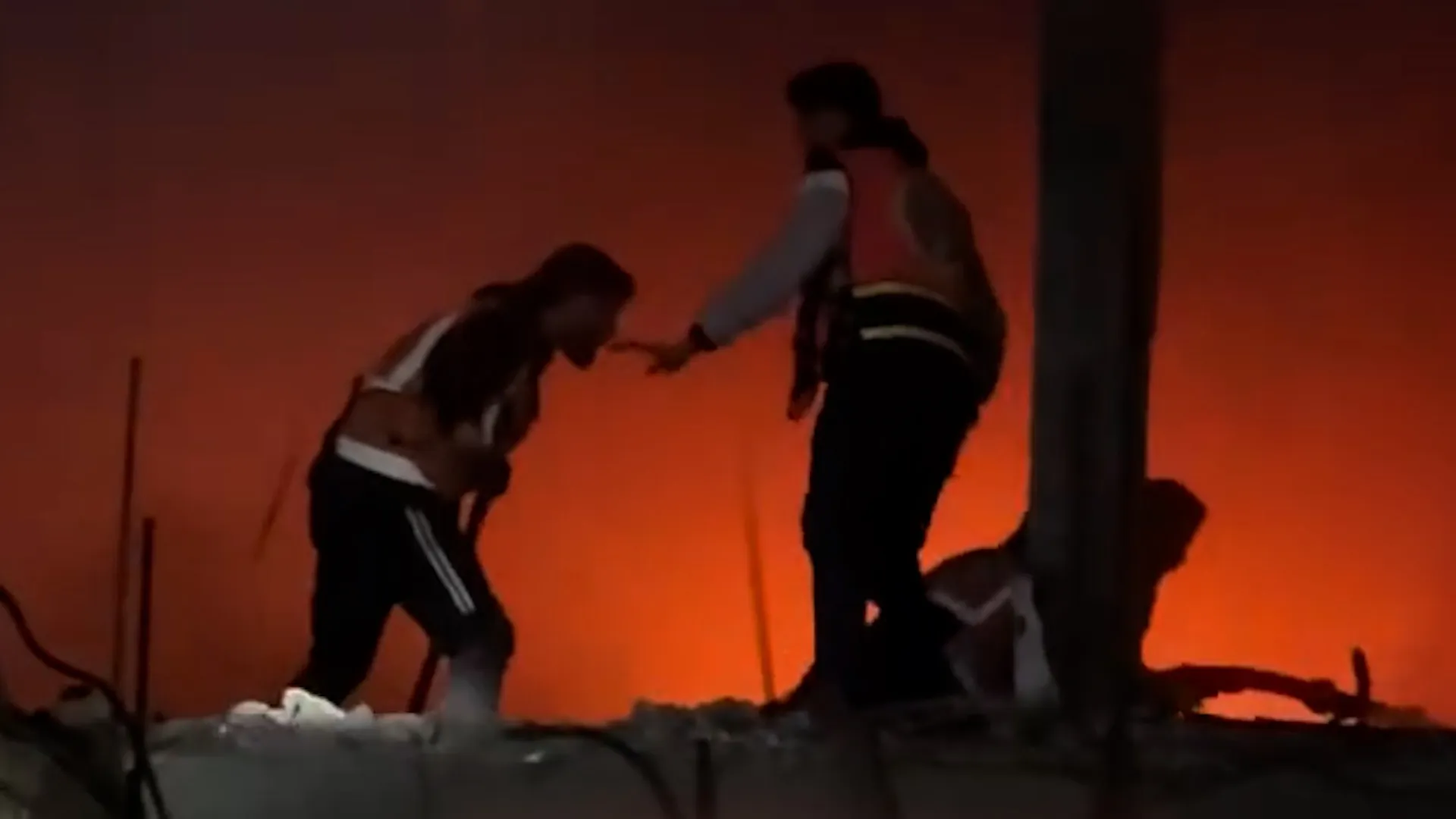
A blast occurred in an apartment above a restaurant in Gaza City, causing a blaze. Rescue teams headed to the site to put off the fires. The cause of the blast is suspected to be an Israeli drone attack, several people had died in the blast.
A BELOVED actress has been remembered as a “powerhouse of vitality and goodwill” after tragically dying following a battle with breast cancer.
Carrie Anne Fleming, 51, passed away in Sidney, British Columbia, and was best known for her role in the fantasy drama Supernatural.
Sign up for the Showbiz newsletter
Thank you!
Carrie Anne Fleming, 51, has tragically died after a battle with breast cancerCredit: GettyFleming’s death was confirmed by her Supernatural co-star Jim Beaver in a touching Facebook tributeCredit: Alamy
She is survived by her daughter Madalyn Rose.
Fleming was confirmed dead by her co-star and friend Jim Beaver in a statement to Variety.
The star died on February 26, from complications after battling the deadly illness.
Later, in a lengthy heartfelt tribute posted to Facebook, 75-year-old Beaver called Fleming his “soulmate”.
“To find a soul mate once in life is something of a miracle. To find one twice is almost unimaginable,” he said.
“To love and be loved is a pearl above price, but such pearls do come more than once or twice to the lucky.”
Beaver said loving her had been devastating, after losing Cecily – the mother of his child – to the same disease.
“I lost Cecily to cancer in 2004,” he said.
“Thursday, I lost Carrie to the same disease. I never thought my heart could break so badly more than once.
“But it has. But, oh, the two torches I carry – what bright, bright light they shed.”
He continued, recounting the first time they met on the set of the popular television series.
“Carrie Anne Fleming was cast as my wife on Supernatural in my fifth season on the show,” he said.
Beaver revealed he had “fallen for her hard” just seconds after meeting her for the first time.
He said he had been “shocked” to find she felt the same way.
“To find oneself paired with someone who not only loves and is loved, but who seems by magic or the grace of the gods to understand you, to want what you are, to want you to be what you are, who GETS you and never feels the need to have you defend who you are, and about whom you feel the same – how many of us can say that spark of divinity has alighted on us once, much less twice? I can,” he said in the heartbreaking tribute.
The pair bonded over both having daughters named Madeline Rose, with Beaver saying the discovery had been “the beginning of a beautiful friendship”.
The star was known for her roles in numerous popular TV showsCredit: GettyShe was born in Digby, Nova ScotiaCredit: Alamy
“We ran lines of dialogue together in my trailer and talked for hours that first day, and the electricity between us was practically visible,” he wrote.
Beaver said the actress had “an amazingly good nature … a rapturous laugh and an utterly adorable personality that didn’t seem to have an off switch”.
“I was so in love I think my eyes turned silver,” he said.
“She seemed to think I was worth hanging around with, too.”
Fleming also starred in other popular shows including iZombie, Smallville, Good Luck Chuck, The L Word, Married Life and Supergirl.
Born on August 16, 1974, in Digby, Nova Scotia, Fleming studied at Mount Douglas Senior Secondary in Victoria, British Columbia, and later attended the Kaleidoscope Theatre as well as the Kidco Theatre Dance Company for drama.
She broke into the industry through an uncredited appearance in Adam Sandler’s Happy Gilmore, and later in a role in Viper.
In 2005 she was cast in Dario Argento’s show Masters of Horror, starring as a disfigured woman with cannibalistic urges.
She went on to appear and star in other horror shows, including Bloodsuckers and The Tooth Fairy.
More recently Fleming played Candy Baker on five seasons of the CW’s iZombie.
She also appeared in the 2015 TV film The Unauthorized Full House Story, exploring the behind-the-scenes making of the hit sitcom.
Fleming played the mother of Full House star Candace Cameron Bure, who portrayed D.J. Tanner on the show.
Fleming also performed in a number of British Columbia stage productions, including Steel Magnolias, Noises Off, and Romeo and Juliet.
Troy Terry scored on a breakaway 1:29 into overtime for his second goal of the game after Mikael Granlund tied it late in regulation and the Ducks rallied to defeat the Buffalo Sabres 6-5 on Sunday night.
Anaheim ended Buffalo’s seven-game road winning streak when Tage Thompson couldn’t keep in the puck in the Ducks’ zone and Terry held on a 2-on-0 break to score on a backhander.
Granlund tied the score at 5 with 1:44 remaining in the third period on a power play with Ville Husso pulled for an extra attacker.
Chris Kreider and Jackson LaCombe had power-play goals in the first period, Beckett Sennecke also scored, Husso made 24 saves and the Ducks have won consecutive games as part of a four-game points streak.
Alex Lyon had his 10-game road winning streak — tied for the third-longest by a goaltender in NHL history — snapped after giving up six goals on 33 shots. That included giving up goals to Sennecke and Terry on two of the Ducks’ four shots in the second period.
Alex Tuch, Josh Doan, Jack Quinn, Owen Power and Zach Benson scored for the Sabres, who extended their franchise-record road points streak to 14 games. It was their second loss in the last 14 games overall.
Lyon hadn’t lost a road start since Dec. 8, when Buffalo was last in the Eastern Conference with a 2-9-2 record outside of upstate New York. The Sabres had since won 20 of 24 road games as part of an astonishing turnaround that has them set to end the longest playoff drought in the NHL and on track to claim a first division title since 2009-10.
A victory for Lyon would have tied San Jose’s Evgeni Nabokov in 2009-10 and Minnesota’s Devan Dubnyk in 2014-15 for the longest undefeated road run in league history.
March 23 (UPI) — President Donald Trump‘s border czar Tom Homan has confirmed that Immigration and Customs Enforcement agents will be deployed to U.S. airports starting Monday, despite strong opposition from unions and Democrats.
Homan told CNN’s State of the Unionon Sunday that he was working on the plan’s execution with acting ICE Director Todd Lyons and Transportation Security Administration Administrator Ha Nguyen McNeill.
“So, we’ll put together a plan today and we’ll execute it tomorrow,” he said.
On Sunday, Trump threatened to send ICE agents to U.S. airports over a protracted fight with Democrats over Department of Homeland Security funding.
Funding for DHS lapsed Jan. 31 after Congress failed to pass legislation to keep the department open, with Democrats are demanding reforms in response to federal immigration agents deploying aggressive tactics during the Trump administration’s immigration crackdown.
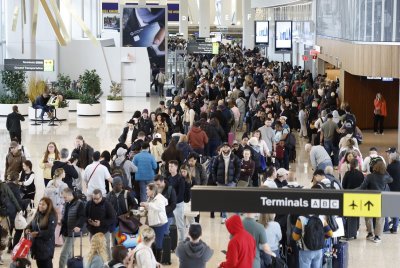
The partial shutdown is affecting the TSA, which is under the DHS. Airports are reporting long lines and congestion due to a shortage in TSA staff, who haven’t been paid since DHS funding ran out.
Trump threatened on his Truth Social platform that ICE will perform security at airports where they will arrest undocumented migrants, raising questions about whether the agents are being sent only to relieve pressure on TSA or to carry out immigration enforcement at major travel hubs.
Homan on Sunday sought to frame the move as a way to alleviate congestion and move long lines of travelers though security.
Asked if ICE had the specialized training to inspect bags and passengers, Homan said he doesn’t expect the immigration agents to be ‘looking at an X-ray machine, because we’re not trained in that.”
“But there are certain parts of security that TSA is doing that we can move them from those jobs, and put them in the specialized jobs to help those lines,” he said, adding that discussions with the TSA concerning what security roles ICE agents would perform were ongoing.
“We will have a plan by the end of today … what airports we’re staring with and where we’re sending them,” he said, suggesting that the worst affected airport will be given priority.
“So it’s a work in progress, but we will be at airports tomorrow helping TSA move those lines along.”
He also confirmed that ICE agents will perform immigration enforcement at the airport, underscoring that their deployment is mainly to aid TSA.
Republicans have attempted to characterize the shutdown as Democrats prioritizing undocumented immigrants over airport security, while the Democrats have blamed Republicans for blocking more than half a dozen attempts to pass legislation to fund the TSA, including on Saturday. The GOP lawmakers say they want to fund the entirety of the DHS.
“Instead of sending ICE agents to harass travelers at airports, why don’t Republicans get their act together and agree to pay TSA workers like we’ve asked them to SEVEN TIMES now?” Senate Minority Leader Chuck Schumer, D-N.Y., said in a statement on X on Sunday.
Vice President JD Vance accused Schumer of continuing “to hold TSA funding hostage.”
“Thankfully, ICE will bring sanity to our airports starting tomorrow, but it’s far past time for Democrats to fund DHS,” he said.
Following Homan’s interview, Rep. Dan Goldman, D-N.Y., accused the Trump administration of using ICE “to strike fear and terror on our airports.”
“Mr. President, it’s pretty simple: if you want TSA agents to get paid (as they should), then pass the Democrats’ bill to fund TSA,” he said on X. “No need for your out-of-control paramilitary to do yet another thing they aren’t trained to do.”
Hartsfield-Jackson Atlanta International Airport has been informed it is among those where ICE agents will be deployed Monday, Atlanta Mayor Andre Dickens said in a statement.
The agents will report to the TSA and will be assigned to line management and crowd control within domestic terminals, he said, adding that federal officials have indicated that they are not intended to conduct immigration enforcement activities.
“Our administration remains hopeful the Federal Government can soon find a way to fully fund TSA and pay their employees to resume standard operations at Hartsfield-Jackson Atlanta International Airport — and all airpots we connect to,” he said.
The deployment of ICE agents is also being lambasted by the American Federation of Government Employees, the largest government worker union in the United States.
It accused the Trump administration of sending ICE agents to do the jobs of the more than 50,000 TSA employees who have worked without pay for more than five weeks.
It also expressed worry that the ICE agents will be undertrained for what they may be required to do, arguing that stationing them at security checkpoints will create security risks.
“Our members at TSA have been showing up every day, without a paycheck, because they believe in the mission of keeping the flying public safe,” AFGE National President Everett Kelley said in a statement.
“They deserve to be paid, not replaced by untrained, armed agents who have shown how dangerous they can be.”
The leaders of several flight attendant unions also criticized the Trump administration on Sunday for using the TSA and frontline security officers “as pawns in this dangerous game,” stating that the DHS can use its billions of dollars in discretionary funding to pay them.
“This latest threat of ICE invasion at the airports is another distraction from solutions that protect Americans,” the Association of Flight Attendants-CWA, the Association of Professional Flight Attendants, International Brotherhood of Teamsters Local 135 and the International Association of Machinists and Aerospace Workers said in a joint statement.
The Argentinian star forward records his 901st career goal as Inter Miami beat New York City FC at Yankee Stadium.
Published On 23 Mar 202623 Mar 2026
Micael dos Santos Silva’s go-ahead goal in the 74th minute lifted Inter Miami to a 3-2 comeback victory over hosts New York City FC on Sunday.
Dos Santos headed home a beautiful ball from fellow defender Noah Allen, which found its way past NYCFC keeper Matt Freese and gave Inter Miami (3-1-1, 10 points) their first Major League Soccer (MLS) win since March 7.
Recommended Stories
list of 3 itemsend of list
Lionel Messi scored his 901st career goal, and Gonzalo Lujan scored his first career MLS goal for Inter Miami, which bounced back after being eliminated from the CONCACAF Champions Cup on Wednesday following a pair of draws against Nashville, with that side advancing on the away goals tiebreaker.
NYCFC (3-1-1, 10 points) suffered their first defeat of the season and snapped a three-game winning streak despite goals from Nicolas Fernandez Mercau and Agustin Ojeda.
Inter Miami’s Micael dos Santos Silva (#16) scored the match-winner in the 74th minute [Seth Wenig/AP Photo]
Maxi Moralez delivered a stellar assist to Ojeda in the 59th minute to put NYCFC briefly ahead 2-1.
Moralez sent a great ball through traffic down the middle of the field to Ojeda, who was uncontested, and flipped the ball past Inter Miami goalkeeper Dayne St Clair.
But two minutes later, Inter Miami earned a free kick, and Messi delivered. His shot deflected off NYCFC’s Hannes Wolf and redirected past Freese (five saves) to tie the game at 2.
Messi nearly had a multi-goal match as he came close on several chances. He hit the post in the 31st minute and the crossbar in the 42nd minute. He also had a late opportunity to pad Miami’s lead but missed wide.
German Berterame appeared to extend Miami’s lead in the 79th minute, but what would have been his first goal with his new club was nullified after he was ruled offside.
After Lujan scored in the fourth minute, NYCFC levelled the match with a fantastic free kick goal by Fernandez Mercau, who lifted a high shot that bounced just under the crossbar and in, freezing St Clair in place in the 17th minute.
NYCFC used Moralez as a decoy, having him approach as if he would take the shot, and then Fernandez Mercau ran up and booted it.
St Clair (three saves) made a huge save late in stoppage time to preserve Inter Miami’s win.
Monty Don has gone under the knife and admits he will need to do it again in 2027 as he opens up about his future with Gardeners’ World and retirement plans
Monty Don has been speaking to Saga magazine(Image: PA)
Monty Don has spoken of his “painful” recovery from a knee replacement in October that briefly slowed the Gardeners’ World host. The broadcaster and horticulturist went under the knife shortly after he turned 70 last Summer.
Looking back he says: “I was finding by the end of a day’s filming I could barely walk upstairs and I certainly couldn’t take the dogs for a walk. It was severely limiting what I was doing. I did it so I could keep on working because it was getting to the point where filming was cutting round me limping.
“However you do it, a knee replacement is horribly painful. But three months on I’m gardening again and haven’t walked with a stick for a month. Sarah says I’ve been doing far too much stuff, but it’s fine and going to plan – though it can be inexplicably painful one day and then not at all another. At some point, I’m going to have to do the other one – but only when I can fit it in, probably late 2027.”
**Ensure our latest headlines always appear at the top of your Google Search by making us a Preferred Source. **Click here to activate** or add us as your Preferred Source in your Google search settings.**
As well as planning his next new knee, the good news for his fans is Monty is also in discussions to continue hosting on screen Gardeners’ World until at least 2028.
Although speaking to Saga Magazine, he admits he may be closer to the end of his run than the beginning now, having been on the show since 2003, with a break between 2008 and 2011.
“I hope I’m continuing, but as I come up to the end of every contract, I seriously consider how it fits the rest of my life.” He ponders. “And each time, it’s come down fairly and squarely that I’d like to continue. But there will come a time when either they’ll say, ‘No, thanks’ or I’ll say, ‘It’s time for a change’. But neither of us, as far as I know, has reached that point yet.”
Almost all of his TV filming is done at his Herefordshire home Longmeadow, which the father-of-three shares with his wife Sarah and their two dogs; golden retriever Ned and Yorkshire terrier Patti.
“Longmeadow has a dual personality,’ admits Monty. “The compatibility between a private domestic garden for all the family and one that works for television is at best a fine line and at worst an impossible line to tread. Everything we do is heavily influenced by filming. I’m often working on the programme seven days a week and when we’re filming, it’s a place of work at every level.”
So whilst that level of work maybe ok for now, it seems there will come a time when he wants to do a bit less. Retirement completely is not on the cards though.
“I genuinely don’t know what retirement would look like. I don’t play golf or tennis, and I can’t see myself doing the crossword all day. Whenever I say to Sarah, ‘Well, thank God, I have no addictions’, she rolls her eyes and says, ‘You are completely addicted to work!’.”
Monty is also well known for being a dog lover with his faithful hounds on screen. He has lost three of his dogs in recent years – Nigel then Nellie who died in 2020 and 2023 – then Peggy who died on 24 January but thinks he is ‘good for one more at least’.
He said: “She[Peggy] was 16, very old, so while it was sad, somehow it was the right thing. She was completely deaf, 90% blind, and walking round and round in circles. So we’re down to just two dogs, Ned and Patti, the lowest number for a long time. Although I’m sure it will go up again, as there’s talk of more. I think I’m good for one more dog, at least.
“I’ve always said the deal with dogs is one of you is going to die, and with ageing it’s more likely to be you. But of course, the dog won’t care particularly, I think we completely romanticise that. They’re absolutely callous.”
* The full interview with Monty Don is in April’s Saga Magazine.