



Long-delayed China-North Korea bridge officially opens | International Trade
China and North Korea have officially opened the New Yalu River Bridge after a 12-year delay. The 3 kilometre bridge is expected to become the main land route between the two countries as they seek to improve relations.
Published On 15 Oct 2026
Russia says Ukraine resumes attacks on oil refineries | Russia-Ukraine war News
Ukraine president earlier said Kyiv was ‘done’ with energy ceasefire and strikes on Russian oil refineries would resume.

Published On 15 Oct 2026
Russia says Ukraine has targeted an oil refinery in Ryazan, about 180 kilometres (110 miles) south of Moscow, as President Volodymyr Zelenskyy said Kyiv was “done” with an energy ceasefire unilaterally announced by United States President Donald Trump over the weekend.
“The Kyiv regime attempted a large-scale attack on an oil refinery in Ryazan,” Moscow’s defence ministry said in a statement on Thursday, adding that a “fire broke out after drone debris fell onto the refinery site.”
Recommended Stories
list of 3 itemsend of list
Ukraine’s president earlier told the British newspaper the Financial Times that strikes on Russian oil refineries would resume, and accused the US of weakening Ukraine’s position on the battlefield by allegedly withdrawing crucial intelligence sharing.
Trump on Sunday unilaterally announced an “energy ceasefire” that was not publicly confirmed, and Moscow continued striking Ukrainian energy infrastructure. Ukraine said it suspended attacks on Russian energy sites for several days after Trump’s announcement.
The US has pressured Ukraine to halt strikes on Russian refineries, claiming that a suspension of attacks and a deal to purchase 1.8 million tonnes of diesel from Russia would help reduce soaring fuel prices.
“This politically is not simple [in America], because everybody will want to ask how it can be when some people are surviving, fighting, dying – and you make . . . business with the guys with such aggression,” Zelenskyy told the FT.
Zelenskyy also alleged that Ukraine’s access to SpaceX’s satellite internet service was restricted, potentially leaving it more vulnerable to Russian attacks. The Ukrainian armed forces use SpaceX’s military-grade Starshield system for offensive and defensive operations.
In a post on X on Wednesday evening, SpaceX owner Elon Musk said that only the US military and Trump had the authority to limit Starshield’s usage and speed for clients.
In a separate post, he called for Zelenskyy to “go” as Ukraine’s leader.
“And so the slaughter continues,” Musk wrote in a separate post on X. “Time for Zelensky to go.”
Ukraine is heavily dependent on Western military aid in its fight against Russia, particularly from the US and Germany. However, Kyiv’s relations with Washington have been strained in recent weeks, with Trump calling on Saturday for Zelenskyy to be replaced.
Against this backdrop of tensions, Zelenskyy said he would be willing to pause strikes on Russian energy sites again, but only if the US supplied Ukraine with crucial Patriot interceptors.
Zelenskyy is due to meet European leaders in Brussels on Thursday as he pushes for tougher sanctions on Moscow and faster delivery of support from the European Union.
Dutch Prime Minister Rob Jetten has called on EU leaders to “step up” their game to ensure Ukraine wins the war against Russia.
The EU has already pledged $50 billion in support for Ukraine next year. However, the sum falls far short of the $175 billion Kyiv plans to spend on its defences next year.
Trump has denied that the US has stopped sharing intelligence with Ukraine.

Chronicles of Narnia star weds American Idol partner as he pays gushing tribute to his new wife
CHRONICLES of Narnia star Ben Barnes has tied the knot with partner Aubrey Cleland.
Ben, 45, played the role of Prince Caspian in the titular 2008 film as well as 2010’s Voyage of the Dawn Treader.
Taking to Instagram, the actor confirmed he and American Idol alum Aubrey Cleland, 33, have wed.
Paying tribute to his bride, Ben penned: “We got married!
“In a world of 8 billion people, it is extraordinary to find someone who feels like your person, someone who matches your sense of humour, curiosity and humanity — with whom you can be effortlessly yourself, feel understood, valued and loved for everything that you are.
“And, speaking for the first time as a proud husband: I married a woman of such rare grace, kindness and beauty, who somehow makes the world feel both bigger and more like home, who finds wonder, joy and laughter in things that might have passed me by, and who makes the ordinary feel momentous.


“We are so happy and so excited for everything to come.
“Ben & Aubrey.”
Friends and fans soon flocked to the comments section to share their congratulations.
Actress Katherine McNamara wrote: “CONGRATULATIONS!!!”
EastEnders star Robert Kazinsky added: “My best mate got his fairytale!”
Katherine Heigl penned: “Oh my lord!!! Congratulations my old friend I am so so so thrilled and happy for you!!”
A fan shared: “Congrats Ben and Aubrey! Wishing you both so much love and happiness.”
Another remarked: “Could not be happier for you both! You both look absolutely radiant and stunning!!!”
A third chimed in: “Congratulations. Wishing you both a world full of happiness and luck. And a life together filled with love, laughter and creativity!”
A fourth said: “I’m in absolute tears!!! I have NEVER been happier.
“Congratulations you absolutely gorgeous humans!!
“May this next chapter be everything you both ever wished for!!”

Mendocino County’s Skunk Train introduces a luxe, adults-only railcar
A hike among redwoods is fine if you go in for that sort of thing.
But to gaze upon those towering trees from a slow train with a stiff drink in your hand — that’s something else entirely.
And with the latest added offerings from Mendocino County’s historic Skunk Train, slow-rolling drink-sipping is possible on short excursions from the railway’s stations in both Fort Bragg along Highway 1 and Willits along U.S. 101.

Known as the Noyo, this car is a new cocktail car that’s part of the Skunk Train, rolling from Willits, Calif.
(Christopher Reynolds / Los Angeles Times)
The first part of this expansion happened last year when the Mendocino Railway, better known as the Skunk Train, unveiled the Redwood, a fancy railcar offering cocktails as part of a seven-mile round trip from Fort Bragg. The Willits end of this expansion followed in September, when the railroad introduced another reconditioned traincar, this one known as the Noyo. Formerly a U.S. Army railcar, it’s now been reborn as a rolling cocktail lounge for up to 22 guests, featuring leather chairs, plush couches, a carpeted floor and ‘50s overtones.
On the journey I joined recently, passengers mingled in a spacious, adults-only railcar with vintage jazz on the sound system and servers outfitted in spiffy white jackets. For about $200 each, Willits-based passengers get a 16-mile round trip, charcuterie snacks and two cocktails (or mocktails).
Most popular cocktail so far: the Redwood Martini, made with dry gin, dry vermouth and orange bitters, served with a sprig of redwood.
The journey takes about two hours, passing through an 812-foot-long tunnel (a.k.a. Tunnel No. 2), then pausing to turn around in a clearing known as Crowley.

Passengers relax in the Skunk Train’s “presidential class” railcar, the Noyo, from Willits.
(Mendocino Railway)
Crowley, once a logging camp, can’t be reached by road, but train passengers can wander among picnic tables, fire pits, cornhole games and a massive, gnarled old redwood known as the Wolf Tree. (In September, when the performers of the Flynn Creek Circus were in town, the troupe hauled a big tent out to the clearing and staged two weeks of live performances there.)
Through October and November, the Skunk Train offers “presidential class” cocktail-car trips four to five days per week from Fort Bragg, two to three days per week from Willits. In December, trips from Willits are also offered on most weekdays and service from Fort Bragg drops to two days per week. (Willits-based service shuts down in January and February before resuming in March.)


1. Passengers in the Skunk Train’s “presidential class” railcar, the Noyo, from Willits get two cocktails (or mocktails) with the price of admission for a two-hour round-trip journey. 2. Besides cocktails or mocktails, service aboard the Skunk Train’s “presidential class” cars from Willits and Fort Bragg includes charcuterie plates. (Mendocino Railway)
These cocktail cars are the latest additions in a decade of Skunk Train team improvisations in the wake of long history and, more recently, trouble on the tracks.
The Fort Bragg Railroad started up in 1885 to haul redwood and fir logs to the coast for shipping south to San Francisco. By 1911 there was steam-driven passenger service between Fort Bragg and Willits, and by 1925, locals had nicknamed it the “skunk train” because of the odor that billowed from the railcars’ recently introduced gasoline-burning engines and oil-burning stoves.
That moniker might have faded, but in May 1959, National Geographic magazine devoted a spread to the train under the headline “The Friendly Train Called Skunk.” In its 40 miles, that article noted, the train climbed more than 1,600 feet, crossed 34 bridges and trestles and rounded some 381 turns, occasionally pausing to deliver groceries to rural neighbors.

A passenger soaks up atmosphere on the two-hour, round-trip Skunk Train journey from Willits in Mendocino County.
(Christopher Reynolds / Los Angeles Times)
Alas, the timber industry faded, a mail delivery contract was lost and railroad ownership changed hands. On the way, the Skunk Train began to depend mostly on tourists. Then in 2013, the railroad’s Tunnel No. 1 collapsed, blocking the tracks about four miles east of Fort Bragg. Repairs followed, but the same tunnel collapsed again in 2015. There were no injuries in either accident, but it remains impossible for any railcar to make the full 40-mile journey between Fort Bragg and Willits.
“We are committed to reopening the tunnel,” Mendocino Railway president and CEO Robert J. Pinoli has said. But the reopening won’t be quick. Besides the challenge of rebuilding the tunnel, the railroad has been tangled for several years in legal disputes with the city of Fort Bragg and the California Coastal Commission. For now, every trip on the Skunk Train, including traditional railcars and increasingly popular pedal-assisted railbikes, is an out-and-back journey designed to avoid the blocked tunnel.
From Fort Bragg, most train and railbike trips go 3.5 miles east and 3.5 miles back again. From Willits, most trips go eight miles west and turn around, including the fall Pumpkin Express and Christmas Train. The great exception is “Railbikes on the Noyo,” a 25-mile journey that begins near Fort Bragg with a hike to the east end of Tunnel No. 1. From there, guests pedal an eastbound railbike for 12.5 miles through the forest, including a dozen wooden trestle bridges and recurring views of the Noyo River. After a picnic lunch, guests double back to where they started. That adventure usually takes about six hours and starts at $564 (combined) for two people sharing a two-seat railbike.
The new cocktail car excursion, meanwhile, requires less time, less money and less perspiration.

A view of the Skunk Train’s Noyo railcar.
(Mendocino Railway)
After our train reversed direction at its midway stop in Crowley, I could have stayed in my comfortable cocktail-car seat. But I had been tipped to check out the back end of the train. That’s the open observation car (no ceiling) in the back of the train. Skunk Train employees say it was first built for the U.S. Marines to transport Sherman tanks. It works just fine carrying us gawking civilians.
“Ahhh,” said 2-year-old Elle Davis, looking up to the sky and standing by her mother, Kaitlyn Davis of Willits. The observation car is open to all aboard — that is, the Noyo Car passengers and to those Skunk Train passengers who pay standard fares ($81.47 per adult) for less luxe railcars (open to all ages).
As you stand there with the wind in your face and the rails rattling below, the evergreen boughs whoosh past. Depending on the hour and humidity, the sky might be dimming or masked by fog. These days you don’t get that skunky scent of years gone by, but a ride is still a full sensory experience. And even if you have an adult beverage in your hand, you might find yourself with the same sense of rejuvenation that engineer Johnny Galliani described to National Geographic back in 1959.
“Young or old, they’re all kids when they ride with us,” Galliani said. “Nothing like a ride on this train to take the years off your back and make you young again.”

Passengers board the Skunk Train on an excursion from Willits to a forest clearing (once a lumber camp) called Crowley.
(Christopher Reynolds / Los Angeles Times)

Thursday 15 October Independence Day in Guatemala
The provided text details the rich historical background of Guatemala, noting that the region served as the foundational center of the ancient Maya civilization. It explains how Spanish forces led by Pedro de Alvarado captured the majority of the territory during the sixteenth century, integrating it into the viceroyalty of New Spain. The article highlights that the area originally served as the native source for several vital crops, including potatoes, corn, chili peppers, and avocados. Furthermore, the source describes how European conflicts weakened Spanish control and sparked local rebellions, ultimately culminating in the official declaration of the Act of Independence of Central America on September 15, 1821. Finally, it outlines the subsequent political transitions, mentioning brief integration into the Mexican Empire before the region established the Federal Republic of Central America in 1823.

‘We just need to win tomorrow.’ Dodgers optimistic despite 3-0 hole
The Dodgers have two pitchers who have won multiple Cy Young Awards in Blake Snell and Tarik Skubal. Another starter, Yoshinobu Yamamoto, is the reigning World Series most valuable player.
None of them will be on the mound Thursday when the season will be on the line. Instead, manager Dave Roberts will put the ball — and his team’s future — in the massive right hand of Tyler Glasnow, who will have no margin for error.
“It’s win or go home,” Skubal said. “Our backs are against the wall.”

That’s not how Andrew Friedman, the Dodgers’ president of baseball operations, saw things playing out when he traded three prospects to Detroit for Skubal in August. Or when he spent $182 million to sign Snell before last season. Or when he committed $325 million to sign Yamamoto the season before that.
The Milwaukee Brewers have bested all three in the National League Championship Series, reaching Snell for the only three home runs he’s given up this season in a 6-2 win in Game 3 on Wednesday. Now Glasnow is the only thing standing between the Dodgers and a long, cold winter.
And while that may not be the way the Dodgers wanted things to play out, they say they like their chances — for one night, at least.
“Everybody in the team is very confident in his ability and the stuff that’s coming out of his hand and doing his job,” Skubal said of Glasnow.
“I feel great about Glas,” utility man Kiké Hernández added. “He’s got some of the best stuff in the game. I feel like our pitchers have given us a chance every day to win a game, and we just haven’t hit. So we just got to hit.”
Glasnow started the season as the No. 3 starter, but before the Dodgers had gotten six weeks into their schedule, he was on the injured list because of lower back spasms. He spent most of the season there, pitching more innings in minor-league rehab starts than he did for the Dodgers between May and September.
He returned to make six starts down the stretch, striking out 49 in 34-1/3 innings to finish the season 5-2 with a 3.53 earned-run average in 13 starts, then held Atlanta to one hit over 4-2/3 innings in the deciding game of the division series.
“He’s fresh,” Roberts said of Glasnow. “He’s got a lot of arm talent. He’s got experience certainly in the postseason. We’ve got a lot of guys behind him” in the bullpen.
“I think he’s going to pitch well.”
The Dodgers’ season is depending on that. Glasnow, however, is just approaching it as another start.
“When I was younger maybe I’d feel it and get excited, and I’m like, ‘Oh, I can throw 105 if I try hard,’” he said. “Now it’s more about trying to settle in and go back to as close of a normal feeling as possible, not trying to chase it and be any different or any more or any less. Just try to stay with it and what I’ve done all week, my preparation, how I feel on the mound, and just keep it consistent.”
Glasnow, 33, has pitched in 17 postseason games for Tampa Bay and the Dodgers, going 2-6 with a 4.27 ERA. Only Snell, among Dodgers starters, has more playoff appearances. But Glasnow hasn’t won a playoff game since the 2020 division series when he was pitching for the Rays.
If he can give the Dodgers a boost Thursday, however, if he can extend their season just one more day, it could give the team new life.
Only one team has come back from a three-game deficit to win a best-of-seven League Championship Series and that was the 2004 Boston Red Sox team Roberts played for — a team that also gave the ball to its fourth-best starting pitcher with its season on the line.
On the afternoon of Game 4, with the New York Yankees looking to beat Derek Lowe and sweep the Sox, Boston’s Kevin Millar stepped on the field at Fenway Park and issued a warning.

Dave Roberts of Boston steals second past Derek Jeter of the Yankees in the ninth inning of Game 4 of the 2004 ALCS. Roberts and the Red Sox became the only team to come back from down 3-0 to win an LCS.
(Jed Jacobsohn / Getty Images)
“Don’t let us win tonight,” he shouted. “If we win today, we’ve got Pedro [Martínez] coming back and then [Curt] Schilling will pitch Game 6 and anything can happen in a Game 7.”
The series played out exactly as Millar predicted. And if Glasnow can rescue the Dodgers, they would have their three high-paid aces — Skubal, Yamamoto and Snell — lined up for the next three elimination games.
But none of that matters if they lose Thursday.
“We just need to win tomorrow’s game,” Skubal said.

Iraq devalues dinar to ease cash crunch, leaving traders in limbo | Business and Economy News
Baghdad, Iraq – Sitting anxiously in his small office in Jameela market, one of Baghdad’s main wholesale markets, food trader Hamza al-Rudayni is waiting to see what the coming days will bring.
A decision by the Iraqi government to devalue the country’s currency, the dinar, against the US dollar has left traders like him facing sudden losses and uncertainty over the prices they should charge for their goods.
Recommended Stories
list of 3 itemsend of list
“I don’t know what to do,” al-Rudayni told Al Jazeera after the devaluation reduced the dollar value of his dinar holdings, leaving him with less money to purchase imported goods.
“All I know is I woke up a few days ago to discover that I had lost 25 million Iraqi dinars (roughly $16,500 at the new exchange rate) because of this decision, while larger merchants lost billions,” he said.
Al-Rudayni entered the wholesale trade market last year after losing his previous job at a private Iraqi bank that he says was sanctioned by the United States Treasury. He sold his car and used his savings to start trading with a larger merchant before recently launching his own business.
With exchange-rate fluctuations making prices unpredictable, al-Rudayni said he and many other traders have chosen to suspend buying and selling until the situation stabilises.
“Market activity has ground to a halt,” al-Rudayni said. “Traders buy goods in dollars but sell them in dinars, as regulations prohibit them from selling in dollars.”
That is the root of the problem for traders: A weaker dinar means they have to pay more in local currency for goods imported in dollars, while making it harder to determine the right price they should charge customers for goods they already have in stock.
Why devalue?
On October 7, the Iraqi government introduced a new official exchange rate against the US dollar, in an attempt to ease a financial crisis triggered by the US-Israeli war on Iran and the disruption of oil exports through the Strait of Hormuz.
Before the war, Iraq exported around 3.5 million barrels of oil per day through the Strait of Hormuz, accounting for 90 percent of Iraq’s government revenue.
The Central Bank of Iraq decision set the rate at 1,520 dinars per US dollar for cash sales to the public. It was previously set at 1,320 dinars per dollar.
Devaluing the Iraqi dinar by almost 15 percent against the dollar allows the government to receive more local currency for every dollar of oil revenue it converts, helping it cover public spending, including government employee salaries.
“It is my decision and I am responsible for it,” Iraqi Prime Minister Ali al-Zaidi said during a meeting with parliamentary leaders on Thursday.
“I was facing three challenging options to cover salaries and other mandatory expenditures,” al-Zaidi added. “The first is to cut salaries by 35 percent … the second is to pay the salaries every 45 days … while the third is to resort to foreign loans.”
Al-Zaidi, a former banker, also said that his government had inherited public debt exceeding 208 trillion Iraqi dinars ($139bn at the new rate) when it took office in May. He said the government needed approximately 10 trillion dinars ($6.7bn) each month to cover salaries and other essential expenditure.
A shortage of liquidity
The crisis in the Strait of Hormuz had caused a severe financial squeeze for the Iraqi government.
Although the situation has eased somewhat in recent weeks after Iraq’s oil exports partially recovered, they have yet to return to their pre-war levels.
Mudher Mohammed Salih, the Iraqi prime minister’s financial adviser, said in August that the Central Bank of Iraq’s foreign currency reserves had declined from $106bn to approximately $80bn.
To make up for the loss of revenue, the Iraqi government has also turned to borrowing from domestic banks to cover salaries and other expenses.
A Finance Ministry official told Al Jazeera that ensuring salaries were paid on time remained the government’s main priority, describing this issue as a matter of domestic economic stability.
“Our hands are tied regarding the revenue and how to maintain enough money to ensure that we can pay the salaries,” the official, who asked to remain anonymous because he was not authorised to speak publicly, said.
Economists have warned that while adjusting the exchange rate could ease some immediate fiscal pressures, it would not address the deeper weaknesses in Iraq’s economy.
“Nothing in economics is sacred, including the exchange rate,” said Nabil al-Marsoumi, professor of economics at Al Maaqal University in Basra. “It can be adjusted, but only after all other options have been exhausted.”
“In any case, the exchange rate shouldn’t be used as a cover-up for failures in the state’s economic and fiscal policies,” he added.

The irony of OpenAI crying foul over spying | Opinions
Americans can rest easy – for the moment, at least. The fine folks at the Federal Bureau of Investigation have thwarted a major national security threat.
On October 9, the FBI arrested 35-year-old engineer Abdulrahman Alfozan, a Saudi citizen employed at the California-based artificial intelligence company OpenAI, the maker of the chatbot ChatGPT, and a firm that describes its mission as ensuring that “artificial general intelligence benefits all of humanity”.
A press release from the United States Department of Justice said that Alfozan was accused of installing a “surreptitious audio recording device” in an executive conference room at the OpenAI offices in San Francisco.
The statement quoted Director of National Intelligence Jay Clayton’s assessment that “this serious situation underscores why winning the global super intelligence race is a national security prerogative”. (For those who have not yet got the memo, US President Donald Trump recently decreed that the term “artificial intelligence” be changed to “super intelligence” or “SI.”)
FBI director Kash Patel concurred that “protecting American SI innovation is essential to safeguarding our nation’s economic strength and national security”, and assured everyone that the FBI would continue doing its part “to ensure our country maintains its competitive edge”.
So much for the separation of corporation and state in the world’s self-appointed greatest democracy.
The covert device was reported to have been concealed in toilet paper and attached to the back of a television monitor. The Gizmodo website has noted with amusement that, despite being cast as a “sophisticated” spying apparatus, the device in question can in fact be easily ordered online “for the low low price of $13.99”.
If convicted, Alfozan faces up to five years in jail and a fine of $250,000.
Now, some of you may still be asking what the big deal is – and why the US government is acting like it’s 1950 and the Soviets are stealing our nuclear secrets.
The spectacle becomes all the more curious when we consider that the company up in arms over the alleged attempted theft of its technology owes much of its existence – and massive valuation – to stealing stuff from people.
The day before Alfozan’s arrest, USA Today and several other newspapers sued OpenAI in a Manhattan federal court for copyright infringement and the unauthorised use of hundreds of thousands of news articles and other materials to develop ChatGPT.
And back in July, various US media outlets including the New York Times and the New York Daily News requested that a federal judge impose sanctions on OpenAI for “hiding and destroying evidence showing how ChatGPT was trained on stolen journalism”, as attorney Steven Lieberman put it.
The moral of the story, perhaps, is that when OpenAI steals things it’s to “benefit all of humanity” – but when a 35-year-old Saudi engineer does it, it’s a national security crisis.
In case we were not already bored to tears hearing about national security, US Attorney General Todd Blanche took to X on Tuesday to preach that the “theft of intellectual property involving cutting-edge super intelligence technology poses a serious threat to our national security”, necessitating continued “swift action … to protect American innovation and safeguard our nation”.
Of course, many Americans might wonder why “innovation” gets such special treatment when they themselves are so often on the receiving end of government abuse. The frequency with which US police officers murder unarmed Black people, for instance, would seem to indicate that there are far more literal threats to the nation’s security than a $14 device hidden in toilet paper.
But human security is of no interest to a corporatocracy increasingly dominated by AI, an industry that thrives on putting people out of jobs and that is deeply entwined in a number of sordid developments at home and abroad. Among them is mass surveillance, which combines AI-assisted violations of civil liberties and constitutional protections with good old police state “innovation”.
To that end, a bunch of US cops have taken advantage of new AI-powered technology, such as automated licence plate readers, to stalk their exes. Then there is the matter of the FBI and other government agencies buying up data en masse from tech companies in a bid to keep tabs, Big Brother-style, on everyone’s personal information at all times.
It makes you think twice about the sudden concern for “spying” in the Alfozan case.
As for threats to other people’s national security, OpenAI and like-minded tech companies that do business with the Pentagon have been complicit in recent US aggression – from Venezuela to Iran – as the US pursues its strategy for “Accelerating America’s Military AI Dominance” (concocted before Trump mandated the renaming of AI as SI).
Israel, too, has exploited OpenAI technology, among other US-made goodies, to conduct its contemporary apocalyptic exercises in the Middle East. Last year, the Associated Press news agency (AP) revealed that US tech giants had “quietly empowered Israel to track and kill many more alleged militants more quickly in Gaza and Lebanon through a sharp spike in artificial intelligence and computing services”.
The AP report went on to note that “the number of civilians killed has also soared, fueling fears that these tools are contributing to the deaths of innocent people”.
But while it might be news to the AP, that is unfortunately how a genocide works.
And as the US goes to war for AI dominance while the tech giants bank on a post-human world, one can’t help but feel that the toilet paper was a nice touch, indeed.
The views expressed in this article are the author’s own and do not necessarily reflect Al Jazeera’s editorial stance.

Coronation Street fans convinced Bethany’s baby daddy isn’t Kit
Coronation Street’s Bethany Platt is pregnant after her fling with Kit Green, but some viewers are predicting a twist on the ITV soap involving another character

Bethany Platt’s baby news on Coronation Street has led to some predictions about who the father is(Image: ITV)
Bethany Platt’s baby news on Coronation Street has led to some predictions about who the father is.
While Bethany actress Lucy Fallon appeared to confirm the dad’s identity, it hasn’t stopped theories curculating about it being somebody else. Bethany learned she was pregnant this week, and she has yet to decide if she will have a termination.
Bethany had a fling with her mum’s ex Kit Green recently, with her mum Sarah Platt currently in prison. The betrayal and now the pregnancy has left her struggling in secret, but fans wonder if a twist will see another character confirmed as the father.
Amid a blossoming romance with Ryan Connor, fans are desperate for the soap to confirm that Ryan is the father of Bethany’s baby. It’s not thought that Ryan and Bethany have slept together, but fans still hope the soap will end up making Ryan the dad.
One fan said on social media: “It’ll be the same as EastEnders, she will tell Kit it’s his, have a DNA test and it ends up being Ryan’s then she just leads Kit on to believe its his.” Another fan said: “I think Ryan would be a great dad.”
A third fan posted: “Hope it’s Ryan’s but doubt that,” as a fourth commented: “I do hope it’s Ryan’s and they get together.” Another viewer said: “I hope it’s Ryan’s would be awful if the baby was Kit’s.”
One more prediction read: “My money is on Ryan,” as a final comment said: “Let’s hope it’s Ryan.” It comes as Lucy, who plays Bethany, appeared to confirm who the dad is.
According to her, Kit is the father, with this also hinted at in scenes this week. She shared: “It’s not going to end well, because it’s her mum’s ex-boyfriend’s baby!”
Lucy is expecting some fan backlash over the betrayal too. She explained: “I think they’re going to be annoyed at her and think that she’s just really stupid, which she is for what she’s done. But there was two people involved here so I’m hoping she doesn’t get all the blame.”
Bethany’s mum Sarah could soon find out about the betrayal too, while Lucy shared that Bethany will not want to tell her mum the truth. Lucy said: “[She feels] really, really, really guilty. Bethany and Sarah have a really good relationship, she’s been such a support to her, she’s basically been a mum to Harry while Sarah’s been in prison.
“They’re almost like best friends because they’re not so far apart in age. So she’s not feeling great about it, and I think it’s going to eat away at her until one day she can’t take it anymore.”
Coronation Street airs weeknights at 8:30pm on ITV1 and ITV X. * Follow Mirror Celebs and TV on TikTok , Snapchat , Instagram , Twitter , Facebook , YouTube and Threads .

Popular Spanish beaches introduce strict new bans with tourists facing £2,500 fines
BRITS could face hefty fines if caught smoking, or playing loud music at one popular holiday spot.
In some cases, the penalty could be as much as £2,500.
The area of La Laguna in Tenerife, has approved new rules banning smoking, camping, overnight stays and disruptive music on its beaches and natural swimming pools.
The announcement was made on October 7 and has been put in place to protect the coastline.
Under the new rules, beaches within the areas and natural pools are now smoke-free.
It also stops visitors from leaving rubbish behind including soap and shampoo in public showers.


Unless there’s a a special permitted event, beachgoers are banned from playing loud music or general noise that disturbs those around them.
The new rules also state that there is a ban on camping and overnight stays on the beaches.
Within the area of La Laguna, the coastal areas where these rules have been enforced include Bajamar, Punta del Hidalgo, Jover and La Barranquera.
While there is a maximum fine of €3,000 (£2,500), it does not apply to every beach.
The amount also depends on the offence with those deemed minor having fines of €300 (£254).
In summer 2026, lots of beaches and hotels in Tenerife put rules in place to stop tourists reserving loungers and sand space with a towel.
Tourists could see their belongings confiscated and be fined up to €3,000.
It comes after strict rules were put in place across Spain for summer 2026.


Commentary: Karen Bass says L.A.’s political establishment doesn’t like Raman. Well, boo-hoo
With three weeks left to go until election day and polls showing her on the brink of losing, Los Angeles Mayor Karen Bass has begun to channel the Sun King himself, Louis XIV:
L’État, c’est moi.
Gaslighting voters by insisting the political establishment that has left Los Angeles a mess and that she personifies is worth keeping in office for four more years is her only hope for victory. It’s a wild strategy that reached a crescendo during Tuesday night’s debate, as Bass kept bringing up the fact that L.A.’s ancien régime just doesn’t like her democratic socialist opponent, Nithya Raman.
“Your colleagues have a very difficult time working with you,” Bass snapped at one point, later claiming that Raman’s constituents don’t care for her even though the council member won reelection two years ago. The mayor twice bragged that immigrant rights groups support her; twice referenced Imelda Padilla, the moderate San Fernando Valley council member whose internet dragging of Raman has been out of the Burn Book from “Mean Girls”; and described her opponent as “not ready for prime time.”
Well, the way the mayor’s term has gone in the last couple of years, if it was a prime-time TV show, it might be called “Breaking Bad 2.” And it wouldn’t exactly be a hit.
If it were, two-thirds of Angelenos wouldn’t have decided to vote for anyone but Bass in the primary.
Bass arguably won the debate Tuesday night, but it felt like the technical “victory” — and that’s probably the wrong word — of a politician who is simply more polished. The mayor really needed a knockout punch, and that she did not achieve.
Instead, she in effect told voters that the last four years of disasters, inefficiencies and ineptitude are still a better option than taking a chance on the City Hall equivalent of the classroom dork.
Yet people are so angry at Bass and what she represents that a democratic socialist has a great shot at becoming L.A.’s next mayor — an unthinkable prospect even last year, with no one to blame but the ruling class that has left this great city hobbled, cynical and at the point of giving up.
So the establishment doesn’t like Raman: So what? And: Boo-hoo.
Casting Raman as a political leper while asserting that Bass represents stability and good times ahead isn’t the winning strategy that Bass and Raman’s critics think it is. It’s really just a sad coda for Bass.
She’s been a good soldier for L.A., someone who has participated in nearly every progressive movement to pass through Southern California since volunteering for Robert F. Kennedy’s presidential campaign as a teenager nearly 60 years ago. Even as Bass embarked on a 22-year political career that has seen stops in Sacramento, Washington and City Hall, the native Angeleno always successfully depicted herself as a political outsider.
Because she was: a Black woman in a realm not meant for people like her. She was someone who co-founded a pioneering nonprofit in the crucible of a changing South L.A. in the 1990s and always seemed to land on the right side of history until becoming mayor in 2022.
Sadly, Bass didn’t turn out to be the visionary L.A. desperately needed.

Mayor Karen Bass, left, sits for Tuesday’s debate with Councilmember Nithya Raman, right. Between them are NBC4 reporter Conan Nolan, NBC4 News anchor Colleen Williams and Telemundo 52 anchor Alejandra Ortiz.
(Eric Thayer / Los Angeles Times)
Like so many baby boomers, Bass eventually became The Man without realizing it. Today, she not only stands as the figurehead of the city’s liberal potentates, but she’s also calling on them to rally around one of their own — and they have responded in kind. Democratic politicians, bureaucrats and labor leaders, once rabble-rousers like Bass who nowadays seem to exist mostly to keep their sinecure, have labored mightily to convince unbelieving voters that Bass deserves another shot.
That’s always been the marvel of L.A.’s political establishment. It can take someone like Bass, once considered so radical that her days visiting communist Cuba in the 1970s torpedoed her chances of becoming then-presidential candidate Joe Biden’s running mate in 2020, and transform her into an anodyne incumbent. It can make democratic socialists like Councilmembers Eunisses Hernandez, Ysabel Jurado and Hugo Soto-Martínez — people who explicitly ran to take on a sclerotic City Hall — full-throated Bass supporters who have refused to support one of their own in Raman.
Raman was also becoming part of L.A.’s political chosen ones, to the point she initially endorsed Bass. But she now embraces her turn as the machine’s biggest sellout — whether it’s a true change of heart or a chameleonic self-serving measure, as critics maintain, remains to be seen. It was Raman who said at the end of the debate, “When the mayor is confronted with issues, she blames the system. With your support, we can actually change the system” — catnip to enough Angelenos that Raman seems to be at the cusp of victory and a monumental upset.
After the debate, NBC reporter Robert Kovacic interviewed elected officials to let them hype up Bass or Raman. The latter’s proxy was City Controller Kenneth Mejia, another person loathed by L.A.’s political know-it-alls because he keeps bucking the establishment. Mejia gushed about how Raman “destroyed” Bass with the enthusiasm of a Swiftie.
Bass’ supporters were Councilmember Monica Rodriguez and Assemblymember Rick Chavez Zbur, both of whom gravely parroted their candidate’s warnings about just how dangerous a Raman mayoralty would be. Chavez Zbur reduced Raman’s not-bad performance to a “host of complaints” — ironic, because most of Bass’ night was spent bashing Raman instead of offering much of anything positive.
Rodriguez, meanwhile, told Kovacic that voters shouldn’t choose Raman because “we can’t afford that level of indecisive leadership.”
I rolled my eyes when Rodriguez — whose office declined a chance for her to sit down with me to talk up why Latinos should support Bass — said that.
She’s part of the fabled eastern San Fernando Valley Latino political machine, another group of former gatecrashers who assumed the trappings and stylings of the old guard once they assumed power. Rodriguez long blasted Bass with the same venom she reserved for Raman until the latter mounted her challenge — but now that Rodriguez’s power is under threat, she’s all of a sudden decided to become Bass’ ride-or-die?
Moves like that remind me of another French monarch, Louis XV. “After me, the deluge,” he is supposed to have said, a warning of what would happen once his reign ended.
If Bass’ vow to rule the same as before represents a decisive leader, more and more Angelenos seem to be saying, give us the Raman flood.
Besides, nobody ever said, nor ever put on a campaign sticker, “The establishment? It’s cool!”
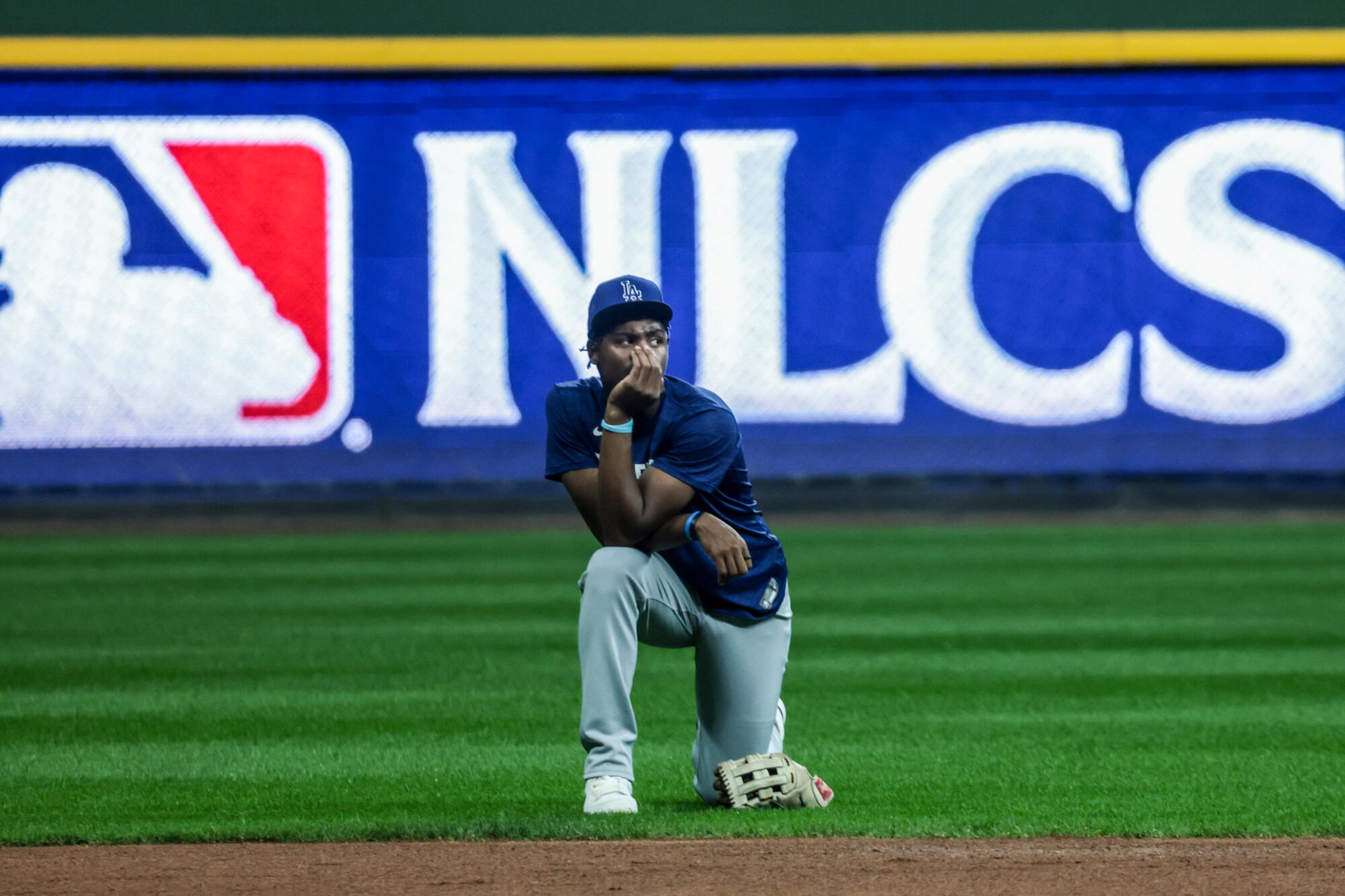
Here’s how Dave Roberts explained all the Dodgers’ moves that backfired
You don’t want to hear from me. You want to hear from Dave Roberts, the Dodgers’ manager.
The Dodgers are one loss from an abrupt ending to their season, and from a National League Championship Series sweep by the Milwaukee Brewers.
Let’s take you through the critical decisions Roberts made Wednesday night, the ones you second-guessed at home. They all pretty much backfired on him.
Situation: In the third inning, and again in the fifth inning, Tommy Edman comes to bat with Miguel Rojas on first base, none out, and the Dodgers trailing, 1-0. By the end of the fifth, the Dodgers had gone nine consecutive innings without scoring, and with a game plan of getting ahead before the Brewers’ vaunted bullpen could take over. Roberts does not ask Edman, one of the team’s most accomplished bunters, to sacrifice the runner into scoring position.
Roberts: “I just didn’t feel like giving up an out right there. … We could have bunted, but I felt I wanted to give Tommy an opportunity to drive in a run. … We haven’t been getting hits with runners in scoring position (3 for 32 in the postseason). To give up an out, to bank on getting a hit with runners in scoring position, I’d rather just try to maybe slug, hit a double.”
Result: Edman flied out both times. The Dodgers did not score in either inning.
———
Situation: In the sixth inning, with the Dodgers still trailing, 1-0, the Brewers turn to Abner Uribe, who had faced 26 batters and walked two in the postseason. Uribe walks the first two batters, and Roberts deploys his primary left-handed bench threat, Max Muncy. That takes right-handed Andy Pages out of the game; the only Dodgers with more hits than Pages this October are Kyle Tucker and Mookie Betts.
Roberts: “Abner is death on righties. You’re trying to guard against — you want to keep the inning going, and you don’t want a double play ball. Muncy’s not starting, and you want to fire that bullet in a leverage spot. First and second base, nobody out, it gives us the best chance to keep the inning going, in my opinion, and it gets Shohei up, and you have a chance to build an inning.”
Result: Muncy struck out.
———

Josue DePaula’s presence was wasted in Game 3.
(Robert Gauthier/Los Angeles Times)
Situation: After Muncy, Ohtani walks to load the bases, and Will Smith follows with a two-run double to give the Dodgers a 2-1 lead. With the right-handed Rojas due up, Roberts opts for the left-handed Josue De Paula as a pinch-hitter. Brewers manager Pat Murphy promptly replaces Uribe with left-hander DL Hall, who had been warming up. Roberts counters with the right-handed Kiké Hernández.
Roberts: “It’s a decision: Do I want Uribe facing Rojas? Then I chose De Paula, and they made the move. At that point in time, I felt we had the matchup advantage with Kiké. … For me, all the experience that Kiké’s had, I feel very confident with Kiké taking a bat with a guy on second and third, infield in.”
Result: Hernandez struck out, and so did Edman. The inning was over, and the Dodgers would not advance another man past first base the rest of the evening. The Dodgers could have used De Paula to bat against right-handed closer Trevor Megill in the ninth inning, but Roberts had already burned him.
Murphy said Uribe was coming out after Smith’s double no matter what — at that point, Uribe had thrown six strikes and 14 balls — so Roberts could have saved De Paula had he waited to see what Murphy would do.
———
Situation: Blake Snell has retired 14 consecutive batters entering the seventh inning, with the Dodgers leading, 2-1. It’s the first time the left-handed Snell has pitched beyond the sixth inning this season, with the right-handed Andrew Vaughn leading off and the left-handed Jake Bauers and Garrett Mitchell to follow. Evan Phillips is warming up in the Dodgers bullpen.
Roberts: “His stuff was really good. I don’t think they were seeing him well. I was trying to get him three more hitters. We had Evan for that fourth hitter.”
Result: Vaughn walks, on six pitches. Bauers homers, on 11 pitches. The Brewers have the lead, 3-2.
Roberts: “Hasn’t given up a homer all year, but it just — it’s baseball. For me, I felt good with where Blake’s stuff was at. You’ve got to give Bauers credit.”
Situation: By that time, Snell is at 99 pitches, two shy of his season high, after the exhausting battles with Vaughn and Bauers. Roberts sticks to his plan: Snell for Mitchell, then Phillips for the right-handed Cooper Pratt.
Result: Mitchell homers, giving the Brewers a 4-2 lead. Hall and Megill combine for 3 1/3 innings of scoreless relief, and the Dodgers are one defeat from winter vacation.
Police arrest US teen in alleged Illinois Hindu temple mass shooting plot | Racism News
Coworker alerted police after receiving disturbing messages from 19-year-old suspect.
Published On 15 Oct 2026
A teenager arrested in a Chicago suburb had shared a document expressing white supremacist views and outlined an alleged plan to carry out a mass shooting, potentially targeting a Hindu place of worship, police in the US state of Illinois have said.
Alexandros Paporakis, 19, of Palatine, was arrested on Sunday after an individual reported receiving concerning electronic communications from him, Palatine police said on Wednesday. It was not immediately clear whether he had legal representation.
Recommended Stories
list of 3 itemsend of list
Detectives searched Paporakis’s home and recovered a rifle, multiple loaded rifle magazines and hundreds of additional rounds of rifle ammunition.
“Among the recovered items was a tactical vest containing body armor and a patch displaying imagery associated with white supremacist extremism,” a police statement said.
Paporakis’s coworker reportedly told police that he openly identified himself as a white supremacist at work and said he “couldn’t wait” to kill Indian people, according to prosecutors from the Cook County State’s Attorney’s office.
Detectives recovered a document called “Why I fought: A.K.A.: (Aurora Shooter’s Manifesto)” which had sentiments expressing white supremacist and extremist ideologies, referencing violence towards South Asians, specifically Indians.
Authorities believed Paporakis was planning to carry out his attack on Sunday, possibly targeting a Hindu temple in Aurora, 40 miles (65km) southwest of Palatine.
“However, the specific intended location has not been confirmed and remains under investigation,” the police said, adding the FBI was assisting in the probe.
Police said Paporakis is facing felony charges of “making a terrorist threat” and possessing an unlawful weapon.
The suspect appeared for a detention hearing on Wednesday and his next court appearance is scheduled for the end of October.
Human rights advocates said hate against South Asians has surged in the United States in recent years due to rising anti-immigration policies and a rise in white supremacist ideology.
Army Explains How Merops Interceptor Drone Became Program Of Record In Just 142 Days
The U.S. Army turned the Merops interceptor drone into a formal program in just 142 days, an acquisition milestone that highlights efforts to speed the service’s response to emerging threats and get combat-proven capabilities into the hands of troops and allies. The Merops won accolades for its role in defending against Iranian barrages of Shahed-136 one-way attack munitions in the Middle East.
Speaking at the Association of the U.S. Army’s (AUSA) main annual convention in Washington, D.C., where TWZ is in attendance, Col. Christopher Hill, director of the Army’s Global Tactical Edge Acquisition Directorate (G-TEAD), described the Merops effort as “an example of how we can move fast when we need to.”

The Merops is a small, relatively low-cost counter-UAS system designed to rapidly intercept long-range, one-way attack drones in flight. It was originally developed under the U.S.-backed Project Eagle initiative, with contributions from Swift Beat, a company associated with former Google CEO Eric Schmidt. The system uses Surveyor drones as airborne interceptors, with onboard sensors to track targets and the ability to operate autonomously or under remote control. The interceptors can destroy enemy unmanned aircraft through direct impact or a proximity-detonated explosive warhead.
The interceptor was initially brought to the Army’s attention after drone incursions involving two NATO partners prompted a senior commander to demand an urgent response. The system was not part of the commander’s original acquisition plan, Hill explained, but its demonstrated performance in Ukraine made it a compelling candidate.
“He said, ‘I want this capability in the hands of our partners within 14 days,’” Hill recalled. “Everyone looked around the room, and he looked over at me, and I nodded my head like, ‘We’ll figure it out.’”
The Army did not quite meet that deadline. Hill said acquisition personnel and soldiers went into the theater to evaluate the capability, ultimately getting it into the hands of NATO partners within approximately 21 or 22 days.

A new system to identify and take down Russian drones is deployed to NATO’s eastern flank
That initial effort has since expanded. Hill said the Army procured additional Merops systems in partnership with the Joint Interagency Task Force, which procured 13,000 of the interceptors. The effort also progressed from providing the capability to NATO partners to supplying mobile Merops firing teams to a second theater — presumably U.S. Central Command (CENTCOM).
In CENTCOM, the U.S. military has been confronting the threat posed by Iran’s Shahed-136 and other one-way attack drones, which have been used in barrages against American and allied forces and installations in the Middle East. Former Army Secretary Daniel Driscoll had previously highlighted Merops as a particularly attractive option for countering such threats because of its relatively low cost and the speed with which it can be acquired.
You can watch Driscoll’s testimony on Merops at the 36-minute mark of the video below:

Budget Hearing – The United States Army
During congressional testimony, Driscoll said the Army was able to purchase 13,000 Merops interceptors within approximately eight days after the conflict with Iran began. He put the cost at about $15,000 per interceptor, with the potential for that figure to fall below $10,000 as production scales. In a separate interview with Bloomberg, he suggested larger orders could eventually push the price down to between $3,000 and $5,000.

Shahed drones have been estimated to cost tens of thousands of dollars apiece, while traditional air defense interceptors are far more expensive. Using comparatively inexpensive drones to defeat them can improve the economics of air defense while preserving more sophisticated interceptors for threats that require them.
Ukraine has employed Merops alongside domestically produced interceptor drones to counter Russian Shahed/Geran one-way attack drones. The system’s battlefield use has helped demonstrate the potential of a new class of air defense weapons designed to defeat these kinds of drones without relying exclusively on costly surface-to-air missiles.

However, Hill cautioned that success in Ukraine does not automatically mean a system will perform equally well in every operational environment.
“On the Merops, it absolutely was influenced by [Ukraine]. I mean, that’s where it came from. That’s where we saw the capability,” he said. “But that’s one of the things where the employment of the system really matters.”

Hill noted that the system’s effectiveness will vary depending on where it is used, including differences between desert environments and the urban areas where it has operated in Ukraine. The objective, he said, is to get the capability into the Army’s inventory so commanders can make informed decisions about how and where to use it.
“Once we get it into our hands, now we can make a decision in Europe. Where does it go? Do I even need it?” Hill said. “It’s getting it in our hands. So that was the key for the Merops. The speed of getting it, then we can make the decision of how we employ it.”
That approach reflects a broader change in how the Army wants to manage emerging technology. Rapid fielding is important, but the service also wants to avoid acquiring a capability for an urgent operational need only to leave it without a clear path toward long-term funding, production, and support.
Hill said G-TEAD’s process is designed to involve the organizations that will eventually take responsibility for a capability from the outset. Program acquisition executives, or PAEs, are involved early, while the Army’s test and evaluation community and soldiers provide feedback as the system is assessed. The goal is to identify a transition partner upfront rather than wait until after an initial fielding effort to determine who will take ownership.

“We want to make sure that we’re giving commanders capability that we know works,” Hill said.
He described the directorate’s standard process as a 180-day effort, with the objective of reaching a decision on whether a capability should become an Army program within that period. The Merops effort, at 142 days, moved faster than that target.
The process is also intended to address what acquisition officials often call the ‘valley of death’: the gap between getting an emerging capability into the hands of operational units and the point at which a program office takes over and provides the funding and contracting structure needed to scale it.
“We will work to fill that valley of death gap between the time that we put capability into the hands of units and the time that the PM picks it up and actually [provides funding],” Hill said. “There’s a gap there. So we can do that intermediate scaling portion before it fully transitions.”

The effort builds on the Army’s wider push to streamline acquisition, an issue Driscoll has also emphasized. The Army secretary previously described an old process involving 16 decision-making steps, each with the ability to veto a proposal and send it back through the system. That structure could leave the service waiting two to seven years to purchase a capability.
The Merops experience suggests that some of those delays can be reduced when acquisition professionals work directly with operational units and the organizations responsible for evaluating and sustaining new equipment.
But rapidly acquiring an interceptor is only part of the challenge. The Army must still determine where it offers the greatest value, how it fits into existing air defense architectures, and how to produce and sustain enough systems to meet operational demand.
Low-cost interceptors are also not a replacement for every layer of air defense. They are, however, an increasingly important option against large numbers of relatively inexpensive attack drones, particularly when the alternative is expending missiles worth hundreds of thousands or millions of dollars to defeat each target.
For the Army, Merops is therefore serving two purposes: providing an additional tool against the growing one-way attack drone threat and demonstrating a faster route from an emerging battlefield capability to a formally supported military program.
Contact the author: thomas@thewarzone.com

LA28 still not prepared for Cultural Olympiad, critics say
With less than two years until the 2028 Olympic and Paralympic Games in Los Angeles, serious questions remain about funding and coordination for the Cultural Olympiad, the arts and culture program accompanying the Games.
The Cultural Olympiad is a measure of a host city’s commitment to the creative arts and can have a lasting impact on a region’s artistic legacy. The 2024 Olympics in Paris featured more than 2,500 projects over a period of three years. And while Los Angeles arts organizations and neighboring cities are already commissioning work and developing neighborhood celebrations, critics say a more formal and cohesive plan has failed to materialize.
At a legislative hearing Wednesday at the California Science Center, lawmakers pressed organizers for answers to a basic question: How much money will there be to support the Cultural Olympiad, and when will that money reach the artists and communities expected to bring it to life?
Former Los Angeles County Supervisor Zev Yaroslavsky, director of the Los Angeles Initiative at UCLA’s Luskin School of Public Affairs, criticized the failure to mobilize cultural planning earlier. Los Angeles was awarded the Games in September 2017, giving it nearly 11 years to prepare.
“I’m not trying to point a finger here, but it just didn’t happen,” he said.
The delay had consequences, he warned: major artists book engagements years in advance, limiting what organizers can now arrange.
“So that’s the kind of thing that we lose. But that doesn’t mean that the Cultural Olympiad is a flop.”
Yaroslavsky also described the 1984 Olympic Arts Festival as a catalyst for Los Angeles’ cultural growth. “It allowed us to think much bigger,” he said.
“The urgency to share what our local communities can expect has been pressing, and many local cities and nonprofits could no longer wait for outside direction,” said Sofia Klatzker, Santa Monica’s cultural affairs manager.
She outlined Santa Monica’s proposed cultural framework, “Land and Water Here and Now,” encompassing performances, exhibitions, public art and international cultural exchanges.
The joint hearing of the Senate’s Special Committee on International Sporting Events and the Legislature’s Joint Committee on the Arts brought together about 100 city and county officials, LA28 Cultural Olympiad leaders and arts advocates. Their presentations revealed a patchwork of efforts, with municipalities and organizations moving ahead while seeking clearer coordination and financial commitments.
Sen. Benjamin Allen (D-Santa Monica), who chairs both committees, convened the hearing.
A September report from City Administrative Officer Matthew W. Szabo and Chief Legislative Analyst Sharon M. Tso puts LA28’s Olympic and Paralympic Games budget at $7.263 billion.
At Wednesday’s hearing, Dwayne Jones, LA28’s senior vice president for the Cultural Olympiad and stakeholder events, did not disclose a precise cultural budget or how much funding had been secured. He described a fundraising ambition in the tens of millions of dollars, with conversations underway with philanthropic donors and LA28 partners.

The Olympic cauldron is lit at the Los Angeles Memorial Coliseum ahead of the launch for ticket registration to the 2028 Summer Olympic Games Tuesday, Jan. 13, 2026, in Los Angeles.
(Damian Dovarganes / Associated Press)
Sen. Lola Smallwood-Cuevas (D-Los Angeles) repeatedly questioned how those resources would reach artists and community organizations. After the hearing, she conceded that “there are a lot of unanswered questions.”
LA28 Cultural Olympiad Executive Director Nora Halpern and Jones provided updates on plans first outlined in May, including an official Cultural Olympiad mark recognizing participating programs and a digital calendar and mapping platform. They also said programming spanning fashion, film, food, music, performing and visual art, will be announced in 2027.
Applications for the mark are expected to open in early 2027. The calendar and mapping platform is scheduled to launch in January 2028.
Separately, Halpern said artists had been selected to create 16 official posters — eight Olympic and eight Paralympic — through a process involving nominations from regional curators. The posters will be unveiled in July 2027.
Jones also described free community film screenings paired with local food and musical performances, as well as plans for dance, theater and spoken-word programming. Further announcements will come in 2027, he said.
City and county cultural affairs officials presented complementary efforts. Los Angeles’ Department of Cultural Affairs general manager Daniel Tarica said $15 million from its existing budget has been committed to its core program.
The department reported completing 19 programs and events this year, citing World Cup celebrations that combined sports screenings with art-making and dancing. The department is continuing exchanges between local and international artists and testing neighborhood programming ahead of an official summer 2027 launch. Additional initiatives, including 15 new Olympic and Paralympic murals and disability arts celebrations, depend on further funding.
Los Angeles County’s Department of Arts and Culture is building its 2028 effort around existing grants, youth programs, public art and neighborhood partnerships, Director Kristin Sakoda said. Plans include a Year of Creative Youth, an Olympic arts education curriculum being developed with the Olympic Museum in Switzerland, and outreach through parks, libraries and cultural venues.
Arts administrators from Long Beach and West Hollywood described local initiatives. Long Beach Cultural Affairs Officer Griselda Suarez reported investing $135,000 in 12 groups to pilot cultural projects, while Rebecca Ehemann, arts manager, City of West Hollywood, said the city was completing its first year of implementing a multiyear creative plan.
Arts for LA CEO Gustavo Herrera presented Mosaic LA, a community-led initiative intended to coordinate neighborhood cultural programming and sustain investment beyond 2028. Its proposals include a pooled fund, technical assistance and shared promotion, alongside exploration of a new county-level arts funding mechanism. Cultural districts would anchor the effort.
Its financing remains unresolved. “There are budgets that have been laid out, but no resources that have been allocated to it yet,” Herrera said.
The discussion also touched on the federal government’s role. Congress has appropriated $1 billion through FEMA’s State Homeland Security Grant Program for Olympics-related security, planning and other costs, and $94.3 million for Games-related transportation assistance. Those commitments are separate from the cultural fundraising described at the hearing.
Assemblymember Christopher M. Ward (D-San Diego) called for federal financial support and “a little bit of a better attitude,” saying recent political rhetoric was unhelpful to attracting visitors to California.
Earlier this month, President Trump drew criticism for remarks at a Nebraska rally about Iran potentially striking Los Angeles and San Diego. He subsequently said his comments had been misinterpreted.
The potential benefits of the Games are not automatic, UCLA professor of history Dr. Tawny Paul cautioned. Her research found that large Olympic visitor numbers do not necessarily translate into higher museum attendance, underscoring the importance of local audiences and programming before and beyond the competitions.
For Smallwood-Cuevas, securing additional state support requires a clearer account of the needs.
“At the end of the day, we need a concise, coordinated and clear ask,” she said after the hearing. “That’s rooted in some real facts.”
Horowitz is a special correspondent.

Justice Dept. demands California prove citizenship for lists of voters
The U.S. Department of Justice has ratcheted up its pressure campaign on California election officials to ferret out alleged voter fraud ahead of the Nov. 3 midterm election, demanding that officials statewide prove the U.S. citizenship of thousands of voters flagged by the federal government as potential noncitizens, or withhold or set aside their ballots.
Acting Deputy Atty. Gen. Trent McCotter made the demand — which experts called highly questionable at a time when votes are already being cast — in letters to state election officials Tuesday, including Secretary of State Shirley Weber and Dean Logan, head of the L.A. County Registrar-Recorder/County Clerk’s office.
The letters, reviewed by The Times, call on the state officials to respond to the Justice Department within 48 hours.
McCotter wrote that the Justice Department had provided Logan’s office with a “password-protected thumb drive with a list of names the Federal Government believes are likely noncitizens who were sent a vote-by-mail ballot” for the Nov. 3 election.
“We request that you review the list within 48 hours to determine whether any citizens are listed. For individuals whom you cannot independently confirm citizenship status, we request that you immediately instruct the appropriate elections officials to segregate — not cancel — those individuals’ vote-by-mail ballots until their citizenship status can be determined,” McCotter wrote to both Weber and Logan.

The demand letter came from U.S. Acting Deputy Atty. Gen. Trent McCotter, shown entering a news conference in September 2026 in Washington.
(Finn Gomez / Getty Images)
Voters on the federal list who haven’t already been sent a ballot should not be sent one until their citizenship is verified, while ballots already returned by voters on the list should not be counted until their citizenship is verified, McCotter wrote.
Weber’s office in a statement late Wednesday criticized the Justice Department for telling it to obtain a list of an unknown number of voters it hadn’t been given directly from Logan’s office, investigate all of those voters and “take action” all within 48 hours, based on inaccurate federal data that has led to U.S. citizens being purged from rolls in other states, and under threat of litigation despite the Justice Department providing no legal authority for the demand.
Weber said the Justice Department’s “relentless efforts to unlawfully gain access to states’ protected voter data and purge voter rolls serve only to cause chaos and fuel public distrust in our elections,” and that California already has “robust state law requirements” to ensure only U.S. citizens vote.
Logan said his office was reviewing the Justice Department letter in coordination with Weber and California Atty. Gen. Rob Bonta, but had not accessed the USB drive because state officials “do not consider the device a secure medium” and accessing its contents “would conflict with established data privacy and information security protocols.”
He said that maintaining accurate voter records is a fundamental responsibility of his office, but also that federal and state laws “are clear on how voter eligibility is established — and any action to remove a voter from eligibility must be based on verifiable information, not assertions of unconfirmed data matching.”
Weber previously questioned the basis for a claim by Homeland Security Secretary Markwayne Mullin in July that there may be more than 190,000 noncitizen voters on California rolls, and rebuffed Trump administration offers to work with her office to purge state rolls of such ineligible voters ahead of November without additional information on how it reached its conclusions.
Similar Trump administration lists have been shown in other states to be substantially inaccurate, and to include many voters who are indeed citizens. Election experts say that makes the demand on California — where ballots have already been mailed out — even more concerning.
“One must question why the DOJ would violate its own rules about investigating elections close to election day, and over a week after they knew the state had already mailed ballots out, particularly when their past claims have been full of errors,” said David Becker, executive director of the nonpartisan Center for Election Innovation & Research.
Becker noted the Trump administration alleged that there were nearly 16,000 noncitizens registered in Nevada, later reduced that number to 185 after additional scrutiny, and then determined all of them were in fact citizens.
A Justice Department spokesperson, in a statement to The Times, defended the agency’s demands to California — saying it “should not be controversial, as the criminal statute is clear: only American citizens may vote in federal elections. It is a federal crime for noncitizens to vote in U.S. elections, and the DOJ is asking California to ensure that is not occurring.”
The spokesperson said the agency could not provide the exact number of voters whose citizenship is being questioned, but that it is in the thousands.

California Secretary of State Shirley N. Weber speaks during the state Democratic Party convention in Anaheim on May 31, 2025.
(Damian Dovarganes / Associated Press)
McCotter wrote that if Weber cannot implement his demands for how to segregate ballots and verify voter citizenship for those on the federal list, the Justice Department “will have no choice but to seek emergency relief” — an apparent reference to seeking court intervention.
McCotter copied on the letters First Assistant U.S. Atty. Bill Essayli, the lead federal prosecutor in Los Angeles whose office previously sent Logan’s office a series of grand jury subpoenas for individual voter records as part of a criminal investigation into illegal voting.
Essayli’s office referred questions to the Justice Department. Bonta’s office referred questions to Weber and Logan.
Rick Hasen, director of the Safeguarding Democracy Project at UCLA School of Law, said that he is “not aware of anything like this ever happening this close to an election,” and that it may in fact be illegal under the National Voter Registration Act, which “prevents systematic purges of voters 90 days before the election.”
He said that the question of whether that preclusion against purges applies to the removal of noncitizens is an issue that is currently before the U.S. Supreme Court, in an Arizona case the high court will hear in December, but that the Justice Department’s actions strike him as “legally questionable.”
Hasen said the “whole point of that 90-day rule is to prevent the inadvertent disenfranchisement of eligible voters by mistake in the rush before the election,” and that risk is increased by the inaccuracies of similar lists presented by the Trump administration in other states. “So if there is an attempt to go to court — if DOJ tries to sue over this — they might have a hard time getting a judge to agree that this is something that the registrar must do or even can do.”
The fact that election officials are already busy receiving and preprocessing ballots would only bolster the state’s position in such a case, Hasen said.
“It’s obviously not a convenient time,” he said. “And given the fact that the lists have proven to be wildly inaccurate, at least in other states, it might be sending the registrar on a wild goose chase, when they have more relevant things to do in the election.”
But that “chaos” may be the point, Hasen said. “This is potentially another example of DOJ just making the work of state and local election administrators — which is already quite difficult and stressful — even harder,” he said.
Attorneys with the UCLA Voting Rights Project filed a lawsuit last month on behalf of the Coalition for Humane Immigrant Rights, or CHIRLA, and a California voter named Pedro Trujillo, in which they challenged the Trump administration’s use of unproven federal databases to allege registered California voters are not citizens.
On Wednesday, they told the Justice Department that they would be seeking emergency relief from such practices, given McCotter’s letters.
“The federal government’s attempt to pressure California election officials into acting on lists that may misidentify eligible voters is an alarming abuse of power as election season gets underway. This puts our communities and our fundamental rights at risk,” said Carl Bergquist, a CHIRLA attorney.
The Justice Department in recent weeks has announced scattered arrests of alleged noncitizen voters around the country, and Trump administration officials — including Essayli — have pointed to such arrests as proof that noncitizens are voting illegally.
Such voting does happen, Hasen said, but after months of the administration aggressively searching for such voters, the relatively small number of arrests “belies the contention that it’s widespread” or criminal, with many of the few cases identified the result of “administrative error or misunderstanding” rather than an intent to illegally cast ballots.
In his letters to Weber and Logan, McCotter wrote that allowing “noncitizens to vote cancels citizen votes,” and that ferreting out illegal noncitizen voters is a joint responsibility of state and federal officials.
“States are responsible for voter registration, and the Federal Government is responsible for maintaining immigration records to enable verification of citizenship,” he wrote. “Working together, we can more effectively protect against voter dilution and promote election integrity.”

Marco Reus and Galaxy shut out the Portland Timbers
Marco Reus had a goal and an assist to back JT Marcinkowski and the Galaxy beat the Portland Timbers 2-0 on Wednesday night at Dignity Health Sports Park.
Reus staked the Galaxy (10-11-9) to a 1-0 lead in the 17th minute when he used assists from Robert Taylor and Pablo Ruiz to score his eighth goal of the campaign.
That’s where the score stood until Reus set up up Justin Haak in the 80th minute for his second goal this season and his fourth in 110 matches. It was the career-high 11th assist for Reus.
Marcinkowski finished with five saves for the Galaxy. It was his fourth clean sheet in 24 starts this season.
James Pantemis stopped three shots for Portland (9-14-6).
The clubs played to a 1-1 draw in Portland to close out March.
The Galaxy improved to 6-4-5 at home, while the Timbers fall to 2-10-3 on the road.
Portland has gone 1-4-2 since the start of September.

Is Lamine Yamal’s Barcelona record better than Messi’s as a teenager? | Football
A string of mazy runs down Barcelona’s right flank, two goal assists within three minutes, and a player of the match award cap off yet another impressive night in European football; Lamine Yamal continues to rack up remarkable statistics and mesmerising performances eight weeks into the club football season.
While this isn’t Yamal’s breakthrough year by any means – the Spanish forward first burst onto the scene as a 16-year-old in the 2023-24 season – his consistency for both club and country in the past eight weeks has led to comparisons with some of the greatest prodigies of recent years.
Recommended Stories
list of 3 itemsend of list
Since returning from the FIFA World Cup as a champion, Yamal has enjoyed scintillating form with the Catalan side.
Across the eight match weeks in club football, the 19-year-old has scored eight goals and provided nine assists in his 10 matches in all competitions for Barcelona, bringing his total number of goal contributions to an impressive 17.
All-time Barcelona and Argentina great Lionel Messi had 14 goal contributions – eight goals and six assists – to his name in the 2008-09 season, when he won his first Ballon d’Or award as a 19-year-old.

Barcelona’s Lamine Yamal vs Real Madrid’s Kylian Mbappe
Yamal has made no secret of his desire to win the award in 11 days, but he will face stiff competition from French star Kylian Mbappe and England captain Harry Kane.
Mbappe, who has broken goal-scoring records of his own, leads the attack at Real Madrid – Barcelona’s fiercest rivals and the undeniable kings of European football.
While Real have not won the Champions League since the 2023-24 season, which brought their record-extending 15th trophy, Mbappe helped them beat Italian giants Inter Milan in their first match last month.
Before joining Real in 2024, Mbappe was on a goal-scoring spree with French champions Paris Saint-Germain. He joined the club as an 18-year-old in 2017 and enjoyed great success a year later.
As a then-19-year-old, Mbappe scored 12 goals and made four assists in his first 10 games, bringing his goal contribution to 16 – one behind Yamal’s current record after the same number of matches.

The master Messi vs apprentice Yamal?
While comparisons between Yamal’s overall career with Messi’s would be grossly unfair, the Spaniard is following in his club legend’s footsteps.
Both players enjoy the unique statistic of having scored braces in their first five La Liga games. Messi’s came as a 25-year-old in the 2012-13 season, while Yamal has achieved the same feat this season.
In April 2007, Messi scored his famous solo goal against Getafe, dribbling from his own half past five players as Camp Nou watched in awe.
Three months later, Lamine Yamal was born, and not long after, Messi was seen with baby Yamal in a photo that went viral this year.
The hype reached fever pitch during the World Cup as a young Messi bathed baby Yamal during a TV commercial. At first, many thought it was an AI-generated image, but it’s indeed real and dates back to 2007.
During a UNICEF fundraising shoot at Camp Nou stadium, a 20-year-old Messi met Yamal, who was only five months old at the time.
The two Barcelona stars faced off in the World Cup final on July 19, with the Argentinian walking away in tears as Yamal’s Spain lifted the trophy, but not before they exchanged a warm embrace.
Yamal later revealed what he said to Messi on the pitch in New York.
“I said thank you for everything you gave football,” Yamal told a British newspaper.
Before the final, much of the attention had centred on the battle between 39-year-old Messi and 19-year-old Yamal, with the match likened to a master vs apprentice clash.
Nineteen years on from that iconic photo, Yamal is already chasing Messi’s Barcelona milestones. Here’s how old each of them was when they played their 150th game for the club.

Barcelona boss says ‘Everyone’s watching Lamine’
During the current season, Yamal’s incredible goal tally overshadows that of three other La Liga teams.
His seven individual goals in the league are more than what Valencia (six), Getafe (four) and Malaga (four) have managed as teams.
The forward’s form and skills are not lost on his manager, Hansi Flick.
The Barcelona boss heaped praise on his number 10 after the 4-1 win over Galatasaray in Istanbul.
“When you see the chances Lamine creates in every training session, it’s the same in matches. I have a lot of top-quality players. Everyone’s watching Lamine – that’s only natural.”
“It’s incredible to have players like that; he’s turned the game around for us.”

From Morocco to South Africa, Israel election watched closely across Africa | Israel Election 2026 News
Lagos, Nigeria – As Israelis prepare to vote on October 27, African governments from Pretoria to Rabat are weighing what the result could mean for their own foreign and domestic policies.
The war on Gaza has exposed sharp differences across the continent, with some governments pursuing diplomatic measures against Israel while others maintain commercial and security ties.
Recent polling has shown a closely contested race between Prime Minister Benjamin Netanyahu’s Likud party and the far-right coalition it leads and a bloc of Jewish-led opposition parties.
Neither is projected to win the 61 seats needed for a majority in the 120-seat Knesset, with a protracted period of coalition talks expected to follow the vote.
The next government’s approach to Gaza and the Palestinian question could influence Israel’s efforts to preserve and expand its partnerships across the continent.
Israel’s relationships across Africa are shaped by competing priorities. While the Gaza war has intensified diplomatic pressure and public opposition in many countries, security needs, commercial interests and longstanding bilateral partnerships continue to influence government decisions.
Diplomatic strain vs closer ties
Since the war began in October 2023, South Africa has emerged as one of Israel’s most vocal critics in Africa. Its government brought a case against Israel at the International Court of Justice (ICJ), alleging violations of the 1948 Genocide Convention. Israel rejects the allegations. The court’s so-called provisional measures in 2024, including an order for Israel to take action to prevent acts of genocide, are not a final ruling on whether genocide has occurred.
In November 2023, South Africa’s National Assembly adopted a motion calling on the government to close the Israeli embassy and suspend diplomatic relations. The motion did not itself implement those measures, but it underscored the strength of political opposition to Israel’s military campaign.
Other African governments have taken different approaches that reflect national political priorities and foreign policy calculations rather than a single continental position.
Chad recalled its ambassador to Israel in November 2023, while some countries have maintained relations despite criticism of Israel’s military campaign in Gaza.
Morocco offers a contrasting example. It restored relations with Israel in 2020 under a US-backed arrangement linked to Washington’s recognition of Moroccan sovereignty over Western Sahara. Despite public demonstrations opposing normalisation, Rabat has continued to pursue closer ties.
On September 16, Israeli Foreign Minister Gideon Sa’ar and Moroccan Foreign Minister Nasser Bourita met in New York at a trilateral summit hosted by US Ambassador to the United Nations Mike Waltz. The three countries reaffirmed plans to upgrade diplomatic relations, elevate their respective missions to embassies and appoint ambassadors.
They also agreed to conclude investment protection and double taxation agreements by the end of this year, expand flights to include Moroccan airlines and arrange reciprocal high-level visits in the coming months. These were announced commitments, rather than confirmation that the changes had already been implemented.
For Idowu Johnson, associate professor of international relations at the University of Ibadan, the diversity of African states makes it difficult to predict a uniform response to Israel’s election.
“Africa’s heterogeneity means individual states have handled relations with Israel separately. Since the October 7, 2023 attacks, African criticism has focused on Israel’s denial of Palestinian statehood.
“The October 27 election will therefore be pivotal, as a new government’s stance on the Palestinian cause will shape how far Africa cooperates on agriculture, trade, security and technology, guided by self-determination and international law as well as bilateral interests,” Johnson said.
Israel’s relationship with the African Union (AU) also reflects these divisions. In 2021, the AU Commission chairperson accredited Israel’s representative to the organisation, prompting objections from member states.
In February 2022, the AU Assembly established a committee of heads of state and government to consult on Israel’s observer status. The dispute continued into 2023, when the AU moved to suspend Israel’s accreditation pending further consideration.
The disagreement has reflected wider divisions over Israel’s treatment of Palestinians and the organisation’s approach to the conflict.
A new Israeli government could seek to ease those tensions, but any change would depend on its policies as well as the positions of AU member states.
Security ties may outlast diplomatic tensions
Security cooperation has been a significant part of Israel’s relationships with some African governments. Israeli companies have pursued defence and security contracts involving equipment, surveillance technology and training.
But the nature and scale of those relationships vary by country and claims about particular agreements or technologies should be tied to documented cases rather than treated as evidence of a uniform Israeli security presence across the continent.
The Democratic Republic of the Congo offers a recent example of efforts to deepen cooperation. Congolese President Felix Tshisekedi visited Israel on August 31 and September 1, meeting Prime Minister Benjamin Netanyahu and President Isaac Herzog. Discussions covered security, defence, agriculture, infrastructure, energy and high technology. Both sides expressed a desire to strengthen their strategic partnership and expand cooperation across several sectors.
The visit followed memorandums of understanding signed on July 27. Congolese officials said the visit would review those agreements and explore further Israeli investment, including opportunities linked to the Lobito Corridor. The meetings demonstrate the potential scope of bilateral cooperation, but do not establish that a specific new security contract has been concluded.
For governments confronting armed groups, insecurity can create incentives to seek equipment, intelligence and training from foreign partners. Yet the importance of Israeli cooperation differs between countries and diplomatic tensions will not necessarily have the same effect on every security relationship.
The limits of Israel’s diplomatic outreach were also evident after it recognised Somaliland as an independent state on December 26, last year, the first country to do so. Somalia and other critics rejected the move, arguing that it undermined Somalia’s territorial integrity. The decision triggered demonstrations in Somalia and Somaliland.
Speaking to Al Jazeera this month, President Hassan Sheikh Mohamud said Somalia will not accept Israeli presence in the country “under any circumstances”. He added that Israel was planning to establish a naval base in Berbera and use the city’s airport, adding that its real aim was to get closer to the Gulf states and Iran.
According to the Armed Conflict Location & Event Data project (ACLED), 110 demonstrations directly linked to Israel’s Somaliland recognition had been recorded by the time of its February 2026 Africa overview. Only seven supported the move, all in Somaliland; the others opposed it. The figures cover demonstrations linked to that particular decision, not all African views of Israel, and should not be treated as a continent-wide measure of public opinion.
Hossamaldeen Ibrahim, an Africa analyst at the Bloomsbury Intelligence and Security Institute, argues that public opposition can constrain governments even when they see strategic value in maintaining ties.
“The strongest constraint, however, may come from African publics rather than governments: the Somaliland recognition drew widespread opposition, the African Union and many governments reaffirmed Somalia’s territorial integrity, and ACLED logged 110 related demonstrations, only seven in support.
“Depending on its approach, the next Israeli government could therefore either deepen strategic cooperation in Morocco, Sudan and the Red Sea, or face a legitimacy problem if it continues policies seen as tied to the Gaza war, widening the gap between state-level cooperation and public sentiment,” Ibrahim told Al Jazeera.
The Somaliland episode shows how a diplomatic move can provoke opposition when it is perceived to challenge a core principle of sovereignty.
It does not, by itself, establish that African governments will abandon security agreements with Israel. The consequences will depend on the countries involved, the terms of their cooperation and the domestic political costs of maintaining them.
Trade, agritech and the contest for influence
Trade and development cooperation offer Israel another route to maintaining relationships in Africa. Israeli firms and officials have pursued partnerships in areas including agriculture, irrigation, water management, health and technology.
Such cooperation can offer practical benefits to governments seeking investment and technical expertise, but commercial ties do not necessarily translate into public support for Israel’s policies.
Zambia illustrates Israel’s efforts to deepen bilateral engagement. Israel opened a resident embassy in Lusaka in August last year, after a 52-year absence. Agriculture, water management, health, education and technology have been identified as potential areas for closer cooperation. The move formed part of Israel’s broader effort to strengthen its engagement with African countries.
Some analysts have interpreted Israel’s renewed engagement with Zambia as an attempt to cultivate partners who could counterbalance South Africa’s influence in the region. That remains an interpretation, not an established explanation for the relationship.
Zambia has its own reasons for seeking investment and cooperation, particularly in agriculture, water management and technology; closer bilateral ties alone do not prove that countering South Africa is Israel’s objective.
Professor Iwebunor Okwechime, of Obafemi Awolowo University, points to the historical roots of South Africa’s position towards Israel.
“If we trace the stance South Africa took, it goes back to the apartheid era, when Israel backed the apartheid regime and refused to support the struggle against the minority government. This historical context is important for understanding South Africa-Israel relations today,” Okwechime told Al Jazeera.
For African governments, the challenge will be to balance security and commercial interests against public opposition, commitments to Palestinian rights and positions on international law. For Israel, the upcoming election will test whether a new government can ease diplomatic tensions across Africa without fundamentally changing the policies that have fuelled them.
As Okwechime told Al Jazeera, “There won’t be a radical change in sentiments regardless of the government in power”.

Leave Leo alone! I’m on the fat jabs but this is why I’m backing ‘dad bods’ over gym bros any day

IF Leonardo DiCaprio, a man who seems to have dated half the Victoria’s Secret catalogue, can’t whip his shirt off on a Hawaiian beach without critics likening him to a beached whale, what hope is there for the rest of us blokes?
The recent photos of Leo catching some rays sparked a frenzy of online trolling, with keyboard warriors gleefully pointing out that the actor – shock horror – no longer possesses the boyish physique he sported 30 years ago on the bow of the Titanic.
Apparently, we are now fair game and it’s open season on the male waistline.
Leo’s holiday flab, the internet decided, was public property, ripe for mockery.
They disparagingly call it the “Dad Bod” – even though Leo, as far as we know, has yet to produce any sprogs.
It’s a term delivered with a patronising smirk, conjuring images of a bloke whose primary exercise consists of walking to the fridge between repeats of Top Gear.
But let’s pause for a second and reverse it. Would any sane person ever dream of pointing a camera at a woman on a beach and laughing at her “Mum Bod”?
You’d be cancelled in an instant with feminists queuing up to condemn you.
Yet, when it comes to blokes, it seems the rules against bodyshaming don’t apply.
Now, I’ll acknowledge the elephant in the room, women have put up with relentless, toxic body scrutiny for decades.
But it’s the women in my life who have been most gleeful when scrutinising poor Leo.
It’s only fair they argue, after all 51-year-old Leo isn’t shy at letting his own preferences be known, dating a string of twenty-somethings who look like they’ve never consumed a carb in their short lives.
But underneath the jokes about Leo’s paunch, there is a serious side to all of this.
The pressure to look like a muscle bound Marvel actor is driving ordinary blokes to desperate measures – and contributing to poor male mental health.
Gym memberships are skyrocketing, not just because men suddenly care about their cardiovascular health, but because they are chasing the Hollywood aesthetic.
We are witnessing an epidemic of normal blokes turning to unregulated peptides and sometimes illegal supplements, desperately trying to keep up with the unachievable, steroid-assisted standards plastered across their Instagram feeds.
I’ll hold my hands up and confess I am one of the millions who has tried the fat jabs.
After years of miserable yo-yo dieting, I would always end exactly back where I started, so I finally caved and got on the Mounjaro.
The pharmaceutical quick fix certainly worked, helping me to lose a couple of stone within six months despite the dreaded side effects.
But despite my smaller frame – and annoyingly pricey new wardrobe to match – I still have to contend with the toxic pressure of the perfect body burrowed in my own brain.
And I’m far from the only one. Just look at the male celebs who are supposedly at the top of the food chain.
Pop icon Robbie Williams has been open about his own torturous battle with his weight and his use of fat jabs, telling fans: “I could write a book about self loathing where my body image is concerned, like pure self hatred.
“The struggle is real. The sadness is shocking. I’ve had it all my life. And it won’t abate.”
James Corden has faced abuse from those obsessed with his waistline, even channelling his frustration with the industry into Nessa and Smith’s love story in Gavin & Stacey.
He once said: “If an alien came back and they had to take a reading on planet Earth by just watching films or TV, they would imagine that if you are chubby or fat or big, you never really fall in love, you never have sex. Certainly no-one really ever finds you attractive.”
Even the supposed “hunks” are miserable. While Jason Momoa has shrugged off “Dad Bod” criticism, Zac Efron has spoken out about the severe dehydration and “pretty bad depression” he suffered to get his Baywatch body.
While Chris Pratt had to ditch his Parks & Rec “dad bod” to break Hollywood as the ripped Star-Lord in Guardians of the Galaxy.
But then found himself criticised for being too thin, forcing him to warn critics to back off: “Just because I am a male doesn’t mean I’m impervious to your whispers. Body shaming hurts.”
So it’s little wonder that the next generation of young men are endlessly preening themselves in the mirror.
They call it looksmaxxing, a dystopian online cult where young lads obsess over every facet of their appearance to fit a very specific alien-like visage.
We have genuinely reached a point where an influencer known as Clavicular, literally smacks himself in the face with a hammer in a bid to attempt to reshape his jawline, and is watched in this mindboggling process by millions of impressionable youngsters.
We have created a world where teenage boys are learning that blunt-force facial trauma is preferable to looking like a normal human being.
It’s time to call time on the madness.
If the price of a Hollywood physique is a lifetime of misery, macros counting, and taking a hammer to your own cheekbones, you can count me out.
Let’s leave Leo to enjoy his Hawaiian holiday in peace, and please give us blokes a bloody break too.

‘I went to the Maldives for £350 – it doesn’t have to cost thousands’
Natasha Whitley has saved a huge amount compared to the costs people expect to pay

Natasha Whitley on her budget holiday to the Maldives(Image: Natasha Whitley/SWNS)
A budget traveller who has been to the Maldives four times has revealed how she spent less than £350 on one trip.
Natasha Whitley, 30, first travelled to the country in April 2024 with friend Kara, 26, for five days and tried out two islands – Thulusdhoo and Dhiffushi. Staying in cheap accommodation costing just £60 per night and a local ferry costing them just £1 to get from the airport, Natasha “loved it”.
Since then Natasha started her own business for solo travellers, Say Yes Adventures, and returned to the Maldives a further three times as part of group trips. Her most recent visit in February 2026 saw her travel solo on a new island – Fulidhoo – for three nights.
She flew from Gatwick Airport with her flights costing £800 – but it cost just £2.50 for the three-and-a-half-hour ferry trip from Malé to Fulidhoo. She stayed at a hotel costing £260 for three nights, she explored the local island and tried out local food like Maldivian fish curry while there. After paying £29 for a speedboat back from Malé, she continued on to stay at an all-inclusive resort called Niva Kuramathi Maldives – which she says was “not affordable at all but interesting to see the contrast”.
Love of travel
Natasha, a content creator from Bournemouth, Dorset, said: “I’ve always loved travel and I was lucky my parents were interested in travel. They met while travelling in the 80s, so it’s always been a part of my life and story.
“I’m a pharmacist and I worked for four years and took a career break, which was meant to be eight months – it was a big round-the-world trip to Australia, New Zealand, Hawaii and Central America all on a budget.
“I quit my pharmacy job for a content creation summer job. I met my friend Kara the following year and put the feels out there to see if she wanted to come to the Maldives with me.
“There’s not much online about the Maldives on a budget – people know it as somewhere super expensive and a honeymoon destination. In terms of budget I think we said we’d spend around £100 per day on accommodation and activities.
“We spent less than that and spent £420 over the five or six days. You see all the resorts across from you on the local islands, which is crazy because people are paying thousands and you’re spending a fraction of the price in the same waters. Staying on local islands has saved me a lot of money.”
2026 trip
In February 2026, Natasha headed out on her fourth trip to Fulidhoo.
She said: “In the Maldives my favourite food is the Maldivian fish curry, which is usually five dollars. From that island you can do snorkelling trips and watch wild stringrays and nurse sharks from the jetty at night.
“You can snorkel off the beach as well. If you’re nervous about solo travelling just start small, don’t think big because a big six-month trip can be quite overwhelming. The best way to start is to join a group trip because you travel solo, but as soon as you arrive you’re in a group of people, so you get a bit of both”.
In total, Natasha has spent more than 100 nights in the Maldives over the last two years, which would have cost her more than £45,000. You can follow Natasha’s adventures on @travelsbytash and find out more about her group travel company Say Yes Adventures at sayyesadventures.com.
Costs for Natasha’s trip to Fulidhoo
Accommodation: £261 for 3 nights, including breakfast
Transport: £2.50 for local ferry, £30 for speedboat
Food: £7 to £10 per meal
Total cost: £344.50
Example costs for a trip to a resort
Accommodation: £2,482 for 3 nights in an overwater bungalow with private pool and full-board
Transport: £127 return speedboat from Malé
Food: £47, including shrimp pad-Thai at à-la-carte restaurant
Activities: £91, snorkelling with manta rays
Total cost: £2,747

U.S. Banks’ Urge to Merge
This article appears in the October issue of Global Finance Magazine.
U.S. banks are merging again as a rare combination of a friendlier regulatory environment, excess capital among the bigger players, and the rising cost of competing in artificial intelligence continues to drive broad industry consolidation.
S&P Global Market Intelligence data shows that 81 banking deals were announced in the U.S. in the first half of 2026, the largest first-half tally since 2021.
The resurgence in banking mergers and acquisitions follows a regulatory shift that began in May 2025, when the Office of the Comptroller of the Currency restored expedited review and a streamlined application process for the industry’s mergers. Two months later, the Federal Deposit Insurance Corp. rescinded its 2024 policy statement on bank mergers and returned to its earlier guidelines, broadening the regulatory overhaul.
The practical effect has been a shorter path from announcement to completion: Median deal time fell from 187 days in 2024 to 134 days in 2025 and 94 days so far this year, according to S&P Global.
Bankers responded with a series of deals, including Huntington Bancshares’ acquisitions of Veritex and Cadence Bank and PNC’s purchase of FirstBank. By the fourth quarter of 2025, bank deal value had reached $26.3 billion, the highest quarterly total since early 2019.
“If you are a bank looking ahead at succession planning or at the technology investments to compete as you get bigger, there is this window within this administration,” said Catherine Mealor, a Keefe, Bruyette & Woods managing director. “If you think you might want to sell within the next three or four years, you might as well go now. You can get it closed quickly.”
According to PwC research, five banking deals worth more than $5 billion were announced in the latest four-quarter period, pushing aggregate deal value to roughly the same level as the previous four quarters despite a lower volume of transactions.
The consolidation pressure is also coming from the capital side of the equation. Recent research by Bain & Co. found that 17 U.S. lenders each held more than $10 billion in excess capital at the end of June, with seven above $20 billion.
The same research also found that deals combining scale with new capabilities delivered total shareholder returns 14 to 18 percentage points above scale-only transactions over the past two years, as banks face rising costs to build and maintain technology and artificial intelligence capabilities.
Bigger Deals Become the Norm
That appetite for scale is visible in this year’s largest transactions. Santander’s $12.2 billion acquisition of Webster Financial created a $327 billion-asset bank, while Fifth Third’s $10.9 billion purchase of Comerica produced the ninth-largest U.S. bank. Pinnacle Financial Partners’ merger with Synovus created another institution with more than $120 billion in assets.
Sellers, though, may not agree with buyers regarding a franchise’s worth. The median price paid for a bank seller is about 141% of tangible book value, according to Piper Sandler, while 68% of banks surveyed by Bank Director say they would require at least 175% to sell.
Thomas Monteiro is a contributing writer based in Spain.
The post U.S. Banks’ Urge to Merge appeared first on Global Finance Magazine.