



The Days Of Army Air Defense Systems Firing Just One Type Of Interceptor Are Ending
The U.S. Army now has at least five named programs seeking new anti-air interceptors of various tiers to collectively address everything from advanced hypersonic missiles to small weaponized drones. In the process, an important central theme is emerging: the service’s days of fielding air defense systems that can only use one type of interceptor look to be increasingly over. For the U.S. military, the impacts from the war with Iran have made clear that diversifying munitions stockpiles and supplier bases is no longer just valuable, it is critical.
Army Lt. Gen. Frank Lozano, the service’s Portfolio Acquisition Executive for Fires, highlighted this growing trend yesterday during a panel discussion at the Association of the U.S. Army’s (AUSA) main annual convention, at which TWZ has been in attendance.

To provide some immediate context, with the exception of Patriot, the main ground-based air defense systems in Army inventory today are fielded with just one type of interceptor. In the case of Patriot, the service’s procurement of new interceptors had also been increasingly limited to just one type, the PAC-3 Missile Segment Enhancement (MSE). Production of the preceding PAC-3 Cost Reduction Initiative (CRI) missile ended in 2023. Just earlier this year, the Army placed its first order in decades for new PAC-2 Guidance Enhanced Missile-Tactical (GEM-T) missiles, an older interceptor design for Patriot that has remained in production primarily for U.S. allies and partners.

Separately, the Army is in the process of fielding Enduring Shield, a new middle-tier air defense system designed to handle multiple interceptor types. However, the service is currently only acquiring AIM-9X Sidewinders to load into them. We will come back to this later on.

“We have the capabilities we need to have to fight and win, but it’s our job to ensure that victory is achievable in the future inside of any dynamic environment scenario fight we might find ourselves in,” Lt. Gen. Lozano said yesterday. “So, it’s incumbent upon Mr. Ingraham [Assistant Secretary of the Army for Acquisition, Logistics and Technology Brent Ingraham] and I to continue to be creative and looking at, well, should we buy GEM-Ts because they’re being produced?”
“GEM-Ts are a really good missile in the battlespace within they operate. I mean, they’re being employed today by air defense brigades around the world,” he continued. “So if we have the opportunity, it’s probably something we should take advantage of, and we’re looking at doing that.
“We’ve had a lot of discussions about even more interceptors. From a PAC-3 MSE perspective, our goal has always been to get to 2,000 [per year],” he added. “Why we’re running programs like LCI [Low Cost Interceptor], and NGSRI [Next-Generation Short-Range Interceptor], and NGCM [Next-Generation C-UAS Missile], and Second Interceptor, is because I think the easy button answer is just buy more of a great missile. We’re going to buy more [PAC-3 MSEs], but when we start talking about overall missile output, we start looking at numbers like is it 4,000, is it 6,000, is it 8,000, we’re looking at a diverse set of capabilities.”
The LCI program is seeking a lower-cost and lower-tier interceptor for Patriot with a unit price of no more than $1 million. PAC-3 MSE’s average unit cost has been around $4 million in recent years.

NGSRI is the Army’s program to find a replacement for the venerable Stinger. The new missiles have to be compatible with existing vehicle-based and man-portable launchers.

The Army is working to field a new counter-drone interceptor through NGCM. Those missiles will be integrated into launchers the service has now for the Coyote interceptor.

Raytheon Missiles & Defense proves counter-UAS effectiveness against enemy drones
The Second Interceptor effort is for Enduring Shield, which is also known as the Indirect Fire Protection Capability Increment 2 (IFPC Inc 2). The main goal there is to provide increased capability against incoming cruise missiles compared to the AIM-9X.
There is also the Army’s Future Interceptor effort, which also came up separately at the panel yesterday, and is also for Patriot. Unlike LCI, the aim here is to acquire a new interceptor with improved capabilities against hypersonic missiles and other upper-tier threats.
Historically, Army programs like these would eventually result in the selection of a single winning missile design. Lozano’s remarks yesterday point to the service increasingly taking a very different approach.
On “second interceptor, obviously, we just moved into phase two of that program. We’ve got Lockheed Martin competing with Boeing, who was teamed with Anduril,” Lozano said. “But we wanted to turn up the heat on that program. I constantly get frustrated when a funding profile emerges over the FYDP [the Future Years Defense Program], and then magically we lay in a five-year program.”

“I’m like, no, I actually need that capability now,” he continued. “So, have we thought maybe what if we ran a 24-month program or a 36-month program, right? And so, in that vein, what we have decided to do is, while those two companies continue to compete, we’re going to create a shoot-off opportunity in [the] fourth quarter [of Fiscal Year 20]27, and I want to run an in-parallel, what I call an in-stride competition.”
“We just held an industry day, and we basically just said, hey, if there’s any other company who didn’t make the first cut in the phase one, but, oh, by the way, who continued to invest in the IFPC Second Interceptor capability, we’d love for you to come out to the range,” he added. “We’ll give you range time, we’ll present targets, and we’ll allow you to recompete with an opportunity to get back into the program folder.”
The Army is doing the exact same thing with NGSRI, where Lockheed Martin and Raytheon have been competing face-to-face. That program is also now planning to hold a new shoot-off that will be open to other vendors in the fourth quarter of Fiscal Year 2027.


There are signs the Army is moving in a similar direction with NGCM, where it previously selected AeroVironment to supply its Freedom Eagle-1 (FE-1) interceptor. The service put out a request for information seeking new NGCM options in August, with a goal of holding an initial evaluation again in the fourth quarter of Fiscal Year 2027. A deeper operational assessment could then follow in Fiscal Year 2028.

Freedom Eagle-1, the Next-Gen CUAS Missile
To reiterate, on top of all this, the Army is also now pursuing at least two new interceptor options for Patriot.
“We have to address the threat, and we need to address the threat in a complementary way, meaning we need to fight on a cost curve that’s affordable for the U.S. Army to maintain and sustain that warfighting capability abroad,” Lozano stressed yesterday.
This gets to the crux of the matter. It is not at all a new observation that just having a stockpile of any particular munition on day one of a conflict is not enough, especially if the fight becomes drawn out. There needs to be sufficient depth to those stocks at the start and the ability to readily replenish them in line with expenditures. The war with Iran, compounded by other crises in the Middle East and the ongoing conflict in Ukraine, has made clear that these core truths apply to all armed forces, even the U.S. military.
Lower-cost munitions are part of the solution, but they also need to be producible at scale on reasonable timelines. The lead time for higher-end munitions today is often measured in months, if not years. Furthermore, being locked into a single vendor has been shown to not just be undesirable, but a potential national security risk in an actual conflict. Lozano’s remarks yesterday, and how the Army is now pursuing new anti-air interceptors, reflect larger trends, not just in the acquisition of larger volumes of munitions overall, but also from a broader array of total suppliers.
There has also been a push across the U.S. military to bring in new and non-traditional firms, including in partnership with established prime contractors. An example of this is the Boeing/Anduril team-up for Second Interceptor. This was also underscored by new framework agreements the Pentagon announced back in May regarding the planned purchase of thousands of lower-cost cruise missiles.
With regard to the LCI program, specifically, Lozano highlighted an additional aspect of all of this yesterday.
LCI has “a unique twist to it because we’re looking for companies who have all-up rounds, but I’m also asking for companies to come in at the component level,” he explained. “We typically don’t do that, right? There’s a lot of risk in managing components and generating all-up round systems. But we’re also looking for weapon system integrators, because I want to be able to create two or three teams who can compete with the all-up round guys to see if we can generate some momentum behind the fact that we need to thicken our inventory with low-cost, affordable munitions.”
The U.S. Navy is now pursuing a roughly similar approach with its Naval Modular Missile (NMM) program. NMM envisions an entirely new family of sea-launched surface-to-air missiles that offer very different capabilities, but that all feature certain common components, as you can read more about here.

The Army is also eyeing a new family of launcher vehicles, as well as containerized options, all capable of firing various types of surface-to-air and surface-to-surface munitions. Autonomy is also an important aspect of what is aptly dubbed the Common Autonomous Multi-Domain Launcher (CAML) program.
It is also important to note here that the underlying aim is not to eliminate more exquisite munitions, or the capabilities that they offer, but to create a more affordable, complementary mix of options.
“What I would say is we’re solely focused on delivering on the programs we are executing now,” Lozano said in closing at the end of the panel yesterday. “We have to deliver, and if we deliver on that wide variety of capability, then we can increase and ramp that capacity. And that would be my wish list, that we have enough resources and we achieve programmatic success in the way that we’re planning to, so we can deliver in mass.”
All signs point to the diversity in munitions that Lozano is talking about here being particularly pronounced in future Army air defense capabilities full of systems firing multiple types of interceptors.
Contact the author: joe@twz.com

Actress Hilary Swank, 52, is pregnant with her third baby just 3 years after her and husband welcomed twins

ACTRESS Hilary Swank is pregnant with her third child more than three years after welcoming her twins.
Swank, 52, announced her pregnancy on social media on Wednesday, sharing a creative video of glowing stick figures with a tiny baby attached to the belly of one of their bodies.
The video displayed three glowing stick figures, which appear to represent Swank’s husband Philip Schneider and their twins Aya and Ohm, dancing to Ain’t Seen Nothing Yet by Bachman-Turner Overdrive.
Moments later, a fourth member joins the party, however, this stick figure has a baby attached, which suggests Swank’s pregnancy.
Swank captioned the post, “A lot of people have been asking what project I’m doing next, this one releases in December,” hinting that she is due in the winter.
Swank and Schneider welcomed their twins in April 2023, nearly five years after tying the knot at an outdoor ceremony at the Santa Lucia Preserve in Carmel, California, in August 2018.
The Oscar-winning actress announced her first pregnancy during an interview on Good Morning America in October 2022.
Swank gushed at the thought of becoming a mom, saying, “This is something that I’ve been wanting for a long time and my next thing is I’m gonna be a mom.”
She then teased, “And not just of one but of two.
“It’s such a blessing. It’s a total miracle. It’s unbelievable.”
Most read in Entertainment
Swank made the decision to freeze her eggs at 37, not yet sure whether she wished to be pregnant someday.
She then used these eggs a decade later, and opened up to Women’s Health magazine about how it felt to become a mother at the age of 48.
The star shared: “I would have had kids earlier. I’m not saying I actively waited until 47. But that was a magical time in my life, when it all culminated. It was the right time for myriad reasons.
“I’m a very different parent than I would’ve been, even in my early 40s, I’m much more patient. I’m much more understanding. I am much more, I think, interested in a different way than I would’ve been.
“I’m really interested in their brains. I am fascinated about what makes them tick. And I have my career that’s already established, so I’m not divided. I’m able to really sink in and be present with them and be a hands-on parent.”
Swank also graced the cover of Women’s Health magazine to flaunt her post-baby body in a series of sexy bathing suits.
The then 50-year old ooze confidence in the stunning snaps, flashing her enviable figure.
Her stomach looked super flat and toned despite carrying twins, and her smile beamed from underneath a blue sun visor.
More to follow… For the latest news on this story, keep checking back at The U.S. Sun, your go-to destination for the best celebrity news, sports news, real-life stories, jaw-dropping pictures, and must-see videos.
Like us on Facebook at TheSunUS and follow us on X at @TheUSSun

The Welsh mountain inn that helped conquer Everest | Wales holidays
In the early hours of 2 June 1953, guests at the Pen-Y-Gwryd hotel in the heart of Eryri (Snowdonia) were woken from their sleep by the sound of footsteps running down the corridor outside their rooms. The commotion was followed by gleeful shouting and the sound of champagne corks popping. A late-night telephone call to the hotel’s owner had moments earlier confirmed that Edmund Hillary and Tenzing Norgay had successfully summited Mount Everest. It had taken two days for the news to travel from the Himalayas to London. Serendipitously, news of the historic achievement coincided with the coronation of Queen Elizabeth II later that day.
In the days and weeks that followed, the two mountaineers were feted across the front pages of newspapers around the world. Posing awkwardly for the cameras, their beaming smiles shone out of frost-burnt faces. In the decades that followed, Tenzing Norgay’s role in the expedition was increasingly marginalised – he was a Sherpa, indigenous to the area, and the load-carrying guide, while Hillary firmly planted his ice axe in the history books.
A new film, set for release this week on Apple TV, aims to set that record straight. Tenzing, starring Genden Phuntsok and Tom Hiddleston, tracks Tenzing Norgay’s life from a young boy growing up in the Khumbu Valley to his rise as one of the most accomplished climbers within the Sherpa community, and his eventual recruitment to the 1953 British expedition to Mount Everest (known locally as Chomolungma) led by Colonel John Hunt.
The film opened the Zurich film festival last month, where its director, Australian film-maker Jennifer Peedom, told audiences: “It’s often reduced to a familiar shorthand: Hillary conquered Everest, assisted by a Sherpa. But Tenzing had more experience on Everest than anyone else on that 1953 expedition. He wasn’t just helping another man achieve his dream. He had his own dream.”
In the spring of 1952, a full year before the British expedition, Tenzing, alongside Swiss climber Raymond Lambert, came agonisingly close to reaching the summit – less than 250 metres stood between them and glory. After a storm-lashed night on the south-east ridge, and with little oxygen, they were forced to retreat, albeit having set a new altitude record.
Meanwhile, back in the UK, Hunt, having been assigned by the Joint Himalayan Committee to assemble a team of climbers, set up base camp at the Pen-Y-Gwryd hotel at the foot of the Llanberis Pass. It was here they would practise their technical climbing skills and test the state-of-the-art equipment that had been designed specifically for this adventure, in particular the closed-circuit oxygen tanks that would be critical in keeping them alive in the “death zone” above 8,000m. The teams spent weeks on Yr Wyddfa’s (Snowdon) notorious Crib Goch ridge and on Yr Lliwedd mountain, testing the revolutionary new high-altitude boots that would replace the old leather and hobnail ones, which offered little to no protection from the freezing temperatures of Everest.
Artefacts from those pioneering days can be seen at the hotel today. A glass cabinet contains some of the summit team’s original equipment and mementoes: goggles, an ice axe, a ledger of Sherpas’ fingerprints as most could not read or write, a compass and a battered tin mug. Little has changed in the 73 years since Christopher Briggs woke his guests with those glasses of champagne. The Pen-Y-Gwryd is a time capsule; it remains in family hands, now run by Briggs’s grandsons, Nick and Rupert Pullee, who are determined to maintain the hotel’s legacy and the traditions that have made it a beloved destination for those with a penchant for adventure and late-night conversations in front of roaring fires.
“My grandfather was originally from Scarborough,” Nick says. “He was a chemist, but his shop was bombed during the war, so [in 1947] he persuaded a friend to lend him the money to buy a hotel in Wales. The building had been used to home children during the blitz and had fallen into terrible disrepair, but he somehow managed to turn it into a success.”
Briggs also started the Snowdon Club, where guests under the age of 16 who have successfully climbed the mountain take part in a small ceremony in which they are quizzed on their mountain knowledge. Those who answer correctly get to drink (lemonade) from Hillary’s pewter tankard and are awarded a sterling silver ice-axe brooch, with their name added to a book of members – a ritual that still happens today.
The Smoke Room serves as the residents’ bar, a tiny wood-panelled snug whose walls are adorned with photos of the Everest team, with Tenzing featuring prominently. In one, he’s perched in the bar drinking tea with George Band, the youngest climber on the 1953 expedition. In another, he’s on a rocky outcrop of Tryfan, another famous Snowdonia peak, with team leader Hunt.
“I was only a toddler when Tenzing last visited the hotel,” says Nick. “I remember he was incredibly kind and was constantly smiling. He used to give Rupert and myself piggybacks up the stairs. He was great friends with my grandfather, who visited him in Nepal often.”
after newsletter promotion
Built in 1810 on the bedrock that makes up the Glyderau range, the Pen-Y-Gwryd hotel is also the original starting point of the Pyg track, one of the most iconic routes to the summit of Yr Wyddfa, and today guests can walk directly from the hotel’s door to the path that snakes upwards towards Pen y Pass. The timeless interior of the hotel is devoid of TV screens or piped music, and the only concession to the 21st century appears to be the wifi.
This summer’s endless heatwaves saw sun-scorched hillwalkers cool their limbs in the natural outdoor pool in the grounds of the hotel. Fed by mountain streams, it offers unparalleled views of the hills and sweeping valley towards the mountain village of Capel Curig. The addition of an outdoor sauna and the popularity of cold-water swimming mean it’s now a year-round proposition.
The 20 rooms are all named evocatively after local peaks: Pen yr Ole Wen, Elidir Fawr, Crib Goch, Y Garn. Each is as cosy as one would expect from a rain-lashed mountain hotel: softly lit and with comfy mattresses wrapped in vintage Welsh wool blankets. In the labyrinthine corridors upstairs, you’ll discover bathrooms with Victorian roll-top tubs and Heath Robinson-esque showers. The bathroom doors are adorned with illustrations in the style of Aubrey Beardsley, and photos and artworks capturing the surrounding landscape and its mountaineering history adorn virtually every wall.
Dining at the Pen-Y-Gwryd is an event in itself: mealtimes are announced by the banging of a gong, the dining room is an unapologetic whirlwind of Axminster and silverware, and the menu features roast Welsh lamb and Welsh steak and ale pies, sticky toffee puddings or rhubarb crumble – everything you’ll need to replenish after a long mountain trek.
The ceiling of the Everest Room in the public bar has been signed by pretty much every big-name mountaineer of the past 100 years, and each corner of the building appears to have a story and artefact attached. It’s this authenticity that Nick believes gives the hotel its charm.
“I think our greatest attraction may be that things remain unchanged,” says Nick. “We have a lot of regular guests from all over the world, and for many people the opportunity to step back from the world in the wilds of Snowdonia is extremely enticing. It’s something we aim to protect and cherish.”
Rooms at the Pen-Y-Gwryd hotel range from £114 to £172 B&B; three-course dinner £49. Tenzing is on Apple TV from 16 October

A little bipartisan bromance as Schwarzenegger, Newsom laud California’s climate-change wins
Former Gov. Arnold Schwarzenegger, a Republican, celebrated the 20-year anniversary of landmark climate legislation he signed while in office alongside Democrats including Gov. Gavin Newsom on Wednesday.
“California is the perfect example of what can be done when people work together and when we don’t look at this as a Republican or as a Democratic issue,” Schwarzenegger said at an economic conference in Long Beach, noting that Assembly Bill 32, the Global Warming Solutions Act had significantly reduced greenhouse gas emissions while creating more than a half a million clean-energy jobs.
“This is the message that is so important for the world,” he said, because the state’s policies have become a model for other states and nations.
Newsom noted that the state had met “audacious” goals for reducing greenhouse gas emissions, touting 39,000 megawatts of clean energy that have been installed in the last seven years, 23,000 megawatts of battery storage created, and that no flex alert has been issued in the state in four years.
“So we’re not in the goal-setting business; we’re in the how business,” he said.
He added that the clean energy transition is “the most critical national security issue in the United States of America,” with economic and supply chain leadership at stake as China surpasses the U.S. in electric vehicles, clean-energy manufacturing and the deployment of renewables.
The state already met the climate change legislation’s ambitious target — returning emissions to 1990 levels by 2020 — four years ahead of schedule. However, recent analyses indicate California is not on track to meet its future targets of cutting emissions 40% by 2030 and 85% by 2045.
The legislation paved the way for the creation of California’s nation-leading carbon market, cap-and-invest, which launched in 2013. The Legislature extended cap-and-invest’s life to 2045 last year, and the state is now initiating the process of linking its market with Washington state.
The event as well as a luncheon the prior day in Santa Monica were rare displays of bipartisan unity at a time of heightened political polarization in the United States. Schwarzenegger and Newsom piled praise upon each other during the Wednesday afternoon discussion, hugging at the end.
At the luncheon, former Gov. Gray Davis, whom Schwarzenegger ousted from office in the 2003 recall election, as well as billionaire hedge-fund founder turned environmental warrior Tom Steyer, who unsuccessfully ran for governor this year, were among the Democrats in attendance, as well as former state Assembly Speaker Fabien Nunez and former state Sen. Fran Pavley, who were both pivotal in the passage of the climate-change legislation.
In addition to remarks highlighting the foundation of some of the nation’s bedrock environmental policies, such as former GOP President Richard Nixon creating the Environmental Protection Agency and signing the Endangered Species Act, there were moments of levity.
Schwarzenegger said he told fellow Republicans “f— you” when they balked at him naming Susan Kennedy, a Democrat, as his chief of staff, he said Tuesday.
During a breakout session at the Wednesday conference, he referenced his former wife, Maria Shriver, a scion of the Kennedy family, as he described his desire to hear from people on both sides of the aisle.
“So I had Democrats in my administration, and of course the Republican Party went nuts,” he said. “I didn’t care because, to me, I thought I wanted to hear what the Democrats were thinking. Plus, I was sleeping with one every night anyway.”

Aaron Wainwright, Olly Cracknell and Tommy Reffell: Wales back-row trio starring for Leicester in the Prem
The three players have arrived at Welford Road at contrasting times during their careers.
Wainwright is the new kid on the block despite, having played 70 internationals in a nine-year Wales career that includes a Grand Slam title and two Six Nations triumphs. He has also played at two World Cups.
Wainwright moved to Leicester after almost a decade at Dragons to join a growing influx of Wales’ top players in England.
Wales captains Dewi Lake and Jac Morgan have joined Gloucester, with Louis Rees-Zammit, Dafydd Jenkins, Tomos Williams, Nicky Smith, Rhys Carre, Archie Griffin, Tomas Francis and Christ Tshiunza among those also playing in the Prem.
Wainwright is in a lift-share with Reffell and fly-half Billy Searle.
“Reff is keeping keeping me company in the morning, so he’s doing a good job of helping me settle in,” said Wainwright.
“He has helped introduce me to everyone and it felt a bit like it was a first day at school.
“I was nervous but everyone’s been welcoming and I feel I have settled in.”
Wainwright made an instant impression with his team-mates on his debut after setting up Wales wing Gabriel Hamer-Webb with a try-scoring pass against Saracens.
“He moves like a back and hits like a forward,” said Hamer-Webb.
“He has this engine on him that just does not stop and that’s part of the Leicester Tigers DNA.
“He’s also got that soft touch that you saw when he assisted me against Saracens with that great pass.
“I have seen him play before but to be on the same pitch as him and see how he moves, he is phenomenal.”
Wainwright has also become a firm fans’ favourite, as indicated by an incident after the away victory at Newcastle.
“I saw some of the fans and there’s a few that had the headbands and wigs on and I had a photo,” said Wainwright.
“One of them just snuck me a packet of Welsh cakes to take home on the bus. That was a nice touch.”
The 29-year-old still has a fondness for his home city having opened a cafe in Newport.
He has also taken on a director of coaching role at his boyhood club Whiteheads RFC, despite living in a Leicestershire village almost three hours away.
Wainwright deserved his move after being such a loyal servant, playing in a Dragons side that was not used to winning. There were 33 victories, 97 defeats and eight draws in his 138 matches.
Leicester are preparing for the start of the Champions Cup matches away in Pau on Sunday, with Wainwright having never played in the top-tier competition.
He missed the only two Champions Cup games that Dragons played while he was at Rodney Parade, which came back in 2020.
Now, one of Wales’ elite back rowers is finally set to grace Europe’s elite tournament.

Heavy rain causes mass pileup in Brazil tunnel | Newsfeed
Flooding left vehicles piled up and people stranded inside Sao Paulo’s Anhangabau tunnel. People had to wait for the floodwaters to recede before rescue teams could reach them.
Published On 15 Oct 2026

Israel has detained more than 2,000 Palestinian children since 2023: report | Child Rights News
At least 350 Palestinian children currently face “harsh conditions” in Israeli prisons.
Published On 15 Oct 2026
Israeli forces have detained more than 2,000 Palestinian children since October 2023, the Palestinian Prisoner’s Society said.
In a report released on Wednesday, the Palestinian rights group said Israeli authorities continue to escalate their targeting of Palestinian children. At least 350 Palestinian children are currently facing “harsh conditions” in Israeli prisons.
Recommended Stories
list of 3 itemsend of list
On Tuesday, Israeli forces arrested at least six children from Hebron in the occupied West Bank, the report said.
The organisation said information regarding the number of children arrested in Gaza is unclear, given the thousands of missing persons in the besieged Gaza Strip, including children, and the ongoing policy of enforced disappearance.
The group said Israel’s policy of detention without charges or a release date constitutes “an additional violation and crime that leaves children facing the unknown and deprives them of family and educational stability”.
Cases of Palestinian children in prison
The report described Israeli practices that begin with “intimidation and arrest” and extend to “torture, starvation and denial of healthcare”.
The group highlighted the case of 15-year-old Mohammed Hamid, who contracted scabies, a contagious skin infestation, while he was detained in Ofer Prison, where rights groups have long documented abuses. He suffered severe infections, underwent heart surgery and was admitted to intensive care in critical condition. He subsequently had one of his legs amputated.
The organisation also highlighted the case of 17-year-old Walid Ahmed, who died in March 2025 after six months in Megiddo Prison. In December, an Israeli judge halted the investigation into his death, stating that although there was evidence of starvation, no definitive cause of death had been established.
American children in Israeli prisons
Ahmed was imprisoned in Megiddo with his friend Mohammed Ibrahim, a teenager from Florida. Ibrahim was released after months of advocacy from US-based organisations and appeals from high-ranking lawmakers.
Mohammed Ibrahim was not the only young American held in Israeli prison without charge – Israeli forces reportedly took Abdalkareem Issa Ahmed Safi from his West Bank home in a late-night raid in June. He turned 18 in detention, and authorities subsequently moved him from a youth holding area into an adult section at Ofer Prison.
Similarly, Israeli forces arrested 16-year-old Adam Wajeh Abdelfattah Karakrah, also an American, in July. Although he was set for release in August after his family secured bail, Israeli authorities abruptly reversed the decision to free him.
The Palestinian Prisoner’s Society called for “real international action” to ensure the release of arbitrarily detained children, enforce investigations and end torture, starvation and the denial of treatment in Israeli prisons.
Israeli forces have detained more than 25,000 Palestinians in the West Bank, and thousands more in Gaza, since Israel’s genocidal war began in October 2023.

Amy Dowden teases Strictly comeback as she replaces injured Delta Goodrem
Amy Dowden has teased her comeback to Strictly Come Dancing after it was confirmed she would be replacing injured Delta Goodrem, who is unable to dance this week

Amy is returning to the Strictly dancefloor this weekend(Image: BBC)
Amy Dowden has teased her comeback to Strictly Come Dancing as she’s set to replace injured Delta Goodrem.
Singer Delta has been forced to miss this year’s Icons Week after breaking her rib. She has been forced to pull out of the show this week and will get a bye to the following week as per the rules.
It has been confirmed that Amy will dance with Kai. Vogue Williams said on Lorraine today: “It’s good to see her back, but she’s going to be dancing with Kai, and supposedly to Dolly Parton’s Jolene. I mean, that’s going to be so good.”
Now, footage has emerged of Amy – who was first out the competition with Chris Appleton – reacting to the group dance. “I really think this Icon’s Week is going to be phenomenal,” she said as the group prepared to dance to a Madonna number.
Today, Delta shared an update on her own health. Taking to social media, she wrote: “Just wanted to come on here and say a big Thank you to everyone who has sent messages and wrote lovely comments the last couple of days, I see them all.
“Not the start to the week I’d hoped for but your support has meant the world. Also special big thank you to my amazing dance partner @kaiwidd who I will miss dancing with this weekend but I am so beyond grateful for his guidance and friendship through it all.. as well as the wonderful Strictly team!!”
To see more of the stories you love from The Mirror and to find them easily in Google then make us your preferred source. Free and easy-to-do, just click on the link here to find more from The Mirror at the top of your feed.
Delta had previously said she was “absolutely gutted” to be out the show for the week, and hoped she’d be back the following week. She told fans: “I’ve been loving every second of this experience, so having to sit this one out is heartbreaking – especially after the high of Saturday night.
“I cannot tell you how much I love being a part of this magical show. I’m going to focus on resting and recovering, and hopefully I’ll be back on that dancefloor very soon. Thank you so much to everyone for all the love and support. It’s so appreciated. I’ll be cheering everyone on from the sidelines this week!”
Like this s tory? F or more of the latest showbiz news and gossip, follow Mirror Celebs on TikTok , Snapchat , Instagram , Twitter , Facebook , YouTube and Threads .

Supreme Court refuses to toss out fees for lawyers who sought hand count in Arizona election
PHOENIX — The U.S. Supreme Court has refused to toss out $122,000 in legal costs that lawyers for former Arizona gubernatorial candidate Kari Lake were ordered to pay for false and misleading statements they made in a lawsuit that sought to require a hand-count of all ballots in the 2022 midterm elections.
The nation’s highest court on Tuesday denied a request from Andrew D. Parker, an attorney who represented Lake in the lawsuit, to review a lower-court decision over the legal costs arising from the unsuccessful litigation.
The lawsuit by Lake and state lawmaker Mark Finchem sought to ban electronic tabulation devices. It was dismissed by a judge who found Lake and Finchem lacked standing to sue and that their lawsuit was filed too close to the election.
In 2022, Lake lost the governor’s race to Democrat Katie Hobbs and Finchem was defeated in the secretary of state’s race by Democrat Andrian Fontes. Both Republicans had promoted the narrative that the 2020 election was marred by fraud.
Maricopa County had sought sanctions against Lake, Finchem and their lawyers, alleging they broke a court rule by making unfounded allegations and by not conducting the necessary research before filing the lawsuit.
U.S. District Judge John Tuchi later concluded the lawsuit’s claims lacked an adequate basis in fact, that the standard inquiry attorneys must make before pressing litigation hadn’t been done and that the lawyers acted recklessly in seeking a court order based on frivolous claims.
The requirement to pay the legal fees applies to the lawyers who pressed the lawsuit, not to Lake and Finchem.
The 9th Circuit Court of Appeals rejected appeals over the lawsuit’s dismissal and the awarding of the legal fees.
The Associated Press left phone and email messages Tuesday for Parker, whose firm is based in Minneapolis.
Earlier this year, Parker asked the Supreme Court to throw out the requirement to pay Maricopa County’s legal fees in the case, arguing such sanctions would deter attorneys from bringing aggressive or novel legal claims.
Maricopa County said lawyers for Lake and Finchem had disregarded a letter that identified false allegations they had made in their lawsuit and relied on some of those claims in a later court filing. The county’s attorneys said those who brought the lawsuit failed to present evidence to support their allegations and falsely alleged that Arizona didn’t use paper ballots and that its electronic voting systems hadn’t been subjected to expert analysis.
Billeaud writes for the Associated Press.
The Dodgers are done. The reigning champs are out of gas
The quiet crowd had come alive. The quiet pitcher had become unhittable. The quiet catcher had loudly blasted a ball that sent Chavez Ravine into tremors.
In the sixth inning Wednesday night, with their pursuit of history on the line against those pesky Milwaukee Brewers, the somnolent Dodgers had finally come to life.
Moments later, they were dead again.

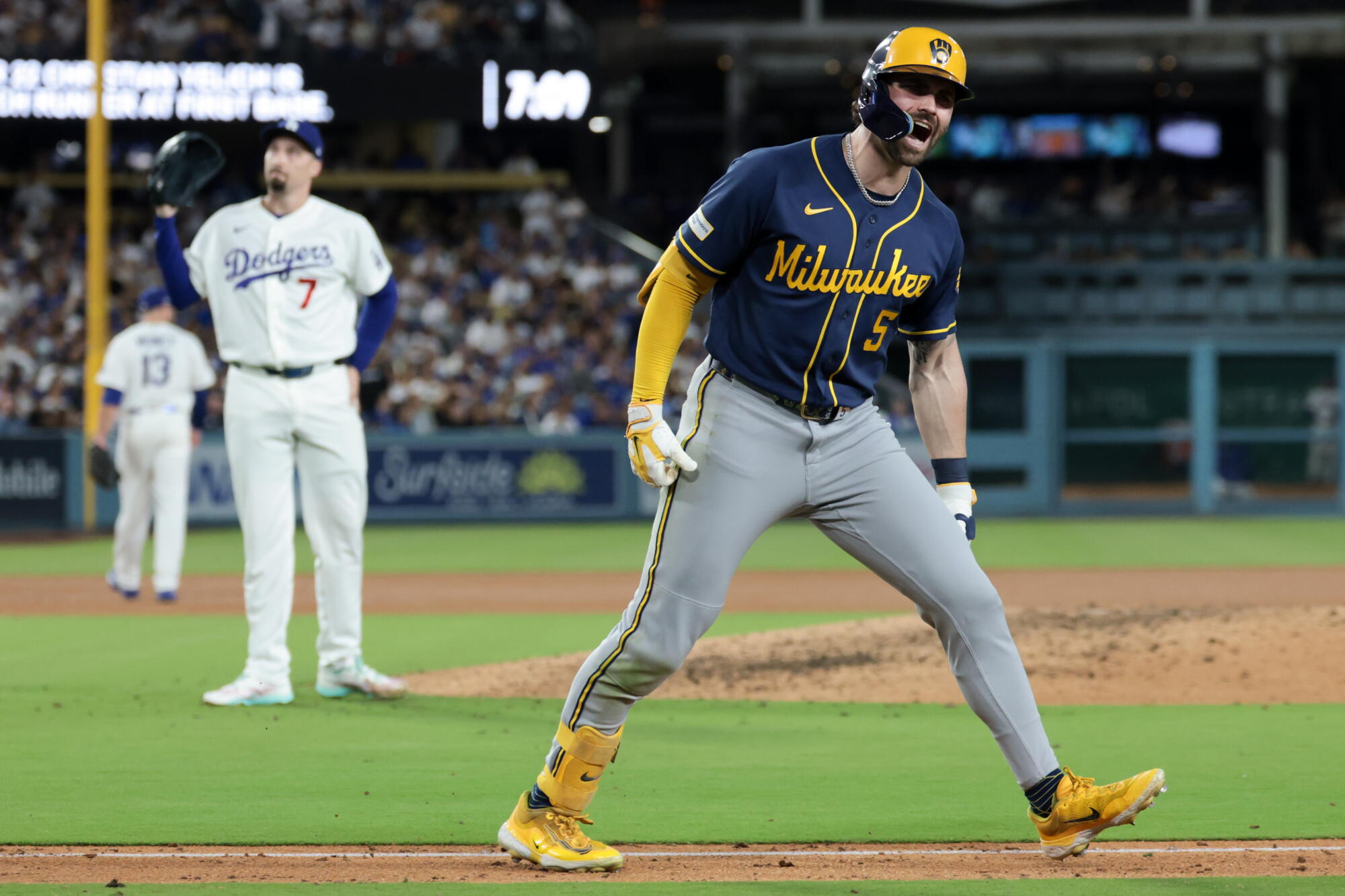
The Brewers’ Garrett Mitchell yells after hitting a solo home run in the seventh inning off Blake Snell in Game 3 of the NLCS at Dodger Stadium on Wednesday.
(Robert Gauthier/Los Angeles Times)
And they will remain so next spring.
After an inspiring, two-run rally authored by a bases-loaded double from Will Smith, Dodgers starter Blake Snell allowed back-to-back homers to Jake Bauers and Garrett Mitchell to open the seventh and eventually close out the Dodgers’ season in a 6-2 loss in Game 3 of the National League Championship Series.
It’s not over, but it is. The Dodgers aren’t done, but they’re so done.
The chase for a third consecutive World Series championship is historically and essentially and practically kaput. Their pursuit of a three-peat has been smothered by the Brewers’ own version of a three-peat, and nearly all hope is lost.
The Dodgers now trail the Brewers three-games-to-none in this best-of-seven series, a virtually impossible mountain to scale, achieved only once in major-league history.
Yes, Dave Roberts stole the base that spurred the Boston Red Sox to work out of a similar hole against the New York Yankees in 2004, but he’s no longer on the field and any of that inspiration has long since vanished.
“I don’t know if some of those guys even know I played,” said Roberts before the game..
They could have used some of his fire Wednesday in a game played against a background of apathetic embarrassment.
Namely, it wasn’t a sellout. How can an NLCS game in the most perpetually crowded baseball stadium in America not sell out?
The huge swaths of empty seats were perhaps a sign that, after watching their team slog through two losses in Milwaukee, Dodger nation had already given up. The 50,708 fans who did show up made lots of noise, but it was too late to reverse the optics of a team abandoned.

Dodgers left fielder Teoscar Hernández reacts after taking a strike in the sixth inning of Game 3 of the NLCS at Dodger Stadium.
(Robert Gauthier/Los Angeles Times)
Not surprisingly, there were several standing ovations given to injured star Shohei Ohtani, who the Dodgers considered benching before allowing him to talk his way into staying in the lineup. Also not surprisingly, Ohtani did little to reward his devotees, He hit a soft flyout, he was hit by a pitch, he drew a walk to help fuel the Dodgers sixth-inning rally and he singled after the Brewers had taken a three-run lead. No heroics. No hard hits. No chance.
The injury-plagued season of Ohtani will end with the Dodgers surely realizing that they should have taken control of his situation instead of empowering him to dictate the terms of his participation. They shouldn’t have let him keep playing hurt, but they did because they didn’t want to upset him, and it was the team that ended up paying the price.
All this negativity swirling around Dodger Stadium Wednesday night and, to think, the Dodgers were just moments from saving themselves.
Snell was brilliant for six innings, allowing just a leadoff home run to Jackson Chourio.
The Dodgers then set him up for a victory by taking advantage of a terrible decision by Brewers manager Pat Murphy.
Entering the sixth inning Brewers starter Robert Gasser had allowed just three singles in five shutout innings and had thrown just 72 pitches. Yet he was stunningly pulled by Murphy in favor of heavily used Abner Uribe.
Sure enough, Uribe threw eight balls in his next nine pitches to walk Teoscar Hernández and Kyle Tucker. After Max Muncy struck out, Ohtani drew a five-pitch walk in one of his best plate appearances this month.
Up stepped Smith, who entered the game with one hit in his previous 25 postseason plate appearances. But this night was going to be different, as it was hours after Will Smith’s wife, Cara, announced the birth of their third child.
Oh baby! Dad powered a two-run double off the left-center field fence to give the Dodgers a 2-1 lead.
Snell took the mound in the seventh having retired the previous 14 Brewers and looking strong. But he had not pitched this deep all season. And the Chourio home run was the first he had allowed this season.
Should Roberts have pulled him? You decide. Snell opened the seventh by walking Andrew Vaughn and losing an 11-pitch duel to Bauers, who won the battle with a two-run homer. Two pitches later, Garrett Mitchell took Snell deep to almost exactly the same right-center field spot to give the Brewers a 4-2 lead they never lost.
Snell was gone, but it was too late and too much. The weary and distracted Dodgers never again showed much energy on a night when Dodger Stadium did its best.
There was Keith Williams Jr. hitting all the high notes — and even higher — during his usual incredible national anthem.

Brewers first baseman Jake Bauers hits a two-run home run during the seventh inning of Game 3 of the NLCS on Wednesday at Dodger Stadium.
(Gina Ferazzi/Los Angeles Times)
There was past Brewers playoff nemesis Chris Taylor chanting, “It’s time for Dodger baseball!.”
Late in the game, there was even unofficial Dodger emcee Ice Cube on the video board saying “We ain’t backing down to no one.”
The hardest part of all this is that Cube is wrong. The Milwaukee Brewers are a good team but make no mistake.
Blessed with an opportunity to step up and make history, the Dodgers backed down.
Soon to be knocked out.
Argentina’s Milei backs Trump for US midterms, calls vote crucial for West | Donald Trump News
The President’s ally says conservatives “cannot give an inch” in Latin America as he accepts an award in Washington.

Published On 15 Oct 2026
Argentine President Javier Milei has urged his ally, US President Donald Trump, to come out of the United States midterm elections in a stronger position, calling the vote important for the West as a whole.
Milei made the appeal on Wednesday at a Hispanic Heritage gala in Washington, where a Hispanic association gave him an award, ahead of November’s vote.
Recommended Stories
list of 2 itemsend of list
Conservatives, he said, “cannot give an inch in our reconquest of the hemisphere”, according to Agence France-Presse (AFP).
Milei flew into the US capital on Wednesday for meetings with investors and the gala. He is due to address the US Chamber of Commerce on Thursday.

Milei’s lifeline
Trump firmly backed Milei a year ago, when his government also faced crucial legislative elections. He has called Milei his “favorite president”.
That backing, together with a currency swap agreement with the US Treasury, helped Milei to success in those polls, analysts have argued.
The centrepiece of the package, announced by Treasury Secretary Scott Bessent, was a $20bn swap with Argentina’s central bank, in which the US exchanged dollars for pesos. The swap came shortly after Milei’s party lost a key provincial election.
Trump made clear at the time that the support hinged on a Milei victory. “I’m with this man because his philosophy is correct,” he said ahead of a White House lunch with the Argentine leader. “If he wins, we’re staying with him. And if he doesn’t win, we’re gone.”
Trump also warned that the US would not be “generous” if Milei lost. The remarks unsettled Argentine markets, with the main stock index giving up earlier gains and falling about 2 percent, The Associated Press reported.
The package drew criticism in the US. Democratic lawmakers accused Trump of prioritising a foreign bailout while the US government was shut down.
White House defends new press secretary Katie Zacharia amid questions about her legal credentials
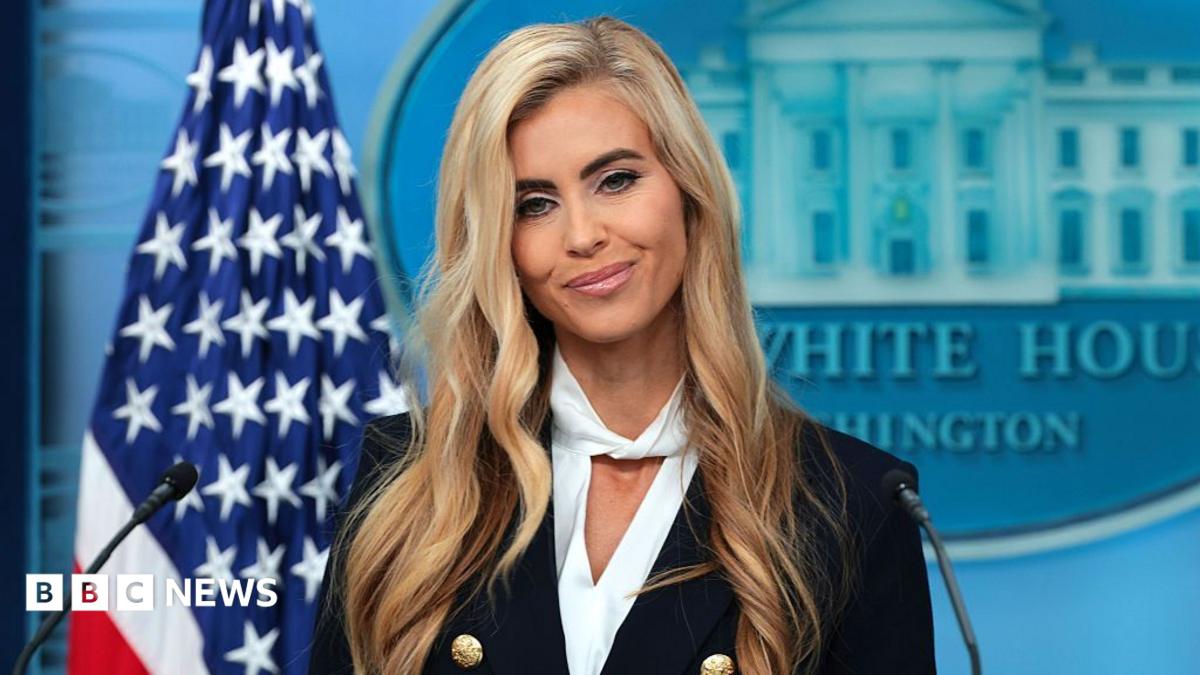
The White House is defending its new press secretary, Katie Zacharia, as she faces scrutiny over her legal credentials.
President Donald Trump described Zacharia as an attorney when announcing her appointment last week and she has referred to herself as a lawyer.
But when she was asked on Tuesday by a reporter in which state she had passed the bar exam required to be an attorney in the US, she said standing alongside the president: “When I moved to China.”
She does not appear to be registered to the bar in any state where she has lived. White House communications director Steven Cheung said Zacharia is “uniquely qualified and whip smart to help inform the American people”.
Responding to questions about her credentials, Zacharia said in a statement this week: “I practised international transaction law, with all the appropriate credentials.”
On Wednesday, a watchdog group, Campaign for Accountability, filed a complaint with the California State Bar Association.
They are seeking an investigation into whether Zacharia “repeatedly held herself out to the public as entitled to practise law without a licence to do so, conduct California law treats as a crime”.
The 42-year-old political strategist graduated from law school at Pepperdine University in California in 2011, the university confirmed.
A law degree is not a licence to practise law in the US.
The new White House press secretary told the New York Times on Wednesday that when she first began appearing on cable news, she had asked Pepperdine how she should identify herself.
She said she was advised by the university president that she could call herself a lawyer, but not an attorney.
Zacharia took the bar exam in California after graduating from law school but did not pass, according to the Wall Street Journal. California’s bar exam is widely regarded as one of the hardest in the US to pass.
A person with direct knowledge of the matter told the outlet that Zacharia took the exam around the same time that she was planning a wedding and preparing to move to China with her husband-to-be.

Why Stephanie Mills called Lady Gaga a ‘culture vulture’
R&B icon Stephanie Mills revealed she had an unresolved beef with “Mother Monster” Lady Gaga.
During Wednesday’s episode of “The Jason Lee Show,” the Grammy-winning “Wiz” star didn’t hold back when she explained what went down between her and Gaga and how the experience left a sour taste in her mouth.
“I feel like Lady Gaga is a culture vulture,” Mills said. “Can I tell you something. … I don’t even know if I should say it now.”
But Mills went on and said it anyway.
She said she was approached by her former manager a few years ago and asked to fly to New York, where Lady Gaga was doing a fashion shoot. Mills’ megahit “Home” was Gaga’s favorite song, according to the manager, who asked Mills, “Would you come and surprise her and sing?”
“At first I said no,” Mills continued. “Why would I do that? And I was talked into it. Never let somebody talk you into something.
“I went,” Mills said. “She had a little black dog there, and all the other people, and so I sang for her. She didn’t smile. She didn’t do anything. She looked at me like I had two heads.”
Mills said she finished singing “Home,” and the stars took photos, but before she left, Gaga’s team stopped her at the elevator and insisted she delete the pictures. “And they did not let us leave until they saw every picture being deleted,” she said. “Very disrespectful.”
The Broadway star further explained that she thought Gaga was a culture vulture because she was managed by a Black man, Troy Carter, who also worked with John Legend, Eve, Nelly, Meghan Trainor and Charlie Puth. Carter is widely credited with ushering the “Born This Way” singer into superstardom in the aughts.
“I know who I am. I did it. I sang a song for her. I had admiration for her. I don’t any longer,” Mills said.
“I give everybody grace, and I’ve learned throughout the years to take my temperature down and not react but show them who I am later. … It’s like you don’t have to always react, but sooner or later you’ll get your chance to say, ‘Do you remember?’”
She followed the statement by looking straight into the camera and addressing Gaga, “I hope you watch, and I hope you remember what you did. And I feel like you owe me an apology.”
Reps for Gaga did not immediately respond to The Times’ request for comment, but the star — as well as many other musicians and actors — has a history of nixing photographs.
Post-debate, lingering questions about who Raman is and how she would lead
In the Los Angeles mayoral debate Tuesday night, I was reminded of two things.
First, as I’ve said before, it’s no surprise that roughly one-third of likely voters remain undecided with less than three weeks to go until election day.
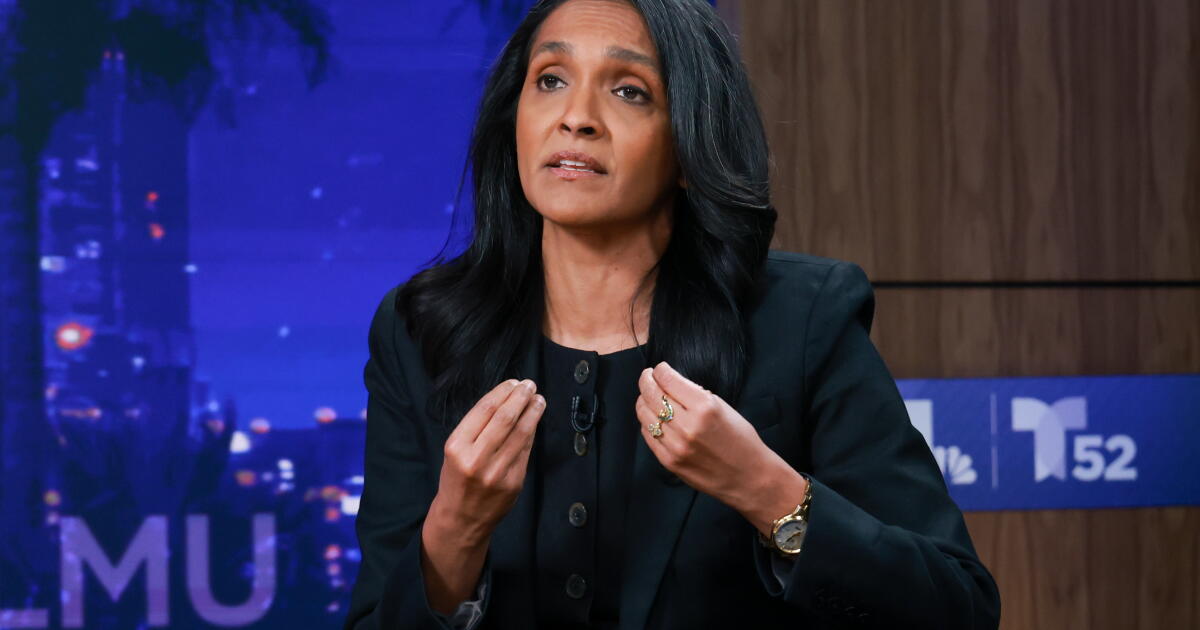
Second, there is one key difference between the two candidates: We know who Mayor Karen Bass is, but we don’t yet know who Councilmember Nithya Raman is, even though she’s been leading in most polls.
Those two points are connected. I think a majority of voters want a change at City Hall because of the marginal progress on homelessness, the erosion of basic services and the bad decisions before and after the Palisades disaster, among a host of other issues.
But they’re not sure what they’d be getting in Raman.
Why not?
If you haven’t already seen the story a few days ago by The Times’ longtime City Hall reporting ace, Dave Zahniser, you need to check it out right here.
The headline neatly sums it up:
“L.A. mayoral candidate Nithya Raman has strong opinions. But they often change.”
Raman has flip-flopped so many times, it’s as if she’s having a political identity crisis, which is not a great selling point for a candidate.
She endorsed Bass, an ally, for reelection and then abruptly and surprisingly announced that she was running against her.
She rose to power as a darling of the Democratic Socialists of America and vowed to defund the police, only to later support an LAPD budget increase.
She embraced the so-called mansion tax, then said it needed an overhaul.
She supported and helped fund Bass’ signature homelessness initiative, Inside Safe, and now has turned against it.
“That’s the real wild card,” said Sara Sadhwani, assistant professor of politics at Pomona College. “She has flip-flopped so extensively on policy that it’s unclear which version of her values we would get.”
Look, it’s not uncommon for a candidate of the left, or the right, to move toward the center to broaden support. And there’s nothing wrong with learning on the job and evolving. It’s all too rare, in fact.
The problem for Raman is that in somersaulting around on core issues, she’s alienating some of the people she would need as allies in order to be an effective mayor.
They might come around, because in the city’s shared system of power, there are times when the City Council and mayor need to paddle in the same direction in order to get anywhere. But among the 15 City Council members, 13 have endorsed Bass, and that support includes even the DSA wing of the council.
I like the idea of a rebel as L.A. mayor, but the job is hard enough with City Council allies. Without them, Raman could be cooked. And it’s not as if she’d have an easy time winning support for much of anything from the powerful public employee unions and traditional business interests, which are for the most part aligned with Bass, for better and for worse.
Both candidates had their moments in the debate, although I gave the edge to Bass. During The Times’ live chat, I said I think L.A. really needs a leadership change, and I think Raman did not prove that she’s the answer.
It’s probably the second-most important political job in the state, in one of the great cities of the world, and along with the ducking and punching, I wanted more love, more poetry, more unbridled passion and a contagious sense of possibility.
And please, all you Spencer Pratt toadies, don’t send me your whiny little notes about how he was the guy all along. Identifying some of the obvious problems is easy enough. (I do it all the time.) Having a plan is another matter, and that’s why I never ran for mayor, and why Pratt faded out of the picture.
So what next, as the final three weeks of the campaign play out?
If I were Raman, who is 45, I’d go heavy on touting the work she’s done on eviction protections and capping rent hikes, because nailing down younger voters could give her the keys to the throne. On homelessness, she knows the issue better than most, has detailed what’s wrong with the Bass program, has made headway in her own district, and has laid out a plan to speed up progress and efficiency citywide.
But her best argument is that City Hall and the entrenched political establishment need a major shake-up, because the machine is now a jalopy.
“We cannot afford another four years of decline, of mismanagement, of excuses,” Raman said in the debate.
As for Bass, 73, you can’t count her out just yet because she’s a fighter, and she’s better at campaigning than at being mayor. She also is likely to benefit from the fact that older voters — who are most likely to go to the polls — favor her by a huge margin.
“You are not ready for prime time,” Bass told her former ally during the debate, and Bass also hammered Raman for taking “different positions on different days of the week.”
In 2005, Mayor Jim Hahn became the first L.A. mayor to lose a reelection bid in more than three decades, falling to Antonio Villaraigosa. It was a rout, at 58% for Villaraigosa to 41% for Hahn.
I don’t see a rout this time.
The question for Los Angeles is this:
Have you had enough of the mayor you know, and are you ready to roll the dice on someone you don’t?
steve.lopez@latimes.com

Defender Will Fish challenges Cardiff City to take home form on road
Fish was thrust into the action for his first minutes of the season against the Hornets after Dylan Lawlor went down clutching at his hamstring.
Wales international Lawlor had only just returned from his own injury, and was making his second start of the campaign before being forced off after 29 minutes.
Fish has been recovering from hernia surgery, and feels he has more to go before declaring himself fully fit, although he is in a much better place than he was.
“It’s never nice to get injured, especially as we came back for pre-season. In effect, I’ve not really had a pre-season. I’m almost playing catch-up at the minute,” he said.
“I feel like I’ve got a long way to go, but it was nice to get out there on Tuesday night and get some minutes into my legs.
“My injury, you can’t help that. It is what it is. I got over it, and I feel like I’m in a good place now, and I’m ready to help the team.”
Cardiff established a 5-0 lead with five minutes of Tuesday’s game remaining – only to concede a late Watford consolation shortly after.
“I was disappointed,” admitted Fish.
“At that stage in the game, of course, we could have done better. We were all hoping for the clean sheet, but it was nice to get three points.”
Cardiff are yet to keep a clean sheet since winning promotion back to the Championship and face a tough challenge when they head to second-place Middlesbrough on Saturday, October 17 (12:30 BST).
Like Cardiff, Kim Hellberg’s side rank among the best performers for shots on goal and touches in the opposition box.
After a trip to Teesside, the Bluebirds face further tests against Birmingham and relegated trio Wolves, West Ham and Burnley.
Fish is not looking too far ahead. Instead, he wants his side to lay down a marker by becoming the first away side to win at the Riverside this season.
“The games we have got coming up are tough. Every game of football that you play in this league is tough. We will just take it game by game,” he said.
“[Watford] was a good start, and hopefully we can pick up another win in Middlesbrough on Saturday.”

Kenya’s Ebola cases test preparedness beyond Nairobi | News
Nairobi, Kenya – Kenya’s response to an imported Ebola case has demonstrated its ability to mobilise a national response in the capital.
But a suspected case in the northeastern county of Wajir has raised a critical question: whether the country’s preparedness measures can protect communities far from major hospitals, laboratories and transport hubs.
The suspected case in Wajir tested negative, according to county officials, easing fears of wider transmission. Yet the incident highlighted the importance of local health facilities being able to recognise suspected infections, isolate patients safely and communicate reliable information to residents.
For communities near Kenya’s borders, preparedness requires more than screening travellers at airports and official crossings.
It also depends on trained health workers, appropriate protective equipment, functioning isolation facilities and clear referral procedures. Residents must know where to seek care and how to respond when health authorities raise the alarm.
Wajir’s readiness under scrutiny
Garad Saney Mohamed, communications director for Wajir county, told Al Jazeera that the county had established an isolation centre in Wajir town and formed a rapid response team to strengthen its preparedness.
He said the county was also using radio campaigns, community health promoters, school health programmes and posters to raise awareness about Ebola. A preparedness plan and budget had been put in place, he added.
However, the county did not provide details on the isolation centre’s capacity, the number of health workers trained specifically in Ebola response or the budget allocated to these efforts. Without that information, it is difficult to assess whether the county has the personnel and resources needed to manage suspected infections safely or respond to a wider outbreak.
The suspected case involved a 20-year-old man who had travelled from the Democratic Republic of the Congo through Uganda before reaching his home in Wajir on September 20. He was assessed at Habaswein Subcounty Hospital in Wajir South after presenting with a severe febrile illness.
His sample tested negative for Ebola, according to county officials. He was to remain under observation while receiving medical care.
The case prompted precautionary action, but it does not establish whether Wajir’s wider preparedness systems would be sufficient during an outbreak. That would depend on factors including the availability of protective equipment, staff trained in infection prevention and control, safe sample transport and reliable links between local facilities and designated testing laboratories.
Wajir’s proximity to Somalia, which lies 110km (70 miles) to the east, and the movement of people and goods across the border make surveillance and public communication particularly important. Screening at formal entry points remains essential, but it cannot replace the ability of local health facilities and community health workers to recognise warning signs and guide people towards appropriate care.
National screening, local challenges
Kenya’s national response intensified after an Ebola case was linked to a Kenyan travelling from the Democratic Republic of the Congo through Uganda. The patient arrived in Nairobi on October 3, was diagnosed with Bundibugyo virus of the disease and died on October 5, according to the World Health Organization (WHO). Kenya notified the WHO on October 6.
The patient had fallen ill while living in the Democratic Republic of the Congo and travelled by road to Kampala before flying to Nairobi. Laboratory tests at the National Virology Reference Laboratory and the Kenya Medical Research Institute confirmed the infection, according to the Ministry of Health.
On October 14, Kenya confirmed a second case of Bundibugyo virus disease involving a 39-year-old man who was a close family member of the first patient. He was already in quarantine and under daily monitoring when he developed symptoms, including fever, fatigue and joint pains, on October 13.
Laboratory tests confirmed the infection, and he was transferred to a designated treatment centre for supportive care. The Ministry of Health said the two cases were linked and there was no evidence of transmission in the wider community.
Authorities subsequently intensified surveillance at points of entry, contact tracing and public communication. The negative test result in Wajir underscored the importance of investigating suspected infections promptly and using laboratory testing to establish whether the virus is present.
As of October 6, Kenya had screened 652,584 travellers, tested 267 samples and trained 4,971 healthcare workers in Ebola prevention and management, according to the Ministry of Health.

By October 12, the WHO reported that more than 665,000 travellers had been screened and 127 contacts had been listed, with 94 in quarantine. Five laboratories had been designated to test for the disease, and nearly 5,000 health workers had received training.
These figures demonstrate the scale of the national response. But the number of travellers screened or health workers trained does not, on its own, establish how effectively those resources are distributed or whether individual counties can manage suspected infections.
For Wajir, the key questions concern the readiness of local facilities, the availability of trained personnel and protective equipment, and the speed with which samples can be transported for testing. The county has outlined the measures it has taken, but the available information does not provide a complete picture of its operational capacity.
Preparedness means more than the numbers
Health workers need to recognise suspected cases, follow infection-prevention protocols, collect and transport samples safely, and refer patients without exposing others. Facilities must also have appropriate protective equipment and clear procedures for managing suspected infections.
The WHO reported that Kenya’s national preparedness score rose from 66 percent in May to 82 percent in July. The assessment covered measures including surveillance, laboratory testing, isolation and treatment facilities, and trained response teams.
The improvement suggests that preparedness measures had advanced before the imported case was confirmed. However, a national score cannot establish whether every county has the equipment, staffing and referral arrangements needed to respond effectively. Assessments of local capacity are essential to identifying gaps that national figures may not reveal.
The Kenya Red Cross has also supported preparedness and public awareness efforts. Dr Paul Olale, a representative of the organisation, told Al Jazeera about a preparedness assessment. However, the basis of the separate figure attributed to the organisation was not established in the information available for this report, making it difficult to determine what it measured or whether it identified county-level weaknesses.
The organisation has highlighted the need to counter misinformation. During an outbreak, rumours can leave people uncertain about symptoms, how the virus spreads and whether they should seek medical attention.
For residents, information needs to be practical. People should know where to seek care, how to report a suspected illness and what to do while awaiting medical advice. Communication must also address stigma and reassure people that reporting a suspected illness can help protect their families and communities.
Community health promoters, local radio stations, schools and trusted community leaders can help deliver information in languages and formats residents understand. But awareness campaigns are most effective when they are consistent and backed by health services capable of responding promptly to concerns.
Wajir’s experience illustrates why Kenya’s Ebola preparedness must be measured not only by national screening figures and training totals, but also by the ability of individual counties to respond safely when a suspected case emerges.
An isolation centre, a rapid response team and public awareness campaigns are important components of an effective response. Their existence alone, however, does not establish whether facilities have adequate equipment, staff can follow established protocols or residents can access reliable information when they need it.

Kenya has demonstrated its ability to mobilise a national response, expand screening and undertake laboratory testing. The challenge is ensuring that these measures translate into effective protection beyond major transport hubs, including in remote communities where access to healthcare and timely information may be more difficult.
Dr Mary Muthoni, Kenya’s principal secretary for public health and professional standards, underscored the importance of protecting frontline staff in remarks delivered on behalf of Health Cabinet Secretary Aden Duale, according to a WHO statement released on October 12.
“No health worker in this country should be asked to attend to a suspected Ebola case without the right protective equipment.”

Trump plays Muslim Brotherhood card against Senate candidate El-Sayed | Politics
President Donald Trump says Michigan Senate candidate Abdul El-Sayed is a member of the Muslim Brotherhood. The organisation has wide support across the Middle East for its charitable work, but is designated a terrorist organisation by the US. El-Sayed denies ties to the group.
Published On 15 Oct 2026

Aaron Paul shares heartbreaking vid of RJ Mitte speaking about mental health after Breaking Bad star’s death by suicide
AARON Paul has shared a gut-wrenching video of his Breaking Bad co-star, RJ Mitte, following his tragic death by suicide.
The actor best known for starring as Walter White Jr in the Emmy Award-winning show, died on Monday in Brownsville, Texas, aged just 34.
In an emotional tribute to his friend, Aaron said RJ’s strength and kindness was “blinding”.
Aaron shared a video of Mitte talking about the importance of taking care of one’s mental health.
The late actor lived with cerebral palsy and used his platform to raise awareness and champion people with disabilities.
RJ said in the video shared by Paul: “I hope y’all are doing well today in this time of uncertainty but I would like to talk to you a little about mental health.

“Its very important to take care of ones physical health but its equally as important to take care of one’s mental health.”
RJ said that “more often than not” people hide how they truly feel by saying “I’m fine” and “I’m good.”
He continued: “But its ok to not always be good.
“But its not ok to harbour that feeling, harbour those emotions.
Most read in Entertainment
“So I am hoping to inspire each and everyone that sees this video today.”
Aaron apologized for not realizing the pain his friend was experiencing.
He wrote: “I am so sorry you were hurting my friend. I wish we knew.”
“You constantly had a smile on your face and you took every single challenge that was given to you with such confidence and grace.
“I met you when you were a little boy and watched you grow into a beautiful young man.”
“What an absolute tragic loss.”
Aaron finished his post by encouraging anyone who is feeling lost, sad or uncertain about the future, to reach out for help.
He said: “We must suffocate the noise and focus on each other.”
The tribute from the star, best known for portraying Jesse Pinkman, followed the heartbreaking news that RJ was found dead by suicide at his home on Monday, as confirmed by his publicist.
RJ said in his final interview that he wanted to “keep living the dream” but added that “every dream could be a nightmare … just keep living it, just keep pushing forward”.
RJ’s on-screen dad, Bryan Cranston, 70, said he is in “deep despair” at the young actor’s death as he shared an emotional tribute.
Bryan said: “I met him when he was only 14 years old when he was cast as Walter White Jr., a part he played with such joy and enthusiasm.
“Born with Cerebral Palsy, he never – ever – allowed that challenge to be an excuse for anything. He met the demanding shooting schedule head on with great determination.”
The actor, like his character Walter Jr, had cerebral palsy and said his greatest achievement in life had been “giving back”.
He said: “That’s really the greatest thing that ‘Breaking Bad’ has given me, is to be able to lend my voice to causes that make a meaningful impact that changes people’s lives.
“I think that’s one of the greatest things that I have and it’s not the awards.
“It’s not all of these things people assume come with this. It’s literally being able to impact someone’s life in a meaningful way that without that, wouldn’t have it.”
If you or someone you know is affected by any of the issues raised in this story, call or text the 988 Suicide & Crisis Lifeline at 988, chat on 988lifeline.org, or text Crisis Text Line at 741741.
How to get help
EVERY 90 minutes in the UK a life is lost to suicide
It doesn’t discriminate, touching the lives of people in every corner of society – from the homeless and unemployed to builders and doctors, reality stars and footballers.
It’s the biggest killer of people under the age of 35, more deadly than cancer and car crashes.
And men are three times more likely to take their own life than women.
Yet it’s rarely spoken of, a taboo that threatens to continue its deadly rampage unless we all stop and take notice, now.
If you, or anyone you know, needs help dealing with mental health problems, the following organisations provide support:
CALM, www.thecalmzone.net, 0800 585 858
Heads Together,www.headstogether.org.uk
HUMEN www.wearehumen.org
Mind, www.mind.org.uk, 0300 123 3393
Papyrus, www.papyrus-uk.org, 0800 068 41 41

California ID law for immigration agents blocked by 9th Circuit
The 9th Circuit Court of Appeals nixed a trailblazing California law on Wednesday, permanently barring the state’s efforts to force federal immigration agents to display identification while on duty.
“As before, we conclude … the No Vigilantes Act attempts to directly regulate the United States in its performance of governmental functions,” Judge Mark J. Bennett wrote for the panel. “No set of circumstances exist under which the Act would be valid.”
The U.S. Justice Department first sued to block the ID requirement alongside a related law attempting to ban masks for federal agents and local police in the fall of 2025.
The joint case hit Los Angeles federal court at the beginning of this year amid a surge of immigration enforcement in Minneapolis that led to the shootings of civilians Renee Good and Alex Pretti by U.S. Immigration and Customs Enforcement agents.
By then, more than a dozen other states were pursuing similar statutes in an effort to rein in what many saw as lawlessness in President Trump’s sprawling deportation force.
Judge Christina A. Snyder ultimately blocked California’s law prohibiting the use of masks by law enforcement, on the grounds that it unfairly carved out an exception for state peace officers, but allowed the ID requirement for ICE agents and others to go forward, agreeing with the state that it was more akin to a speed limit on the highway than a direct regulation of the federal government.
The 9th Circuit quickly disagreed.
“If a state law directly regulates the governmental conduct of the United States without congressional authorization, it is void irrespective of whether the regulated activities are essential to federal functions or operations, and irrespective of the degree to which the state law interferes with such functions or operations,” Bennett wrote.
The decision comes as ICE is quietly shedding many of the 12,000 new recruits it hired last year. Although public outrage over Trump’s militarized mass deportation efforts has diminished somewhat since the winter, it remains a potent election issue.
A Reuters/Ipsos poll from September showed more than 40% of Americans strongly disapprove of the president’s handling of immigration. Meanwhile, the share who fret over unauthorized immigration is nearly identical to the proportion who worry about the unchecked spread of measles — anxieties that pale in comparison with stress over the cost of living, the proliferation of data centers and the war with Iran, data show.

Burnham had two hospitality dinners with Man City chairman, deleted records show
On Monday, the GMCA released a statement about Burnham’s meetings with Man City in his role as mayor for the region for almost a decade.
The statement said he had a formal meeting with Al Mubarak in October 2021 at the UK Government’s Global Investment Summit, arranged by the Department for International Trade; and that he met the club chairman “informally in the stands” at a testimonial match in 2019 for former player Vincent Kompany.
It also said that “in his capacity as mayor, he was a guest of Manchester City at home matches on a small number of occasions”.
But the statement did not specify that this referred to, external two hospitality dinners he had with the Manchester City chairman at separate matches.
A previous GMCA register of declarations for Burnham, seen by the BBC, detailed a “dinner with [then-Manchester City Council leader] Richard Leese and Chair of Man City” for an Everton match at the Etihad stadium in August 2017, valued at £300 for hospitality.
Below is another entry for “dinner with the Chairman at the Man City/Man Utd derby at the Etihad” in April 2018, valued at approximately £699.
Burnham previously declared those dinners, alongside a £150 pair of tickets to see Ed Sheeran perform at the stadium in May 2018.
But the register of declarations has since been deleted from the GMCA website, as first reported by The Sun. The BBC understands it is the authority’s policy to only publish entries from the current mayoral term.
BBC News has asked GMCA for more details about this policy – given its website has entries dating back to 2022, despite the current mayoral term beginning in 2024.
Downing Street has defended the two dinners with Man City’s chairman, saying this was hospitality received at home games, which had been declared, rather than separate meetings with the club chairman.
But political pressure on Burnham to be clearer about any former discussions with Man City is continuing to mount.
Tory shadow sports minister Louie French said: “Andy Burnham promised the country and House of Commons full transparency on his dealings with Manchester City.
“This was essential after his inappropriate intervention into football.”
And Reform UK’s Robert Jenrick said “this saga stinks” as he accused Burnham of having apparently “concealed his extensive links to Man City’s owners”.
Conservative leader Kemi Badenoch has demanded for several days that No 10 release all details of meetings between the prime minister and senior figures at the club.
Burnham told the Rest Is Politics podcast last week he was “happy” to do this and would “quite clearly put out there everything that I have done working with them in my previous role as Mayor of Greater Manchester”.
“None of it is recent, actually, in terms of the meetings I had. I only had one significant meeting, actually, and that was in 2021.”
Asked at Prime Minister’s Questions on Wednesday whether anyone at the club had raised the charges they were facing with him or his team, Burnham said: “They did not raise those issues with me.”
With the PM continuing to face pressure on the issue, he told MPs he was happy for “everything to be set out in full”, referring to the GMCA’s statement as “a full statement of my key dealings with the owners of Manchester City Football Club”.
When asked by reporters why the statement did not refer to the two dinners, and what the difference is between “everything” and “key dealings”, the PM’s press secretary referred back to the GMCA statement.
The list of meetings, which was published by the GMCA on Monday, did not include detail on what was discussed. The BBC has asked GMCA why the two dinners were not specifically mentioned.
In September Man City – which has dominated the top flight of English football for years – was found guilty by an independent commission of breaching Premier League financial regulations.
The commission found City had broken rules over a nine-year period between 2009 and 2018 by creating “sham” contracts with commercial partners to secretly funnel more than £830m into their football operations.
Sanctions are yet to be announced and City, which denies any wrongdoing, has lodged an appeal against the verdict.
Earlier this month, Sir Richard Leese – who was head of Manchester City Council for 25 years until 2021 – defended a decade-old deal between the council and Man City owners Abu Dhabi United Group (ADUG).
Under the partnership between the authority and the company, which is linked to the United Arab Emirates royal family, land was leased to ADUG at “below comparable rates”, according to a University of Sheffield report.

Trump suggests those who leak government information should ‘be shot’ | Donald Trump News
The US president has long been unhappy with inside information about his administration being leaked to the media.
United States President Donald Trump has suggested that those who leak information to the news media should be shot as punishment.
Trump made the remarks at a campaign rally in Bullhead City, Arizona, as he urged supporters to vote in the November 3 midterm elections.
Recommended Stories
list of 3 itemsend of list
“In my opinion, leakers should be shot,” Trump told the crowd. “In the old days, we used to shoot leakers, you know, when they leak what time you’re going to attack a country.”
Trump made the statement in an apparent reference to Operation Midnight Hammer, which saw the US launch a surprise attack on Iran in June 2025 during the 12-day war between Israel and Iran.
In the aftermath of the attack, several media outlets published findings from a preliminary report by the US Defense Intelligence Agency.
That report – which had not yet been released to the public – indicated that Iran was able to move some of its enriched uranium away from the sites the US had bombed.
It also suggested that the extent of the damage to Iran’s nuclear facilities was more modest than what Trump had asserted.
Trump, however, appeared to signal that the timing of the US attacks was among the leaked information. He accused the news media of putting military members in danger, calling out The New York Times and CNN in particular.
“They leaked the time we were leaving, the time we were arriving,” Trump said, claiming he had to reschedule the bombing campaign two days later as a result.
“Somebody leaked. Some sleaze-bag, they ought to go to jail or be shot. For the rest of their life, they should be in jail.”
Trump has long had an adversarial relationship with the news media, and he has previously called for harsh punishment against any official who passes on confidential information to news outlets.
After parts of the Defense Intelligence Agency report became public, he blamed lawmakers in the Democratic Party for its release.
“The Democrats are the ones who leaked the information on the PERFECT FLIGHT to the Nuclear Sites in Iran,” Trump wrote on social media at the time. “They should be prosecuted!”
Under Trump, the White House has taken aggressive action to track down the source of leaks.
Staff in his administration, as well as officers in the military, have also been asked to take polygraph tests.
Journalists at several news outlets, including The New York Times, The Washington Post and The Wall Street Journal, have also received subpoenas aimed at determining the sources of internal information made public.
The newspapers had reported on stories such as a botched Navy SEALs raid in North Korea and how Trump ignored internal Pentagon warnings against launching the Iran war.
Last year, the Department of Defense demanded that journalists who wished to access the Pentagon sign an agreement not to publish unauthorised material.
Much of the Pentagon press corps refused to agree, and a federal court struck down many of the new demands made on journalists at the department.
Trump has long raged against leakers, going back to his first term as president from 2017 to 2021.
Former White House official Alyssa Farah Griffin told a podcast in 2024 that Trump had called for leakers to be executed, after media outlets reported that he had taken shelter in a White House bunker during racial justice protests in 2020.
Trump appeared to reprise that sentiment in his speech to Arizona voters on Wednesday, less than three weeks before the November 3 midterms.
“Leakers should be dealt with very, very strongly,” Trump said. “To me, they are the scum of the earth.”

White House spokesperson Katie Zacharia’s law career faces scrutiny | Donald Trump News
Katie Zacharia, the new White House press secretary under United States President Donald Trump, has drawn increasing criticism over claims about her professional background.
On Wednesday, a public accountability nonprofit filed a complaint with the State Bar of California over Zacharia’s repeated claims that she was a lawyer.
Recommended Stories
list of 3 itemsend of list
If made falsely, such a claim is a crime in the state. According to Zacharia’s LinkedIn profile, she received a degree from the Pepperdine Caruso School of Law in 2011, but critics have questioned whether she received a licence to practise law, as she has suggested.
“Ms. Zacharia has represented herself as a lawyer repeatedly to buttress her reputation and credibility as a television legal commentator and now as the White House spokesperson,” Michelle Kuppersmith, the head of the Washington, DC-based Campaign for Accountability, said in a statement. “Yet it seems it was all a lie.”
Her organisation filed the complaint with California’s bar office, a regulatory agency that oversees the licensing of lawyers.
“In California, calling yourself a lawyer without a license isn’t puffery; it’s a crime,” Kuppersmith said.
“The State Bar should investigate whether Ms. Zacharia has misled the public about her credentials and hold her accountable if she has.”
Zacharia, a commentator who has appeared frequently on Fox News and Newsmax, began her term as White House press secretary on Tuesday.
In a news briefing that day, she seemed to falter and speak haltingly, sometimes having to repeat herself.
Her appearance was brief, lasting under 15 minutes. She spent much of her time at the podium thanking Trump for the opportunity and reading from a prepared statement.
“I have wanted to work for him for a very long time,” Zacharia said.
Later, she joined Trump outside the White House to speak further with reporters. When asked where she had passed the bar exam, Zacharia replied, “When I moved to China.”
The response was an apparent reference to a three-year stint in which she claims she worked at a law firm in Beijing.
A biography on the website for the pro-Trump women’s organisation Trumpettes USA Inc says she “served as outside counsel” for the World Bank and International Finance Corporation while in Beijing.
Her LinkedIn profile, meanwhile, indicates Zacharia served as an associate at the Zhong Lun Law Firm in Beijing from 2011 to 2013. More recently, from 2024 to 2025, it lists her as general counsel for Fix California, a voter rights group started by a Trump administration official.
On her Instagram profile, Zacharia describes herself as a “Wife, Mom, & Lawyer”.
But Zacharia’s assertion that she passed the bar in China has fuelled media scrutiny. China’s equivalent of the bar exam, the notoriously difficult National Unified Legal Professional Qualification Examination, can only be taken by Chinese citizens.
China has, on rare occasion, allowed foreigners to practise law in the country if they have several years of experience in their home countries first.
But that does not appear to be the case for Zacharia. According to media reports, Zacharia has not been found to be licensed as a lawyer in any state in the US.
In a statement to The Associated Press, Zacharia responded to the scrutiny by saying, “I practice international transaction law, with all the appropriate credentials.”
Since Trump’s return to office for a second term, Zacharia has spent several months as a communications adviser at the Department of Homeland Security.
Since June, she has also worked as the senior communications adviser at the Trump Media and Technology Group, which owns the Truth Social platform.