



Ukraine’s patience with US peace push wears thin as Russia skirts pressure | Russia-Ukraine war News
Ukraine expressed frustration with its ongoing peace talks with Russia and the United States this week, saying US pressure was too one-sided against it.
“As of today, we cannot say that the outcome is sufficient,” Zelenskyy told Ukrainians in a Wednesday evening video address.
Before Wednesday’s talks in Geneva had begun, Zelenskyy told Axios news service that ceding the remaining one-fifth of the eastern Donetsk region that Russia doesn’t control, as Moscow has demanded, would not be accepted by Ukrainians.
“Emotionally, people will never forgive this. Never. They will not forgive … me, they will not forgive [the US],” Zelenskyy said, adding that Ukrainians “can’t understand why” they would be asked to give up additional land.
Russia currently controls about 19 percent of Ukraine, down from 26 percent in March 2022.

Last month, 54 percent of surveyed Ukrainians told the Kyiv International Institute of Sociology they categorically reject transferring the whole of the Donetsk region to Russian control, even in return for strong security guarantees, with only 39 percent accepting the proposal.
Two-thirds of respondents also said they did not believe the current US-sponsored peace negotiations would lead to lasting peace.
Instead of ceding land now, Zelenskyy favours freezing the current line of contact as a pretext for a ceasefire and territorial negotiations.
“I think that if we will put in the document … that we stay where we stay on the contact line, I think that people will support this [in a] referendum. That is my opinion,” he told Axios.
Blaming Ukraine
US President Donald Trump told Reuters last month that Ukraine, not Russia, was holding up a peace deal.
But Zelenskyy said it was “not fair” that Trump was putting public pressure on Ukraine to accept Russian terms, adding, “I hope it is just his tactics.”
US senators visiting Odesa last week agreed with him, saying they want their government to put more pressure on Russia.
“Nobody, literally nobody, believes that Russia is acting in good faith in the negotiations with our government and with the Ukrainians. And so pressure becomes the key,” said Senator Sheldon Whitehouse of Rhode Island.
Russia unleashed a barrage of 396 attack drones and 29 missiles on Ukraine’s energy infrastructure on the day of the Geneva talks, its second large-scale blow in six days. On February 12, another attack had left 100,000 families without electricity, and 3,500 apartment buildings without heat in Kyiv alone.
“Russia greets with a strike even the very day new formats begin in Geneva – trilateral and bilateral with the United States,” said Zelenskyy in a video address. “This very clearly shows what Russia wants and what it is truly intent on.”
Zelenskyy has repeatedly asked Western allies to stop Russian energy sales that circumvent sanctions, and to stop exporting components to third countries, which re-export them to Russia’s armaments industry.
Russia is believed to be using a shadow fleet estimated at between 400 and 1,000 oil tankers to carry and sell its crude oil. France has seized two of those tankers, and the US seized a second tanker on Monday.
The US Senate has held off voting on a sanctions bill that has 85 percent support because of opposition from Trump. The bill would impose secondary sanctions on buyers of Russian oil – notably India and China.

Can Russia take Donetsk anyway?
Russia has fought since 2014 to seize the two eastern regions of Ukraine, which triggered its invasion – Luhansk and Donetsk – where it claimed a Russian-speaking population was being persecuted by the government in Kyiv.
Late last year, Russia managed to seize all of Luhansk, but analysts believe it is doubtful that it could take the remainder of Donetsk without serious losses, because Ukraine has heavily fortified a series of cities in the western part of the region.
That task has now become even harder, according to observers, since Russia this month lost access to Starlink terminals, which helped it communicate, fly its drones and coordinate accurate counter-battery fire.
As Russian ground assaults have faltered, Ukraine has seized the initiative to make gains in Dnipropetrovsk, said Ukrainian military observer Konstantyn Mashovets.
Ukrainian forces gained 201sq km of territory from Russian occupation forces between February 11 and 15, according to observers, reportedly their fastest advance since a 2023 counteroffensive.

Russia has been trying to replace Starlink using stratospheric balloons, reported Ukrainian Defence Ministry adviser Serhiy “Flash” Beskrestnov.
Russia would likely take six months to replace Starlink, said a Ukrainian unmanned systems commander, offering Ukrainian forces a window to roll back Russian advances.
It also suffered 31,680 casualties in January, estimated Ukraine’s General Staff – a sustainable number given Russian recruitment levels of about 40,000 a month. But those numbers would rise in the event of a major assault on the remainder of Donetsk, experts say.
“Our goal is to have at least 50,000 confirmed enemy losses every month,” said Ukrainian Minister of Defence Mykhailo Fedorov on February 12, echoing a goal set by Zelenskyy last month.
Fedorov has set out to increase the production of remote-control FPV drones used on the front lines, which Ukraine says are now responsible for 60 percent of all Russian casualties.
As part of that effort, joint drone production facilities are planned in several European countries. The first started operating on February 13 in Germany, Zelenskyy told the Munich Security Conference, and nine more are planned.
In addition, Ukraine’s European allies pledged 38 billion euros ($44.7bn) in military aid this year during a Ramstein format meeting – the alliance of more than 50 countries which plans military aid for Ukraine – including 2.5 billion euros ($2.9bn) for Ukrainian drones – “one of the most successful ‘Ramsteins’,” Fedorov said.
The European Union has additionally voted to borrow 90 billion euros ($106bn) to give to Ukraine in financial aid this year and next.
The US stopped being a donor of military and financial aid to Ukraine after Trump was sworn in as president in January 2025.
Against Trump’s wishes, the US Senate voted to spend $400m in each of the next two years as part of the Ukraine Security Assistance Initiative, which pays US companies for weapons for Ukraine’s military. Europeans have pledged to spend at least 5 billion euros ($5.8bn) on US weapons this year.
Europe would also be the main contributor to a “reassurance force” policing the line of contact after a ceasefire, and on Ukraine’s insistence, US representatives also met with British, French, German, Italian and Swiss representatives before the talks in Geneva.


China’s Largest Modern Naval Gun To Date Just Appeared On A Test Ship
What looks to be a new 155mm naval gun has been installed on a Chinese weapons trials ship. This is larger than any gun currently found on People’s Liberation Army Navy (PLAN) warships. The weapon could offer a boost in naval gunfire support capability to aid in future amphibious operations, as well as additional firepower for use against enemy ships and aerial threats, including possibly incoming missiles.
A picture showing what appears to be a Type 910 test vessel with a very large caliber gun mounted in a turret on the bow began circulating online yesterday, but it is unknown when exactly it was taken. The location is readily identifiable as Liaoning Shipyard, also known as Dalian Liaoning South Shipyard. This yard, which is situated adjacent to the PLAN’s Lushun Naval Base, has been involved in other advanced naval developments in the past, including the testing of a stealthy Chinese corvette or light frigate.


Though it is a relatively low-quality image, what is visible of the weapon and its turret aligns with what has emerged in the past year or so about a new 155mm naval gun under development in China.


Specific details about the 155mm gun remain limited, but a picture of a data plate that previously appeared online indicates that it weighs 21,800 kilograms (roughly 48,060 pounds) and is capable of firing guided projectiles. There have also been reports that the Inner Mongolia Northern Heavy Industries Group division of the state-run China North Industries Group Corporation (NORINCO) has been responsible for the design. NORINCO is a heavy industrial conglomerate involved in a wide variety of military and commercial enterprises, including the development and production of ground-based 155mm howitzers and other large caliber guns.
The largest caliber gun in active PLAN service today is a single-barrel 130mm (roughly 5-inch) type known variously as the H/PJ-38 and the H/PJ-45. The design was reverse-engineered from the Soviet-era AK-130, a twin-barrel weapon. The H/PJ-38 / H/PJ-45 first appeared on the Type 052D destroyer in the early 2000s and is also now found on newer Type 055 destroyers.

Though the maximum range of the H/PJ-38 / H/PJ-45 is unclear, the AK-130 is said to have a maximum range of around 14 miles (23 kilometers). One would expect, then, that the new 155mm naval gun would have greater reach.
The larger 155mm caliber could also open the door to more novel ammunition types in line with other developments globally. The U.S. Army, for instance, has been actively pursuing ramjet-powered 155mm rounds for ground-based howitzers in recent years. The Army, as well as the U.S. Navy, have also been supporting work on a 155mm gun-launched glide munition from General Atomics called the Long Range Maneuvering Projectile (LRMP). Hypervelocity projectiles that could be fired from howitzers on the ground and naval guns on ships, and be used to engage land, sea, and aerial targets, have been another area of active development in the United States.


Long-Range Maneuvering Projectile
Other known 155mm naval gun developments elsewhere in the world have historically focused primarily on meeting requirements for naval gunfire support for amphibious operations. China has uniquely relevant needs to be able to bombard targets ashore, especially in the context of any future intervention against Taiwan, as well as operations in the hotly contested South China Sea and other littorals it may seek to control.
The PLAN has been making other major investments in recent years to expand its amphibious warfare capabilities, overall. This has included the construction of the new supersized Type 076 amphibious assault ship Sichuan, as well as the continued expansion of its fleet of smaller Type 075s. China has also been acquiring a fleet of barges with jack-up legs that could be used to establish temporary piers after beachheads are secured.

Chinese PLA Navy’s First Type 076 Amphibious Assault Ship “Sichuan” Conducts First Sea Trial
A long-range naval gun capable of firing hypervelocity projectiles, as well as other ammunition types, could offer new cost and flexibility advantages over missiles in certain scenarios against other types of targets, as well. The U.S. military has previously demonstrated the ability of a 155mm howitzer to down incoming subsonic cruise missiles when firing hypervelocity rounds that could cost $100,000 or less when produced at scale.

At the same time, the reach of any gun is still likely to be relatively short in the context of modern naval warfare, which is dominated today by missiles, another area where the PLAN has been making major investments. As such, there are still questions about the utility of a new longer-ranged gun in any naval context, given what it might take to get a ship armed with one within range of relevant targets. TWZ explored exactly these issues in detail when U.S. President Donald Trump made his first comments about plans for a new class of “battleships” for the U.S. Navy last year.
This is all reflective of a larger debate over the value, or lack thereof, of naval gunfire support globally. This played a notably central role in the development of the Zumwalt class stealth destroyers for the U.S. Navy. A pair of 155mm guns that would sit fully concealed with their turrets when not in use, and that would fire long-range guided rounds, was central to the original Zumwalt design. The Navy subsequently balked at the cost of the Long-Range Land Attack Projectiles (LRLAP), the unit price of which was pegged at approximately $800,000. That, in turn, threw the future of the guns into limbo. The U.S. Navy is now refitting its Zumwalt class ships with new vertical launch system cells for hypersonic missiles in place of the guns.

BAE Systems – 155mm Advanced Gun System (AGS) Long Range Land Attack Projectile (LRLAP) [480p]
The Trump class “battleship” design that has now emerged does feature an electromagnetic railgun, as well as multiple 5-inch guns, but also various types of missiles and laser directed energy weapons. The U.S. Navy had shelved previous work on railguns in the early 2020s, despite having seen promising progress, due to significant technological impediments.
China has also been developing railguns for naval use. A prototype design mounted in a large turret emerged on a PLAN ship in 2018, but the current status of that program is unclear. It is possible that Chinese work now on a traditional 155mm naval gun could be, at least in part, a hedge against issues with the railgun effort.

Other countries are also pursuing railguns for naval use, with Japan notably having now conducted multiple at-sea tests of a prototype design, as you can read more about here.

How the development of the new Chinese 155mm naval gun proceeds is still to be seen, but the project does look to be advancing now toward at least initial at-sea testing.
Contact the author: joe@twz.com

Is the Brat credit card from Charli XCX’s The Moment real?
Need to know
The bright green credit card is a main character all on its own in The Moment

The Brat card is introduced in pop mockumentary The Moment(Image: A24)
Everything to know about the Brat credit card from The Moment including whether you can get one
- Charli XCX’s feature-length pop mockumentary The Moment hit UK cinemas today (February 20). The Von Dutch hitmaker stars as an exaggerated version of herself in the film, which follows what happens as she prepares for her first-ever arena tour.
- One of the key moments in the film is the Brat credit card Charli is forced to promote, issued by fictional bank Howard Stirling. Card holders are promised free tickets to the Brat tour with disastrous consequences.
- Given the film blurs the line between Charli’s real experiences in the pop world and total fiction, just how real is the bank card? Can you really get one? And was it ever used a promotional tool?
- The card is a total work of fiction – that is, until now. Film studio A24 has actually made the card available to buy for $10 in order to promote The Moment and it has already sold out. However, the card is merely a gimmick and doesn’t function as a working bank card nor does it hold any monetary value.
- A blurb accompanying the product reads: “Howard Stirling Bank is brat. Introducing the new brat card in collaboration with Charli XCX. You’re different. Your credit card should be too. Get your custom embossed brat card today.”
- Fans who missed out on getting their own physical copy can still download a picture of one customised with their own name on the fictional Howard Stirling website.
READ THE FULL STORY: Charli XCX’s The Moment plot explained

Hidden gem in Spain has colourful houses and delicious food
This town has been named among “Spain’s most secret destinations” by European Best Destinations, with colourful houses, fresh seafood and vibrant festivals

One of Spain’s ‘most secret destinations’ is a fishing village with colourful homes(Image: Getty)
Tucked away between verdant rolling hills and the Cantabrian Sea lies a hidden gem of a village that European Best Destinations has crowned amongst “Spain’s most secret destinations”. Cudillero, situated in the Asturias region, is celebrated for its enchanting winding alleyways, vibrant houses down the slopes, and thriving fishing harbour.
Fishing has long been the lifeblood of the village’s economy, and today you can still observe fishermen carrying out their age-old routines along the waterside. Tourists can meander along the harbour, observe the fishing vessels gently rocking in the water, and savour fresh seafood and traditional northern specialities in the village’s eateries.
Asturian gastronomy, originating from the Asturias region in northern Spain, is celebrated for its robust and richly flavoured fare that frequently showcases fresh seafood, substantial stews, and locally procured produce, reports the Express.
Arguably its most iconic offering, the Fabada Asturiana, is a sumptuous and soul-warming bean casserole prepared with large white beans (fabes), chorizo, morcilla (blood sausage), and pork.
Another comforting treat worth sampling during the chillier seasons is the Caldereta de Pescado, an Asturian seafood casserole that highlights the region’s maritime treasures.
It comprises an assortment of fish and seafood including hake, monkfish, prawns, and clams, simmered in a richly flavoured stock with tomatoes, onions, and garlic.
The Empanada Asturiana, a savoury pastry filled with tuna, chorizo, or other ingredients is a beloved snack in Asturias and often taken on picnic trips and to family events by locals.
Visitors to this corner of Spain simply must sample the traditional Asturian Cider, known locally as Sidra Asturiana, which is customarily poured from a considerable height to oxygenate it and amplify its taste.
Cudillero is a village that invites discovery, boasting a historic quarter resembling a labyrinth of narrow, twisting lanes flanked by quintessential Asturian dwellings, many decorated with vibrant balconies with pots brimming with flowers.
Perched atop the village on a clifftop commanding views of the ocean sits the Church of Santa María, providing sweeping vistas across the vegetation-clad surrounding landscape.
Nature lovers will find Cudillero offers abundant opportunities for adventure, with neighbouring walking routes winding through dramatic coastal terrain and lush woodland.
Beyond its scenic splendour and seafaring character, Cudillero is also celebrated for its lively festivals held year-round, including L’Amuravela, which occurs every June 29th and commences with a local resident delivering, in rhyme and “pixueto” dialect, a sermon wittily recapping the year’s events whilst seeking divine protection for the 12 months ahead.
Ensure our latest headlines always appear at the top of your Google Search by making us a Preferred Source. Click here to activate or add us as your Preferred Source in your Google search settings.

The epic indoor play attraction families say they ‘wish was in the UK’ with zip lines, bowling alley & climbing walls
WE all know Americans do things a lot bigger than in the UK – from fast food to drink sizes – and it goes for play areas too.
One in the US the size of a football pitch has caught the eye of Brits who say they’d love to see one open in the UK.
Called The Fun Station Cedar Falls, the enormous play area stretches across 70,000 square feet and is the state of Iowa‘s largest indoor adventure park.
It has over 20 attractions from zip lines to trampolines, an obstacle course, laser tag, racing slides, bowling alleys and fairground rides.
There’s a multi-level play maze, seven climbing walls as high as 22ft, a high-ropes course at 55ft, an arcade with 35 video arcade games where players can win prizes.
There’s food on-site too from a salad bar, to a cafe and fizzy drink station.


It’s popular with local parents who say that their kids “love to climb for hours here”.
With a video doing the rounds on Facebook, it’s even caught the attention of UK residents with one even saying “wish we had this in the UK”.
For UK parents, one parent in the comments suggested heading to Riverside Hub in Northampton.
One writer Catherine Lofthouse visited the attraction that has the UK’s largest playframe across four floors, which they called ‘soft play on steroids’.
Catherine said: “Laser tag, crazy golf, two climbing poles, go-karts and even arcade machines all included in the price.
“The main issue is keeping an eye on all your children as they head off in opposite directions to make the most of everything on offer.
“While the youngest was taking a spin on the carousel, my middle son was clambering up the two 10m climbing poles, one in the shape of an oak tree and the other a beanstalk, in the centre of the hub.”
There are also Fun Stations in the UK – but these are owned by a different company.
In cities like Birmingham, Leeds and Milton Keynes, there are Fun Stations that are more like arcades.
It’s packed with immersive and action-packed video and VR games, along with carnival games where visitors can win top prizes like iPads and headphones.
Some destinations even have dodgems, mini bowling, laser tag, escape rooms and mini golf.
For more on play areas, here are five of the UK’s biggest indoor soft plays to escape the rainy weather with huge climbing frames and drop slides.
And here is a huge new wooden play attraction that’s set to open at a historic English house with den building, zip lines and racing slides.

UCLA extends winning streak to 20
From Felicia Keller: The No. 2 UCLA women’s basketball team beat Washington 82-67, extending its win streak to 20 games, clinching the No. 1 seed in the Big Ten tournament and earning at least a share of the league regular season title on Thursday night.
“It shows how hard we are working throughout the season, and we’re just going to have to continue to try to get better,” Bruins center Lauren Betts said. “Obviously it’s great, but we have bigger things that we’re looking forward to, so we’re just going to continue to keep our heads down.”
It is the Bruins’ first regular season conference championship since the 1998-99 season, when they tied for first in the Pac-10.
“To have a couple of alumni that were on that team here today, that’s really special, and I really want to compliment these guys for always having a sense of humility,” UCLA coach Cori Close said. “We walk on the shoulders of the people that came before us, and we’re just really thankful to be in the position we’re in, and in the number one net conference in the country for women’s basketball.”
Betts scored a game-high 23 points and was one of five UCLA players to finish with double-figure scoring, while Washington freshman Brynn McGaughy recorded the second-highest point total of her college career with 19. Avery Howell scored 17 points and led the Huskies with seven rebounds.
USC women get a scare in victory
From Ryan Kartje: Through a stellar debut season, freshman Jazzy Davidson has done everything for USC that was asked of her. She’s led the Trojans in scoring, in rebounds, in blocks, in assists, in steals. She’s been their best defender, their most clutch performer. Six times, she’s won Big Ten freshman of the week.
Her star turn had helped turn the Trojans around in recent weeks, powering a season-long win streak that was extended to six with a 66-59 victory over Wisconsin on Thursday. She’d already turned in another in a season’s worth of extraordinary performances, when Davidson landed awkwardly in the final minutes and a searing pain shot through her calf.
The pained look on the freshman’s face and the hush of the Galen Center in those first few seconds was enough to transport at least some of the USC faithful in the crowd back to last March, when Trojan superstar JuJu Watkins injured her knee not far from the same spot. The feeling of dread only worsened as teammates carried her first to the sideline, where coaches and trainers eventually carried her to the locker room.
Considering all the unfortunate twists of fate for USC over the last year, it was impossible not to, for a moment at least, assume the worst. But not long after, Davidson strode into the postgame news conference room no worse for the wear.
“Based on the 30 texts I’ve gotten,” coach Lindsay Gottlieb said, “Jazzy is OK.”
Cramps, it turned out, were the culprit.
Big Three ready for Lakers
From Broderick Turner: The Lakers had just completed practice Thursday with a full and healthy squad when Luka Doncic strolled over to speak with the media.
Doncic had played only five minutes Sunday for Team World in the All-Star Game because of a lingering left hamstring strain. He missed the previous four Lakers games.
With the Lakers’ season scheduled to restart against the Clippers on Friday night at Crypto.com Arena, Doncic was asked if he would be playing.
“Probably,” he said. “We’ll see. I got to talk to people.”
Since Doncic practiced, he was asked how he was doing and how his hamstring felt.
“I’m good,” he said. “Feeling good.”
Lon Rosen to take over business operations for the Lakers
Bennedict Mathurin helps Clippers edge the Nuggets
Bennedict Mathurin scored 38 points in his home debut for Los Angeles and the Clippers held off the Denver Nuggets 115-114 on Thursday night.
Denver’s Jamal Murray had a chance to tie it on three free throws with 0.9 seconds remaining after a foul from Derrick Jones Jr. Murray made the first two before missing the third, with time expiring on the rebound.
Kawhi Leonard added 23 points, and Jones had 22 to help the Clippers (27-28) improve to 21-7 since Dec. 20. Both teams were coming off the All-Star break.
Mookie Betts feels ready for resurgence
From Jack Vita: Dodgers manager Dave Roberts did not hesitate when asked about his expectations for Mookie Betts.
“He will be in the MVP conversation this year,” Roberts said this week. “But again, I think, speaking for Mookie, his main goal is to help us win a championship. So, I think whatever falls out from there, I think that will happen. I just want him to focus on just being healthy, helping us win, and then whatever happens outside of that, will happen.”
Coming off a season that got off on the wrong foot with a stomach virus that caused him to lose 20 pounds and then saw him set career lows for batting average (.258), on-base percentage (.326) and OPS (.732), Betts is eager to move forward. And with a more typical spring training timeline this year — unlike the previous two years when season-opening games in South Korea and Japan sped up preparations — Betts can ease into his seventh season with the Dodgers.
“I haven’t had a regular spring maybe since I’ve been a Dodger,” said Betts, who also won’t be participating in the World Baseball Classic as he did in 2023. “I just know that, being 33 now, I don’t have to hurry up and get here, and be ready to play from day one. So, I can just kind of embrace that. Not everybody’s blessed to have that, so being that I am one of the ones that’s blessed with that, I’ll see what I can make of it.”
Rain is the winner at Genesis Invitational
From Steve Galluzzo: The roars were back at The Riv on Thursday… and so was the rain.
After a four-birdie spree on the back nine, Englishman Aaron Rai vaulted into the lead at six-under-par through 16 holes before the horn sounded to suspend play at 5:41 p.m. He and 29 others will finish their first rounds when play resumes Friday morning at the Genesis Invitational.
Unfazed by a nearly three-hour weather delay, Jacob Bridgeman fired a five-under-par 66 and shares the clubhouse lead with the No. 2-ranked player in the world Rory McIlroy.
“Awesome course,” Bridgeman said as he left the press tent. “Played it yesterday for the first time and I love it!”
Making his tournament debut, Bridgeman carded four birdies on the back nine, the last at No. 17, to pull even with McIlroy at five-under, and parred the 18th to take the clubhouse lead. The 26-year-old South Carolinian is ranked 52nd — the highest he has been since turning pro four years ago — but has never won on the Tour.
Genesis Invitational leaderboard
This day in sports history
1887 — The International Assn., the first minor league baseball association, is organized in Pittsburgh.
1951 — The college point-shaving scandal prompts Long Island University to drop basketball and all other intercollegiate sports. LIU revives basketball in 1957.
1971 — En route to a record 76-goal season, Boston’s Phil Esposito becomes the first player to score his 50th goal in February, but the Bruins lose to the Kings 5-4.
1972 — Larry Brown of the Denver Rockets sets ABA records for assists in a game (23), half (18) and quarter (10) during a 146-123 home win over the Pittsburgh Condors.
1974 — Gordie Howe, the NHL’s career scoring leader, comes out of retirement and signs a $1-million, four-year contract to play with the Houston Aeros of the WHA and sons Mark and Marty.
1976 — Muhammad Ali beats Jean-Pierre Coopman with a fifth-round knockout at the Roberto Clemente Coliseum in Puerto Rico to defend his world heavyweight title.
1988 — In Calgary, Brian Boitano of the U.S. wins the Olympic figure skating gold medal on a technical merit tiebreaker and nearly flawless free skate.
1993 — Julio Cesar Chavez records a fifth-round TKO over Greg Haugen in a WBC super lightweight title bout before a record crowd of 130,000 at Mexico City’s Aztec Stadium.
1998 — Tara Lipinski, 15, becomes the youngest Olympic figure skating champion, beating fellow teen and U.S. teammate Michelle Kwan to take the gold. Lipinski is two months younger than Sonja Henie was in her 1928 victory.
2006 — Tanith Belbin and partner Ben Agosto end the U.S. medals drought in Olympic ice dance competition with a silver. The last to do so were Colleen O’Connor and James Millns, who won bronze in 1976.
2009 — Lindsey Van of the U.S. becomes the first female ski jumping world champion. Women’s ski jumping makes its debut at this year’s Nordic world championships in the Czech Republic. Todd Lodwick wins the opening Nordic combined event to give the U.S. two golds in one day. Before Van’s victory, the U.S. had not won a gold at a Nordic worlds since 2003 when Johnny Spillane took a Nordic combined sprint.
2010 — Switzerland’s Simon Ammann wins the large hill at the Vancouver Games to become the first ski jumper with four individual Olympic titles.
2011 — Trevor Bayne, 20, wins the Daytona 500, NASCAR’s biggest race, in only his second Sprint Cup start.
2011 — Kobe Bryant wins his record-tying fourth All-Star game MVP award, scoring 37 points before his hometown fans and leading the West past the East 148-143.
2016 — Lindsey Vonn clinches a record 20th World Cup crystal globe title and surpasses Swedish great Ingemar Stenmark. It’s Vonn’s record eighth downhill title. Stenmark won 19 globes between 1975 and 1984.
2021 — Australian Open Women’s Tennis: Naomi Osaka of Japan wins her fourth major and second Australian title; beats American Jennifer Brady 6-4, 6-3.
2022 — Hannah Green of Australia becomes first woman to win a mix-gender golf tournament over 72 holes; closes with five-under 66 for a 4-stroke win in TPS Murray River on the PGA Tour of Australasia.
Compiled by the Associated Press
Until next time…
That concludes today’s newsletter. If you have any feedback, ideas for improvement or things you’d like to see, email me at houston.mitchell@latimes.com. To get this newsletter in your inbox, click here.

UK’s train ride to vibrant Spanish beach is a stunning adventure
Epic train journey starts in London then passes through Paris, leading travellers to a beach in Spain with golden sand and a lively atmosphere

San Sebastian in Spain boasts golden beaches reachable by train from the UK(Image: Jose Miguel Sanchez via Getty Images)
A stunning nine-hour rail journey that begins with the Eurostar in London and concludes on a breathtaking beach in Spain is sure to leave you mesmerised. The thrilling train adventure sets off from St Pancras station in London, whisking you away to the picturesque La Zurriola beach, nestled in the city of San Sebastián (Donostia) in Spain.
This charming beach is famed for its idyllic surroundings, golden shores, and superb surfing conditions, making it a favourite spot for both locals and holidaymakers. To reach this scenic beach in San Sebastián from London by rail, you’ll need to first board the Eurostar train from London St Pancras International to Paris Gare du Nord.
This leg of the journey takes roughly two hours and 15 minutes. From Paris, passengers can then jump onto a TGV train bound for Hendaye, which will take around five to six hours, reports the Express.
Upon reaching San Sebastián’s train station, you can opt for a bus or taxi ride to La Zurriola beach.
The beach is situated in the Gros district, which is within strolling distance from the train station, but it might be more practical to take a brief bus or taxi trip, particularly if you’re laden with luggage.
One visitor reviewed the seaside location on TripAdvisor, writing: “Visiting San Sebastián was truly unforgettable, especially with the breath-taking view of the Atlantic Ocean.
“The coastline is stunning, just a short walk from downtown, where you can surf, swim, or simply relax and soak in the soothing sounds of waves crashing on the shore.”
The beach boasts a vibrant ambience with a bustling promenade peppered with bars, eateries, and shops, creating a lively hub of activity.
The official tourism website for the region, San Sebastián Turismoa, described the area on their website: “The promenade running round the beach from Sagüés to the Kursaal ‘cubes’ continues on its way round Monte Urgull and along the Paseo Nuevo to end at the Peine del Viento sculpture on the Concha Bay.
“This spectacular city walk covers around six kilometres and offers spectacular sea views and delightful resting spots along the way.
“From the Zurriola, you can also make your way up to Monte Ulía, a green area only a moment’s walk from the city centre. A former look-out point for whales, Monte Ulía is the city’s best hillwalking option and follows part of the coastal route on the Way of Saint James.”
La Zurriola is renowned for being a top-notch surfing location in Europe. The beach regularly experiences powerful swells from the Bay of Biscay, drawing in surfers ranging from novices to seasoned pros.
Surf schools and hire shops are on hand to accommodate visitors keen to ride the waves or pick up the sport.
Beyond surfing, La Zurriola offers the chance to partake in other water sports such as bodyboarding and paddleboarding. The beach also occasionally plays host to beach volleyball tournaments and other leisure activities.
The most affordable ticket from St Pancras for 29 April currently stands at roughly £67 on Trainline.
Ensure our latest headlines always appear at the top of your Google Search by making us a Preferred Source. Click here to activate or add us as your Preferred Source in your Google search settings.
No Ramadan joy, respite for families in Gaza City destroyed by Israel | Israel-Palestine conflict News
Nisreen Nassar and her family, like many other Palestinians, continue to live in schools and makeshift shelters.

Published On 20 Feb 2026
Just before sunset on Thursday, Nisreen Nassar crouched over her makeshift oven, burning wood and scraps of plastic to bake bread for her family so they could break their fast.
Four months after the United States-brokered “ceasefire” came into effect in October, and as US President Donald Trump convened the first meeting of his Board of Peace on Thursday, she wasn’t expecting to be sheltering with her family in an abandoned school and cooking on an open fire during the Muslim holy month of Ramadan.
Recommended Stories
list of 3 itemsend of list
“Our preparations and expectations for Ramadan this month were that it would be better than previous ones during the war. Unfortunately, it is worse,” Nassar told Al Jazeera’s Hani Mahmoud, reporting from Gaza City.
Nassar’s family is one of many still living in schools and makeshift shelters throughout northern Gaza, relying on humanitarian aid for their basic needs and barely able to prepare a meal to break their fast, known as Iftar, due to gas shortages.
Nassar, her husband Thaer, and their seven children lived in Beit Hanoon, in the northeast, before Israel’s genocidal war on Gaza began in October 2023, which has killed more than 72,000 people, according to Gaza’s Ministry of Health statistics.
They have since been displaced several times, from Beit Hanoon to Rafah and Khan Younis in the south.
The Nassar family is still waiting for a decision that would allow them to return home – or to what remains of it. This marks the third Ramadan that they have been living in a school, which, apart from the concrete walls, offers little shelter.
The children sleep not in beds, but directly on a classroom floor. The Nassar family’s only possessions comprise a few bags of clothes and some thin blankets.
Thaer said his children are afraid to go outside due to Israeli gunfire, in violation of the “ceasefire” agreement.
“My children live in fear, whether they go out into the street or stay here in the shelter. In the past, in better days, they had better times, playing ball, going to school, and then returning home.”
According to Gaza’s Ministry of Health, more than 600 Palestinians have been killed in Israeli attacks since the “ceasefire” came into effect.
While Palestinians have had little respite this Ramadan, Mahmoud said Palestinians remain steadfast.
“For many of the Palestinians sheltering inside this school, Iftar is a celebration of spiritual resilience, unbroken by Israel’s genocide and a future that is far from certain.”

You need to love yourself first: Modern dating advice that is demonstrably untrue
WHEN it comes to dating advice, we’ve hopefully moved on from platitudes like ‘plenty more fish in the sea’. But is the touchy-feely advice of the internet age any better? Of course not.
You’ll find love when you stop looking
So dating is governed by some sort of sentient force, and when it notices you’re less desperate to find a partner, it will send one your way? Great timing. If you give the slightest credence to this sort of quasi-mystical bollocks you may as well start believing in in fairies. At least then you might shag a Wiccan.
You need to love yourself first
Objectively, whether you adore yourself or have low self-esteem makes very little difference to whether people want to go out with you. Also, what sort of twat won’t date someone if they’re a bit insecure or down on themselves? ‘Sorry, pleasant Dua Lipa lookalike, a relationship is out of the question because you mentioned you’re not very confident at work. I’ll get you an Uber.’
Don’t spend too long in the ‘talking stage’
This refers to the Gen Z practice of conducting a relationship via social media or texting, then it being a disaster when they meet in person. However if you’re too thick to understand the whole point of dating is to be in the same physical space so you can have sex and use those Pizza Express vouchers, maybe it’s best if you never get a chance to add to the gene pool.
You’ve got to ‘work on yourself’
Commonly cited examples of ‘working on yourself’ are: journaling, improving your sleep/exercise habits, and learning new skills. With the exception of exercise, it’s hard to see how any of these help with dating. In fact notmentioning your boring, badly-written, self-obsessed journal will probably increase your chances of pulling 100 per cent.
When you know, you know
This is usually said by tiresome women trying to sound wise about matters of the heart. What they actually mean is: ‘I found someone who met my long-term relationship requirements and also had a decent car.’ But they can’t say that because then it doesn’t sound as if they’ve got an enigmatic sixth sense.
You have to work at a relationship
This received wisdom holds that relationships are an endless knackering slog requiring constant vigilance and effort, which is incredibly depressing. And probably bad advice if a couple fundamentally aren’t suited. But in any case, you don’t have to work at a relationship. It’s a free country. What’s your partner going to do, call the Crappy Birthday Present Police?
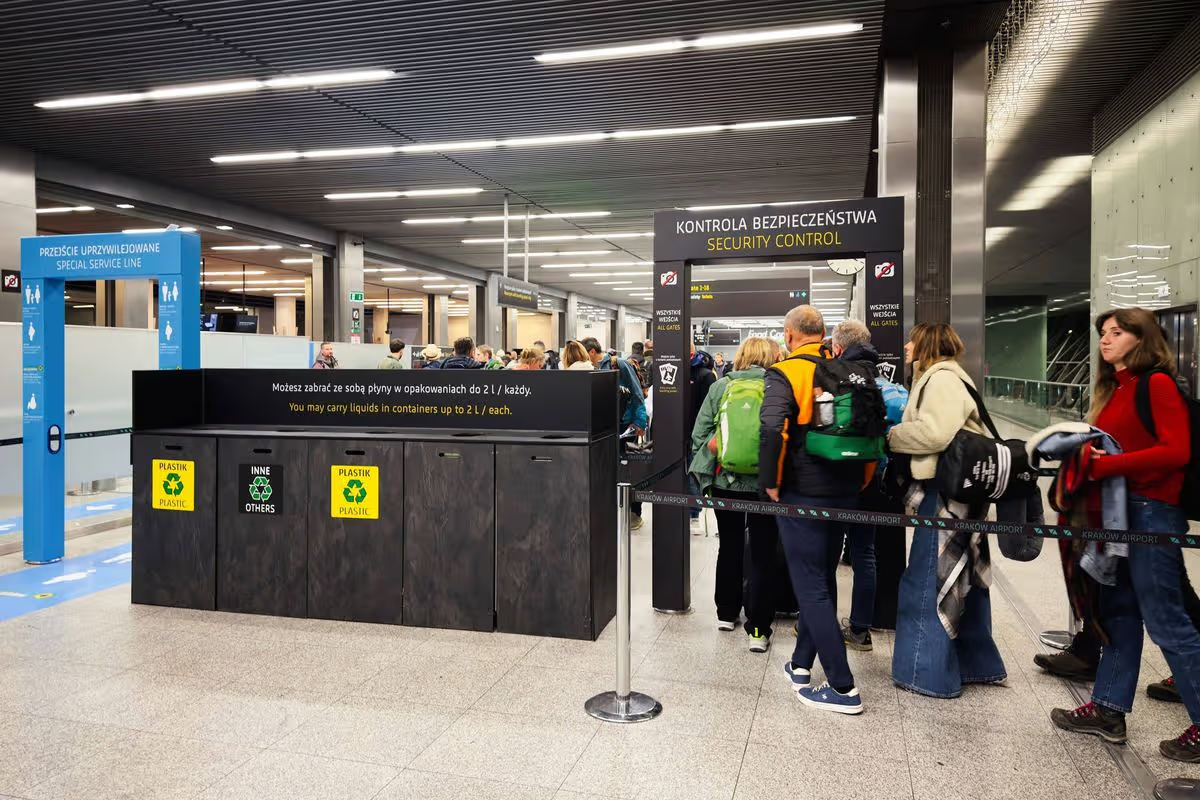
Brits issued warning over passport delays due to new travel rules
New Entry/Exit system and ETIAS requirements coming to Europe in 2026 mean British passport holders need to prepare for biometric checks and travel authorisation.

New requirements mean delays(Image: Getty)
As winter fades away, millions of Britons are probably mapping out their summer getaways. Some might already have flights secured, and if that’s you, it’s crucial to familiarise yourself with the new regulations taking effect.
Whether you’re jetting off to Europe or across the Atlantic, fresh legislation is being implemented that could result in substantial hold-ups at airports and railway terminals. Updated requirements covering visas, biometric information and passport checks mean that international travel is growing increasingly complex.
That said, provided you understand what’s needed, your journey should remain hassle-free.
For those bound for Europe, the new entry/exit system may trigger bottlenecks. The introduction of this began in October 2025, and by April 2026, it’s anticipated to operate throughout all Schengen zones.
It demands biometric information – fingerprints and a facial photograph – at the airport, reports the Express.
This may create hold-ups at border crossings, so it’s vital to factor these in and avoid leaving your travel arrangements too tight.
Also anticipated in 2026 is the European Travel Information and Authorisation System (ETIAS). This will oblige non- European Union nationals to secure ETIAS approval if they intend to visit Europe for up to 90 days.
The application will set you back £17.46 but comes free for those under 18 and over 70, and remains valid for three years or until your passport runs out.
Whilst this won’t launch until the final quarter of 2026, specialists are encouraging travellers to get ready and stay informed about the upcoming transformation.
Those planning a journey to the US will be required to use the Mobile Passport Control App. The application was created to cut down queuing times at airports and do away with paper documentation.
Upon arrival in the US, passengers must download the app, set up a profile and respond to a number of questions about themselves.
After completing your submission, you’ll be given a QR code to present at passport control.
Nicole Kerr, CEO at ground transportation platform Mozio, said: “UK searches for ‘summer holiday deals’ have increased by 123% in the past three months, as Brits look to secure their travel plans ahead of peak season.
“While a holiday is meant to be a relaxing and stress-free experience, experts have warned that changes to the travel industry could cause delays and confusion.”

RSF killings in Sudan bear signs of genocide, UN says | Newsfeed
A UN fact-finding body says mass killings by Sudan’s paramilitary Rapid Support Forces in El Fasher carry the hallmarks of genocide, with thousands reported killed. Al Jazeera’s Hiba Morgan breaks down the findings, which accuse the RSF of rape, torture, and extortion.
Published On 20 Feb 2026

Ruth Langsford says Eamonn split was ‘huge shock’ and left her ‘devastated’ saying ‘I thought I had a happy marriage’
RUTH LANGSFORD has said her split from husband Eamonn Holmes was a “huge shock” and left her “devastated”.
The much-loved telly couple announced their separation in May 2024 after 14 years of marriage and 27 years of being together.

Opening up about the split, she told Daily Mail: “I had a very happy marriage. Of course you question yourself, ‘did I miss something, was I not aware, was I too busy?’ But there’s no point playing the blame game.
“I just didn’t think I’d find myself here, and I wasn’t strong at the start. I was broken. Broken heart. Broken dreams. We all have an image of how we think our life and future is going to be.
“This wasn’t mine. I was devastated. We had gone from being a couple, traversing the usual ups and downs of a marriage, to an abrupt end. It was a huge shock.”

Furious Las Vegas visitors charged $180 for two cocktails and two bottles of water
CUSTOMERS who visited a bar in Las Vegas were astounded that they were charged up to $180 for four beverages.
No one expected the cost to be so astronomically high, with additional hidden fees only making it higher.

One concertgoer visited the Las Vegas Strip bar in the Dolby Theater and purchased two cocktails and two bottles of water.
But due to hidden “admin fees” he found himself $180 out of pocket.
The surprise fees added an extra $26 to his bill, which he’s said is “hurting the city” in a social media post online.
He continued: “It’s the “Vegas is expensive” problem that this receipt highlights.
“I have the financial means to buy what I want, but even I was shocked. MGM is taking it too far.
“We always stay at the Encore tower suits and this hotel is not cheap, but they never price gouge.”
Others had similar experiences, with two more Sin City visitors revealing they found themselves charged $100 for the four drinks they ordered.
Fans sharing their experiences are hoping that posting their stories will help future Vegas visitors to make more informed decisions.
In addition to product prices in Vegas, admin fees as well as gratuity are often automatically added to help cover staffing, transaction costs and credit-card processing fees.
These extra fees are often discreetly hidden until the point of purchase.

Winter Olympics TV schedule: Saturday’s listings
Saturday’s live TV and streaming broadcasts for the Milan-Cortina Olympics unless noted (subject to change). All events stream live on Peacock or NBCOlympics.com with a streaming or cable login. All times Pacific. 🏅 — medal event for live broadcasts.
MULTIPLE SPORTS
8 p.m. — “Primetime in Milan” (delay): Cross-country skiing, bobsled, figure skating, freestyle skiing and more. | NBC
BIATHLON
5:15 a.m. — 🏅Women’s 12.5-kilometer mass start | USA
10:30 a.m. — 🏅Women’s 12.5-kilometer mass start (re-air) | USA
BOBSLED
1 a.m. — Four-man bobsled, Run 1 | Peacock
2:55 a.m. — Four-man bobsled, Run 2 | Peacock
8 a.m. — Four-man bobsled, runs 1-2 | USA
10 a.m. — Two-woman bobsled, Run 3 | NBC
12:05 p.m. — 🏅Two-woman bobsled, final run | Peacock
12:15 p.m. — 🏅Two-woman bobsled, final run (in progress) | NBC
2:15 p.m. — Two-woman bobsled, runs 3-4 (delay) | NBC
CROSS-COUNTRY SKIING
2 a.m. — 🏅Men’s 50-kilometer mass start classic | Peacock
3:10 a.m. — 🏅Men’s 50-kilometer mass start classic (in progress) | USA
8:30 a.m. — Men’s 50-kilometer mass start classic (delay) | NBC
CURLING
🏅Women’s bronze-medal match
5:05 a.m. — Teams TBD | Peacock
7:20 a.m. — Teams TBD (delay) | USA
🏅Men’s gold-medal match
10:05 a.m. — Teams TBD | CNBC
Women’s bronze-medal match
1 p.m. — Teams TBD (re-air) | CNBC
FIGURE SKATING
11 a.m. — Exhibition gala | Peacock
11:55 a.m. — Exhibition gala (in progress) | NBC
12:50 p.m. — Exhibition gala (in progress) | NBC
FREESTYLE SKIING
1 a.m. — Men’s skicross, qualifying | Peacock
1:45 a.m. — 🏅Mixed team aerials, final | USA
2:55 a.m. — 🏅Men’s skicross, finals | Peacock
8:45 a.m. — Men’s skicross, finals (delay) | USA
9:15 a.m. — Mixed team aerials, final (re-air) | USA
10:30 a.m. — 🏅Women’s freeski halfpipe, final | NBC
1:30 p.m. — Mixed team aerials, final (re-air) | NBC
HOCKEY
🏅Men’s bronze-medal game
11:40 a.m. — Teams TBD | USA
SKI MOUNTAINEERING
4:30 a.m. — 🏅Mixed team relay | Peacock
SPEEDSKATING
6 a.m. — 🏅Men’s and women’s mass start, semifinals and finals | Peacock
7 a.m. — 🏅Men’s and women’s mass start, semifinals and finals (in progress) | NBC

Seoul stocks again end at record high of above 5,800 despite global uncertainties

The Korea Composite Stock Price Index (KOSPI), shown on a screen in the trading room at Hana Bank in Seoul, topped a record-high 5,800 on Friday. Photo by Yonhap
South Korean stocks topped the 5,800-point mark for the first time Friday to end at a fresh record high amid expectations that upcoming investor-friendly measures will help lift market valuations. The local currency fell against the U.S. dollar.
The benchmark Korea Composite Stock Price Index (KOSPI) added 131.28 points, or 2.31 percent, to close at an all-time high of 5,803.53.
Trade volume was heavy at 1.73 billion shares worth 32.74 trillion won (US$22.64 billion), with winners outnumbering losers 543 to 340.
Institutions scooped up a net 1.61 trillion won worth of shares, while foreign and retail investors sold a net 745.06 billion won and 986.12 billion won worth of shares, respectively, for profit-taking.
After a three-day Lunar New Year holiday break, the index surged Thursday to top the 5,600 level, with experts saying pent-up demand accumulated during the holiday continued to flow into the stock market.
The KOSPI has been on a bull run recently, surpassing the 5,000 mark for the first time ever on Jan. 27 and the 5,500 level on Feb. 12.
“Geopolitical tensions have heightened after U.S. President Donald Trump signaled the possibility of military action against Iran following a 10-day negotiation deadline, and some analysts suggest the risk of a full-scale conflict is not negligible,” Kim Seok-hwan, an analyst at Mirae Asset Securities, said.
“But investors have maintained expectations for a series of measures by the government and companies to boost shareholder returns and overall market valuations,” he added.
U.S. shares lost ground Thursday (U.S. time) amid concerns about the U.S.-Iran situation and risks linked to massive investments in artificial intelligence (AI), as the U.S. private market and alternative assets manager Blue Owl Capital announced it is going to tighten investor liquidity.
Most large-cap shares finished higher, with chip and defense shares leading the market advance.
Market bellwether Samsung Electronics edged up 0.05 percent to 190,100 won, and chip giant SK hynix surged 6.15 percent to 949,000 won.
Carmakers traded mixed. Top automaker Hyundai Motor went down 0.78 percent to 509,000 won, while its sister affiliate Kia soared 1.06 percent to 171,800 won.
Leading battery maker LG Energy Solution fell 0.5 percent to 401,500 won, but AI investment firm SK Square advanced 2.47 percent to 580,000 won.
Nuclear power plant builder Doosan Enerbility surged 5.18 percent to 103,500 won, and defense giant Hanwha Aerospace spiked 8.09 percent to 1,242,000 won.
Leading shipbuilder HD Hyundai Heavy jumped 4.88 percent to 602,000 won, and its rival Hanwha Ocean shot up 6.61 percent to 149,900 won.
Pharmaceutical giant Samsung Biologics went up 0.93 percent to 1,736,000 won, while Celltrion dipped 1.02 percent to 242,000 won.
Financials gathered ground. KB Financial added 1.38 percent to 168,800 won, and Shinhan Financial grew 1.69 percent to 102,000 won.
Samsung Life Insurance climbed 4.78 percent to 219,000 won, and Mirae Asset Securities rose 0.57 percent to 70,900 won.
The Korean won was quoted at 1,446.65 won against the U.S. dollar at 3:30 p.m., down 1.15 won from the previous session.
Bond prices, which move inversely to yields, closed higher. The yield on three-year Treasurys lost 3.5 basis points to 3.143 percent, and the return on the benchmark five-year government bonds also shed 3.5 basis points to 3.391 percent.
Copyright (c) Yonhap News Agency prohibits its content from being redistributed or reprinted without consent, and forbids the content from being learned and used by artificial intelligence systems.

New ‘Skynook’ economy seat that feels more like business class with private sliding door
A NEW economy seat has been revealed but it isn’t your normal limited leg-room option.
Dubbed the ‘SkyNook’, there’s a new economy seat that could offer passengers a “semi-private” retreat when flying.
The seat would feature at the back of a plane, transforming the underutilised space into an area that could host families, travellers with service animals or pets, travellers with sensory sensitivities or even someone flying with either a bulky or fragile item that cannot go into hold.
The reason the seat would feature at the back of a plane, is because widebody aircraft often taper inwards at the back – which means a triple row of seats cannot fit.
Instead, two seats are usually put in this area, but there is still some extra room between the side of the plane and the window seat.
The SkyNook would fill this space so that a secure car seat would fit or a pet carrier or service animal.
Read more on travel inspo


Mock-ups of the cabin show how the armrest of the seat nearest the window could lay flat to be used as a table or to sit a baby carrier on.
A bassinet could also be fitted into the space and secured onto the armrest.
Travellers in this seat could also make use of a privacy divider which is designed to reduce cabin noise and separate the seats from the aisle, which can often fill with people waiting for the toilet.
The screen could be particularly useful for passengers who want to feed children, for example.
Created by Collins Aerospace, an RTX business, the seat is up for a 2026 Crystal Cabin Award in the Passenger Comfort category.
The award recognises innovation, excellence and creativity in aircraft cabin interior design.
The winner of the award will be announced on April 14.
Another concept that has been named a finalist is Airbus’ new Airspace A350-1000 first class cabin concept.
The new first class cabin experience would be similar to flying in a private jet and would feel more like an apartment.
A master suite would be in the middle of the cabin of the aircraft and for two travellers with a double bed, a private toilet, a changing area and a bar.
And to make the experience not feel claustrophobic, there are virtual panoramic windows that wrap around the suite which stream images from outside the aircraft.
So, essentially, you will always have a view.
Another finalist is Spaceframe, which is another take on an economy seat.
The seat would have a mesh backrest with foam to make it more comfortable for longer journeys and they would also slide forwards, to recline, which would mean they don’t invade the passenger’s space behind.
The seats would also have integrated power, lighting and wireless charging.
Some airlines are already well-known for their economy seats, such as Emirates.
The Sun’s Head of Travel Lisa Minot recently flew in economy with Emirates and said: “Even in economy it’s easy to see how Emirates is in a different league to other long haul airlines.
“Launching their first London flights back in 1991, the next year they were the first ever airline to install in flight entertainment screens in all seats across every class.
“And as the first airline to order the game-changing Airbus A380 and I was among the first to travel on the two-deck leviathan capable of holding up to 615 passengers.
“The in-flight catering always feels generous compared to other airlines and while the seats may not be any more generous than our flag-carrier, the plush padding makes it much more comfortable over a long flight.
“And unlike the service I’ve received on some American airlines over the years, the Emirates crew have been faultless on every trip I’ve been on.”
In other aviation news, here’s the airline with the best economy seats in the world – and you can even book private beds.
Plus, the UK airline with the comfiest Economy seats revealed.

Asos co-founder dies after Thailand apartment block fall
Quentin Griffiths co-founded Asos in 2000 and remained a significant shareholder after leaving the firm five years later.
Source link

Classic 70s television series streaming for free from today
A beloved children’s programme is now available to watch for free on a streaming service.

A beloved children’s programme is available to watch for free (Image: GETTY)
A classic children’s programme is streaming for free from today on ITVX.
Captain Pugwash first aired on British television in 1957 as a black-and-white stop-motion show, before the full colour version of the series was first broadcast from 1974-75.
The series is based on the much loved children’s comic strips and books created by Josh Ryan.
It follows Captain Horatio Pugwash as he sails the high seas in his ship, the Black Pig, ably assisted by Tom the captain boy, pirates Willy and Barnabas and Master Mate.
Along their adventures, they’re battling against his mortal enemy, Cut-Throat Jake, captain of the Flying Dustman.
The children’s animation was written, illustrated and produced by John Ryan, before Peter Hawkins voiced all the characters, bringing them to life.
Captain Pugwash originally ran from 1957 to 1966 before being revived in colour in the 70s, and again in 1997.
The synopsis teases on ITVX: “The bumbling 50s kids TV star is back on screen. Join him aboard the Black Pig & meet cabin boy Tom, pirates Willy & Barnabas, & Master Mate. Beware of the enemy Cut-Throat Jake.”
Viewers have been left reminiscing on the iconic childhood series, with one writing on Reddit : “Love Pugwash – have complete set of DVDs.”
Another said: “I can hear the theme tune in my head right now,” as a third elsewhere wrote: “Ooh wow, that brings back memories, brilliant.”
This comes as ITV has added a variety of returning and new programmes to the streaming service, with more yet to come this year.
In a press release announced earlier this year, the broadcaster shared: “ITV will ring in the new year with a raft of brand new dramas, exclusive entertainment shows, much loved juggernauts and big name reality.
“Jing Lusi, Michelle Keegan, Martin Compston, Natalie Dormer, Shaun Evans, Romala Garai, Eve Myles, Gemma Arterton, Rafe Spall, Dominic Cooper, Luke Evans, David Morrissey, Douglas Booth, Sophie Rundle, Philip Glenister, Mia McKenna-Bruce, Rishi Nair, Robson Green, Aimée-Ffion Edwards, Daniel Mays, Ben Miller, John Simm, Richie Campbell and Omid Djalili are just some of the names appearing in ITV dramas over the next twelve months.”
Drama includes Michelle Keegan’s The Blame, The Party, based on the acclaimed novel by Elizabeth Day, Gemma Arterton leading a stellar cast in Secret Service, and new scandalous drama Adultery.
Elsewhere in entertainment, Graham Norton hosts a street-sized reality game, The Neighbourhood, Rob Brydon is fronting new gameshow The Floor and Gary Lineker is hosting The Box. Ben Shephard ’s The Summit has already begun, and I’m A Celebrity All Stars will return alongside Britain’s Got Talent, Ant & Dec’s Limitless Win and The 1% Club.
Captain Pugwash is available to watch on ITVX.

EU steel exports to US drop 30% as talks stall over Trump tariffs relief
Published on •Updated
European steel shipments to the US declined 30% between June and December 2025 compared with the same period a year earlier, according to recent Eurostat data compiled by Eurofer, the Brussels-based industry group.

ADVERTISEMENT
ADVERTISEMENT
The decline underscores the impact of the US’s 50% tariffs on EU steel, even after the EU and US signed a trade agreement in July 2025 agreeing a blanket 15% US tariff on EU goods. Steel was carved out of that deal and talks to ease duties remain stuck.
“A 30% drop in steel exports to the US within just six months is a clear signal that the blunt 50% tariffs imposed by the US government on EU steel are damaging our industry,” Eurofer Director general Axel Eggert said.
“The US decision to include EU downstream steel products, such as machinery, will have another huge negative impact on us and our European customers,” he added.
Washington imposed 50% tariffs on EU steel and aluminium in June 2025 and extended the measures to more than 400 steel and aluminium products in August.
Steel talks tied to EU-US trade deal enforcement
The US has framed the tariffs as a shield against Chinese overcapacity flooding global markets, including Europe.
With Chinese exports increasingly redirected from the US to the EU, the European Commission proposed on 7 October 2025 to halve the volume of steel allowed into the bloc duty-free and to levy a 50% tariff on imports exceeding a quota of 18.3 million tons a year.
The proposal steel needs to be adopted by the EU legislator. Meanwhile Brussels itself hopes to reopen talks with the White House to secure lower duties on EU steel.
But US negotiators have linked any resumption of discussions to the implementation of last summer’s EU-US trade deal, struck by Commission President Ursula von der Leyen and President Donald Trump. Under that pact, the EU agreed to cut its tariffs on US goods to zero while accepting 15% duties on its exports to the US.
With the EU legislative process still requiring approval from lawmakers and member states, Washington’s patience is wearing thin. Tensions could rise further after EU lawmakers introduced amendments that may complicate talks with capitals.
The European Parliament is expected to vote on the deal in March, paving the way for negotiations with member states.
The talks stalled on the European side after the US threatened to annex Greenland militarily from Denmark in January. Although the US has softened its language, it led to delays. The administration’s continuous lobbying for less stringent rules when it comes to digital legislation in Europe has also added obstacles to the talks.

Friday 20 February Malaysian Declaration of Independence Day in Melaka
This article chronicles the historical significance of the Malaysian Declaration of Independence Dayspecifically within the region of Melaka. It details how Tunku Abdul Rahman led a successful negotiation in London during early 1956 to secure the end of British colonial rule. Upon his return, he chose Padang Banda Hilir as the symbolic site to officially proclaim that Malaya would become a sovereign nation on August 31, 1957. The text highlights the jubilant public reception and the motorcade that greeted the leaders as they arrived to share this monumental news. Ultimately, the source serves as a commemorative look at the diplomatic milestones and the emotional celebrati …

Four teenagers charged after drive-by shooting of Matt Utai
New South Wales Police has charged four teenagers over the drive-by shooting of former NRL player Matt Utai and the alleged arson attacks targeting his family in Sydney.
Utai sustained gunshot wounds to his leg and shoulder during a drive-by shooting in Sydney suburb Greenacre on Tuesday.
A 16-year-old boy and a 19-year-old man have both been charged with “accessory after the fact to shoot at with intent to murder”.
A 18-year-old and another 19-year-old have both been charged with damaging property by fire, while the latter was also charged with supplying prohibited drugs.
Utai, 44, remains in a serious condition after undergoing surgery for his injuries.
Police said the shots had been fired from a white SUV, which was later found burned out in nearby Wiley Park.
On Wednesday, police attended a further incident after shots were fired at a house in St Clair. A woman in her 50s was at home but was not injured.
A short time after they found a car on fire in Colyton and later the same day a house and vehicle were found ablaze in Guildford West.
New South Wales Police department said a task force was assembled to investigate the incidents – all of which are believed to have been targeting the same family.

‘I got on overnight train from major UK city and woke up in most magical place’
The train rocks you to sleep and wakes you somewhere spectacular

There was plenty of stunning scenery to explore(Image: Kirsty Bosley)
Just one sleeper train ride away from a major English city is spectacular views, deserted beaches and waterfalls. Features Writer Kirsty Bosley branded it “one of the most magical days of her entire life”.
Just the previous evening, she had been stuck in gridlock at Birmingham’s Five Ways island, stressed and anxious about missing the Caledonian Sleeper – the train that lulls you to sleep in the midland city and rouses you in the Scottish Highlands.
She secured a ticket to whisk her from Brum to Inverness, awakening in Scotland following a 10-hour journey on the overnight service and granting roughly 12 hours there before her pre-booked return departure.
The purpose was straightforward: To see whether the Caledonian Sleeper merits booking, given it’s only recently begun collecting passengers in Birmingham. Kirsty gives her honest opinion on her trip…
Therefore, I was determined to cram in absolutely everything possible during those 12 hours – family-friendly attractions, trails for hikers, intimate experiences for lovers and tranquil spots for contemplation in the wilderness, much like the moment I was savouring on Dores Beach, reports Birmingham Live.
Furthermore, I aimed to accomplish everything whilst spending minimal money, surviving on Tunnocks Teacakes and Irn Bru alongside small portable snacks we grabbed en route. The day’s largest expense turned out to be the most worthwhile: a pre-paid £42 hire car from Enterprise.
After a brisk 15-minute stroll from the train station, we picked it up and embarked on our ambitious mission to navigate the entirety of Loch Ness (roughly 70 miles) in a single day.
Fuelled by a mere £15, we accomplished our goal, embarking on a clockwise journey that began with tears of joy as the loch unveiled itself, perfectly timed to Taylor Swift’s bridge from Cruel Summer blaring from the speakers.
We pulled over, rolled down the windows and danced roadside under the rising sun, brimming with anticipation for the perfect day ahead.
A masterclass in Loch Ness
Following our jubilant pit stop, our first destination was the Loch Ness Clansman Hotel to see the plaque commemorating Ozzy Osbourne’s nocturnal escapades in the loch, where he searched for Nessie alongside his son Jack.
Driving felt less like a chore and more like a pleasure with the constant backdrop of the Highlands. In Drumnadrochit, at the hotel where the monster tales originated, we made our second largest purchase of the day: £15 entry to The Loch Ness Centre, narrated in its entirety by David Tennant.
As we moved from room to room, we delved into the origins of the rumours, the ensuing frenzy, the history and geography of the land, and the Scottish myths and legends that lent an air of reality to the tale.
We also discovered the fascinating science behind why it’s impossible to definitively prove there isn’t a monster lurking in a body of water so extraordinarily deep that all the freshwater from every lake, reservoir and river in England and Wales combined couldn’t fill it.
Following that revelation, I found myself scrutinising the water far more intently, half-convinced there was a genuine possibility she might poke her enormous neck above the surface to greet us passing Brummies.
The sheer sense of wonder sparked by the centre’s masterclass justified the entrance fee entirely, as every subsequent free activity we undertook was now enhanced by our newfound knowledge.
We reached Urquhart Castle in remarkably quick time – a military ruin positioned directly on the water’s edge.
Walk-up admission costs £16 and whilst I was certain it would be spectacular to explore, we decided to save it for another visit now we were absolutely convinced we’d be returning. Boat excursions can transport you there, so that was immediately added to my ‘to-do’ list.
Enchanted woodlands and breathtaking vistas
We pressed on along the waterside A82 towards Invermoriston, the sort of place that appears lifted straight from an adventure film.
The Old Bridge spanning the thundering falls of the River Moriston, as it crashes dramatically towards Loch Ness, resembles something from a fairy tale. Despite being situated on the renowned Great Glen Way trail, it all felt like a mystical secret because remarkably few other visitors were present.
We parked up (parking is free, but donations are appreciated, as with many public toilets along the route) and embarked on a stroll into the woodland, pausing at the historic Summer House Victorian folly to soak in the surroundings, much like folks did years ago as salmon battled their way upstream.
Meandering through spongy clusters of radiant white reindeer lichen, pausing to observe the rapids and keeping an eye out for squirrels, I felt a sense of tranquillity wash over me. It’s a must-visit spot for any traveller – I wish every Brummie could experience it.
By the time we reached the South Shore, it was 2pm, and we’d managed to cover half the loch’s circumference in just four hours.
A brief pause for photos and laughter ensued before we rounded the southernmost point and were greeted by a view so breathtaking from the Suidhe Viewpoint that we had to pull over.
Another family of tourists arrived, and although we exchanged few words, our shared silence spoke volumes about the unforgettable, life-affirming moment we were experiencing. We swapped cameras to help each other capture proof of our presence in this extraordinary place. The wild beauty of our surroundings was almost overwhelming as we continued our journey.
Wildlife and waterfalls
We encountered a majestic stag who turned to regard our car. It felt like we’d stepped into an illustration on the front of a tin of special shortbread biscuits. Overhead, giant birds, possibly including a golden eagle, soared majestically.
Our next stop was the Falls of Foyers, a spectacular 140ft waterfall nestled within a forest inhabited by elusive red squirrels. Tunnocks Teacakes and Irn Bru proved insufficient fuel for the challenging descent down steep steps, but thankfully the Waterfall Cafe offered sausage rolls and other snacks to revive us.
With daylight fading, we passed by Boleskine House (the former residence of Aleister Crowley and Led Zeppelin’s Jimmy Page), which was shut, though we went anyway simply to say we’d been, before heading off to find a man we’d discovered at The Loch Ness Centre.
Dusk – One final adventure
Steve Feltham is a renowned ‘Nessie Hunter’ who abandoned his family business, relationship and home to move from Dorset. Since 1991, he’s lived on the loch’s shores and has devoted himself to spotting ‘the monster’ ever since.
Yet his tale is really about leaving behind what doesn’t fulfil you and pursuing the life you desire. I desperately wanted to meet him before nightfall.
We reached his modest dwelling as the sky began transforming colours above Dores Beach. He wasn’t there, but after the dog-walkers departed, I chose to wait a whilst longer in case he returned.
The pebbled shoreline is magnificent, the surroundings breathtaking. I pondered whether Steve might welcome a new neighbour, though I knew Birmingham beckoned so I could pen this account.
Both Steve and Nessie remained beyond our grasp, only one possessing confirmed existence but both surrounded by legends I yearned to explore further. Returning to relinquish the rental car and hop back on what I’ll forever dub the ‘Loch Ness Express’, we bid farewell to it all, but only physically.
I was convinced that my spirit remained in Invermoriston, still on the hunt for red squirrels. I plan to retrieve her on the next available journey aboard the Caledonian Sleeper. This time around, I’ll be sure to pack sandwiches.