Overnight missile and drone attacks hit several Ukrainian regions as world leaders gather in New York for the UN General Assembly.
Published On 22 Sep 202622 Sep 2026
Russian forces have launched widespread attacks targeting industrial sites and critical energy infrastructure across several regions of Ukraine, killing at least three people and knocking out power to nearly 100,000 residents, Ukrainian officials said.
The strikes overnight hit industrial facilities simultaneously in the Dnipropetrovsk region, including Dnipro, Pavlohrad and Kryvyi Rih, the hometown of President Volodymyr Zelenskyy, regional Governor Oleksandr Hanzha said on Telegram on Tuesday.
Recommended Stories
list of 3 itemsend of list
Three people were killed and six others were wounded in Dnipro, where missiles, drones and artillery heavily damaged business and warehouse premises, Hanzha said.
Ukraine’s air force said Moscow’s overnight barrage involved 212 drones, four cruise missiles, and an unspecified number of Oniks antiship and ballistic missiles.
The strikes also damaged energy infrastructure. An attack on a power facility left nearly 100,000 consumers without electricity in the northern region of Chernihiv, while in the Poltava region, Governor Vitalii Diakivnych said a “massive” Russian attack hit an industrial enterprise and a critical infrastructure facility.
The Russian Ministry of Defence confirmed its forces carried out major strikes, stating it hit industrial and military facilities, the fuel and energy sector, port infrastructure and sea vessels operating for the Ukrainian military.
Meanwhile, Ukrainian drones targeted Russia’s Samara region along the Volga River, killing one person and injuring four, according to the local governor. The region hosts critically important facilities, including oil refineries.
The Russian Defence Ministry said its air defence units intercepted and destroyed 297 Ukrainian drones across various regions overnight.
Diplomatic push in New York
The attacks come as Zelenskyy arrived in New York for the United Nations General Assembly (UNGA), where talks on ending the war are set to be high on the agenda as nearly 130 heads of state gather.
The Ukrainian president wrote on X that a “drone deal” was ready to be signed to bolster air defence and secure funding for the war effort.
“Of course, Ukraine’s number one priority is bringing peace closer and protecting the lives of our people,” Zelenskyy posted. “There are concrete security proposals and de-escalation measures that could bring the end of the war closer. We are working to strengthen air defence and ensure sufficient financing for Ukraine.”
He said, “Around 20 meetings are planned, including with the US president, European leaders, US senators and members of the House of Representatives, heads of international organisations, leading American companies and think tanks.”
Zelenskyy met French President Emmanuel Macron on Monday and is likely to meet US President Donald Trump on Tuesday.
Earlier, Macron also met Trump, after which he said the two countries agreed to work together to secure a moratorium on strikes targeting energy networks and civilian infrastructure in Ukraine. Both Zelenskyy and Russian Foreign Minister Sergey Lavrov are set to address the UNGA later this week.
French President Emmanuel Macron, left, with his Ukrainian counterpart, Volodymyr Zelenskyy, on the sidelines of the UNGA in New York, US, September 21, 2026 [Ludovic Marin/AFP]
Two housemates were then forced to say their goodbyes on Friday night (September 18), with fake contestant Tays leaving alongside bartender Millie. But viewers have also been watching romances bloom between Chelsey and Lynx, as well as Omar and Rhianna.
However, this won’t be Rhianna’s first love story to play out on screen. She previously dated Made in Chelsea star Freddy Knatchbull and appeared in several episodes of the show alongside him.
In her first scene on the Channel 4 series, the 21-year-old revealed that she doesn’t use the name she was given at birth. The Russian star actually chose her current name at just six years old, after her mother became a British citizen.
“I’m Russian but I’ve lived everywhere,” she explained to Freddy’s friends. When asked what her real name is, Rhianna shared: “I changed my name too, when I was like six. Because my mum became a British citizen.”
She went on to reveal her potential choices: “As a six-year-old, she’s asking me ‘Oh, change your name if you want.’ And I was like ‘Okay.’ Gave her three options: Zendaya, Rihanna like the singer, or Kylie Jenner.”
Try ITVX Premium free for a week
This article contains affiliate links, we will receive a commission on any sales we generate from it. Learn more
ITVX Premium offers exclusive ad-free content that can be streamed on-demand and on the go, with everything from Hollywood blockbusters to bingeable British box sets.
An annual plan costs £59.99 – equal to £4.99 per month – after a seven-day free trial.
The Big Brother star didn’t reveal her birth name on the show. But she touched on her unusual upbringing, during which her mother hired a full-time bodyguard to stop her being a “wild child”.
Reflecting on her teenage years, Rhianna said: “I would meet people for the first time and they’d be like ‘Rhianna, by the way, there’s someone following you.’ Can you imagine trying to meet guys and then a bodyguard is with you?”
The so-called stay-at-home daughter is now hoping to win over the nation and take home the Big Brother crown. Living with strangers will also be a new experience for her. “I’ve never done that before,” she admitted before starting the show.
“I’ve never stayed in a hostel, gone to summer camp or boarding. I’ve never been in a situation where I have to stay the night with complete strangers and that is really exciting for me. I get to meet people that I most likely wouldn’t have met in my day-to-day life.”
Big Brother continues on ITV2 and ITVX tonight at 9pm
The Trump administration has proposed investing $5B in a new fund that would help Middle Eastern countries rebuild energy infrastructure battered in the Iran war and reduce their reliance on the Strait of Hormuz to transport oil and gas, according to U.S. and Middle
Henry Pollock has brought an end to his contract stand-off with Northampton, saying it was ultimately “a very easy decision” to sign an extension with the defending Prem champions.
However, the boxing promoter’s valuation was never likely to be met at Northampton or elsewhere in the Prem, given Saints’ star-studded line-up, the league’s £6.4m squad salary cap and rules over players moving between clubs.
The exact level of Pollock’s pay increase is unclear. While some sources have valued his new contract at £400,000 a year, others involved in the deal say the figure is higher.
It is certainly short of Scotland playmaker Finn Russell, who, as Bath’s marquee player, is on the league’s most lucrative package, worth about £1m a year.
Pollock’s pay puts him well ahead of most of his contemporaries in the Prem however.
His new deal is comfortably ahead of the average annual salary in the league (£191,000), the average earned by someone in his 20-22 age bracket (£106,000) and with his level of international experience (£224,000), as revealed by the latest league payroll data, covering the 2024-25 campaign., external
Only 4% of Prem players that season were paid in excess of £400,000 a year.
Pollock’s previous contract, signed in December 2024, is understood to have been worth about £150,000.
Some graduates are paying thousands just to look employed. And parents are spending up to $50,000 on career coaches. Why is the entry level job market so broken? Al Jazeera’s Yasmeen ElTahan explains.
EASYJET is set to be disrupted by staff walkouts next month – with flights to and from the UK expected to be cancelled.
The airline’s cabin crew in Portugal have voted to strike on two separate occasions across October and December.
easyJet cabin crew in Portugal are set to strike next month – and again in DecemberCredit: Alamy Stock Photo
Members of the SNPVAC union have announced walkouts from October 2–6 and again in December on 19–23.
The strike will affect flights from busy airports including Lisbon, Porto and Faro.
Sign up for the Travel newsletter
Thank you!
From the UK, easyJet operates flights to Portugal from the likes of Birmingham, Bristol, Edinburgh, Glasgow, Liverpool, Gatwick, Luton, Southend, Manchester and Newcastle.
The union has estimated that the strike in October alone could ground around 500 scheduled flights overall.
This is likely to include 35 return flights to and from the UK.
A spokesperson from the airline added: “We are extremely disappointed that SNPVAC is planning strike actions despite our willingness to continue a constructive dialogue.
“We had just started a conciliation process through the mediation of DGERT with the aim to reach an agreement to meet our employees’ requests and protect the sustainability of easyJet business in Portugal.
“The current union demands are unworkable especially given that our crew are already paid significantly above the Portuguese national average.
Flight compensation rules
A look at your rights if a flight is delayed or cancelled, when your entitled to compensation and if your travel insurance can cover the costs.
What are my rights if my flight is cancelled or delayed?
Under UK law, airlines have to provide compensation if your flight arrives at its destination more than three hours late.
If you’re flying to or from the UK, your airline must let you choose a refund or an alternative flight.
You will be able to get your money back for the part of your ticket that you haven’t used yet.
So if you booked a return flight and the outbound leg is cancelled, you can get the full cost of the return ticket refunded.
But if travelling is essential, then your airline has to find you an alternative flight. This could even be with another airline.
When am I not entitled to compensation?
The airline doesn’t have to give you a refund if the flight was cancelled due to reasons beyond their control, such as extreme weather.
Disruptions caused by things like extreme weather, airport or air traffic control employee strikes or other ‘extraordinary circumstances’ are not eligible for compensation.
Some airlines may stretch the definition of “extraordinary circumstances” but you can challenge them through the aviation regulator the Civil Aviation Authority (CAA).
Will my insurance cover me if my flight is cancelled?
If you can’t claim compensation directly through the airline, your travel insurance may refund you.
Policies vary so you should check the small print, but a delay of eight to 12 hours will normally mean you qualify for some money from your insurer.
Remember to get written confirmation of your delay from the airport as your insurer will need proof.
If your flight is cancelled entirely, you’re unlikely to be covered by your insurance.
“We are doing everything we can to minimize the impact of the strike on our customers including actioning some cancellations in advance to allow our customers to rearrange their travel plans.”
The annual general debate of the United Nations General Assembly (UNGA) starts on Tuesday morning in New York amid dire circumstances. Besides traffic gridlock and overpriced hotel rates, cavalcades of motorcades and successive dignitaries delivering calibrated speeches, this session will hear Secretary-General Antonio Guterres’s last speech on the state of the UN.
Guterres headed the UN for 10 years, and during that time, he repeatedly failed to defend it when it came under attack. He passes on his post at the top of a world organisation on the verge of financial collapse and more marginalised than ever before.
Paradoxically, Guterres has the United States, the host government of the UN, and its mercurial president, Donald Trump, to thank for this dismal state of affairs.
Earlier this year, the Trump administration withdrew from dozens of UN agencies and organs and, in an extraordinary move, ceased all payments of its dues to the regular and peacekeeping budgets of the UN. But these drastic policy decisions did not spring out of nowhere. Trump’s unhappiness with the UN is multifaceted, and his decision to stop fulfilling Washington’s legally binding financial obligation may well be the logical culmination of decades-long US policy.
In the mid-1980s, the Reagan administration accused the UN of being a third-world, anti-US forum. To compel the organisation to better serve its interests and under the guise of the ubiquitous need for reform, which all secretaries-general fell for, the US started to withhold a share of its assessed contribution, which accounted for a quarter of the regular budget and a third of the peacekeeping budget back then.
By 1987, the US relaxed its payment withholding policy, but the precedent was set. Washington continued to use the threat of withholding payment to maintain its grip on an organisation it viewed and continues to view as a vehicle serving its national interests rather than a multilateral agent serving the whole of humanity.
Ever since the Reagan years, the US has kept the UN on a short financial leash, and to this day, has been deliberately accruing arrears. It currently owes an estimated $4.2bn – that is equivalent to 120 percent of the regular UN budget for 2026.
Trump has readily embraced this policy of financial blackmail. His administration has slow-walked mandatory payments, although earlier this month it paid $827m towards its outstanding dues so it could preserve its voting rights in the UNGA.
The president’s ambivalent view of the UN may be rooted in a lesser-known detail. In 2001, Trump, then a real estate developer, lobbied then Secretary-General Kofi Annan to be awarded the billion-dollar renovation project of the UN headquarters, but he did not get his way. That was probably not forgotten.
But just like during the Reagan years, there is another major factor driving Trump’s assault on the UN: US congressional politics. As Israel faced growing backlash at the UN for its genocide in Gaza, pressure from the Israeli lobby in Washington mounted. The Iron Dome diplomatic cover the US provided to Israel in the UN Security Council (UNSC) was no longer sufficient.
By 2025, two years into the genocidal campaign, Guterres’s tepid and overdue criticisms of Israeli policies, critical UNGA resolutions and scathing reports by special rapporteurs of the Human Rights Council – including Francesca Albanese, whom Washington placed under sanctions in violation of its host country obligations – became too much for Trump, Secretary of State Marco Rubio and the US Congress.
In the 1980s, Washington deemed the UN a third-world anti-US forum; today, it is deemed anti-Israel and anti-Semitic. The US’s blind and unconditional support for Israel has brought it growing isolation at the UN, as has its decision to launch a war of aggression against Iran.
Against the backdrop of these developments, the selection of the next secretary-general is dominating the behind-the-scenes agenda. Guterres’s lacklustre tenure at the helm of an organisation on the verge of financial bankruptcy and political demise will soon be forgotten. But what should be remembered is that his appeasement policy vis-a-vis Washington since the first Trump administration has evidently failed.
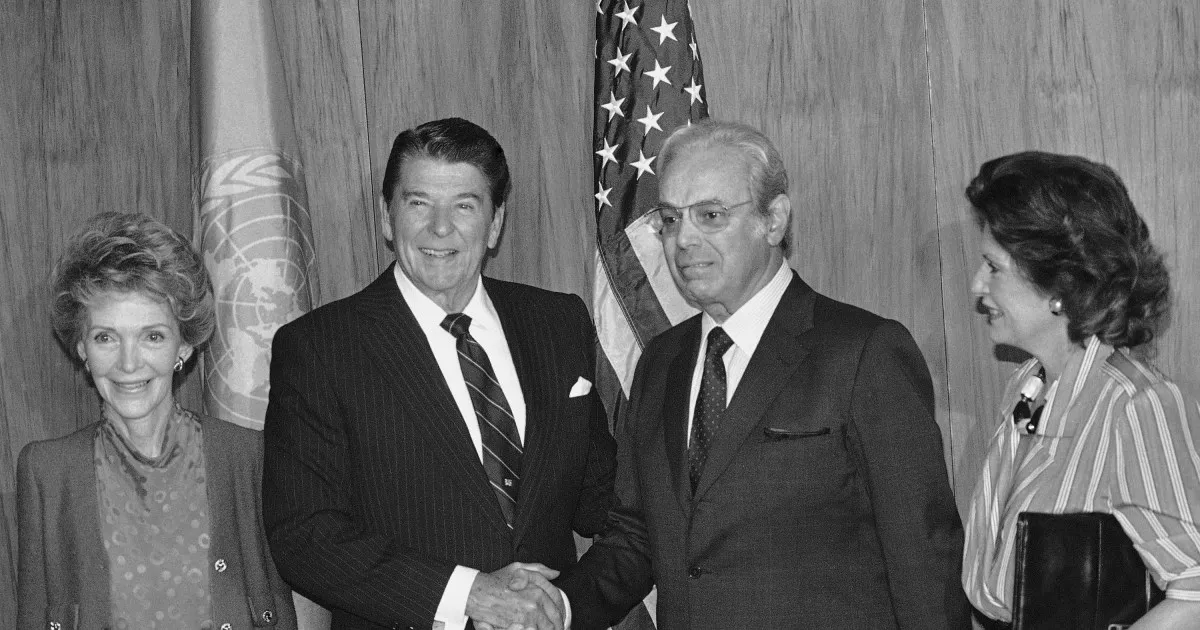
The new secretary-general will inherit the modus vivendi under which all secretaries-general since Javier Perez de Cuellar have had to operate — chronic cash flow problems due to US arrears.
That should motivate the new UN leadership to consider an overhaul of how the UN budget is put together and how member states’ contributions are allocated. Leaving the power of the purse in Washington’s hands is a self-inflicted perpetual wound that could prove lethal for the organisation.
Another fundamental question is whether the UN would be better off had its headquarters not been in the US. For too long, Washington has seen the UN either as a vector of its national interests or in adversarial terms. It has even used its position as a host to exclude world leaders it has viewed as hostile or undesirable, such as PLO Chairman Yasser Arafat and today Palestinian President Mahmoud Abbas.
Evidently, those are decisions only the UNGA can take. But a secretary-general with foresight and political backbone ought to provide views and leadership on those seminal questions to save the organisation from further marginalisation and possible demise.
The views expressed in this article are the author’s own and do not necessarily reflect Al Jazeera’s editorial stance.
The series is hosted by BBC Silent Witness expert Jo Millington
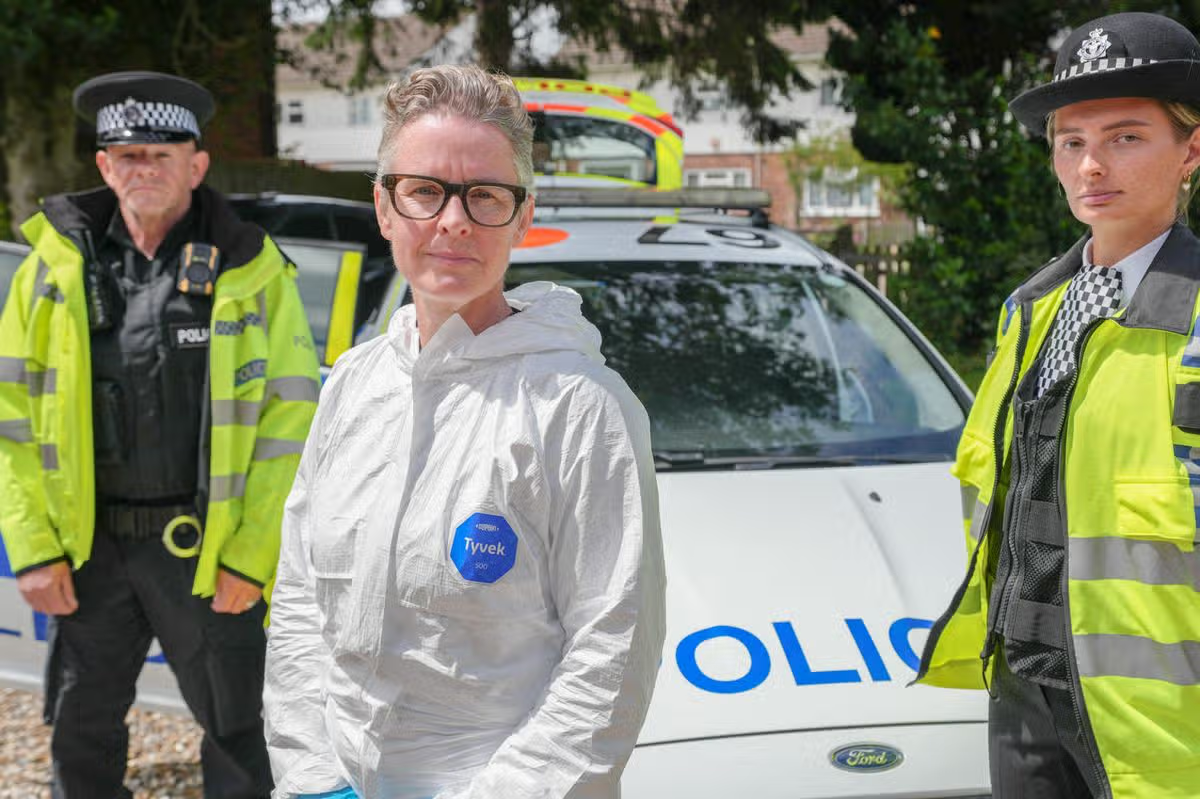
Forensic Scientist Jo Millington will be at the heart of a brand new series (Image: True Crime)
True crime fans do not want to miss a brand new chilling documentary series, plunging viewers into the heart of a crime, and it’s coming sooner than you think.
UK Forensic Breakthroughs is a brand new release, dropping today (September 22) on the True Crime channel. Spanning across 10 episodes, each instalment will focus on its own murder case where scientific breakthroughs and microscopic evidence secured justice for grieving families.
From the murder of a Witney local, whose investigation was the first time in the UK fibre mapping technique was used, and the conviction of a serial arsonist in Cornwall, forensic scientist Jo Millington will give exclusive access to the experts behind the investigations.
Jo Millington has been a forensic scientist for over 30 years, even working behind the scenes on BBC’s Silent Witness. An official synopsis teases: “A rare in-depth dive into the unseen world of forensic science – from ballistics and fibre analysis to forensic ecology and fire investigation. Firsthand testimony from detectives and leading forensic experts directly involved in the cases.
“Ten real UK murder cases where scientific breakthroughs and microscopic evidence secured justice for grieving family, friends and all those impacted by the crime.”
Premiering at 10pm tonight on the True Crime channel, the series will show how forensic science continues to shape major criminal investigations across the UK.
Speaking exclusively to Reach ahead of the show’s new launch, Jo Millington said UK Forensic Breakthroughs stands out from other crime shows, adding: “The first difference is that it puts forensic science at the heart of the show, which normally sits on the periphery in the shadow.
“Over a 10 part series, we’re using the programme to kind of assure a spotlight on forensic science. And more importantly, the scientists that do forensic science, every single day.”
Giving unprecedented access into the world of a forensic scientist, dubbed the “unsung heroes of investigations”, tonight’s episode will explore the story of Edwin Hiles who was found murdered in his own home, but a pioneering fibre mapping technique was used to link one suspect to the crime.
With episodes released weekly, one particular instalment viewers do not want to miss is episode 8 where teams take a deep dive into the world of forensic archaeology and forensic anthropology.
Jo added: “The teamwork that was involved in recovering Natalia Doherty’s body from a clandestine burial site is one of the most painstaking tasks that I have encountered in forensic science.
“Every layer of soil, every root system, and every fragment of evidence had the potential to reveal how her grave had been created, when it was dug and whether it had been disturbed over time.
“Caroline Sims’ archaeology team worked centimetre by centimetre – to record the grave’s construction, the position of the remains and to methodically recover every item from within it.
“Their meticulous approach ensured that the burial itself became evidence, allowing detectives to understand not only where Natalia had been hidden, but how her body had been concealed for so many years.”
TRUE CRIME is available on Sky, Virgin Media, Freeview, Freesat and Freely as well as for streaming via TRUE CRIME UK (FAST), accessible on platforms including Prime Video, Rakuten TV, Pluto TV, Plex, LG Channels, Samsung TV Plus, ITVX and 5.
UK Forensic Breakthroughs premiers tonight at 9pm on True Crime
US chipmaker AMD has become the latest company to join the $1 trillion (€850bn) valuation club, as investors pile into stocks benefiting from the massive investment boom in artificial intelligence.
ADVERTISEMENT
ADVERTISEMENT
At around 5:10 p.m. CEST on Monday, AMD shares were up 9.4% at $612 (€520), extending a surge that has added some $200 billion (€170bn) in valuation to the semiconductor company in a week.
The California-based group, which has announced ventures with both OpenAI and Anthropic, notched a 50% jump in second-quarter revenues over the year-ago level to $11.5 billion (€9.8bn), thanks to a more than doubling of data centre revenue.
In releasing results in early August, AMD said it expects data centre sales to accelerate in the second half of 2026.
Even with the latest surge, AMD’s valuation significantly trails rival chip company Nvidia, considered the pace-setter in artificial intelligence.
Nvidia’s valuation currently approaches $5.5 trillion (€4.7trn).
Publisher Fuel has spotlighted 150 of the best Soviet hotels in its latest book, Socialist Hotels, a photographic project by Elena Amabili that traces the state-sponsored holiday industry in the former Eastern Bloc
When Dodgers manager Dave Roberts said earlier this week that the best was yet to come, his expectations were centered on the offense.
In the Dodgers’ 10-4 rout of the San Francisco Giants on Saturday, that better version of the offense was on display, putting together a pair of three-run rallies in back-to-back innings to take pressure off the pitching staff.
“This is the first time, seems like all year, that we’ve had four or five hitters swing the bats well for four or five games,” Roberts said. “So it’s been really good to see.”
This month, Mookie Betts, Kyle Tucker and Teoscar Hernández have led the group, with Max Muncy and Will Smith heating up this week. The Dodgers’ 15 hits Saturday were their most in a game since July 2 against the San Diego Padres, and just two shy of their season high.
Reinforcements should be coming soon too. Shohei Ohtani (right biceps and left knee) hit off the Trajekt machine Saturday and ran the bases before the game. Roberts said there’s a “good chance” that he’ll be activated off the 15-day injured list during the Dodgers’ series against the San Diego Padres this week. He can be reinstated as early as Wednesday.
Center fielder Andy Pages (fractured left hand) went through a simulated game Saturday. He could return Tuesday.
“You’re going to go through your waves,” said Betts, who finished the day with three doubles and a single. “You’ve just got to ride them. … Right now we’re getting them across, and we’re just going to keep giving ourselves chances. That’s the main thing.”
The offense kept the Dodgers in the game, despite Tarik Skubal struggling.
Skubal pitched only five innings, tied for his shortest start with the Dodgers. And he surrendered four runs, the worst mark of his Dodgers tenure.
Entering the game, Skubal appeared to be peaking. His previous two starts, both against the Reds, were some of his most efficient.
That efficiency, however, regressed against the Giants (64-91).
“Fastball command wasn’t great,” he said. “Not driving it up and in, kind of pulling the ball down at times, pushing it up at times. I think almost [all] pitching is all fastball command, and mine wasn’t great today.”
Though he got through the first two innings without giving up a run — thanks in part to a diving catch by Tucker in the right-center field to end the first — he issued two-out walks in each.
The Dodgers’ offense used that time to mount a lead. Betts hit the first of those doubles in his first at-bat, and Muncy authored his own to drive in the first run.
The next inning, rookie Josue De Paula’s walk, and singles from Alex Freeland and Betts combined to push in another run.
Dodgers baserunner Kyle Tucker slides head first into Giants catcher Andrew Knizner while scoring a run in the fifth inning Saturday.
(Gina Ferazzi / Los Angeles Times)
Then Skubal began to struggle. With a runner on second and one out, he pitched to a full count against designated hitter Victor Bericoto. Skubal missed down the middle with a fastball, and Bericoto sent it 425 feet to center field. It landed on the netting on the other side of the wall to tie the score.
The Dodgers’ offense, coming alive in September, struck back in the third. Smith hit his second home run in as many nights, launching the second pitch of the inning into the left-field pavilion.
The Giants took a different approach to tie the score for a second time. After back-to-back singles, they used back-to-back sacrifice bunts to advance the runners and score another run.
Then the two teams traded runs again. Betts put the Dodgers (95-60) up with an RBI double in the fourth. Skubal gave up back-to-back doubles in the fifth.
That marked both the end of Skubal’s start and the beginning of the Dodgers’ offensive onslaught.
“Obviously, I wasn’t very good today,” Skubal said. “But the offense and defense and bullpen picked me up big time. And that’s what good teams do, they pick each other up and win series and win baseball games. So, hats off to them.”
The Dodgers brought seven batters to the plate in the fifth, and all but one reached base. Tommy Edman hit a two-run single. And pinch-hitting Miguel Rojas almost matched him, but Giants left fielder Turner Hill made a perfect throw to nab Edman in a close play at home to end the inning.
Betts’ and Smith’s bats stayed hot to open the sixth with a leadoff double and one-out RBI single, respectively. The Dodgers took advantage of the Giants’ sloppy infield play to load the bases for De Paula, who lined a two-run single into shallow center field.
Those were the kinds of stifling rallies that had defined the Dodgers’ offense earlier in the season, when they were scoring regularly in double digits.
“I think our potential’s winning the World Series,” Tucker said. “So until we do that, then I can say we reached it. But we feel like we’re in a good spot right now. Our pitching staff’s done a great job all year giving us an opportunity to win every single night. Our defense has played pretty well behind them, and then offensively we’ve done a solid job as well.
“Right now we’ve got a few guys that are feeling good, a few guys that are banged up. But we’re still out there grinding, trying to win as many games as possible before the season ends and just trying to carry it all the way to the playoffs.”
Tucker picked up some extra bumps and bruises Saturday, most notably fouling a pitch off his right knee in the third inning. Once the game became a blowout, Roberts pulled him.
“I feel like everyone’s grinding at this point in the season,” Tucker said. “But I’ll be good with it.”
When the shooting starts, Sara tells her children to lie flat on the ground; the bullets, she said, can go straight through her family’s tent.
Sara, who asked that her real name not be used, has been arbitrarily detained for nearly a decade in Roj camp in Syria’s far northeast, which holds more than 2,300 children and mothers, many of whom are held on the basis of alleged family or other associations with ISIL.
Recommended Stories
list of 4 itemsend of list
Her children have grown up behind guarded fences topped with barbed wire and tangled with rubbish that often blocks the view of the barren, windswept landscape beyond.
United Nations experts and human rights groups describe open-ended detention in camps such as Roj as a breach of international law.
In recent months, women in the camp told Al Jazeera that the situation has steadily escalated: gunfire at night, stones thrown by guards and a boy left with a serious head injury.
Complaints to the administration, they say, bring promises but little else. “Every cry for help results in another wave of aggression,” one mother said.
Al Jazeera cannot independently verify their accounts, but they match reports by UN investigators and NGOs.
On September 8, the UN Independent Commission of Inquiry on Syria told the body’s Human Rights Council that conditions in Roj had worsened over the past year, with regular night raids, extortion and violence by camp security.
It described the camp as the world’s largest site of mass arbitrary detention of women and children on security grounds.
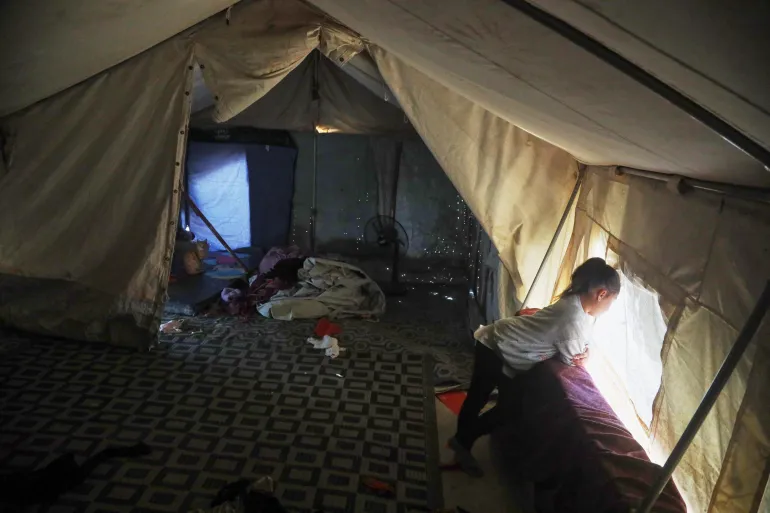
A young girl looks out from a tent in a section of Roj Camp in eastern Syria [File: Baderkhan Ahmad/AP Photo]
Who really controls the camp?
The violence comes amid sweeping change in the region.
On August 25, the Kurdish-led Syrian Democratic Forces (SDF), once a key US ally in the fight against ISIL, announced it would dissolve as an independent military force under an agreement with Syria’s central government in Damascus.
After a government offensive in January, the SDF lost much of the territory under its control and agreed to merge with the national army.
Its commander, Mazloum Abdi, has since been appointed a presidential adviser.
Roj, which the SDF had controlled until last month, is now the Syrian state’s responsibility.
But inside the camp, detainees said the transition has been anything but smooth.
One woman described to Al Jazeera a divided security presence, with those who accepted integration with the government on one side and holdouts who refused or were rejected on the other, and tensions between them that play out over the heads of the women and children.
In an open letter published on Monday, 11 mothers in Roj wrote that many of the same guards remain.
“While individuals’ [affiliations] may have changed,” one woman told Al Jazeera, “the people themselves remain the same”.
A woman and a child stand in Roj camp [File: Baderkhan Ahmad/AP Photo]
No legal basis for detention
Children from more than 50 countries remain stranded in Syria.
None has been given an individual legal process to determine why they are held, or for how long.
Fionnuala Ni Aolain, who served as UN special rapporteur on counter-terrorism and human rights from 2017 to 2023 and now sits on its inquiry commission, visited the camp in 2023.
Upwards of 70,000 people were once detained in al-Hol, another larger camp in the northeast holding the families of alleged ISIL fighters. In 2023, more than 52,000 people – mostly Syrians and Iraqis – were held in al-Hol and Roj, including an estimated 12,000 foreign nationals.
She found that conditions met “the threshold for torture under international law”. The violence women and children face now, she told Al Jazeera, is worse.
“It is utterly unacceptable that women and children who have never been convicted of any crimes, who have never been subject to any legal process, are being detained in this way,” she said.
There is no legal basis for their arbitrary detention, she said, adding that the remedy is release.
In January, order at al-Hol collapsed in chaos. The fate of thousands who had been held there remains unknown.
An SDF patrol at the al-Hol camp in northeastern Syria in February 2025 [File: Nils Adler/Al Jazeera]
Beatrice Eriksson, a spokesperson for the Swedish branch of the rights organisation Repatriate the Children, which has been in contact with hundreds of mothers in the camps since 2019, told Al Jazeera that boys have been taken from their mothers as young as 12 or 13 and initially held in so-called rehabilitation centres.
Some have since been transferred to Iraq, she said, where they were detained in a makeshift prison for adult alleged ISIL fighters. The whereabouts of others remain unknown.
Eriksson argues that integrating former SDF-controlled forces and administrative structures into the Syrian government could provide an opportunity for change.
She said responsibility for the families has shifted from a non-state group to an internationally recognised government with which most of their home countries have diplomatic relations.
However, some detainees told Al Jazeera that they feel trapped. Governments tell them to reach out to an embassy, but their detention makes that impossible.
Ni Aolain said the responsibility does not just lie with the Syrian government, which is “doing its best to manage the massive post-conflict needs of the population as a whole”.
Instead, she said part of the blame clearly lies with foreign governments, “who have remained persistently stony-faced and unwilling to accept responsibility for their nationals”.
“It is not consistent with solidarity and support for a transitional state, and it’s an abdication of both their human rights and their security responsibilities to Syria”, she said.
For the women and children in Roj camp, the current situation is not sustainable.
“We want the next steps to begin where we’ll see an end to the suffering of our children,” one woman told Al Jazeera, “even if that means going to prison back home.”
At the time of publication, Syria’s Ministry of Foreign Affairs and Expatriates had not responded to Al Jazeera’s request for comment on the reports of violence at Roj as well as the government’s plans for the camp and its detainees.
The camp administration also did not respond to Al Jazeera’s request for comment.
Prof Aidan Fowler, national director of patient safety at NHS England, said the expansion of Martha’s Rule would give families and NHS staff “a critical new lifeline” to help improve care and save more lives.
Staff can themselves ask for a review from a different team if they are concerned the appropriate action is not being taken.
During the eight-month pilot at the seven trusts, 69 calls were made to dedicated Martha’s Rule phone numbers, including some calls relating to acute deterioration following an urgent clinical review. In some cases, it led to a patient having immediate surgery or being transferred to intensive care.
Prof Fowler said: “Early testing has shown that Martha’s Rule can work well in busy A&Es and builds on the evidence from our adult and children’s wards, where thousands of calls have been made by patients, families and staff to date, with many leading to changes in treatment and potentially life-saving interventions.”
Health minister Baroness Merron said the initiative was part of “wider efforts to put patient safety at the heart of the NHS.”
Actor Jason Watkins, whose two-and-a-half-year-old daughter Maude died from sepsis in 2011, praised the rollout, saying Martha’s rule “is making a difference on the wards”.
“It enables a parent to have a voice and if there is an issue, that is addressed,” he told BBC Breakfast, and urged parents: “if you’re at all worried when you go into A&E, ask for a second opinion.”
Watkins said the rollout of Martha’s law could benefit medical professionals too, explaining: “Those extremely dedicated medical practitioners, nurses, doctors and consultants, it gives them a pause and a thought ‘am I doing everything I can to assess this child accurately?'”.
Patients and their families can check with their local hospital or NHS trust where Martha’s Rule is available by visiting the trust’s website or asking hospital staff.
Scotland is beginning to use Martha’s Rule and Northern Ireland is considering using it, while Wales has a similar scheme called Call4Concern.
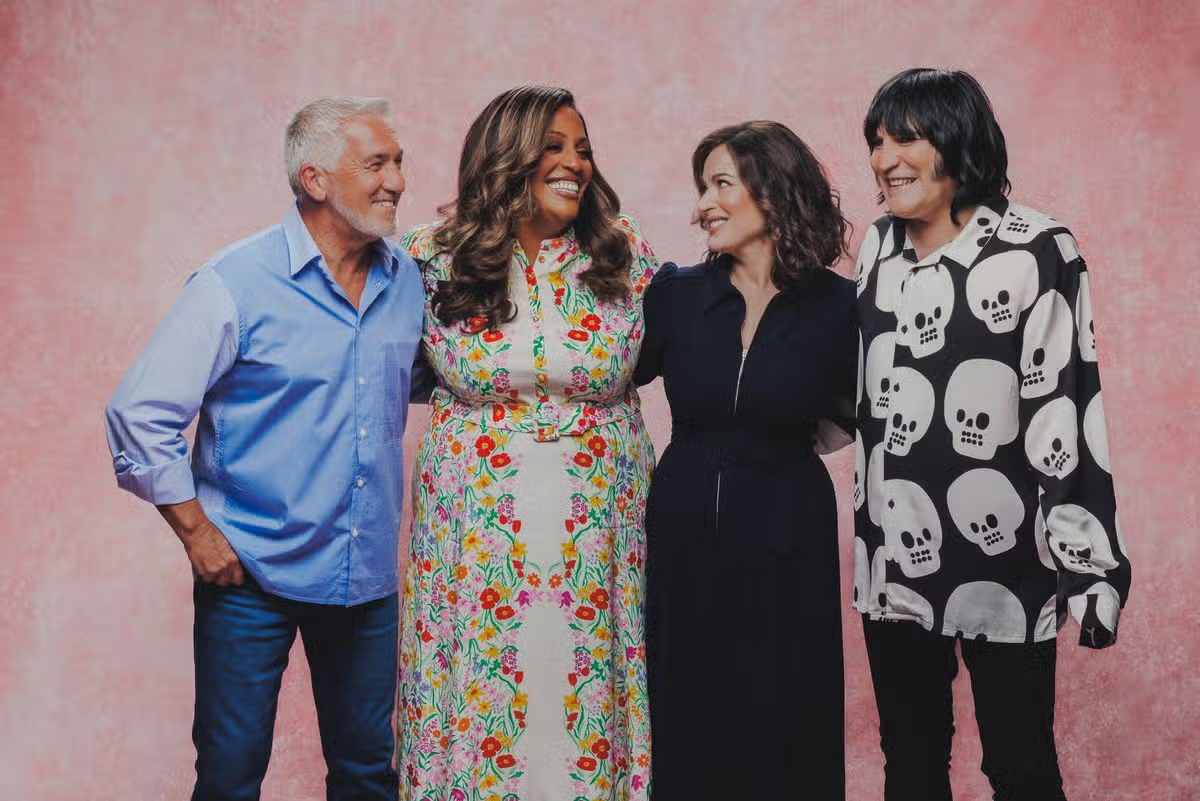
The Great British Bake Off returns to Channel 4 this week, with Nigella Lawson making her debut as the new judge replacing Prue Leith
Nigella Lawson has joined the Channel 4 show
Paul Hollywood has shared his thoughts on the latest addition to the Channel 4 show following Prue Leith’s exit. Earlier this year, the 86-year-old announced it was the ‘right time’ to leave The Great British Bake Off after nine years.
However, in her place, viewers will welcome Nigella Lawson to the tent as the 66-year-old will be judging this year’s contestants alongside Paul. Sharing his thoughts on the newcomer, Paul told Radio Times how each person he’s worked alongside has varied from one another.
He remarked that Mary Berry was different from Prue and Prue was different to Nigella before adding ‘Nigella is different to Mary’. Admitting how each of them brought their ‘own character’ to the programme, he highlighted that Nigella is a ‘very warm’ person, especially to the contestants taking part in the competition, reports the Express.
However, Paul commented that he’s the ‘constant’ as he remains the ‘constructively critical’ judge. Although people are welcoming a new face to the tent, presenters Alison Hammond and Noel Fielding are returning as hosts once again.
Channel 4 viewers were treated to a glimpse of Nigella in the iconic tent during a brief teaser clip revealing the show’s return date.
She walked towards the camera in a purple jumpsuit before playfully pretending to tuck into the lens as though it was a sweet treat. When it was announced that Nigella was joining the Channel 4 show, she had nothing but excitement.
Nigella commented: “I’m uncharacteristically rather lost for words right now! Of course, it’s daunting to be following in the footsteps of Prue Leith and Mary Berry before her, great dames both, but I’m also bubbling with excitement.
“The Great British Bake Off is more than a television programme, it’s a National Treasure – and it’s a huge honour to be entrusted with it.
“I’m just thrilled to be joining the team and all the new bakers to come. I wish the marvellous Prue all the best, and am giddily grateful for the opportunity!”
Meanwhile, Dame Prue Leith added: “I’m thrilled that Nigella is to experience brilliant Bake Off. She’s sassy, fun, and she knows her onions — and her croissants, cake and crumble.”
As Ian Katz, Chief Content Officer at Channel 4 added: “We’re incredibly excited about the marriage of two great British icons: Bake Off and Nigella.
“With Nigella joining the tent, Love Productions have created the dream team of British telly. Nigella brings an incomparable combination of warmth, expertise and sophistication to the tent, and this summer’s series will be as mouthwatering a prospect as her chocolate Guinness cake.”
The Great British Bake Off is set to air on Channel 4 on Tuesday, September 22 at 8pm
Braskem SA (BAK) creditors are demanding that controlling shareholders Petrobras (PBR) and IG4 Capital Group inject $3B in fresh equity into the troubled Brazilian petrochemical producer, according to a report by Bloomberg.
The request signals mounting friction in efforts to
Myles Garrett is out for four games following knee surgery, but other Rams edge rushers said they were ready to step up against the New York Giants on Monday night at SoFi Stadium.
Aaron Donald will play for the Rams against the New York Giants on Monday, but will Puka Nacua be on the field?
“I’m not going to go out there and be Myles Garrett,” said Stewart, who made six tackles and had one quarterback hit in the Rams’ season-opening defeat by the San Francisco 49ers, “but as a group we’ll fill our role and help do the job.”
The Rams’ pass rush will be aided by the addition of lineman Aaron Donald, the three-time NFL defensive player of the year who will make his season debut after coming out of two-year retirement.
But the outside linebackers plan to contribute.
“The room is full of talented guys, so everybody always smells blood,” said Johnson, a fourth-year pro. “We’re all sharks in the room, but we’re all helping each other. … It’s time for everybody to put on them big-boy boots.”
Bailey was the only first-year undrafted free agent to make the roster. He did it with outstanding performances in preseason games.
Young said losing Garrett was “huge” but he is confident the group will perform well.
“We’ve got guys that can definitely rush,” Young said. “I definitely think as a collective we can affect it together. He’s going to be back soon, and while he’s gone we’re going to hold it down and do what we do.”
Ministers demand an end to maritime shipping attacks and urge Iran to stop arming the Yemeni group.
Published On 22 Sep 202622 Sep 2026
The foreign ministers of the Group of Seven (G7) nations have condemned what they called “unacceptable continued strikes” by Yemen’s Houthis against Saudi Arabia.
The ministers issued the statement on Monday following an informal meeting on the sidelines of the United Nations General Assembly in New York.
Recommended Stories
list of 3 itemsend of list
“We condemn in the strongest terms the unacceptable continued strikes carried out by the Houthis in Yemen and against the Kingdom of Saudi Arabia,” the ministers of the UK, Canada, France, Germany, Italy, Japan and the United States said in the statement.
The ministers urged the Houthis “to immediately cease all military actions, all threats and attacks against civilian shipping, and to return to the political process in good faith”.
They also called on Iran to stop arming and supporting the group, saying Tehran is in violation of past UN Security Council resolutions. They added that Iran’s backing of the Houthis constituted a dangerous pattern of escalation that risked undermining international trade and creating global instability.
The latest escalation in the Arab region’s most impoverished nation follows a period of relative calm that had largely held since the UN-brokered ceasefire in 2022 between the Iran-aligned group and the Saudi-backed Yemeni government.
Iran must “end its arming of and support” for the Houthis in Yemen, the foreign ministers of G7 nations have said in a joint statement.
The G7 also condemned “in the strongest terms” Houthi attacks on Saudi Arabia, adding that the recent escalation in fighting against Saudi-backed forces in Yemen represented a threat to regional and global energy security.
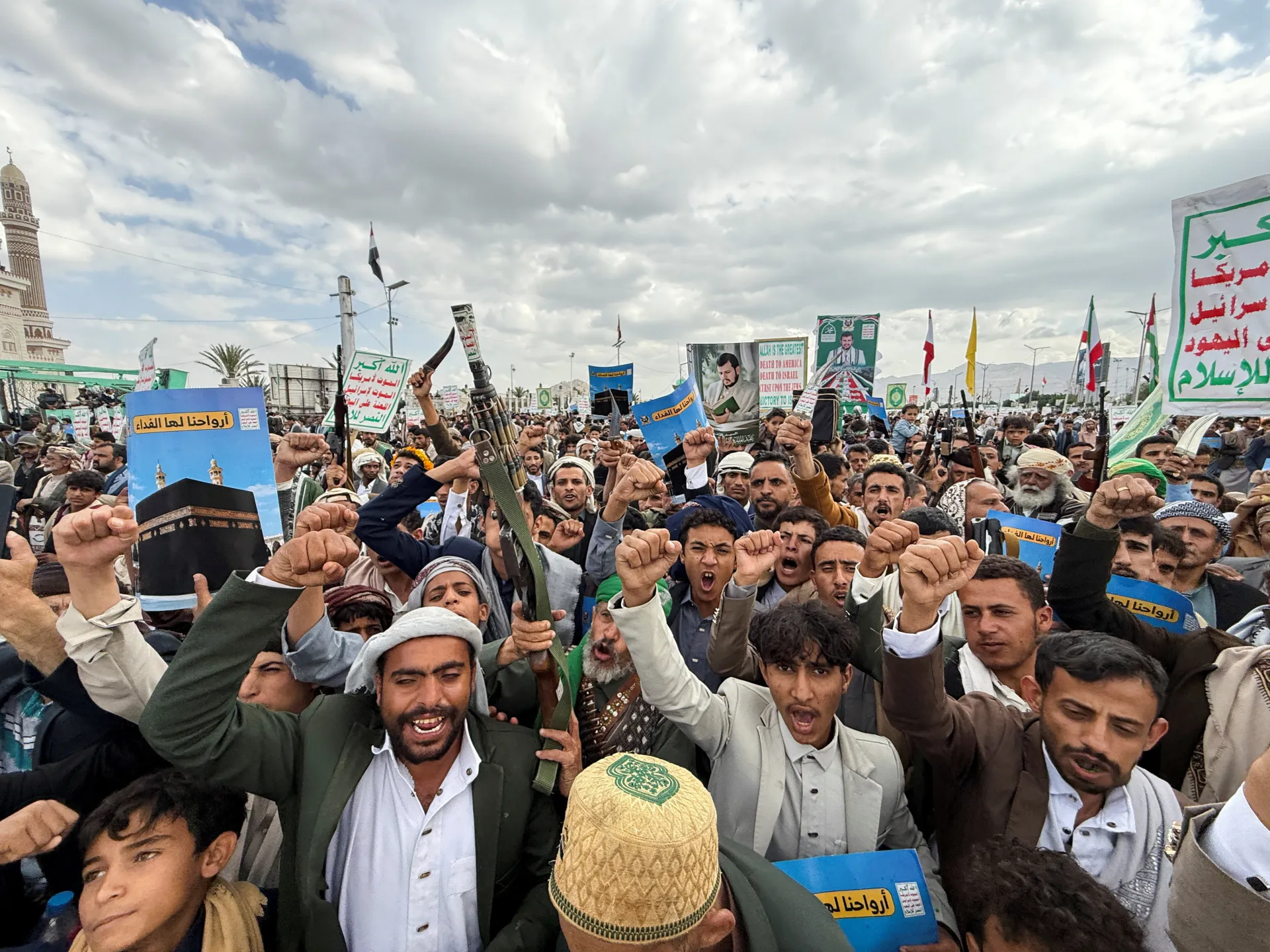
Thousands of refugees have fled Yemen in recent days after the Iran-backed group seized territory along the country’s Red Sea coastline, including near the Bab al-Mandab Strait, a critical shipping route for global trade.
The statement comes ahead of the annual UN General Assembly in New York, where senior Iranian officials are due to speak.
“We call on the Houthis to immediately cease all military actions, all threats and attacks against civilian shipping, and to return to the political process in good faith,” said the foreign ministers of the UK, Canada, France, Germany, Italy, Japan and the United States.
It went on: “Their reprehensible actions constitute a dangerous pattern of escalation that risks further exacerbating the conflict, undermining international trade and creating global economic instability.”
“Looking forward, we will continue to support the legitimate Government of Yemen and reaffirm our strong commitment to the unity, sovereignty, independence, and territorial integrity of Yemen,” the ministers said.
Their statement was issued following a meeting on the sidelines of the UN General Assembly.
At 69, I had never hiked with a backpack and I had no idea what land art was. Nonetheless, when my friend Jackie, a nature documentary film-maker, invited me to join her and her friends Wendy and Sasha on a hiking trip to Refuges d’Artin the mountainous countryside of Haute-Provence, I said a resounding “yes”. We would be sleeping alongside sculptures by the renowned land artist Andy Goldsworthy.
First, I watch Rivers and Tides, a documentary on Goldsworthy’s work, and discover he has built exquisite ice sculptures and stone cairns in my own country, Canada. His work seems to speak to an older part of the soul. Then, I start walking up hills, gradually adding weights to my backpack until I can comfortably carry 9kg (20lb).
We meet in Digne-les-Bains, a bustling mountain town in the centre of the Unesco geopark of Haute-Provence, and the starting point for a 10-day, 150km (93-mile) hiking route that includes the possibility of staying overnight at seven reservable but free off-grid sleeping cabins. Goldsworthy worked alongside local teams to restore the abandoned shepherd huts, farmhouses, chapel and stone shelters, and created a site-specific artwork for each one. Over four days, we will visit three of these refuges and hike about 45km (28 miles).
Our first stop in Digne-les-Bains is Maison Alexandra David-Neél, a museum dedicated to the adventurous, peripatetic life of a woman who, in 1924, disguised herself as a beggar to become the first western woman to enter the Forbidden City of Lhasa in Tibet. The keys to the refuges are kept here, no doubt, to inspire hikers for the adventures that lie ahead.
On the first day, we encounter one of three sentinels that sit like giant mysterious eggs watching over the route. These 2 to 3-metre tall cairns were made by Goldsworthy without mortar or cement and rely on fitting the right shapes and weights of the stones.
La Forest by Andy Goldsworthy, illuminated by natural light. Photograph: Hemis/Alamy
Jackie has told us the trail is mostly flat and indeed, we start on even gravel, chatting and laughing, getting used to the weight of our packs. After 5km, she says we should look for a path leading up the hill on our right. She checks her satnav and points to a goat path going straight up the rocks. I panic. My backpack suddenly feels extremely heavy. In desperation, I check further down the road and, to everyone’s relief, find a path marked with white and red horizontal lines signifying a granderandonnée, a trail certified by the French government.
We begin our ascent, pausing to photograph curlicued and wispy plants right out of Dr Seuss, yellow, scarlet and blue wildflowers, an orange moth sitting on purple brush. Spanish broom perfumes the air. We lift our gaze and see multiple valleys and unique geological formations. It’s easy to imagine our ice-age ancestors walking these trails 15,000 years ago and it’s gratifying to be travelling under our own steam, as they did.
We arrive at the first refuge, La Forest, as the sun is setting. The key unlocks the door. Inside, the air is cold. Our eyes adjust to the dark. A table and benches stand in front of us. To the left, a stairway leads to sleeping platforms. To the right, a doorway into a dark, empty room. From its depths glows a cylindrical obelisk, light falling on one large stone where someone could sit. It’s concave, constructed of light grey stone ending in a porthole to the sky. It’s illuminated by natural light and changes with the time, the weather, the season. This art is living and feels sacred.
That evening, we eat freeze-dried mushroom risotto in the flickering candlelight, play cards, eat chocolate, laugh and share stories. Sasha, who works in film in Germany, teaches us two words: der salzlose – someone who is bland and without flavour; and extrawurst – someone who always demands more. Neither apply to our group. The camaraderie and conviviality bring pure pleasure.
We climb the stairs to the sleeping platforms. Wendy and Sasha have brought sturdy sleeping mats on Jackie’s recommendation. We lay them out and say goodnight. The quiet is complete. Then, a tidal wave of sound erupts. Wendy and Sasha have rolled over. The friction on the technical fabric of their sleeping mats is deafening. The price of comfort has been revealed; they must lie like mummies.
Claudia and friends Jackie and Sasha (left to right) in Le Vieil Esclangon art refuge. Photograph: Wendy Reeves
The next day, we descend, picnic by a river on crackers, avocados and cheese, then start climbing again. Sasha and I subversively agree that it’s psychologically better to be told something is going to be hard and then it turns out easier. I console myself that climbing with a backpack is good for bone density and way less boring than lifting weights.
The next refuge, Le Vieil Esclangon, is in a mountain-top meadow. A majestic fan of lifted rock shines across the wide valley. Everywhere we turn there are more mountains and valleys. The first floor of the refuge is a large dark room split in two by a massive fireplace. Upstairs, the sleeping platforms look out on to a sunlit verge. Across from the fireplace, a tall serpentine shape made of dried mud loops back and forth like a meandering river, ending at the top in the source.
The wind picks up and the temperature drops. We gather wood and light a fire. In the flickering orange light, the sculpture comes to life, looking like one of Plato’s eternal forms. We eat our freeze-dried pad thai, the art and the hikers transient and temporary but together in this warm and cosy moment.
Later, we sleep to the sound of wind and rain, woken only by a mouse rave in the middle of the night.
La Ferme Belon, where ‘huge interlinked semicircular stone arches look like a dragon’s body swimming through earth’. Photograph: B Warluzel
We arrive at the third refuge, La Ferme Belon, in time for a late lunch. In the basement, huge interlinked semicircular stone arches look like a dragon’s body swimming through earth. Upstairs, the sleeping platforms are lovely except for one small detail. A colony of bats hang above. I can feign nonchalance because I know Wendy, who is quietly uber-capable, will find us a delightful B&B for the night. Over pizza and cold rosé, Sasha and I confess to Jackie that we would have rather known how challenging the hikes were going to be. “But you wouldn’t have come if I’d told you,” she answers with a twinkle in her eye.
Andy Goldsworthy said: “To me there is a tremendous difference between works of art that we observe in a museum just for a few minutes and works of art in which we live for a short while, in which we sleep. To sleep in a sculpture is a wonderful idea.”
In Digne-les-Bains we return the keys and soak our stronger bodies in the town’s hot springs. We’ve already said yes to Jackie’s next adventure, sight unseen.
Claudia Casper’s novelThe Mercy Journals won the Philip K Dick award for distinguished science fiction in 2017(Arsenal Pulp Press)
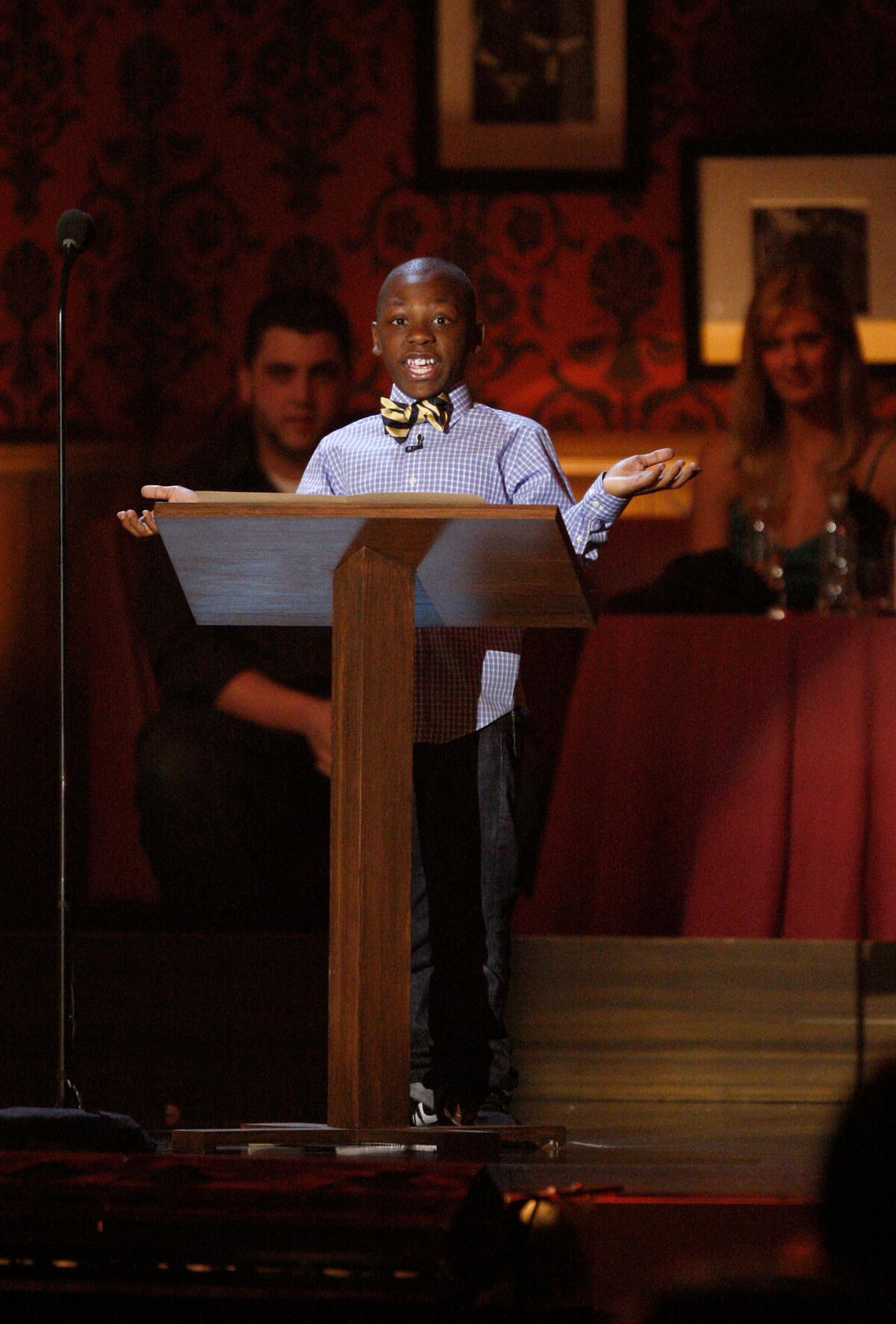
Former child star Bobb’e J. Thompson, who acted in “That’s So Raven” and “30 Rock,” has been sentenced to more than two years in federal prison.
Thompson was arrested last fall after police said he was driving 104 mph — more than 30 mph over the speed limit — in Cerro Gordo County, Iowa. A news release issued by U.S. attorney’s office of the Northern District of Iowa said an officer stopped the vehicle and spotted Thompson and the passenger switching seats. The officer reported that, when he approached the car, there was a smell of marijuana coming from the vehicle.
Officers searched the vehicle and, according to the news release, found a backpack holding bags of dispensary-bought marijuana and a .40-caliber handgun that was fully loaded with a 15-round magazine. Police said the gun had been reported stolen from a car in Kansas City, Mo.
Actor Bobb’e J. Thompson speaks at Spike TV’s 2009 Guys Choice Awards at Sony Studios in Culver City.
(Kevin Winter / Getty Images)
The “Role Models” and “Tyler Perry’s House of Payne” actor was also convicted of battery and assault in 2020. Then in 2022 he was convicted of possession of a firearm, which was prohibited because he was a felon.
In April, Thompson pleaded guilty to possession of a firearm, and last week he was sentenced by an Iowa district judge to more than two years in prison.
Thompson’s “That’s So Raven” co-star Kyle Massey told TMZ on Monday that he loved his former co-star no matter what.
“Free Bobb’e J., man, that’s my brother,” he said. “We love you, we support you, we got your back, whatever you need, man, we’re gonna take care of you. It just always sucks to see one of your friends or someone that you love go through something hard like that. So we’re just gonna be rooting for him no matter what.
“Keep your head up, we’re here and we love you,” he added. “We love you so much, bro. No matter what.”
Football fans were shown a “constant bombardment” of advertisements promoting junk food and drinks during matches at the 2026 Fifa World Cup, according to a new study.
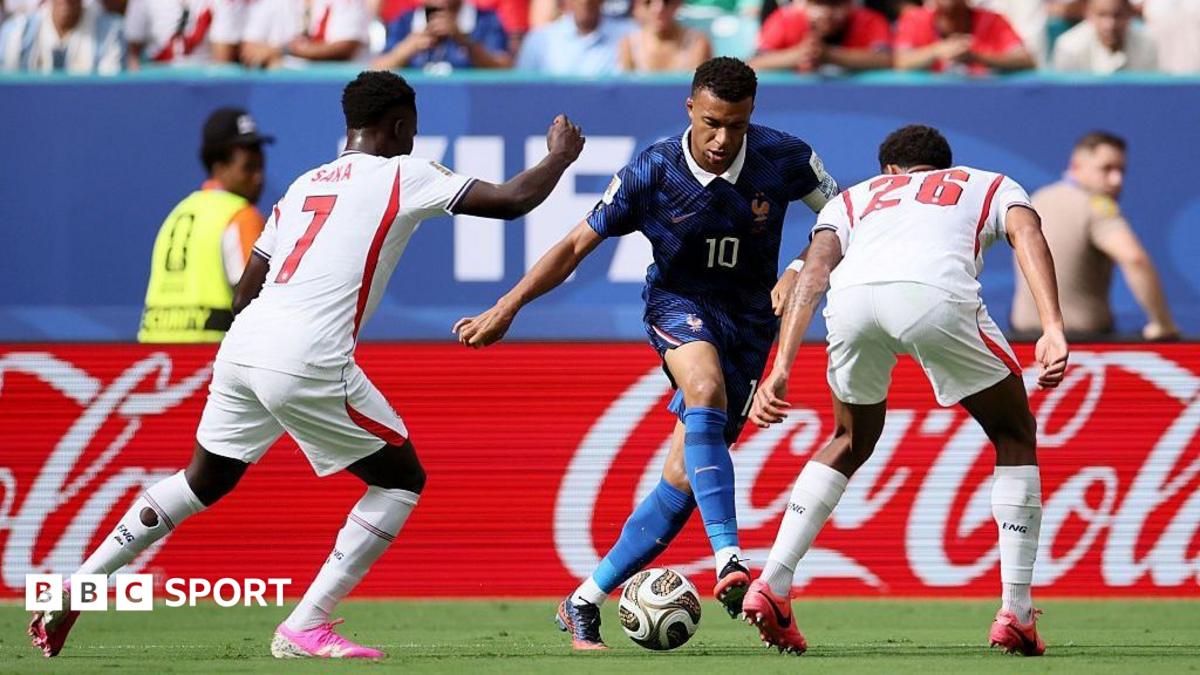
Researchers at the University of Bristol and University of Oxford created an AI tool to analyse ads which were visible to television viewers during live play in the tournament’s 104 matches, mostly displayed on pitchside advertising boards and around stadiums in the USA, Canada, and Mexico.
They found that logos and products for brands that produce junk food and drinks – defined by the UK government as being high in fat, salt or sugar – were displayed 65,722 times in total.
And the study also found that those adverts were visible for 28.1 hours’ time across the tournament, or just over 16% of the total time that matches were being played.
The ads were all shown on the international feed of matches during play – meaning they were visible to every viewer in every country broadcasting matches – and do not include ads shown during pre-match coverage, half-time commercial breaks, or the controversial in-match hydration breaks.
The model used by the researchers estimated that there were an average of 576 visible ads for junk food and drink shown during each individual match.
Coca-Cola had the highest number (21,893), followed by McDonald’s (13,915), Powerade (12,777), and Lay’s – the crisps manufacturer known as Walkers in the UK – (12,087).
All four brands are official partners of world football governing body Fifa, with the Powerade energy drink owned by the Coca-Cola company.
In response to the findings, Fifa argued that the vast majority of its revenue is put back into football, including on projects promoting health and wellbeing in which thousands of people participate.
A Fifa spokesperson said: “Fifa works with a broad, global portfolio of partners, all of which are subject to its governance and compliance frameworks.
“Fifa’s social impact campaigns, including Be Active, delivered messages of unity, inclusion, health and friendship to audiences on an unprecedented scale throughout the World Cup”.
BBC Sport also contacted Coca Cola, McDonald’s and PepsiCo – which owns Lay’s – but did not receive a reply.




![France's President Emmanuel Macron meets with Ukraine's President Volodymyr Zelenskyy on the sidelines of the United Nations General Assembly in New York City on September 21, 2026 [Ludovic Marin/AFP]](https://i0.wp.com/www.aljazeera.com/wp-content/uploads/2026/09/AFP__20260922__C8XY4MU__v1__HighRes__UsFranceUkrainePoliticsDiplomacy-1790058813.jpg?w=640&ssl=1)