
From £27 per night
Sykes Cottages



For just the 11th time in 55 games this season, the Lakers had Luka Doncic, LeBron James and Austin Reaves sharing the court together.
They are the core of the Lakers, the engines that make this team go, but health issues have prevented them from playing together for far too much of the 2025-26 campaign.
During their first game since the NBA All-Star break, Doncic, Reaves and James carried the the Lakers to a 125-122 win over the Clippers Friday night at Crypto.com Arena.
Doncic had 38 points, 11 assists and six rebounds.

Lakers guard Austin Reaves celebrates after Clippers guard Bennedict Mathurin (9) was called for an offensive foul Friday at Crypto.com Arena.
(Gina Ferazzi/Los Angeles Times)
Reaves had 29 points, six assists and made a big defensive play late in the game.
And James had 13 points and 11 assists, his fifth straight game with 10 or more assists.
Up 118-115 with 1:49 left, Reaves took drew a charge on Bennedict Mathurin, the Clipper’s sixth foul that sent him to the bench with 26 points.
Still, the Lakers didn’t escape until Doncic made two free throws with 21.2 seconds left to give the Lakers a five-point lead that barely stood.
With a 125-122 lead and the ball, James threw a dangerous cross-court pass intended for Doncic that Nicolas Batum instead stole.
But Batum missed a potential game-tying three-pointer and James got the rebound to secure the win.
The Lakers put two defenders on Kawhi Leonard, double teaming the Clippers’ best offensive weapon, keeping a crowd of defenders around him, especially when they employed their zone defense.
Leonard was giving it to the Lakers, but he left late in the fourth quarter with left ankle soreness, departing with 31 points on 11-for-19 shooting.
Lakers coach JJ Redick said pre-game that Leonard is back to being a force on both sides of the basketball.
That’s why so much of the Lakers’ gameplan centered around trying to slow down Leonard, who is eighth in the NBA in scoring (27.8) and tied for first in steals (2.0).
“He’s more consistently taking the tougher assignments right now, and he’s back to being just an elite two-way player on both ends of the floor,” Redick said. “And you know, he’s playing as well as anybody in the NBA right now for the last two months, whatever the starting point would be, but it really is on both sides of the ball.”
Leonard is a primary reason why the Clippers are still rolling despite having traded away two key pieces in guard James Harden and center Ivicia Zubac.
The Clippers started the season 6-21, looking nothing like a playoff team.
But then they beat the Lakers on Dec. 20 and that got the Clippers rolling to a 21-7 stretch entering Friday night’s game, a two-month period that saw them get to one game under .500.
Clippers coach Tyronn Lue said none of the Clippers ever gave up on the season, adding they were always “playing to win” no matter whether they had “young, old, toddlers” on the court.
“I just feel confident,” Lue said. “I just feel confident in our players, confident in our coaching staff and I just feel confident in the environment and the culture that we’ve set. Why wouldn’t we want to play to win? That’s our mindset. That’s my mindset every single night. As tough as it may be or you start 6-21 whatever it may be, you’re playing to win. So, we make it to the playoffs and anything can happen. So our goal is to make it to the playoffs. I don’t know why somebody would scoff at that.”
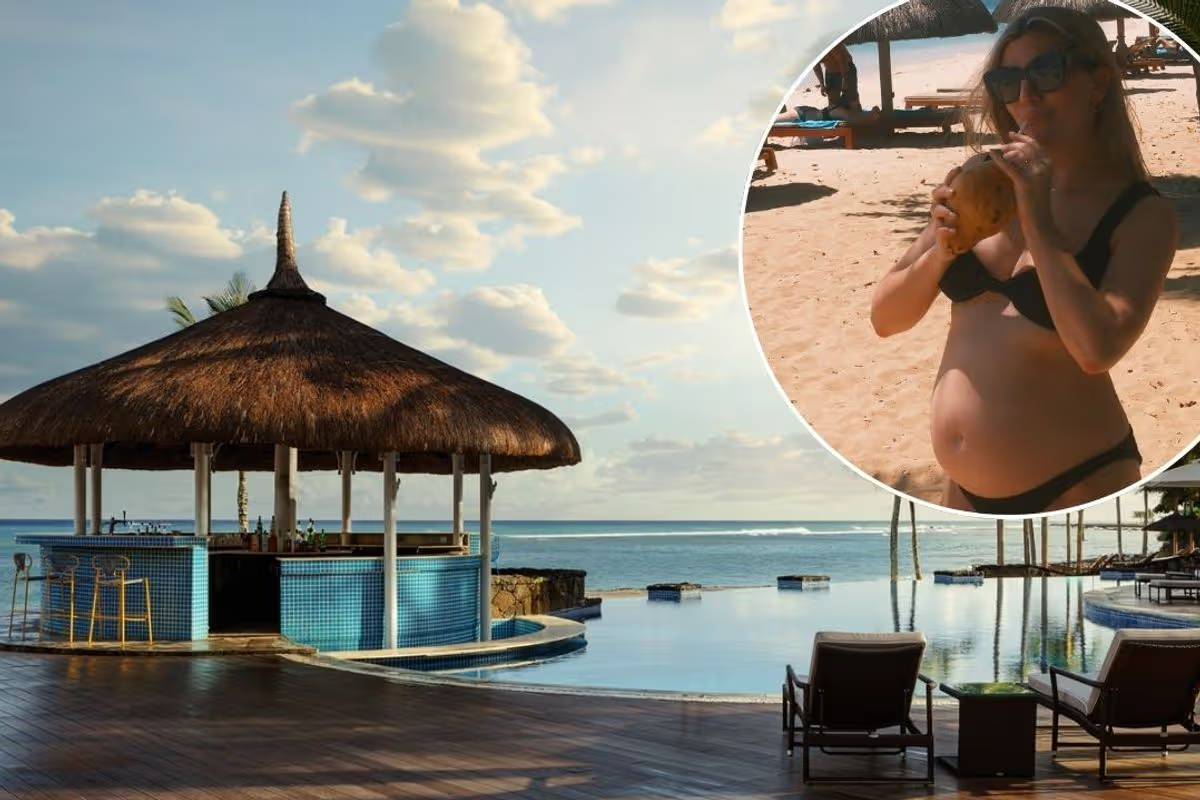

We think we’ve found the perfect babymoon destination(Image: Le Meridien Ile Maurice, Laura Mulley)
Looking for a holiday destination for one last trip as a two before our baby arrived, we found our options surprisingly limited. We didn’t want to chance potential bad weather in Europe off-season, and with the risk of mosquito-borne virus Zika – which is particularly dangerous to pregnant women – ruling out most of the Caribbean and Asia, there was a clear frontrunner that ticked all of our boxes: Mauritius.
Emirates proved to be the best airline to fly with from our nearest airport – Manchester – with the most flight options available – and the staff were exceptionally helpful at making a six-months-pregnant woman feel as comfortable as possible during the journey.
Once we landed, our aim was simple: to enjoy all the things we’d probably struggle to do once our baby arrived, on what would potentially be our last relaxing holiday for a while. And it certainly delivered.
READ MORE: ‘I maximised my holiday to the Maldives with this clever booking trick’
READ MORE: ‘I got a first look at 2026’s newest cruise ship and found its hidden secret on board’
Our first stop was the huge, open, colourful Le Méridien Ile Maurice on the island’s northwest coast. One of Mauritius’s leading family hotels (perfect for showing us what to expect from our future holidays), its hidden gem is its adults-only section, Nirvana, at the end of the kilometre-long beach, which has its own rooms, reception, restaurant, beach area and infinity pool scattered with squishy floating beanbags.
Our Hideaway Suite here was truly one of the biggest we’d ever seen, with a massive distance between the patio doors at the front to the heated plunge pool out the back. Guests get access to a ‘butler’ via WhatsApp, and lots of thoughtful touches from the friendly staff make staying here feel extra-special, from the complimentary cocktail (or mocktail) by the pool at sundown to the petal-strewn bath we found waiting for us after dinner. One night there was even a pregnancy pillow laid out on the bed, something we hadn’t requested but made our stay even more comfortable.
There are four restaurants at Le Méridien, and it’s worth making your way around them all: Nomad’s buffet is popular with families, Waves serves Mediterranean-style fish and grilled dishes, Kumin gives guests a taste of Mauritius’s strong Indian influence, and – our favourite – Nirvana’s Jade does excellent Asian cuisine, including sushi and teppanyaki (take breakfast here too if you want to savour the child-free moments for as long as possible). All are included in half-board and all-inclusive packages, although booking is recommended for the à la carte restaurants.
Keen to enjoy as many grown-up activities as possible, we took part in sunset yoga on the beach, took kayaks and pedalos out into the lagoon’s clear waters, and enjoyed treatments in Le Méridien’s spa, including a heavenly head massage using warm coconut oil, and the perfect pre-natal full body massage. The therapists here are all incredibly skilled – you’ll really feel the benefits.
The second half of our trip was spent at sister hotel St. Regis Le Morne, formally the JW Marriott, and which joined the historic St. Regis hotel group – founded by American tycoon and Titanic victim John Jacob Astor IV – following a major renovation last year.
On the island’s southwest point, this is a quieter, more secluded part of the country, and St. Regis sits under the shadow of Mauritius’ iconic Le Morne mountain surrounded by miles of beautiful beaches and shallow waters.
Although we spotted plenty of multi-generational families here too, St. Regis definitely has a more elegant and luxurious air to it. With a colonial-style design and elegant rooms set amongst lush vegetation and trickling water features, it has a slight ‘White Lotus season three’ vibe.
There’s a huge pool here, but we found that most couples chose to spend their days on the loungers under palm leaf-umbrellas that line the beach, which are peaceful, always available, and serviced by bar staff at the touch of a button.
Out of St. Regis’s five restaurants, our favourites were INDYA, serving a modern take on Indian cuisine with the friendliest service, and Japanese Atkuso, where the chef veered from the menu to whip up some of the best maki rolls we’d ever tried to cater to our vegetarian diets. Each restaurant also does its own signature cocktails and ‘mindful mocktails’ with certain health benefits.
St. Regis is proud of its history and heritage, and a key feature are its three ‘rituals’, found in all its properties around the world, and all – pleasingly for our purpose – highly unsuitable for children: Bloody Marys, sabrage and afternoon tea.
In homage to the first ever spicy tomato juice cocktail as we know it, reportedly invented at the St. Regis New York in the 1920s, our charismatic bartender Vymal demonstrated how to make this hotel’s own version, the L’Île Mary, using Mauritian rum infused with curry leaves and topped with turmeric foam. The self-appointed Bloody Mary connoisseur out of the two of us declared it to be one of the best he’d ever tasted.
Next up was learning sabrage – the art of opening a bottle of champagne with the swish of a sword, and supposedly how Napoleon liked to celebrate his victories. Although initially unconfident, following expert instruction we were thrilled to deftly remove the top of our bottle of fizz in one smooth swipe.
Afternoon tea was a more genteel affair, and is a reference to Lady Astor’s daily habit of gathering family and friends around in the afternoons to share wisdom. Here it involves Mauritian tea and viennoiserie from the hotel’s kitchen, taken under swaying palm trees on the beach – just heavenly, and the perfect last few moments of calm before we became a three.
Rooms at Le Méridien Ile Maurice start from £220 per night on a B&B basis based on double occupancy. Rooms at St. Regis Le Morne start from £585 per night based on double occupancy (two night minimum stay required). Returns flights from Manchester to Mauritius were with Emirates start from £775.
President Trump calls Supreme Court justices an ’embarrassment to their families’ in 45-minute address to the media.

Published On 21 Feb 202621 Feb 2026
Share
United States President Donald Trump and his vice president, JD Vance, have launched personal attacks on the justices of the US Supreme Court and their families, after the country’s top court struck down trade tariffs imposed by the White House.
In a 45-minute address to reporters at the White House, the US president heaped criticism on the six justices who ruled against his signature tariff policy in the 6-3 decision by the court on Friday, including Neil Gorsuch and Amy Coney Barrett, whom Trump appointed to the court during his first term.
list of 4 itemsend of list
“I think it’s an embarrassment to their families, you wanna know the truth, the two of them,” Trump said, referring to Justices Gorsuch and Barrett.
“I’m ashamed of certain members of the court – absolutely ashamed – for not having the courage to do what’s right for our country,” Trump added.
Shockingly, Trump also claimed that the Supreme Court “has been swayed by foreign interests”, without providing any evidence.

Trump then warmly praised the three members of the court who dissented in the ruling.
“I’d like to thank and congratulate Justices [Clarence] Thomas, [Samuel] Alito, and [Brett] Kavanaugh for their strength and wisdom and love of our country, which is, right now, very proud of those justices,” Trump said.
“When you read the dissenting opinions, there’s no way that anyone can argue against them,” he said.
Vice President Vance also sharply criticised the justices for their ruling, accusing them of “lawlessness” in a post on X.
“Today, the Supreme Court decided that Congress, despite giving the president the ability to ‘regulate imports’, didn’t actually mean it,” Vance wrote in a post on X.
“This is lawlessness from the Court, plain and simple,” said Vance, whose political profile rose to prominence after writing a memoir about his time at Yale Law School.
Trump and Vance’s comments mark a rare rebuke of the nine-member Supreme Court, which currently has six members appointed by Trump’s Republican Party and has often ruled in favour of his administration’s policies.
Nigerian lawmaker reports ‘at least 50 people dead’ after attack as list of missing is still being compiled.

Published On 21 Feb 202621 Feb 2026
Share
Gunmen killed at least 50 people and abducted women and children in an overnight assault on a village in northwestern Nigeria’s Zamfara State, authorities and residents said.
The attack started late on Thursday night and continued into Friday morning in Tungan Dutse village in the Bukkuyum area of Zamfara when armed men arrived on motorcycles and began setting fire to buildings and abducting residents.
list of 4 itemsend of list
“They have been moving from one village to another … leaving at least 50 people dead,” said Hamisu A Faru, a lawmaker representing Bukkuyum South.
Faru, speaking to the Reuters news agency by phone on Friday, said the number of people abducted remained unclear as local officials were still compiling lists of the missing.
Residents say warning signs were visible before the attack.
Abdullahi Sani, 41, said villagers alerted security forces after spotting more than 150 motorcycles carrying armed men a day earlier, but no action was taken.
“No one slept yesterday; we are all in pain,” Sani said, adding that three members of his family were killed in the attack.

Areas of Nigeria’s north and west continue to grapple with overlapping security threats, including armed criminal gangs and rebel fighters.
Just last week, at least 46 people were killed in raids in the Borgu area of northwest Niger State. The deadliest assault occurred in the village of Konkoso, where at least 38 residents were shot or had their throats cut, according to reports.
The crisis has drawn increased international involvement.
Nigeria recently expanded security cooperation with the United States after President Donald Trump accused the country of failing to halt the killing of Christians and threatened military intervention.
On December 25, the US launched air strikes on the northern state of Sokoto, conducted in coordination with Nigerian authorities.
Earlier this week, Nigeria’s military confirmed the arrival of 100 US soldiers tasked with training local forces.
Samaila Uba, spokesperson for Nigeria’s Defence Headquarters, said the US troops would offer “technical support” and “intelligence sharing” to help combat “terrorist organisations”, along with “associated equipment”.
He stressed the US personnel would not engage directly in combat and would share technical expertise under Nigerian command.

The nominated Oscar shorts come in three categories — and a lot of subjects, styles and temperaments. It’s further proof that an award dictated by length needn’t be bound by anything else.
In the live-action category, a mixed bag of approaches — some inspired by classic literature — are burnished by inspired performances. Lee Knight’s “A Friend of Dorothy” may be a tad on the nose about the cultural and emotional impact of a lonely London widow on a closeted teenaged boy. But leads Miriam Margolyes and Alistair Nwachukwu practically shimmer with humor and warmth. “Jane Austen’s Period Drama,” a loving tweak of the writer’s oeuvre from Steve Pinder and Julia Aks (who also stars), is essentially a one-joke calling card to make feature comedies and it should do the job. Its cast is exactly the sprightly ensemble needed to land its what-if laughs.
Two others just miss the mark in terms of bringing their tensions to powerful resolutions yet benefit from who the camera adores. Meyer Levinson-Blount’s “Butcher’s Stain,” centered on a flimsy accusation against a friendly Palestinian butcher in an Israeli market, undercuts its gripping story with lackadaisical filmmaking and an unnecessary subplot, but lead Omar Sameer is commanding. The black-and-white future shock “Two People Exchanging Saliva,” directed by Natalie Musteata and Alexandre Singh, is an uneven Euro-art bath of unrealized intimacy and casual violence — kissing is punishable by death, slapping is currency — but is given exquisite tautness by the elegant, unrequited swooniness of stars Zar Amir and Luana Bajrami.

A scene from “Jane Austen’s Period Drama,” nominated in the live-action short category.
(Roadside Attractions)
Then there’s my favorite, Sam A. Davis’ likely winner “The Singers,” from Ivan Turgenev’s short story, which pays off handsomely in bites of soulful warbling that briefly turn a barroom’s den of anesthesia into a temple of feeling.
Most of this year’s documentary nominees deal with the grimmest of tragedies, as in “All the Empty Rooms” and “Children No More: Were and Are Gone,” which address the remembrance of children brutally killed. The former film, from Joshua Seftel, follows CBS correspondent Steve Hartman and photographer Lou Bopp on an essay project into the bedrooms of kids gunned down in school shootings, their private worlds heartbreakingly preserved by their families. The latter short, directed by Hilla Medalia, witnesses Tel Aviv’s silent vigils for Gaza’s children, protests marked by posters with beaming faces, and sometimes met with open scorn. These are dutiful, sobering acts of mourning — Seftel’s is the probable awardee. You may wish they were more than that, however, considering the issues (guns, war, political intransigence) that created the devastation.
Combat is what drove award-winning photojournalist Brent Renaud, killed in Ukraine in 2022. But his brother Craig’s memorializing of him, “Armed Only With a Camera,” is oddly uninvolving, more an excerpted flipbook of Brent’s far-flung assignments than a meaningful portrait of excelling at a dangerous job. A more affecting real-world dispatch (and my pick, if I could vote) is “The Devil Is Busy,” directed by Christalyn Hampton and dual nominee Geeta Gandbhir, also up for the feature “The Perfect Neighbor.” It observes a day in the operation of a carefully guarded, female-run Georgia abortion clinic as if it were a newly medieval world’s last chance healthcare outpost, getting by on grit, compassion and prayer. You certainly won’t forget security head Tracii, the clinic’s heavyhearted knight and guide.

A scene from “Perfectly a Strangeness,” nominated in the documentary short category.
(Roadside Attractions)
Your chaser is Alison McAlpine’s appealing, aptly titled “Perfectly a Strangeness,” sans humans, but starring three donkeys in an unnamed desert happening upon a cluster of hilltop observatories. The whir of science meets the wonder of nature and this charming, gorgeously shot ode to discovery (both on Earth and out there) makes one hope the motion picture academy sees fit to recognize more imaginative nonfiction works going forward.
Animation, of course, thrives on the thrill of conjured worlds, like the one in Konstantin Bronzit’s wordless (but not soundless) desert island farce “The Three Sisters.” It owes nothing to Chekhov — though there are seagulls — but much to a classically Russian sense of humor and a Chaplinesque ingenuity. Elsewhere, you can watch the overly cute Christian homily “Forevergreen,” from Nathan Engelhardt and Jeremy Spears, about a nurturing tree, a restless bear and the dangerous allure of potato chips. The message gets muddled but this eco-conscious journey is charming.
It’s tough to predict a winner when the entrants are this strong, but John Kelly’s “Retirement Plan” feasts on wry relatability, as Domhnall Gleeson narrates a paunchy middle-aged man’s ambitious post-career goals, while the cascade of deadpan funny, thickly-lined and mundanely hued images stress a more poignant, finite reality. In its all-too-human view of life, this is, entertainingly, whatever the opposite of a cloying graduation speech is.

A scene from “Retirement Plan,” nominated in the animated short category.
(Roadside Attractions)
The spindly aged-doll puppetry in the stop-motion gem “The Girl Who Cried Pearls” marks a sly fable of need, greed and destiny, centered on a wealthy grandfather’s Dickensian fashioning of his poverty-stricken childhood in early 19th century Montreal. Filmmakers Chris Lavis and Maciek Szczerbowski find an enchanting balance between storybook allure and adult trickery. Maybe this one steals it?
Whichever the case, the animation that moved me the most is “Butterfly,” from Florence Miailhe, imagining the last, memory-laden swim of Jewish French-Algerian athlete Alfred Nakache, who competed in the Olympics before and after the Holocaust. In the cocooning fluidity of an ocean-borne day, rendered with thick-brushed painterliness and splashes of sound, we travel across flashes of community, injustice, achievement, love and despair. The visual, thematic constant, though, is water as a haven and a poetic life force that feeds renewal.
‘2026 Oscar Nominated Short Films’
Not rated
Running time: Animation program: 1 hour, 19 minutes; live-action program: 1 hour, 53 minutes; documentary program: 2 hours, 33 minutes
Playing: Opens Friday, Feb. 20 in limited release
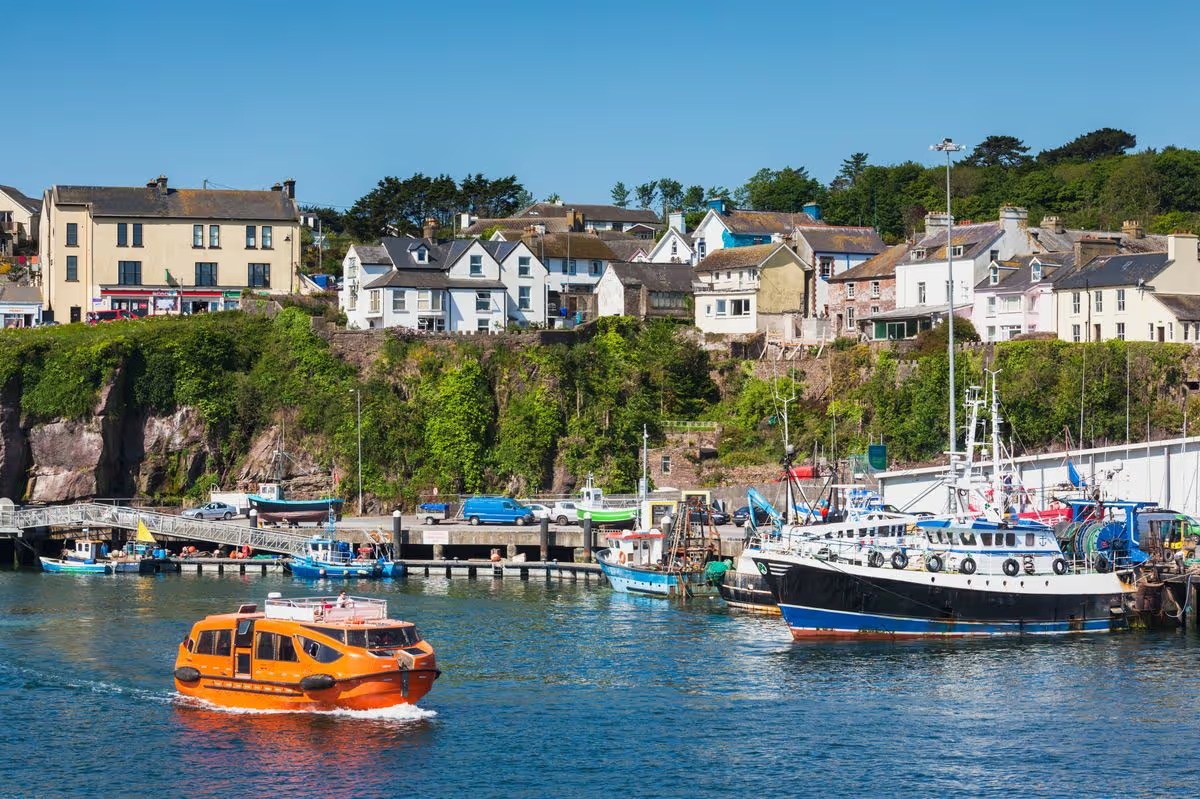

It’s home to plenty of lively pubs and restaurants (Image: Walter Bibikow via Getty Images)
Compact and picturesque, this Waterford fishing village offers everything required for a peaceful retreat, yet it frequently goes unnoticed by visitors exploring Ireland‘s coastline.
Nestled discreetly on the western edge of Waterford Harbour lies the charming village of Dunmore East, where there’s far more to discover than initially apparent.
Boasting up to six hidden beach coves and numerous scenic walking routes, visitors can fully embrace the splendour of the Irish seaboard.
While it’s thought people have lived in the village since pre-Iron Age times, the area truly flourished during the 1800s when it evolved into a holiday destination.
Playing a significant role in the fishing trade, featuring a delightful beach, a working harbour and an extensive selection of restaurants, it remains an excellent escape from everyday life, even now.
Waterford itself boasts up to 147 km of coastline, with Dunmore East comprising part of that stretch, hosting up to six coves throughout the village alone.
These provide ideal locations for snorkelling and swimming, with two principal beaches proving most favoured amongst visitors – Councillors Beach and Lawlors Beach.
Best UK holiday cottage deals
From £27 per night
Sykes Cottages
Sykes Cottages offers a wide range of handpicked holiday homes across the UK and Ireland, from cosy countryside retreats to stunning coastal escapes. Prices start from £27 per night
Lawlor’s is situated directly in the village centre, whilst Councillors is a south-facing shore overlooking dramatic cliffs. One recent visitor posted a Google review, describing it as a “beautiful beach with stunning cliff views”, while another remarked it was “popular for a reason”.
They added: “The most popular beach in Dunmore, which can lead to it becoming crowded at times; however, it is popular for a reason.
“It is the largest beach here, so there is adequate space for everyone. It is sandy rather than rocky, and it is located in an area with very safe water, and lifeguards are on duty often.”
The standout trail in the vicinity, and arguably throughout the whole of Waterford, is the Dunmore East Cliff Walk, spanning 5km along the shoreline. During the 1830s, the path served as a commuter route for labourers travelling between Portally and Ballymacaw.
It’s a route suitable for all fitness levels and ages, typically taking around two hours to complete, whilst showcasing breathtaking scenery and abundant wildlife throughout.
Particularly noteworthy are the sweeping coastal vistas, including views of Hook Head Lighthouse – one of the world’s oldest functioning lighthouses.
One walker described their experience on TripAdvisor, noting: “An absolutely gorgeous and easy walk along the cliffs above the sea. Stunning vistas, pretty flowers, pastures of sheep and cows. We took a lot of photos! The path is well marked and easy enough for a basic level of fitness.”
For something slightly different, there’s also the Dunmore East Woods walk, guiding you through an impressive 42-acre woodland expanse teeming with wildlife. Visitors can complete a circular route of the grounds or opt to discover one of the four distinct zones within it.
Dining in Dunmore East is an absolute must for genuine food enthusiasts, with numerous establishments offering locally caught seafood that diners consistently praise. A considerable number of these eateries also feature stunning coastal panoramas to complement your meal.
According to TripAdvisor ratings, the village’s top culinary destination is Azzurro, a family-operated restaurant and bar. They primarily offer Mediterranean fare, which patrons have labelled “top class”.
One delighted customer wrote: “This restaurant is top class. Pizzas to die for as well as heavenly desserts. Peroni on draught and fab coffee also. Pleasant and efficient staff. Can’t recommend highly enough.”
For highly-rated seafood in Dunmore East, The Strand Inn Seafood Restaurant sits directly on the waterfront, commanding views across the bay. A previous visitor shared: “Really exceptional service and a great energy in the restaurant and bar.
“Amazing views, sea air, great chowder. The front of house is very helpful, and I can’t recommend it more. It feels like a five-star hotel.”
Additional favourites amongst both locals and visitors include the Bay Café and Harper’s Point, perfect for a swift coffee or midday meal. A recent patron described the Bay café as “uniquely beautiful and quaint”, with many stumbling upon it during their seaside strolls.


The site was left abandoned for years (Image: Alexander W Helin via Getty Images)
For those looking for an extraordinary walking adventure, this trail delivers something truly unique and proves ideal for youngsters who relish uncovering secret treasures along the way.
Nestled within the forests on the outskirts of Settle in Yorkshire lies Hoffman Kiln, an abandoned kiln that once served as an insulated furnace for burning raw materials.
Today, it resembles an subterranean grotto constructed from brickwork and blanketed in moss, lending the location an unsettling verdant atmosphere.
Its past remains somewhat enigmatic to locals, though additional points of interest dot the vicinity, designated as part of the ‘Craven Limeworks trail’.
The kiln formed part of what was previously an industrial complex, where Yorkshire workers toiled in appalling conditions before nature eventually reclaimed the site, leaving it abandoned.
Save on the best holiday cottages in Yorkshire

Famous for its dramatic landscapes, historic cities, hearty food, and rich cultural heritage Yorkshire is just waiting to be explored. Sykes Cottages has a large number of properties to choose from with prices from £31 per night.
The nineteenth century witnessed the establishment of the railway route connecting Settle to Carlisle, which subsequently generated fresh industrial prospects for the region.
The railway regularly transported coal inbound to process the limestone extracted from the scar, then carried away the completed product.
Enormous quantities of stone were once processed here, yet now it lies concealed. The kiln was previously operated by labourers whose responsibility involved shovelling burnt lime onto wagons positioned mere feet away in the sidings.
Describing the harsh working conditions, Senior Historic Environment Officer Miles Johnson explained: “It’s quite pleasant space to be in now but whilst it was in use it was probably absolutely grim. Lime is really nasty, caustic stuff to work with.
“The lime burners who worked in here had to cover every inch of their body with rags and clothing to try to keep the lime dust out. When lime dust meets moisture or water it reacts and generates a lot of heat.
“So if you’ve got lime dust on your body, and you’re shovelling and starting to sweat, then you’d start to blister and burn quite quickly.”
Proposals to develop the land housing the kiln have been under consideration for some time. Back in 2021, it emerged that Craven District Council’s planning application had received approval, with the site now earmarked for commercial development.
Prior to construction commencing, one visitor wrote on TripAdvisor: “Really loved my visit. I was amazed by how big the site is, considering it isn’t promoted very well. There is lots to explore, and the information boards are very helpful.
“The car park for the site is also quite large, so there is plenty of room. It felt quite exciting to be exploring the vast Hoffmann kiln by torchlight, and I was very pleased to see that it hadn’t been littered or abused.”
Yet more recently, visitors have suggested that the feeling of discovering a secret, unspoilt location has vanished, with construction work now progressing at full pace. A later review states: “These unusual kilns are well worth a visit.
“However, as other reviewers have mentioned, at the moment the area is a building site. There is access to the Hoffman kiln, but you need to cross the building site and walk along beside the railway.”
To find the kiln, you can use the postcode BD24 9NU, where you’ll find it just off the main road between Langcliffe and Stainforth.
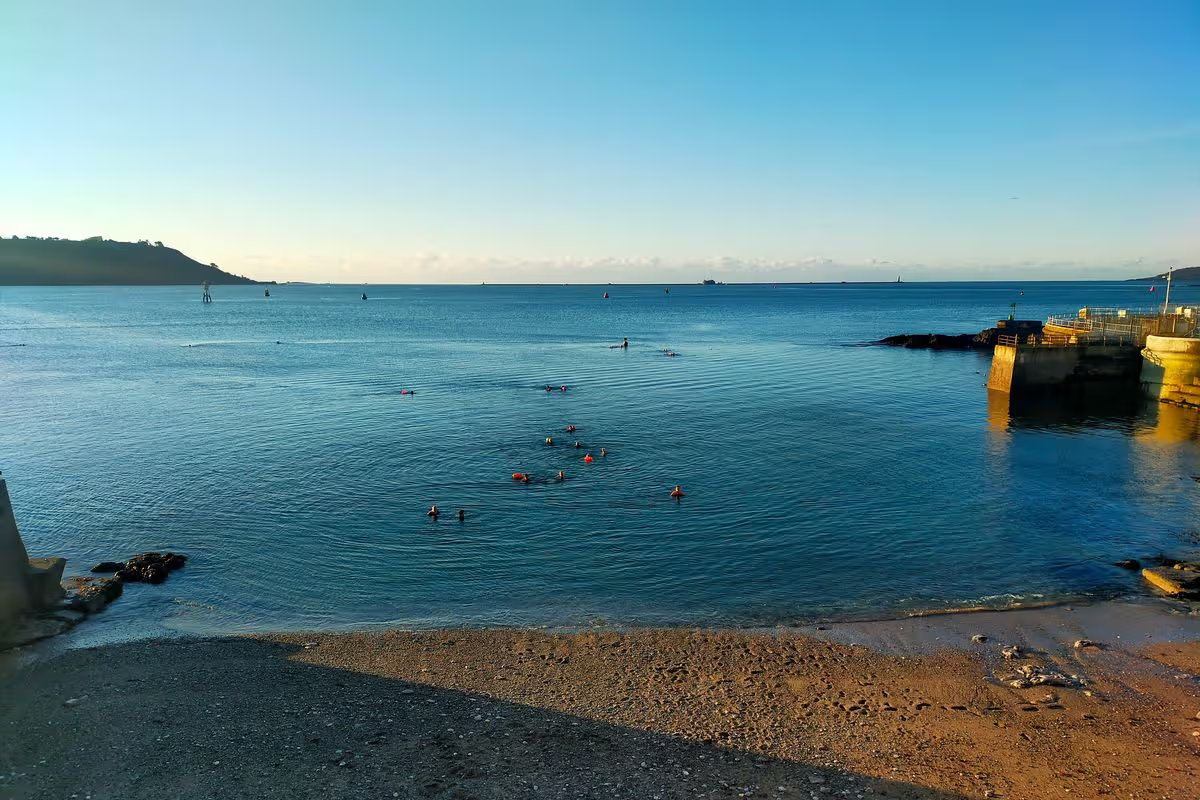

It’s a beautiful spot, but the surrounding steps and sunbathing area have eroded away after relentless storms(Image: Katie Oborn )
Swimmers in Plymouth have been warned to stay out of the water at one of Britain’s most beloved beauty spots in the self-proclaimed Ocean City — a caution that follows the battering the south west endured from Storm Ingrid in January 2026. The Victorian-era steps at Plymouth Hoe’s Tinside Beach were left severely damaged by towering waves in January, though the outdoor Tinside Lido, which underwent renovation last year, has escaped unscathed.
Local year-round swimmers, however, are now speaking out, arguing that the destruction has laid bare “what an eyesore” the small beach and its surroundings have become — and they’re calling on authorities to invest in restoring Tinside Beach as a “fabulous asset” for Plymouth once more.
A visit to the much-loved spot on Saturday, February 14, uncovered “no swimming ” signs installed by Plymouth City Council, alerting visitors to “sharp spikes and debris” as well as “dangerous and uneven surfaces”.
The beach has long been a cherished gathering place for locals who brave the elements throughout the year, with many citing its significant contribution to their mental wellbeing alongside the wider benefits of wild swimming.
Yet in the wake of the storms that obliterated the concrete steps and several railings, swimmers have reported that getting into the water “safely” has become incredibly difficult. Numerous locals have also expressed worries that, even before the storm wreaked havoc, the vicinity had already become “rundown”, despite still attracting holidaymakers throughout the summer season, , reports the Express.
Melanie Green shared with me: “There’s a lot of all-year-round swimmers that know what should be used to do a ‘quality’ job with regards to repairs now needed.
“Plymouth City Council, please have a meeting with us all and make the Hoe steps and seafront look great again. This is where tourists come to visit. Invest in it.”
The dawn swimmers at Tinside Beach form a friendly community. Chuckles, cheerful banter and even homemade cakes are exchanged amongst the group whenever birthdays or milestone moments occur.
However, the Victorian-era steps at Tinside are in “desperate need of repair”, making it difficult to congregate – and one habitual swimmer observed that regular maintenance “would save money in the long run”.
The council has confirmed it “cares about the Hoe and foreshore” and is “sad to see the damage the recent storms have caused.”
A Plymouth City Council spokesperson further explained that “our surveyors and contractors are reviewing repair options for the Tinside steps and we will look to mobilise repairs as soon as practically possible”.
Last summer witnessed the reopening of the restored outdoor Tinside Lido beside Tinside Beach. The redevelopment was funded through the National Lottery Heritage Fund, Youth Investment Fund, Levelling Up Fund, and Plymouth City Council.
With this in mind, local swimmer Rena Truscott remarked: “I wish the council would have a complete rehaul and properly fix the waterfront, starting with Tinside (beach and steps).
“I feel investment is desperately needed now, not just to make the best of a fabulous asset for Plymouth but to ensure it remains safe and an ongoing legacy for the benefit of all.
“The Tinside Lido (renovation completed in 2025) now looks amazing and I’m sure it draws attention and hopefully tourists and revenue back to the Hoe. However, this now highlights what an eyesore the surrounding area is. Despite this, it remains popular all year round.”
Debra Romagnuolo voiced similar worries, stating: “Tinside steps are in desperate need of repair. Not just a quick fix. It needs good quality workmanship, not something that literally lasts a few weeks like the railings. It is in a sorry state.”
During my visit, chunks of concrete from the storm damage were visible strewn across the shoreline and seabed near the steps.
Warning notices have been put up advising people not to enter the water in this location, as large concrete blocks remain underwater and, depending on the tide, may not always be easily spotted.
A Plymouth City Council spokesperson commented: “We care about the Hoe and foreshore and are sad to see the damage the recent storms have caused, not just here in Plymouth but in so many other coastal villages, towns and cities.
“We are very much at the mercy of the elements but work hard to direct as much resource as possible towards protecting and reinforcing our historic waterfront so it can continue to be enjoyed for generations to come.
“Recent and ongoing works include repairs to West Hoe Pier and the Admirals Hard slipway, as well as the steps into the water at Commercial Wharf.”
Plymouth City Council added in their statement: “Our surveyors and contractors are reviewing repair options for the Tinside steps and we will look to mobilise repairs as soon as practically possible, once the weather is more in our favour.
“We are also working with marine and foreshore technical advisors and contractors on condition surveys of the wider foreshore. The findings from these surveys will be used to produce an action plan of monitoring, further investigations and prioritised repair works, for which we can then seek funding.
“Refurbishment works at Tinside Lido last year transformed underused areas of the Grade II-listed Art Deco building, safeguarding it for future generations whilst creating new opportunities for people to connect with Plymouth Sound.
“Its careful preservation and transformation will ensure Tinside continues to be a much-loved feature of Plymouth’s waterfront whilst supporting the health, wellbeing and aspirations of young people in Britain’s Ocean City.”
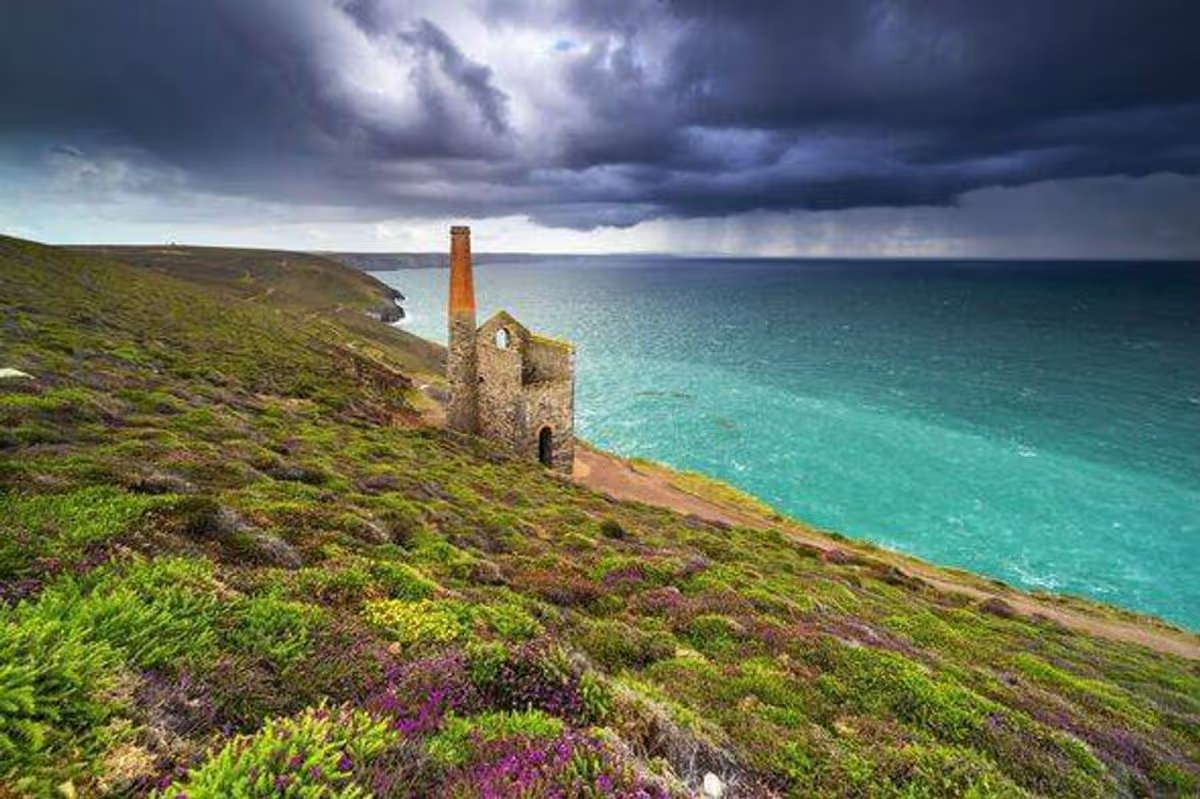

The village is celebrated as a traveller’s haven(Image: Getty)
Some corners of the world seem to have been shaped with exceptional care and affection – and this pristine Cornwall coastal village is undoubtedly among them.
Nestled along the North Cornwall coastline approximately 10 miles southwest of Newquay, this historically significant and remarkably unspoiled coastal settlement offers breathtaking vistas, vibrant community character, and prize-winning cuisine and beverages.
Concealed within an immaculate section of the Cornish shore, this tiny village represents a gem positioned within both a designated Area of Outstanding Natural Beauty and a World Heritage Site.
This waterside settlement thrives courtesy of its robust local community, which supports an array of independent retailers and enterprises, including one of Britain’s most ancient bakeries still trading from its founding location.
Save on the best holiday cottages in Cornwall

Famous for its rugged coastline, golden beaches, picture-perfect villages and rich maritime heritage, Cornwall is one of the most-visited corner of the UK. Sykes Cottages has a large number of holiday homes to choose from, with prices from £36 per night.
Boasting beautiful, canine-friendly shores, exceptional public houses and dining establishments, and access routes to some of Cornwall’s most dramatic coastal paths and walks, it’s little wonder this village is hailed as a traveller’s paradise, reports Cornwall Live.
The celebrated St Agnes Bakery has been trading from its original site in St Agnes for more than 120 years – having initially welcomed patrons back in 1905.
Famed for producing the most delectable traditional Cornish recipes daily, St Agnes Bakery stands as one of the village’s finest attractions.
Their renowned Cornish Pasty has secured Gold Standard status, whilst the distinctive ‘Giant Sausage Roll’ was created and gained popularity within the bakery’s modest premises.
Buttery flaky buns, delectable Cornish cakes, and freshly baked loaves also feature amongst St Agnes Bakery’s bestselling items.
St Agnes Bakery has collected numerous prestigious accolades – from World Pastry Awards to National Bakery Awards, each testament to the quality of its exceptional offerings.
The bakery’s owners said: “The joy of baking is deeply rooted in both our own childhood memories and experiences. Since taking over the bakery it has been our aim to bake all our breads, cakes, Cornish pasties and giant sausage rolls using time-honoured methods, tried and tested recipes and only the highest quality of ingredients, just like our own mothers showed us.”
St Agnes Bakery procures the majority of its ingredients locally from Cornwall, with most suppliers and producers based near St Agnes.
The prize-winning bakery isn’t the only draw St Agnes has to offer. This charming seaside village, with its winding lanes and delightful independent shops, proves irresistible to holidaymakers.
Its narrow streets brim with Cornish character, establishing St Agnes as a treasured destination for visitors. St Agnes boasts several stunning beaches for visitors to discover, including Trevaunance Cove, Chapel Porth, and Porthtowan – all hugely popular spots for surfing enthusiasts, swimmers, and those simply wanting to soak up the sun.
The surrounding coastal area is steeped in captivating history, particularly its mining heritage, exemplified by sites such as the derelict 19th-century tin mine Wheal Coates.
The village possesses a fascinating past and industrial legacy rooted in tin and copper mining, which dominated Cornwall’s economy during the 18th and 19th centuries. Today, remnants of this mining history, including engine houses and mine shafts, still punctuate the landscape.
Despite ranking amongst Cornwall’s larger coastal villages, St Agnes maintains a charming and unspoilt character. One of its most celebrated landmarks is St Agnes Beacon – an elevated vantage point offering panoramic views of the spectacular countryside and historically serving as a watchtower.
The adjacent St Agnes Head is similarly cherished by both residents and tourists, providing magnificent views across the dramatic Cornish coastline.
This enchanting seaside village has frequently been hailed as an ‘underrated gem’ by those who visit, delivering spectacular coastal scenery featuring dramatic cliffs, sandy beaches, and picture-perfect rural countryside.
It’s also the home of The Peterville Inn, an award-winning establishment which previously claimed the coveted ‘Pub of the Year’ title at the VisitEngland Awards for Excellence in 2024. Chapel Porth Beach stands out as another essential spot in St Agnes, with the Chapel Porth to St Agnes Circular Walk coming highly recommended.
Visits to the St Agnes Museum and Perranporth Airfield are also strongly suggested for those seeking enjoyable pursuits, whilst the St Agnes to Trevellas Porth Circular Walk proves a treat for walking enthusiasts.
Admirers of Winston Graham’s bestselling Poldark novels (and its dashing hero Ross Poldark) will be thrilled to learn that the writer lived just moments from St Agnes and has famously revealed he found inspiration in this picturesque village, calling it ‘Poldark Country’.
Despite its modest proportions, St Agnes brims with delightful attractions, making it an essential destination if you’re after a brilliant experience amidst breathtaking scenery.

Sheffield United boss Chris Wilder has said the prospect of relegating their cross-city rivals is “not in his thought process at all”.
The Blades fan, who is unbeaten in his seven games against the Owls, said he disagreed with the notion that his side, who are 15th in the table, should cruise to a win.
“We’ll have done more preparation on this game than we have on any game this season and all the games other than the play-off final last season,” he told BBC Radio Sheffield.
“I’ve got complete respect for Henrik and a group of players… there’s talk of it being a mismatch or a gimme, whether it’s bookies’ odds or the narrative in the city… football just doesn’t work like that.
“The players have to play with a discipline and a control to win a game of football, to win a local derby.”
Wilder added: “We put a slide up about Macclesfield v Crystal Palace and Bodo/Glimt v Manchester City. There are all sorts of examples recently, let alone [in] the 100 years plus of football, the game isn’t decided on team sheets.
“We understand it’s basically their season on the line, we’re not daft. But we’ve got our fight, and ours has to be bigger than theirs.”

More than 7,000 languages are spoken around the world today and at least 3,000 of them, or 40 percent, are endangered.
English is the most widely spoken language, with approximately 1.5 billion speakers in 186 countries. Two out of every 10 English speakers are native, while the remaining 80 percent speak English as their second, third or higher language, according to Ethnologue, a database which catalogues the world’s languages.
Mandarin Chinese is the second most spoken language with almost 1.2 billion speakers. However, when accounting for native speakers, it is the largest language in the world, owing to China’s large population.
Hindi comes in third at 609 million speakers, followed by Spanish (559 million), and Standard Arabic (335 million).

There are 293 known scripts – sets of graphic characters used to write a language – according to The World’s Writing Systems, a reference book about global scripts.
More than 156 scripts are still in use today, while more than 137 historical scripts, including Egyptian Hieroglyphs and Aztec pictograms, are no longer in use.
The Latin script, which is used to write English, French, Spanish, German and more, is used in at least 305 of the world’s 7,139 known living human languages. More than 70 percent of the world’s population use it.

Of the 7,159 languages spoken worldwide, 3,193 (44 percent) are endangered, 3,479 (49 percent) are stable, and 487 (7 percent) are institutional, meaning they are used by governments, schools and the media.
A language becomes endangered when its users begin to pass on a more dominant language to the children in the community. Many are used as second languages.
According to Ethnologue, some 337 languages are said to be dormant while 454 are extinct.
Dormant languages are those that no longer have proficient speakers, but the language still has social uses and the language is part of the identity of an ethnic community. Extinct languages are those that have no speakers and no social uses or groups that claim it as part of their heritage or identity.
According to Ethnologue, 88.1 million people speak an endangered language as their mother tongue. There are:

Just 25 countries are home to some 80 percent of the world’s endangered languages. Oceania has the most endangered languages, followed by Asia, Africa and the Americas.
Some endangered languages include:
Oceania
In Australia, Yugambeh, an endangered Aboriginal language, is spoken by the Yugambeh people, primarily across the Gold Coast, Scenic Rim and Logan in eastern Australia.
In recent years, a strong community-led revitalisation programme and the use of learning apps have made the language more accessible to younger generations.
Asia
Japan’s Ainu (Ainu Itak) is a critically endangered language. According to UNESCO, it can’t be linked with certainty to any family of languages. The exact number of Ainu speakers is unknown, however a 2006 survey showed that out of 23,782 Ainu, 304 know the language.
Africa
In Ethiopia, Ongota is a critically endangered language.
It was spoken by a community on the west bank of the Weito River in southwest Ethiopia. There are only about 400 members of the community left, with a handful of elders speaking the language.
Americas
In North and Central America, almost all Indigenous languages are endangered. Louisiana Creole, a French-based creole with African and Indigenous influences, is a seriously endangered language in the United States, with it mostly spoken by elders.
Leco is an endangered Indigenous language spoken in Bolivia and is considered an isolated language – one that has no genetic relationship to other languages. The language is only now spoken by elders with a Leco ethnic population of only about 13,500.
Europe
Cornish (Kernewek), spoken in southwest England, was marked as an extinct language by UNESCO, until it was revived and in 2010 changed to an endangered language. It is spoken as a first language by 563 people according to the 2021 England and Wales census.
Brazil’s President Lula says fate of Venezuelan president should be determined by the ‘people of Venezuela’ and ‘not by foreign interference’.
Published On 21 Feb 202621 Feb 2026
Share
Brazilian President Luiz Inacio Lula da Silva has said that Venezuelan President Nicolas Maduro should face trial, but that it should take place in a Venezuelan court, rather than in the United States, where he is currently being held after his abduction by the US military.
“I believe that if Maduro has to be trialled, he has to be trialled in his country, not trialled abroad,” Lula said in an interview, emphasising that “what matters now is to re-establish democracy in Venezuela”.
“It has to be solved by the people of Venezuela, and not by foreign interference,” said Lula, citing a history of US-backed dictatorships in Latin America, including Chile, Argentina and Uruguay.
“We cannot accept that a head of state of one country could invade another country and capture the president,” the Brazilian leader added.
Lula’s comments come as Venezuela’s acting president, Delcy Rodriguez, has been working to release hundreds of politicians, activists and lawyers jailed during Maduro’s residency, which began in 2013.
The Brazilian has openly criticised the abduction of Maduro and his wife, Cilia Flores, in a military operation ordered by US President Donald Trump on January 3.
Maduro was flown to New York after his abduction in a bloody night raid on Caracas. He has since been accused by US authorities of planning to transport drugs to the US alongside other charges.
The US government’s own data shows that Venezuela is not among the world’s major drug producers; however, Trump administration officials have accused Maduro and others of working with the region’s largest drug trafficking groups, including in Colombia and Mexico.
While the Trump administration has claimed that its military buildup near Venezuela and maritime blockade of the country were focused on combating drug trafficking, Trump has laid claim to Venezuelan oil reserves since removing Maduro.
Trump has also invited US oil companies to exploit Venezuela’s oil and said he wants proceeds from the sale of Venezuelan oil “to benefit the people of Venezuela and the United States”.


A REALITY telly pal of Jennifer Lopez caught speeding in her £200,000 Bentley has been banned.
Amanda Cronin begged JPs to let her keep her licence as she needed a car to care for her mum — who “won’t accept” taxis.

But magistrates, who heard she already had nine penalty points from speeding offences, were unmoved and gave her three more.
That took her to 12 and an automatic six-month ban under totting-up rules.
Real Housewives of London star Cronin, 57, was caught by a camera doing 24mph in a 20mph zone in Earls Court, West London, last May.
The ex-model, who dated Wham! star Andrew Ridgeley and counts US singer J-Lo as a pal, argued she needed her £200,000 Bentley Continental to drive from her £4million home in Belgravia, central London, to widowed mum Janet’s home near Soberton, Hants.
She said she regularly ferried the 85-year-old to medical appointments.
Cronin told Bromley JPs: “She won’t accept going in taxis.
“My mum will suffer if I’m not able to drive her around.”
Magistrate Jo Caseby said: “You’re a good and attentive daughter but there are solutions which can be put in place.”
Cronin, who divorced millionaire energy mogul Mark Daeche in 2019, also owns a £12million home in London’s Mayfair.
She must pay £334 in a fine and costs.



Travellers told what happens if you ignore a safety procedure(Image: Getty)
Flying remains one of the safest ways to travel, largely due to meticulously crafted safety protocols. Whilst some procedures might appear mundane or superfluous, each serves a vital purpose in safeguarding passengers and crew alike.
However, a pilot (@PerchPoint) has taken to TikTok to clarify whether one specific procedure genuinely needs following. Whether through absent-mindedness or simply not knowing better, switching your phone to aeroplane mode matters – and it’s not “a conspiracy theory,” the pilot cautions.
But what actually occurs if you don’t bother? In the video, the pilot explained: “This is just a friendly PSA, that the airplane mode button is not a conspiracy.
“If you forget to put your phone on airplane mode, no, it’s not the end of the world, the plane will not fall out of the sky, and it won’t even mess with the systems on board.”
However, does this mean passengers can disregard the procedure? “If you have an aircraft with 70, 80, or 150 people on board and even three or four people’s phones start to try and make a connection to a radio tower for an incoming phone call, it sends out radio waves.
“There’s a potential that those radio waves can interfere with the headsets that the pilots are using.”
He proceeded to describe his own encounter with this interference whilst attempting to land safely, noting there was an irritating noise in the headset that “sounded like a mosquito.”
The pilot explained: “No, it’s not the end of the world, but it’s pretty annoying when you’re trying to copy down instructions and it sounds like a wasp or something flying around you. So if you’re ever curious why you need to put on airplane mode, that’s why.”
According to Travel and Leisure, it goes beyond mere irritation. Pilots frequently operate with restricted visibility, meaning they depend heavily on information relayed from ground control, particularly during takeoff and landing – the phases when most aviation incidents take place.
Consequently, it’s vital that they remain focused and their communication isn’t compromised.
Per Federal Aviation Administration (FAA) regulations, all passengers must enable airplane mode during flight to avoid potential signal interference.
It’s also a straightforward gesture of consideration that contributes to a seamless journey for all passengers, according to Booking.com.
“When smartphones and devices were first introduced, it was found that cell phones that aren’t in flight mode can overload the networks on the ground, especially during takeoff and landing, as phones try to connect to multiple towers at once.
“How much phones affect aviation technology hasn’t been studied in-depth, but pilots say they can hear background noise and interference from phones while flying, especially when they’re landing, and mobile phones begin to make contact with towers again.
“So, while your phone may work at times during flight, do you really want to distract your pilot while they’re speaking with air traffic control to execute a safe landing?”
According to Lovely Planet, pilots and flight attendants are seen with devices right in the cockpit, which gives them access to digital charts and documents.
However, unlike passenger devices, this equipment has undergone rigorous testing to guarantee it won’t disrupt the aircraft’s systems.

In his varsity debut, sophomore second baseman Auron Blackledge of Calabasas made quite a first impression on Friday. On the seventh pitch of his first at-bat, he hit a home run.
He finished with three hits and three RBIs in the Coyotes’ 7-0 win over Castaic.
Luke Szymanski struck out five with no walks in five innings.
Gahr 16, Santa Margarita 3: Andres Gonzalez and Bryce Morrison each had three hits for Gahr.
Harvard-Westlake 8, Texas Marcus 5: Ira Rootman hit his second home run of the season and finished with two hits and three RBIs for the 2-0 Wolverines.
Mira Costa 4, Westlake 1: Three pitchers combined on a four-hitter for the Mustangs (2-0).
El Camino Real 9, Culver City 1: Shane Bogacz had four RBIs and Andrew Katzman threw 4 1/3 innings of no-hit relief for the defending City Section champions.
Bishop Alemany 7, Newbury Park 1: Brody Thompson hit a two-run home run and Noel Barrientos threw five scoreless innings with five strikeouts for the Warriors.
Chaminade 4, Hart 3: A three-run rally in the seventh lifted the Eagles to victory. Robby Morgan finished with three hits.
Mission Viejo 5, Corona del Mar 1: Aiden Chapuis struck out seven in five innings and Joey Pallone had two hits for the Diablos.
Oxnard Pacifica 3, Chatsworth 1: Isaiah Sanchez struck out four in six innings for Chatsworth.
Anaheim Canyon 4, Redondo Union 2: Logan Adams had two hits and two RBIs for Canyon.
Oaks Christian 4, Paraclete 3: Carson Sheffer hit a home run and Dane Disney had two hits for Oaks Christian (2-0).
Rio Mesa 3, Cleveland 2: A bases-loaded walk in the ninth inning lifted Rio Mesa to victory. Grant Oh had three hits for Cleveland.
Narbonne 3, Palos Verdes 2: Joshua Minor had an RBI single during a two-run sixth for Narbonne.
Valencia 8, Buena 3: Tyler Wertz had two hits, including a home run, and Evan Conrad added three RBIs for Valencia.
Camarillo 4, Sun Valley Poly 1: Turner Hothan gave up one hit in four innings for Camarillo.
Granada Hills 4, Highland 1: Cayden Lazar struck out seven and gave up one hit in six innings for the Highlanders.
St. Francis 6, Santa Barbara 1: Daniel Izaguirre went three for three for 3-0 St. Fancis.
Norco 3, Aliso Niguel 0: Peyton May struck out 12 and threw an eight-inning no-hitter.
JSerra 2, Chino Hills 1: Annabel Raftery had a walk-off sacrifice fly in the eighth for the win.
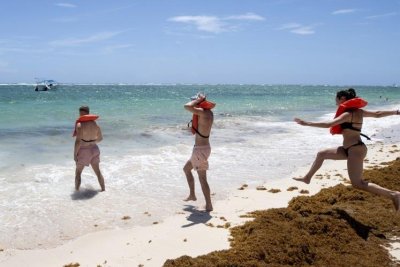

People walk past sargassum clumps on the sand in Punta Cana, Dominican Republic, in July. File Photo by Orlando Barria/EPA
Feb. 20 (UPI) — The Dominican Republic opened the year with 1.22 million tourists in January, a 5.5% increase compared with the same month last year. The increase was driven by growth in air arrivals and sustained demand from the United States.
Tourist arrivals to the island by air surpassed the 800,000-passenger mark for the first time in a single month, posting year-over-year growth of 8.7%, according to the Ministry of Tourism,. The figure exceeds pre-pandemic levels and is 61% higher than recorded in January 2019.
“Receiving 1,219,606 visitors for the first time in the history of Dominican tourism tells us how extraordinary this year will be for the sector,” Dominican Republic Tourism Minister David Collado said.
Collado held meetings in New York with representatives of JPMorgan, Bank of America, Standard & Poor’s and American Express, as well as other key players in the international financial system, as part of a strategic agenda to position tourism as the country’s leading productive sector.
According to information released Thursday by the presidency, Collado presented projections for Dominican tourism for this year, highlighting the sector’s sustained growth and predicting that if the current trend continues, 2026 could close with new record figures for the industry.
Dominican tourism continues to position itself as a reliable destination for investment, authorities said, backed by what they describe as “a vision of sustainable development that inspires confidence in international markets.”
According to information from the Ministry of Tourism, North America is the main source market for tourists to the island, accounting for 59% of air arrivals, led by the United States and Canada. Latin America also showed solid performance and expanded its share of total visitors.
Punta Cana accounted for the largest share of the country’s air traffic during the month. The cruise segment recorded a slight decline compared with the same period last year, while hotel occupancy averaged 82% nationwide during peak season.
Tourism is one of the main generators of foreign exchange and employment. In 2025, the country received more than 11.6 million visitors, consolidating its position as the Caribbean’s leading tourist destination.
As part of its international promotion strategy, the Ministry of Tourism signed a strategic alliance with Visa Inc., making the Dominican Republic the first country in the Caribbean to finalize an agreement of this kind with the global payments company.
The alliance includes joint campaigns, targeted promotions and exclusive benefits for international travelers, with emphasis on key markets such as the United States, Canada, Europe and Latin America.
The Dominican Republic is projected to be the fastest-growing economy in Latin America and the Caribbean in the coming years, according to the most recent forecasts by the World Bank and the International Monetary Fund.
Growth projections for 2026 place real GDP expansion between 4.0% and 4.5%, positioning the country as one of the economic leaders in the Caribbean region.
In that scenario, tourism is a strategic engine and the backbone of the Dominican economy. Its role is not only to generate revenue, but also to act as a catalyst for other key sectors, such as construction, commerce and transportation.
In 2025, the sector contributed approximately $21.1 billion, representing about 16% of the gross domestic product.

Almost fifty years after the revolution in 1979 that changed the political landscape of Iran, Iran is at the crossroads of its history, which is defined by economic pressures, social pressure, and the changing geopolitical environment. The Islamic Republic was constructed as a combination of revolutionary ideology, anti-Western response, and promise of social justice. In the present day, although the ideological framework is still maintained, the sustainability of that framework is being strained increasingly by the structural economic pressures of the day, generational shifts, and changing regional hegemony.
On the economic front, Iran is continually constrained by global sanctions and inefficiency in its structure. Withdrawal by the United States from the Joint Comprehensive Plan of Action (JCPOA) and the reimposition of massive sanctions in 2018 have cut off much of the oil exports of Iranian oil, banking, and foreign investment flows. The country works well under its economic potential despite the fact that Tehran has been able to sustain limited oil sales, especially through discounted sales to China and through surrogate routes. The inflation rate has been above 40 percent during the recent years, the Iranian rial is falling drastically, and unemployment among the youth is also a burning issue. It is the middle and lower classes that are directly impacted by these economic pressures and that pose a legitimacy challenge that cannot be solved only through rhetorical means of revolution.
The internal landscape is a manifestation of long-term frustration. Frequent demonstrations regarding fuel prices, the state of the economy, and social liberation indicate the growing disparity between state discourses of resistance and the realities that the citizens encounter. The newer generation born after the revolution has lost any connection with the revolutionary memory of 1979 and perceives governance less as ideologically symbolic and more based on economic performance and individual opportunity. The policy employed by the state has been based on the repressed handling of dissent, which consists of the limitation of the mobilization of protests and the prevention of the collapse of the system. Although this is a way of maintaining short-term stability, it does not deal with structural issues like brain drain, capital flight, falling purchasing power, and diminished faith in long-term economic potential.
The main political quandary is consequently a legitimacy transformation quandary. In the past, the Islamic Republic gained legitimacy through revolutionary mobilization, religious control, and confrontation with the external hostilities, especially the United States and Israel. Nevertheless, the contemporary politics demands more and more performance-based legitimacy—providing economic growth, stability, and material changes in the quality of life. The conflict between ideological stability and realistic adjustment is the characteristic of the contemporary crossroads of Iran.
Iran is geopolitically a country that exists in the complex web of pressures. The United States is still the main external agent, which affects the Tehran strategic calculations. The policy of Washington is alternating between the engagement of diplomacy and coercion, yet the ultimate goal is the same as it is: avoiding the possibility of Iran obtaining nuclear weapons competence and reducing its impact in the region. In Tehran, it will need negotiations that will help soften sanctions and stabilize the economy, but any deal will not collapse under the perception of submission over matters of sovereignty, ballistic missile potential, and relations with the region.
Meanwhile, the nuclear and missile programs in Iran are considered to be existential threats to Israel. The shadow struggle that has been there for a long time, including cyber attacks, precision attacks, espionage, and proxy wars, has heightened strategic mistrust. The intensity of this rivalry is shown by the fact that Israel has been carrying out its operations within Iran and against Iran-related targets in Syria. Any intensification would attract Gulf states and disrupt world energy supply, especially through the Strait of Hormuz, which is a choke point in the oil markets of the world. Even minor confrontations will have a global economic impact, as Iran is strategically placed in the important maritime paths.
The regional policy of Iran has focused on the establishment of strategic depth by alliance and coalition with non-state actors and supportive governments within Lebanon, Iraq, Syria, and Yemen. This system becomes a deterrence and leverage factor, making it difficult to engage in a direct military strike on the territory of Iran. Geostrategically, this doctrine of forward defense has enhanced the bargaining power of Iran. But it is likewise causing tension with the other Arab countries and creating the impression of destabilization in the region. The recent diplomatic thaw between Iran and Saudi Arabia, which was facilitated by China, shows that both sides noticed that continued confrontation is expensive in terms of both economics and strategy.
Iran is geographically at one of the most strategic points of Eurasia. It connects the Persian Gulf with Central Asia, the Caucasus, and South Asia. The International North-South Transport Corridor is one of the major trade routes that can make Iran a major transit route between India and Russia and Europe. This geo-economic location, in theory, has colossal prospects of being rolled into new multipolar trade systems. Sanctions and political isolation in reality prevent full access to the global markets. The latter can be said to be strategic convergence, as Iran was brought closer to Russia, especially after the war in Ukraine, as a result of Western pressure. But such convergence also subjects Tehran to secondary sanctions and makes it less flexible in its East-West balancing.
Iran—Concerns about the nuclear problem continue to be the major pivot of the external affairs. Tehran maintains that its nuclear program is nonviolent and has indicated that it is free for verification. But the Western governments require more guarantees and wider negotiations, which can feature missile capabilities and regional operations. It is possible that a strictly limited nuclear deal will minimize the risks of immediate proliferation and alleviate the economic pressure, which might make the Iranian internal situation more stable. Nonetheless, such a deal may not help solve any underlying rivalries between the region but could simply freeze the situation unless there are larger regional de-escalation mechanisms. On the other hand, the inability to find any solution will lead to the further worsening of the economy and the possible military clash.
In a more geo-strategically global understanding, the balance of power between the Middle East and the rest of the world will be influenced by the course of Iran. In case Tehran manages to negotiate the lifting of sanctions and turns in the direction of economic integration with the Gulf states, it will be able to shift from the resistance-focused model to the development-oriented state step by step. This would strengthen the stability of the region, safeguard the energy security, and minimize the motivation to intervene. It would also make the regional rivalry be based more on economic rivalry rather than military rivalry, especially in terms of infrastructure rivalry, trade corridor rivalry, and energy market rivalry.
Nevertheless, should the negotiations fail and the confrontation escalate, Iran might apply the asymmetric deterrence further, increasing the range of its missiles and extending proxy bases. That way would strengthen the preemptive stance of Israel and increase the presence of the US military in the Gulf. The escalation would disorient shipping routes, exert more volatility on oil prices, and disintegrate the security infrastructure in the region. To the surrounding Arab nations, which require diversifying and changing their economies, new warfare would destroy investment conditions and long-term strategies.
On the domestic front, economic resilience is what will sustain the strategic position of Iran. The political principle of endurance can only be stretched so far as inflation undermines the wages and the depreciation of currency undermines savings. This needs structural changes: enhancing transparency, welcoming foreign investment, and a non-hydrocarbon economy, and empowering the business sector. Foreign policy victories cannot entirely offset its dissatisfaction at home without economic change.
After all, the crossroads of Iran is not only ideological but also structural. The state has to strike a compromise between sovereignty and economic need, deterrence and diplomacy, and ideological identity and practical governance. Its strategic location means that its decisions will have a far-reaching impact, not only across its frontiers, but also on the energy markets of the world, the great-power politics, and the new security order of the Middle East. The future of Iran becoming a development-oriented regional power with full membership in multipolar networks or being a sanction-bound resistance state under continuous pressure will not only dictate the internal stability of the country but also the geopolitical orientation of a long-time conflict-ridden and strategically divided region.

Hours before filmmaking legend Rob Reiner and his wife Michele were found stabbed to death in their Brentwood home, they attended a holiday party at Conan O’Brien’s house.
Now, two months after the tragedy, the comedian has broken his silence about the death of his good friends.
“To have that experience of saying good night to somebody and having them leave and then find out the next day that they’re gone … I think I was in shock for quite a while afterward,” O’Brien said in an interview for “The New Yorker Radio Hour” podcast. “I mean, there’s no other word for it. It’s just very — it’s so awful. It’s just so awful.”
As host of the Dec. 13 party, O’Brien was among the last people to see the Reiners alive. Their 32-year-old son, Nick, was arrested the following night and charged with murdering his parents. Two sources who attended the party described witnessing a loud verbal exchange between Nick Reiner and his parents.
In an interview published Friday, O’Brien said he and his wife were very close with the couple, describing them as “just such lovely people.”
O’Brien praised Rob Reiner’s talent as a director and his tireless advocacy efforts. The “When Harry Met Sally …” director was a prominent Democratic donor, noted critic of President Trump and a champion for causes such as early childhood education and gay marriage.
“I think about how Rob felt about things that are happening in the country, how involved he was, how much he put himself out there — and to have that voice go quiet in an instant is still hard for me to comprehend,” O’Brien told The New Yorker.
O’Brien said he considers Reiner “one of the greats” given his impressive track record of directing a series of blockbuster movies.
“To make seven — in, like, a nine-year, 10-year, 11-year period — is insanity,” O’Brien said. “With ‘Spinal Tap’ alone, if that’d been the only thing he ever did, he influenced my generation enormously.”
O’Brien fondly recalled first watching the rock mockumentary “This is Spinal Tap” in college, calling it a “splitting-the-atom moment.”
The pair were not only friends, but also collaborators. Reiner was a guest on a 1999 episode of “Late Night with Conan O’Brien,” and also appeared on episodes of O’Brien’s podcast, “Conan O’Brien Needs a Friend,” in 2023 and 2025.
Authorities allege Nick Reiner fatally stabbed his 78-year-old father and 70-year-old mother at their Brentwood home sometime in the early morning hours of Dec. 14. The couple’s bodies were discovered in the master bedroom by their daughter around 12 hours later, and Nick Reiner was arrested that night in South L.A. by Los Angeles police.
Nick Reiner was charged with two counts of first-degree murder on Dec. 16 and has yet to enter a plea. In January, his arraignment was postponed to Monday after his lawyer, famed defense attorney Alan Jackson, stepped down and was replaced by a public defender.
Nick Reiner has a history of struggles with mental health and substance use. It is unclear how prominently those struggles will feature in criminal proceedings.
Times staff writers James Queally and Richard Winton contributed to this report.


Whitby has long been known as a dark and brooding place(Image: Getty Images)
Sometimes, when a storm hits the UK, rain batters the pavements and wind whips the trees, it’s easy to feel swept up in the kind of awe-inspiring conditions that helped Emily Brontë to write her classic novel, Wuthering Heights.
There is a little town in Yorkshire, 100miles from Cathy and Heathcliff’s home, but steeped in as much Gothic drama, where every day feels like you’ve tumbled into such dark Victorian melodrama.
As I stepped aboard my coach bound for Whitby, I imagined a sleepy seaside town, much like those down south that slowly emerge as you drive along the road towards the sea. What I got was very different.
Just getting to Whitby was a beautiful journey. The town is nestled between the rugged expanse of the moors and the wild thrashing of the North Sea. In days gone by, travellers would only be able to access it if they hiked for miles along the hills and valleys of the North York Moors or braved the violent waves of the sea. Now, we have cars and trains, but both still take you over the moors.
READ MORE: Stunning Welsh beach named best in in UK and will stop you in your tracksREAD MORE: I travel the world because of my divorce – now I always pack the same 2 items
As my coach sped through the twists and turns of the roads across the moors, I was like a child, with my face pressed against the window. There wasn’t a soul for miles, just acres and acres of heather. Once in Whitby, when you hear the waves crash against the sea defences and feel the wind whistle past your ears, it’s easy to see how someone might think a faint voice calling for Heathcliff was coming over their shoulder.
The town itself is split into two halves. The newer section was built following the Second World War, but much of the town is older and filled with Georgian terraces. Even older is Whitby Abbey, whose ruins stand proudly at the top of a cliff and have inspired many a tale, including Bram Stoker’s Dracula.
If you walk along the coast from the nearby villages of Saltmoore and Sandsend, the gothic ruins stay within your sightline. Lucky hikers will get to see the sea fog – which locals used to believe was the fiery breath of a dragon – come in to cover the abbey. You’ll feel like you’re trekking the same paths Heathcliff did as he searched for Catherine’s ghost, not least because Emerald Fennell’s new film was shot about two hours away, in the Yorkshire Dales.
The most remarkable sight comes when you walk back towards Whitby, as when the fog clears, the Abbey can be seen looming through a gap between the cliffs. It’s terrifying and awe-inspiring all at once. I felt drawn towards the ruins, much as Cathy is drawn to Heathcliff or as an entranced Lucy is drawn to Dracula. How could anyone resist such a terrible sight?
Indeed, not Whitby residents of years gone by. Whitby Storyteller, Rose Rylands, who tells of the myths of the moors. When Rose spoke about the ghostly figures said to appear on the hilltops, goosebumps pebbled my skin, as if I was walking with them myself.
The tale of Bram’s inspiration in Whitby was similarly haunting. During a holiday, the author stayed on the West Cliff, offering views of the Abbey, which he felt suited the Gothic atmosphere of his story. One day, he turned to the local library to research a shipwreck, only to discover the name ‘Dracula’ in the records. Its meaning in the Wallachian language, Bram learned, is ‘devil’.
When Rose told us these tales, the winter’s night pressing against the hostel windows, my heart started to beat faster. I began to wonder if I, too, would soon be hallucinating the ghost of lost love calling to me.
Of course, Heathcliff’s hallucinations of Cathy’s ghost all happen at night, and there really is nowhere better to see the stars than the North York Moors. The national park is a designated International Dark Sky Reserve, one of only 25 in the world, protected from light pollution and able to provide clear horizons, clouds permitting. As someone who grew up in London and finds it hard to sleep without the orange glow of streetlights coming in through the curtains, just standing in complete darkness is a wonder. When the stars are visible, there are no words.
We went to Castle Howard, a stately home that has served as a filming location for Brideshead Revisited and Bridgerton, to see the stars. Except for the enormous house, there is nothing around for miles, leaving the sky unpolluted by light. Inside, the house is equally beautiful.
The entrance hall is a vast space whose domed ceiling has been painted with the most gorgeous fresco of cherubs – it’s similar to Michelangelo’s painting The Creation of Adam, which decorates the Sistine Chapel. The whole place feels like an art gallery, really. I couldn’t wrap my head around the fact that people actually live there, but they do. The family is very involved in ensuring the house and its heritage remain standing strong.
Flouncing around the house, through the rooms, and then eventually into the cold and dark night definitely made me feel like I was Cathy after she had married Edgar Linton. Castle Howard has all the opulence of Thrushcross Grange, and it was easy to slip into the role of the new wife enjoying her surroundings. Heading out to see the stars, with the house behind me, had my heart racing, as though I could really see Heathcliff across the moors at Wuthering Heights.
If you want to really live in the kind of luxury that the Earnshaws did (without the madness and rooms where the wallpaper is modelled after Margot Robbie’s skin), the Saltmoore Hotel and Spa is the place to go. Just slightly removed from the touristy bustle of Whitby, the hotel is extremely peaceful. My room was a huge and managed to fit in a double bed, a giant shower (with underfloor heating) and two incredibly comfortable armchairs where you can sit and you listen out for ghosts at the window.
Additionally, the staff couldn’t be more helpful. They even lend you wellies for a walk along the beach. Fingers crossed the next time I go, I’ll be better prepared. And best believe, I will be back. For costume drama fans, there really is nowhere better to be.
Rose can be booked for walking tours of Whitby via her website.
You can find out more on visitengland.com and visitnorthyorkshire.com. Rooms at the Saltmoore Hotel and Spa start from £311 a night, based on two adults sharing.
Rooms at Saltmoore Hotel and Spa start at £236.
Ensure our latest lifestyle and travel stories always appear at the top of your Google Search by making us a Preferred Source. Click here to activate or add us as your Preferred Source in your Google search settings.


It was a long day at the office for Marco Penge, but the overtime hours were well worth it for the 27-year-old from Lancashire, England, who shot a bogey-free 64 Friday and is tied for the lead with Jacob Bridgeman after two rounds of the Genesis Invitational at Riviera Country Club.
Penge surged to the lead with birdies on five of the last seven holes, then watched as Bridgeman closed with three birdies to catch him at 12 under par.
“I was biding my time on the front nine — the targets are so small here — but I found my swing coming down the stretch and that allowed me to be more aggressive,” said Penge, who won three times on the DP World Tour last year to earn his first PGA Tour card. “It’s tough for a European to come over here and do the things Rory [McIlroy] and Tommy [Fleetwood] are doing but I managed the course well today.”
Penge was in the last group Thursday and was on the 10th hole when play was suspended due to darkness. He carded four birdies and two bogeys on the back nine early Friday morning to join McIlory, Bridgeman and countryman Aaron Rai at five under par. He had only 38 minutes between finishing his first round and starting the second, but showed no signs of fatigue.

Marco Penge reacts after putting on the 18th green during the second round of the Genesis Invitational at Riviera Country Club on Friday.
(Caroline Brehman / Associated Press)
“Not really, I wasn’t any more tired than usual,” he said. “When you see you’re near the top your adrenaline gets you through it.”
Although he did not get paid time and a half for playing 27 holes instead of the normal 18, a healthy check will come his way Sunday afternoon if Penge can hold his position.
Likewise for Bridgeman, who rode his momentum from the day before to also card a 64, opening his round with an eagle and posting eight birdies to more than offset bogeys at No. 7 and No. 12.
“I putted really well, hit my driver great and I’m excited to be in the hunt for the second straight week,” Bridgeman said after coolly sinking an eight-foot birdie putt on the last hole. “Yesterday was a learning experience. The 18th was playing a lot longer than I thought today. It’s shocking how soft and how fast these greens are. This is the most pure layout I’ve ever seen.”

Jacob Bridgeman hits from the 18th fairway during the second round of the Genesis Invitational at Riviera Country Club on Friday.
(Caroline Brehman / Associated Press)
McIlroy, the world’s No. 2-ranked player, looms one shot back after a six-under 65 and two-time winner Adam Scott rocketed into contention with two eagles and six birdies — an eight-under-par 63 marred only by his bogey at 18. Scott has won twice at Riviera, in 2005 (a rain-shortened 36 holes) and 2020, and is tied for fourth with Xander Schauffele at -9.
Schauffele, ranked 13th in the world, also had a prolonged day. He was tied for 29th at even par through 11 holes when play was suspended Thursday and played the last seven holes of the first round in three-under-par. The 2016-17 Rookie of the Year notched the last of his 10 Tour victories at the Baycurrent Classic last October.
“I’m tired man… I’m looking forward to laying down sometime soon,” said the 32-year-old who lives in Jupiter, Florida but was born in San Diego and played his college golf at Long Beach State and San Diego State.
Asked about tournament host Tiger Woods’ suggestion to reschedule the event to the summertime, Schauffele said: “Wherever it is and whatever the conditions are — dry, damp, moist — I just enjoying playing here.”
Rai led by one stroke when play was suspended Thursday but bogeyed 18 early Friday to drop into a tie and shot a second-round 69, leaving him tied for 12th with South African Aldrich Potgeiter, Ryan Fox and 2021 Genesis champion Max Homa at the halfway point.
“My ball striking was better than yesterday and I got more looks at birdie,” Potgeiter said after shooting 68 for a second straight day. “The course is looking great… with the amount of rain we’ve had they did a good job.”
World No. 1 Scottie Scheffler was tied with Keegan Bradley for last place at five-over when he walked off the course Thursday evening and shot two under over his last eight holes early Friday morning to begin the second round tied for 65th at +3. He had three birdies and six pars on the back nine for a 68 in the second round to get to even par and was among 51 in the 72-player field to make the cut.
“It’s nice to be able to get another two cracks at the course,” a relieved Scheffler said after having to drain a four-foot birdie putt at the 17th to extend his consecutive cuts streak to 68—the longest active streak on Tour. “This place and I have a weird relationship. I feel like I can play well here, I just haven’t yet. I was very aware I had to get to at least even par to keep going. I had to battle because the closing stretch is tough here.”
Scheffler has not missed a cut since the FedEx St. Jude Championship in August of 2022.
The conditions were ideal and scores reflected that on the second day of the 100th edition of a tournament that is still up for grabs, with 22 players within nine shots of the lead. One of them is Max Greyserman, who is tied for sixth with Australian Min Woo Lee at -8.
“Starting off with an eagle is always nice,” said Greyserman, a 30-year-old who lives in Palm Beach and is seeking his first pro win. “I hit a lot of nice drives. If you miss the fairways around here things get tricky. The kikuyu grass is interesting. I didn’t grow up on it. I played Genesis last year at Torrey [Pines] and I’ve played here four times before this week. It’s a good test, a fair test, a fun test.”
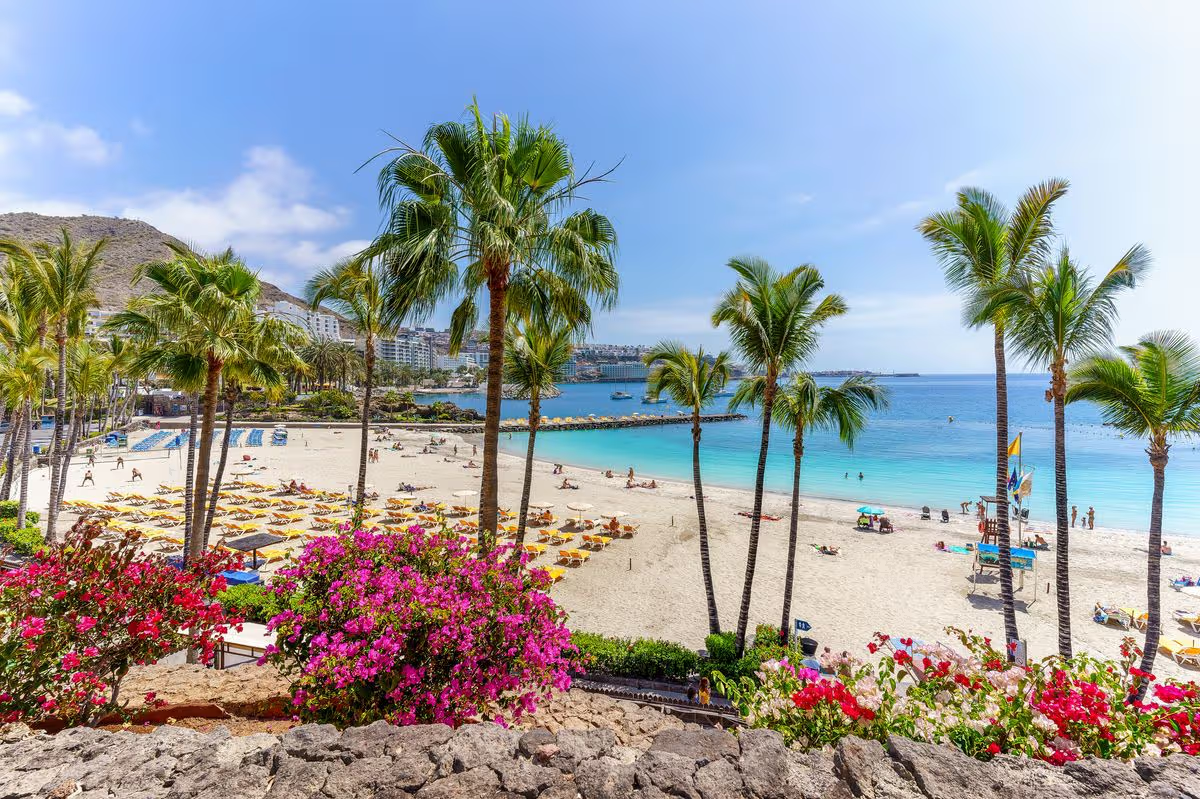

This sunny island could be the ideal Easter escape you’ve been looking for(Image: Getty Images)
A sunny island offering balmy rays of 22C and golden sand beaches could be the ideal destination to jet off to this Easter.
With February half term almost over, thoughts will start turning to the Easter holidays, particularly when a vitamin D fix is in order. One destination that offers ‘near guaranteed sunshine’, alongside its expansive sand beaches, dramatic volcanic landscapes and crystal-clear turquoise waters, is Gran Canaria in the Canary Islands.
In a bid to help travellers book their Easter escape, easyJet collected data to reveal the destinations with the highest chance of blistering rays and clear skies in April. From their research, they found that Gran Canaria would offer a balmy 22C in April and just a mere 5 to 15 per cent chance of rain per day, coming in third place behind Egypt and Cape Verde in the easyJet index.
The beautiful island, off northwestern Africa, is a haven for radiant weather with an average of nine hours of sunshine a day – perfect for days spent by the hotel pool or on the beach! What’s more, one-way direct flights to the sun-soaked island in April start from just £25.99 with easyJet, making an Easter escape even more appealing.
Among its fun-packed waterparks to keep the kids entertained, and desert-style sand dunes for days of exploring, easyJet revealed that the average price of a package holiday to Gran Canaria starts from around £429. There’s also a catalogue of sprawling resorts nestled along the picturesque shores, making it even easier to choose your preferred accommodation.
As the third-largest island of the Canary Islands, Gran Canaria has often been dubbed a ‘miniature continent’ due to its diverse landscapes, with around 60km of pristine sand beaches stretching along its 236km coastline. One of the most popular beaches is Playa de Maspalomas, with its heaps of golden sand dunes.
While it’s a scenic spot that’s certainly worth visiting to marvel at this phenomenon, you can also spend time on the beach with nearby bars and restaurants. One traveller shared on TripAdvisor: “Stunning, unique, and a magical natural place, and with a sea and climate all year round. Spectacular with pleasant places where you can bathe and be relaxed, its coasts, its dunes, beaches and its wonderful people and delicious food, all in general, a visit where I will return safely, always.”
Other notable beaches include Playa de Las Canteras, Playa de Amadores and Playa de Mogan, which has been hailed as a “total hidden gem off the beaten track”. The beautiful beach has often been dubbed a ‘Little Venice’, due to its charming canals connecting the marina to the town, with waterfront restaurants, cafés, and shops also in the area.
Aside from the sprawling beaches, there’s plenty more to explore in Gran Canaria. Including the huge waterpark, Aqualand Maspalomas and Lago Taurito, as well as the Palmitos Park, a garden and zoo, for the kids to enjoy when they’re not splashing around in the sea or building sand castles.
For those looking to delve into local culture, the historic old town of Vegueta (Las Palmas) is worth exploring, with its majestic Santa Ana Cathedral and Casa de Colón. Additionally, there is the traditional town of Teror and the municipality, Arucas, which is famed for its neo-Gothic Church and ancient rum distillery.
Stuart Wright, Customer Director at easyJet holidays, said: “After making it through the dark winter months, we know many of our customers are relying on April’s Easter break to catch up on some much-needed vitamin D.
“For those chasing warmer weather at this time of year, nearby destinations across Europe and North Africa can be brilliant options and are well worth considering. We know how important it is for customers to feel confident when booking a sunny Easter getaway. easyJet holidays offers great-value packages across a wide range of beach destinations, which is why we’ve launched our new sun-reliability index to give customers extra reassurance when choosing where to go, helping set them up for a brilliant holiday experience.”
Do you have a travel story to share? Email webtravel@reachplc.com
Ensure our latest lifestyle and travel stories always appear at the top of your Google Search by making us a Preferred Source. Click here to activate or add us as your Preferred Source in your Google search settings.


