



Early Sydney Sweeney TV role stuns fans as adorable clip of megastar resurfaces online
SYDNEY Sweeney fans have been left lost for words after realising that she has also appeared in a late 2000s teen drama.
The actress, 29, is arguably best known for her roles in Euphoria and White Lotus.
But in 2010 she appeared on our screens during the sixth episode of the third season of 90201.
Although it was only a small part, in the scene, her character can be seen approaching a shirtless Liam (Matt Latner) and asks him for help.
Her character tells him: “We’d like to look at those jeans but they are too high up for us to reach.”
As he reaches for the trousers, her character cheekily touches his bum and she starts giggling to her friends.


The episode is called How Much Is That Liam in the Window.
One fan shared the scene on TikTok and said: “Sydney Sweeney before she was Sydney Sweeney.”
Many rushed to the comments section to share their shock over the fact they never noticed her before on the show.
One said: “I had no idea!”
Another confessed: “I didn’t recognise her so much she’s dressed.”
A third chimed in: “Omg I just watched this episode and didn’t even recognise her.”
90210 aired on The CT between 2008 and 2013.
It starred the likes of Rob Estes, Shenae Grimes, Jessica Stroup, Lori Loughlin, Michael Steger, Jessica Lowndes, Matt Lanter, Trevor Donovan, Gillian Zinser, Tristan Wilds, Tristan Wilds, Dustin Milligan and Ryan Eggold.
Sydney has appeared in a number of films over the years including Anyone but You, Spiders 3D, Clementine, Along Came the Devil, Eden and The Housemaid.
Meanwhile she’s landed telly roles including Grey’s Anatomy, Pretty Little Liars, Robot Chicken, Family Guy, Kickin’ It and Criminal Minds.
As well as acting, Sydney has recently stripped naked as she balanced on a basketball in a steamy sports-themed shoot.
She also regularly models lingerie from her own brand Syrn on social media.

Senate committee advances Dr. Nicole Saphier’s nomination for surgeon general
WASHINGTON — Dr. Nicole Saphier, President Trump ‘s third nominee for surgeon general, moved a step closer to confirmation after a Senate committee voted to advance her nomination on Wednesday.
Saphier, a radiologist and former Fox News Channel contributor, was advanced out of the Senate Committee on Health, Education, Labor and Pensions on a 12 to 11 vote to serve as surgeon general after she was grilled at her confirmation hearing earlier this month about her stance on childhood vaccines.
She expressed support for vaccines and told lawmakers she didn’t believe they cause autism. The Trump administration has sought to revisit claims about a link between vaccines and autism, although widespread scientific consensus and decades of studies have firmly concluded there is none.
Timothy Westlake, who was nominated to serve as assistant secretary for mental health and substance use at the Department of Health and Human Services, was also advanced out of committee on the same en bloc vote.
It was not immediately clear when the officials would face a full Senate vote for their confirmation, but they are expected to be approved.
During her confirmation hearing, Republican Sen. Bill Cassidy pressed Saphier to declare whether she believed there was a link between vaccines and autism. Saphier responded that she does “not believe childhood vaccines cause autism,” adding that “the MMR vaccine is our greatest tool for combating measles,” in response to a question by Cassidy over whether parents should give children that shot.
MMR stands for measles, mumps and rubella, and the president recently called for the shots to be spaced out, against the guidance of medical groups.
The surgeon general position carries limited policymaking power but serves as a loud megaphone as the nation’s top communicator to Americans on public health issues.
Cassidy, who led the inquiry into Saphier’s views on vaccines, ultimately voted in support of her nomination.
Sen. Bernie Sanders, the ranking member of the Senate HELP committee, said ahead of Saphier’s vote that he would vote down her nomination because in part Saphier “has questioned the need for the hepatitis B vaccine at birth, when the data science has been clear.”
“We need a surgeon general who will tell the truth about vaccines, not someone who misleads the public,” Sanders said. At her confirmation hearing, Saphier said the universal birth dose of hepatitis B was safe and effective.
Chris Klomp, who was nominated to serve as deputy secretary of the Department of Health and Human Services, was advanced out of the Senate Finance Committee last week on a 15 to 12 vote. He was questioned during the same hearing as Saphier about his duties associated with the role as the current chief counselor of the Department of Health and Human Services under the leadership of Health Secretary Robert F. Kennedy Jr. as well as about his vaccine stance.
In protesting Klomp’s nomination at the Senate Finance Committee, Sen. Ron Wyden said Klomp “tried to create the impression that he will be the adult in the room on vaccines. Yet, as we sit here today, the vaccine chaos that we’ve come to expect from Robert Kennedy’s HHS continues.”
Hussein writes for the Associated Press.

Phil Mickelson had stint in facility for family trauma and addiction
Golfer Phil Mickelson checked himself into a facility earlier this year “seeking treatment for family trauma and addiction,” a representative for the six-time major championship winner said in a statement to news outlets on Wednesday.
Mickelson, 56, reportedly is no longer at the facility. No information about the specifics of his stay or details about his reasons for entering the program have been made available.
In February, Mickelson announced that he would miss the first two LIV Golf events of the year because he and his wife, Amy Mickelson, “need to be present for a family health matter.”
The only tournament the golfer known as Lefty has competed in this year was LIV Golf South Africa, where he finished at 7-under par and tied for 48th place, in March.
The following month, Mickelson announced he was withdrawing from the Masters and that he would “be out for an extended period of time as my family continues to navigate a personal health matter.”
In June, Golf Digest reported that a female member of the staff at the Farms Golf Club in Rancho Santa Fe had accused Mickelson of making “nonconsensual and inappropriate physical contact” with her months earlier.
Mickelson hired defamation attorney Tom Clare, who said video evidence contradicted the allegations.
In response to the Golf Digest report, a Mickelson spokesperson said in a statement: “Any misunderstanding has been cleared up. Phil continues to attend to a family health matter and is uncertain when he will be able to return to professional golf.”
A longtime gambling enthusiast, Mickelson admitted in a 2023 Instagram post that at some point he had “crossed the line of moderation and into addiction” but was “back on track to being the person I want to be.”
“After many years of receiving professional help, not gambling, and being in recovery from my addictions, I’m now able to sit still, be present in the moment and live each day with an inner calm and peace,” Mickelson wrote. “I still have a lot of cleaning up to do with those I love the most but I’m doing it slowly and as best I can.”
US judge approves settlement allowing Paramount to acquire Warner Bros | Media News
Mammoth deal has raised questions about corporate consolidation and editorial independence in media.

Published On 30 Sep 2026
A United States judge has entered an order giving the green light for the media giant Paramount to complete its $110bn acquisition of entertainment company Warner Bros., despite fears about the long-term impacts of media consolidation.
On Wednesday, US District Court Judge Araceli Martinez-Olguin approved a settlement between Paramount, Warner Bros, and a group of 12 states that had sued to block the merger.
Recommended Stories
list of 3 itemsend of list
In her ruling, Martinez-Olguin described the proposed deal as a “fair, reasonable, and good faith approach to address the competitive harms”.
Analysts have long raised concerns about the acquisition, one of the largest media mergers in history.
The coalition of states that sued to block the deal, led by California, had argued that combining Paramount with Warner Bros would effectively stifle media competition. They estimated that nearly one-third of all theatrical releases and basic cable programming would be consolidated under the merger.
But the states abandoned their lawsuit in favour of a settlement on September 21.
The five-year agreement requires Paramount to abide by theatrical film release quotas, committing to 30 releases per year in the US.
It also mandates that the combined company must keep negotiations with cable providers for Warner-owned channels separate from its deals for Paramount-owned channels.
The settlement approved on Wednesday also includes the creation of a five-member panel meant to safeguard the editorial independence of CNN and CBS, two major news networks.
But sceptics have pointed out that the merger puts a large swath of US media under the control of David Ellison, who leads Paramount.
Under Wednesday’s agreement, Ellison is in charge of appointments to the board that would oversee news independence.
The Paramount CEO is the son of billionaire Oracle founder Larry Ellison, a strong backer of pro-Israel causes who has close ties to the administration of President Donald Trump.
The founder of the film production company Skydance, David Ellison acquired Paramount last year as part of another controversial merger.
The 2025 Paramount-Skydance deal brought CBS under Ellison’s control. Ahead of the merger, sceptics questioned the abrupt cancellation of the CBS comedy show The Late Show with Stephen Colbert, which had been critical of Trump.
Ellison later installed Bari Weiss, a pro-Israel media figure, as the head of CBS News in a move that also raised questions about diminished independence within major journalism outlets.
Some critics depicted Wednesday’s settlement as a further capitulation to powerful corporate interests.
“Allowing one Trump-aligned, foreign-owned conglomerate to dominate American news and entertainment is a disastrous outcome,” Senator Elizabeth Warren of Massachusetts said in the wake of the settlement’s announcement.
But public officials like California Governor Gavin Newsom had called on his state’s Attorney General Rob Bonta to scrap the 12-state effort to block the deal and to pursue a settlement instead.
Paramount emerged victorious from a bidding war with the streaming giant Netflix in February to win control of Warner Bros’s holdings.
That includes a series of media and entertainment services, including the film studio Warner Bros Pictures, CNN and HBO Max. The Trump administration approved the deal without alterations in June.

‘Strong indication’ of Iran’s involvement in suspected plot near RAF base: UK PM – Middle East Monitor
There is a “strong indication” that Iran played a role in Sunday’s suspected terror plot near Royal Air Force (RAF) Fairford base in South West England, the prime minister confirmed Wednesday, Anadolu reports.
“There is indeed a strong indication that Iran played a part,” Andy Burnham confirmed in an interview with Sky News.
However, he added: “This remains, though, a complex and very serious police investigation. So I can’t say any more at this stage.”
Five men from London, age between 23 and 25, were arrested on suspicion of explosives offences and terrorism.
The incident came after a farmer discovered three vans blocking a road near the RAF base in Gloucestershire at 1.30 am local time (0030GMT).
Later, it was understood that one of the suspects had contacted authorities around an hour before, a development first reported by The Times newspaper.
READ: UK foreign minister denounces Netanyahu government, vows tougher action over Gaza
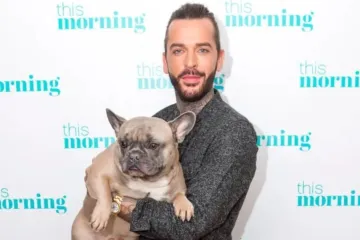
Pete Wicks takes swipe at exes Maura Higgins and Megan McKenna as he reveals how he and Olivia Attwood got together
PETE Wicks has seemingly taken a thinly veiled swipe at his exes Maura Higgins and Megan McKenna.
The swipe came as the star chatted to the Daily Mail about how he and Olivia got together, as he seemed to shade his past relationships.
Speaking about how in love he feels, Pete shared that it feels like the first time he’s truly fallen.
He said: “Yeah, I think so. I’ve loved people, of course, but it’s a different feeling to what I’ve had before.
“She’s [Olivia’s] become my best friend. She’s that before anything else.
“I have fallen in love for the first time and I don’t really have anything to compare it to.”


Pete also revealed that he opened up about his feelings for Olivia before Olivia opened up to him.
Chatting about whether he was nervous, Pete noted: “I’m quite a confident guy in a lot of areas, but not as confident when it comes to feelings.
“It was not a case of just fancying someone. Obviously I do – she’s beautiful, I think she’s incredible – but there was more.
“I didn’t really know what that was, or where it came from. It just happened.”
Pete and Olivia started dating in February of this year, and made their relationship Instagram official during a trip to Ibiza in July.
The romance follows Olivia’s divorce from former flame Bradley Dack.
Their marriage crumbled due to what was described at the time as a “breach of trust” on Bradley’s side.
Olivia had been friends with Pete for years prior to her beginning to date him.
Months of romance rumours swirled before the pair confirmed their romance, and they appear to be super loved up!
Pete and Maura dated for around six months between 2024 and 2025.
They split on Valentines Day of 2025 following a fiery row.
Meanwhile Pete and Megan were together for approximately a year and a half, with their relationship beginning in 2016.
The ups and downs of their romance were documented on The Only Way Is Essex.
Justice Department files complaint against judges over immigration enforcement surge comments
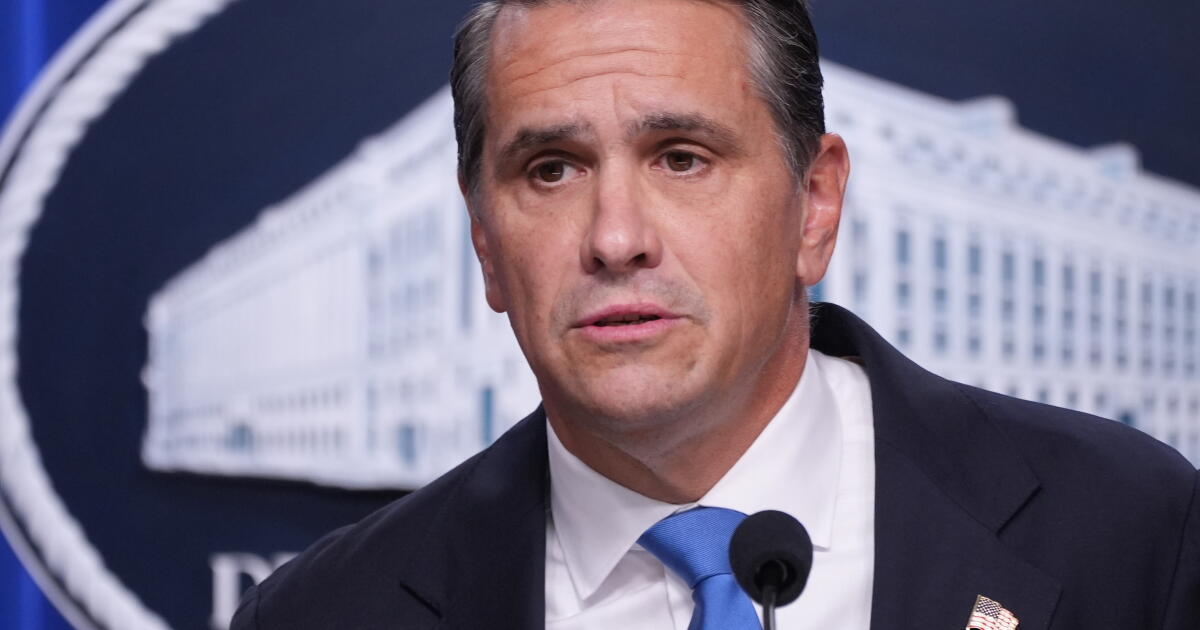
WASHINGTON — The Department of Justice filed a complaint Wednesday against federal judges in Minnesota over their remarks to the media related to the Trump administration’s immigration enforcement surge.
The complaint escalates the department’s battle with the federal judiciary, which has halted administration priorities, dismissed high-profile prosecutions and accused government lawyers in some cases of failing to comply with court orders.
The department is demanding that the judges recuse themselves from all criminal or civil cases involving the Department of Homeland Security, Atty. Gen. Todd Blanche told reporters, because of what he described as “obvious bias they have shown” in recent remarks to the New York Times.
At issue is a September article in which seven federal judges in Minnesota — nominated by Democrats and Republican presidents — spoke on the record about their experience dealing with a flood of cases during last winter’s immigration crackdown that led to thousands of arrests.
The judge at the center of the story, Patrick Schiltz, accused the government in January of failing to comply with nearly 100 court orders. He said in a ruling that U.S. Immigration and Customs Enforcement, a part of Homeland Security, “is not a law unto itself.”
Schiltz, who was nominated by Republican President George W. Bush and served as a law clerk for Supreme Court Justice Antonin Scalia, told the newspaper that what happened in Minnesota’s federal court last winter “created a grave threat to the rule of law.”
In a statement Wednesday, Schiltz said he was “acting well within the ethical rules that apply to federal judges in speaking to The New York Times.”
“Indeed, in February of this year, the Committee on Codes of Conduct issued an advisory opinion to emphasize that federal judges” may speak or write “on core judiciary matters such as advocacy for the rule of law and judicial independence,’” Schiltz said. “That is exactly what I did.”
The complaint was filed with the chief judge of the U.S. 8th Circuit Court of Appeals, which oversees federal judges in Minnesota.
The Republican administration has railed against what it describes as “activist judges” who officials say are intent on thwarting Trump’s agenda. Yet some of the most critical and unfavorable court rulings have come from judges nominated by Trump and other Republican presidents.
Richer writes for the Associated Press.

Craig Overton and Sophie Luff win Professional Cricketers’ Association awards
Somerset pair Craig Overton and Sophie Luff have won the top prizes at the Professional Cricketers’ Association awards.
Overton, the men’s player of the year, had a stellar season across formats as Somerset just missed out on a first County Championship title and reached the semi-finals of the T20 Blast.
Luff becomes the first winner of the women’s player of the year award not to have played international cricket since 2021. As well as superb form in county cricket, the 32-year-old was part of the Trent Rockets team that won The Hundred.
Pace bowler Sonny Baker and left-arm spinner Tilly Corteen-Coleman won the two young player of the year awards.
All-rounder Overton, 32, scored three first-class hundreds and averaged less than 20 with the ball in the County Championship.
His form has led to talk of a recall to the England team to fill the vacancy left by Ben Stokes, four years after he won the last of his eight Test caps.
Overton beat off other shortlisted nominees Joe Clarke, George Hill and Dan Lawrence.
“It’s a phenomenal feeling,” said Overton. “To be chosen by your peers to win this award is very special, it means so much to me.
“I felt like I got in a groove where my body was in a good spot, not 100% because of the schedule, but mentally I felt like I was in a great spot to be able to go out and perform when games come along near enough every other day.”
Somerset captain Luff scored more than 1,000 runs across formats during the summer, including averaging in excess of 40 in the One-Day Cup.
Luff triumphed ahead of three internationals on the shortlist – Maia Bouchier, Sophia Dunkley and Mady Villiers.
“I’ve always been a leader that wants to lead from the front, but I think people are seeing that play out in games now,” said Luff. “I think this year I’ve just showcased what I’m capable of.
“I’ve had a new role at Somerset opening the batting and it’s safe to say it’s gone pretty well and I’ve probably unlocked something to bring the best out of me as a player. I’m so grateful to all my team-mates and coaches at Somerset that have supported me.”
Baker, 23, made his Test debut against New Zealand at The Oval in June. He was part of the Manchester Super Giants team that won The Hundred and the Hampshire side that reached the final of the T20 Blast.
Corteen-Coleman, 19, was a surprise inclusion in the England squad for the T20 World Cup.
Former England captain Heather Knight was given the Outstanding Contribution Award following her international retirement.
Another international retiree, Tammy Beaumont, won a Special Merit Award.

It’s the ‘closest thing to an HIV vaccine’, but who gets access? | HIV/AIDS
A twice-yearly injection could revolutionise HIV prevention. But who gets access raises bigger questions about public money, pharmaceutical power, drug prices and shrinking global health funding. Al Jazeera’s Mikail Malik looks at the fight over access.
Published On 30 Sep 2026

Venezuela: Feminist Collectives Rally to Demand Abortion Decriminalization
Protesters urged Venezuelan authorities to understand the right to abortion as a public healthcare issue. (Maureen Riveros)
Caracas, September 30, 2026 (venezuelanalysis.com) – Venezuelan feminist organizations protested on Monday to mark International Safe Abortion Day and demand reforms to advance sexual and reproductive rights in the Caribbean nation.
Around 100 activists gathered in Plaza Venezuela, Caracas, to debate the conditions facing working-class women and urge responses from Venezuelan authorities.
“We are here to protest against the absence of inclusive public policies,” Jackeline López, spokesperson for the Clara Zetkin Women’s Movement, told press. “Abortion remains a taboo subject for Venezuelan authorities, whose response is to criminalize it.”
López went on to stress that unsafe abortions mostly plague Venezuelan working-class women.
“The current wages do not allow women access to family planning or contraceptive methods,” she continued. “The right to decide over our bodies is a key public healthcare issue, and leaving it unattended means criminalizing poor women.”
Comunes, Pan y Rosas, and Mujeres en Lucha were some of the other grassroots movements present at the protest. “We have to abort this patriarchal system” was one of the main chants in Monday’s rally. Feminist collectives also organized smaller rallies or public discussion forums in other parts of the country.
Venezuela has one of the most draconian abortion laws in Latin America, with termination of pregnancy only allowed if a doctor determines that the woman’s life is in danger. Women who perform abortions risk six-month to two-year sentences, while doctors who facilitate the procedure face up to three years in prison.
Though the country’s Penal Code was last updated in 2005, articles governing abortion were left unchanged from their original 1915 version.
In recent years, women’s rights organizations have engaged with Venezuelan institutions, including the National Assembly and the Supreme Court, proposing the opening of public debates on sexual and reproductive rights and initiatives to reform the criminal code. However, the projects have not gained traction.
María Alejandra Reyes, an activist from Faldas-R, told Venezuelanalysis that support networks and sources of information for women in need of abortions have “grown organically” in Venezuela despite a lack of institutional progress.
The activist highlighted findings from Faldas-R’s safe abortion hotline, including that more than 50 percent of women who seek information had used some kind of contraceptive method. “This underscores that we are dealing with a public healthcare issue, not just a matter of women being ‘careless’,” she said.
“Also, nearly 40 percent of the women who reach out to us already have kids,” she added. “So they are conscious of what motherhood implies and their decision is driven mostly by the present conditions in Venezuela.”
Reyes warned that the growing influence of conservative religious groups, especially evangelical churches, stands as an obstacle to women’s rights, as well as the country’s “political instability.”
“Women’s rights are never seen as a priority because there is always something urgent going on, whether it’s a [US] economic blockade, or military strikes, or something else,” she explained. “However, we are talking about basic rights for half of the population.”
In recent years, the Venezuelan government, under President Nicolás Maduro and Acting President Delcy Rodríguez, forged close ties with Venezuelan evangelical groups, granting them a public holiday and funding programs. In March, Rodríguez administration officials additionally hosted high-profile international pentecostal pastors, including Trump ally Ramiro Peña.
Edited by Lucas Koerner in Philadelphia, USA.
Sean Combs’ release pushed up, as report details pampered lifestyle
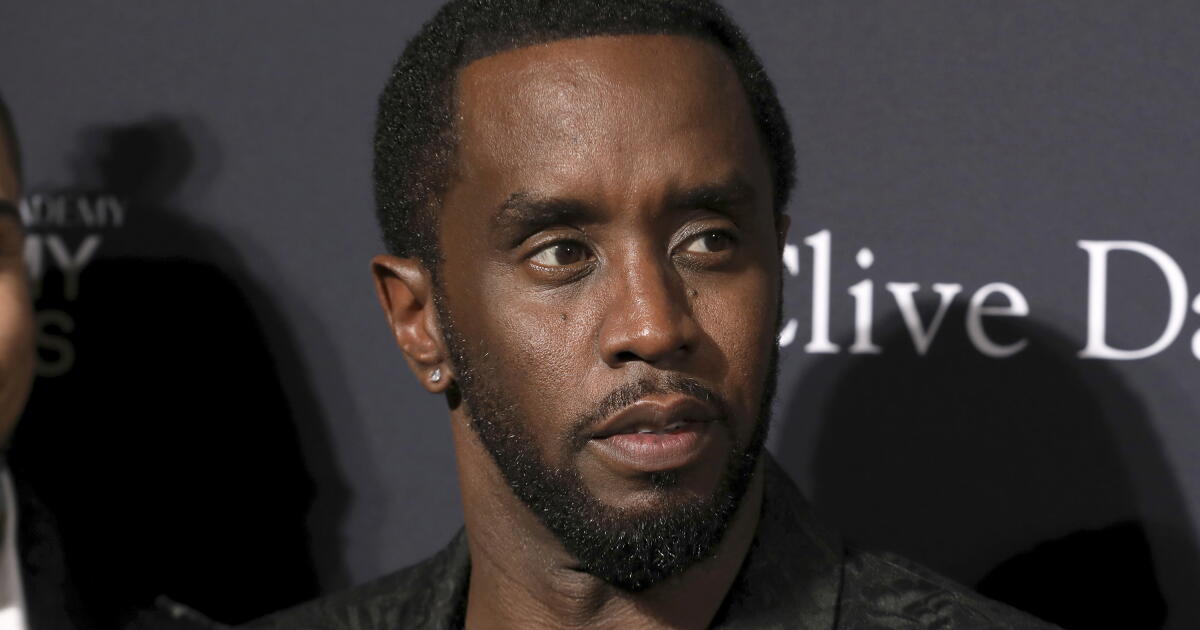
Sean “Diddy” Combs’ release date has been moved up once again, just as reports of his alleged pampered federal prison lifestyle have emerged.
The 56-year-old is scheduled to be released on Jan. 21, 2028, from FCI Fort Dix, a low-security federal prison in New Jersey, according to the Federal Bureau of Prisons inmate database.
The disgraced music mogul was sentenced to 50 months in prison last October after he was convicted of transporting prostitutes across state lines for drug-fueled sex performances known as “freak-offs.”
The initial release date for Combs was projected for June 2028.
Time in the jailhouse for the “Mo Money Mo Problems” rapper has been shortened several times this year. The last update to his sentence occurred this summer, moving his release to late February 2028.
News of his shortened prison stint comes as reports of Combs’ special lifestyle have emerged in a report by NBC News published Tuesday.
According to four inmates — who were granted anonymity by the outlet to speak freely about life inside the prison — Combs has allegedly been paying men to clean and cook special meals for him, including curry chicken, pizza and empanadas, and that the hip-hop artist receives Chinese-style massages.
One man told NBC, “This is not some normal s— you see in jail. This is some rich s—. It looks crazy, but again, it’s Diddy.”
The news outlet also reviewed footage obtained from inside the correctional facility, where Combs appeared to be using a contraband phone, which multiple inmates claim the artist-producer is using to scroll Instagram and view explicit nude content shared by an old girlfriend.
There are also claims that the “I’ll Be Missing You” singer is purchasing an antidepressant drug known as Remeron, or “rem-roms,” from other inmates and that he keeps a secret stash of liquor that was smuggled into the prison by guards.
“Hell yeah, I drank with him,” one of the men told NBC. He recounted drinking Hennessy with Combs.
Sources also allege that individuals outside the prison are depositing thousands of dollars into the commissary accounts of those performing services for the “Bad Boy for Life” rapper.
A spokesperson for Combs responded to the Los Angeles Times’ request for comment.
“The continued scrutiny of every mundane detail of Sean Combs’s life in prison has reached the point where the media characterizes ordinary prison life as news,” the spokesperson said via email. “The only real news is that Sean continues to serve his sentence within the rules and he patiently awaits the court’s decision on his appeal.”
In an emailed statement to The Times, a FCI Fort Dix spokesperson said they cannot comment on the “conditions of confinement for any incarcerated individual,” nor can they “confirm or deny the existence of a corresponding investigation.”
“Like all correctional agencies, contraband, particularly cell phones, narcotics, and weapons, remains a constant challenge, and we continue to tackle the problem of contraband being introduced into our facilities,” the spokesperson said. “Inmates are not permitted to have access to cell phones, and all incarcerated individuals in the Federal Bureau of Prisons (BOP) who are found to violate the ‘Inmate Discipline Program’ policy are subject to sanctions.”
Combs’ legal troubles hit a peak last year after he was involved in a lengthy and public trial involving allegations of sexual assault and other violence. Among the accusers were his former girlfriend Casandra “Cassie” Ventura and producer Rodney “Lil Rod” Jones, who lodged civil complaints against the music tycoon.
In July 2025, Combs was found guilty on two counts of a prostitution-related charge, but the business titan was cleared of racketeering conspiracy and sex trafficking, which carried heavier penalties, including a maximum sentence of life in prison.
Times staff writer Alexandra Del Rosario contributed to this report.
Former Homeland Security Secretary Kristi Noem files for divorce from her husband of 34 years
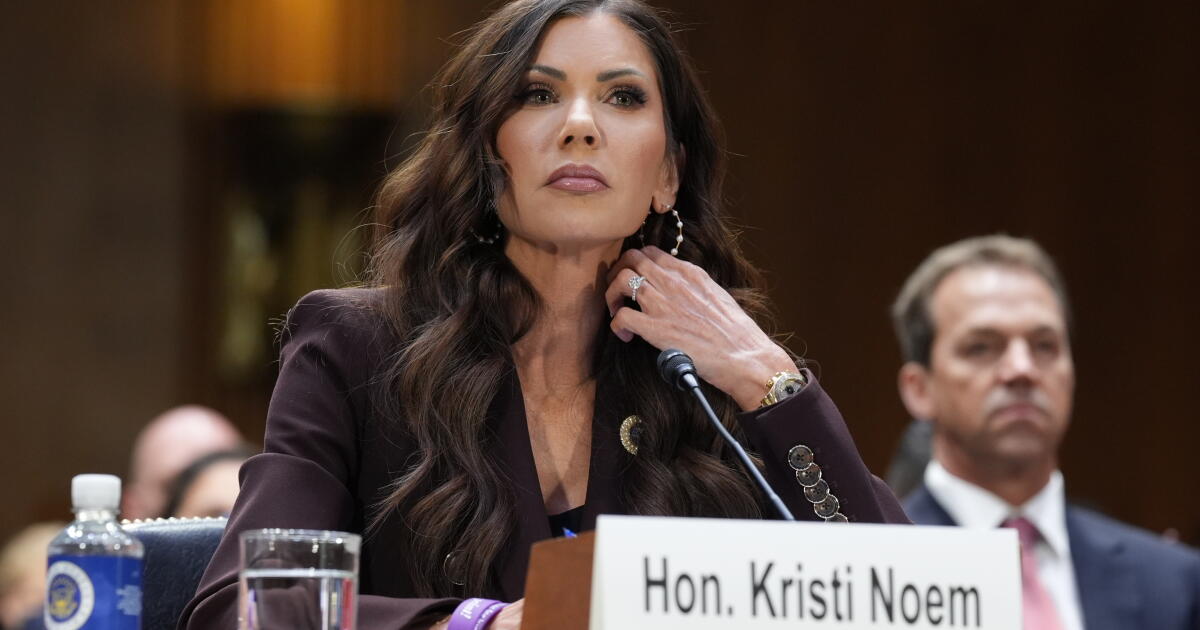
SIOUX FALLS, S.D. — Former Department of Homeland Security Secretary Kristi Noem has filed for divorce from her husband of 34 years.
Noem, who was tasked with leading President Trump’s immigration crackdown from January 2025 to March 2026 and previously served as South Dakota’s governor, is seeking a divorce from Bryon Noem in their home state. The two married in May 1992 and have three children.
The filing, made in April but posted online Monday, comes after questions arose earlier this year about the nature of Kristi Noem’s relationship with a top advisor. The complaint, filed in Hamlin County, notes “irreconcilable differences” as grounds for the divorce.
In a statement, Kristi Noem’s attorney confirmed she has filed for divorce and said she will reserve further comments for the legal process. Lawyers for Bryon Noem did not immediately respond to requests for comment.
A day before Noem was ousted from her post in Trump’s Cabinet, members of Congress questioned her about an alleged extramarital affair with Corey Lewandowski, a special government employee and one of the secretary’s lead advisors. He was Trump’s first campaign manager in 2016 and appeared to play an outsize role in Noem’s department, even though his position was supposed to have a limit on days worked.
Noem denied the allegations that they were having an affair, dismissing them as “tabloid garbage.”
Once a close ally to Trump, Noem became a liability for the Republican president as questions arose over her conduct following the shooting deaths of two protesters in Minneapolis at the hands of immigration officers. Noem characterized Renee Good and Alex Pretti, both U.S. citizens, as aggressors, contradicting videos from the scene and descriptions of their deaths from bystanders. She also faced criticism from fellow Republicans for her spending at her department.
Trump nominated Markwayne Mullin, then a U.S. senator from Oklahoma, in Noem’s place and made her a special envoy for the Shield of the Americas, a new security initiative focused on the Western Hemisphere.
Schoenbaum and Raza write for the Associated Press. Schoenbaum reported from Salt Lake City, Utah.

High school football coaches use USC vs. Oregon incident as a teaching moment
If there’s one positive to come out of the controversial play and video from Saturday’s USC vs. Oregon football game during which Oregon quarterback Dante Moore suffered a concussion after a late hit by USC’s Desman Stephens, it’s that high school football coaches are using it as a teachable moment on how not to react after a player is injured.
Stephens received a one-game suspension from USC after he was seen celebrating when hitting Moore in the head as he gave himself up on a slide to end a running play.
Whittier coach Lorenzo Hernandez said he reminded his players, “You’re always in someone’s lens.”
“You have to be compassionate about someone being injured,” he said.
St. John Bosco coach Jason Negro said there were plenty of lessons to point out to his players.
Negro said in a text, “As mentors, educators, and coaches we are constantly using moments like this to educate our players on how not to be. Football is a small fraternity and regardless of rivalries or spirited competitions we have to respect the health and safety of our opponents. Celebrating in a moment like that is disheartening and would never be tolerated here at Bosco.
“It wasn’t just the Dante Moore situation. It was also the situation from the Texas vs Tennessee game, too, with the unnecessary antics that draw penalties.
“We have to do better in making our kids realize there is a proper way to conduct yourself in an athletic contest. Personal character is revealed in these moments so choose wisely when you plan your actions after you make a good play.”
Trump administration files complaint against judges over media comments | Civil Rights News
Seven Minnesota judges face ethics complaint after speaking publicly about the US president’s immigration crackdown.
Published On 30 Sep 2026
The United States Justice Department has filed a misconduct complaint against seven federal judges in Minnesota who spoke publicly about the pressure their courts came under during President Donald Trump’s immigration crackdown.
The judges spoke to The New York Times this month about dealing with a flood of cases during Operation Metro Surge, an immigration crackdown that led to thousands of arrests in the Minneapolis-St Paul area from December to February.
Recommended Stories
list of 4 itemsend of list
The Justice Department says it crossed an ethical line by talking publicly about the cases.
Attorney General Todd Blanche accused the judges of showing “obvious bias” against the Trump administration and called on them to step aside from any cases involving the Department of Homeland Security (DHS).
“When we have a situation like we have now, where you have a judge, a couple of judges, just not only violating the canons in our view but also showing bias in what they’re saying, we have no choice but to act,” Blanche told reporters.
The judges say they did nothing wrong. A spokesperson for Minnesota’s federal court system said legal experts had found that the judges were “well within the ethical rules” when they spoke to the newspaper.
The complaint is the latest in a series of clashes between the Trump administration and the judiciary, which has blocked some of the president’s policies and, in several cases, accused government lawyers of failing to follow court orders.
One of the judges named in the complaint, Patrick Schiltz, alleged that the government did not comply with nearly 100 court orders related to immigration enforcement in January alone.
In one ruling, he wrote that US Immigration and Customs Enforcement (ICE) “is not a law unto itself”.
Schiltz was nominated by Republican President George W Bush and previously clerked for conservative Supreme Court Justice Antonin Scalia.
He later told The New York Times that what happened in Minnesota’s federal courts during the crackdown “created a grave threat to the rule of law”.
Schiltz also pointed to guidance issued by a federal judicial ethics panel in February, saying that judges can speak publicly about issues such as the rule of law and judicial independence.
“That is exactly what I did,” he said.

Israeli attacks across Gaza kill at least eight | Gaza
Israeli attacks on residential areas across Gaza killed at least eight civilians and wounded others on Wednesday. In Gaza City, an Israeli strike hit a minibus in the Tel al-Hawa area, killing six people and wounding 15 others, according to Palestinian medical officials.
Published On 30 Sep 2026

‘Savvy’ Liam Gallagher made so much money from Oasis reunion tour that he bought his new Cotswolds mansion in CASH
ALONGSIDE his brother Noel, Oasis rocker Liam Gallagher is believed to have earned around £50million from their Live ‘25 Tour.
But rather than spending it on VIP boxes at Manchester City, or a palatial palace and gold-plated bone for his beloved rescue dog Buttons, Liam appears to have plunged part of his cash into a new house.
Paperwork for his pad in the Cotswolds, which he bought with fiancée Debbie Gwyther, revealed the singer paid the £4million bill in cash.
A source said: “Liam and Noel are both savvy and have people advising them when it comes to their earnings.
“The cash they earned from their Live ’25 Tour is just the start of it as, when they finish their second tour next year, they will both be so minted they’d never have to work a day in their lives ever again.”
And as they continue to ride the wave of success — with their 42-date tour next year totally sold out — Noel and Liam are doing everything they can to protect their legacy.
Read more on Liam Gallagher


Yesterday it was confirmed the brothers had taken legal action against an auction house over a proposed sale of old Oasis recordings.
London-based Littleton Auctions had announced they had a huge lot of archive footage — including audio from soundchecks and 100 hours of rehearsal tapes from Oasis’s Nineties heyday.
The lot was taken to them by Owain Richards, whose father Huw worked with the band from 1994 until 2001.
An injunction has now been taken out by Oasis to stop the auction going ahead.
The MD of the company said in a statement: “Littleton Auctions confirms that the Oasis recordings known as The Desk Tapes have been withdrawn from our October 3 auction in light of legal proceedings.
“We are very disappointed that we cannot offer this significant archive as planned.”
When asked about the legal row, Owain said: “It is true that Oasis have sued me and my father, to try to prevent the auction of the tapes made by my father many years ago.
“We have agreed to postpone the auction to enable the legal dispute to be resolved, either by litigation or otherwise in an orderly way.”
Some items have been allowed through, including original set lists and itineraries from Oasis’s early tours, as well as an original Kangol parka coat, and will go under the hammer on Saturday.
JIMI STILL IN RON’S ART
RONNIE WOOD has put his never-before-seen portraits of Jimi Hendrix on display at the late rocker’s home, which has been turned into a museum in London.
Speaking at Handel Hendrix House, where he was given a giant celebratory bouquet of flowers, Ronnie also spilled the beans about the time when he and Jimi were young housemates in London back in the day.
He revealed they both nearly starved because neither of them had a clue how to cook.
Ronnie said: “Food was never an option.
“We had a few peas to shove around the plate.”
But life was certainly interesting.
Ronnie said of Jimi: “He could play the guitar right and left-handed.
“He used to play over the neck, upside down.
“In the end, he ran out of ideas and used to set his guitar on fire.”
Recalling Jimi’s passing in 1970, Ronnie added: “I was at Ronnie Scott’s the night he died.
“He was walking away with his arm around a girl, he said goodbye – and died that night.
“It was such a shock the next day.”
Ronnie also gave an update on The Rolling Stones after their last two planned tours were canned.
He said: “I take it as it comes.
“I don’t like waiting.
“That is why I get a band together, to keep playing.”
You can get along now to Ronnie’s show at Jimi’s old house in Mayfair, which was also once home to composer George Frideric Handel.
It runs until April 11 next year.
BIG NAMES LINE UP FOR MERCURY SHOW
FLORENCE + THE MACHINE, Olivia Dean, Raye, Suede, Pulp and Jade Thirlwall are all confirmed as performers at this year’s Mercury Prize show.
Dove Ellie, Knats, Kojey Radical and Nia Archvies will also take to the stage at the Utilita Arena in Newcastle on October 22.
Each artist will perform one track from their Album Of The Year entry, while fellow nominees Dave and Sir Paul McCartney will be celebrated with two special, short films showcasing their records.
THE BEATLES’ Apple Corps company made a huge £41.1million profit last year.
That’s up £16million on the year before, with surviving members Paul McCartney and Ringo Starr each pocketing millions, as will the estates of John Lennon and George Harrison.
JUST A PERFECT DAZE
DAISY EDGAR-JONES reminds me here of an angelic ornament you’d find in your nan’s garden.
She wore this demure white dress for a garden shoot in Australia to promote her movie Sense And Sensibility, based on the romantic novel by Jane Austen.
As is the trend with actresses now, Daisy has taken a leaf out of Zendaya‘s book and is matching her fashion choices to the film she’s promoting.
And as she steps back in time to play sensible older sister Elinor Dashwood in the new big-screen adaptation of Austen’s 1811 novel, Daisy absolutely nailed the vibe while posing for pictures in Sydney.
But could her stylist have a bit more fun with her fashion? For sure.
BRIT Awards bosses say holding the ceremony in Manchester for the first time gave the city a major boost earlier this year.
A new report says the ceremony contributed £5million in direct spending, with £3.6million coming from visitors and the remaining £1.4million from organisers and partners.
On top of this, employment rates got a helping hand, with 3,099 temporary jobs created.
The report also revealed that 92 per cent of attendees rated their Brits experience as excellent or good – which is helpful, given the bash is going to be held at Co-op Live in the city for the next two years.
Stacey Tang, co-president of RCA Records at Sony Music UK and chair of the Brits Committee, said: “Moving the Brits to Manchester was about more than moving an awards show.
“It’s about shining a light on talent and creative communities across the UK, opening up opportunities and widening participation.”
DESTINY TALKS HIT SETBACK
KELLY ROWLAND has issued a blow to Destiny‘s Child fans after admitting talks of a reunion had stalled.
Appearing on the Table Manners podcast, she said of her bandmates Beyonce and Michelle Williams: “It hasn’t been anything we talked about . . . I was just with the girls, and we had a great time talking, and our children are together.”
Kelly, who is a coach on the next series of The Voice UK, also revealed she’d chosen to go teetotal.
She said: “I just tried to see what a week was like, and then it was like, ‘Oh, I’ve gotten to two weeks.’
“Next time I knew it was like six months and I hadn’t had a drink, and I was like, ‘Oh, I like this feeling. It works.’”
R.E.M. are re- releasing their 12th studio album Reveal to celebrate its 25th anniversary.
The reissue – out November 20 – will be put out alongside The Black Sessions Revealed, a previously unreleased 17-song performance by R.E.M., recorded for Radio France in 2001.
THE house where Taylor Swift recorded her 2014 No1 album 1989 has gone up for sale.
The Pillsbury Estate in Beverly Hills, which was her home for seven years until 2018, has become a mecca for fans.
It is now on the market for $7.9million.
GRAND PLANS
FREDDIE Mercury’s grand piano is going under the hammer today – and could fetch up to £400,000.
Before the auction began, the late Queen frontman’s godson, Freddie Mack, opened up about his favourite memories of his namesake.
In an exclusive chat, he said: “He came to my family home in Munich, and there was this big rocking horse.
“It was very fancy and I was kind of scared of it.
“He just waited with me then guided me to befriend this new toy.
“He put me on it and rocked me back on forth and showed me that this is a nice gift, nothing to be scared of.
“He just took his time to be there for me.”
The piano is up for sale at Propstore’s Music Memorabilia auction, alongside other big-ticket collectors’ pieces.
These include Michael Jackson‘s black and gold military-style jacket, which could fetch up to £500,000.
Or if you fancy John Lennon’s tinted glasses, they could cost you £200,000.
WAYNE’S TROPHY FOR ROB
WAYNE ROONEY has told Robbie Williams he wants the singer to take back the Brit Award Rob gave him more than a decade ago.
Angels star Robbie had sent his trophy to Wayne to cheer him up after learning the footie ace had broken his foot.
But Rob recently admitted he was under the influence when he told his manager to give it away.
Appearing on Absolute Radio, Wayne said: “I went to Knebworth to see Robbie and after I broke my foot, when I got home he’d sent me his Brit Award for Angels to somehow help me get my foot better.
“I’ve now offered to give it back.
“I’ve seen the documentary with his daughter talking about Angels and what it meant, so I’ve now been in touch and said, ‘Listen, take it back for your daughter,’ and he’s said to me, ‘No, I gave it to you,’ so I still have it.”
Pop it in the post, Wazza – you’ll make Robbie’s day.
Hegseth confirms U.S. military will cut 20% of generals and admirals
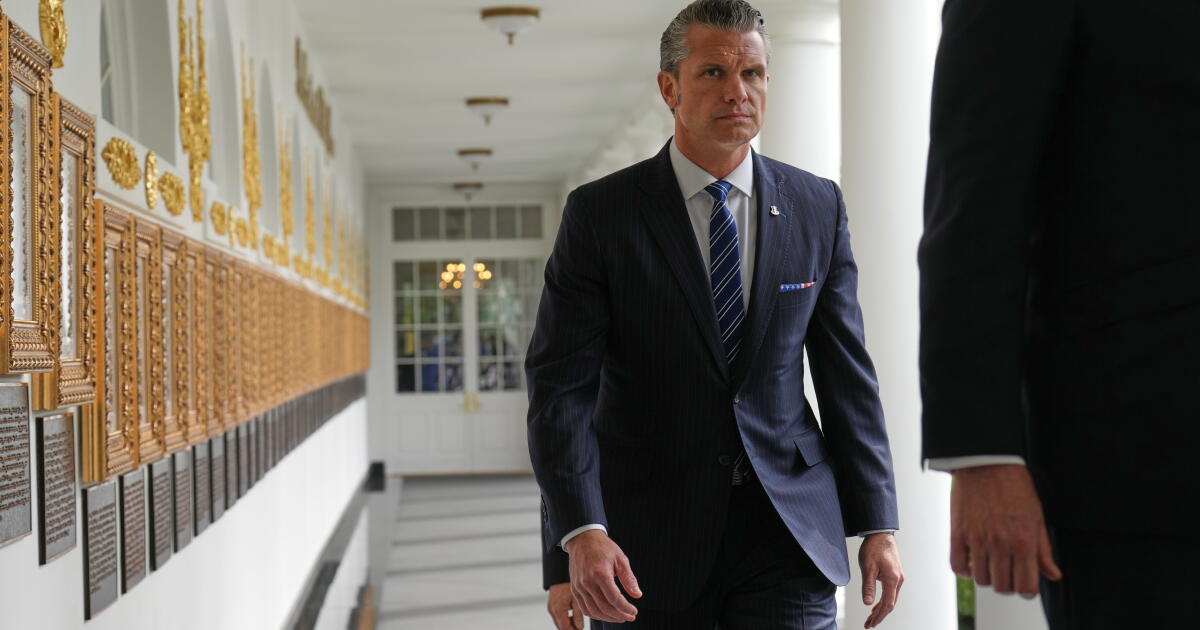
QUANTICO, Va. — Defense Secretary Pete Hegseth confirmed Wednesday that the U.S. military will cut 20% of its generals and admirals as he delivered what he is calling his “State of the Force” address.
Hegseth was speaking to junior officers and enlisted leaders at the Marine Corps Base Quantico in Virginia, the second year in a row that he has given such an address. This time, the U.S. military is seven months into a war with Iran with no clear end in sight, has captured Venezuelan leader Nicolás Maduro and killed more than 200 people in strikes on alleged drug trafficking boats in Latin America, among other actions worldwide.
The speech is not a usual fixture among Pentagon leaders. While Hegseth’s predecessors regularly addressed troops and top officers, they traditionally have done so in small or private settings.
The Pentagon chief, however, again focused on how he has drastically retooled the U.S. military by targeting what he calls “woke” culture — through a rollback of diversity programs, a review of ground combat units with female troops and a new screening program for “testosterone deficiency” among male personnel.
Pentagon officials had previewed that Hegseth would announce more cuts to the number of generals and admirals. He directed all military services to double the 10% reduction he ordered last spring for roughly 800 flag and general officer positions, making it a total 20% decrease to be completed by Jan. 1.
“I call it accountability and long overdue,” he said.
Several senators viewed Hegseth’s move as nothing short of a “purge” of the military’s top ranks that will take years to rebuild.
“He’s got some kind of like deep-seated grievance about leadership in the military,” said Sen. Mark Kelly, D-Ariz., the former Navy combat pilot and NASA astronaut, who has been critical of Hegseth. “He’s purging a generation of great leaders of the military, and it’s going to take a generation to recover from it.”
Republican Sen. Mike Rounds of South Dakota, a member of the Senate Armed Services Committee, said he wanted to understand Hegseth’s reasoning behind the decision.
“If it’s simply a matter of eliminating a very heavy top, there may be some validity to it, but I want to see it first,” Rounds said.
Hegseth and President Trump already have fired or pushed to retire more than two dozen military leaders since taking office, including the Army’s top uniformed officer, Gen. Randy George, a move that angered both Republicans and Democrats in Congress. The purge also has included a number of senior officers who are women or people of color.
Previous leaders who were ousted include Joint Chiefs Chairman Gen. CQ Brown; Chief of Naval Operations Lisa Franchetti; and Vice Adm. Shoshana Chatfield, the U.S. military representative to the NATO Military Committee.
Although Hegseth never gave specific reasons for those firings, most were tied to the belief that they endorsed or spoke openly in support of diversity, equity and inclusion programs, which have been targets of Hegseth and Trump.
As part of last year’s cuts, Hegseth also ordered the active duty military to shed 20% of its four-star general officers — the highest-level leaders — and the National Guard to shed 20% of its top positions, but it is unclear if all those cuts have been made. The new cuts could include any one-star general or above, or an officer of equivalent Navy rank.
When Hegseth first announced the effort to trim the highest levels of the military ranks, he argued it was intended to remove “redundant force structure to optimize and streamline leadership.” In a memo released in May 2025, he said the aim was to free the military from “unnecessary bureaucratic layers.”
The number of general officer positions in the military is set by law, but it is possible to let positions remain unfilled by not submitting replacements to Congress.
Hegseth’s efforts have extended well beyond personnel changes among the top ranks. He oversaw Trump’s ban on transgender troops while announcing new directives for “gender-neutral” or “male-level” standards for physical fitness.
Toropin and Finley write for the Associated Press. AP writers Lisa Mascaro and Meg Kinnard contributed to this report.

The Sports Report: Who’s ready (or not) on the Dodgers?
Who’s ready (or not) for the Dodgers?
From Maddie Lee: Dodgers right fielder Kyle Tucker has never shied away from just how bad his performance at the plate was for much of his first season in Los Angeles.
For the first five months of the season, when he’d show brief glimpses of progress before sinking back into an extended slump, Tucker’s .683 OPS was the third-worst among Dodgers hitters with at least 100 plate appearances, better than only Hyeseong Kim and Kyle Freeland, who both spent time in triple A.
In September, however, he found a sustainable adjustment. He fixed his bat path, extending through the ball more consistently instead of pulling off of it. He posted a .889 OPS in September, on par with his four straight All-Star seasons before signing with the Dodgers.
Now, all of a sudden, he looks like a potential difference-maker in the postseason.
“The last month or so is more or less what I expect out of myself,” Tucker said in a recent conversation with The Times. “The biggest thing is we have an opportunity now being in the playoffs to win another World Series. Once the playoffs start, you can forget about any stats or personal numbers. The only one that really matters is the win column. So that’s just what I’m gonna try and contribute towards.”
Here’s how some other key players are trending going into the postseason:
The Dodgers have an old roster. But that isn’t necessarily a drawback in October
Much competition to make Lakers’ roster
From Thuc Nhi Nguyen: Walker Kessler wasn’t focused on the stats. He wasn’t really counting the number of shots he swatted — “one or two” — or lobs he dunked — “like four probably” — in his official Lakers practice debut Tuesday.
The only thing the star center cared about was the competition on the court. He and his teammates delivered on that, Kessler said with a smile.
The Lakers opened training camp Tuesday with a focus on competition as the new-look team takes shape. Six of the team’s top nine players from last season are gone. A month’s worth of practices and five preseason games are the stage as players audition to fill the vacant roles.
“This is a meritocracy,” coach JJ Redick said. “You got to earn your minutes, and you cheer for your teammates while you’re doing it.”
Redick can confidently lock in three starters in Luka Doncic, Austin Reaves and Kessler. The other two starting positions, and even the last spots on the roster as the Lakers need to trim at least one player to reach the NBA-maximum of 15 guaranteed contracts by the Oct. 21 season opener, remain up for grabs.
Swanson: Lakers paid Austin Reaves to be a star. Now they need him to prove his durability
Olympic torch relay to start in Atlanta
From Thuc Nhi Nguyen: She became an Olympic champion in Seoul. Janet Evans then won her fourth gold medal in Barcelona. But the star swimmer’s greatest Olympic moment came outside of a pool in Atlanta.
LA28 announced Tuesday it will begin the U.S. portion of the 2028 Olympic torch relay in Atlanta in a return to the city that hosted the United States’ last Summer Games and provided the Olympic movement with one of its most iconic torch relay moments. The city where Evans passed the Olympic flame to Muhammad Ali changed the swimming champion’s view on the Games and fueled her desire to bring the torch back as LA28 hopes to write an equally influential chapter of Olympic history.
“I realized when I carried that torch that the flame represents so much more than medals,” said Evans, now LA28’s chief athlete officer. “It certainly represents victory and all those attributes about the Olympics. But it also brings people together, and it’s a symbol of hope and what the Olympic movement really does for everyone.”
MLB postseason schedule
National League
No. 3 Atlanta vs. No. 6 Philadelphia
at Atlanta 5, Philadelphia 3 (box score)
Wednesday at Atlanta, 11 a.m., NBC/Peacock
*Thursday at Atlanta, 11 a.m., NBC/Peacock
No. 4 San Diego vs. No. 5 Chicago
at San Diego 8, Chicago 0 (box score)
Wednesday at San Diego, 7 p.m., Peacock/NBCSN
*Thursday at San Diego, 7 p.m., Peacock/NBCSN
American League
No. 3 Houston vs. No. 6 Chicago
Chicago 6, at Houston 3 (box score)
Wednesday, 2 p.m., Peacock/NBCSN
*Thursday, 2 p.m., Peacock/NBCSN
No. 4 New York vs. No. 5 Boston
at New York 9, Boston 0 (box score)
Wednesday, 5 p.m., NBC/Peacock
*Thursday, 5 p.m., NBC/Peacock
*-if necessary
Note: NLDS and ALDS start Saturday.
NLCS starts Sunday, Oct. 11
ALCS starts Monday, Oct. 12
World Series starts Friday, Oct. 23
This day in sports history
1939 — Fordham participates in the world’s first televised American football game. In front of the sport’s first live TV audience, the Rams defeats Waynesburg College, 34-7.
1984 — The Rams set an NFL record with three safeties in a 33-12 victory over the New York Giants. Two of the safeties are on blocked punts in the end zone.
1995 — Prairie View A&M sets the college football record for consecutive losses with a 64-0 loss to Grambling State. It is the team’s 51st straight defeat, an NCAA record for any level.
2007 — Osi Umenyiora has six of the New York Giants’ NFL record-tying 12 sacks in a 16-3 victory over Philadelphia.
2007 — Detroit scores an NFL-record, 34 points in the fourth quarter of a 37-27 victory over Chicago. The Lions combine with Bears for 48 points — also a league record.
2007 — Brett Favre passes Dan Marino to become the NFL leader in career touchdown passes, throwing Nos. 421 and 422 in Green Bay’s 23-16 victory over Minnesota.
2007 — Germany defeats Brazil 2-0 in the final of the FIFA Women’s World Cup held in Shanghai, China.
2012 — New England beats Buffalo 52-28 to become the first team since the 1950 New York Giants (48 points) to score at least 45 second-half points in a game in which it trailed at halftime (14-7). The Patriots become the second team in NFL history with a 300-yard passer (Tom Brady, 340 yards), two 100-yard rushers (Brandon Bolden, 137 and Steven Ridley, 106) and two 100-yard receivers (Wes Welker, 129 and Rob Gronkowski, 104). The only other team to accomplish the feat was the 2008 Packers.
2015 — The 9th U.S. Circuit Court of Appeals agrees that the NCAA’s use of college athletes’ names, images and likenesses in video games and TV broadcasts violate antitrust laws but strikes down a plan to allow schools to pay players up to $5,000.
2017 — Troy’s defense forces four turnovers and the surging Trojans upset No. 25 LSU 24-21. Troy is the first team from outside the Southeastern Conference to win in LSU’s Death Valley since UAB in 2000.
2018 — The Ryder Cup is won by Europe 17½-10½ at Le Golf National in Saint-Quentin-En-Yvelines, France. The home team secures the victory when Phil Mickelson knocks one in the water at the par-3 16th hole, conceding his match to Francesco Molinari right on the tee box. Molinari becomes the first European player to go 5-0 in the competition since the current format was adapted in 1979. Tiger Woods loses all four of his matches, capped by a 2-and-1 loss to 23-year-old Jon Rahm of Spain, the youngest player in the event.
2018 — Brittney Griner scores 15 points to help the United States beat Australia 73-56 and win the FIBA Women’s Basketball World Cup.
Compiled by the Associated Press
This day in baseball history
1904 — Doc White of the Chicago White Sox pitched his fifth shutout in eighteen days, a 4-0 win over the New York Yankees.
1915 — The Boston Red Sox clinched the American League pennant when St. Louis beat Detroit 8-2, giving Boston a 2 1/2-game margin.
1916 — New York’s Rube Benton pitched a 4-0 one-hitter over the Boston Braves to give the Giants their record 26th straight win in the first game of a doubleheader.
1927 — Babe Ruth hit his 60th home run of the season in the eighth inning off Tom Zachary to lead the New York Yankees to a 4-2 victory over the Washington Senators.
1934 — Dizzy Dean beat the Cincinnati Reds, 9-0, for his 30th victory of the year as the St. Louis Cardinals clinched the NL pennant.
1934 — New York’s Babe Ruth played his final game as a Yankee, going 0 for 3 with a walk, in a 5-3 loss to the Washington Senators at Griffith Stadium.
1945 — Hank Greenberg’s grand slam in the top of the ninth inning gave the Detroit Tigers a 6-3 win over the St. Louis Browns and the American League pennant on the last day of the season.
1947 — In the first televised World Series, the New York Yankees beat the Brooklyn Dodgers, 5-3, in the opening game.
1951 — Jackie Robinson homered in the 14th inning to give the Brooklyn Dodgers a 9-8 victory over the Philadelphia Phillies, tying the New York Giants for first place in the National League and forcing a playoff.
1962 — Willie Mays homered to give the San Francisco Giants a 2-1 victory over the Houston Colt 45s in the season’s final day. That, coupled with the Dodgers’ 1-0 loss to the St. Louis Cardinals, forced a playoff for the NL pennant.
1972 — Roberto Clemente doubled off Jon Matlack during Pittsburgh’s 5-0 victory over the New York Mets. The hit was the 3,000th and last for the Pirates star, who was killed in a plane crash during the offseason.
1984 — Mike Witt of the Angels tossed 97 pitches in a perfect game against the Texas Rangers, winning 1-0.
1988 — Dave Stieb of the Toronto Blue Jays lost a no-hit bid with two out in the ninth for the second consecutive start and finished with a 4-0 one-hitter over the Baltimore Orioles.
1992 — George Brett became the 18th player to get 3,000 hits in the Kansas City Royals’ 4-0 win over the Angels at Anaheim. Brett went 4-for-5 and got the milestone with a single in the seventh off rookie reliever Tim Fortugno.
2007 — The New York Mets missed the playoffs when Tom Glavine was tagged for seven runs during the first inning of a season-ending 8-1 loss to Florida. No major league team had owned a lead of seven games or more with 17 to play and failed to finish in first place. New York, which had that margin on Sept. 12, matched the largest lead blown in September.
2014 — The Kansas City Royals overcame a 7-3 lead to force extra innings and outlasted Oakland 9-8 in 12 innings in the AL wild-card playoff. This was the first wild-card game to go extra innings.
2017 — Detroit’s Andrew Romine became the fifth player in baseball history to play all nine positions in one game, helping the Tigers to a 3-2 win over Minnesota.
2022 — Pinch-hitting for Luis Torrens with two out in the 9th, Cal Raleigh blasts a 406-foot homer against Domingo Acevedo to give Seattle a 2-1 win over Oakland and clinch a postseason spot for the first time since 2001, the longest active drought in the majors.
Compiled by the Associated Press
Until next time…
That concludes today’s newsletter. If you have any feedback, ideas for improvement or things you’d like to see, email me at houston.mitchell@latimes.com. To get this newsletter in your inbox, click here.
US judge rules Wisconsin mosque leader Salah Sarsour can be deported | Civil Rights News
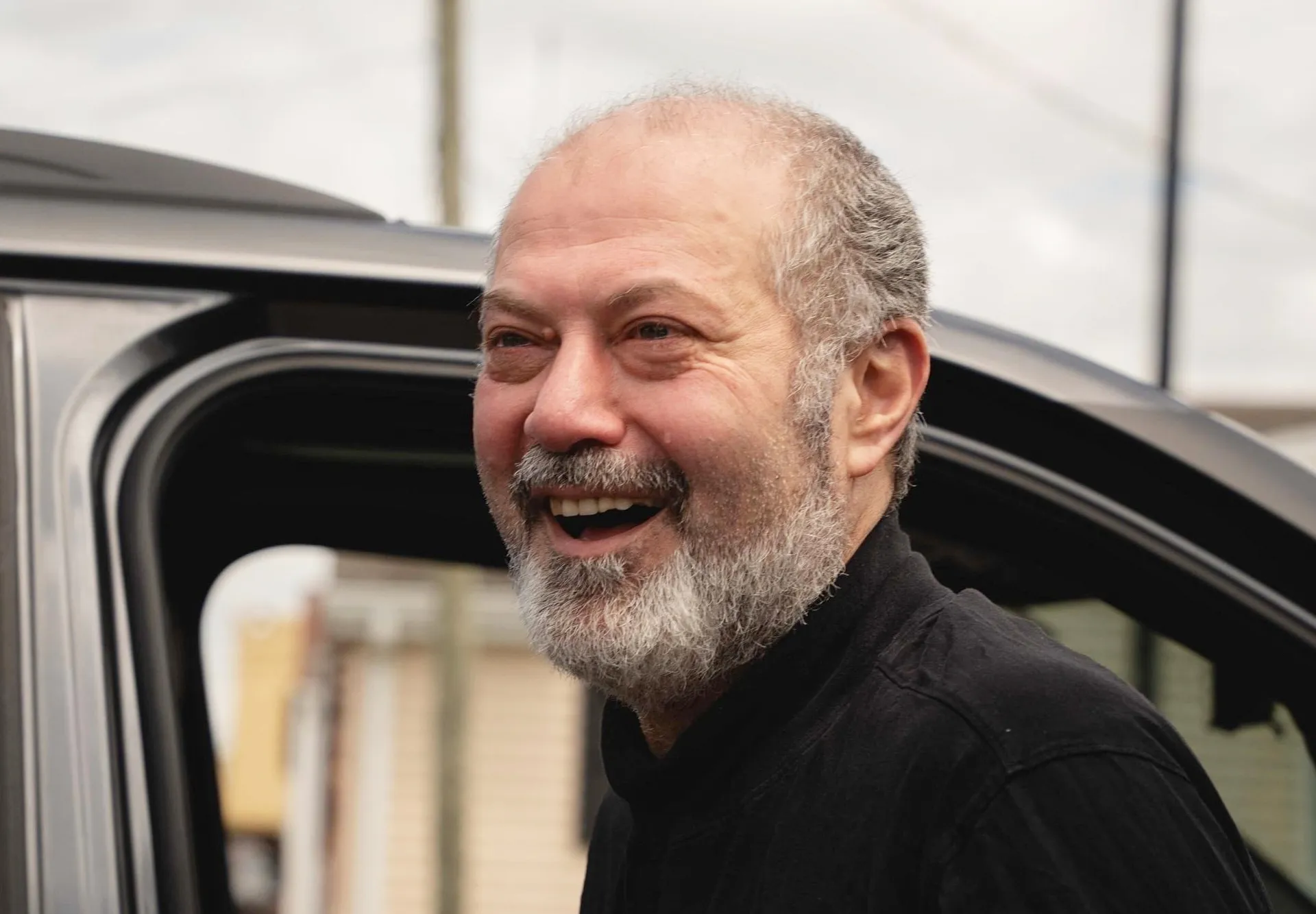
A United States immigration judge has ruled the leader of Wisconsin’s largest mosque can be deported under a controversial law that United States President Donald Trump’s administration has used against non-citizens advocating for Palestinian rights.
Judge Jayme Salinardi ruled on Wednesday that Palestinian-born Salah Sarsour, president of the Islamic Society of Milwaukee, can be removed from the US based in part on a memo by Secretary of State Marco Rubio that “his actions undermine US foreign policy to combat antisemitism around the world”, according to his lawyers.
Recommended Stories
list of 4 itemsend of list
Sarsour, who has lived in the US for more than three decades, called the ruling “deeply disappointing”.
“I will continue fighting to defend the right to free speech and to stay in the country I have called home for more than three decades,” he told The Associated Press news agency.
His lawyer, Patrick Taurel, strongly rejected the decision.
“I wish the world could see the evidence that we presented and hear the testimony that the court heard because the case we presented compels only one conclusion, which is that Salah is not deportable,” Taurel told reporters on Wednesday.
“He’s done nothing wrong. He should be given back his green card, frankly, with an apology for what’s being done to him.”
The ruling does not mean Sarsour will be immediately deported.
His lawyers have 60 days to argue that sending Sarsour back would put him at risk of torture, which could protect him from deportation under the Convention Against Torture. If they lose, they plan to appeal. Taurel said he can’t be deported while that appeal is pending and will remain in the US for the “foreseeable future”.
‘Extreme deference’
Sarsour was detained by Immigration and Customs Enforcement (ICE) officers in Milwaukee in March, nine months after Rubio issued a memo declaring him deportable on foreign policy grounds.
The June 2025 memo invoked a rarely-used US law that allows the Secretary of State to seek the deportation of non-citizens whose presence could have “potentially serious adverse foreign policy consequences.” The administration has used the same provision against pro-Palestinian activists Mahmoud Khalil and Mohsen Mahdawi.
Sarsour’s lawyers criticised the “extreme deference” Salinardi gave to Rubio’s memo. But Taurel said the judge believed his hands were tied by an earlier ruling in Khalil’s case, which found that a letter from the Secretary of State could be enough to make someone deportable on foreign policy grounds.
That meant Salinardi could not look behind Rubio’s decision to examine the evidence supporting it, Taurel said.
“If the Secretary of State says the person is deportable, it is game over,” he told reporters Wednesday.
The government did not win on all of its arguments.
Salinardi rejected its allegation that Sarsour had lied on his green card application. Taurel said the judge also rejected an allegation that Sarsour had falsely claimed to be a US citizen in order to vote.
Al Jazeera reached out to the State Department and the Department of Homeland Security but did not receive responses by the time of publication.
Decades-old convictions
Sarsour is separately fighting the Trump administration in federal court over his detention while his deportation case is ongoing.
A federal judge ordered his release from ICE custody in June after 81 days, questioning why decades-old convictions that US authorities had long known about suddenly justified detaining him. The judge found there was a “substantial” case that the government was retaliating against him for speaking out about Palestinian rights.
The Trump administration has appealed his release, arguing that Sarsour’s convictions in Israel make him a security threat. He was imprisoned in 1988 after confessing to throwing stones and a Molotov cocktail at Israeli military personnel, and was convicted again in 1995 over an attempt to hold weapons.
Sarsour denies the offences, and his lawyers say the confessions were forced through torture. His former lawyer, Jawad Boulos, testified in August that Sarsour was coerced into signing confessions and was not convicted of an offence tying him to a “terrorist” organisation.
Taurel criticised Salinardi for giving what he called “extreme deference” to Israeli government records submitted by ICE, which Sarsour’s lawyers argue were incomplete and relied on confessions obtained through torture.
“A great deal of evidence we presented was ignored,” Taurel said.
The evidence challenged Israel’s military court system, where he said secret evidence can be used and Palestinians can be denied access to lawyers for extended periods.
Luna Droubi, an attorney representing Sarsour, said the case raises broader questions about whether immigrants can speak freely on political issues without fear of being targeted by the government.
“Why raise these arrests now?” she said. “Do I have the right to speak out about issues that matter to me? What if I draw a political cartoon? Am I going to be arrested and detained because of that?”
‘The end of my life’
Sarsour said being deported to the occupied West Bank “means the end of my life”.
His lawyers argue his prior treatment in Israeli custody shows he could face torture if sent back. Taurel said Sarsour’s former lawyer testified that his case stood out because Sarsour told him that Shin Bet, Israel’s internal security agency, had taken him to hospital while in custody.
The judge also named Jordan as a possible destination. Sarsour travelled to the US on a Jordanian-issued document, but his lawyers say he is not a Jordanian citizen and has no right to live there. They believe he could ultimately be returned to the West Bank and Israeli custody if sent to Jordan.

F-15EX May Finally Get Missile Warning System The USAF Originally Skimped On Buying
The U.S. Air Force is looking at adding a missile warning system (MWS) to its new F-15EX Eagle II fighters. This will give the aircraft a way to optically detect incoming missile threats, especially passively guided ones like heat-seeking infrared-guided missiles, which they currently lack. The continued absence of an MWS has become more pronounced in light of recent combat experiences over Iran.
The F-15EX is derived from earlier F-15 variants that all have MWSs, and it had seemed logical to expect the Eagle II would feature this capability. So it was puzzling when the first examples rolled out without such a system, and no apparent plans to install one on a jet already costing upwards of $100 million. The omission has been glaring for years now, especially given that the aircraft has all the provisions for such a system, including blanked-over spots for the sensors.

The Air Force has 22 Eagle IIs in inventory now and currently plans to acquire a total fleet of 267 of the jets. The aircraft’s manufacturer, Boeing, is on contract now to build 120 F-15EXs, including a lot of 22 jets through a new $2.38 billion deal also announced yesterday.
Now, the Air Force Life Cycle Management Center’s (AFLCMC) Fighters & Advanced Aircraft Directorate “is seeking sources for the procurement of an operationally qualified threat missile launch and approach warning system for rapid integration into the United States Air Force (USAF) F-15EX Eagle II fighter aircraft,” per a contracting notice put out yesterday. “The MWS must alert the F-15EX aircrew to the presence of missiles that may threaten the aircraft without unreasonably distracting the aircrew with false alarms.”
As mentioned, the F-15EX is already configured to accommodate an MWS, inside and out, something AFLCMC’s notice emphasizes. This is a result of the Eagle II having been directly derived from the F-15QA variant for Qatar, which itself was an outgrowth of the F-15SA for Saudi Arabia. While many of the F-15EX’s advances come from these aircraft, the first F-15 variant to get an MWS was actually Singapore’s F-15SG. The Advanced Eagle line and the F-15SG are part of Boeing’s extended F-15E Strike Eagle family.

“The MWS must use the six (6) pre-existing F-15EX sensor locations, data cables, power cables, and cooling,” the contracting notice says. “It must be easily, safely, rapidly, and organically installable and removable in the field by USAF military aircraft maintenance personnel without requiring any change to aircraft configuration beyond installation of MWS line replaceable units (LRUs) in the six (6) pre-existing locations in the aircraft dedicated for missile warning.”
Those most visually prominent of those pre-existing sensor locations are two horn-like sponsons, one on each side of the forward fuselage right below the cockpit canopy. There are two more locations at the ends of the jet’s tail booms. The last two locations are situated so additional sensors can face straight up and down to provide total 360-degree coverage.


The sources sought notice does not mention any specific MWS and invites prospective vendors to submit proposals. It also stresses that the Air Force is still in the “market research” phase of the contracting process and that it “does not constitute [a] solicitation and shall not be construed as a commitment” to buy such a system.
The F-15SA uses the AN/AAR-57 Common Missile Warning System (CMWS), and this system is understood to also be found on the F-15QA. Beyond F-15 variants, versions of the AN/AAR-57, for which BAE Systems is currently the prime contractor, are fielded today on a wide variety of other fixed-wing aircraft and helicopters, including various types in U.S. military service. CMWS variants are notably found across the U.S. Army’s AH-64, UH-60, and CH-47 helicopter fleets.


All versions of the CMWS consist of several electro-optic missile sensors (EOMS), the number of which varies from platform to platform, linked to a central electronic control unit (ECU). The system is also designed to be integrated into larger defensive suites.

While the AN/AAR-57 is a proven system with years of successful integration on the F-15 and other platforms, it is just one option of the open market today. The Air Force could choose to take another route, possibly with a new system that offers added functionality.
The addition of any MWS will give the F-15EX a valuable, if not increasingly critical, boost in defensive capability. The Eagle II does already have an extremely powerful self-protection suite, including the Eagle Passive/Active Warning Survivability System (EPAWSS). However, it is heavily geared toward defending against radar-based threats that pump out signals that can be detected and jammed. Infrared-homing anti-air missiles zero in on their targets passively.

Eagle Passive Active Warning Survivability System (EPAWSS) l BAE Systems
In general, MWSs also typically make use of passive infrared sensors to spot the heat plumes of missile launches and the thermal signatures of those threats as they continue their approach. BAE Systems says current-generation versions of the AN/AAR-57 are sensitive enough to detect infantry anti-armor rockets being launched, as well as small arms fire from the ground, under the right circumstances. Though an MWS is not an active countermeasure unto itself, the early warning it provides gives critical time to deploy flares or employ other defensive capabilities, or just take evasive action.
TWZ touched on all of this last month after The New York Times reported new details about the shootdown of an F-15E Strike Eagle over Iran in April. A shoulder-fired, heat-seeking surface-to-air missile, also known as a man-portable air defense system (MANPADS), is said to have been responsible, thought his remains unconfirmed. The Strike Eagle also lacks an MWS. The Times‘ story said that the F-15E’s defensive suite provided the crew with only half a second of warning. As we noted at the time, it would actually have provided no warning given that the Strike Eagle also lacks an MWS.

Even before the current conflict with Iran broke out, TWZ had questioned the F-15EX’s lack of this capability given the general focus on increased survivability to match expanding threat ecosystems globally. EPAWSS is already a reflection of that reality, and could be made even more capable when tied together with an MWS. In May, we had reached out to the Air Force about any plans to integrate an MWS onto the F-15EX in light of observations from the ongoing conflict with Iran. The service told us then that it had no details to share. Whether the service now has any plans to add MWSs to the Strike Eagle fleet, which would require more significant integration work, is also unknown.
Infrared homing anti-air missiles, as well as air defense systems that use passive infrared sensors for target detection and cueing, are certainly not threats limited to Iran. In Yemen, Iranian-backed Houthi militants have been making good use of these capabilities for years now, something else we have explored in great detail in the past. The Houthis claimed to have downed a Saudi Arabian F-15 just earlier this month and, per a now-long standing modus operandi, subsequently released video captured through a ground-based forward-looking infrared (FLIR) system as evidence. The group also shared images of the wreckage of what looked to be an F-15SA Advanced Eagle, underscoring the dangers posed even to aircraft equipped MWSs.
These threats are not limited to the Middle East more broadly, either, and are only increasingly likely to be encountered in future conflicts globally. The emergence of ever-more capable and longer-range anti-air missiles with infrared or dual-mode guidance systems is a significant factor in all this. Expanding use of passive infrared search and track (IRST) systems on aircraft and infrared sensors on ground-based air defense systems are part of this larger equation, as well.
How the Air Force ultimately decided to proceed with the integration of an MWS onto the F-15EX fleet remains to be seen. However, the Eagle II’s lack of this capability is only becoming more striking, especially in light of the conflict with Iran.
Contact the author: joe@twz.com

Hispanic Heritage Awards ditch Kennedy Center for Minneapolis; Los Tigres Del Norte present
The 39th annual Hispanic Heritage Awards — which will honor the contributions and accomplishments of Latinos in the U.S. and Latin America — will air nationwide Friday on PBS.
In a historic decision by the Hispanic Heritage Foundation, which presents the annual awards, the event departed from its home base of Washington. Instead, Latino luminaries gathered at the Orchestra Hall in Minneapolis, where the celebratory occasion was taped for broadcast Sept. 10.
The move to the Midwest was a timely decision for members of the Hispanic Heritage Foundation, a nonprofit organization established by the White House in 1988. They took into consideration Minnesota’s response to a large-scale immigration enforcement campaign that began in December, known as “Operation Metro Surge.”
“We went to Minneapolis because we wanted to recognize what’s great about our community, [our] courage, resilience, strength, unity and looking out for each other,” said Antonio Tijerino, president and CEO of the Hispanic Heritage Foundation, in a phone call with De Los.
The Department of Homeland Security called the undertaking the “largest DHS operation ever” earlier this year on X, with an estimated 2,000 agents deployed to the Minneapolis–St. Paul metropolitan area. Thousands of Minnesota residents rallied against the tactical and militant methods used by Immigration and Customs Enforcement agents.
Civil unrest hit a boiling point following the killings of Renée Good and Alex Pretti on Jan. 7 and 24, respectively, by federal agents.
“ We actually went with a delegation of national Latino leaders to offer our support of the community during this crisis and we were overwhelmed by the heroism,” said Tijerino, who recalled a group visit to Minneapolis in February. There, he and his colleagues learned more about the rapid response efforts underway in the city.
“It was an American story that we wanted to tell,” he added.
At the 39th ceremony, Los Tigres del Norte presented a bit of that story to the people of Minnesota — who were collectively honored with the Humanitarian Award.
“Peaceful, hard-working communities of immigrants and refugees found themselves in fearful chaos as more than 4,000 parents, grandparents, neighbors, friends and families were taken by force, U.S. citizens among them,” Los Tigres del Norte announced in English while presenting the award. The players closed the show with a rendition of their 1984 song “Jaula de Oro,” which speaks to the plight of the undocumented community.
“I think Minnesota [is] a reflection of all of our Latino communities across the nation,” said Henry Jiménez, president and CEO of Propel Nonprofits, who was one of the individuals on stage representing the people of Minnesota.
“It uplifted the people. I think people felt validated for all of their hard work and effort that they’ve had to endure, not just the last couple months, but really a lifetime of work,” said Jiménez, whose organization helps consult and raise funds for budding nonprofits.
The relocation of the Hispanic Heritage Awards also comes as D.C. deals with the temporary closure of the John F. Kennedy Center for the Performing Arts — which hosted the Hispanic Heritage Awards in years prior.
The Kennedy Center closed its doors indefinitely on Sept. 15 after an inspection found acute public safety concerns, among them roofing issues. In a letter to Congress, various former employees allege that leadership was aware of the issues but halted plans for repair in April.
The closing also comes after a federal judge blocked the board’s decision to include President Trump’s name on the building in September. Trump’s takeover of the Kennedy Center began in February 2025, when he dismissed half its board members and installed himself as chairman.
“We were [at the Kennedy Center] for a very long time. It brought a lot of prestige and to fill a historic venue like that with Latinos was wonderful,” said Tijerino. “After many years of being at the Kennedy Center, we decided we wanted to go to another venue.”
In April 2025, the Hispanic Heritage Foundation announced that it would host its 38th annual awards at the Warner Theater instead; previous versions of the ceremony have also taken place at the historic Warner Theater venue, including in 2015 for the 28th Annual Awards and 2017 for the 30th celebration.
Hosted by comedian Anjelah Johnson-Reyes, the other honorees of the 39th Hispanic Heritage Awards included Venezuelan artist Oscar D’León, the salsa singer behind notable hits such as “Llorarás” and “Me Voy Pa’ Cali,” who received the Legend Award for his lifelong contributions to the genre.
Chilean singer-songwriter Mon Laferte, the vocal powerhouse behind power ballads like “Tu Falta de Querer” and “Amárrame (feat. Juanes),” also received the Social Justice Award. The Latin Grammy-winning artist has long championed feminist causes and challenged sexual harassment in the entertainment industry — a topic central to her 2024 Netflix documentary, “Mon Laferte, Te Amo.”
Puerto Rican rapper Eladio Carrión, whose trap flow famously featured in songs like “Coco Chanel” with Bad Bunny and “Sigue Bailandome,” was also honored with the Inspira Award.
Mexican singer-actor Ximena Sariñana, whose early composition appeared on the soundtrack of the 2002 teen film “Amar Te Duele,” received the Music Award as well.
Following the success of their Minneapolis awards show, the Hispanic Heritage Foundation is now toying with the idea that the ceremony can take place anywhere where there is a strong Latino presence.
“Who knows if L.A. is the [next] spot!” said Tijerino, who hails from Long Beach,
Though Jiménez assures that he is not swayed by any particular city at the moment, he offers one idea: “I hope that the community that’s chosen [to host] doesn’t have to go through a difficult time to be chosen.”

Legislation on permanently banning Chinese vehicles in the U.S. stalls in the Senate (F:NYSE)

Republican Senator Rand Paul is standing in the way of the bipartisan Connected Vehicle Security Act of 2026, sponsored by Senators Bernie Moreno of Ohio and Elissa Slotkin of Michigan, from passing through the Senate. The legislation aims to prohibit the import, manufacture, and sale