



Gas prices, data centers, Trump: Takeaways from governor’s race debate
The two candidates to become California’s next governor painted vastly different portraits of the state they want to lead during a televised CNN debate Wednesday night — though they both agreed the state faces tremendous challenges.
Democrat Xavier Becerra, leading in polls, cast the state as an economic engine and a critical bulwark against the disastrous economic policies and creeping authoritarianism of the Trump administration, but also a victim of Trump policies, including tariffs and the war in Iran, that have made life less affordable and the nation less safe.
Becerra said he would work hard to help struggling Californians — including by cutting red tape on housing and regulating AI to ensure it doesn’t destroy jobs — while his challenger, Republican Steve Hilton, would harm them further by backing President Trump’s agenda at every turn.
Hilton, endorsed by Trump, blamed the state’s most entrenched ills on years of Democratic governance, awash in unnecessary state bureaucracy and regulation that have made it wildly unaffordable, and wrongly obsessed with fighting the president instead of bringing down costs and fixing related local issues like homelessness.
Hilton said he would help struggling Californians by cutting taxes, cutting the cost of building new housing, eliminating fraud and bringing common sense back to state policy-making.
Both candidates came out of the gate on offense, and at times it got intensely personal, particularly on immigration — with Becerra accusing Hilton of welcoming white immigrants into the country while rejecting Latino immigrants, and Hilton accusing Becerra of handing migrant children over to sex and labor traffickers during his time as U.S. Health and Human Services secretary.
With ballots soon arriving in voters’ mailboxes and the Nov. 3 midterm election rapidly approaching, the hour-long debate — moderated by CNN anchors Jake Tapper and Dana Bash in Burbank and aired live by the national news network — provided the public with its latest look at two candidates vastly different both in politics and campaign style.
Becerra, a former Congress member from Los Angeles, California attorney general and Health secretary under President Biden, surged past a slate of other Democrats to win the June primary after onetime front runner Rep. Eric Swalwell dropped out of the race amid sexual assault allegations. Hilton placed second after Republican voters and others coalesced behind his message to shake up Sacramento — earning him the right to face off against Becerra in November.
Hilton, a former British political aide, former Fox News host and Silicon Valley entrepreneur, has been crisscrossing the state looking for votes anywhere he can find them — an uphill battle given registered Democrats outnumber Republicans by a nearly 2-to-1 margin, and opposition to Trump is widespread in the state and growing even among Republican voters.
A poll this month by the UC Berkeley Institute of Governmental Studies and co-sponsored by the Los Angeles Times found 58% of likely voters surveyed said they support Becerra, compared with 33% who back Hilton — a slight increase to Becerra’s lead compared with an August IGS poll. California voters identified the high cost of living as their top concern, but that was followed closely by opposition to the Trump administration.
The same poll found found that 76% of Republican voters in the state approve of the president’s performance, down from 83% last year.
Becerra has taken a less visible approach to campaigning, with critics accusing him of intentionally keeping a low profile in an effort to cruise to victory in a state that hasn’t elected a Republican to statewide office in two decades.
“I just want to say thank you to CNN for bringing Xavier out of hiding,” Hilton said at the beginning of Wednesday’s face-off. “He’s barely been seen in public since the primary four months ago; it’s very important we have this debate.”
During the debate, both candidates seemed prepared to focus on the lack of affordability — namely by blaming the other’s political party for it. But they also discussed artificial intelligence and data centers, immigration policy and, of course, Trump.
Tackling gas prices, high cost of living
California has some of the highest housing and energy costs in the nation, and affordability tops the list of concerns for likely voters. It also was the first issue the candidates debated.
Hilton has made the cost of living a central theme of his campaign, with a plan he calls “Califordable” to cut gas prices and end income taxes on earnings up to $150,000. He blamed California’s high costs on Democrats, who have controlled the Legislature and statewide offices for more than 15 years. Hilton says he can lower costs by slashing onerous state regulations on businesses.
Hilton said the “quickest way to get more money in people’s pockets is for the government to take less out” and to reduce regulations to allow more housing to be built — including in “10 new cities” he said he would help build in the state.
Becerra has blamed higher prices on Trump’s tariffs and the war against Iran. In response to attacks from the U.S. and Israel, Iran has for months choked off a major oil trade route, sending global gas prices soaring — to a national average of $4.48 per gallon this month.
Becerra said Hilton’s plan to end income taxes would amount to a massive tax cut for “billionaires and millionaires” that would take money from schools, healthcare and other critical services. “The math doesn’t add up to what he’s talking about. He’s going to have to take it out of somewhere. It will come out of our schools,” Becerra said.
Becerra said he would bring down costs for people by cutting red tape, including on housing, and fighting the Trump administration — which he said is the real driver of cost increases. He also said he has helped create millions of jobs during his career.
Agree but disagree on AI and data centers
Hilton and Becerra both support regulations for data centers and artificial intelligence companies, a sign of growing bipartisan pushback seen across the country.
Hilton said he wants California to take a leading role in regulating AI, given much of the industry is located in the state, and expressed concern about losing AI jobs to other states such as Texas and Arizona. Hilton questioned whether Becerra would have the political courage to rein in the industry, saying his campaign has received funding from it.
When Bash asked Hilton if those companies should be able to “self-police,” as Trump has suggested, Hilton said, “We’ll have to see.” He also said he appreciates the effort by Trump to get assurances from AI companies on safety during a recent summit, and he would work to make sure that those promises are upheld.
Becerra derided Trump’s deal as a meaningless “pinky promise” that does not guarantee a safe path forward. He said he would lead efforts to reach real and meaningful regulations but also work directly with local communities on what they want.
“If someone wants to come in and build a data center that creates more jobs in the community, adds more energy to our grid, and it actually protects and adds more water capacity, then let’s talk,” he said. “But it has to be good for the community.”
Sharp attacks on immigration
Becerra has faced bipartisan criticism of how Health and Human Services cared for the influx of unaccompanied immigrant children during the pandemic.
Hilton has hammered Becerra on it, and at the debate accused him of sending “thousands of young children directly into the clutches of child sex and labor traffickers.”
Becerra was attacked by Democratic rivals in the gubernatorial primary in the aftermath of a Pulitzer Prize-winning series in the New York Times, including an article that said thousands of migrant children who entered the United States between 2021 and 2023 worked in slaughterhouses, factories and other dangerous jobs that violated child labor laws. The investigation also alleged that tens of thousands of the children Becerra’s agency released couldn’t be found because he relaxed screening of relatives and sponsors.
Becerra repeatedly has said that despite a lack of congressional funding for licensed-care facilities dismantled by the Trump administration, his staff worked hard to vet the people who the children would be placed with.
At the debate, he called Hilton’s claims “Trump talking points.” He also said more needs to be done to ensure children aren’t separated from their immigrant parents.
Becerra also has slammed the Trump administration for its mass deportation program and immigration crackdown, which has sent immigration enforcement agents into cities across the country, including Los Angeles.
Hilton said he would work to “lower the temperature” in the immigration debate and “prioritize the removal of dangerous criminals,” which he said is not occurring in California because Democrats are playing “politics” with the Trump administration.
Becerra, the son of immigrants, said California welcomed Hilton as an immigrant, and Hilton “welcomed ICE mercenaries” into California in return. He also accused Hilton of welcoming immigrants that look like Hilton, who is white, while working to remove immigrants who look like Becerra, who is Latino.
“I have fought all my life to make life better for immigrants, to represent them well, to defend them, to let them grow and build like my parents. But here’s the problem I have with your policies: You seem to welcome immigrants who look like you, but deport immigrants who look like me,” Becerra said.
Hilton called that “disgraceful.”
Trump, Trump and more Trump
Hilton repeatedly has praised Trump and his policies and consolidated support among California Republicans after Trump endorsed him before the June primary. But Trump’s endorsement could be an albatross in the Nov. 3 election, given his low approval ratings — particularly in California.
Becerra repeatedly hammered Hilton as a Trump acolyte, so much so that Hilton said that it was Becerra’s only attack line, and that Becerra “takes no responsibility” for Democratic policies that have harmed California for years.
“All you ever say is Trump, Trump, Trump, and that’s nothing but an insult to every Californian who is desperate for something to change in this state, and all you’re offering is more of the same,” Hilton said.
Becerra countered that Hilton embraced Trump during the primary.
“Your words, Trump, Trump, Trump. Because he is your supporter,” Becerra said. “You chased his endorsement.”
Where they stand on billionaire’s tax, schools and other quick hits
- Proposition 40, the billionaires tax: Both Becerra and Hilton oppose the controversial wealth tax proposal on the ballot that would enact a one-time 5% levy on billionaires’ assets to largely replace $100 billion in federal healthcare funding cuts to California.
- Proposition 39, voter ID: Hilton expressed support for the ballot measure, which would require voters to present ID at the polls or write a special pin on their mail-in ballot. Becerra, who opposes the measure, claimed the initiative is part of an effort by Trump and his supporters to interfere in elections.
- Improving schools: Fewer than half of third-grade students read at grade level. Hilton said it’s a “catastrophe” that exemplifies Democratic failure in the state. Becerra conceded that the school system is not “well coordinated” but supports transitional kindergarten, a new pre-K grade created by Gov. Gavin Newsom.

Football gossip: Haaland, Foden, Schade, Minteh, Martinez, Scalvini
Germany forward Kevin Schade wanted by Liverpool, while Erling Haaland and Phil Foden are among the Manchester City players drawing interest from Europe’s top clubs.
Liverpool have emerged as genuine contenders to sign Brentford and Germany forward Kevin Schade, 24, who has also been linked with Manchester United. (Teamtalk), external
Barcelona have confirmed that they tried but failed to sign Argentina and Inter Milan forward Lautaro Martinez, 29, in the summer. (Fichajes – in Spanish), external
Real Madrid and Barcelona have both been circling Norway and Manchester City forward Erling Haaland, 26, and will be ready to pounce if the opportunity arises. (Sun), external
German giants Bayern Munich would move for England midfielder Phil Foden, 26, if he becomes available for a move from Manchester City. (Teamtalk), external
Italy and Atalanta defender Giorgio Scalvini, 22 would like to experience playing abroad at some stage in his career, with Newcastle and Chelsea having already expressed their interest. (Football Italia), external
Nottingham Forest, Roma and Napoli target Dodo, 27, looks set to secure a move away from Fiorentina in Janaury, with several clubs interested in the Brazilian full-back. (La Gazzetta dello Sport – in Italian), external
Brighton and Gambia winger Yankuba Minteh, 22, is still keen to join Liverpool after a summer move failed to materialise. (GiveMeSport), external
South Korea’s exports hit record high on AI boom | Business and Economy News
Exports jump 83.5 percent to top $120bn for the first time amid ferocious semiconductor demand.

Published On 1 Oct 2026
South Korea’s exports have surged to a monthly record amid explosive demand for chips used to power artificial intelligence.
Exports jumped 83.5 percent year-on-year to $120.9bn in September, eclipsing the previous monthly record of $102.25bn set in June, preliminary customs figures showed on Thursday.
Recommended Stories
list of 4 itemsend of list
Chip shipments accounted for nearly half of exports, soaring more than 260 percent to $60.3bn, according to data from the Korea Customs Service.
Total exports from January through September hit $814.5bn, exceeding those for all of 2025, when exports reached a record $709.7bn.
During the first nine months of the year, the country recorded a trade surplus of $49.85bn.
“This is a valuable achievement that once again demonstrates the strength of our industries and companies, and is thanks to the sweat and efforts of our entrepreneurs who have competed fiercely in the global market,” said Kim Jeong-kwan, South Korea’s minister for trade and industry, in a statement.
“While we expect to achieve $1 trillion in annual exports, the strengthening of global protectionism and tensions in the Middle East remain major variables affecting our exports,” Kim said.
South Korea’s economy has been running red-hot this year amid a global shortage of memory chips used in AI.
Asia’s fourth-largest economy is home to one of the world’s largest semiconductor industries, led by top memory chip makers SK Hynix and Samsung Electronics.
SK Hynix and Samsung Electronics together control roughly 80 percent of the global market for high-bandwidth memory and 60 percent of the market for dynamic random-access memory, according to Counterpoint Research.
South Korea’s nominal gross domestic product (GDP) growth hit a five-decade high in the April-June quarter, skyrocketing 26.4 percent year-on-year.
South Korea’s Ministry of Finance and Economy has forecast real GDP to grow 3 percent in 2026, which would be the strongest performance since 2017, excluding the outlier years of the COVID-19 pandemic.
The AI boom has also propelled the country’s stock market into the ranks of the best-performing bourses this year, with the benchmark Kospi rising nearly 60 percent.

US officials fail to put Christa Pike to death by lethal injection | Death Penalty News
Witnesses say Tennessee officials were unable to execute Christa Pike after a lethal injection attempt.
Published On 1 Oct 2026
Officials in the United States have failed to put a Tennessee woman to death for a murder she committed in 1995, after the lethal injection was halted for hours as courts considered a last-minute appeal to stay her execution.
Christa Gail Pike, 50 had been scheduled to die on Wednesday for a killing she committed at age 18, after the US Supreme Court overturned an appeals court ruling that stopped the lethal injection just an hour before it was to start.
Recommended Stories
list of 4 itemsend of list
Her death would have been Tennessee’s first execution of a woman in at least 200 years.
Following the top court’s ruling, officials attempted to go ahead with the execution as planned and appeared to give Pike two doses of the sedative pentobarbital, according to media witnesses.
At 7:46pm local time, prison officials closed the curtain separating Pike from the media viewing room. It was raised three minutes later, when witnesses said Pike could be heard loudly snoring.
The curtain was closed again at 8:06pm. Witnesses continued to hear Pike snoring until the microphone was switched off at about 8:53pm, when they were told to leave the area. The Associated Press news agency reported that emergency vehicles were seen coming and going from the prison.
The Tennessee Department of Correction did not immediately explain why the execution had not been completed.
Supreme Court ruling
Pike had initially been scheduled to die on Wednesday morning, and witnesses had already gathered at the Riverbend Maximum Security Institution in Nashville when the 6th Circuit US Court of Appeals voted 2-1 to issue a stay.
The appeals court said a delay was needed to consider whether Pike’s allegations of childhood sexual abuse were fully considered during her sentencing.
Later on Wednesday, the Supreme Court cleared the way for the execution to proceed. Its conservative majority did not explain the decision, while the three liberal justices dissented.
Justice Sonia Sotomayor wrote that vacating the stay “unnecessarily prevents” the appeals court from giving due consideration to Pike’s claim.
Tennessee’s attorney general had argued that delaying the execution traumatised the family of Pike’s victim, Colleen Slemmer, and rewarded what it called “abusive delay tactics”.
1995 killing
Pike and her boyfriend, Tadaryl Shipp, were convicted of the fatal stabbing and beating in 1995 of 19-year-old Slemmer, their classmate at a job training facility in Knoxville.
Shipp was 17 when the crime happened and received a sentence of life in prison with the possibility of parole. Pike was the only one sentenced to death.
Pike does not deny committing the killing, but her supporters argue the state should consider her age at the time, her mental illness and her allegations of severe sexual abuse, including that she was raped from early childhood.
“It is inconceivable that in the 21st century, the criminal justice system is poised to execute a survivor of rape and child sexual abuse whose jury never had the opportunity to consider those facts in weighing the defendant’s moral culpability,” her lawyers wrote in a filing.
After the killing, Pike was diagnosed with bipolar disorder and post-traumatic stress disorder. In her clemency petition, she said she had initially intended to fight Slemmer but killed her in a frenzied attack when she could not “put the brakes on”.
“I was a mentally ill 18-year-old kid. It took me numerous years to even realise the gravity of what I’d done. Even more to accept how many lives I affected. I took the life of someone’s child, sister, friend. It sickens me now to think I had the ability to commit such a crime,” Pike said in a statement.
Slemmer’s mother has said she wants Pike’s death sentence carried out after waiting decades for the execution.
Tennessee has not executed a woman for at least 200 years, according to the Death Penalty Information Center.
Since the Supreme Court reinstated the death penalty in 1976, 18 women have been executed in the US, representing about 1 percent of all executions, according to the centre.

Sydney Sweeney is a Baywatch babe as she nearly bursts out of red swimsuit on lake getaway with boyfriend Scooter Braun

SYDNEY Sweeney looked utterly incredible posing up a storm in a red Baywatch-style swimsuit.
The sexy star modeled the skin-tight iconic outfit while standing in front of a stunning lake.
In the snaps Sydney placed a hand on either of her hips and posed in front of the camera.
Her waist looked teeny while being hugged by the red fabric, which emphasized her enviable curves.
The swimsuit featured a low cut neckline, highlighting Sydney‘s chest.
She finished the outfit off by simply adding a pair of dark shades and a smile for the camera.
Another snap shows Sydney‘s beau Scooter lifting her up while laughing.
The thong bottom of Sydney’s swimsuit is visible from behind, showing how she looks sexy from every angle.
She donned Scooter’s baseball cap in the outfit in these snaps, making for an adorable couple moment.
The sweet couple snap and sexy outfit come shortly after Sydney was reportedly ordered to dump Scooter by a top Hollywood agent.
Most read in Entertainment
The actress signed with CAA earlier this month after leaving Paradigm Talent Agency and becoming a free agent.
This reportedly followed an awkward exchange in January between the Euphoria star and Ari Emanuel, executive chairman of WME Group, an entertainment and media agency, about her future.
According to Page Six, multiple sources claimed that Ari ordered Sydney, 29, to split from Scooter, 45, to “better serve” her career.
“Ari was telling her that if she wanted to be taken seriously as an actress and businesswoman, she needed to break up with Scooter,” an insider told the outlet.
The source said Scooter learned of Ari’s remarks and was very upset, especially since he convinced Sydney to take the meeting.
A rep for Ari denied that the meeting ever happened and that he told Sydney to dump the former talent manager, Page Six reported.

Micron expects fiscal Q1 revenue of $61.5B ±$1.5B as it raises fiscal 2027 CapEx plans amid tighter 2027-2028 supply-demand (NASDAQ:MU)
Earnings Call Insights: Micron Technology (MU) Q4 fiscal 2026
Management View
- “Micron delivered an exceptional fiscal Q4 with significant records in revenue, gross margin and EPS, each exceeding the high end of our guidance.” (CEO & Chairman Sanjay Mehrotra)
- “We
Seeking Alpha’s Disclaimer: This article was automatically generated by an AI tool based on content available on the Seeking Alpha website, and has not been curated or reviewed by humans. Due to inherent limitations in using AI-based tools, the accuracy, completeness, or timeliness of such articles cannot be guaranteed. This article is intended for informational purposes only. Seeking Alpha does not take account of your objectives or your financial situation and does not offer any personalized investment advice. Seeking Alpha is not a licensed securities dealer, broker or US investment adviser or investment bank.

Here’s who won the Hilton-Becerra debate for California governor
Democrat Xavier Becerra and Republican Steve Hilton debated for 60 minutes Wednesday night on a soundstage in Burbank. Times columnists Gustavo Arellano, Anita Chabria and Mark Z. Barabak watched the gubernatorial match-up and weigh in.
Arellano: Steve Hilton came in with next to no chance of becoming the next California governor, but maybe if he focused on touting the feel-good messages he’s been spouting since launching his campaign in front of the Huntington Beach Pier earlier this year — Make California Gold Again! Califordable! I’m a Legal Immigrant with a British Accent! — he might’ve convinced at least a few voters to go with him.
Instead, Hilton debated like someone already preparing to launch a podcast or beg for his old Fox News job back after he gets walloped. When your solution for solving California’s housing crisis is building 10 new cities, you’re not running for California governor — you’re angling for an influencer job with the Irvine Co.
He whined and grumbled and grinned and quoted someone calling Becerra a “bitch ass,” which would’ve been a funny dig if he wasn’t running to run the greatest state on Earth. Hilton is charming in person, in the way all British people inevitably, initially come off as to Americans, and he has traveled to every California county — and especially to Latino-majority cities. He should’ve shared some of the many stories of hardship that I’m assuming he’s heard over the last year.
Nope! Instead, Hilton attacked Becerra again and again — why? California is a super-blue state, Latino Trump supporters notwithstanding, so Hilton should’ve tried to at least offer a reason for voters to choose him instead of saying — not completely inaccurately — that the problems Californians deal with are the fault of Democrats.
But blaming the other side only gets you so far — just ask Democrats how it worked out with them in 2024.
“We’ve got to try something different,” Hilton said in his concluding remarks. Californians agree — and his name is Xavier Becerra, who last I heard isn’t Gavin Newsom, no matter how much the California GOP is trying to convince people otherwise.
Becerra, meanwhile, didn’t offer much in terms of vision, mostly because he played defense most of the evening. But he didn’t have a major flub, except maybe raising a CNN coffee cup a few too many times. Why, Becerra sometimes even smiled — proof that he’s not some Chicano automaton. He hasn’t agreed to any more debates with Hilton — but after this blowout, Becerra should take the both of them on the road to make Hilton the next John Cox.
Chabria: Becerra came out as more of a fighter than we’ve seen before, even in the earlier Democratic debates. He held his own against Hilton, who is a skilled orator and attacker with a pointed wit and slick accent. But please, for the love of God, Hilton, button that shirt. This is not a casino.
Becerra was the clear winner, and to be honest, Hilton — usually a nimble pugilist — came across flat too much of the time. Maybe he’s already signed his Fox contract, as Gustavo suggests.
But Becerra also failed to lay out any kind of vision for the future of California. He did a good job of fending off Hilton’s attacks, but never told us what a vote for him will bring to the average Californian. There was some talk about housing, about protecting health insurance, but no big picture of what the California Dream of the future is and how we deliver it for the next generation.
I walked away from this debate certain that Hilton hadn’t gained a single voter, and equally certain Becerra hadn’t lost one. But also certain that Californians are rightfully disenchanted with this political moment because it offers little for the people who are voting. Becerra is going to ghost-coast into leading the most powerful state in the nation, and none of us will know what that will mean or why we should care one way or another.
Yes, there is a strong Legislature that will certainly keep the next governor focused on Democratic priorities. But what Becerra stands for remains a mystery that only the next four years will reveal. Let’s hope it has to do with our collective well-being.
Barabak: Xavier Becerra walked onto Wednesday’s debate stage as the overwhelming favorite to become California’s next governor.
Becerra exited the stage a little over an hour later, still the overwhelming favorite to become California’s next governor.
As the Democratic nominee in a state where Democrats enjoy big numerical, structural and political advantages — and have for decades — Becerra needed only to show up at CNN’s Burbank studio, field some questions alongside Hilton and avoid a Bidenesque disaster. (Even that might not have mattered.)
It was an exceedingly low bar, and one Becerra easily surmounted.
He was authoritative, crisp and kept on the offense most of the night, which raises the question of why his campaign handlers have been sheltering him up to now. Yes, it did get a bit repetitive when the Democrat’s response to so many questions amounted to: Trump, Trump, Trump! But that’s hardly surprising in a state where the president is about as popular as $6-a-gallon gas and $10-a-pound hamburger.
What was surprising was Hilton’s failure to do more to unshackle himself from the ball-and-chain sitting in the White House.
He allowed a smidgen of daylight here and there, but not enough to doff the MAGA mantle Becerra has draped around him. If anything, Hilton yoked himself even closer to Trump, sounding at times like his wacky Health secretary, Robert F. Kennedy Jr,. as he talked about vaccines — Hilton said he was for them, but also favored more parental discretion — and re-litigated masking and other pandemic policies from the Biden administration.
Hilton’s most effective moments came when he asked why unhappy California voters should expect anything different if they keep electing Democrats. Not an unreasonable question. Trump Lite, however, doesn’t seem like the remedy most are looking for.
Little to nothing seems likely to change as a result of Wednesday night’s encounter. Still, it was important to give California voters an opportunity to take the measure of the two gubernatorial hopefuls side by side and hear — in something more than a 30-second commercial — how they would lead the state.
It’s far more probable than not Becerra will be the candidate voters choose on Nov. 3. But for those who don’t like Becerra’s vision, his record, Democratic affiliation or, heck, his glasses or salt-and-pepper hair, Hilton offered an alternative — albeit more of a grouchy one than the happy warrior who’s appeared on the campaign trail.
Hilton gave it his best shot. Becerra ably deflected him.

Manchester City charges: Punishment before end of season, Premier League clubs believe
Meanwhile, City club sponsor Etihad Airways said it is considering legal action against the Premier League.
In a statement issued on Wednesday, the United Arab Emirates-based airline said it “categorically rejects any finding, conclusion or implication that suggests the airline has ever been involved in improper commercial arrangements”.
It added: “The Premier League’s public communication of the commission’s findings, following a period of selective leaks and reporting, has further created damaging implications for Etihad despite the airline not being named in the redacted published findings.”
Etihad, City’s main sponsor since 2009, also said it was given no opportunity to engage in a process that now reflects “adversely on the airline”.
The statement added: “Etihad is deeply concerned by the way this matter has been communicated publicly.
“The lack of clarity and transparency, together with the selective disclosure of information, has created damaging implications for Etihad despite the airline not being named in the published decision.
“The Premier League must take responsibility for the consequences of the way in which these findings have been presented.
“Etihad will seek the relevant legal counsel on the options and recourse available to protect its interests.”
The Premier League declined to comment when contacted by BBC Sport.

AFCON 2027: East Africa races to get tournament-ready | Africa Cup of Nations News
Nairobi, Kenya – With less than nine months until the 2027 Africa Cup of Nations kicks off, Kenya, Uganda and Tanzania are entering the most demanding phase of preparations: completing and testing the stadiums, training grounds and supporting infrastructure needed to host the tournament.
The tournament, scheduled for June 19 to July 17, 2027, will be the first Africa Cup of Nations jointly hosted by three countries and the competition’s return to East Africa since Ethiopia staged the finals in 1976.
A Confederation of African Football (CAF) delegation spent eight days inspecting facilities across the three host countries earlier this month, assessing stadiums, training grounds, hotels, airports and other infrastructure. The delegation included officials responsible for competitions, safety and security, transport, media, television and logistics.
Kenya: Talanta takes centre stage
In Kenya, the biggest project is the newly built Talanta Sports International Stadium in Nairobi.
The 60,000-capacity stadium is intended to be the country’s flagship AFCON venue and was inspected by CAF earlier this month. During a subsequent visit, CAF President Patrice Motsepe said he was impressed by the progress at Talanta. He also visited Kasarani Stadium, where work remains to be completed.
But Kenya’s preparations extend well beyond its new flagship stadium.
CAF’s inspection also covered training venues, hotels, airport infrastructure and other sites supporting the Nairobi tournament operation.
Nicholus Musonye, chairman of Kenya’s AFCON 2027 Local Organising Committee, told Al Jazeera that the country was addressing the outstanding requirements.
“I want to assure Africa, and I want to assure the world, that Kenya, Uganda, Tanzania, we are ready to host AFCON,” Musonye said.
He said work on Kasarani’s pitch should be completed by the end of October, with the venue planned to be ready for handover in December.
But concerns remain about some of the facilities that will support the tournament.
Kelvin Kimaru, a Kenyan football fan, told Al Jazeera that training grounds remained a concern.
“We are not yet ready because the training grounds for the coming teams are not yet ready,” Kimaru said.
Moses Kamalik, an executive member of the Boxing Federation of Kenya, said other venues also needed work, including Nyayo Stadium and Kipchoge Keino Stadium in Eldoret.
The challenge for Kenya is broader than completing Talanta; it needs a network of match venues, training grounds and supporting facilities capable of operating together when teams and supporters arrive.
Tanzania: the race extends beyond stadiums
Tanzania is also entering the final stretch, with preparations covering stadiums, training grounds and the infrastructure connecting them.
Neema Msitha, chief executive of the country’s AFCON 2027 Local Organising Committee, told Al Jazeera that the country’s stadiums were more than 80 percent complete on average and expected to be ready for handover to CAF in January.
“All these stadiums are almost ready. If you grade them on average, all of them are almost above 80 percent,” Msitha said.
Training facilities are being developed alongside the main venues, with five facilities being prepared in each host location. Msitha said they were about 75 percent complete.

The Tanzanian government has also applied pressure to accelerate the work.
In August, Prime Minister Mwigulu Nchemba ordered work on AFCON training grounds to speed up, saying the facilities needed to be completed on time and meet CAF standards. He issued the directive after inspecting the Farasi and Leaders Club training grounds in Dar-es-Salaam.
Road infrastructure is also part of the preparations. In June, Works Minister Abdallah Ulega ordered contractors working on roads linked to the tournament in Arusha to operate around the clock to meet deadlines and international standards.
Msitha pointed to regional airlines, Air Tanzania and ferry services between Dar-es-Salaam and Zanzibar as part of the transport arrangements being developed for teams, officials and supporters.
CAF’s September inspection included Benjamin Mkapa Stadium in Dar-es-Salaam and other key facilities in Tanzania as the governing body continued to assess preparations across the three hosts.
Uganda faces its own deadlines
Uganda is working towards the same year-end push.
Patrick Ogwel, a CAF infrastructure monitoring officer, told Al Jazeera that infrastructure development was expected to be ready by December 31.
Hoima City Stadium has been completed and commissioned, he said, while Akii-Bua Olympic Stadium in Lira is due to be completed and commissioned by December.
Uganda’s Local Organising Committee has identified Akii-Bua, Hoima City Stadium and Mandela National Stadium as its three main stadiums. It expects 10 of the country’s 12 training facilities to be ready by the end of the year.
The organising committee said after CAF’s latest inspection that all three stadiums remained on course for completion by the end of December, while some training facilities were planned to be completed in January 2027.
But the deadlines are not without pressure.
On September 24, Uganda’s State Minister for Sports Peter Ogwang directed the Uganda People’s Defence Forces to accelerate work on several AFCON training facilities, citing concerns about the pace of construction at sites including Pece Stadium in Gulu, Lira and Gulu University.
After its September inspection, the CAF delegation also briefed President Yoweri Museveni, with challenges outside Kampala among the issues raised during the assessment.
From construction to tournament readiness
The coming months will test whether the three hosts can turn construction progress into a functioning tournament operation.
AFCON requires stadiums and training grounds that can handle teams and spectators while meeting requirements for broadcasting, media, security, transport, hospitality and match operations.
A completed stadium is only one part of the equation.

Kenya, Tanzania and Uganda have already gained experience from jointly hosting the 2024 African Nations Championship, which allowed the three countries to work together on a major continental tournament. CAF has also involved representatives from the three local organising committees in an observer mission at the recent AFCON in Morocco.
But AFCON will be a larger undertaking, with 24 national teams competing across the three countries for almost a month.
The coming months will determine whether the work under way across the three countries can be completed, verified and brought into operation before teams and supporters begin arriving.
For supporters in East Africa, the tournament represents more than a test of stadiums and infrastructure. It is also a chance to experience Africa’s biggest national-team competition on home soil.
Gilbert Okeya, a Kenyan football fan and Football Kenya Federation referee, told Al Jazeera:
“We are happy because we are going to host, and we are going to have an opportunity to have live matches for AFCON in our country.”
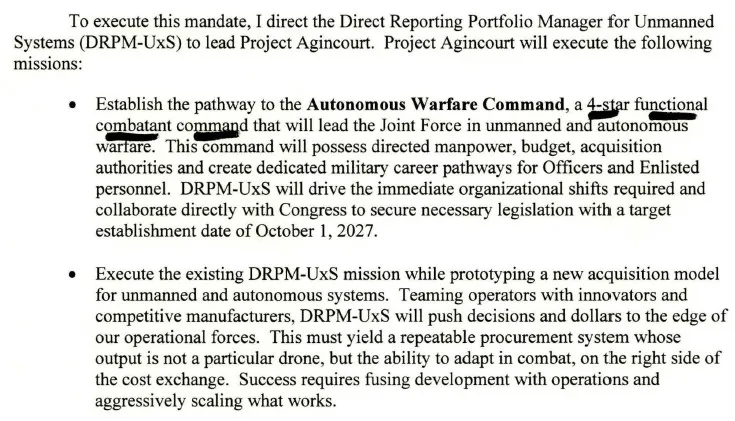
Vision For New Autonomous Warfare Command Laid Out By Pentagon
The Pentagon has announced plans for a new functional combatant command, very broadly akin to U.S. Special Operations Command (SOCOM) or U.S. Space Command (SPACECOM), but for operational activities involving autonomous and robotic capabilities. Secretary Pete Hegseth has also announced new initiatives to help further accelerate the fielding of uncrewed systems in the air, at sea, and on land, as well as explore future warfighting challenges. All of this builds on previous and long-overdue efforts to prioritize the fielding of various tiers of drones, as well as artificial intelligence (AI) and other emerging technologies, across domains, but there are questions about how these new efforts will translate into tangible developments.
Secretary Hegseth unveiled plans for what is tentatively dubbed Autonomous Warfare Command (AUTOWARCOM), as well as the aforementioned initiatives, called Project Agincourt and Project Meridian, during a speech to service members today at the U.S. Marine Corps’ base in Quantico, Virginia. Hegseth called this a State of the Force address, and said he planned to make it an annual event.
“At my direction, we are announcing the creation of Autonomous Warfare Command, or AUTOWARCOM, a new four-star combatant command with service-like authorities built to scale autonomous and robotic capabilities across the joint force in the fastest peacetime shift in modern military history,” Hegseth declared. “Drone warfare supercharged by SI-enabled targeting is the biggest battlefield revolution in generations. You already know that. Yet when I was sworn in to the Department of Defense, there was scant urgency in this domain.”
“SI” here stands for “super intelligence,” a term the Trump administration is now using in place of AI.
Hegseth called attention to the Drone Dominance initiative he unveiled last year, as well as the establishment of Joint Interagency Task Force 401 (JIATF-401), as examples of steps the Department has already taken in this regard. JIATF-401 is notably focused on counter-drone capabilities, as you read more about here.
“It’s a good start, but it’s certainly not enough. The pace of war is changing faster than the process to support it. Cheap compute, super intelligence, and advanced commercial manufacturing have enabled the proliferation of low-cost, high-precision strikes,” Hegseth continued. “For 40 years, the United States relied … primarily on expensive weapons that placed quality over quantity. Now, that approach gave us a lot of enormous advantages, and we need to preserve those capabilities. But today we need both quality and quantity. The term you know is high-low mix. An analogy is a thunderstorm. We need bolts of lightning high, our existing high-end kill chains capable of striking unexpectedly and decisively. We also need steady wind and rain, mass drones and other autonomous attritable systems that flip the cost exchange and impose unrelenting pressure on an adversary on the battlefield.”
Hegseth highlighted lessons learned from the ongoing conflict in Ukraine as underscoring these points.
“So today, with Autonomous War Command, AUTOWARCOM, we institutionalize and we supercharge the era of SI, robotics, and autonomous systems, all in order to win,” he added.
A memo the Pentagon has now released makes clear that the establishment of this command is contingent on Congressional approval, and the current goal is for it to be established by October 1, 2027.
“Autonomous Warfare Command will define joint needs and integrate Service-provided forces in support of geographic combatant commanders,” the memo also notes. “It will test equipment and force designs with realistic opposition in demanding exercises and rugged environments, modify rapidly, and field what works. We must build a wartime arsenal whose main product is adaptation at the edge.”
Many questions remain to be answered about how these activities with work being done now within the individual services, and how all of that will translate into operational activities. Part of Project Agincourt’s role will be working to help answer the questions above. The name here is a reference to the battle in 1415 in which British forces prevailed over their French opponents, famously in part through the application of a particular military technology, the longbow.

The office of the Direct Reporting Portfolio Manager for Unmanned Systems (DRPM-UxS) will lead this initiative. Owen West, head of the Pentagon’s Defense Innovation Unit (DIU), and U.S. Navy SEAL Senior Chief Max Strasiser are set to serve as the Chief Executive Officer and Chief Operating Officer of the DRPM-UxS, respectively.
Project Agincourt will also “prototype a new construct called warfighting acquisition, not just acquisition that happens at the Pentagon,” according to Hegseth. “This model fuses operators with entrepreneurs in rapid adaptation cycles while distributing decisions and dollars closer to frontline units, to combatant commands. Realistic training exercises, and when possible, the crucible of combat, will be used to compress innovation timelines and scale what works.”
“Also today, we are phasing in new MOS [Military Occupational Specialty] frameworks within each military department to support our shift to autonomy,” the Secretary also noted during his speech in the context of Project Agincourt and the plan for AUTOWARCOM. “We need institutional knowledge and career paths for a new generation of autonomous warfighters.”
Project Meridian sits adjacent to these efforts and has a broader mandate to explore ways to ensure the U.S. military maintains its technological edge on future battlefields.
“Project Meridian, the future of warfare, is not about developing new strategies or new policies. We already do that. Rather, its purpose is to creatively look to the future, and identify the domains that we must conquer, and capabilities we must master,” Hegseth said. “We need to be looking forward into the future to achieve technological and military dominance on the battlefield for decades to come. It is futuristic on purpose. Their work will be focused on discovering, developing, and fielding the weapons and systems that our children and our grandchildren will need in their lifetimes, without any creative limitations or restrictions, on any future battlefield, from under the Earth to beyond the Moon.”
“Project Meridian will study the battlefields of the future, identify which weapons and technologies warfighters will need to harness to dominate in these environments, and propose actionable solutions to start developing, testing and fielding these capabilities such that America will have overmatch for the 21st century and beyond,” according to a separate memo the Pentagon put out today. “The Joint Staff and all services should be prepared to connect their future warfare efforts and research to Project Meridian.”

Furthermore, “Project Meridian will leverage critical perspectives from outside the Pentagon, drawing upon a group of top technologists, innovators, business leaders, policy makers, and national security experts,” according to the memo. “Project Meridian’s primary function will be to map the trajectory of future warfare, identify critical capability gaps, and propose actionable solutions in furtherance of the identified goals in the 2026 National Security Science and Technology Strategy.”
This is also very much a near-term initiative, with Hegseth demanding a final report no later 120 days from now, or January 28, 2027. The Pentagon’s Chief Technology Officer, Emil Michael, has been directed to set up this project. Today, Hegseth also named Elon Musk, Palmer Luckey, and Newt Gingrich as key members.
Elon Musk, founder of SpaceX, which dominates the commercial space launch and services market globally, as well as the host of other companies, has had an on-again-off-again relationship with the Trump Administration. Palmer Luckey is another entrepreneur now best known for founding Anduril, which has increasingly a major player in the U.S. defense industry. Newt Gingrich, a highly influential member of Trump’s Republican Party and former Speaker of the U.S. House of Representatives, has more recently become an outspoken advocate of advancing AI technology in the United States.

The inclusion of Musk and Luckey does raise ethical questions, as they both lead companies with major U.S. government contracts already, and which could be in line to see more opportunities based on Project Meridian’s findings. What guardrails might be put in place to prevent conflicts of interest is unclear.
To reiterate, it remains to be seen how all of these efforts will progress and how, or if, they will ultimately translate to more tangible developments. The U.S. military has a long history now of launching high-profile initiatives that still struggle to demonstrate real progress, despite widespread support for accelerating the fielding of uncrewed systems, AI, and other advanced technologies. The Pentagon has certainly produced tangible results through other organizational shifts in recent years, including the aforementioned Drone Dominance initiative and JIATF-401, as well as the Replicator initiative under President Joe Biden.
At the same time, there are real potential hurdles to these new plans. The Pentagon has itself already acknowledged that support from Congress will be key to the AUTOWARCOM vision. Annual budgeting, and the uncertainty that often surroudns that will also be a factor. There is also the matter of efforts to expand the U.S. defense industrial base. The limitations of existing U.S. industrial capacity and supply chains have already become a matter of national debate in light of concerns about dwindling stockpiles of critical munitions as a result of the ongoing conflict with Iran, as well as a succession of other global crises in recent years.
During his speech, Hegseth called attention to efforts to broaden the defense industrial base with new, smaller firms, as well as agreements with large established contractors to expand on their existing capacity. He also highlighted the Trump administration’s $1.5 trillion defense spending plan for Fiscal Year 2027 and issued a new call on Congress to pass an additional $350 billion reconciliation package.
With today’s announcements, the Pentagon has certainly reinforced its commitment to expanding the fielding of uncrewed and other high-tech capabilities across all branches of the U.S. military, but there is clearly work still to be done to turn those visions into realities.
Contact the author: joe@twz.com

Claudia Winkleman explains why she would be ‘awful’ as Celebrity Traitors contestant
Claudia Winkleman says the new series of Celebrity Traitors is so good she didn’t want to leave

Claudia is excited for fans to watch the new series of Traitors.(Image: Ian West/PA Wire)
Claudia Winkleman has insisted she is “too thick” to take part in the Celebrity Traitors. The TV presenter will return to screens tonight hosting the hit BBC series when a new batch of famous faces enter the Scottish castle.
Actors Michael Sheen and Richard E Grant, supermodel Jerry Hall, presenter Maya Jama and comedians Rob Beckett, Romesh Ranganathan and James Acaster are among the line-up, alongside Little Mix singer Leigh-Anne Pinnock, musician James Blunt and The Last Of Us star Bella Ramsey.
However, 54-year-old Claudia said she would never want to be among their number. She said: “I’m too thick. I mustn’t play it in public. I must not, thank you so much. I’m just being honest. I could have come up with a schmoozier (answer) but no.
“It’s a privilege to play that game and to be at the round table, but I think I would just be too awful at it.”
The game follows the celebrity contestants – the majority of whom are known as faithfuls – as they try to seek out the murderous traitors among them, who kill off players in the middle of the night. Asked who were her favourite players this time, Claudia refused to name names but said as a collective they kept her gripped.
She explained: “I can’t. Genuinely, all of them were tremendous. And when we do any series, I have this room with the monitors. I’m like a weirdo just applying fake tan watching. And they’re like, ‘You can go now. You can go home. You’re free.’ I’m not leaving. This one, I never left. And I slept with just my eyes on it because they are all, you love them anyway, but they are tremendous.”
In fact, Claudia has fallen in love with the Scottish castle and its surroundings so much that she is taking her family there on holiday in the Highlands this year.
Speaking at the show launch earlier this month, she said: “That’s where we’re going this Summer, me and my family. And my husband’s like, ‘You’re already there quite a lot. What’s the matter with you?’.
“It’s the most beautiful place I’ve ever been in the world, is the truth. It is breathtaking. And we just went (for filming on civilian version) We went west and we went west – I can’t say anything else – for a mission and there was a sign that said, ‘Do beware, there are extra otters this year.’
“I was like, ‘Well, full stop’. There’s always a double rainbow, just the colours of it. And everybody is so kind and lovely to us when we’re there. So yeah, that’s where we’re going.”
Executive producer Sarah Fay added that the new line up of celebrities were cheekier than in the first series. She explained: “I can say its a very twisty turny series. I think what I would say is that the celebrities had the chance to see series one – obviously last tine they hadn’t had Celebrity before. It was new territory, but I think this time they’ve seen it. They know that they can be naughty. No one’s going to get canceled in the Traitors Castle for being naughty, so they had fun.”
The first celebrity spin-off was won by traitor Alan Carr, was a ratings hit and won a slew of awards.
Exec Sarah also said she was “chuffed” it was such a hit and hopes the second outing lives up to the past success and even ups the ante. She said: “We never take for granted that the audience is always going to come to it. So (the first series) felt a little bit like Monopoly money, it just didn’t seem real, but obviously we’re so, so chuffed.”
She continued: “But going into the series, we wanted to make sure it felt it wasn’t comparable and we could bring a new freshness to it. A new cast could bring something to it, whether that’s the dynamics of Rob and Romesh, with a celebrity duo with new twists, new turns. We’re always looking at ways to up the ante and make it feel like compelling viewing.”
She insisted fans were also likely to be left shouting at their screens with lots of cliffhanger endings to episodes.
Sarah explained: “We always have an idea before going into production what might be cliffhangers, but as I said before, we have to be so reactive because who knows what the story’s going to be. We’ve had to end before when we’ve done deadlocks last year when it was down to David[Olusoga] and Mark[Bonnar] where it was a tie.
“We never knew that that was going to happen until obviously it was happening right before our eyes. And so when we did get to the edit, we decided to end the episode there, but that could have been another cliffhanger. But I think the beauty of this game as well, because the format, every episode we’ve probably got about three options for what the cliffhanger could be because it’s so nail biting and there’s lots of tension and things going on throughout.”
* The Celebrity Traitors begins tonight (Thursday October 1) at 8pm on BBC One and iPlayer.
Like this story? For more of the latest showbiz news and gossip, follow Mirror Celebs on TikTok, Snapchat, Instagram, Twitter, Facebook, YouTube and Threads.
$7.5-billion mini-NIH plan goes to California voters under bill signed by Newsom
California voters will decide whether to establish a $7.5-billion state scientific research arm — similar to the National Institutes of Health — after Gov. Gavin Newsom signed a bill that will put the proposal on the March 2028 ballot.
The new state fund would aim to blunt federal research cuts by the Trump administration and ensure state and private institutions — including the University of California and California State University — can continue to produce scientific breakthroughs.
If voters approve the measure, $7.5 billion in bonds would fund California scientific and medical research into diseases such as cancer, Parkinson’s and ALS. Other research areas include reducing wildfire risk and fighting pandemics and climate change.
“This is a research and science bond that does the opposite of what Donald Trump is doing that will allow us to double down on what makes this state great — what makes America great,” Newsom said Wednesday during a bill signing atop the Golden Gate Bridge. “We are the tentpole of the U.S. economy because we invest in the future so that we can all do well there.”
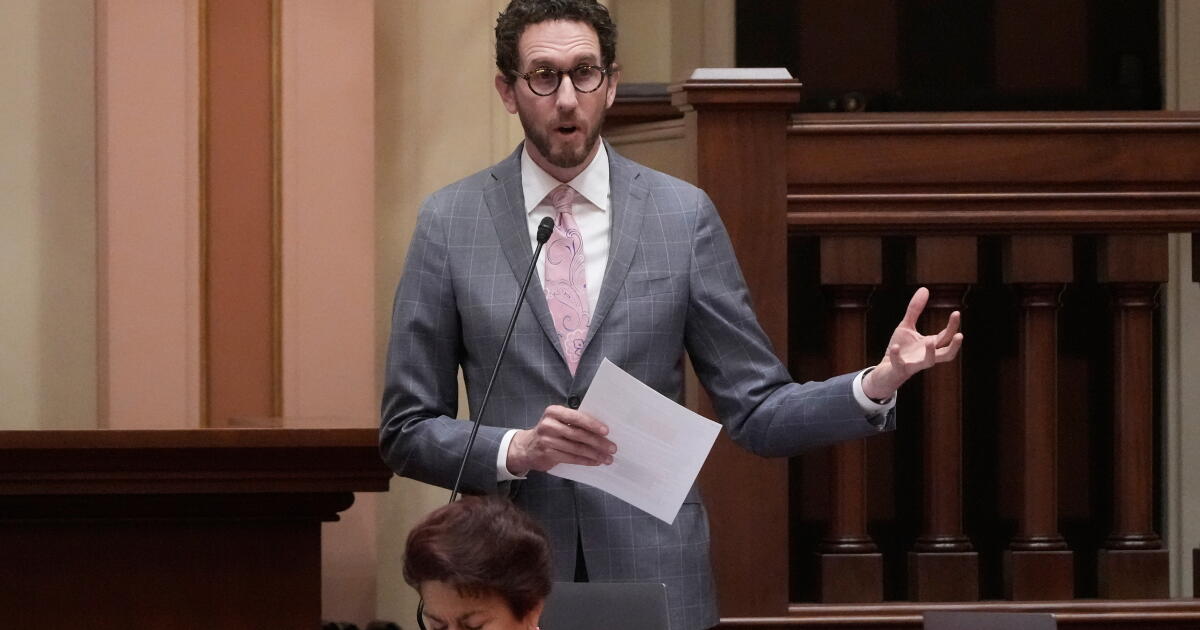
The legislation to establish the bond measure, state Senate Bill 895, was authored by Sen. Scott Wiener (D-San Francisco), who in a statement called it a “bold step to protect science, improve lives, and continue California’s global leadership on innovation for many years to come.”
The bill was sponsored by the Union of American Physicians and the University of California, as well as the United Auto Workers Local 4811, which represents some 60,000 UC academic workers.
The bond measure represents a pullback from what Wiener and supporters first proposed.
Originally conceived as a $23-billion bond measure that the Legislature would approve to go before voters in November, it was whittled down to $12 billion. But lawmakers then did not approve it in time for the November ballot.
Wiener said legislative leaders and the governor’s office then worked out a compromise, deciding on a $7.5-billion bond measure for 2028.
The measure also calls for the new state fund to establish regulations that would allow it to recoup part of its investments while not damaging innovation.
“This is a major achievement, made possible by an extraordinary coalition of people who understand the importance of investing in scientific research,” UC President James B. Milliken said in a statement.

AL wild-card roundup: White Sox eliminate Astros
The Chicago White Sox used a big first inning and a three-run homer from Chase Meidroth to propel them to a 7-3 win over the Houston Astros on Wednesday to sweep their AL Wild Card Series.
It’s the first time Chicago has won a playoff series since beating Houston in the World Series in 2005. Under the direction of second-year skipper Will Venable and with a letter of support from Pope Leo XIV, the White Sox advanced to face AL Central champion Cleveland in the AL Division Series beginning Saturday in Cleveland.
The White Sox, who lost 100 games in each of the last three seasons, are the only team in major league history to follow consecutive 100-loss seasons with a playoff berth.
The AL West-winning Astros went 81-81 to become the first team to reach the postseason without a winning record. Their recent playoff woes in Houston continued Wednesday as they dropped their ninth straight home playoff game in a ninth trip to the postseason in the last 10 years.
Chicago pounced on the Astros for four runs in the first inning a day after scoring three in the first two innings of a 6-3 win. Houston ace Hunter Brown was lifted after getting just two outs and wasn’t helped by a sloppy defense which committed two first-inning errors.

Hegseth announces 20% cut to US military commanders | Military
US Secretary of Defense Pete Hegseth says he’s firing 20% of the military’s generals and admirals, as part of his ‘anti-woke’ overhaul. He also announced a new technology-focused warfare division co-led by Elon Musk.
Published On 1 Oct 2026

Passengers tell of ‘nightmare’ onboard diverted Flydubai flight | Aviation
Israeli passengers tell of the horror onboard the Flydubai flight that was diverted after the pilot stabbed his co-pilot in the cockpit. The plane dropped 17,000 feet during the fight from Dubai to Tel Aviv, but landed safely after being diverted to land in Saudi Arabia.
Published On 1 Oct 2026

RM, leader of K-pop’s BTS, curates his first museum show at SFMOMA
The leader of the world’s biggest band is nervous.
“I think I revised this speech about 10 times, but somehow the more I worked on it, the more confused I became, like always,” said K-pop star and BTS rapper RM on Tuesday at a preview of a show he has co-curated at San Francisco Museum of Modern Art called “RM x SFMOMA: Between You and Me”
Three years ago, RM held an anonymous show in South Korea, but this is the first proper exhibition he has staged. For many of his fans — some of whom wait outside the museum trying to get a glimpse of him — his favorite activities, including museum-hopping, bicycling and being out in nature, come as no surprise. There is even a word for it: “namjooning,” a play on the singer’s first name, Namjoon. But still, the exhibition is the rare chance to view RM as a serious art collector; someone who values Korean identity in art but also loves works from many genres, eras and countries.

Philip Guston, Untitled (Red and Black Book), 1969; from the collection of RM.
(The Estate of Philip Guston / Hauser & Wirth)
Dressed in a gray T-shirt, dark collared shirt and leather pants, RM’s hair is a light burnt sienna color matching the fur of the stylized tiger on the screen behind him. From a 17th century painting by Lee Won-chan, it’s from his personal collection of more than 400 artworks. For this exhibition, 142 pieces owned by RM will be shown alongside 36 works from SFMOMA for a total of 178 works on display.
RM sees “Between You and Me” as an introduction to his inner life and reflection of contrasting aspects of his personality, whether as a public figure interacting with his adoring fans or an erudite intellectual and avid reader with a reputation as a clumsy and lovable goofball.
RM was on a hiatus from BTS and on the cusp of beginning his mandatory military service in South Korea when SFMOMA first approached him for the project two years ago. As it came to fruition, he sought to answer two main questions when contemplating which works of his collection to share with the public.
Does the artwork move him deeply? And, if the work is from a noncontemporary artist, does the piece have something to communicate in 2026?
“In an age where everything is consumed so fast,” RM explained, “I believe the attitudes of some of the past artists can resonate even more deeply today.
“I’ve always dreamed of seeing different places, times, boundaries and backgrounds all mixed together in harmony,” he continued. “It could be a mess because I’ve never formally studied, and I’m not a ‘curator, curator,’ but in any field sometimes an outsider can bring in a new breeze.”

Wonwoo Lee, “Candy,” 2023; from the collection of RM
(Wonwoo Lee / PKM Gallery)
It’s not RM’s first time working with a museum. In 2023, he partnered with Los Angeles County Museum of Modern Art to provide guided audio narration for “The Space Between: The Modern in Korean Art”.
At SFMOMA, RM was joined in his effort by two co-curators: SFMOMA project manager América Castillo and assistant curator of painting and sculpture Hyoeun Kim.
Kim, who has long championed Korean artists internationally, was particularly impressed with the diversity of Korean art that RM has amassed, including its “remarkable range.”
“His collection began with 6th century works, moved through the Joseon Dynasty, and continued to major Korean modern and contemporary art. It spans nearly 1,500 years,” Kim said during the preview.
The show is arranged in eight parts and begins with a large white wall at the entrance with the title of the show scrawled in RM’s handwriting. Handwritten touches are found everywhere — “Plz take it in with your eyes and heart” is scribbled on the floor in both English and Korean. The wall text for each piece, which also includes a QR code for audio narration, is composed by RM in both languages.

An inscription on the floor of an SFMOMA exhibit curated by RM of BTS features RM’s writing as part of the wall (and floor) text.
(Christine Terrisse.)
Guests will also receive a zine-style pamphlet with the same homespun appeal explaining each of the eight sections in RM’s words alongside a diagram of the room.
“Blue Water” centers the work of Kim Whanki, the late globe-trotting abstract artist and the first RM says he “fell for.” In addition to Whanki and works by Vija Celmins and Tony Feher, some RM fans might recognize one of Roni Horn’s glass cylinder sculptures from a now-archived Instagram post where it was casually displayed in RM’s apartment.
There’s even a room filled with especially eclectic pieces called “i don’t know..but i like it.” By way of explanation, RM said, “Sometimes I don’t really know why I collected all these things.”
The last room, “Umber” or “Dasaek” (referring to the color of Korean rice fields) might be the most meaningful to the singer. It features works by the late artist Yun Hyong-keun, for whom RM has a particular personal affinity. The cover for his debut solo studio album, “Indigo,” depicts Hyong-keun’s 1972 painting “Blue,” and the album’s lead track, “Yun,” a collaboration with Erykah Badu, kicks off with recorded dialogue from the artist.
Back in 2018, around the same time RM began his art journey with not much formal training in art history, co-curator Castillo began her career with SFMOMA.
At the time, she was in awe of the power of art to connect with people, but frustrated that more people from unconventional backgrounds weren’t being given opportunities to curate major shows, thereby shaping the stories told. Her work on this exhibition is part of a continuing mission to bridge the art world and the ordinary person.

Chang Ucchin, “Road,” 1986, from RM’s collection.
(Chang Ucchin Foundation / Seoul Auction)
This mission guided her through the process of selecting works by famous artists from SFMOMA’s collection to contextualize RM’s pieces from lesser-known but equally important names.
“The first time we pulled a list on the SFMOMA side, we had like 500 options we then dwindled down,” she said in an interview while standing in the “Umber” room. “There were some artworks and specific artists that we knew from the get-go we wanted to be in the show. We wanted them to have a moment. Mark Rothko was definitely one of them.”
The sole Rothko piece in SFMOMA’s collection, “No. 14,” (1960) is featured in one of the final rooms in the exhibition. Adjacent to it is “untitled” (1986-90) by Hyong-keun. In the exhibit pamphlet, RM notes that Hyong-keun’s paintings are often compared to Rothko’s, but “their darkness is not the same.” “To my eyes, if Rothko’s darkness is one that ‘opens’ then Yun’s is the darkness that remains after he endured everything he possibly could,” he writes.
As RM steps into the spotlight of the art world, he is learning to become comfortable with the uncomfortable in-between spaces he occupies. “I started this with an innocent heart. As I’m standing here talking to you, I still feel like I’m always drifting and floating somewhere, ” he said, adding that the feeling comes when he’s in the U.S. but also when he’s in his hometown of Seoul. “It’s not a very pleasant feeling. I think I’ve leaned on art a lot because of that feeling.”
Before the preview, BTS fans, called the ARMY, passed out small gifts to the press, and afterward donors lined up for a special reception. RM’s mother, father and sister even arrived to celebrate, but he didn’t have much time to hang around. He was scheduled to depart for Bogotá, Colombia, to join his bandmates on the Latin American leg of their ARIRANG stadium world tour.
It is time to leave the quiet of the museum for the roar of the crowd.
“RM SFMOMA: Between You and Me” opens to the public on Oct 3, and runs through Feb.7, 2027. For more information visit sfmoma.org

Fed’s Waller Eyes Agentic AI Commerce
Agentic AI has a toehold in B2C transactions, but has a way to go to capture B2B transactions, Waller said at the Sibos conference.
Artificial intelligence and autonomous AI agents will fuel the next evolutionary leap in global and cross-border payments, Federal Reserve Board Gov. Christopher Waller said during a speech at Sibos 2026 in Miami.
The payment industry’s early adoption of machine learning and large language models has helped combat payment fraud and quicken reconciliation and similar tasks, said Waller.
“Now it is helping build the foundation infrastructure for AI agents to operate more broadly in the economy,” he added. “These agents can plan and execute multistep processes using LLMs, enabling those agents to transact autonomously.”
Waller separated agentic commerce into two models: agentic-assisted and agentic-delegated. In the agentic-assisted model, the agent is primarily for product search and discovery, while the buyer remains in control. In the agentic-delegated model, “a buyer grants authority to an AI agent to shop and make payments on their behalf. The buyer may specify some constraints and set up guardrails, but the agent operates autonomously.”
Because agentic-delegated commerce could increase the risk of unintended purchases, Waller suggested deploying more extensive trust mechanisms and guardrails.
Agentic B2B Payments
Although agentic commerce has gained traction in consumer-to-business transactions with personal AI assistants, Waller said that business-to-business purchases would be fertile ground for agentic-delegated commerce.
“The purchases are often recurring and abide by a set of rules, such as approved suppliers and budget limits, which create natural guidelines for agents,” he said. “Agents could also potentially negotiate terms with suppliers and develop payment strategies to optimize working capital.”
However, the industry would need to develop and deploy robust controls and monitoring capabilities since B2B transactions typically carry a higher value than their consumer counterparts.
Also, unlike consumer-to-business transactions, AI agents executing B2B transactions will need to support a broad range of payment rails, including the Automated Clearing House, wire transfers, instant payments, and credit cards.
The biggest barrier to agentic commerce adoption is building trust mechanisms between buyers and sellers, which changes the payment authentication paradigm, said Waller. “The question shifts from proving that a buyer is an authorized payer to proving that an agent has the authority to pay on the buyer’s behalf. Capturing this will require new authentication approaches.”
He also noted two key questions about the future of agentic commerce: whether it will migrate toward platform-specific or interoperable standards. The latter would work across ecommerce systems, agent interfaces, and payment methods. “In this sense, they could help to level the playing field for smaller merchants and payment providers seeking to operate in this space.”
The payment industry still needs to take significant steps before it can bring agentic commerce to fruition, including developing standards for how agents can “carry identity, consent, and payment credentials across the full ecommerce stack,” as well as striking the proper balance between convenience and friction regarding agent authorization, Waller said.
These steps will require the payments industry to balance innovation with the safety, integrity, and stability that underpin trust in payments, he concluded.

Federal judge allows Paramount-Warner merger to move forward
A federal judge in Oakland has approved a settlement that allows Paramount Skydance Chief Executive David Ellison to finalize his $111-billion acquisition of Warner Bros. Discovery.
U.S. District Judge Araceli Martínez-Olguín on Wednesday signed a settlement agreement, effectively ending an antitrust lawsuit brought by California Atty. Gen. Rob Bonta and 11 other state attorneys general who initially fought the formation of a new Hollywood colossus.
The judge did not offer additional conditions to an agreement struck last week between Paramount and the states, instead allowing Paramount’s negotiated settlement terms to stand.
“The Court finds the proposed settlement agreement reflects a procedurally sound resolution,” Martínez-Olguín wrote in her order.
Ellison is aiming to finalize the merger early next week, capping his meteoric rise into one of the industry’s most influential figures. The Ellison family claimed Paramount and CBS last year, and will now add HBO, CNN, TBS, HGTV and the film and television studio with rights to Batman, Harry Potter, Fred Flintstone, “Friends” and “The Pitt” to its sprawling media and entertainment portfolio.
His father Larry Ellison, through his company Oracle Corp., also owns a substantial stake in the social media app TikTok and is among the tech giants supporting development of artificial intelligence.
The settlement agreement, which spans five years, requires the combined Paramount-Warner Bros. to release at least 30 films in theaters each year, commit an additional $1.5 billion to domestic film production and set aside $47.5 million for workers who may be adversely affected by the merger. It calls for the creation of a five-member panel to monitor editorial independence of CBS News and CNN, although critics note the Ellisons control board appointments, diminishing its independence.
The agreement, known as a consent decree, also stipulates that Paramount won’t sell or close its Melrose Avenue campus in Hollywood or the larger Warner Bros. lot in Burbank. The combined company must instead operate the historic facilities “in a manner consistent with past practices” for at least five years.
Paramount will also face restrictions on how it wields clout during negotiations for distribution of its basic cable TV channels. An independent monitor is expected to oversee implementation of the settlement terms.
The merger has been unpopular in Hollywood and critics denounced the settlement as weak. Opponents accused Bonta, who led the negotiations with Paramount, of caving into pressure from Gov. Gavin Newsom and Los Angeles Mayor Karen Bass, who publicly urged Bonta to abandon his court fight.
“Our settlement with Paramount resolves our antitrust concerns in every market we brought in our case, protects competition and consumer choice, and centers the needs, concerns, and futures of California workers,” Bonta’s office said in a statement.
Los Angeles County’s Department of Economic Opportunity has estimated that the merger will result in the loss of 4,500 local jobs as Ellison seeks to integrate the two entities and cut costs. Paramount has promised investors that it will shave $6 billion in spending within three years.
“Allowing the Paramount Skydance-Warner Bros. Discovery merger to move forward with no meaningful structural remedies will cost jobs, mute creativity, weaken independent journalism, and damage our First Amendment rights,” the Block the Merger coalition said Wednesday in a statement.
Sen. Cory Booker (D-N.J.) last week urged Martínez-Olguín to order an independent review to evaluate the strength of the proposed settlement terms and determine whether the pact adequately addresses alleged violations of the Clayton Antitrust Act.
During a Thursday hearing, Martínez-Olguín questioned key deal tenets, including the five-year length of the agreement and the value of the Miramax film studio, which Paramount agreed to divest should the company fall short of its film goals. She also asked why the state attorneys general dropped so many of their initial demands in pursuit of a settlement with Paramount.
“In years to come, we’ll be able to point to this failure to put consumers over the monied interests of corporate consolidation as the tipping-point moment for media in this country,” the Block the Merger coalition said in its statement.
The judge noted that she recognized the deep disappointment by merger opponents, and heard their concerns about news independence and a potential lack of diversity in storytelling when the two studios consolidate.
“But these hopes and desires for the proposed consent decree to reach farther — to achieve more — do not rise to the level of legal violations upon which the Court can reject the parties’ negotiated resolution,” Martínez-Olguín wrote.
The lawsuit resolution ends months of acrimony over Ellison’s deal for Warner Bros. Discovery, which was stalled for two months after Bonta and 11 other state attorneys general sued, arguing the combination would violate U.S. antitrust law and thwart competition. The Writers Guild of America lobbed its own antitrust lawsuit in an attempt to foil the merger.
But Paramount dug in, and its lobbying reached a crescendo by early September. A parade of state and local politicians, including Bass and others, urged a settlement due to fears that Paramount might follow through on its threat to leave California unless Bonta retreated.
Bonta and his coalition then worked behind the scenes to hammer out a settlement with Paramount, which was announced Sept. 21.
Paramount’s bankers have since been pricing bonds and lining up loans needed to finance the buyout of Warner Bros. Discovery shareholders at $31 a share. Ellison’s team had hoped to price the offering months ago, and interest rates have since climbed.
Paramount is selling about $44 billion of bonds and $7.5 billion in loans to finance the takeover, according to Bloomberg, which said the combined company will have more than $87 billion of investment-grade and high-yield debt.
Larry Ellison has promised to guarantee $47.5 billion in equity that his son needs to close the deal. Three Middle Eastern sovereign wealth funds, representing royal families in Saudi Arabia, Abu Dhabi and Qatar have agreed to invest $24 billion in the merged company, giving them a substantial stake in the new Paramount-Warner Bros.
Paramount separately announced Wednesday that Mattel Chief Executive Ynon Kreiz would soon join the merged company as co-chief executive, running Paramount-Warner Bros. day-to-day operations. Friday will be Kreiz’s last day at Mattel.

World Rally Championship: The five titles that got away as Elfyn Evans closes in on elusive crown
A revamp of the points system for 2025 was welcomed by Evans; it also brought his tightest title race yet.
After second place to Ogier in the Monte Carlo curtain-raiser, the re-energised Welshman won in Sweden and Kenya – rallies the Frenchman sat out.
With a 36-point advantage, Evans had opened up the largest championship lead ever recorded after three rounds of a WRC campaign.
But he would not win again that season and though he never finished lower than sixth, Ogier gradually whittled away at his lead until it came down to just three points with one round to go.
That race was a brand new entry to the calendar, and there was uncertainty over what lay ahead at Rally Saudi Arabia.
The terrain proved brutal for all the drivers. Tyre problems galore saw the leaderboard shifting like the sand. It ended with Ogier in third and Evans in sixth.
The points-swing was seven. The Frenchman had won a record-equalling ninth WRC title by four points, and Evans had fallen just short for the fifth time in six years.
“We’ve done what we can, that’s it,” was his reaction.
“We’re competitors at the end of the day, we always want better, we always want more.”

Iraq celebrates Sovereignty Day as US troops complete withdrawal | ISIL/ISIS
Night time celebrations filled the air as Iraqis observed the start of a four-day holiday to mark the withdrawal of US troops and international forces after more than a decade in the country fighting ISIL.
Published On 1 Oct 2026

Thursday 1 October Investiture of the Captains Regent in San Marino
There is an old saying that ‘two heads are better than one’. In San Marino that saying is literally taken as a form of government.
In a tradition that dates back to 1243 and based on a custom of the Roman Republic, this tiny republic has not one, but two heads of state.
Known as the Captains Regent, two people are elected every six months by the Grand and General Council, the country’s legislative body.
The two Captain Regent are usually selected from different political parties to give a unique balanced government. Once they have served the six months, they cannot become regents again for another three years.
This may sound a bit bonkers to those of us from countries whose leaders are elected for periods of four or five years, but the roles are mainly symbolic and more like that of a king or queen rather than a president.
Women were prevented from taking public positions in San Marino until 1972. The first female Captains Regent was elected in April 1981.
If you are visiting San Marino on April 1st or October 1st, you can watch the investiture of the new Captains Regent which takes place at the Piazza della Liberta, outside the Government Palace.

Iran parades Shahed drones through capital | Conflict News
Crowds cheered and waved national flags as two Shahed drones were paraded through Tehran. Iranian-made, low-cost Shahed drones have become a major feature of modern warfare, used in attacks across the Gulf and extensively by Russia in its war in Ukraine.
Published On 1 Oct 2026