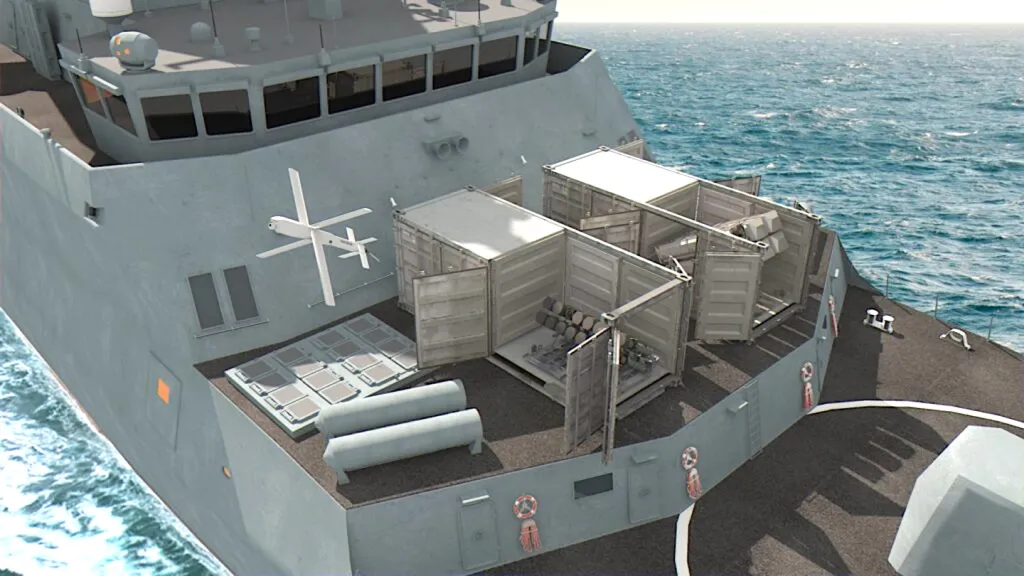
The Defense Advanced Research Projects Agency (DARPA) is asking for concepts for drones with a high degree of autonomous operation, as well as remotely-operated containerized systems to launch, recover, and otherwise support them. What DARPA is really interested in is a pairing that can be employed as part of a largely self-sustaining “autonomous constellation” capable of supporting networked swarms consisting of as many as 500 drones at once.
A “constellation” like the one described above, incorporating drones configured for a wide array of roles, including surveillance and reconnaissance and kinetic strike, could be readily deployed in contested areas, or even potentially positioned deep behind enemy lines. Ukraine’s Operation Spiderweb covert drone attacks on several Russian airbases last year, as well as Israel’s near-field attacks from within Iran during the opening phases of the 12 Day War, have already demonstrated the effectiveness of the kind of capability DARPA is seeking. TWZ has also highlighted the value that this kind of drone swarm launch capability would offer on land and at sea on several occasions in the past, including after the Pentagon’s Defense Innovation Unit (DIU) put out a very similar call for proposals earlier this year.
DARPA’s Tactical Technology Office (TTO) first put out its request for information for this containerized drone swarm capability back in April, but has updated the relevant contracting notice several times since then. The latest version was posted online yesterday. At least from what has been shared so far, DARPA has not yet given this project a name.

“Existing commercial, airborne Group 1-3 platforms are limited in endurance, payload capacity, and onboard electrical auxiliary power. When operated as constellations, they typically require substantial infrastructure and basing area [sic] for deployment and recovery. These constellations typically require human involvement to recover, recharge/refuel, and launch again, lacking full autonomy necessary to achieve sustained operations spanning days or longer,” the current version of the contracting notice explains. “The landscape of current platform technologies has broad limitations that require evolution to achieve high-endurance constellations consisting of drones with meaningful payload Size Weight, Power, and Cost (SWaP-C) staged from fully autonomous containers capable of complete mission-cycle management inclusive of launch, sustainment/swap-out, and recovery.”
The U.S. military breaks drones into five different categories. Collectively, drones in Groups 1 and 2 can have maximum weights of up to 55 pounds, fly up to altitudes of 3,500 feet, and have top speeds of up to 250 knots. Group 3 is a very broad middle tier that covers designs that weigh anywhere from 56 to 1,320 pounds and can get up to 18,000 feet, but again have speeds of 250 knots or less. Together, Groups 1 through 3 include a very wide range of drones from small quadcopters all the way up to long-range one-way attack munitions.
Given the aforementioned limitations, “DARPA has identified an exigent need for highly deployable, versatile-SWaP Group 1-3 platforms, operating in autonomous constellations that are stored within, deployed from, recovered in, and managed by a fully autonomous container, to support a variety of payloads and missions in GPS-denied environments,” the contracting notice adds. “Advancements in low-SWaP technologies enable constellations comprising a variety of novel payloads, each requiring dedicated power and weight, but capable of operating in synchrony across the constellation. Constellation populations may comprise up to 500 platforms (number may vary as a function of payload type). Each platform will be equipped with a subsystem or independent payload system with the potential to achieve high operational availability for the combined system over multiple-day periods.”


The notice leaves the requirements for the drones and the containerized launch and recovery systems relatively open-ended.
“Unmanned aerial vehicle (herein referred to as “drones”) in the Group 1-3 space with capabilities for fully autonomous launch, recovery, storage, organization, recharging/refueling, organization, internal logistics management, and pre/post-flight checkout. Proposed drone designs must form a mission-focused, collaborative constellation. Responses must be cognizant of long endurance drone constellations with high operational availability and constellation management,” per the notice. “Novel configurations that enable multi-day continuous operations with their corollary constellation management software (ideally with path optimization and collision deconfliction) and innovative configurations of autonomous container-based deployment solutions are of particular interest to DARPA.”
“Storage containers (herein referred to as “containers”) that provide fully autonomous drone storage, logistics management, launch, recovery, and recharge/refuel, while conforming to the intention of a standardized military container (e.g. Conex, 463L pallets, Tricon, ISU container, etc.),” the notice adds. “Innovative ideas and non-standard containers (e.g. suitcase-based distributed systems, box-based systems) will also be considered within the context of the presented approach, but solutions should be compatible with current military transport capabilities. It is envisioned that these containers shall be self-sufficient with consideration of energy storage, communication equipment, and compute capability.”
DARPA also says it has a tangential interest in a remotely operated “host platform” that could carry the containers to and from a designated area, from which the drones can then be launched and recovered. The contracting notice does not specify whether this would be an air, ground, or maritime platform, or some mixture thereof.
The video in the social media post below shows a launch system for quadcopter-type drones installed on an uncrewed ground vehicle, which the U.S. Army previously tested.
Perhaps most interestingly, DARPA’s contracting notice highlights existing drone-and-launcher combinations used for “preplanned lightshows and commercial activities,” though it also notes that these are not suitable for U.S. military use. Last year, TWZ pointed out how these exact kinds of developments in the commercial entertainment space underscore very real threats posed by more capable, weaponized swarms. That piece came after a Chinese firm, DAMODA, rolled out a containerized system capable of launching, recovering, and recharging thousands of small, electrically-powered quadcopter-type drones at the touch of a button.

China just dropped a new level of drone swarm tech | One-click auto-deploy of thousands | by DAMODA
As we wrote at that time:
It is worth reiterating that DAMODA’s Automated Drone Swarm Container System, at least as it exists now, is clearly designed for entertainment industry use first and foremost. Though the company’s drone light show routines are certainly visually impressive and often go viral on social media, they are pre-scripted and conducted in a very localized fashion. What the company is offering is not a drone swarm capable of performing various military-minded tasks in a highly autonomous manner at appreciable ranges from its launch point.
At the same time, large-scale drone light shows put on by DAMODA (and a growing number of other companies), do highlight, on a broad level, the already highly problematic threats posed by swarms. The new Automated Drone Swarm Container System underscores the additional danger of these same threats hiding in plain sight. The steady proliferation of advances in artificial intelligence and machine learning, especially when it comes to dynamic targeting, will only create additional challenges, as TWZ has explored in detail in this past feature.
This is not theoretical, either. As mentioned, in June [2025], Ukrainian forces launched multiple drone attacks on airbases across Russia with the help of covert launchers loaded on the back of unassuming civilian tractor-trailer trucks. This entire effort was dubbed Operation Spiderweb and took months of planning.
The global market space for containerized launch systems for drones and other payloads is already substantial and continues to grow. Firms in China have been particularly active in this regard, and developments in that country have often also been tied to work on swarming capabilities. Companies in the United States, as well as in Europe and elsewhere around the world, are also increasingly active in this arena.

中国电科陆空协同固定翼无人机“蜂群”系统

Modular Payload System: Launching from Land or Sea
In general, containerized weapon systems offer immense flexibility for employment in ground-based modes, including for rapid deployment to remote or austere locations, as well as on any ship with sufficient deck space. TWZ has previously laid out a very detailed case for why the U.S. Navy should arm its warships with containers loaded with swarms of drones, which you can find here.
Container-like launchers for drones, many of which are mounted on trucks, are also an increasingly common sight globally. Iran has been a particularly significant developer of such capabilities as part of its development of long-range kamikaze drones, as seen in the video below.

Баражуючий іранський боєприпас «Shahed 136»
However, most existing relevant containerized or container-like systems focus on launching payloads rather than recovering them, let alone getting them ready to be relaunched. To date, the latter capabilities have been more of an area of interest for commercial applications. Chinese firm DJI and other companies are increasingly offering container-like ‘docks’ for small commercial drones, though they are generally designed to host just one uncrewed aerial system at a time.
TWZ actually covered much of this already after the DIU announced it was hunting for a very similar-sounding Containerized Autonomous Drone Delivery System (CADDS) capability in February. The CADDS announcement, however, was focused purely on the launch-and-recovery components of the equation, as you can read more about here. How DIU’s effort might be related to what DARPA is exploring now is unknown.
In its call for CADDS proposals, DIU had also highlighted a new, more general emerging demand for more launch capacity to go along with a U.S.-military push to acquire and field hundreds of thousands, if not millions, of new drones, especially smaller types, in the next few years. This has all been spurred on by sweeping new guidance from the Pentagon rolled out last year, aimed at “unleashing U.S. Military drone dominance.” Though DARPA’s contracting notice does not touch on this directly, the capability it is describing would help address this broader question of how U.S. forces were actually employ all of these new uncrewed aerial systems.

Furthermore, as we wrote after DIU put out its call for CADDS proposals:
“Even in an overt operational context, readily deployable containerized systems capable of acting as hubs for drone operations across a broad area with limited manpower requirements could offer a major boost in capability and capacity. Ships, trucks, and aircraft, which could themselves be uncrewed, could be used to bring them to and from forward locations, even in remote areas. If they can support a ‘heterogeneous mix’ of uncrewed aerial systems, a single container could be used to support a wide array of mission requirements, including intelligence, surveillance, and reconnaissance, electronic warfare, kinetic strikes, and/or communications signal relay.”
“An inherent benefit of a drone swarm, in general, is that each individual component does not have to be configured to perform all of the desired tasks. This creates additional flexibility and resilience to threats, since the loss of any particular drone does not necessarily preclude the swarm from continuing its assigned missions. There are tangential design and cost benefits for the drones themselves, since they can be configured to carry only the systems required for their particular mission demands.”

Army Aviation Launches Autonomous Pack Hunters
…
“Drone swarms are only set to become more capable as advancements in autonomy, especially automated target recognition, continue to progress, driven by parallel developments in artificial intelligence and machine learning, as you can read more about here. Future highly autonomous swarms will be able to execute various mission sets even more efficiently and in ways that compound challenges for defenders. Massed drone attacks with limited autonomy already have an inherent capacity to just overwhelm enemy defenses. In turn, electronic warfare systems and high-power microwave directed energy weapons have steadily emerged as some of the most capable options available to tackle swarms, but have their own limitations. Even powerful microwave systems have very short ranges and are directional in nature, and electronic warfare systems may simply not work at all against autonomous drones.”
It remains to be seen whether or not DARPA’s exploration of drone swarms and associated launch systems that could form future “autonomous constellations” leads to an operational capability. Still, this, together with DIU’s CADDS effort, shows clear interest within the U.S. military in making this a reality, if possible.
Contact the author: joe@twz.com