



Sudan condemns RSF chief’s visit to Uganda as minimising ‘human values’ | Sudan war News
Uganda Ministry of Foreign Affairs says Mohamed Dagalo’s meeting with President Yoweri Museveni focused on ending war.
Sudan has condemned Uganda for hosting the head of the paramilitary Rapid Support Forces (RSF), Mohamed Hamdan Dagalo, as an “insult” to humanity and the Sudanese people.
In a statement on Sunday, Sudan’s Ministry of Foreign Affairs denounced the reception of Dagalo, also known as “Hemedti”, in the “strongest terms” and his meeting on Friday with Ugandan President Yoweri Museveni.
Recommended Stories
list of 3 itemsend of list
“This unprecedented step insults humanity before it insults the Sudanese people, and at the same time, it disregards the lives of innocent people killed due to the behaviour of Hemedti and his terrorist militia,” the Foreign Ministry wrote.
Rights groups and international organisations have accused the RSF of war crimes and targeting civilians in Sudan.
Khartoum said hosting Dagalo “disregards” human values.
It “completely disregards the laws governing relations between member states of regional and international organisations that prohibit providing any support for rebel forces against a legitimate, internationally recognised government”, the Foreign Ministry added.
In 2023, Sudan was plunged into a civil war between the Sudanese army, led by Abdel Fattah al-Burhan, and the RSF.
According to the Office of the United Nations High Commissioner for Refugees (UNHCR), at least 11.7 million people have been displaced by the conflict and an estimated 150,000 people have been killed.
Last week, the United States imposed sanctions on three RSF commanders over their alleged roles in the 18-month siege and capture of el‑Fasher, the capital of North Darfur State in western Sudan.
In a statement, the US Department of the Treasury accused the RSF of perpetrating “a horrific campaign of ethnic killings, torture, starvation, and sexual violence” during the siege and capture of el-Fasher, which fell to the RSF in October.
Separately, a UN mission found that the RSF campaign in el-Fasher was a “planned and organised operation that bears the defining characteristics of genocide”.
‘Poisonous’ identity politics
Uganda’s Ministry of Foreign Affairs issued its own statement on Dagalo’s visit and said his meeting with Museveni focused on “ending the ongoing conflict in Sudan and restoring regional stability”.
Museveni reiterated in his remarks to Hemedti that peace in Sudan could only be achieved through dialogue and warned against what he described as identity politics.
“When I last came to Sudan, I met [former] President [Omar al-] Bashir and advised against the politics of identity instead of the politics of interest,” Museveni said.
“Identity politics is poisonous. It does not yield good results. What is important are shared interests that unite people,” he said while calling for both parties to prioritise “peace over military confrontation”.
For his part, Dagalo thanked Museveni and said he shares the Ugandan president’s “principles and your commitment to peace”, according to a statement released by the Ugandan government.
“He noted that Sudan continues to face serious humanitarian and institutional challenges as a result of the conflict and stressed the need for a peaceful resolution,” the statement added.

From ‘Bonnie and Clyde’ to ‘Star Wars’: The real history of New Hollywood
Book Review
If you buy books linked on our site, The Times may earn a commission from Bookshop.org, whose fees support independent bookstores.
“That’s my pot dealer!” exclaimed Michelle Phillips in a crowded movie theater in 1977. Months earlier, the Mamas & the Papas singer had only known Harrison Ford as a stoner-carpenter with a few bit parts to his credit. Now he was Han Solo in “Star Wars,” directed by a young upstart, George Lucas. Clearly the world was changing.
How much, though? Conventional wisdom about the Hollywood renaissance of the ‘60s and ‘70s suggests that starting with “Bonnie and Clyde” and “Easy Rider,” a batch of emerging auteurs shook the studios out of a rut and transformed American film. There’s plenty of truth to that: Francis Ford Coppola’s shift in 10 years from a director-for-hire on an old-hat musical, “Finian’s Rainbow,” to the auteur behind “Apocalypse Now” is just one of the era’s most remarkable achievements.
A pair of new books, though, suggest that the overall shift was only so modest, ultimately shoring up not just the old-school studio system but the social norms the interlopers were supposed to be upending.

Paul Fischer’s lively history of the new wave of California directors, “The Last Kings of Hollywood,” concentrates on Lucas, Coppola and Steven Spielberg. (New York contemporaries like Martin Scorsese and Brian De Palma are present but relatively off-screen.) Fischer has a gift for highlighting the ways that moments that we now accept as inevitable were often the product of dumb luck, pyrrhic victories and tough decisions. Coppola made “The Godfather” out of financial desperation, averse to adapting a mob novel; Spielberg’s “Jaws” was beset with mishaps, from a foolhardy attempt to train a real shark to its malfunctioning mechanical one; only when Lucas learned that the rights to Flash Gordon were unavailable did he pursue a space-opera concept all his own.
Their brashness and can-do spirit were worth cheering for: As the trio delivered films that broke box office records — ”The Godfather,” “American Graffiti,” “Jaws” and more — there were reasons to believe that big-budget films could operate outside the studio system. Lucas in particular was driven as much by resentment of the old as passion for the new. He never forgot how Warner Bros. manhandled his debut feature, “THX 1138” and was driven to muscle “Graffiti” into existence to spite the suits who said he couldn’t. In 1969, Coppola and Lucas launched their own studio, American Zoetrope, in San Francisco, with a passel of scripts in progress (including “Apocalypse Now” and “The Conversation”) and a $300,000 investment from Warner Bros. But Coppola wasn’t much of a businessman, and he had an easier time putting the office’s fancy espresso machine to work than the suite of state-of-the-art editing bays: “He ran his business like he ran a film set — on vibes,” Fischer writes.
A decade later, both Coppola and Zoetrope would declare bankruptcy, and he would split with Lucas, who’d used the success of “Star Wars” to cut his own path as a Hollywood kingmaker via his own production company, Lucasfilm. It allowed him to indulge his love of classic cliffhanger serials, and he tapped Spielberg to direct “Raiders of the Lost Ark.” But Fischer frames Lucas’ career arc as a disappointment, despite all those dollar figures — Lucas wanted to return to artsier “THX”-style fare, but needed cash flow. “If George was ever going to be independent from Hollywood, he thought he wouldn’t get there by making abstract mood poems,” Fischer writes. By the ‘80s, with two “Star Wars” sequels done, Lucas was out of the mood-poem business entirely.

While “Last Kings” focuses exclusively on directors’ relationship to movie economics, Kirk Ellis’ “They Kill People” considers “Bonnie and Clyde” and the New Hollywood from a variety of angles — filmmaking, the social turmoil of the ‘60s, America’s complex relationship with outlaws in general and guns in particular. It’s a meaty yet accessible book that captures the lightning-in-a-bottle nature of the generation’s ur-text, capturing the unlikely nature of its creation and the somewhat dodgy nature of its legacy.
“Bonnie” was such a provocation — nakedly, almost giddily violent — that its studio, Warner Bros, all but willed it not to exist. It was given a shoestring budget, was mocked by studio chief Jack Warner (who sarcastically referred to director Arthur Penn and producer-star Warren Beatty as “the geniuses”), and initially released largely in Southern drive-ins. “They figured the redneck kids would like the guns,” Penn said.
Everybody liked the guns. A few scolding critics lamented the film’s violence, especially its then-shocking bloody finale, but Beatty and co-star Faye Dunaway were deeply seductive onscreen. (Ellis notes that the two are always the best-dressed characters in the film.) And its outlaw sensibility resonated with young audiences in the late‘60s. Moreover, writes Ellis (a historical-drama screenwriter best known for “John Adams”), it represented the culmination of decades of American culture that equated American gun culture with freedom — a notion that would’ve baffled the founding fathers, who dwelled little on gun-rights matters in the Federalist Papers and other constitutional drafting documents, but gained traction thanks to gun manufacturers. “In the printed legend of American history, guns and freedom have become synonymous,” Ellis writes, but it was a new legend — stoked in part by “Bonnie and Clyde” — not America’s origin story.
It’d be a mistake to reduce the New Hollywood to the filmmakers highlighted by these two books — though, focused as they are on white men, they echo the way women and people of color were largely shut out of the system, or relegated to more marginal blaxploitation work. Artists looking to operate outside the system have plenty of inspiration to draw from in the ‘70s. Yet the books also expose how commerce does what it always does — take provocations and sand the edges off of them, then look for ways to make them profitable. In the early ‘80s, a decade after Coppola and company stormed the barricades, Paramount chief Michael Eisner shared a fresh and contradictory vision, such as it was: “We have no obligation to make history. We have no obligation to make art. We have no obligation to make a statement. To make money is our only objective.”
It would take another decade — and auteurs on the East Coast — to launch another attack on that sensibility, via films like “Do the Right Thing” and “sex, lies, and videotape.” They would help usher in the Miramax era — but that’s another story, with its own problematic twists.
Athitakis is a writer in Phoenix and author of “The New Midwest.”

T20 World Cup: England bowlers complete victory over Sri Lanka
A superb bowling performance breathed life into England’s T20 World Cup campaign as Harry Brook’s side beat co-hosts Sri Lanka by 51 runs in their opening match of the Super 8s phase.
England remained unconvincing with the bat in posting 146-9 but their bowlers took full advantage of a tricky surface to knock over their hosts for 95.
Jofra Archer dismissed key batter Pathum Nissanka and fellow opener Kamil Mishara but even more impressive were the three wickets for all-rounder Will Jacks inside the powerplay.
Jacks, who has struggled with the ball at times in this tournament, removed Kusal Mendis and Pavan Rathnayake in consecutive deliveries and added the scalp of Dunith Wellalage as Sri Lanka crumbled to 34-5 under the pressure of a chase.
After Kamindu Mendis chipped back a catch to Liam Dawson and Dushan Hemantha hit his own wicket, Jacks combined with Tom Banton to complete a fine relay catch on the boundary to dismiss Dasun Shanaka, Sri Lanka’s captain and the last recognised batter, for 30.
That England’s batting remains far from perfect is pushed to another day. Jos Buttler made a tortured seven from 14 balls, Jacob Bethell fell to a wild slog and Tom Banton ran himself out.
Phil Salt’s 62 and 21 from Jacks, who was the next highest scorer in a fine all-round display, were crucial.
England play Pakistan on Tuesday and New Zealand on Friday in their remaining Super 8s matches.
One win should be enough to qualify for the semi-finals.

Video: Hundreds of far-right anti-Islam protesters march in Manchester | Protests
Hundreds of far-right anti-Islam marched through Manchester on Saturday, demanding mass deportations of migrants and Muslims from the UK. Al Jazeera’s Nils Adler spoke to protesters and counter-protesters at the rally.
Published On 22 Feb 2026

Man killed after entering perimeter of Trump’s Mar-a-Lago resort | Donald Trump News
BREAKINGBREAKING,
The incident in Florida took place on Sunday when US President Donald Trump was in Washington, DC.
Published On 22 Feb 2026
The United States Secret Service says its agents have shot and killed a man who attempted to break into a secure perimeter at President Donald Trump’s Mar-a-Lago resort in Florida.
The man, in his 20s, appeared to be armed with a shotgun and fuel can, according to the Secret Service’s communications chief Anthony Guglielmi. He was shot at about 1:30am Sunday morning (06:30 GMT).
Trump was in Washington, DC, not Mar-a-Lago, when the incident took place. No other individuals under Secret Service protection were present, said the agency.
Guglielmi said Secret Service agents and a deputy from the Palm Beach County Sheriff’s Office confronted the armed individual, whose identity has not yet been disclosed, after he approached Mar-a-Lago’s north gate. The individual was pronounced dead after being shot by law enforcement officials.
“The incident, including the individual’s background, actions, potential motive and the use of force, is under investigation by the FBI, the US Secret Service and the Palm Beach County Sheriff’s Office,” said Guglielmi.
This is a breaking news story…

‘Scrubs’ returns with Turk, J.D. and Elliot making the rounds again
The cast of “Scrubs” knows that the show’s creator, Bill Lawrence, has a habit of building communities with his series, which include “Ted Lasso” and “Shrinking.” But the “Scrubs” crew knows they are the closest.
“Since I work on all those shows, I can say that we’re the tightest-knit group,” says Zach Braff on a video call with his fellow fake doctors Sarah Chalke and Donald Faison. “We vacation together.”
Lawrence, just a day later, has to concede that Braff has a point. “It’s annoying because I have to admit that they are right,” he says. “We’ve stayed the tightest because we all still spend way too much time together.”
And now the gang is back together for a new, nine-episode season of the beloved series premiering Feb. 25 on ABC, and the next day on Hulu. When “Scrubs” debuted in 2001, narrator J.D. (Braff), his best friend Turk (Faison) and on-again, off-again love interest Elliot (Chalke) were interns at Sacred Heart Hospital. Now, J.D. is a concierge doctor, while Turk and Elliot have advanced to leadership positions at Sacred Heart. There’s a new batch of interns, a new cheery hospital representative (Vanessa Bayer) whose job involves making sure no one gets offended, and a new doctor (Joel Kim Booster) who is not too fond of J.D. But there are also other familiar faces including John C. McGinley as J.D.’s begrudging mentor Dr. Cox and Judy Reyes as nurse Carla, who also happens to be Turk’s wife.


“Scrubs” then and now: Sarah Chalke, Zach Braff and Donald Faison in the original series, left, and in the ABC revival. (Chris Haston/NBC) (Brian Bowen Smith/Disney)
In the Season 8 finale — before the show reset with a medical school setting — J.D., always prone to elaborate fantasy sequences, sees a vision of how his life is going to turn out. His reality doesn’t exactly resemble that.
“We say midlife crisis or whatever, but it’s a time of questioning, a time where you take stock of your life,” says showrunner Aseem Batra. “That’s really a cool time to catch up with our characters because when we saw them last, they were in their quarter life.”
Batra herself has followed a similar path to the characters. After working as an assistant at ABC, her first writing gig was on “Scrubs.” Now she’s in a position of authority. “Truly, it was the best job I had and it was my first job and I’m doing it again out of pure love,” she says. (Longtime “Scrubs” writer Tim Hobert was originally announced as co-showrunner but departed the project.)
Lawrence, who serves as executive producer on the new incarnation, can also see a parallel between his path and that of his fictional creations. “I’m only good at writing about stuff that’s at least tangentially part of my life and the idea that of those young goofballs who are the students now being the teachers, it’s very much part of my life right now,” he says.

“Scrubs” creator Bill Lawrence has handed the reins to Aseem Batra, who is the showrunner of the revival. “Truly, it was the best job I had and it was my first job and I’m doing it again out of pure love,” she says.
(Christina House / Los Angeles Times)
Still, Lawrence says the reason the revival of the show was able to work is because of the closeness of the original cast. Faison and Braff are still constantly collaborating whether that’s on a podcast or commercials, and even though she’s decamped from Los Angeles to Canada, Chalke makes a point to keep in touch. On a boisterous Zoom call, we spoke about returning to their beloved characters.
What were your reactions coming back to this world?
Donald Faison: Please. Please. Revive it. Do me that solid and revive it.
Sarah Chalke: I manifested it. A couple years ago, I was like, “Oh, I miss ‘Scrubs.’ I want to do a comedy like ‘Scrubs’ that shoots in Vancouver, and then it all happened.”
Zach Braff: To be honest, I was very surprised when it actually started happening that ABC was going to put it in prime time. I thought it might be something on Hulu. That felt like a giant audience with Hulu the next day and a really big scale and really a belief in the project. That was really exciting.
Why do you think the show’s legacy is so strong that there is that belief?
Braff: I think that it’s Bill’s unique mix of comedy and pathos and emotion and fantasy. It’s such a unique recipe. But in execution, as he did with the first pilot, it was undeniable. It was so groundbreaking at the time. No one had done that in the network space. It was also at a time when there was no streaming. So, the show was on at 9:30 and Bill was trying to push what you could still do on network [television]. That’s why it was a more risqué version of what we’re doing now. I think now the goal was — well, there’s streaming for that. What’s a show that we can have on at 8 that pairs with “Abbott Elementary” that parents can watch with their kids? Maybe some jokes will fly over the kids’ heads, but it’s not trying to compete with what people are doing on streaming.
What do you remember about getting cast? You were all in your 20s.
Faison: I was the oldest one. Still the oldest one. I remember how big of a deal it was. This was the pilot of the season. I remember everybody and their mama was talking about how great the script was and how they wanted to be on the show. I remember my agent telling me, “This is a big one. The creator of the show really likes you. Let’s see what you can do.”
Chalke: I didn’t know this until two days ago. Our casting director came up to set to visit, and she said I was the first person to audition on the first morning of casting. In the character description, it said she moves and talks at a faster pace than normal humans. And in every single job, I’ve been told, “Slow down.” It felt like the luckiest thing; I’ll never forget when Bill called me and said that I got it and I truly couldn’t believe it. And the experience far exceeded any expectation I could have had about what it was going to be.
When I think back on it, what I remember is what that felt like to be at work every day, genuinely laughing so hard to the point where it would get late at night and there was one sound that Zach and Donald could make that would make me laugh.

Sarah Chalke on being cast in “Scrubs”: “I’ll never forget when Bill called me and said that I got it and I truly couldn’t believe it. And the experience far exceeded any expectation I could have had about what it was going to be.”
(Christina House / Los Angeles Times)
What was the sound?
Faison: It’s almost like a fart.
Braff: No, it’s not a fart.
Faison: I’m not trying to make a fart joke. But do you know how when you fart, it always sounds like a question mark. So, that’s the sound.
Braff: Esther, do not use this, please. It’s a high-pitched noise like this [does noise]. We would do it quietly enough that no one would hear we were doing it. And then she would break down laughing and ruin the take and we’d be like, “Sarah, what are you doing? It’s late. We want to go home.”
Zach, what were your initial thoughts about the project?
Braff: I was waiting tables at a French-Vietnamese restaurant called Le Colonial at Beverly and Robertson [in L.A.]. And I had to wear a tunic, which I put into “Garden State.” I’d been auditioning for so many things and not really getting much traction in the sitcom space, but I read this and I thought it was so funny. I was like, “Oh, I think I could really sell this because I find it so funny.”
How did you know the chemistry between the three of you was going to work?
Braff: When we were shooting the pilot, I was just like, “Wow. I really love these people.” I was obsessed with Sarah. I thought Donald was the funniest person I’d ever met. And then Bill was legitimately the funniest person I’ve ever met. I just felt in really good hands.
Chalke: We were all so excited to be there and we’d just hang out and watch the other scenes that we weren’t in. And I remember just being by the monitor, watching everybody else work and just being so blown away.
Braff: We would hang out after we were wrapped, which Sarah still does occasionally. This time Donald came early because there’s this really weird coffee robot in the production office that Donald seems to think is amazing coffee. So, I caught him a few times coming in early for the coffee robot.
Faison: That’s not why I came in early. I was notoriously late and unprepared the first go of “Scrubs.” I heard Tom Hanks talking about how he was a young actor and a very established actor kept forgetting their lines. And the director finally goes, “Ah, come on, come on guys. Three things. Show up early, know the text, have an idea. Let’s take 10,” and walks away. And Tom Hanks goes, “Oh, if that’s what it takes, I can do that s—.” So, I took that to heart and this is the second opportunity.
Braff: I thought it was the coffee robot.


Zach Braff on his co-stars: “When we were shooting the pilot, I was just like, ‘Wow. I really love these people.’ I was obsessed with Sarah. I thought Donald was the funniest person I’d ever met.” (Christina House / Los Angeles Times)
But Sarah would hang out after you wrapped?
Chalke: We are all executive producers on this. Zach is producing and directing and editing and writing and doing all of the things, and that’s been really neat to watch. I legitimately do want to learn. Obviously, there’s a balance of that with also going back into work full-time and having two kids.
Braff: Sarah gave me this whole speech at the top of the show. She’s like, “Hey, I really do want to learn this stuff. I want to sit by your director’s chair. I want to ask you questions. I want to learn to genuinely [executive produce], genuinely direct.” And I was like, “Great.” The first week I was like, “All right. Sarah, we’re going on a big tech scout. It’s probably going to be about…”
Chalke: “In a van for seven hours.”
Braff: I go, “You’re going to learn more on the tech scout than you could in film school.” And she’s like, “No, I won’t be able to do that.” And then by the end of the nine episodes, Sarah was like, “I think my EP thing is morale.”
Faison: I want to piggyback on something Sarah said though. Zach has done a lot, these nine episodes. For this revival, he’s done so much and has worked so hard on this. And that’s made us all feel very safe and secure also because we know we have the No. 1 guy on the call sheet who cares about the show completely putting in 100% to make sure that we’re coming out the gate with something very, very, very, very strong and undeniable for the fans.
What were your conversations about where your characters would be after all these years?
Braff: One of the big conversations we had was we wanted to reground the show because the show got really broad over the years and we wanted to dial it back and go back to where we started, where it exists in a real place. We have the luxury of the fantasies where we can be super silly. And obviously, we dip our toe over the line sometimes and stuff is a little broad. But for the most part, the new show is back to Season 1 and grounded again.
As we all know, especially when you reach 50 years old, a lot of things in life don’t turn out the way you hope they would. And that’s why we opened the show with J.D. living this fantasy that he is this heroic trauma ER guy when in fact he’s fixing toes in the suburbs. Also, I think with regard to me and Donald, [Lawrence] said, “I want them to be silly as those two guys are in real life, but … when they drop in and they’re teachers, they’re really good teachers.”

Donald Faison on returning for the revival: “When we did the table read, I laughed so hard when the first voice-over kicked in, when Zach read the voice-over.”
(Christina House / Los Angeles Times)
Was it easy to fall back into your rhythms?
Faison: When we did the table read, I laughed so hard when the first voice-over kicked in, when Zach read the voice-over.
Braff: The whole room did. It was really funny because no one had heard me do that voice in 20 years.
Chalke: One of the coolest things that helped with the show was Bill would just write to everybody’s strengths or write to their quirks or write to their personalities and weave it in. That happened this season, but it happened all through the first eight years. And so, to a certain extent, the lines blurred sometimes between ourselves and our characters. So, stepping back into them, there’s a reason why it felt so comfortable.
Braff: Sarah is a fast-talking klutz.
Chalke: I am. We met all the interns and Zach said, “So, guys, Chalke’s going to come in every day and something’s going to be broken. Every day there’s going to be a story.” And then I proceeded the very next day, which was the day before filming, to fall and break my finger. So, I did have to come in on the first day and say, “So, I broke my finger.”
How did you break your finger?
Braff: Walking.
Chalke: It’s part of who I am, but it’s also part of who Elliot is.
Braff: I think if we put in the show how really klutzy you are, people would think it’s too much.
Was there anything you were nostalgic for that wasn’t in the new incarnation?
Chalke: Sam Lloyd.
Braff: Sam Lloyd who played the lawyer was such a big part of the show and not only a fan favorite, but our favorite. He was just the funniest, nicest man. And Bill calls people like Sam Lloyd “comedy assassins.” They come in and they have one line and you’re laughing. And he was one of the greats.
Faison: It’s not the same “Scrubs.” And I kind of miss a little bit of that. There are so many new stories to tell. And you get nostalgic when you see the stuff that we’re doing in it, but I do sometimes miss some of the stories that we told in the past. It’s like capturing lightning in the bottle again, and I feel like we did it. I really do hope we have that opportunity again. I really do hope that this isn’t just nine. But it’s important for the audience to know that we’re definitely older. That’s just real talk. I’m not a 26-year-old man anymore. I’m 50.

California Elections : Boatwright Roils Waters in State Senate Race
RICHMOND, Calif. — New bumper stickers reading “Jesse Jackson/Dan Boatwright” appeared recently in this heavily black and economically struggling industrial city across the bay from San Francisco.
“Can you believe that?” state Senate candidate Sunne McPeak grumbled. “It makes it appear that Jesse Jackson has endorsed Dan Boatwright. He hasn’t. And Boatwright hasn’t endorsed Jackson. It’s misleading.”
McPeak, for 10 years a Contra Costa County supervisor, is challenging Sen. Daniel E. Boatwright, a white, 16-year veteran of the Legislature, in the hottest state Senate contest in the June 7 primary election.
On the same day the Jackson/Boatwright bumper stickers showed up, McPeak, who also is white, trumpeted the endorsement of her candidacy by Los Angeles Mayor Tom Bradley as she walked black precincts in the 7th Senate District, which includes most of Contra Costa County.
Boatwright, widely regarded as a conservative Democrat who said he has not endorsed any candidate for President but will support the party’s nominee, denies that the bumper stickers are misleading. He asserts, while denying any contradiction, that they merely are intended “to get Jesse Jackson and me elected.”
In a tight election, the black vote–which Boatwright said makes up 15% of the Democratic registration–could be pivotal.
McPeak and Boatwright seem to share the same conservative political philosophy on many issues. Both fiercely oppose export of additional water from Northern to Southern California without ironclad guarantees that water supplies in their home base of Contra Costa County will not be degraded or diminished.
McPeak gained statewide attention in 1982 when she spearheaded a successful referendum that overturned a law that would have built the controversial Peripheral Canal, a project strongly supported by Southern California water interests and opposed by Northerners.
McPeak, 39, a former health care consultant, is the mother of two school-age children. An attorney, Boatwright, 58, is the father of three grown sons.
The Democratic winner in June will face Republican William Pollacek, a Martinez city councilman who is unopposed in the GOP primary. Although declining in numbers, Democrats still hold a big registration advantage in the district, 53.7% to 35.1% over Republicans. So the Democratic primary winner is a heavy favorite to emerge victorious in November.
The fast-growing region is a bedroom for San Francisco and includes some of the wealthiest neighborhoods in the Bay Area, as well as some of the poorest. Ethnically diverse, Anglos account for roughly 71% of the district’s population, blacks 10%, Latinos 9%, Asians 5% and others 5%. But since blacks register heavily in the Democratic Party, they represent a much larger voter bloc in Democratic primaries than they do in general elections.
Boatwright’s casual manner masks an explosive temper and the tenacity of a pit bull. He delights in characterizing himself as “tough as a cob” and still speaks in a slight drawl that lingers from his boyhood in Arkansas
In legislative skirmishes, he has been known to invoke his experience as a combat infantryman in Korea and once told a reporter: “I’ve never seen anybody around that I couldn’t lick. And if I can’t do it with my fist, I’ll still do it.”
But the tough-talking Boatwright also writes poetry. In a sentimental poem printed in a campaign brochure, Boatwright talks of soaring “like a magic machine” with Jonathan Livingston Seagull.
Boatwright unabashedly boasts of his fondness for dipping into the “pork barrel” of public projects and delivering them to his constituents, including the expansion of Mt. Diablo State Park and authorization for a new state university campus at Concord.
“See that ridge up there?” he said, pointing to an undeveloped saddle of land as he wheeled his sedan through a scenic valley en route to a meeting with constituents to discuss creating a new bay-side park. “We saved that for open space.”
Last year, Boatwright carried a major bill for his district that proposed massive rehabilitation of deteriorating levees in the Sacramento-San Joaquin Delta. But he got into a feud with fellow Democratic Sen. Ruben S. Ayala of Chino, chairman of the Senate Water Committee, and Ayala sent the bill back to his committee, never to re-emerge.
This left Boatwright open to political attack that he had failed his constituents. But pressure continued for a levee repair bill and in December, environmentalists, farmers, Southern California water interests, Deukmejian Adminstration water officials, Ayala and Boatwright agreed to a virtually identical measure.
Boatwright’s name was attached to the new bill as its author and it became law in March.
“Boatwright needed a substantial bill to run with in his district,” observed a Senate Democratic staff source.
McPeak, still active in water affairs, contends that the compromise would never have occurred without “pressure” from herself and others.
Now, Boatwright has proposed drought-spawned legislation that would require the installation of water meters in Sacramento, one of the few major population centers in California where water rates are not tied to water usage. Boatwright maintains that 25% of water used in Sacramento is wasted and if metering forced water conservation, his downstream district would benefit. Similar measures have failed in the past.
In her quest to unseat Boatwright, who concedes that this reelection race is his toughest, McPeak goes from door to door telling voters that “the incumbent has been in the Legislature for 16 years. I think it’s time for a change. Don’t you?”
For Boatwright, it is the first time since his election to the Senate in 1980 that he is spending his Saturdays walking precincts and knocking on doors in search of votes. His support includes Senate staff employees from Sacramento who “volunteer” to walk.
McPeak decided to take on Boatwright against the advice of the Democratic Establishment, including Senate leader David A. Roberti of Los Angeles, who last year perceived Boatwright as conspiring to topple him as president pro tem of the Senate.
As a result, Roberti fired Boatwright as chairman of the Appropriations Committee, one of the Senate’s most prestigious posts. Later, Roberti softened the punishment and appointed Boatwright as a member of the committee.
Lukewarm to Candidacy
Some Senate sources have suggested that Roberti is privately only lukewarm to Boatwright’s candidacy. But in keeping with Senate’s clubby tradition of standing by their own, Roberti has publicly pledged to provide “whatever is necessary” in campaign contributions to secure Boatwright’s renomination. Although he may be a rebel at times, Boatwright still is a member of the Senate Democratic fraternity.
Boatwright, who coasted to victory in previous reelection campaigns, estimated his primary election budget at $500,000, a substantial sum for an established incumbent. McPeak estimated her spending at $300,000, with most contributions coming from residents and organizations within the county, many of them developers.
McPeak, endorsed by some labor unions who had been urged by Roberti to remain neutral in the primary, portrays herself as an outsider, striking out against the “power brokers, the bosses, the political dictators” in Sacramento who counseled her not to run.
However, delegates to a recent convention of the California Democratic Party endorsed her over Boatwright, who became the only incumbent Democrat to not receive the endorsement of his party.
Although Boatwright did not seek the endorsement, giving it to McPeak rankled him. “I resent the state Democratic Party injecting itself into my race,” he said. “They don’t know how I vote in the Senate, and they shouldn’t be telling people in my district how they should vote.”
Stirs Controversy
Virtually from his first election to the Assembly in 1972, Boatwright has stirred controversy. He has been the subject of investigations by a local district attorney, state attorney general, Fair Political Practices Commission and the FBI. In each case, no charges were filed.
Additionally, he was sued by a citizen watchdog organization for allegedly failing to accurately disclose the value of two shares of stock he owned in a Walnut Creek shopping center. He purchased them for $24,000 in 1973 but the lawsuit charged their actual value exceeded $300,000. Boatwright won in court.
Later, the Internal Revenue Service claimed that Boatwright and his former wife owed $112,800 in back taxes and penalties on income from that stock allegedly not reported in 1976. Boatwright sued the IRS and the agency dropped the action, a Boatwright aide said.
McPeak said she does not intend to hit Boatwright about the investigations but will concentrate on his legislative record.
“We won’t get into that,” she said. “We are focusing on issues that affect the future. We are talking about his voting record. . . . We think that is sufficient.”
But Boatwright is skeptical. “She can’t get me on my record,” he asserted. “She is going to have to start attacking me personally. She is going to get down and dirty. She has to.”

Wales rugby: Welsh Rugby Union set to face EGM
The EGM news comes at a time of turmoil for Welsh rugby off the field.
Swansea Council has applied for a High Court injunction to halt the proposed deal between the WRU and Ospreys owners Y11 Sport and Media to buy rivals Cardiff.
Ospreys are under threat of being removed from the professional tier with owners Y11 the WRU’s preferred bidders to buy Cardiff from the governing body.
The WRU wants to cut one professional men’s side in Wales with Ospreys now in the firing line if Y11 buy Cardiff.
The WRU has told Swansea Council a deal will not be completed with Y11 before 16 March.
On the field, Wales, who have lost the opening three games against France, England and Scotland, finish their Six Nations campaign against Italy in Cardiff on Saturday 14 March after travelling to face Ireland in Dublin eight days before.
The WRU statement continued: “The WRU published its plans for the future of the elite game in Wales at the end of October 2025, following an extensive consultation process.
“We are now focused on rolling out that plan and have been working tirelessly with the key stakeholders during the last months to agree a consensus on its implementation.
“This detailed work has been undertaken with the professional clubs, the United Rugby Championship and player representatives, and we remain committed to reaching consensus on the next steps.
“We ask all stakeholders to continue working with us. We recognise that change is challenging, but it is essential for the long-term health of the game in Wales.”

Japan ruling party backs broader weapons exports

The Uzushio-class submarine of the Japan Maritime Self-Defense Force (JMSDF) sails during International Fleet Review to commemorate the 70th anniversary of the foundation of the JMSDF at Sagami Bay, off Yokosuka, south of Tokyo, Japan, 06 November 2022. File. Photo by ISSEI KATO / EPA
Feb. 20 (Asia Today) — Japan’s ruling Liberal Democratic Party has approved a draft proposal calling for a significant expansion of lethal weapons exports, including scrapping existing limits that restrict overseas transfers to non-combat equipment.
The draft, endorsed Wednesday by the party’s Security Affairs Committee, seeks to revise operational guidelines under Japan’s Three Principles on Defense Equipment Transfer.
At the center of the proposal is the abolition of the so-called “five categories” rule, which currently limits arms exports to non-combat purposes such as rescue, transport, surveillance and mine clearance.
Under the draft, exports of weapons with lethal capability would in principle be permitted.
Kojiro Onodera, head of the committee, told reporters after the meeting that Japan’s security environment is “growing increasingly severe” and said expanding defense exports is necessary to strengthen coordination with allies and like-minded countries.
The party plans to finalize its recommendations next week and submit them to the government in early March.
Exports would be limited to countries that have signed defense equipment and technology transfer agreements with Japan. Media reports have cited between 10 and 17 partner countries, including the United States and Australia.
Decisions on lethal weapons exports would be subject to review by the prime minister and relevant Cabinet ministers at the National Security Council. Non-lethal items such as body armor and helmets would be handled at the working level within the government, with possible post-reporting to the Diet rather than requiring formal Cabinet approval in each case.
The draft also calls for allowing finished products developed through international joint programs to be exported to third countries beyond the original partner nations. Current rules restrict such transfers largely to the next-generation fighter program jointly pursued by Japan, Britain and Italy.
Another sensitive issue is exports to countries involved in armed conflict. The existing principles prohibit transfers to parties engaged in conflict, allowing only limited non-lethal support to countries such as Ukraine.
The draft would maintain a general ban on exports to countries actively engaged in combat but allow exceptions in “special circumstances” when Japan’s security interests are at stake.
Japanese media outlets including Asahi, Mainichi and Sankei described the move as accelerating Japan’s shift toward a more active defense export policy.
The push reflects efforts to revitalize Japan’s defense industry and deepen security ties with partner nations. Critics, however, have raised concerns that easing restrictions could weaken parliamentary oversight and increase the risk of arms proliferation.
— Reported by Asia Today; translated by UPI
© Asia Today. Unauthorized reproduction or redistribution prohibited.
Original Korean report: https://www.asiatoday.co.kr/kn/view.php?key=20260220010005980

‘I went on easyJet’s cheapest five-star holiday – tourists should be aware of one thing’
Six holidaymakers paid just £450 each for a week at a five-star all-inclusive hotel in Tunisia through easyJet, including flights and transfers – but there’s one thing to watch out for

Terry Langley(Image: Terry Langley/YouTube)
A week-long stay at a five-star, all-inclusive hotel for under £65 per night — with flights and transfers included — might sound like fantasy. But that’s exactly what one group of six holidaymakers claim they paid for a winter getaway to Tunisia through easyJet, albeit with one important caveat for travellers to bear in mind.
Terry Langley documented the trip on his YouTube channel, Travelly Man, after arriving at the Iberostar Selection Kuriat Palace in Monastir, where the group stayed for seven nights.
The seafront resort served as their base throughout the holiday.
“We have just arrived here at the Iberostar Selection Kuriat Palace in Monastir, Tunisia, which is going to be our base for this easyJet all-inclusive holiday,” he said at the start of the trip.
The hotel, which opened in 2019, appeared modern and well maintained.
“Now this hotel itself is actually really quite modern. It was only built in 2019 and I think we got this for an absolutely incredible price,” he added.
While generally impressed, Langley noted some minor cosmetic wear in places and a small maintenance issue in one of the rooms.
“The hotel, the Kuriat Palace, I think this is fantastic despite the fact there are a few knocks here and there to the rooms and the fact we did have a small maintenance issue, which was sorted straight away,” he said, reports the Express.
He mentioned that some external areas could benefit from a fresh coat of paint, though staff appeared to be preparing for the upcoming peak season. Inside, however, he described an impressive first impression.
“The common areas are really well kept and there is a real feeling of grandeur when you enter reception for the first time.”
For Langley, it was the service that truly set the hotel apart.
“More than that though, the staff are truly excellent and they do make you feel very welcome and, combined with the service that they offer, for me this is really what makes the stay,” he said.
He suggested the hospitality might be characteristic of either the Iberostar brand, North Africa more broadly, or a combination of both.
“Now I don’t know if it’s an Iberostar thing, a North African thing or a combination of the two but, for the second consecutive year, the service has been incredible — both here in Tunisia and last year in Morocco as well. And that goes for reception, housekeeping, bar staff, restaurant staff and the entertainment team as well. So I have to thank them for that.”
Despite his overwhelmingly positive review, he did flag one issue prospective guests may wish to consider — particularly during busier periods.
“Yet again, I think the only thing to note, and to give some balance, is that the food — despite it being of a really good quality — can be a little bit repetitive and it can also get a little bit congested at the buffet when it’s busy, as it is only a small space,” he said.
Given the visit took place during winter, he warned the issue could be more pronounced in summer when the hotel operates at full capacity.
“So bearing in mind that we’re here in winter, during the main holiday season I think that could be something to watch out for.”
The location may also prove less suitable for guests hoping to explore on foot.
“The other thing I need to mention is the location. It isn’t the best. You can’t really walk out of the front of the hotel and go to any shops or just take a stroll if you want to. You will need to get a taxi into Monastir, but that’ll take less than 10 minutes and it will definitely be cheap enough anyway. And then if you want to go to Sousse, that’s about a 20-minute drive in the other direction.”
However, it was the price that stood out most.
“We booked not one, not two, but three rooms for six people. We have stayed here for a full week on an all-inclusive basis. The total stay came to a cost of £2,700,” he revealed.
That works out at £450 per person, or £64.28 per night, for a five-star all-inclusive package including flights and transfers.
“I don’t know what you think, but I think that is absolutely insane value. And if you’ve ever seen those ‘I tried to profit from an all-inclusive’ videos on YouTube, I can tell you straight away — I don’t need to make such a video. I can tell you 100% that we definitely have.”

Pretty English town once the ‘capital of Cornwall’ where you might spot some royals
CORNWALL is a gem to visit – but one Cornish town in particular has heaps of history and if you are lucky, you might spot a royal.
Lostwithiel (pronounced lost-with-ee-ul) sits at the head of the River Fowey estuary and was the medieval administrative capital of Cornwall in the 13th and 14th centuries.
Now, it is nicknamed the ‘antiques capital of Cornwall‘ thanks to having numerous independent shops with fascinating objects.
For a bargain, head to the Community Centre which hosts a number of antiques fairs throughout the year.
You’ll find most of the independent shops on Bodmin Hill and Fore Street, including gems such as homeware shop Alice in Scandiland and Hagstone Pottery.
Restormel Castle sits on a circular keep and looks over the River Fowey.
Read more on travel inspo


The castle was most used under the reign of Edward the Black Prince, who gained his name from the black armour he wore which made him stand out in battle during the Hundred Years’ War.
The castle is an English Heritage site and is currently closed, but will reopen to visitors on March 28 with entry costing £6.50 per adult and £3.50 per child.
And Duchy Palace can be found in the town centre, which once made Lostwithiel the administrative capital of Cornwall.
Though currently closed, the Old Duchy Palace dates back to 1292.
And other famous links to the town include King Charles III and his family, who have been known to stay in the area.
The town used to be an important port as well, importing tin from the Mediterranean Sea.
There’s a good choice of pubs in the town too, including The Globe Inn which opened back in 1707.
One visitor said: “Lovely ambiance, cosy and felt like we’d stepped back in time.”
If you want to explore slightly further afield, then head off on a walk along the river to a wooded creek which leads to the village of Lerryn.
When the tide is out, you can cross the river via stepping stones and walk through the woods that inspired Kenneth Grahame’s famous novel The Wind in the Willows.
Also in Lerryn you will find an abandoned pleasure garden that is over 100-years-old and was inspired by one of the world’s oldest and most popular amusement parks.
Tivoli Park in Lerryn features abandoned fountains, arches, a bandstand and even a swimming pool among the trees.
The park was inspired by the Tivoli Gardens amusement park in Copenhagen, Denmark.
The Cornish park opened back in 1922 and was previously used as the venue for Lerryn Regatta.
Around Lostwithiel there are lots of places to stay as well, from independently-run hotels to B&Bs and campsites.
For more places to explore in the county, here’s The Sun’s favourite hotels, holiday parks, cottages and campsites in Cornwall.
Plus, the Cornish road trip that rivals New Zealand with pirate towns and fairytale islands.

I took the entire family to the beachfront Greek island holiday resort where the cast of Mamma Mia! stayed
“TONY ‘the Slugger’ Rizzo, boss of New York’s Castelli crime family, wiped the blood off the baseball bat with the dead guy’s toupee…”
“Grandad!”
“ . . . He jabbed a finger at his late accountant and shouted: ‘See what happens when you double-cross me, you muthaf . . . ’ ”
“Grandad!!”
“ ‘. . . and you gone and got your blood all over my freakin’ money. So now I gotta waste my day laundering it!’ . . . ”
“GRANDAD!!!”


I am lying on a beautiful Greek beach, a good book in my hand and a cold Mythos beer on the table beside me.
It’s holiday perfection, but someone keeps interrupting.
Two-year-olds . . . it’s all about them, isn’t it?
My wife and I are in Skiathos with our daughter and her husband and our granddaughter Flo.
We’re on one of those multi-generational breaks — or as we grandparents call it, a working holiday.
(“Just off to the spa. Can you look after Flo?” “Can Flo stay with you while we go into town?” “We thought we might have dinner on our own tonight. Just the two of us . . . ”)
Luckily, we are at the Princess Resort, a wonderful hotel just 20 minutes from the island’s airport that knows how to help families relax — especially grandparents who have forgotten what holidaying with a toddler entails.
We first came here about 15 years ago, when my daughter and her brother and sister were young, and had one of our best ever family holidays. I didn’t get much reading done then either . . .
The hotel may be the most famous on the island thanks to Mamma Mia!.
The cast stayed here during filming and Colin Firth loved it so much, he came back the next year.
You can see why. It is located in beautiful, manicured gardens in the sheltered bay of Agia Paraskevi.
Rooms are in a two-storey building in a semi-circle which means everyone gets a view of the beach.
And what a beach! A long stretch of immaculate golden sand with shallow, warm water gently lapping up against it. It’s the perfect setting for one of the big ambitions of our holiday: Operation Get Flo Swimming.
Flo loves going to the pool at home in Brighton and is just learning, but what would she make of the sea?
After some initial reluctance caused by the feel of the sand between her toes and several swallows of salty water, she soon takes to it.
And, naturally, it’s grandad she wants to keep going in with her for a splash about.
The beach’s sun loungers and tiki umbrellas are all reserved for guests and free but you can shell out on a cabana.
OK, this isn’t cheap at €90 a day but it is definitely worth it, especially with a baby or toddler. We were in Skiathos in June and, God, it was hot.
With a cabana you have a proper base on the beach in the shade where you can snooze, eat and read (yeah, right).
It’s vital when you are trying to keep a little one from getting sunburned.
The Princess Resort is great for children. There’s a complimentary kids’ club, the Little Seals Club, a superb outdoor play area and a €15-a-night babysitting service. (Now they tell me.)
Plus, a lot of the equipment you need — from high chairs and potties to car seats and even prams — is available from reception.
(Don’t even bother asking about the fuss we had packing for a holiday with a toddler.)
But, adults need a break, too, you know, and the hotel offers scuba diving, horse riding, water sports and fishing and sailing trips. Or you can just kick back and take advantage of the massages and beauty treatments in the spa.
The Princess Resort is B&B, which means you are not tied to the hotel for dinner.
But make sure you eat at Ammos, the hotel’s taverna on the beach, which specialises in fresh seafood.
It’s not cheap but the location and grub is definitely worth it. And they love kids.
As do the staff at the superb Platanias Taverna & Bar over the road from the hotel.
It’s a good value family-run restaurant serving traditional food, where children can run free while indulgent staff manoeuvre around them without complaint.
It would be Jan Leeming’s restaurant nightmare.
For an upmarket, foodie experience head to the waterfront Baracoa about ten minutes away from the hotel by taxi.
It’s expensive, but the setting and menu have made it one of the must-visit places to eat on Skiathos.
Oh, and for a meal WITHOUT nippers, try the Princess Resort’s sister hotel, the boutique adults-only Aegean Suites Hotel, just outside town. Amazing food and terrific views over the old marina.
One of the great things about Skiathos is that you don’t need a car.
There’s a bus stop right outside the Princess Resort and the fare into town is just €2.
Or splash out €40 and get a boat ride from the jetty along from the hotel and arrive in town in style.
A word of warning, though — taxis can be thin on the ground in Skiathos Town in the evening. So if you are planning a late return, get a cab into town and arrange a return pick-up with the driver.
There are plenty of upmarket boutiques, bars and restaurants to discover in this beautiful whitewashed island capital.
It’s great to sit on the waterfront with a beer and watch the boats come and go.
And not much beats wandering around the narrow alleyways and coming across some enticing looking bar or a cafe serving delicious Greek treats.
Watch out for the scooters, though.
Since Mamma Mia! was filmed in the Sporades islands, Skiathos Town has definitely moved upmarket and it is a lot busier — even though most of the movie locations are on Skopelos and Alonissos.
But it retains a friendly, down-to-earth vibe you simply don’t get in the A-list hangouts of Santorini and Mykonos.
Anyway, after a long, tiring day of exploring in Skiathos Town, Flo’s finally in bed — so at last I can get some serious reading done.
Here we go: “It was Peppa Pig’s birthday and Daddy Pig had a great idea . . . ”
GO: SKIATHOS
STAYING THERE: Seven nights at the Princess Resort, Skiathos, starts from £675pp (based on two adults sharing), staying in a family room with private garden on a B&B basis.
Price includes flights from Gatwick based on a May 2, 2026, departure.
See olympicholidays.com.
For more information on the hotels, see santikoscollection.com.
LIVE: Tottenham Hotspur vs Arsenal – Premier League | Football News
Live MatchLive Match,
Follow the build-up, analysis and live text commentary of the game as Spurs host Arsenal for a crucial North London derby.


Published On 22 Feb 2026

Kelly Osbourne pens heartfelt post about grief seven months after dad Ozzy’s death
KELLY Osbourne has penned an emotional message about grief seven months after her father Ozzy’s passing.
The Black Sabbath singer died aged 76 at home with wife Sharon, 73, and his kids by his side, back in July.
Ozzy passed away weeks after he took to the stage one final time with his bandmates at Villa Park in Birmingham.
Kelly, 41, has been candid in opening up on the difficulties of processing her tragic loss.
She previously told how she slept in her late father’s bed along with her mum Sharon as they dealt with their grief.
The mum and daughter duo also broke down in tears this month at a Grammys tribute to Ozzy.


Now Reality TV star Kelly has taken to her Instagram post for a lengthy message pouring out her feelings.
She wrote in white text on a black background: “Some grief doesn’t end. It changes shape.
“It becomes the quiet weight you learn to carry, the ache woven into your days.
“Making it through doesn’t mean leaving it behind.
“It means finding the strength to live and love and keep going even with forever resting in your heart.
“When grief feels endless and disastrous, like it’s unmaking you from the inside out, surviving isn’t about conquering it.
“It’s about enduring it.
“It’s about standing in the wreckage of our own heart and whispering, ‘I am still here,’ even when every part of you feels shattered and like you don’t want to be here!”
Ozzy died at home in his stunning mansion in Welders, Buckinghamshire “surrounded by love”.
Sharon, his wife of 43 years and mum to their children Aimee, Jack and Kelly, was by his side.
A statement from his family said at the time: “It is with more sadness than mere words can convey that we have to report that our beloved Ozzy Osbourne has passed away this morning.
“He was with his family and surrounded by love. We ask everyone to respect our family privacy at this time.
“Sharon, Jack, Kelly, Aimee and Louis.”
Ozzy became known as the “Prince of Darkness” in his six-decade career thanks to his on-stage antics that attracted a legion of heavy rock fans.
He last graced the stage this July when he reunited with his bandmates Geezer Butler, Tony Iommi and Bill Ward and played a five-song set in a farewell to music.
The gig was touted as “the greatest heavy metal show ever,” with Ozzy grinning to chanting fans as he thanked them for all they had done for him.
Over the weekend, we told how removal boxes have been seen outside Sharon’s £13million LA mansion as she downsizes following her spouse’s passing.
Trans athletes face intense efforts to sideline them. These California teens are resisting
At a recent meeting of California’s high school sports governing board, two seniors from Arroyo Grande High School spoke out against a transgender peer competing on their track and field team and allegedly “watching” them in the girls’ locker room.
One of the Central Coast students said she is “more comfortable” changing in her car now. The other cited a Bible verse about God creating men and women separately, and accused the California Interscholastic Federation of subjecting girls to “exploitative and intrusive behavior that is disguised through transgender ideology.”
“Our privacy is being compromised and our sports are being taken over,” she said.
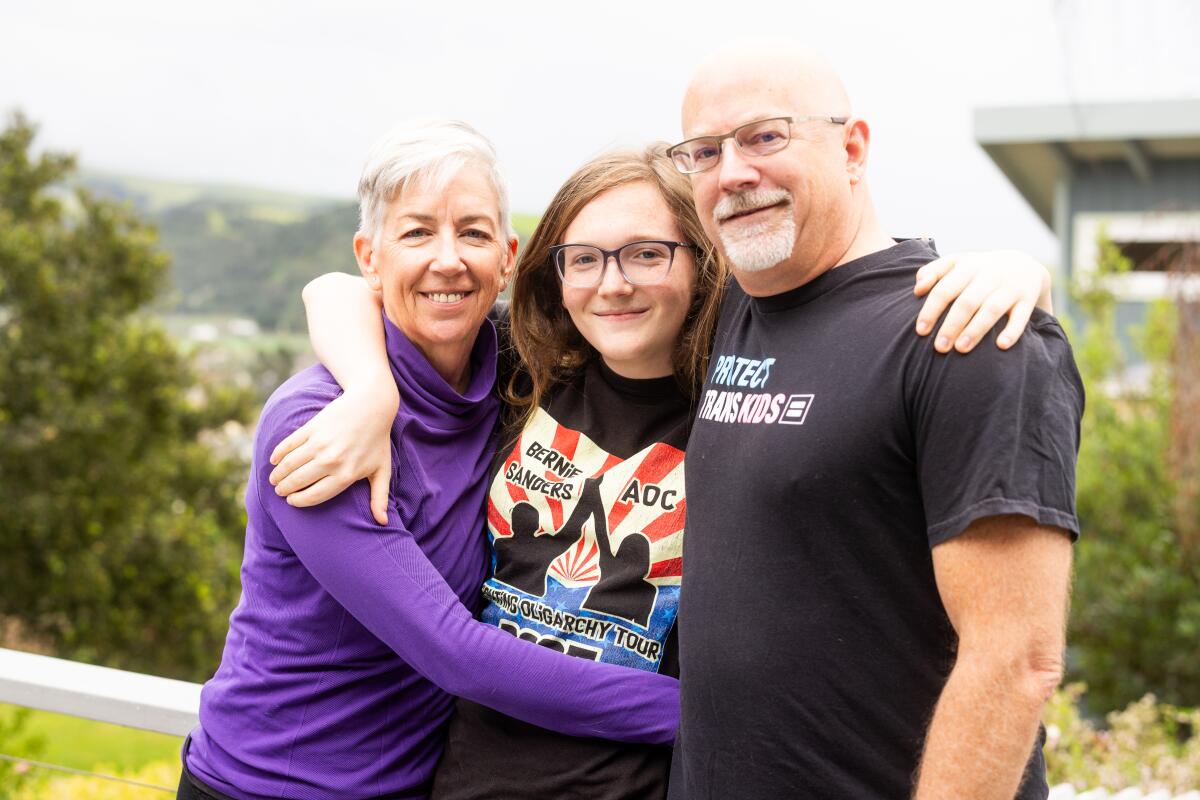
During the same meeting, Trevor Norcross, the father of 17-year-old transgender junior Lily Norcross, offered a starkly different perspective.
“Bathrooms and locker rooms are the most dangerous place for trans students, and when they are at their most vulnerable,” he said. “Our daughter goes to extreme lengths to avoid them. Unfortunately, sometimes you can’t.”

Lily Norcross with her parents, Trevor and Hilary Norcross.
(Owen Main / For The Times)
Norcross said Lily’s teammates had for months been misrepresenting a single moment from the year prior, when Lily had to use the restroom after a full day of avoiding it, chose to use the one in the locker room because it is monitored by an adult and safer for her than others, and briefly stopped to chat with a friend on her way out.
“There’s always more to the story,” he said.
The conflicting testimony reflected an increasingly charged debate over transgender athletes participating in youth sports nationwide. Churches, anti-LGBTQ+ advocacy groups, cisgender athletes and their conservative families are organizing to topple trans-inclusive policies, while liberal state officials, queer advocacy groups, transgender kids and their families are trying to preserve policies that allow transgender kids to compete.
The battle has been particularly pitched in California, which has some of the nation’s most progressive statewide athletic policies and liberal leaders willing to defend them — including from the Trump administration, which has attacked transgender rights and is suing the California Department of Education and the CIF, alleging their trans-inclusive sports policies violate the civil rights of cisgender athletes.
Along with a pending U.S. Supreme Court decision on the legality of policies banning transgender athletes from competing in states such as Idaho and West Virginia, the Trump administration’s lawsuit against California could have sweeping implications for transgender athletes — with a state loss potentially contributing to their being sidelined not just in conservative states, but nationwide.
For the handful of transgender California teens caught in the middle of the fight, it has all been deeply unnerving — if strangely motivating.
“I have to keep doing it, because if I stop doing sports, they won,” Lily Norcross said. “They got what they wanted.”
A coordinated effort
The movement to overturn California’s trans-inclusive policies is being coordinated at the local, state and national levels, and has gained serious momentum since several of its leaders joined the Trump administration.
At the local level, cisgender athletes, their families and other conservative and religious allies have expressed anger over transgender athletes using girls’ facilities and resentment over their allegedly stealing victories and the spotlight from cisgender girls.
In 2024, two girls at Martin Luther King High School in Riverside filed a lawsuit challenging the participation of their transgender track and field teammate Abigail Jones, arguing her participation limited their own in violation of Title IX protections for female athletes. A judge found insufficient evidence of that, and recently dismissed the case.
Last year, Jurupa Valley High School track star AB Hernandez won several medals at the CIF State Track and Field Championships despite President Trump personally demanding she be barred from competing. Critics argued Hernandez’s wins were unfair, despite CIF having changed its rules so that her cisgender competitors received the medals they would have received had she not competed.

AB Hernandez competed for Jurupa Valley High School in the long jump at the 2025 CIF State Track and Field Championships.
(Tomas Ovalle / For The Times)
The challenges to Abigail, AB and Lily competing have all been driven in part by a network of conservative organizations working across California and beyond to oust transgender girls from sports, including by coordinating with evangelical churches, pushing social media campaigns, lining up speakers for school board meetings and working with cisgender athletes to hone their messages of opposition.
Shannon Kessler, a former PTA president and church leader who is now running for state Assembly, has worked within the wider network. In March 2025, Kessler founded the group Save Girls’ Sports Central Coast, and the next month distributed fliers at Harvest Church in Arroyo Grande that called on parishioners to challenge Lily’s participation on the track and field team.
Kessler said the two seniors on Lily’s team, who did not respond to a request for comment, had initially asked if she would “speak on their behalf,” so she did, but she has since let the girls “take the lead.”
“They took the initiative to speak and wrote their own speeches,” Kessler said, of their remarks at the recent CIF meeting.
Norcross said the effort to sideline his daughter has clearly been coordinated by outsiders from the start. He blames Kessler, Harvest Church and the state’s wider network of conservative activists for stirring up baseless fears about transgender athletes, exposing his family to danger and leaving them no choice but to defend themselves publicly.
“It’s not a fair position to be in,” he said.
Tied up in court
Within months of Trump issuing his February 2025 executive order calling for transgender athletes to be barred from competition nationwide, two leaders within the California conservative network turned Trump administration officials — Harmeet Dhillon, who is now assistant attorney general for civil rights, and former state Assemblyman Bill Essayli, who is now in charge of the U.S. attorney’s office in Los Angeles — quickly moved to bring the state to heel.
They launched an investigation into California’s trans-inclusive sports policies, ordered its school districts to comply with Trump’s order in defiance of state law, and then sued the Department of Education and the CIF when they refused — alleging the state’s policies illegally discriminate against cisgender girls under Title IX by ignoring “undeniable biological differences between boys and girls, in favor of an amorphous ‘gender identity.’”
Neither Dhillon nor the Justice Department responded to a request for comment. Essayli’s office declined to comment.

Assistant Atty. Gen. for Civil Rights Harmeet Dhillon arrives for a news conference at the Justice Department in September.
(Andrew Harnik / Getty Images)
The Department of Education and the CIF have called for the lawsuit to be dismissed, arguing that Title IX regulations “do not require the exclusion of transgender girls” and that the Justice Department had provided no evidence that the state’s policies left cisgender girls unable to compete.
The CIF said in a statement that it “provides students with the opportunity to belong, connect, and compete in education-based experiences in compliance with California law,” but it and the Department of Education said they do not comment on pending litigation. California Atty. Gen. Rob Bonta’s office has slammed the Trump administration’s efforts, and filed its own lawsuit to block them.
Separate from the California litigation, there is a major case on transgender youth athletes before the U.S. Supreme Court.
After athletes successfully challenged West Virginia and Idaho bans on transgender competition in lower federal courts, the states appealed. During arguments last month, the high court’s conservative majority sounded ready to uphold the state bans — but not necessarily in a way that would topple liberal state laws allowing such athletes to compete.
Pressure and resolve
Lily, AB and Abigail — all of whom are referenced anonymously in the federal lawsuit against California — agreed, with their parents, to be identified by The Times in order to share how it has felt to be targeted.
Abigail, 17, graduated early and is preparing to start college but hasn’t stopped being an advocate for transgender high school athletes, continuing to show up to CIF and school board meetings to support their right to compete.
“This is a part of my life now, whether I like it or not,” she said.
Speaking can be intimidating, Abigail said, but it has also become familiar — as has the cast of anti-transgender activists who routinely show up to speak as well. “It’s always the same people,” she said.

Abigail Jones participates in a protest against President Trump and his attacks on transgender people in April in Riverside.
(Gina Ferazzi / Los Angeles Times)
AB, also 17, said last year — when everyone, including Trump, seemed to be talking about her — was “just so much — too much.”
She felt she had to constantly “maintain an image,” including among her peers, that she was “not bothered by anything and just confident,” which was exhausting, she said. “There were a lot of times I just didn’t go to school, because I felt like I couldn’t keep up that image and I didn’t want them to see me down.”
It still can be overwhelming if she looks at all the vitriol aimed her way online, she said, but “off the internet, it’s a completely different story.”
AB was nervous headed into last year’s championships, but a couple of other competitors reached out with their support and the meet ended up being “a blast,” she said. At track practice this year, she’s surrounded by friends — one of her favorite things about being on the team.
For Lily, the last year has been “different and interesting, in not really a good way.”
She has had slurs lobbed at her and been physically threatened. She sometimes waits all day to use the toilet, nearly bursting by the time she gets home. When she has to use a school restroom, she times herself to be in and out in under three minutes. She took P.E. courses over the summer in part because she felt there would be fewer students around, but faced harassment anyway. Like AB, she feels as though she’s under a constant spotlight.
And yet, Lily said she is also “a lot happier with who I am” than she ever was before transitioning a couple of years ago. She said she’s enjoying her classes and her school’s Gender and Sexuality Alliance, where LGBTQ+ kids gather at lunch to swap stories, and is optimistic about the future — even if things aren’t great right now.
Her dad said watching her come out and transition has been gratifying, because “the smile came back, the light in her eyes came back.” Watching her navigate the current campaign against her, he said, has been “really hard,” because “she has been forced to grow up too quickly — she has been forced to defend herself in a way that most kids don’t.”
Mostly, though, he’s just proud of his kid.
“We had our fears as parents, as any parent would, that, OK, this is a different path than we thought our kid was going to be on, and we are worried about her safety and her future in this world,” he said. “But she is amazingly strong — amazingly courageous.”

JSerra High’s Godschoice Eboigbodin is impressing in two sports
JSerra High has an athlete, Godschoice Eboigbodin, whose size and athleticism are earning rave reviews in two sports. People are calling him a “beast.”
The 6-foot-5, 260-pound junior played football for the first time last fall and was so impressive that college recruiters immediately became enamored with his potential.
Now in basketball, which he has much more experience playing, he continues to rise. He had 19 points and 15 rebounds Friday night when JSerra defeated Inglewood 103-91 to advance to the Southern Section Division 1 championship game.
There’s also his outgoing personality.
Early in the season, he was so aggressive he got into foul trouble. Now he’s in “basketball shape,” coach Keith Wilkinson said, and the Lions are surging with him and 6-9 Ryan Doane combining their talents inside.
Eboigbodin also can make free throws, so when opponents foul him, he can take advantage.
Football still looks like his future sport in college, but he’s sure having fun playing basketball.
This is a daily look at the positive happenings in high school sports. To submit any news, please email eric.sondheimer@latimes.com.

Palestine Action activists reunited with family after granted bail | Genocide
Twelve Palestine Action activists, including hunger strikers, who were charged with breaking into the British site of an Israeli-linked defence firm, reunited with their families outside London’s Central Criminal Court after they were granted bail on Friday.
Published On 22 Feb 2026

What to do when your daughter brings home a bad boy
TEENAGE daughter brought home a slouching yob with a leather jacket riding a 125cc scooter like it’s a Harley? Want to end their misbegotten relationship ASAP? Here’s how:
Pretend to like him
Nothing will dim the appeal of this iconoclastic rebel more than boring old dad’s approval. Invite him to sit down for a single malt. Get him telling his most outrageous anecdotes and reply with stories from your own wild youth, emphasising how dull you’ve become. Your daughter’s lust for him will slowly be replaced by a feeling of sick revulsion.
Dig the dirt
He’ll have a shady past and today’s youth live half of it online, so enlist the help of your most Insta-obsessed friend and get digging. If you find a drug-dealing criminal record, conceal it. You’re looking for footage of him singing Circle of Life with his school choir, his abandoned Warhammer-painting YouTube channel, or an Ed Sheeran stan Twitter.
Get into his music
He’ll have to be into something transgressive and shit, so find out what and start listening to it. It’s on Spotify, it doesn’t cost anything. Your daughter will secretly hate it already so will be dismayed to come home and find you’re also blasting Tyler, The Creator on the kitchen Bluetooth. ‘Sick beats,’ you’ll nod, effortlessly tarnishing his cool.
Offer lifts
Dating a bad boy means hanging out with his equally monosyllabic mates in their filthy flats for hours on end. Occasional texts mentioning you’re at a nearby Sainsbury’s if she needs picking up will prove irresistibly tempting when the alternative is another four hours of black metal, Xbox and cans of Carling. ‘It’s my dad, he’s ordering me home,’ she’ll lie.
Pay him off
He’s living outside morality, the law and boring bourgeois notions of working for a living, so he’ll take any bribe. Tell him you’ll give him a grand to end it and his greedy little counterculture eyes will turn to dollar signs at the thought of the tattoo he can now afford. Then don’t pay him. Who’s the bad boy now?
Move house
Drastic, but on balance worth it. 50 miles or so should do it, then learn in horror that’s where he’s been driving from and you’re actually nearer his home, because he’s the kind of bad boy whose parents are richer than you. That black tinted-window BMW will be parked on your new drive before you’ve finished unpacking.

Attackers kill dozens, abduct women and children in Nigeria
Dozens are reported to have been killed and women and children abducted after armed men attacked a village in Nigeria.
Source link

Death in Paradise star Ardal O’Hanlon says ‘I miss him’ in emotional confession
Former Death in Paradise star Ardal O’Hanlon has opened up about his time on the BBC crime drama

Ardal O’Hanlon left Death in Paradise in 2020(Image: ITV screengrab)
Ardal O’Hanlon has revealed how much he misses former co-star Don Warrington since his departure from Death in Paradise.
The comedian and actor, who portrayed DI Jack Mooney in the popular BBC crime drama, exited the show in 2020 after a three-year stint, reports the Express.
During an appearance on ITV’s Love Your Weekend with Alan Titchmarsh on Sunday (February 22), he reflected on his time on the series after Alan asked whether it had been “emotional” to leave the island and long-time co-star Don, who portrays Commissioner Selwyn Patterson.
“He’s just brilliant, he’s brilliant,” Ardal enthused. “I miss him more than anything, actually. I loved Don and we’re still very good friends, but yeah that was kind of a bromance actually.”
He continued: “It always starts off the new detective and you know very, very wary around the inspector but eventually the inspector softens by the end.”
Although the programme is set on the fictional Caribbean island of Saint Marie, most of the filming takes place in Guadeloupe.
The star said he did “love it” but also acknowledged it was “a commitment”, as it involved being away for months of the year for filming.
“I’m kind of in one way glad I don’t have to do it now because it’s like, it’s gruelling, but I look back at it very fondly,” he shared. “It was just a great adventure apart from anything else, as well as being like a, you know, a challenging acting job.”
He also shared how he enjoyed having a variety of different actors join the cast every few weeks.
“All these great great people… these people I adored,” he said. “And then you’d also get the hot shots, the up-and-coming people who have gone on to Hollywood now. We got them raw.”
Ardal, who is also known for his portrayal of Father Dougal McGuire in Father Ted, went on: “Because you take great pride in the island, because I’ve been there for a few years and you get to love it and you can’t wait to show it off to them.
“So on the rare days off you’d bring them to some waterfall that only you know about or some boiling hot part of the sea like, right where the volcano heats the water, you know, that side of it I really, really loved.”
For the latest showbiz, TV, movie and streaming news, go to the new **Everything Gossip** website.
Ensure our latest headlines always appear at the top of your Google Search by making us a Preferred Source.** Click here to activate**** or add us as your Preferred Source in your Google search settings.**
Death in Paradise broadcasts on the BBC and Love Your Weekend with Alan Titchmarsh is on ITV.

California governor candidates pitch Democrats at convention
SAN FRANCISCO — It was speed dating: Eight suitors with less than four minutes each, pitching the woo to thousands of Democratic Party faithful.
The race for California governor has been a low-boil, late-developing affair, noteworthy mostly for its lack of a whole lot that has been noteworthy.
That changed a bit on a sunny Saturday in San Francisco, the contest assuming a smidgen of campaign heat — chanting crowds, sign-waving supporters, call-and-response from the audience — as the state party held its annual convention in this bluest of cities.
Delegates had the chance to officially endorse a party favorite, providing a major lift in a contest with the distinct lack of any obvious front-runner. But with an overstuffed field of nine major Democratic contenders — San José Mayor Matt Mahan was said to have entered the contest too late for consideration — the vote proved to be a mere formality.
No candidate came remotely close to winning the required 60% support.
That left the contestants, sans Mahan, to offer their best distillation of the whys and wherefore of their campaigns, before one of the most important and influential audiences they will face between now and the June 2 primary.
There was, unsurprisingly, a great deal of Trump-bashing and much talk of affordability, or rather, the excruciating lack of it in this priciest of states.
The candidates vied to establish their relatability, that most valuable of campaign currencies, by describing their own hardscrabble experiences.
Former Los Angeles Mayor Antonio Villaraigosa — the first speaker, as drawn by lot — spoke of his upbringing in a home riven by alcoholism and domestic violence. State Supt. of Public Instruction Tony Thurmond described his childhood subsistence on food stamps, free school lunches and surplus government cheese.
Former state Controller Betty Yee told how she shared a bedroom with four siblings. Katie Porter, the single mom of three kids, said she knows what it’s like to push a grocery cart and fuel her minivan and watch helplessly as prices “go up and up” while dollars don’t stretch far enough.

Michele Reed of Los Angeles cheers at the state Democratic Party convention.
(Christina House/Los Angeles Times)
When it came to lambasting Trump, the competition was equally fierce.
“His attacks on our schools, our healthcare and his politics of fear and bullying has to stop now,” Villaraigosa said.
Rep. Eric Swalwell (D-Dublin) called him “the worst president ever” and boasted of the anti-Trump battles he’s fought in Congress and the courts. Xavier Becerra, a former California attorney general, spoke of his success suing the Trump administration.
Porter may have outdone them all, at least in the use of profanity and props, by holding up one of her famous whiteboards and urging the crowd to join her in a chant of its inscription: “F—- Trump.”
“Together,” the former Orange County congresswoman declared, “we’re going to kick Trump’s ass in November.”
Porter was also the most extravagant in her promises, pledging to deliver universal healthcare to California — a years-old Democratic ambition — free childcare, zero tuition at the state’s public universities and elimination of the state income tax for those earning less than $100,000.
Unstated was how, precisely, the cash-strapped state would pay for such a bounty.
Former Assemblyman Ian Calderon offered a more modest promise to provide free child care to families earning less than $100,000 annually and to break up PG&E, California’s largest utility, “and literally take California’s power back.” (Another improbability.)
Becerra, in short order, said he was “not running on inflated promises” but rather his record as a congressman, former attorney general and health secretary in President Biden’s cabinet.

Rachel Pickering, right, vice chair of the San Luis Obispo County Democratic Party, stands with others wearing pins supporting Democratic causes at the party’s state convention.
(Christina House/Los Angeles Times)
It was one of several jabs that could be heard if one listened closely enough. (No candidate called out any other by name.) “You’re not going to vote for a Democrat who voted for the border wall, are you?” Thurmond demanded, a jab at Porter who supported a major funding bill that included money for Trump’s pet project.
“You’re not going to vote for a Democrat who praises ICE, are you?” Thurmond asked, a poke at Swalwell, who thanked the department for its work last year in a case of domestic terrorism.
“You’re not going to vote for a Democrat who made money off ICE detention centers,” Thurmond went on, targeting Tom Steyer and his former investment firm, which had holdings in the private prison industry.
Yee seemed to take aim at Mahan and his rich Silicon Valley backers, suggesting grassroots Democrats “will not be pushed aside by the billionaire boys club that wants to rule California.”
The barb was part of a full-on assault on the state’s monied class, which includes Steyer, who made his fortune as a hedge fund manager.
In a bit of billionaire jujitsu, he sought to turn the attack around by saying his vast wealth — which has allowed him to richly fund his political endeavors — made him immune to the blandishments of plutocrats and corporate interests.
“Here’s the thing about big donors,” Steyer said. “If you take their money, you have to take their calls. And I don’t owe them a thing. In a world where politicians serve special interests, I can’t be bought.”
There were no breakout moments Saturday. Nothing was said or done in the roughly 35 minutes the candidates devoted to themselves that seemed likely to change the dynamic or trajectory of a race that remains stubbornly ill-defined and, to an unprecedented degree in modern times, wide open.
And there was certainly no sign any of the gubernatorial candidates plan to give up, bowing to concerns their large number could divide the Democratic vote and allow a pair of Republicans to slip through and emerge from California’s top-two primary.
But for at least a little while, within the confines of San Francisco’s Moscone Center, there was a glimmer of a life in a contest that has seemed largely inert. That seemed a portent of more to come as the June primary inches ever closer.

Prep softball preview: Norco looks for a repeat performance
There is an adage in sports that it is harder to defend a championship than to win it. That is the challenge that coach Rick Robinson and the Norco High softball team face this season, but the Cougars have the skill to make a run at back-to-back titles after winning 29 of 32 games en route to the Southern Section Division 1 crown last spring.
Robinson entered the 2026 campaign with 728 career wins and has added three to that total as his team won its own showcase last week at Big League Dreams in Chino Hills.
In the final, junior pitcher Coral Williams fanned 11 Orange Lutheran batters in a 2-1 victory, picking up where she left off last spring when she was named the Southern Section Division 1 player of the year after going 17-0 with 10 complete games, a 0.59 earned run average and 147 strikeouts while giving up only nine earned runs in 106 innings. In the semifinals, Oklahoma State signee Peyton May threw a no-hitter and struck out 12 in an eight-inning 3-0 win against Aliso Niguel. She was 10-3 last year with a 1.49 earned run average and 132 strikeouts in 80 innings.
Offensively the Cougars are led by junior shortstop Leighton Gray, a Texas A&M commit who was All-Southern Section as a sophomore after batting .435 with 40 hits, eight home runs and a 0.793 slugging percentage. Add to the mix London Potter, who follows in the footsteps of sisters Riley and Dakota (Norco alums now playing at Quinnipiac and South Carolina, respectively) and catcher/first baseman Camryn May, Peyton’s younger sister.
Since taking over the program in 2000, Robinson has guided Norco to section titles in 2003, 2009, 2012, 2015, 2018, 2019 and 2025 (all but the first in the top division). He also won the Division IV title in 1996 in the second of his five years at Corona Centennial —giving him a Southern Section record of eight.
Among the teams capable of dethroning Norco is Orange Lutheran, No. 2 behind the Cougars in Cal-Hi Sports’ preseason Southland top 20 rankings. The Lancers will miss star center fielder Kai Minor (now an Oklahoma Sooner) but returning are second baseman Sierra Nichols (40 hits), shortstop Madelyn Armendariz (32 hits, 29 RBIs) and pitching aces Rylee Silva (135 strikeouts as a freshman) and UCLA signee Jo Marsh.
Battling the Lancers for Orange County supremacy could be Trinity League rival JSerra, which is off to a 2-0 start behind Florida-bound pitcher Liliana Escobar and sophomore sensation Annabel Raftery, who led the team with 36 hits, 21 RBIs and five homers a year ago.
Sherman Oaks Notre Dame has one of the section’s best all-around players in Oklahoma State commit Aliyah Garcia and starts out as the team to beat in the San Fernando Valley. The senior pitcher/shortstop had one run, two hits, an RBI and drew two walks while recording five strikeouts in three innings in the Knights’ season-opening win.
Fullerton has one of the most formidable one-two pitching combos in California Baptist commit Katelynn Mathews and Analise Barrios (both also play second base). Mathews had a 15-3 record with 185 strikeouts in 115 1/3 innings and Barrios had a 0.72 earned run average last season when the Indians won 21 games and played Norco tough in the third-place game of the Michelle Carew Classic in April. Utah State-bound outfielder Hayley Brock batted .393 with 38 hits and 24 RBIs.

Fullerton pitcher Analise Barrios compiled a 0.72 earned run average as the Indians went 21-8 last season.
(Steve Galluzzo / For the Times)
Despite its loss to Norco in the second round of the playoffs a year ago, Oaks Christian is the cream of the crop in Ventura County as most of its key contributors are back — Utah State-bound shortstop Gianna Garcia, Brigham Young-bound outfielder Terrianna Kelley (33 hits, 27 RBIs, nine doubles, five homers and a .750 slugging percentage in 2025); shortstop Trystyn Crutcher, pitcher Sophia Debs, outfielder Reagan Beck and catcher Giabella Otani.
Other Southern Section programs that should continue their success from last year include Division 1 runner-up El Modena and semifinalist Temescal Canyon, Division 2 champion Los Alamitos and Division 3 champion Marina as well as La Mirada, Ayala, Chino Hills and Long Beach Poly.
In the City Section, Granada Hills finished 28-3 last season and beat nemesis Carson 11-2 in the Open Division final behind player of the year Addison Moorman (now a freshman at Lehigh) but back to help the Highlanders defend their title are All-City senior co-captains Zoe Justman (who slugged .802 as a junior) and Elysse Diaz (47 hits, 12 doubles, seven stolen bases and an .865 slugging percentage).
Players to watch
Name; School; Year; Position
Coral Willams; Norco; Jr.; Pitcher
Leighton Gray; Norco; Jr.; Shortstop
Emoni Lam Sam; LB Poly; Sr.; Third Base
Kale’a Tindal; Harvard-Westlake; Sr.; Outfield
Aliyah Garcia; Notre Dame; Sr.; Pitcher/Shortstop
Rylee Silva; Orange Lutheran; So. Pitcher
Katelynn Mathews; Fullerton; Jr.; Pitcher
Dailynn Battee; Etiwanda; So.; Third Base
Mia Valbuena; Marina; Sr.; Pitcher
Alison Ortega; La Mirada; Jr.; Pitcher
Koa Puppe; Bonita; Jr.; Third Base
Terrianna Kelley; Oaks Christian; Sr.; Outfield
Annabel Raftery; JSerra; So.; Catcher
Alivia Magallanes; Los Alamitos; Sr.; Outfield
Bree Carlson; Huntington Beach; Jr.; First Base
Nia Hall; Temescal Canyon; Jr.; Third Base
Brett Lambrecht; Chino Hills; So.; Utility
Eliana Corona; La Habra; So.; Catcher
Zoe Justman; Granada Hills; Sr.; Utility
Ashannalee Titialii; Carson; Sr.; Shortstop

Zoe Justman slugged .802 to help Granada Hills claim the City Section Open Division title last season.
(Steve Galluzzo / For The Times)