





Former Trump press secretary Karoline Leavitt joins Fox News
Karoline Leavitt, the tenacious former Trump White House press secretary, is joining Fox News as a contributor.
The network announced Monday that Leavitt, 29, known for her rapid-fire defense of Trump’s policies in the White House briefing room, will be delivering commentary and analysis across Fox News programs starting Nov. 1.
Leavitt joins a long line of former White House secretaries who have made the jump to TV news punditry. Her predecessor Kayleigh McEnany is a co-host on the daytime Fox News chat show “Outnumbered” and hosts her own Saturday program.
Jen Psaki, landed her own program on MS NOW in 2023 after two years behind the briefing room lectern for President Biden.
Leavitt joins Fox News at a time when President Donald Trump has been irritable over negative press coverage as his favorability ratings with the public are at an all-time low. He briefly banned CNN, MS NOW and Politico from the White House until a federal judge stepped in.
Trump has complained about Fox News coverage as well, although the opinion hosts on the conservative-leaning network have continued to defend him. Leavitt will likely give the president another robust advocate on the channel he often watches.
Trump has hired Fox News personalities for his cabinet as well, naming former weekend host Pete Hegseth as his defense secretary and Jeanine Pirro, a one-time co-host of “The Five,” as U.S. Attorney for the District of Columbia.
“Karoline’s first hand experience in the White House and on the presidential campaign trail gives her a distinct understanding of today’s political landscape,” Fox News Media Chief Executive Suzanne Scott said in a statement.
Leavitt served in Trump’s second administration from Jan. 2025 until Aug. 2026. She was the youngest person in American history to hold the White House press secretary position. She departed her role after returning from maternity leave, saying she would continue to promote the Republican party and the issues important to Trump’s MAGA followers.
Prior to joining the White House, Leavitt served as national press secretary for Trump’s 2024 presidential campaign. She ran for Congress in her home state of New Hampshire in 2022 and served as communications director for then-House Republican Conference Chair Rep. Elise Stefanik (R-NY).
Leavitt also served as an assistant White House press secretary during Trump’s first term.
In her time as press secretary, Leavitt created a “new media” briefing room seat, often filled by conservative commentators and pro-Trump social media influencers.

Jesus fires back over Ronaldo question
Portugal manager Jorge Jesus fires back at a question from the media over his handling of Cristiano Ronaldo after the veteran forward left the squad in a row over playing time.
Source link

Two dead after ship sinks off Romania following fire | News
Two crew members died and 11 were rescued after a fire broke out aboard the Turkish-owned Royad Mammadov in the Black Sea. Ukrainian president Volodymyr Zelenskyy said Russian drones caused the fire, but Romanian authorities did not comment.
Published On 5 Oct 2026

I got free tickets to top UK festivals for YEARS with extra perks
TEENAGE years were often consumed by the excitement of planning which festival to go to, met by the disappointment of not being able to afford (or even able to get) a ticket.
Fortunately, there is a way to get free festival tickets even as a now-adult.
Volunteering might remind you of litter picking in parks, but it looks a whole lot different at festivals.
With Oxfam, you can volunteer across a number of different roles while getting a free ticket to the festival.
Having done a number of festivals with the charity I can safely say that it is a lot more fun than you’d think, AND you get other great perks as well.
The role with the most positions available is to be a steward – you’ll carry out a range of roles across three eight-and-a-quarter- hour shifts including checking tickets on the gate, patrolling campsites or the arena and staffing accessibility platforms.
Read more on travel inspo


You will get all the training you need, as well as a meal voucher for every shift, free tea and coffee, crew camping (read, quieter campsites), hot showers and free phone charging.
Applications for the positions open in the new year and are served on a first-come first-served basis.
You will need to fork out the ticket price upfront but this essentially acts as a deposit to ensure you show up to your shifts – you will then get it back four weeks after the festival.
You will also need to be 18-years-old or over to volunteer by the time you arrive onsite.
Other roles include campaigning, which requires four, six-hour shifts ending before headline acts, and shop volunteers to run festival shops, with one six hour shift a day.
For the latter role, you will need to be a current shop volunteer, intern or member of Oxfam staff with at least three months of experience.

But in reality what does the work actually look like?
For my first festival, I volunteered at NASS although this sadly no longer runs.
As a smaller festival in the UK, I was only required to do two shifts and these both consisted of checking tickets into the festival – one on arrival day and another for second day arrivals.
It meant I missed NOTHING – not a single act.
Both my shifts were finished before music even started, which meant I had enough time to nip back to the spacious campsite with hot showers and freshen up before going and singing my heart out as Loyle Carner performed just metres from me.
The other festivals I volunteered at were much bigger and are household names – Boardmasters in Cornwall and Reading Festival.
Staff camping at Reading was a decent walk from the main arena and while that meant it was a bit of a pain to just ‘nip’ back to your tent, it did mean that I was away from ALL noise.
The campsite is spacious, peaceful, empty of drunken festivalgoers and has its own toilet block – which were actual toilets with no stench.
When I saw the toilets in the main campsites, I realised how appreciative I was of swapping some hours of my time for a free festival ticket.
I slept soundly each night with no thumping music or rowdy people around me.
As for my shifts at Reading, one of my three, eight-hour shifts was spent checking tickets on the first arrival day – before the festival had even properly started.
My second shift was patrolling campsites during the daytime, before any major acts were on.
And my third shift? Being right in the pit as Sea Girls played, handing out water to festival-goers.
None of these tasks, other than perhaps standing in the blazing sun, are strenuous and shift leaders are great at constantly making sure you have water as well as regular time in the shade if your shift involves being in the direct sun.
What is volunteering at Glastonbury like?

DEPUTY Travel Editor, Kara Godfrey has previously volunteered at Glastonbury Festival with Oxfam and here are her thoughts:
I am not a festival-goer – camping on the cold hard ground, traipsing through the inevitable mud and don’t get me started on refusing to use anything other than a standard, private bathroom.
And then being made to pay at least £400 just to be allowed in the gates? I never saw the appeal.
However, when I did work Glastonbury with Oxfam, I was very much converted.
Early access, so a more laidback first day without the huge crowds, three meals a day without having to pay extortionate amounts, and, of course, much nicer toilets and showers.
Being able to charge my phone and have a much quieter campsite – it felt like glamping without the cost.
The only downside was the shift patterns. I was on ticket checking duty, and you had to do a day, afternoon and overnight shift.
You in theory could swap with people, but good luck trying when there was a big performer (I was there the year of Dolly Parton).
But as long as you aren’t going just for one act, I had the best time hanging with my fellow Oxfam crew as we played our own party tunes at the entrance, shared snacks – and laughed our heads off at all the men dressed up as good ol’ Dolly herself.
Oh, and it barely cost me a penny once my ticket costs rolled back into my bank account. Win win!
Across these three shifts I only missed one act I wanted to see.
And last but not least, Boardmasters was a similar story – one of my three eight-hour shifts was spent checking tickets before the festival began, another was a day shift campsite patrolling and the third was an overnight campsite shift.
Again, with these I missed no acts I wanted to see and while the final overnight shift was tiring (and cold), it involved standing and sitting at the entrance to a campsite answering questions… hardly hard work.
Across all shifts you get a half hour break as well as a meal token which you can use at selected vendors across the festival.
These often include gourmet burger joints and pizza vans, so there is plenty of choice.
Depending on what festival you are at, you might get actual shower and toilet blocks too, a communal area on your campsite and quite often other goodies like free Coca-Cola from brand sponsors walking the festival ground.
There are other companies and charities you can go through for festivals too, such as Hotbox Events, My Cause UK and Festaff.
Though, I wouldn’t look further than Oxfam – everyone is there to have a good time and thanks to not having to pay a penny and camping with more space, I’d say I was happier than most paying festivalgoers each time I volunteered.
Latest US military strike on alleged drug boat kills four in Caribbean | News
The latest attack brings the death toll from US military boat strikes to at least 235 from 70 maritime strikes across the region.

Published On 5 Oct 2026
The United States has conducted another strike on an alleged drug trafficking boat in the Caribbean, killing four, according to the US military.
US Southern Command said late Sunday that it struck alleged drug traffickers operating along “established narco-trafficking routes” in the eastern Pacific and Caribbean, following its standard reporting pattern for military operations of suspected cartels across the multinational maritime zones.
The latest attack brings the death toll from US military boat strikes to at least 235 deaths across 70 attacks, since the administration of US President Donald Trump first launched its counter-narcoterrorism campaign, termed Operation Southern Spear, in September of last year.
At the time, Trump characterised the fight against cartels in Latin America as an active “armed conflict” while defending the strikes as a necessary escalation to curb illicit drug trafficking and reduce fatal US overdoses.
The move comes as United Nations experts warn that the strikes violate international law and could amount to crimes against humanity.
Despite releasing footage on X showing the explosion that destroyed the moving vessel, the US military has offered no evidence that the targeted boat was ferrying drugs.
The Trump administration has been actively seeking regional security agreements across Latin America to expand joint military operations against what it has designated as criminal cartels. The deals come under the US-led Shield of the Americas coalition, launched in March. The president has pledged the undertaking will use “unmatched military might” to dismantle drug cartels while simultaneously countering Chinese economic influence in the Western Hemisphere.
During a visit to Panama in August, Defense Secretary Pete Hegseth announced that Colombia, Guatemala and Honduras had agreed to joint counter-crime military operations on their soil, a statement Guatemala quickly disputed to clarify its sovereignty and boundaries within the 19-member alliance.

Jim Davidson, 72, dating Simon Cowell’s ex, 60, just weeks after cancelling sixth wedding to 23-years-younger fiancee
JIM Davidson has reportedly found love once again with Maria Rice-Mundy, a beauty pageant queen who previously dated Simon Cowell.
It comes just a month after the comedian and former Celebrity Big Brother star, 72, split from his fiancée and called off their planned nuptials.
In September, The Sun revealed how Jim had cancelled his wedding – which was set to be his sixth time tying the knot – to partner of three years Natasha, who is 23 years his junior.
But back on the dating horse already, Jim is said to have been seeing new partner Maria, 60, for “a few weeks”.
A source told The Daily Mail: “Jim’s already fallen big time and posted a picture of her on his Facebook.
“They’ve been on a few dinner dates and she’s very giggly around him. Jim doesn’t mess about when it comes to the ladies.”


The Sun has reached out to Jim’s representative for comment.
Maria, a mum of two, dated music mogul Simon Cowell back in the 1980s.
Jim has been married five times and it was set to be six before he called off his wedding to ex Natasha.
The pair were set to wed at Hampton Court Palace – the home of home of Henry VIII – and lost their £10k deposit when they jilted.
Speaking to The Sun in September, Jim revealed: “There’s no bad blood. Natasha is the most caring and dutiful person.
“It’s not like we’re splitting up because we don’t love each other anymore.
“It’s a sort of a grown-up separation. The timing’s not right because she has so much time for everybody and how can you knock that?”
He added at the time: “We still speak every other day, but whether we’ll ever find room to see one another again, I don’t know.
“She is very dutiful. She puts family first. And of course she has three children and now a grandson as well.
“She is just so busy and so I’m very busy as well.”
Dad-of-five Jim met Natasha, who is 23 years his junior, at the Southampton Boat Show in 2023 soon after the breakdown of his fifth marriage.
It was shortly after his split from fifth wife Michelle Cotton, whom he was with for 14 years.
Jim first married his childhood sweetheart Sue Walpole back in 1971, but the union lasted just a year.
He then went on to wed Julie Gullick in 2981, before they divorced in 1986.
TV presenter Alison Holloway was next, but she only stayed married to Jim for two years.
His fourth wife was Page 3 model Tracy Hilton, and they were together for ten years.
Jim’s most recent marriage – before getting engaged to Natasha – was Michelle, whom he married in 2009 and split from in 2023.

DHS buys three detention centers in California for $950 million
WASHINGTON — The Department of Homeland Security has purchased three immigrant detention facilities in Adelanto for $950 million, according to the private prison corporation that sold them.
The sale by the GEO Group, a Florida-based government contractor, follows an initial $1.5-billion sale over the summer of two other California detention facilities by GEO’s competitor, CoreCivic of Tennessee.
The facilities owned by GEO Group include the 1,280-bed Adelanto West ICE Processing Center, the 660-bed Adelanto East ICE Processing Center and 704-bed Desert View Annex.
In total, the federal government has now spent nearly $3.2 billion on detention facility purchases, the majority of them in California. CoreCivic sold off two other facilities, in Minnesota and Kansas, in August.
The sales were made possible by an infusion last year of $45 billion for immigration detention from President Trump’s One Big Beautiful Bill Act.
In its announcement, GEO Group sad it will continue managing daily operations at the facilities under the company’s existing contract with U.S. Immigration and Customs Enforcement, which is effective through Dec. 19, 2034.
The company said it is engaged in an “active process” with Homeland Security for the potential sale of multiple other facilities. Those sales hinge on GEO Group’s ability to continue managing those facilities under long-term contracts, the company wrote.
“We are pleased with the completion of these important asset sales to the U.S. federal government, and we look forward to continuing to provide high-quality secure support services under our existing long-term contracts with ICE,” George C. Zoley, the company’s CEO, wrote in a news release.
“We are proud of our 40-year public-private partnership with ICE, and we stand ready to continue to assist the federal government in meeting its immigration enforcement priorities,” Zoley added.
During a shareholder call in August, Zoley said ICE was contemplating buying more than 10 facilities, and that number “could continue to grow.”
“We believe we have two types of assets: the buildings and the businesses of providing support services,” he said on the call. “We are pursuing a potential sale of the buildings, but we want to retain the business. We consider ourselves primarily a support services operator, and will place particular importance on our ability to continue our support services at any facility sold to ICE.”
GEO Group said it anticipates receiving $705 million in proceeds from the sales, after taxes and transaction fees. The company wrote that net proceeds will reduce the company’s debt and facilitate the repurchase of company shares.
This story will be updated.

A host of ethical concerns are engulfing high school sports
Hi, and welcome to another edition of Prep Rally. I’m Eric Sondheimer. Football forfeits have been happening. Athletic directors and coaches have been scrambling to make sure players are eligible and parental paperwork is accurate. That’s just a small part of the ethical dilemmas taking place in the high school sports world.
Let the debate begin on ethics
Nobody likes to be told what to do. Nobody likes to be told they are wrong. Nobody likes bureaucracy because it moves slowly. Everybody likes to find shortcuts and to be told they are right. It’s almost a daily experience working in the high school sports world, figuring out ethical dilemmas and how to proceed.
Coaches are supposed to tell their players every season that hazing is wrong and won’t be tolerated. Then hazing happens, and the coach is the one held accountable, sometimes even losing their job.
There always are internal politics at play. A winning coach will be treated differently from a losing coach. That’s a fact. In my job as a sportswriter, I’ve been monitoring decisions on ethics for decades. I was around when the California Interscholastic Federation adopted lessons from the influential Michael Josephson, who created the Character Counts coalition. Awards continue to be given out to those who hold their ground and choose the ethically right decision to make.
Do you go out and check the address of transfer student or trust the paperwork submitted? Do you report another team using an ineligible player immediately or hold it back until right before the playoffs, causing the entire team to lose out on the playoffs because of forfeits?
Here’s a look at some of the challenges.

Tahj Skinner of Sherman Oaks Notre Dame accounted for four touchdowns — throwing for three and returning an interception for another— in a 28-21 win over Chaminade.
(Craig Weston / For The Times)
Tahj Skinner of Sherman Oaks Notre Dame intends to play safety for UC Davis. But he’s been doing such a fantastic job playing quarterback for the unbeaten Knights that being a wildcat quarterback could be in his future. He had three touchdown passes and returned an interception for a touchdown in a win over Chaminade. Here’s the report.
In a battle of very good defenses, Santa Margarita defeated Mater Dei 14-7. Here’s the report.
Another week, another historic win for unbeaten Cleveland in the City Section. The Cavaliers defeated longtime power Birmingham 14-9 in the West Valley League opener. Here’s the report.
In a battle of unbeaten teams, Corona del Mar got past Villa Park, 24-10. Here’s the report.
Granada Hills Kennedy (6-0) has won 20 consecutive Valley Mission League games.
Ceasar Reyes of Garfield continues to pile up rushing yards. He had 374 yards in 39 carries and scored five touchdowns in a 42-28 win over Bell. He‘d better bring doughnuts to his offensive linemen on Monday mornings.
Quarterback Shawn Sanders of Paracete had a game for the ages in a 56-36 win over St. Paul. He was 14 for 15 passing for 205 yards and two touchdowns. He rushed for 188 yards and two touchdowns. He kicked seven PATs and seven balls into the end zone for touchbacks. Did he bring out the water bottles too?
Corona Centennial has nine players in its football program with variations of the same first name. Here’s the report.
Here are this week’s top 25 rankings by The Times.
Here’s a look at top individual performances from the past week.
Here’s the schedule for this week’s games.
Here are this week’s top 10 rankings by The Times.
One of the great teams from the 2026-27 school year is going to end up being JSerra flag football. The Lions won the Southern Section Division 1 title last season and are even better this season with 21 consecutive victories. If any opponent gets close, that will be news.
You need to go watch the duo of quarterback Kate Meier and receiver Tessa Russell.
Carson has taken over as No. 1 in the City Section.
Girls’ volleyball
There’s a clear pecking order in the Southern Section. Mater Dei and Sierra Canyon have been the top teams all season. Mira Costa, Los Alamitos and Marymount are right behind.
Here are the latest Southern Section rankings.
Sierra Canyon, at 26-1, plays host to Marymount on Tuesday in a huge Mission League matchup.
Venice, Cleveland, Palisades and Chatsworth hold down the top spots in City Section rankings.
Notes…
Left-handed pitcher Joe Bell of La Cañada has committed to the Naval Academy….
Pitcher Ricky Aguilar from Gahr has committed to Cal State Bakersfield….
Sean Compton of Bonita has committed to play baseball at UC Riverside….
Offensive lineman Adam Fogleson of Mater Dei has committed to UC Davis….
Junior softball standout Scarlett LaBriola of Santa Margarita has committed to Stanford….
Junior softball standout Anna Plotke of Santa Margarita has committed to Maryland….
Gunner Welch is the new boys’ volleyball coach at Campbell Hall….
Senior basketball guard Cole Holden from Harvard-Westlake has committed to UC Riverside….
Defensive back Dean Gibson from Corona Centennial has committed to San Diego….
Leah Reynolds of Bonita has committed to play softball at Colorado State…..
Junior catcher Annabel Raftery of JSerra has committed to Stanford for softball….
It’s strange times at Van Nuys High, where baseball coach Andres Sepulveda was dismissed for building an illegal batting cage. The softball program also faces scrutiny for an unapproved fence and dugouts…
Yorba Linda’s football team has been forced to forfeit four victories, which means its record is 0-6 and making the playoffs would require earning an automatic berth from the Alpha League. The school district indicated there were violations involving bylaws 503.B (1) and 510, which involve administrative oversight and undue influence….
Todd Therrien, a former football coach at St. Bonaventure who won two state Division III championships, died on Sept. 30, the Ventura County Star reported. He was 47. He recently had a stroke and was a quadriplegic after a spinal cord injury from a car accident in 2022. He succeeded Jon Mack in 2007….
Newport Harbor is No. 1 in the first Southern Section boys’ water polo rankings….

Freshman Emiliano Plascencia of Whitter has more than 100 goals for his water polo team this season.
(Los Angeles Times)
Whittier has a freshman water polo player scoring goals in bunches. Here’s the report. …
JSerra made it to the championship game in water polo at the Elite 8 tournament before losing to Cathedral Catholic….
The Southern Section football playoff pairings will be announced on Sunday, Nov. 1 at 10 a.m. That’s also the end of daylight savings time when the clocks move back one hour, so no sleeping in for coaches, parents or players….
The Luderer twins, Keira and Kelsey, from Sherman Oaks Notre Dame committed to Florida State for softball. Here’s the report….
Chaminade has begun construction of a $66-million project that will include new baseball and softball diamonds. Here’s the report.
From the archives: Jamie Dixon
Jamie Dixon was a star guard at Sherman Oaks Notre Dame, went on to Texas Christian, became a top assistant to Ben Howland at Northern Arizona, then an assistant at Pittsburgh before becoming coach. He has been TCU’s coach since 2016.
Here’s a story from 2019 when Dixon was being considered for the UCLA coaching opening.
From Pittsburgh Magazine, a story on Dixon’s past in 2015.
Recommendations
From the Los Angeles Times, a story on Inglewood football coach Mil’Von James saying he played three ineligible players in Texas because he didn’t know they were ineligible outside of California.
From the Los Angeles Times, a story on how unbeaten Sierra Canyon’s football team has found a top sophomore linebacker in Eli Zamorano, who spent nearly three months living on Easter Island when he was 15.
From Yahoo, a story on former Mater Dei receiver Cooper Barkate having a breakout performance for Miami.
Tweets you might have missed
Until next time….
Have a question, comment or something you’d like to see in a future Prep Rally newsletter? Email me at eric.sondheimer@latimes.com, and follow me on X at @latsondheimer.
Did you get this newsletter forwarded to you? To sign up and get it in your inbox, click here.

US pulls bombers from UK base: Is Iran manoeuvring Trump’s war plans? | US-Israel war on Iran
Last week, a British bomb disposal robot roamed the area near the Royal Air Force (RAF) base at Fairford and 85 homes were evacuated as the threat of an attack appeared imminent.
Days later, the United States speedily sent B-1 bombers stationed there, which were used to strike Iran in its ongoing war, back home. About a dozen had been stationed at the air base.
The foiled incident resulted in no charges and the release of five suspects, and subsequently a separate British-Iranian suspect. But the US cited concerns about more potential attacks for its decision to withdraw its fleet. Tehran has denied any link to the alleged plot to target the base.
RAF Fairford was a pit stop for US bombers during the war – but more importantly, it allowed Washington to rapidly unleash intensive strikes on Iran, say analysts.
They added that their withdrawal reduces Washington’s ability to rapidly generate and sustain bombing missions, but it will not prevent the US from continuing to strike Iran.
“The United States has lost a convenient launchpad, not its underlying strike capability,” Dania Thafer, executive director of the Gulf International Forum and a lecturer at Georgetown University, told Al Jazeera.
Long bombing campaigns made more demanding
The analysts were in agreement that the British base gave the US a faster and more efficient way to sustain strikes on Iran.
The bombers at the Fairford base were officially stationed there for defensive strikes – at the behest of the UK government – and likely had a modest targeting list, said Christoph Bergs, an analyst at the world’s oldest defence and security thinktank, the Royal United Services Institute.
“Their withdrawal reduces the capacity to quickly surge sorties against Iran, reducing the threat level somewhat,” Bergs told Al Jazeera.
Thafer explained that while the loss of the bombers does not remove the US’s ability to strike or escalate, “depending on where other assets are positioned, it could make a prolonged bombing campaign more demanding”.
The removal of B-1 bombers imposes a number of tactical costs, says Arun Dawson. He is a PhD candidate at King’s College London’s Freeman Air and Space Institute and a researcher with the UK Nuclear Deterrence Network.
Unlike the more modern B-2 stealth bomber designed to make enemy tracking difficult – which has also previously been stationed at RAF Fairford – “the B-1’s principal advantage is its conventional weapons payload – the largest of any aircraft in the US military”, Dawson told Al Jazeera. The B-1 carries at least 34 tonnes of ordnance, he said.
“This makes the B-1 particularly effective at delivering large volumes of precision-guided weapons against multiple targets during a prolonged air campaign,” said Dawson.
“In the Iran war, those targets may include air-defence infrastructure, ballistic missile sites and IRGC facilities,” he added, referring to the Islamic Revolutionary Guards Corps.
With the B-1s withdrawing, the US may now have to rely more heavily on longer-range missions from the US or other distant bases, increasing flight times, crew fatigue and the need for aerial refuelling, he explained.
Still, the US may have made the withdrawal decision based on an examination of risks, said Dawson.
“Their abrupt departure suggests that specific threats may have been directed at the aircraft, their crews or the base itself,” he said.
Washington may have also calculated that temporarily withdrawing the bombers could protect it for future operations, especially if the US does not expect the Iran war to intensify any time soon, said Dawson.
For David Des Roches, a professor at the Thayer Marshall Institute and a former Pentagon official, the B-1 withdrawal suggests that the risks outweighed the benefits of keeping the jets at the UK airbase.
The security incident last week “exposed a vulnerability” as the aircraft were “out in the open” and only about 300 yards (275 metres) from where the public could see them.
“So they were very vulnerable to, say, drone attacks or other kind[s] of mortar attacks,” he told Al Jazeera.
“Just a small drone or any kind of a drone with explosives on board could conceivably cause significant damage,” said Des Roches.
The former Pentagon official acknowledged that the deployment of the US bombers means “you lose a little bit of operational ability,” but said that given the threat seen at Fairford, “we should have had overhead cover for all of our aircraft, globally, years ago”.
Can the bombers go elsewhere?
The US has two potential options if the bombers are to be redeployed: to Diego Garcia, the remote coral atoll in the central Indian Ocean hosting both a US and UK military base; or to its many US bases in the Gulf.
Thafer pointed out that Diego Garcia offers greater protection from potential Iranian attacks, but requires longer flight distances.
Rerouting the bombers to Diego Garcia will also depend on how quickly additional aircraft can be folded into the local basing infrastructure, pointed out Bergs.
Stationing them in the Gulf closer to Iran would give them the advantage of shortened transit times, reduced tanker requirements and the ability to generate sorties more rapidly, said Dawson.
But basing in the Gulf region, the analysts agreed, will require more deliberate negotiations around risk mitigation, given that these countries have taken the brunt of Iranian counterstrikes throughout the war. They also want to avoid being seen as direct participants in a US campaign against Iran.
Fairford had therefore offered a “useful” middle ground between the two options, said Thafer.
But with Fairford no longer an option, Diego Garcia would be the more obvious choice, Dawson said, offering not only greater distance from Iran but also a more secure operating environment. It has infrastructure designed to support large-scale US air operations, he said.
US capabilities in the war ahead
For now, the withdrawal appears to blunt rather than eliminate US bombing capacity against Iran.
However, the practical impact on US military options will depend largely on whether the administration sees a need for such strikes now, or whether the threat posed by similar aircraft stationed at Diego Garcia is sufficient for the time being, said Bergs.
The expected arrival of the Theodore Roosevelt carrier strike group and the Makin Island Marine Expeditionary Force to the Middle East by November, meanwhile, will add significant US carrier-based air power in the region, said Dawson.
“Aircraft for aircraft, carrier fighters cannot substitute for the B-1’s enormous payload, but there are many more of them, giving commanders additional options for shorter-range strikes,” he said.
What this episode highlights, said the researcher, is the importance – and the vulnerability – of the US’ alliances and overseas basing.
Washington has long enjoyed access to a global network of military facilities – which has been key for its ability to project power rapidly and at scale, he said.
But if those bases face attacks or political restrictions – the implications would extend beyond the Iran war, warned Dawson.
They would affect “how the US military structures its forces, distributes its assets, generates combat power and sustains operations overseas”.

All the best travel comps to enter NOW to win a £60k lodge, £7k cruise or a luxury trip to Caribbean,
ANTIGUA, Florida and the Caribbean… what do they all have in common? Obviously they’re all beautiful, exotic destinations that typically cost thousands to visit.
They’re also some of the amazing locations currently being offered as prizes in some incredible competitions. We’ve rounded up all of the best ones to enter right now…

There’s something for everyone, from luxury staycations to five-star escapes abroad – plus all are free to enter.
So whatever your ideal holiday is, here are some of the best competitions currently taking entries offering a wide range of prizes…
Europe
Live like royalty on a family trip to Versailles
Le Shuttle is giving away a trip to Versailles for a family of four, with access to the Palace of Versailles, the Trianon Estate, Queen’s Hamlet and Gardens, plus a guided tour of the special Marie-Antoinette by Sofia Coppola exhibition.
You’d stay at the Le Louis Versailles Château MGallery and get a VIP shopping experience with One Nation Paris.
To enter, create a free Le Shuttle account by 1pm on October 16 – click enter.
Travel in style on a Croatia long weekend
Win a short break on the Dubrovnik Riviera in Croatia, plus an Osprey backpack and a £250 Ellis Brigham voucher.
The winner gets a four-night trip and can choose between either a men’s Farpoint 55 or women’s Fairview 55 pack.
Just answer the question ‘what is the capital city of Croatia?’ along with your details by December 15 – click to enter.
Live in luxury on a French Alps family ski trip
Family Ski is offering a seven-night family ski holiday for four to the French Alps.
Included in the prize is £500 of Roarsome Ski Wear for Kids, accommodation in a luxury catered chalet at either Ardent, Portes du Soleil or Reberty, Les Trois Vallées (depending on availability), childcare and airport transfers.
You’ll need to book your own travel from the UK to Geneva, plus lift passes, ski hire and travel insurance.
To enter, fill out the entry form and follow Roarsome and Family Ski Company on Instagram by October 31 – click to enter.
Take the family to the alternative Lapland
Win a family trip to Swedish Lapland worth £4,648.
On Instagram, Letsgofaraway is offering a round-trip (flights up to a maximum of £1,033.09) to Grand Lodge at Blueberry Lodge Lapland for up to eight people.
One activity at the lodge for all guests in included, plus a private session in the relaxation area, which has a sauna, Nordic hot tub and a homemade fika.
To enter, follow @letsgofaraway_, @hospitality.guide, @danieltravl and @blueberry_lodge_lapland on Instagram, then like the competition post, tag two friends and repost/share.
The holiday must be for a date between 2028 and 2029 – enter by midnight on October 31 – click to enter.
Snowy holiday to Innsbruck
Monster energy drinks is offering a snow trip for two people to Innsbruck in Austria.
All you need to do is enter your details by October 31 – click to enter.
Long-haul
All-inclusive luxury holiday to Antigua
Win a seven-night all inclusive holiday to St James’s Club & Villa in Antigua, with Neutradol.
The resort spans 100 acres and features two “moon-white” beaches and three pools.
To enter, answer the question ‘What do Neutradol Laboratory tests prove?’ by January 10, 2027 – click to enter.
Bucketlist 16-day road trip to New Zealand
Via Waitrose, with Trailfinders, win a road trip in New Zealand lasting 16 days with return flights for two from London.
Included is two nights in a hotel, plus two weeks with a Maui Ultima Plus Motorhome.
Enter with your My Waitrose card number before October 13 – click to enter.
If you don’t have a card, that’s fine, you can sign up for free.
Luxury Saint Lucia holiday and Arsenal tickets
Windjammer Landing Resort & Residences is offering a seven-night round-trip to Saint Lucia from London.
You’ll also get two tickets to an Arsenal game hosted by the Saint Lucia Tourism Authority and two Arsenal t-shirts.
Answer the questions ‘what is the name of Saint Lucia’s famous national landmark?’ and ‘which Arsenal legend has just visited Saint Lucia?’ by December 15 – click to enter.
Fabulous, personalised holiday toOrlando
Tripadvisor and Visit Orlando are offering an eight-night holiday to Orlando, Florida for two people, plus a free holiday planning session.
To win, enter your details before the end of December – click to enter.
Live like a millionaire in the Cayman Islands
Win a five-night condo stay at Harbour Heights, Grand Cayman in the Cayman Islands for up to four guests.
You’ll need to purchase your own flights though.
Fill out your details by July 30, 2027 – click to enter.
Cruise
14-night all-inclusive cruise to the Canaries
Saga is giving away a 14-night all-inclusive cruise to the Canaries and Casablanca.
You’d set sail from Portsmouth on January 6, 2027 in a Twin Standard Balcony cabin, stopping at La Palma, Tenerife, Madeira and Gran Canaria.
All you have to do is be over the age of 50 – click to enter by November 20.
Cruise to France and Spain plus spending money
Via Ice Lolly, Cunard is offering two people a cruise worth £2,000 from Southampton to Spain and France.
Set sail on June 13, 2027, to La Coruña, Gijon and Getxo in Spain before visiting Le Havre in France.
With $250 (£188.65) to spend on board.
Click to enter before midnight on October 12.
14-night Caribbean cruise with food and drink included
Ambassador Cruise Line is giving away a two-week Caribbean cruise for two people.
Choose between three Ambassador Cruise Line sailings between November 22 and February 14.
The giveaway includes a twin ocean view cabin for two people, full-board and return Virgin Atlantic flights from Heathrow or Manchester.
Click here to enter your details by October 11.
Scenic river cruise worth £7,000
Win a river cruise through Europe on the Danube or Rhine with Scenic worth £7,000.
The prize includes suite accommodation, excursions, five dining venues, premium drinks, butler service, return flights and transfers and complimentary e-bikes to explore the destinations you stop at.
Click here to enter your details by October 31.
P&O Britannia cruise
Win a seven-night cruise for two onboard P&O Britannia, Via Vision Cruise.
Click here to enter by January 31.
Island hop in Greece on a cruise
Win a seven-night Greek Intensive Cruise with Azamara Cruises for two people, departing from Athens on October 9.
Stay in an Oceanview Stateroom, stopping at Patmos, Rhodes and Crete.
You will need to get your own flights though.
Click here to answer how many ships are in the Azamara fleet by February 1, 2027.
Seven-night Scandinavian cruise
In this Cotton Traders competition, two people and their guests will win a seven-night cruise to Sweden and Denmark.
You’d travel from London Cruise Terminal on April 24, 2027 with Ambassador Cruise Line.
Click here to enter your details by October 7.
Stunning staycations
Five star trip for two at Old Course Hotel, St Andrews
Old Course Hotel in Scotland is a five-star spot boasting views of the Fife coastline and a large golf course.
Win a one-night stay at the hotel for two people with a two-course dinner and a full Scottish breakfast – worth £700.
You’ll get a full day to spend at Kohler Waters Spa, with a spa pool, hydrotherapy suite with a thermal pool, steam room, sauna and plunge pool and the UK’s first Espuro Foam Steam Rooms.
Each guest will get a 50-minute treatment, from a custom massage, hot stone massage, classic prescription facial, reflexology session or a 25-minute facial and 25-minute massage combo.
You need to have a Muddy Stilettos account to enter (free to sign up) and click here to answer ‘what town is Old Course Hotel in?’ by October 14.
West End show and a 4-star London hotel stay
The Royal Mint recently launched a coin dedicated to the musical Wicked to celebrate 20 years of the West End show.
To celebrate they are giving away a one-night stay at The Clermont Hotel, a silver Proof Colour edition of the Wicked UK coin and two tickets to the London show.
Click here to answer ‘what is the name of the university that Glinda and Elphaba attend?’ by October 18.
Luxury hotel stay and £400 goodie bag
Salcombe Gin has teamed up with Harbour Hotels to give away an overnight stay for two at any Harbour Hotel, with breakfast included.
You will also get a Salcombe Gin Coastal Cool Bag Bundle, with a Salcombe Gin School Experience Voucher for two people (worth £160).
Also included is a £250 voucher to spend at fashion brand Beaufort and Blake.
Click here to enter your details by October 13.
Five-star countryside retreat and year’s supply of popcorn
Popcorn brand Jo & Sephs are offering a luxury trip to Devon, to celebrate the release of the new Sense and Sensibility movie.
The prize includes a three-night stay in a five-star hotel, a private horse-drawn carriage ride and afternoon tea, plus a year’s supply of popcorn.
Click here to answer the question: ‘in Sense and Sensibility, what are the names of the two Dashwood sisters at the heart of the story?’ by November 30.
A luxury stay at Andy Murray’s Scottish country house hotel
Discover Britain is running a competition to win a luxury stay at ‘Cromlix’ – Sir Andy Murray‘s country hotel in Scotland.
It includes dinner in the hotel’s new restaurant – The Garden Room.
Click here to enter your details by January 3, 2027.
A three-bedroom holiday home worth £60,000, plus £10,000
Park Holidays UK is giving away a 36ft x 12ft three-bedroom holiday home worth £60,000, plus £10,000 spending money.
Click here to enter your details by December 31.
Win your own holiday park lodge for a year
Park Leisure is giving away a 12-month ownership experience for a lodge worth £60,000, with £3,000 park credit to be used on site.
You will also get free Wi-Fi for the ownership period, plus all utility bills included.
Click here to enter by March 31, 2027.

Travel advice issued for Brits this half term after changes to 100ml liquid rules
New rules have been introduced at some UK airports, and holidaymakers have been issued a warning ahead of the busy October half-term, as thousands are expected to jet off abroad

A travel warning has been issued to Brits jetting off abroad(Image: Getty Images/Stock Image)
Airports across the nation will be bracing for another busy travel season as we head towards the October half-term, with thousands of families set to jet off abroad on a sun-soaked getaway. But amid the excitement, holidaymakers have been issued a warning and advised to be well prepared for the new rules.
Some UK airports have upgraded their security scanners, meaning that travellers can carry up to 2 litres of liquid through security and no longer need to remove liquids from their hand luggage. Additional rules have also been introduced for security checks, which can vary from airport to airport, making it even more confusing when travelling abroad.
To ensure that holidaymakers are fully prepared before jetting off abroad in the coming weeks, Heathrow Airport issued an update to all travellers. Taking to X, formerly Twitter, the UK’s largest airport shared its “top tips” for going through security and warned: “Security requirements may vary by destination, both within and outside the UK.”
It comes as Heathrow has upgraded its security scanners. On the airport website, they confirmed: “You can now keep liquids and large electronic items in your cabin bag, so getting through security is quicker and easier”. They then outlined that passengers passing through Heathrow should:
- Keep liquids in your cabin bag
- Carry liquids in containers of up to 2 litres each
- Empty metal and insulated bottles before security. You can refill them after security
- Keep laptops, tablets and other large electronic items in your bag
The change is thanks to new CT scanners that provide security staff with detailed 3D images of bags, allowing travellers to keep their two-litre liquids in their hand luggage when passing through airport security. However, it’s important to understand that “not all airports use the same security equipment”, as Heathrow warned.
They said: “If you’re flying from another UK or international airport, check the local security rules before you travel. Liquid limits and security checks may be different.” They further explained that “many airports outside Heathrow still have a 100ml liquids limit” and it’s best to check the rules before travelling. This also applies to UK airports, with many still obtaining the 100ml rule.
UK airports that have ditched 100ml rule
- Belfast International
- Belfast City
- Birmingham
- Bournemouth
- Bristol
- Edinburgh
- London Gatwick
- London Heathrow
UK airports that still have 100ml liquid rule
- Aberdeen
- Bournemouth
- Cardiff
- East Midlands
- Glasgow International
- Glasgow Prestwick
- Inverness
- Isle of Man
- Leeds Bradford
- Liverpool
- London City
- London Stansted
- London Luton
- Manchester
- Newcastle
- Norwich
- Southampton
- Teesside
While many UK airports still have the 100ml liquid rule in place, some have relaxed measures. A number of airports no longer require travellers to store their liquids in a clear plastic bag, and they can also be kept in their hand luggage when going through security. However, as specific rules can vary, it’s best to check directly with the airport you’re flying from, especially in the run-up to the October half-term.
Do you have a travel story to share? Email webtravel@reachplc.com

Dawood Safi detained for killing Wayne Broadhurst in Uxbridge
A man who killed dog walker Wayne Broadhurst and attacked two other people in a “frenzy of violence” in west London has been given an indefinite hospital order for manslaughter.
Dawood Safi, 28, fatally stabbed Wayne Broadhurst, 49, in the street during a series of knife attacks which began at Safi’s home in Uxbridge on 27 October last year.
Safi, who was having paranoid delusions and hearing voices, attacked his landlord Shahzad Farrukh minutes before killing Broadhurst, and also stabbed a 14-year-old boy.
This breaking news story is being updated and more details will be published shortly. Please refresh the page for the fullest version.
You can receive Breaking News on a smartphone or tablet via the BBC News App. You can also follow @BBCBreaking on X, external to get the latest alerts.

P. Louise under fire over ‘rip-off’ £250 advent calendar & why row has reignited feud with rival Made By Mitchell

IT’S supposed to be the most wonderful time of the year – until you spend £250 on a beauty advent calendar that leaves you feeling ripped off.
While most mere mortals won’t get their hands on P. Louise’s latest extravagant design until November, a large number of beauty enthusiasts have ripped theirs open and revealed everything inside it. Spoiler alert – I don’t think it’s worth the cash.
And in a crushing blow to entrepreneur Paige Louise Williams, the general consensus seems to be that her old rival Made By Mitchell – founded by Mitchell Halliday – has a much better offering this year, which I’m told has fuelled their old feud.
My insider said: “Everyone knows beauty advent calendars are big business these days and it means a lot to brands like P. Louise and Mitchell that the fans like them.
“To see people slating her creation is tough, but knowing many prefer Mitchell’s is a hard pill to swallow.
“If anything it will make her even more determined to come out on top next year.”
Known for her extravagant packaging and bold makeup, P. Louise What Glows Around Advent Calendar is a massive pink and gold light-up carousel featuring 25 doors of full-size products.
But the lavish box comes with a hefty price tag of £250, with the brand claiming it’s full of products valued at £500.
In comparison, the Harrod’s beauty advent calendar is £225, but with contents worth over £1k, Fortnum & Mason Beauty Advent Calendar retails for £275, but claims to be worth over £1,225 and the No7 The Ultimate Beauty Advent Calendar, comes in at £170 and is worth £550.
Made By Mitchell’s version – called the Apres Ski – is priced at £99 and states that everything included is a brand new product, which makes it difficult to value.
Fans have the option to pay both upfront or in instalments for the P. Louise version, which promises to offer new formulas, flavours and shades made just for Christmas.
If you don’t have £250 lying around, you can pay £25 today and then pay the rest interest free over the next month.
But as unboxing videos flood TikTok, some viewers have been left distinctly underwhelmed. Many consumers feel the calendar is bloated with skincare items rather than makeup the brand is famous for.
Others are questioning the curation of the products altogether.
One person raged: “I think this year’s is the worst. The products do look good, don’t get me wrong, but she should have two different ones now or at least do a proper 50/50 mix of skincare and make-up. For the price I feel like you could get a higher end skincare advent calendar instead.”
One creator was disappointed after a piece broke off her box before she could properly open it. Another declared it “felt like rip off.”
After watching clips online, lots have vowed to cancel their order, with one person commenting: “I’m gutted I’m going to cancel my order. I don’t want boring skincare and a few pieces of generic makeup like mascara and a neutral eyeshadow palette.”
Another frustrated fan questioned the contents, asking: “Is she just putting the stuff that’s not selling in there?”
Have you ordered P Louise’s advent? Let me know what you think fay.leyfield@thesun.co.uk
Whenever P. Louise faces criticism, another name is rarely far behind: Made By Mitchell.
Mitchell Halliday‘s wildly successful beauty brand has also been heavily promoting its own holiday calendar.
And according to many beauty enthusiasts watching the drama unfold, Mitchell has completely outshone his former friend this season.
“Honestly I think this one (P. Louise) is so disappointing compared to other years,” one user noted. “I feel Made by Mitchell have definitely taken the advent crown between the two brands this year.”
Another commented: “I would be disappointed if I paid for this advent calendar this year. I think Made by Mitchell are getting it right. Packaging still on point but the right level of products etc.”
It’s certainly not the first time TikTok Shop juggernauts Paige and Mitchell Halliday have been pitted against each other.
Indeed, the pair have a long history before things went awry.
Mitchell was a star make-up artist and instructor at the P. Louise Makeup Academy and the two frequently collaborated, dominating the UK glam scene together.
However, as Mitchell’s star rose and he eventually branched out to launch his own brand, Made By Mitchell, their close relationship fractured.
Things came to head when they collaborated on a product together in 2019 – the now iconic Paints.
Mitchell claims his name was removed from the product, which led him to make the decision to go it alone. Paige has not publicly commented on the situation.
He admitted the pair no longer speak at all, despite once being so close.
But the split certainly didn’t seem to harm either of them, who have gone on to be really successful.
Paige started out in life with humble beginnings on a council estate but is now amassing a huge net worth of £100 million thanks to her overnight success online.
We reported how last year alone, Paige raked in a whopping £71.3 million for her cosmetics.
The 31-year-old founded the P. Louise Make-up Academy and salon back in 2014 in Manchester before expanding to produce her own cosmetics line.
She was able to kickstart her passion project with a £20,000 loan from her grandmother and is now reaping the rewards for her tenacity.
In 2024, the brand broke records by making £1.5m in 12 hours while promoting the beauty products on a TikTok Shop Live.
It’s been an extraordinary journey but not without its controversies.
Last Christmas her Pinkmas event was cancelled after issues with the licensing process.
The event was supposed to run from December 1 to January 4 and was meant to include attractions including a pink ice skating rink and a pantomime performance.
Tickets had been priced at £60 for off peak times and £80 for peak times – leaving fans gutted it didn’t take place.
But as Pinkmas showed, a bump in the road – or a backlash on TikTok – rarely keeps Paige down for long.
While Mitchell may have snatched the advent crown this year, we imagine Paige is already plotting her payback for next year.

Dennis Hastert, longtime Republican House speaker who went to prison, dies at age 84
CHICAGO — Dennis Hastert, the nation’s longest-serving Republican House speaker, who helped turn much of President George W. Bush’s agenda into law before his own political legacy was forever fouled by allegations that he molested high school athletes when he was a wrestling coach, died over the weekend, a coroner said Monday. He was 84.
Hastert, who was speaker from 1999 until 2007, died of natural causes at his home, according to Kendall County Coroner Jacquie Purcell.
When he was sentenced in 2016 to more than a year behind bars, the former history teacher became one of the highest-ranking American politicians ever ordered to prison.
In the late 1990s, Hastert was a little-known Illinois lawmaker with a reputation for congeniality that had helped him ascend the ranks of congressional leaders. When Newt Gingrich lost support because of ethics violations and the GOP’s poor showing in an election, Republicans elected Hastert to succeed him. In his first weeks on the job, he presided over the House while the Senate conducted Bill Clinton’s impeachment trial.
After the GOP reclaimed the White House, Hastert took much of what Bush proposed and steered it to passage, including massive tax cuts and a measure that amounted to a huge expansion of prescription drug benefits — the biggest change in Medicare in decades.
His legacy was suddenly thrown into doubt in 2015, when he was accused of evading banking regulations as part of a plan to pay hush money to conceal unspecified “prior misconduct.” Nearly a year later, prosecutors filed papers that described what media reports had suggested for months: Hastert’s misconduct involved the sexual abuse of teenage boys on his wrestling team in the small town of Yorkville, west of Chicago.
During a 16-year coaching career, he led his team to a state championship and was named national coach of the year in 1976. But behind the accolades, prosecutors said, Hastert sexually abused at least four team members from 1965 to 1981.
The person Hastert was paying, identified in court papers only as Individual A, said the abuse occurred in a motel room when he was 14 on the way home from wrestling camp. Hastert allegedly touched other wrestlers in a locker room after saying he would give them massages. Two wrestlers said Hastert performed sex acts on them.
Prosecutors also described a recliner where Hastert often sat in the locker room with a direct view of the stalls where the boys showered.
Hastert agreed to plead guilty to evading banking laws. In all, he paid more than $1.7 million out of $3.5 million that he had promised to Individual A, sometimes in lump sums of $100,000 cash.
At the sentencing hearing where he received 15 months behind bars, the visibly angry judge called Hastert a “serial child molester.” A former wrestler struggled with his emotions as he told the court about his “dark secret” from adolescence.
In his own statement, Hastert said he was “deeply ashamed” and admitted that he “mistreated” some of his athletes. But he never referred directly to sexual abuse.
The public knew nothing about Hastert’s past when Republicans lost seats in the 1998 midterm elections. Hastert confronted Gingrich about dissatisfaction in the GOP ranks, saying it was unlikely Gingrich could hold his post, Hastert wrote in “Speaker: Lessons from 40 Years in Coaching and Politics.”
“Well, I’ll make them support me,” he quoted Gingrich saying of the GOP rebels. Told that was unlikely, Gingrich asked Hastert what to do.
“Do what you have to do,” he replied. The next day, Gingrich stepped down as speaker and left the House.
Hastert’s path to the speaker’s office was cleared when Louisiana Rep. Bob Livingston, who was considered a lock to replace Gingrich as speaker, resigned after acknowledging several extramarital affairs.
In January 1999, Hastert broke with tradition by delivering his acceptance speech from the House floor and by allowing Minority Leader Dick Gephardt, a Missouri Democrat, to briefly preside over the day’s proceedings.
“Solutions to problems cannot be found in a pool of bitterness,” Hastert said in his speech. “They can be found in an environment in which we trust one another’s word, where we generate heat and passion, but where we recognize that each member is equally important to our overall mission of improving the life of the American people.”
Hastert was aware of the personal pitfalls of holding the powerful position.
“You know, in this business, especially in a job like this, you can get your head someplace where it shouldn’t be,” Hastert said in a 1999 interview with The Associated Press. “But you come back home, and you’re home. You’re back where you’ve always been, and your feet are back on the ground.”
He was generally viewed as a friendly, even-tempered lawmaker. His wrestling experience followed him to Washington, with GOP colleagues often calling him “coach.”
Hastert said he lacked the appetite for higher office.
As the recount of the 2000 presidential election dragged on, Hastert’s aides briefed him on the possibility that he might become acting president in the event of an Electoral College deadlock.
“I really didn’t want to be president, temporary or otherwise,” he wrote in his book. But he decided that he would not pass the office to the constitutional officer next in line if an Electoral College deadlock extended beyond Inauguration Day. In the end, the Supreme Court’s 5-4 ruling ended the recount, and Bush moved into the White House.
Hastert’s journey to Congress from his boyhood farm appeared to be the result of fate and luck.
In 1980, he finished third in an Illinois House primary. But the incumbent became fatally ill, and GOP leaders chose Hastert to take his place on the November ballot, where he won in a traditional GOP stronghold.
Hastert became a congressional candidate in 1986, when local Republican leaders put him on the primary ballot, replacing freshman Rep. John Grotberg, who was battling cancer. Hastert went on to beat the Democrat with 52 percent of the vote, his smallest margin of victory in a congressional race.
In Washington, Hastert served quietly in House leadership, working closely with Gingrich and then-House Majority Whip Tom DeLay after Republicans took control in 1995. Several years later, DeLay was the force driving Clinton’s impeachment and was simply too toxic to seek the speaker’s chair.
Hastert’s tenure was marked by a shift of power from committee chairmen to GOP leaders, fealty to the Bush administration and an explosion of congressional pet projects known as earmarks. Democrats fumed that he weakened the ethics process that ensnared DeLay, who left Congress under a cloud of criminal charges in 2006.
Hastert became wealthy largely through a complex web of transactions that coincided with one of his own highway earmarks increasing the value of land he had purchased in his district.
He was forced to step down as speaker in 2007, when Democrats gained control of the House, and he resigned his seat later that year. In 2008, he joined the Washington lobbying firm of Dickstein Shapiro as a senior adviser, specializing in government law and strategy.
Born in Aurora, Illinois, Hastert earned a bachelor’s degree in economics from Wheaton College in 1964 and a master’s in education from Northern Illinois University in 1967.
In 2007, Wheaton named its newly created public policy center the J. Dennis Hastert Center for Economics, Government and Public Policy. After Hastert’s indictment, the school removed his name in 2015. Other organizations abandoned associations with Hastert, and his portrait was removed from a hallway outside the House chamber.
Hastert lived his entire life in Chicago’s suburbs, primarily in the Yorkville area. While growing up, he helped his father with the family feed business.
Survivors include his wife, Jean, and two adult sons.
Tarm and McCann write for the Associated Press. Tarm and McCann are former Associated Press reporters.
UCLA alum Natalie Nakase and her Valkyries are shaking up the WNBA
All season long, Golden State Valkyries coach Natalie Nakase has been begging her team to empty the tank. In the winner-take-all Game 3 win over Dallas on Friday, it seems she took that too literally.
“The stress at this time of year is real,” said Becky Hammon, Las Vegas Aces coach and Nakase’s former mentor. “The pressure, you don’t get a lot of sleep. You’re not eating as well as you probably should. There’s a lot of factors that go into that. That was kind of scary actually to watch, and just you know, that little sucker popped right back up, though. Got right back up on that marker and kept it pushing.”
Nakase said Sunday she is fine and just battling exhaustion, something she is taking seriously in her quest to prioritize self-care.
“[My father] told me about 10 years ago when I never knew what I was going to do with my career, and he just said, ‘do not let your career ever get involved if your mental health or your health gets complicated,’” she said. “So when that happened, it definitely was like a wake-up call for me.”
Newsletter subscription change
Starting Sept. 21, this newsletter will be available to Los Angeles Times subscribers only. A free press isn’t free, and we depend on reader support to report on the stories that make a difference. If you’re already a subscriber, nothing will change. If you’re not, there’s never been a better time to sign up. Get started here.
But anyone who knows Nakase is not surprised to see her truly empty the tank like this. Ever since the Huntington Beach native and Marina High graduate was a walk-on to UCLA’s team in 1998, she has had an unwavering intensity.
“She has that [intensity] but with a smile on her face,” said her high school coach Pete Bonny. “From the get-go, this is who she is.”
In her second season as a WNBA coach, those around her have seen her willingness to adapt to the situation.
“She has always found ways to keep us winning,” Valkyries assistant coach Landon Tatum said. “Her ability to change in real time and make adjustments I think is the biggest difference for her this year.”

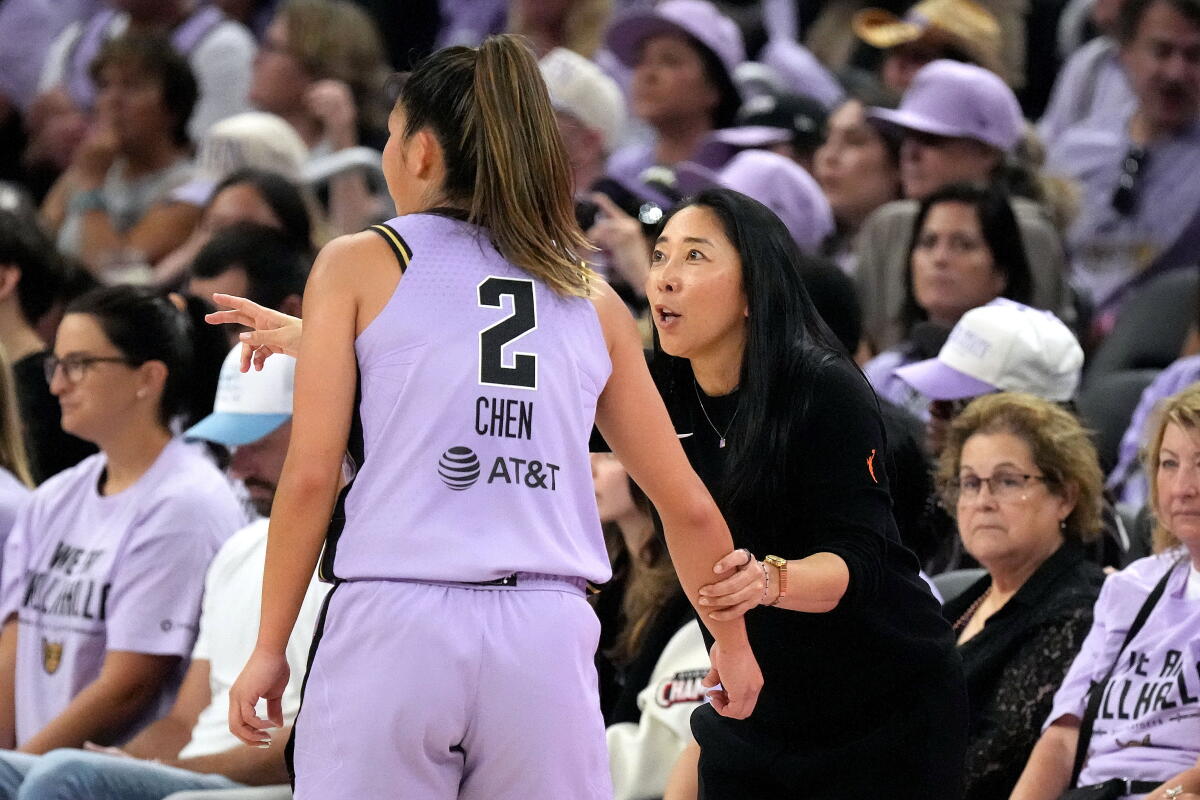
Golden State Valkyries coach Natalie Nakase talks with Kaitlyn Chen during Game 1 of a WNBA semifinal series against the Las Vegas Aces in San Francisco on Sunday.
(Tony Avelar / Ap Photo/tony Avelar)
Nakase walked on at UCLA after turning down a scholarship offer from UC Irvine. With the Bruins, she became a starter and captain, earning honorable mention All-Pac-10 honors in 2002 and finishing her career ranked 10th in program history with 358 assists.
The Bruins made two NCAA tournament appearances during Nakase’s four seasons.
In her first year as a WNBA head coach, Nakase led the Valkyries to the postseason, the first time an expansion team ever accomplished that feat. It earned her the league’s coach of the year award.
“If you put all 44 games together, all 44 of the regular season, I don’t know if there’s a team that played harder than her team every [game] for the 44 games, and that’s that’s a tribute to her,” Hammon said. “That’s the highest compliment I can give someone.”
This year, Golden State went even deeper with a first-round series win over Dallas after finishing the regular season with the league’s second-best record. After top seed Minnesota was upset in the first round, the Valkyries now have home court throughout the postseason.
“She always sticks to her plan,” said Valkyries point guard Veronica Burton about how she has seen Nakase grow this season. “Every single game she approaches with the utmost respect. I think it says a lot about her as a coach, and then what she expects of us. I think every single game I know what to expect going in, and I know what she wants of me, and I know what she expects of me. She makes us feel prepared.”

Golden State Valkyries coach Natalie Nakase raises the WNBA Coach of the Year award before a playoff game against the Minnesota Lynx on Sept. 17, 2025, in San José.
(Thearon W. Henderson / Getty Images)
Nakase was back on the sidelines on Sunday to face Hammon, wearing a heart monitor and trying to practice what she preaches about recovery. She ultimately led Golden State to a 71-60 win in Game 1 of the series.
Nakase does not plan on tempering her trademark fervor, even if this was an important learning experience. After all, she built an unlikely UCLA career and surging WNBA coaching career by sticking with who she is.
“She’s never been afraid that she knows she is going to mess up sometimes,” Tatum said. “Her ability to create a culture that fast, like that’s not easy. I think that’s when you kind of knew off top in training camp, like, oh yeah, I think she’s ready for this. She’s got this.”
Bruins’ Canada also thriving in WNBA playoffs

Dream guard Jordin Canada dribbles between New York Liberty center Han Xu, left, and guard Marine Johannes, right, during Game 1 of a WNBA semifinal series Sunday in Atlanta.
(Colin Hubbard / Associated Press)
The Associated Press’ Alan Cole highlighted a banner Sunday for UCLA alum Jordin Canada:
Jordin Canada scored 20 of her 25 points in the second half and had five steals to help the Atlanta Dream beat the New York Liberty 92-82 on Sunday in Game 1 of the best-of-five WNBA semifinals series.
DeWanna Bonner added 23 points and helped fill the void when Allisha Gray went down with a left hand injury in the second quarter. Atlanta once again played stellar defense, scoring 32 points off 21 forced turnovers, including 16 in a dominant third quarter. The 32 points off turnovers tied an all-time WNBA playoff record.
“Everybody stepped up, and that’s what we need,” Canada said. “Next-man up mentality. I just tried to do what I do best. I tried to be aggressive, find my shots and take my shots with confidence.”
Gray’s injury was the key moment of a very even first half. Neither team led by more than six points in a half that had 14 lead changes. New York went into the locker room with a slim 40-37 advantage. But Atlanta outscored New York 32-15 in the third quarter, seizing control with relentless defensive pressure.
“We knew we didn’t play our best in the first half,” Canada said. “We gave up a lot of defensive assignments, we weren’t playing up to our schemes and we just weren’t being aggressive enough on the offensive end.”
Angel Reese and Canada had three steals apiece in the third, keying a 13-3 run to start the half which gave Atlanta a lead it never surrendered. Seven New York players recorded at least one third-quarter turnover, and the team shot just four of 14 from the floor in a stretch that created a margin too big to overcome.
Oregon’s Lanning compares UCLA to national champs
Oregon coach Dan Lanning dodged questions this past week about the health of quarterback Dante Moore following a brutal hit during a win over USC by trying to focus on UCLA.
USC linebacker Desman Stephens II charged forward to tackle Moore on a run play on Sept. 26. Moore slid late and Stephens didn’t change course, lowering his shoulder and running into Moore’s head. Oregon players and fans were more offended after Stephens celebrated the play that nearly triggered a fight among the two teams and he was captured by NBC cameras smiling on the sideline while Moore was treated on the field before being transported to the hospital by ambulance. Stephens was ejected for targeting, but new NCAA rules allowed him to remain on the sideline and try to fire up his team during the second half.
A day after USC coach Lincoln Riley said he did not see Stephens’ sideline behavior and defended keeping him on the sideline in the second half, the school issued statements from Riley and Stephens apologizing for the hit and Stephens’ behavior while Moore received treatment. Stephens was suspended for one game.
Lanning called the play “disgusting” during his postgame news conference.
Oregon announced that Moore was diagnosed with a concussion, but tests showed no further injuries. Lanning said the team would be cautious as Moore recovers from the head injury.
Oregon, like UCLA, had a bye this past week and Lanning didn’t see reporters again until Wednesday. When asked for updates on Moore and for his thoughts on USC’s apologies and discipline, Lanning punted and instead compared UCLA to last year’s national champion.
“We’re about to play a UCLA team that reminds me a lot of Indiana from last year,” Lanning told reporters. “…Let’s just be honest. We’re not remotely close to what we need to be. We’re not remotely close.”
Lanning also said UCLA coach Bob Chesney texted him after the Ducks’ win over USC, offering to visit Moore if he had to remain in the hospital in Los Angeles. Moore instead was released and allowed to fly back to Oregon with his teammates.
Men’s water polo splits top-four matchups
The No. 1 UCLA men’s water polo split its marquee matchups to open Mountain Pacific Sports Federation play during the weekend.
The Bruins fell 19-15 to No. 2 Stanford on Saturday, but they rebounded for a 13-11 win over No. 4 California Sunday. Junior Ryder Dodd had five goals and three assists during the victory over the Golden Bears.
The Cardinal set a tougher pace on Saturday, leading by one goal at the end of the first, second and third quarters before extending their lead during a pivotal 7-4 fourth quarter. Dodd again paced the Bruins with four goals and five assists.
UCLA hosts Golden West College and California Baptist this weekend before the pressure rises again with a match at No. 3 USC on Oct. 17.
Bruins on deck
Here are all UCLA games scheduled to be played this week across all sports, with all times Pacific:
Tuesday, Oct. 6
Men’s soccer vs. Westmont, 7 p.m.
Thursday, Oct. 8
Women’s soccer vs. Indiana, 7 p.m.
Friday, Oct. 9
Men’s tennis at UC Santa Barbara Fall Classic, All day
Cross country at Wisconsin’s Nuttycombe Invite, Time TBA
Women’s volleyball at Maryland, 3:30 p.m.
Saturday, Oct. 10
Men’s tennis at UC Santa Barbara Fall Classic, All day
Football at Oregon, 12:30 p.m.
Men’s water polo vs. Golden West College, 1 p.m.
Women’s volleyball at Rutgers, 4 p.m.
Men’s water polo vs. California Baptist, 6 p.m.
Men’s soccer vs. Ohio State, 6 p.m.
Sunday, Oct. 11
Men’s tennis at UC Santa Barbara Fall Classic, All day
Women’s soccer vs. Illinois, 1 p.m.
In case you missed it
How UCLA built one of the most dominant rushing attacks in the country
Ultimate SoCal college football sports bar guide: Where to watch your team
UCLA Unlocked: Bob Chesney’s Bruins enter bye week with momentum
Have something Bruin?
Do you have a comment or something you’d like to see in a future UCLA newsletter? Email newsletters editor Houston Mitchell at houston.mitchell@latimes.com. To get this newsletter in your inbox, click here.
Sports editor Iliana Limón Romero contributed to this report.

Samoa Prime Minister apologises after Nazi salute video surfaces | Social Media
Samoa Prime Minister has apologised after a video of him resurfaced, showing him leading a Nazi salute and saying ‘Heil Hitler’ at a family gathering.
Published On 5 Oct 2026

Is it safe to travel to Crete right now? Latest advice after major flooding forces tourist evacuation on Greek island
SEVERE storms have caused flooding on a popular Greek holiday island.
Crete in Greece is currently suffering from mass flooding causing widespread disruption across the island including some tourists being evacuated from coastal accommodation.
Some cars and trees have even been washed into the sea.
Here is the current advice for travel to or from Crete right now:
Where is the flooding?
Flooding in Greece right now is mainly impacting the island of Crete.
Massive storms have been battering the island since October 1 and resulted in torrential rainfall with bad flooding and mudslides.
Read more on travel inspo


Worst hit areas include the Milopotamos district and the village of Zoniana, as well as Kato Gouves, Finikia, and Heraklion city.
In Chania, there have been big waves as well which have damaged seafront restaurants.
Is it safe to travel to Crete right now?
There is currently a Red Alert warning in Crete, which has been issued by the local authorities and the Hellenic National Meteorological Service (EMY).
Emergency services are still currently clearing mudslides and damage caused by the flooding.

The advice from GOV.UK reads:
“Greece can experience extreme natural phenomena such as earthquakes, wildfires, extreme heat and flash floods.
“To be alerted to events near where you are located in Greece, make sure your mobile phone is set to allow emergency alerts.
“For instructions on how to do this see:
- for iPhones go to Settings > Notifications and enable the ‘Emergency Alerts’ option at the bottom
- for Android 11 and higher go to Settings > Notifications > Advanced Settings > Wireless Emergency Alerts
- for Samsung devices go to Settings > Apps > Messages > Notifications > Emergency Notifications and enable the ‘Emergency Alerts’ option
“This will allow the Greek government’s Emergency Communication Service alerts to reach you. Always keep your phone with you as you will receive alerts according to the location of your phone.
“Adverse weather conditions, including floods, can happen quickly. Register for Emergency alerts and follow ‘112 Greece’ on X for official updates.”
Are flights still going to Crete?
Currently, flights are not impacted to or from Crete.
However, if you are already in Crete and need to get to the airport you may want to allow for more extra time.
If you are due to fly in and have concerns, it may be worth contacting your airline to check if they are operating normally.
What if I have a holiday to Crete booked?
As the Foreign Office has not warned against travel to Greece, there are no special circumstances in place for holidaymakers to cancel their trip and receive a full refund.
Depending on what travel insurance you have, your policy might include natural disaster cover.
If so, your insurance policy should cover you for when you are unable to reach your holiday destination due to natural disasters, like wildfires.
So it is worth checking your travel insurance policy.
Can I cancel my trip?
If you do choose to cancel your trip, it is best to contact your airline or holiday provider.
There is no obligation for companies to refund bookings unless government advice changes.

Before UK Greens, who else has equated Zionism with racism? | Israel-Palestine conflict News
The United Kingdom’s Green Party has voted to define Zionism as a form of racism, drawing condemnation from the Israeli government.
In a binding vote held at the party’s conference over the weekend, members voted to usher in the new definition as well as a series of other strongly pro-Palestine policies.
Recommended Stories
list of 4 itemsend of list
However, just as the resolution has drawn international criticism, it has also proved internally controversial with four of the party’s five members in parliament opposing it.
Israel on Monday banned party leader Zack Polanski from the country just a day before the politician faces a by-election as he runs in the London constituency that former Prime Minister Keir Starmer represented.
Zionism emerged as a political ideology in the late 19th century. It called for the creation of a Jewish homeland at a time of rising anti-Semitism and persecution of Jews in Europe. Theodore Herzl, an Austro-Hungarian journalist considered the father of political Zionism, originally proposed an independent and colonial Jewish state in either Palestine or Argentina.
Here’s what we know about what the Greens have said:

What is the resolution?
The Greens endorsed the motion to equate Zionism with racism by a vote of 1,022 to 813.
In addition, the party restated its “commitment to Palestinian liberation” and called for the “establishment of a single democratic state throughout historic Palestine”.
The party also recommitted to its support of Palestinians’ right of return as well as to the Boycott, Divestment, Sanctions movement against Israel.
“The real, material, manifestation of Zionism has been the historic and ongoing dehumanisation, displacement, dispossession, disenfranchisement and destruction of Palestinians,” a Green Party statement said.
A significant number of party members, including four of its five MPs, were against parts of the resolution, exposing divisions within the party.
Codeputy leader Rachel Millward said in a post on X that while the party is committed to “stop the genocide”, the term Zionism means “different things to different people, … so I personally do not think the policy helps us do the work we all want to”.
Meanwhile, Polanski, who is Jewish and was away campaigning during the vote, told journalists afterwards that if Zionism equates to the displacement of Palestinians, “that is clearly racist.”
Polanski said he, however, did not support the reference to a single Palestinian state and external entities should not decide what a future state would look like.
How has Israel responded?
Israel has accused the party of legitimising “terrorism”, and senior officials equated it to anti-Semitism.
“The Greens have adopted not only the green of Hamas, but also its ideology: the elimination of the State of Israel through armed struggle,” the Israeli Ministry of Foreign Affairs wrote on social media.
Israeli President Isaac Herzog said it would “deliberately endanger Jews and Israelis everywhere”. Opposition leader Yair Lapid said the party was “racist”.
The Green Party has rejected equating criticism of Israel with anti-Semitism and reiterated its stance against “any form of discrimination or harassment”.
“We know there is no conflict between supporting the rights of Palestinians and the rights of Jewish people,” Polanski and other senior party members said in a statement on Sunday.
Has Zionism been equated to racism before?
Yes. In 1975, the UN General Assembly passed a resolution that “determines that Zionism is a form of racism and racial discrimination”.
The vote was sponsored by the Soviet bloc and the Arab League. It passed after 72 countries, largely from the Middle East and Africa, voted for it. Israel and 34 other countries – chiefly from the West – were against it. Thirty-two other countries abstained.
Just a year before, at the 1974 General Assembly, Palestinian leader Yasser Arafat had given his “olive branch” speech at the General Assembly.
About the same time, African countries opposing the apartheid regime in South Africa, which was increasingly allying with Israel, had resolved separately that the Israeli government was “racist” and both had an “imperialist origin.”
Also, in 1975, at the first international women’s conference, held in Mexico City, attendees decided there would be no international peace outside the “elimination of foreign occupation, Zionism, apartheid” and all other forms of “racial discrimination”.
However, the General Assembly vote proved controversial. Chaim Herzog, then-Israeli ambassador to the UN and later president, told the assembly in a speech that it was “based on hatred, falsehood and arrogance” and proceeded to rip up copies of the resolution in front of the audience.
The US too accused the UN of making “anti-Semitism international law”.
In December 1991, the US, under President George HW Bush, stepped up a campaign to revoke the resolution with Bush declaring at the UN that equating Zionism with racism “is to reject Israel itself” and to “challenge its right to exist”.
Israel also insisted it would not participate in the Madrid Peace Process to continue negotiations between Israel and Palestinian leaders if the resolution was not cancelled.
After much pressure from the US, an overwhelming majority of countries voted for its revocation – 111 to 25, including European and African countries.
Who else equates Zionism with racism?
Jewish Voice for Peace, the American anti-Zionist and pro-Palestinian advocacy group, has also named Zionism as a movement that creates a “racist hierarchy with European Jews at the top”.
In a February statement, the group reiterated its stance against what it called the “colonial ideology” of Zionism’s founders.
Similarly, in the United Kingdom, an employment tribunal in 2024 backed anti-Zionist activist and professor David Miller, who was earlier sacked from his post at the University of Bristol in 2021 for his views that the movement was “inherently racist”.

Myleene Klass breaks silence on Hear’Say reunion as she reveals why she isn’t joining bandmates for tour
MYLEENE Klass has finally spoken out on why she won’t be joining her fellow Hear’Say bandmates for their upcoming reunion tour.
The noughties band announced last week that they were returning for a tour to mark 25 years since their No.1 hit Pure & Simple.
However, fans quickly noticed that Myleene was missing from the line-up – as Kym Marsh, Suzanne Shaw, Noel Sullivan and Danny Foster were all promoting the reunion online while she remained silent.
Now, Myleene has revealed why she turned down the tour.
Talking on today’s Loose Women, the star explained: “They were really sweet and they did include me in the discussions but it’s not something I can commit to at the moment, I just really can’t.
“I know they are still figuring out a lot of the moving parts of it and until they do that, there’s nothing set in stone. For me, I’m just super busy.


“I’m committed to you guys. I’ve got my work. I love the guys dearly, it was an incredibly important time in my life. It taught me so much, epic songs and moments like that.”
Myleene isn’t totally against the idea of ever joining her bandmates, she admitted.
When quizzed by her fellow Loose Women, Myleene said: “I would say never say never about anything.
“Because, I don’t really agree about revisiting the past but then people say to me, like, ‘you went back in the jungle’ and I went back and had another bob! So, I’m a walking contradiction in that sense!
“Like I said, until there are things set in stone it’s very difficult to commit to something that is so up in the air. I think they are figuring things out as well, but I really do appreciate that they included me in the initial discussions.”
Hear’Say formed on ITV reality television show Popstars and debuted in 2001, splitting the following year.
The band set tongues wagging last week as they reignited an Instagram page to tease their tour.
They posted a screen recording of a WhatsApp conversation between them, with Danny writing: “Wow . . . can you believe the response to that tour clip we posted?!”, referencing a video they had shared of an old performance. Suzanne replied: “I know right, amazing! Ahhh the memories . . . can you believe it was 25 years ago?!”
Noel said: “OK, so hear me out . . . ” Kym urged: “Go on,” before Noel added: “Fancy getting the band back together?”
The post came exactly 24 years after Hear’Say split, with the band disbanding on 1 October 2002.

Column: Becerra on cruise control, Hilton offers contrived fixes for California’s problems
SACRAMENTO — Look, Xavier Becerra could cruise to a South Pacific island and bask on the beach until election day and Californians would still choose him as their next governor.
So, last week’s televised CNN debate between Becerra and Republican Steve Hilton really had no election significance, although it was important for the Democratic frontrunner in other ways.
Who won the debate? Becerra, because he came across as calm, collected and capable of governing this troubled state — certainly very few voters’ ideal candidate, but the only real choice for most Californians.
There’s simply no way Becerra can lose on Nov. 3 because his only opponent is a Republican. Californians will not elect a Republican governor in this polarized era, particularly one endorsed by the reviled President Trump.
Moreover, Hilton’s only previous political experience was as an advisor to a British prime minister and his sole claim to U.S. notoriety was as a Fox News TV host–not exactly resume boosters in California.
Becerra — with public office experience spanning more than three decades — held a growing 25-point lead in a recent poll by the UC Berkeley Institute of Governmental Studies.
He’s a shoo-in simply because he has a “D” beside his name in this state where Democrats outnumber Republicans nearly 2-to-1 and despise the GOP president.
Californians haven’t elected a Republican to statewide office in 20 years — and that’s Hilton’s main pitch to voters.
“The definition of insanity is doing the same thing and expecting a different result,” the GOP candidate asserted during the debate, as he does several times a day.
Turning to Becerra, Hilton said:
“You’re the candidate who is supported by the machine in Sacramento — the unions, big business, all these people that for 16 years have given us the highest cost of living in the country, made it impossible to build anything, given us the highest unemployment rate, the highest poverty rate….
“And that’s why we’ve got to try something different this time instead of voting for more of the same.”
OK, fair point. But try what exactly? That’s where Hilton stalls or veers erratically.
He’d build “10 new cities.” Build them where exactly? He doesn’t say.
He definitely doesn’t want to construct new apartment buildings in the suburbs “when we have got so much space that we could be building on in California.”
Like out in Southern California deserts or Central Valley farm fields — requiring two-hour commutes to urban jobs?
And where does the water come from for these 10 new cities as the West scrambles for what’s left of diminishing supplies? But unfortunately there was no discussion of that during the debate.
One debate exchange that caught my attention was about vaccines. Hilton seemed to be carrying the torch for whacko anti-vaxxer Robert F. Kennedy Jr., Becerra’s successor as U.S. health secretary in the Trump administration.
Debate co-moderator Dana Bash recalled what Hilton said previously about children’s vaccinations: “The government should have nothing to do with these fundamental and vital decisions.” And she asked whether he’d push to eliminate California’s vaccine requirements.
“No,” Hilton replied. “I’m pro vaccine.” But then he seemed to wander all over the stage looking to have it both ways.
It’s a “very, very emotional issue for a lot of parents,” he said, adding there’s “data around the world” showing that where vaccine “mandates are lower… you actually have higher [vaccination] compliance, where parents don’t feel that they’re being bullied into doing something that they don’t want to do. And that’s what I want to see here.”
But he ultimately said,“I’d follow the law.”
In California, the law requires all children without medical exemptions to be vaccinated for several diseases — including polio, measles, mumps, chickenpox, hepatitis B and whooping cough — before they’re admitted to school.
That’s a blessing. When I grew up, practically every kid at some point was bedridden with one or more of those dangerous ailments. Then some saviors invented vaccines.
“We had nearly eradicated measles,” Becerra said, responding to Hilton. “When I left HHS, you rarely heard of a case of measles…. Today, children are dying of measles. Today, the spread of measles has reached a proportion we haven’t seen since the 1960s.
“That’s what happens when vaccine deniers take over.”
Becerra achieved all he needed to in the debate. He didn’t screw up. He kept cool and actually was fairly quick on his feet in replying to Hilton’s attacks, while planting a MAGA hat firmly on the Republican’s head.
He missed an opportunity to accomplish more, however — like making Californians feel really good about voting for him, rather than merely because he’s the only Democrat left standing in the contest to replace the termed out Gov. Gavin Newsom.
Voters might like to hear what Becerra’s vision is — if he has one — for the California he wants to build.
What does he have in mind besides just defending California against Trump? That’s a given. How’s he going to lower our living costs? Upgrade public education? Prevent wildfires? Details, not platitudes.
Rather than relaxing on his lead, Becerra should be constantly moving around the state, introducing himself to Californians and — more importantly — listening to their problems and ideas. To his credit, he’s doing that this week.
“The debate was boring and uneventful, but Becerra won it,” says Republican consultant Rob Stutzman. “He is perfectly vanilla and that makes it really hard to pin him down in an attack.”
“We got the genuine Xavier Becerra. That’s exactly who he is,” says veteran Democratic strategist Garry Sragow, a longtime political ally. “Thoughtful, committed and very decent, but does not go very high on the charisma meter.”
In California right now, a candidate’s charisma rates much lower than a simple “D.”
What else you should be reading
The must-read: Voter ID proponents accuse California Democrats of lying about Trump’s support for Prop. 39
Eyes of the World: Will or won’t they? Newsom and Harris weigh 2028 contest — and possible collision
The L.A. Times Special: Voter guide to the 2026 California general election
Until next week,
George Skelton
—
Was this newsletter forwarded to you? Sign up here to get it in your inbox.

Times of Troy: What’s going on with USC QB Jayden Maiava?
Welcome back to the Times of Troy newsletter, where I, like many of you, can’t help but wonder: What’s going on with Jayden Maiava?
As USC’s quarterback kneeled out the final seconds of an unsatisfying win over Washington on Saturday, he didn’t waste any time celebrating on the field. Maiava spotted an NBC camera trained on him, turned toward the Coliseum tunnel and took off.
The camera followed Maiava and caught USC sports information director Katie Ryan sprinting to reach him. But even after Ryan caught up to the quarterback, Maiava barely broke his stride. He just kept running, the first one up the tunnel, while his Trojan teammates remained on the field.
It was a strange moment, after a game of strange moments for Maiava. And it certainly was not the sort of body language you want to see from your starting quarterback and team leader. Let alone after a win.
It didn’t get much better afterward, when USC trotted him out for the team’s postgame news conference. Maiava was asked about not being able to get into a rhythm. And he proceeded to answer a question that seemingly wasn’t asked.
“Just being able to trust it, fall back on routine plays,” Maiava said.
That’s not new for Maiava, who has often avoided any questions that he doesn’t want to answer by using a non sequitur football cliche. That’s his right. He’s not obligated to play ball with reporters.

USC quarterback Jayden Maiava jogs off the field without pausing for an NBC interview after the Trojans’ win over Washington at the Coliseum on Saturday.
(Ronaldo Bolanos/Los Angeles Times)
But USC has trumpeted Maiava’s progress as a vocal leader for more than a year now. And as the quarterback, he is naturally a representation of the program’s leadership and its larger culture. Which is what makes the body language of the past two weeks, as USC’s season feels on the brink, particularly concerning. Especially in context with what we’ve seen on the field.
The truth is Maiava hasn’t really looked the same since the shutout of Fresno State on Sept. 4, when he appeared to hurt his right shoulder. Maiava was asked about it the following weeks, but he said that he was “great.”
“It’s a physical game,” Maiava said. “It’s what happens.”
No one has mentioned the injury since, but Maiava has been markedly less accurate in the ensuing four games. He’s completing 60% of his passes over that time, after the first two games had him closer to 90%. Maiava’s mechanics have looked far less consistent over that stretch. And then there were the moments Saturday in which Maiava appeared tentative, like he might actually be shying away from running the ball.
During USC’s opening drive, Maiava scrambled away from pressure and had a chance to take off upfield and potentially pick up the first down with his legs. But instead he sprinted wider toward the sideline, in search of receivers who weren’t there in the corner of the end zone. He ended up getting sacked.
A couple possessions later, Maiava launched a prayer down the field off his back foot. It was intercepted and the quarterback threw his hands, fully aware the turnover was his fault.
USC’s problems certainly can’t be laid at Maiava’s feet. The quarterback has been pretty good this season by normal statistical standards. He’s ninth in the nation in passing yards per game (290) and third in total passing touchdowns (15)
But our eyes also don’t deceive us. Maybe he is hurt. Regardless, in order to actually save their season, the Trojans need Maiava to be more than just a passable Big Ten quarterback. They need him to put the team on his back.
Riley said earlier this season that Maiava has come further than any other passer he’s mentored as a college coach. But midway through his third season at USC, it’s this last step in his development that seems to be most troubling Maiava.
Patterson in the press box

USC defensive coordinator Gary Patterson walked onto the field before the Trojans played Oregon at the Coliseum on Sept. 26.
(Ronaldo Bolanos/Los Angeles Times)
With its defense clearly struggling to communicate, USC moved defensive coordinator Gary Patterson from the field to the press box.
The results at least seemed palpable on Saturday. The defense was much more dialed in on third down, holding the Huskies to just a single conversion on 12 attempts. And the secondary seemed to iron out most of its communication problems.
Whether that can be attributed to Patterson being the one in the booth is impossible for me to say. The bigger question, as I see it, is why there was such a disconnect between Patterson, his scheme and the rest of the staff. Riley seemed to suggest that the way Patterson wanted to do things wasn’t clicking with the rest of the operation.
“Going through some of these first few games, seeing the makeup of the staff, it was a conversation that he and I had on Sunday,” Riley said after USC’s win over Washington. “We thought there were some reasons just kind of in our operation that made sense. He knows this defense obviously better than anyone. He was used to having, I think, a staff at TCU — if you look at his staff there, for years and years, they had little to no turnover, right? So when you had guys who had been coaching with you for 15-20 years, like he had in a lot of ways, you might handle that different. He had a heck of a defensive staff, and it’s kind of like players, right? You’re trying to just move the chess pieces to get everyone in the right position to get the best out of them.”
House of Troy ‘Chapter 3: A New Era’ episode drops this week

Ask most people from within the Trojan family when things started to unravel for USC’s football program, and they’ll inevitably point to the Reggie Bush-related NCAA sanctions as an obvious starting place.
Well, what if I told you that the mess that USC would find itself wrapped up in could’ve been so easily avoided?
At least, that’s the opinion of the key former members of New Era Sports & Entertainment, the failed sports agency that said it paid Bush and his family. Bush continues to deny allegations he violated NCAA rules. What could’ve presumably ended with one calm conversation in 2006 ended up snowballing into a yearslong saga that didn’t just upend USC football, it derailed the lives of everyone involved.
You can hear the whole story on Tuesday, at this link and wherever you get your podcasts.
— USC’s pass rush finally played to its potential. The Trojans tallied 25 (!) pressures against Washington and sacked Demond Williams Jr. five times, which was more than its previous three games combined. The most important of those sacks came on the final drive, as Kameryn Crawford dropped Williams on a critical third down, deep in USC’s own territory. Freshman Luke Wafle also got his first college sack, after being close basically 10 other times, and he seemed relieved by that. He wasn’t the only one relieved by the pass rush production. The Trojans’ maligned secondary, in particular, was a major beneficiary.
— Rampant penalties may just be a part of this team’s identity. USC committed nine penalties against Washington and lost 94 yards, but the numbers alone didn’t tell the whole story. Half of those penalties were pretty consequential. An illegal formation call brought back a USC passing touchdown, then a face mask from Wafle kept the ensuing Washington drive moving. The Huskies ended up scoring a go-ahead touchdown. USC has at least eight penalties in three of its past four games.
— Should Desman Stephens II keep his starting job when he returns? Not because of what happened against Oregon, but because of what happened against Washington. I thought his replacement, Ta’Mere Robinson, played the best game of any linebacker at USC this season. Robinson had six defensive stops, twice as many as any other Trojan defender on Saturday. He added a sack and graded quite well in coverage by Pro Football Focus. It’s not like Stephens was playing all that well before his suspension. USC also got a strong showing from reserve linebacker Elijah Newby.
— Alex Graham is clearly essential to USC’s secondary. The Trojans’ Swiss Army knife defensive back returned from injury Saturday and made a marked difference for the whole unit. Graham had four pressures as a blitzer and has looked absolutely lethal in that role. And he played a huge part in taking away Washington’s short-area passing game, which can be dangerous if Williams is able to get loose. There’s no player more valuable on the back end of USC’s defense.
This week … in 2006

USC’s Brian Cushing blocks Sean Douglas’ punt during the Trojans’ win over Washington on Oct. 7, 2006.
(Matt Sayles / Associated Press)
For the second straight week, USC’s defense was backed up deep into its own territory in the final seconds, in danger of losing to a lesser Pac-10 team.
Washington had gotten the ball back with 1:34 remaining, trailing the Trojans, 26-20, when Husky quarterback Isaiah Stanback proceeded to march down the field on USC’s defense. Stanback scrambled to convert a fourth down with 18 seconds remaining, then completed a 19-yard pass to the USC 15.
But with two seconds left, Washington couldn’t get set in time to spike the ball. The clock ran out on their comeback attempt.
The whole experience gave linebacker Brian Cushing flashbacks of USC’s loss to Texas at the Rose Bowl.
“That last minute just got a little nerve-racking,” Cushing said.
Olympic sports spotlight
USC’s men’s water polo team was down 12-11 to California when the Trojans collected the ball with five seconds remaining in their Mountain Pacific Sports Federation opener. Somehow, they managed to win the game from there.
It started with an exclusion. Then a goal with a single tick left on the clock, sending the game to overtime.
It went to a second overtime and USC eventually put away the game 15-14 with a golden goal from Strahinja Krstic. A scintillating start to conference play.
Polling the people
Newsletter editor and poll manager Houston Mitchell is out this week, so we’re extending our poll one more week. If you have not voted, feel free to weigh in now.
Will Lincoln Riley be USC’s coach in 2027?
Yes
No
Click here to vote in our survey.
What I’m watching this week

Sienna Miller and Dominic West star in the new HBO series “War.”
(Justin Downing/ Sky / HBO)
I’ve been yearning for a slow-burn HBO drama since the end of “Industry’s” most recent season, and I’m optimistic that the network appears to have delivered.
“War” has that potential, at least. The first season of what is apparently an anthology series follows a high-stakes divorce case between a tech mogul played by Dominic West and a movie star played by Sienna Miller. And while it doesn’t seem to be breaking any new ground as a legal drama, the writing and acting appears to be on point — as usual with an HBO show of this magnitude.
In case you missed it
Listen now: Podcast ‘House of Troy’ features inside look at highs, lows of USC Athletics
USC silences the ‘Fire Lincoln!’ chants with thrilling comeback win over Washington
Lincoln Riley backs coordinator Gary Patterson amid USC defensive woes
Jahkeem Stewart eases back from injury at critical time for USC defense
‘All options are on the table’: Fallout from Oregon loss puts Lincoln Riley on hot seat
Ultimate SoCal college football sports bar guide: Where to watch your team
Times of Troy: USC gave Lincoln Riley everything. And for what in return?
Until next time …
That concludes today’s newsletter. If you have any feedback, ideas for improvement or things you’d like to see, email me at ryan.kartje@latimes.com, and follow me on X at @Ryan_Kartje. To get this newsletter in your inbox, click here.