The new US charge adds to the existing drug trafficking case against Venezuela’s former president and first lady.
Published On 8 Oct 20268 Oct 2026
Former Venezuelan President Nicolas Maduro and his wife, Cilia Flores, were charged in the US state of New York with conspiring to commit torture in connection with allegations that they tortured political opponents to maintain their power.
The charge announced on Thursday in a Manhattan federal court adds one count of conspiracy to commit torture to the drug trafficking charges the couple already faced.
Maduro and Flores pleaded not guilty to the drug charges and have been held at Brooklyn’s Metropolitan Detention Center since their capture. Their trial is scheduled for June 1.
The charges pile on an ongoing criminal case against Maduro and Flores. A superseding indictment accuses Maduro of working with cartel groups to move cocaine through Venezuela toward the United States.
EASYJET is the latest airline to cut flights from its winter schedule in order to manage fuel costs.
The airline in total has now cut almost 1.4million seats between October 2026 and March 2027.
EasyJet has announced it will be cutting a further 600,000-700,000 seatsCredit: ALBIT / SplashNews.comIn total 1.4million flights have been axedCredit: Getty
EasyJet usually offers around 50million flights over the winter season.
But earlier this year it announced 700,000 flights would be axed from the schedule.
Sign up for the Travel newsletter
Thank you!
And now almost another 700,000 flights have been cut with latest axing meaning it’s had a reduction of two days’ worth of flying, according to Gurufocus.
Talking to the Financial Times, chief executive Kenton Jarvis explained that easyJet would be scaling back capacity over certain months so that it could avoid paying high fuel costs.
In a statement, the airline said “Subject to pricing and passenger demand, Ryanair expects this one-off winter schedule cut to reduce [November 2026 – March 2027 losses] by €70 million to €100 million (£85.8million).”
The two million seats works out to as many as 13,000 flights, although which routes will be affected is yet to be confirmed.
Ryanair has also cut seats for this year with warnings of price increasesCredit: Hans Lucas/AFP via Getty Images
Talking about 2027, Michael O’Leary said that flight prices were “only going one way”, which is “significantly upward”.
He added: “Fares for Ryanair passengers and every other passenger into the summer of 2027 are going to rise materially, I believe, because of significantly higher oil prices.”
After blowing past a self-imposed August deadline, the U.S. Navy has finally announced Boeing as the winner of its F/A-XX next-generation carrier-based fighter competition. F/A-XX has become one of the most hotly anticipated U.S. defense procurement decisions in recent memory after the Pentagon tried to shelve the program indefinitely last year.
Boeing had been competing against Northrop Grumman for the F/A-XX contract. An earlier down-select reportedly eliminated Lockheed Martin back in March 2025.
TWZ has now published an initial analysis of Boeing’s winning F/A-XX design based on what can be seen in the new rendering, which you can find here.
As mentioned, the Pentagon had moved to freeze the F/A-XX program in June 2025. Three months earlier, Boeing had won a separate U.S. Air Force competition to produce what is now called the F-47. U.S. military officials had argued that the U.S. industrial base lacked the capacity to support work on two next-generation fighters simultaneously.
A rendering of Boeing’s F-47 for the US Air Force. USAF
Congress subsequently intervened to keep the F/A-XX program running, but its future had remained very murky until earlier this year. In April, Chief of Naval Operations (CNO) Adm. Daryl Caudle said that a winner of the competition would finally be announced in August. Secretary Pete Hegseth and Acting Secretary of the Navy Hung Cao both publicly committed to that same timeline later that month. There had been concerns that the program might have slipped back into limbo after that deadline came and went. Adm. Caudle told Aviation Week‘s Brian Everstine that he himself was no longer aware of when this decision might come on the sidelines of the Tailhook Association’s annual convention last month.
Just two weeks ago, Air Force Gen. Dale White, the service’s Direct Reporting Portfolio Manager for Critical Major Weapon Systems, reiterated concerns about industrial capacity in response to a question about potential challenges in building F/A-XXs at the same time as F-47s. White also acknowledged that these concerns were “not unique” to F/A-XX and F-47.
In this context, Boeing’s win today is perhaps unsurprising. The company will be able to leverage design work it has already been doing in relation to the F-47 program, as well as relevant production experience and supply chains. TWZ had previously highlighted similarities between what was seen in a rendering the company released of its F/A-XX proposal and official renders of what it is building for the Air Force. We still have yet to learn just how closely related the two designs are.
Boeing’s previously released F/A-XX rendering. Boeing
It is also worth noting here that Boeing previously pushed back publicly on the assertion that it was not ready to meet Air Force and Navy needs at the same time.
Regardless of any industrial base considerations, top Navy officials have been consistently vocal about the need for F/A-XX, even after the Pentagon’s move to put the program on ice last year. The service has presented the next-generation fighters as essential for staying ahead of top global competitors like China and Russia, as well as smaller adversaries, such as Iran.
“I know these things are expensive, and I know the defense industrial base is compressed, but we have got to figure out how to walk and chew gum here with aircraft,” CNO Caudle said in January, just weeks before the start of major combat operations against Iran. “The folks that used to be not in [the] headspace that I needed a stealth aircraft of this level to fly a mission into their country, will gain capability that the F-18 [F/A-18E/F Super Hornet] will not match against.”
A US Navy F/A-18E Super Hornet seen being launched from a carrier. USN
“This is an ever-evolving theme, and when you’ve got partnerships … well coupled with each other across China and Russia and Iran and North Korea, and terrorist groups that are getting that kit from all of those through back-channel ways, our ability to fly with impunity with our existing airframes is fleeting,” he added at that time. “So, if I don’t start building that [F/A-XX] immediately, you’re not going to get it for some time.”
The Pentagon has now issued a full press release for the F/A-XX contract award to Boeing, which is valued at approximately $20 billion. The deal covers the “full-scale development phase” and includes the procurement of “multiple test aircraft for ground, airworthiness, systems, and weapons integration testing.”
“The F/A-XX is a critical pillar in our commitment to maintaining peace through strength. F/A-XX will dominate contested airspace, extend operational reach, and deliver a decisive combat advantage for the warfighter,” Michael P. Duffey, Under Secretary of War for Acquisition and Sustainment, has said in a statement. “The F/A-XX platform represents a crucial, non-negotiable investment in America’s national security and long-term air combat capabilities. We are joining forces with Boeing to field these capabilities rapidly, ensuring our warfighters possess the lethal and highly networked systems required to deter aggression, project undisputed power, and secure absolute air superiority.”
“This achievement marks a new era for the U.S. Navy,” Acting Secretary of the Navy Hung Cao also said in a statement. “The Sixth-Generation fighter is a generational leap in air superiority and will provide the world’s best aviators with unparalleled capabilities to fight, win, and come home safe. We are excited to partner with Boeing, and for our warfighters to continue to dominate the skies and defeat our nation’s enemies.”
“The F/A-XX will provide advanced carrier-based power projection that extends the range of the most agile and survivable airfields: U.S. Navy carriers. In addition, F/A-XX will be interoperable with manned and unmanned platforms such as Collaborative Combat Aircraft (CCA) and increase the capability of every CCA it teams with,” the press release adds. “Following this contact award announcement, Boeing will deliver the platform to augment and eventually replace legacy F/A-18E/F Super Hornets and EA-18G Growlers beginning in the 2030s, and operate alongside the F-35C.”
The Navy has not yet announced a formal designation for the F/A-XX aircraft. If Boeing’s base design does share significant DNA with the F-47, it is possible that the designation for the new sixth-generation carrier-based fighter could reflect that.
It is also worth noting how muted the F/A-XX announcement has been across the board given how hotly anticipated it was. The contrast with the F-47 contract announcement, which was a live-broadcast event headed up by President Donald Trump from White House, is particularly striking.
Update: 6:14 PM ET –
Boeing has now put out its own press release regarding the F/A-XX contract award, which notes that “technical and programmatic details” about the aircraft “remain classified under U.S. national security and export laws.”
“It’s an honor to be selected to produce the Navy’s first sixth–generation platform,” Steve Parker, President and CEO of Boeing Defense, Space & Security, said in a statement. “Backed by decades of work, bolstered by game-changing innovations and solidified by the investments we’ve made in new facilities uniquely suited to build multiple products with next generation capabilities, our dedicated and talented team is ready to execute this critical program.”
6th-gen edge.
Thank you, @USNavy, for continuing our partnership to design, build and deliver your F/A-XX aircraft. We’re honored to produce the 6th-generation fighter that will revolutionize advancements in naval aviation to maintain U.S. carrier air superiority.
“Delivering two advanced fighters in parallel was always our plan, and we invested accordingly,” Parker added. “We are ready and able to build multiple concurrent future combat aircraft franchise programs.”
Boeing’s release explicitly highlights a major ongoing expansion of its production and other facilities in St. Louis, Missouri. That work is also widely understood to be supporting the F-47 program, asTWZ reported separately just earlier today.
“Investment in facilities is just one part of the story,” Boeing’s Parker also said. “We’re also investing in technology and people so that we can deliver for our customers.”
As an aside, Boeing also received a separate contract today from the Navy, valued at $16,667,607, to support the final shutdown of the production line for the F/A-18E/F Super Hornet fighter and EA-18G Growler electronic warfare jet.
Great timing. The same afternoon Boeing gets F/A-XX, the Navy gives them a new contract for shutting down the F/A-18, EA-18 line
Boom times are coming for STL though: F-47, F/A-XX, F-15EX increase, T-7 ramping up, MQ-25. pic.twitter.com/9TnMBC7jMb
Welcome Faithfuls, come on in Traitors, and a special hello to anyone who claims to be both (Richard E Grant, we see you there in your Burberry scarf).
Celebrity Traitors is back on screens tonight for episode 3 and we dive straight back into the first banishment with the Faithfuls hoping they’ve caught a Traitor.
But it’s a battle between people taking Richard E ‘I’m a Traitor’ Grant at his word and the others that think he’s a Faithful on a wind-up, which is proving an increasingly tricky position to take.
Will he survive? Can’t see how, but this is Celebrity Traitors and Alan Carr, who couldn’t even say “I am a Faithful” without cracking up, won it! Anything could happen.
Hi, and welcome to another edition of Dodgers Dugout. My name is Houston Mitchell. I’m back! Who missed me? No one? That’s sad.
Are you a true-blue fan?
Get our Dodgers Dugout newsletter for insights, news and much more.
By continuing, you agree to our Terms of Service, which include arbitration and a class action waiver. You agree that we and our third-party vendors may collect and use your information, including through cookies, pixels and similar technologies, for the purposes set forth in our Privacy Policy such as personalizing your experience and ads.
Game 4 thoughts
—Sorry I missed the first three games, I was sick and had to rest. A combination of Nyquil, Theraflu, Zinc and vitamin C had me seeing three Dodgers on the mound. I guess I could have written about the one in the middle. But I’m back for the duration.
—Best wishes to Joe Davis, who lost his voice. I like the Davis-John Smoltz combo, though Smoltz tends to use 20 words to say something he could say in five.
—Some online complain that the Dodgers announcer gets to call the Dodgers’ postseason games. They must have missed the Vin Scully years. Plus, no one seems to be complaining that a Braves Hall of Famer is the commentator. I detect no bias from either of them.
—This recap is written as the game is going on. I don’t go back and change things to make me look good …. or bad. It’s just what I’m thinking at the time.
First inning
—Tyler Mahle was 4-1 with a 1.99 ERA in nine starts with the Braves. He throws a lot of strikes, so being patient will be extra difficult for the Dodgers today.
—Will we get the good Tyler Glasnow or the bad Tyler Glasnow?
—My mom could steal a base off Glasnow.
—You ever notice how great it is when Dodger fans stand up and cheer when their pitcher has two strikes, but how annoying it is when other fans do it?
—That’s OK. The Dodgers were going to have to score a run to win anyway, now they need to score two.
Second inning
—Watching Shohei Ohtani swing makes me think we are going to hear that his injuries were a lot more serious than let on. Sort of like in 2024 when he hurt his shoulder much worse than they said.
—Ohtani still hasn’t learned to slide without jamming his left arm into the ground.
—Rare back-to-back errors by the Braves. Not exactly how you’d predict the teams would score their first runs. Dodgers 1, Braves 1.
—Glasnow seems to be effectively wild so far.
Third inning
—We seem to be in the settling-in phase of the game now.
—Glasnow has made 44 pitchers. 22 balls, 22 strikes. That’s not really sustainable. Michael Harris II reaches on a walk. Will he steal on the first pitch?
—Whoever runs Atlanta’s in-game noise is stuck in the 1980s. An air horn? I half-expect a sound effect from Pac-Man.
—And Harris didn’t try to steal at all. Surprising.
Fourth inning
—The Dodgers are chasing too much.
—I like the Danny DeVito Jersey Mike’s commercials. Not a big fan of Jersey Mike’s though.
—Speaking of fast food, when is Carl’s Jr. bringing back the steak sandwich?
—Great. Now I’m hungry.
—All three Dodgers struck out.
—Do you think the Dodgers brain trust has had any conversations about giving Ohtani a game off?
—Suddenly, both pitchers are locked in.
—As soon as I write that, Glasnow walks Mike Yastrzemski (worth 29 points in Scrabble).
Fifth inning
—Nice at-bat by Kiké Hernández, even if it did end in an out. The Dodgers need to make Mahle work.
—Andy Pages is scorching the ball. He needs to get off this list though:
Worst career postseason batting average, minimum 80 plate appearances:
Dan Wilson, .091 Dal Maxvill, .114 Brandon Lowe, .115 Andy Pages, .123 (10 for 81) Yasmani Grandal, .127 Rhys Hoskins, .141 Austin Meadows, .145 Jason Heyward, .145 Mike Bordick, .148 Mark McLemore, .152
—Glasnow walked Austin Riley. These walks are going to cost him at some point.
—Mookie Betts never swings at the first pitch. Michael Harris II swings at every first pitch.
—I’m not sure how the Tomahawk Chop chant is still a thing.
—Ronald AcuñaJr. walks. And that’s it for Glasnow. Only one hit, but five walks.
—Matt Olson creamed that ball. If any of us had been playing second, we’d have said, “What? A ball was just hit by us? Never saw it.” These guys make fielding seem so easy.
Sixth inning
—Will Smith is one for 16 this series. It’s amazing the Dodgers are up 2-1, because it feels like no one is hitting.
—The Dodgers were hitting .218 coming into this game, the Braves .160.
—Ozzie Albies could have been at third if he had run hard out of the box on his double off the wall. Will it cost the Braves?
—Edgardo Henriquez tries to get out of the inning. This feels like a pivotal moment.
—The Braves hit ball hard twice, but right at people. And at the two worst fielders. But they are out of the inning.
—That inning seemed to last a million years.
Seventh inning
—This will probably be Mahle’s last inning.
—Ohtani swings at the first pitch.
—Teoscar gets a hit, and that’s it for Mahle, who pitched very well.
—I’m not sure of the wisdom of pinch-hitting for Super Kiké. But Josue De Paula walked. Tommy Edman runs for him.
—Now it’s Kyle Tucker. Is this his moment?
—Teoscar almost has an all-time base-running blunder.
—Tucker walks. New pitcher for Atlanta, to face Pages. Time to get off that worst 10 list.
—He gets off it! Two RBIs. 2025 is a distant memory. Dodgers 3, Braves 1.
—Now, who comes out of the bullpen to hold it?
—Just want to circle back to De Paula. He’s 21 and spent most of the season in double A. But he doesn’t chase any pitches and works an important walk. Impressive.
—Henriquez stays on the mound for the bottom of the inning.
—Hard shot to Max Muncy, who is so much better as a fielder compared with two years ago.
—Henriquez shakes off Will Smith twice and then throws a meatball up to the plate. Maybe listen to Smith.
—After a booming double by Harris, Acuña swings at the first pitch and bounces out. Thanks.
Eighth inning
—The Dodgers go down quietly, and turn to Tanner Scott for the bottom of the eighth.
—Scott made Olson strike out on a pitch that was almost in the dugout.
—Scott looks dominant. Three outs away.
Ninth inning
—Braves bring in their close to maintain the two-run deficit. It’s former Angels closer Raisel Iglesias.
—He failed. Muncy crushed that ball. Dodgers 4, Braves 1.
—I see all these ads for betting sites and prediction markets and still wonder why sports allows these ads.
—Can Edwin Díaz get the final three outs and send the Dodgers to the NLCS?
—Díaz always starts the game with PitchCom problems.
—Rowdy Tellez is a large human being.
—Strike out, fly out, fly out. See you Sunday in L.A. or Milwaukee.
—By the way, how much longer is the postseason nowadays? Today (Thursday), is the 70th anniversary of Don Larsen’s perfect game in Game 5 of the 1956 World Series.
Farewell, Fred Claire
Former Dodgers general manager Fred Claire died this week. He was 91. Claire took over the Dodgers in April 1987 when Al Campanis made a fool of himself on “Nightline,” making racist remarks. The Dodgers had a poor season, but Claire was subtly changing the Dodgers, signing players such as Mickey Hatcher and acquiring Tim Belcher. Before the 1988 season, Claire signed Kirk Gibson to a three-year, $4.5-million deal (doesn’t that contract sound quaint nowadays). He acquired Alfredo Griffin, Jay Howell and Jesse Orosco, among other moves. And we all know how the 1988 season ended.
More important, Claire may have been one of the nicest people in history. He took part in the “Ask… “ series in this newsletter, and would check in with critiques and compliments throughout the history of this newsletter. If I needed to contact a retired player for an “Ask…” interview, he invariably had their number. He will be missed.
Former Dodgers owner Peter O’Malley, on Claire: “We hired Fred in 1969 as publicity director when he was the beat writer covering the Dodgers for the Long Beach Press-Telegram. He then began a distinguished 30-year career with the Dodgers. Fred was a talented team player and everyone in the organization enjoyed working with him. We were all happy when he was Executive Vice President and named major league Executive of the Year after the 1988 Dodgers won the World Series. Our thoughts are with his wife Sheryl and the entire family.”
Have a comment or something you’d like to see in a future Dodgers newsletter? Email me at houston.mitchell@latimes.com. To get this newsletter in your inbox, click here.
New York City’s Mayor Zohran Mamdani was met by crowds calling him a ‘traitor’ for attending a vigil organised by Israelis for Peace on the third anniversary of the October 7 attacks. Mamdani was also criticised by pro-Israel groups over a statement he released on the same day.
French Prime Minister Sebastien Lecornu has promised to address student concerns as growing protests force hundreds of schools to close. Students are demanding better school conditions and more teachers, while criticism grows over how police are handling the demonstrations.
BECKY Hill has taken a swipe at The Voice bosses as she opened up about how she has missed out on becoming a coach on the show.
The Loose Control singer, 32, shot to fame on the first series of the ITV show back in 2012 when she was 18-years-old.
Becky Hill has revealed the reason why she won’t return to The Voice as a coachCredit: Capital FMThe singer took part in the ITV show when she was a teenager in 2012Credit: Handout
Capital FM host Jimmy Hill was interested to know if Becky would ever return to the singing programme after it was revealed Sir Tom was axed last month.
Sign up for the Showbiz newsletter
Thank you!
Jimmy asked her: “Would you ever go on The Voice as a coach?”
Becky replied: “I don’t think the show would have me on.”
Becky has become a huge pop star since starring on the showCredit: GettyBecky was coached by Jessie J (pictured with Cassius Henry, Ruth-Ann St Luce, Toni Warne, and Vince Kidd)Credit: BBC
She continued: “Because I had an interview with them a few years ago because they were having a fifth chair.
“And in the interview I said well I’m the only success story from The Voice and there is a reason for that because you have talented people on your show.
“You make a TV show out of them, and then you don’t help them out afterwards.
“I remember being 18 and having to knock on so many doors when I was that age, but there were so many people on that show in my year, that were contestants that didn’t have that experience, kind of came off the show feeling like they had a normal job.
“They were then shoved on TV in front of 12 million people and then they were just spat back out.
“And I would wonder whether me saying to The Voice I would like to help artists. I don’t just want to be employed to be like ‘When it was me, I know how you feel’.
“Because I know that that’s what they’re going to try and get me to do.
“I would love to help people out and make people into, introduce them to people.
“Never got a callback. So I don’t think it’s a case of ‘Would you do The Voice?’
“I think it’s a question of would The Voice do me?”
When Becky appeared on The Voice in 2012 the show aired on BBC One and was presented by Holly Willoughby and Reggie Yates.
The coaches were will.i.am, Sir Tom Jones, Jessie J and Danny O’Donoghue.
The series was won by Leanne Mitchell.
The Voice has now aired 14 series since then and it recently hit headlines after it was revealed that Sir Tom Jones was axed.
A source told us at the time “ITV absolutely love Sir Tom and they’re working very hard behind the scenes to make this work.”
Sara Baeur, a chocolatier from Montana, USA, booked a place to stay in Northern Morocco for next year’s total solar eclipse, only to be contacted by the host who had an unwelcome message for her
Sara Bauer booked a place in Morocco for August next year(Image: Supplied)
A family was told they’d be locked out of a rental home if they turned up, despite paying £3,400 for the property.
Solar eclipse enthusiast Sara Bauer booked a place to stay in the Moroccan resort of Marwan for the first week of August 2027, desperate to see the astrological phenomenon from the best possible spot. The northern seaside town is a perfect place to catch the eclipse, which includes an incredible eight minutes of totality – about three times longer than this summer’s.
The Montana woman booked the beachfront property and started looking forward to what’s been dubbed ‘the eclipse of the century’. However, she claims she became alarmed after receiving a message from the host, demanding that she cancel the booking. If she didn’t, she was told her family would be locked out of the home, she alleges.
After Sara gave in and cancelled the booking, she saw the same property relisted for six times the price, she claims.
Do you have a story to share? Email webtravel@reachplc.com
After she was first contacted by the host, the chocolatier, who runs Chocolate Eclipse, told the Mirror: “The host of my Airbnb in Morocco is demanding that I cancel my reservation. He says he will be penalised badly if he cancels it. He said he’s selling the place before next year and didn’t realise at first that I had booked so far out. He says he will be penalised if he does the cancellation, but will if I refuse to cancel.”
Sara added: “He had said I wouldn’t have access even if I didn’t cancel.”
Concerned that she’d fly all the way to Morocco to find a locked house, Sara “caved” and accepted the cancellation request. The host told her that the property was being removed from the rental market for renovations. However, Sara later found the same property listed for the same week for £20,400 – six times more than she paid.
After being contacted by the Mirror, Airbnb deactivated the listing and penalised the host. An Airbnb spokesperson said: “Issues of this nature are rare, and where we determine misuse of our cancellation policy, hosts not only lose the income from the booking, but face consequences we apply, including fees of up to 50% of the booking cost, a block on rebooking their listing for the same dates, impact on search ranking and where warranted, suspension or deactivation of the account. Our initial handling of this report fell short of the standards we expect, and feedback will be provided to the agents. We have deactivated the listing, and have applied the relevant penalties in line with our policies on host cancellation. The guest has been offered rebooking support and a coupon as a gesture of goodwill, which has been positively received.”
Hosts who cancel Airbnb stays without a legitimate reason face a 50% fee on the reservation cost, calendar blocks that prevent them from accepting reservations during the affected dates, and potential consequences for their Superhost status and listing search ranking. Airbnb says cancellation rates have dropped 30% year over year since more deterrents were introduced in July 2023.
The huge demand for places to stay along the path of totality during next year’s solar eclipse has driven prices up sharply. Some property owners have resorted to canceling reservations in a bid to make hay while the sun shines.
THE festive season would not be complete without a trip to London’s iconic Hyde Park Winter Wonderland. And this year you can experience the festive fun for FREE thanks to The Sun!
Here is your chance to grab two FREE tickets to the event, including entry to the amazing Magical Ice Kingdom presents Neverland, in partnership with Great Ormond Street Hospital Charity.
Join Sun Club now — don’t miss out.
There is plenty of festive fun waiting for the whole familyCredit: Joshua Atkins
We have 10,000 FREE tickets up for grabs on a first-come, first-served basis, so do not miss out.
Spreading festive cheer since 2007, Hyde Park Winter Wonderland returns from Thursday, November 19 to Sunday, January 3.
Sign up for the Travel newsletter
Thank you!
With more than 150 rides, attractions and magical experiences to enjoy, there is something for everyone.
Your tickets will allow you to escape to the fantastic Magical Ice Kingdom presents Neverland – an enchanted world crafted from over500 tonnes of ice and snow and brought to life in partnership with GOSH Charity.
Step into the magic of Neverland at the Magical Ice KingdomCredit: Joshua Atkins
The adventure begins in the Darling family nursery, where you will meet Tinkerbell and Peter Pan.
Together you will journey through the Lost Boys’ camp, cross the enchanted mermaids pool and ‘board’ the Jolly Roger.
Fly down frozen slides and take on the fearsome Captain Hook to free Peter Pan – but be careful not to walk the plank!
Every turn will bring the story breathtakingly to life through hundreds of hand-carved sculptures, with a donation from every ticket going towards GOSH Charity.
From visits from Santa to carol singing with the Chaplaincy team, GOSH Charity brings comfort and joy to the wards, while giving more children the hope of many more Christmases to come.
And there is plenty more Christmas magic waiting to be discovered at Winter Wonderland.
Step out of the Magical Ice Kingdom and onto the UK’s largest open-air ice rink, enjoy a drink at Hyde Park’s iconic Victorian bandstand, or get your adrenaline pumping on one of the attraction’s many rollercoasters.
Thrillseekers can enjoy a spin on the 70m Giant Wheel for views across London or brave the Real Ice Slide powered by Joybuy.
Make festive memories at Hyde Park Winter Wonderland this ChristmasCredit: Joshua Atkins
If you fancy a party, head to the Bavarian Village for live music, DJs, seasonal singalongs and authentic German food and drink.
Or grab some stocking fillers at the Christmas Market where you can find handcrafted gifts and tempting seasonal treats.
You can also catch the new Gandeys K-pop Dragon Circus, bringing together K-pop music, dance and circus acts.
Two FREE Winter Wonderland tickets
To claim your tickets, follow the steps below:
Step 1: Join thesun.co.uk/club for just £1.99 a month or £12 for the first year, then £19.99 thereafter.
Step 2: Go to the Offers Hub and select the Winter Wonderland page. You do not need to collect Sun Savers codes.
Step 3: Your unique booking code will appear on this page. Redeeming a code does not guarantee tickets. Click the ‘Copy’ button and then hit ‘Book’. You will be directed to the Winter Wonderland website.
Step 4: Select your preferred date and time, then choose ‘The Sun Winter Wonderland Entry & Magical Ice Kingdom Offer’. Two tickets will be added automatically to your basket.
Step 5: Continue to checkout to complete your booking. You must book your tickets by Sunday, November 1.
Our tickets are available for visits between Thursday, November 19 to Sunday, December 6.
Or you can pick up the The Sun newspaper from Saturday, October 10 and collect Sun Savers codes to book your tickets.
Go to the Offers section, click Start Collecting on the Hyde Park Winter Wonderland page.
Collect THREE out of five Sun Savers codes printed daily in The Sun from Saturday, October 10 to Wednesday, October 14.
Enter your THREE Sun Savers codes on sunsavers.co.uk or scan them on the Sun Savers app.
Click ‘Book’ from 11am Monday, October 12. If you do not see the ‘Book’ button, you will need to refresh the page or restart your app.
Your unique booking code will appear on this page. Redeeming a code does not guarantee tickets. Click the ‘Copy’ button and then hit ‘Book’. You will be directed to the Winter Wonderland website.
Enter your code in the ‘Offer code’ box, select your preferred date and time. Select two tickets on ‘The Sun Winter Wonderland Entry’. Add any paid extras you would like.
Continue to checkout to complete your booking. You must book your tickets by Sunday, October 25.
Join Sun Club now — don’t miss out.
18+ UK only (exc. NI, IoM & CI). Sun Savers multiple code collect 10/10/26-14/10/26 or digital subscription required. Online access required. 5,000 pairs of tickets available (7,000 off-peak, 2,000 standard & 1,000 peak) on a first come, first served basis. Subject to availability, daily allocation limits apply. Tickets available between 19/11/26 – 06/12/26. 2 tickets per person only. Non-transferable and non-refundable. T&Cs apply, see sunsavers.co.uk or club.thesun.co.uk/sun-club. New customer offer: £2.99 per month for 3 months, £6.99 thereafter unless you cancel at least 7 days before your next billing date. Full T&Cs apply, visit thesun.co.uk/terms-and-conditions.
Stanford University has released a video showing US scientist Karl Deisseroth breaking the news to his son and two daughters that he won the Nobel Prize in Medicine. His children were seen erupting in joy, jumping and hugging him.
As new research reveals young people could spend 42% more time on their phones during the school holidays, mum of two Hannah Britt took matters into her own hands on a DIY digital detox
Mum of two Hannah Britt booked her extended family into a remote farmhouse in France for a DIY digital detox to reap the rewards of going screen-free
With half term approaching, screen time may be about to soar. In fact, young people could spend 42% more time on their phones during the summer holidays compared to term time, according to research by Vodafone. But it doesn’t have to be this way. Mum of two Hannah Britt booked her family into a remote farmhouse in France for a DIY digital detox to reap the rewards of going screen-free…
I’m not going to lie, I’m completely addicted to my phone. As is my partner John. We spend our evenings scrolling social media, sending endless Reels back and forth. We work on small screens during the day, take breaks and look at our tiny screens… then watch the big screen in the living room to unwind.
Thankfully our two young children don’t have a phone, but they do both own a Kindle and are quite partial to a Peppa Pig marathon. Like many, during school holidays their screen time soars. And this is something I’m determined to change. When I read the research that young people could spend 42% more time on screens on school holidays, it gave me an idea.
Leaving the Kindles at home, I booked a remote French farmhouse on Airbnb and packed us off for a DIY digital detox. And I’m so glad I did. The stone farmhouse, in Saint-Sauveur-de-Cruzieres provided the perfect backdrop for old fashioned family fun – not a telly or smartphone in sight.
Parenting expert Kirsty Ketley explains. “School provides children with structure and built-in limits on screen use, and of course, once home, there are less hours in the day for screens, but once the holidays arrive, that structure disappears,” she says.
“Parents are often juggling work, childcare, and the cost of keeping kids entertained, so screens naturally become a convenient option. On top of that, digital entertainment is designed to be engaging and hard to switch off from, so it’s no surprise children gravitate towards it when they have long stretches of free time.”
So what’s the issue? “It’s not that screens are inherently ‘bad’,” says Kirsty. “In fact, they can be educational, social, and even calming at times. However, when screen time dominates, it can crowd out other important activities like active play, real-world socialising, outdoor time, and rest.
High levels of screen use are also linked to disrupted sleep, reduced concentration, and higher stress levels in both children and adults. The key issue isn’t the screen itself, but what’s being displaced when usage creeps up too high. It’s why having consistent boundaries around screen time is important, so that kids strike a healthy balance.”
But back to the Airbnb farmhouse. It was a Guest Favourite (easy to recognise as they have a special logo on the properties, and a collection of the most-loved homes on Airbnb, according to guests), and soon became a home from home.
On arrival, John and I placed our phones in a drawer, along with the children’s Kindles. Finding the TV remote, we hid it on the top shelf of a bookcase. The DIY digital detox had begun!
And soon we found there was plenty to do that didn’t involve a device. The pool, of course, provided hours of entertainment, as did the swings, hammock and garden games. With no phone to check, I found myself truly engaged the whole time, present and in-the-moment. The girls were the same.
Peppa Pig was replaced with a performance of the Backstreet Boys in the outdoor dining area, and Instagram was shunned in favour of a nature walk in the grounds. We saw a rabbit, hundreds of crickets and the back end of a badger for our troubles.
The farmhouse’s long indoor table was close to the aircon, and provided a place to draw and read when the weather outside reached boiling point. And we spread blankets out on the parched grass to lounge upon and play tea parties.
We did use a satnav (technically a screen) when exploring the local area, but car games provided entertainment on journeys to Barjac for its antique market, and and phones were stashed in bags when out and about, only taken out to pay for fridge magnets and snacks.
As the days wore on, the kids stopped asking for their Kindles, or to watch TV, and I missed my phone less and less. I felt more relaxed than I had in ages, more present and calm. By the time our week at the farmhouse was up I was almost sad to take my device from its drawer, something totally unexpected. And I can’t wait to go screen free again.
Exploring Saint-Sauveur-de-Cruzières and beyond
Barjac: Stroll through the shady, cobbled streets of this neighbouring Renaissance village (about 7.4 km away), known for its stone architecture, local artisan shops, and vibrant markets.
Saint-Montan: Wander around a beautifully restored medieval village clinging to the rocks near the Sainte-Beaume gorges.
Local Markets: Visit nearby regional open-air markets, such as Barjac on Fridays or Saint-Ambroix on Tuesdays, to sample local goat’s cheese, honey, and charcuterie.
Gorges de l’Ardèche & Pont d’Arc: See the famous natural stone arch of Le Pont d’Arc (about 16 km away) and enjoy canoeing, swimming, or lounging on the river beaches.
Bois de Païolive: Hike through a magical, labyrinth-like stone forest filled with bizarrely shaped limestone rocks and ancient oak trees.
Plan fun offline activities
Cook and bake together: Involve children in prepping meals, measuring ingredients, or baking treats to build teamwork and practical skills.
Head outdoors: Go for family bike rides, visit a local park, or kick a football around to boost physical health and burn energy.
Play together: Break out board games, card games, puzzles, or building blocks like Lego for low-stress, interactive group play.
Create easy access to crafts: Keep colouring books, crafting supplies, and building kits in a visible, reachable spot so family members can grab them out of boredom instead of reaching for a screen
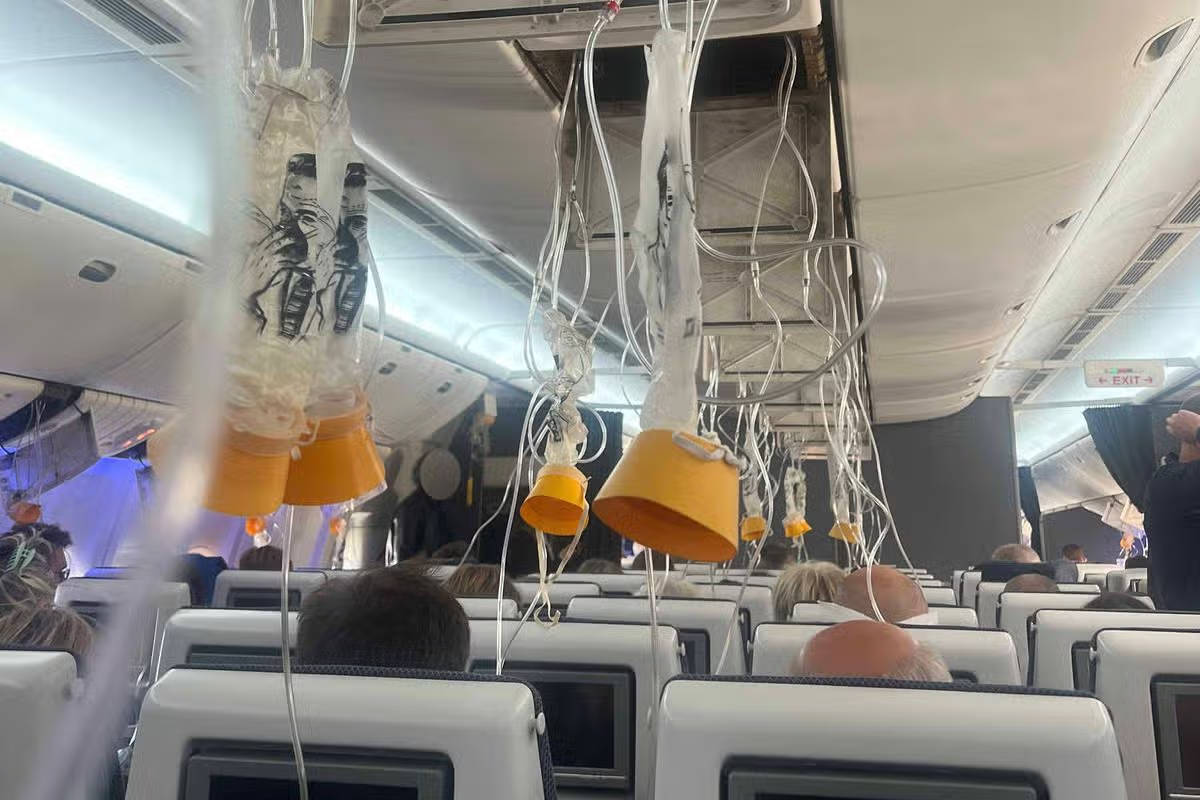
Flight BA295 had reached a cruising altitude of 37,000ft on its way from London to Chicago before the mid-air emergency
The oxygen masks deployed on the British Airways flight from London Heathrow to Chicago on October 5, 2026(Image: SWNS)
A passenger aboard a London to Chicago British Airways flight says the cabin was “silent” as they dropped 27,000ft in minutes. A “technical issue” caused the aircraft to drop and declare an emergency, and return to London on October 5.
Scott Tanner, 39, was a passenger on the plane when it began descending “noticeably” and they were told to put on oxygen masks. Flight BA295 had reached a cruising altitude of 37,000ft after taking off from Heathrow before the mid-air emergency.
Flight tracking data showed the aircraft dropped sharply down to 9,000ft. Scott said their was “silence” for 10 minutes before they were told they could remove their masks, and retuned to London after five hours in the air.
Scott, from Torbay, Devon, told Talk to the Press: “About an hour into the flight I was listening to an audiobook when, completely without warning, the oxygen masks suddenly dropped throughout the cabin.
“An automated announcement instructed everyone to put on their masks immediately. For around 10 minutes afterwards there was no further information from the flight deck.
“There was simply silence apart from the automated announcement repeating on a loop, which was probably the most disconcerting part. Despite this, everyone remained remarkably calm. I did not hear a single scream.
“We could feel the aircraft descending quite noticeably, although it felt controlled rather than like a plunge. The captain then told us that we were below 10,000 feet and could remove our masks.
“He later explained that we would be returning to Heathrow, but because the aircraft was carrying fuel for the transatlantic journey we would need to circle for several hours to burn it off. We eventually landed safely after about five hours in the air.”
Scott says British Airways provided passengers with hotel accommodation, but further arrangements were “frustrating”. He said: “I was initially rebooked via Charlotte despite direct flights being available, and I had to negotiate to have this changed.
“When I asked whether BA might offer some gesture in recognition of what had happened, I was repeatedly sent between different desks and eventually told that any compensation would have to be dealt with online.”
The plane left London Heathrow’s Terminal 5 at 11:50am, with an expected flight time of eight hours and 40 minutes before landing at Chicago O’Hare International Airport. The flight crew issued a squawk 7700 code – the international aviation signal for a general emergency – shortly after beginning the steep descent.
Passenger Tom Nicholls told the Mirror there was a “sudden bit of turbulence” during the emergency. Mr Nicholls explained: “The plane adjusted but it didn’t feel like it was descending rapidly. I’d say the pilots did a very good job.
“The oxygen masks popped out soon after and there was a bit of uncertainty onboard. The couple in front couldn’t get to theirs but by the time they’d found a spare seat with a mask, the captain announced we were below 10,000ft so they were not needed.”
A spokesperson from British Airways said: “The safety of our customers and crew is always our top priority, and the aircraft landed safely after our highly-trained pilots returned to Heathrow following a technical issue.
“Customers disembarked the aircraft normally and our teams are working to get their travel plans back on track as quickly as possible.”
STAYING in the UK for October half-term sounds like the smart, budget-conscious choice… until you sit down and crunch the numbers.
Between filling the fridge, shelling out for soft play, buying fuel for days out and those innocent-looking theme park trips that somehow cost £50 before you’ve even passed through the turnstiles, you could easily spend hundreds in a week.
Once you’ve added up food, petrol and activities for the week, a holiday abroad might not cost much moreCredit: On The BeachMagic Fantasy Hotel in Spain is one for the entire familyCredit: On the Beach Holidays
And that’s before the mental toll of cooking three meals a day, clearing up the constant mess and playing full-time entertainment director.
So, I did the maths on another option – cheap resorts with all-inclusive packages for October half-term, starting from £255pp or £51 a night.
With accommodation, meals and selected snacks and drinks included, as well as free childcare at some resort hotels, flying abroad starts to look like something worth pricing up against your half-term plans at home.
Here are the seven best-value resorts I’d be searching for this October half term – and someone else can handle the cooking.
7. Kusadasi, Turkey – from £433pp
Grand Blue Sky International has a fantastic All Inclusive offerCredit: On the Beach Holidays
Kusadasi gives families an all-inclusive holiday and a change of scenery from the usual Spanish resorts.
It also gives you plenty of scope for time outdoors, with an average October daytime high of 24C.
It has pools, (including a children’s pool), play areas and a club advertised for children aged four to twelve.
Breakfast, lunch and dinner are served buffet-style as part of its All Inclusive programme, with a later breakfast option if the family pulls off the rare miracle of sleeping in.
At £408pp, this is the priciest of the seven, but it gets you five nights at a mega-resort, with flights and meals included. Not bad.
6. Albufeira, the Algarve – from £378pp
Grand Muthu Forte da Oura has a pool and is right by the beachCredit: On the Beach Holidays
Albufeira is a good fit for an autumn break that mixes beach time with getting out and exploring.
The October daytime high is 23C, ideal for a walk along the beach or an afternoon in the brilliant bars of Albufeira’s old town.
Grand Muthu Forte da Oura is around 750 metres from Praia da Oura beach, with a main pool, children’s pool and playground.
And its stellar all-inclusive programme covers breakfast, lunch, dinner, afternoon snacks and selected locally produced drinks.
Lunch and dinner can be buffet-style or served from a set menu, but either way, having those meals accounted for makes your spending money easier to plan.
There is also free childcare year round – check availability before booking.
The five-night deal I found here was just £378pp, with flights, accommodation and all-inclusive food and drinks chucked in.
5. Callao Salvaje, Tenerife – from £330pp
Expect the warmest October temperatures at BLUESEA Callao GardenCredit: On the Beach Holidays
As you’d expect, Tenerife has the highest October average on this list.
With an average daytime high of 27C in October, Callao Salvaje is a strong pick when maximum warmth is what you’re after.
The apartment-style accommodation has three outdoor pools and activities including mini golf and table tennis.
Its all-inclusive board includes buffet meals, so there’s less need to hunt for somewhere to eat whenever somebody gets hungry.
And for all of this – guaranteed October heat, all you can eat and drink, return flights and your accommodation sorted – you’ll only need to part with £330pp.
4. Benidorm, Costa Blanca – from £325pp
Hotel Cuco is one for the Benidorm fansCredit: On the Beach Holidays
Benidorm makes family time in the sun easy – you’ve got massive beaches, promenades that aren’t a nightmare with a pushchair and plenty to see without committing to a full day’s excursion.
And the weather’s great too, with an average October daytime high of 25C.
I wouldn’t look much further than the highly-rated Hotel Cuco, just ten minutes’ walk from Poniente Beach.
Its buffet restaurant serves Mediterranean dishes with show cooking, and there’s a decent pool at the hotel too.
There’s a mini club for the little ones, as well as a rooftop pool bar which mum and dad might have more interest in exploring.
I found a deal for five nights this October for only £325pp, all-inclusive – that’s mega value for half-term.
3. Oropesa del Mar, Costa del Azahar – from £293pp
Crazy pools, pirate buffets – Magic Fantasy Hotel was made for familiesCredit: On the Beach Holidays
If your family wants proper entertainment rather than five quiet days by the pool, Oropesa del Mar could be the perfect pick.
With an average October daytime high of 24C, you get great conditions for getting out, topping up the Vitamin D and working on your tan.
And this hotel’s something special for both adults and kids too.
Magic Fantasy Hotel goes big on the family theme, with fantasy-inspired rooms and a Pirates Buffet serving Spanish and international food with a children’s section.
Over the October break there’s live entertainment, costume contests, and the waterparks fully open.
At £293pp for five nights all-inclusive, you’re getting flights, meals and plenty to get your teeth into for the week before you’ve planned a single day out.
2. La Pineda, Costa Dorada – from £283pp
Big pool, nearby beach and simply buffet food makes La Pineda an easy choice for the half termCredit: On The Beach
La Pineda makes family days super-straightforward.
Its long, flat beach gives everyone room to spread out, and the resort has an average October daytime high of 22C.
Not boiling, but that’s plenty of warmth for time on the sand, whether or not anyone fancies getting in the sea…
Gran Hotel La Hacienda is around 550 metres from the beach and has pools and a mini club for younger guests.
Meals are served buffet-style at its Riviera Maya restaurant, taking the daily “where shall we eat?” discussion off your hands, thank God.
PortAventura World is nearby too if you fancy a theme park day out, though tickets cost extra.
And the five-night all-inclusive package I found comes in at £283pp. Bargain.
1. Lloret de Mar, Costa Brava – from £255pp
Guitart Central Park Aqua Resort is our biggest bargain on the listCredit: On The Beach
My number one pick, Lloret de Mar, gives you beaches, coastal walks and a town to explore with the kids.
October’s average daytime high is around 22C.
That’s a comfortable temperature for a beach stroll or an afternoon exploring the Costa Brava without worrying about caking the kids in sun cream every ten minutes.
Guitart Central Park Aqua Resort has several pools, children’s clubs for different age groups and buffet restaurants serving Mediterranean, Italian and Catalan dishes, including loads of great options for children.
Its aquapark is the star of the show though with enough slides and features to keep the kids busy all week.
At £255pp, or £51 a night, this is the cheapest five-night all-inclusive deal I found too, and the one I’d personally be booking.
LIKE many, I have longed for a Rimowa suitcase, but the brand’s premium prices puts it out of my price range.
I simply can’t justify spending over £1000 on a suitcase, so I was understandably thrilled when I spotted the same luxe aesthetic for just £60 at Dunelm.
It has a nifty section for your laptop which the Rimowa does notCredit: Dunelm
Constellation Cabin Suitcase with Front Opening, £60 at Dunelm
The Constellation Silver Cabin Case caught my eye with its sleek silver finish and modern linear hard shell, which gives it a similar, minimalist look to the iconic Rimowa cases.
Sign up for the Travel newsletter
Thank you!
Like Rimowa, it also has a durable construction with a hard shell protecting the contents, while looking stylish in the Arrivals hall.
It also comes with a 360-degree spinner wheel system, meaning you can glide it along in pretty much any direction.
But there’s one particular feature that makes it extra appealing to modern travellers like me.
Dunelm’s dupe is spacious enough to fit up to a week’s worth of clothesCredit: Dunelm
The front-opening opening offers speedy access to your tech essentials, so you don’t have to disturb your perfectly packed suitcase as you’re going through security.
As someone who travels with a laptop, I think that’s actually more useful than simply having a suitcase that looks pretty.
In terms of size, the Constellation Cabin Suitcase measures 55 x 35 x 22cm, including its overall product dimensions, while the Rimowa Original Cabin is 55 x 40 x 23cm.
While they’re the same height, Dunelm’s case is 5cm narrower and 1cm shallower, making it the more compact option.
You’re getting the sleek minimal aesthetic, hard shell construction, 360-degree wheels and a clever tech compartment for £60 rather than £1,090, pocketing £1030 in savings.
With half-term around the corner, this is the sort of cabin case I’d be looking at for a short family break or a European mini break.
Will it meet airline luggage rules?
Before buying, check your airline’s free cabin-bag allowance.
The Dunelm case fits Jet2 and British Airways’ larger 56 x 45 x 25cm allowance, but it won’t be free on every airline or fit under the seat in front.
If you’re looking for underseat bags that nail the designer look, I’ve rounded up some alternatives below.
A compact option for short trips.Credit: CabinMax
CabinMax Underseat Cabin Suitcase, £39.95 at ASOS
What’s it good for? Weekend getaways, short city breaks, or business trips where you don’t need multiple outfits or heavy layers.
What you’ll like? It has wide suitcase-style opening, so you don’t have to dig through from the top like a regular backpack.
The Mykonos Hard Shell Vanity Case is perfect for make up loversCredit: M&S
The Mykonos Hard Shell Vanity Case, £30 at M&S
What’s it good for? Carrying delicate toiletries without worrying about leaks or crushed packaging.
It could also work as a sleek standalone bag for overnight trips if you travel light.
What you’ll like? It has an elasticated rear trolley strap that slips over telescoping suitcase handles for effortless, one-handed wheeling.
Now, these suitcases aren’t Rimowa, so you won’t get the same premium branding, construction or engineering.
But if, like me, you’re mainly after the chic silver aesthetic and some of the practical features seen in expensive luggage, they’re a tempting alternative.
If you’ve had a Rimowa suitcase on your wishlist but can’t swallow the £1,090 price tag, my Dunelm find could be the more purse-friendly alternative.
During his time as the lead propulsion engineer for SR-71 Blackbirds at NASA’s Dryden Flight Research Center, Tim Conners looked into how to push the iconic recon plane to fly faster than it had ever flown before. The world record for any crewed jet-powered aircraft is officially Mach 3.3, or 2,193 mph. It was set by a Blackbird in 1976 “on a straight-line course over Edwards Air Force Base in California.” In a recent interview with TWZ, Conners said he investigated whether there were ways to get Blackbird to approach Mach 4, equivalent to roughly a whopping 2,660 mph at altitude. Fast forward to today, with the possibility that NASA could be returning the SR-71 in some configuration to its test fleet, as well as its potential missions, the question of just how fast could the airframe go has become far more relevant than just a hypothetical exercise.
Conners spoke to us about his knowledge of plans to restore SR-71 #844, which had mysteriously disappeared from NASA’s Armstrong Flight Research Center, as well as its potential uses, in a deep-dive interview here. Prior to the revelations about the missing Blackbird, speculation about NASA’s renewed interest in the type was sparked last month, when NASA Administrator Jared Isaacman showed the silhouette of an aircraft that immediately drew comparisons to SR-71 during a speech at the annual All-In Summit in Los Angeles, California. Isaacman pushed back on a direct link to the SR-71 but said his agency is working hard to get “back in the business of flying high and fast again.”
NASA Administrator Jared Isaacman talks at the All-In Summit about new high- and fast-flying X-planes with the eye-catching aircraft silhouette in the background. All-In Summit/YouTube screencap
Given that, we wanted to know what limited the SR-71’s speed in its original configuration and how fast Conners thought it could go with modifications.
“The study that I did at Dryden was purely conceptual,” Conners explained of his work on the topic there in the early 1990s. “I asked questions of the Lockheed folks and the Pratt folks regarding limitations on speed. So stagnation temperature. What can we get to at altitude?”
The Blackbird, he said, “flew a trajectory that was usually operationally limited to 450 knots equivalent airspeed. If you look at the flight envelope, that defines the right edge of the envelope.”
SR-71 Blackbird. (Courtesy photo via USAF)
“The engines, however, were optimized to fly at about 500 knots equivalent airspeed, 475 to 500, and for whatever reason, there was a mismatch between what the engines were designed to do and what the airframe was ultimately optimized for, which was flight at around 450 knots,” the engineer added. “And you end up with that limitation now, the equivalent airspeed curve hooks up and to the right as you go up in altitude, so it sweeps out Mach number, and as you sweep out Mach number, the stagnation temperature is going up on you.”
“So you do reach a point, even at 500 KEAS [knots equivalent airspeed], where you end up with a constant value up at altitude once you’re in the stratosphere,” Conners said. “The Blackbird was trimmed or limited at that speed on the right side of the envelope, and that equated to a certain stagnation temperature. That limitation was driven primarily by the material strength of the engine front frame, from what it was described to me, and that’s what drove the analysis we did at NASA.”
SR-71 tail number 844 during its service with NASA. (NASA)
To even consider pushing the aircraft past the world record speed, Conners said something had to be done to mitigate the tremendous effects of the extreme heat on the air entering the engines.
“We weren’t looking at active cooling of the frame by pumping coolant through it,” Conners recalled. “What we looked at was spray cooling of the incoming airflow to lower the bulk temperature, so it would only be used when you were accelerating beyond about Mach 3.4. You would only very briefly do Mach excursions to a higher Mach number, and then come back. That was the conops for that system.”
“This is a way to [get to a higher Mach range] briefly,” the engineer postulated. “You could probably get to a higher Mach number. The problem is that if you clog or freeze the system, if it fails while you’re at higher speed, you have to decelerate in a hurry to protect the assets.”
Among other impediments to breaking the speed record, the Blackbird’s existing power plant was not up to the job, according to Conners.
“So that weak link was the J58,” he explained. “It had the performance, but not the material strength. If we’re looking at alternate engines designed to handle the higher Mach capability, then that could put the limiter on the airframe at that point, which we were told at NASA was somewhere like up near Mach 4 for brief excursions.”
The Pratt & Whitney J58 – The Engine of the SR-71 Blackbird
Aviation expert Paul F. Crickmore, who’s written several books about the Blackbird, told us that the aircraft was designed around a sustained cruise speed of Mach 3.2, with the primary critical limitation being aforementioned compressor inlet temperature (CIT).
Above 427 degrees Celsius (about 800 degrees Fahrenheit), the engines would be damaged, Crickmore noted. But if outside air temperature was colder, the aircraft could go faster before hitting that limit (in practice, Mach 3.3).
Temperature was just one factor in limiting how fast the SR-71 could travel, Crickmore explained. The shock waves from traveling so fast would also tamp down the Blackbird’s ultimate speed potential.
Paul Crickmore’s latest book on the SR-71, Lockheed Blackbird: Beyond the Secret Missions. The Missing Chapters. (Osprey Publishing)
“On the SR, you have to think three-dimensionally,” Crickmore explained. “But looking in just two dimensions, you would have an oblique shock wave on the nose, the first shock wave, and it would be at 90 degrees on either side. As the airplane got faster, that cone became more sharp until you got down to about 32 degrees. Now, at that speed, you’re at [Mach] 3.2. That oblique shock wave was still outside the envelope of the airplane – you don’t want to get that shockwave going anywhere near the flight controls. The faster you go, the narrower that cone, and the closer it gets to the wingtips, which is not good. This is the thing: People say, ‘Oh yeah, we can go maybe Mach 6.’ Well, right. But it’s not just about that. It’s about a lot of other things.”
The limiting factors imposed by the CIT value and the shockwave effect are also recalled by the late SR-71 pilot David Peters, recounted on the Habubrats SR-71 account on X.
“A little clarification on the speed. The issue is that I have been limited to less than Mach 3 on a few occasions because the outside air temperature was entirely above standard, and 427C came up at about [Mach] 2.95. On other occasions, like the Murmansk deal I got above 3.4 (3.49 on one occasion) and wasn’t close to 427C. The actual limiting airspeed is around 3.55; that is where the spike, being at full retraction loses the intercept on the shock wave and can no longer position it correctly in the inlet. Also, the overflow of the shock starts to go over the wing and interfere with the flight controls. So the limiting speed as configured would be about 3.55 so long as you don’t exceed 427C.”
Dare to Dream: A SR-71 Pilot’s Tale
For his part, Conners said that “shock effects at the inlet can be accommodated through rescheduling the inlet spike movement and perhaps making changes to the bypass schedules. None of that would necessarily be simple, and any changes would require careful envelope expansion. But it would not be impossible.”
Regardless of any other factors, Conners, the Blackbird engineer, remembered that his effort in boosting the jet’s speed never took off.
“It never got beyond me just sizing tank volume, considering different fluids that might work as a coolant, and then just gauging the relative appetite of NASA hierarchy for something like that,” Conners stated. “They weren’t interested in the risk. Nobody was asking for that Mach range.”
But that may be changing. It seems clear that one of the biggest challenges of getting the Blackbird back in the air will be its engines. They have sat for a long time, and getting them into a flyable condition could be the limiting issue. Beyond that, equipping the SR-71 with new engines also may represent the biggest opportunity for NASA getting a return on investment from its revived Blackbird.
(NASA)
In our interview, Conners told us that the feedback he heard about the remaining Blackbird J58 engines was “discouraging” because “the engines are indeed unserviceable.”
“I don’t believe that is based on an actual attempt to run them,” he explained. “It is based on inspection. Probably no surprise. They’ve sat idle, you know, for 27 years. That is what led to questions going back and forth regarding how the airframe would be powered. And that’s what led into, if you connect the dots, that’s where the airframe would be used as an engine test bed.”
Different engines “would have to be high-Mach bypass systems,” he noted. “We can speculate on which engine company might be developing those systems, but yeah, I don’t want to give it too much away because I don’t want us to lose the inside information that we got.”
Pratt & Whitney J58 engine. (National Air and Space Museum)
Also, the flight regime approaching Mach 4 would likely be one of the areas NASA is most interested in. It’s here where a combined cycle engine capable of hypersonic flight, one that contains both turbojet and ramjet or scramjet functions, would ‘hand-off’ propulsion from the turbojet to the other that is optimized for extreme speed. This is the same concept behind Lockheed’s SR-72 concept. Having an aircraft, and especially one that is not mired in deep classification and hidden from view, that can actually test this transitional flight regime could be of extreme value in unlocking a future where hypersonic flight is more accessible.
“Yeah, that could very well be what we’re looking at here,” Conners told us when we asked whether Blackbird’s open classification level is a driving factor in using it as a test bed for this research. “I’ve had friends ask that question this week. We were talking about the SR-72. Where is that at? I don’t know. I know people who went to work on it years ago. I’ve never heard anything since. So it could be that that’s so deep black that there’s no way that platform could be used as a test asset. So I think it’s precisely what you said. The Blackbird’s no longer classified, and that it’s possible that the engines that might be used in Blackbird wouldn’t be classified either.”
Lockheed’s ‘SR-72’ hypersonic plane concept. (Lockheed Martin Skunk Works)
So, reengining the SR-71 may solve two birds with one stone — providing a modern powerplant that won’t require the J58s to be revived and taking care of the inlet temperature issues discussed above that would allow the SR-71 airframe’s full potential to be exploited in testing. The fact that the jet can carry a massive payload on its back could allow it to provide critical testing of the handoff for dual cycle engine concepts.
This is just one use, of course. With the explosion in high-speed flight for defense purposes over the last decade, there are many other reasons to push a Blackbird to higher Mach numbers.
So with all this in mind, if we get the Blackbird back at all, maybe it will roll out with some major modifications that could indeed push it to new velocities.
Rachelle Goulding, Jacob Batalon and Georgia Waters in “Reginald the Vampire.”
(James Dittiger / Syfy)
Based on Johnny B. Truant’s “Fat Vampire” book series, this Syfy series brings to light the (some would say preposterous) idea that a vampire could look like an average human. Created by “Twin Peaks” veteran Harley Peyton, it also hits on an important, body-affirming message: Reginald, who was played by Jacob Batalon, wasn’t super strong or super fast. But he was super smart.
His October track record suggested he was an unlikely hero. He entered Wednesday with a .123 playoff batting average. He was benched in Game 5 of the World Series last year. He’d even started this postseason hitless in the first two games of the National League Division Series against the Atlanta Braves, and was given the red light on ABS challenges.
He didn’t carry any of that up to the plate with him in the seventh inning, with the score tied, the bases loaded and hard-throwing Braves reliever Robert Suarez entering the game to face him.
“I like being in those at-bats,” Pages said in Spanish after the Dodgers’ 4-1 win in Game 4 of the NLDS. “There are times the result comes, sometimes not, but I prepare to be in those spots. And today I was able to get the result.”
He was patient, working a full count as he fouled off and then foul-tipped a pair of fastballs in the zone.
The next one, he sent through the middle of the infield for a two-run single to finally give the Dodgers the lead in the deciding moment of the series.
The Dodgers are headed to the NL Championship Series for the ninth time in 14 seasons. They will play the Milwaukee Brewers, who finished off the San Diego Padres in four games, starting Sunday. And they came one step closer to their goal of winning a third straight World Series.
Get the latest on L.A.’s teams in the daily Sports Report newsletter.
By continuing, you agree to our Terms of Service, which include arbitration and a class action waiver. You agree that we and our third-party vendors may collect and use your information, including through cookies, pixels and similar technologies, for the purposes set forth in our Privacy Policy such as personalizing your experience and ads.
When asked about his quarterback Tuesday, Trojans coach Lincoln Riley quickly replied that Maiava is not injured.
“Jayden has been pretty healthy,” Riley said. “They’ve kept him upright all season long.”
Maiava has adapted to shifting receiving options, calling it a learning experience as he connects with new pass catchers. USC freshman Trent Mosley was an early breakout star, but Maiava has had to look to others with Mosley out the past two games because of injury.
From Thuc Nhi Nguyen: The five Buss siblings who voted to sell the family’s shares of the Lakers filed their formal opposition to team governor Jeanie Buss’ attempts to block the sale on Wednesday, calling Jeanie’s petition “legally and factually baseless” in a statement provided to The Times.
“While discussions among the siblings continue, their focus remains on facilitating the proposed transaction and the Trust’s participation in it, while ensuring that all beneficiaries, including Jeanie, are treated equally,” Jimmy, Johnny, Janie, Joey and Jesse Buss said in the statement.
“Today’s filing is a necessary step to protect those interests and ensure the transaction proceeds on schedule.”
Evan Bouchard had two goals and an assist to become the second defenseman in NHL history with at least six goals through the first four games of a season, and the Edmonton Oilers used a five-goal second period to beat the Ducks 5-2 on Wednesday night.
Bouchard has a league-leading six goals through four games. Harry Cameron had eight goals in four games for the Toronto Arenas during the NHL’s inaugural season in 1917-18.
Leon Draisaitl had four assists, Connor McDavid had a goal and two assists, Kasperi Kapanen and Vasily Podkolzin also scored, and the Oilers overcame a sluggish start to win their third straight game. Devon Levi made 28 saves.
No. 2 Dodgers vs. No. 3 Atlanta at Dodgers 5, Atlanta 3 (box score) Atlanta 3, at Dodgers 2 (box score) Dodgers 3, at Atlanta 1 (box score) Dodgers 4, at Atlanta 1 (box score)
No. 1 Milwaukee vs. No. 4 San Diego at Milwaukee 3, San Diego 2 (box score) at Milwaukee 4, San Diego 3 (box score) at San Diego 4, Milwaukee 3 (box score) Milwaukee 3, at San Diego 1 (box score)
American League
No. 1 Tampa Bay vs. No. 4 New York at Tampa Bay 1, New York Yankees 0 (box score) at Tampa Bay 5, New York Yankees 2 (box score) Tampa Bay 4, at New York Yankees 3 (box score)
No. 2 Cleveland vs. No. 6 Chicago White Sox Chicago White Sox 3, at Cleveland 0 (box score) Chicago White Sox 4, at Cleveland 3 (box score) Cleveland 9, at Chicago 3 (box score) Thursday at Chicago, 2 p.m., TBS/truTV/UniMas/HBO Max *Saturday at Cleveland, 2 p.m., TBS/truTV/UniMas/HBO Max
NLCS
No. 1 Milwaukee vs. No. 2 Dodgers Sunday at Milwaukee, TBD, FOX/FS1/FOX Deportes/FOX One Monday at Milwaukee, TBD, FOX/FS1/FOX Deportes/FOX One Wednesday at Dodgers, TBD, FOX/FS1/FOX Deportes/FOX One Thursday at Dodgers, TBD, FOX/FS1/FOX Deportes/FOX One *Friday, Oct. 16 at Dodgers, TBD, FOX/FS1/FOX Deportes/FOX One *Sunday, Oct. 18 at Milwaukee, TBD, FOX/FS1/FOX Deportes/FOX One *Monday, Oct. 19 at Milwaukee, TBD, FOX/FS1/FOX Deportes/FOX One
ALCS
No. 1 Tampa Bay vs. Cleveland/Chicago winner Monday, at Tampa Bay, TBD, TBS/truTV/UniMas/HBO Max Tuesday at Tampa Bay, TBD, TBS/truTV/UniMas/HBO Max Thursday at Chi/Cle, TBD, TBS/truTV/UniMas/HBO Max Friday, Oct. 16 at Chi/Cle, TBD, TBS/truTV/UniMas/HBO Max *Sat., Oct. 17 at Chi/Cle, TBD, TBS/truTV/UniMas/HBO Max *Monday, Oct. 19 at Tampa Bay, TBD, TBS/truTV/UniMas/HBO Max *Tuesday, Oct. 20 at Tampa Bay, TBD, TBS/truTV/UniMas/HBO Max
* if necessary
World Series starts Friday, Oct. 23
This day in sports history
1933 — Cliff Battles of the Boston Redskins becomes the first NFL player to gain more than 200 yards rushing with 215 yards in a 21-20 win over the New York Giants.
1949 — Walt Pastuszak has five of Brown’s 11 interceptions in a 46-0 rout of Rhode Island.
1950 — Bill Grimes of the Green Bay Packers gains 167 yards in 10 carries in a 44-31 loss to the New York Yankees.
1966 — Jerry DePoyster of Wyoming becomes the first player in college football to make three field goals of 50 yards or more in a game. DePoyster connects on two 54-yard tries and a 52-yarder in the Cowboys’ 40-7 rout of Utah.
1961 — Paul Hornung scores 33 points, with four touchdowns, six extra points and a field goal, to lead the Green Bay Packers to a 45-7 romp over the Baltimore Colts.
1977 — No. 7 Alabama beats No. 1 USC 21-20 in Los Angeles. USC fullback Lynn Cain scores with 38 seconds remaining but the 2-point attempt fails.
1992 — Doug Smail scores two goals and the expansion Ottawa Senators rock the Montreal Canadiens 5-3 — the first regular-season NHL game by an Ottawa franchise in 58 years.
1993 — The Anaheim Mighty Ducks, before 17,174 at the Arrowhead Pond, lose 7-2 to the Detroit Red Wings in their first NHL game.
1995 — Dolphin’s Dan Marino breaks Fran Tarkenton’s NFL career completions record.
1997 — Adam Oates reaches 1,000 points with three goals and two assists as the Washington Capitals post a 6-3 victory over the New York Islanders.
2005 — Baylor wins a Big 12 road game for the first time in the league’s 10-year history, beating Iowa State 23-13. The Bears had been 0-37 on the road in the Big 12 Conference.
2006 — Randy Moss’ 22-yard TD catch between two defenders 51 seconds before halftime is the Oakland receiver’s 100th touchdown reception. He’s becomes the seventh receiver in NFL history with 100 TD catches.
2011 — Howard scores all its points in the fourth quarter, including 16 in the final 1:27 to beat 29-28 Florida A&M. Parker Munoz caps the improbable comeback by hitting a 21-yard field goal with 4 seconds left following FAMU’s Damien Fleming fumble on the 28-yard line.
2015 — Tampa Bay’s Jason Garrison scores his second goal of the game at 2:17 of the extra period to lead the Lightning past the Philadelphia Flyers in the first 3-on-3 overtime game in NHL history.
2016 — Will Worth and Navy stuns No. 6 Houston, romping to a 46-40 victory. Worth runs for 115 yards and throws two scoring passes for the Midshipmen. Navy hadn’t beaten a top 10 team since 1984, when it topped then-No. 2 South Carolina in Annapolis.
2017 — Aaron Rodgers throws a 12-yard touchdown pass to Davante Adams with 11 seconds remaining, lifting Green Bay over the Dallas Cowboys 35-31 in another thriller nine months after the Packers’ divisional playoff victory on the same field.
2018 — Drew Brees’ 62-yard touchdown pass to rookie Tre’Quan Smith makes him the NFL’s all-time leader in yards passing and sends the New Orleans Saints well on their way to a 43-19 victory over the Washington Redskins. Brees enters the game needing 201 yards to eclipse Peyton Manning’s previous mark of 71,940 yards. He finishes 26 of 29 for 363 yards and three touchdowns.
Compiled by the Associated Press
This day in baseball history
1956 — Don Larsen of the New York Yankees pitches the only perfect game in World Series history, a 2-0 triumph over Brooklyn.
2018 — Red Sox utility player Brock Holt becomes the first MLB player to hit for the cycle in a postseason game.
Compiled by the Associated Press
Until next time…
That concludes today’s newsletter. If you have any feedback, ideas for improvement or things you’d like to see, email me at houston.mitchell@latimes.com. To get this newsletter in your inbox, click here.
Italy’s parliament is voting on Thursday on a new electoral law that would make it easier for election winners to form a majority government.
The law, proposed by Prime Minister Giorgia Meloni, would award extra seats to any party or coalition that obtains more than 42 percent of seats in both parliamentary chambers, ensuring it holds a majority.
Recommended Stories
list of 3 itemsend of list
Meloni has framed the legislation as a route to greater stability in Italy’s political system, which has often been run by fragile coalition governments. Her critics, however, say the move is actually aimed at boosting her own chances in elections next year.
Here’s what we know about the electoral law and what it means for Italian politics:
What is Italy’s current electoral system?
Italy currently has a mixed electoral system for its 600-seat parliament, with about 36 percent of members of parliament elected directly in constituencies where the candidate with the most votes wins, and the rest decided through proportional representation.
The system, called “Rosatellum”, has been in place since 2017. It encourages coalition-building but can produce fractured results that make a governing majority hard to forge.
What would the new law change?
The new legislation would replace the mixed electoral system with a fully proportional one, as well as awarding extra seats to the party or coalition that wins the most seats if it secures at least 42 percent in both chambers.
The bonus would be as many as 70 seats in the 400-member Chamber of Deputies, the lower house, and up to 35 seats in the Senate, which has 200 elected members.
That means if a party or coalition meets the 42 percent share threshold in both chambers, it would have stronger power to govern. If no party or coalition meets the threshold, representation would be decided proportionally.
The new law would also force coalitions to announce their candidates for prime minister before the elections. Rado Fonda, head of research at Italian pollster SWG, told the Reuters news agency this provision could “prove problematic for the centre-left, potentially forcing an early leadership contest and exposing divisions that could weaken the bloc”.
Meloni, who currently leads the country’s longest-serving government since World War II, has said the reform will help stabilise the country rather than serve any one political group. “Whoever wins the elections will have the numbers to govern,” she said.
What stage is the legislation at?
The proposed law has already been approved by the Senate and must now undergo a final secret-ballot vote in the Chamber of Deputies.
Giovanni Orsina, a political scientist at Rome’s Luiss Guido Carli University, predicted that the law is “extremely likely” to pass.
If it fails, Meloni has said she will resign.
Italian Prime Minister Giorgia Meloni speaks during the MED9 Summit, in Split, Croatia, October 7 [Antonio Bronic/Reuters]
Why is the legislation controversial?
Opponents say the law is undemocratic because it could potentially grant a winning coalition a disproportionate level of power in parliament.
They also say that the legislation is intended to favour Meloni, whose Brothers of Italy party (Fdl) is bracing for a tough election battle next year.
Riccardo Magi, head of the liberal More Europe party, who is on a hunger strike to protest the proposed reform, has called it an “anti-democratic law” that risks giving a minority bloc a huge majority in parliament.
Senator Matteo Renzi, who leads the Italia Viva party, has accused Italy’s governing coalition of pushing the electoral reform due to a fear of losing power.
Other critics have pointed out that the law would do little to stabilise the political system if no party or coalition reaches the 42 percent threshold in both chambers – a relatively high bar.
“This could produce a hung parliament, making post-electoral negotiations necessary to form a government,” Vincenzo Emanuele, a political science professor at Luiss Guido Carli University in Rome and a member of the Italian Center for Electoral Studies (CISE), told Al Jazeera. “Even relatively small changes in coalition composition could make the difference between a clear parliamentary majority and a situation of political deadlock.”
When are Italy’s next elections, and what do the polls show?
Italy’s next general election must be held by December 22, 2027, although the government can call elections earlier if it wishes.
Currently, Meloni’s Fdl is polling ahead of all other parties, with 27 percent support, according to Politico’s polling aggregator. Her coalition partners, Lega and Forza Italia, have a combined 12 percent support, according to Politico, bringing the coalition share to 39 percent.
Fdl’s polling has been dented by support for a new far-right group, Futuro Nazionale (National Future), Reuters reported. It currently has 7.8 percent support, according to Italian polling institute SWG.
In opposition, the Democratic Party (PD) has 21 percent support, the Five Star Movement (M5S) has 12 percent and the Alliance of Greens and Left (AVS) has 6 percent, according to Politico. The Italy Viva (IV) and More Europe parties have 2 percent support each.
Emanuele said the current landscape means the proposed electoral law would not necessarily favour Meloni and could even benefit the opposition.
He said recent simulations by the CISE have shown that a centre-left coalition including the PD and M5S could potentially reach 44 percent of the vote, securing a “comfortable parliamentary majority”, though that could change if Meloni allies with National Future.
“The reform does not inherently favour the incumbent government: Its effects will depend crucially on how the competing coalitions are formed,” said Emanuele.
BOOKING a budget-friendly family getaway has never been easier.
If you want to keep the whole family entertained on holiday without breaking the bank, one of the UK’s top holiday park operators is rolling out some seriously unmissable deals.
Go all inclusive on your next UK family holiday at a Parkdean Resorts holiday parkCredit: TripAdvisor
Parkdean Resorts is offering action-packed family hols including all inclusive getaways, Nickelodeon Weekenders for Paw Patrol fans, and Tots Breaks where kids eat completely free.
Better yet, these breaks start from an unbelievably cheap £6.19 per person, per night. Here’s our favourite Parkdean offers on right now.
Sign up for the Travel newsletter
Thank you!
All inclusive breaks
45 of Parkdean Resorts’ holiday parks offer an all inclusive optionCredit: Parkdean Holidays
Forget the faff of cooking and supermarket runs on your next caravan holiday, as 45 Parkdean Resorts across the UK offer all-inclusive meal packages.
The deal is available at popular parks including Camber Sands, Highfield Grange, and mega resort Trecco Bay, which is the one of the largest holiday parks in Europe.
The all inclusive offer bundles in three hot, sit-down meals a day in the site’s main restaurant alongside unlimited soft drinks and hot drinks.
This means you can start every morning with a cooked breakfast, enjoy crowd-pleasing lunch options like burgers and curries, and sip on bottomless Costa Coffees.
The all inclusive option works as an add-on to the cost of your stay and starts from £80 per adult and £30 per child (under 12) for a four-night break.
That works out to a bargain £20 per night for grown-ups and £7.50 per child.
The all inclusive offer is available for four night breaks with Monday arrivals, excluding the school holidays.
However 14 of the parks are offering three-night weekend options, too. Click here to browse which ones.
Tots Breaks
Parkdean Resorts Tots Breaks are designed for families with under fivesCredit: TripAdvisor
Keeping toddlers entertained and well-fed on holiday can be exhausting and expensive, but Parkdean Resorts has come up with the ultimate solution.
Their brilliant ‘Tots Breaks‘ are tailor-made for families with under-fives, with four-night stays starting from £99.
That works out to £6.19 per person, per night for a family of four.
Best of all, kids eat completely free for the entire holiday.
Little ones get complimentary breakfasts, lunches, and dinners from the Starland Krew Menu, with hits like beef burgers, tomato pasta, and chicken strips, saving families up to £70 on their food bill.
There are plenty of activities designed for young children, too.
Under-fives can dive into messy play, soft play, sing-a-long Tots & Tunes music sessions, or even tackle an adorable obstacle course, the ‘Mini Olympics’.
The entertainment line-up is just as impressive, with Milkshake! Mornings across 40 UK sites, plus exciting meet-and-greets with PAW Patrol characters like Chase and Marshall.
Nickelodeon Weekender
Meet and greet classic cartoon characters like the Ninja Turtles on a Nickelodeon weekenderCredit: Parkdean Resorts
If your kids are obsessed with PAW Patrol, Ninja Turtles or SpongeBob SquarePants, we’ve got good news. Parkdean Resorts have put together the perfect weekend break for Nickelodeon fans.
You can bag a Nickelodeon Weekender family break from £163 for three nights, working out to £13.58 per person, per night for a family of four.
From morning to night, there is plenty of free Nickelodeon-themed entertainment for all ages.
Little ones can complete ‘Mighty Missions’ set by PAW Patrol’s Ryder and learn the Pup Pup Boogie, or head down to the Showbar to learn martial arts from the Teenage Mutant Ninja Turtles and earn their very own ninja mask.
The fun does not stop when the sun goes down, with a lineup of evening events including interactive family game shows, dance parties and live shows packed with prizes.
When you’re ready to chill out, families can settle down for a special ‘Movie with the Stars’ screening alongside the actual characters from the film.
Ukraine says it has received proposals from India, Turkiye, Egypt and the United States to broker talks with Russia. The offers come as the two adversaries escalate attacks on each other’s energy and port infrastructure with their war now in its fifth year.
Ukrainian Foreign Minister Andrii Sybiha revealed the four proposals at a briefing in Kyiv on Friday and singled out New Delhi’s. “The most comprehensive is India’s proposal,” he said, adding that India had signalled a willingness to play a role for the first time.
Recommended Stories
list of 3 itemsend of list
None of the proposals aims to end the war. Each seeks a narrower truce, covering energy facilities, ports or commercial shipping in the Black Sea.
Here’s what we know:
What is India proposing?
India has not made its plan public. Quoting unnamed sources, however, Indian media have reported it has three parts. According to the Hindustan Times, it would aim to protect infrastructure, keep grain and energy supplies moving through Black Sea ports, and ensure the safety of commercial shipping.
The first part – mutually halting strikes on energy facilities and ports – matches what Kyiv has been demanding. Sybiha said any deal must be a complete energy truce that covers port infrastructure as well.
The second part builds on the Black Sea Grain Initiative, which Turkiye and the United Nations mediated in 2022 but Russia abandoned in 2023.
The third part, protecting merchant ships and their crews, is particularly important to India because Indian sailors have been killed or harmed on Black Sea routes.
The sources were quoted as saying India’s plan goes further than the other three proposals because it covers infrastructure and shipping together. A Ukrainian official told the Kyiv Independent that it incorporates elements of the Turkish, Egyptian and US initiatives. The Kyiv Post reported that Sybiha also described the plan as addressing a possible ceasefire along the front lines, although other accounts said he gave no specifics.
The proposal likely took shape during Indian External Affairs Minister Subrahmanyam Jaishankar’s first visit to Ukraine last month and in a later meeting with Sybiha at the UN General Assembly in New York, also in September. Jaishankar said New Delhi was “trying to be helpful, starting with the Black Sea safety of shipping issue”.
What do we know about the Turkish and Egyptian proposals?
Very little. Neither Ankara nor Cairo has published details. Both reportedly focus on keeping Black Sea grain supplies moving by suspending attacks on commercial shipping. Some reports said the two countries proposed a grain truce jointly while others described two separate plans.
Turkiye has done this before. With the UN, it steered the 2022 grain deal, one of the few narrow truces of the war to hold for any length of time. Ankara and the UN are now organising new Black Sea talks with a round planned for October.
Beyond its Black Sea focus, almost nothing is known about Egypt’s proposal. Its interest, however, is clear: Egypt relies on Ukraine for nearly one-third of its grain supplies.
What is the US pitching?
According to Ukrainian President Volodymyr Zelenskyy, Washington has proposed three steps: a mutual halt to energy strikes, a reopening of the grain corridor and a trilateral meeting with Ukraine and Russia, possibly in Abu Dhabi.
The latest effort began in early September when US President Donald Trump’s envoys visited Kyiv and Moscow and secured an agreement in principle for a trilateral meeting. Steve Witkoff and Jared Kushner met Russian President Vladimir Putin in Moscow on September 5 while Kremlin envoy Kirill Dmitriev visited the US twice in September.
The trilateral meeting has since been pushed back. It had been expected to take place in the United Arab Emirates in early October. Washington now wants it in late October, and people close to the talks blamed the delay on Russia.
Washington has also invited Putin to the Group of 20 summit in Miami, Florida, in December. “We hope that’s an invitation he’ll accept,” US Secretary of State Marco Rubio said. The Kremlin said no decision has been made.
At the same time, the US is applying pressure to try to end the war. Trump recently signed a law giving him sweeping powers to sanction buyers of Russian energy.
He has also called on Ukraine to stop targeting Russian diesel facilities amid a diesel prices crisis in the US, where Trump faces tricky midterm elections next month. “Mr Zelenskyy has to do one thing,” he said on September 13. “He has to stop knocking out diesel fuel in Russia.” This drew much criticism that Trump instead should focus his comments on Russia, which began the war with its invasion of Ukraine in February 2022.
He is reportedly sceptical about his own government’s latest diplomatic initiative. People familiar with his thinking have told US media that he doubted Putin would agree to an energy truce before winter.
(Al Jazeera)
How have Russia and Ukraine responded?
Sybiha said Ukraine would agree to a truce but with conditions. It would accept an energy and Black Sea shipping ceasefire, but only as a combined package, he said.
He added that Kyiv is also open to an unconditional ceasefire along the current front lines. Zelenskyy backs the US-proposed meeting but stressed it needs “not only Ukraine but also the Russian side” to support it.
Moscow has been warm in tone but has committed to nothing. Kremlin spokesperson Dmitry Peskov said Russia would welcome India’s peace efforts while Putin said Modi has “very good ideas aimed at finding mutually acceptable solutions”, but he did not elaborate.
In private, Moscow appears to have said no. A Ukrainian official told the Kyiv Independent that Russia has rejected India’s proposal although this has not been confirmed publicly. Ukraine’s agriculture minister said Russia had rejected every Black Sea ceasefire option the mediators have presented.
Why are Global South countries becoming more involved?
Food supplies, the lives of their citizens and fuel prices are all at stake.
“I think it’s clear to many countries that this war is not a localised war, but it’s a war that has these global consequences,” Fredrik Wesslau, a senior policy fellow at the European Council on Foreign Relations, told Al Jazeera.
Russia and Ukraine account for more than a quarter of global wheat shipments, and their attacks on each other’s ports helped push wheat futures to a three-year high in August.
Sailors from countries with no links to the war are being killed. At least five Indian seafarers have died in strikes on Black Sea shipping in recent months along with seven Azerbaijani crew members since June. On Saturday, a Russian strike on a Liberian-flagged ship in a port in the Odesa region killed a crew member. Ukraine, for its part, has targeted tankers it links to Russia’s shadow fleet since July.
The energy war is also being felt in global markets. Ukraine reported more than 194 drone attacks on Russian refineries this year, hitting all 11 of the largest. Bloomberg News estimated that Russia’s fuel output has fallen by more than 30 percent. With Middle East supply already down as a result of the US-Israel war on Iran, global diesel markets are more exposed to the loss of Russian supplies.
Maximilian Hess, a nonresident senior fellow in the Eurasia Program at the Foreign Policy Research Institute, said energy is at least as important as grain in driving the diplomatic efforts. He pointed to a “clear frustration” among many countries over high oil prices, which reflect both the Russia-Ukraine war and the crisis in the Middle East.
“Of course, Ukrainian grain is important for them, but the oil-price factor is important there as well,” he told Al Jazeera. “I think it is those commodity-shock concerns that are pushing them to re-embrace this rhetoric, rather than anything else.”
What are the challenges ahead?
Every previous attempt at diplomacy has failed to end the Russia-Ukraine war. A US-brokered, 30-day energy truce in early 2025 collapsed amid accusations of violations on both sides. At talks in Istanbul in May 2025, Zelenskyy complained that Russia had sent a junior delegation with no authority to sign a ceasefire.
In August 2025, a meeting between Trump and Putin in Alaska yielded no results despite Trump claiming to be close to a deal ahead of it.
Wesslau said Washington’s efforts have faltered partly because Trump – who had boasted he would end the war within 24 hours of taking office in January 2025 – has appeared unwilling to put real pressure on Moscow. “The Russians see this, and they conclude that they can continue this war,” he said.
Deep distrust remains. Oleksandr Merezhko, head of the Ukrainian parliament’s foreign affairs committee, said: “Putin never keeps agreements.”
Moscow’s actions on the ground suggest it is in no hurry, Wesslau said “They’re trying to strangle Ukraine, strangle the economy, and make it unliveable ahead of the winter,” he said. He added that Moscow’s occasionally softer rhetoric was aimed mainly at the Trump administration and “has always proved to be a bluff”.
Russia’s terms are another obstacle. Hess said Moscow’s demands have not softened at any point since it launched the war and at times have grown. Putin has demanded all of Ukraine’s Donetsk, Luhansk, Kherson and Zaporizhia regions, including territory Russian forces have never controlled, as well as a buffer zone in northern Ukraine. Moscow is also seeking sanctions relief and military concessions for any Black Sea deal.
“I don’t think it’s a question of who actually mediates. I think it’s really a question of the calculation in Moscow,” Wesslau said. “Fundamentally, the problem is that Putin doesn’t want a ceasefire or a peace agreement. He wants to continue the war. He believes that he can win.”
Analysts said only greater economic pressure is likely to change that calculation.
Wesslau said if Europe can close down Russia’s shadow fleet of oil tankers, “this would be a massive blow to Russia’s war economy.” Hess said the country best placed to shift things quickly is China, rather than the US, by cutting its purchases of Russian oil. However, he added: “I don’t think Beijing is interested in doing so.”
Hess said that unless there is an outside shock, the war “is much more likely to last another four years than another four months”.