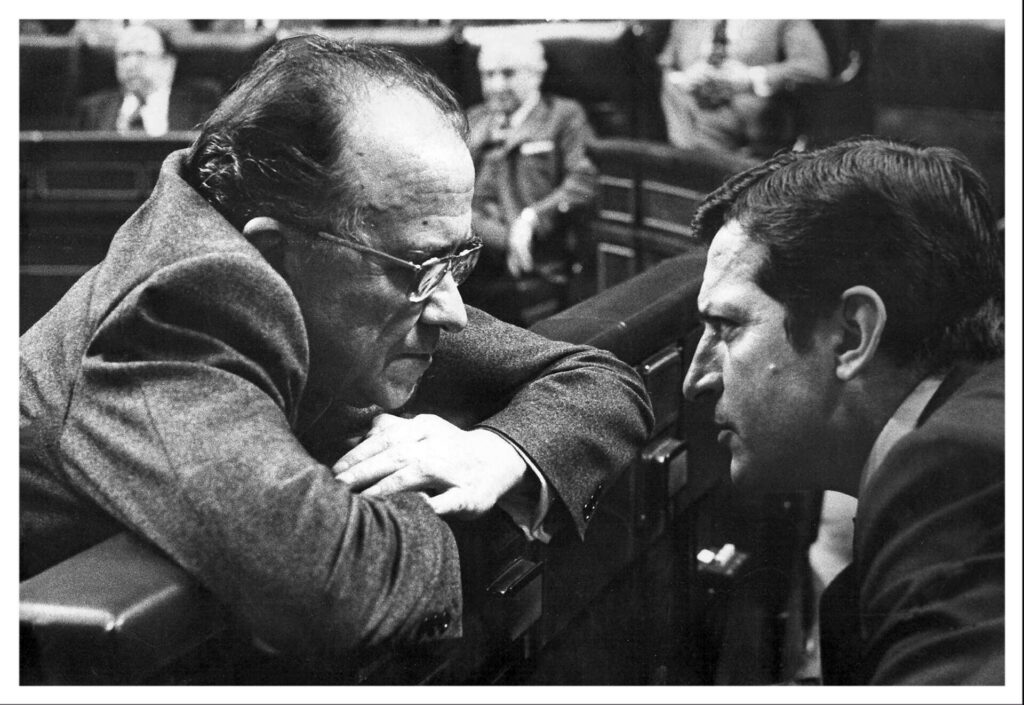
King Juan Carlos I summons party leaders after the failed 1981 coup. From left to right: Santiago Carrillo (Communist Party), Agustín Rodríguez Sahagún (Defence Minister), Adolfo Suárez (Prime Minister), Juan Carlos I, Felipe González (PSOE) and Manuel Fraga (People’s Alliance, later PP).
(“Gosh, no! Not another hyper-comparative article about two distant political conflicts…” Apologies. We’ll try to make it a fun read).
More often than not, our intellectual circles have felt tempted to look at alien historical episodes in a never-ending search for resolute answers that shed light on our present. In 2023, when Maduro flirted with attacking US-supported Guyana, some revisited the Falklands War as a sign that a serious military incursion would be a fatal mistake that would lead to the dictatorship’s downfall. Then came the road to the 2024 presidential election; many feared (rightfully, in the end) that the country would plunge into the “Nicaragua scenario” if the dictator refused to recognize his defeat. Others momentarily wondered if enough external pressure could give way to a Guatemala-style transfer of power and a weak transition government.
The days of terror seem to be behind us, yet there’s no progressive reformer like Raúl Alfonsín steering the wheel of justice. Instead, Donald Trump gave us the Pizza Hut scenario. Here, Delcy Rodríguez has become the poster girl of the MAGA international franchise. Here, too, US geopolitical ambitions and business interests at times seem to be competing with the need for free elections and a democratic regime.
Is Rodríguez our Mikhail Gorbachev, trying to open the economy and political system just enough while attempting to save the chavista State from outright collapse? What if chavismo is already dead and she’s the Yeltsin of the Caribbean, the feeble leader who will give away the country’s riches to oligarchs in an arbitrary fashion, laying the ground for a new form of autocracy?
Or might Delcy be the chavista version of Adolfo Suárez, the not-so-brilliant and obscure but highly charismatic Francoist insider? Suárez finished the job after a remarkable run, surviving a period of meagre political support, declining approval rates and a coup d’etat that could have killed him. The comparison now sounds like an insult to the Spaniard. Like Gorbachev in today’s Russia, Suárez has become a sort of mythical statesman abroad while Spanish right- and left-wing critics dispute his legacy.

There are genuine similarities between the process currently unfolding in Caracas and the outset of Spain’s democracy, as well as room for gross contrasts. While 2026 has been insane for Venezuelans, Spain exactly fifty years ago was astonishing due to the speed at which Suárez acted in unilaterally dismantling the regime from within the regime. The dictator was finally gone, and as soon as he had the chance, the new King ordered a politician without strong ideological convictions to establish a full parliamentary democracy.
Suárez took office in June 1976. The Law for Political Reform, meant to pave the way for a new democratic legislature (with the King acting as a key enforcer), was through six months later. Spain held general elections within a year. That was just the start. What followed was a sequence full of the raw materials that tend to feed these history-making episodes: secret meetings and grand bargains between rivals and strange bedfellows, journalists acting like hinges, political violence, and leaders who soon become overwhelmed by their own decisions and actions.
How the transition worked out
When scholars praise the atmosphere of consensus that defined Spain in the 1970s, they generally speak of the close cooperation between regime reformers and opposition moderates in devising broad agreements that fastened democracy, fundamental rights and regional autonomy with the recognition of the monarchy. In doing so, these figures refused to address legal and moral responsibilities for the violence left by the Civil War and four decades of military rule (more on this later).
The spirit of the Transición is best encapsulated by the political partnership between Suárez and Santiago Carrillo, leader of the Communist Party (PCE) and the most prominent figure in a scattered opposition. Much like María Corina Machado this year, Carrillo was a key veto player in the transition’s inception. Suárez had the power; democracy just couldn’t be without the legitimacy carried by Francoism’s utmost rival. The government legalized the PCE only after it abandoned Marxist-Leninist doctrine and Republican (“anti-Spain”) symbols. As Javier Cercas recounts in the brilliant Anatomy of a Moment, the duo protected each other’s backs amid hardline pressures, in a climate of growing economic hardship and political violence where ETA and Far Right violence threatened to destabilize their project.
In Spain’s first elections since 1936, Suárez won and the renewed PSOE of a young Felipe González managed to eclipse the old-looking communists. Once the new democratic parliament was settled, Suárez and representatives from major parties signed the Moncloa Pacts, then framed as a national agreement to save the economy. Parallels with Venezuela’s Puntofijo Pact are there: the political class came together on monetary policy and wage regulation; welfare and public spending; and fundamental freedoms for citizens, workers and members of the press. An amnesty for political prisoners followed. In 1978, Spanish voters overwhelmingly voted to approve a new consensus constitution.

As is only natural during these processes, the position of Suárez before Francoist remnants in the State became untenable. Time exposed the true nature of his goals: he eventually crossed all the red lines of the inmovilistas, wiping out Franco’s ultra-conservative and nationalist institutions. Far Right groups, elites, the military and even newspapers plotted to jeopardize the transition and restrain its main characters. However, much of the groundwork for political action and breakthroughs was laid by domestic and outside backers who had an unequivocal pro-democracy stance.
In the Francois legislature, King Juan Carlos appointed his personal tutor and advisor, Torcuato Fernández-Miranda, as president. In the diplomatic arena, regional leaders and international actors favored Spain’s democratization and European integration. Willy Brandt, Francois Mitterrand and even Carlos Andrés Pérez encouraged PSOE’s social-democratic turn and the rise of González. Meanwhile, Carrillo had the endorsement of fellow Eurocommunists that had broken with the Soviet Union.
However, royal and international support were neither constant nor salient enough in the Spanish case. Domestic variables and the consequences of political opening made Suárez grow weaker in 1979, and his government could have fallen apart. In Venezuela, where the level of tutelage in place is more decisive than in Spain back then, the approach of the United States remains gradual and its supervision restrictive for opposition actors. The speed of reforms also seems to be contingent on the diverse interests of the Trump administration. Unlike in Spain at this stage, elections don’t appear to be around the corner, and new policies and initiatives are either limited in scope or yet to show results.
The transition’s key omissions
When comparing the Spanish transition with the Venezuelan process, significant details reveal mistakes whose lessons should serve to prevent their repetition. The transitional justice model, the control of the security forces, and the polarization that affects public opinion after decades, are some of the aspects that can be adjusted to learn from what Spain did well. However, we must keep our eyes open regarding the issues left unresolved.
Six years after Franco’s death and following many important reforms, the Spanish government did not have control of its security apparatus. As a result, a group of Guardias Civiles led by Antonio Tejero, stormed the Congress of Deputies on February 23, 1981, taking Suárez, Carrillo and the entire government hostage while tanks occupied the city of Valencia. The coup failed, but it became clear that the nascent democracy was fragile and that military, police and political elements were able to undermine it. Just like Venezuela in the early sixties.
A change in government, even one negotiated and backed by the US, does not guarantee control over the Venezuelan armed forces. During the transition process, the loyalty of the military must be built and put to the test. There is no guarantee that Venezuela will not experience an episode like Spain’s 23-F; the only way to ensure otherwise is to include representatives of the military high command at the negotiating table from the very beginning.

Then we have the famous Pact of Forgetting. As the opposition basically got everything it wanted, la Transición did not establish any special justice mechanisms. Reconciliation was built on a pacto del olvido, an implicit agreement between regime reformers and a large part of the opposition that consisted of not judging the past, not establishing truth commissions, and adhering to a logic of equivalency between the Two Spains: the Republican Left and the Nationalist Right, the losers and the winners of the Civil War.
The “pact of forgetting” is far from what we Venezuelans aspire to. The victims of Francoism were unable to access mechanisms for reparations during the first 25 years of democracy. Later, the Ley de Memoria Histórica (Historical Memory Law, LMH) and the Ley de Memoria Democrática (Democratic Memory Law, LMD) were enacted to fill that void. The reality is that justice came too late, was biased, and failed to meet international standards on truth, memory, and non-repetition.
One only needs to take a close look at the 1977 Amnesty Law. It passed almost unanimously; its original intent was a genuine desire to bring closure. However, the same law granted amnesty to those who were politically persecuted as well as to “authorities, civil servants, and law enforcement officers” for violations against the rights of Spanish citizens. To an extent, these are the same flaws that have been criticized in the Venezuelan amnesty law enacted in January 2026.

Forgetting and silence created wounds in Spain that were not fully healed and vulnerable to political manipulation throughout this century. A 2008 study found that 55.7% of those surveyed stated that the victims of the dictatorship had not received the recognition they deserved. That sense of injustice has fueled the narrative promoted by the Spanish Left that the transition was a “deal” between elites rather than a pacted rupture with the regime.
Venezuela’s amnesty law bears the same risk and exacerbates it by ordering the destruction of records and criminal histories. Erasing the evidence that will one day be needed to reconstruct the patterns of repression is the opposite of reconciliation. The construction of memory is the only thing that can guarantee that in 2050, Venezuelans will not be having the same disputes that Spain continues to have about Franco. For our process to move toward transformation, we must establish special justice mechanisms that include both reparations and forgiveness. Without this, at best, the next generations will be prone to forgetting.
Coming to terms with post-chavismo
It’s important to make a clarification regarding our case. Today, chavismo is not a force that polarizes the country, capable of winning elections like Suárez did, but a political elite that faces widespread rejection. That does not mean it will disappear from the political landscape. On the contrary, the mere fact that chavismo continues to rule may hint that it will remain part of public life. Eventually, the heirs of chavismo could try to reframe the legacy of Chávez, “saving” him from the discredit brought on by Maduro-era atrocities. The Maduro-Flores faction and a few other figures will likely be erased from chavismo’s new narratives. They will be portrayed as a deviation from chavismo’s original ideas. They will try to bring in new faces, and perhaps Diosdado Cabello will hand over the PSUV to some new figure, such as Héctor Rodríguez and a crop of young, “converted democrats.”
Yet the suffering caused by the chavista project cannot be so easily erased from the memories of millions of Venezuelans who endured hunger, exile, repression and imprisonment.
The wounds that remain fresh among Venezuelans can be as deep as those borne by the older generations in Spain, who faced the destruction and trauma of armed conflict. Like Franco, Chávez and Maduro spent two decades trying to build a “new man” through the military and partisan occupation of public life. However, the nature of the crimes and mismanagement in 21st-century Venezuela is different from that in Francoist Spain, where thousands of dissidents were systematically persecuted and killed. Like in Cuba and the USSR, economic and social devastation has been so severe that it led to mass starvation and exodus. Our remaining task and the lesson learned from what was lacking in the Spanish transition, is to build a historical memory focused on ensuring that anything resembling that does not happen again, and that whoever wants to enter the political arena can do so according to the rules of democracy.
Bonus: Delcy vs. Suárez
Adolfo Suárez became prime minister in 1976, having emerged from the very structures of Francoism and State-owned media. He was certainly not a reformer, much less a democrat until Juan Carlos appointed him to lead the transition. Suárez eventually acted on his own volition, seeing the process through to the end. Delcy, as Maduro’s “Super Minister” and his last vice president, has been a far more prominent figure in the chavista State, and also more deeply involved with the repressive apparatus than Suárez was, as UN reports can attest). In the case of Delcy, US military intervention has pushed her to change certain policies, cool down repression and engage with a sector of the opposition, part of a strategy for political survival where her regime needs to balance Washington’s demands with avoiding chavismo’s downfall. That has nothing to do with a “democratic” conversion.
The comparison is still vague, but Venezuelan historians can re-assess if this process leads to its much-needed destination.
Timeline (optional read)
1973: A decrepit Franco steps down as PM, separating the headship of state and the presidency of government for the first time. He names his loyal right-hand man, Admiral Luis Carrero Blanco, as Prime Minister, with jurist Torcuato Fernández-Miranda as Deputy PM and conservative Carlos Arias Navarro at Interior. The global oil shock strikes Spain, ending fifteen years of economic boom (the Spanish Miracle) and unleashing severe inflation. In December, ETA assassinates Carrero Blanco in Madrid. Arias Navarro succeeds him with the backing of Franco’s family.
1974: Knowing that Franco’s death was imminent, the regime starts to split between moderates and hardliners while ETA consolidates as a lethal enemy of Madrid. Arias Navarro promises freedom of association, but under pressure from hardliners, the proposal ends up being a sham. The opposition favours gradual reform away from Francoism. European leaders encourage PSOE’s social-democratic turn, appointing a young Felipe González as Secretary General. Communist Party (PCE) leader Santiago Carrillo and other exiled figures call for a peaceful, democratic rupture with the regime.
1975: Franco dies in November. King Juan Carlos I is crowned head of state and reinstates Arias Navarro as PM, maintaining an impossible cabinet of both regime hardliners and moderate reformers like Manuel Fraga. ETA and left-wing terror groups step up attacks, while public strikes and protests demand amnesty and democracy. González enters Spain; Carrillo remains abroad.
1976: Arias Navarro’s sluggish reforms cause political deadlock and social unrest. Pressured by the King, he resigns in July. Juan Carlos appoints Fernández-Miranda as President of the Cortes and Torcuato’s former pupil, Adolfo Suárez, as PM. Suárez promises elections for 1977 and skilfully passes the Law for Political Reform through the Francoist parliament, dismantling the regime from within. Suárez tries to build democratic credibility by engaging with González. The more prominent Carrillo remains sidelined, leading the Communists from clandestinity, until he forces the regime to briefly arrest and release him.
1977: Carrillo and Suárez negotiate a pact in person. Suárez legalizes trade unions and, in a risky move during Holy Week, legalizes Carrillo’s PCE. The Communists abandon its Marxist-Leninist doctrine and traditional Republican symbols. In June, Spain holds its first free general election since 1936: Suárez’s UCD wins, closely followed by the renewed PSOE of González. Major parties sign the Moncloa Pacts to stabilize the economy. An Amnesty Law releases political prisoners.
1978: Parliamentary committees draft a consensus constitution guaranteeing fundamental rights, regional autonomy, and a constitutional monarchy. In December, Spanish voters overwhelmingly approve the new Constitution in a national referendum, formally ending the Francoist State and establishing Spain as a modern parliamentary democracy. The government discovers that some security officials are plotting a coup against Suárez, including Guardia Civil Lieutenant Colonel Antonio Tejero, but the main conspirators receive minor penalties.
1979: Spain holds its first elections under the new Constitution: UCD wins again but fails to secure an absolute majority. Regional autonomy statutes pass in Catalonia and the Basque Country. Economic trouble, internal UCD infighting, and rising ETA violence create growing political instability and unrest within the military.
1980: Suárez faces worsening economic crises, mounting regional tensions, and a vote of no confidence tabled by the PSOE. Suárez survives the vote, but his authority inside the UCD collapses as cabinet ministers and faction leaders publicly break ranks, making his government increasingly untenable.
1981: Exhausted by political crisis and plots, Suárez resigns in January. During the parliamentary vote to appoint Leopoldo Calvo-Sotelo as his successor on February 23, Lt. Col. Antonio Tejero leads an attempted military coup (23-F). King Juan Carlos rejects the coup on national television, securing army loyalty and saving the young democracy.
1982: Calvo-Sotelo navigates Spain into NATO despite widespread public opposition. Disintegrating from internal factionalism, the ruling UCD collapses. In the October general elections, Felipe González leads the PSOE to a historic landslide victory, marking the first peaceful transfer of power to a left-wing government and consolidating Spanish democracy.
1983: The newly inaugurated PSOE government launches major economic restructuring and industrial modernization plans to prepare Spain for European integration. Simultaneously, the State initiates decentralisation by establishing the final Autonomous Communities, completing Spain’s territorial map under the 1978 Constitution.