As Israelis prepare to vote, Palestinians in the occupied West Bank say they have little hope of change, as they face movement restrictions, expanding settlements and the threat of forcible displacement, with no say in the Israeli elections shaping the reality they live under.
Venezuela is once again debating a renewal of its institutions, as if the problem could be solved simply by replacing the people in office. This remains the crucial question: what would have to change among those who wield power so that new rules are respected, even when doing so is inconvenient for them?
We are talking about rebuilding the State, restoring judicial independence, or recovering institutional integrity, often attributing agency to structures that, in practice, operate through human decisions. Behind every appointment, court ruling, or agreement are individuals driven by interests, convictions, fears, and power dynamics. No reform can overlook them.
When a future Supreme Court (TSJ) justice faces the uncomfortable decision of ruling against the interests of those who made their appointment possible, they will recall that the Constitution guarantees their independence; yet, they will also realize that their decision hinges on the safeguards available to them and the personal consequences of challenging those in power.
Individuals who uphold institutions
Following the fall of the Pérez Jiménez dictatorship on January 23, 1958, key political leaders realized that democratic survival required agreements that predated any constitutional framework. Rómulo Betancourt, Rafael Caldera, and Jóvito Villalba represented the parties that signed the Pact of Puntofijo in October of that year. The 1961 Constitution came later, built upon a foundation of compromises reached by former adversaries who had experienced the failure of 1945–1948. The agreements preceded the rules they were meant to uphold.
Those agreements, however, were not all-encompassing. The Communist Party was excluded from the pact, and the system of elite conciliation studied by Juan Carlos Rey ultimately revealed significant limitations regarding representation. Moreover, civilian consensus does not guarantee military obedience. In May and June 1962, the uprisings known as the Carupanazo and the Porteñazo put the Betancourt government to the test.
The 1999 Constitution already provided a Judicial Nominations Committee with civil society participation—much like the one we now expect—yet its operations ultimately became subordinate to political control.
Democracy survived because key sectors of the Armed Forces remained loyal to the constitutional order, even though their defense of it was accompanied by restrictions and repressive measures. Institutions require individuals willing to uphold them against those seeking to tear them down.
Institutions that sustain individuals
Four decades later, Venezuela embarked on another institutional transformation. The 1999 Constitution promised to expand citizen participation and strengthen rights, yet its existence did not prevent the progressive concentration of power. In 2004, the Organic Law on the Supreme Tribunal of Justice (TSJ) expanded the court from 20 to 32 justices, facilitating political control over the body. In the presidential elections of July 28, 2024, the National Electoral Council (CNE) declared Nicolás Maduro the winner without publishing the disaggregated results backing its announcement. The electoral fraud exposed a fundamental contradiction: the body charged with guaranteeing the popular will ended up proclaiming a result contrary to the available electoral evidence.
The problem was not simply the gap between a sound Constitution and poor leaders. Over the years, relationships of dependency were built that made it possible to subordinate formally autonomous institutions. Consequently, public offices, judicial decisions, and oversight mechanisms increasingly served the preservation of a political project. The result was that an institution could retain its name, legal powers, and procedures while losing the actual capacity to constrain those in power. The rules remained, but those charged with defending them lacked the independence to do so.
US influence on the process also raises questions about the extent to which agreements reflect the priorities of the Venezuelan people.
In 2026, the debate resurfaces under different circumstances. Following Maduro’s removal on January 3, the government of Delcy Rodríguez is negotiating the renewal of the branches of government. Dinorah Figuera, president of the National Assembly elected in 2015, announced a schedule that seeks to revamp the Supreme Court of Justice (TSJ) by November and complete work on the National Electoral Council (CNE) by December. These are announced political timelines that remain subject to negotiation.
But who is actually negotiating, and to whom are they accountable? US influence on the process also raises questions about the extent to which agreements reflect the priorities of the Venezuelan people. Furthermore, any given concession can be instantly interpreted on social media—by polarized audiences—as either a victory or a betrayal, thereby raising the political cost of negotiation.
The broader audience watching this process is not solely in Venezuela. Millions participate from abroad in public conversations about the country’s future and will also play a role in defending the institutions that may eventually be rebuilt. Institutional reconstruction must incorporate both the Venezuelans who remain in the country and those who have had to build their lives elsewhere. The experience of exile, diverse life paths, and political differences should not become obstacles to participating in defining our shared future. After so many years of division, the challenge also lies in recognizing ourselves as part of the same society, one in which no one is considered expendable in the effort to rebuild democracy.
Added to this is an issue that no agreement between civilians can sidestep: the continued existence of a military and security structure formed under chavismo. The conduct of those who control the weapons will be a decisive test for any new institutional order.
Society vs. institutional boundaries and agreements
The answer to the initial question (“what must change among those in power so that new rules are respected, even when doing so is inconvenient for them?”) requires concrete guarantees. For a judge to rule independently, the processes of selection and tenure must be shielded from those who expect obedience in exchange for the appointment. The 1999 Constitution already provided a Judicial Nominations Committee with civil society participation—much like the one we now expect—yet its operations ultimately became subordinate to political control. However, the 2024 election also taught us that when the CNE failed in its duty of transparency, citizens and organizations gathered and preserved the tally sheets that allowed the official results to be challenged.
Venezuelan society demonstrated that it can generate evidence and demand accountability, even when an institution fails.
Reconstruction therefore demands reforms capable of altering the incentives for those in power, guarantees for those who have suffered persecution, and oversight mechanisms that do not rely on the goodwill of those governing. Yet, it also requires a society capable of upholding those boundaries. The armed forces also need to find a place within that balance. Transparent rules for promotion and retirement, professionalization, and subordination to civilian authority could offer an alternative to personal loyalty. Their incorporation into the new order cannot imply impunity; distinguishing individual responsibilities and ensuring independent investigations will be essential to prevent inclusion from merely reproducing the privileges of the past.
The experience of the 2024 vote tallies offers a concrete possibility: transforming that capacity for civic organization into permanent oversight of the new authorities.
That capacity also depends on a democratic culture that recognizes the value of disagreement. A democracy is not built among equals, but among people who think differently yet still find reasons to reach compromises. Alterity—understood as recognizing the other in their difference—allows for the acceptance that an adversary also has the right to participate in shaping shared rules. Agreements require this disposition not only to emerge but also to endure and be revised when circumstances change.
For Venezuelans abroad, such participation requires more than just invitations to return: it demands guarantees for exercising political rights, effective mechanisms for participation, and conditions that allow their skills and capabilities to be linked to the country’s reconstruction. Within Venezuela, the experience of the 2024 vote tallies offers a concrete possibility: transforming that capacity for civic organization into permanent oversight of the new authorities, with access to public information and spaces to demand answers.
Institutional frameworks cannot remain static, either. Rules that once facilitated coexistence may require adjustments in the face of new social demands and political transformations. The contemporary challenge lies in the speed of these changes, which demands a greater capacity for understanding from those who govern and better tools for evaluating consequences from society. A democratic civic culture must allow institutions to evolve without becoming subject to the will of whoever happens to hold power at the time.
Domestic and international economic and financial sectors also need reasons to commit to this order. Legal certainty, transparent public contracts, and independent courts would allow informal influences to be replaced by relationships governed by established rules. However, such a commitment requires abandoning advantages gained through discretionary practices. An economy capable of long-term investment needs institutions that protect legitimate activity without relying on personal proximity to power.
Venezuela can overhaul its courts, appoint new electoral officials, and even draft another Constitution. None of that, on its own, will resolve the power dynamics that enabled authoritarianism. Institutions require rules that protect those who enforce them, as well as citizens capable of defending them when their own leaders seek to disregard them. Legitimacy is neither imported from Washington nor decreed from Caracas; it is built through the decisions of those who wield power and a society’s capacity to hold them accountable for those decisions.
King Juan Carlos I summons party leaders after the failed 1981 coup. From left to right: Santiago Carrillo (Communist Party), Agustín Rodríguez Sahagún (Defence Minister), Adolfo Suárez (Prime Minister), Juan Carlos I, Felipe González (PSOE) and Manuel Fraga (People’s Alliance, later PP).
(“Gosh, no! Not another hyper-comparative article about two distant political conflicts…” Apologies. We’ll try to make it a fun read).
More often than not, our intellectual circles have felt tempted to look at alien historical episodes in a never-ending search for resolute answers that shed light on our present. In 2023, when Maduro flirted with attacking US-supported Guyana, some revisited the Falklands War as a sign that a serious military incursion would be a fatal mistake that would lead to the dictatorship’s downfall. Then came the road to the 2024 presidential election; many feared (rightfully, in the end) that the country would plunge into the “Nicaragua scenario” if the dictator refused to recognize his defeat. Others momentarily wondered if enough external pressure could give way to a Guatemala-style transfer of power and a weak transition government.
The days of terror seem to be behind us, yet there’s no progressive reformer like Raúl Alfonsín steering the wheel of justice. Instead, Donald Trump gave us the Pizza Hut scenario. Here, Delcy Rodríguez has become the poster girl of the MAGA international franchise. Here, too, US geopolitical ambitions and business interests at times seem to be competing with the need for free elections and a democratic regime.
Is Rodríguez our Mikhail Gorbachev, trying to open the economy and political system just enough while attempting to save the chavista State from outright collapse? What if chavismo is already dead and she’s the Yeltsin of the Caribbean, the feeble leader who will give away the country’s riches to oligarchs in an arbitrary fashion, laying the ground for a new form of autocracy?
Or might Delcy be the chavista version of Adolfo Suárez, the not-so-brilliant and obscure but highly charismatic Francoist insider? Suárez finished the job after a remarkable run, surviving a period of meagre political support, declining approval rates and a coup d’etat that could have killed him. The comparison now sounds like an insult to the Spaniard. Like Gorbachev in today’s Russia, Suárez has become a sort of mythical statesman abroad while Spanish right- and left-wing critics dispute his legacy.
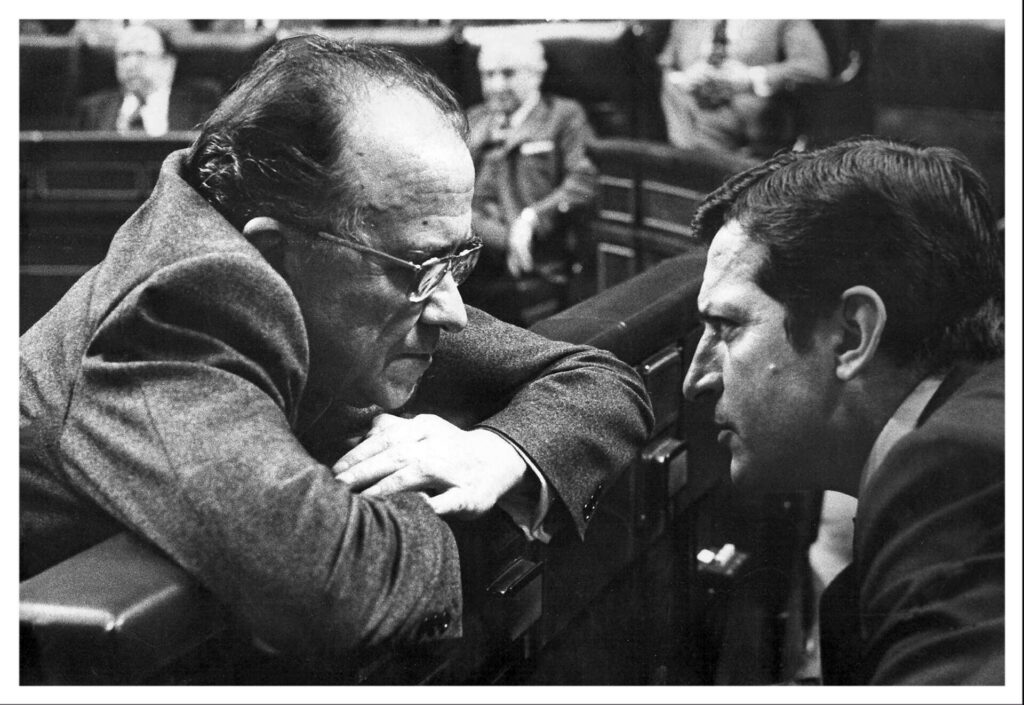
Suárez and Santiago Carrillo developed a close working relationship during the transition.
There are genuine similarities between the process currently unfolding in Caracas and the outset of Spain’s democracy, as well as room for gross contrasts. While 2026 has been insane for Venezuelans, Spain exactly fifty years ago was astonishing due to the speed at which Suárez acted in unilaterally dismantling the regime from within the regime. The dictator was finally gone, and as soon as he had the chance, the new King ordered a politician without strong ideological convictions to establish a full parliamentary democracy.
Suárez took office in June 1976. The Law for Political Reform, meant to pave the way for a new democratic legislature (with the King acting as a key enforcer), was through six months later. Spain held general elections within a year. That was just the start. What followed was a sequence full of the raw materials that tend to feed these history-making episodes: secret meetings and grand bargains between rivals and strange bedfellows, journalists acting like hinges, political violence, and leaders who soon become overwhelmed by their own decisions and actions.
How the transition worked out
When scholars praise the atmosphere of consensus that defined Spain in the 1970s, they generally speak of the close cooperation between regime reformers and opposition moderates in devising broad agreements that fastened democracy, fundamental rights and regional autonomy with the recognition of the monarchy. In doing so, these figures refused to address legal and moral responsibilities for the violence left by the Civil War and four decades of military rule (more on this later).
The spirit of the Transición is best encapsulated by the political partnership between Suárez and Santiago Carrillo, leader of the Communist Party (PCE) and the most prominent figure in a scattered opposition. Much like María Corina Machado this year, Carrillo was a key veto player in the transition’s inception. Suárez had the power; democracy just couldn’t be without the legitimacy carried by Francoism’s utmost rival. The government legalized the PCE only after it abandoned Marxist-Leninist doctrine and Republican (“anti-Spain”) symbols. As Javier Cercas recounts in the brilliant Anatomy of a Moment, the duo protected each other’s backs amid hardline pressures, in a climate of growing economic hardship and political violence where ETA and Far Right violence threatened to destabilize their project.
In Spain’s first elections since 1936, Suárez won and the renewed PSOE of a young Felipe González managed to eclipse the old-looking communists. Once the new democratic parliament was settled, Suárez and representatives from major parties signed the Moncloa Pacts, then framed as a national agreement to save the economy. Parallels with Venezuela’s Puntofijo Pact are there: the political class came together on monetary policy and wage regulation; welfare and public spending; and fundamental freedoms for citizens, workers and members of the press. An amnesty for political prisoners followed. In 1978, Spanish voters overwhelmingly voted to approve a new consensus constitution.
Suárez and Felipe González share a smoke during the Moncloa Pacts negotiations. By Gustavo Catalán Deus.
As is only natural during these processes, the position of Suárez before Francoist remnants in the State became untenable. Time exposed the true nature of his goals: he eventually crossed all the red lines of the inmovilistas, wiping out Franco’s ultra-conservative and nationalist institutions. Far Right groups, elites, the military and even newspapers plotted to jeopardize the transition and restrain its main characters. However, much of the groundwork for political action and breakthroughs was laid by domestic and outside backers who had an unequivocal pro-democracy stance.
In the Francois legislature, King Juan Carlos appointed his personal tutor and advisor, Torcuato Fernández-Miranda, as president. In the diplomatic arena, regional leaders and international actors favored Spain’s democratization and European integration. Willy Brandt, Francois Mitterrand and even Carlos Andrés Pérez encouraged PSOE’s social-democratic turn and the rise of González. Meanwhile, Carrillo had the endorsement of fellow Eurocommunists that had broken with the Soviet Union.
However, royal and international support were neither constant nor salient enough in the Spanish case. Domestic variables and the consequences of political opening made Suárez grow weaker in 1979, and his government could have fallen apart. In Venezuela, where the level of tutelage in place is more decisive than in Spain back then, the approach of the United States remains gradual and its supervision restrictive for opposition actors. The speed of reforms also seems to be contingent on the diverse interests of the Trump administration. Unlike in Spain at this stage, elections don’t appear to be around the corner, and new policies and initiatives are either limited in scope or yet to show results.
The transition’s key omissions
When comparing the Spanish transition with the Venezuelan process, significant details reveal mistakes whose lessons should serve to prevent their repetition. The transitional justice model, the control of the security forces, and the polarization that affects public opinion after decades, are some of the aspects that can be adjusted to learn from what Spain did well. However, we must keep our eyes open regarding the issues left unresolved.
Six years after Franco’s death and following many important reforms, the Spanish government did not have control of its security apparatus. As a result, a group of Guardias Civiles led by Antonio Tejero, stormed the Congress of Deputies on February 23, 1981, taking Suárez, Carrillo and the entire government hostage while tanks occupied the city of Valencia. The coup failed, but it became clear that the nascent democracy was fragile and that military, police and political elements were able to undermine it. Just like Venezuela in the early sixties.
A change in government, even one negotiated and backed by the US, does not guarantee control over the Venezuelan armed forces. During the transition process, the loyalty of the military must be built and put to the test. There is no guarantee that Venezuela will not experience an episode like Spain’s 23-F; the only way to ensure otherwise is to include representatives of the military high command at the negotiating table from the very beginning.
During the 23-F coup attempt, Suárez, Carrillo, and Deputy Prime Minister Manuel Gutiérrez Mellado were the only ones to refuse Tejero’s orders to throw themselves to the floor. In the picture, Gutiérrez Mellado confronts the rebel Civil Guards.
Then we have the famous Pact of Forgetting. As the opposition basically got everything it wanted, la Transición did not establish any special justice mechanisms. Reconciliation was built on a pacto del olvido, an implicit agreement between regime reformers and a large part of the opposition that consisted of not judging the past, not establishing truth commissions, and adhering to a logic of equivalency between the Two Spains: the Republican Left and the Nationalist Right, the losers and the winners of the Civil War.
The “pact of forgetting” is far from what we Venezuelans aspire to. The victims of Francoism were unable to access mechanisms for reparations during the first 25 years of democracy. Later, the Ley de Memoria Histórica (Historical Memory Law, LMH) and the Ley de Memoria Democrática (Democratic Memory Law, LMD) were enacted to fill that void. The reality is that justice came too late, was biased, and failed to meet international standards on truth, memory, and non-repetition.
One only needs to take a close look at the 1977 Amnesty Law. It passed almost unanimously; its original intent was a genuine desire to bring closure. However, the same law granted amnesty to those who were politically persecuted as well as to “authorities, civil servants, and law enforcement officers” for violations against the rights of Spanish citizens. To an extent, these are the same flaws that have been criticized in the Venezuelan amnesty law enacted in January 2026.
In January 1977, in the space of three days, far-right gunmen killed three students and four labor lawyers linked to the Communist Party. The events became known as Madrid’s Semana Negra and remain a symbol of the injustices that marred the transition.
Forgetting and silence created wounds in Spain that were not fully healed and vulnerable to political manipulation throughout this century. A 2008 study found that 55.7% of those surveyed stated that the victims of the dictatorship had not received the recognition they deserved. That sense of injustice has fueled the narrative promoted by the Spanish Left that the transition was a “deal” between elites rather than a pacted rupture with the regime.
Venezuela’s amnesty law bears the same risk and exacerbates it by ordering the destruction of records and criminal histories. Erasing the evidence that will one day be needed to reconstruct the patterns of repression is the opposite of reconciliation. The construction of memory is the only thing that can guarantee that in 2050, Venezuelans will not be having the same disputes that Spain continues to have about Franco. For our process to move toward transformation, we must establish special justice mechanisms that include both reparations and forgiveness. Without this, at best, the next generations will be prone to forgetting.
Coming to terms with post-chavismo
It’s important to make a clarification regarding our case. Today, chavismo is not a force that polarizes the country, capable of winning elections like Suárez did, but a political elite that faces widespread rejection. That does not mean it will disappear from the political landscape. On the contrary, the mere fact that chavismo continues to rule may hint that it will remain part of public life. Eventually, the heirs of chavismo could try to reframe the legacy of Chávez, “saving” him from the discredit brought on by Maduro-era atrocities. The Maduro-Flores faction and a few other figures will likely be erased from chavismo’s new narratives. They will be portrayed as a deviation from chavismo’s original ideas. They will try to bring in new faces, and perhaps Diosdado Cabello will hand over the PSUV to some new figure, such as Héctor Rodríguez and a crop of young, “converted democrats.”
Yet the suffering caused by the chavista project cannot be so easily erased from the memories of millions of Venezuelans who endured hunger, exile, repression and imprisonment.
The wounds that remain fresh among Venezuelans can be as deep as those borne by the older generations in Spain, who faced the destruction and trauma of armed conflict. Like Franco, Chávez and Maduro spent two decades trying to build a “new man” through the military and partisan occupation of public life. However, the nature of the crimes and mismanagement in 21st-century Venezuela is different from that in Francoist Spain, where thousands of dissidents were systematically persecuted and killed. Like in Cuba and the USSR, economic and social devastation has been so severe that it led to mass starvation and exodus. Our remaining task and the lesson learned from what was lacking in the Spanish transition, is to build a historical memory focused on ensuring that anything resembling that does not happen again, and that whoever wants to enter the political arena can do so according to the rules of democracy.
Bonus: Delcy vs. Suárez
Adolfo Suárez became prime minister in 1976, having emerged from the very structures of Francoism and State-owned media. He was certainly not a reformer, much less a democrat until Juan Carlos appointed him to lead the transition. Suárez eventually acted on his own volition, seeing the process through to the end. Delcy, as Maduro’s “Super Minister” and his last vice president, has been a far more prominent figure in the chavista State, and also more deeply involved with the repressive apparatus than Suárez was, as UN reports can attest). In the case of Delcy, US military intervention has pushed her to change certain policies, cool down repression and engage with a sector of the opposition, part of a strategy for political survival where her regime needs to balance Washington’s demands with avoiding chavismo’s downfall. That has nothing to do with a “democratic” conversion.
The comparison is still vague, but Venezuelan historians can re-assess if this process leads to its much-needed destination.
Timeline (optional read)
1973: A decrepit Franco steps down as PM, separating the headship of state and the presidency of government for the first time. He names his loyal right-hand man, Admiral Luis Carrero Blanco, as Prime Minister, with jurist Torcuato Fernández-Miranda as Deputy PM and conservative Carlos Arias Navarro at Interior. The global oil shock strikes Spain, ending fifteen years of economic boom (the Spanish Miracle) and unleashing severe inflation. In December, ETA assassinates Carrero Blanco in Madrid. Arias Navarro succeeds him with the backing of Franco’s family.
1974: Knowing that Franco’s death was imminent, the regime starts to split between moderates and hardliners while ETA consolidates as a lethal enemy of Madrid. Arias Navarro promises freedom of association, but under pressure from hardliners, the proposal ends up being a sham. The opposition favours gradual reform away from Francoism. European leaders encourage PSOE’s social-democratic turn, appointing a young Felipe González as Secretary General. Communist Party (PCE) leader Santiago Carrillo and other exiled figures call for a peaceful, democratic rupture with the regime.
1975: Franco dies in November. King Juan Carlos I is crowned head of state and reinstates Arias Navarro as PM, maintaining an impossible cabinet of both regime hardliners and moderate reformers like Manuel Fraga. ETA and left-wing terror groups step up attacks, while public strikes and protests demand amnesty and democracy. González enters Spain; Carrillo remains abroad.
1976: Arias Navarro’s sluggish reforms cause political deadlock and social unrest. Pressured by the King, he resigns in July. Juan Carlos appoints Fernández-Miranda as President of the Cortes and Torcuato’s former pupil, Adolfo Suárez, as PM. Suárez promises elections for 1977 and skilfully passes the Law for Political Reform through the Francoist parliament, dismantling the regime from within. Suárez tries to build democratic credibility by engaging with González. The more prominent Carrillo remains sidelined, leading the Communists from clandestinity, until he forces the regime to briefly arrest and release him.
1977: Carrillo and Suárez negotiate a pact in person. Suárez legalizes trade unions and, in a risky move during Holy Week, legalizes Carrillo’s PCE. The Communists abandon its Marxist-Leninist doctrine and traditional Republican symbols. In June, Spain holds its first free general election since 1936: Suárez’s UCD wins, closely followed by the renewed PSOE of González. Major parties sign the Moncloa Pacts to stabilize the economy. An Amnesty Law releases political prisoners.
1978: Parliamentary committees draft a consensus constitution guaranteeing fundamental rights, regional autonomy, and a constitutional monarchy. In December, Spanish voters overwhelmingly approve the new Constitution in a national referendum, formally ending the Francoist State and establishing Spain as a modern parliamentary democracy. The government discovers that some security officials are plotting a coup against Suárez, including Guardia Civil Lieutenant Colonel Antonio Tejero, but the main conspirators receive minor penalties.
1979: Spain holds its first elections under the new Constitution: UCD wins again but fails to secure an absolute majority. Regional autonomy statutes pass in Catalonia and the Basque Country. Economic trouble, internal UCD infighting, and rising ETA violence create growing political instability and unrest within the military.
1980: Suárez faces worsening economic crises, mounting regional tensions, and a vote of no confidence tabled by the PSOE. Suárez survives the vote, but his authority inside the UCD collapses as cabinet ministers and faction leaders publicly break ranks, making his government increasingly untenable.
1981: Exhausted by political crisis and plots, Suárez resigns in January. During the parliamentary vote to appoint Leopoldo Calvo-Sotelo as his successor on February 23, Lt. Col. Antonio Tejero leads an attempted military coup (23-F). King Juan Carlos rejects the coup on national television, securing army loyalty and saving the young democracy.
1982: Calvo-Sotelo navigates Spain into NATO despite widespread public opposition. Disintegrating from internal factionalism, the ruling UCD collapses. In the October general elections, Felipe González leads the PSOE to a historic landslide victory, marking the first peaceful transfer of power to a left-wing government and consolidating Spanish democracy.
1983: The newly inaugurated PSOE government launches major economic restructuring and industrial modernization plans to prepare Spain for European integration. Simultaneously, the State initiates decentralisation by establishing the final Autonomous Communities, completing Spain’s territorial map under the 1978 Constitution.
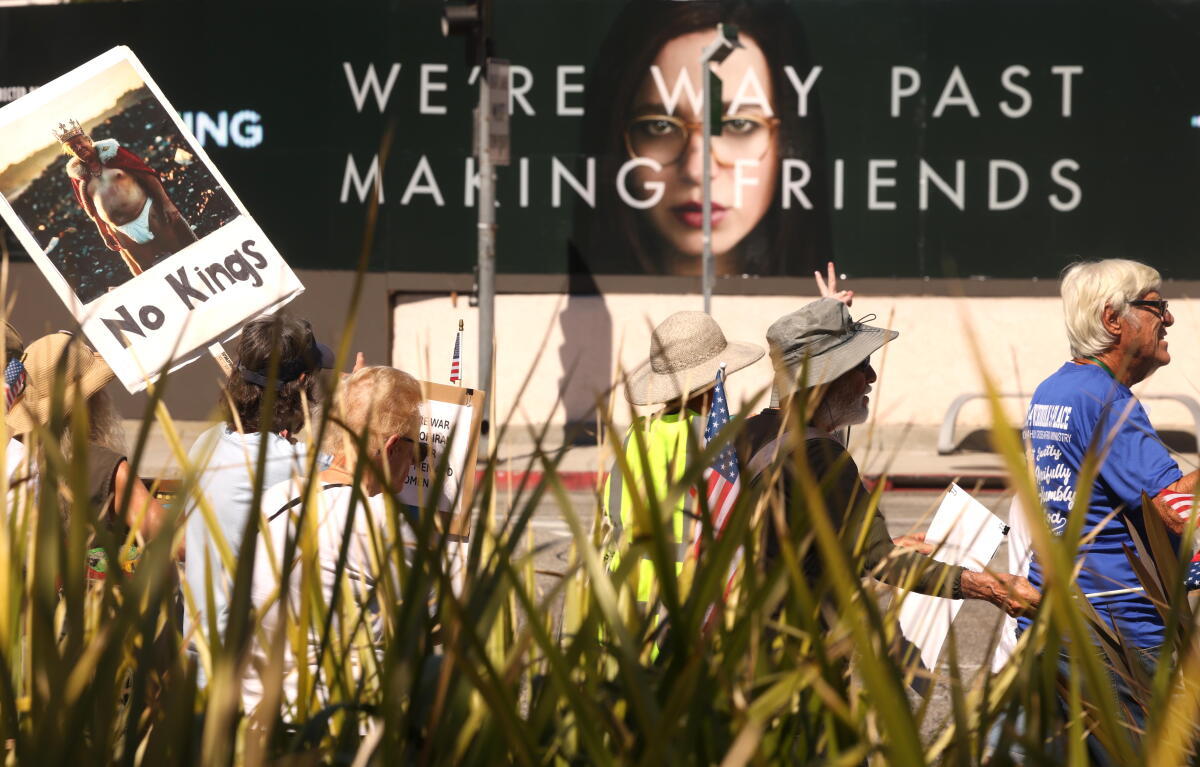
On a sweltering Saturday, around 100 people gathered in Culver City for a rally and march to deliver a message to several major media companies: Help us protect our democracy.
Spotlighting Sony Pictures Studios, Apple, Pinterest and Amazon MGM Studios, all with local offices, protesters demanded that the companies sign on to the “Business for Democracy Pledge” ahead of the elections in November.
After hearing from a few speakers outside Culver City’s City Hall, the band of demonstrators marched a few blocks to the offices of Sony Pictures Studios. From there — walking by posters for the upcoming Sony release “The Social Reckoning” — they made their way back across downtown Culver City to stop outside the historic Culver Studios, now owned by Amazon MGM.
Local groups Culver City and Friends Rising and Keep Showing Up led the protests. This week, they sent letters to the chief executives of all four corporations asking them to sign the pledge. No response has been received. (Messages from The Times to spokespeople for all four companies also were not returned.)
“Businesses and particularly large corporations like Sony, Apple, Pinterest and Amazon, who are our focus today, have a particular role to play in defending democracy,” Phil Ansell, leader of Culver City and Friends Rising, said before the rally. “They have weight, and this administration cares what business says.”
He added, “We’ve seen internationally that in situations where democracy has been under threat, that when the business community stands up for democracy, it can make a huge difference in preventing a full-on shift to authoritarianism.”
Bryan “Bubba” Fish, Vice-Mayor of Culver City, was on hand as a featured speaker and noted how Culver City, a relatively small community that is home to offices for multiple international media companies, is uniquely positioned to help ensure residents’ voices are heard.
“The message of this event is that these major corporations, that are the largest and richest corporations in the history of the planet, benefit from our civilized society,” Fish said before the rally. “…The only reason they’ve been able to grow to the size that they are is because we have stable, legitimate governance, and the bare minimum should be that they commit to defending and speaking out when our elections and our democracy is at risk. That should be the floor.”
Fish added, “We’re here saying you’re a part of our community, stand for free and fair elections and defend democracy alongside us.”
Demonstrators march to the offices of Sony Pictures Studios and past posters for the upcoming Sony release “The Social Reckoning.”
(Genaro Molina/Los Angeles Times)
Reverend Dr. Frances Wattman Rosenau, pastor at Culver City Presbyterian Church, spoke outside of both Sony and Amazon MGM.
“Democracy is one of our core values as a country, and me as a person of faith, I care deeply about giving voice to the voiceless and making sure that no one is marginalized,” Rosenau said while walking from one location to the other. “And calling our business partners to come alongside us is an act of partnership. It’s time for everybody to be in the boat and rowing, affirming what we stand for as a people for the common good.”
The Culver City event is one of a series around the country this week in collaboration with the group May Day Strong. Representatives of other local activist groups, including PowerSwitch Action, National Nurses United and Singing Resistance Santa Monica, were also in attendance on Saturday.
Amy Schur, campaign director with Alliance of Californians for Community Empowerment (ACCE), is involved with coordinating the national campaign for the “Business for Democracy” pledge.
“We’re in a unique moment where people are rising up all across the country of their own accord,” Schur said. “People are seeing what’s at stake. So they’re ready to march, they’re ready to speak out.”
Schur noted that much work remains to harness that energy and turn it into real change.
“The critical question is, can we do it in ways that are strategic and have the impact that we need in this moment?” she said. “Just marches are not enough because it’s kind of easy to ignore those. But when it’s a march with a purpose and calling out big corporations, it has more impact.”
The march in Culver City was one of several nationwide actions this week.
(Genaro Molina/Los Angeles Times)
Ansell noted that companies such as Apple and Amazon spoke out after the insurrection of Jan. 6, 2021 and hopes they will continue in that same spirit.
“We’re here today to say don’t wait for the equivalent of January 6 to happen again,” Ansell said. “Commit yourself now publicly to opposing any efforts to undermine this election. And our view is that to the extent that many large corporations across this country take that public stance, it will significantly reduce the risk of a major effort to subvert this election.”
Organizers see Saturday’s protest as part of an ongoing effort and hope more people will feel empowered to participate.
“People are not alone,” Ansell said. “No one should feel like they have to stay home alone and despair. There are many opportunities for action, and we have to be prepared. Today’s action is one of many to defend this election.”
When Maduro was taken and arrested on January 3rd, many Venezuelans brought out the good stuff. The old bottle of rum or whiskey they’d been saving for a special occasion, believing the incursion would inevitably lead to the return of liberty in Venezuela. Nine months later, the “transition” has not been what most Venezuelans wanted. Hundreds of political prisoners were released, but that is not enough. A few laws are being reformed, but not the institutions that carry them out. Delcy remains in power despite no lawful statute allowing it nor any sort of popular mandate for her to be the head of the Venezuelan State.
Many who brought out the good whiskey have soured on the transition, or at the very least lost their shiny optimism. But the mistake was not just to believe in a future that now seems a bit naive, but to yearn for the return of a past which was the precursor to our current tragic state.
The quest for a more liberal society
Yes, we were better off before the 2000s, but we’ve never had a truly free society without clientelism or corruption. Chavismo may have perfected the art of corruption in Venezuela, but they certainly did not invent it. Venezuela, since its inception, has not been able to ameliorate the very Latin American issue of inequalities of power. We tend to forget about the problem during oil bonanzas. Everyone is doing better, right? Why worry? Then the oil price inevitably falls, the party stops, the lights turn on and we see the naked truth that we are in a horrible state of disrepair.
Many say that the Venezuelan problem is economic (lack of diversification or investment in non-oil industries), political (once high polarization and weak rule of law), or even cultural (a tendency towards el guiso). But within these lies a deeper philosophical issue: for a society that claims to love liberty and our libertadores as much as we do, we don’t actually understand what it takes to create a liberal society.
This is hardly a Venezuela-specific issue, but we are a unique case in that so much of our self-perception is based on the idea of a people who achieved freedom from the yoke of Spanish tyranny, only to then continue to liberate other countries in South America, making Simón Bolívar the most famous person in the history of the continent.
What room is there to become “more liberal” once all citizens are recognized by the law and there is universal suffrage?
To understand what it means to be a liberal society, perhaps it would be best to understand what it means to be a more liberal society. When the classical liberal revolutions of the 18th and 19th centuries took place, it was the divine right of kings that fell. The power was taken from an individual and shared amongst parliaments, which were at the time controlled almost exclusively by rich landowners (including our own first few republics). Still, this was unquestionably a redistribution of power from the individual to the few. It took a long time, but eventually this distribution of power from the one to the few became a distribution of power from the few to the many. Nowadays, democratic societies are expected to allow every single citizen to vote, but this is a reality that is younger than the oldest person alive today. When English supercentenarian Ethel Caterham in the UK was born in 1909, her mother would not have been allowed to vote.
Liberal societies today hardly even question the idea that all people should be equal in respect to the law and that we ought to have a voice in the decisions of our country through voting. So what room is there to become “more liberal” once all citizens are recognized by the law and there is universal suffrage?
It’s true that the distribution of power in liberal countries these days is much improved when compared to 100 years ago, but is it better than 50 years ago? The laws may say that all people are equal, but systems don’t seem to provide that result. Even in societies where they have nominally distributed power amongst all citizens, the power has not been really distributed amongst them nearly as well. Throughout the current Trump presidency, there have been a string of pardons for white-collar criminals who have paid patronage to Trump and his family, including the former president of Honduras convicted of drug trafficking, or a Venezuelan oligarch indicted for allegedly bribing a Puerto Rico governor.
This is a clear example of a two-tiered justice system in which if you put the right money in the right pockets, you get preferential treatment.
A post-WW2 recipe?
I use these examples to show that although there is nothing ontologically wrong with wealth inequality, especially if the rich earned that money honestly, in practice inequality in resources leads to inequality in power and inevitably abuse of that power. This is the state of Venezuela now, but it was also the state of Venezuela long before Chávez caught a whiff of power and what ultimately led a majority of voters to choose a murderer and traitor over the “democracy” that was in place.
The issue, after nearly three decades of chavismo, is that although they entered power on the basis of railing against resource and power inequalities, in the time since they’ve been in charge they’ve done nothing to ameliorate those same inequalities. The people in government have simply taken the seats of the previously corrupt politicians and become even more clientelist, leading to greater inequalities in power and resources than ever before (on top of just a generally poorer country).
The vast majority of Venezuelans can clearly see what chavismo is now, even many who used to vote for it. And though we are still not through with it, we ought to give serious consideration to what we want to replace it with. Do we want a return to bipartidismo and clientelism with high inequality? Just hoping that the price of oil rises so we can keep our population happy whilst oligarchs accrue more and more power? Or do we actually want to achieve the liberty we say we value so much?
We can imitate post-WWII States who decreased inequalities by taxing the incomes of extremely wealthy people at extremely high rates whilst maintaining a belief in free markets, property and the rule of law.
When we get rid of chavismo, we will have an even greater challenge ahead. We’ll have the challenge of rebuilding a country destroyed by decades of mismanagement, a country filled with people who have gotten their wealth by enchufándose into a corrupt system that has oppressed the voice of its people. And we’ll have to decide how we want to go about bringing back liberty. I suggest we act like the previous liberal revolutions we venerate, and distribute more power from the few to the many.
So what is the solution to power inequalities and resource inequalities?
Thankfully, there is no need to reinvent the wheel. We can copy the policies of post-WWII countries (US, Japan, France, UK, Germany, etc) who decreased inequalities in their countries by taxing the incomes of extremely wealthy people at extremely high rates whilst maintaining a belief in free markets, property and the rule of law. This has the added benefit of diversifying government incomes away from just oil revenue or sales taxes, which are regressive and hurt consumers and small businesses (I could go on and on about the economic benefits, but I’ll stick to the institutional ones here). I specify the post-WWII liberal societies here and not the communist ones, because although communist countries seek to ameliorate resource inequalities they end up increasing power inequalities which lead to just as much abuse, if not even more than hyper-capitalistic oligarchic societies.
But before we can consider which policies we ought to copy from which societies, we must adopt the attitudes and political beliefs which made those policies implementable in the first place.
The world, not just Venezuela, is at a crossroads between greater authoritarianism or greater liberalism. If we are leaders of liberalism in our continent, as we have historically perceived ourselves to be, then we ought to understand the nature of liberalism and how we ought to achieve it. If we do not have a vision of how to recreate our institutions and our general idea of what a liberal society even is, then we will surely return to the sad state we are in right now, even after we get rid of the kleptocrats sitting in Miraflores.
The solution is simple, but it’s not easy. Entrenched interests are just that; entrenched. But if the people of the country yearn for liberty and we manage to understand what it takes to attain it, then it can be done through hard work and dedication, as ultimately all worthwhile goals are achieved.
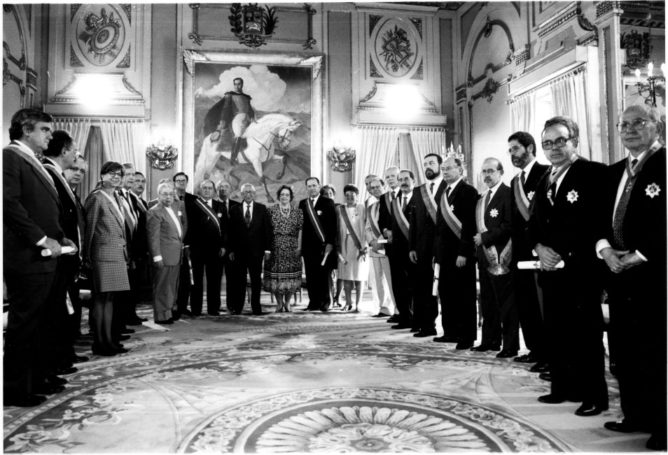
Photo: Acting President Ramón J. Velásquez (1993–1994) and his cabinet on the last day of his term. Dr. Velásquez, both during his brief tenure and previously at the helm of a special commission, was a leading proponent of decentralization in the late 20th-century. | Source: Archivo Fotografía Urbana.
The next democratically elected president of Venezuela will inherit an office that is simultaneously too powerful and not powerful enough.
Too powerful because decades of centralization have placed extraordinary political, fiscal and administrative authority in Miraflores. Not powerful enough because whoever inherits it will also confront a damaged bureaucracy, weak public services, deteriorated infrastructure and institutions that may still be controlled by political adversaries.
That combination will make concentration tempting.
A new government will have an enormous reconstruction mandate and voters impatient for results. Every institutional restraint will risk looking like another obstacle left behind by chavismo. Decentralization can wait until the State is stabilized. Congressional procedures can wait because the crisis is urgent. Extraordinary executive authorities can be justified because ordinary government is too slow.
Many of those arguments will contain some truth.
That is what makes them dangerous.
Chávez inherited Venezuela’s presidentialist political culture and radicalized it.
If Venezuela wants this transition to be the last one it needs, the country cannot simply transfer the powers accumulated in the presidency to someone more democratic. But neither can it respond to authoritarianism by constructing an executive incapable of governing.
The question is not whether Venezuela needs a strong president or a weak one. It needs to decide what the president should actually be strong enough to do.
Miraflores was powerful before Chávez
Chavismo radically expanded executive power, but it did not invent Venezuelan presidentialism.
Long before Hugo Chávez, the presidency occupied an unusually commanding position over the political system. Oil reinforced that arrangement. Whoever controlled the national government controlled the principal source of public revenue, and the ability to distribute that revenue made Caracas not merely the political center of Venezuela but the financial center on which much of the rest of the government depended.
The result was a particular understanding of political effectiveness. Presidents were expected to not merely administer the executive branch but to solve national problems, distribute resources, arbitrate conflicts and impose direction on the State.
Chávez inherited that culture and radicalized it.
Carlos Rangel would have recognized something familiar in the phenomenon. His critique of Latin American political culture repeatedly returned to the attraction of the providential leader: the politician whose extraordinary personal mandate supposedly allows him to rise above institutions that appear slow, compromised or incapable of producing the transformation the country requires.
A new democracy has to be built for the political society Venezuela actually has.
Chavismo gave that tradition a twenty-first-century vocabulary. The leader possessed a direct relationship with the people. Institutions that resisted him therefore did not represent legitimate constraints on democratic power; they interfered with the popular mandate.
That logic did not begin with Chávez, and removing chavismo will not automatically remove it.
This is one reason institutional design matters more than hoping Venezuela will simply develop a different political culture. A new democracy has to be built for the political society Venezuela actually has, including its recurring attraction to presidents who promise to cut through institutions rather than patiently govern through them.
Decentralization was one answer
Venezuela has attempted to solve part of this problem before.
The decentralization reforms beginning in 1989 transformed Venezuelan politics by allowing voters to directly elect governors and mayors. They created alternative centers of democratic legitimacy, allowed regional leaders to build careers outside national party hierarchies and weakened the assumption that every important political decision had to originate in Caracas.
Those reforms were real democratic progress.
They also occurred during the accelerating crisis of the political system that had governed Venezuela since 1958. Carlos Andrés Pérez was attempting a profound economic transformation while confronting social unrest, two coup attempts, resistance within his own party and an increasingly fragmented political environment.
Enough independently powerful actors with absolute vetoes can also make coherent government extraordinarily difficult.
It would be wrong to claim that decentralization caused Pérez’s downfall. The crisis of his second government had far deeper causes. But the period should caution against the assumption that dispersing power automatically produces better government. A political system needs restraints. It also needs the capacity to reach decisions.
Juan Linz famously warned that presidential systems contain an inherent problem of competing legitimacy: both the president and the legislature can claim a direct mandate from voters. Venezuela could face that problem almost immediately in a transition. A newly elected president may claim a national mandate for reconstruction while legislators, governors, courts and other institutions exercise equally legitimate powers to resist particular policies.
Those conflicts are not defects but rather an essential part of democracy.
But enough independently powerful actors with absolute vetoes can also make coherent government extraordinarily difficult. The goal cannot therefore be to create as many obstacles to presidential action as possible.
Decentralization has to mean power, not administration
Chavismo subsequently demonstrated another weakness in Venezuela’s earlier decentralization: elected local government does not necessarily amount to decentralized power.
A governor who depends overwhelmingly on transfers determined in Caracas may be politically elected but remains fiscally vulnerable to the center. A municipality with responsibilities but inadequate revenue possesses decentralization on paper. A regional government whose police, infrastructure projects or public services can be bypassed by parallel national authorities is autonomous only until Miraflores decides otherwise.
Chávez and his successors became adept at exploiting these weaknesses. Political authority could be recentralized, resources redirected, parallel institutions created and opposition-controlled governments bypassed without formally abolishing governors or mayors.
A president who negotiates every administrative action with multiple institutions would not protect democracy for very long. It could instead discredit it.
A serious decentralization therefore has to involve more than another constitutional declaration that Venezuela is a federal State.
It must ask where revenue is collected, who controls it, which responsibilities genuinely belong to states and municipalities and which functions require national coordination. Regional governments need enough authority and predictable resources to govern without requesting political permission from the president. But the national government must retain enough capacity to maintain common standards, respond to national emergencies, redistribute among regions and preserve the Venezuelan State as a functioning whole.
That balance is much harder than simply transferring competencies from one level of government to another.
The State must still be able to act
An executive constrained by law is not the same thing as an impotent executive. The Venezuelan president should be capable of executing a legally approved budget, directing the national administration, coordinating responses to disasters, conducting foreign policy and implementing the program on which voters elected the government. Rebuilding infrastructure, stabilizing public finances and restoring basic services will require a national government capable of making decisions and making those decisions stick.
A presidency that must negotiate every administrative action with multiple institutions would not protect democracy for very long. It could instead discredit it. Citizens judge democratic government partly by whether it governs. If elections repeatedly produce leaders incapable of responding to crime, blackouts, inflation or deteriorating public services because every decision disappears into institutional paralysis, frustration with democratic restraint will eventually become politically valuable. The politician promising to eliminate the obstacles will always be waiting.
Institutional design has to emerge from Venezuela’s own history and needs.
Machiavelli understood the underlying problem centuries before modern constitutionalism gave it different terminology: a political order that cannot preserve itself will not remain a political order for long. Democracies require enough power to respond to genuine threats.
The danger lies in what happens next.
Emergency authorities created to save the State can outlive the emergency. Executive discretion justified by reconstruction can become normal government. A president given extraordinary authority because democratic institutions are initially weak acquires the ability to ensure that those institutions remain weak.
Venezuela has already lived that cycle.
Miraflores should matter less
The difficult conclusion is that democratic reconstruction will require whoever next controls the presidency to surrender powers at precisely the moment when there will be compelling reasons to retain them. That is a much harder political proposition than replacing chavista officials.
Someone who has spent years fighting to reach Miraflores may arrive there facing a devastated country and discover an arsenal of executive authority that could make reconstruction easier. It will be extraordinarily tempting to argue that institutional reform should come later, after the emergency has passed and the country has stabilized.
But democratic restraints are easiest to support when they constrain somebody else. Their real test comes when they constrain us.
The president should not determine whether an opposition governor receives the resources necessary to govern. The executive should not be able to transform regulatory authority into political discipline. Emergency powers should expire without depending on presidential generosity. Institutions capable of investigating the government should not owe their survival to that government’s continued support.
None of this necessarily requires turning Venezuela into a parliamentary republic, copying the United States or mechanically importing someone else’s federal model. Institutional design has to emerge from Venezuela’s own history and needs.
But one principle should survive whatever arrangement eventually emerges: winning the presidency should not mean winning the State.That principle protects more than the opposition, it also protects the president.
Winning should give politicians the authority to govern without giving them the tools to decide whether anybody else will ever govern again.
A system in which the loss of Miraflores does not mean losing access to every meaningful source of political authority makes electoral defeat less existential. Governors can govern. Legislators retain influence. Parties can preserve territorial organizations. Former incumbents can imagine returning through elections rather than manipulating the State to avoid leaving. Distributing power can therefore make alternation easier to accept.
The point is not to make political victory meaningless. Elections must have consequences. Governments need enough authority to implement different programs or democracy becomes little more than a ritual for changing administrators.
The objective is narrower: winning should give politicians the authority to govern without giving them the tools to decide whether anybody else will ever govern again.
That is the distinction Venezuela failed to maintain.
And it brings three problems of institutional reconstruction together. Venezuela needs institutions that remain democratic regardless of who occupies them. It needs a State capable of implementing rules while remaining bound by them. And it needs political power distributed widely enough that no single electoral victory becomes an ownership of the Republic.
For 25 years, Venezuela’s political system increasingly revolved around a simple question: who controls Miraflores?
A durable democracy will require making the answer matter considerably less. The next president of Venezuela should inherit enough power to govern the country, but considerably less power to define it.
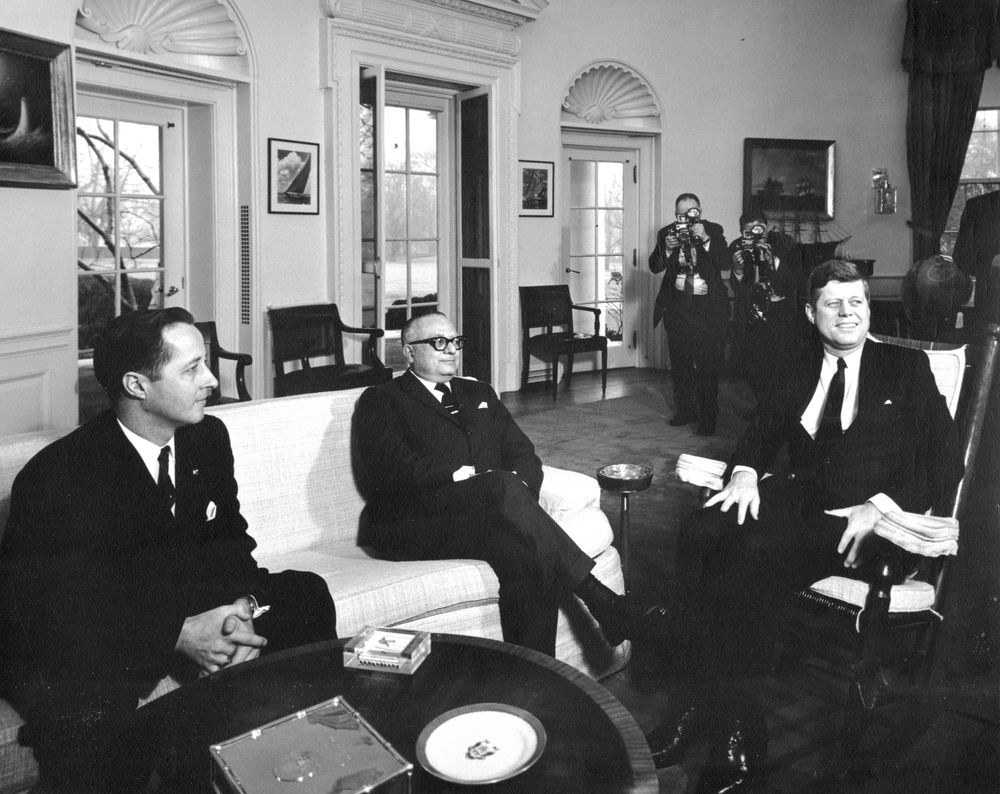
John F. Kennedy receives Betancourt in the Oval Office on February 19, 1963. White House photograph by Abbie Rowe, JFK Presidential Library and Museum.
In 1898, the United States entered Cuba promising to liberate a nation; the subsequent occupation and the Platt Amendment ultimately granted it the right to intervene in the country’s affairs. A century before chavismo, Juan Vicente Gómez found a different formula: domestic order, foreign capital, and oil, all while leaving the citizenry out of the equation. Rafael Osío Cabrices and Marcus Golding have revisited both precedents to reflect on the Venezuela that would emerge after January 3. These two mirrors are uncomfortable, yet they are not the only ones; a third exists—also born of the relationship between Venezuela and the US—though it is based on a different idea of how to build stability.
During the 1950s, Venezuelan social democrat leader Rómulo Betancourt wrote from exile to convince Washington that its policy toward Latin America was based on a flawed premise. While military dictatorships might declare themselves anti-communist and guarantee a certain level of stability, repression, inequality, and a lack of civic participation paved the way for the very radicalization the US wished to contain. A democracy capable of enacting social reforms could serve as a more reliable ally.
This wasn’t Betancourt’s idea alone. Within the US government, there were already officials who viewed reformist forces as a more effective bulwark against communism. Betancourt’s own contribution lay elsewhere: articulating this argument from within Latin America and attempting to prove its validity while in power. Research by Steven Schwartzberg shows that this approach had begun even before the long exile triggered by the 1948 coup.
Upon returning to Venezuela after January 23, 1958, Betancourt did not ask the White House to build Venezuelan democracy. The major political parties agreed on rules for coexistence and the country held elections, which he won. His government undertook agrarian, educational, and social reforms starting in 1959, all while facing military conspiracies, guerrilla violence, and hostility from neighboring dictatorships. There were abuses, restrictions on civil liberties, and incomplete results. It was not a conflict-free democracy, but a democracy struggling to survive.
Both voting and finding a way out of the economic crisis remain priorities that oil alone cannot resolve.
That experience bolstered Betancourt’s argument before Washington. A State Department report from the time described Venezuela as a hemispheric leader in promoting social reform and economic development within a constitutional framework. This foreign alliance rested on a domestic political foundation: it did not rely solely on oil or on a shared stance against a common enemy.
The Cuban Revolution had made this discussion more urgent since January 1959. Upon arriving at the White House in 1961, John F. Kennedy understood that anti-communism alone was insufficient, and he found an exceptional partner in Betancourt. The Alliance for Progress sought to link development, social reform, and representative democracy. When Kennedy visited Venezuela in December 1961, the two governments issued a joint declaration framing economic cooperation within the context of “the effective practice of representative democracy.” Democracy was not a destination to be reached only when conditions became more favorable. It was an integral part of the journey itself.
1961 versus 2026
We can’t idealize that era. The Alliance for Progress yielded uneven results, and the US continued to tolerate dictatorships when it served its interests. Years later, Betancourt would welcome Jimmy Carter’s emphasis on human rights—as Guillermo Ramos Flamerich notes—precisely because such a stance had never been a constant in US foreign policy, which has historically oscillated between democratic values and the immediate benefits of partnering with governments capable of maintaining order.
That tension has returned. Democratization expert Thomas Carothers argues that the Trump administration has departed from five decades of bipartisan US commitment to promoting democracy, adopting policies that favor autocratic regimes instead. Other intellectual figures such as Ricardo Hausmann and Paul Krugman have also questioned the direction of the process: Hausmann warned that if Trump does not facilitate the transition, Venezuelans will have to oppose his strategy; Krugman criticized the agreement with former members of the Maduro government while the democratic opposition is sidelined.
For her part, María Corina Machado continues to regard Trump as a “key ally” but calls for a democratic transition. Nor does Venezuelan society appear willing to trade its vote for a promise of stability: an in-person poll cited by the Financial Times found greater optimism following Maduro’s removal on January 3, but also revealed that the majority wanted free elections in 2026. After the electoral fraud of July 28, 2024, both voting and finding a way out of the economic crisis remain priorities that oil alone cannot resolve.
On July 24, 2026, Donald Trump stated in the Oval Office that Venezuela was “not yet” ready to hold elections. He praised the “fantastic work” of Delcy Rodríguez and linked his assessment of her to the volume of oil the country is shipping—according to the Republican president—to the US. On September 2, he reiterated that Venezuelans were not ready, while Rodríguez avoided setting an election date during a press conference focused on oil deals.
The solution, however, does not lie in waiting for Trump to become Kennedy. Betancourt did not simply wait for a sympathetic US president, either.
The difference compared to 1961 lies in more than just words. Kennedy and Betancourt framed their cooperation within a shared democratic commitment. Current rhetoric allows oil interests to advance in the present while democracy waits for an undated future. This does not mean Washington has permanently abandoned the idea of Venezuelan elections, but it does reveal its priorities: barrels can be counted, legitimacy can be deferred.
This exemplifies what I termed “asymmetric reconstruction” in a previous article for CEBRI: the recovery of certain economic and geopolitical capabilities, while institutions, rights, and public wellbeing progress at a different pace. Here, the warnings of Osío Cabrices and Golding converge. An intervention can displace the actors who fought for democracy; an opening of the oil sector can coexist with opaque deals, unelected authorities, and power structures that have learned to survive by switching partners.
The solution, however, does not lie in waiting for Trump to become Kennedy. Betancourt did not simply wait for a sympathetic US president, either. He organized a political party, built consensus within Venezuela, formulated a vision for the country, and then sought to alter Washington’s calculations. He understood that while a nation like ours cannot dictate the priorities of a major power, it can present itself to that power as a political actor rather than merely as available territory.
The United States’ best ally will not be the most obedient Venezuela.
Venezuela can once again become a solid ally of the United States. To achieve this, it requires competitive elections with a set date; institutions capable of protecting rights, providing services, and managing resources; and an economy that transforms investment into a better life for its citizens. Oil-driven growth can help. It is no substitute for any of that.
It also requires a mature international relationship. Cooperating with the United States should not mean ceding to Washington the decision of who governs Venezuela or when its citizens are ready to vote. Sovereignty does not consist of isolating oneself from the world. It consists of participating in it without losing one’s identity.
History offers three possibilities: the tutelage experienced by Cuba starting in 1898, the order-without-citizenship of the Gómez era, and the democratic alliance Betancourt sought to build with Kennedy. None can be replicated exactly as they were at the time. Yet, we can still decide which model we wish to emulate.
The United States’ best ally will not be the most obedient Venezuela. It will be the Venezuela that regains legitimacy in the eyes of Venezuelans themselves.
Americans have demonized us as criminals, buffoons, lechers, invaders, criminals and job stealers since the fall of the Alamo. Latino culture typecasts hombres as eternal machos always a few drinks away from brawling or bawling. Educators view us as underachievers. The political class long stereotyped Latino men as a sleeping giant who could change the country, if only we showed up to vote with the same enthusiasm as attending a Raiders game or lining up for a sneaker drop.
The blame game continues. A study released this month by UCLA’s Latino Policy & Politics Institute basically paints Latino men as little better than MAGA minions, trumpeting a gender gap on standing up to this administration’s deportation deluge, defending democracy and “fighting the Trump agenda.” To the media and to outraged internet commentators, it didn’t matter that two-thirds of Latino men had responded that each of those three issues was “very important” or “somewhat important.”
We just aren’t anti-Trump enough, which marks us as alien to the president’s critics. The UCLA paper’s cover page even features a red man and a blue woman conversing in what look like Aztec speaking glyphs — as if the sexes can’t understand each other and probably never will.
To explain the Latina-Latino political chasm, UCLA offers hypotheses straight out of “Men Are From Mars, Women Are From Venus.” The women supposedly work more in caretaker jobs like teaching and healthcare, softening their views toward the least of us. The men are in blue-collar sectors with a Darwinian outlook. But it doesn’t take a fancy academic paper to come to that conclusion — all you need to do is, you know, talk to Latino men.
When Trump descended that damned escalator in 2015 to announce his first presidential run by sliming Mexican immigrants as rapists and drug dealers, I knew that this racist excuse for a leader — the most anti-Latino politician in our nation’s history — would nevertheless appeal to many Latino men.
The reasons were evident: Trump’s fame. His strongman persona. His riches. His default setting of, as we Mexicans say, me vale madre — I don’t give a damn what people think. Yet three successive Democratic presidential campaigns willfully ignored these flashing sirens, instead insisting that Green New Deals and diversity, equity and inclusion programs would appeal to working-class Latino men.
Pundits thought we were still motivated by the radical politics of the Chicano movement, as previous generations were. What they didn’t realize was that assimilation had transformed Latino men into the modern equivalent of President Nixon’s silent majority.
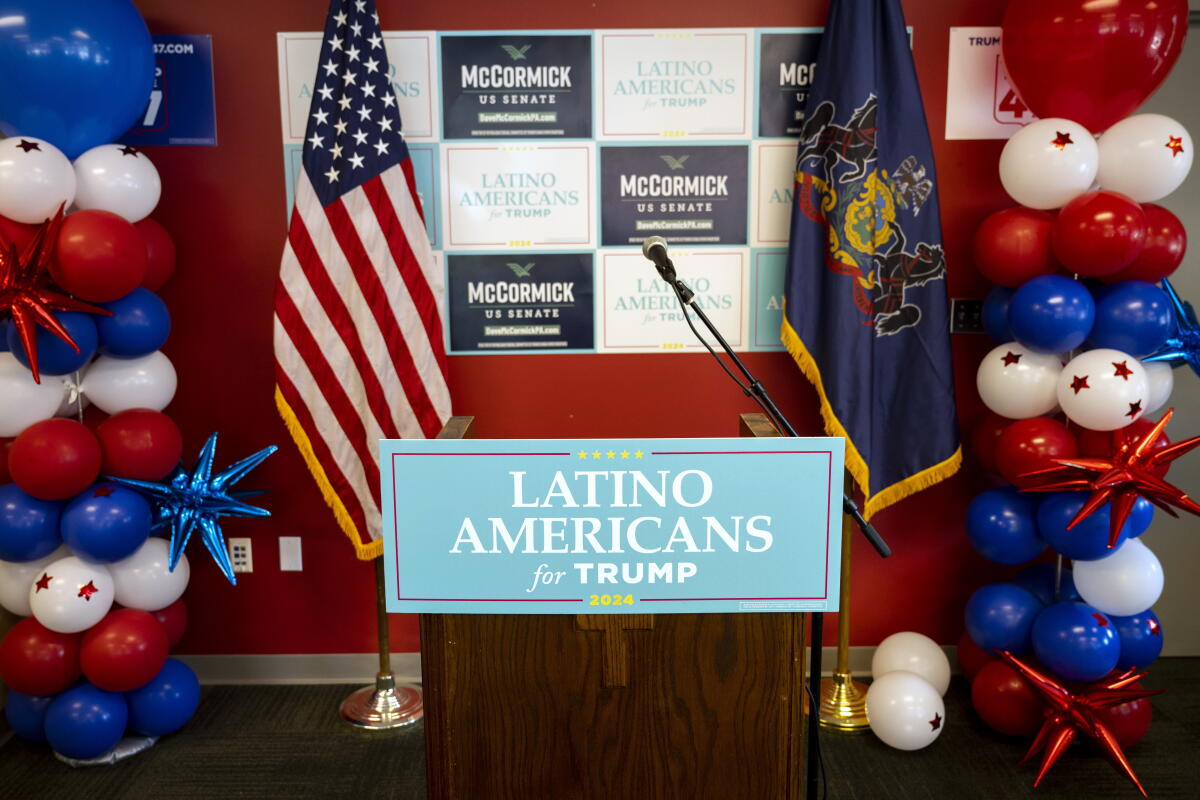
A “Latino Americans for Trump” office in Reading, Pa., during the 2024 elections.
(Joe Lamberti / Associated Press)
I’ve always thought Latino male Trumpers were deluded — but I’ve always understood where they’re coming from. They’re believers in rancho libertarianism, my neologism for the individualistic politics exemplified by the Mexican men who raised me and who I grew up with.
Rancho libertarians, like their Scotch-Irish cousins from another mother, are forever skeptical of government, respect insurgents who want to take on the establishment, love their people and subscribe to a bootstraps approach to life. Not as praiseworthy is a tendency to dislike being told what to do, and in proving a point, to not only cut off their nose to spite their face but to lop off their heads as well.
No wonder so many Latino men went for Trump. To quote another Mexican saying, por eso estamos como estamos. That’s why we’re the way we are.
And look at what it’s earned us.
MAGA has been a miasma on this land, but especially for the blue-collar Latinos whom Trump increasingly courted with each election cycle. Immigration agents have arrested U.S.-born Trump supporters and thrown their friends and family members into squalid detention centers to await certain deportation. Diesel and gas prices are outrageously high, after Trump started a war with Iran that seems to have no end.
Nothing has degraded more for Latino men, however, than the simple pleasures of life.
When my dad and my brother had a pool party for some cousins and their children last month at our Anaheim home — no more than 15 people — the cost of carne asada, chicken, chorizo and tortillas from a local carnicería was more than $200. That side of the family never supported Trump while not exactly being wokosos, either. As Spotify blasted Antonio Aguilar and Banda El Recodo, they complained about the economy and the Republicans who have rubber-stamped the Trump agenda, when we should have been talking about the Dodgers and vacations back to our ancestral Mexico state of Zacatecas.
If my Arellano cousins are ready to stick it to Trump on election day, so should the Latino men who supported him two years ago.
In 2024, Latinos were the pivotal vote that delivered swing states to Trump. In this year’s midterms, Latino men are the swing vote within that constituency, from congressional races once considered safely red in Texas and Florida to local elections across the country. It’s gotten so dire for Republicans that Florida Rep. Maria Elvira Salazar put out a television ad warning Trump that “the same Hispanics who brought you to the White House … feel betrayed today.”
Honor remains big among rancho libertarians, and no politician has insulted the Latino way of life more than Trump. Helping to flip the House and Senate to the Democrats wouldn’t end his influence, but it sure would help. Plus, it would be a perfect rebuke to a pendejo who fooled too many good Latino men.
American society, whether the left or the right wing, will never fully accept us. We’ll always be thought of as too conservative, too dumb, too reactionary, too violent by too many.
Well, if we’re going to be loathed, we might as well stand on the right side of history. It’s time for Latino men to stand up and hit Trump with another Mexican saying: