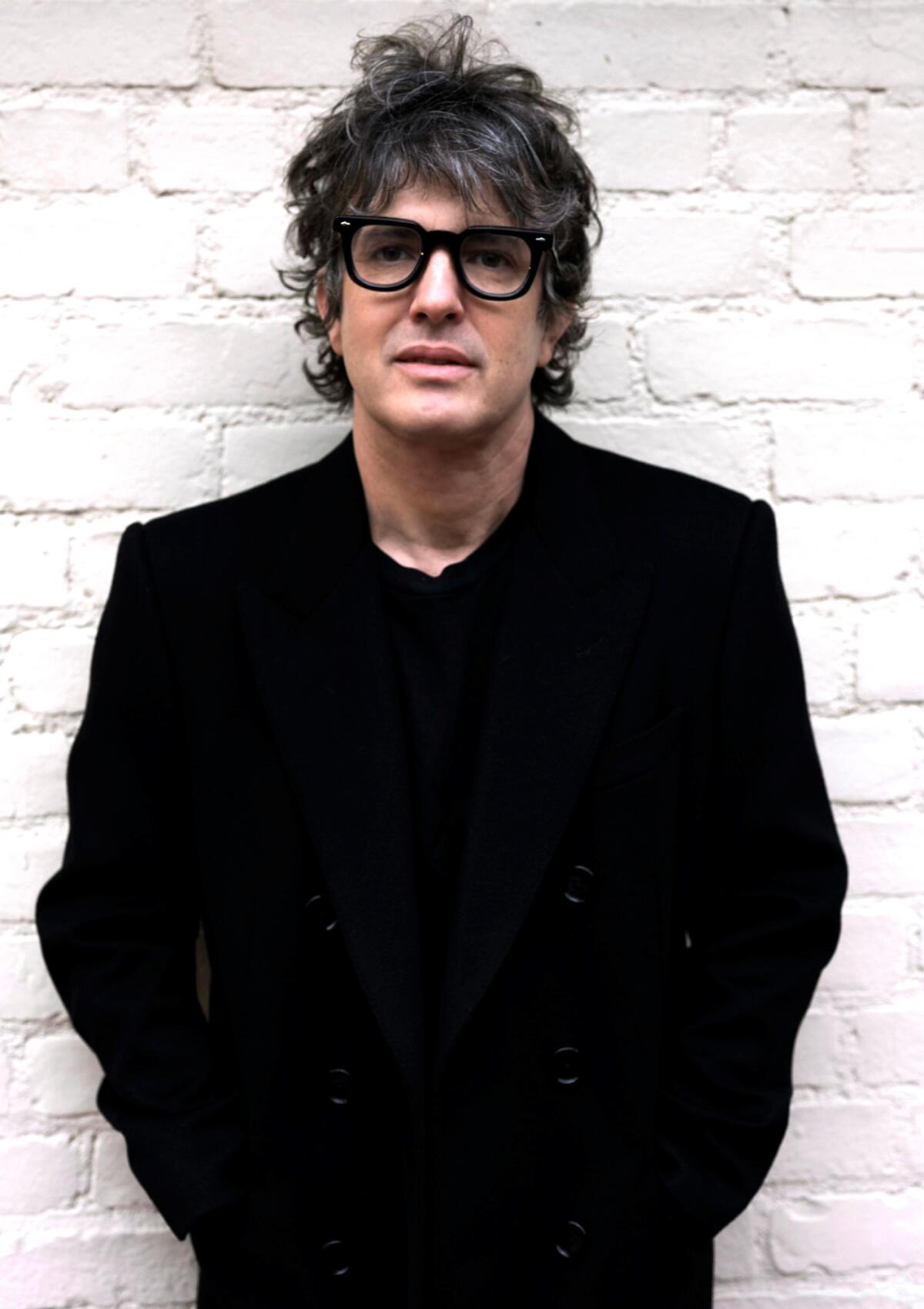
Our present podcast era has bred a new generation of interlocutors from the public sphere, veteran interviewees turned journalists. Harper Simon is among the many pro musicians who have taken on the role of insatiably curious interrogator. The singer-songwriter, who is the son of Paul Simon, has made four solo albums and toured the country both as a solo artist and sideman, but it wasn’t until he was tapped by music manager Michael Lustig in 2016 to host an internet series called “Talk Show” that Simon found his new avocation.
The cream of Simon’s interviews have now been collected in “Thinking Out Loud,” which is published by L..A. imprint Hat & Beard Press. I chatted with Simon about the art of the interview, Pink Floyd and Ed Snowden.
✍️ Author Chat
I have found that people who have been interviewed a lot are good at interviewing others. They know how to avoid the banal and obvious questions.
I’m not a trained journalist, so the conversations were closer to what Andy Warhol’s “Interview” magazine used to be. More of a casual back-and-forth, rather than me trying to ask questions or having someone promote their product. So the book is really a combination of folks that I’ve known my whole life and others that I just asked to interview.
Interviewing public figures can be a very stilted experience. And then you wind up not getting much of anything.
Interviews with journalists are a funny thing. There is always this weird, uncomfortable hierarchical relationship, where the journalist might feel superior, or the subject feels that way. It creates this strange imbalance. The journalist might feel the need to wrest some hot information from the subject, or find some aha moment and then the subject gets their guard up. I feel like the interviews in my book are very relaxed. You’re going to get some truth, even if it’s a modest truth. There were some interviews I left out of the book because the subjects seemed too media trained or too guarded.
Some of your interviewees, like Eric Idle and Buck Henry, are people you’ve known your entire life, having grown up with your dad in that kind of very stimulating artistic milieu. Does that help or hurt?
I think I might get better material from folks like that. There’s a warmth there, but I’m also a huge fan of their work, so I want to hear about Eric Idle’s work with Monty Python, or Buck Henry hosting “Saturday Night Live.” There are still plenty of stories that I’ve never heard.

Harper Simon, the artist and son of Paul Simon, has released three solo albums and toured the country. His latest project is a collection of interviews.
(Demme)
Someone like Pink Floyd’s David Gilmour has been interviewed hundreds of times in his career. What is there left to ask?
It’s kind of like my father, where the legacy is so familiar and well-known, what is there left to be said? What is there left to say about “Dark Side of The Moon”? But it turned out to be a really good interview. He had some great things to say about [Pink Floyd founder] Syd Barrett, how Gilmour felt like the other members had behaved callously towards him at times. He also speaks with great warmth about his own family.
Harry Dean Stanton is in the book, and I have to empathize. He was by far the most difficult interview subject I’ve ever had to deal with. A man of few words.
It’s funny, because I wound up doing some projects with Harry Dean, like this big tribute event to help raise money for Vidiots in Eagle Rock, but even after all of that, we didn’t get any closer. He was a very hard person to know.
You interviewed James Woolsey, and you guys were definitely not on the same page, but the tone remains civil. Don’t you think it’s important to have a reasoned discourse with someone you don’t agree with politically?
Absolutely, but that was one that definitely became contentious at times. James Woolsey had been the former head of the CIA under Clinton. So I came into the interview feeling very outgunned. I’m not a trained political journalist. But somehow I had gotten it in my head that I was Abbie Hoffman and he was J. Edgar Hoover or something. This was 10 years ago, and Edward Snowden was the big story in the news. So I led with that, and Jim Woolsey, being a good CIA man with very strong convictions, felt that Snowden was a traitor. But then he said he would like to see him hung by his neck, which felt aggressive. Then things really went off the rails when we somehow got locked into a discussion about Israel and Palestine. I remember him saying to me, “You’re just parroting the talking points of the Muslim Brotherhood.” Now I found those words echoing in my thoughts when I listen to some people discuss the current situation. I respected him and enjoyed the conversation but it was intense. I thought I held my own reasonably well but he was a tough guy to get in the ring with.
(This Q&A was edited for length and clarity.)
📰 The Week(s) in Books

“‘Second Skin’ is more sociological than sexy; more anthropological than animalistic,” writes Meredith Maran.
(Los Angeles Times illustration; book jacket from Catapult)
Meredith Maran thinks Anastasiia Fedorova’s book “Second Skin” does a great job of busting open the taboo of what is commonly regarded as deviant sexual desire. The book “advocates for a person’s right to like what they like and to get it consensually,” writes Maran.
Victoria Lancaster has a chat with Emily Nemens about her new novel “Clutch” and the challenges of writing about midlife among a clutch of close female friends. “I was cognizant of balance and understanding the lazy-Susan of it,” says Nemens. “Making sure I was spinning all the way around the table and touching each piece in each storyline.”
Two new novels about game-changing women in history — Janet Rich Edwards’ “Canticle” and Paula McLain’s “Skylark” — find favor with Bethanne Patrick. What these books “get right about their very different heroines and time periods is that change doesn’t happen overnight. … [But] change can and does happen, one determined woman at a time.”
Finally, on the occasion of the new screen adaptation of “Wuthering Heights,” six authors weigh in on their love of Emily Brontë’s enduring romance novel.
📖 Bookstore Faves

Skylight Books on Vermont is a staple of the Los Feliz literati.
(Joel Barhamand/For the Times)
Let us praise Skylight Books, which for over 30 years has remained a pillar of its Los Feliz community, with the main shop and the arts annex just a few doors away from each other on Vermont Boulevard. Store manager Mary Wiliams tells us what her customers are sweeping off the shelves right now.
What is selling right now?
“Vigil” by George Saunders is our biggest seller right now. Aside from that, it seems like great recent fiction in paperback is dominating the bestseller list — “Rejection” by Tony Tulathimutte, “The City and Its Uncertain Walls” by Haruki Murakami, “Martyr!” by Kaveh Akbar, and “All Fours” by Miranda July all are books that keep on selling really well for us, month after month.
Do you sell more fiction than nonfiction, or is it a tie?
We sell a good amount of both, but fiction is the bigger seller. Especially literary fiction, which is our bread and butter. On the nonfiction front, “Everything Now” by Rosecrans Baldwin is a perennial bestseller out of our Regional section — it’s a great collection of essays about Los Angeles. And everything Patti Smith touches turns to gold, so her book “Bread of Angels” is also a hit here.
Your arts annex is unlike anything else in L.A. I suppose there is still a market for cool periodicals and expensive art books that the internet hasn’t knocked out?
Our goal with the annex is for it to be a place of discoverability — where you can find the weird cool art book, comic or magazine you didn’t know you needed. We hope even our customers who are well-versed in art books find something new every visit. A fair amount of what we carry isn’t widely available online in the U.S., so when we put it on our website in our Annex Picks section and advertise it in our newsletter, we get orders from around the country.
Skylight Books in Los Angeles is located at 1818 North Vermont Ave.
(Please note: The Times may earn a commission through links to Bookshop.org, whose fees support independent bookstores.)