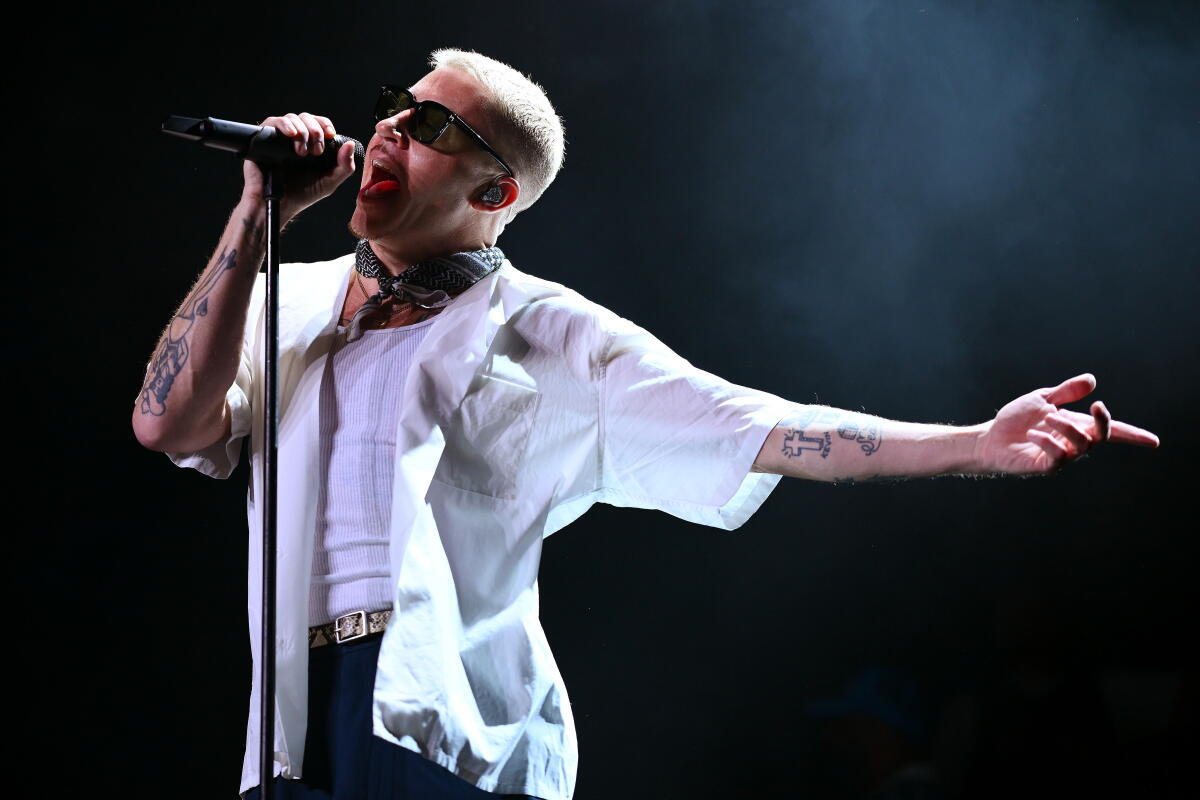
Netflix subscribers will wake up to a video livestream of “The Breakfast Club” starting next month, marking the platform’s first daily live podcast.
The deal is part of the streaming platform’s ongoing focus on live programming, and the latest video podcast offering through its partnership with iHeartRadio, the company said on Thursday. The nearly three-hour show will include a live video feed exclusive to Netflix and will air every weekday morning.
“Taking this show live every day to a global audience on Netflix is a powerful example of how we’re expanding the reach of our biggest brands while giving audiences entirely new ways to experience them,” Bob Pittman, iHeartMedia’s chairman and chief executive, said in a statement. “Whether it’s morning in NYC or the afternoon in London, the conversation is live and reaching the world in real time.”
“The Breakfast Club” will air simultaneously on Netflix, the iHeartRadio app and it will continue to be syndicated by Premiere Networks on more than 100 broadcast radio stations nationwide. Netflix’s video feed is meant to provide more behind-the-scenes content, as radio formats will still need to include commercial breaks. Instead of pausing the program, Netflix watchers will get an uninterrupted stream, where those traditional breaks will be filled with exclusive segments and extended discussions.
“The media landscape will always evolve, but one thing consistently cuts through: live programming,” Charlamagne tha God said in a statement. “That’s a big reason ‘The Breakfast Club’ has sustained its reign for so long. We’re building something powerful — real‑time conversation, real community, on a global scale. The future belongs to those who can see what’s possible — and trust me, the vision for ‘The Breakfast Club’ and Netflix is crystal clear.”
The radio program first got its start in 2010 on WWPR-FM in New York. Over the years, it has become one of the most popular morning shows, rooted in Hip-Hop and R&B culture and known for its lively interviews and entertaining commentary from hosts Charlamagne Tha God, DJ Envy and Jess Hilarious. The show has welcomed guests like former President Barack Obama, and artists like Kendrick Lamar and Cardi B. In 2020, the talk show was inducted into the Radio Hall of Fame.
Over the last five years, there has been a significant shift in how fashion and sports intersect, both on and off the court, with athletes’ influence extending beyond the court and into culture at large. Why now? And how has athlete style evolved?
These were some of the questions that three prominent athlete stylists — Brittany Hampton, Courtney Mays and Dex Robinson — unpacked last week at the panel “Game Changers: Where Sport Meets Style.” Moderated by Image contributor Darian Symoné Harvin and co-organized with the Only Agency, the event took place at the private members club Gravitas, a hub for folks at the intersection of sports, business and luxury in Beverly Hills. Gathered in the swanky yet intimateupstairs bar and events room, guests sat in plush chairs and sipped pink vodka cocktails and flipped through Image’s May sports and arts issue ahead of it hitting the newsstands. An also-plush takeaway?Stress balls in the shape of footballs, courtesy of the Only Agency.
The evening could’ve kept going — Hampton, Mays and Robinson had so much to say about an industry that is still widely misunderstood and filled with gatekeeping. The below edited version of the conversation gives you a glimpse into the demanding yet deeply fulfillingworld of styling athletes.
Darian Symoné Harvin: Athletes often are not sample size. How do you source clothes and work with brands? Are they supportive? Anything you would tell brands if you could?
Courtney Mays: Size inclusivity is a huge thing. Because, especially when you’re talking about the W[NBA], you’re talking about women who are sometimes a men’s size 13 shoe, who are sometimes a 36-inch inseam. And although we’re using this platform to talk about larger issues, sometimes the larger issue is: I’m here and I’m a plus-size woman. Sometimes you have to use your presence to talk about those things, if you’re not verbally saying that, [and] you have to get the brands to stand behind you.
“We’re making sure that that Old Navy looks like Bottega,” said Courtney Mays, “so that at the end of the day you feel like the superstar that you are. We’re really curating the moment.”
Brittany Hampton: It’s also important for everyone that’s in the room to know that stylists can’t always get the ask that you guys may be asking for. If I have a seven-foot athlete, which I do have on my roster, and he’s, you know, he’s massive — he wears a 16-and-a-half shoe. There may only be a few brands [with his size]. There are going to be certain things that I may even have to pull out of his own closet. And then it still means, “Well, why do we have to give you that budget for that?” And it’s like, well, because I had to have an assistant go get that piece from his closet, have it dry-cleaned, have it picked up, then have it delivered to set. It’s still a process, there’s value in the work that we put in. We’re trying our hardest.
DSH: From a tunnel walk to a press run to a campaign, how do you break down your budget and your fee?
Dex Robinson: Each stylist approaches fees and pricing a different way, right? Also depends on how you were groomed or how you came into the situation. I was an assistant for years before I ever said I was a stylist, and even then I kind of treaded lightly before I was like, “I am a lead stylist.” I was someone’s assistant, and that’s when I asked all the questions that I needed to ask about what my fees would be. I knew the structures, I knew the things, so I wasn’t asking my peers, “Oh, how do I charge for this?”
BH: I do want to jump in and state for the people in the room that may or may not know we’re speaking in terms of expenses. The current budgets that they are talking about are particular to clothing expenses. That does not allot to our fees. We have labor that is very imperative, labor that goes into us doing market research, that goes into us having assistance across cities most of the time. I live in Los Angeles. None of my clients live in Los Angeles. So let’s say my client is currently in the playoffs and lives in Cleveland, but I’m pulling from both New York and Los Angeles, then we’re meeting in Cleveland to have a fitting with him, and that all takes a tailor of this, of that, etc. Now, having tunnel looks is one thing, but then also having a campaign is something completely different. We also then have to be very strategic about brands that we’re pulling from. And we are using our own cards!
CM: A lot of times, we are giving our own money down to say, “I’m taking this half a million dollars’ worth of wardrobe out of your store, and I’m promising you that I’m going to bring it back in a certain amount of time.”
DR: It’s a more lengthy exercise to get people to let you borrow clothes versus [when] the [clients] just pay for this stuff and I don’t have to worry about it after. I would much rather let them have it in their wardrobe and I figure out what to do with it after. And I’m not like, “Oh, you wore this one time,” and just throw this out. No, we gonna cut the arms off of this. We gonna turn this into some shorts.
When asked for one piece of advice for aspiring stylists, Dax Robinson encouraged people to first do their research. “Being fashionable does not make you a stylist … it takes years of perfecting a craft to become a stylist.”
But then to pull from a [showroom], that’s a whole ‘nother situation. That’s not really a money exchange, that’s more of a publicity exchange. And again, it’s still based off your name or your client.
CM: That’s when it’s important to get the shot. We live in a social media world. When we work with brands and we work with designers, we work with PR firms — what they’re looking for is that image. Not only the tunnel walk, but maybe it’s the walk out of the hotel or that paparazzi shot.
So we’re also partnering with photographers, saying, “Hey, our clients are going to the opening of LACMA. We need to capture the moments before.” Just like all the celebrities, they go to the SAG Awards, whatever, and they have these beautiful editorial shots before they even hit the red carpet. Why? Because they invested in a photographer to come to their home, to their hotel room, and say, “Let’s use 15 minutes before you walk out the door, get this BTS, get this shot, and we’re going to make it look beautiful.” Because we want to build the relationships with the brands of the clothing that we’re wearing.
DSH: What I love about what you’re saying is that it’s not only the tunnel, it’s not only the press run, it’s not only the campaign. It’s like, how are you creating this world around who the athlete is? To me, that’s exciting. It’s when you get into the creativity.
Let’s say that you receive a cold email from someone who wants to work with you. What kinds of questions do they ask that lets you know that they’re informed or they mean business? What lets you know, “Oh, they’ve done their homework a little bit, and they’re not just going to toss me around as a possibility”?
BH: We are brand architects, and because you guys are reaching out to us about a particular client, our job is not to just create a character, right? We don’t just create characters. We work with athletes. We understand that we have to know that athlete before they even walk in the room, and we have to understand their identity, understand their brand, and then build that with you [the brands] before we can even do the job right. There’s nothing more that I love than being on a call with a full production team for a full hour for a commercial. Because we actually want to know: One, what’s going into that player. Two, what they look like. Three, what they’re going to be doing, if there’s a double or if they’re going to be active — our talent is very performative, they’re performance-based first, and so we have to remember that when we’re dressing them.
Brittany Hampton on the role stylists play beyond the tunnel walk: “We’re not just bringing them a rack of clothes. We’re truly there to help build their identity and then who they’re about to become.”
CM: I feel like those conversations need to happen at the onset of working with a new client, with the agent, with the manager, with the assistant so that you can understand what the broader goal is for that client. A lot of times when people hire stylists, whether it’s per project or for a longer stint, a season, I think it’s like, “Oh, they just need clothes.” Like, I just had a job. [Her team] was like, “It’s the opening of the WNBA season. She needs clothes tomorrow.” Like an idiot, I took it: I really want to work with this girl. I’m gonna just send her a box. And I knew that was the dumbest thing I could have ever done, because I’ve never met her in person. I didn’t have the right sizes, and I think it ruined the relationship, because I didn’t have any context. So the fact that I couldn’t execute in 24 hours is sticking with me. I should have said no, because that is not my job — to go shop for you at the mall. My job is to really have a conversation about what your goals are, what your fit is, what brands do you love, what do you want to do when this basketball thing is over? I think that part and those conversations are important.
BH: It’s also important to have emotional intelligence. As we are the people that work with athletes on a consistent basis, we have to understand their bodies, but we also have to understand that they win games, they lose games. And half the time we are picking up their energy. We’re not just bringing them a rack of clothes. We’re truly there to help build their identity and then who they’re about to become. Sometimes you don’t get that lucky and get to have someone for that long, but the relationship building and creating that trust is something that’s so important, which is why those factors matter, like hiring someone maybe a month in advance and setting up those calls between the client and the stylist. Even if we just get on the call and we just want to shoot the shit and we’re like, “What colors do you like? What size do you like? What are brands that you love? Who do you look up to in terms of fashion?” Because some of these kids like it, and some of them absolutely don’t know.
DR: Well, that [direct relationship] might not be the reality depending on how big your client is sometimes, too. I’ve worked with people where they had to have that middleman for a little bit until they felt comfortable. So it wasn’t a situation where you could do that direct situation until they were ready. It’s also a different situation for me as a male, because guys don’t like being around other guys, so that’s why [women] dominated [the styling landscape] for years. Think about it. Like, as a guy, your mom is your first stylist. And then when you get a shorty you may say, “Yo, babe, I look nice. I’m good.” Guys really feel confident with a woman saying, “You look nice.” Not, “Yo, bro.” And then, even for me, a lot of the bigger guys I worked with, it was really their wives that was like, “You know what? My man can’t dress. I need you to come in.”
CM: That’s still the case. It’s somebody’s girlfriend or wife or agent. Like, “Please help.”
DSH: I want to talk about the people who you all work with when you are on set. I’m thinking particularly about glam. I’m curious about the makeup, hairstyle and grooming conversation that you are having, and why it matters.
“What you’re saying is that there’s a level of love that you have to put into it, and it’s not just about the clothes, but about the person,” reflected moderator Darian Symoné Harvin. “What do you like off the court? Where do you want to be? Where do you want to show up, right?”
CM: I feel like the stylist always becomes the creative director. We’re the hype man. We’re the one that’s talking to the hairstylist to say, “OK, she’s wearing this dress, we got to do XYZ, LMNOP.” We’re talking to the hairstylist. We’re talking to the photographer. We’re saying, “OK, we need a green backdrop instead of a yellow.” And I feel like that’s why we’re asking for certain rates; it’s not just me going to Old Navy to get y’all some jeans. And even if I am, because sometimes [Old Navy is] cute, we’re tailoring it. We’re making sure that that Old Navy looks like Bottega, so that at the end of the day you feel like the superstar that you are. We’re really curating the moment.
DSH: What advice would you give if you were sitting across a coffee table with a stylist who says, “I want to get into styling athletes”? What’s the one honest piece of advice you would give them?
BH: We can’t do everything. There are hundreds and hundreds of athletes across the board, and although we all came from a world of gatekeeping, it’s just not that anymore. Like we all have to share relationships. We have to continue to boost one another up. There’s been jobs where I’m like, “I can’t take that. Can you take that? Would you want that? This could be a good girl for you.”
DR: I think that a lot of people think because they’re fashionable, that means they should be a stylist. And I think being fashionable is just that. Being fashionable does not make you a stylist. I think it takes a sharpened eye. I think it takes understanding skill and proportion. I think it takes years of perfecting a craft to become a stylist. I think that people should just do research. I think that people should assist people. I think that when you come into a space and you don’t assist people, [maybe] you can easily attain a client, but retaining them is going to be hard, and I think that’s a difference, right? I wish a lot of the younger people that came into the space were more open to being a student first and not trying to become a professor.
CM: I also think that what we do is such an intimate thing. We’re getting people dressed. We’re in their homes, we’re in their hotel rooms. We’re with their families. Come as your authentic self and know that you have to do your best professionally — but also there’s a level of love that you have to put into it, and it’s not just about the clothes, but about the person, and about their goals and their aspirations. Make sure that you become a part of those conversations in a real, authentic way.
BH: It’s not just transactional. This is truly our passion. And we want to continue to work and just push for every person that comes after us.
For more than 40 years, Barry Walters has been closely watching the dance floors of New York and San Francisco, chronicling the ways in which LGBTQ+ culture has influenced mainstream culture. As a writer for the Village Voice, the Advocate and Spin, among others, Walters became one of music journalism’s most eloquent and crucial voices, championing artists like the Pet Shop Boys and Madonna during their formative years.
Walters’ new book, “Mighty Real,” draws on his deep firsthand knowledge, offering a comprehensive history of LGBTQ+ music from 1969 to 2000. I recently spoke with Walters about Babs, Madge and Bowie.
You’re reading Book Club
An exclusive look at what we’re reading, book club events and our latest author interviews.
By continuing, you agree to our Terms of Service, which include arbitration and a class action waiver. You agree that we and our third-party vendors may collect and use your information, including through cookies, pixels and similar technologies, for the purposes set forth in our Privacy Policy such as personalizing your experience and ads.
✍️ Author Chat
In the book, you make a distinction between pre-Stonewall LGBTQ music and post-Stonewall LGBTQ music.
Gay culture before Stonewall really had to be hidden, or at least secretive. I think of Barbra Streisand as a quintessential pre-Stonewall figure. Judy Garland, as well. These women are tough, and even though they sing songs written by men, it’s not in a submissive way. They are singing like they are the champions, even when they are suffering through what men do to women through the torch songs they perform.
What can you say about the encoded nature of certain songs that spoke to gay culture in a way that flew under the radar of hetero listeners in the pre-Stonewall era?
The music that spoke to gay culture, by necessity, had to be encoded. “Secret Love” by Doris Day is a good example. It’s about struggling to have something that’s otherwise forbidden. Sinead O’Connor covered that song. There was a song I loved as a young child called “Have I The Right?” by the Honeycombs, which was written by two British gay men at a time when homosexuality was illegal in England. You know, have I the right to be with whomever I want to be with?
What, in your view, was the big bang of post-Stonewall LGBTQ music?
David Bowie to a large degree. Right around the time that “Hunky Dory” was being released in 1971, he told the Evening Standard newspaper that he was gay, flat out just said it. And it was such a strange thing to say that many people doubted his sincerity.
Barry Walters, a writer for the Village Voice, the Advocate and Spin, among others, wrote a new book about the history of LGBTQ+ music.
(Kelly Lawrence for Walters)
I remember seeing Bowie wearing that dress on the cover of “The Man Who Sold The World,” thinking that was the most transgressive act any rock star had ever committed.
And then he performed “Starman” on Top of the Pops in 1972 and he put his arm around his guitarist Mick Ronson, who also looked gorgeous. They were displaying a familiarity men aren’t supposed to have.
I thought I knew everything about pop music, but you have uncovered so many fascinating stories. Tell me about Olivia Records.
Olivia Records was an independent record label in the Bay Area owned and controlled by lesbians for female artists. This is years before punk or indie rock, when so many small labels cropped up. They pioneered so much. They would recruit fans in different cities to man the merchandise and to help get their records in stores. The idea of a merch table was something new at the time. They also created the forerunner of Burning Man. They would go find a farm somewhere and create an impromptu village, with food, sanitation and the rest.
You have given the most space in your book to Madonna, whom you have written about extensively over the years. Why is Madonna such a huge figure in the history of LGBTQ music?
Her art is so queer. I feel like she is one of us. She’s very much like Grace Jones, in that her sensibility is so aligned with gay culture. I related to Madonna on multiple levels. In the early ‘80s, I would see her around town, dancing at the same New York clubs I was frequenting, like Danceteria. She was steeped in gay culture, and then she brought all of this into the mainstream, and that was profound. I also feel like she was misunderstood in many ways. When straight men called her a slut, things like that. That is so far from the truth. She is such a complex artist. If you are making that claim, you don’t know anything about her.
(This Q&A was edited for length and clarity.)
📰 The Week(s) in Books
(Javier Pérez / For The Times)
Pulitzer prize winner Elizabeth Strout has a new novel called “The Things We Never Say,” and Julia M. Klein approves. “[Strout] reprises her familiar themes: the mysteries of human personality, the perils of solitude, the occasional possibility of grace … in deceptively simple, occasionally mannered prose that draws readers in and immerses them in her fictional worlds,” Klein writes.
They’re on a boat! Paula L. Woods climbed aboard a 130-foot yacht in Marina del Rey to soak in the vibes of the Yacht Girls Book Club. “I wanted conversations with like-minded women that were intellectual but fun,” club founder Aloni Ford told Woods. “And talking about books seemed to be the ideal way to achieve that.”
“PEN15” co-creator Anna Konkle has written a memoir called “The Sane One,” and Rachel Brodsky talked to her about it. “In some ways, ‘PEN15’ was a reaction to loving memoirs,” she tells Brodsky. “Raw memory has always been very exciting to me.”
Finally, our Times critics take the measure of this summer’s hottest beach reads.
📖 Bookstore Faves
Kinokuniya bookstores sell Japanese manga, stationery and literature.
(Courtesy of Kinokuniya)
When Kinokuniya opened its first L.A. shop in 1977, it was primarily to provide Japanese expats with imported books and magazines to read in their native tongue. Forty years later, the store has become a locus of Japanese printed matter for Angelenos eager to scoop up Japanese literature and manga in Japanese and English, as well an expansive selection of imported stationery products that, in L.A., can only be found in Kinokuniya’s three stores. I spoke with Sakura Yamaguchi, who manages two of Kinokuniya’s stores downtown (the third is in Mar Vista) about its many-splendored pleasures.
How did the store travel from Japan to Los Angeles?
Books Kinokuniya was founded by Moichi Tanabe in 1927. Located in the Shinjuku district of Tokyo in a two-story wooden building, the first Kinokuniya started with five employees, including Mr. Tanabe himself. In 1969, Kinokuniya opened its first overseas bookstore in San Francisco. The first Los Angeles store opened in 1977.
Who are your customers?
We first started as a store for Japanese customers, so we imported Japanese books and magazines and sold them, mainly. But in the past 10 years, Japanese manga/anime, stationery and literature has been quite popular in the U.S. Therefore our customers are a mix of Japanese-speaking customers and non-Japanese speakers who are interested in Japanese culture.
What percentage of your clientele buys Japanese–language products?
Forty percent Japanese-language products versus 60% English books.
What specific titles are selling for you right now?
Are you seeing more young people turning to printed matter? It seems like there is an analog revival at the moment.
We have been trying to make exclusive editions that come with freebies to make the printed manga more attractive, but without that our English manga sales have been increasing and our main target for the manga is young people. There are many titles that are published exclusively in e-book format, but we frequently hear from customers asking when they will be released in print form. Also, recently there has been a growing number of cases where titles that were originally available only in digital format have later been published as physical books.
Kinokuniya at the Bloc in Los Angeles is located at 700 W 7th St.
(Please note: The Times may earn a commission through links to Bookshop.org, whose fees support independent bookstores.)
SACRAMENTO — Dana Williamson, one of the political heavyweights at the center of a financial scandal involving gubernatorial candidate Xavier Becerra, looked shell-shocked Thursday morning in a federal courtroom in downtown Sacramento, as most folks do when bad choices collide with the hard realities of the justice system.
A thousand-yard stare in her eyes, Williamson responded “guilty” three times in a voice that required a microphone to be heard as the judge walked her through a plea deal reached days before with the U.S. Department of Justice. She likely won’t be sentenced until fall (possibly close to the general election) but will — again, just a likely here — at best face home confinement and at worst upward of three years in prison.
It was her savvy and ability to deliver whatever was needed through her deep connections and knowledge of the complicated structures — official and cultural — that govern the California halls of power that make her predicament all the more confounding. Especially because, far from stealing money for self-enrichment, she actually paid money to be part of this scheme.
That alone, to me, raises questions.
Though Williamson’s guilty plea may seem like an ending to the saga, it shouldn’t be, because there’s still a lot lurking in the dark corners of this deal.
If Becerra makes it past the primary, which seems (I’ll use that word again) likely, voters have a right to know.
Here’s the simple backstory, according to court documents. Becerra’s close aide, Sean McCluskie, took a pay cut to remain with his boss when he moved to Washington to become President Biden’s secretary of Health and Human Services.
Strapped for cash, McCluskie asked Williamson to receive money from Becerra’s dormant campaign account — which Becerra was legally not allowed to manage while holding federal office — and pass it through a bunch of other accounts before giving it to McCluskie’s wife as payment for a nonexistent job.
Williamson’s attorney, McGregor Scott, said Thursday that Williamson received $7,500 each month from the Becerra account and added $2,500 from her own funds before sending it on to ultimately reach McCluskie — for a total of $10,000 a month.
McCluskie was “living on a government salary,” Scott said Thursday after court. “Wife is home with the kids. They didn’t have enough money, and that’s where this all originated. [Williamson] was simply trying to help a friend in a pinch as best she could.”
Scott, a former Bush and Trump United States attorney, managed to get Williamson’s original 23-count indictment knocked down to the Becerra account issue, along with lying to the FBI and filing a false tax return.
Becerra, who is a slim-margin front-runner for governor, was the victim in this case — or more precisely, his state campaign bank account was, according to court documents.
There has never been any indication that Becerra was investigated as a participant, and he has forcefully denied wrongdoing, calling it a “gut punch” that his advisers allegedly betrayed him.
That, of course, hasn’t stopped the other candidates from using the case against him.
“My opponents have spent millions spreading lies to purposefully mislead voters,” he wrote Thursday on social media. “Today confirms what I have said from day one: I did nothing wrong. Case closed.”
Meanwhile, Scott, the attorney, also said Thursday that Williamson assumed, based on her conversations with McCluskie, that McCluskie had spoken to Becerra about the concept of the money transfer. Text messages in court records show a brief and ambiguous exchange between McCluskie and Williamson that backs that up.
Scott said that Williamson never spoke directly with Becerra about the scheme.
That leaves the distinct possibility that Williamson believed Becerra knew what was happening — but never asked him. Dumb? Maybe. But Williamson isn’t usually dumb.
“The understanding that McCluskie conveyed to my client was it was OK to proceed,” Scott said.
Becerra has repeatedly said he believed the $10,000 a month was a legitimate fee being paid to manage the funds in the dormant account while he could not — though that is an amount above what is usual for such work, as my colleague Dakota Smith has reported.
Becerra has also repeatedly used some variation of the “case closed” line, seemingly hoping to move past this scandal without further answers.
But at the very least, it deserves some kind of mea culpa from Becerra or lessons learned, a more robust conversation than the brush-off it’s been getting. Because either McCluskie is one heck of a con man who rolled both Becerra and Williamson, making both believe what was happening was kosher with entirely different tales, or someone isn’t being entirely honest.
Did Becerra never question why an account with almost no activity was costing so much to manage? Did he never wonder what Williamson was doing to earn all that money? Should he, with his decades of legal and political experience, have seen red flags, even with a trusted adviser? Or is Williamson, facing sentencing, just trying to paint herself in a sympathetic light?
“I’m not trying to paint my client as a victim,” McGregor said. “She’s accepted responsibility today for what she did by pleading guilty. She’s now a felon. So you know, we’re not trying to do anything to dance away from that.”
Williamson may be done dancing, but the music’s still playing, and the fancy footwork of politics continues.
Karen Bass, Spencer Pratt and Nithya Raman each came into tonight’s mayoral debate with goals for what may be their only time together on stage.
As the incumbent mayor, Bass had to weather blows from her challengers while trying to sell voters on her fitness for another term, despite a disastrous 2025.
As a reality TV star with no political experience, Pratt needed to show that he could offer substance instead of just AI fanboy videos and the name-calling — “Karen Basura” — he has indulged in on social media.
Raman’s task was perhaps the hardest. As a city councilmember whose two previous campaigns were backed by the local Democratic Socialists of America chapter, she needed to convince Pratt-curious voters that she’s more conservative than Bass. Yet for others, she needed to appear liberal enough to peel away support from the mayor and come out as a progressive lioness to excite Democrats in a year where GOP candidates like Pratt have to answer for the disaster that is President Trump’s second term.
Only one of the three failed.
At times, Raman was tongue-tied trying to answer simple questions. Moderators kept telling her she was going over her time. Answering a yes/no question about whether noncitizens should be allowed to vote in city elections, the councilmember went on and on, until the moderator cut her off.
While Raman offered some policy plans, she also played a card straight out of Trump’s arsenal. She claimed that Pratt and Bass were teaming up against her — an unlikely scenario that drew laughs from the audience. She got more and more frustrated, to the point that when Bass was allowed time for a rebuttal, she dejectedly proclaimed, “I haven’t been offered that in a lot of this debate.”
Raman, who had endorsed Bass’ reelection before throwing her hat in at the last minute, came off as inexperienced, touchy and unprepared.
The line of the night was Pratt dismissing Raman as a “random councilmember” — which is how the L.A. political world responded to her entry into the race. She was so upset about Pratt’s remark that she continued to whine about it to a KNBC reporter after the debate.
What’s shocking about Raman’s flop is that she should know how important it is to project well to a television audience, given that her husband is a screenwriter. Her tone was flat, when she needed to be passionate.
No one had to remind Pratt of that. He was parrying tough questions on a big stage for the first time, facing an audience who knew him only as the Angry L.A. White Guy he has reveled in playing.
He mostly succeeded.
At his best, Pratt came off as a boisterous bro with enough charm to call himself “humble” without coming off as obnoxious. He dominated the flow of conversation without coming off as commandeering, even interrupting Raman at times to let Bass speak. At one point, he even said “Sorry” when he had taken up too much time and the moderators cut him off.
He was light on specifics, other than saying he was going to do better than the others and that he would prioritize public safety above all. Instead, he was the one person on stage who used anecdotes to sell himself, citing conversations about abused animals, downtown workers too afraid to eat outside and film producers hiring local gang members to keep their shoots safe.
As a TV personality-turned-influencer, Pratt knows that storytelling is far more effective than drowning the audience in statistics, as Bass and Raman did.
But the bad Pratt flared up at times. He earned a reprimand from KNBC anchor and debate co-moderator Colleen Williams when he called the mayor an “incredible liar.” Affecting high-pitched voices to mock Bass and Raman came off as juvenile and possibly sexist. And when it came to last summer’s federal immigration raids that terrorized Southern California, Pratt appeared flummoxed when Bass pointed out that 70% of those arrested didn’t have criminal records — a use of stats that hit.
Bass was also who she had to be — measured, forceful and raring to defend her record, without coming off as defensive. She wasn’t exactly inspirational, but she didn’t have to be. The city’s powerful labor unions have backed her, along with much of the Democratic establishment.
Raman and Pratt are right in deeming Bass the old guard of a beat-up city — but the old guard didn’t get there without knowing how to win.
We are living in an era of dissent, but what does that mean in 2026? According to writer Gal Beckerman, to be a dissident is as much a way of being as it is an act of resistance. In his new book “How to Be a Dissident,” Beckerman, a staff writer for the Atlantic, unpacks dissent as a kind of rough art. His book is both an instruction guide and a primer.
In nine short, potent chapters, Beckerman lays out the essential traits of an effective dissident — loyalty, recklessness and watchfulness, among them — to illustrate how communities of resistance are built from the ground up. I recently chatted with Beckerman about playwright and former president of the Czech Republic Václav Havel, President Trump and AI.
You’re reading Book Club
An exclusive look at what we’re reading, book club events and our latest author interviews.
By continuing, you agree to our Terms of Service, which include arbitration and a class action waiver. You agree that we and our third-party vendors may collect and use your information, including through cookies, pixels and similar technologies, for the purposes set forth in our Privacy Policy such as personalizing your experience and ads.
✍️ Author Chat
You have written three books that deal with dissent — political, cultural and societal. It’s clearly a big issue with you.
I don’t think of myself as an activist; I don’t approach these topics with an activist’s fervor. I’m genuinely curious about how change happens in society. All four of my grandparents survived the Holocaust, and I think the notion of a society that can change that quickly and turn on you was always very shocking and interesting to me.
In reading your book, it’s really inspiring and extraordinary to read about individuals putting their lives on the line to make change happen.
They genuinely fascinate me as these bizarre human beings who are able to act in ways that I find really mysterious. There’s a mystery as to how people’s minds actually change, and how society can change.
You write about making moral choices, and doing something bold because of some strongly held belief. This is not the same thing as joining the crowd, which can be the path of least resistance.
I had this feeling during the first few months of the current Trump term (and I share this sentiment with a lot of people) that we were just bowled over by the degree to which people in elite places were acquiescing to the exercise of executive power and being willing to bend the knee in ways that felt shocking to me. This prompted me to wonder, what would I do in that situation? Would I say “no” and not succumb to the will of executive power? Would any of us do so? It’s a question we all have to ask ourselves.
You cite Iris Murdoch’s notion of “radical humanism” as a key trait of effective dissent.
Radical humanists are attuned to the messy and wonderful ways that beings just are. They are defending those conditions for human beings to have a normal life, whether that means being able to listen to whatever music you like, or to wear your hair in a certain way, or to take care of a neighbor that is being ill-treated. Václav Havel called it the “pre-political” way of thinking and acting. And we saw this recently in Minnesota, with people standing up to ICE, regardless of what their political affiliations might be. Something pre-political was going on.
Another important factor you cite is civic mindedness, which feels like a difficult goal given how our communities have been dissolved by our screen addictions.
The communication tools that we use are dehumanizing in many ways because they don’t allow us to really see each other. Instead we preconceive each other and just scream a lot. And we know this at a gut level even as we continue to use them. That’s why I do think it takes an almost dissident sort of energy to insist on thinking in a different way and scrambling the assumptions that our modes of communication have foisted upon us.
What about AI? It feels as if there is a lot of resistance to accepting AI into our lives just because technology companies are investing billions of dollars to make it so. You are seeing communities protesting against the construction of data farms in their neighborhoods, for example.
The money behind the ideology pushing AI is about letting us feel that the only way to have an efficient life is through AI. And I feel like the 20th century taught us that there are lots of ideologies that come around to promise this sort of thing. And so we need to learn from that. I think there are a lot of overwhelming powers that try to flatten us. But we have to take that wonderful human element, that radical humanism, to say no, maybe there’s a way to do it better.
📰 The Week(s) in Books
Monica Lewinsky as a saint offering solace to the lovelorn and abandoned? Julia Langbein’s wild conceit works beautifully in her novel “Dear Monica Lewinsky,” according to Julia M. Klein, who calls the book “smart, poignant and involving.”
Among the casualties of the Vietnam War were the Appalachian communities whose male populations were decimated on the frontlines. This is the subject of Pamela Steele’s “taut, lyrical” novel “In the Fields of Fatherless Children,” a book that delves into the “poverty, racism, environmental degradation and despair suffered in the Appalachian ‘holler’ during the Vietnam era,” writes Meredith Maran.
The Times’ Deputy Entertainment and Arts Editor Nate Jackson sat down with the rapper, actor and K-Town native Jonnie Park to discuss his memoir, “Spit: A Life in Battles.”
Finally, Maddie Connors answers the question, “why are novels getting shorter?” Welcome to the age of the Adderall novel.
📖 Bookstore Faves
The inside of Mystery Pier Books
(Mystery Pier Books)
Established in 1998, Mystery Pier Books is L.A.’s prime destination for rare books and signed editions across a wide range of genres and forms, including Shakespeare folios and vintage sci-fi paperbacks. Located right alongside its Sunset Strip neighbor Book Soup, Mystery Pier was established by character actor Harvey Jason and his son Louis, who continue to run the store together. I chatted with Harvey about the treasures to be found in his store.
What is the market like for rare books right now?
Very strong, in fact. We just sold a beautiful edition of J.R.R. Tolkien’s “Lord of the Rings” trilogy to a private collector for $55,000. And that is actually a reasonable price for those books. We have a long list of serious collectors all over the world that contact us for books, customers that have been coming to us for years. We also sold a first edition of “The Adventures of Huckleberry Finn” for $17,500.
Why should one own a rare book?
It’s a good investment. People who collect rare books are book lovers, first and foremost. And they are smart enough to know that the books they love can increase in value year by year. First editions never depreciate. They always become more valuable over time.
I’m interested in journalism books. Do you have any Tom Wolfe or Hunter Thompson in your store?
Hunter Thompson came in here years ago and signed all of his books, so, yes, we have his books signed by him.
Do you see young people looking to get into collecting books?
Yes. A lot of recent college graduates are building collections. It’s very heartening to see that. You can come into our store and find nice editions for $100. The front room of our store contains the first editions but our other rooms will have landmark titles for far less money. This is really a pursuit for everybody, not just wealthy collectors.
LONDON — In the world of diplomatic faux pas, it could have been a lot worse.
At Tuesday’s state dinner honoring King Charles III and Queen Camilla, President Trump said that during a private meeting earlier in the day the British monarch had agreed with him that Iran should never be allowed to have nuclear weapons.
“We’re doing a little Middle East work right now … and we’re doing very well,” Trump told the audience. “We have militarily defeated that particular opponent, and we’re never going to let that opponent ever — Charles agrees with me, even more than I do — we’re never going to let that opponent have a nuclear weapon.”
While many Britons would agree with the president’s sentiment, the comment triggered mild consternation among pundits in the U.K.
By convention, people aren’t supposed to relay private conversations with the monarch. That is partly because the king has to remain above the political fray, but also because the sovereign doesn’t have the ability to wade into a public debate and correct the record if he’s misquoted.
“Generally, as a matter of protocol, I think I would expect discussions between heads of state to be sort of behind the scenes, in those closed meetings, for those to be sort of kept private,” said Craig Prescott, an expert on constitutional law and the monarchy at Royal Holloway, University of London. “And, you know, this was something that the U.K. government wanted to avoid.”
There had been a fair amount of jitters before the king’s trip to the United States, which comes amid Trump’s very public frustration with U.K. Prime Minster Keir Starmer over his failure to support U.S. actions in the Iran war.
Like all royal visits, this is a carefully choreographed diplomatic event carried out at the request of the U.K. government, which hopes that warm relations between the king and Trump can help repair the rift.
But Trump is an unconventional leader who has a penchant for breaking protocol, and there were concerns about just what he might say or do.
At least in this case, the king’s comments seemed clearly within the bounds of existing U.K. government policy.
“The King is naturally mindful of his government’s long-standing and well-known position on the prevention of nuclear proliferation,” Buckingham Palace said in a statement designed to provide context to the president’s remarks.
Prescott said that “in a sense, this was always the issue, just what Trump would do or say — would he put the king in an embarrassing position?’’ Prescott said.
“You always had that sort of issue of what he would post on social media,” he said. “And I think, you know, this could have been much, much worse.”
Before the state dinner, Charles gave a speech to a joint session of U.S. Congress. The king received repeated standing ovations during the address, which celebrated the longstanding bonds between the U.S. and Britain while nodding to differences over NATO, support for Ukraine and the need to combat climate change.
Now, from the U.K. government’s point of view, the trip is shifting to safer ground as the king and queen leave Washington behind and head to New York, where the focus will be on the city’s creative industries, rather than politics.
The most difficult part of the trip may be over, Prescott said.
“If this is the only controversy arising out of this phase of the state visit, I think overall this has been an enormous success for the king and the British government, because the king was able to make some quite pointed remarks in Congress and it hasn’t really yielded any sort of negative reaction from the president.”
“In a sense,” he said, “you get the feeling that the king rather charmed Washington with his speech to Congress and, you know, his very witty speech at the state banquet.”
Prominent Democratic governors, some considering 2028 presidential bids, gathered Thursday in Los Angeles for a high-dollar fundraiser.
Tickets to attend the event cost up to $100,000, according to an invitation. Closed to the press, it was expected to raise more than $1.5 million for the Democratic Governors Assn., among the largest amount the group has ever raised at a fundraiser in Los Angeles.
Gov. Gavin Newsom introduced fellow Democratic Govs. Andy Beshear of Kentucky, Maura Healey of Massachusetts, Laura Kelly of Kansas, Katie Hobbs of Arizona, Wes Moore of Maryland, Josh Stein of North Carolina, Tim Walz of Minnesota and Gretchen Whitmer of Michigan.
Several attendees, including Newson, Beshear and Whitmore, are widely believed to be eyeing a presidential run in 2028. Walz was then-Vice President Kamala Harris’ running mate in her unsuccessful 2024 bid for the presidency.
Beshear moderated the conversation among the state leaders at the Los Angeles-area home of liquor heiress Ellen Bronfman Hauptman and her husband, former Chicago Fire soccer club owner Andrew Hauptman. Attendees enjoyed cocktails and passed hors d’oeuvres around the pool before settling in for a conversation in the house that focused on how governors must focus on results more than ideological disputes, and how that ought to be a model for federal elected officials.
About 45 donors attended, including Damon Lindelof, the creator of “Lost,” and Scott Budnick, the executive producer of “The Hangover” movie series. Others who supported the event included director J.J. Abrams and former Walt Disney Studios Chairman Alan Horn.
This year’s festival will take place Saturday and Sunday at the USC campus, and it’s packed with a mind-boggling array of great participants and exhibitors. You can peruse the complete schedule, download the book festival app, and book your parking and panel reservations here.
I have warm fuzzy feelings about the festival, attending as a budding writer in the early aughts. As someone who aspired to “go long” but had no clue how to go about doing it, the event was an inspiration: all these hot-shot authors talking about their craft, and free admission no less.
Of course the event wasn’t the sprawling, magnificent behemoth it is now, with cooking demonstrations from the world’s greatest chefs, and bestselling children’s authors reading to tiny budding bibliophiles. The first festival in 1996 drew 75,000 book fans; last year, more than twice as many people showed up.
As the festival grew, so did the excitement. In 2007, I waited in line along with hundreds of other fans for the privilege of hearing Gore Vidal talk about his craft in UCLA’s Royce Hall. Gay Talese, one of my journalism heroes and a veteran of some of the very first festivals in the late ’90s, was always a pleasure. His stories about breaking into the New York Times conjured up a lost world that seems positively antediluvian now. “If you show up in a three-piece suit and a hat, and you look like you might have taken a bath recently, they don’t kick you out as fast,” Talese told a packed crowd in 2008.
By that time, much to my astonishment, I knew Talese personally. In 2004, I was working on a book about the New Journalism movement that he spearheaded. That year, he asked me to join him at the book festival as a guest. It was my first time in the “green room,” the backstage area where authors socialize over food and drinks. After ogling all the A-list talent in the room, I was asked by Talese to join him for lunch at a table along with novelists Jane Smiley and John Kaye, historian Doug Brinkley and social critic Naomi Wolf, all of whom were appearing at the festival. Reader, my mind was suitably blown. I just kept my mouth shut and listened.
I will be moderating a panel Sunday at 1:30 p.m. at the Ray Stark Family Theatre (plug) and I can’t wait. There is nothing like this festival; it is The Times’ annual gift to the Southland, and we should all be grateful we get to enjoy it.
Here are some of this weekend‘s festival highlights. All panels are an hour in duration.
You’re reading Book Club
An exclusive look at what we’re reading, book club events and our latest author interviews.
By continuing, you agree to our Terms of Service, which include arbitration and a class action waiver. You agree that we and our third-party vendors may collect and use your information, including through cookies, pixels and similar technologies, for the purposes set forth in our Privacy Policy such as personalizing your experience and ads.
Graphic novelists Henry Barajas, Eagle Valiant Brosi, Anders Brekhus Nilsen, Mimi Pond and Angie Wang discuss their latest graphic novels, each of which is based on true events or popular myths.
Where: Albert and Dana Broccoli Theatre When: 10:30 a.m.
Acclaimed author Amy Tan is the recipient of the 2025 Robert Kirsch Award for lifetime achievement, which recognizes a writer with a substantial connection to the American West. Tan’s expansive body of work, including essays, memoirs and bestselling novels “The Joy Luck Club,” “The Kitchen God’s Wife” and “The Bonesetter’s Daughter,” is widely celebrated for its profound exploration of the immigrant experience, family bonds and the quest for individual identity. Join us for a conversation with Amy Tan and award-winning former Los Angeles Times writer Thomas Curwen.
Novelists Jade Chang, Kevin Wilson and Sarah Levin discuss their new novels, which are fresh examinations of family in contemporary life: the ones we’re born with, the ones we make, and the ways we reach out for connection in an increasingly isolated, chaotic, and lonely world.
Lana Lin, Melissa Febos, Susan Orlean and Amanda Uhle have produced literary and artistic work that has shaped conversations, influenced culture and established them as leaders in their fields. Now, they turn the pen inward and become the story. Exploring their careers, relationships, sexuality and more, these writers offer a rare and intimate look at the vulnerability, creativity and humanity behind their work
Join California Atty. Gen. Rob Bonta, Steven J. Ross, Omer Aziz, Erwin Chemerinsky and Los Angeles Times reporter Seema Mehta for a conversation about the state of our freedoms today and what our current political atmosphere could mean for the future of our democracy.
Where: Hancock Foundation, Newman Recital Hall When: 1:30 p.m.
How do we raise children in an age of rapid technological change, political polarization and global uncertainty? Drawing from their new books and their experience as parents, Reza Aslan and Jessica Jackley will explore how to have honest, age-appropriate conversations with kids about complex and challenging topics, while psychologist Darby Saxbe shares groundbreaking research on the science of fatherhood.
Join Austin Channing Brown, Tre Johnson, Tamika D. Mallory and Carvell Wallace as they reflect on the moments that shaped their lives, work and perspectives. Through individual stories of resilience, love, purpose and self-discovery, their experiences weave together like a mosaic to form a deeper collective portrait of Black life and identity in America today.
Where: Hancock Foundation, Newman Recital Hall When: 10:30 a.m.
Panelists Matthew Cuban Hernandez, Karla Cordero, Sonia Guiñansaca and Yesika Salgado will dive into what it means to be autonomous, to be your own supreme authority, to belong to yourself, the land(s) and people you choose.
Christine Bollow, Karen Tei Yamashita and Naomi Hirahara dive deep into the myriad Asian American experiences at turning points in American history, shedding light on untold stories and essential characters in our shared history.