Terrorists have attacked at various locations and soldiers are ‘currently engaged in eliminating the attackers’

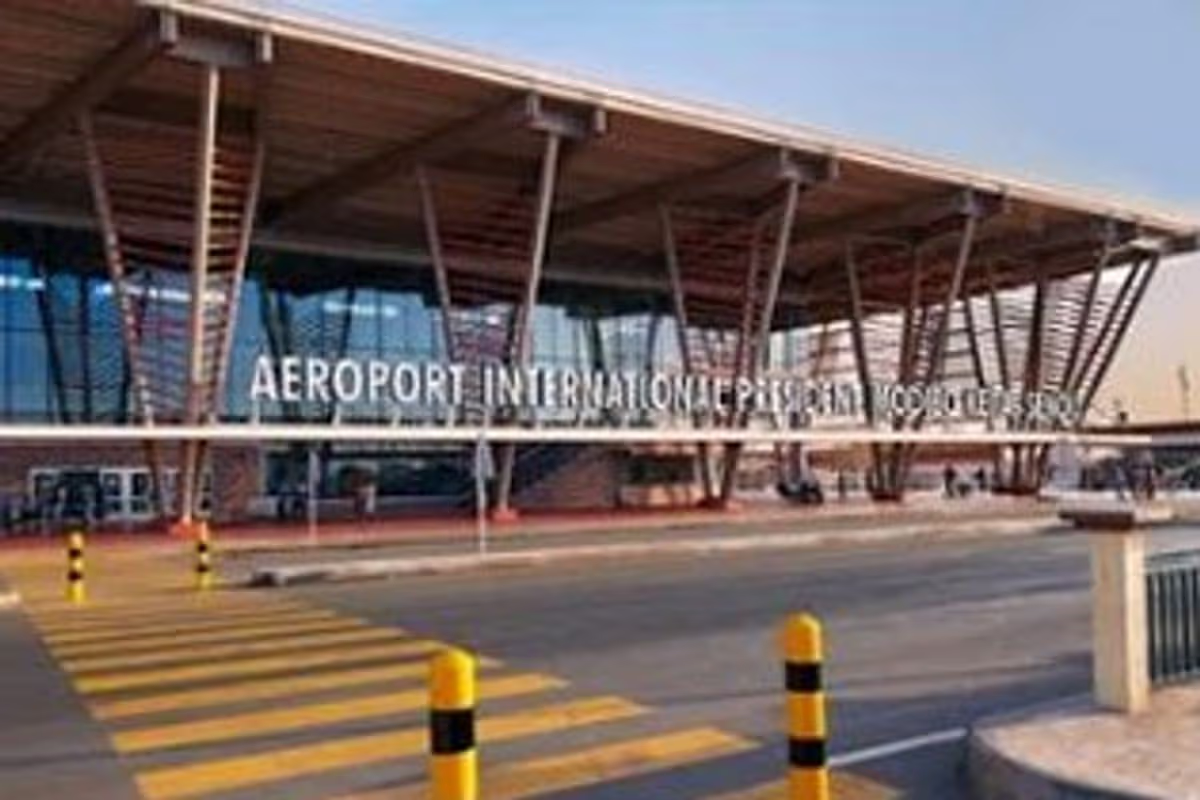
Bamako International Airport has closed after the attacks, the Foreign Office said
The Foreign Office this afternoon said people should not travel to Mali after a sderies of attacks today. Officials co-ordinated attacks have struck the country.
Gunmen attacked several locations in Mali’s capital and other cities early on Saturday in a possible co-ordinated assault, residents and authorities said. Mali’s army said in a statement “unidentified armed terrorist groups targeted certain locations and barracks in the capital”. It added that soldiers were “currently engaged in eliminating the attackers”.
The Foreign Office told British citizens today: “A series of coordinated attacks occurred in multiple locations including Kidal, Gao, Kati, Sevare and in the vicinity of Bamako International Airport on 25th April, which has temporarily closed.
“If you are in Mali, you should stay indoors where possible, avoid crowded places and areas of military or police activity, and follow guidance issued by local authorities. We continue to advise against all travel to Mali.”
Previously the Foreign Office told people to only leave via the airport as overland routes are ‘too dangerous.’ It added: “This is due to terrorist attacks along national highways.
“Terrorist group Jama’a Nusrat ul-Islam wa al-Muslimin (JNIM) has implemented blockades on key routes throughout Southern and Western Mali, including the capital city of Bamako. These blockades are targeting fuel trucks and are enforcing checkpoints for individuals attempting to pass through them. Attacks can occur at any time.
“There is a high threat of kidnapping and criminal activity across Mali, including in the capital, Bamako. If you choose to remain in Mali, you do so at your own risk. You should have a personal emergency plan that does not rely on the UK government.
Mali has been plagued by insurgencies fought by affiliates of al Qaida and the so-called Islamic State group, as well as a separatist rebellion in the north.
An Associated Press journalist in the capital Bamako heard sustained heavy weapons and automatic rifle gunfire coming from Modibo Keita International Airport, around 15km (nine miles) from the city centre, and saw a helicopter over nearby neighbourhoods.
The airport is adjacent to an air base used by Mali’s air force. A resident living near the airport also reported gunfire and three helicopters patrolling overhead.
Residents in other cities in Mali reported gunfire and blasts on Saturday morning, suggesting a possible co-ordinated attack by armed groups.
Gunmen entered the northeastern city of Kidal, taking control of some neighbourhoods and leading to gunfire exchanges with the army, a former mayor of Kidal told AP over the phone.
The Azawad separatist movement has been fighting for years to create the state of Azawad in northern Mali. They once drove security forces from the region, before a 2015 peace deal that has since collapsed paved the way for some ex-rebels to be integrated into the Malian military.
Mohamed Elmaouloud Ramadane, a spokesman for the Azawad Liberation Front, said on Facebook its forces had taken control of several areas of Kidal and Gao, another northeastern city. The AP could not independently verify his claim.
A resident of Gao said gunfire and explosions started in the early hours of Saturday and could still be heard in the late morning.
“The force of the explosions is making the doors and windows of my house shake. I’m scared out of my wits,” the resident told AP by phone. He spoke on condition of anonymity. The resident said the gunfire came from the army camp and the airport, which are next to each other.
A resident of Kati, a town near Bamako that is home to Mali’s main military base, also said he was woken up early in the morning by the sounds of gunfire and explosions.
General Assimi Goita, the leader of Mali’s military junta, lives in Kati.
In 2024, an al Qaida-linked group claimed an attack on Bamako’s airport and a military training camp in the capital, killing scores of people.
Mali, alongside neighbouring Niger and Burkina Faso, has long been battling armed groups affiliated with al Qaida and the Islamic State group, a fight that has escalated over the past decade.
Following military coups, the juntas in the three countries have turned from Western allies to Russia for help combating Islamic militants.
But the security situation in Mali, Niger and Burkina Faso has worsened in recent times, analysts say, with a record number of attacks by militants. Government forces have also been accused of killing civilians they suspect of collaborating with militants.