The attraction was an adults-only zone where grown ups could unwind. However, this has now been closed, with customers who’ve booked their spot in advance being contacted for a refund
Butlin’s has closed the facility at its Bognor Regis site(Image: Adam Gerrard / Daily Mirror)
Butlin’s has confirmed the closure of an attraction in its Bognor Regis park, with customers who had bookings saying they’re “gutted” by the news.
The park was home to Ocean Spa, a part of the resort primarily aimed at the adult market, with 13- to 17-year-olds admitted only if accompanied by an over-18. The spa included a steam room, sauna, heated tiled loungers, a hydrospa, and a sun terrace, allowing for relaxing spa days and a variety of treatments.
The spa, the last of its kind in its parks, is now set to close on August 28. Butlin’s is contacting customers with existing bookings to offer them their money back. Previously, the holiday park operator also operated a spa at its Skegness park, which closed in 2021.
Josh Engleman, communications manager at Butlin’s, said: “We can confirm we’ll be closing our spa at Butlin’s Bognor Regis. We’ve contacted the small number of guests who had booked to visit the spa and they will, of course, receive a full refund.
“The spa has always been a small part of the resort experience. Our focus is on the activities and entertainment that families come to Butlin’s for, including recent additions such as PLAYXPERIENCE, which opened at Bognor Regis last year.”
Butlin’s customers have taken to social media to express their disappointment in the news. One posted a copy of the email she received confirming her cancellation, and commented: “We going in October and just got this. Gutted. First year my daughter is old enough.”
Another said: “What a massive mistake! This was one of the only things for adults to relax and have a break from the kids! Such a disappointment.” While another complained: “Why close the spa? We need a place to de-stress!”, accompanied by a string of angry emojis.
While the spa closure has been confirmed, Butlin’s has announced some new facilities in its parks in recent months. It recently added self-service bars to its parks, allowing people on both self-catering and all-inclusive packages to skip the queues and easily pour their own pints, soft drinks, and cocktails.
It also added bookable karaoke pods, where groups of up to 12 can choose from 45,000 chart-topping hits and throwback tunes, with a 55-minute session costing £36. You can even keep the party going by ordering drinks to your pod.
PLAYXPERIENCE was also added to Butlin’s Bognor Regis in autumn 2024, a 50,000 square feet activity centre that offers nine experiences across two floors for kids and adults. These include escape rooms, a virtual reality arcade, laser tag, and hi-tech mini golf courses.
In addition to family holidays, Butlin’s also continues to offer its adult-only Big Weekenders for visitors who’d prefer to enjoy the parks without kids around. These include themed weekends based around music genres and decades.
Have a story you want to share? Email us at webtravel@reachplc.com
BEACHGOERS are being warned to stop trying to visit closed UK beach.
Local authorities have said that a number of Brits have been putting themselves in danger by ignoring signs at a beach that has been closed for two months.
Selwicks Bay near Flamborough Lighthouse has been closed for two monthsCredit: East Riding of Yorkshire Council
Selwicks Bay near Flamborough Lighthouse in Yorkshire has been closed for several weeks now after an inspection revealed that steps down the cliff side were damaged.
Since the closure, there has been a barrier at the entrance of the steps.
Sign up for the Travel newsletter
Thank you!
Now the local council is urging visitors to not climb over the barrier or ignore signs near the beach.
Councillor Nick Coultish, the council’s cabinet member for culture, leisure, tourism and planning, said in a statement: “We don’t want to restrict access to this beach, but these steps are in a dangerous condition, so we had no choice but to close them.
“Please don’t ignore the barrier and closure signs, because there is a real risk that someone could get seriously hurt if the steps give way.
“This won’t be a quick repair, unfortunately. The damage means we may have to rebuild them.
“We look forward to reopening these steps when they are made safe, but until then please don’t use them.”
The steps are the only way to reach the beach, so until new steps are built the beach will remain closed.
The spot is also popular with paddle boarders and the council is concerned that they could become stranded or have to turn back as there isn’t a way to get up from the beach.
Engineers are currently planning a solution for the beach, but the council has said this may take some time.
A EUROPEAN airport has been forced to close for the third day in a row as a volcano eruption continues to disrupt thousands of passengers.
Flights at Catania Airport in Sicily, Italy, will now be suspended until at least early Saturday due to ash from Mount Etna’s ongoing volcanic eruption.
Catania Airport has had to close for a third dayCredit: ReutersThis is due to Mount Etna volcano eruptingCredit: Reuters
Over the course of this week hundreds of flights have been cancelled with further flights diverted to neighbouring airport Palermo.
The airport has been closed for three days now, with flights disrupted over the past seven days.
Sign up for the Travel newsletter
Thank you!
In the latest update on its website, the airport states: “Due to Mount Etna’s eruptive activity, the closure of Sector C1 and B3 has been extended, resulting in the suspension of departures and arrivals until 2:00 AM on August 15.
“Passengers are kindly advised to check the status of their flight with their airline before heading to the airport.
In total, nine flights to the UK are cancelled today as well as nine flights from the UK due to arrive at Catania.
Hundreds of flights have been cancelled across this week resulting in people sleeping at the airportCredit: ReutersPassengers already at the airport are being told there are no flights taking offCredit: ReutersDesperate travellers are trying to find alternative routes homeCredit: Reuters
Over the past days, more than 700 flights have been cancelled.
Families have also been left stranded at the airport, with videos on social media showing how some passengers have resorted to sleeping on luggage belts at the airport.
The impact has spread further than the Sicilian airport as well, with Malta International Airport forced to cancel 19 flights earlier this week too.
What does the disruption due to Mount Etna mean for passengers?
Anton Radchenko, air passenger rights expert and founder and CEO of AirAdvisor, explainedwhat the disruption means for customers…
“When volcanic ash closes airspace, airlines will usually class it as an extraordinary circumstance, which means fixed cash compensation is unlikely.
“However, I would urge passengers not to confuse ‘no compensation’ with ‘no rights’.
“The airline must still offer a refund or rerouting and provide reasonable meals, accommodation and transport while passengers wait.
“If you still need to get home, do not automatically accept a refund.
“Once you accept it, the airline’s rerouting and care obligations will normally end.
“Ask for the earliest reasonable alternative and, if another airline can get you back significantly sooner, ask to be transferred to that service.
“If you have to pay for reasonable essentials because the airline fails to provide them, keep every itemised receipt so you can seek reimbursement.”
This is supported by the UK Civil Aviation Authority’s current cancellation guidance which you can findhere.
President Donald Trump and his son Eric Trump, walk to Marine One on the South Lawn of the White House, on April 10 in Washington, D.C. Capital One attorneys said in court documents that the bank closed the Trump Organization’s accounts over concerns about money laundering. File Photo by Al Drago/UPI | License Photo
Aug. 3 (UPI) — Capital One attorneys said in court documents that the bank closed the Trump Organization’s accounts over concerns about money laundering.
Attorneys for the bank have asked a federal judge to dismiss a lawsuit brought by President Donald Trump over it closing hundreds of Trump Organization accounts in 2021. The motion filed by Capital One on Friday clarifies that money laundering concerns were the reason the accounts were closed.
“The closures were the result of months of analysis and a careful review by Capital One’s [anti-money-laundering] team in accordance with bank policies and regulatory guidance,” the court files read.
Trump argues that banks have “debanked” him and other conservatives for their political views. This followed the Jan. 6, 2021, riot at the U.S. Capitol. He has also filed a lawsuit against JPMorgan Chase for the same allegations and sought $5 billion in damages.
Capital One argues that the Trump Organization’s accounts were closed in a lawful manner.
“Instead, Plaintiffs attempt to keep their misguided allegations of political discrimination alive by speculating that Capital One’s anti-money laundering concerns were pretextual and claiming that Plaintiffs were somehow ‘misled’ by the contractually permitted closure decision,” the court filings read.
The bank adds that its contracts with clients give it the discretion to close any account “at any time, for any reason or no reason and without notice.”
About 385 accounts with ties to the Trump Organization, Executive Vice President Eric Trump and other affiliated businesses were closed in total.
In March, U.S. District Judge Roy Altman granted a previous motion by Capital One to dismiss the initial lawsuit that allowed Trump a limited window to refile. Trump and plaintiffs since filed an amended complaint that Capital One says suffer from “the same fundamental flaws as their prior two pleadings.”
If Capital One’s latest motion for dismissal is granted, the Trump Organization will be barred from filing another lawsuit.
Brits heading out to Spain may want to rethink their travel plans ahead of soaring temperatures, as they experience a different kind of holiday without a safe trip to the beach
The weather is set to hit as high as 45 degrees (Image: Getty Images)
Tourists hoping to catch a tan on the beach in Spain may be disappointed to learn that close to 27 beaches so far will in fact be a tourist-free zone as the scorching heat takes a hold.
The Costa Blanca is set to see a huge beach ban this week amidst dangerous weather warnings to protect locals’ and tourists’ safety.
Spain’s national weather agency, AEMET, has predicted strong storms and gusts of wind, which have the potential to cause thermal blowouts. As a result, local councils are forcing shutdowns as Alicante is set to see its most dangerous weather days of the summer in the final week of July.
Thermal bursts, or blowouts, are a phenomenon in which precipitation evaporates as it crosses dry air in warm environments. This phenomenon causes a sudden spike in temperature and strong winds.
Inland temperatures are forecast to reach up to 45 degrees, and the province remains under a yellow weather warning, as thunderstorms could bring hazardous conditions to the area.
Three municipalities in total, including Alicante, Guardamar del Segura, and Orihuela, have decided to raise red flags on their beaches to prevent the potential risks caused by the extreme shift in weather, Mercia Today suggests.
Orihulea City Council confirmed that all beaches along the coast will be closed from 5pm, July 23, with the red flags banning all swimming activity.
This restriction affects the likes of Punta Prima Beach, Cala Mosca, Cala Estaca, Cala Bosque, Cala Capitan and Cala Cerrada, as well as any coves in the area.
Meanwhile, Alicante City Council has also activated emergency measures, where all municipal beaches will be closed for visitors, along with parks, gardens and wooded areas.
The ban affects popular tourist beaches such as Postiguet, San Juan Beach, Urbanova-El Saladar, Aguamarga, La Almadraba and Albufereta, according to the Olive Press.
All three councils have supposedly asked that beachgoers remove the likes of umbrellas and any other objects that have the potential to be thrown around by the strong gusts of wind.
Authorities are advising tourists to avoid unnecessary travel and steer clear of beaches and exposed coastal areas for their own safety. Although, as things stand, there is no official statement that advises against travel to any parts of Spain due to the heatwave.
If you are someone travelling out to Spain amidst these extreme temperatures or travelling around the country during the hottest days, you should take general precautions to avoid the sun.
Typically, the hottest hours are from 11am to 3pm, so it’s best to avoid this time if possible, all while staying hydrated and wearing sunscreen and light, breathable clothing.
As for your villa, holiday home or hotel space, be sure to bring inside any parasols, outdoor furniture, plant pots and loose objects that live on any balconies or terraces. If the thunderstorms develop, it is best to stay indoors where possible and most definitely avoid walking near exposed costal spots.
The adjoining municipalities of Santa Pola and Torrevieja have yet to make a statement over their beaches, but this could change.
Chellu Masaram’s shelter stands on a patch of land in Goniri, a community a few kilometres from Bama town in northeastern Nigeria.
At 85, she does not have the strength to build a house. So when she and her grandchildren arrived after the closure of the Government Senior Science Secondary School (GSSS) camp in Bama, one of the largest displacement settlements in Borno State outside Maiduguri, they used the only materials they had.
“We still do not have a room,” Chellu told HumAngle. “We made a room out of the tarpaulin we brought from the camp. The room leaks when it rains.”
For more than a decade, displacement has shaped her life. She fled Sabsabwa, a town in Bama, in 2014 when Boko Haram terrorists attacked the community and killed her son. Since then, she has raised his three children alone: a year at the Bama General Hospital camp, then ten years at GSSS.
Now she is displaced again.
On June 25, Borno State announced the closure of the GSSS camp as part of its broader policy of ending camp-based displacement and resettling people to their communities of origin or nearby settlements. The announcement was made by Dauda Iliya, spokesperson to Governor Babagana Umara Zulum. The exercise was described as the relocation of about 3,000 households to settlements including Abbaram, Darajamal, Mainti, and Goniri, though the actual number of individuals moved remains unclear. Authorities also indicated that the displacement camp in Gwoza could be among the next to close.
The numbers associated with the GSSS camp have varied considerably over the years. In 2023, the camp’s own management estimated it was hosting more than 100,000 people, four times its designed capacity of 25,000. Government statements on the recent closure referenced approximately 3,000 households being relocated to surrounding communities. But that figure came with its own complications. During the closure announcement, Governor Zulum noted that a year earlier the camp had held no more than 400 households, and expressed surprise that the number had risen to 3,000 shortly before closure. “Most of them are residents living within the town,” he said, suggesting that a significant share of those counted at the end were not long-term displaced persons but local residents who had re-entered the camp, most likely to access aid distributions. If that is accurate, the 3,000 figure may overstate the number of people who were genuinely in need of resettlement support, while simultaneously obscuring how many actual long-term IDPs were moved and to where. Humanitarian and official figures detailing the exact number of individuals relocated have not been publicly released.
HumAngle wrote to the Borno State Emergency Management Agency (BOSEMA) seeking clarification on the number of households and individuals relocated, the preparedness of receiving communities, and plans for future camp closures. The agency had not responded by the time of publication.
What is emerging from Goniri and other receiving communities is a more complicated picture than the language of “camp closure” suggests. For some families, displacement may not have ended. It may simply have changed location.
Abubakar Mohammed, 36, lives with his wife and children in a single-room tarpaulin shelter in Goniri after being relocated from the GSSS camp. “The Aja [District Head] said, ‘You may live here pending when you find your own place,’” he recalled. The roof leaks when it rains. Photo: Al’amin Umar/HumAngle.
From Camp Residents to Makeshift Settlers
Chellu and her grandchildren left the camp in the evening, a truck transporting their belongings. “We paid ₦7,000,” she said.
The move brought them to Goniri, one of the communities receiving former camp residents. The grandchildren she cares for are now 17, 15, and 12 years old. None attend formal school. The oldest studies at a Tsangaya school in Bama and returns there to sleep each night. The two girls remain with their grandmother.
The family survives through a combination of small trading and firewood collection. Chellu sells groundnuts when she can. The more demanding work falls to her granddaughters. “The girls go to the bush to gather firewood to sell,” she said. According to her, they spend up to three hours walking into surrounding bush areas before returning with wood that earns around ₦2,000 daily. “This is what we depend on majorly.”
Chellu Masaram at the entrance of her makeshift shelter in Goniri. Since relocating from the GSSS camp, she sells groundnuts outside the structure while her granddaughters venture into surrounding bush areas to gather firewood for sale. Photo: Al’amin Umar/HumAngle.
The arrangement is not unusual. Across displacement settings in Borno and the wider North East, firewood collection has become one of the primary survival strategies available to women and girls. In 2020, HumAngle reported how this burden traps women in a cycle of poverty that limits access to education and economic opportunity while increasing exposure to violence.
For Chellu’s granddaughters, the hours in the bush are not a choice. They are an economic necessity shaped by the inadequacy of humanitarian support and the absence of alternative livelihoods. But in Borno, those hours carry a risk that goes beyond physical exhaustion.
Firewood collection in conflict-affected parts of the northeast has long been documented as a moment of acute danger for women and girls. A 2018 World Food Programme survey found that 85 per cent of women in four local government areas of Borno feared rape, murder, or abduction while collecting firewood. UNHCR protection monitoring reports have recorded incidents of rape during firewood collection, alongside the persistent threat of abduction by terrorists. In March 2024, more than 200 internally displaced women were abducted in Ngala, Gamboru Ngala LGA, while collecting firewood in the bush around Jillam and Wurga villages, approximately 15 kilometres from town. Older women and children under 10 were reportedly released; scores of others remained unaccounted for. In August 2023, at least 42 women were abducted by suspected Boko Haram terrorists while gathering firewood in Mafa. This often forces relatives in camps to crowdsource ransom.
In Goniri, Chellu’s granddaughters are navigating that same risk. They go anyway, because the family has to eat.
Chellu’s granddaughters rest outside their makeshift shelter after returning from a firewood collection trip. HumAngle spoke with their grandmother, Chellu Masaram, while they rested that evening. Photo: Al’amin Umar/HumAngle.
The broader consequences of this dependence extend beyond the households bearing it.
As hundreds of families like Chellu’s converge on Goniri and surrounding communities, demand for firewood is rising sharply in an environment already under significant ecological pressure. The Lake Chad Basin, of which Borno is a part, has experienced accelerating deforestation driven by displacement, conflict, and climate stress. A study examining the impact of internally displaced persons on forest cover in Jere LGA found that displaced populations destroyed approximately 12 square kilometres of forest and vegetation. Research on the Lake Chad Basin has found that competition between displaced populations and host communities for firewood is driving deforestation and natural resource degradation, reducing the resilience of both groups. Governor Babagana Zulum has acknowledged that displacement-linked deforestation in Borno is contributing to soil erosion, reduced water availability, and increased vulnerability to climate change.
“It was not like this at the camp,” Chellu said.
Food worries now dominate her thoughts. She said she recently cried because she did not know how she would provide enough. For water and medical care, she and the children walk to Bama, a journey she estimates at over an hour on foot. “As old as I am, I must trek with the children for at least an hour daily,” she said. The move has also introduced tensions with neighbours. A nearby resident has repeatedly told her family they are not welcome. “He said he does not want us beside him,” she said. She says the man has attempted to physically attack her and her granddaughters on multiple occasions, and that complaints to local leaders have produced no resolution.
“I wish the government would intervene.”
The uncertainty surrounding shelter, water, food, and social acceptance has left her wondering what exactly changed when the camp closed. For a woman who has spent 11 years moving between displacement sites, the answer is not obvious.
The shelter gap in Goniri
The Borno State government has long argued that prolonged camp life is not a sustainable solution. Camp closures form part of a broader strategy aimed at restoring communities, reducing dependency on humanitarian assistance, and facilitating recovery from years of insurgency. But interviews with former camp residents in Goniri suggest the transition has been uneven.
Abubakar Mohammed, 36, arrived in Goniri after years in displacement. He first fled Alagarno in Damboa Local Government Area when insurgent attacks devastated the community, spent three months at the Bama General Hospital camp, and then moved to the GSSS camp, where he remained for several years. Like many residents, he said the relocation came with little explanation. “We were asked to relocate two weeks ago,” he told HumAngle on July 7. “We were not given any reason.”
The token Abubakar Mohammed received at the GSSS camp before relocation. Households holding a token received ₦30,000 along with 25-kilogram bags of rice and maize flour when they left the camp. Those without tokens, including Babagana Ali, received nothing. Photo: Al’amin Umar/HumAngle.
Before departure, he received a token card later exchanged for a document used during aid distribution. The government distributed ₦30,000 to each household that held a token, along with 25-kilogram bags of rice and maize flour. “Only those who had tokens got the money,” he said. Even so, the assistance did not resolve the housing challenge. “The government constructed some shelters before asking us to relocate,” he acknowledged. “But it is not sufficient.” He now lives in a makeshift tarpaulin shelter on land temporarily provided by community heads. “The Aja [District Head] said, ‘You may live here pending when you find your own place,’” he recalled. His wife and children share the structure with him; his mother and three sisters are staying elsewhere in Goniri with a friend. Many other households have improvised similar arrangements, renting accommodation or relying on relatives. Some remain more exposed. “Other people could not even afford to set up shelters,” he said. “They sleep in the open.”
With no shelter of their own, some displaced families sleep in the open in Goniri. “Other people could not even afford to set up shelters,” said Abubakar Mohammed, who was relocated from the GSSS camp. “They sleep in the open.” Photo: Al’amin Umar/HumAngle.
The experience of Babagana Ali, 38, illustrates how unevenly the same process was administered.
His displacement history spans multiple locations. He first fled Warafaya in 2017 and settled in Kumshe, both in Bama; in 2022, violence displaced him again, eventually bringing him to Bama town and the GSSS camp. When officials announced the closure, residents received approximately one week’s notice. “They came on a Thursday and gave us a week’s notice,” he said. Unlike Abubakar, Babagana never received a ration card. He was working on his farm when distributions took place and as a result received none of the food items, zinc sheets, or money given to other households. Without money for a truck, he rented a pushcart for ₦1,500 and made two trips to move his belongings. Today, he shares a single tarpaulin shelter with two wives, six children, and four children belonging to his late brother. When it rains, water enters through the roof.
His experience points to a concern emerging across interviews: the closure of the camp may have reduced the visibility of displacement without resolving the housing deficit it created.
Earlier, humanitarian actors have made appeals for emergency shelter interventions in Goniri and Abbaram following the influx of relocated households. Those appeals suggest that aid agencies themselves recognised accommodation gaps after the movement began. This pattern is not new to Borno’s camp closure process. A 2022 Human Rights Watch report documenting earlier rounds of camp closures found that housing, water, healthcare, schools, and other infrastructure necessary to meet basic needs were lacking in many receiving communities, and that the closures had stripped over 200,000 displaced people of food and shelter without adequate alternatives.
Residents gave varying estimates of how many people have arrived in Goniri since the closure. Chellu believed there could be about 3,000 people in the settlement; Abubakar estimated as many as 6,000, with roughly half lacking adequate shelter. HumAngle could not independently verify these figures, but both accounts point to the same reality: Goniri’s population has grown rapidly, and the question is whether the community has the infrastructure to absorb it.
Life beyond the camp
For government officials, the success of relocation will ultimately depend on what happens after families arrive. Housing is only one part of that equation. Access to livelihoods, water, healthcare, sanitation, education, and social acceptance all determine whether a relocation becomes sustainable. In Goniri, many of those systems remain under pressure.
Water emerged repeatedly during HumAngle’s reporting. Chellu, Abubakar, and Babagana all described the same daily routine: a walk to Bama that can take up to an hour. OCHA’s 2025 Humanitarian Needs and Response Plan identifies overcrowding in camps and receiving settlements, alongside lack of access to clean water and sanitation, as conditions that have worsened as a direct result of IDP movements linked to camp closures in Borno. Healthcare follows the same route as water. Abubakar estimated transportation costs at about ₦300 per trip, a burden that falls hardest on older residents, pregnant women, and households without steady income.
Sanitation presents another strain. Babagana said the communal latrines built for an earlier displaced population are now being shared by hundreds of newly arrived households. “There are insufficient toilets,” he said. “We have to queue. It is also dirty.” He estimated that only five fenced latrines serve the settlement.
A communal latrine in Goniri, now shared by hundreds of newly arrived households relocated from the GSSS camp. “There are insufficient toilets,” said Babagana Ali. “We have to queue. It is also dirty.” He estimated only five fenced latrines serve the settlement. Photo: Al’amin Umar/HumAngle.
Livelihoods present a different challenge. Before the closure, many residents relied on a combination of humanitarian support and informal income. Outside the camp, they face greater pressure to generate income independently. Abubakar is a farmer by training, but insecurity has limited access to agricultural land this season. “I now do menial jobs,” he said, earning around ₦3,000 on a good day. Babagana manages similarly. “Anything that my strength can do,” he said, with income averaging around ₦2,000 daily. Neither considers it sufficient for households of their size.
For children, the transition raises additional concerns. None of Chellu’s grandchildren attends formal school. Their days revolve around religious education and income-generating activities, the girls spending long hours collecting firewood that contributes directly to household survival. They are not alone in this. UNICEF estimates that 56 per cent of displaced children across Borno, Adamawa, and Yobe states do not attend school, with roughly two million children out of school across the three states. The situation in Goniri illustrates how economic hardship reshapes childhood after displacement, turning survival into a full-time occupation.
Social integration remains unresolved. While some host community members have provided land and accommodation, not all relationships appear harmonious. Abubakar said some residents blame the displaced for ongoing insecurity. “They say we caused the ongoing insecurity,” he said. Such perceptions breed friction in communities already stretched by scarce resources and years of conflict.
A state moving toward more closures
The debate over Bama is likely to intensify as the camp in Gwoza is expected to be the next major closure.
Many residents of Borno also want to leave camps behind. After years of displacement, the idea of living in a community rather than a crowded camp carries real emotional weight.
“I expected the government to wait for peace before asking us to relocate,” he said.
That concern reflects a broader uncertainty in Bama and surrounding areas. Several communities continue to experience insecurity, farming restrictions, and periodic displacement linked to insurgent activity and military operations. Earlier in 2024, OCHA conducted area-based assessments of both the GSSS camp in Bama and the camp in Gwoza, both of which document the fragility of receiving communities and the scale of unresolved displacement needs. Sabsabwa, from which Chellu was displaced in 2014, experienced renewed disruptions in late 2022 and 2025. Warafaya, where Babagana once lived, was emptied by violence years ago. Alagarno, Abubakar’s hometown, was devastated by insurgent attacks. For many families, displacement has not been a single event but a series of movements from one place to another.
Without clear data from BOSEMA, several questions remain unanswered. How many people were actually moved from the camp? How many houses were completed before the relocation? How many households are still living under tarpaulins or in the open? What support is planned for communities such as Goniri and Abbaram as their populations grow? Those questions matter not only for Bama but for every future camp closure in Borno.
Chellu Masaram spreads a wrapper soaked by the previous night’s rain, as her granddaughters sit nearby. At 85, she is among the elderly displaced persons for whom daily life in Goniri, with no nearby water, healthcare, or secure shelter, has been the hardest adjustment since the camp closed. Photo: Al’amin Umar/HumAngle.
As evening approaches in Goniri, Chellu’s grandson leaves for the Tsangaya school where he sleeps, her granddaughters prepare for another trip into the bush to gather firewood, and the tarpaulin roof remains patched against the next rain.
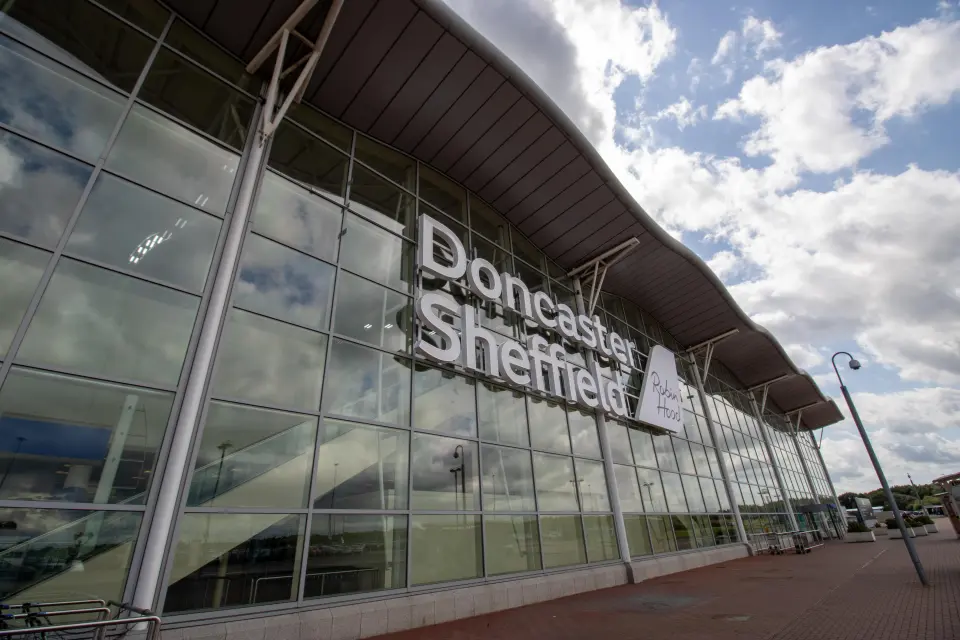
DONCASTER Sheffield Airport has taken a big step forward towards its reopening.
Approval has been given by the Civil Aviation Authority (CAA) to move forward with a crucial stage in order for the airport to welcome back passengers.
Doncaster Sheffield Airport has taken a step towards its reopeningCredit: City Of Doncaster / Mayor Ros Jones
The CAA has said that the hub can go ahead with its public consultation on the Airspace Change Proposal (ACP).
Locals and stakeholders get to state their opinion about its reopening – a necessary step in the process.
Christian Foster, Director for FlyDoncaster Ltd, operators of Doncaster Sheffield Airport said: “A reopening project of this scale includes a number of important milestones, but being able to go out to public consultation around our airspace is one that is absolutely crucial.
“We want to hear the views of people from across Doncaster and beyond, so that they can have a meaningful say about the airspace connected to this airport.
“As a community asset, it’s vital that we engage with those who live and work nearby to us and ensure we listen to the views of local people.”
Doncaster Sheffield Airport closed back in 2022 but could reopen to passengers in as little as two years’ time.
The regional airport in the north of England provided a gateway toEuropefor those living in and around Doncaster up until four years ago, after it was deemed ‘not financially viable’, and closed.
Christian Foster, Director of FlyDoncaster – the company set up to manage the airport – told us: “It does feel like the world has changed post-Covid, whereas people were focused two weeks inSpainorGreece, nowadays we’re seeing a lot of people keen to take city breaks.”
When talking of where he would like to fly, he said: “We’d love to fly to places like Croatia, and other destinations that are a bit more quirky like Azerbaijan.
“We’re keen to look at emerging places to visit as well, likeIndia.“
The ground floor will be used for retail and food and drink spaces, while the hotel will take over the first and second floor.
The Howlands Building will get a three to four storey extension upwards, which will be the hotel space as well.
Levels 24-30 are unconfirmed as to what they will be used for but could become art or culture areas.
And a public space will be part of the exterior as well, to make it more easily accessible.
The rooftop pool will be open both the public and hotel guestsCredit: OrmsThe downstairs area will have retail and dining storesCredit: OrmsA new public square is also part of the plansCredit: OrmsAn official opening date is yet to be confirmedCredit: Orms
Designers Orms are behind the renovation, who has replaced Heatherwick Studios.
They said in the application: “While maintaining the overall structure, we will remove unsightly modern additions to the 1960s exterior on the ground floor.
“We will then introduce retail on the ground floor and add a modest pavilion structure on the roof.”
A planning application will be submitted in September, although works cannot start in 2029 due to BT decomposing on equipment inside.
A SPOT that has previously been mocked as the worst place to live in the UK could be getting a sparkling new lido.
Hull has previously had a bad reputation, including being named the worst town in the book Crap Towns: The 50 Worst Places to Live in the UK in 2003.
Sign up for the Travel newsletter
Thank you!
Hull has previously been named one of the worst places to live but National Geographic recently named it one of the best places to visit this yearCredit: Alamy
Though over the past few years it has had a bit of a resurgence with National Geographic naming it one of the “best places in the world to travel to in 2026”.
And soon, there could be even more of a reason to visit the city as it could reopen a historic outdoor lido.
East Park Lido in a park of the same name opened back in 1964 as an unheated swimming pool.
Though, in 1985 it closed and was demolished three years later.
Councillors are now exploring whether the lido could reopen and how much it would cost to do this.
If plans went ahead at the former site, it would mean redeveloping the free splash pad with 43 jets and animal enclosures that are currently there.
Many people have taken to social media to share their thoughts on the news.
One person said: “Should never have gotten rid of the lido.”
East Park Lido opened in the 60s before closing in the 80sCredit: MEN Media
Another added: “About time get the lido open again on a new site.”
Now councillors are looking at the possibility of reopening the lidoCredit: Alamy
East Park itself is Grade II listed and already has some other attractions including a Grade II listed water ride that was built in 1929 called The Splash Boat.
Riders head down a 30.5metre drop into the boating lake below.
The ride is only open at weekends, bank holidays and during school holidays with each ride costing £2.
There are also swan pedalos at the park which cost £2 per person.
Hull currently has only one outdoor lido, which is Albert Avenue Pools and Fitness Lido.
The lido reopened in 2023 after an extensive £10.5million refurbishment.
The pool is heated to 28C throughout the summer season.
While in the city, make sure to head to Hull Minster – the largest parish church in England.
The church is over 700-years-old and is known to have some of the finest medieval brickwork in the country.
You can also climb up 180 steps in the church to see panoramic views of the city.
Hull has also been a backdrop more recently for big blockbuster films and TV series’ including The Crown, Victoria and Enola Holmes 2.
And thanks to lots of money being pumped into the city over the past decade, many of its former warehouses are now thriving restaurants, bars and cafes.
A POPULAR Victorian-era attraction used to spy on tourists will stay closed for weeks while essential maintenance work is carried out.
The “hidden gem” is a beloved tourist spot that offers 360 degree views of the area.
Sign up for the Travel newsletter
Thank you!
A popular tourist attraction will remain closed for several weeks while essential repair work is carried outCredit: Getty ImagesThe Great Union Camera Obscura offers 360 views of the coastlineCredit: Handout
The Great Union Camera Obscura will stay temporarily closed for several more weeks while a number of repairs are carried out.
The tourist attraction, located on the Isle of Man, first shut down on June 14, with a notice posted online by volunteers.
The notice read: “Please note that the Camera Obscura is currently closed while essential work is being carried out.
“The closure may last for several weeks, but we’ll keep you updated and let everyone know as soon as we’re able to reopen.”
Now, it has been revealed that the site will need to remain closed for longer as the latest condition survey unearthed a series of repairs that would need to be carried out.
Department of Education, Sport and Culture Minister Daphne Caine confirmed the repairs when responding to a written question about the work.
She said: “Since the last condition survey, issues have been found that require further repairs and maintenance, and the Department of Infrastructure is currently engaging with a contractor to address these issues.
“At the present time, these include the removal and replacement of wooden joists and decking, and the removal and replacement of corroded steelwork, fastenings and bolts located underneath the decking.”
The latest condition survey occurred in March 2025, and also identified areas of the sailcloth roof edging that had begun to fail and nails used to fix timber panels that were showing signs of decay.
According to Mrs Caine, the Camera Obscura underwent extensive repairs in 2017-18.
The Great Union Camera Obscura was first built in 1892, offering visitors a 360 degree view of the surrounding area, including the Douglas harbour and lighthouse.
According to the Isle of Man tourist website, the optical effect of the camera works through a series of mirrors and lenses located around the roof line above a darkened room with views of the surrounding area then projected onto a circular table.
The “unique” Camera Obscura boasts eleven lenses to create its views, whereas most only have one.
The “hidden gem” tourist attraction offers visitors a look into how Victorians first saw moving pictures and according to reviews is “well worth visiting to see how things were”.
Visitors have praised the “knowledgeable volunteers” at the attraction and the “stunning” views.
“You have to go to understand it,” wrote one visitor. “Like watching an old movie with movement.”
LONDON is undoubtedly home to numerous hidden gems, but I bet you didn’t know it has a secret island slap bang in the middle of the Thames.
Oh, and two times a year you can even visit it – including next weekend.
Sign up for the Travel newsletter
Thank you!
From Waterloo, it takes about 20 minutes to reach Twickenham and then the island is a 10 minute walk from the stationCredit: Cyann FieldingEel Pie Island is a hidden island on the River ThamesCredit: AlamyThe island only opens to the public twice a yearCredit: Alamy
Eel Pie Island sits in the middle of the River Thames in Twickenham, around 20 minutes from Waterloo.
The rather exclusive island has a very famous past as well.
The destination used to host live music events with top acts including The Rolling Stones, David Bowie, The Who and Pink Floyd.
In the 19th century, it was even a popular resort with steamboats and the famous Eel Pie Island Hotel, which sadly closed in 1967 after its dancefloor collapsed.
After the hotel’s closure, the island became a hippie commune – and this is where the island’s creative haven that you see today started to emerge.
On the island today, there are over 26 artists across cottages and studios which are littered around the island.
The island used to be home to the famous Eel Pie Island HotelCredit: GettyFamous musicians including David Bowie and The Rolling Stones performed at the hotelCredit: Alamy
Twice a year, the island opens its bridge to visitors, where you can explore the intricate network of paths and venture through what feels like a jungle to discover the different artists’ huts.
The island spans no more than nine acres and you can easily walk around it within an hour.
With small jetties off the end of gardens and plants that look way too tropical to be surviving in the Big Smoke, the island does feel more like Little Venice in Los Angeles than an urban jungle.
Roughly 120 people live on the island across 50 houses and houseboats and as you meander the paths you’ll see quirky enamel signs and American-style post boxes.
The island will open to the public next weekend as well as July 11 to 12Credit: AlamyThe island is now home to more than 26 artistsCredit: Getty
These all just add to the Californian vibe, with different spots on the island named ‘Palm Beach’, ‘Copper Beach’ and ‘Love Shack’.
Several spots across the island also feel like treasure troves of antique junk, from headless mannequins to hanging bird cages.
You can explore the island and workshops for as long as you like on the day you have a ticket for – which are free.
There are even a couple of spots where you can stay on the island.
And you can even stay on the islandCredit: Airbnb
One is a flat in a converted boatyard – it has one bedroom, along with a sofa bed and a living area.
Alternatively, you could stay in a converted boat house.
The Open Studios weekends take place on July 4 to 5 and July 11 to 12 between 11am and 5pm.
A NUMBER of iconic landmarks have closed around the country, as Brits brace for record-breaking heat.
Temperatures today have already broken June weather records, with highs of 36C seen in Surrey.
Sign up for the Travel newsletter
Thank you!
London’s Tower Bridge will close today and tomorrow due to hot weatherCredit: Dario AmadeLondon Zoo is shutting at 4pm on both days to support wildlifeCredit: Shutterstock
Multiple British landmarks have completely closed or restricted public access today as the Met Office’s red weather warning takes effect.
This comes after over 1,000 schools shut doors across the South of England, West Midlands and Wales due to rapidly rising temperatures.
Tower Bridge, a London landmark that attracts nearly one million visitors annually, has shut entirely today and will remain shut tomorrow.
Operators have said the decision was made for “the welfare of our staff and visitors”, and plan to reopen the bridge on Friday.
Changing of the Guard ceremonies at Buckingham Palace and Windsor Castle are suspended for the rest of the week.
The Household Division said: “We take the wellbeing of our soldiers and military working horses very seriously.
“Whilst it may be disappointing not to experience the Ceremonial Operations in full, it is important the wellbeing of the public, our soldiers and military working horses is maintained at all times.”
The historic spectacle, taking place on alternative days at Buckingham Palace and Windsor Castle, is a popular tourist attraction and “must see” for London visitors.
Changing of the Guard has been cancelled to protect the safety of soldiers and their horsesCredit: Getty
Major British landmarks closing this week
A number of British landmarks around the country have closed this week due to hot weather conditions
Full closures on Wednesday, 24 June and Thursday, 25 June:
Tower Bridge, Southwark
Changing of the Guard: Buckingham Palace and Windsor Castle
Young V&A, Bethnal Green
Cutty Sark, Greenwich
The Royal Observatory, Greenwich
Longleat House, Wiltshire
Severn Valley Railway, Wiltshire
Wild Zoological Park, Wolverhampton
Various National Trust properties and stately homes
Part closures on Wednesday, 24 June and Thursday, 25 June:
London Zoo – closing at 4pm on both days
Chester Zoo – closing at 2pm on Thursday
London Wetland Centre – closing at 3pm on both days
The Natural History Museum, Kensington – DC Atrium and West Entrance closed
Victoria and Albert Museum, Kensington – Galleries on level 4, alongside glass and architecture rooms
British Museum, Bloomsbury – Potential temporary closure of some galleries
Royal Parks – Spaces and playgrounds in Bushy Park, Greenwich Park, Hyde Park, Kensington Gardens, Richmond Park, St James’s Park, Green Park, Regent’s Park and Primrose Hill, Brompton Cemetary, and Victoria Tower Gardens
Hampton Court Palace, Richmond – Magic Garden
Greenwich landmarks the Cutty Sark and The Royal Observatory have also both announced their closures, with visitors of the area recommended to view the Queen’s House and National Maritime Museum as an alternative.
Away from the capital, various National Trust properties are operating on shortened hours, such as the Stourhead Estate in Wiltshire, Blists Hill Victorian Town in Shropshire, and Mottisfont House in Hampshire.
Longleat House and the Severn Valley Railway in Wiltshire, alongside the Wild Zoological Park in Wolverhampton, have also closed today and tomorrow.
The UK’s most visited museum, Natural History Museum, alongside the Victoria and Albert Museum have temporarily closed certain sections of the building, with the Young V&A shutting entirely.
The British Museum has further said on its website: “We may also temporarily close some galleries in the Museum to ensure the comfort and safety of staff and visitors.”
Beloved family attractions London Zoo and Chester Zoo are also shutting early on certain days, with London closing at 4pm both days, and Chester Zoo closing at 2pm on Thursday.
Outside, playgrounds in London’s Royal Parks have shut to keep staff, wildlife and visitors safe, including popular sites in Kensington Gardens, Hyde Park, Regent’s Park, and more.
Hampton Court Palace has also shut its Magic Garden from 1pm today, continuing until the end of tomorrow as the hot weather continues.
The Met Office red alert is in place for swathes of the country until late tomorrow night, with warm weather anticipated for the rest of the week.
A MAJOR airport is closed after a thunderstorm caused damage to air traffic control systems.
All flights are grounded from Bristol Airport, according to traffic monitoring site Inrix.
Sign up for the Travel newsletter
Thank you!
Bristol Airport is closedCredit: AlamyLightning during a thunderstorm in Minster on Sea, Kent, overnight into todayCredit: Alamy
Passengers are being urged to contact their airline and to check before they travel.
The airport’s website says: “Following the earlier electrical storm, Bristol Airport remains closed to arriving and departing aircraft whilst engineers investigate a fault with Air Traffic Control systems.
“Customers should contact their airline with any specific flight queries.”
Brits making the most of the scorching summer weather at the seaside resort of Lyme Regis, Dorset, yesterdayCredit: AlamyExtreme heat warnings are in place this weekCredit: MET Office
The extreme weather is also causing further travel chaos this morning – after thunderstorms and torrential downpours overnight.
Operators are imposing emergency speed restrictions and warning passengers to expect longer journey times.
London’s transport network has been hit hard, with the Circle line suspended and severe delays on the Hammersmith & City line, as well as parts of the District line shut and the Elizabeth line experiencing significant delays.
Services between Heathrow Terminal 4 and Heathrow Terminals 2 & 3 are also suspended.
The storms battered the South West of England last night, with hundreds of homes in Shepton Mallet, Glastonbury and Bristol being struck with temporary blackouts.
Meanwhile, passengers in the South East saw delays due to signalling issues.
Southeastern warned: “With ongoing thunderstorms and heavy rain in a number of areas, speed restrictions have been imposed in many places across the network as a precaution.
“Trains are continuing to run on all routes but your journey may take longer than expected.”
Lightning reportedly struck the home causing an infernoCredit: UKNIPFlames ripped through the roofCredit: UKNIP
But a second, more extreme red warning comes into force across Wednesday and Thursday for parts of southern England, as well as the Midlands and southern Wales.
From Friday conditions are expected to start turning slightly less intense.
Highs of 33C are still forecast in areas of Eastern England, but the worst of the heat should be beginning to pass.
By the weekend, temperatures are forecast to drop to the mid-20s.
A tarp covers the sign for the Donald J. Trump and The John F. Kennedy Memorial Center for the Performing Arts in Washington, D.C., last week as federal employees complied with a court order to remove Trump’s name from the building. Photo by Aaron Schwartz/UPI | License Photo
June 20 (UPI) — The board of directors at the John F. Kennedy Center for the Performing told a judge this week that the venue has no plans to schedule new programming and will likely remain closed for renovations.
U.S. District Judge Christopher Cooper in May ruled that the Kennedy Center’s board had decided to close the facility in July for two years of renovations and refurbishments without considering its responsibilities as a federal monument, ABC News and The Washington Post reported.
The May 29 ruling also ordered the center to remove President Donald Trump‘s name from the building, which it complied with last Friday, just hours before the court’s deadline to do so.
Trump made a sudden announcement in February that he planned for the center to be shut down for “construction, revitalization and complete rebuilding” over the course of a two-year period.
Matt Floca, executive director of the Center, told Cooper in a filing Friday that the board will be considering three potential paths forward — full closure, partial closure or a set of phased closures — but that public access to parts of the building would be maintained during any work there.
“Given present uncertainty as to future programming, management has deferred affirmative long-term programming or staff adjustments until the board selects a final operational path.
Performances and shows that were scheduled after the July closure date have already been canceled and are not expected to be rescheduled.
The public will continue to have access to various exhibits and smaller gatherings held there, including the John F. Kennedy exhibit — the facility was designed as a living memorial to the former president — during work there.
The Center’s board is expected to consider the three renovation options at a meeting in mid-July.
President Donald Trump presents a Medal of Honor to Tom Ripley on behalf of his father, John W. Ripley, during a Medal of Honor award ceremony in the East Room of the White House on Thursday. Photo by Aaron Schwartz/UPI | License Photo
However, after Iran’s statement, US Central Command (Centcom) spokesperson Tim Hawkins said “traffic continues to flow”. He said US forces were “monitoring the situation to ensure this remains the case”, adding that “Iran does not control the Strait of Hormuz”.
The abandoned Pontins resort in Prestatyn seems to have been left to decay since its closure in November 2023
The site has been left to rot(Image: Daily Post Wales)
A beloved entertainment hotspot has been left dormant for years and now looks a far cry from its former glory. Pontins in Prestatyn was once a thriving holiday destination, drawing families in droves with its private beach, swimming pools and children’s play areas. Now, the site sits largely deserted and crumbling, with many residents branding it a significant eyesore.
After over half a century of welcoming guests since it first opened its doors in 1971, the resort shut permanently in November 2023. The closure marked the end of a lengthy era in the town’s story, leaving behind a sprawling site that has since become a stark symbol of its deterioration.
Speculation has been rife in the three years since about its future. Rumours range from plans for a rejuvenated tourism venture to suggestions it may be bulldozed to make way for housing.
Images of the location continue to surface online, revealing boarded-up structures, unkempt grounds and clear signs of decay throughout the former holiday park. Once beaming with holidaymakers, large swathes of the resort now look abandoned, with several buildings visibly crumbling.
At the time, the closure of Pontins sent shockwaves through the entire local community. Britannia Hotels, which owns Pontins, had also shut down its Camber Sands resort in East Sussex.
Local residents previously shared their thoughts on the future of the site with North Wales Live. Among those to speak out was Pete Davis, who runs a cleaning firm that once worked with Pontins.
He said: “It ought to be used for something. I think it should be a holiday camp again. The council could issue a compulsory purchase order (to help that happen).”
A fellow resident shared the same view: “It’s empty and I’d rather it was a holiday camp again. We moved here in 1973 and it was never any trouble to us. I don’t want it knocked down for more houses as I don’t feel there are enough doctors’ surgeries and schools, not enough infrastructure to support them.”
A grandmother and grandson described the site as “decrepit” and an “eyesore”, saying: “It’s quite decrepit and an eyesore for the local community. Something needs to be done. It should be reborn as a holiday camp or used for modern apartments. Something needs to be doing to it otherwise it’s going to become a drug den or a place for fly-tippers.”
Residents aren’t the only ones calling for change at the derelict holiday park. Prestatyn’s Mayor, Cllr Adrian West, added his voice to the chorus, stating: “I want to see the site brought back into some form of productive use again.
“For it just to be lying idle is doing nobody any good. I would not want it used for some sort of industry, given that it’s right next to the waterfront.”
Not everybody is mourning the closure of Pontins, however, with one scathing TripAdvisor reviewer writing: “Thank god this rancid filthy cesspit has shutdown. Awful, worn out and really dirty. and it needed knocking down years ago.”
A further disgruntled visitor declared: “As time has gone by all the rooms are filled with mould, vomit, worse than a dog kennel. It looks like a rubbish dump,” while another pulled no punches, stating: “There are no words to describe how awful this place is. A prison cell would be preferable to the chalet.
“The areas outside are overgrown, potholes in the car park, pavements cracked and overgrown. Concrete on stairs broken, support for stairs rotten, nails sticking out.”
Other features of the festival include chill out zones and a number of VIP areas.
Little other details have been revealed about the festival yet.
Visitors can even camp right near the runwayCredit: Wikipedia
Visitors can book camping passes for £103, which allow for a pitch with up to 10 people (so £10.30 per person) or a camper van.
And with each camping pass, one weekend festival pass is included (so other guests camping at the pitch will need to purchase their own festival ticket).
A regular weekend pass costs from £37 per person or you can get four for £112.50.
If you fancy heading to the festival for just one day, you can do so for £22 and kids go free.
And the festival will have a cheap shuttle bus from Thanet Parkway Station if travelling to the festival via train.
Manston Airport closed back in 2014 and was used as a former RAF base and a regional hub, flying Brits abroad from the 1960s.
However, there are current talks to see if the airport could reopen, with the return of flights scheduled for 2029 – however this will be for cargo aircraft only.
Initially, the airport planned to reopen in 2025, but this has been pushed back.
Manston Airport closed in 2014 but is set to open in the next four yearsCredit: AlamyThe sites was once an RAF base and is currently undergoing public consultationCredit: Times Media Ltd
Three years ago, Manston Airport was bought by RiverOak Strategic Partners (RSP) who revealed plans to reopen it for around £750million.
The initial timeline was to open the airport in 2025, but this has been pushed back to 2029.
RSP said that the reason for the delays have been due to rising construction costs and the financial market.
Currently, the planning process of reopening the airport is entering its third stage.
Anyone living the local area of Ramsgate and Herne Bay – which are the towns located at either end of the airport’s runway have a first look at where aircraft will be seen and heard if the site reopens.
The documents were published on March 16, with the public given until June 22, 2026 to comment.
On social media it appears there has been a lot of support to open the airport once again.
One commented on Facebook said: “It would be nice to have an airport on our doorstep even if it was for short trips instead of going up to London same as the Eurostar.”
Tony Freudmann, Director at RiverOak Strategic Partners said: “This consultation is an important step in our ambitions to reopen Manston Airport, representing a once-in-a-generation opportunity to deliver new runway capacity to support the UK air cargo market and to transform the economic landscape in East Kent.
“We know Manston holds a special place in the area’s history, we would encourage people to find out more about our proposal and provide any feedback they might have to help shape our plans.”
The airport once operated passenger flights to EuropeCredit: Wikipedia
While the aim is to reopen the airport in 2029, this will be for cargo aircraft only.
When fully open, it’s believed that Manston Airport could handle around a million tonnes of freight a year.
There is still the chance that the airport will operate passenger planes later on.
No airlines have expressed interest yet, Mr Freudman said the likes of Jet2 and TUI prefer “regional airports like this one”.
The airfield was previously used as a regional hub to fly Brits abroad from the 1960s.
AN airport in Spain is finally set to reopen – after cancelling all flights for the last month.
Santiago de Compostela Airport, in northern Spain, closed in April due to much-needed repair works, costing millions.
Sign up for the Travel newsletter
Thank you!
Ryanair operates flights three times a week – but there haven’t been any for a monthCredit: Alamy
Follow The Sun’s award-winning travel team on Instagram and Tiktok for top holiday tips and inspiration @thesuntravel.
Having closed on April 23, it will finally be back up and running from May 27.
On its closure, an announcement was made on the Spanish airport operator’s website, Aena at the time, saying: “Santiago-Rosalía de Castro Airport will be closed from 23 April to 27 May 2026 for runway resurfacing works.
“During this period, the airport will be closed to all traffic, and no takeoffs or landings will take place.