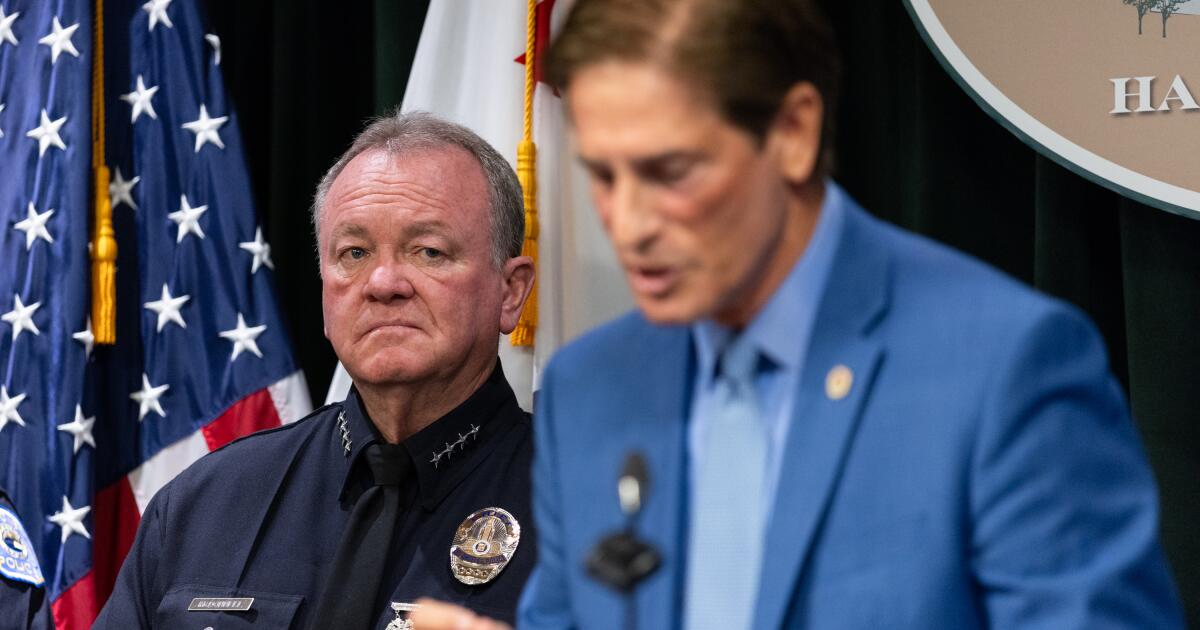
In the days since he charged a Los Angeles police officer with a crime for capturing evidence of his co-workers’ racist remarks, Los Angeles County Dist. Atty. Nathan Hochman has been the subject of withering criticism from Mayor Karen Bass, former cops and even some of his own prosecutors.
The chorus of voices decrying the filing of 16 counts of felony eavesdropping against Officer Daniel Flores — who caught fellow officers on tape using slurs and making derogatory remarks about Asians, Mexicans, Black people and women in the LAPD’s Training Division in 2024 — say the charges will dissuade other officers from reporting corruption and raise questions about Hochman’s commitment to police accountability.
“The bottom line is that the alleged racist, sexist, and homophobic comments made are outrageous and unacceptable,” Los Angeles Mayor Karen Bass said in a statement to The Times on Tuesday. “While I understand that it is inappropriate and a crime to record colleagues without their consent, those charges certainly send the wrong message that calling out egregious behavior could land you in prison.”
Six L.A. County prosecutors — all speaking on condition of anonymity in order to discuss the case candidly — also said in recent days they were shocked by Hochman’s decision to charge Flores.
One referred to the filing as “insane,” while another suggested Flores’ case should have been dismissed in the interest of justice.
On Friday, the district attorney’s office made public a 27-page motion asking for a lengthy preliminary hearing in the case. The filing alleged Flores deceptively edited the recordings to hide his own insensitive remarks. Several of the officers whom Flores taped said he often talked about wanting to win the “LAPD lottery,” meaning he intended to sue the department and retire on his winnings, according to the motion.
“[Flores] often starts the recordings in mid-conversation,” the district attorney said in an interview Friday. “Many people talk about the fact that he initiated some of these discussions, that he participated in some of these discussions. You’ll hear references to comments he made. Usually he has edited out his comments.”
The motion — which relies heavily on representations made by the officers whose comments Flores exposed — alleges Flores “manipulated conversations by initiating or participating in discussions about a particular topic before activating the recording device, then ceasing his own participation.”
Hochman said the recordings contain evidence that Flores made sexist remarks and referred to a group of people as “f—ing Crips.” It was not clear how referencing the infamous L.A. gang was, on its own, racist.
Flores’ attorney, Alan Jackson, did not immediately respond to a request for comment. Flores is due in court for an arraignment on Monday.
Some of Hochman’s own prosecutors said the charges look bad considering the district attorney’s suspect record in police accountability cases.
“Optics are terrible,” one prosecutor said, questioning whether Hochman was pressured to act by police unions, which made heavy contributions to his 2024 campaign.
Since taking office, Hochman has moved to dismiss a number of violent use-of-force cases against police and resolved others with lenient plea deals. He also either dismissed charges or offered no-jail plea deals to four former Torrance police officers who had been accused of crimes after they were implicated in the department’s infamous racist text scandal.
One prosecutor also said the Flores case is unwinnable and will certainly fail before a jury.
“Just because a law is broken doesn’t necessarily mean you are going to get 12 jurors in L.A. to convict,” the prosecutor said.
Flores turned over 122 recordings of his colleagues’ commentary to the LAPD Office of the Inspector General early last year, according to the motion filed Friday. An amended criminal complaint submitted in late July suggested the recordings were then used as evidence against Flores by LAPD officials who sought to punish him.
Flores has said he heard co-workers refer to Black people as “monkeys” who like grape soda and eat watermelon between basketball games, according to a retaliation lawsuit he filed last year. The suit claims Flores also heard colleagues call female officers “bitches” who couldn’t be trusted and alleged a supervisor said Mexican L.A. Dodgers legend Fernando Valenzuela died of septic shock because he “ate too many” tacos.
In the motion made public Friday, Hochman argued that Flores made the recordings, in part, to support his civil suit. Several of the officers quoted in the motion said Flores said he had anxiety about wearing a police uniform or going on patrol and wanted to retire to become a “stay at home Dad,” according to the motion.
The motion also provided more information about the alleged insensitive discussions than has been previously reported. One of the officers recorded by Flores admitted to describing a potential LAPD recruit as “rapeable” because they were “someone who could be taken advantage of,” according to the motion.
“The use of the phrase ‘rape’ was not in a sexual context,” the motion read.
The officers also suggested in the D.A.’s motion Flores was a habitual liar. He became embarrassed after he was caught fabricating or embellishing stories about playing college baseball, responding to protest scenes and an award he won in the police academy, according to the motion.
The motion said that an internal affairs sergeant found many of the allegations Flores made concerning officers in the recruitment unit improperly disqualifying candidates based on appearance and falsifying time sheets were not supported by evidence.
When he announced the charges last week, Hochman said that while the comments captured by Flores were deplorable, he couldn’t turn a blind eye to a blatant violation of the state’s two-party consent recording statute. With few exceptions, it is a crime in California to record a conversation without the consent of all parties involved.
Hochman said Friday that Flores is not protected by whistleblower laws because, although the recordings exposed bigoted speech, they did not prove evidence of a crime by any of the other officers. He also said the comments were not hateful in nature. At multiple points, the motion refers to the comments as “locker room” talk.
Many of the officers told investigators they made the crude comments “in a sort of joking, sort of locker room banter context. In hindsight these things are insensitive … but you’ll have for instance a Black individual making comments about Blacks,” Hochman said. “You’ll have an Asian individual making insensitive stereotypical comments about Asians.”
Hochman said the prosecution was meant to deter rogue police actions rather than silence whistleblowers. He likened what Flores did to a detective using illegal means to record a drug dealer or gang member.
Hochman said Flores should have reported his colleagues’ misconduct to internal affairs or the LAPD’s inspector general. But California Department of Justice records show there were 4,878 allegations of racial bias made against LAPD officers in the last decade, and the department upheld only three of those complaints.
Presented with those statistics at a news conference Thursday, LAPD Chief Jim McDonnell did not respond directly to a question about how Flores could possibly have faith in an internal probe. McDonnell said Flores’ complaint triggered an investigation into 18 other officers, all but one of whom faced sustained disciplinary complaints.
He declined to say what sanctions the officers faced. An LAPD spokesperson declined to elaborate.
The district attorney’s office has been less aggressive in prosecuting those who made surreptitious recordings in the past.
When asked to pursue charges against those who secretly recorded several City Council members making racist remarks during a meeting at the L.A. County Federation of Labor’s headquarters, the district attorney’s office found a crime had been committed but referred the case to the L.A. city attorney’s office for misdemeanor filing in 2024. Ultimately, no charges were filed.
Last year, the D.A.’s office opted not to bring charges in a different case involving an LAPD officer in possession of a secret recording.
In that case, the ex-girlfriend of Brandon Tilford provided the department with an audio recording he had texted her in January 2024, according to a rejection memo by prosecutors. In the recording, an unidentified police officer is heard saying, “Officer walks through processing and goes, man, this is f— Planet of the Apes in here” in an apparent reference to Black inmates. Tilford texted his former girlfriend, “That’s my sgt btw lol.”
But prosecutors said there was insufficient evidence to bring charges because the girlfriend couldn’t identify the officers in the recording or say who made it. Thus, prosecutors reasoned that they could not prove Tilford created the recording and did so without the others’ knowledge.
Retired LAPD Cmdr. Lillian Carranza said she understood why Flores “might feel compelled to gather evidence to substantiate serious allegations,” given how the department has handled past whistleblower cases.
“For me, the difficult question is not whether evidence should be gathered, but where the line should be drawn,” said Carranza, a 36-year department veteran who successfully sued the city several times for misogyny and sexual harassment. “Gathering evidence over days or even weeks to document ongoing misconduct is one thing. Doing so over many months raises different legal and ethical questions.”
Hochman said the sheer volume of recordings, and the fact that Flores is a sworn law enforcement officer, played a role in the decision to file felony charges.
The union that represents front-line public defenders also seized on the controversy, saying in a statement that Hochman’s decision sent a clear message to others who may want to report wrongdoing: “keep quiet, or you will be the one facing trial.”
The department has long had a policy that forbids retaliation against officers who report misconduct.
But in practice, LAPD insiders say, those who come forward with compromising information get little support. The department is facing scores of lawsuits by officers who claim they faced retaliation after speaking out in the form of poor job evaluations, harassment, demotions and even termination.