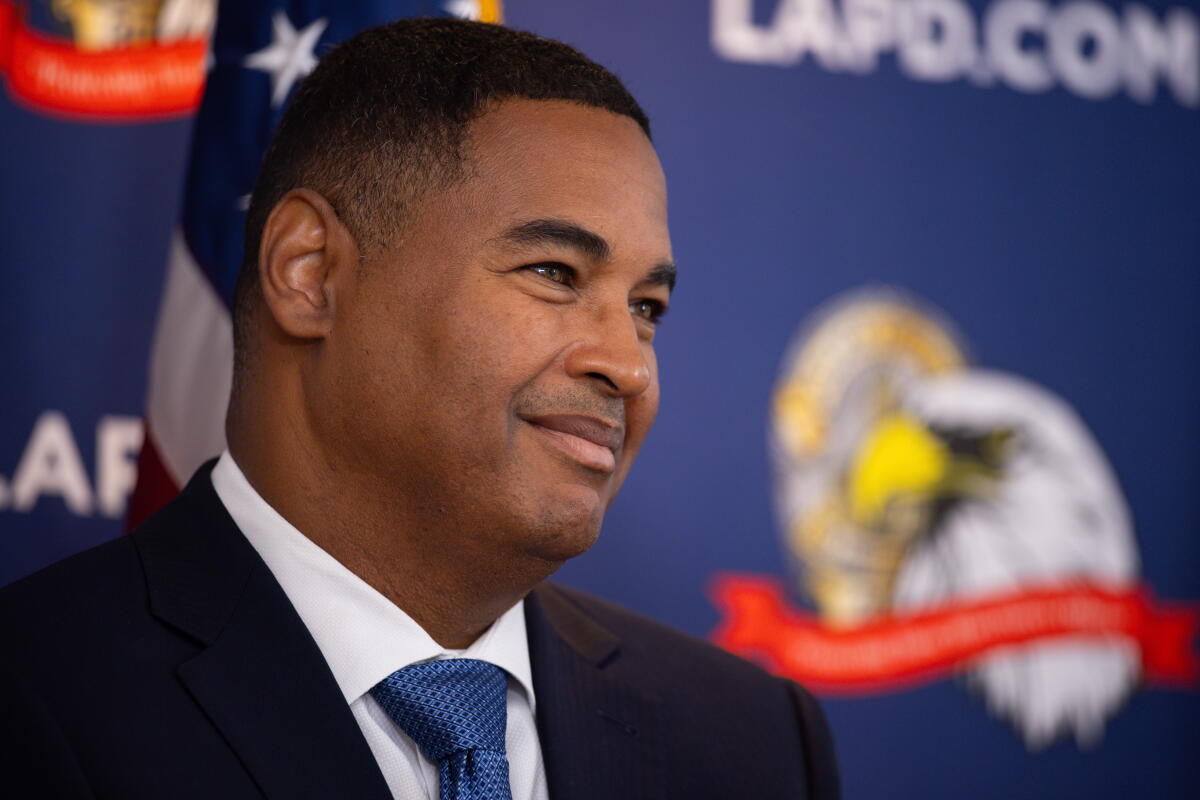
He didn’t think he’d be a lawyer. Now, he might be L.A. city attorney
Growing up without “two nickels to rub together,” John McKinney never thought he’d be a lawyer.
At the beginning of 2026, sitting in his office as one of the highest-ranking prosecutors in Los Angeles County, McKinney had no designs on trying to become L.A.’s city attorney.
But if he can beat progressive darling Marissa Roy next month and finish off an upstart campaign that barely had a pulse six months ago, McKinney would complete a lifelong underdog story that saw him go from working as a house painter and substitute teacher to pay for college to serving as the top lawyer for the second-largest city in America.
A highly regarded trial lawyer, McKinney, 58, claims an undefeated record in homicide trials and has won convictions in some of the region’s most infamous crimes, including the murder of beloved L.A. hip-hop star Nipsey Hussle. He reached his longtime perch in the district attorney’s office’s major crimes unit after a lifetime of struggle. Both of McKinney’s parents died before he was 5, and he was raised by his oldest sister in a cramped household with half a dozen other children in Passaic, N.J.

John McKinney speaks at a news conference at the Los Angeles Police Protective League in May.
(Kayla Bartkowski / Los Angeles Times)
McKinney beams with pride while discussing his hardscrabble East Coast upbringing — whether praising his sister’s hustle for working “six days a week,” or refusing to turn in his Yankees hat in a Dodger blue city. In interviews, he’ll sneak in a verbal jab at Roy, then finish the insult with a wry smirk. McKinney notes he’s been a prosecutor almost as long as his 34-year-old opponent has been alive.
“She’s never tried a case,” McKinney said. “When you’re running for city attorney overseeing trial lawyers and having to make high-impact decisions on whether to settle a case for $20 million or not, you should at least know what it’s like to go through a jury trial.”
Roy was part of the team that secured a $17-billion settlement from Meta in a landmark case this year, and has tried many cases decided by judges, rather than jury panels. She’s pushed back on McKinney’s barbs, noting he has no experience handling civil cases, a core component of the job.
McKinney has focused his campaign on lessening the city’s homelessness crisis by leveraging people into treatment, tackling quality-of-life crimes, and reducing the city’s out-of-control legal costs.
But he faces an uphill battle. Roy, a deputy state attorney general, has been campaigning for more than a year and raised more than twice as much money as McKinney. With the backing of both the county’s Democratic Party and the local Democratic Socialists of America chapter, Roy won June’s primary easily, outpacing McKinney by 15 percentage points. Both finished far ahead of City Atty. Hydee Feldstein Soto.

Marissa Roy, a deputy attorney general with the California Department of Justice, is running against John McKinney to become L.A.’s next city attorney.
(Gary Coronado/For The Times)
Los Angeles County Dist. Atty. Nathan Hochman leads a strong coalition of law enforcement support for McKinney, who has also been endorsed by four former city attorneys, two prior district attorneys and several City Council members, including Traci Park.
McKinney has emphasized the word “Democrat” in his ads, a nod to Roy’s attempts to cast him as the preferred choice of Republicans who won’t stand up to the Trump administration if elected. Although McKinney rubbed elbows with Republicans during efforts to recall then-Dist. Atty. George Gascón and employed fundraisers who worked with Trump, he says he “despises” the president and was disgusted by immigration raids in the city last year.
McKinney thinks Roy’s emphasis on fighting Trump speaks to a misunderstanding of the job. Across the country, it has been state attorneys general, not city attorneys, who have spearhead litigation against the White House, said McKinney, who dismissed the partisan attacks as a “misleading smear campaign.”
“Her lack of management experience and jury trial experience has not gone unnoticed by voters and her platform of wanting to turn the city attorney’s office into the country’s largest public interest law firm is out of alignment with the issues important to voters: public safety, homelessness and protecting taxpayer dollars,” he said.
Long before he was concerned about winning an elected office, McKinney was simply worried about survival.
The youngest of seven children, McKinney lost his mother to cancer when he was only 2. His father passed away unexpectedly three years later. His oldest sister, Ora, was recently divorced with three kids of her own but took in McKinney and his sister. He remained especially close to Ora — whom he described as his “mother, father and best friend” — until she passed away last year.
With his caretaker working nearly round the clock, McKinney said, he easily could have run in the streets with friends caught up in the crack cocaine boom of the 1980s. But McKinney said his sister’s determination inspired him to choose a better path.
“My sister made me believe there was really no limit to what I could do in life if I worked hard enough for it,” he said.
McKinney isn’t seeking sympathy, but believes sharing his backstory shows he’s “lived a life that mirrors a lot of the adversity Angelenos face every day.”
For much of his career in L.A., McKinney was seen as one of the district attorney’s office’s premier trial lawyers. He said he had no interest in management or politics until Gascón was elected in 2020. McKinney was one of several prosecutors to publicly criticize and sue Gascón. His involvement in the failed bid to recall Gascón put him in a political spotlight for the first time. He frequently spoke at recall events — which sometimes overlapped with rallies against Gov. Gavin Newsom and promoted conservative causes — and later joined the crowded field vying to replace Gascón in 2024.
Colleagues said McKinney has a history of being able to reach across ideological and cultural aisles. Bobby Grace, a veteran prosecutor who has worked with McKinney for decades, said he had a knack for getting people to take risks to take the stand in important cases.
“I think that’s where he made his reputation as a good trial lawyer,” Grace said. “To be successful, particularly in gangs, you’ve got to be able to convince witnesses who don’t want to come forward, and I think that was really his strength.”
Although he failed to gain traction in the race to unseat Gascón, finishing far behind Hochman, he caught the future district attorney’s eye and the two became allies. When Hochman took office, he put McKinney in charge of specialized prosecutions, giving him oversight of a wide range of cases, including cop killings, juvenile crimes, gang homicides and child abuse.
McKinney said he wasn’t even thinking about getting into the city attorney race until the middle of January, when a number of people approached him about entering.

City attorney candidate John McKinney, left, walks through Skid Row in downtown Los Angeles on July 1.
(Christina House / Los Angeles Times)
By March, McKinney was scrambling to get a campaign together, and Hochman was quick to lend the fundraisers and managers who helped him oust Gascón.
He soon ascended from nonfactor to legitimate contender. Frustrated with ballooning legal costs and her handling of a department data breach, the city’s powerful police union abandoned Feldstein Soto and backed McKinney. Independent expenditures — political interest groups that can spend unlimited amounts in campaigns if they don’t coordinate with candidates — doled out $3 million to support McKinney.
In total, records show those groups have spent nearly $5 million on McKinney. More than half of that money has come from a venture capitalist who has publicly praised Elon Musk and a political action committee run by Airbnb, the rental giant currently facing a lawsuit from the city for price gouging during the wildfires.
McKinney insists campaign support won’t influence his decision-making in office. He has vowed to sue Airbnb if it engages in price gouging, and he knows the Los Angeles Police Department is a major factor in the city’s rising litigation costs. Given his law enforcement background, he argues he’s better positioned to influence police than Roy.
“I think because they know I’m not coming at them from a vindictive point of view, trying to underfund them or undermine them, that my criticism will be taken for what it’s worth, which is to make them stronger, to make them more trusted and more effective,” he said.
Whereas Hochman often compared L.A. to crime-plagued “Gotham City,” McKinney acknowledges the city’s more recent struggles are not with violence, but with quality-of-life crimes: unchecked homeless encampments, street racing, animal abuse on Skid Row.
Walking around Skid Row this summer, McKinney spoke with several people who approached from tents and other jerry-rigged structures. He listened closely as they explained their struggles and pleaded for help in a part of the city few residents ever set foot in. He describes his approach to the city’s homeless crisis as one of “compassionate accountability.”
“Every person who is living on the street has had some tragic circumstance in their life,” he said that day.
McKinney acknowledged he can’t do anything about a lack of housing as city attorney, but he can better manage the way L.A. throws resources at the problem. That includes more sophisticated audits of community-based organizations that have contracts with the city to aid unhoused people, he said.
Ultimately, he does not want to punish people who are suffering, but thinks the city attorney’s office can use its power of prosecution to pressure homeless defendants suffering from addiction or mental health issues into treatment. The mission is a personal one for McKinney, who grew up with a schizophrenic nephew whose slow decline he watched for years.
“When I talk about compassionate accountability, it’s not just a campaign slogan for me,” he said. “It’s real. These are real people.”