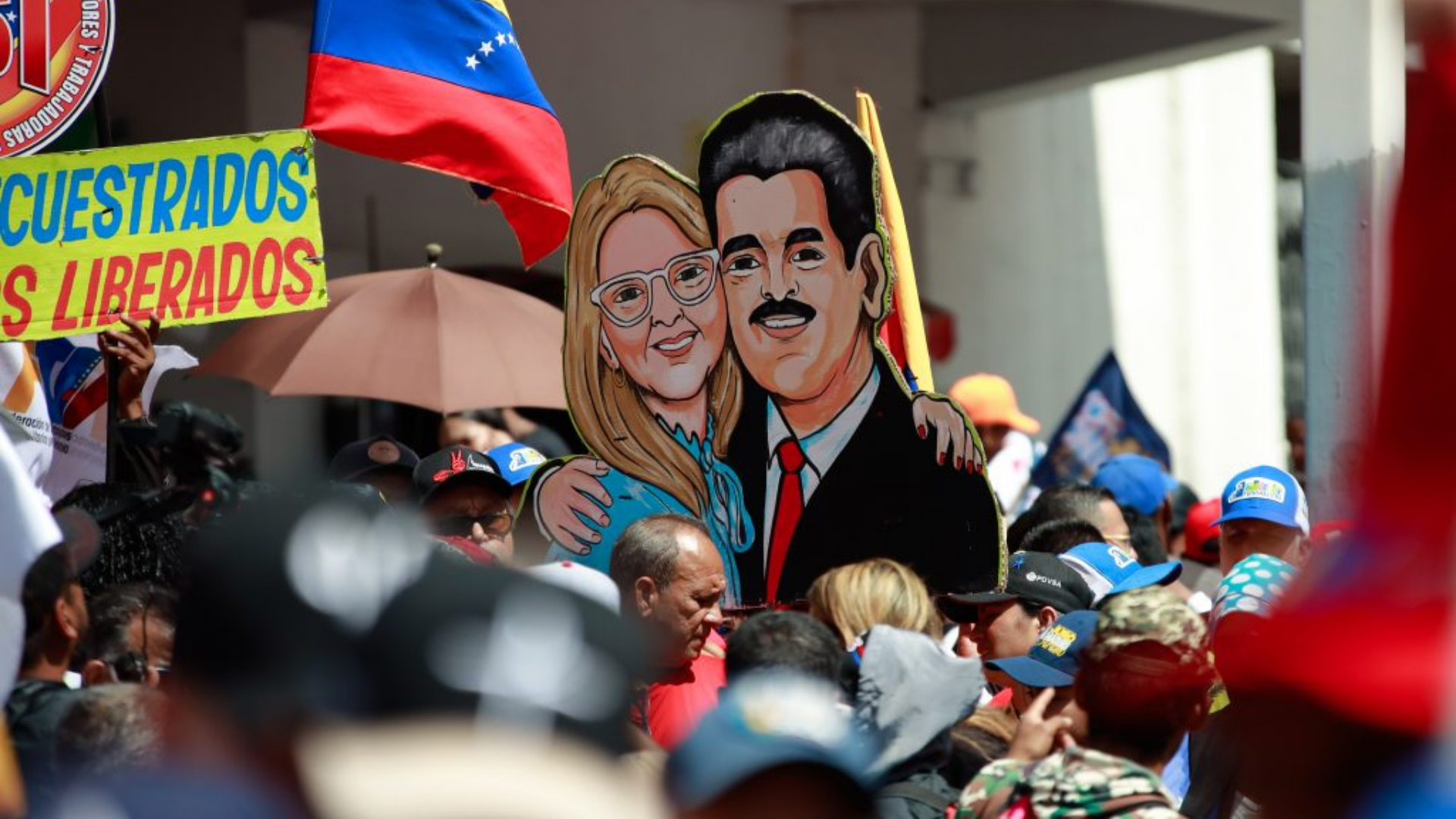
Rally in Caracas in January demanding the release of Nicolás Maduro and First Lady Cilia Flores. (AFP)
Mérida, October 16, 2026 (venezuelanalysis.com) – Venezuelan President Nicolás Maduro and First Lady Cilia Flores have rejected a new indictment amid an ongoing prosecution by the US government.
I reject this document in its entirety,” Maduro told New York Judge Alvin Hellerstein in a hearing on Thursday. Similarly, Cilia Flores maintained her “absolute innocence” when asked to respond to the new charges, declaring: “I am completely innocent. I am not guilty.”
The judge entered formal not-guilty pleas on behalf of both defendants for all counts.
Maduro and Flores have been detained in Brooklyn’s Metropolitan Detention Center since being kidnapped by US special forces on January 3.
In the Manhattan federal court, US Attorney Jamie McDonald presented the superseding indictment that introduces a “conspiracy to commit torture” charge alongside the previous charges of “narco-terrorism” and drug trafficking conspiracy, as well as weapons possession.
The accusation claims Maduro personally oversaw purported torture of prisoners and held authority over whether detainees were released or prosecuted.
“Maduro, Flores, and other high-ranking members of their inner circle used a violent system of torture and repression to maintain their power,” McDonald stated to reporters outside the courthouse.
According to the legal filing, the prosecution alleges that Maduro and Flores oversaw a violent state “apparatus of repression” spanning from the former’s election in 2013.
The document claims methods like electric shocks, asphyxiation, and simulated drowning, among others, were allegedly deployed against political dissidents, state officials suspected of disloyalty, and US citizens detained inside Venezuela.
Defense attorneys have repeatedly questioned the legitimacy of the entire prosecution, framing it as an unprecedented overreach of U.S. extraterritorial jurisdiction. Maduro and Flores have consistently maintained that they are political prisoners and that their capture constituted a flagrant violation of Venezuelan sovereignty.
Legal counsel has filed pre-trial motions requesting the dismissal of the charges on grounds that Maduro and Flores, as a sitting president and legislator, respectively, possess sovereign immunity from foreign criminal prosecution.
Hellerstein recently rejected a request from Flores’ defense team that she be moved to house arrest due to severe health concerns, arguing that the first lady poses a “substantial flight risk.”
The updated indictment forced the judge to adjust the calendar of proceedings. The hearing on sovereign immunity arguments has been moved to January. The trial was pushed back two weeks and is now slated to commence on June 14, 2027, with a final pretrial conference scheduled for June 8.
In Venezuela, National Assembly Deputy Iris Varela blasted the new charges, arguing that Maduro and Flores remain victims of a forced kidnapping orchestrated by Washington.
“I wish to publicly express, once again, my absolute and total rejection of the despicable act that the U.S. government is brazenly carrying out against our president and our congresswoman,” Varela wrote on her X account.
She further described the latest charges as “a miserable ploy [and] a grotesque maneuver” and went on to label US President Donald Trump as a “pedophile pig.”
In contrast to Varela, the Venezuelan government has made no official statement regarding the latest developments in the legal case against Maduro and Flores.
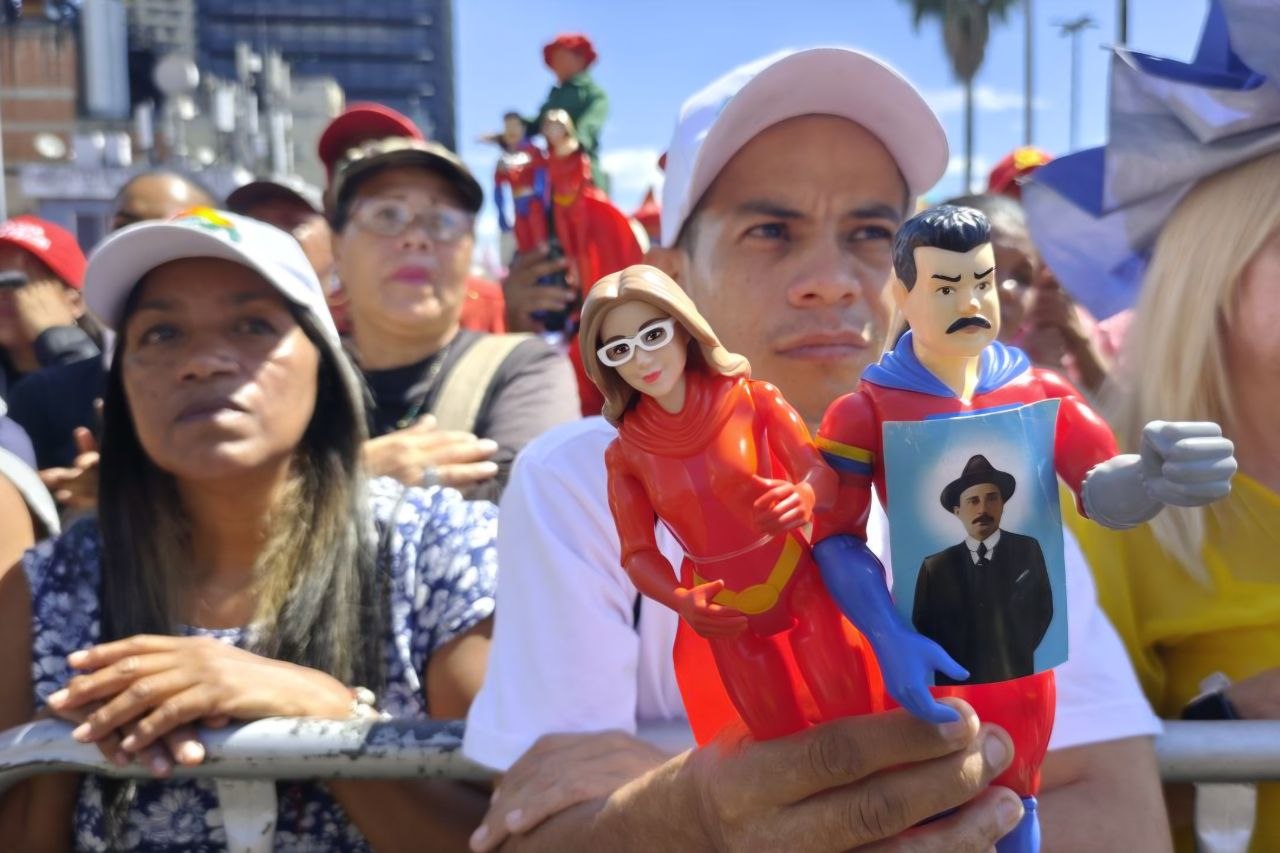
A supporter holds Maduro and Flores action figures in a demonstration in Caracas. (MinMujer)
Caracas, October 8, 2026 (venezuelanalysis.com) – US District Judge Alvin Hellerstein denied a request by Venezuelan First Lady Cilia Flores to be released from jail and allowed to face trial under house arrest in New York following reported health problems.
The Southern District of New York judge argued in a bail hearing on Thursday that Flores posed a “substantial flight risk” and dismissed assurances from defense attorney Mark Donnelly that she would not flee.
“With all the money at stake and all the contacts Ms. Flores has with the Venezuelan government and the people who make it up, the risk is serious. There is no combination of conditions that would make that risk any less serious,” Hellerstein said.
In a court filing submitted in early September, Flores’ defense team requested that the 69-year-old be transferred to a private residence in New York with armed guards around the clock, an electronic monitoring bracelet, restricted visitors, and monitored phone calls.
Flores and Venezuelan President Nicolás Maduro were kidnapped by US special forces on January 3. They have been detained at the Metropolitan Detention Center in Brooklyn while facing “narco-terrorism,” drug trafficking conspiracy, and weapons possession charges.
Flores’ lawyers have pleaded that she requires extensive cardiac treatment and that the prison does not provide the necessary conditions for her care. Attorneys added that the Venezuelan first lady, who is also a legislator, would cover the transfer costs and offered to surrender her passport as an additional assurance of remaining in custody.
The filing describes episodes of chest pain, arrhythmia, difficulty breathing, and a weight loss of more than 24 pounds since her detention. It also claims that Flores may have suffered a mild heart attack on July 29.
A group of demonstrators gathered outside the courthouse, demanding that the Venezuelan first lady’s health concerns be addressed and protesting the “illegal” abduction and prosecution of the presidential pair.
Hellerstein’s denial of bail coincided with US Justice Department prosecutors filing a new indictment against Maduro and Flores, expanding the charges they face in the United States.
The superseding indictment, backed by US Attorney General Todd Blanche, US Attorney for the Southern District of New York Jamie McDonald, DEA Administrator Terrance C. Cole, the secretary of the Department of Homeland Security, and FBI Director Kash Patel, accuses them of conspiring to torture political opponents, military personnel, and other detainees, including three US citizens.
The prosecution’s filing alleges coercion, electric shocks, and threats against family members, among other practices. Prosecutors claim that after taking office in 2013, Maduro “oversaw a system designed to employ torture, arbitrary detention, and violence as means of repression against the political opposition.”
“As alleged in the indictment, the Maduro regime subjected American citizens to torture while held in custody of the Venezuelan government […]. Today’s charges reflect the commitment from this FBI and this Department of Justice to accountability, the rule of law, and the protection of U.S. national security,” FBI Director Kash Patel stated.
Maduro’s attorney, Barry J. Pollack, said his client denies the allegations in the new indictment and looks forward to his day in court. The updated indictment added “narco-terrorism” to the accusations against Flores.
The document also names Nicolás Maduro Guerra, the former president’s son; current Interior Minister Diosdado Cabello; former minister Ramón Rodríguez Chacín; and Héctor Guerrero Flores, alias “Niño Guerrero,” the leader of the Tren de Aragua gang, who was reported killed in a US military operation inside Venezuelan territory in June.
Last week, US prosecutors challenged Maduro’s claim to sovereign immunity, arguing the White House had not recognized him as president and that the Venezuelan government had never requested that he be granted such status. They said, however, that Caracas had pursued a similar request for Acting President Delcy Rodríguez in a separate civil lawsuit.
Hellerstein is scheduled to hear oral arguments from both sides on the immunity question on November 17. The US government has asked the court to reject motions filed by Maduro and Flores seeking dismissal of charges. If the case proceeds, the trial is scheduled to begin in June 2027.
The Venezuelan government has not commented on the latest charges against the Venezuelan president and first lady or on their legal claims to immunity.
A Black police officer asked whether a monkey was named “Tyrone,” to the laughter of a roomful of Latino and Asian colleagues.
A Latina cop described how to inflict maximum pain: “You hit Black people in the liver — I heard they got weak livers,” she said, according to an LAPD internal affairs report.
The report said their boss, an Asian sergeant, stood by as his employees used terms like “midnight” and “chocolate, chocolate” to describe people’s skin tones.
Those were among the comments that came to light last year after an LAPD whistleblower secretly recorded his colleagues in a unit that screens police recruits.
The scandal, which has seen new developments in recent weeks, is forcing department officials to reckon with a harsh reality: Years of efforts to make the LAPD more diverse have seemingly done little to stamp out prejudice in the ranks.
For much of its history, the LAPD was a white man’s department. Aggressive tactics in communities of color fueled racial uprisings in the 1960s and early 1990s, when the beating of motorist Rodney King led to the discovery of messages similar to those in the recruitment unit tapes, with officers referring to Black men as “Buckwheat” and bragging about “busting heads.”
Under pressure from lawsuits and consent decrees, police leaders pushed to recruit more Black, Latino and Asian officers, seeking to build up trust in minority communities.
1
2
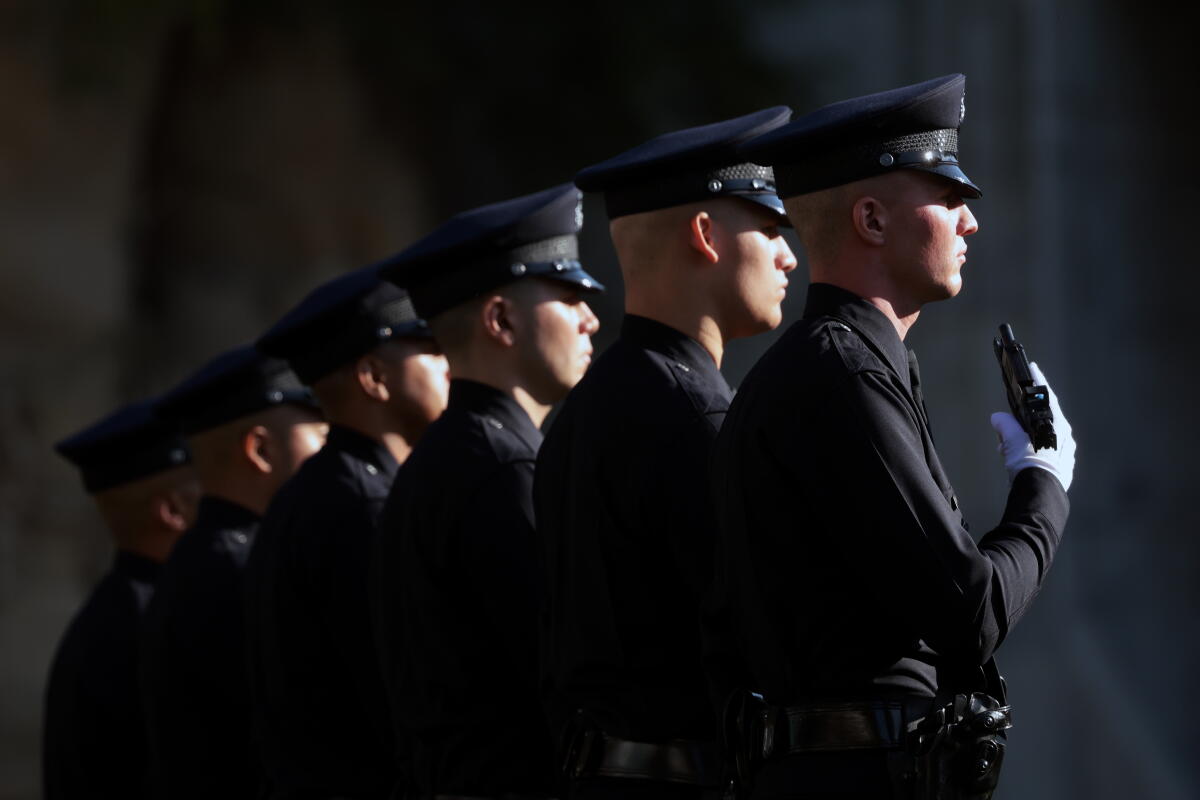
1.Los Angeles Police Department graduates a total of 22 recruits at the Los Angeles Police Academy in Elysian Park on Friday, September 18, 2026.2.(Christina House/Los Angeles Times)
Latinos now make up more than half of the 8,500-officer department. Black officers constitute less than 9% of the force, coinciding with a decline in the city’s Black population.
The officer who made the recruitment unit recordings, Daniel Flores, is Latino.
He recorded dozens of conversations over a six-month span in 2024, eventually handing them over to the department’s inspector general for investigation.
Last week, Flores filed a new lawsuit against the city, adding to a previous claim that alleged he faced retaliation from his bosses for documenting the offensive comments he heard while on the job.
According to his latest claim, department officials recommended that he be suspended for 22 days without pay. After initially seeking to keep his job with the LAPD, the 13-year department veteran said in the lawsuit that he recently decided to retire rather than endure an increasingly hostile work environment.
Flores also alleged LAPD officials were responsible for pushing a criminal case against him for violating a state eavesdropping law that prohibits recording conversations without consent. Initially alleging 16 felonies, Dist. Atty. Nathan Hochman has since reduced the charges to misdemeanors, likely allowing Flores to avoid jail time.
An LAPD spokesperson declined to answer questions about Flores’ case.
“The Department takes these allegations seriously,” Lt. Elpidio Orozco said in a statement. “Because the case and related personnel proceedings remain ongoing, we cannot discuss individual disciplinary actions or make comparisons to unrelated past incidents.”
The department’s defenders maintain that progress has been made toward rooting out bigotry.
Officers are required to undergo psychological screening and training aimed at teasing out unconscious biases. New recruits and seasoned officers alike take field trips to the Museum of Tolerance, where trainers extol the virtues of multiculturalism. The department has sent recruiters to historically Black colleges in the South and the East Coast.
But others, including civil rights attorney Connie Rice, say the latest scandal proves that the LAPD’s problems run deeper than the hateful actions of a few individuals.
The beating of Rodney King in 1991 forced a reckoning for the LAPD.
(George Holliday / Associated Press)
“Racism is like the herpes virus in the body of the LAPD: You can suppress it with a good chief, but as soon as they leave, it breaks out again,” Rice said.
A 2024 study by British researchers examined racial attitudes among members of the department’s vaunted Metropolitan Division.
The researchers found that LAPD officers were “shockingly defensive” when asked about systemic racism, taking a negative view of diversity hiring programs and insisting that left-leaning activists, elected officials and media outlets were stoking public outrage over racial profiling.
“The dismissive reactions … to a question on such an important issue highlight an unhealthy antagonism which prevents any organization from learning or developing its practice,” the researchers concluded. “It is a fundamental barrier that must be overcome.”
While hiring more officers from historically marginalized groups has long been pushed as a way to improve police practices and build trust in minority neighborhoods, studies have not necessarily borne that out, said Daniel Gascon, a sociology and criminology professor at the University of Massachusetts Boston.
“Just because there’s more numbers of a given sort in a department doesn’t mean it’s going to change automatically,” said Gascon, who has studied the LAPD’s relationship with Latino communities.
Since the start of the year, a review of recruit graduation announcements shows the department has hired just seven new Black officers. By contrast, roughly 80% of the 241 officers to graduate from the police academy over the last nine months have been Latino.
The growing Latino presence in the LAPD has been reflected in police use-of-force numbers.
A Times analysis of police shootings since 2016 found that of the roughly 150 people who have been shot dead by the LAPD across the city, at least 94 were Latino men. In 3 out of every 4 of those shootings, at least one of the officers who fired was also Latino, the analysis showed.
LAPD Officer Daniel Flores, left, listens as his attorney Alan Jackson speaks to reporters at the Superior Court building.
(Libor Jany / Los Angeles Times)
Despite the increased diversity, interviews with current and former LAPD members indicate deep divisions are reflected in the way that Black and Latino officers see the department’s racial issues. Most agreed to speak on the condition of anonymity due to fear of retaliation.
Several Black officers told The Times they still experience workplace hostility and racial dog whistles, such as fretting about the lowering of police recruit standards. The comments, they said, came from Black and Latino colleagues alike.
Too often, the Black officers said, Latinos who wear the uniform see themselves only as victims of discrimination, and not perpetrators.
Some Black officers said they avoid conversations about race entirely for fear of upsetting conservative colleagues — who feel emboldened by the divisive rhetoric coming from the White House.
The Latino officers who spoke to The Times said the department has for too long prioritized the promotion of Black members of the force to leadership roles while the representation of Latinos in the highest ranks has slipped.
Others argue that because society tends to lump Latinos of different backgrounds together, workplace discrimination against and within the community is often missed.
Officers from both groups said their race has been used against them when it comes to promotions. But both sides also say racism is a problem in society writ large, and not limited to the LAPD.
In a recent interview with The Times, Mayor Karen Bass said that although she is pleased that the department has increased the number of Latino officers to reflect the city’s demographics, its percentage of Black officers continues to dwindle as older African Americans are on the brink of retirement with very few young Black officers coming onto the job.
Bass, who was a young community organizer in South L.A. when the King beating happened, said it was foolhardy to believe that merely because the LAPD is more diverse, old problems cannot be repeated.
“Just because this happened 30 years ago and there are new policies that were put in place, that’s not enough,” she said in an interview with The Times. “You’ve gotta make sure that those policies are constantly updated.”
Times staff writers Andrea Flores and Richard Winton contributed to this report.