Spain sanctioned by FIFA after incidents at Espanyol’s stadium in Barcelona, which staged the friendly with Egypt.
Published On 16 Oct 202616 Oct 2026
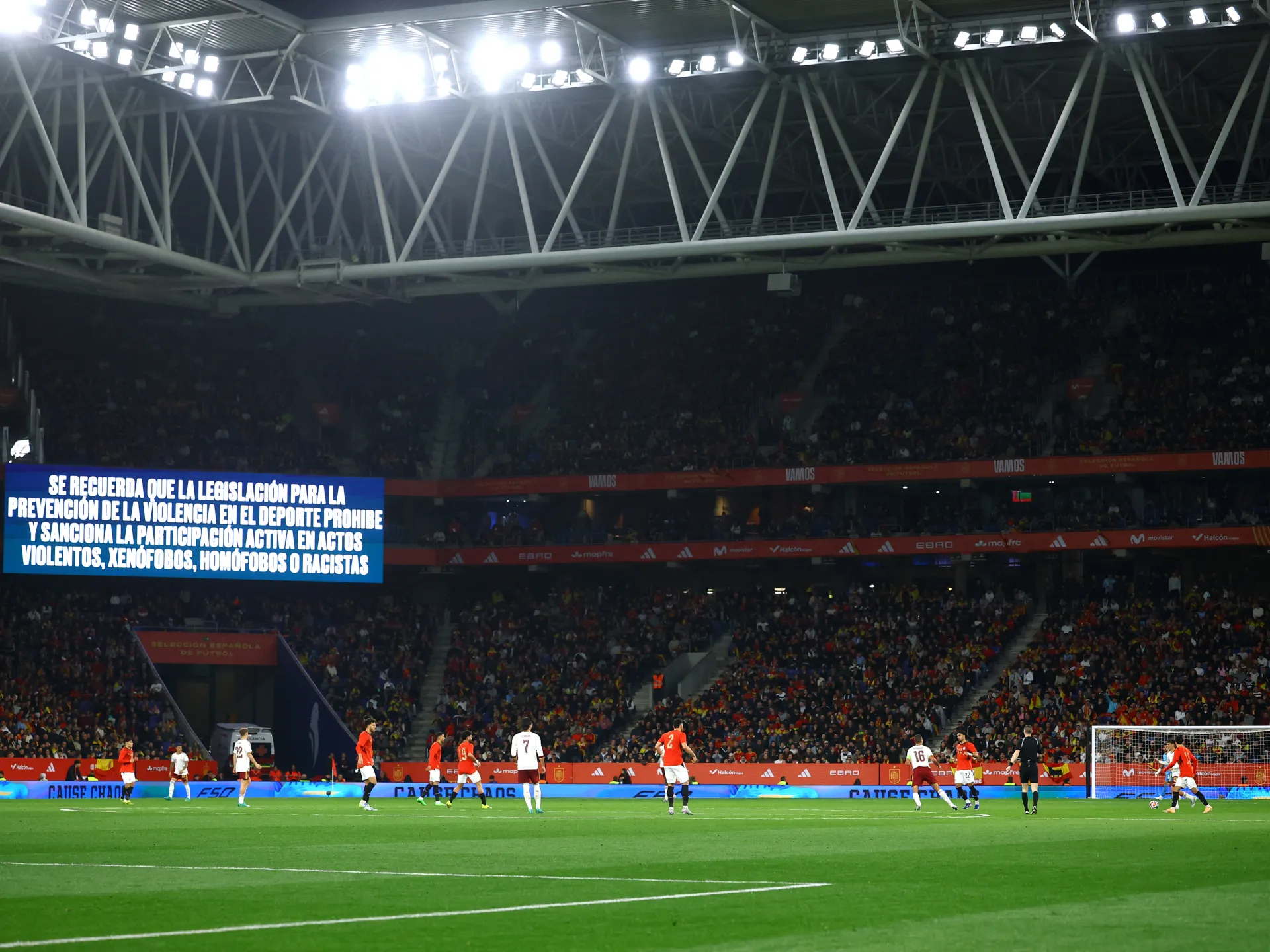
Spain have been fined $20,000 and ordered to partially close their stadium for their next friendly after supporters twice chanted Islamophobic slogans during the game against Egypt in March, FIFA said in a statement.
The sanctions relate to incidents at the RCDE Stadium near Barcelona, home of LaLiga club Espanyol, where some Spain fans chanted, “Who doesn’t jump is a Muslim” during a World Cup warm-up match which ended in a 0-0 draw.
Recommended Stories
list of 3 itemsend of list
After the second occurrence of the chant, the stadium announcer issued a warning and the scoreboard displayed a message against discriminatory behaviour.
Spain winger Lamine Yamal, who is Muslim, condemned the chants at the time, describing them as disrespectful and intolerable and calling those responsible “ignorant and racist”.
Spanish police launched an investigation the following day, while world governing body FIFA later started disciplinary proceedings against the Spanish football federation (RFEF).
It argued that the word ‘Muslim’ was “neither insulting nor pejorative”, adding that the fans’ conduct should be assessed under FIFA’s Article 17, which covers political, ideological, religious or offensive messages, rather than Article 15, which deals with discrimination and racist abuse.
However, FIFA’s disciplinary committee rejected that argument, saying Article 15 does not require the explicit use of a slur and that a term can be discriminatory when used in context as “an insult, taunt, or marker of inferiority”.
FIFA fined the RFEF and ordered the closure of at least 15% of available seats for Spain’s next friendly.
Coworker alerted police after receiving disturbing messages from 19-year-old suspect.
Published On 15 Oct 202615 Oct 2026
A teenager arrested in a Chicago suburb had shared a document expressing white supremacist views and outlined an alleged plan to carry out a mass shooting, potentially targeting a Hindu place of worship, police in the US state of Illinois have said.
Alexandros Paporakis, 19, of Palatine, was arrested on Sunday after an individual reported receiving concerning electronic communications from him, Palatine police said on Wednesday. It was not immediately clear whether he had legal representation.
Recommended Stories
list of 3 itemsend of list
Detectives searched Paporakis’s home and recovered a rifle, multiple loaded rifle magazines and hundreds of additional rounds of rifle ammunition.
“Among the recovered items was a tactical vest containing body armor and a patch displaying imagery associated with white supremacist extremism,” a police statement said.
Paporakis’s coworker reportedly told police that he openly identified himself as a white supremacist at work and said he “couldn’t wait” to kill Indian people, according to prosecutors from the Cook County State’s Attorney’s office.
Detectives recovered a document called “Why I fought: A.K.A.: (Aurora Shooter’s Manifesto)” which had sentiments expressing white supremacist and extremist ideologies, referencing violence towards South Asians, specifically Indians.
Authorities believed Paporakis was planning to carry out his attack on Sunday, possibly targeting a Hindu temple in Aurora, 40 miles (65km) southwest of Palatine.
“However, the specific intended location has not been confirmed and remains under investigation,” the police said, adding the FBI was assisting in the probe.
Police said Paporakis is facing felony charges of “making a terrorist threat” and possessing an unlawful weapon.
The suspect appeared for a detention hearing on Wednesday and his next court appearance is scheduled for the end of October.
Human rights advocates said hate against South Asians has surged in the United States in recent years due to rising anti-immigration policies and a rise in white supremacist ideology.
The former British Army member harboured ‘extreme right-wing’ views and was ordering explosives components, say police.
Published On 14 Oct 202614 Oct 2026
A British court has handed a former army chef a nearly four-year jail term for possessing weapons for “terrorist purposes”.
Mark Broadhurst, 28, was given the sentence on Wednesday at Sheffield Crown Court in England, two years after police uncovered online messages in which he expressed racist views and an intention to sell homemade firearms to right-wing groups.
Recommended Stories
list of 3 itemsend of list
Police found a stockpile of weapons at Broadhurst’s home address when they took him into custody in September 2024, including knives and crossbows, black powder, ammunition, air pistols and what officials described as “an improvised homemade cannon”.
The former British Army member was also found to be part of an online chat group with three other men who last year were jailed for planning to carry out a “terrorist” attack at mosques or synagogues as part of what they believed to be a coming “race war”.
Frank Ferguson, head of the special crime division of the UK’s public prosecution agency, the Crown Prosecution Service (CPS), said Broadhurst was “clearly interested in violence and developing weapons that had the ability to cause untold harm to innocent people”.
Detective Chief Superintendent James Dunkerley, who heads “counterterror” policing in the northeastern region, said Broadhurst was found to be harbouring an “extreme right-wing mindset” and was “proactively ordering components to make explosives”.
Broadhurst pleaded guilty to firearm possession and possessing an explosive under suspicious circumstances, but denied they were for “terrorism” purposes. A judge, however, ruled that Broadhurst’s offences were connected to “terrorism”.
His conviction comes against a backdrop of rising racial tensions and hate crimes in the UK, with marginalised communities increasingly targeted.
British police in July arrested 12 people in connection with an “extreme right-wing terrorism threat” targeting an Islamic gathering in eastern England.
Six months earlier, UK prosecutors said they were handling the highest number of hate crime cases referred by police in its history.
Swansea City head coach Vitor Matos says the lengthy stoppage during their 1-0 win away at Millwall was a result of racist abuse aimed at Ji-sung Eom.
The South Korea winger was among the Swansea substitutes, and had been warming up on the side of the pitch when the Championship game was brought to a halt.
Referee Edward Duckworth had lengthy discussions with both sets of coaches, during which the game was paused for around seven minutes.
Following the stoppage, an announcement was made over the speakers at The Den confirming there had been alleged chants of racism and that police were working to identify any offenders using CCTV.
Speaking after the game, Matos said it was the 24-year-old who had been the subject of the abuse.
“The situation was with Ji-sung Eom,” said Matos.
“The referee followed the protocol for these sort of situations, they did the right thing. Millwall also did the right thing to get the protocol moving on.
“We all know there is no space for this, this kind of situation should not happen.
“When they do happen we are here to stand with the player, in this case it is our player.”
Millwall stated they were “aware of an alleged, individual incident of discriminatory abuse towards a Swansea City player during the second half” of the game.
“The club operates a zero-tolerance policy towards any form of discriminatory abuse. Any individual found to have engaged in such behaviour will face the strongest possible action,” added the hosts.
“The club is working alongside the relevant authorities to establish the facts and is unable to comment further as tonight’s alleged incident is the subject of an ongoing police investigation, which the club fully supports.”
Victory kept Swansea two points clear at the top of the Championship, with the Welsh club putting together their best start to a season in a century.
Matos said he was saddened by the abuse aimed at Eom, but says the rest of the squad will rally around their team-mate.
“He is a smart kid, he is not happy with the situation but he knows we will stay with him and follow the situation as long as we can,” added Matos.
“Millwall did the right thing by announcing there is no place for this sort of thing.
“I’m happy with how it was handled, but really sad that it happened. Now it is about evaluating the situation and we’ll see what happens.”
Zack Polanski calls for internal rule reforms to give party leaders greater control over policy after Zionism vote.
Published On 11 Oct 202611 Oct 2026
Zack Polanski, the leader of the United Kingdom’s Green Party, has proposed a potential overhaul of his party’s democratic mechanisms, calling for the leader to have larger control over strategic direction.
The appeal came in an article published in The Guardian on Sunday after party members passed a motion declaring that Zionism is racism at their annual conference on October 4 in a divisive vote.
Recommended Stories
list of 4 itemsend of list
Polanski also failed to grab a parliamentary seat in the wake of the row with Israel in a by-election.
The Labour Party won the election for the parliamentary seat vacated by former leader Keir Starmer in Holborn and St Pancras on Friday, fending off a strong challenge from the left-wing Green Party in a boost for British Prime Minister Andy Burnham.
“Our party democracy must now evolve to meet that – creating wider engagement for members, giving leaders more responsibility to set the party’s strategic direction, and making our processes as robust and accessible as possible,” he wrote.
“Above all, that unity must be deployed in the service of changing this country for the better,” the Green Party leader added.
Criticism over vote on motion
Polanski also replied to the criticisms of him for not participating in the vote on the motion on Zionism.
“I have been asked why I was not present for the vote. The answer is that my priority was fighting a hugely consequential by-election for our party,” he said, adding that he put all his “energy into the race in Holborn and St Pancras”.
He admitted that some members feel “let down” by his decision not to make an appearance there.
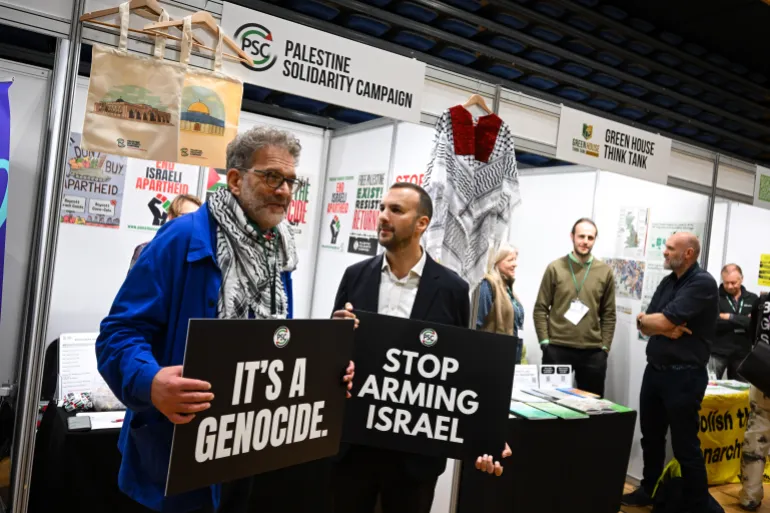
The Green Party’s motion, which called for “Palestinian liberation, the right of return, Boycott, Divestment and Sanctions (BDS), and a full arms embargo against Israel” was criticised by Jewish groups, other parties and most Green Party MPs.
After conceding defeat in the fiercely contested by-election, Polanski answered his critics, saying he would stay on as leader.
He was barred from entering Israel after his party backed a motion to define Zionism as racism.
The United Kingdom’s Green Party has voted to define Zionism as a form of racism, drawing condemnation from the Israeli government.
In a binding vote held at the party’s conference over the weekend, members voted to usher in the new definition as well as a series of other strongly pro-Palestine policies.
Recommended Stories
list of 4 itemsend of list
However, just as the resolution has drawn international criticism, it has also proved internally controversial with four of the party’s five members in parliament opposing it.
Israel on Monday banned party leader Zack Polanski from the country just a day before the politician faces a by-election as he runs in the London constituency that former Prime Minister Keir Starmer represented.
Zionism emerged as a political ideology in the late 19th century. It called for the creation of a Jewish homeland at a time of rising anti-Semitism and persecution of Jews in Europe. Theodore Herzl, an Austro-Hungarian journalist considered the father of political Zionism, originally proposed an independent and colonial Jewish state in either Palestine or Argentina.
Here’s what we know about what the Greens have said:
Green Party leader Zack Polanski, right, chats with Ben Jamal, director of the Palestine Solidarity Campaign, at the 2025 Green Party conference in Bournemouth, England [File: Getty Images]
What is the resolution?
The Greens endorsed the motion to equate Zionism with racism by a vote of 1,022 to 813.
In addition, the party restated its “commitment to Palestinian liberation” and called for the “establishment of a single democratic state throughout historic Palestine”.
The party also recommitted to its support of Palestinians’ right of return as well as to the Boycott, Divestment, Sanctions movement against Israel.
“The real, material, manifestation of Zionism has been the historic and ongoing dehumanisation, displacement, dispossession, disenfranchisement and destruction of Palestinians,” a Green Party statement said.
A significant number of party members, including four of its five MPs, were against parts of the resolution, exposing divisions within the party.
Codeputy leader Rachel Millward said in a post on X that while the party is committed to “stop the genocide”, the term Zionism means “different things to different people, … so I personally do not think the policy helps us do the work we all want to”.
Meanwhile, Polanski, who is Jewish and was away campaigning during the vote, told journalists afterwards that if Zionism equates to the displacement of Palestinians, “that is clearly racist.”
Polanski said he, however, did not support the reference to a single Palestinian state and external entities should not decide what a future state would look like.
How has Israel responded?
Israel has accused the party of legitimising “terrorism”, and senior officials equated it to anti-Semitism.
“The Greens have adopted not only the green of Hamas, but also its ideology: the elimination of the State of Israel through armed struggle,” the Israeli Ministry of Foreign Affairs wrote on social media.
Israeli President Isaac Herzog said it would “deliberately endanger Jews and Israelis everywhere”. Opposition leader Yair Lapid said the party was “racist”.
The Green Party has rejected equating criticism of Israel with anti-Semitism and reiterated its stance against “any form of discrimination or harassment”.
“We know there is no conflict between supporting the rights of Palestinians and the rights of Jewish people,” Polanski and other senior party members said in a statement on Sunday.
Has Zionism been equated to racism before?
Yes. In 1975, the UN General Assembly passed a resolution that “determines that Zionism is a form of racism and racial discrimination”.
The vote was sponsored by the Soviet bloc and the Arab League. It passed after 72 countries, largely from the Middle East and Africa, voted for it. Israel and 34 other countries – chiefly from the West – were against it. Thirty-two other countries abstained.
Just a year before, at the 1974 General Assembly, Palestinian leader Yasser Arafat had given his “olive branch” speech at the General Assembly.
About the same time, African countries opposing the apartheid regime in South Africa, which was increasingly allying with Israel, had resolved separately that the Israeli government was “racist” and both had an “imperialist origin.”
Also, in 1975, at the first international women’s conference, held in Mexico City, attendees decided there would be no international peace outside the “elimination of foreign occupation, Zionism, apartheid” and all other forms of “racial discrimination”.
However, the General Assembly vote proved controversial. Chaim Herzog, then-Israeli ambassador to the UN and later president, told the assembly in a speech that it was “based on hatred, falsehood and arrogance” and proceeded to rip up copies of the resolution in front of the audience.
The US too accused the UN of making “anti-Semitism international law”.
In December 1991, the US, under President George HW Bush, stepped up a campaign to revoke the resolution with Bush declaring at the UN that equating Zionism with racism “is to reject Israel itself” and to “challenge its right to exist”.
Israel also insisted it would not participate in the Madrid Peace Process to continue negotiations between Israel and Palestinian leaders if the resolution was not cancelled.
After much pressure from the US, an overwhelming majority of countries voted for its revocation – 111 to 25, including European and African countries.
Who else equates Zionism with racism?
Jewish Voice for Peace, the American anti-Zionist and pro-Palestinian advocacy group, has also named Zionism as a movement that creates a “racist hierarchy with European Jews at the top”.
In a February statement, the group reiterated its stance against what it called the “colonial ideology” of Zionism’s founders.
Similarly, in the United Kingdom, an employment tribunal in 2024 backed anti-Zionist activist and professor David Miller, who was earlier sacked from his post at the University of Bristol in 2021 for his views that the movement was “inherently racist”.
A Black police officer asked whether a monkey was named “Tyrone,” to the laughter of a roomful of Latino and Asian colleagues.
A Latina cop described how to inflict maximum pain: “You hit Black people in the liver — I heard they got weak livers,” she said, according to an LAPD internal affairs report.
The report said their boss, an Asian sergeant, stood by as his employees used terms like “midnight” and “chocolate, chocolate” to describe people’s skin tones.
Those were among the comments that came to light last year after an LAPD whistleblower secretly recorded his colleagues in a unit that screens police recruits.
The scandal, which has seen new developments in recent weeks, is forcing department officials to reckon with a harsh reality: Years of efforts to make the LAPD more diverse have seemingly done little to stamp out prejudice in the ranks.
For much of its history, the LAPD was a white man’s department. Aggressive tactics in communities of color fueled racial uprisings in the 1960s and early 1990s, when the beating of motorist Rodney King led to the discovery of messages similar to those in the recruitment unit tapes, with officers referring to Black men as “Buckwheat” and bragging about “busting heads.”
Under pressure from lawsuits and consent decrees, police leaders pushed to recruit more Black, Latino and Asian officers, seeking to build up trust in minority communities.
1
2
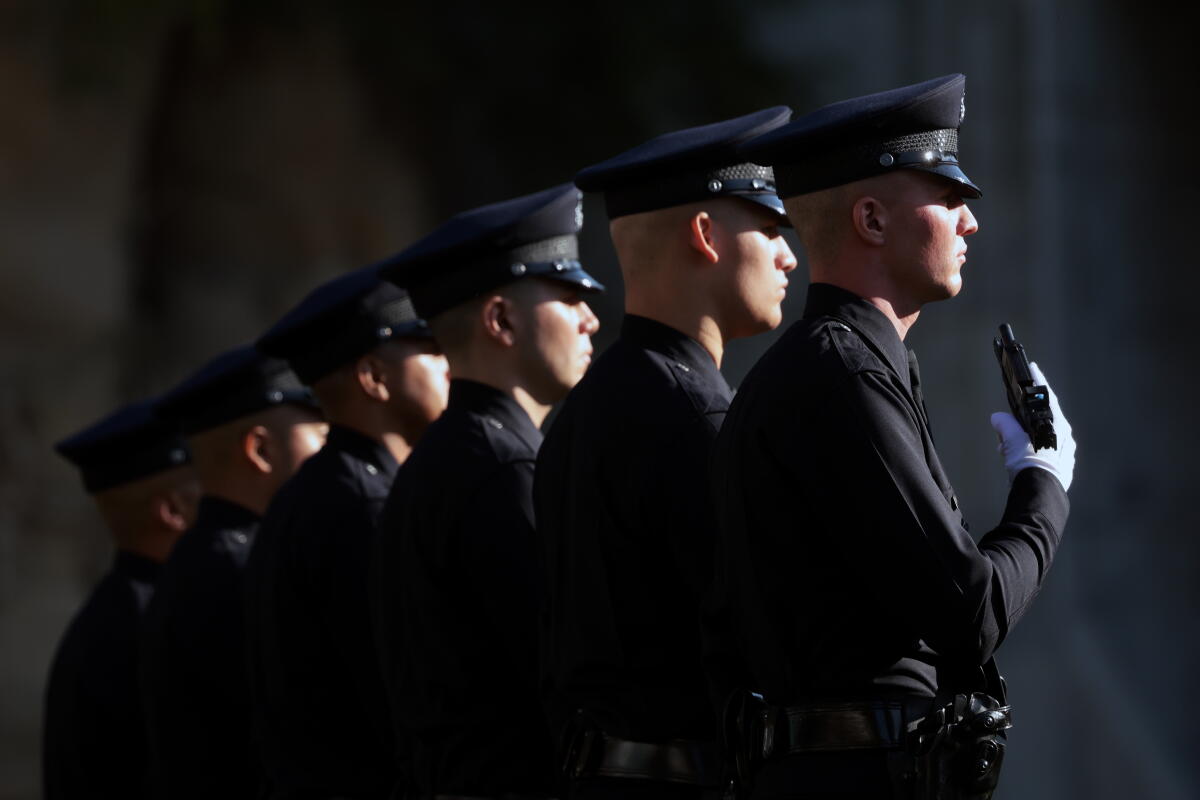
1.Los Angeles Police Department graduates a total of 22 recruits at the Los Angeles Police Academy in Elysian Park on Friday, September 18, 2026.2.(Christina House/Los Angeles Times)
Latinos now make up more than half of the 8,500-officer department. Black officers constitute less than 9% of the force, coinciding with a decline in the city’s Black population.
The officer who made the recruitment unit recordings, Daniel Flores, is Latino.
He recorded dozens of conversations over a six-month span in 2024, eventually handing them over to the department’s inspector general for investigation.
Last week, Flores filed a new lawsuit against the city, adding to a previous claim that alleged he faced retaliation from his bosses for documenting the offensive comments he heard while on the job.
According to his latest claim, department officials recommended that he be suspended for 22 days without pay. After initially seeking to keep his job with the LAPD, the 13-year department veteran said in the lawsuit that he recently decided to retire rather than endure an increasingly hostile work environment.
Flores also alleged LAPD officials were responsible for pushing a criminal case against him for violating a state eavesdropping law that prohibits recording conversations without consent. Initially alleging 16 felonies, Dist. Atty. Nathan Hochman has since reduced the charges to misdemeanors, likely allowing Flores to avoid jail time.
An LAPD spokesperson declined to answer questions about Flores’ case.
“The Department takes these allegations seriously,” Lt. Elpidio Orozco said in a statement. “Because the case and related personnel proceedings remain ongoing, we cannot discuss individual disciplinary actions or make comparisons to unrelated past incidents.”
The department’s defenders maintain that progress has been made toward rooting out bigotry.
Officers are required to undergo psychological screening and training aimed at teasing out unconscious biases. New recruits and seasoned officers alike take field trips to the Museum of Tolerance, where trainers extol the virtues of multiculturalism. The department has sent recruiters to historically Black colleges in the South and the East Coast.
But others, including civil rights attorney Connie Rice, say the latest scandal proves that the LAPD’s problems run deeper than the hateful actions of a few individuals.
The beating of Rodney King in 1991 forced a reckoning for the LAPD.
(George Holliday / Associated Press)
“Racism is like the herpes virus in the body of the LAPD: You can suppress it with a good chief, but as soon as they leave, it breaks out again,” Rice said.
A 2024 study by British researchers examined racial attitudes among members of the department’s vaunted Metropolitan Division.
The researchers found that LAPD officers were “shockingly defensive” when asked about systemic racism, taking a negative view of diversity hiring programs and insisting that left-leaning activists, elected officials and media outlets were stoking public outrage over racial profiling.
“The dismissive reactions … to a question on such an important issue highlight an unhealthy antagonism which prevents any organization from learning or developing its practice,” the researchers concluded. “It is a fundamental barrier that must be overcome.”
While hiring more officers from historically marginalized groups has long been pushed as a way to improve police practices and build trust in minority neighborhoods, studies have not necessarily borne that out, said Daniel Gascon, a sociology and criminology professor at the University of Massachusetts Boston.
“Just because there’s more numbers of a given sort in a department doesn’t mean it’s going to change automatically,” said Gascon, who has studied the LAPD’s relationship with Latino communities.
Since the start of the year, a review of recruit graduation announcements shows the department has hired just seven new Black officers. By contrast, roughly 80% of the 241 officers to graduate from the police academy over the last nine months have been Latino.
The growing Latino presence in the LAPD has been reflected in police use-of-force numbers.
A Times analysis of police shootings since 2016 found that of the roughly 150 people who have been shot dead by the LAPD across the city, at least 94 were Latino men. In 3 out of every 4 of those shootings, at least one of the officers who fired was also Latino, the analysis showed.
LAPD Officer Daniel Flores, left, listens as his attorney Alan Jackson speaks to reporters at the Superior Court building.
(Libor Jany / Los Angeles Times)
Despite the increased diversity, interviews with current and former LAPD members indicate deep divisions are reflected in the way that Black and Latino officers see the department’s racial issues. Most agreed to speak on the condition of anonymity due to fear of retaliation.
Several Black officers told The Times they still experience workplace hostility and racial dog whistles, such as fretting about the lowering of police recruit standards. The comments, they said, came from Black and Latino colleagues alike.
Too often, the Black officers said, Latinos who wear the uniform see themselves only as victims of discrimination, and not perpetrators.
Some Black officers said they avoid conversations about race entirely for fear of upsetting conservative colleagues — who feel emboldened by the divisive rhetoric coming from the White House.
The Latino officers who spoke to The Times said the department has for too long prioritized the promotion of Black members of the force to leadership roles while the representation of Latinos in the highest ranks has slipped.
Others argue that because society tends to lump Latinos of different backgrounds together, workplace discrimination against and within the community is often missed.
Officers from both groups said their race has been used against them when it comes to promotions. But both sides also say racism is a problem in society writ large, and not limited to the LAPD.
In a recent interview with The Times, Mayor Karen Bass said that although she is pleased that the department has increased the number of Latino officers to reflect the city’s demographics, its percentage of Black officers continues to dwindle as older African Americans are on the brink of retirement with very few young Black officers coming onto the job.
Bass, who was a young community organizer in South L.A. when the King beating happened, said it was foolhardy to believe that merely because the LAPD is more diverse, old problems cannot be repeated.
“Just because this happened 30 years ago and there are new policies that were put in place, that’s not enough,” she said in an interview with The Times. “You’ve gotta make sure that those policies are constantly updated.”
Times staff writers Andrea Flores and Richard Winton contributed to this report.
Hate speech against Indians, Bangladeshis and Pakistanis in the United States has risen sharply online, according to a report that traces the surge to US President Donald Trump’s immigration crackdown and rhetoric, economic anxiety, and the South Asian community’s growing visibility in US life.
The report, titled “The Rising Tide of Anti-South Asian Hate in the United States”, by the Center for the Study of Organized Hate (CSOH), published on Sunday, found that the monthly volume of hate towards South Asians in the US on the social media platform X rose 240 percent between January 2024 and June 2026, from 12,904 posts to 43,843.
Recommended Stories
list of 4 itemsend of list
Researchers identified more than 542,000 hateful posts on the platform between January 2025 and June 2026 alone towards people from South Asia living in the US, with five of the six highest-volume months falling at the end of that period.
The researchers used the United Nations definition of hate speech. They tracked recurring anti-South Asian slurs and narratives online, reviewing posts to exclude criticism that did not meet the UN threshold.
They found that nearly half of the hate posts on X accused South Asians of invading the US, stealing jobs or threatening the country demographically, while the derogatory slur “pajeet” and its variants showed up in 30 percent of hateful posts on X and 45 percent on fringe platforms.
Posts depicting South Asians as dirty or unhygienic grew by 171 percent on X, “the fastest of all narratives”.
The hate frequently collapsed South Asian ethnic and religious groups into one, with Indians, Pakistanis and Bangladeshis conflated with one another, and Hindus, Muslims, Sikhs and Christians also treated as a monolith.
So why now?
Racism against Indians, Bangladeshis and Pakistanis has a long history in the US, but researchers argue the current surge reflects a confluence of longstanding prejudices and new political and economic pressures.
The report points to the H-1B visa programme, which allows US employers to hire skilled foreign workers, as a major flashpoint. Indians account for more than 70 percent of H-1B visa holders, and researchers linked several spikes in anti-South Asian hate to political fights over the programme, such as when Trump imposed a $100,000 payment requirement on certain new H-1B petitions in September 2025.
“Such actions serve a powerful symbolic function, in the bargain reinforcing the hostility of Trump’s base toward South Asians,” said the report.
The report makes the same argument about the administration’s rhetoric, highlighting Trump’s speech at an AI summit in July 2025, in which he criticised US technology companies for outsourcing jobs to India, after which researchers saw a sharp spike in anti-South Asian rhetoric online.
As more recent examples, the report points to a since-deleted September 2026 Department of Homeland Security post titled “Transformers: Age of Deportations”, featuring a Sikh man identified as “Mr Singh” and telling him to “get off our roads”.
Days later, the Department of Education posted “Make College Football Great Again”, after Texas Republican Bo French had complained about the presence of South Asians at a University of Texas football game.
The report argues that such rhetoric reinforces the idea of South Asians as outsiders who “can never truly belong in the country”.
From ‘model minority’ to job thieves
Economic resentment is another factor, researchers wrote, with the success of some South Asians increasingly being weaponised against them.
Indian Americans once stereotyped as a “model minority” are now portrayed as “opportunists and cheats”, and South Asians are used more broadly as a scapegoat for anger over jobs and the economy.
This comes as South Asians have become increasingly visible in US politics, from former Vice President Kamala Harris and New York Mayor Zohran Mamdani to Vice President JD Vance’s wife, Usha Vance, and politician Vivek Ramaswamy. The report documents racist attacks against figures across party lines and highlights how, for example, Mamdani’s primary and mayoral victories triggered spikes in anti-South Asian and Islamophobic abuse.
Researchers say both trends are now also tied up with “anxieties on the part of the majority about loss of status”, and feed the “Great Replacement Theory”, a conspiracy about the white population in Western countries being replaced by an orchestrated takeover.
Social media has also turned those narratives into targeted harassment.
Researchers found X accounts doxxing South Asians accused of taking jobs or committing visa fraud, while influencers have confronted people at their homes and workplaces and posted the encounters online. Doxxing refers to exposing a person’s private details, such as their home address, online.
In one example, right-wing influencer Sara Gonzalez posted a video to more than half a million followers in which the report says she harassed a South Asian person she accused of exploiting the H-1B programme.
Meanwhile, generative AI has made that content even easier to produce, researchers say, depicting South Asians as “filthy and unclean, sexually predatory, culturally backward, or a demographic threat”.
While the report tracks hate largely through what is happening online, researchers write that online hate “does not exist in isolation from offline forms of hostility”. It cites a July incident in which an Indian Muslim mall employee in Utah was repeatedly stabbed in an attack that federal prosecutors charged as a hate crime. In September, a Sikh truck driver was stabbed 17 times at a Wyoming truck stop.
“Online and offline hate can reinforce one another”, the researchers wrote, “as narratives, stereotypes, and forms of demonization move between digital platforms, political discourse, media, and everyday life”.
Durban, South Africa – Bishop Raphael Bahebwa is in hiding, afraid he could be attacked for speaking out for the rights of foreigners in South Africa.
“I am in hiding now because they say they are going to kill me for speaking about the rights of foreigners,” he told Al Jazeera.
Bahebwa has lived in South Africa for 26 years, after arriving as a refugee from the Democratic Republic of the Congo (DRC).
In that time, he has watched antiforeigner sentiment flare repeatedly in the country he came to call home. But he says this year feels different.
A September 30 deadline declared by March and March, an anti-immigration movement that has led protests across South Africa this year, has renewed fears of violence among migrant communities.
The group has called for undocumented foreign nationals to leave South Africa and has warned of further demonstrations if its demands are not met.
For Bahebwa and other refugees in Durban, however, the distinction between documented and undocumented migrants offers little comfort. They say the hostility they experience on the streets rarely begins with a request to see their papers.
Fears of renewed violence
South Africa will hold local government elections on November 4, in a campaign in which migration has become an increasingly prominent political and social issue.
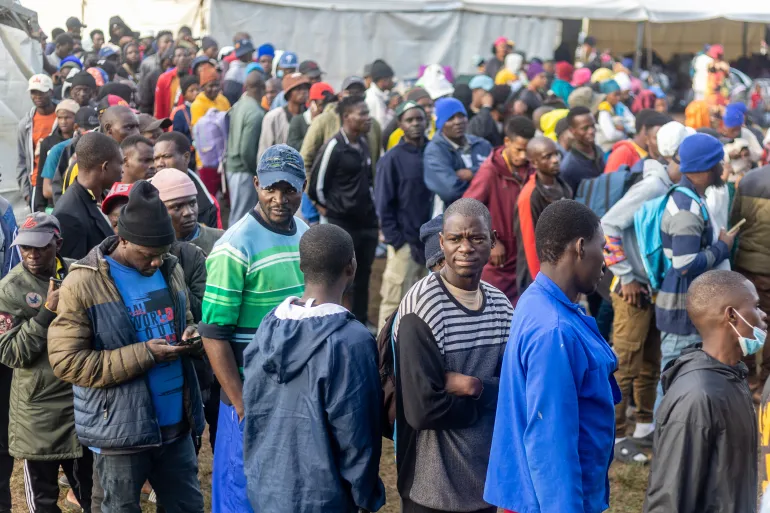
For months, Bahebwa was among hundreds of refugees and asylum seekers who slept on the pavement outside the Durban Refugee Reception Centre on Che Guevara Road.
Many were from the DRC and Burundi, with others from Uganda, Mozambique and Tanzania. They said they had fled their communities because they feared antiforeigner attacks.
They arrived outside the Department of Home Affairs (DHA) office seeking safety.
Instead, the pavement became their home.
For roughly four months, men, women and children slept outside, exposed to the elements and dependent on civil society organisations and volunteers for food and other necessities.
“It has been very tough,” Bahebwa said. “Never before have I experienced something like this.”
Some of the migrants told Al Jazeera that conditions became desperate. They described irregular access to food and medication and said one man who had tuberculosis died while living at the camp. Al Jazeera has not independently established the circumstances of his death.
The camp was also not far removed from the hostility its residents said they had fled.
On September 3, members of March and March confronted refugees and asylum seekers living outside the centre. Violence broke out, and police intervened. At least four people were reported injured.
At another protest days later, police officers stood between the two groups, forming a barrier as tensions rose.
March and March has described its mobilisation as a campaign against undocumented immigration, crime and deteriorating conditions in South African communities.
The group says the government’s response to immigration enforcement has been insufficient.
Its leaders have repeatedly rejected accusations that their campaign is xenophobic and insist their target is undocumented migration rather than foreign nationals generally.
Bahebwa said documented and undocumented migrants alike have been caught in the hostility.
Earlier this year, six refugees working in salons around Durban’s Warwick Street Market were beaten by men carrying sticks, according to public-interest news outlet GroundUp. Two were hospitalised.
Bahebwa said the migrants had also struggled to obtain help from the authorities after earlier attacks.
“Police said we can’t open cases because we are foreigners. We had nowhere to go,” he alleged. Police have not publicly responded to that specific allegation.
Nowhere obvious to return to
In mid-September, the government moved to clear the makeshift camp outside the refugee centre.
The refugees were given a choice: return to the communities they had fled or accept temporary accommodation at the Lindela facility in Gauteng, hundreds of kilometres from Durban. Lindela is a government-run immigration detention facility used to hold people facing deportation.
The choice divided them.
Malawi migrants to South Africa line up for supplies at an informal refugee camp in Sherwood, Durban, South Africa, after fleeing their homes amid fears of xenophobic attacks [File: EPA]
Some feared going to Lindela, a facility historically associated with immigration detention and repatriation. Others felt they could no longer endure life on the pavement.
On September 15, 274 people were transported by bus from Durban to Lindela. About 150 others chose to remain in Durban and began trying to find alternative accommodation.
For those who stayed behind, leaving the pavement did not resolve the problem that had brought them there in the first place.
Kafuti Muyumba, a small business owner from the DRC and a representative of the refugee community, said many were afraid to return to neighbourhoods where they had built businesses and lives.
People are afraid, he said. “Even the police allow March and March violence. They came with sticks and say we are attacking them,” Muyumba told Al Jazeera.
He said many refugees had lost their livelihoods during the months of upheaval and were now desperate to find accommodation.
“This is not the first time we are experiencing xenophobia,” he said. “In 2008 and then in 2015 we also experienced this.”
In 2008, xenophobic violence spread through townships and informal settlements, killing dozens and displacing thousands.
Further outbreaks of violence against foreign nationals followed in subsequent years.
For Muyumba, those memories make the rhetoric surrounding September 30 difficult to dismiss.
“We don’t trust the police. They are not being fair with us. Some of them are also saying we must go,” he said.
Police have said there are no plans to change their normal policing approach because of the September 30 deadline and that any protesters will be expected to remain within the law.
March and March said all it wants is for undocumented immigrants to leave the country and return home.
But Muyumba said returning to the DRC is not a viable alternative for many Congolese refugees.
“There is still war there,” he said.
A country tightening its borders
In response to ongoing protests, the South African government said it had intensified its immigration enforcement.
Between June 14 and August 20, authorities processed 86,596 foreign nationals for deportation and repatriation, according to the government’s Inter-Ministerial Committee on Migration.
Malawians made up the largest group, followed by Zimbabweans and Mozambicans.
Government data says 90 percent of those repatriated had entered South Africa illegally, while 95 percent were classified as having crossed the border outside official ports of entry.
The government says the operations form part of a broader effort to strengthen border management and enforce immigration law.
At the same time, officials have repeatedly warned private groups against taking immigration enforcement into their own hands.
March and March’s September 30 deadline has no legal authority. The government says common citizens cannot deport anyone from South Africa.
Protesters hold placards during an anti-immigration march in Durban, South Africa, calling for tighter border controls and the deportation of undocumented migrants [File: Thuli Dlamini/Reuters]
But deadlines do not need legal force to create fear, as was the case for an earlier deadline of June 30. For the refugees who spent months sleeping outside the DHA office in Durban, September 30 is another uncertainty layered on top of many others.
Some have been moved hundreds of kilometres away.
Others are trying to find new homes in the same communities they once fled. But among the migrants Al Jazeera spoke to, there is a shared anxiety that paperwork may offer limited protection when anger is directed first at being foreign.
Bahebwa has spent more than a quarter of a century in South Africa. For now, he says he is hiding and does not know what September 30 will bring.
“They are scapegoating us as foreigners,” he said. “It is not going to end on September 30. It has to do with the elections.”
Justice minister condemns ‘Hitler salutes, antisemitic slogans, violence’ at the anti-immigration rally.
Published On 19 Sep 202619 Sep 2026
Dutch riot police have intervened at a protest against immigration and asylum policies after about 500 far-right demonstrators pelted them with projectiles and fireworks .
Police used baton charges and dogs to break up the demonstration in The Hague on Saturday, reported the AFP news agency.
Recommended Stories
list of 4 itemsend of list
Local authorities said the demonstration was ended because of continued violence, and protesters were escorted away from Malieveld park in the city centre.
Police said they arrested 24 people and deployed water cannon to disperse the rioters. Further investigations were underway, they added.
Prime Minister Rob Jetten said on X that the demonstrators deliberately sought confrontation with the police and chanted “abhorrent” far-right and antisemitic slogans
Justice Minister David van Weel condemned the violent scenes and slogans.
“Identical images from the Malieveld. Hitler salutes, antisemitic slogans, violence against the police and throwing fireworks at the riot squad,” he posted on X. “It is important that hardline action is taken against this.”
He also thanked police officers for helping to maintain the democratic rule of law.
The “Wij zijn het volk” rally, which translates to “We are the people”, was organised to protest against government policies in the Netherlands’, specifically on immigration.
The protesters had planned to march through The Hague, but local authorities banned it when violence began and ordered the demonstration to be broken up.
The Prince’s flag with the symbol of the Dutch East India Company during the far-right demonstration in The Hague on Saturday [Nicolas Economou/Reuters]
Someone at the rally was seen giving a Hitler salute, while a truck serving as a stage displayed a screen reading “The Netherlands is for the Dutch,” according to the country’s largest national news agency, Algemeen Nederlands Persbureau (ANP).
Protester Thijs Jansen, a 31-year-old mechanic, told AFP: “We’re losing our country. We’re literally losing our country to mass migration”.
A police car was then set on fire in clashes between black-clad protesters and police, as the headquarters of the centrist D66 party were attacked. Its leader, Rob Jetten, is now prime minister.







![Protesters hold placards during an anti-immigration march in Durban, South Africa, calling for tighter border controls and the deportation of undocumented migrants [Thuli Dlamini/Reuters]](https://i0.wp.com/www.aljazeera.com/wp-content/uploads/2026/06/2025-11-07T155727Z_1005019881_RC2NRHA84QWK_RTRMADP_3_SAFRICA-PROTEST-1782784993.jpg?w=640&ssl=1)
