A judge in a Northern California county that has become a poster child for election skepticism has halted a voter-approved measure that would dramatically reshape elections there, including by eliminating most voting by mail and requiring ballots to be hand-counted.
Shasta County Superior Court Judge Benjamin L. Hanna on Friday issued a preliminary injunction that temporarily blocks Measure B, a citizens’ initiative approved by 56% of voters in the June primary.
None of the measure’s sweeping changes will be implemented for the November general election, and all active registered voters in Shasta County will receive ballots by mail, as mandated by state law, the county said in a statement.
California Atty. Gen. Rob Bonta and Secretary of State Shirley Weber, the state’s top elections official, sued Shasta County in mid-June, days after the primary, arguing that Measure B violates multiple state election laws and must be struck down before the November election.
The case initially was filed in California’s 3rd District Court of Appeal, but judges there declined to review it, saying the case first should proceed through the trial court.
In his ruling last week, Hanna wrote that he was halting implementation of Measure B while the case proceeds because allowing it to go into effect now “would likely result in the disenfranchisement of many Shasta County voters who would be clearly eligible to vote under state law, but would not meet the improperly narrow criteria to vote under Measure B.”
The measure, Hanna wrote, “seeks to create a whole new electoral system that would require creation of new voter rolls and re-registration of existing voters.” Doing so “would be “difficult under normal time frames, let alone three months before the November general election.”
Hanna cited the state’s “high likelihood” of success in the lawsuit.
Weber said in a statement that the judge’s decision “made clear what we already know — creating unnecessary barriers does not strengthen our democracy, it weakens it.”

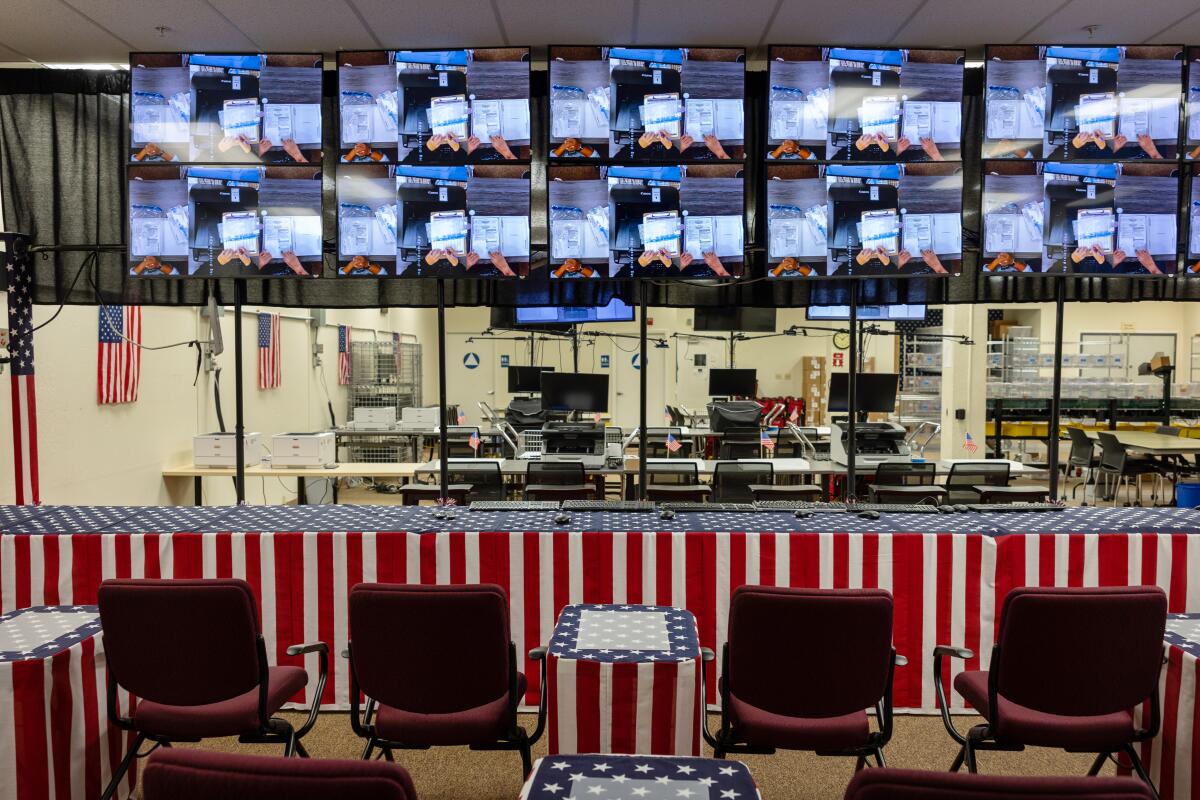
The new public observation room at the Shasta County elections office.
(Jason Armond / Los Angeles Times)
The Shasta Election Task Force, the citizens’ group that wrote the initiative and collected thousands of signatures to get it on the ballot, said in a statement that Measure B “was enacted by the voters” and that they do not believe the state has established a lawful basis for blocking it “merely because Sacramento objects to the election reforms they adopted.”
The fight over election integrity in mostly-rural, deeply conservative Shasta County comes as President Trump — who remains fixated on his 2020 election loss — is calling for the federal government to “nationalize” state-run elections and fighting to restrict voting by mail.
Measure B gained popularity amid Trump’s baseless claims of cheating. California’s anticipated but painfully slow vote count after the June primary — largely the result of the labor-intensive process for tallying millions of mailed ballots — only fueled such claims. But it also prompted Gov. Gavin Newsom and Democratic state lawmakers this summer to allocate $40 million to help counties speed up the process.
The citizens’ initiative approved in Shasta County would limit voting by mail, the method used by an overwhelming majority of Californians, to only “the infirm, military, and U.S. citizens living overseas.”
Measure B would require elections to be held in person on a single day and create a separate county voter registration system disconnected from the state’s uniform system. It also would require residents to present government-issued photo identification to cast a ballot (as would a statewide ballot measure that voters will decide upon in November).
The measure drew steep opposition from numerous civil and voting rights organizations — including the ACLU, the League of Women Voters, Disability Rights California, the Asian Law Caucus, and Asian Americans Advancing Justice Southern California — who said it would disenfranchise voters.
One prominent supporter of Measure B told The Times in May that he expected the county to be sued if voters approved it.
“We don’t like the state laws,” said Richard Gallardo, a leader of Save Shasta Elections. “We want to enact our own local election reform. … There’s a lot in there, so, yes, we do expect the state to sue us.”
Gallardo, an election integrity activist who once tried, unsuccessfully, to place all of the county supervisors under citizen’s arrest during the COVID-19 pandemic, is among the “real parties in interest” named in the state’s lawsuit. He said he believed the onus was on the county to “fully and fervently” defend Measure B in court because it’s “the will of the voters.”

Richard Gallardo, a leader of the citizens’ group that wrote Shasta County’s Measure B, is blocked by a guard in November 2022 after attempting to go into a restricted area to observe ballots at the elections office in Redding. At right is then-assistant county registrar Joanna Francescut.
(Mel Melcon / Los Angeles Times)
In recent years, the election skepticism movement bolstered by Trump has found a strong foothold in Shasta County.
In 2023, the Shasta County Board of Supervisors, swept up in unfounded election fraud allegations promoted by the president, ditched Dominion voting machines and opted to hand-count ballots for the county’s more than 110,000 registered voters — quickly prompting a new state law that banned them from doing so.
Last year, the supervisors appointed Clint Curtis — a Florida-based attorney whose claims about rigged voting machines stretch back to the early 2000s — to be the Shasta County registrar of voters, a position vacated by two previous registrars who resigned for health reasons, saying they were exacerbated by the stress of the job.
Curtis promptly eliminated nine of the vast county’s 13 ballot drop boxes. He accused his predecessors in the registrar’s office, without evidence, of stuffing ballots to sabotage conservative Republicans. And he called for federal authorities to raid his office and seize ballots.
Curtis — a vocal proponent of hand-counting ballots who has worked with MyPillow Chief Executive and pro-Trump conspiracy theorist Mike Lindell — advocated for Measure B and is named as a defendant in the state’s lawsuit.
He was voted out of office in June and will be replaced in January by Joanna Francescut, the former longtime assistant registrar, whom he fired.